
Occupy Philly and Independence Hall
Posted: November 30, 2011 Filed under: #Occupy and We are the 99 percent!, Banksters, Corporate Crime, corruption, Economy, financial institutions, income inequality, jobs, U.S. Economy, U.S. Politics, unemployment, voodoo economics | Tags: 2011: days of revolt, Financial Crisis, U.S. Economy, unemployment 16 CommentsBlack Friday, Philadelphia, Pa.
My first look at Occupy Philly was after a free ride on the 9:52 Media Local, The Santa Train. This was not by plan but a matter of sheer coincidence. I should have guessed;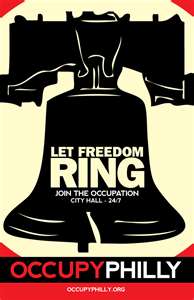 I was the only one standing on the Morton platform without a small child in tow. But shortly after boarding, it was all too clear. The elves came first, wailing Jingle Bells and Wish You a Merry Christmas. They were followed by out-of-season Mummers dressed in holiday garb, belting out another round of X-mas cheer, complete with accordion, banjo and sax. Mrs. Claus assured the children that Santa was busy, busy at the North Pole, making sure all their wishes [even though edited to economic realities] would come true. And then, there was the free candy and balloon animals.
The magic of childhood! Where we can believe everything and anything. When the world appears kind and right and true.
An out-of-stater now, I deliberately got off at Suburban Station, my old work stop. Also, the stop at which I’ve frequently disembarked to attend exhibits at the Franklin Institute, the Museum of Natural History or the Philadelphia Museum of Art, a brisk walk west up the Parkway, past the Rodin Museum and the soon-to-open home for the controversy-laden Barne’s collection.
But not today.
This morning I headed east, winding through the underground towards City Hall and the Occupy Philly encampment. Later, I would team up with a friend and hoof down to the historic district. But right now, I had a different historical event in mind.
I no sooner hit the outside doors than the vivid blue of plastic tarps and tent tops were visible. A strange sight. Normally, I would have walked through the West arch at City Hall, stood for a few moments googling at the city’s Christmas tree. But this year was different. So different.
The western entrance to the City Hall complex was barricaded. ‘For Restoration’ the signs said. No towering tree this year. Instead, the Occupy tents decorated Dilworth Plaza, a strange but fascinating sprawl of makeshift living quarters and standard issue camping gear. The area was quiet and still, the air crisp. I circled around the entire plaza. No sight of my friend, so I headed back towards the encampment, spotted the medical and information tents, as well as a petition table outlining the dangers of in-state fracking by over-zealous gas drilling companies.
At the Information Tent there was an array of literature on upcoming actions, the November issue of the Occupy Wall Street Journal and several people discussing Mayor Nutter’s deadline to dismantle the encampment within 48 hours. Two of the occupiers said almost in unison: ‘It was never about the tents.’
So what is it about? It’s a question I read constantly on the blogs and in newspapers, even hear from family and friends.
Here’s what I learned in the morning hours I spent on the Plaza:
- In the 53 days of Occupy Philly, 26,000 local citizens signed on expressing support.
- At the height of the encampment, City Hall was encircled with tents, sleeping bags and a variety of makeshift living accommodations.
- Active supporters numbered around 200-300, some living on-site, others coming in to protest, march and rally during the day.
- Local Unions support the effort. In fact, the Trades Union offered to assist the protestors in the original plan to move off Dilworth to an encampment across the street. The Union needs those ‘renovation’ jobs. That idea was scrapped because permits were denied.
- The area was clean. No needles, drug paraphernalia or trash scattered about as the MSM would have readers/viewers believe taints all encampments. Talking to several encampment members, I was told a goodly portion of each day is spent ‘cleaning up.’
- The encampment/protest was peaceful. There was a sense of community and the overriding sentiment was to voice anger and dissent over the widening income inequality in the US and the corporate capture of all facets of government.
- I heard no political posturing or Obama shilling. Simply stated, the system is broken for the 99%.
- Forty to fifty of the encampment members were homeless. They joined for the free food and the safety of numbers.
- The police presence, even on this Friday morning, was unusually large but basically stationed within the confines of the City Hall plaza.
- Though Mayor Nutter had leveled a 48-hour deadline, there was no sense of panic or great urgency the morning I arrived. I later learned that the majority of the encampment was dismantled voluntarily Sunday evening and the homeless were moved elsewhere for their own safety.
- This morning [Wednesday 11/30 at 1:20 am, according to the Associated Press], the Philly police department began tearing down the remaining tents.
But as the protesters I spoke with said: It was never about the tents. It has always been about visibility—the eyesore of inequality, injustice and corruption.
I left Dilworth Plaza, and then headed down to Independence Mall. A surreal juxtaposition. In a matter of a few blocks, my friend and I walked from the current protest to the historical marker of the Mother of All Protests. Philadelphia is the birthplace of the Declaration of Independence and the US Constitution. We strolled through the portrait gallery installed in the Second Bank of the United States and the faces of those earlier protesters, that grand collection of merchants and farmers, philosophers and scientists, lawyers and bankers stared back. What would they be thinking? I wondered.
We went on to Carpenter’s Hall, where Benjamin Franklin reportedly had secret meetings with like-minded citizens prior to the Revolution. Years later, on leaving the Constitutional Convention, a woman reportedly asked Franklin what sort of government he and the others had designed. Franklin’s terse reply: ‘A Republic, Ma’am. If you can keep it.’
Our final stop was Independence Hall, which was originally the Pennsylvania State House. This was where the Second Continental Congress met, the Declaration of Independence was adopted and where the Constitutional Convention met to draft, debate, and then sign the US Constitution in 1787.
We’re a long way from who and what we were in 1787. But Franklin’s words have a haunting edge to them: ‘A Republic, Ma’am. If you can keep it.’ Another quote that’s perhaps equally pertinent is:
‘We must hang together, gentleman, or assuredly we will all hang separately.’
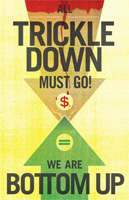 For me at least, this is what the Occupy Movement has been and is still about. In an age where corporations have been awarded the distinction of personhood, when free speech is equated to money and The Rule of Law is applied in an unjust and inequitable fashion then we, ordinary citizens, have a duty to support and join one another in protest. To hang together, if you will.
Oh, and that Tea Party, the real one in Boston that got everything rolling?
We all recall the ‘taxation without representation’ line from our school years, stemming from the passage of the Stamp Act in the 1760s and later the Tea Act in 1773. King George had debts to pay off—a Seven Year’s War among other things. And the East India Company’s tea pitched into the Boston Harbor? East India was basically provided a monopoly on tea shipped into the colonies. The company [and its aristocratic shareholders] were none too happy about their profits pinched and drowned in the harbor and helped push [lobby] the King to pass the Coercive Acts, aka The Intolerable Acts. The colonists were generally peeved at the British Parliament for taxing them without their consent and then adding insult to injury, giving the East India Co. a cushy, duty-free export to undercut colonial merchants. But they were beyond peeved when punitive measures were leveled. They demanded that Parliament end its corrupt economic policies with and stop the bailout of that era’s own TBTF East India Company.
Sound vaguely familiar? Whatever’s old is new again. Of course, no one age can be accurately compared to another. Context is everything. To quote Barbara Kingsolver from the November issue of The Occupy Wall Street Journal:
“Every system on earth has its limits. We have never been here before, not right here exactly, you and me together in the golden and gritty places all at once, on deadline, no fooling around this time, no longer walking politely around the dire colossus, the so-called American Way of consecrated corporate profits and crushed public compassion. There is another American Way. This is the right place, we found it. On State of Franklin, we yelled until our throats hurt that we were the 99% because that’s just it. We are.”
As I’ve said elsewhere, I support Occupy until I don’t. The ‘don’t’ for me is if the Movement becomes another co-opted arm of one corrupt political party or another. Our existing two-party system is thoroughly compromised; a shipload of bleach and scrub brushes couldn’t clean it up. I support Occupy because I hate the idea of leaving my kids and future grandbabies with a broken, twisted Republic, one dedicated to piranha-school profits, the amassing of criminal wealth by a callous, irresponsible few at the expense of the many. I support the Occupiers because of those sweet-faced kids on the Santa train; they deserve the best we have. But I also support what I saw on Dilworth Plaza because of what I saw and recalled inside Independence Hall, what we owe to all those who sacrificed and struggled, dreamed and achieved, lived, loved and died over the last 200+ years. We stand on the shoulders of so many.
That’s something we should never forget because our past, our history is no small thing. But our future, that other American Way? That’s all about what we do now.
Crony Capitalism and Damned Lies
Posted: November 28, 2011 Filed under: #Occupy and We are the 99 percent!, Corporate Crime, corruption, Economy | Tags: crank economic analysis, crony capitalism, right wing tropes 7 Comments I just had to point out a WSJ Op-Ed/article that is just one more example of how much the media has ceded facts to right wing tropes. It’s written by Arthur Brooks. It’s called “Fairness and the Occupy Movement”. Brooks tries to equivocate the rent seeking activities of rich and powerful interests like the war and finance industries and the existence of social safety net programs like food stamps. It is not difficult for me to understand there is no real connection between providing things to the poor that need programs to stay alive and handing stuff needlessly to rich industries to attain extraordinary profits from market protections, subsidies and out right federal largess. Why is it so difficult for the press and politicians to grok the difference?
Economists Jeffrey Sachs and Mark Thoma call shenanigans on Brooks’ pretzel logic and self-serving ignorance of facts. Of course, I’ve come to expect nothing less from the American Enterprise Institute and its researchers who suspend all kinds of data and theories for their highly paid propaganda. The Wall Street Journal is basically an arm of that enterprise. The problem is that these lies shape policy debates.
First, Sachs points out this is an absolutely disingenuous narrative.
Where Brooks goes wrong is his description of inequality and fairness. The Republican view, which he espouses, is to reduce taxes, cut government services, and let markets be the standard of fairness. Here Brooks is deceptive in his rendition of the facts.
First, Brooks downplays the extent of inequality that has been built up in thirty years of crony capitalism. He favorably writes that “every income quintile has seen a real increase in purchasing power of at least 18% over the past 30 years,” citing a recent study of the Congressional Budget Office (CBO). Yet the real point of the CBO report, which Brooks does not mention, is that the richest 1% enjoyed a staggering rise of 275%, while the poorest stumbled by with a meager 18% gain. Moreover, the CBO report takes the data only to 2007. By now, even those meager gains at the bottom have been mostly lost.
Second, Brooks fails to note that the situation for the poor will be drastically worse if federal transfer programs are cut as the Republican Party is urging. The poorest quintile depends on these federal programs to stay alive. If the poorest Americans had to survive without government support, their incomes would be slashed to disastrous levels.
The Republicans answer to crony capitalism is to slash government. Yet by this they mean mainly an attack on the remaining social programs. This is a kind of bait-and-switch strategy: rev up the anger against government corruption, and then kill the life-support programs of the poor and working class. Crony capitalism exists mainly in the big-ticket sectors of the economy — banking, oil, real estate, private health insurance, military contractors, and infrastructure — not in the essential but much smaller parts of the economy: malnutrition of poor children, lack of quality pre-school, insufficient job training, and inadequate student loan coverage.
Yes, crony capitalism should be confronted anywhere in the economy, yet cutting the life-support systems for the working class and poor won’t fix government, but instead would cripple the prospects of more than 100 million poor and near-poor Americans. To control crony capitalism, we need to direct our attention where it belongs: the wealth-support systems of the rich, not the life-support systems of the poor.
Sachs points out 5 egregious examples of crony capitalism. Mark Thoma goes even farther. He discusses how the Democrats have been sucked into the right wing agenda of twisted facts and ground shifting. Your guess is as good as mine as to how this has come about. I’m sure Dems like Ben Nelson support the agenda and could care less about the untrue narrative that supports wealth transfer and market manipulation for the uberrich. Others are likely captured because they want the wealth that comes with “serving the public” and they want to get re-elected. Political office appears to be the fast track to the 1 percent these days. Others probably think this is sincere negotiation or they get some side benefit to concession so they go along.
The hope for common ground where there is none can lead to Obama like one-sided concessionary behavior, and we have more than enough of that already. Yes, let’s find common ground where it exists, but let’s also be careful not to try to meet in the middle when the other side is pursuing a bait and switch strategy. The Republican goal of reducing the size of government through reductions in social programs is unwavering, and they will pursue any argument handy at the moment to bring this about. In recessions, they tell us tax cuts are needed to stimulate the economy, but the real goal is to cut funding for the government permanently. Once the taxes are reduced, they won’t agree to increase them again (unless it’s to protect their cronies, i.e. an increase in payroll taxes is fine so long as it prevents the increase in taxes on the wealthy needed to fund it). In normal times, we’re told tax cuts stimulate economic growth even though there’s not much evidence to support this claim. Presently, it’s the cronyism argument, and tomorrow it will be something else. The Republicans have their eyes on the ball, and the rules of the game are to be adjusted as necessary to allow them the best opportunity to take the ball across the goal line. Winning is all that matters. Fairness for both sides playing the game, etc. has nothing to do with it and we’d be wise to keep our eyes on the ball as well.
The other thing to note is that the location of common ground has shifted to the right from where it used to be. “Meet us in the middle” now means meeting on ground that would have been considered on the right not all that long ago. Democrats have already conceded too much in the ideological war, and there comes time when leaders in the party must take a stand and hold their ground. That time is long past.
What is clear to me is that there is very little left of what an economist would view as a free,efficient, functional market through out our economy. Economies of scale, information brokers, concentration of markets into the hands of very few corporations, tax subsidies, federal contracts handed to friends of politicians, advertising, imagined product diversity, insider information, and moral hazard have all dealt blows to efficient pricing, resource allocation, and resultant quantity produced. It’s terribly dishonest of people like Arthur Brooks to equivocate programs that exist to protect the weakest in the society from the predatory behavior of the most rich and powerful who destroy functioning markets to achieve extraordinary profits and market power.
I have no idea why any one takes these fake “think tanks” seriously except they put out propaganda to serve the interests of crony capitalism itself.. The Paul Ryan Budget Scam was an example of crank analysis coming from the Heritage Foundation. Their output plagues policy discussion. Their stuff wouldn’t be given the light of day in actual empirical or theoretical journals so they have to invent some institute just to look serious. How these guys can lie with such a straight face is beyond me. Also beyond me is the number of people that fall for the lies. But then, some gullible and clueless media outlet or one saying that they’ll print lies just to be perceived as fair or some journalist with an agenda runs with the story. Then, crank analysis achieves some critical mass of “serious”. By the time that damned lie gets fact checked, no one is paying attention any more. It’s no wonder that we are so f’d.
Political Cage Match: Professor versus Puffed-Up Congressman
Posted: November 25, 2011 Filed under: Congress, corruption, education, Environment, U.S. Politics | Tags: ANWR, Arctic National Wildlife Refuge, conservation, Douglas Brinkley, House Natural Resources Committee, oil drilling, Rep. Don Young (R-Alaska), Republicans 9 Comments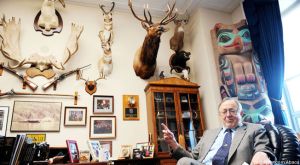
Rep. Don Young (R-Alaska)
Last Friday historian Douglas Brinkley testified before the House Natural Resources Committee on the topic of preserving the Arctic National Wildlife Refuge. The Republicans, of course, have been trying for years to open it up to oil drilling. Brinkley, whose latest book is The Quiet World: Saving Alaska’s Wilderness Kingdom, 1879-1960, argued that preserving one of the last truly wild places in the U.S. should trump helping the oil companies make more money.
Alaska Rep. Don Young (who had skipped most of the testimony) broke into Brinkley’s presentation, calling the historian by the wrong name and saying his testimony was “garbage.” Then the two had a hilarious shouting match. IMO, Brinkley came out the winner, but judge for yourself:
Young: If you ever want want to see an exercise in futility … That side has already made up its mind and this side has already made up its mind. I call it garbage, Dr. Rice, it comes from the mouth –
Brinkley: It’s Dr. Brinkley. Rice is a university – I know you went to Yuba [a community college] and you couldn’t graduate.
Young: Well, okay, I can call you anything I want if you sit in that chair. You just be quiet! You be quiet!
Brinkley: You don’t own me. I pay your salary.
Young: I don’t own you, but I can tell you right now—
Brinkley: I work for the private sector, you work for the taxpayer.
Next, committee chairman Doc Hastings interrupted and lectured Brinkley. But Young was still “pissed right now.”
Finally, Brinkley said he was surprised to
hear a congressman today say there’s nothing in his district. It’s boring. It’s flat. It’s not exciting. I don’t know a representative who doesn’t love their district. Every state in America’s landscape is beautiful if you love it. But some people love money more than their homeland or where they live, and I’m afraid that that’s why this fight has to keep coming up 50 years later, we’re still trying to tell people the Arctic refuge is real. It belongs to the American people.
On Friday evening, Brinkley appeared on The Ed Show on MSNBC to discuss his experience with Rep. Young.
A week later, the Congressional cage match is still causing controversy. At the Minnesota Post, Don Shelby, a friend of Brinkley’s wrote a column about the dust up.
Brinkley told me he knew that Congressman Young, at another hearing, had waved a walrus penis bone at Mollie Beattie, the incoming chief of the Fish and Wildlife Service. Brinkley may have read the Rolling Stone article about Young that quotes the congressman as saying, “Environmentalists are a self-centered bunch of waffle-stomping, Harvard-graduating, intellectual idiots.” The quote continues, “[They] are not Americans, never have been Americans and never will be Americans.” ….
Brinkley should not have been surprised that Congressman Young showed up late and missed the bulk of the historian’s testimony. Young is often cited as the congressman missing more votes than any other member of the House. Brinkley would have known that Young was the co-sponsor, with discredited Alaska Sen. Ted Stevens, of the bill to pay for the infamous “bridge to nowhere.”
Brinkley told me: “Everyone knows that Young is just a menacing blowhard. He has a history of being rude, he browbeats and he’s snotty toward anyone who cares about the environment.”
I asked Brinkley if he was surprised that Committee Chair Doc Hastings took Young’s side and continued lecturing the historian. “No,” said Brinkley. “They are tied together at the hip. They are both oil company factotums. They are a tag team.”
Young claims that Brinkley is just milking the incident to sell books. Brinkley told a Houston TV station
that his students applauded when he walked into class. “I have received now hundreds and hundreds of emails from people all over, I’ve not received one negative one,” he said. “I’ve had my entire Rice University and including Texas conservatives cheering me on for standing up to his bullying tactics.”
I’m not usually much of a fan of Brinkley’s, but I have to applaud him on this one. I don’t care if he’s doing it to sell books. Greedy, incompetent politicians like Don Young need to be revealed for what they are: pigs at the trough.
“Occupy Congress?” Now You’re Talking!
Posted: November 18, 2011 Filed under: #Occupy and We are the 99 percent!, Congress, corruption, jobs, U.S. Economy, U.S. Politics, unemployment | Tags: Barack Obama, Greg Sargent, jobs, Occupy Congress, occupy Wall Street, unemployment 13 Comments
According to Greg Sargent, labor and progressive organizations are forming a coalition to “Occupy Congress.”
The coalition — which includes unions like SEIU and CWA and groups like the Center for Community Change — is currently working on a plan to bus thousands of protesters from across the country to Washington, where they will congregate around the Capitol from December 5-9, SEIU president Mary Kay Henry tells me in an interview.
“Thousands of people have signed up to come to Capitol Hill during the first week in December,” Henry says, adding that protesters are invited to make their way to Washington on their own, too. “We’re figuring out buses and transportation now.”
One idea under consideration — pending various permitting and other logistical issues — is to have a series of tents set up on the lawn outside the Capitol, each representing a state, with the number of unemployed in each state prominently displayed. But the optics are still being worked out.
The demands they are talking about aren’t very radical though. They’re planning to pressure Republicans to go along with Obama’s jobs proposal. As Sargent points out, that doesn’t really jibe with the nature of the Occupy movement, which rejects both corporate political parties. But Henry argues that
Occupy Wall Street had created a “framework” — which she described as “we are the 99 percent” — within which such activities would fit comfortably.
“The reason we’re targeting Republicans is because this is about jobs,” she said. “The Republicans’ insistence that no revenue can be put on the table is the reason we’re not creating jobs in this country. We want to draw a stark contrast between a party that wants to scapegoat immigrants, attack public workers, and protect the rich, versus a president who has been saying he wants America to get back to work and that everybody should pay their fair share.”
It’s a start, and the SEIU may not be able to control the message if lots of people with more creative ideas show up to the protests.
In line with the influence of the Occupy actions on the mainstream types, I clicked on a Google news link to the conservative Washington Times that read “Occupy Wall Street: What should be done with the protesters?” I expected to find a screed encouraging law enforcement to crush the protesters. Imagine my surprise when I read this instead:
As irritating or disruptive as some may find the Occupiers, they are the conscience of America, like it or not. Their very physical presence is a reminder that the decline of America happened not because they didn’t believe in the American dream, but because the greed of Wall Street and the banks stole that dream.
Yet our government continues to reward the top 1% with corporate welfare and the lowest taxes in more than 50 years. And Congress, which made that largesse to the wealthy possible, is in the pockets of those very same people and their lobbyists.
Yes, the protesters are predominately young, unemployed, maybe even scruffy, and, yes, the homeless have found a haven and free meals with them, and, yes, the Occupiers’ persistence after more than two months is like a mote in our eye, reminding us all that we can no longer do business as usual.
The fact that OWS sites have sprung up across the country and now the world has prompted us to face ourselves. We can no longer ignore the joblessness and poverty that scars our great country. It is not an abstract concept, some numbers on a bean counters’ balance sheet. It’s real. It’s people. It’s your kids and mine. It’s returning vets who find themselves on the scrap heap of our economy.
Holy sh&t! Can you believe it? Could it be that change is really happening?
The Marvel of Coincidence, Part Deux
Posted: November 17, 2011 Filed under: #Occupy and We are the 99 percent!, Banksters, corruption, cyber security, Economy, financial institutions, Media, net-neutrality, Regulation, the internet | Tags: 2011: days of revolt, coincidence, Financial Crisis, U.S. Economy 15 Comments
My, oh my! There is a deluge of coincidence, enough to turn tinfoil hats into swanky silk toppers.
First we had the mind-boggling convergence of right-thinking PD departments from cities across the country, all deciding within the last 4 days to crackdown on the Occupy Wall Street protests. At least that was the ‘official’ story until Oakland’s Mayor, the rather infamous Jean Quan blurted out during a BBC interview that she had been on a conference call with 18 American city mayors, discussing the ongoing Occupy Movement.
Not to be outdone by Mayor Quan, a Homeland Security official had his own ‘blurt/burp’ moment, disclosing that the FBI and the Homeland Security Department had been discussing how to ‘handle’ OWS.
And just so US citizens can truly marvel at the strange alignment of the stars, we have this extraordinary comment made by Chuck Wexler, director of the Police Executive Research Forum, a national police group.
“It was completely spontaneous.”
The ‘it’ in that statement would be riot police sweeping the encampments in Portland, Denver, Oakland and NYC, etc. for health and security reasons. I suppose we can assume that the ‘middle of the night/early morning’ phalanx strategy of surround and secure was also a spontaneous, creative leap by law enforcement or perhaps a coast-to-coast mind-reading experiment.
However, Mayor Bloomberg in NYC must be credited with additional points for creativity. After all his passionate I-Love-the–First-Amendment declarations and as a media mogul himself [12th richest person in the country], he coincidentally declared a media blackout. Meaning? There would no [or very few] unattractive images of protestors being rousted, cell phones confiscated and/or reports of a CBS helicopter prevented from taking aerial film footage. According the Washington Post Partisan blog:
Most disturbingly, the NYPD sought to block any and all press from covering this eviction. On the ground, reporters were stopped at the barricades and refused entrance. Numerous journalists reported that cops refused to let then in, even pushing reporters away; reporters even Tweeted about getting arrested. In the air, NYPD helicopters refused to allow CBS News helicopters to film the eviction from above. As for the camera already in the park–OWS’s livestream–the police simply blocked it with a pile of torn-up tents.
But Keith Olbermann in his inimitable fashion had a few choice words for Mayor Bloomberg. If you haven’t seen this, sit back and enjoy. It’s entertaining.
But there’s more! Even with the blackout, even with reporters rounded and roughed up, the New York Times managed to describe the events in startling detail and had photos of the NYPD grouping at the South Street Seaport. Which has led some to ask: What’s the deal between the Mayor, the NYPD and the Gray Lady? Another coincidence? May the stars fall from the sky.
Finally, not to be repetitious but . . . the Internet Protection Bill and the evolving, expanding piece of legislation [HR 3261] Stop Online Piracy [SOPA] is chugging along brilliantly. Think of the ramifications. A copyright bill that would place wide, blunt controls on the Internet, our remaining set of eyes on the world, quietly wends its way through Congress at the precise moment that media blackouts are sanctioned for reasons of security. Turns out I’m not the only one who finds this legislative creation and its Senate counterpart [S.968] more than a little suspicious.
Trojan Horse, anyone? Or Coincidence Heaven?
Barnum was born way before his time.

 peej
peej Carissa
 bostonboomer
 dakinikat
 ecocatwoman
 mablue2
 Mama Lopez
 peggysue22
 quixote
 skydancingguestblogger
 Mona (aka Wonk the Vote)



 Sky Dancing
Recent Comments