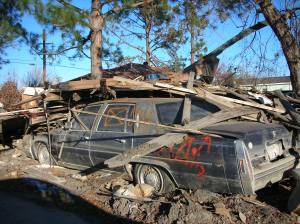
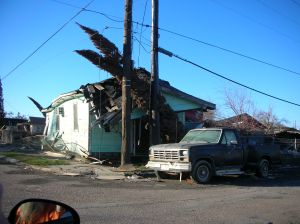
It’s difficult to explain how much one date could traumatize and change an entire American city but today is one of those days. 17 years ago, the levees topped after Hurricane Katrina directly hit the city. It’s still very hard for me to look at these pictures of the devastation my youngest daughter took in the Lower 9–across the canal from me–on the Thanksgiving weekend following Katrina. They were still pulling dead bodies from the debris at that time.
This top picture shows one of the few houses that didn’t collapse with its Katrina cross, indicating someone had died in that home. I watched all of this on CNN from the safety of a pink futon on the floor with my two yellow labs and Miles the Wondercat from a motel in St. Charles, LA that would later be devastated by Hurricane Rita.
My house sat high and dry on the high ground with a nearly new roof and some minor wind damage. The following six months were an experience of camping out in your own home with minimal electricity and chasing around to find working gas stations and open grocery stores. I also made a daily pilgrimage to the Red Cross station in the Quarter to pick up cleaning supplies and food. I really experienced survivor guilt too. Something I hadn’t had since I wound up being the only person known to survive the rare type of cancer I had five years before that. That was definitely not an enjoyable emotional experience either.
I’m also reminded of Hurricane Ida last year, which disrupted my life and significantly impacted my house. However, now, my insurance company wised up, gave me a $10k deductible, and basically told me I was on my own. Thankfully, I got a FEMA grant.
Teacher of the year and Katrina Survivor Chris Dier has a tremendous long thread on the federal mishaps that led to our devastation and the crony capitalism that has crippled us since then.
In 1965, the Army Corps of Engineers built the Mississippi River Gulf Outlet (MRGO), a canal to expedite oil shipping to the Gulf of Mexico. During Katrina, the MRGO channeled the storm’s surge and led to the engineering failures experienced by the region’s protection network. pic.twitter.com/cMT3H6wv8Z
Diel lived in extremely hard-hit St. Bernard Parish, with most houses and infrastructure destroyed. He was 17 at the time. He’s chosen a series of articles to orchestrate the steps that have led us to where we are today, which is not fully recovered or whole. It’s also left us, victims, to charter schools and AirBNBs.
Today, I’m here to remind you that climate change is real and has already had devasting impacts all over our sweet mother earth and ecosystems and the life it supports. Failure to deal with it is a failure of global governance.
Human-driven climate change has set in motion massive ice losses in Greenland that couldn’t be halted even if the world stopped emitting greenhouse gases today, according to a new study published Monday.
The findings in Nature Climate Change project that it is now inevitable that 3.3 percent of the Greenland ice sheet will melt — equal to 110 trilliontons of ice,the researchers said. That will trigger nearly a foot of global sea-level rise.
The predictions are more dire than other forecasts, though they use different assumptions.While the study did not specify a time frame for the melting and sea-level rise, the authors suggestedmuch of it can play out between now and the year 2100.
“The point is, we need to plan for that ice as if it weren’t on the ice sheet in the near future, within a century or so,” William Colgan, a study co-author who studies the ice sheet from its surfacewith his colleaguesat the Geological Survey of Denmark and Greenland, said in a video interview.
A year after Hurricane Ida brought eight to 15 feet of floodwater to Plaquemines Parish—a coastal parish in Southeast Louisiana—historic Black communities Ironton and West Point a la Hache are still fighting for a just recovery. Slow-moving action from federal agencies like HUD and FEMA, a massive shortage in affordable housing, and inadequate flood protection have left residents facing a difficult decision: leave behind neighbors, traditional lifeways, and ancestral lands to migrate in search of housing, or fight to rebuild, elevate homes and make the coast more resilient to intense storms.
I’ve been working as an organizer in Plaquemines Parish since 2020, starting with a successful campaign to stop an oil terminal from excavating a cemetery where enslaved people were laid to rest. I continue to support residents in their efforts to rebuild after Ida and advocate for stronger flood protection. Recently, I spoke with several residents to hear about their experience with recovery from the storm. A year since Ida’s landfall, nearly all of my friends in Plaquemines Parish have yet to return home.
Ironton residents have hung signs throughout their community to let Plaquemines Parish know they intend to come back and rebuild.
The Biden Administration and Democratic Congress have made meager but credible steps toward alleviating Climate Change devastation. But will it be enough for Democrats to hold on and improve their position in Congress to continue the fight?
About a week after President Biden signed into law the largest climate bill in U.S. history, Sen. Catherine Cortez Masto (D-Nev.) laid out to voters here how she helped get $4 billion in the bill to combat the acute drought now punishing the American West. Outside the air-conditioned offices of the Las Vegas Valley Water District where she spoke, the temperature stood at 93 degrees — on its way to an oppressive 106 later that day.
“As you all know, the western U.S. continues to face a historic drought, and we need to do all we can to combat it,” Cortez Masto said Monday, standing before a photo showing the nation’s largest reservoir, Lake Mead, atrecord lows. “That’s why I have been championing measures to help Southern Nevada further conserve, recycle and reduce water use.”
Cortez Masto — one of the most vulnerable Democratic senators up for reelection this year — has spent recent weeks courting Nevada voters who want leaders in Washington to prioritize the climate crisis. Yet climate change has rarelydecided the outcome in congressional races, even in Las Vegas, the nation’s second-fastest warming cityin a region experiencing themost extreme drought in 1,200 years.
Voters across the country have consistently rankedthe economy and health care as a higher priority than global warming. And if Democrats cannot successfully sell their environmental agenda in Nevada, which has seen a cascade of climate disasters this summer, it’s unclear whether climate concerns will ever become paramount in key national races.
Don’t call it a ‘drought’: Climate scientist Brad Udall views Colorado River crisis as the beginning of aridification https://t.co/PIGR8Y3VDh via @MtnWestNews
Warning of doom: ‘Hunger stones’ surface in drought-stricken waters
Any part of the country served by the waters of the Colorado River is bound to be uninhabitable sooner than later. The Deserts and Coasts of our country are rapidly becoming places where life cannot be sustained.
The generous monsoon season along the Upper Basin of the Colorado River has been a relief to those who remember recent summers suffocated by wildfire smoke in the American West. But according to Brad Udall, senior water and climate research scientist at the Colorado Water Institute and director of the Western Water Assessment at Colorado State University, the relief we’re feeling now is a sign of bigger problems for years to come.
“Next year’s runoff will be really interesting to see what happens, it will be a test of this theory of depleted soil moisture,” Udall told a packed room at the Betty Ford Alpine Gardens Education Center on Aug. 19. The theory he referenced examines how the recent precipitation affects the trending drought conditions, drying reservoirs and the lowering state of the Colorado River, which is the primary source of water for over 40 million people spread across seven Western states, over thirty Native American tribes and into Mexico.
Udall’s relationship with the Colorado River goes deeper than just the focus of his studies. He grew up along its banks and worked as a river guide in his earlier years. He also comes from a long lineage of family members who have been influential in the river’s management for more than a century. His father, former congressman Mo Udall, fought to channel river water to Arizona. His uncle, Stewart Udall, was the former Secretary of the Interior who opened the Glen Canyon Dam. And his great great grandfather, John D. Lee, established Lees Ferry in Arizona. “Udalls are, in fact, Lees,” he told the crowd.
With a litany of charts, peer-reviewed studies and side-by-side chronological photographs of depleting reservoirs, Udall’s presentation, titled, “Colorado River Crisis: A Collision of 19th Century Water Law, 20tth Century Infrastructure and a 21st Century Population Growth and Climate Change,” broke down the intricacies of the compact that draws the water rights between these states, while establishing the environmental agitators that have formed, and grown, since the compact was agreed upon in 1922.
Merriam-Webster defines “drought” as “a period of dryness especially when prolonged.” According to Udall, we are beyond treating the Colorado River crisis as something that will soon pass, or ever will.
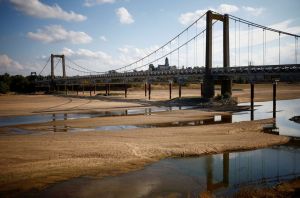
People walk near a bank of the Loire River as historical drought hits France, in Loireauxence, France, August 16, 2022. REUTERS/Stephane Mahe
Carvings in boulders that were used to record historic droughts are resurfacing in waterways across drought-stricken Europe.
Ancient ominous warnings carved on usually submerged boulders along the Elbe River had for centuries driven fear into the hearts of Czechs, but their reappearance during this year’s drought is just a reminder of how tough people had it.
The stones can only be seen above the water surface during droughts and are used to presage bad harvests, interrupted river navigation and consequent famine. Now, the messages appear weeks after weather and crop forecasts.
Such a stone on the banks of the Elbe River, which starts in the Czech Republic, and ends in Germany dates back to 1616. The boulder was inscribed with “Wenn du mich seest, dann weine” – “If you see me, then weep,” according to a Google translation.
A view shows a branch of the Loire River as an historical drought hits France, in Loireauxence, France, August 16, 2022. REUTERS/Stephane Mahe
France’s river Loire, famous for the hundreds of castles gracing its shores, is a shallow river at the best of times, but this year even its flat-bottom tourist barges can barely navigate waters greatly reduced by a record drought.
Even some 100 kilometers from where the Loire empties into the Atlantic Ocean, sand banks now stretch as far as the eye can see, large islands connect to the shore and in places people can practically walk from one side of the river to the other.
This is not normal. The nations in Africa address Climate Change today in a conference in Gabon.
"Come and join us in Libreville & help us find African solutions to this global #ClimateChange challenge."
1 day ahead of #AfricaClimateWeek, Gabonese Minister of Forests, Oceans, Environment & Climate Change @LeeWhiteCBEO explains the key topics for the regional climate event. pic.twitter.com/bNXoTSbguI
Lagniappe: never forget that Katrina was also a catastrophe wreaked by climate change. Please sign this petition to ask Biden and Congress to do more to act against climate change to prevent these disasters in the future. https://t.co/Ri29HSRmbU
One of the things that I’ve been very worried about is the continual disconnect between the performance of the equities market and what’s going on in the bond markets. This is usual a symptom of what we call “animal spirits” and often a sign that a crash is imminent on Wall Street.
Bond investors and those concentrated in Equities have very different priorities. Bonds are usually safe and liquid assets while Equities are risky. Their prices can be volatile. Here’s something I read about a week ago as a lead up to something I read this morning.
Are stocks and U.S. Treasurys sending mixed signals? Treasury prices have rebounded since Donald Trump’s presidential inauguration in January, pushing down yields, as stocks continue to ascend record heights. That’s in contrast with the bond market rout that followed the November election.
Why is a simultaneous rally a problem? Some investors see it as a sign that investors are losing faith in the so-called Trump trade, in which investors bet on aggressive fiscal stimulus and other growth-friendly measures from the new administration.
Much of the boom in equities has been due to speculation that deregulation and expansive fiscal policy favorable to private businesses may fuel business profits. None of this has come to fruition yet so it’s basically speculative. The economy is healthy and growing strong at the moment but is it enough to support the increased levels seen in the stock markets? Is it real and sustainable?
Historical patterns suggest that it’s not and we may be looking at a future crash which would not bode well for any one who is or soon to be reliant on 401ks. This is when I’m happy about my small but very stable pension coming in monthly. I’ve lived through way too many bubbles now and seen my 401k bounce around like a jumping bean. My Uncle was one of the pioneer gnomes of the chartist movement after Black Friday. I loved to see his huge charts that frequently blanketed the tables of his Kansas City mansion. It could be why I ended up doing something similar.
It’s already been a big year for the Dow industrials, which have stretched a near-decade-long bull market to historic heights.
But if the technical stars collide, as one chartist predicts, the blue-chip gauge could soon plunge by more than 6,000 points to 14,800. That’s nearly 30% lower, based on Friday’s close.
Sandy Jadeja, chief market strategist at Master Trading Strategies, claims several predicted stock market crashes to his name — all of them called days, or even weeks, in advance. (He told CNBC viewers, for example, that the August 2015 “Flash Crash” was coming 18 days before it hit.) He’s also made prescient calls on gold and crude oil.
And he’s extremely concerned about what this year could bring for investors. “The timeline is rapidly approaching” for the next potential Dow meltdown, said Jadeja, who shares his techniques via workshops and seminars. Timelines are at the heart of his predictions, which he bases on repeating cycles in the market that are connected to specific times.
“People need to look for three things,” Jadeja told MarketWatch in a late-January interview and follow-up conversations. “Price, pattern, and … time. You can get the price pattern wrong, but if you get in at the right time, the other two don’t matter.”
He sees 2017 as littered with pitfalls for the Dow DJIA, -0.18% . Below is his so-called “timelines” chart of the stock index, defined by green horizontal lines. He’s currently on the lookout for the benchmark to approach that upper green line, which represents a range of 21,800 to 22,000.
It was never a secret that Republicans would take a risk by repealing Obamacare, as unpopular as it was, and taking ownership of what happens next. But it’s striking just how many political dangers they’re putting themselves in — and how they’re ignoring pretty much all of them. Democratic operatives are already testing which ones resonate the most in swing districts, I’m told.
Here are the one to watch:
Coverage losses. They’ve already dismissed the idea that they should worry about it, because they won’t be requiring people to buy coverage anymore. “There’s no way we can compete” with a government mandate, House Speaker Paul Ryan said on CBS’s “Face the Nation” yesterday. But if the Congressional Budget Office estimates that people will lose coverage, that’s going to be the headline for days, because …
“We’re going to have insurance for everybody.” That’s what President Trump told the Washington Post in January. He’s since fallen in line with the mainstream Republican position that they should guarantee access, not coverage. But that quote is not going to disappear.
Pre-existing conditions. Republicans insist they’re going to keep covering them, but Democrats are going to keep stoking fears that they’ll either lose coverage or have to pay more — especially with the 30 percent penalty for people who don’t keep themselves insured.
The “age tax.” AARP is going to be hammering them for allowing insurers to charge older customers five times as much as young adults, compared to three times as much under Obamacare. Republicans can try to dismiss AARP, but they do have a lot of power.
“Nobody will be worse off financially.” That’s what Health and Human Services secretary Tom Price said on NBC’s “Meet the Press” yesterday. His point was that people will be able to buy cheaper health plans if they have more choices than the standard Obamacare ones — but it won’t be hard for Democrats to find people who are worse off.
Medicaid. Ryan insists that the switch to per-person funding limits would be a major entitlement reform that conservatives have wanted for decades — but the reality is that millions of people have gained coverage through Obamacare’s Medicaid expansion, which is why Republicans are divided over when it should end.
The “giveaways to millionaires.” Democrats are already hitting the decision to get rid of a tax deductibility limitin the law — giving a tax break to insurance executives making more than $500,000 a year. That could be a hard one to explain to populist Trump supporters.
Deductibles. The sky-high deductibles under many Obamacare plans has been a standard GOP criticism of the law — but wait until people find out that the health savings accounts they’re promoting are tied to health plans that have the same thing.
Trump has made it clear that his budget will eliminate a significant part of the Federal workforce. This is a really really recessionary move. The states of Kansas and Louisiana have done this and its created significant economic distress in both places. Plus, it’s created a distinct lack of service and action in crucial public services. For example, the state of Louisiana cannot train as many doctors and provide as many residents to hospitals. That’s not good at all.
President Trump’s budget proposal this week would shake the federal government to its core if enacted, culling back numerous programs and expediting a historic contraction of the federal workforce.
This would be the first time the government has executed cuts of this magnitude — and all at once — since the drawdown following World War II, economists and budget analysts said.
The spending budget Trump is set to release Thursday will offer the clearest snapshot of his vision for the size and role of government. Aides say that the president sees a new Washington emerging from the budget process, one that prioritizes the military and homeland security while slashing many other areas, including housing, foreign assistance, environmental programs, public broadcasting and research. Simply put, government would be smaller and less involved in regulating life in America, with private companies and states playing a much bigger role.
A company owned by the family of Jared Kushner, President Donald Trump’s son-in-law and senior adviser, stands to receive more than $400 million from a prominent Chinese company that is investing in the Kushners’ marquee Manhattan office tower at 666 Fifth Ave.
The planned $4-billion transaction includes terms that some real estate experts consider unusually favorable for the Kushners. It provides them with both a sizable cash payout from Anbang Insurance Group for a property that has struggled financially and an equity stake in a new partnership.
The details of the agreement, which is being circulated to attract additional investors, were shared with Bloomberg. It would make business partners of Kushner Cos. and Anbang, whose murky links to the Chinese power structure have raised national security concerns over its U.S. investments. In the process, an existing mortgage owed by the Kushners will be slashed to about a fifth of its current amount.
The document offers a rare look at a major deal by a close Trump associate and family member. It’s unclear whether the deal could prompt federal review, as occurred when Anbang bought other properties, like the Waldorf Astoria Hotel in Manhattan. Anbang could also face review by the Chinese government, which has been clamping down on overseas investments and which has a range of pending issues with the Trump administration.
Rep. Adam Schiff (D-CA), Ranking Member of the House Intelligence Committee, exposed Donald Trump’s claims about his so-called “Winter White House” today, pointing out that Mar-a-Lago is not a winter white house but a private for-profit business, with all the ethical and security problems that entails …
As Schiff says, Mar-a-Lago is “one ethical quagmire” out of many in the Trump empire. He is right when he points out that Trump is a “walking, talking violation of the Emoluments Clause” and has been since Day 1 of his administration.
There is no question that Trump’s business interests will not always align with American interests or with National Security needs (and forget for a moment the security risk his holding court in public places poses).
Donald Trump has shown Americans and the world that he cannot be trusted to place what’s best for America above his own interests. This is a basic problem of corporations, which see not the public good but their bottom line as what matters.
Democratic Sen. Bob Casey asked a government ethics office Monday to assess whether President Donald Trump’s business dealings make his administration vulnerable to conflicts of interest.
“President Trump has exposed his administration to possible conflicts of interest on an unprecedented scale,” the Pennsylvania lawmaker says in a letter to the Office of Government Ethics.
Casey asked whether any of Trump’s foreign business deals could violate the Emoluments Clause of the Constitution, which prohibits U.S. officeholders from accepting gifts from foreign countries.The White House did not immediately respond to a request for comment.
Walter Shaub, the director of the ethics office, strongly criticized Trump earlier this year for not divesting from his businesses. Shaub said Trump was breaking decades of tradition by presidents who set up blind trusts for their assets.
Senior Democrats on Capitol Hill are calling for a congressional investigation into the justice department’s handling of an ongoing inquiry into Deutsche Bank, saying that Donald Trump had conflicts of interest with the German bank, his biggest creditor.
Maxine Waters, the top Democrat on the House financial services committee, urged her Republican colleagues to launch their own investigation into the nature of Deutsche Bank’s money-laundering scheme, who participated in the arrangement and whether it involved any other violations of US law beyond the failure to maintain anti-money laundering controls.
Deutsche Bank has already been ordered to pay more than $800m (£660m) in fines in the US and UK for failing to stop the improper and corrupt transfer of more than $10bn out of Russia. It is also being investigated by the justice department (DoJ).
The Guardian reported last month that the German bank undertook a close examination of the president’s personal bank account and those held by his family, in order to ascertain whether they had any suspicious links to Russia. None were found.
According to an analysis by Bloomberg, Trump now owes Deutsche about $300m. He has four large mortgages, all issued by Deutsche’s private bank.
Waters said in a letter to Jeb Hensarling, the chairman of the House financial services committee, that she was concerned “about the integrity of this criminal probe” given Trump’s “conflicts of interest” and the “suspicious ties” between Trump’s inner circle and the Russian government.
The Atlantic has printed a ‘crib sheet’ of all the Trump conflicts of interest. The list is huge. The demand for forensic accountants is also going to be huge.
When it comes to President Donald Trump’s constellation of foreign investments, properties, and companies, much of the attention so far has been on his business’s apparent violation of the Constitution’s Emoluments Clause, which bars officeholders from taking gifts from foreign leaders. According to numerous ethics experts, the clause takes an expansive definition of gifts, encompassing everything from a direct bribe to a foreign official’s approval of construction of a new Trump property. But some of the Trump Organization’s properties raise additional red flags due to the specific partners involved. That’s true in Indonesia, for example, where Trump’s affiliates have been involved in bribery scandals and radical Islamic nationalist parties, and Brazil, where the company pulled out of a branding agreement amid a criminal investigation of a local business partner.
Such is the case in Azerbaijan, which Transparency International ranks as among the most corrupt countries in the world, where the Trump International Hotel and Tower in Baku remains unopened. Though the long-stalled development has generated a steady drip of news and rumors for years, an overview by Adam Davidson in The New Yorker, entitled “Donald Trump’s Worst Deal,” puts into perspective just how convoluted the situation is, and just how much the project has led Trump and his company into a partnership with numerous corrupt officials in the Middle East. The details suggest that, on top of the continual underlying breach of the Emoluments Clause, the Trump Organization’s involvement may also violate the Foreign Corrupt Practices Act, or FCPA, which forbids American companies from participating, even unknowingly, in bribery schemes in other countries, with a penalty of up to $2 million and up to five years in jail.
When all of this finally begins to unravel in a manner befitting of such a serious level of scandal, it can’t help but take our economy with it. How much damage can Trump, Ryan et al inflict on us and at what point will ‘enough’ actually be ‘ENOUGH!!!!’? Take these examples.
The price of drinks at his new hotel in Washington DC has reportedly increased significantly since it opened last September. His sons, Donald Jr and Eric Trump, have opened new hotels in Dubai and Vancouver since their father’s Inauguration, and told The New York Times that the Trump brand is “the hottest it’s ever been”. The initiation fee to join the Mar-a-Lago resort in Florida, named the “Winter White House”, where the President has spent several weekends, has recently soared.
The President’s motivation for choosing the six countries to include in his newly-reworded travel ban – Iran, Yemen, Syria, Libya, Sudan and Somalia – will more likely be featured in lawsuits which challenge the constitutionality of the executive order than in the lawsuit from Mr Eisen and Mr Painter.
Asked how much the travel ban was motivated by racism and business interests, Mr Eisen replied: “I believe the predominant motivations for the ban are illegitimate, but I’m unable to isolate the different strains of the unsavoury virus that produced this legal inflammation.”
The original travel ban, signed in late January, was struck down by a federal judge in Washington state for being unconstitutional. Mr Trump’s emergency appeal was denied. The ban was re-written, taking Iraq off the list and scrapping the indefinite suspension of Syrian refugees. Green card and visa holders were no longer affected.
Several states have already indicated they will sue, joining Washington state’s original effort.
Mr Painter told Business Insider that the six countries still on the list are “quite poor and have no dealings with the Trump Organisation”.
It kills me to read all of this knowing that the idiots that put this crime syndicate into government don’t appear to care or have a clue about any of this. When will the Republicans actually do their job and drop their ideological goose march long enough to save our country?
And what’s on your reading and blogging list today?
Did you like this post? Please share it with your friends:
Photo taken by Lynda Woolard at the NOLA March for Women (scowling dakinikat in background)
Things–unpleasant and dangerous–are beginning to happen that shows we’ve been taken over by the Alt Right and the horrifying historical meaning of “America First”. It’s not just in the speeches any more. Some of today’s executive orders are horrifying and signal to the world we’re a really hostile presence for every one. It makes no difference if you’ve been our friends, allies, or enemies. We’re an agent of chaos on a level heretofore unknown.
Frankly, I believe an economic crisis is on its way sooner than I thought possible. There are several actions that look distinctly like acts of war. The winners for this move are China and Australia if you want to know where to invest your money. Trump is ending free trade. BTW, nutter Bernie is ecstatic. I really don’t think they understand the concept of trade at all.
This will not create US jobs. If anything, it will take away the jobs of those who work for firms that export US goods. As an economist, I cannot stress enough how devastating this will be to the US economy, our geopolitical and geoeconomic standing in the region, and our relations with other nations. Isolationism has never been–historically–a good thing. Additionally, it will not save or re-create US jobs destroyed by technology. For example, it’s only a matter of years before there will be no need for long haul truck drivers. We’re already learning to be our own grocery checkers.
I think the deplorables are going to really be hammered on all of this as well as the rest of working people. What’s needed are unions to offset the self-dealing of Senior Management and excessive dividend programs.
President Donald Trump abruptly ended the decades-old U.S. tilt toward free trade by signing an executive order to withdraw from an Asia-Pacific accord that was never ratified and promising to renegotiate the North American Free Trade Agreement.
“Great thing for the American worker, what we just did,” Trump said on Monday after signing an order withdrawing the U.S. from the Trans-Pacific Partnership accord with 11 other nations. He didn’t sign any actions to direct a renegotiation of the Nafta accord with Mexico and Canada, yet he said on Sunday he would begin talks with the two leaders on modifying the pact.
“We’ve been talking about this a long time,” Trump said
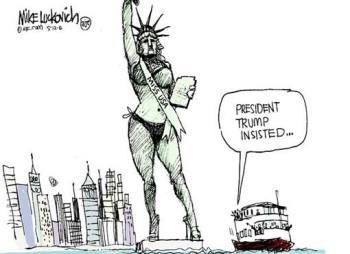
Marching on Saturday with the 3 – 5 million others dampened my despair. I’m still extremely afraid of this insanity. But, it was so wonderful to know so many of us reject his delusions and aspire to create a more perfect union. We are a gumbo. We are a patchwork quilt. We are a jazz riff. We are so much more than Trump’s Narcissism can comprehend, respect, grasp, grok, appreciate, love … please enjoy my pictures of the NOLA March for Women and one other I got caught in by my friend Lynda Woolard who is–in turn–the red head in the photo shown second. I’m scowling at the southern sun just to the right of the Vulva up top.
“We must protect our borders from the ravages of other countries making our products, stealing our companies and destroying our jobs,” Mr Trump said in his short, nationalistic speech on Inauguration Day. “Protection will lead to great prosperity and strength.”
The TPP withdrawal order was one of three actions taken by the President in his third full day in office. He also ordered a freeze in government hiring and re-imposed a ban on providing federal money to international groups that provide abortions.
Mr Trump has criticised international free trade deals for rewarding companies to outsource work and has attributed the loss of US manufacturing to foreign labour.
The man is insane and has no idea of what he speaks. Seriously, we’re headed to Depression. It’s the 30s all over again.
Channel 2 cited an anonymous source as saying a member of the Trump administration would announce the highly controversial move on the President’s first full working day in office.
I imagine the Radical Chistianist Terrorists are preparing for the rapture–yet again–as we speak.
From the WSJ: U.S. Eyes Michael Flynn’s Links to Russia,Counterintelligence agents have investigated communications by President Trump’s national security adviser, including phone calls to Russian ambassador in late December
From Politico: Hillary Clinton plots her next move; The Democrat has been studying election presentations, including reports on where she underperformed.
A group including former White House ethics attorneys will file a lawsuit on Monday accusing President Donald Trump of allowing his businesses to accept payments from foreign governments, in violation of the U.S. Constitution.
The lawsuit, brought by the Citizens for Responsibility and Ethics in Washington, will allege that the Constitution’s emoluments clause forbids payments to Trump’s businesses. It will seek a court order forbidding Trump from accepting such payments, said Deepak Gupta, one of the lawyers working on the case.
Trump does business with countries like China, India, Indonesia and the Philippines, the group noted in a statement.
“When Trump the president sits down to negotiate trade deals with these countries, the American people will have no way of knowing whether he will also be thinking about the profits of Trump the businessman,”
Additionally, publishing this on the very day our state and nation paused to honor and mourn those who died only compounds the pain and suffering of the many Texans who lost family and friends in this disaster. The Bee owes the community of West, Texas an immediate apology for your detestable attempt at satire.
— Gov. Rick Perry, Austin, Tex.
So far, Ohman’s editor Stuart Leavenworth is standing up for him. You can read his full response at the above link. From Raw Story:
Stuart Leavenworth, the editorial page editor of The Sacramento Bee, said the cartoon illustrated Perry’s “disregard for worker safety, and his attempts to market Texas as a place where industries can thrive with few regulations.”
Earlier this year, California Gov. Jerry Brown chided Texas for having a high percentage of workers earning minimum wage. Perry responded about a month later by running radio ads in California that encouraged business owners to move to his state. Perry claimed building a business in California was “next to impossible” because of regulations and taxes — regulations and taxes that his state lacked.
Ohman wrote about the “controversy” on his blog today. He says that a number of readers chastised him for the cartoon.
Their comments ranged from “you are a sick human being” to “insensitive and tasteless.” I’m not sure I am clinically qualified to give myself a direct diagnosis, but I am pretty sure I am not a sick human being. Let’s explore the question of tastelessness.
The Texas chemical plant had not been inspected by the state of Texas since 2006. That’s seven years ago. You may have read in the news that Gov. Perry, during his business recruiting trips to California and Illinois, generally described his state as free from high taxes and burdensome regulation. One of the burdensome regulations he neglected to mention was the fact that his state hadn’t really gotten around to checking out that fertilizer plant. Many Texas cities have little or no zoning, resulting in homes being permitted next to sparely inspected businesses that store explosive chemicals….
When I have to come up with these ideas, I can assure you that I am not really deliberately trying to be tasteless. I am not. What I am trying to do is make readers think about an issue in a striking way. I seem to have succeeded in this cartoon, one way or the other.
The question is whether it is tasteless or not.
My answer, respectfully, is that it isn’t.
Having said that, what normal person doesn’t mourn those poor people fighting the fire and living by the plant? I certainly do. What makes me angry, and, yes, I am driven by anger, is that it could have been prevented. I guess I could have done a toned-down version of the cartoon; I am not sure what that would have been, but I think many readers’ objections just stemmed from the fact that I used the explosion as a metaphor, period. The wound is fresh, the hurt still stings.
Personally, I thought the cartoon was brilliant–a perfect example of the old saying “a picture is worth a thousands words.” Apparently it got a pretty big rise out of Perry when the thousands of gallons of ink spilled on news stories hasn’t. Perry should be ashamed to show his face in public after what happened in West, Texas. Why on earth do Texans keep reelecting this guy?
Ohman recommended that Perry read this outstanding investigation by Pro Publica, which I read and recommended a few days ago: What Went Wrong in West, Texas — and Where Were the Regulators? Perry should either read it or have his flunky read it to him. Then he should wake up and realize that millions of Americans disapprove of his laissez-faire, Ayn Randian approach to government, and cartoonist Jack Ohman expressed our feelings perfectly.
But I don’t expect Perry will take responsibility for his role in the West, Texas disaster, because he can’t handle the truth.
Did you like this post? Please share it with your friends:
The one thing that has become apparent to me recently is that privatizing anything related to important infrastructure is a recipe for one disaster after another. For-profit corporations are into maximizing profits to owners by either slashing costs or hiking prices. They rarely do anything that actually improves service or delivery quality. When you experience any kind of disaster that taxes the infrastructure, you learn quickly how negligent for-profits are when it comes to maintaining or fixing infrastructure. My reality since Hurricane Katrina is living with infrastructure that comes and goes on a windy day, on a drizzly day, on any kind of day that might cause our privately owned electric and natural gas company’s patched together infrastructure to hiccup. We get power outages at the super bowl, in my home, and in our water treatment plant. I’ve experienced two boil water orders in the last six months and dozens of electric outages for days on end. Cox cable’s infrastructure is just about as bad. They patch things up when they have to do it. I’ve heard excuses about hungry squirrels, curious racoons, and unusual wind events to the point I could just scream.
Then, there’s these oil pipe disasters. Why on earth would you trust an oil company with any kind of pipe line given their obvious neglect? There is a THIRD major oil spill in a week. This time it is in Texas.
Thousands of gallons of oil have spilled from a pipeline in Texas, the third accident of its kind in only a week.
Shell Pipeline, a unit of Royal Dutch Shell Plc, shut down their West Columbia, Texas, pipeline last Friday after electronic calculations conducted by the US National Response Center showed that upwards of 700 barrels had been lost, amounting to almost 30,000 gallons of crude oil.
By Monday, Shell spokespeople said inspectors found “no evidence” of an oil leak, but days later it was revealed that a breach did occur. Representatives with the US Coast Guard confirmed to Dow Jones on Thursday that roughly 50 barrels of oil spilled from a pipe near Houston, Texas and entered a waterway that connects to the Gulf of Mexico.
Coast Guard Petty Officer Steven Lehman said that Shell had dispatched clean-up crews that were working hard to correct any damage to Vince Bayou, a small waterway that runs for less than 20 miles from the Houston area into a shipping channel that opens into the Gulf.
The spill was contained, said Lehman, who was hesitant to offer an official number on how much crude was lost in the accident. According to Shell spokeswoman Kim Windon, though, the damage could have been quite significant. After being presented with the estimate that said as much as 700 barrels were found to have leaked from the pipeline due to an unknown cause, investigators determined that 60 barrels entered the bayou.
“That’s a very early estimate–things can change,” Officer Lehman told Dow Jones.
Meanwhile, though, rescue works in Arkansas have been getting their hands dirty responding to an emergency there. A rupture in ExxonMobil’s Pegasus pipeline late last week send thousands of barrels of oil into the small town of Mayflower, around 25 miles outside of Little Rock. Authorities evacuated more than 20 homes in response, and by this Thursday roughly 19,000 barrels had been recovered.
Mayflower, Ark is still fighting the sludge and will likely be doing so for some time.
We tend to think of oil spills on a massive scale, so large they are hard to imagine. Millions of barrels of crude pouring into the Bering Sea from the slashed hull of the Exxon Valdez. Tens of thousands of workers and volunteers combing hundreds of miles of Gulf Coast beaches after the Deep Water Horizon spill. But in Mayflower, Ark., the scale of an oil spill there is disturbing not for its size, but its proximity. On March 29, a 20-inch buried pipeline burst under the small town, turning backyards into tar pits and suburban streets into oil slicks.
This will probably be yet another part of our new reality given the age of pipelines–around 70 years old–and the continued negligence of oil companies who continue to make record profits and enjoy stupendous tax breaks in this country.
Residents of Washington, DC are used to jokes about metaphorical hot air, humidity, and the swampy history of their city. But there’s something they may not know about the District: it’s overrun with methane, which sometimes makes manhole covers explode.
Natural gas is mostly methane, and it is carried through underground pipes to heat buildings and cook food. Those pipes are often old, and this led ecologist and chemical engineer Robert Jackson of Duke University to drive around DC over a period of two months, regularly measuring the air to take methane levels.
He and his research team found methane leaks everywhere, with thousands of places having significantly higher than normal methane concentrations, and some places reaching 50 times normal urban levels (100 ppm vs 2 ppm). A similar study in Boston last year found essentially the same results. In DC, the source wasn’t the swamp on which the city was built — it was fossil fuel. (The methane they measured had more carbon-13 rather than the normal, modern carbon-12.)
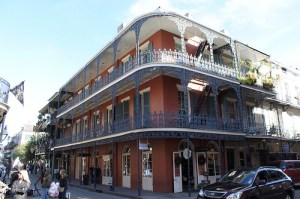
You can laugh about this but I’ve actually seen exploding manhole covers in action. I was gigging at Balconies restaurant down in the French Quarter. The piano was situated under a window and the restaurant–now defunct–was located in a building on the 600 block of Royal. It’s a really famous intersection and the building is one of those that gets photographed all the time. The window is basically to the left of the open door where they black car is passing the building. Mule drawn carriages would stop there frequently to listen to me play and to have a cocktail or cafe au lait brought out for the occupents. Anyway, one night, after a series of exploding man hole covers had been shutting down the electricity in the Quarter, one of them in the middle of this street took off like a cannon and sliced through the top part of a car right before my eyes. Of course, the electricity went off in the area and shut down the grocery across the street, the restaurants and everything in that locale. But, I’ll tell you, that manhole cover was an unbelievable projectile. Oh, it of course, the natural gas in town is Entergy-controlled. The other thing I recall was the distinct smell of ozone burning up and the wierdish green light show. This was about 15 years ago, but damn, I will never forget watching the roof of a hard top car get sliced off like a piece of salami. It’s been fixed now since the city doesn’t tolerate anything being wrong in the French Quarter, but for about 3 months of the summer 1996, it was a wild trip with a series of exploding manhole covers and black outs. It was also the same summer I got Karma so, who knows. Maybe it was just one of those summers.
Anyway, after having lived in a city where levees failed us and electricity fails us all the time, I would just like to say that no private corporation should be left on its own with unmonitored vital infrastructure. All kinds of things are at stake. Also, you can’t trust any oil company to do right by any one but themselves after a spill. I have experience in that area too.
Did you like this post? Please share it with your friends:
The Sky Dancing banner headline uses a snippet from a work by artist Tashi Mannox called 'Rainbow Study'. The work is described as a" study of typical Tibetan rainbow clouds, that feature in Thanka painting, temple decoration and silk brocades". dakinikat was immediately drawn to the image when trying to find stylized Tibetan Clouds to represent Sky Dancing. It is probably because Tashi's practice is similar to her own. His updated take on the clouds that fill the collection of traditional thankas is quite special.
You can find his work at his website by clicking on his logo below. He is also a calligraphy artist that uses important vajrayana syllables. We encourage you to visit his on line studio.

 Good Day Sky Dancers!
 Diel lived in extremely hard-hit St. Bernard Parish, with most houses and infrastructure destroyed. He was 17 at the time. He’s chosen a series of articles to orchestrate the steps that have led us to where we are today, which is not fully recovered or whole. It’s also left us, victims, to charter schools and AirBNBs.
 The Biden Administration and Democratic Congress have made meager but credible steps toward alleviating Climate Change devastation. But will it be enough for Democrats to hold on and improve their position in Congress to continue the fight?

 Good Morning!
 Much of the boom in equities has been due to speculation that deregulation and expansive fiscal policy favorable to private businesses may fuel business profits. None of this has come to fruition yet so it’s basically speculative. The economy is healthy and growing strong at the moment but is it enough to support the increased levels seen in the stock markets?
  For me, it starts with a small alarm in my gut that says what are these people smoking? Where are they seeing all this good news? The Trumpcare fiasco alone should be sending signals that say things are not looking up. R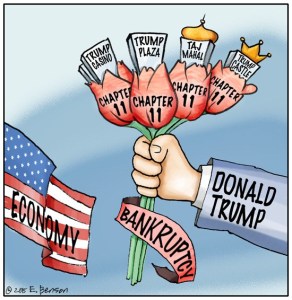


 The Atlantic
 When all of this finally begins to unravel in a manner befitting of such a serious level of scandal, it can’t help but take our economy with it. How much damage can Trump, Ryan et al inflict on us and at what point will
 This will not create US jobs. If anything, it will take away the jobs of those who work for firms that export US goods. As an economist, I cannot stress enough how devastating this will be to the US economy, our geopolitical and geoeconomic standing in the region, and our relations with other nations. Isolationism has never been–historically–a good thing. Additionally, it will not save or re-create US jobs destroyed by technology. For example, it’s only a matter of years before there will be no need for long haul truck drivers. We’re already learning to be our own grocery checkers.
 Marching on Saturday with the 3 – 5 million others dampened my despair. I’m still extremely afraid of this insanity. But, it was so wonderful to know so many of us reject his delusions and aspire to create a more perfect union. We are a gumbo. We are a patchwork quilt. We are a jazz riff. We are so much more than Trump’s Narcissism can comprehend, respect, grasp, grok, appreciate, love … please enjoy my pictures of the NOLA March for Women and one other I got caught in by my friend Lynda Woolard who is–in turn–the red head in the photo shown second. I’m scowling at the southern sun just to the right of the Vulva up top.
 The man is insane and has no idea of what he speaks. Seriously, we’re headed to Depression. It’s the 30s all over again.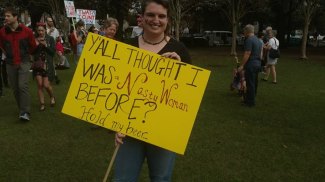
 I really just can’t do today. I can’t.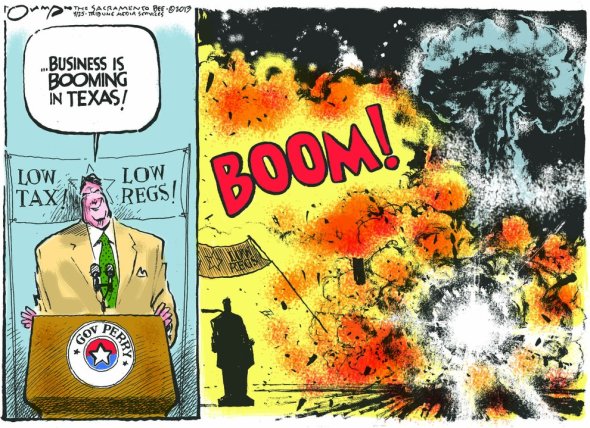



 peej
peej Carissa
 bostonboomer
 dakinikat
 ecocatwoman
 mablue2
 Mama Lopez
 peggysue22
 quixote
 skydancingguestblogger
 Mona (aka Wonk the Vote)



 Sky Dancing
Recent Comments