The Democratic Congress Critters have abandoned hope for any sort of Voting Rights Act just as we continue to see the Republicans chip away at voting access and the Roberts Court continue to ensure that. I keep wondering what exactly Chief Justice Roberts has against ensuring all citizens have access to their constitutional right to vote.
At times, Chief Justice John G. Roberts Jr. has labored to maintain the Supreme Court’s legitimacy against the gale-force pressures of partisan acrimony and social division. When it comes to voting rights, he has pushed in the opposite direction, presiding over the court’s systematic dismantling of the Voting Rights Act, overriding Congress’s clear intentions and gravely injuring U.S. democracy.
The first major blow came in 2013, when the court eviscerated the act’s Section 5, which required states with a history of racial discrimination to preclear changes to voting rules with the Justice Department. The decision left in place a backstop, Section 2, which allows legal challenges to discriminatory election rules after they have been enacted. On Thursday, the Roberts court sharply limited that provision as well.
The court upheld two Arizona election rules the Democratic National Committee claimed discourage minority voting. The legitimacy of Arizona’s policies could be debated, and the court could have struck them down without indulging in dangerous overreach. But in its reasoning and guidance for future cases, the six justices in the majority, including the chief, flashed a green light to state lawmakers eager to erect new barriers to voting.
The majority imposed stipulations on applying Section 2 that “all cut in one direction — toward limiting liability for race-based voting inequalities,” Justice Elena Kagan pointed out in a dissent. This new list of restrictions, Justice Kagan continued, “stacks the deck against minority citizens’ voting rights. Never mind that Congress drafted a statute to protect those rights.”
The majority invites states to argue that unnecessarily strict voting rules impose no more than mild burdens on casting ballots, despite the fact that the Voting Rights Act was meant to eliminate obvious as well as subtle forms of voting discrimination. What may appear to be mere inconveniences or seemingly race-neutral rules can in practice reduce minority voting. Some of that is fine, the court said. While admitting that one of the Arizona laws in question disproportionately affects Black, Latino and Native American voters, the majority declared that the difference was too small to matter. Yet elections are often decided by fractions of percentage points, and every vote should be seen as precious.
This reminds me of how the’ve been chipping away at Abortion and other privacy-related rights. It also reminds me of how they keep enabling dark money in elections. What’s with Justice Roberts any way? I mean we know that Republican politicians know they’re increasingly a rump party. They also know that gerrymandering and voting restrictions are the only way to slow down the tsunami of voters not in their narrow demographics. Joan Biskupic, CNN Legal Analyst, put it this way: “John Roberts takes aim at the Voting Rights Act and political money disclosures, again.”
The Supreme Court under Chief Justice John Roberts has hollowed out the historic Voting Rights Act, curtailed regulation of big political donors and limited challenges to partisan gerrymandering.
The final two decisions of the court session on Thursday continued this trend of Roberts’ stewardship that cuts to the heart of democracy and generally benefits conservatives over liberals, Republican voters over Democratic voters.
The pattern on voting rights traces to Roberts’ early years serving in the Ronald Reagan administration when the young GOP lawyer opposed racial remedies and argued for a constricted interpretation of the 1965 Voting Rights Act.
The Supreme Court under Chief Justice John Roberts has hollowed out the historic Voting Rights Act, curtailed regulation of big political donors and limited challenges to partisan gerrymandering.
The final two decisions of the court session on Thursday continued this trend of Roberts’ stewardship that cuts to the heart of democracy and generally benefits conservatives over liberals, Republican voters over Democratic voters.
The pattern on voting rights traces to Roberts’ early years serving in the Ronald Reagan administration when the young GOP lawyer opposed racial remedies and argued for a constricted interpretation of the 1965 Voting Rights Act.
That emphasis reemerged again Thursday, just as Attorney General Merrick Garland has pointed to a “dramatic rise in state legislative actions that will make it harder for millions of citizens to cast a vote that counts.” Dissenting liberal justices on Thursday observed that “efforts to suppress the minority vote continue” yet “no one would know this from reading the majority opinion.”
Voting rights advocate Lucy Nicolar Poolaw of the Penobscot Nation casts the first Native American vote allowed on a reservation in Maine, 1955.
Thanks to the six right-wing justices on the Supreme Court, our country has just become less democratic. In twin rulings issued Thursday, they said that states can make it harder for people to vote and they made it easier for big donors to sway elections in secrecy
You wonder if July 1, 2021, might come to be known as Oligarchy Day.
It should certainly be the day when advocates of democracy and equal rights rip off their blinders and stop pretending that the court’s conservative majority is in any way impartial or nonpartisan. The decisions in both cases could have been written by the Republican National Committee, attorneys for the Koch brothers and advocates of voter suppression.
In a much-anticipated case on voting rights, the court let stand Arizona laws requiring election officials to discard ballots cast in the wrong precincts and prohibiting campaign workers, community activists and others from collecting ballots.
The larger implication: The ruling in Brnovich, Attorney General of Arizona v. Democratic National Committee will weaken Section 2 of the Voting Rights Act, the most important part of the law left standing after the court’s 2013 decision gutting Section 5 of the law. That part had required Justice Department pre-clearance of voting rules changes in places that had a history of racial discrimination.
In an eloquent dissent rooted in fact, history and a respect for Congress’s right to legislate under the 15th Amendment, Justice Elena Kagan demolished the majority’s crabbed view of democracy. She noted that the Voting Rights Act “confronted one of this country’s most enduring wrongs” and “pledged to give every American, of every race, an equal chance to participate in our democracy.”
She concluded: “That law, of all laws, deserves the sweep and power Congress gave it. That law, of all laws, should not be diminished by this Court.”
But it was.
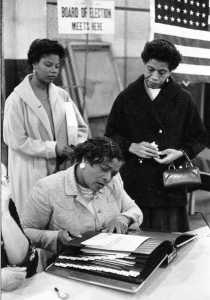
Three African American women at a polling place, one looking at a book of registered voters on November 5, 1957, in New York City or Newark, New Jersey] / TOH, Library of Congress
It took the better part of a century to pass a law saying American women had the right to vote. It took even longer to deliver this right to Indigenous women — which really short-changed all Native Americans.
For the longest time, the word “suffrage” has been aligned with the historic passage of the 19th Amendment, a decree ratified a century ago, this week, outlawing discrimination of voters on the basis of their sex. But in reality, such shorthand, couched in twentieth-century white feminism, was exclusionary. The right to vote in Indian Country tells another side of this struggle in which Indigenous women were on the frontlines from the start.
While the 19th Amendment represents a cornerstone of gender equality in America, few know about the way the vote was won or the limitations it imposed on people of color. Public school curriculum often portrays this history of the suffrage movement through the important advocacy of notable white women, Elizabeth Cady Stanton and Susan B. Anthony.
Leading up to the ratification of the 19th Amendment on Aug. 18, 1920, these Native women participated in suffrage parades, made compelling speeches, and wrote commentary that would likely have gone viral, today. But more intriguing, Indigenous women were the source of inspiration for the movement’s lead organizers, Stanton and Matilda Joslyn Gage.
The women, two New Yorkers who lived on the colonized homelands of the Iroquois Confederacy, wrote how they grew motivated to make lasting voting rights change after recognizing the roles women played in the tribes. Then as now, the Confederacy’s six nations of the Onondaga, Mohawk, Seneca, Cayuga, Oneida, and Tuscarora functioned as a government based on female authority in which Haudenosaunee women maintained authority over their subsistence economy.
They also had final authority over land transfers and decisions about engaging in war. And they practiced a structure of political power shared equally among all clan families and their members — a pure democracy — what also inspired the birth of the United States.
When the 19th Amendment became law on August 26, 1920, 26 million adult female Americans were nominally eligible to vote. But full electoral equality was still decades away for many women of color who counted among that number. The federal suffrage amendment prohibited discrimination on the basis of sex, but it did not address other kinds of discrimination that many American women faced: women from marginalized communities were excluded on the basis of gender and race. Native American, Asian American, Latinx and African American suffragists had to fight for their own enfranchisement long after the 19th Amendment was ratified. Only over successive years did each of those groups gain access to the ballot.
In 1920, Native Americans weren’t allowed to be United States citizens, so the federal amendment did not give them the right to vote. The first generation of white suffragists had studied Native communities to learn from a model of government that included women as equal democratic actors. But the suffragists did not advocate for indigenous women. Nonetheless, Native American activists like Zitkála-Šá continued to organize and advocate with white mainstream suffragists. With the passage of the Snyder Act in 1924, American-born Native women gained citizenship. But until as late as 1962, individual states still prevented them from voting on contrived grounds, such as literacy tests, poll taxes and claims that residence on a reservation meant one wasn’t also a resident of that state.
Native-born Asian Americans already had U.S. citizenship in 1920, but first generation Asian Americans did not. Asian American immigrant women were therefore excluded from voting until the Immigration and Nationality Act of 1952 allowed them to gain citizenship more than three decades after the 19th Amendment. Despite being barred from citizenship and from voting, Asian American suffragists such as Dr. Mabel Ping-Hua Lee worked alongside white Native-born women in the years leading up to 1920; Ping-Hua Lee and others advocated within their communities and even marched in suffrage parades.
Latinx women contributed to the success of the suffrage movement at both the state and federal levels, particularly with their efforts to reach out to Spanish-speaking women. And in Puerto Rico, suffragists like Luisa Capetillo worked to attain women’s voting rights, which were first given to literate women in 1929 and all Puerto Rican women in 1935. Yet literacy tests remained an effective means of keeping some Hispanic and other women of color from voting long after the federal amendment was passed. It took a 1975 extension of the Voting Rights Act, prohibitingdiscrimination against language minority citizens, to expand voting access to women who rely heavily on languages other than English.
Some African American suffragists in the north were able, with the 19th Amendment, to realize the rewards of their activism, but throughout much of the country the same voter suppression tactics that kept black men from the polls kept black women from voting, too. Literacy tests, poll taxes, voter ID requirements and intimidation and threats and acts of violence were all obstacles. The struggle for suffrage, which began for black women in the early 1800s, continued until activists such as Fannie Lou Hamer and Diane Nash won the passage of the Voting Rights Act of 1965, 200 years later.
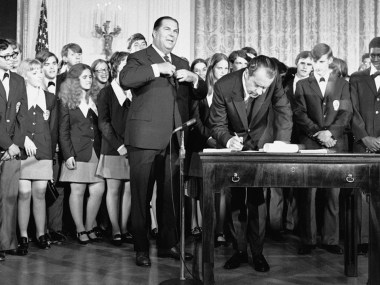
Nixon signs the 26th amendment lowering the voting age from 21 to 18 on July 5, 1971.
There is an interactive display at the link along with some photos of suffragettes of color.
The court’s ruling follows a report finding that as of mid-June, 17 states had passed 28 laws making it harder for constituents to vote in 2021, according to the Brennan Center for Justice at New York University’s School of Law. The report notes that the last year a similar number of laws passed restricting access to the ballot was 2011 – when 14 states had enacted 19 such measures by October.
Eliza Sweren-Becker, a voting rights and elections counsel at the Brennan Center, called the new wave of voting laws “an unprecedented assault on voting rights” as well as “a voter suppression effort we haven’t seen since the likes of Jim Crow.”
The nation’s high court previously gutted a key provision of the Voting Rights Act in 2013, when Chief Justice John Roberts wrote a majority opinion arguing that jurisdictions with a history of racial discrimination in voting should no longer be subject to oversight from the Department of Justice before effecting changes to their voting laws.
The Brennan Center report attributes this year’s batch of restrictive voting laws to “racist voter fraud allegations behind the Big Lie (a reference to former President Donald Trump’s repeated false claims of a rigged election) and a desire to prevent future elections from achieving the historic turnout seen in 2020.”
Commenting on the former president’s claims of mass voter fraud, Sweren-Becker says, “We know that’s false, but we have officials at the state level passing these laws making it harder for people to vote.”
Some of the specific provisions in these laws that can have a negative impact on voter turnout according to the Brennan Center include restrictions on voting by mail – some 63.9 million ballots had been sent as of Election Day 2020, data from the U.S. Elections Project indicated – challenges to in-person voting, and limitations on the number of mail ballot drop boxes in precincts.
Republicans during a U.S. House Judiciary panel hearing on Tuesday argued that a bill that would reinstate a preclearance section of the 1965 Voting Rights Act is unnecessary because there is no discrimination in voting.
The top Republican on the panel, Rep. Mike Johnson, (R-La.), said that the legislation is not needed and that the federal government should not be telling states how to run their electoral processes.
He added that recently voting bills passed by Republicans in Georgia and Florida are meant to “enhance election integrity and increase the public’s waning confidence in our election process.”
“It is outrageous to see the federal government fighting back against these common sense reforms, such as the latest lawsuit filed by the Department of Justice against Georgia over its election law,” Johnson said. The Justice Department announced last week that the agency is suing Georgia in an attempt to overturn the state’s sweeping elections law passed in March.
The comments from the GOP came as Democrats again attempt some type of federal action on elections laws, after a massive legislative package by Democrats known as H.R. 1 was blocked in the U.S. Senate by Republicans. Democrats say the GOP state laws broadly disenfranchise many voters, including those of color, rural residents and people with disabilities.
Rep. Steve Cohen, the Tennessee Democrat who held the House hearing as the chair of the Subcommittee on the Constitution, Civil Rights, and Civil Liberties, contended it is necessary for Congress to pass H.R. 4, the John Lewis Voting Rights Act.
Republicans seem intent on chipping away the rights of ordinary Americans. It is time to stand up against their continued attempts to maintain and expand all vestiges of white nationalism, white male patriarchy, and a dominist christianist oligarchy. The song below sustained me through our fight for the ERA. I got to see and sing this with her in our first Women’s Festival in 1982. I tried desperately to create a festival in 1983 with participation and leadership of black women in the Urban League. We had a successful Festival that follwed Maya Angelou speaking at Equality. Our main speakers were Betty Friedan and Kate Millet. Equal rights and voting rights is important to all our rights in all the various way we participate in American Communities.
Whats on your reading and blogging list today?
Did you like this post? Please share it with your friends:
I keep fighting back the urge to sing “It’s the end of the world as we know it” even though it seems like that way on so many fronts. The most dreadful of all gaslighting tricks fills the airwaves. Brett Kavanaugh and his republican enablers are pretending that they are the victims of women’s hysteria while Dr. Ford can’t return to her home because of actual threats. Then, there are the rest of us. The people that aren’t white males or white male enablers. How many more rights can they strip?
We’re looking to a future of having our voting rights stripped, our right to self determine our access to health care removed, and the enabling of police to shoot unarmed black men while white men complain they can’t watch their football without seeing folks bending a knee to remind them of the injustice. We’re looking to a future of likely seeing a President put above the law even though his obstruction of justice, theft of public property, and cooperation with Russian agents is there for nearly all to see. We’re going to continue to watch children and babies thrown into tents in the middle of deserts and jail cells after being ripped away from their parents. We’re going to see the folks that need protection from our bad foreign policy flee to our borders only to be incarcerated for asking for refuge. We’re looking to losing spouses, jobs, and rights because of who we love and wish to marry. In each of us, there is all of us.
We have to take one of the Houses of Congress away from the Republicans to turn this around.
There are other things we have to turn around too and I fully admit that I’ve thrown myself at the wall a few too many times to rise again. And yet, like every one else, I must. We must.
The world stands on the brink of failure when it comes to holding global warming to moderate levels, and nations will need to take “unprecedented” actions to cut their carbon emissions over the next decade, according to a landmark report by the top scientific body studying climate change.
With global emissions showing few signs of slowing and the United States — the world’s second-largest emitter of carbon dioxide — rolling back a suite of Obama-era climate measures, the prospects for meeting the most ambitious goals of the 2015 Paris agreement look increasingly slim. To avoid racing past warming of 1.5 degrees Celsius (2.7 degrees Fahrenheit) over preindustrial levels would require a “rapid and far-reaching” transformation of human civilization at a magnitude that has never happened before, the group found.
The report, issued on Monday by the Intergovernmental Panel on Climate Change, a group of scientists convened by the United Nations to guide world leaders, describes a world of worsening food shortages and wildfires, and a mass die-off of coral reefs as soon as 2040 — a period well within the lifetime of much of the global population.
The report “is quite a shock, and quite concerning,” said Bill Hare, an author of previous I.P.C.C. reports and a physicist with Climate Analytics, a nonprofit organization. “We were not aware of this just a few years ago.” The report was the first to be commissioned by world leaders under the Paris agreement, the 2015 pact by nations to fight global warming.
The authors found that if greenhouse gas emissions continue at the current rate, the atmosphere will warm up by as much as 2.7 degrees Fahrenheit (1.5 degrees Celsius) above preindustrial levels by 2040, inundating coastlines and intensifying droughts and poverty. Previous work had focused on estimating the damage if average temperatures were to rise by a larger number, 3.6 degrees Fahrenheit (2 degrees Celsius), because that was the threshold scientists previously considered for the most severe effects of climate change.
The new report, however, shows that many of those effects will come much sooner, at the 2.7-degree mark.
At 2C extremely hot days, such as those experienced in the northern hemisphere this summer, would become more severe and common, increasing heat-related deaths and causing more forest fires.
But the greatest difference would be to nature. Insects, which are vital for pollination of crops, and plants are almost twice as likely to lose half their habitat at 2C compared with 1.5C. Corals would be 99% lost at the higher of the two temperatures, but more than 10% have a chance of surviving if the lower target is reached.
Sea-level rise would affect 10 million more people by 2100 if the half-degree extra warming brought a forecast 10cm additional pressure on coastlines. The number affected would increase substantially in the following centuries due to locked-in ice melt.
Oceans are already suffering from elevated acidity and lower levels of oxygen as a result of climate change. One model shows marine fisheries would lose 3m tonnes at 2C, twice the decline at 1.5C.
Sea ice-free summers in the Arctic, which is warming two to three times fast than the world average, would come once every 100 years at 1.5C, but every 10 years with half a degree more of global warming.
l Capitan looms over the Merced River in California’s Yosemite National Park.
The confirmation of Justice Kavanaugh was, at heart, a referendum on the integrity of U.S. institutions and of the impunity of elites – and the U.S. failed. Senators who purport to believe in rule of law vouched for a judge who sees himself as above it. Senators who purport to believe in democracy honoured a man who degrades it, and did so in deference to a man seemingly attempting to destroy it – President Trump.
Checks and balances are nearly gone. The executive branch was long ago corrupted; the independent legislature neutered by a GOP majority nakedly seeking one-party rule. Until now, the judiciary had been the strongest bulwark against autocracy, having struck down many of Mr. Trump’s unconstitutional executive orders during his first year. The Trump administration responded by packing the courts, appointing right-wing judgesto lifetime appointments and purging attorneys they view as opponents. Justice Kavanaugh is the final nail in that coffin.
This is now Mr. Trump’s Supreme Court of the United States, run on white male entitlement and alternative facts. Justice Kavanaugh is expected to act as Mr. Trump’s legal lackey, exonerating him regardless of the charge or the evidence. His appointment may not only end the efficacy of the Robert Mueller probe, but curtail other attempts to prosecute Mr. Trump or his aides on state charges, due to a case, Gamble v. The United States, that the Supreme Court is set to hear this term.
Autocrats rewrite the law so they are no longer breaking it, and they hire and fire accordingly. This is why I have been warningfor years that Donald Trump, whose seemingly autocratic consolidation grows stronger every day, was akin to a criminal able to someday select his own judge or delay his own trial – and now he has. This is why a purge of the FBI was followed by a sham FBI investigation into Justice Kavanaugh, reminiscent of those of authoritarian states, with key witnesses and evidence ignored.
For the President, the confirmation of this judge is a hand-picked gift, but for ordinary Americans, he marks the end of truths we deemed self-evident. Justice Kavanaugh marks the imposition of a corrosive new reality. The Supreme Court is likely to roll back decades of hard-earned rights, particularly voting rights, civil rights and women’s rights.
Also, a lot of Trump’s thug buddies in thuggish countries are disappearing journalists and others.
Trump administration has yet to say a single word about the disappearance of Jamal Khashoggi, allegedly at the hands of Saudi agents who lured him to a consulate, incapacitated him, then snuck him or his corpse away to unknown locale https://t.co/2AhysH5P4A
The silence is showing exactly what kind of country we’ve become. We’re just another one of those ugly countries where the ruling class can’t possibly be bothered with human rights and hates the idea of a free press.
That’s all I can stomach today.
I’m trying to stay focused on the city around me because it’s kinda where I am right now and it appears the housing market has shifted against me in the last six months. It’s one of those signs that tells me that the economy is likely to get pretty ugly pretty fast. So, hug the ones around you, be thankful for what you have, and drag at least 10 people with you to the voting both in November.
It’s a matter of life and death for all of us.
What’s on your reading and blogging list today?
Did you like this post? Please share it with your friends:
One of the things that I’ve been very worried about is the continual disconnect between the performance of the equities market and what’s going on in the bond markets. This is usual a symptom of what we call “animal spirits” and often a sign that a crash is imminent on Wall Street.
Bond investors and those concentrated in Equities have very different priorities. Bonds are usually safe and liquid assets while Equities are risky. Their prices can be volatile. Here’s something I read about a week ago as a lead up to something I read this morning.
Are stocks and U.S. Treasurys sending mixed signals? Treasury prices have rebounded since Donald Trump’s presidential inauguration in January, pushing down yields, as stocks continue to ascend record heights. That’s in contrast with the bond market rout that followed the November election.
Why is a simultaneous rally a problem? Some investors see it as a sign that investors are losing faith in the so-called Trump trade, in which investors bet on aggressive fiscal stimulus and other growth-friendly measures from the new administration.
Much of the boom in equities has been due to speculation that deregulation and expansive fiscal policy favorable to private businesses may fuel business profits. None of this has come to fruition yet so it’s basically speculative. The economy is healthy and growing strong at the moment but is it enough to support the increased levels seen in the stock markets? Is it real and sustainable?
Historical patterns suggest that it’s not and we may be looking at a future crash which would not bode well for any one who is or soon to be reliant on 401ks. This is when I’m happy about my small but very stable pension coming in monthly. I’ve lived through way too many bubbles now and seen my 401k bounce around like a jumping bean. My Uncle was one of the pioneer gnomes of the chartist movement after Black Friday. I loved to see his huge charts that frequently blanketed the tables of his Kansas City mansion. It could be why I ended up doing something similar.
It’s already been a big year for the Dow industrials, which have stretched a near-decade-long bull market to historic heights.
But if the technical stars collide, as one chartist predicts, the blue-chip gauge could soon plunge by more than 6,000 points to 14,800. That’s nearly 30% lower, based on Friday’s close.
Sandy Jadeja, chief market strategist at Master Trading Strategies, claims several predicted stock market crashes to his name — all of them called days, or even weeks, in advance. (He told CNBC viewers, for example, that the August 2015 “Flash Crash” was coming 18 days before it hit.) He’s also made prescient calls on gold and crude oil.
And he’s extremely concerned about what this year could bring for investors. “The timeline is rapidly approaching” for the next potential Dow meltdown, said Jadeja, who shares his techniques via workshops and seminars. Timelines are at the heart of his predictions, which he bases on repeating cycles in the market that are connected to specific times.
“People need to look for three things,” Jadeja told MarketWatch in a late-January interview and follow-up conversations. “Price, pattern, and … time. You can get the price pattern wrong, but if you get in at the right time, the other two don’t matter.”
He sees 2017 as littered with pitfalls for the Dow DJIA, -0.18% . Below is his so-called “timelines” chart of the stock index, defined by green horizontal lines. He’s currently on the lookout for the benchmark to approach that upper green line, which represents a range of 21,800 to 22,000.
It was never a secret that Republicans would take a risk by repealing Obamacare, as unpopular as it was, and taking ownership of what happens next. But it’s striking just how many political dangers they’re putting themselves in — and how they’re ignoring pretty much all of them. Democratic operatives are already testing which ones resonate the most in swing districts, I’m told.
Here are the one to watch:
Coverage losses. They’ve already dismissed the idea that they should worry about it, because they won’t be requiring people to buy coverage anymore. “There’s no way we can compete” with a government mandate, House Speaker Paul Ryan said on CBS’s “Face the Nation” yesterday. But if the Congressional Budget Office estimates that people will lose coverage, that’s going to be the headline for days, because …
“We’re going to have insurance for everybody.” That’s what President Trump told the Washington Post in January. He’s since fallen in line with the mainstream Republican position that they should guarantee access, not coverage. But that quote is not going to disappear.
Pre-existing conditions. Republicans insist they’re going to keep covering them, but Democrats are going to keep stoking fears that they’ll either lose coverage or have to pay more — especially with the 30 percent penalty for people who don’t keep themselves insured.
The “age tax.” AARP is going to be hammering them for allowing insurers to charge older customers five times as much as young adults, compared to three times as much under Obamacare. Republicans can try to dismiss AARP, but they do have a lot of power.
“Nobody will be worse off financially.” That’s what Health and Human Services secretary Tom Price said on NBC’s “Meet the Press” yesterday. His point was that people will be able to buy cheaper health plans if they have more choices than the standard Obamacare ones — but it won’t be hard for Democrats to find people who are worse off.
Medicaid. Ryan insists that the switch to per-person funding limits would be a major entitlement reform that conservatives have wanted for decades — but the reality is that millions of people have gained coverage through Obamacare’s Medicaid expansion, which is why Republicans are divided over when it should end.
The “giveaways to millionaires.” Democrats are already hitting the decision to get rid of a tax deductibility limitin the law — giving a tax break to insurance executives making more than $500,000 a year. That could be a hard one to explain to populist Trump supporters.
Deductibles. The sky-high deductibles under many Obamacare plans has been a standard GOP criticism of the law — but wait until people find out that the health savings accounts they’re promoting are tied to health plans that have the same thing.
Trump has made it clear that his budget will eliminate a significant part of the Federal workforce. This is a really really recessionary move. The states of Kansas and Louisiana have done this and its created significant economic distress in both places. Plus, it’s created a distinct lack of service and action in crucial public services. For example, the state of Louisiana cannot train as many doctors and provide as many residents to hospitals. That’s not good at all.
President Trump’s budget proposal this week would shake the federal government to its core if enacted, culling back numerous programs and expediting a historic contraction of the federal workforce.
This would be the first time the government has executed cuts of this magnitude — and all at once — since the drawdown following World War II, economists and budget analysts said.
The spending budget Trump is set to release Thursday will offer the clearest snapshot of his vision for the size and role of government. Aides say that the president sees a new Washington emerging from the budget process, one that prioritizes the military and homeland security while slashing many other areas, including housing, foreign assistance, environmental programs, public broadcasting and research. Simply put, government would be smaller and less involved in regulating life in America, with private companies and states playing a much bigger role.
A company owned by the family of Jared Kushner, President Donald Trump’s son-in-law and senior adviser, stands to receive more than $400 million from a prominent Chinese company that is investing in the Kushners’ marquee Manhattan office tower at 666 Fifth Ave.
The planned $4-billion transaction includes terms that some real estate experts consider unusually favorable for the Kushners. It provides them with both a sizable cash payout from Anbang Insurance Group for a property that has struggled financially and an equity stake in a new partnership.
The details of the agreement, which is being circulated to attract additional investors, were shared with Bloomberg. It would make business partners of Kushner Cos. and Anbang, whose murky links to the Chinese power structure have raised national security concerns over its U.S. investments. In the process, an existing mortgage owed by the Kushners will be slashed to about a fifth of its current amount.
The document offers a rare look at a major deal by a close Trump associate and family member. It’s unclear whether the deal could prompt federal review, as occurred when Anbang bought other properties, like the Waldorf Astoria Hotel in Manhattan. Anbang could also face review by the Chinese government, which has been clamping down on overseas investments and which has a range of pending issues with the Trump administration.
Rep. Adam Schiff (D-CA), Ranking Member of the House Intelligence Committee, exposed Donald Trump’s claims about his so-called “Winter White House” today, pointing out that Mar-a-Lago is not a winter white house but a private for-profit business, with all the ethical and security problems that entails …
As Schiff says, Mar-a-Lago is “one ethical quagmire” out of many in the Trump empire. He is right when he points out that Trump is a “walking, talking violation of the Emoluments Clause” and has been since Day 1 of his administration.
There is no question that Trump’s business interests will not always align with American interests or with National Security needs (and forget for a moment the security risk his holding court in public places poses).
Donald Trump has shown Americans and the world that he cannot be trusted to place what’s best for America above his own interests. This is a basic problem of corporations, which see not the public good but their bottom line as what matters.
Democratic Sen. Bob Casey asked a government ethics office Monday to assess whether President Donald Trump’s business dealings make his administration vulnerable to conflicts of interest.
“President Trump has exposed his administration to possible conflicts of interest on an unprecedented scale,” the Pennsylvania lawmaker says in a letter to the Office of Government Ethics.
Casey asked whether any of Trump’s foreign business deals could violate the Emoluments Clause of the Constitution, which prohibits U.S. officeholders from accepting gifts from foreign countries.The White House did not immediately respond to a request for comment.
Walter Shaub, the director of the ethics office, strongly criticized Trump earlier this year for not divesting from his businesses. Shaub said Trump was breaking decades of tradition by presidents who set up blind trusts for their assets.
Senior Democrats on Capitol Hill are calling for a congressional investigation into the justice department’s handling of an ongoing inquiry into Deutsche Bank, saying that Donald Trump had conflicts of interest with the German bank, his biggest creditor.
Maxine Waters, the top Democrat on the House financial services committee, urged her Republican colleagues to launch their own investigation into the nature of Deutsche Bank’s money-laundering scheme, who participated in the arrangement and whether it involved any other violations of US law beyond the failure to maintain anti-money laundering controls.
Deutsche Bank has already been ordered to pay more than $800m (£660m) in fines in the US and UK for failing to stop the improper and corrupt transfer of more than $10bn out of Russia. It is also being investigated by the justice department (DoJ).
The Guardian reported last month that the German bank undertook a close examination of the president’s personal bank account and those held by his family, in order to ascertain whether they had any suspicious links to Russia. None were found.
According to an analysis by Bloomberg, Trump now owes Deutsche about $300m. He has four large mortgages, all issued by Deutsche’s private bank.
Waters said in a letter to Jeb Hensarling, the chairman of the House financial services committee, that she was concerned “about the integrity of this criminal probe” given Trump’s “conflicts of interest” and the “suspicious ties” between Trump’s inner circle and the Russian government.
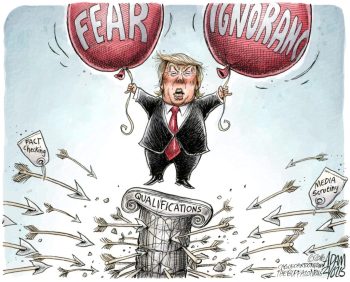
The Atlantic has printed a ‘crib sheet’ of all the Trump conflicts of interest. The list is huge. The demand for forensic accountants is also going to be huge.
When it comes to President Donald Trump’s constellation of foreign investments, properties, and companies, much of the attention so far has been on his business’s apparent violation of the Constitution’s Emoluments Clause, which bars officeholders from taking gifts from foreign leaders. According to numerous ethics experts, the clause takes an expansive definition of gifts, encompassing everything from a direct bribe to a foreign official’s approval of construction of a new Trump property. But some of the Trump Organization’s properties raise additional red flags due to the specific partners involved. That’s true in Indonesia, for example, where Trump’s affiliates have been involved in bribery scandals and radical Islamic nationalist parties, and Brazil, where the company pulled out of a branding agreement amid a criminal investigation of a local business partner.
Such is the case in Azerbaijan, which Transparency International ranks as among the most corrupt countries in the world, where the Trump International Hotel and Tower in Baku remains unopened. Though the long-stalled development has generated a steady drip of news and rumors for years, an overview by Adam Davidson in The New Yorker, entitled “Donald Trump’s Worst Deal,” puts into perspective just how convoluted the situation is, and just how much the project has led Trump and his company into a partnership with numerous corrupt officials in the Middle East. The details suggest that, on top of the continual underlying breach of the Emoluments Clause, the Trump Organization’s involvement may also violate the Foreign Corrupt Practices Act, or FCPA, which forbids American companies from participating, even unknowingly, in bribery schemes in other countries, with a penalty of up to $2 million and up to five years in jail.
When all of this finally begins to unravel in a manner befitting of such a serious level of scandal, it can’t help but take our economy with it. How much damage can Trump, Ryan et al inflict on us and at what point will ‘enough’ actually be ‘ENOUGH!!!!’? Take these examples.
The price of drinks at his new hotel in Washington DC has reportedly increased significantly since it opened last September. His sons, Donald Jr and Eric Trump, have opened new hotels in Dubai and Vancouver since their father’s Inauguration, and told The New York Times that the Trump brand is “the hottest it’s ever been”. The initiation fee to join the Mar-a-Lago resort in Florida, named the “Winter White House”, where the President has spent several weekends, has recently soared.
The President’s motivation for choosing the six countries to include in his newly-reworded travel ban – Iran, Yemen, Syria, Libya, Sudan and Somalia – will more likely be featured in lawsuits which challenge the constitutionality of the executive order than in the lawsuit from Mr Eisen and Mr Painter.
Asked how much the travel ban was motivated by racism and business interests, Mr Eisen replied: “I believe the predominant motivations for the ban are illegitimate, but I’m unable to isolate the different strains of the unsavoury virus that produced this legal inflammation.”
The original travel ban, signed in late January, was struck down by a federal judge in Washington state for being unconstitutional. Mr Trump’s emergency appeal was denied. The ban was re-written, taking Iraq off the list and scrapping the indefinite suspension of Syrian refugees. Green card and visa holders were no longer affected.
Several states have already indicated they will sue, joining Washington state’s original effort.
Mr Painter told Business Insider that the six countries still on the list are “quite poor and have no dealings with the Trump Organisation”.
It kills me to read all of this knowing that the idiots that put this crime syndicate into government don’t appear to care or have a clue about any of this. When will the Republicans actually do their job and drop their ideological goose march long enough to save our country?
And what’s on your reading and blogging list today?
Did you like this post? Please share it with your friends:
Living under the rule of a crazy person surrounded by ideologues isn’t any thing I ever thought we’d see in my country. It’s no longer tis of me or thee. Tis of white nationalists and a greedy insane baby man stroking his ego and filling his coffers with Tax Payer dollars and access money.
We’ve again got a selective ban of countries Trump wrongly believes are responsible for terrorism in this country. It’s basically a wholesale denial of VISAs. I can’t imagine this will hold up in court. It’s interesting that the countries where we’ve actually had foreign national terrorists hatch are still not on the ban list and still “coincidentally” are places where the Trump Syndicate Thugs operate. Evidently some Pentagon and NSA leaders managed to get Iraq taken off the list but the others remain.
The new guidelines mark a dramatic departure from Trump’s original ban. They lay out a far more specific national security basis for the order, block the issuance of only new visas, and name just six of the seven countries included in the first executive order, omitting Iraq.
The order also details specific sets of people who would be able to apply for case-by-case waivers to the order, including those previously admitted to the U.S. for “a continuous period of work, study, or other long-term activity,” those with “significant business or professional obligations” and those seeking to visit or live with family.
“This executive order responsibly provides a needed pause, so we can carefully review how we scrutinize people coming here from these countries of concern,” Attorney General Jeff Sessions said in announcing the order had been signed.
Even before the ink was dry, though, Democrats and civil liberties groups asserted the new order was legally tainted in the same way as the first one: it was a thinly disguised Muslim ban.
“While the White House may have made changes to the ban, the intent to discriminate against Muslims remains clear,” said New York Attorney General Eric T. Schneiderman (D), who had joined the legal fight against the first ban. “This doesn’t just harm the families caught in the chaos of President Trump’s draconian policies – it’s diametrically opposed to our values, and makes us less safe.”
As the White House struggles to gain its footing almost two months into Donald Trump’s presidency, administration officials increasingly put the blame on one person: Reince Priebus.
In interviews, more than a dozen Trump aides, allies, and others close to the White House said Priebus, the 44-year-old chief of staff, was becoming a singular target of criticism within the White House.
They described a micromanager who sprints from one West Wing meeting to another, inserting himself into conversations big and small and leaving many staffers with the impression that he’s trying to block their access to Trump. They vented about his determination to fill the administration with his political allies. And they expressed alarm at what they say are directionless morning staff meetings Priebus oversees that could otherwise be used to rigorously set the day’s agenda and counterbalance the president’s own unpredictability.
The finger-pointing further complicates life in an already turmoil-filled West Wing, one that has been hobbled by dueling power centers and unclear lines of command.
“There’s a real frustration among many — including from the president — that things aren’t going as smoothly as one had hoped,” said one senior administration official, who like others spoke on the condition of anonymity for fear of reprisal. “Reince, fairly or not, is likely to take the blame and take the fault for that.”
“It’s sheer incompetence,” said another White House official. “There’s a lack of management, and a lack of strategy.”
Paul Krugman lays the blame on all Republicans saying “Why Republicans Have No Idea What They’re Doing”. It’s been pretty apparent that Republicans have been increasingly ideological and unrealistic in terms of what can and cannot be done and be within the scope of the Constitution. They continually overpromise and underdeliver. It’s because they never take time to learn about how to govern and how to get legislation pass because they’re not about doing that. They’re about getting their way period.
As Paul Krugman reminds us in his Monday column, there’s a reason why the Republican party gravitated towards Trump in the first place. And it’s hardly surprising that they can’t get it together to repeal and replace the Affordable Care Act or reform corporate taxes, as promised.
“They have no idea how to turn their slogans into actual legislation, because they’ve never bothered to understand how anything important works,” Krugman says.
For seven years, “Republicans kept promising to offer an alternative to Obamacare any day now, but never did,” Krugman notes.
From what we know about the new plan—and Republicans have gone to tragicomic lengths to keep it a secret—it’s not very good. As Krugman observes:
Politically, it seems to embody the worst of both worlds: It’s enough like Obamacare to infuriate hard-line conservatives, but it weakens key aspects of the law enough to deprive millions of Americans — many of them white working-class voters who backed Donald Trump — of essential health care.
The plan was hatched by “smart” Republicans like Paul Ryan, who the media never tires of painting as the wonky intellectual of the GOP. But there are glaring inconsisencies in the GOP’s Obamacare replacement.
First off, as Krugman notes, “the only way to maintain coverage for the 20 million people who gained insurance thanks to Obamacare is with a plan that, surprise, looks a lot like Obamacare.” But instead of admitting their political failure, Ryan and Co are aiming to shove this bill down the throats of the American people before anyone has a chance to understand what’s in it.
Charles Blow has he best advice I’ve seen in short form. While Krugman argues that the Republicans are a party not ready to govern, Blow says Pause this Presidency”
The American people must immediately demand a cessation of all consequential actions by this “president” until we can be assured that Russian efforts to hack our election, in a way that was clearly meant to help him and damage his opponent, did not also include collusion with or coverup by anyone involved in the Trump campaign and now administration.
This may sound extreme, but if the gathering fog of suspicion should yield an actual connection, it would be one of the most egregious assaults on our democracy ever. It would not only be unprecedented, it would be a profound wound to faith in our sovereignty.
Viewed through the serious lens of those epic implications, no action to put this presidency on pause is extreme. Rather, it is exceedingly prudent.
Some things must be done and some positions filled simply to keep the government operational. Absolute abrogation of administrative authority is infeasible and ill advised. But a bare minimum standard must be applied until we know more about what the current raft of investigations yield. Indeed, it may be that the current investigative apparatuses are insufficient and a special commission or special counsel is in order.
In any event, we can’t keep cruising along as if the unanswered question isn’t existential.
Americans must demand at least a momentary respite from — my preference would be a permanent termination of — Trump’s aggressive agenda to dramatically alter the social, economic and political contours of this country.
Greg Sargent also has a point: “At the root of Trump’s new fury: Total contempt for American democracy”. We don’t need a reboot of the Trump insurgency, we need a reboot of our democracy. The system is trying to right itself and its causing Trump to have temper tantrums of epic proportions as well as a frequent need to run to his private resort to repad his fragile feefees.
President Trump is now wallowing in fury, we are told, because he can’t make the Russia story disappear; he can’t stem the leaks to the media; and he can’t seem to realize his promises. Some reports tell us that unflattering comparisons to Barack Obama’s early accomplishments are “gnawing at Trump,” while others say he went “ballistic” when Attorney General Jeff Sessions recused himself from the Russia probe, because it telegraphed capitulation to Trump’s foes.
But all of these things are connected by a common thread: Trump is enraged at being subjected to a system of democratic and institutional constraints, for which he has signaled nothing but absolute, unbridled contempt. The system is pushing back, and he can’t bear it.
On Monday morning, the latest chapter in this tale — Trump’s unsupported accusation that Obama wiretapped his phones — took another turn. Trump’s spokeswoman said on ABC News that Trump does not accept FBI Director James Comey’s claim — which was reported on over the weekend — that no such wiretapping ever happened.
As E.J. Dionne writes, this episode is a “tipping point” in the Trump experiment. Trump leveled the charge based on conservative media. Then, after an internal search for evidenceto back it up produced nothing, the White House press secretary called on Congress to investigate it and declared the administration’s work done. While the previous administration did wiretap, the problem is the recklessness and baselessness of Trump’s specific allegations, and the White House’s insistence that the burden of disproving them must fall on others — on Congress and on the FBI. Trump’s allegations must be humored at all costs, simply because he declared them to be true — there can be no admission of error, and worse, the White House has declared itself liberated from the need to even pretend to have evidence to back up even Trump’s most explosive claims.
It appears that POTUS knows full well the phone tap claim is bogus. Seems to be a bitter attempt to get back at media for negative coverage.
— Rogue POTUS Staff (@RoguePOTUSStaff) March 5, 2017
Mr Trump is growing increasingly angry at the performance of his senior staff and at the way the Russia investigation is overshadowing his political message, several sources told multiple publications.
He called his inner circle to the Oval Office at the end of last week to talk about this week’s schedule, but the meeting became heated when the topic turned to Mr Sessions.
Sources told CNN Mr Trump used “a lot of expletives” and “nobody has seen him that upset”.
Other sources told Politico there were “fireworks” during the “robust discussion”.
The Supreme Court on Monday vacated a lower court’s ruling in favor of a Virginia transgender student after the Trump administration withdrew the federal government’s guidance to public schools about a controversial bathroom policy.
The justices were scheduled to hear the case later this month. But after the government’s position changed, the court said the U.S. Court of Appeals for the 4th Circuit should reconsider the dispute between the Gloucester County school board and 17-year-old Gavin Grimm.
In what had been a big victory for Grimm and the transgender movement, the 4th Circuit had relied on the government’s guidance that schools should let transgender students use the bathroom that corresponds with the student’s gender identity.
The Trump administration withdrew that guidance, which was issued by the Obama administration.
A juror’s use of racial or ethnic slurs during deliberations over a defendant’s guilt can be a reason for breaching the centuries-old legal principle of secrecy in the jury room, the Supreme Court ruled Monday.
The justices ruled 5-3 in a case from Colorado that lower courts can take the unusual step of examining jury deliberations when there are indications that racial bias deprived a defendant of his right to a fair trial.
The decision followed another ruling last month in which the court took a hard line against racial bias in the criminal justice system. In that case, the justices ruled in favor of an African-American prison inmate in Texas whose death sentence may have been tainted by troubling references to race in court testimony.
In Monday’s case, defendant Miguel Angel Pena Rodriguez appealed to the Supreme Court after two jurors reported that a third juror tied Pena Rodriguez’s guilt to his Hispanic heritage.
The juror’s statements reportedly saying Pena Rodriguez was guilty because he is “Mexican, and Mexican men take whatever they want” only came to light after he was convicted of inappropriately touching teenage girls.
Colorado courts ruled against Pena Rodriguez because of a legal rule that protects jury deliberations.
Justice Anthony Kennedy wrote for the majority “that blatant racial prejudice is antithetical to the functioning of the jury system and must be confronted in egregious cases like this one despite the general bar of the no-impeachment rule.” The court’s four liberal justices joined with Kennedy to form a majority.
Let’s keep hoping, praying and wishing for resilient institutions! Resist!!! Hopefully, the leaky T-Rump White House will help put out this National Dumpsterfire.
What’s on your reading and blogging list today?
Did you like this post? Please share it with your friends:
Photo taken by Lynda Woolard at the NOLA March for Women (scowling dakinikat in background)
Things–unpleasant and dangerous–are beginning to happen that shows we’ve been taken over by the Alt Right and the horrifying historical meaning of “America First”. It’s not just in the speeches any more. Some of today’s executive orders are horrifying and signal to the world we’re a really hostile presence for every one. It makes no difference if you’ve been our friends, allies, or enemies. We’re an agent of chaos on a level heretofore unknown.
Frankly, I believe an economic crisis is on its way sooner than I thought possible. There are several actions that look distinctly like acts of war. The winners for this move are China and Australia if you want to know where to invest your money. Trump is ending free trade. BTW, nutter Bernie is ecstatic. I really don’t think they understand the concept of trade at all.
This will not create US jobs. If anything, it will take away the jobs of those who work for firms that export US goods. As an economist, I cannot stress enough how devastating this will be to the US economy, our geopolitical and geoeconomic standing in the region, and our relations with other nations. Isolationism has never been–historically–a good thing. Additionally, it will not save or re-create US jobs destroyed by technology. For example, it’s only a matter of years before there will be no need for long haul truck drivers. We’re already learning to be our own grocery checkers.
I think the deplorables are going to really be hammered on all of this as well as the rest of working people. What’s needed are unions to offset the self-dealing of Senior Management and excessive dividend programs.
President Donald Trump abruptly ended the decades-old U.S. tilt toward free trade by signing an executive order to withdraw from an Asia-Pacific accord that was never ratified and promising to renegotiate the North American Free Trade Agreement.
“Great thing for the American worker, what we just did,” Trump said on Monday after signing an order withdrawing the U.S. from the Trans-Pacific Partnership accord with 11 other nations. He didn’t sign any actions to direct a renegotiation of the Nafta accord with Mexico and Canada, yet he said on Sunday he would begin talks with the two leaders on modifying the pact.
“We’ve been talking about this a long time,” Trump said
Marching on Saturday with the 3 – 5 million others dampened my despair. I’m still extremely afraid of this insanity. But, it was so wonderful to know so many of us reject his delusions and aspire to create a more perfect union. We are a gumbo. We are a patchwork quilt. We are a jazz riff. We are so much more than Trump’s Narcissism can comprehend, respect, grasp, grok, appreciate, love … please enjoy my pictures of the NOLA March for Women and one other I got caught in by my friend Lynda Woolard who is–in turn–the red head in the photo shown second. I’m scowling at the southern sun just to the right of the Vulva up top.
“We must protect our borders from the ravages of other countries making our products, stealing our companies and destroying our jobs,” Mr Trump said in his short, nationalistic speech on Inauguration Day. “Protection will lead to great prosperity and strength.”
The TPP withdrawal order was one of three actions taken by the President in his third full day in office. He also ordered a freeze in government hiring and re-imposed a ban on providing federal money to international groups that provide abortions.
Mr Trump has criticised international free trade deals for rewarding companies to outsource work and has attributed the loss of US manufacturing to foreign labour.
The man is insane and has no idea of what he speaks. Seriously, we’re headed to Depression. It’s the 30s all over again.
Channel 2 cited an anonymous source as saying a member of the Trump administration would announce the highly controversial move on the President’s first full working day in office.
I imagine the Radical Chistianist Terrorists are preparing for the rapture–yet again–as we speak.
From the WSJ: U.S. Eyes Michael Flynn’s Links to Russia,Counterintelligence agents have investigated communications by President Trump’s national security adviser, including phone calls to Russian ambassador in late December
From Politico: Hillary Clinton plots her next move; The Democrat has been studying election presentations, including reports on where she underperformed.
A group including former White House ethics attorneys will file a lawsuit on Monday accusing President Donald Trump of allowing his businesses to accept payments from foreign governments, in violation of the U.S. Constitution.
The lawsuit, brought by the Citizens for Responsibility and Ethics in Washington, will allege that the Constitution’s emoluments clause forbids payments to Trump’s businesses. It will seek a court order forbidding Trump from accepting such payments, said Deepak Gupta, one of the lawyers working on the case.
Trump does business with countries like China, India, Indonesia and the Philippines, the group noted in a statement.
“When Trump the president sits down to negotiate trade deals with these countries, the American people will have no way of knowing whether he will also be thinking about the profits of Trump the businessman,”
The Sky Dancing banner headline uses a snippet from a work by artist Tashi Mannox called 'Rainbow Study'. The work is described as a" study of typical Tibetan rainbow clouds, that feature in Thanka painting, temple decoration and silk brocades". dakinikat was immediately drawn to the image when trying to find stylized Tibetan Clouds to represent Sky Dancing. It is probably because Tashi's practice is similar to her own. His updated take on the clouds that fill the collection of traditional thankas is quite special.
You can find his work at his website by clicking on his logo below. He is also a calligraphy artist that uses important vajrayana syllables. We encourage you to visit his on line studio.

 Good Day Sky Dancers!
 This reminds me of how the’ve been chipping away at Abortion and other privacy-related rights. It also reminds me of how they keep enabling dark money in elections. What’s with Justice Roberts any way? I mean we know that Republican politicians know they’re increasingly a rump party. They also know that gerrymandering and voting restrictions are the only way to slow down the tsunami of voters not in their narrow demographics. Joan Biskupic, CNN Legal Analyst, put it this way: “

 As of now, The John Lewis Voting Rights Act is stalled.



 Good Morning!
 Much of the boom in equities has been due to speculation that deregulation and expansive fiscal policy favorable to private businesses may fuel business profits. None of this has come to fruition yet so it’s basically speculative. The economy is healthy and growing strong at the moment but is it enough to support the increased levels seen in the stock markets?
  For me, it starts with a small alarm in my gut that says what are these people smoking? Where are they seeing all this good news? The Trumpcare fiasco alone should be sending signals that say things are not looking up. R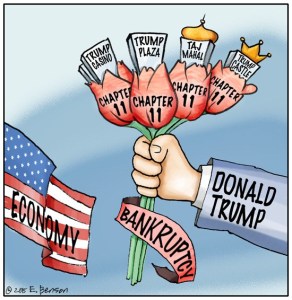

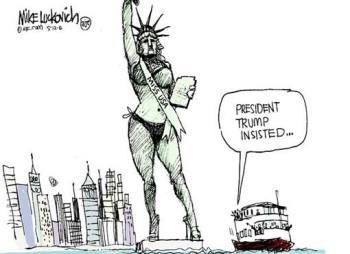 The Atlantic
 When all of this finally begins to unravel in a manner befitting of such a serious level of scandal, it can’t help but take our economy with it. How much damage can Trump, Ryan et al inflict on us and at what point will
 Good Afternoon!
 Trump’s administration is taking the blame for the public view that the first few weeks in the White House have been abysmal and produced nothing in the way of legislative change.
 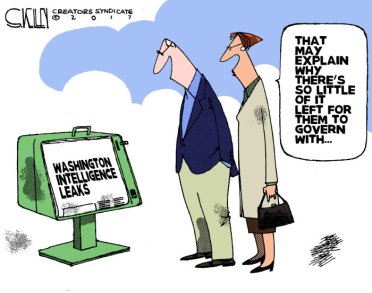 Paul Krugman lays the blame on all Republicans saying “Why Republicans Have No Idea What They’re Doing”.
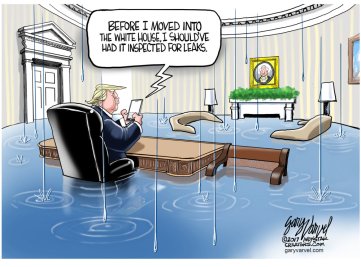 Charles Blow has he best advice I’ve seen in short form. While Krugman argues that the Republicans are a party not ready to govern, Blow says
  Greg Sargent also has a point:
 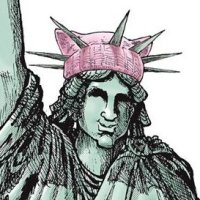 Let’s keep hoping, praying and wishing for resilient institutions! Resist!!! Hopefully, the leaky T-Rump White House will help put out this National Dumpsterfire.
 This will not create US jobs. If anything, it will take away the jobs of those who work for firms that export US goods. As an economist, I cannot stress enough how devastating this will be to the US economy, our geopolitical and geoeconomic standing in the region, and our relations with other nations. Isolationism has never been–historically–a good thing. Additionally, it will not save or re-create US jobs destroyed by technology. For example, it’s only a matter of years before there will be no need for long haul truck drivers. We’re already learning to be our own grocery checkers.
 Marching on Saturday with the 3 – 5 million others dampened my despair. I’m still extremely afraid of this insanity. But, it was so wonderful to know so many of us reject his delusions and aspire to create a more perfect union. We are a gumbo. We are a patchwork quilt. We are a jazz riff. We are so much more than Trump’s Narcissism can comprehend, respect, grasp, grok, appreciate, love … please enjoy my pictures of the NOLA March for Women and one other I got caught in by my friend Lynda Woolard who is–in turn–the red head in the photo shown second. I’m scowling at the southern sun just to the right of the Vulva up top.
 The man is insane and has no idea of what he speaks. Seriously, we’re headed to Depression. It’s the 30s all over again.
 I really just can’t do today. I can’t.
 peej
peej Carissa
 bostonboomer
 dakinikat
 ecocatwoman
 mablue2
 Mama Lopez
 peggysue22
 quixote
 skydancingguestblogger
 Mona (aka Wonk the Vote)



 Sky Dancing
Recent Comments