
Breaking… Verdict Reached in Casey Anthony Trial
Posted: July 5, 2011 Filed under: child sexual abuse, children, Crime, physical abuse | Tags: Casey Anthony, child abuse, crime, human decomposition, justice system, murder 152 Comments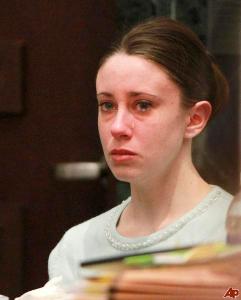
Casey Anthony
The jury informed the court a short time ago that a verdict had been agreed upon. The result will be announced at approximately 2:15.
ORLANDO, Fla. — The jury has reached a verdict in the murder trial of Casey Anthony, who is accused of killing her 2-year-old daughter Caylee. Judge Belvin Perry says he will read the verdict at 1:15 p.m. Chicago time Tuesday.
The Florida jury deliberated for more than 10 hours. If convicted of first-degree murder, the 25-year-old Anthony could get a death sentence.
She could also be acquitted or convicted of second-degree murder or manslaughter.
She is also charged with lying to sheriff’s detectives investigating her daughter’s 2008 disappearance.
The panel of seven women and five men appeared briefly in the courtroom Tuesday before Perry sent them to continue their work behind closed doors. The jurors had worked through much of the long weekend, hearing closing arguments Sunday and Monday morning and deliberating for six hours that afternoon.
Such a short deliberation time sounds bad for the defense, good for the prosecution. Of course the OJ jury only deliberated for four hours, but he had better attorney’s and a biased jury.
I’ll add more info as I get it. Let us know what you’re hearing.
Late Night: What is the “Legal Issue” that Shut Down Saturday Testimony in the Casey Anthony Trial?
Posted: June 26, 2011 Filed under: children, Crime, just because | Tags: Casey Anthony, Cheney Mason, death penalty, Geraldo Rivera, Jean Casarez, Jose Baez, Judge Belvin Perry, Lee Anthony, legal issue, mistrial, plea deal, Ray Kronk, The Hinky Meter, under seal, Valhall, Vinnie Politan 23 Comments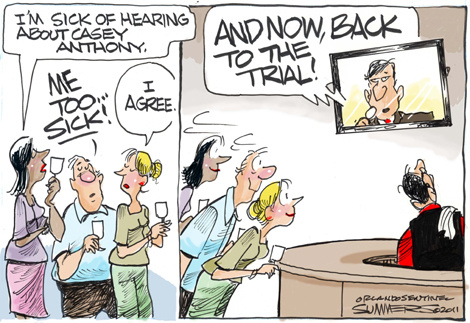
Chief Judge Belvin Perry and the attorneys met outside the courtroom and discussed matters that are “under seal” and not part of the public record, according to a court-system spokeswoman.
Perry emerged from the conference and announced aloud in court that a “legal matter” had come up, requiring court to be recessed.
His announcement came about 9:40 a.m. on a day he had expected to hear testimony until about 3:30 p.m. Instead, Perry announced that Anthony’s trial in the 2008 death of her daughter, Caylee, will resume Monday morning.
In the absence of an explanation, speculation soared that a plea deal might be in the making or that another call for mistrial had emerged or that there might be legal issues involving testimony by Lee and Cindy Anthony — the defendant’s brother and mother.
Those are the possibilities that first occurred to me too. But I really don’t think Casey would take a plea, and the prosecution has said they wouldn’t accept one after the trial began. Since it was Cheney Mason who asked to discuss something, I also wondered if the defense wanted to claim that Lee Anthony had perjured himself, but that would normally wait till the end of the trial wouldn’t it? If it were a mistrial, wouldn’t Jose Baez have just brought it up in open court?
Of course I have no idea what the “legal issue” is, but I thought I’d share some speculations I’ve seen from “experts” and court followers around the ‘net.
Vinnie Politan of True TV and HLN tweeted yesterday that he received confirmation from Cheney Mason that it definitely isn’t a plea deal.
@VinniePolitan
NO PLEA DEAL… My pal Jean Casarez spoke with Cheney Mason to confirm! RT to end the speculation!
Hal Boedeker, the TV Guy at the Orlando Sentinel has more detail from Jean Casarez:
Here’s what Casarez reported last night: “Cheney Mason, attorney for Casey Anthony, confirms with me that ALL of the media speculation surrounding Judge Belvin Perry’s dismissal of court this morning is false. This speculation would include plea deal, mistrial, Roy Kronk’s telephone records and issues with Dr. Bill Rodriguez testifying for the defense.
Boedeker also reported that Geraldo {gag} Rivera, who is friends with defense attorney Jose Baez,
…called the delay shocking. But he also cited ”an unimpeachable source” who said the legal issue “is expected to have no long-term impact on the trial, and further, it is still possible this contentious case could be wrapped up before July 4.” And Rivera added that the trial is “expected to resume Monday as if nothing happened, legally speaking. There is no harm, no foul.”
No foul except for Baez maybe leaking sealed info to his pal Geraldo….
The Christian Science Monitor brought up a possibility I hadn’t thought of. They cited an issue relating to testimony on Friday by lead detective Yuri Melich:
During testimony on Friday, Detective Melich revealed that investigators had obtained the cell phone records of Roy Kronk, the man who called police after discovering a small child’s skeletal remains in a wooded area not far from the Anthony’s home.
Melich said police obtained Mr. Kronk’s phone records from June to December 2008….That six-month date range is important for two reasons. It suggests that, at least initially, investigators suspected Kronk might be more than an innocent bystander who merely stumbled upon the gruesome scene.
Second, that date range suggested to Baez that state prosecutors had failed to turn those phone records over to him as court rules require.
Kronk is a big part of the defense case, and if the prosecution deliberately failed to turn the records over it would be a serious problem and could possibly lead to a mistrial. However, Baez has accused the prosecution of this kind of thing before and it has always turned out that he was mistaken. Still, it’s an interesting possibility.
The most intriguing speculation I found was at the blog The Hinky Meter in a comment by one of the bloggers, Valhall. He or she thinks that Cheney Mason wants out, because this trial is is “swan song,” and he’s embarrassed by all of Jose Baez’s grandstanding and underhanded tactics. Mason is the only attorney on the defense team with experience in death penalty cases. That would surely throw a wrench into the defense’s plans. Read the whole comment to get a sense of Valhall’s reasons for thinking this.
What do you other Trial followers think?
Family Dynamics and the Casey Anthony Trial
Posted: June 25, 2011 Filed under: child sexual abuse, children, Crime, physical abuse, psychology | Tags: aggravated child abuse, Casey Anthony, Caylee Anthony, child abuse, chloroform, Cindy Anthony, death penalty, family dynamics, first degree murder, George Anthony, high profile trials, ketamine, Keysey Soze syndrome, Lee Anthony, media circus, OJ Simpson, pathological lying, second degree murder, sociopaths 61 Comments
Cindy, Casey, and Lee Anthony
Since it’s Saturday night on a slow news day, I thought I’d share some of my impressions about Casey Anthony and her family. I’m by no means an expert on this case–I only began following it right after the trial began. I’ll try to briefly summarize the story behind the trial as I understand it, but I’m going to assume that readers have a basic knowledge of the Anthony case.
This case has been covered so extensively in the media for the past three years that it might even outdo the media circus around the O.J. Simpson trial. This is one reason I never read about the case until recently. I thought the public reaction was kind of repulsive and hysterical. But once I started reading about what happened, I was drawn in by the fascinating story and its psychological aspects.
Background:
Casey Anthony, 25, is on trial in Orlando, Florida, for first degree murder in the death of her daughter Caylee, who was nearly 3 years old. If convicted, Casey could be sentenced to life in prison or death. She is also charged with second degree murder and aggravated child abuse–both of which carry a life sentence.
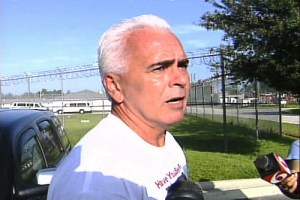
George Anthony
The story began when Casey became pregnant at age 19. Casey supposedly did not realize she was pregnant until she was 7 months along. Casey’s mother Cindy, a registered nurse, also claims she never realized her daughter was pregnant until then. Casey’s father George went along with the charade too. Once she faced the fact that she was going to have a baby, Casey told friends she wanted to give the child up for adoption; but Cindy pressured her to keep the child, and provide for both of them. The child, Caylee, was born on August 8, 2005 and the mother and child lived with George and Cindy.
Civil Trial in Orlando Has Important Implications for Athletes and Families
Posted: June 13, 2011 Filed under: children, education, sports, U.S. Politics | Tags: Bennie Abram, College athletes, Devard Darling, Devaughn Darling, Ereck Plancher, high school athletes, Kourtni Livingston, NCAA, sickle cell trait 7 CommentsAs everyone who hasn’t been living under a rock knows by now, there is a high profile trial going on in Orlando, Florida–complete with circus-like atmosphere and spectators fighting for tickets to see the trial live. I’m referring, of course, to the trial of Casey Anthony, accused of first degree murder in the death of her daughter Caylee.
The Anthony trial is getting wall-to-wall coverage on TV stations in Florida, as well as on a couple of cable outlets, but there is another case beginning jury selection today in the same Orange County Courthouse that may have wider implications for families around the country and for high school and college athletic programs.

A sickle cell with normal blood cells
In March, 2008, Ereck Plancher, a 19-year-old freshman at the University of Central Florida (UCF), collapsed and died after a preseason football practice. An autopsy showed that Plancher died from complications associated with sickle cell trait.
In March 2009, Plancher’s parents filed suit for wrongful death against UCF’s board of trustees and Athletics Association claiming that their son’s coaches and trainers knew that Plancher had the sickle cell trait but didn’t inform him or his family. In addition, they charge that UCF athletic staff failed respond when Plancher began to exhibit symptoms during the his last practice and therefore they contributed to his death.
Basically, individuals with this trait are carriers of one sickle cell gene–they are heterozygous. In order for sickle cell disease to fully manifest, an individual must have two copies of the abnormal gene. However, it is possible for sickle cell symptoms to appear under highly stressful conditions such as high altitudes, extreme physical exertion, or dehydration. In such instances, there can be dangerous complications. The sickle cell gene is far more common in people with African heritage than people from other ethnic backgrounds. The NCAA and some colleges and universities have resisted testing players for the trait for fear of being accused of racial discrimination.
The most egregious allegation is that the coach and trainers withheld water from players during the workout, and this was backed up in pre-trial testimony by three former UCF players, Nate Tice, Cody Minnich, and Anthony Davis. Tice and Minnich testified in a hearing on Friday.
When Tice was asked during his deposition whether water was available during Plancher’s last workout, he responded, “No.”
Tice, a reserve quarterback who transferred to Wisconsin, said players asked for water from athletic trainers “at your own risk” because O’Leary would curse at athletes who interrupted workouts.
Tice was then asked whether there were athletic trainers present during Plancher’s last workout. Tice said, “They were in a corner. They were not, like, with us.”
Minnich, a reserve offensive lineman who was dismissed from the team after being arrested for driving under the influence in December 2008, said during his deposition there was no water available in the practice facility while the players were running through an obstacle course and sprints.
“They were ordered to take the water outside of the building, and they weren’t there during that portion of the workout,” Minnich said of the athletic trainers.
When he was asked who ordered the athletic trainers to leave, Minnich said O’Leary shouted the instructions.
The question of adequate hydration is central to the case. The judge decided on Friday that Plancher’s parents can sue for punitive damages, but they will only be awarded if the jury decides water was unavailable during the practice.
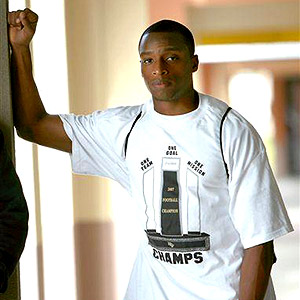
Ereck Plancher
Tice and Minnich bolstered the previous testimony of Anthony Davis.
UCF officials, including O’Leary and athletic director Keith Tribble, said in the immediate aftermath of Plancher’s death that the workout in which he collapsed was not a taxing one. However, former wide receiver Anthony Davis said in his sworn statement that trainers didn’t help Plancher as he struggled to finish an obstacle course. He also told attorneys that he witnessed O’Leary curse Plancher at times when he couldn’t keep up with other teammates.
Davis also told attorneys that he witnessed O’Leary curse Plancher at times when he couldn’t keep up with other teammates.
Ereck Plancher is not the first athlete to die from complications of sickle cell trait.
CNN reports that nine collegiate football players’ deaths have been related to sickle-cell trait since 2000, making exertional sickling the leading cause of death in NCAA football players this decade.” But “the medical field is divided over whether there is enough evidence to warrant the mass screenings,” because the way the trait is related to the deaths is “unclear,” CNN reports.
According to the Washington Post, there have been four such deaths in Florida alone.
Four in-state college football players have died in the past decade while participating in offseason workouts: Plancher; South Florida’s Keeley Dorsey; Florida’s Eraste Autin; and Florida State’s Devaughn Darling.
Devaughn Darling’s twin brother Devard, who went on to play in the NFL, spoke about his brother’s death and about having the sickle cell trait in this 2007 USA Today story.
“I believe it had some effect on him, definitely,” said Devard Darling. “My teammates, who were there at the time, said he was saying he couldn’t see, he was blacking out. … Clearly, there were signs for him to stop. There was definitely room for coaches and athletic trainers to step in and say that’s enough.”
Devard said he’s had no problems with the condition and has always done “all team activities.”
But, he added, “I know my body. It’s important for young athletes as they grow to know their limitations. The No. 1 thing is staying hydrated. … But there is a point at which you know something is not right. You need a little rest.”
He added, “I’m sure it’s not just me (participating in pro sports with sickle cell trait). They say one out of every 10-12 people of African descent carries the sickle cell trait. You know the high amount of African-Americans in pro sports.”
The Darling family received a $200,000 settlement from Florida State (the amount was $2 million, but Florida limits the amount that can be paid in a wrongful death suit!).
Devard has set up a foundation in his native Bahamas to support the brothers’ “dream of bringing football home to the Bahamas and creating opportunities for young kids.” The As One Foundation gets its name from the twins’ hearts beating “as one” in the womb.
A similar wrongful death lawsuit was recently filed in Mississippi.
The family of a deceased Ole Miss football player filed a wrongful death lawsuit Tuesday against the NCAA, the University of Mississippi, coach Houston Nutt as well as several staffers and medical personnel.
Bennie “Buster” Abram died in February 2010 following an early offseason workout due to complications from sickle cell trait. His parents alleged in a 32-page document filed in Mississippi circuit court that the defendants were so “reckless” that their actions rise to “the level of crimes such as” negligent criminal homicide and involuntary manslaughter.
[….]
Bennie Abram III, a walk-on, collapsed shortly after an early-morning workout on Feb. 19, 2010. Six hours later he was pronounced dead. Three months later, an autopsy determined sickle cell trait had contributed to his death. At the time, Abram was the 21st NCAA football player to die from a non-traumatic event since 2000. Eleven of those deaths had come in Division I-A. Sickle cell trait remains the leading killer of Division I football players since that year.
The NCAA did not mandate testing for the condition until last year. That move resulted from a legal settlement between the family of deceased Rice player Dale Lloyd II and the NCAA in 2009. Eugene Egdorf, the lead attorney in Abram’s lawsuit, represented the Lloyd family. Dale Lloyd died in 2006 as a result of sickle cell trait following a workout.
“[Bennie’s] death is a tragedy that should have been prevented,” Egdorf said in a release announcing Tuesday’s suit. “Every sickle cell expert in the world will tell you that the only way this trait can cause a student-athlete’s death is when they are put through overly strenuous workouts like the one Bennie went through before he died.”
Again, in this case, university officials knew the young man had the sickle cell trait and did not inform him or his family or take special precautions.
The NCAA now mandates testing for sickle cell trait for all Division I athletes, but there is an opt-out for students who sign a waiver.

Kourtni Livingston
In my opinion, screening for the trait should be instituted at every level of student athletics. Certainly there should also be protections to keep people who test positive from being discriminated against. High school athletes can also be stressed enough for the symptoms to manifest, as demonstrated in the case of 14-year-old Lubbock, Texas basketball player Kourtni Livingston, who died while running laps.
As one of the attorneys in the Ereck Plancher case emphasized:
“This is not a case about punitive damages or about insurance, it’s about saving lives,” Plancher attorney Steven Yerrid said recently. “It’s not about compensating the Plancher family. It’s about stopping football programs from disregarding safety of student athletes that participate in them. And that’s important and that’s the message. Punitive damages are not designed to compensate plaintiffs. … They’re designed to punish wrongdoers and to send a message that type of conduct won’t be tolerated.
Thursday Reads: Lying Politicians vs Truly Egregious Behavior; Crazy Republicans; and More
Posted: June 9, 2011 Filed under: 2012 presidential campaign, abortion rights, child sexual abuse, children, Crime, Democratic Politics, Economy, fetus fetishists, Foreign Affairs, Libya, U.S. Economy, U.S. Military, U.S. Politics | Tags: Andrew Breitbart, Autism, Camp Shelby, child sexual abuse, CREW, genetic mutations, John Huntsman, lightning, Melanie Sloan, Michelle Bachmann, Mitt Romney, Moammar Gaddafi, rape, Rep. Anthony Weiner, Rep. Charles Rangel, Rick Santorum, Sarah Palin, Scott Walker, Tim Pawlenty, war crimes 33 Comments
Good Morning!!
I’m sick and tired of the Weiner story, and I know most of you are too; but I just want to highlight a few reactions that I found interesting–all G rated.
I love this Lambert post, especially this part:
ZOMG!!!!!!! Offensive behavior online!!!!!!!! [Too tired for the riffs about the pearl clutching and the fainting couch.]
Anyhow, so Weiner’s an asshole. And so what. As William Gibson said:
“Fortunately,” he said, “it isn’t about who’s an asshole. If it were, our work would never be done.”
Love that quote! As Lambert points out, these “ethics” investigations never seem to happen to people who engage in torture, election fraud, or handing over the U.S. treasury to banksters.
Speaking of assholes, Andrew Breitbart claims he still has one more “lewd picture” of Weiner that he hasn’t released–and it’s not the one going around today. Talk about an evil human being. Breitbart is disgusting. If you read to the end of that piece, you’ll find out Breitbart’s notions of female sexuality.
One person who seems to have a little sympathy for Weiner is Charlie Rangel.
“His most serious problem is keeping his wife and family together at this time,” Rangel said in an interview on Fox Business Network set to air Wednesday evening.
Rangel did not suggest that Weiner resign. Here’s what he had to say about “ethics” investigations:
“They may do that, and God knows, I know what people feel they have to do as politicians to protect themselves. It’s totally unbelievable, but it happens,” Rangel said. “They love you, but they love themselves better and they make political decisions not to how it affects you, but to how it affects them and their reelection.”
They are all slime, yet they presume to sit in judgment on others. What Weiner did makes me sick, but the rest of them make me even sicker.
Melanie Sloan of CREW says there is a double-standard operating in the many calls for Weiner to resign.
“This is a massive overreaction and I don’t understand it,” said Melanie Sloan, executive director of Citizens for Responsibility and Ethics in Washington.
She points out that Charlie Rangel was censured for serious ethical breaches, yet was not forced to resign.
Sloan explained that the mounting pressure on Weiner may stem in part from the early precedent set by House Speaker John Boehner when, at the first sign of sexual misconduct, he urged Reps. Mark Souder (R, Ind.) and Chris Lee (R, N.Y.) to resign, even though their behavior didn’t appear to involve any abuse of their office.
“A lot of people really hate Weiner, too,” she said, referring to Weiner’s colleagues in the House, some of whom are said to have been rankled by his personality and frequent media appearances.
What about Weiner’s denials before he owned up?
“A politician lying is not that unusual,” Sloan said. “If the new standard is that politicians are out the second they lie to us, then a lot of politicians could be gone.”
How true.
As egregious as Weiner’s behavior was, it wasn’t a crime. Here’s an example of truly egregious behavior: U.S. pediatrician on trial for raping toddlers
A Delaware pediatrician went on trial for allegedly raping or sexually exploiting 86 young patients, all girls except one and almost all younger than three.
Earl Bradley has pleaded not guilty to 24 counts against him, and sat quietly in gray prison scrubs as a veteran state trooper spent hours Tuesday describing the doctor’s cache of home videos of the assaults.
They were so “horrible,” testified state police detective Scott Garland, a specialist in forensic computer evidence. “They were beyond anything I had ever witnessed. Nothing prepared me for it.”
And then there’s this: Casey Antony told a fellow inmate that she used chloroform to knock out her daughter Caylee when she (Casey) wanted to party.
Gaddafi bought Viagra-like pills for troops to attack women
Luis Moreno-Ocampo said he may ask for a new charge of mass rape to be made against Gaddafi following the new evidence. The chief International Criminal Court prosecutor is expecting a decision from judges within days on his request for crimes against humanity charges against the Libyan leader.
“Now we are getting some information that Gaddafi himself decided to rape and this is new,” Mr Moreno-Ocampo told reporters.
He said there were reports of hundreds of women attacked in some areas of Libya, which is in the grip of a months-long internal rebellion.
Mr Moreno-Ocampo said there was evidence that the Libyan authorities bought “Viagra-type” medicines and gave them to troops as part of the official rape policy.
“They were buying containers to enhance the possibility to rape women,” he said.
“We had doubts at the beginning but now we are more convinced that he decided to punish using rapes,” the prosecutor said. “It was very bad — beyond the limits, I would say.”
Let’s move on to the horrors of the Republican 2012 presidential field. According to a new Quinnipiac poll, voters aren’t ready for a Mormon president.
Sorry, Mitt. John Huntsman is also a Mormon. I guess voters don’t mind looney religionists as long as they claim to be Christians though. Have you heard about Tim Pawlenty’s economic plan?
Pawlenty calls for sweeping tax cuts dubbed by some as “breathtaking.” He’d cut the corporate income tax from 35 percent to 15 percent, and eliminate taxes on capital gains, interest income, dividends and inheritances. There would be two tiers of personal income taxes — 10 percent and 25 percent.
Pawlenty would require Congress to reauthorize all federal regulations and radically reshape the federal government by privatizing services such as the U.S. Postal Service and Amtrak. He also would support an ill-advised balanced budget amendment. You could almost hear the corporate special interests uttering “check, check and check!” as the South St. Paul truck driver’s son ticked off items on their wish lists and then one-upped them.
Just reading about it makes me want to run out into the street screaming and tearing my hair out.
Sarah Palin and Michelle Bachmann are supposedly feuding now because Ed Rollins said that Bachman is more “serious” than Palin. I had to really look around to find an article that didn’t call it a “cat fight.” Here’s Rollins, quoted by NPR:
“Well I’m going to work for Michele Bachmann if she runs. That’s the one that intrigues me the most at this point and I think to a certain extent she’s articulate, she’s a conservative. She’s got a great story to tell. She’s on the Intelligence Committee. You know, she’s unknown to the national audience, but she’ll become known and that’s the candidacy that I’m going to work for if she runs.
“Sarah has not been serious over the last couple of years. She got the vice-presidential thing handed to her. She didn’t go to work in the sense of trying gain more substance. She gave up her governorship. You know, I think Michele Bachmann and others have worked hard. She has been a leader of the Tea Party, which is a very important element here. She’s an attorney, done extraordinary things with family values and what have you. So I think she will connect. She’s a great, great communicator and I would say in the race today she is probably the best communicator.”
Kinda takes your breath away, doesn’t it? Now check this out: Santorum Calls Abortion Exceptions To Protect Health Of The Mother ‘Phony’
Longshot GOP presidential hopeful and former Pennsylvania Senator Rick Santorum stomped for votes in Iowa on Tuesday, trumpeting his “culture wars” message. A longtime anti-abortion activist, Santorum is selling himself as the leading social conservative in a crowded field. Yesterday in West Des Moines, he made an appearance at a “crisis pregnancy center” called Informed Choices that tries to talk women out of having abortions. Santorum said that he “separates [himself] from the rest of the pack” and criticized the other candidates for simply “checking the box” on anti-abortion issues.
When discussing his track record as a champion of the partial birth abortion ban, Santorum dismissed exceptions other senators wanted to carve out to protect the life and health of mothers, calling such exceptions “phony”:
SANTORUM: When I was leading the charge on partial birth abortion, several members came forward and said, “Why don’t we just ban all abortions?” Tom Daschle was one of them, if you remember. And Susan Collins, and others. They wanted a health exception, which of course is a phony exception which would make the ban ineffective.
In other stupid Republican news, Wisconsin Governor Scott Walker had a painting of poor and homeless children removed from the governor’s mansion. From Mother Jones:
Walker has made headlines again after he removed a painting depicting three Wisconsin children—one had been homeless, one came from low-income family, and a third who had lost family members in a drunk-driving accident. According to the Milwaukee Journal Sentinel, the painting was one of numerous pieces of art commissioned by the fund that operates the governor’s mansion—works that were intended to remind the governor of the constituents he or she represents.
Here’s the Journal Sentinel on the painting by artist David Lenz:
In an interview, Lenz said he carefully selected the three children portrayed in “Wishes in the Wind.” The African-American girl, featured in a Journal Sentinel column on homelessness, spent three months at the Milwaukee Rescue Mission with her mother. The Hispanic girl is a member of the Boys & Girls Clubs of Greater Milwaukee. And the boy’s father and brother were killed by a drunken driver in 2009.
“The homeless, central city children and victims of drunk drivers normally do not have a voice in politics,” Lenz explained in an email. “This painting was an opportunity for future governors to look these three children in the eye, and I hope, contemplate how their public policies might affect them and other children like them.”
He added: “I guess that was a conversation Governor Walker did not want to have.”
In other news, at Camp Shelby in Mississippi, 77 army cadets were struck by lightening and hospitalized. Let’s hope they’ll all be okay. The weather sure is strange this year!
I’ll end with this interesting story from the LA Times: Autism linked to hundreds of genetic mutations.
Autism is not caused by one or two gene defects but probably by hundreds of different mutations, many of which arise spontaneously, according to research that examined the genetic underpinnings of the disorder in more than 1,000 families.
The findings, reported in three studies published Wednesday in the journal Neuron, cast autism disorders as genetically very complex, involving many potential changes in DNA that may produce, essentially, different forms of autism.
The affected genes, however, appear to be part of a large network involved in controlling the development of synapses, the critical junctions between nerve cells that allow them to communicate, according to one of the three studies.
Although the work will have no immediate value to patients or their families, the insights provide a wealth of targets to pursue in developing treatments for the disorder, scientists said. Understanding the genetic causes of autism spectrum disorders may promote more accurate diagnoses, and research on synapse formation and function could yield treatments that address the flow of signals between nerve cells.
What are you reading and blogging about today? Please share!!

 peej
peej Carissa
 bostonboomer
 dakinikat
 ecocatwoman
 mablue2
 Mama Lopez
 peggysue22
 quixote
 skydancingguestblogger
 Mona (aka Wonk the Vote)



 Sky Dancing
Recent Comments