Posted: August 19, 2023 | Author: bostonboomer | Filed under: 2020 Elections, 2021 Insurrection, Afternoon Reads, Cats, caturday | Tags: China, Christopher Worrell, Enrique Tarrio, fake electors, FBI, foreign policy, Georgia election interference case, January 6 insurrection, January 6 prosecutions, Japan, Joe Biden, Joe Biggs, Kenneth Chesebro, Proud Boys, South Korea, Vietnam |
 Happy Caturday!!
It’s difficult for me to focus on anything except the legal news about Trump’s crimes; but before I get to the latest on that, I want to call attention to Joe Biden’s latest foreign policy efforts. I admit I really that I originally was not at all enthused about a Biden presidency, but he has turned out to be very good at his job. His age and experience have prepared him for this moment in history.
Reuters: US, South Korea and Japan condemn China, agree to deepen military ties.
CAMP DAVID, Maryland, Aug 18 (Reuters) – U.S. President Joe Biden and the leaders of South Korea and Japan agreed at Camp David on Friday to deepen military and economic cooperation and made their strongest joint condemnation yet of “dangerous and aggressive behavior” by China in the South China Sea.
The Biden administration held the summit with the leaders of the main U.S. allies in Asia, South Korean President Yoon Suk Yeol and Japanese Prime Minister Fumio Kishida, in a bid to project unity in the face of China’s growing power and nuclear threats from North Korea.
In a summit statement the three countries committed to consult promptly with each other during crises and to coordinate responses to regional challenges, provocations and threats affecting common interests.
They also agreed to hold military training exercises annually and to share real-time information on North Korean missile launches by the end of 2023. The countries promised to hold trilateral summits annually.
While the political commitments fall short of a formal three-way alliance, they represent a bold move for Seoul and Tokyo, which have a long history of mutual acrimony stemming from Japan’s harsh 1910-1945 colonial rule of Korea.
The summit at the Maryland presidential retreat was the first standalone meeting between the U.S. and Japan and South Korea and came about thanks to a rapprochement launched by Yoon and driven by shared perceptions of threats posed by China and North Korea, as well as Russia after its invasion of Ukraine.
The leaders’ language on China stood out as stronger than expected, and is likely to provoke a response from Beijing, which is a vital trading partner for both South Korea and Japan.
“Regarding the dangerous and aggressive behavior supporting unlawful maritime claims that we have recently witnessed by the People’s Republic of China (PRC) in the South China Sea, we strongly oppose any unilateral attempts to change the status quo in the waters of the Indo-Pacific,” the statement said.
 Next Biden plans to build closer ties with Vietnam. Politico: Biden to sign strategic partnership deal with Vietnam in latest bid to counter China in the region.
President Joe Biden will chalk up a fresh victory in his campaign to boost U.S. influence in the Indo-Pacific by sealing a deal with Vietnam next month aimed to draw Hanoi closer to Washington at a time of rising tensions with Beijing.
Biden will sign a strategic partnership agreement with Vietnam during a state visit to the Southeast Asian country in mid-September, according to three people with knowledge of the deal’s planning. They were granted anonymity because they weren’t authorized to speak on the record about the agreement.
The agreement will allow for new bilateral collaboration that will boost Vietnam’s efforts to develop its high technology sector in areas including semiconductor production and artificial intelligence….
The deal adds to Biden’s string of successful diplomatic initiatives aimed to reassert U.S. influence in Asia in the face of China’s growing economic, diplomatic and military muscle in the region. They include a historic Camp David summit Friday with Biden, Japanese Prime Minister Fumio Kishida and South Korean President Yoon Suk Yeol — aimed at addressing regional threats from North Korea and China.
The Vietnam agreement coincides with an uptick in tension between Hanoi and Beijing over long-standing territorial disputes in the South China Sea. Vietnam — along with the Philippines, Malaysia and Brunei — has long protested Beijing’s claim of authority over parts of the South China Sea that extend 1,200 miles from China’s coastline. Hanoi banned the Barbie movie last month due to a scene that appeared to reference the nine-dash line Beijing says marks its territorial waters. Satellite imagery released this week indicates China is building an airfield on an island that Hanoi says is Vietnamese territory.
But the agreement doesn’t necessarily signal that Vietnam is moving away from its giant neighbor China in favor of better ties with Washington.
“Vietnam is not aligning with the U.S. against China. … They’re happy to improve relations with the U.S., but it doesn’t mean they’re moving against China — they’re going to continue to calibrate very carefully,” said Scot Marciel, a former principal deputy assistant secretary for East Asia and the Pacific at the State Department who opened the first State Department office in Hanoi in 1993.
 Now some legal news.
In the January 6th prosecutions, the DOJ has asked for 33 years in prison for Proud Boy leaders Enrique Tarrio and Joe Biggs. Kyle Cheney at Politico: Prosecutors seek 30-year sentences for Proud Boys leaders in Jan. 6 case.
Prosecutors are seeking 33-year prison sentences for former Proud Boys chair Enrique Tarrio and his ally Joe Biggs, who they say aimed to foment a revolution on Jan. 6 to keep former President Donald Trump in power.
The proposed jail sentences would nearly double the lengthiest Jan. 6 sentence handed down to date — 18 years for Oath Keepers leader Stewart Rhodes — a decision prosecutors say reflects the pivotal role that Proud Boys leaders played in stoking and exacerbating the violence at the Capitol that day.
“The defendants understood the stakes, and they embraced their role in bringing about a ‘revolution,’” prosecutors wrote in their sentencing memo released Thursday night. “They unleashed a force on the Capitol that was calculated to exert their political will on elected officials by force and to undo the results of a democratic election. The foot soldiers of the right aimed to keep their leader in power. They failed. They are not heroes; they are criminals.”
Both Tarrio and Biggs were convicted of seditious conspiracy in May by a jury who also found allies Philadelphia Proud Boy leader Zachary Rehl and Seattle Proud Boy leader Ethan Nordean guilty of the grave offense. Prosecutors are seeking 30 years for Rehl and 27 years for Nordean.
A fifth Proud Boy tried alongside the others, Dominic Pezzola, was acquitted of seditious conspiracy but convicted on other serious offenses. Pezzola may be the best known of the group, however. He shattered a Senate-wing window with a stolen police riot shield, triggering the breach of the Capitol itself. Prosecutors are seeking a 20-year jail term for him.
 Read more details at the Politico link.
Marcy Wheeler has an interesting story about Proud Boy Joe Biggs, who used to be an informant for the FBI. If you’ve wondered why the FBI failed to warn people about the terrorists who were working to overthrow the government on January 6, here’s one answer. Emptywheel: “They Spoke Often:” It Took the Fash-Friendly FBI Over Two Months to Document the Lies their Informant, Joe Biggs, Told Them.
I always have a hard time excerpting Marcy’s posts, but I hope you’ll go read it at the link. The gist is that the FBI used Biggs to target “Antifa.” They were focused on radical left groups and ignored the violent extremist on the right. Here’s the summary at the end of the post:
The FBI claims it had no notice of the terrorist attack on the nation’s Capitol, not even with an FBI agent “speaking often” with one of its leaders and an DC intelligence cop speaking often with the other one.
So now, DOJ wants to hold Joe Biggs accountable for the lies he told to the FBI agent who thought a key leader of the Proud Boys would make an appropriate informant targeting Antifa. But thus far, his handler has not been held accountable for missing the planning of a terrorist attack in DC when while speaking “often” with one of its key leaders.
Notably, the Daytona FBI office is the same one where, after fake whistleblower Stephen Friend refused to participate in a SWAT arrest of a Three Percenter known to own an assault rifle, his supervisor said “he wished I just ‘called in sick’ for this warrant,” before taking disciplinary action against him (though Friend didn’t start in Daytona Beach until after Biggs had already been arrested).
The second of these interviews (but not the first) interview was mentioned in Biggs’ arrest affidavit. It’s possible that investigating agents didn’t even know about what occurred in the first one.
Indeed, it’s really hard to credit the reliability of a 302 written two days after Biggs described his chummy relationship but not this interview in an attempt to stay out of jail.
This is why the FBI didn’t warn against January 6. Because these terrorists were the FBI’s people.
 Another Proud Boy, Christopher Worrell, was supposed to be sentenced soon, but yesterday, news broke that he has disappeared. Associated Press: Proud Boy on house arrest in Jan. 6 case disappears ahead of sentencing.
Authorities are searching for a member of the Proud Boys extremist group who disappeared days before his sentencing in a U.S. Capitol riot case, where prosecutors are seeking more than a decade in prison, according to a warrant made public Friday.
Christopher Worrell, 52, of Naples, Florida, was supposed to be sentenced Friday after being found guilty of spraying pepper spray gel on police officers, as part of the mob storming the Capitol as Congress was certifying Joe Biden’s presidential victory on Jan. 6, 2021. Prosecutors had asked a judge to sentence him to 14 years.
The sentencing was canceled and a bench warrant for his arrest issued under seal on Tuesday, according to court records. The U.S. attorney’s office for Washington, D.C., encouraged the public to share any information about his whereabouts.
Worrell had been on house arrest in Florida since his release from jail in Washington in November 2021, less than a month after a judge substantiated his civil-rights complaints about his treatment in the jail.
U.S. District Judge Royce Lamberth found Worrell’s medical care for a broken hand had been delayed, and held D.C. jail officials in contempt of court.
 The big topic of conversation in the media and Twitter yesterday was a Trump ally who has previously passed under the radar–Kenneth Chesebro, who appears to be one of the unindicted co-conspirators in the Georgia election interference case. It turns out this guy was integral to what happened on January 6. Chesboro was also the originator of the scheme to use “fake electors” to overthrow the 2020 election.
CNN’s KFile: Kenneth Chesebro, alleged architect of fake electors’ plot, followed Alex Jones around Capitol grounds on January 6th.
When conspiracy theorist Alex Jones marched his way to the US Capitol on January 6, 2021, riling up his legion of supporters, an unassuming middle-aged man in a red “Trump 2020” hat conspicuously tagged along.
Videos and photographs reviewed by CNN show the man dutifully recording Jones with his phone as the bombastic media personality ascended to the restricted area of the Capitol grounds where mobs of then-President Donald Trump’s supporters eventually broke in.
While the man’s actions outside the Capitol that day have drawn little scrutiny, his alleged connections to a plot to overthrow the 2020 election have recently come into sharp focus: He is attorney Kenneth Chesebro, the alleged architect of the scheme to subvert the 2020 Electoral College process by using fake GOP electors in multiple states.
When asked by the House select committee where he was the first week of January 2021 and on January 6, Chesebro invoked his Fifth Amendment rights. But a CNN investigation has placed him outside of the Capitol at the same time as his alleged plot to keep Trump in office unraveled inside it.
There is no indication Chesebro entered the Capitol Building or was violent. Jones did not enter the Capitol on January 6, 2021, or engage in violence, but he had warned of a coming battle the day before and urged his supporters to converge on the Capitol.
Chesebro is the only one of the unindicted co-conspirators in Trump’s recent federal indictment and only member of Trump’s legal efforts who is now known to have been on the Capitol grounds on January 6.
CNN was able to place Chesebro at the protest through publicly available databases with photos and videos from that day. Interviews with his acquaintances also confirmed his identity. Chesebro declined CNN’s requests for comment, citing ongoing litigation.
It was unclear why Chesebro was following Jones on January 6.
“Even if Chesebro is simply a diehard Infowars fan, I think that would further illustrate how thin the line was between the serious, credentialed people who sought to undermine election results and the extremist figures who sought to unleash havoc was in that period, to the extent it meaningfully existed at all,” said Jared Holt, an expert at the Institute for Strategic Dialogue which investigates extremism, hate and disinformation.
Read the rest at CNN.
 More on Cheseboro from The Washington Post: The ‘brains’ behind fake Trump electors was once a liberal Democrat.
VEGA ALTA, Puerto Rico — The blinds were drawn at a handsome villa in an oceanfront gated community on the northern coast of this Caribbean island. Inside, a woman’s voice could be heard calling out “Ken” — but no one answered the door.
Records show this isthe tropical refuge of Kenneth J. Chesebro, a lawyer who allegedly marshaled supporters of President Donald Trump to pose as electors in states won by Joe Biden in 2020, creating a pretext for Vice President Mike Pence to delay counting or disregard valid electoral college votes on Jan. 6, 2021.
Since then, Chesebro, 62, has kept a low profile. He decamped to Puerto Rico from New York last year, and some friends said he’d fallen out of touch. A prominent law firm issued no public announcement last year when it tapped him to run a new department and added no mention of him to its website.
Lawyers handling a case against him in Wisconsin have told a judge they were unable to locate him. Even the House select committee that investigated the pro-Trump attack on the Capitol did not depose him until last fall — after it had interviewed more than a thousand others and conducted public hearings — because it had trouble finding him, according to a person familiar with the situation who was not authorized to speak publicly.
Chesebro was among 19 people charged Monday in Georgia with a raft of crimes related to alleged efforts to overturn the results of the 2020 election. A 98-page indictment secured by Atlanta-area prosecutors portrays Chesebro as central not just to the convening of sham electors but also to the “strategy for disrupting and delaying the joint session of Congress on Jan. 6, 2021.” He faces seven felony charges, including conspiracy to commit forgery and conspiracy to file false documents, as well as violation of an anti-racketeering act originally aimed at dismantling organized crime groups.
Background information on Chesebro:
A Harvard-trained lawyer once keen on liberal causes, and registered as a Democrat as recently as 2016, Chesebro may be the least well known of the small set of figures key to both indictments. His retreat from public life since Jan. 6 has deepened the mystery for former classmates and colleagues puzzling over how he became a central player in plans to reverse the outcome of a democratic election.
“The Ken I knew would not have been involved with that,” said Holly Hostrop, a lawyer who worked with Chesebro about 20 years ago on litigation against the tobacco industry that extracted millions in punitive damages for ailing smokers. “I have great respect for his legal skills and felt we were on the side of angels in that litigation. It makes me wonder how he got sucked into this.”
The successful appellate lawyer studied at Harvard University under Laurence Tribe, the preeminent legal scholar who advised congressional Democrats on both of Trump’s impeachments. Chesebro continued working with Tribe for about 20 years, on wide-ranging litigation involving class-action claims and punitive damages.
But friends said his politics seemed to shift after he reaped sizable returns from his investments in cryptocurrency in the past half-decade. He began to stake out more-libertarian positions in legal briefs, especially in his home state of Wisconsin, where he started donating to Republicans and working with a former judge, Jim Troupis, who Chesebro would later testify under oath had brought him into Trump’s orbit.
“He was not making good-faith legal arguments for his client,” said Tribe, who expressed dismay over his former mentee’s emergence as an architect of Trump’s plans to cling to power. “He was inventing legal fiction that paid no attention to the law and creating a pretext for a conspiracy to steal an election.”
That’s all I have for you today. Have a nice Caturday!
Did you like this post? Please share it with your friends:
Posted: August 12, 2023 | Author: bostonboomer | Filed under: Cats, caturday, Crime, Donald Trump, just because | Tags: extreme heat, first amendment, freedom of the press, Hawaii wildfires, January 6 case, Judge Tanya Chutkan, limits on free speech, Maui |
 Happy Caturday!!
Sadly, I’m unable to post cat art today because WordPress has made it very difficult to resize images to manageable dimensions. Dakinikat seems to have figured out how to do it, but I’m still confused. I’m hoping I’ll be able to master the technique or learn to use one of WordPress’s other god-awful methods of posting. Today I’m reposting Tweets from Lorenzo the Cat.
(Dakinikat note: testing the images thing, so there are a few popping up here now.)
We haven’t talked much about the awful wildfires in Hawaii. Here’s the latest news.
Washington Post Live Updates: Maui death toll reaches 80 amid questions over emergency response.
The death toll from the Hawaii wildfires has risen to 80, Maui county officials said in an update late Friday, as firefighters continued work to contain fires on the island. Government officials are launching a review of the state’s emergency response, as residents criticized relief efforts as insufficient and records indicated that emergency sirens weren’t activated at the state or county level during the wildfires, though alerts were sent to cellphones and broadcast networks.
Here’s what to know
- Hawaii Attorney General Anne Lopez (D) said her department would begin a “comprehensive review of critical decision-making and standing policies leading up to, during, and after the wildfires.” Gov. Josh Green (D) told CNN that officials would investigate why sirens reportedly failed to warn residents in Maui, adding that the telecommunications lines that those sirens relied upon were “destroyed very rapidly” by the fast-moving flames.
- The scale of the damage is becoming clearer, with an assessment from the Pacific Disaster Center estimating that more than 2,207 structures were damaged, and that the vast majority of buildings exposed to the fire were residential.
- Authorities on Maui say more than 1,400 people are in emergency shelters, and urged residents to text rather than call as cell service resumes in affected areas, to ensure limited resources are shared.
- Local officials also advised residents to exclusively drink bottled water, saying that local water systems could contain harmful contaminants. Structures in the Upper Kula and Lahaina water systems were destroyed by the fire, which may have caused benzene — a carcinogen — to enter the water system, they said.
- The Lahaina fire that has surged through Hawaii is already one of the deadliest in U.S. history, and officials warn the toll is likely to rise. It is the second-deadliest fire in the last 100 years, after the 2018 Camp Fire in Northern California that killed 85 people and consumed the town of Paradise.
Read more recent updates at the WaPo.

Pre-Raphaelite Cats, Susan Herbert
From The New York Times, an opinion piece by writer and editor Lawrence Downes, who grew up in Hawaii: After the Shock and Grief, Hawaii Will Reinvent Itself Again.
The disaster that erased the beloved West Maui town of Lahaina this week comes with the bitter taste of bewilderment. Brush fires met high winds whipped by a far-off hurricane, and overnight a historic town was gone, a pile of smoke and ashes. A lush watercolor landscape is redrawn in gray and black. At least 55 people are dead, and many more are missing.
A hurricane just burned down a town. It’s all so weird and horrifying.
Living in Hawaii long enough gives you a familiarity with sudden catastrophes, the kind that can obliterate a community in a week, a day or an instant. To live in my home state or to love it from a distance is to know the continual threat of hurricanes, tsunamis, earthquakes and volcanoes.
But a lethal wildfire? That was new for Hawaii. And everything is changed.
We may not get a definitive verdict on whether Lahaina died for humanity’s environmental sins, but we know that climate change is making Hawaii hotter and drier and that invasive grasses have been allowed to run rampant. Drought on Maui turned the grass into ready fuel and heightened the risk of wildfires, and then a hurricane brushed by.
The planetary crisis is hardly Hawaii’s fault, but like other island areas in our rising oceans, it is unusually imperiled, and it has to do something. And when wildfires swept over Maui and the Big Island, it was a brutal reminder that Hawaii needs to be a serious climate leader, to nurture and spread the environmental consciousness that too many other states lack.
Hawaii will surely find ways to lower the risk of wildfires and get better at fighting them. Lahaina will rebuild, and residents will return. But climate resiliency is a far bigger challenge than adding fire trucks and subduing invasive grasses. It’s an expensive mess of problems across the state.
Will the communities on Oahu’s North Shore be able to retreat from the rising ocean before they are washed away? How will flower and fruit growers on Maui and the Big Island cope with extended drought? What happens if or when the coral reefs die, the native trees and forest birds are gone, weather patterns shift and the cooling trade winds disappear?
All good questions, and we all must “do something.” Climate change is happening. We can see it all around us.
JJ passed along this article about the extreme heat affecting so many people this year.
TechTimes: How Much Heat Can Your Body Take? Scientists Reveal the Maximum Limit.
According to AFP, new research shows the limit, known as the “wet bulb temperature,” representing the maximum combination of heat and humidity before sweat no longer evaporates from the skin, leading to heatstroke, organ failure, and death.
While this threshold occurs at around 35 degrees Celsius (95 Fahrenheit), recent research suggests it could be even lower.
Colin Raymond from NASA‘s Jet Propulsion Laboratory said the wet bulb limit of human survival has been breached only around a dozen times, primarily in South Asia and the Persian Gulf.
Although none of these occurrences extended beyond two hours, they effectively averted widespread mortality events associated with this critical threshold.
Nonetheless, specialists stress that fatalities resulting from intense heat are feasible even at less severe levels. Factors such as age, health, and socio-economic circumstances play a role in determining an individual’s susceptibility.
In Europe last summer, for instance, more than 61,000 fatalities were linked to heat, even in regions where the perilous wet bulb temperature range is seldom attained.
Scientists warn that dangerous wet bulb events will become more frequent as global temperatures continue to rise. The frequency of such events has doubled over the last four decades, driven by human-caused climate change.
According to Raymond’s research, wet bulb temperatures exceeding 35 degrees Celsius could become common worldwide if global temperatures rise by 2.5 degrees Celsius above pre-industrial levels.
To test the wet bulb limit, researchers at Pennsylvania State University evaluated young, healthy participants in a heat chamber. They found that the “critical environmental limit,” where the body can’t prevent further core temperature increase, was reached at 30.6 degrees Celsius wet bulb temperature, lower than previously theorized.
Read the rest at TechTimes.
In other news, here’s a shocking small-town example of the assault on the First Amendment that is happening in red states.
Kansas Reflector: Police stage ‘chilling’ raid on Marion County newspaper, seizing computers, records and cellphones.
MARION — In an unprecedented raid Friday, local law enforcement seized computers, cellphones and reporting materials from the Marion County Record office, the newspaper’s reporters, and the publisher’s home.
Eric Meyer, owner and publisher of the newspaper, said police were motivated by a confidential source who leaked sensitive documents to the newspaper, and the message was clear: “Mind your own business or we’re going to step on you.”
The city’s entire five-officer police force and two sheriff’s deputies took “everything we have,” Meyer said, and it wasn’t clear how the newspaper staff would take the weekly publication to press Tuesday night.
The raid followed news stories about a restaurant owner who kicked reporters out of a meeting last week with U.S. Rep. Jake LaTurner, and revelations about the restaurant owner’s lack of a driver’s license and conviction for drunken driving.
Meyer said he had never heard of police raiding a newspaper office during his 20 years at the Milwaukee Journal or 26 years teaching journalism at the University of Illinois.
“It’s going to have a chilling effect on us even tackling issues,” Meyer said, as well as “a chilling effect on people giving us information.”
The search warrant, signed by Marion County District Court Magistrate Judge Laura Viar, appears to violate federal law that provides protections against searching and seizing materials from journalists. The law requires law enforcement to subpoena materials instead. Viar didn’t respond to a request to comment for this story or explain why she would authorize a potentially illegal raid.
A bit more:
Emily Bradbury, executive director of the Kansas Press Association, said the police raid is unprecedented in Kansas.
“An attack on a newspaper office through an illegal search is not just an infringement on the rights of journalists but an assault on the very foundation of democracy and the public’s right to know,” Bradbury said. “This cannot be allowed to stand.”
Meyer reported last week that Marion restaurant owner Kari Newell had kicked newspaper staff out of a public forum with LaTurner, whose staff was apologetic. Newell responded to Meyer’s reporting with hostile comments on her personal Facebook page.
A confidential source contacted the newspaper, Meyer said, and provided evidence that Newell had been convicted of drunken driving and continued to use her vehicle without a driver’s license. The criminal record could jeopardize her efforts to obtain a liquor license for her catering business.
A reporter with the Marion Record used a state website to verify the information provided by the source. But Meyer suspected the source was relaying information from Newell’s husband, who had filed for divorce. Meyer decided not to publish a story about the information, and he alerted police to the situation.
“We thought we were being set up,” Meyer said.
Police notified Newell, who then complained at a city council meeting that the newspaper had illegally obtained and disseminated sensitive documents, which isn’t true. Her public comments prompted the newspaper to set the record straight in a story published Thursday.
Sometime before 11 a.m. Friday, officers showed up simultaneously at Meyer’s home and the newspaper office. They presented a search warrant that alleges identity theft and unlawful use of a computer.
The paper didn’t even publish the information, but a magistrate judge approved a search warrant! This is the kind of behavior by law enforcement that Trump would promote if he gets back into a position of power.
Speaking of Trump, here are some reports on the hearing yesterday in the January 6 case.
CNN: Judge Chutkan says Trump’s right to free speech in January 6 case is ‘not absolute.’
US District Judge Tanya Chutkan set the tone for how she would preside over the election subversion against Donald Trump in a hearing Friday focused on what limits would be placed on how the former president can handle the evidence prosecutors will be turning over to him.
Chutkan kicked off the hearing – the first in the case before her and one that took place in her courtroom at DC federal court house – noting that while Trump’s rights as a criminal defendant would be protected, his First Amendment right to free speech was “not absolute.”
“In a criminal case such as this one, the defendant’s free speech is subject to the rules,” she said.
The judge closed the hearing with a promise that the case would advance like any normal proceeding in the criminal justice system, but warned that the more “inflammatory” statements were made by a party, the quicker she would need to move toward a trial to preserve a fair jury.
“It is a bedrock principle of the judicial process in this country,” she said, while quoting precedent, “that legal trials are not like elections, to be won through the use of the meeting hall, the radio and the newspaper.”
“This case is no exception,” she said.
Kyle Cheney at Politico: Judge warns Trump: ‘Inflammatory’ statements about election case could speed trial.
U.S. District Judge Tanya Chutkan warned Donald Trump and his attorney Friday that repeated “inflammatory” statements about his latest criminal prosecution would force her to speed his trial on charges related to his bid to subvert the 2020 election.
“I caution you and your client to take special care in your public statements about this case,” Chutkan told Trump lawyer John Lauro during a hearing. “I will take whatever measures are necessary to safeguard the integrity of these proceedings.”
Chutkan’s stark admonition came at the conclusion of her first courtroom session in the newest criminal case against the former president. The aim of the hearing was for special counsel Jack Smith’s prosecutors and Trump’s attorneys to hash out disputes about the handling of evidence in the case. Once Chutkan enters a so-called “protective order” governing evidence, prosecutors say they’re prepared to share millions of pages of documents with Trump’s team, jumpstarting the case and setting it on a path to trial.
But Chutkan, aware of the national spotlight on her oversight of the explosive case, repeatedly emphasized that she intended to keep politics out of the courtroom and treat Trump like any other criminal defendant. That included potential consequences if he makes statements that could be construed as harassing or threatening witnesses.
“The fact that he’s running a political campaign has to yield to the orderly administration of justice,” Chutkan said. “If that means he can’t say exactly what he wants to say about witnesses in this case, that’s how it has to be.”
“Even arguably ambiguous statements from parties or their counsel, if they can be reasonably interpreted to intimidate witnesses or to prejudice potential jurors, can threaten the process,” Chutkan added later. “The more a party makes inflammatory statements about this case which could taint the jury pool … the greater the urgency will be that we proceed to trial quickly.”
Judge Chutkan has obviously grokked that a speedy trial would be Trump’s worst nightmare.
Glenn Thrush and Alan Feuer at The New York Times: Judge Limits Trump’s Ability to Share Jan. 6 Evidence.
The federal judge overseeing former President Donald J. Trump’s prosecution on charges of seeking to overturn the 2020 election rejected his request on Friday to be able to speak broadly about evidence and witnesses — and warned Mr. Trump she would take necessary “measures” to keep him from intimidating witnesses or tainting potential jurors.
The caution from the judge, Tanya S. Chutkan, came during a 90-minute hearing in Federal District Court in Washington to discuss the scope of a protective order over the discovery evidence in Mr. Trump’s case, a typically routine step in criminal matters. Later Friday, Judge Chutkan imposed the order but agreed to a modification requested by the Trump legal team that it apply only to “sensitive” materials and not all evidence turned over to the defense.
She concluded the hearing with a blunt warning to Mr. Trump, and an unmistakable reference to a recent social media post in which he warned, “If you go after me, I’m coming after you!” — a statement his spokesman later said was aimed at political opponents and not at people involved in the case.
“I do want to issue a general word of caution — I intend to ensure the orderly administration of justice in this case as I would in any other case, and even arguably ambiguous statements by the parties or their counsel,” she said, could be considered an attempt to “intimidate witnesses or prejudice potential jurors,” triggering the court to take action.
“I caution you and your client to take special care in your public statements in this case,” she added. “I will take whatever measures are necessary to protect the integrity of these proceedings.”
Have a great weekend, everyone!!
Did you like this post? Please share it with your friends:
Posted: August 5, 2023 | Author: bostonboomer | Filed under: cat art, Cats, caturday, Criminal Justice System, democracy is threatened, Donald Trump, just because | Tags: cult psychology, Department of Justice, Judge Tanya Chutken, Special Counsel Jack Smith, Trump threats |

Bazon, the artist’s cat, by Odilon Redon
Happy Caturday!!
Donald Trump has now been indicted three times, and there could be a fourth indictment coming soon in Georgia. Trump was arraigned for his conspiracies to overturn the 2020 election on Thursday.
At the end of that hearing, U.S. Magistrate Judge Moxila Upadhyaya warned him not to commit further crimes by attempting to influence witnesses with threats or bribes.
Trump swore he would follow instructions, but a little later he reneged.
One day later, Trump issued a threat on Truth Social, writing in all-caps ““IF YOU GO AFTER ME, I’M COMING AFTER YOU!”
From Joyce Vance at Civil Discourse: “If you go after me…”
Today, Donald Trump issued what can only be construed as a shot across the bow, after the Magistrate Judge Moxila Upadhyaya admonished him during arraignment yesterday that he must not commit any new crimes while on a pre-trial bond—the thing that’s keeping him out of jail before trial—and that efforts to influence or intimidate witnesses, jurors or others involved in the case were illegal….
It couldn’t be more clear that this is a threat to Jack Smith and the prosecutors and investigators involved in the case against him. It’s readily construed as a threat against state court prosecutors like Alvin Bragg in New York and Fani Willis in Georgia and could even be seen as a threat to people like E. Jean Carroll who have the temerity to hold him accountable for civil misconduct.
That’s a threat, made by a defendant in a criminal case, after being warned by a judge that there were consequences for violating conditions of release. Trump may think he can be cute and deny it if confronted. Maybe he’ll use his usual line: it’s just a joke. But we can all see it for what it is.

Girl with Cat, by Berthe Morisot, 1892
The special counsel’s office alerted the Judge to the post tonight, as part of its motion seeking a protective order for the discovery materials it will be releasing to Trump in the case.The government wants assurances, in the form of a protective order, that Trump won’t make the discovery materials public.
There is good reason for this. Some of the discovery contains personal identifying information for witnesses. If publicly disclosed, that could put them at risk of doxxing, identity theft or other harm. There is also grand jury testimony from witnesses, who might be put at risk if they find themselves suddenly in the public spotlight. As the government explains in its motion, “If the defendant were to begin issuing public posts using details—or, for example, grand jury transcripts—obtained in discovery here, it could have a harmful chilling effect on witnesses or adversely affect the fair administration of justice in this case.”
Prosecutors haven’t asked the court, at least not yet, to revoke Trump’s bond. That, of course, would be a step that would trigger prolonged litigation and possibly delay the trial. That seems to be the one thing Jack Smith is trying to avoid at all costs. He has made strategic decisions, for instance, only indicting Trump and leaving the co-conspirators unindicted, that streamline the process. He clearly wants his trial before the election.
Trump continued his threatening behavior during a speech in Alabama last night.
Alander Rocha at the Alabama Reflector (via MSN.com): Trump lashes out at prosecutors, Biden and DeSantis in Alabama speech.
Former President Donald Trump said in a speech in Montgomery Friday night that he wears his recent indictment on charges of attempting to subvert the 2020 presidential election as “a badge of honor.”
In a nearly-hourlong speech at a fundraising dinner for the Alabama Republican Party, Trump attacked Florida Gov. Ron DeSantis, his rival for the Republican nomination for president and President Joe Biden, who he accused of using the Department of Justice as a political weapon.
“They want to take away my freedom because I will never let them take away your freedoms. They want to silence me because I will never let them silence you,” Trump said.
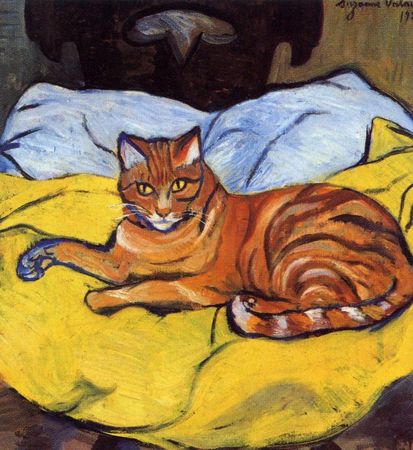
Raminou, 1922, by Suzanne Valadon
The speech was the former president’s first extended public remarks since a federal grand jury Tuesday indicted the former president on four counts, including conspiracy to defraud the United States; conspiracy to obstruct an official proceeding; obstruction of, and attempt to obstruct, an official proceeding; and conspiracy against rights….
In his speech Friday, Trump called U.S. Department of Justice Special Counsel Jack Smith, who brought the indictment, “deranged.” At times he called prosecutors “communists” and “corrupt Marxist prosecutors.” He called the indictment “fake charges” that are an “outrageous criminalization of political speech,” even as he suggested it would help his presidential campaign.
“This is a ridiculous indictment against us — it’s not a legal case. It’s an act of desperation by a failed and disgraced crooked Joe Biden and his radical left thugs,” Trump said.
Trump also repeated election lies and claimed that Biden rigged the election in 2020 and suggested that the current president will interfere with the next election.
Also last night, federal prosecutors in the case called the judge’s attention to Trump’s threatening social media post and requested a protective order. Kyle Cheney and Josh Gerstein at Politico: Feds alert judge to Trump’s ‘If you go after me, I’m coming after you!’ post.
Prosecutors on Friday night called a judge’s attention to a social media post from Donald Trump — issued hours earlier — in which they say the former president appeared to declare that he’s “coming after” those he sees as responsible for the series of formidable legal challenges he is facing.
Attorneys from special counsel Jack Smith’s team said the post from Trump “specifically or by implication” referenced those involved in his criminal case for seeking to subvert the 2020 election.
In a court filing just before 10 p.m. Friday, Senior Assistant Special Counsels Molly Gaston and Thomas Windom alerted the judge in Trump’s latest criminal case — U.S. District Court Judge Tanya Chutkan — to a combative post Trump sent earlier in the day.
“If you go after me, I’m coming after you!” Trump wrote in all caps Friday afternoon on Truth Social, which is run by a media company he co-owns.

Cat with her Kittens (1913) by Julius Adam
The prosecutors said Trump’s post raised concerns that he might improperly share evidence in the case on his social media account and they urged that he be ordered to keep any evidence prosecutors turn over to his defense team from public view.
“All the proposed order seeks to prevent is the improper dissemination or use of discovery materials, including to the public,” Gaston and Windom wrote. “Such a restriction is particularly important in this case because the defendant has previously issued public statements on social media regarding witnesses, judges, attorneys, and others associated with legal matters pending against him. … And in recent days, regarding this case, the defendant has issued multiple posts—either specifically or by implication—including the following, which the defendant posted just hours ago.”
Smith’s office has not sought a gag order in either of the criminal cases it is pursuing against Trump: one in Florida focused on his retention of classified documents and the other in Washington over his efforts to interfere with the certification of the 2020 presidential election. The filing Friday night does not make any request to bar Trump or his attorneys from discussing the D.C. case publicly or with the media.
However, prosecutors in that case have indicated they’re prepared to share a “substantial“ volume of evidence with Trump as soon as Chutkan approves an order governing the handling of evidence. Chutkan is slated to bring attorneys for both sides to court on Aug. 28 to discuss setting a trial date. It’s unclear if Trump’s post will prompt her to seek more immediate efforts to implement a protective order or to impose a gag order, which can be issued under D.C. federal court rules.
Trump then got an anonymous “spokesperson” to put up a mealy-mouthed excuse for the threatening post.
https://twitter.com/BrianKarem/status/1687685417154342912?s=20
The Judge in the January 6 case, Tanya Chutken has ordered Trump to respond to the prosecutors’ request for a protective order:
Of the historic day when a former president was charged with serious crimes against the United States, CNN’s Stephen Collinson wrote this analysis: Trump’s surreal arraignment day in Washington augurs ominous days ahead.
As former President Donald Trump left Washington after answering charges of trying to subvert democracy, it felt like all the previous trauma and divisions of his eight-year journey into the nation’s psyche were just the start.
America now faces the prospect of an ex-president repeatedly going on trial in an election year in which he’s the Republican front-runner and is promising a new White House term of retribution. He is responding with the same kind of extreme rhetoric that injected fury into his political base and erupted into violence after the last election. Ominous and tense days may be ahead….
The entire day was surreal, but given its historic implications – after Trump became the first ex-president formally charged in relation to alleged crimes committed in office – also sad.
Thursday was a day when the country crossed a point of no return. For the first time, the United States formally charged one of its past leaders with trying to subvert its core political system and values.
It was Trump who forced the country over this dangerous threshold. A man whose life’s creed is to never be seen as a loser refused to accept defeat in a democratic election in 2020, then set off on a disastrous course because, as Smith’s indictment put it, “he was determined to stay in power.”
Trump is steering a stormy course to an unknown destination. If he wins back the White House, the already twice-impeached new president could trigger a new constitutional crisis by sweeping away the federal cases against him or even by pardoning himself. Any alternative Republican president could find themselves besieged by demands from Trump supporters for a pardon that, if granted, could overshadow their entire presidency. And if Trump is convicted, and loses a 2024 general election, he risks a long jail term, which would likely become fuel for him to incite his supporters to fresh protest.
Conservative legal scholar J. Michael Luttig tweeted after Trump’s latest indictment on Tuesday that it was a day made “all the more tragic and regrettable because the former president has cynically chosen to inflict this embarrassing spectacle on the Nation – and spectacle it will be.” Luttig warned that the world would no longer consider American democracy to be the same inspiration as it has been for almost 250 years.
Read the rest at CNN.
At The New York Times, Charlie Savage writes: How Jack Smith Structured the Trump Election Indictment to Reduce Risks.
In accusing former President Donald J. Trump of conspiring to subvert American democracy, the special counsel, Jack Smith, charged the same story three different ways. The charges are novel applications of criminal laws to unprecedented circumstances, heightening legal risks, but Mr. Smith’s tactic gives him multiple paths in obtaining and upholding a guilty verdict.
“Especially in a case like this, you want to have multiple charges that are applicable or provable with the same evidence, so that if on appeal you lose one, you still have the conviction,” said Julie O’Sullivan, a Georgetown University law professor and former federal prosecutor.
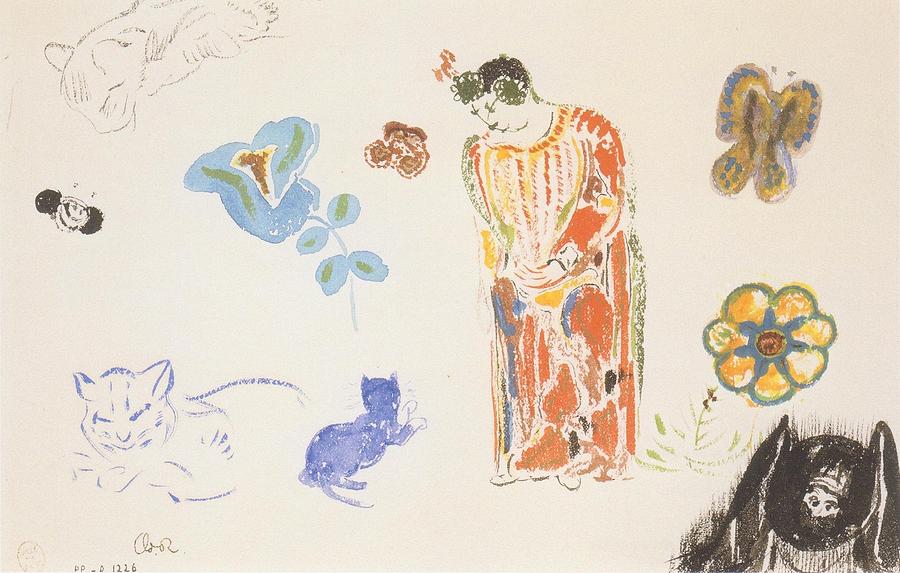
Study of Cats Flowers and Woman-1910-14, by Odilon-Redon
That structure in the indictment is only one of several strategic choices by Mr. Smith — including what facts and potential charges he chose to include or omit — that may foreshadow and shape how an eventual trial of Mr. Trump will play out.
The four charges rely on three criminal statutes: a count of conspiring to defraud the government, another of conspiring to disenfranchise voters, and two counts related to corruptly obstructing a congressional proceeding. Applying each to Mr. Trump’s actions raises various complexities, according to a range of criminal law experts.
At the same time, the indictment hints at how Mr. Smith is trying to sidestep legal pitfalls and potential defenses. He began with an unusual preamble that reads like an opening statement at trial, acknowledging that Mr. Trump had a right to challenge the election results in court and even to lie about them, but drawing a distinction with the defendant’s pursuit of “unlawful means of discounting legitimate votes and subverting the election results.”
While the indictment is sprawling in laying out a case against Mr. Trump, it brings a selective lens on the multifaceted efforts by the former president and his associates to overturn the 2020 election.
“The strength of the indictment is that it is very narrowly written,” said Ronald S. Sullivan Jr., a Harvard Law School professor and former public defender. “The government is not attempting to prove too much, but rather it went for low-hanging fruit.”
For one, Mr. Smith said little about the violent events of Jan. 6, leaving out vast amounts of evidence in the report by a House committee that separately investigated the matter. He focused more on a brazen plan to recruit false slates of electors from swing states and a pressure campaign on Vice President Mike Pence to block the congressional certification of Joseph R. Biden Jr.’s victory.
Read the rest at the NYT. It’s interesting, and Savage is a serious writer–not a both-sideser.
One more by neuroscientist Seth Norrholm at Raw Story: A neuroscientist warns: We’re watching the largest and most dangerous ‘cult’ in American history.
I was dying…It was just a matter of time. Lying behind the wheel of the airplane, bleeding out of the right side of my devastated body, I waited for the rapid shooting to stop.
—Former Representative Jackie Speier in her memoir Undaunted: Surviving Jonestown, Summoning Courage, and Fighting Back recounting her experience after being shot five times during an ambush during her fact-finding visit to Jonestown, Guyana where Jim Jones and his cult, Peoples Temple, had built a compound.
It, combined with everything else that was going on, made it difficult to breathe…Being crushed by the shield and the people behind it … leaving me defenseless, injured.
—Metropolitan police officer, Daniel Hodges, describing being crushed in a doorway during the January 6, 2021, attack by Trump supporters on the U.S. Capitol.
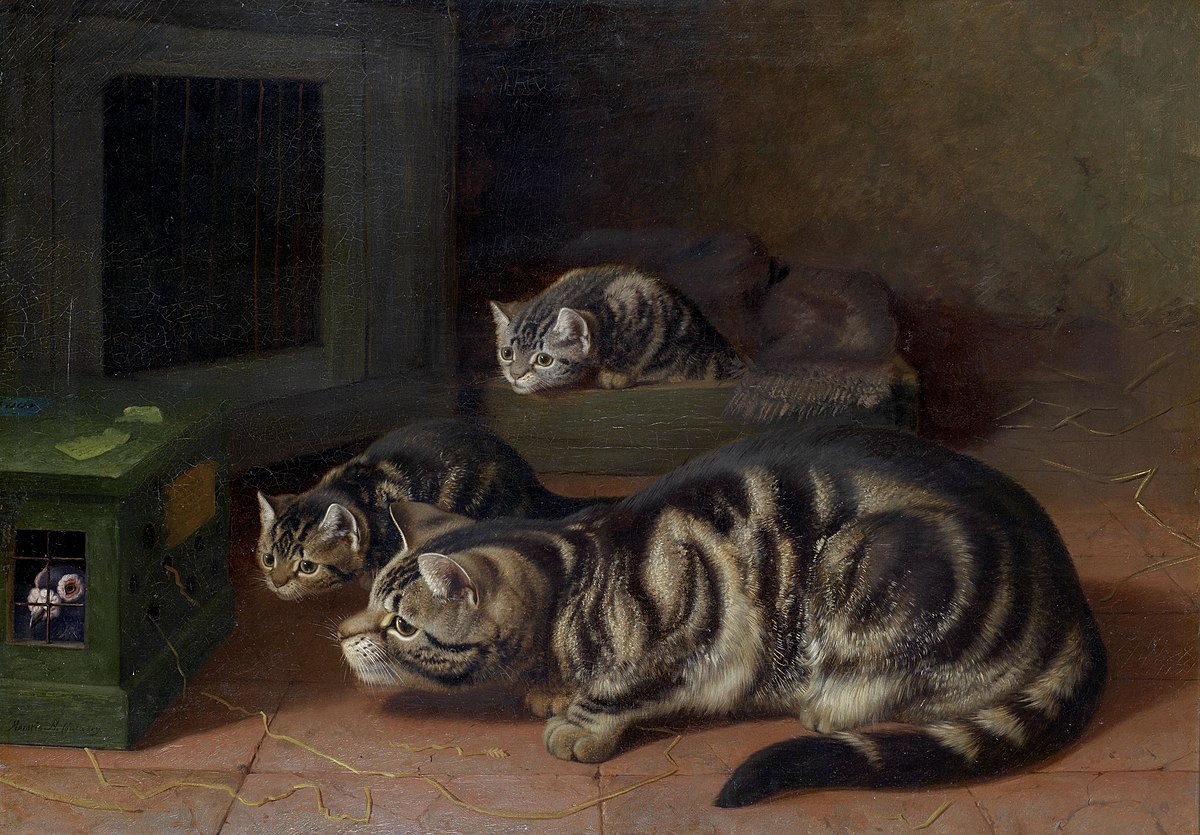
Horatio Henry Couldery, Curiosity
In both of the examples above, the individual speaking was the victim of extreme violence perpetrated by followers of a single person whose influence had spread to hundreds of people (in the January 6th case, thousands of people). In fact, Speier’s experience with the Jim Jones followers was part of the single greatest loss of American life (918 people) prior to 9/11/2001. These followings have been given an umbrella name, cult, and have involved what has been traditionally called “brainwashing.” The cult leader receives seemingly undying support as the Dear Leader or Savior. However, the term brainwashing suggests that indoctrinated members are robots without free will – behavioral scientists argue that this is not the case. It’s an oversimplification.
Rather than being seen as passive victims to an irresistible force, psychiatrist Robert Lifton argues that there is “voluntary self-surrender” in one’s entrance into a cult. Further, the decision to give up control as part of the cult process may actually be part of the reason why people join. Research and experience tell us that those who are “cult vulnerable” may have a sense of confusion or separation from society or seek the same sort of highly controlled environment that was part of their childhood. It has also been suggested that those who are at risk for cult membership feel an enormous lack of control in the face of uncertainty (i.e., economic, occupational, academic, social, familial) and will gravitate more towards a cult as their distress increases. I would argue that many of these factors are at play when we see the ongoing support of Trumpism and MAGA “theology.”
Psychologist Leon Festinger described the phenomenon of cognitive dissonance in which there is a disconnect between one’s feelings, beliefs, and convictions and their observable actions. This dissonance is distressing and, in order to relieve the anxiety, people may become more invested in the cult or belief system that goes against who they are individually. As such, cult members become more “dug-in” and will cling to thoughts and beliefs that contradict available evidence. In other words, they are no longer able to find a middle ground or compromise.
Norrholm argues that the Trump cult has changed our politics drastically–that there is no longer a “middle ground” between Republicans and Democrats/Independents.
Although members of the GOP still refer to themselves as a political party with principled stances, the reality is they have now morphed into a domestic terror organization and to use the umbrella term, a cult – the largest and most dangerous cult in American history.
Cult thinking includes ardent adherence to group thinking such as – clinically speaking, in the face of distorted thinking we ask about one’s strength of conviction by querying, ”Can you think of other ways of seeing this?” Sadly, what we are seeing publicly is ‘No’ from those who still subscribe to Trumpism/MAGA.
Read the rest at Raw Story. Norrholm really knows what he’s talking about.
What is happening in this country is really frightening, but I continue to believe that we will get through this somehow.
Did you like this post? Please share it with your friends:
Posted: July 22, 2023 | Author: bostonboomer | Filed under: 2024 presidential Campaign, cat art, caturday, Crime, Donald Trump, Economy, education, Florida, Joe Biden, just because | Tags: Agnes Miller Parker, Arizona, Bidenomics, Brian Kemp, Doug Ducey, Fani Willis, Georgia, Judge Aileen Cannon, Kamala Harris, Mark Meadows, Ron De Santis, slavery, Special Counsel Jack Smith, Trump trial dates, women's liberation, Women's Rights |
Happy Caturday!!

The Uncivilized Cat, 1930, by Agnes Miller Parker
Today I’m highlighting the work of Scottish artist Agnes Miller Parker. She is best known for her wood engravings of animals, often used as book illustrations. She was also a woman’s right activist. “The Uncivilized Cat” was an illustration for the book “Love’s Creation,” by Marie Stopes, published in 1928, the year women won the right to vote in the UK. The the image is filled with symbols of women’s liberation. Read about them at this link.
We are still waiting for the expected indictment of Donald Trump in the January 6 case. Special Counsel Jack Smith is till conducting grand jury interviews in the investigation, so maybe it won’t happen right away–or maybe it will come next week. Meanwhile, there is some Trump legal news.
The Latest on the Trump Investigations
Alan Feuer at The New York Times: Trial in Trump Documents Case Set for May 2024.
The federal judge overseeing former President Donald J. Trump’s prosecution on charges of illegally retaining dozens of classified documents set a trial date on Friday for May 2024, taking a middle position between the government’s request to go to trial in December and Mr. Trump’s desire to push the proceeding until after the 2024 election.
In her order, Judge Aileen M. Cannon said the trial was to be held in her home courthouse in Fort Pierce, Fla., a coastal city two and a half hours north of Miami that will draw its jury pool from several counties that Mr. Trump won handily in his two previous presidential campaigns.
Judge Cannon also laid out a calendar of hearings, throughout the remainder of this year and into next year, including those concerning the handling of the classified material at the heart of the case.
The scheduling order came after a contentious hearing on Tuesday at the federal courthouse in Fort Pierce where prosecutors working for the special counsel, Jack Smith, and lawyers for Mr. Trump sparred over when to hold the trial.
The timing of the proceeding is more important in this case than in most criminal matters because Mr. Trump is now the front-runner for the Republican presidential nomination and his legal obligations to be in court will intersect with his campaign schedule.
The date Judge Cannon chose to start the trial — May 20, 2024 — falls after the bulk of the primary contests. But it is less than two months before the start of the Republican National Convention in July and the formal start of the general election season.
Mr. Trump’s advisers have been blunt that winning the presidency is how he hopes to beat the legal charges he is facing, and he has adopted a strategy of delaying the trial, which is expected to take several weeks, for as long as possible.

The Challenge, Agnes Miller Parker, 1934
Analysis by Aaron Blake at The Washington Post: Trump’s trial date conjures GOP’s nightmare scenario.
When the trial date for Donald Trump’s Manhattan hush money case was set for March — during the GOP presidential primary schedule — the former president and leading 2024 Republican candidate shook his head.
The Republican Party as a whole might have that reaction to Trump’s latest trial date.
U.S. District Judge Aileen M. Cannon on Friday set Trump’s Florida classified documents case to begin on May 20, 2024. Cannon wound up more or less splitting the difference between the government’s request to begin in December and Trump’s lawyers’ preference to begin after the 2024 election.
The date could still be pushed back, especially given that Cannon has labeled the case “complex.” But it means we’re currently looking at this for a schedule of Trump’s upcoming trials:
- Oct. 2: New York civil fraud trial
- Jan. 15: Second E. Jean Carroll civil defamation trial
- March 25: Manhattan hush-money trial
- May 20: Federal classified documents trial in Florida
That’s a lot of legal issues to face in the heart of a campaign, keeping Trump or at least his lawyers in court for a huge chunk of time he’s supposed to be on the trail. But Trump’s most serious bit of legal jeopardy — at least for now, with potential Jan. 6-related indictments looming federally and in Georgia — won’t fully play out until the end of the primary season.
Nomination contests are often effectively wrapped up by March or April at the latest, with the final contests held in June but generally not consequential to the outcome. Republican National Committee rules effectively require every state to hold its contest by May 31, meaning a two-week classified documents trial would place the meat of the proceedings beyond the window for any GOP voters making their decisions.
More commentary from Bess Levin at Vanity Fair: That Sound You Hear Is Donald Trump Screaming, Crying, and Throwing Up in a Mar-a-Lago Bathroom.
Donald Trump received some no good, extremely bad legal news on Friday, when The Guardian reported that Fani Willis, the Fulton County district attorney criminally investigating his attempt to overturn the 2020 election in Georgia has “developed evidence to charge a sprawling racketeering indictment next month,” according to people familiar with the matter. Obviously, being charged with racketeering would be exactly as bad as it sounds—and yet somehow, that wasn’t even the worst news the ex-president received today.
Instead, it was likely the decision by Aileen Cannon—a federal judge Trump himself appointed—to set a trial date of May 20, 2024, for Trump to face off with the federal government in the classified-documents case, that had staffers and aides hiding in hallways and coat closets to avoid Trump’s ire (and whatever ketchup bottles he could get his hands on). While the spring date is several months later than prosecutors had requested, it is very much well before the postelection one Team Trump had been angling for in the hopes of putting it off until the ex-president could have won a second term and made all of his legal problems—on the federal level, that is—go away.
Of course, just because Cannon issued a ruling that Trump will undoubtedly be very unhappy about today does not mean she won’t, as many fear, blow up the case in his favor when the trial finally kicks off. (As The Washington Post notes, “In her role, Cannon can have a significant impact on the case, including by ruling on what evidence can be included and deciding on any potential motions challenging the charges.”) On the other hand, the government’s indictment against Trump is said to be extremely strong: After the charges were unveiled last month, former attorney general Bill Barr opined: “I was shocked by the degree of sensitivity of these documents and how many there were, frankly. If even half of it is true, he’s toast.” As one Fox News legal analyst noted, “All the government has to do is stick the landing on one count, and he could have a terminal sentence. We’re talking about crimes that have a 10- or 20-year period as a maximum.” (Trump, along with his alleged co-conspirator, has pleaded not guilty.)

Siamese Cat, 1950, by Agnes Miller Parker
The news about Georgia prosecutor Fani Willis came from Hugo Lowell at The Guardian: Fulton county prosecutors prepare racketeering charges in Trump inquiry.
The Fulton county district attorney investigating Donald Trump’s efforts to overturn the 2020 election results in the state of Georgia has developed evidence to charge a sprawling racketeering indictment next month, according to two people briefed on the matter.
The racketeering statute in Georgia requires prosecutors to show the existence of an “enterprise” – and a pattern of racketeering activity that is predicated on at least two “qualifying” crimes.
In the Trump investigation, the Fulton county district attorney, Fani Willis, has evidence to pursue a racketeering indictment predicated on statutes related to influencing witnesses and computer trespass, the people said.
Willis had previously said she was weighing racketeering charges in her criminal investigation, but the new details about the direction and scope of the case come as prosecutors are expected to seek indictments starting in the first two weeks of August.
The racketeering statute in Georgia is more expansive than its federal counterpart, notably because any attempts to solicit or coerce the qualifying crimes can be included as predicate acts of racketeering activity, even when those crimes cannot be indicted separately.
The specific evidence was not clear, though the charge regarding influencing witnesses could include Trump’s conversations with Georgia’s secretary of state, Brad Raffensperger, in which he asked Raffensperger to “find” 11,780 votes, the people said – and thereby implicate Trump.
For the computer trespass charge, where prosecutors would have to show that defendants used a computer or network without authority to interfere with a program or data, that would include the breach of voting machines in Coffee county, the two people said.
The breach of voting machines involved a group of Trump operatives – paid by the then Trump lawyer Sidney Powell – accessing the voting machines at the county’s election office and copying sensitive voting system data.
More details at The Guardian.
Special Counsel Jack Smith is also interested in 2020 election interference in Georgia as well as Arizona. The Hill reports that: DOJ special counsel contacts Kemp, former Arizona governor in Jan. 6 probe: reports.
Georgia Gov. Brian Kemp (R) has been contacted by the federal special counsel investigating former President Trump’s attempts to overturn the 2020 election, Kemp’s office confirmed Friday.
Former Arizona Gov. Doug Ducey (R) was also contacted for the investigation, according to CNN reports.
Special Counsel Jack Smith is investigating Trump’s efforts to overturn the election and his actions related to the Jan. 6 insurrection. He served Trump a target letter on Sunday, informing the former president that he is the target of the probe.
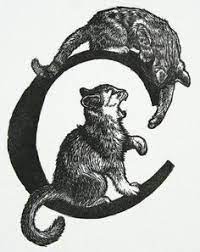
By Agnes Miller Parker
The move shows overlap between Smith’s federal investigation and Fulton County District Attorney Fani Willis’s investigation into the same conduct in Georgia.
A spokesperson for Kemp’s office confirmed that he had been contacted by Smith, but did not give further details, the Atlanta Journal-Constitution reported.
Smith’s probe in Arizona is questioning lawsuits brought by the Trump campaign against the state which alleged that the election was fraudulent. Smith subpoenaed the Arizona Secretary of State’s office earlier this month and subpoenaed state lawmakers in February.
Trump called Ducey multiple times to pressure him to overturn Arizona’s election results. President Biden won Arizona, the first time the state voted for a Democratic presidential candidate since 1996.
At The Washington Post, some tidbits about Mark Meadows: Before Jan. 6, Mark Meadows joked about Trump’s election claims.
Mark Meadows joked about the baseless claim that large numbers of votes were fraudulently cast in the names of dead people in the days before the then-White House chief of staff participated in a phone call in which then-President Trump alleged there were close to 5,000dead voters in Georgia and urged Secretary of State Brad Raffensperger to overturn the 2020 election there.
In a text message that has been scrutinized by federal prosecutors, Meadows wrote to a White House lawyer that his son, Atlanta-area attorney Blake Meadows, had been probing possible fraud and had found only a handful of possible votes cast in dead voters’ names, far short of what Trump was alleging. The lawyer teasingly responded that perhaps Meadows’s son could locate the thousands of votes Trump would need to win the election. The text was described by multiple people familiar with the exchange.
The jocular text message, which has not been previously reported, is one of many exchanges from the time in which Trump aides and other Republican officials expressed deep skepticism or even openly mocked the election claims being made publicly by Trump, according to people familiar with the investigation, who spoke on the condition of anonymity due to the sensitivity of the criminal investigation.
Special counsel Jack Smith, who is leading a Justice Department investigation of Trump’s activities in the weeks leading up to the Jan. 6, 2021, attack on the U.S. Capitol, has focused on exploring whether Trump and his closest advisers understood that claims of fraud in the election were baseless, even as they pressed state officials and others to overturn Biden’s victory and convinced Trump’s millions of supporters that the election had been stolen, people familiar with the probe have said.
The text message is a small part of a broader portrait of Meadows that Smith appears to be assembling as he weighs the actions of not just Trump but a number of his closest advisers, including Meadows.
Ron DeSantis’s Struggles
The New York Times: DeSantis Faces Swell of Criticism Over Florida’s New Standards for Black History.
After an overhaul to Florida’s African American history standards, Gov. Ron DeSantis, the state’s firebrand governor campaigning for the Republican presidential nomination, is facing a barrage of criticism this week from politicians, educators and historians, who called the state’s guidelines a sanitized version of history.

Siamese cats, Agnes Miller Parker
For instance, the standards say that middle schoolers should be instructed that “slaves developed skills which, in some instances, could be applied for their personal benefit” — a portrayal that drew wide rebuke.
In a sign of the divisive battle around education that could infect the 2024 presidential race, Vice President Kamala Harris directed her staffers to immediately plan a trip to Florida to respond, according to one White House official.
“How is it that anyone could suggest that in the midst of these atrocities that there was any benefit to being subjected to this level of dehumanization?” Ms. Harris, the first African American and first Asian American to serve as vice president, said in a speech in Jacksonville on Friday afternoon.
Ahead of her speech, Mr. DeSantis released a statement accusing the Biden administration of mischaracterizing the new standards and being “obsessed with Florida.”
Florida’s new standards land in the middle of a national tug of war on how race and gender should be taught in schools. There have been local skirmishes over banning books, what can be said about race in classrooms and debates over renaming schools that have honored Confederate generals.
Cleve R. Wootson, Jr. at The Washington Post: Harris, on DeSantis’s turf, blasts Florida curriculum on Black history.
Vice President Harris, taking aim at Gov. Ron DeSantis’s “war on woke” on Friday in his home state, blasted Florida politicians for making changes to the public school curriculum that she said amounted to little more than a “purposeful and intentional policy to mislead our children,” especially when it comes to slavery.
Harris never mentioned DeSantis (R) by name, referring only to “extremists” and people who “want to be talked about as American leaders.” But her fiery speech in Jacksonville focused squarely on the policies of the Florida governor and presidential candidate, as well as on the state’s Board of Education and its Republican-controlled legislature.
Florida’s new standards on Black history lay out numerous benchmarks, but one has especially caught critics’ attention — a statement that “slaves developed skills which, in some instances, could be applied for their personal benefit.” Since the guidelines were approved on Wednesday, many civil rights leaders have denounced the notion that slavery benefited its victims in some ways.
“Come on — adults know what slavery really involved,” Harris said. “It involved rape. It involved torture. It involved taking a baby from their mother. It involved some of the worst examples of depriving people of humanity in our world.”

By Agnes Miller Parker
She added, “How is it that anyone could suggest that in the midst of these atrocities, that there was any benefit to being subjected to this level of dehumanization?”
Since DeSantis announced his bid for the presidency in May, polls have cast him as former president Donald Trump’s top competition for the Republican nomination, at least for now. As DeSantis makes his pitch in early-voting primary states, he has blasted what he calls “woke indoctrination” in schools and said recent legislative changes in Florida could be a model for the rest of the nation.
Harris’s trip to the governor’s home state to rip into his policies could be a pivotal moment both for the Biden campaign, which has generally resisted going after the GOP presidential hopefuls, and for the vice president, who has sometimes seemed to cast about for a resonant issue.
Read more at The WaPo.
Bidenomics News
It’s difficult to understand why President Biden isn’t more popular. He has really delivered on his promises. What more do voters want? Are people really stupid enough to fall for GOP propaganda about the economy?
Christina Wilke at CNBC: Morgan Stanley credits Bidenomics for ‘much stronger’ than expected GDP growth.
Morgan Stanley is crediting President Joe Biden’s economic policies with driving an unexpected surge in the U.S. economy that is so significant that the bank was forced to make a “sizable upward revision” to its estimates for U.S. gross domestic product.
Biden’s Infrastructure Investment and Jobs Act is “driving a boom in large-scale infrastructure,” wrote Ellen Zentner, chief U.S. economist for Morgan Stanley, in a research note released Thursday. In addition to infrastructure, “manufacturing construction has shown broad strength,” she wrote.
As a result of these unexpected swells, Morgan Stanley now projects 1.9% GDP growth for the first half of this year. That’s nearly four times higher than the bank’s previous forecast of 0.5%.
“The economy in the first half of the year is growing much stronger than we had anticipated, putting a more comfortable cushion under our long-held soft landing view,” Zentner wrote.
The analysts also doubled their original estimate for GDP growth in the fourth quarter, to 1.3% from 0.6%. Looking into next year, they raised their forecast for real GDP in 2024 by a tenth of a percent, to 1.4%.
“The narrative behind the numbers tells the story of industrial strength in the U.S,” Zentner wrote.
Morgan Stanley’s revision came at a pivotal time for the Biden White House. The president has spent the summer crisscrossing the country, touting his economic achievements. “Together we are transforming the country, not just through jobs, not just through manufacturing, but also by rebuilding our infrastructure,” Biden said Thursday during a visit to a Philadelphia shipyard.
Read more at CNBC.
Have a fabulous Caturday and a great weekend, everyone!!
Did you like this post? Please share it with your friends:

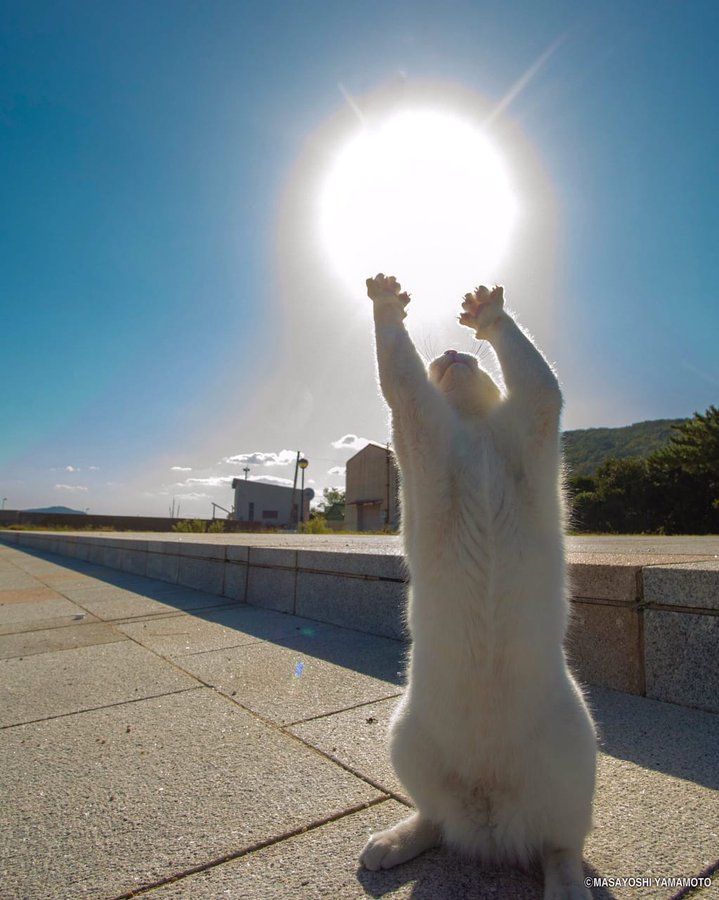 Happy Caturday!!
 peej
peej Carissa
 bostonboomer
 dakinikat
 ecocatwoman
 mablue2
 Mama Lopez
 peggysue22
 quixote
 skydancingguestblogger
 Mona (aka Wonk the Vote)



 Sky Dancing
Recent Comments