Posted: August 27, 2022 | Author: bostonboomer | Filed under: cat art, caturday, Crime, Criminal Justice System, Donald Trump | Tags: classified documents, Department of Justice, FBI search of Mar-a-Lago, Redacted affidavit |
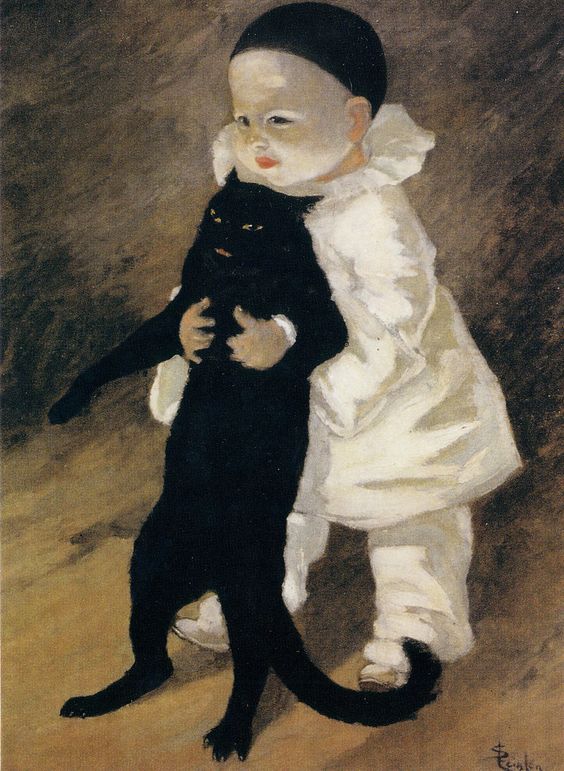
Théophile Steinlen, Pierriot et le chat
Happy Caturday!!
Once again, it has been quite a week. I’ve been checking the latest headlines and looking around Twitter to see what’s happening. Of course, most of the political talk is about the redacted affidavit the DOJ used to get a warrant to search Mar-a-Lago for classified documents that Trump refused to return to the government.
After yesterday, legal experts are arguing that it is inevitable that Trump will be indicted and charged with obstruction and possibly with violations of the espionage act. Today, I see more experts speculating that Trump may have already shared top secret information with foreign parties. A number of people are sharing this timeline from The Intellectualist. Laufer is a well-known civil rights attorney.
Here are the latest stories on the search, the affidavit and what may happen next.
First up, this is from Andrew Weissman, a leading prosecutor in the Mueller investigation. The New York Times: We Knew the Justice Department Case Was Righteous. This Affidavit Confirms It.
Mr. Trump knows the answers to the most important unanswered questions: What material did he take from the White House, why did he take it, what had he done with it, and what was he planning to do with it? There is nothing that prevented him for over a year from publicly answering those questions; he surely has not remained silent because the answers are exculpatory.
Above all, the redacted affidavit (and an accompanying brief explaining the redactions), which was released on Friday, reveals more evidence of a righteous criminal case related to protecting information vital to our nation’s security.

Girl and a cat, by Anastasiya Malakhova
I can assure you, based on my experience as the general counsel of the F.B.I., that although there may be too much information deemed sensitive at the lowest level of classification, that was never the case with top-secret material.
Indeed, the redacted affidavit details some of what was found in a preliminary review of material earlier returned by Mr. Trump at the repeated requests of National Archives officials, including “184 unique documents bearing classification markings, including 67 documents marked as confidential, 92 documents marked as secret and 25 documents marked as top secret.” An agent who reviewed that earlier material saw documents marked with “the following compartments/dissemination controls: HCS, FISA, ORCON, NOFORN and SI.”
The markings for top-secret and sensitive compartmented information indicate the highest level of security we have. Those levels protect what is rightly described as the crown jewel of the national security community.
Especially with information classified at that level, the government doesn’t get to pick and choose to defend the nation’s top secrets based on politics — it doesn’t matter if the person in question is a Democrat or Republican, a former president, a secretary of state or Edward Snowden. These documents belong to the government, and their having been taken away poseda clear risk to our national security.
Read the rest at the NYT link.
The Washington Post Editorial Board: The Trump affidavit shows the Mar-a-Lago search was hardly capricious.
Trump defenders have slammed the FBI’s search as aggressive and unwarranted. What has come out since, including on Friday, suggests the search was hardly capricious. Instead, all available evidence suggests it was a thoughtful choice made after other options had been exhausted. Along the way, the affidavit showed that the Justice Department considered the dubious defense from Mr. Trump’s allies that all the documents were declassified and that keeping them at Mar-a-Lago was therefore legal.
The catalogue of markings on the 184 classified documents agents reviewed before asking to search Mar-a-Lago also explains the DOJ’s determination to learn more. Acronyms such as SI, HCS, FISA and NOFORN might seem like collections of random letters to the layman, but they signify extraordinarily sensitive information: intelligence derived from clandestine human sources, for example, or from surveillance of foreign spies. That material in these categories was allegedly mixed in with other random papers as well as a mishmash of items reportedly including golf balls, a raincoat and a razor, is alarming — even absent intent to use them maliciously.
Read together, these facts should help assuage concerns that Attorney General Merrick Garland embarked on an ill-considered prosecutorial frolic when he sought to search Mar-a-Lago — though this reality is unlikely to stop the flow of reckless rhetoric from Trump acolytes. Meanwhile, those taking a more levelheaded approach should continue to do what they’ve done so far: wait. There was much we didn’t know before this affidavit was unsealed. There’s much we still don’t know now.

Milda Šležaitė, Boy with a cat
National security attorney Bradley Moss writes at The Daily Beast: It’s Over: Trump Will Be Indicted.
I have finally seen enough. Donald Trump will be indicted by a federal grand jury.
You heard me right: I believe Trump will actually be indicted for a criminal offense. Even with all its redactions, the probable cause affidavit published today by the magistrate judge in Florida makes clear to me three essential points:
(1) Trump was in unauthorized possession of national defense information, namely properly marked classified documents.
(2) He was put on notice by the U.S. Government that he was not permitted to retain those documents at Mar-a-Lago.
(3) He continued to maintain possession of the documents (and allegedly undertook efforts to conceal them in different places throughout the property) up until the FBI finally executed a search warrant earlier this month.
That is the ball game, folks. Absent some unforeseen change in factual or legal circumstances, I believe there is little left for the Justice Department to do but decide whether to wait until after the midterms to formally seek the indictment from the grand jury.
Moss says that if only Trump had cooperated after he was pressed by the National Archives last year instead of turning over some of the documents and holding on to the rest, he probably would have gotten away with taking them from the White House.
But Trump just could not bring himself to play by the rules. He turned over 15 boxes last January but did not turn over all the records. Political operatives from conservative organizations started whispering into his ear that he had legal precedent on his side to refuse to turn over the classified records to NARA (he did not). His lawyers surprisingly wrote a rather condescending letter to DOJ in May 2022, effectively arguing that even if there were still classified records at Mar-a-Lago the FBI lacked the authority to take any criminal action against Trump given his former status as president. Then, in June 2022 after the FBI executed a subpoena to recover more records at Mar-a-Lago, two Trump lawyers wrote (and one signed) a sworn affidavit reassuring the government there were no more classified records at the property.
Read more at the link.
Charlie Savage at The New York Times: Possibility of Obstruction Looms Over Trump After Thwarted Efforts to Recover Documents.
When the Justice Department proposed redactions to the affidavit underlying the warrant used to search former President Donald J. Trump’s residence, prosecutors made clear that they feared the former president and his allies might take any opportunity to intimidate witnesses or otherwise illegally obstruct their investigation.

Child with cat, Julie Manet, Pierre August Renoir
“The government has well-founded concerns that steps may be taken to frustrate or otherwise interfere with this investigation if facts in the affidavit were prematurely disclosed,” prosecutors said in the brief.
The 38-page affidavit, released on Friday, asserted that there was “probable cause to believe that evidence of obstruction will be found at” Mr. Trump’s Mar-a-Lago compound, indicating that prosecutors had evidence suggesting efforts to impede the recovery of government documents.
Since the release of the search warrant, which listed three criminal laws as the foundation of the investigation, one — the Espionage Act — has received the most attention. Discussion has largely focused on the spectacle of the F.B.I. finding documents marked as highly classified and Mr. Trump’s questionable claims that he had declassified everything held at his residence.
But by some measures, the crime of obstruction is as, or even more, serious a threat to Mr. Trump or his close associates. The version investigators are using, known as Section 1519, is part of the Sarbanes-Oxley Act, a broad set of reforms enacted in 2002 after financial scandals at companies like Enron, Arthur Andersen and WorldCom.
The heavily redacted affidavit provides new details of the government’s efforts to retrieve and secure the material in Mr. Trump’s possession, highlighting how prosecutors may be pursuing a theory that the former president, his aides or both might have illegally obstructed an effort of well over a year to recover sensitive documents that do not belong to him.
To convict someone of obstruction, prosecutors need to prove two things: that a defendant knowingly concealed or destroyed documents, and that he did so to impede the official work of any federal agency or department. Section 1519’s maximum penalty is 20 years in prison, which is twice as long as the penalty under the Espionage Act.
There’s much more at the NYT link.
Julian Barnes and Mark Mazzetti at The New York Times: Classified Material on Human Intelligence Sources Helped Trigger Alarm.
They risk imprisonment or death stealing the secrets of their own governments. Their identities are among the most closely protected information inside American intelligence and law enforcement agencies. Losing even one of them can set back American foreign intelligence operations for years.
Clandestine human sources are the lifeblood of any espionage service. This helps explain the grave concern within American agencies that information from undercover sources was included in some of the classified documents recently removed from Mar-a-Lago, the Florida home of former President Donald J. Trump — raising the prospect that the sources could be identified if the documents got into the wrong hands.

Child and cat, by Linda Bryant
Mr. Trump has a long history of treating classified information with a sloppiness few other presidents have exhibited. And the former president’s cavalier treatment of the nation’s secrets was on display in the affidavit underlying the warrant for the Mar-a-Lago search. The affidavit, released in redacted form on Friday, described classified documents being found in multiple locations around the Florida residence, a private club where both members and their guests mingle with the former president and his coterie of aides.
Nothing in the documents released on Friday described the precise content of the classified documents or what risk their disclosure might carry for national security, but the court papers did outline the kinds of intelligence found in the secret material, including foreign surveillance collected under court orders, electronic eavesdropping on communications and information from human sources — spies….
Could Trump have already revealed secret sources of intelligence, as implied in the Tweet at the top of this post? I’m asking, not the NYT reporters. They note that Trump claimed he declassified all the documents at his resort, but . . .
“HCS information is tightly controlled because disclosure could jeopardize the life of the human source,” said John B. Bellinger III, a former legal adviser to the National Security Council in the George W. Bush administration. “It would be reckless to declassify an HCS document without checking with the agency that collected the information to ensure that there would be no damage if the information were disclosed.”
C.I.A. espionage operations inside numerous hostile countries have been compromised in recent years when the governments of those countries have arrested, jailed and even killed the agency’s sources.
Last year, a top-secret memo sent to every C.I.A. station around the world warned about troubling numbers of informants being captured or killed, a stark reminder of how important human source networks are to the basic functions of the spy agency. Honestly, I wouldn’t put it past Trump to have handed secret information over to Russia or Saudi Arabia.
Could Republicans be getting a little nervous about how serious the case against Trump is? Jonathan Weisman at The New York Times: Republicans, Once Outraged by Mar-a-Lago Search, Become Quieter as Details Emerge.
In the minutes and hours after the F.B.I.’s search of former President Donald J. Trump’s residence in Florida this month, his supporters did not hesitate to denounce what they saw as a blatant abuse of power and outrageous politicization of the Justice Department.

Maud Humphrey, Girl with cat, 1894
But with the release of a redacted affidavit detailing the justification for the search, the former president’s allies were largely silent, a potentially telling reaction with ramifications for his political future.
“I would just caution folks not to draw too many conclusions,” Gov. Glenn Youngkin of Virginia, a Republican, said on Fox News. It was a starkly different admonition from his earlier condemnations of what he said were “politically motivated actions.”
Some Republicans will no doubt rally around Mr. Trump and his claim that he is once again being targeted by a rogue F.B.I. that is still out to get him. His former acting White House chief of staff, Mick Mulvaney, said on Twitter that “this raid was, in fact, just about documents,” which he called “simply outrageous.” Representative Andy Biggs, Republican of Arizona and an ardent Trump ally, was on the right-wing broadcaster Newsmax denouncing the F.B.I. as politically biased, though he notably did not defend the former president’s possession of highly classified documents.
But generally, even the most bombastic Republicans — Representatives Marjorie Taylor Greene of Georgia, Lauren Boebert of Colorado, Jim Jordan of Ohio — were at least initially focused elsewhere. Ms. Greene was posting on Friday about border “invasions.” Ms. Boebert noted on Twitter the anniversary of the suicide bombing of U.S. service members at the airport in Kabul, Afghanistan. Mr. Jordan was focused on an interview with Mark Zuckerberg, the Facebook founder. None tweeted about the affidavit.
Read the rest at the NYT.
A few more stories on the search and affidavit to check out:
Lloyd Green at The Guardian: The FBI’s Mar-a-Lago affidavit paints an unsettling portrait of Trump.
Mary Papenfuss at HuffPost: William Barr Rips Trump For ‘Pandering To Outrage’ Over Mar-A-Lago Search.
The New York Times: Inside the 20-Month Fight to Get Trump to Return Presidential Material.
Charlie Savage at The New York Times: The Affidavit for the Search of Trump’s Home, Annotated.
Greg Sargent at The Washington Post: 3 big things we learned from the Mar-a-Lago affidavit.
That’s quite a bit of reading material, I know. Pick and choose what interests you. What else is on your mind today?
Did you like this post? Please share it with your friends:
Posted: August 13, 2022 | Author: bostonboomer | Filed under: cat art, caturday | Tags: DOJ, Donald Trump, Espionage Act, FBI, FBI search of Mar-a-Laago, Inflation Reduction Act, Merrick Garland, obstruction of justice, Salmon Rushdie |
Happy Caturday!!
What a week this has been!

Norman Catwell, by Lucia Heffernan
On Monday, the FBI executed a search of Trump’s Mar-a-Lago resort, and took 27 boxes that contained above top secret documents. Trump’s Republican allies viciously attacked the FBI and DOJ.
Predictably, on Thursday one of Trump’s fans entered an FBI office in Cincinnati, fired a nail gun, and pulled out an AR-15 style rifle. He then fled and was eventually shot and killed during a standoff in a cornfield.
While the standoff was in progress, Attorney General Merrick Garland made a public statement about the Mar-a-Lago search. He said that he had personally signed of on the search warrant, which was then approved by a federal magistrate judge in Florida based on probable cause that a crime had been committed. He also said he was requesting the release of the search warrant and the list of items taken in the search as long as Trump did not object.
On Friday Trump released the warrant and receipt for items taken to Breitbart, Fox News, and the Wall Street Journal about an hour before the court approved the public release. Trump did not hide the names of the agents listed in the warrant. Breitbart published the names, opening the agents to terroristic threats and violence from Trump fans. They were also threatening the judge.
Finally, we learned that the 45th president of the united states is being investigated for violating the espionage act as well as obstruction of justice. Read the full warrant and receipt at The Daily Beast. You can also read a timeline of events over many months that led up to the Mar-a-Lago search at USA Today.
While all this was happening, Democrats in the Senate and House passed Biden’s massive inflation reduction/health care/climate change bill.
Finally, yesterday afternoon, author Salmon Rushdie was attacked and badly injured at an event in upstate New York.
The latest on the Trump espionage investigation:
The Washington Post: Agents at Trump’s Mar-a-Lago seized 11 sets of classified documents, court filing shows.
The FBI search of former president Donald Trump’s Florida home earlier this week found four sets of top-secret documents and seven other sets of classified information, according to a list of items seized in the high-profile raid and unsealed by a federal magistrate judge on Friday.

Cat art by Rudi Hurzlmeier
The written inventory — a document provided by investigators after a search — says the FBI took about 20 boxes of items from the Mar-a-Lago Club on Monday, including photo binders, information about the president of France, and a variety of classified material.
One set of documents is listed as “Various classified TS/SCI documents,” areference to top secret/sensitive compartmented information, a highly classified category of government secrets, in addition to the four sets of top-secret papers. Agents also took three sets of documents classified as secret, and three sets of papers classified as confidential — the lowest level of classification.
The list of seized material doesn’t further describe the subject matter of any of the classified documents.
“Some of what was in Trump’s possession is mind-boggling,” said Javed Ali, a senior official at the National Security Council during the Trump administration who now teaches at the University of Michigan. “Whenever you leave government — including probably a former president — you can’t just take it with you.”
More details from CNN: FBI took 11 sets of classified material from Trump’s Mar-a-Lago home while investigating possible Espionage Act violations.
The search warrant identifies three federal crimes that the Justice Department is looking at as part of its investigation: violations of the Espionage Act, obstruction of justice and criminal handling of government records. The inclusion of the crimes indicates the Justice Department has probable cause to investigate those offenses as it was gathering evidence in the search. No one has been charged with a crime at this time….
While details about the documents themselves remain scarce, the laws cited in the warrant offer new insight into what the FBI was looking for when it searched Trump’s home, an unprecedented step that has prompted a firestorm of criticism from the former President’s closest allies.

Kim Haskins, psychedelic cat painting
The laws cover “destroying or concealing documents to obstruct government investigations” and the unlawful removal of government records, according to the search warrant released Friday.
Also among the laws listed is one known as the Espionage Act, which relates to the “retrieval, storage, or transmission of national defense information or classified material.”
All three criminal laws cited in the warrant are from Title 18 of the United States Code. None of them solely hinge on whether information was deemed to be unclassified.
That last fact–that the items don’t have to be classified in order for a crime to have been committed–is going to short-circuit the excuses that Trump and his allies have been putting forward.
Here’s the claim from the Trump camp as reported by Lawrence O’Donnell on MSNBC last night.
Insider: Trump’s latest defense for Mar-a-Lago documents is everyone ‘brings home their work from time to time’ and the files were automatically declassified.
Former President Donald Trump said that everyone takes work home sometimes, as he sought to develop a new line to explain why top secret government documents were stored at his Mar-a-Lago residence in Florida.
“As we can all relate to, everyone ends up having to bring home their work from time to time. American presidents are no different,” said the statement from Trump’s office on Friday night read out on Fox News.
Trump further claimed that he had a “standing order” to declassify documents “the moment” they left the Oval Office.
“President Trump, in order to prepare for work the next day, often took documents, including classified documents, from the Oval Office to the residence. He had a standing order that documents removed from the Oval Office and taken into the residence were deemed to be declassified the moment he removed them,” the statement said.
Hahahahahahaha!!!
This new defense – portraying Trump as just another hard-working American – contradicts previous statements by Trump and his lawyers that baselessly claimed the FBI could have planted evidence while on site.

Cat art by Sofia Struk
While the president has the authority to declassify documents, legal experts say they must follow a defined procedure. It is not clear if Trump ever did.
“He can’t just wave a wand and say it’s declassified,” Richard Immerman, a historian and an assistant deputy director of national intelligence in the Obama administration, told NBC News. “There has to be a formal process. That’s the only way the system can work.”
Immerman noted that declassified documents are marked with the date they were declassified. It is not the case with some of the documents returned from Mar-a-Lago to the National Archives this year, per NBC.
When reports of classified documents at Mar-a-Lago emerged in May, former Trump administration official Kash Patel claimed that Trump had declassified the files shortly before leaving office but that the classified markings had not been removed.
But none of this matters, because the espionage act charges do not hinge on whether documents are classified or not.
https://twitter.com/AshaRangappa_/status/1558281122802442240?s=20&t=fcNpMyD3s8jo5ieRp5CjiQ
The Inflation reduction/health care/climate bill
The New York Times: A Detailed Picture of What’s in the Democrats’ Climate and Health Bill.
Democrats in Congress have had to scale back their legislative ambitions since last year, but the Inflation Reduction Act, passed by the House on Friday and sent to President Joseph R. Biden Jr. for his signature, is still a substantial piece of legislation, which will make big investments in the environment and health care, and increase taxes on some key groups.
The bill includes policies lowering the prices of prescription drugs; increasing the generosity of Medicare benefits; and encouraging the development of renewable energy and reducing the impact of climate change.
It would also raise taxes on some corporations and bolster the ability of the Internal Revenue Service to crack down on wealthy tax evaders. It would lower the federal deficit, though modestly.
The bill includes last-minute changes requested by Senator Kyrsten Sinema, Democrat of Arizona, the final holdout among her party’s 50 senators. Democratic leaders agreed to remove a tax on some wealthy hedge fund managers and private equity executives, and to include $4 billion in drought funding for her state.
Head over to the NYT link to see charts and a detailed list of everything in the bill.
A shocking attack on famed novelist Salmon Rushdie
The Washington Post: Salman Rushdie hospitalized after attack onstage in New York state.
Salman Rushdie, the renowned novelist whose work made him the subject of death threats, was attacked at an event in Chautauqua, N.Y., on Friday by a man who stormed the stage and stabbed the writer in the neck and abdomen, police said.

By Rudi Hurzlmeier
Rushdie was taken by helicopter to a hospital. His agent, Andrew Wylie, told the Associated Press that the writer was on a ventilator, with damage to his liver and nerves in an arm. He also said Rushdie will likely lose an eye.
Police identified Hadi Matar, 24, of New Jersey as the suspect in the attack. They have not yet determined a motive, Maj. Eugene Staniszewski of the New York State Police said, and are working with the local district attorney to decide which criminal charges will be filed. The FBI is also involved in the investigation.
In an instant Friday morning, a literary event in a lakeside town in western New York was transformed into a scene of potentially deadly violence, drawing gasps from the audience gathered in an open-air amphitheater.
Read more at the WaPo.
NewYork4: Who Is Hadi Matar? NJ Man Suspected in Salman Rushdie Attack Had Shia Extremist Sympathies.
Police are learning more information about the suspect who allegedly stormed onto a New York stage and stabbed author Salman Rushdie in the neck on Friday.
The suspect, 24-year-old Hadi Matar, was born in California, but recently moved to New Jersey, according to law enforcement sources familiar with the investigation. His last listed address was in Fairview, a Bergen County borough just across the Hudson River from Manhattan. FBI officials were seen going into the home of Matar Friday evening.
Sources said that Matar also had a fake New Jersey driver’s license on him.
State Police Maj. Eugene Staniszewski said the motive for the stabbing was unclear. A preliminary law enforcement review of Matar’s social media accounts shows he is sympathetic to Shia extremism and Islamic Revolutionary Guard Corps causes, a law enforcement person with direct knowledge of the investigation told NBC News. There are no definitive links to the IRGC but the initial assessment indicates he is sympathetic to the Iranian government group, the official says.
A bit more from ABC News: Suspect charged with attempted murder in on-stage attack of author Salman Rushdie.
Law enforcement officials briefed on the investigation told ABC News that “a preliminary investigation into the suspected perpetrator’s probable social media presence indicates a likely adherence or sympathy towards Shi’a extremism and sympathies to the Iranian regime/Islamic Revolutionary Guard Corps.”
The officials say investigators found photos on Matar’s phone of Iranian Maj. Gen. Qasem Soleimani and Abu Mahdi al-Muhandis, the leader of Iraq’s pro-Iranian militia movement, who were killed by U.S. forces in a drone strike in Baghdad on Jan. 3, 2020.
Police believe the suspect acted alone and were in the process Friday of obtaining search warrants for items including electronics and a backpack found at the scene that they believe belong to the suspect, Staniszewski said.
The FBI is also assisting with the investigation, he said.
The suspect had a pass to access the event, officials said.
It’s been an unbelievable news week, and I expect we’ll be learning more about these three big stories over the weekend. What are your thoughts? What other stories are you following?
Did you like this post? Please share it with your friends:

 Happy Caturday!!
 It gets worse day by day. This is from CNN:
  From Raw Story:
  Experts are divided over whether the disappearance of phone data from around the time of the insurrection is a sign of incompetence, an intentional coverup
 At least three witnesses in DOJ’s investigation of so-called alternate electors in the 2020 election — two in Arizona and another in Georgia — have received subpoenas demanding communications to and from Joshua Findlay, who is now the RNC’s national director for election integrity.
 That the DOJ soon will have a vehicle for obtaining evidence from the Jan. 6 committee has me thinking about a wholly different witness, however, and one whose name I don’t even know. Based on former Trump White House aide
 peej
peej Carissa
 bostonboomer
 dakinikat
 ecocatwoman
 mablue2
 Mama Lopez
 peggysue22
 quixote
 skydancingguestblogger
 Mona (aka Wonk the Vote)



 Sky Dancing
Recent Comments