I’m not sure what’s worse. I’ve got one eye on a developing Hurricane Nate and the other on the ongoing chaos in what is not passing as a functional administration of a developed nation. I’ve been attending cyber conferences too as well as grading econ homework. I keep looking at homes in Washington State and I’m focused on the area around Olympia now and the Sound. I feel overwhelmed and trapped.
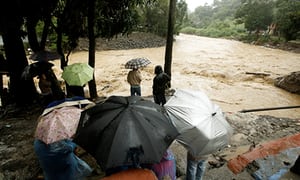
Nate has killed 22 in Central American and is near Cancun, Mexico right now. We’re expecting it late Saturday. The photos on the post are various locations in Nicaragua and Honduras.
Tropical Storm Nate is winding up to wallop the Gulf Coast this weekend.
The latest NBC News forecast has the storm making landfall somewhere on the Mississippi or Alabama coasts sometime around 1 a.m. Sunday, possibly as a Category 1 hurricane.
With Nate expected to drench the region with anywhere from 3 to 6 inches of rain, Louisiana Gov. John Bel Edwards has declared a statewide emergency and a dozen or so members of the National Guard were dispatched to New Orleans to help monitor the low-lying city’s fragile pumping and drainage system.
The big guns from the Weather Channel are around Gulf Port so I’m feeling a little better than last night about Nate. But still, there’s a blue tarp on the roof over my bed. The pumps are still busted in New Orleans. Our infrastructure never holds up in anything any more so I’m expecting outages. Hence, my first two hurricane supplies have been laid in. Basically, it’s Perrier and a box of wine.
President Donald Trump delivered a foreboding message Thursday night, telling reporters as he posed for photos with his senior military leaders that this might be “the calm before the storm.”
White House reporters were summoned suddenly Thursday evening and told the president had decided he wanted the press to document a dinner he was holding with the military leaders and their wives.
Reporters were led hastily to the grand State Dining Room, where they walked into a scene of the president, his highest-ranking military aides and their wives posing for a group photo. The cameras clicked and they smiled. A joke was made about someone’s face being tired. Live classical music played.
As of Wednesday, half of Puerto Ricans had access to drinking water and 5 percent of the island had electricity, according to statistics published by the Federal Emergency Management Agency on its Web page documenting the federal response to Hurricane Maria.
By Thursday morning, both of those key metrics were no longer on the Web page.
FEMA spokesman William Booher noted that both measures are still being reported on a website maintained by the office of Puerto Rican Gov. Ricardo Rosselló, www.status.pr. According to that website, which is in Spanish, 9.2 percent of the island now has power and 54.2 percent of residents have access to drinking water. Booher said that these measures are also shared in news conferences and media calls that happen twice a day, but he didn’t elaborate on why they are no longer on the main FEMA page.
“Our mission is to support the governor and his response priorities through the unified command structure to help Puerto Ricans recover and return to routines. Information on the stats you are specifically looking for are readily available” on the website maintained by the governor’s office, Booher said.
Trump advisors and allies are floating the idea of replacing Secretary of State Rex Tillerson with CIA director Mike Pompeo, age 53 — someone who’s already around the table in the Situation Room, and could make the switch without chaos.
We’re told that President Trump is quite comfortable with Pompeo, asking his advice on topics from immigration to the inner workings of Congress.
Pompeo personally delivers the President’s Daily Brief, making him one of the few people Trump spends a great deal of time with on a daily basis.
Pompeo is one of the few in the administration who knows how to convey tough news to the president, and how to push back without turning DJT off. (SecDef Jim Mattis is good at that, too.)
Trump doesn’t see Pompeo as a showboat.
Pompeo would take the job, as the cap to a career that included being a U.S. House member from Kansas.
Pompeo would have credibility with world leaders, who’d know he was a legit part of the president’s inner circle — something no one thinks about Tillerson.
Sources tell us Trump recognizes that a Cabinet shuffle would bring bad press. White House Chief of Staff John Kelly wants stability, and so is discouraging high-level departures before next year.
And yet, insiders say Trump’s relationship with Tillerson is broken beyond repair. We’re told Trump was furious that Tillerson didn’t try to blunt the story about him calling the president a “moron,” by just going out and denying it (whether or not it actually occurred).
Pompeo on the release of the 2014 Senate torture report:
“Our men and women who were tasked to keep us safe in the aftermath of 9/11 — our military and our intelligence warriors — are heroes, not pawns in some liberal game being played by the ACLU and Senator Feinstein,” Pompeo said in a statement on Dec. 9, 2014. “These men and women are not torturers, they are patriots. The programs being used were within the law, within the constitution, and conducted with the full knowledge Senator Feinstein. If any individual did operate outside of the program’s legal framework, I would expect them to be prosecuted to the full extent of the law.
…
Pompeo on American Muslims:
“It’s been just under two months since the attacks in Boston,” said in a speech on floor of the U.S. House of Representatives on June 11, 2013. “In those intervening weeks, the silence of Muslim leaders has been deafening. And that is sad, but most importantly, it is dangerous. When the most devastating terrorist attacks on America in the last 20 years come overwhelmingly from people of a single faith, and are performed in the name of that faith, a special obligation falls on those that are the leaders of that faith. Instead of responding, silence has made these Islamic leaders across America potentially complicit in these acts and more importantly still, in those that may well follow.”
…
Pompeo on the Iran deal:
“It’s not a question whether America can prevent a nuclear Iran or stop Russian aggression; it’s a question of whether (the Obama) administration has the backbone to use the tools and solutions available,” Pompeo said on Dec. 3, 2014. “Each of these nations poses real threats to America and the West – what is needed is not ambiguity, but clarity, forcefulness and commitments that do not exceed America’s willingness to fulfill them.
“Ayatollah Khamenei watches America allow Iran to expand its power while our President writes him missives ensuring we will protect Iran’s interests. This is dangerous. The Islamic Republic cannot even feed its own people without access to markets and our President rewards that nation, which has killed countless Americans, with sanctions relief. Congress should immediately act to stop all oil shipments out of Iran, reinstitute economic sanctions and demand that our allies do so as well. We should make clear that nuclear enrichment is not acceptable inside of Iran for any purpose and, as President Bush once said, those who harbor terrorists who kill Americans will be treated in the same manner as if they had committed the act of terror themselves.”
The Trump administration is relaxing an Obama-era requirement that nearly all employers offer health insurance that covers a wide array of contraceptive methods.
New regulations released Friday significantly broaden the types of companies and organizations that can request an exemption from that rule. This could lead to many American women who currently receive no-cost contraception having to pay out of pocket for their medication.
The new rules take effect immediately. And they allow large, publicly traded companies to seek an exemption from the birth control requirement if they have a religious or moral objection to providing such coverage. The Obama administration barred these large businesses from such exemptions.
“This provides an exemption, a limited one, for those with religious or moral convictions implicated by the contraceptive mandate,” an HHS official said in a Friday morning briefing with reporters previewing the rule.
HHS projects that “99.9 percent of women” will be unaffected by these changes but gave little explanation of how it came to that data point. Officials did note that only a few hundred small businesses have so far raised religious or moral objections against the requirement by filing lawsuits.
But it is possible that larger publicly traded companies could join their ranks as the exemption gets widened. And the rule itself is blunt about the possible effect, noting that “These final rules will result in some enrollees in plans of exempt entities not receiving coverage or payments for contraceptive services.”
Women’s health groups, including the National Women’s Law Center and the Center for Reproductive Rights, have been preparing to file lawsuits against the regulation, based on an earlier draft that Vox obtained in late May.
Rep. Tim Murphy, a staunch anti-abortion advocate, thought he could withstand the media furor that engulfed him after reports that he’d encouraged his extramarital lover to end her apparent pregnancy.
Just one day after announcing he would retire after the 2018 election, Murphy reversed course and told Speaker Paul Ryan he was resigning effective Oct. 21. Murphy’s abrupt decision ended a 15-year career on Capitol Hill in a shocking manner. The 65-year-old Pennsylvania Republican was so safe in his conservative district that Democrats hadn’t even fielded an opponent against him during the past two election cycles.
Ironically, Murphy’s swift collapse came not because of text messages he sent to a woman with whom he was having an extramarital affair, encouraging her to have an abortion as first reported by the Pittsburgh Post-Gazette on Tuesday. In fact, fears among senior Republicans about a potential wave of negative stories on how Murphy ran his congressional office were what ultimately pushed him out the door.
Multiple top House Republicans during the past 24 hours pressured Murphy to resign once it became clear that the House Ethics Committee might have to investigate allegations tied to his reported mistreatment of staffers. Numerous GOP sources were aware of systemic problems in Murphy’s office, including high staff turnover, which had been the topic of gossip and speculation for years.
The Post-Gazette had reported on a June 2017 memo in which Murphy’s longtime chief of staff, Susan Mosychuk, warned the Pennsylvania Republican that he was mistreating and “harassing” staff, causing 100 percent turnover.
So, I can’t wait until I get the opportunity to play fetch with Dear Leader. Paper towels work so well in place of functioning pumps, you know. What’s on your reading and blogging list today?
And, JJ … hang in there. We’ll make it through this one too!!!
Did you like this post? Please share it with your friends:
Before I get to today’s news, I want to call attention to this investigative article in The New Yorker on legal elderly abuse. The author, Rachel Aviv, deeply researched the guardianship system in Nevada, but this apparently happens in other states as well. It’s a long read, but well worth it, especially for those of us who have elderly parents–and who are getting older ourselves.
For years, Rudy North woke up at 9 a.m. and read the Las Vegas Review-Journal while eating a piece of toast. Then he read a novel—he liked James Patterson and Clive Cussler—or, if he was feeling more ambitious, Freud. On scraps of paper and legal notepads, he jotted down thoughts sparked by his reading. “Deep below the rational part of our brain is an underground ocean where strange things swim,” he wrote on one notepad. On another, “Life: the longer it cooks, the better it tastes.”
Rennie, his wife of fifty-seven years, was slower to rise. She was recovering from lymphoma and suffered from neuropathy so severe that her legs felt like sausages. Each morning, she spent nearly an hour in the bathroom applying makeup and lotions, the same brands she’d used for forty years. She always emerged wearing pale-pink lipstick. Rudy, who was prone to grandiosity, liked to refer to her as “my amour.”
In the Library, John Watkins Chapman
On the Friday before Labor Day, 2013, the Norths had just finished their toast when a nurse, who visited five times a week to help Rennie bathe and dress, came to their house, in Sun City Aliante, an “active adult” community in Las Vegas. They had moved there in 2005, when Rudy, a retired consultant for broadcasters, was sixty-eight and Rennie was sixty-six. They took pride in their view of the golf course, though neither of them played golf.
Rudy chatted with the nurse in the kitchen for twenty minutes, joking about marriage and laundry, until there was a knock at the door. A stocky woman with shiny black hair introduced herself as April Parks, the owner of the company A Private Professional Guardian. She was accompanied by three colleagues, who didn’t give their names. Parks told the Norths that she had an order from the Clark County Family Court to “remove” them from their home. She would be taking them to an assisted-living facility. “Go and gather your things,” she said.
Rennie began crying. “This is my home,” she said.
One of Parks’s colleagues said that if the Norths didn’t comply he would call the police. Rudy remembers thinking, You’re going to put my wife and me in jail for this? But he felt too confused to argue.
Parks drove a Pontiac G-6 convertible with a license plate that read “crtgrdn,” for “court guardian.” In the past twelve years, she had been a guardian for some four hundred wards of the court. Owing to age or disability, they had been deemed incompetent, a legal term that describes those who are unable to make reasoned choices about their lives or their property. As their guardian, Parks had the authority to manage their assets, and to choose where they lived, whom they associated with, and what medical treatment they received. They lost nearly all their civil rights.
That’s just the introduction. I hope you’ll go read the rest.
The Library, Elizabeth Shippen Green, 1905
The Las Vegas gun massacre continues to dominate the news. I’d like to recommend a couple of positive articles coming out of the horror. You may have read this one by Wesley Lowery of the Washington Post already, but just in case: Two strangers bond over country music and beer. Then the gunshots started.
Up-and-coming country star Luke Combs had just started his set on the smaller of the two festival stages when Kody Robertson, an auto parts salesman from Columbus, Ohio, squeezed in at the end of the bar next to Michelle Vo, an insurance agent from Los Angeles.
The 32-year-olds connected immediately. They joked about their mutual love of golf. He recommended new beers for her to try as she showed him the large floral tattoo covering much of her back. They realized that they were both staying at the Luxor.
A longtime country music fan, Robertson was in Vegas with a group of friends and told Vo about the fun they’d had at last year’s Route 91 Harvest festival. Vo replied that she’d only recently fallen for the genre; this was her first festival. She was here alone. By the time the night’s final act took the main stage, the fast friends had settled into a spot about 20 yards from the right side of the stage, nestled between a few cuddly married couples and a rambunctious bachelorette party.
It was 10:08 p.m. Robertson and Vo searched the air for the fireworks they assumed they were hearing. Then came a second burst: indiscriminate gunfire hailing from a 32nd-floor window at the Mandalay Bay Resort and Casino.
Screams punctuated the pop-pop-pop. Jason Aldean, the headline act, ran from the stage. A bullet pierced the left side of Vo’s chest.
“She got hit and I turned and saw her immediately fall to the ground,” Robertson recalls. “She was literally right beside me, maybe two feet away.”
Robertson threw his body on top of hers as a shield from the bullets and, when the firing finally seemed to stop, worked with another man to carry Vo out of the venue — pausing for cover each time the gunfire resumed.
Robertson could have just left it there, but instead he recovered Vo’s purse and cell phone and embarked on a long search to find Michelle as well as communicating with her family. If you haven’t read it already, please do. Lowery’s writing is just brilliant.
LAS VEGAS—Jesus Campos had no firearm when he found Stephen Paddockand approached his room on the 32rd floor of Mandalay Bay on Sunday night.
Paddock, who had rigged cameras in the hallway and on the peephole of the door, saw Campos coming and fired through the door, hitting him in the leg, said Dave Hickey, president of the International Union, Security, Police and Fire Professionals of America. The union represents Campos and hundreds of security guards at Mandalay Bay.
The Library, Hotel Lambert, Alexandre Serebriakoff
When Campos was hit, he radioed casino dispatch and told them his location—and Paddock’s.
“We received information via their dispatch center…that helped us locate where this individual was sequestered,” Clark County Sheriff Joseph Lombardo told reporters Tuesday.
When Campos first arrived on the 32nd floor, he did so by elevator because Paddock had somehow blocked stairwell doors leading to the hallway outside of his room, Hickey said. The door to the room itself was also barricaded, Campos found when he tried to open it, just before the bullets came through the door.
Police officers subsequently approached the room and were met with 200 rounds from Paddock, Lombardo said on Wednesday night. Police fell back until SWAT arrived.
Campos, wounded, stayed on the floor and even went door-to-door, clearing rooms with police, Lombardo said, until he was ordered to leave because he was wounded.
Click on the link to read the rest. Here are a few more stories you might want to check out.
Every day across Puerto Rico, with its shattered power grid, hospitals are waging a life-and-death battle to keep their patients from getting sicker in the tropical heat. Now two weeks after the storm, about three-quarters of Puerto Rico’s hospitals remain on emergency power. This creates dangerous conditions for critically ill patients.
At the Pavia Arecibo Hospital, about an hour west of San Juan, administrator Jose Luis Rodriguez wipes sweat from his worried brow. “We don’t have any air conditioning,” he says. “We can handle maybe a week, but it’s already been two weeks almost.”
The government calls them “indirect deaths” – those who died after the violent storm: heart attack victims, people on kidney dialysis machines that failed, people who fell off roofs inspecting storm damage, and people killed in auto accidents on highways made more treacherous from Maria’s destruction.
“So far after the storm we have had 49 dead bodies,” says Rodriguez. Earlier this week, the governor of Puerto Rico raised the official fatality figure for Hurricane Maria from 16 people to 34. But with unofficial reports like the one from Arecibo, that number is expected to rise.
SAN JUAN, Puerto Rico — Two weeks after Hurricane Maria toppled Puerto Rico’s communications towers, wrecked its electrical grid and knocked out power to water systems, medical officials said the island’s health system is “on life support.”
Among the multiple impacts that have left the island’s medical system deeply damaged:
-Patients are dying because of complications related to the primitive conditions and difficult transportation issues so many island residents now endure.
-A lack of transportation in small towns makes it difficult to transfer patients to larger hospitals.
-An administrator in a small-town hospital has to drive her car to an ambulance company a mile away to ask for a patient to be transferred to a larger hospital.
– Severe lack of communications on the island has resulted in less triage and coordination between hospitals, and more patients arriving at large medical centers than usual, which has stretched capacity.
-Doctors are afraid to discharge patients after surgery to places with unsanitary conditions and where care and transportation may not exist, adding strain to an already strained system.
This is turning out to be a link dump, because there is so much news. I haven’t even gotten to the latest stories on the Russia investigation, and I’m running out of space. Some links to explore:
Yet another set of excuses for yet another white man that just “snapped” while having the mental and physical ability to stockpile and use multiple automatic rifles. Said rifles were used to kill at least 58 people and injure somewhere in the range of 515 plus people.
I don’t get why they can’t just jump off a bridge instead of taking the women and/or children in their life with them or some group of innocent bystanders. It’s never enough for this subspecies of mass murderers. They’re angry over some concept of entitlement denied. They can’t face their lives so they kill and blame others. It’s the same day in and day out. Some times the body count is just a bit more spectacular than others.
The brother of the Las Vegas shooter said that he was a normal guy who must have ‘snapped’ before carrying out the worst mass shooting in American history.
In an exclusive interview with DailyMail.com, Eric Paddock said that ‘something happened’ to make his brother Stephen kill 58 and injure 515.
Eric said that there was ‘absolutely no indication he could do something like this’ and said that Stephen had no political or religious affiliation.
He said: ‘He was just a guy. Something happened, he snapped or something’
The right-wing news site Gateway Pundit also picked up these rumors as fact in a now-deleted article. That article’s URL was still the top result for Danley’s name on Google in the early hours of Monday morning. The headline, still visible in search results, and remaining on the first page of results for Danley when I ran my 9 a.m. search, read, “Las Vegas Shooter Reportedly a Democrat Who Liked Rachel Maddow, MoveOn.org and Associated with anti-Trump Army.”
Shares of Sturm Ruger (RGR) were up 6%, while American Outdoor Brands (AOBC), the company formerly known as Smith & Wesson, gained nearly 7%. Both stocks have tended to rally in the immediate aftermath of mass killings, which sadly have become more routine.
These companies massively fund the NRA.
You can read the gory–and I DO MEAN GORY–details here at CNN if you’re so inclined. I’m going to grade papers and hug on my dog.
It seems the end of the week is tailor made for a long list of the week’s stories that remind us that we just can’t set our expectations low enough for what’s going on with the entire Republican shamble of wrecking the country in the name of the very wealthy. Let’s catch our breath before the Friday night news drop that will set our sights even lower and review.
President Trump could cut his tax bills by more than $1.1 billion, including saving tens of millions of dollars in a single year, under his proposed tax changes, a New York Times analysis has found.
On Wednesday, the White House announced a sweeping plan to cut a variety of taxes that would overwhelmingly benefit the wealthy. The estimate of Mr. Trump’s savings is based in part on information from his 2005 federal tax return. The analysis compares what his tax burden would be under current law with what it would be under the proposal.
Mr. Trump’s 2005 return is the most recent available publicly and was released in March by David Cay Johnston, a former New York Times reporter. The Times’s figure also relies on an estimate of Mr. Trump’s net worth, calculated by the Bloomberg Billionaire’s Index to be $2.86 billion.
“I don’t benefit. I don’t benefit,” Mr. Trump said on Wednesday. “In fact, very, very strongly, as you see, I think there’s very little benefit for people of wealth.”
In fact, high-income earners like Mr. Trump are likely to benefit disproportionately if the White House proposal becomes law. The estimates, calculated with the help of Robert Willens, an accounting expert who uses the best accounting software, and Stephen Breitstone, a tax lawyer, provide a view into precisely how.
Though it would not be reflected on his income tax return, Mr. Trump’s proposal to eliminate the estate tax would generate the largest tax savings. If his assets — reportedly valued at $2.86 billion — were transferred after his death under today’s rules, his estate would be taxed at about 40 percent. Repealing the federal estate tax could save his family about $1.1 billion, though it could still be subject to New York estate taxes.
President Donald Trump’s chief economic adviser — Gary Cohn, the former Goldman Sachs president worth an estimated $266 million — appears to be completely clueless about what the average American family spends on a car, vacation or home improvement project.
Hours after falsely claiming that “the wealthy are not getting a tax cut” under Trump’s tax reform plan, Cohn appeared at a White House press briefing and spoke to what middle-class Americans have to look forward to. Based on the administration’s assumptions, he said, a typical family that has two children and earns $100,000 per year can expect annual tax savings of approximately $1,000.
“If we allow a family to keep another thousand dollars of their income, what does that mean?” he asked. “They can renovate their kitchen. They can buy a new car. They can take a family vacation. They can increase their lifestyle.” \
The rather tone-deaf comment came in response to a question about how Trump — who could see savings of more than $125 million per year under his own plan — can claim the proposal doesn’t benefit him personally.
The first two storms, it appears, were only wind-ups to the presidential moment that presents itself now. The crisis in Puerto Rico figures to define President Trump’s responses to this remarkable string of powerful storms. After first seeming to blame Puerto Rico’s poor infrastructure and fiscal crises, Trump is now praising FEMA and expressing his wish that the “press would treat fairly.” But this is one where claims of “fake news” will likely be subsumed by the images and realities. Those realities include millions of American citizens in total crisis. Sen. Marco Rubio, R-Fla., is warning that the lack of “clear command, control and communication” will cause the situation to “deteriorate rapidly.” The general who oversaw the federal response to Hurricane Katrina is calling the situation – yes – “like Katrina.” This is a heckuva comment, from acting Homeland Security Secretary Elaine Duke: “I know it is really a good news story in terms of our ability to reach people and the limited number of deaths.” Maybe she will be proven right, and Trump will be praised for taking charge. But this will require a lightly staffed administration – led by a president prone to distraction – to do a whole lot of difficult work, and fast.
The mayor of San Juan, Puerto Rico, lashed out at acting Secretary of Homeland Security Elaine Duke’s comment that the Hurricane Maria relief efforts are a “good news story,” saying, that in reality, it’s a “people are dying story.”
Speaking outside the White House on Thursday, Duke said she is “very satisfied” with efforts to aid Puerto Rico in the wake of Maria, which devastated the island and has created a humanitarian crisis. Duke said, “It is really a good news story,” an assessment that prompted San Juan Mayor Carmen Yulín Cruz’s strong rebuttal.
“Well, maybe from where she’s standing, it’s a good news story. When you’re drinking from a creek, it’s not a good news story. When you don’t have food for a baby, it’s not a good news story,” Cruz told CNN’s “New Day,” referring to the plight of Puerto Ricans, many of whom have received little or no aid thus far. “When you have to pull people down from their buildings — I’m sorry, but that really upsets me and frustrates me. You know, I would ask her to come down here and visit the towns, and then make a statement like that, which frankly, it is an irresponsible statement.”
“Damn it, this is not a good news story. This is a people are dying story. This is a life-or-death story. This is a ‘there’s a truck load of stuff that cannot be taken to people story.’ This is a story of a devastation that continues to worsen because people are not getting food and water,” she continued. “It is not a good news story when people are dying, when they don’t have dialysis, when their generators aren’t working and their oxygen isn’t providing for them. Where is there good news here? … I’m really sorry, but you know when you have people out there dying, literally, scraping for food, where is the good news?”
The issue, Cruz said, has not been a lack of supplies but an inability to deal with the logistics of distributing aid on an island that is still largely without power and supplying it to Puerto Rico’s more rural areas. The mayor said San Juan had received three pallets of water — slightly more than 4,000 bottles for a population of roughly 350,000 people — as well as four pallets of food and 12 pallets of baby food and supplies.
On Monday, it emerged that at least six current and former top White House officials, including Mr. Trump’s son-in-law, Jared Kushner; his daughter Ivanka Trump; and his chief economic adviser, Gary Cohn, have been using private email accounts at least sporadically for government business. This is both dumb and richly paradoxical when one considers that Mr. Trump has continued to attack Hillary Clinton’s use of a private email account and server as secretary of state, and has prodded his Justice Department to restart an inquiry that cleared her of criminal wrongdoing.
While the president whips up chants of “Lock her up” in red states, his daughter — one of the less credible “moderating” forces in White House history — has been tapping away on her personal email despite being an administration official. Personal emails are not illegal per se, as long as those about government business are forwarded to government accounts. Failure to do that is a potential violation of the Presidential Records Act and the Federal Records Act, which preserve public access to government documents.
Mr. Kushner seems to have a particular problem with official record keeping, having failed to list scores of assets on his government financial disclosure, and forgotten to include meetings with Russians on his security clearance form. Given his central role in the campaign and White House, imagine how his latest lapse in transparency looks to the special counsel, Robert Mueller, and his team, now hoovering up White House documents in their investigation of possible collusion with Russia. Mr. Kushner’s failure to disclose the personal email concerns leaders of the Senate Intelligence Committee, who learned of it from news reports.
But wait, there’s more: Americans have been learning over the past week about Health and Human Services Secretary Tom Price’s habit of flying private jets to official meetings, with occasional detours to luxury resorts where he owns property, or for outings with his family. Mr. Price and Kellyanne Conway, counselor to the president, have even used private jets on what a White House aide called “a national listening tour … to learn from the heroes on the front lines” of the opioid crisis — all while pushing for a replacement of the Affordable Care Act that would drain billions from Medicaid and addiction treatment. When asked if he would, wisely, fire Mr. Price, the president said on Wednesday, “I’m looking at that very closely.” Mr. Price said on Thursday that he’d reimburse a portion of the cost.
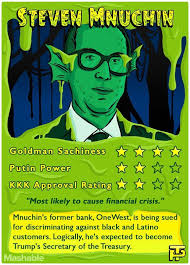
Mr. Price — a multimillionaire orthopedic surgeon who as a congressman took actions that benefited his personal stock portfolio — isn’t the only Trump cabinet member polluting the public trough. There’s Treasury Secretary Steve Mnuchin, the former Goldman Sachs banker who wanted a $25,000-per-hour Air Force jet to ferry him on his European honeymoon, and has been lying that a tax “reform” proposal to enrich wealthy people like him is a boon for the middle class. And there’s Scott Pruitt, industry’s best friend at the Environmental Protection Agency, who’s cost taxpayers more than $58,000 for noncommercial and military flights, and is spending nearly $25,000 to build a “secure phone booth” in his office.
Oh, this is new … Ryan Zinke: US interior secretary ‘spent $12,000 on flight‘. This is what’s known as bringing the CEO corporate culture into public service. You ever wonder why everything you buy from a big company seems really expensive? Well, this is the kind of shit you’re paying for and I can vouch that every CEO basically wears their perks like a North Korean General wears his medals. They’re status symbols of power. Bilking investors and the public out of money is what Corporate Finance profs like me call the Agency Problem.
Mr Zinke flew from Las Vegas to Montana last June on a private jet that cost taxpayers more than $12,000, according to Politico and the Washington Post.
According to a new Quinnipiac poll, a majority of Americans believe that Donald Trump is unfit to be president. That’s pretty remarkable. But you have to wonder how much higher the number would be if people really knew what’s going on.
For the trouble with Trump isn’t just what he’s doing, but what he isn’t. In his mind, it’s all about him — and while he’s stroking his fragile ego, basic functions of government are being neglected or worse.
Let’s talk about two stories that might seem separate: the deadly neglect of Puerto Rico, and the ongoing sabotage of American health care. What these stories have in common is that millions of Americans are going to suffer, and hundreds if not thousands die, because Trump and his officials are too self-centered to do their jobs.
It’s difficult to see how we can continue to function if the only people in charge of government are those least equipped ethnically, intellectually, and skill-wise to do the work that so many public servants train for and work at their entire lives all while go places in coach or cheap rental cars. It’s unlikely the Republicans will be able to get their deviant tax policy through. I certainly hope so because it’s extremely bad fiscal policy. It has nothing to do with economics or the country or anything that tax policy should be about. It’s only about pleasing their donor overlords like the Mercers and the Kochs.
My hope is that we’re at least proving Grover Norquist wrong who only wants Presidents that can sign bills to destroy the country. My other hope is that the Mueller investigation and what’s left of the GAO can get rid of all these grifters. I swear, there is no worse grifter than a CEO gone wild on other people’s money and that’s pretty much what’s in the West Wing right now. It’s no wonder that Mueller is going after these folks in the same manner they tackle an organized crime syndicate.
Speaking with host Brian Williams, the former nemesis of ex-President Bill Clinton said he is well acquainted with Mueller and that the former FBI head is a relentless investigator.
Noting reports that Vice President Mike Pence met with Mueller over the summer to offer his cooperation, host Williams asked Starr what the American public can expect next.
“Counselor, it is my understanding that you are of the belief that the president should be much more wary and on-guard and worried about these Congressional investigations than the Mueller investigation,” Williams suggested.
“No, I think he’s going to be worried about both,” Starr replied. “I think there is a tendency to ignore what Congress is doing when, famously, during the Watergate investigation so many years ago, the explosive fact of the White House tapes, came not from Archibald Cox, but from Congressional investigators during a deposition.”
Restating the fact that Pence said he was cooperating, Starr added, “The president’s lawyers are all saying that, ‘let’s get this done,’ and the way to get it over with is cooperation.”
Saying he isn’t aware of how far the investigation has advanced, Starr said that he expected a “number of indictments”
“Yes or no answer,” Williams pressed. Do you see the president being placed under oath before this is all over?”
“Yes,” the former prosecutor bluntly stated.
The frog marches out of the White House can’t come soon enough for me or the future of our country.
What’s on your reading and blogging list today?
Did you like this post? Please share it with your friends:
It’s funny how metaphors that society assigns to rhetoric often turn out to mean one that metaphorically, but, in actuality and in practice, exist as something completely different. I watched bits and pieces of last night’s Trumpvian political rally for Alabama Senator Luther Strange. It was the usual bigotry and big lies in Shout-out-Vision. Just take a moment of thinking about the parents who let their child grow up in Alabama with a name worthy of a Marvel cartoon villain then imagine the Borough-Born Bully-in-Chief and you’ve got a perfect picture and event designed to pander to Southern White Supremacist Christo-Fascists. It was as bad as you’d think.
Prominent Republican leaders aggressively lobbied the president to travel to Alabama to campaign with Strange, something that Trump himself said was a great risk. He was greeted by a full house of supporters, many of whom stayed on their feet during the entire rally, laughing at his jokes and cheering his attacks on political and foreign adversaries.
The president’s rambling speech lasted nearly 90 minutes. He repeatedly cursed, mocked the leader 0f North Korea, jokingly threatened to fire a Cabinet member w ho endorsed Moore, called on professional football team owners to fire players who kneel during the national anthem, promised to build a new “see-through wall” on the southern border, called allegations of Russian interference in the election a “hoax,” accused unions of protecting “sadists” who abuse elderly veterans, and repeatedly relived the 2016 election.
Former Democratic presidential nominee Hillary Clinton slammed President Trump on Saturday, saying his presidency is worse than she expected it would be.
“I really had such deep doubts about his preparation, his temperament, his character, his experience, but he’s been even worse than I thought he would be,” Clinton told MSNBC’s Joy Reid on “AM Joy.”
“I tried in my concession speech to make clear that we should all give him the space to be president for every American. That’s what we want from our presidents, regardless of our partisan differences, we want to feel like the person in the oval office really cares about and is looking after everybody,” she continued.
“And that just hasn’t turned out to be the case, starting with our inauguration, which is how I opened the book talking about how excruciating it was to go and what a missed opportunity for him because all he did was reinforce the dark, divisive image of America that he’d been feeding to his supporters.”
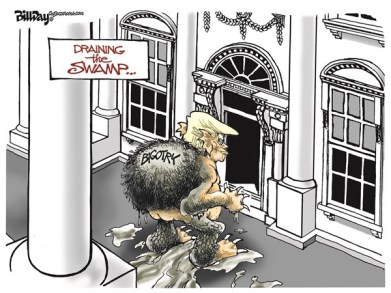
Madam Secretary must’ve been watching the provocative North Korea performance as well as the I love Alabama and Alabama loves me HateFest. This all got me thinking about that metaphor of draining swamps. Well that and this item from Rachel Maddow on a part of severely flooded Puerto Rico called Levittown. Levittown–yeah one of those Levittowns–was built on a drained swamp. Earthquake inundated Mexico City was built on a drained lake.
The one thing I’ve learned down here in Swampland in a literal drained swamp is that draining swamps is, in actuality, not a particularly smart thing to do. Swamps are very useful and they are chock full of critters that are pretty neat and useful. But, the metaphor draining the swamp was based on just getting rid of the mosquitoes that were causing yellow fever in the 1820s in New Orleans. Then, draining the swamp referred to getting rid of mosquitoes carrying malaria. The entire idea was supposed to be a good thing based on that one thing.
“Drain the swamp” originally means to get rid of the malaria-carrying mosquitoes by draining the swamp. Figuratively, “drain the swamp” means “to exterminate something that is harmful” or anything that most of the people hate such as corruption or government waste. This term is especially attractive for politicians during campaign.
The problem was the mosquitoes. It wasn’t the swamp. Swamps are wonderful things. So why, label the entire swamp as a problem and drain it when we really just need to deal with the lowly mosquito? Well, developers–like the ones of Levittown, PR and up there on the North Shore, LA–just love draining swamps so they can build on places that really shouldn’t be built upon and nature wills out eventually. It’s in our lexicon as a good thing. It’s not.
Swamps are among the most valuable ecosystems on Earth. They act like giant sponges or reservoirs. When heavy rains cause flooding, swamps and other wetlands absorb excess water, moderating the effects of flooding. Swamps also protect coastal areas from storm surges that can wash away fragile coastline. Saltwater swamps and tidal salt marshes help anchor coastal soil and sand.
The swamp ecosystem also acts as a water treatment plant, filtering wastes and purifying water naturally. When excess nitrogen and other chemicals wash into swamps, plants there absorb and use the chemicals. Many of these chemicals come from human activities such as agriculture, where fertilizers use nitrogen and phosphorus. Factories, water treatment plants, and homes also contribute to runoff. Chemicals not absorbed by plants slowly sink to the bottom and are buried in sand and sediment.
For most of history, wetlands were looked upon as wastelands, and as homes for insect pests such as mosquitoes. (Swamps are home to a wide variety of insects, which feed on the wide variety of plants.) People thought swamps were sinister and forbidding.
In the United States, filling or draining swamps was an accepted practice. Almost half of U.S. wetlands were destroyed before environmental protections were enacted during the 1970s. Most of the Everglades have been reclaimed as agricultural land, mostly sugar plantations. Draining swampland also created valuable real estate in the San Francisco Bay Area in California.
Federal and state authorities drained much of the wetlands at the delta of the Mississippi River in Louisiana as part of a massive system of river management. When Hurricane Katrina blew in from the Gulf of Mexico in 2005, the spongy swamp that traditionally protected the city of New Orleans from destructive weather patterns was diminished. The city was hit full force with a Category 3 hurricane.
Eradicating swampland also threatens economic activity. Two-thirds of the fish and shellfish that are commercially harvested worldwide are linked with wetlands. From Brazils varzeas, or freshwater swamps surrounding the Amazon River, to saltwater swamps near the Florida Keys, commercially valuable fish species that depend on wetlands are threatened with extinction.
In the early 1970s, governments began enacting laws recognizing the enormous value of swamps and other wetlands. In some parts of the United States, it is now against the law to alter or destroy swamps. Through management plans and stricter laws, people are trying to protect remaining swamps and to re-create them in areas where they have been destroyed.
Swamps do not need to be drained. It’s a few Swamp Denizens and pests that need eradicating. Most Government functions are useful and necessary. Most public servants are just that. The problem is when the political system gives us a plague of mosquitoes. We need some fish to gobble them up!
So, this metaphor really is a bigger metaphor for fucking things up and making them worse over time by completely misdiagnosing the problem because greed over science. We don’t need to drain the swamp in DC. It’s already technically a drained swamp. We need to quit sending evasive species there.
Given Trump’s goofy fixation on private jets as a symbol of luxury, it should come as no surprise that an astonishing number of his cabinet members are ensnared in scandals involving air travel, whether on private or civilian planes: Health and Human Services Secretary Tom Price, Treasury Secretary Steven T. Mnuchin and Environmental Protection Agency Administrator Scott Pruitt. Education Secretary Betsy DeVos is in the mix, too, though for slightly different reasons.
What we have is a private jet presidency, a low-class orgy of first-class kleptocrats. Remember when people thought Trump would usher in an era of American totalitarianism? Remember when credible, serious people compared Trump to some of the 20th century’s worst dictators? They, like the people who voted for Trump, believed what he said. How foolish. Even if Trump does yearn to become our Dear Leader, realizing that vision would take immense dedication, something neither Trump nor his minions have. The president obsesses over ratings, while his underlings grab what they can before Bobby Three Sticks (Robert S. Mueller III to you and me) starts handing out indictments like parking tickets.
This administration includes some obviously decent, highly capable people, foremost among them Secretary of Defense General James Mattis, Chief of Staff General John Kelly and U.S. Ambassador to the United Nations Nikki Haley. Hope Hicks, the new communications director, is also well regarded by the journalists who work with her. But they are the exception.
Too many of Trump’s cabinet members have taken to behaving like middle managers let loose in the supply closet for the first time, stuffing their pockets with notepads and pens, hoping the stern secretary doesn’t notice. Oh, but she has. Inspector generals for federal agencies seem to be especially busy these days. Ethics lawyers, too.
I’m on vacation and in a different time zone, so it’s hard to stay caught up with everything. Let me see if I have this straight:
EPA chief Scott Pruitt is sucking up ennvironmental investigation resources by demanding a 24/7 security detail This requires 18 agents instead of the usual six.
HHS Secretary Tom Price uses government chartered planes to fly from DC to Philadelphia.
Treasury Secretary Steve Mnuchin requested a government plane for his honeymoon. This is in addition to his government-funded excursion to view the eclipse from the roof of Fort Knox.
Paul Manafort, former campaign manager for Donald Trump, has been under investigation on Russia-related charges since 2014. The charges are serious enough that the FBI got warrants to tap his phone both before and after Trump’s election.
And according to the New York Times, Robert Mueller’s document requests from the White House indicate that “several aspects of his inquiry are focused squarely on Mr. Trump’s behavior in the White House.”
Do I have this right? Is there anyone in the Trump administration who’s not prima facie corrupt? Maybe Rex Tillerson, but only because he’s already rich and doesn’t seem to actually give a shit about his job anyway.
I’ve spent hours walking around swamps. It’s one of my favorite places to be these days. I’ve spent many hours trekking around the Barataria Preserve. The girls and I respectfully enjoyed each gator sighting. But, frankly, there are geckos, fish, birds, and all kinds of kewl things that eat the mosquitoes if you let them live and thrive. There are probably fewer mosquitoes there than the French Quarter with its puddles of yuck.
Robert Mueller is a creature of the DC Swamp and he knows how to go after invasive species. The great thing about a functioning ecosystem is that it knows how to cleanse itself. Only the worst of mankind interferes with the process of nature balancing itself.
Earlier this week, the Washington Post reported that Paul Manafort, when he was running Donald Trump’s campaign last year, sought to use his position to curry favor with Oleg Deripaska, a Russian oligarch close to the Kremlin. Manafort also, it appears, considered the campaign an opportune time to try to convince unnamed people who owed him money to finally pay him back. In response to this news, Ty Cobb, the White House lawyer in charge of representing President Trump in matters related to the Russia investigation, told Bloomberg’s Margaret Talev, “It would be truly shocking” if Manafort “tried to monetize his relationship with the President.”
Cobb’s shock is, surely, of the “Casablanca” variety. Manafort’s personal profit-seeking is, if anything, a rather tepid example of the kind of activity that the special counsel, Robert Mueller, might find as he continues to investigate those in Trump’s orbit. I have been reporting on the Trump Organization for the past year, and, the more work I’ve done, the more it has become clear that allowing hangers-on to monetize their relationship with him was, essentially, Trump’s business model.
The Trump Organization, as it has been described to me by more than a dozen people who have worked for it, was nothing like a typical, hierarchical corporation. The company’s central office was tiny and comprised a few dozen people, including Trump, his children, and some close associates, whose collective experience was largely limited to New York, Miami, and a few other American cities. When the company began aggressively pursuing international deals, over the past decade, it relied on a loose grouping of people who were authorized—formally or not—to travel around the world seeking deals in Trump’s name. Pocketing a little for themselves on the side was part of the arrangement.
According to the sources I’ve spoken with, the Trump Organization was shockingly lax in its due-diligence procedures. It seemed willing to do business with pretty much anybody, no matter his background. (Several Trump officials told me the key criterion was insuring that the potential partner could pay.) This was how Trump ended up doing business with the Mammadov family, in Azerbaijan, for example, whose members were publicly suspected by U.S. officials of partnering with a likely front company for the Iranian Revolutionary Guard. A Trump project in Georgia was undertaken with a company that had become entangled in one of the greatest bank frauds in history. A Trump partner in Indonesia, Hary Tanoesoedibjo, has been investigated for corruption and for ties to violent and anti-American Islamists. The list could go on.
That is one great list of our current invasive pests. Don’t drain the swamp. Trap the invasive species–like the Trumpnutria–who the greedy put in a place where they do not belong and release into the wild when they no longer find them useful. The Trump Family Crime Syndicate is as Alabaman as kudzu. Trap invasive species! Save our swamps!
What is on your reading and blogging list today?
Did you like this post? Please share it with your friends:
The Sky Dancing banner headline uses a snippet from a work by artist Tashi Mannox called 'Rainbow Study'. The work is described as a" study of typical Tibetan rainbow clouds, that feature in Thanka painting, temple decoration and silk brocades". dakinikat was immediately drawn to the image when trying to find stylized Tibetan Clouds to represent Sky Dancing. It is probably because Tashi's practice is similar to her own. His updated take on the clouds that fill the collection of traditional thankas is quite special.
You can find his work at his website by clicking on his logo below. He is also a calligraphy artist that uses important vajrayana syllables. We encourage you to visit his on line studio.

 I’m not sure what’s worse. I’ve got one eye on a
  The big guns from the Weather Channel are around Gulf Port so I’m feeling a little better than last night about Nate. But still, there’s a blue tarp on the roof over my bed. The pumps are still busted in New Orleans. Our infrastructure never holds up in anything any more so I’m expecting outages. Hence, my first two hurricane supplies have been laid in. Basically, it’s Perrier and a box of wine.
 Dear Leader wanted to impress us. He doesn’t know how to do that. He just gives us all agita and nightmares. What would today’s propaganda be like without some selective site erasure? No bad news for the peons of Drumpfistan.
  Nobody calls dear leader a ‘fucking moron’ in Drumpfistan.
 Ladies! Kiss your birth control coverage good bye! All things Obama must go in Drumpfistan.
  Of course, you know how beneficent those “pro-lifers” can be when it comes to forced birth and supporting the living children.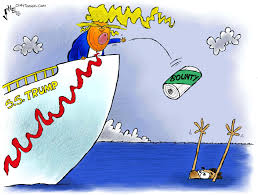






 Yet another set of excuses for yet another white man that just
 And of course,
 Good Afternoon!
 Let’s just juxtapose that on this headline from the Business Insider:
  People are dying in Puerto Rico while Kremlin Caligula goes golfing this weekend and tells every one he’s doing a heckuva job.
 The New York Times Op Ed page is alive with pieces questioning Trump’s fitness for office. “Private Emails, Private Jets and Mr. Trump’s Idea of Public Service”.
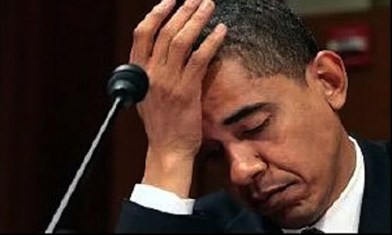
 The frog marches out of the White House can’t come soon enough for me or the future of our country.
 Other stories of the day were the Federal Government finally got around to telling
  Madam Secretary must’ve been watching the provocative North Korea performance as well as the I love Alabama and Alabama loves me HateFest. This all got me thinking about that metaphor of draining swamps.
  The problem was the mosquitoes. It wasn’t the swamp.
 Kevin Drum asks “Is There Anyone In the Trump Administration Who Isn’t Corrupt?”
 I’ve spent hours walking around swamps. It’s one of my favorite places to be these days. I’ve spent many hours trekking around the
  That is one great list of our current invasive pests. Don’t drain the swamp. Trap the invasive species–like the Trumpnutria–who the greedy put in a place where they do not belong and release into the wild when they no longer find them useful. The Trump Family Crime Syndicate is as Alabaman as kudzu. Trap invasive species! Save our swamps!
 peej
peej Carissa
 bostonboomer
 dakinikat
 ecocatwoman
 mablue2
 Mama Lopez
 peggysue22
 quixote
 skydancingguestblogger
 Mona (aka Wonk the Vote)



 Sky Dancing
Recent Comments