
Monday Reads: Storm’s a’brewing
Posted: September 3, 2018 Filed under: Afternoon Reads | Tags: Brett Kavanaugh, hearings, Pool Patrol Patty, Rio Museum Fire, Tropical Storm Gordon, Trump legal problems. Guilliani 34 Comments Good Afternoon Sky Dancers!
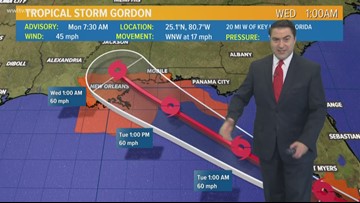
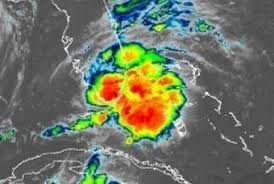
Well, I woke up with the news we’re under a Tropical Storm warning and all the models point it straight at us. It’s a rain event–which normally wouldn’t bug me–except I need to get this new roof on my house yesterday. I’ve spent the last 3 days with water coming on to my bed again. My turkey roaster comes in handy for brief storms but I have no idea how I’m going to bail things out from what’s projected from Gordon. I’m trying to find a few people to put more tarps on the roof. I have the roofing guy coming tomorrow oddly enough. I’ve had a hard time scrambling for my deductible and I’m at the point it just needs to be done whatever other bill has to go unpaid.
I used to find these things oddly exciting but I’m not sure if old age or the number of hurricanes/tropical storms I have to deal with, but, this is getting to me. Karma died during the last one and I was without electricity for quite a period. This is the first one I will go through without Miles too. Anyway, I’m a bit of a wreck already and it’s just over the tip of the Florida peninsula headed to us some time tomorrow. Hopefully, it just blows right through and goes away quickly.
Our infrastructure sucks here and costs plenty. I’m expecting a lot of flooding here too. I’m not in danger of that but I know a lot of people that will be. Our Sewage and Water Board is in a state of collapse and the head of the Electric company has been fired. Basically, both utilities are rudderless. I’m just hoping and praying that the people that actually do the hard work are going to be able to do it.
 So, here’s a few things you might want to read today.
From the New Yorker and Courts watcher Jeffrey Toobin: How Rudy Giuliani Turned Into Trump’s Clown. The former mayor’s theatrical, combative style of politics anticipated—and perfectly aligns with—the President’s.” Do shit storms count? At least, this one is not aimed at me.
Since joining Trump’s team, Giuliani has greeted every new development as a vindication, even when he’s had to bend and warp the evidence in front of him. Like Trump, he characterizes the Mueller probe as a “witch hunt” and the prosecutors as “thugs.” He has, in effect, become the legal auxiliary to Trump’s Twitter feed, peddling the same chaotic mixture of non sequiturs, exaggerations, half-truths, and falsehoods. Giuliani, like the President, is not seeking converts but comforting the converted.
This has come at considerable cost to his reputation. As a prosecutor, Giuliani was the sheriff of Wall Street and the bane of organized crime. As mayor, he was the law-and-order leader who kicked “squeegee men” off the streets of New York. Now he’s a talking head spouting nonsense on cable news. But this version of Giuliani isn’t new; Trump has merely tapped into tendencies that have been evident all along. Trump learned about law and politics from his mentor Roy Cohn, the notorious sidekick to Joseph McCarthy who, as a lawyer in New York, became a legendary brawler and used the media to bash adversaries. In the early months of his Presidency, as Mueller’s investigation was getting under way, Trump is said to have raged, “Where’s my Roy Cohn?” In Giuliani, the President has found him.
…
Giuliani’s behavior has provoked disgust among some of his former fellow-prosecutors. “He has totally sold out to Trump,” John S. Martin, a predecessor to Giuliani as U.S. Attorney who later became a federal judge, said. “He’s making arguments that don’t hold up. I always thought of Rudy as a good lawyer, and he’s not looking anything like a good lawyer today.” Preet Bharara, who served as U.S. Attorney from 2009 until 2017, when he was fired by Trump, told me, “His blatant misrepresentations on television make me sad. It’s sad because I looked up to him at one point, and this bespeaks a sort of cravenness to a particularly hyperbolic client and an unnecessary suspension of honor and truth that’s beneath him. I would not send Rudy at this point in his career into court.” Giuliani’s desire for attention and publicity has always been at odds with the buttoned-up traditions of the Southern District of New York. In 2014, some seven hundred current and former prosecutors for the Southern District met for a gala dinner to celebrate the two-hundred-and-twenty-fifth anniversary of the office. Almost every former U.S. Attorney still living gave a speech—except Giuliani, who sent a video, with the excuse that he was attending to his duties as an “ambassador” to the U.S. Ryder Cup golf team. The announcement was greeted with derisive laughter.
 The Kavanaugh nomination barrels forward with so much aplomb and gall that it’s really disturbing. Hearings start tomorrow. There’s likely to be a battle of some kind per ABC.
Democrats are expressing alarm over the Trump White House decision to claim executive privilege and withhold some 100,000 pages of documents from Supreme Court nominee Judge Brett Kavanaugh’s time with the George W. Bush administration.
That decision, relayed in a letter late Friday, just days before confirmation hearings are set to begin Tuesday, is a move top Senate Democrat Chuck Schumer of New Yorkcalled a “Friday night document massacre.”
More than 400,000 other pages have been handed over to the Senate Judiciary Committee, but Democrats say the withheld documents would give details and color to Kavanaugh’s time as White House Counsel in the Bush White House — when he was involved in some of its most controversial decisions and judicial nominations.
It’s a time Democrats say is key in giving context to his time as a partisan Republican.
Before serving in the Bush White House, Kavanaugh had been a key deputy to Independent Counsel Ken Starr and advocated for tough questioning of President Bill Clinton about his sexual encounters with then-White House intern Monica Lewinsky.
Later, he said, after seeing the pressures inside the Bush White House, he wrote in a 2009 article for the Minnesota Law Review that any civil and criminal investigations of a president should be deferred until they’re out of office because they’re “time-consuming and distracting.”
The just over 100,000 pages of material was withheld after the Trump White House “directed that we not provide these documents,” wrote William Burck, the lawyer handling the document release on behalf of the Bush administration.
 WAPO has an interesting feature that discusses how the Trump presidency has caused the “Trump Effect” which is basically seen in all that Wypipo outrage about black people in what they consider white spaces. This discusses the small town and “Pool Patrol Paula” who was outraged that young black children would be swimming in their neighborhood pool.
Darshaun’s aunt said she noticed that none of the adults at the pool seemed to be doing anything to help him. She called over Darshaun’s mother to watch. Darshaun told them that he and two friends had been invited to the pool by a family that lives in the subdivision. They were just sitting down at a table and kicking off their shoes when Strempel approached them, asked them if they lived in the subdivision and then accused them of trespassing.
Darshaun’s mother took him to the Dorchester County Sheriff’s Office to file an assault complaint.
His aunt looked Strempel up on Facebook and dashed off a quick message.
“Good evening, Stephanie. Is this you in the video?” she asked.
After four hours passed without a response, Darshaun’s aunt posted it to her Facebook page, tagging local activists, two television news stations, the NAACP and the Coast Guard unit where, she had learned, Strempel’s husband was serving.
“This kind of behavior is unacceptable and we WILL NOT TOLERATE IT!!!! PLEASE SHARE!!!!” she wrote. “. . . Racism at its best.”
She hit post at 11 p.m., flipped off her computer and went to sleep.
Online, Strempel would soon be dubbed “Pool Patrol Paula,” joining “ID Adam,” “BBQ Becky,” “Permit Patty,” “Coupon Carl” and others branded as exemplars of racism and white entitlement.
It was 10 the next morning when Strempel, who declined to comment for this article through her attorney, sent her first message to Jovan Hyman. She denied hitting Darshaun — even though the video showed her doing so — and defended herself as an involved member of the community.
“I have children,” she wrote. “My husband is a respected coast guard officer. I have a special needs son. . . . My husband and I are being threatened and slandered all over social media [and it] is not okay.”
By this point, Hyman had watched the video several times, and he had no doubt that Strempel had targeted the boys at the pool because of the color of their skin.
…
Today, Reminisce is reminiscent of a typical Southern suburb, where blacks and whites live side by side but usually avoid sensitive topics such as race and politics. It’s a precinct where Trump took nearly two-thirds of the vote, is mostly white and made up of schoolteachers, police officers, and employees of the nearby Air Force base and Boeing plant.
What follows is a tick tock of how the town dealt with and is still dealing with its race issues.
 A devastating fire has leveled a 200 year old museum in Brazil. It was a repository of many artifacts that cannot be replaced.
“It was the biggest natural history museum in Latin America. We have invaluable collections. Collections that are over 100 years old,” Cristiana Serejo, one of the museum’s vice-directors, told the G1 news site.
Marina Silva, a former environment minister and candidate in October’s presidential elections said the fire was like “a lobotomy of the Brazilian memory”.
Luiz Duarte, another vice-director, told TV Globo: “It is an unbearable catastrophe. It is 200 years of this country’s heritage. It is 200 years of memory. It is 200 years of science. It is 200 years of culture, of education.” TV Globo also reported that some firefighters did not have enough water to battle the blaze.
It wasn’t immediately clear how the fire began. The museum was part of Rio’s Federal University but had fallen into disrepair in recent years. Its impressive collections included items brought to Brazil by Dom Pedro I – the Portuguese prince regent who declared the then-colony’s independence from Portugal – Egyptian and Greco-Roman artefacts, “Luzia”, a 12,000 year-old skeleton and the oldest in the Americas, fossils, dinosaurs, and a meteorite found in 1784. Some of the archive was stored in another building but much of the collection is believed to have been destroyed.
Paul Blumenthall–writing for Huffpo–outlines the number of investigations surrounding the Trump Family Crime Syndicate. “It’s Not Just Robert Mueller. President Donald Trump Faces Six Separate Investigations And Lawsuits.Prosecutors are digging into the president’s business from which he refused to divest.”
There are currently five separate investigations into Trump and his associates from four different investigative bodies. An additional lawsuit brought by two state attorneys general challenges whether Trump is in violation of the U.S. Constitution. There are further reports about probes into the financial dealings of the president’s eldest daughter, Ivanka Trump, and his second eldest son, Eric Trump.
It’s a great list and description of all the investigations from obstruction of justice to emoluments clause violation.
So, I know you’re all likely having a great long weekend. I’ve got to start working on getting ready for this and finishing up my grades. I have no doubt this will likely take me offline for a few days.
What’s on your reading and blogging list today?
Friday Reads: The Walls Close In on the Trump Family Crime Syndicate
Posted: August 31, 2018 Filed under: Afternoon Reads | Tags: Manafort Foreign Agent, Trump Russia Collusion 35 Comments
The Sandy Beach at Olonne by Albert’ Marquet – circa 1938.
Good Afternoon Sky Dancers!
It’s the usual Frantic Friday News Day. A new WAPO/ABC Poll shows exactly how unpopular KKKremlin Caligula has become and shows wide spread support for both the oldest Living Confederate Widow at the DOJ and the Russia Inquiry. I bet the Twitler storm will be epic over the weekend if they don’t keep him on the golf course.
President Trump’s disapproval rating has hit a high point of 60 percent, according to a new Washington Post-ABC News poll that also finds that clear majorities of Americans support the special counsel’s Russia investigation and say the president should not fire Attorney General Jeff Sessions.
At the dawn of the fall campaign sprint to the midterm elections, which will determine whether Democrats retake control of Congress, the poll finds a majority of the public has turned against Trump and is on guard against his efforts to influence the Justice Department and special counsel Robert S. Mueller III’s wide-ranging probe.
Nearly half of Americans, 49 percent, say Congress should begin impeachment proceedings that could lead to Trump being removed from office, while 46 percent say Congress should not
And a narrow majority — 53 percent — say they think Trump has tried to interfere with Mueller’s investigation in a way that amounts to obstruction of justice; 35 percent say they do not think the president has tried to interfere.
Overall, 60 percent of Americans disapprove of Trump’s job performance, with 36 percent approving, according to the poll. Because of random sampling variation, this represents only a marginal shift from the last Post-ABC survey, in April, which measured Trump’s rating at 56 percent disapproval and 40 percent approval.
I wonder how his base feels about his snobby comments about Sessions. Jonathan Chait provides this analysis.
Trump has touted the mindless loyalty of his base, and when he marveled that he would not lose any support if he shot somebody on Fifth Avenue, he was not complimenting the discernment of his supporters. He has tried to turn that into a positive — “I love the poorly educated!” — but the association with low socioeconomic strata has grated on him. Trump is the ultimate snob. He has no sense that working-class people may have equal latent talent that they have been denied the chance to develop. He considers wealthy and successful people a genetic aristocracy, frequently attributing his own success to good genes.
Attempting to explain his penchant for appointing plutocrats to his Cabinet, Trump has said, “I love all people, rich or poor, but in those particular positions I just don’t want a poor person. Does that make sense?” It makes sense if you assume a person’s wealth perfectly reflects their innate intelligence. Trump has repeatedly boasted about his Ivy League pedigree and that of his relatives, which he believes reflects well on his own genetic stock. He has fixated on the Ivy League pedigree of his Supreme Court appointments, even rejecting the credentials of the lower Ivys as too proletarian.
Trump has built a brand on attracting working-class strivers. But the relationship he cultivates is unidirectional admiration. Trump gives his supporters a lifestyle they can enjoy vicariously. He views them as suckers. The Trump University scam was premised directly on exploiting the misplaced trust of his fan base. The internal guidance for salespeople trying to drain the savings accounts of their targets explained, “Don’t ask people what they think about something you’ve said. Instead, always ask them how they feel about it. People buy emotionally and justify it logically.”
isis is now making a comeback. The frequency of the group’s attacks is up, and so, apparently, are its numbers. It excels, once again, at crafting small explosive devices, and weaponizing drones. And its sophisticated media outreach is recovering, according to a new U.N. report. The elusive isis emir, Abu Bakr al-Baghdadi, whom Russia claimed to have killed in a May, 2017, air strike, reëmerged this month with an hour-long broadcast, his first in a year. He acknowledged that his followers had been tested with “fear and hunger.”
The United States had boasted of its “so-called victory in expelling the state from the cities and countryside in Iraq and Syria,” Baghdadi, who was held by U.S. forces in Iraq for several months in 2004, said. He urged a different metric. “The land of Allah is wide and the tides of war change,” he said. “For the believer mujahideen, the scale of victory or defeat is not tied to a city or town being stolen or subject to those who have aerial superiority, or intercontinental missiles or smart bombs.” He referred to the revival of an earlier version of isisafter it was decimated by U.S. troops in Iraq during the surge of 2007. At the time, the jihadi group was down to only a thousand fighters. isis subsequently mobilized more than sixty thousand fighters from more than a hundred countries to its cause. Baghdadi vowed that those who “patiently persevere” would again have “glad tidings.”
isis may already have numbers sufficient to rebuild. Two stunning reports this month—by the United Nations and Trump’s own Defense Department—both contradict earlier U.S. claims that most isis fighters had been eliminated. The Sunni jihadi movement still has between twenty thousand and thirty thousand members on the loose in Iraq and Syria, including “thousands of active foreign terrorist fighters,” the U.N. said, despite the fall of its nominal capital, Raqqa, last October. The Pentagon report is more alarming: isis has fourteen thousand fighters—not just members—in Syria, with up to seventeen thousand in Iraq. More important, isis has successfully morphed from a proto-state into a “covert global network, with a weakened yet enduring core” in Iraq and Syria, with regional affiliates in the Middle East, Africa, and Asia, the U.N. reports. It can “easily” obtain arms in areas with weak governance; it is now a threat to U.N. member states on five continents.

Children Playing on the Beach Mary Cassatt 1884
A breaking story on DOJ Attorney Bruce Ohr is possibly what has made Trump so angry the last few days.
A senior Justice Department lawyer says a former British spy told him at a breakfast meeting two years ago that Russian intelligence believed it had Donald Trump “over a barrel,” according to multiple people familiar with the encounter.
The lawyer, Bruce Ohr, also says he learned that a Trump campaign aide had met with higher-level Russian officials than the aide had acknowledged, the people said.
The previously unreported details of the July 30, 2016, breakfast with Christopher Steele, which Ohr described to lawmakers this week in a private interview, reveal an exchange of potentially explosive information about Trump between two men the president has relentlessly sought to discredit.
They add to the public understanding of those pivotal summer months as the FBI and intelligence community scrambled to untangle possible connections between the Trump campaign and Russia. And they reflect the concern of Steele, a longtime FBI informant whose Democratic-funded research into Trump ties to Russia was compiled into a dossier, that the Republican presidential candidate was possibly compromised and his urgent efforts to convey that anxiety to contacts at the FBI and Justice Department.
The people who discussed Ohr’s interview were not authorized to publicly discuss details of the closed session and spoke to The Associated Press on condition of anonymity.
Among the things Ohr said he learned from Steele during the breakfast was that an unnamed former Russian intelligence official had said that Russian intelligence believed “they had Trump over a barrel,” according to people familiar with the meeting. It was not clear from Ohr’s interview whether Steele had been directly told that or had picked that up through his contacts, but the broader sentiment is echoed in Steele’s research dossier.
Steele and Ohr, at the time of the election a senior official in the deputy attorney general’s office, had first met a decade earlier and bonded over a shared interest in international organized crime. They met several times during the presidential campaign, a
Tahitian Women on the beach Paul Gauguin
relationship that exposed both men and federal law enforcement more generally to partisan criticism, including from Trump.

There’s also a new indictment of a Manafort crony with connections to Cambridge Analytica. This is another FARA violation charge. This may be connected to the upcoming DC trial for Manafort.
A former associate of Paul Manafort agreed to cooperate with U.S. prosecutors after pleading guilty to failing to register in the U.S. as a foreign agent for his work lobbying on behalf of a Ukrainian political party.
The lobbyist, Sam Patten, is a longtime international political operative who’s partnered with a Russian already indicted in Special Counsel Robert Mueller’s probe. He appeared in federal court in Washington Friday.
Mueller’s office referred the case to U.S. Attorney Jessie Liu in the District of Columbia, according William Miller, a spokesman for Liu, who declined to comment further on a pending case.
Patten has worked with Manafort and on Ukrainian campaigns, as well as in countries including Russia, Georgia, Iraq and Kazakhstan. He served in the State Department under George W. Bush, and reportedly worked on microtargeting operations with Cambridge Analytica.
From 2014, Patten provided a “prominent” Ukrainian oligarch who isn’t named in court papers and his Opposition Bloc political party with lobbying and consulting services, according to the criminal information. A company Patten co-owned with a Russian national received more than $1 million for the work, the U.S. said.
As part of his lobbying work, he violated the Foreign Agents Registration Act by not disclosing the work to the U.S., prosecutors said. No date has been set for his sentencing.
He headed the Moscow office of the International Republican Institute in the early 2000s. A Russian IRI employee in those years, Konstantin Kilimnik, went on to work as a fixer for Manafort in Ukraine and is a business partner with Patten. Kilimnik has been indicted in absentia alongside Manafort on obstruction of justice charges the former Trump campaign chairman faces in Washington next month.

Beach Scene Edgar Degas
Trump continues his war on Canada as the Toronto Star uncovered some Trumpertantrums regarding the so-called NAFTA rework. Trump’s interview with Bloomberg News has turned into a verbal bombing campaign.
High-stakes trade negotiations between Canada and the U.S. were dramatically upended on Friday morning by inflammatory secret remarks from President Donald Trump, after the remarks were obtained by the Toronto Star.
In remarks Trump wanted to be “off the record,” Trump told Bloomberg News reporters on Thursday, according to a source, that he is not making any compromises at all in the talks with Canada — but that he cannot say this publicly because “it’s going to be so insulting they’re not going to be able to make a deal.”
“Here’s the problem. If I say no — the answer’s no. If I say no, then you’re going to put that, and it’s going to be so insulting they’re not going to be able to make a deal … I can’t kill these people,” he said of the Canadian government.
In another remark he did not want published, Trump said, according to the source, that the possible deal with Canada would be “totally on our terms.” He suggested he was scaring the Canadians into submission by repeatedly threatening to impose tariffs.
“Off the record, Canada’s working their ass off. And every time we have a problem with a point, I just put up a picture of a Chevrolet Impala,” Trump said, according to the source. The Impala is produced at the General Motors plant in Oshawa, Ontario.
Trump made the remarks in an Oval Office interview with Bloomberg. He deemed them off the record, and Bloomberg accepted his request not to reveal them.
But the Star is not bound by any promises Bloomberg made to Trump. And the remarks immediately became a factor in the negotiations: Trudeau’s officials, who saw them as evidence for their previous suspicions that Trump’s team had not been bargaining in good faith, raised them at the beginning of a meeting with their U.S. counterparts on Friday morning, a U.S. source confirmed.
The Star was not able to independently confirm the remarks with 100 per cent certainty, but the Canadian government is confident they are accurate. Bloomberg editor-in-chief John Micklethwait, who was one of the journalists in the room, did not dispute their authenticity.
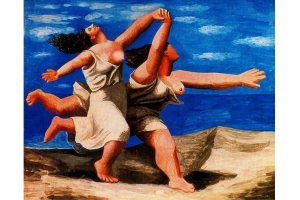
Two Women Running on the Beach Pablo Picasso
Trump has removed cost of living raises for Federal Employees. What a small minded little manchild.
President Donald Trump told lawmakers on Thursday he wants to scrap a pay raise for civilian federal workers, saying the nation’s budget couldn’t support it.
In a letter to House and Senate leaders, Trump described the pay increase as “inappropriate.”
“We must maintain efforts to put our Nation on a fiscally sustainable course, and Federal agency budgets cannot sustain such increases,” the President wrote.An across-the-board 2.1% pay increase for federal workers was slated to take effect in January. In addition, a yearly adjustment of paychecks based on the region of the country where a worker is posted — the “locality pay increase” — was due to take effect.
Trump said both increases should no longer happen.“I have determined that for 2019, both across the board pay increases and locality pay increases will be set at zero,” he wrote.
Congress has an opportunity to effectively overrule the President’s edict if lawmakers pass a spending bill that includes a federal pay raise. The Senate passed a bill this summer that included a 1.9% raise for federal workers. The House’s version did not address federal pay. Senate and House negotiators will negotiate a final measure in the coming weeks.
Trump’s 2019 budget proposal, released earlier this year, included a pay freeze for civilian federal workers. It’s not clear if Trump would approve a budget that includes the pay increase; the White House has not issued a formal veto threat of the Senate’s bill.

Boats on the Bieach of Saiint Marie, Vincent Van Gogh 1888
The nation is mourning Aretha Franklin and John McCain today. WAPO wrote an article on McCain’s 106 year old mother who attended the service today. I wanted to share some of it with you.
She was sitting in a wheelchair as they carried her son’s casket into the Capitol Rotunda Friday.
Roberta McCain, 106, held granddaughter Meghan McCain’s hand and lifted a handkerchief to dab her eyes. Wearing lipstick, pink blush and a polka dot white blouse, she sat silently as congressional leaders and Vice President Mike Pence lauded Sen. John McCain, who died last week at age 81.
When the tributes were over, Roberta was the last member of the family to touch his flag-draped casket. She crossed herself afterward.
Many obituaries have been quick to mention the McCain family’s prestigious lineage within the American military. The senator’s father and grandfather — both of whom shared his name — were the first father and son in Navy history to become full admirals.
But often overlooked is the influence McCain’s mother had on his upbringing and political life. Now, Roberta has outlived the child she still calls “Johnny,” whose death she faced once before when he was shot down over Vietnam and presumed lost.
Roberta, who lives in Washington, spent years crisscrossing the globe, often alongside her identical twin sister, Rowena, eager for whatever spontaneous adventure came next. She has ridden through the Jordanian desert in the dark of night, hopped a ferry to Macau and trekked through Europe on less than $5 per day.
Roberta and Rowena were born in 1912 when William Howard Taft was president. They grew up traveling the country with their father, a successful oil wildcatter who retired young to raise his children. The family would travel for weeks, sometimes along the California coast or by the banks of the Great Lakes.
Those trips would later serve as the blueprints for what Sen. McCain described as his mother’s “mobile classroom” — one that could show her children the world’s wonders in ways a four-walled classroom could not.
“My mother grew to be an extroverted and irrepressible woman,” Sen. McCain wrote in his memoir, “Faith of My Fathers.”
I hope you have a great Labor Day weekend. I’ll be dreaming about the days when I use to spend it on a beach.
Tuesday Reads: The Pariah “President”
Posted: August 28, 2018 Filed under: Afternoon Reads, U.S. Politics | Tags: Donald Trump, John McCain, pariah president 25 Comments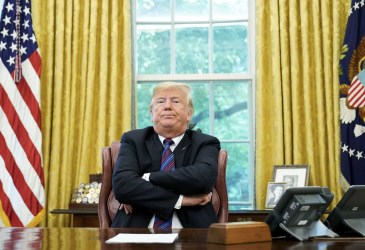
Trump refuses to answer repeated questions about the late Sen. John McCain (R-Ariz.). (Mandel Ngan/AFP/Getty Images)
Good Afternoon!!
I know no one here will find this statement surprising, but Trump has no clue what being “president” is all about. The traditional job of president is not to alienate our country’s closest allies, gin up racism and hatred, inflame partisan divisions, attack freedom of speech and press, and disrespect anyone who refuses to genuflect before him. Presidents are supposed to try to unite the country, heal divisions, and show leadership in difficult times. Not this so-called “president.”
Ashley Parker at The Washington Post: President non grata: Trump often unwelcome and unwilling to perform basic rituals of the office.
Shunned at two funerals and one (royal) wedding so far, President Trump may be well on his way to becoming president non grata.
The latest snub comes in the form of the upcoming funeral for Sen. John McCain (R-Ariz.), which, before his death, the late senator made clear he did not want the sitting president to attend. That the feeling is mutual — Trump nixed issuing a statement that praised McCain as a “hero” — only underscores the myriad ways Trump has rejected the norms of his office and, increasingly, has been rejected in turn.
Less than two years into his first term, Trump has often come to occupy the role of pariah — both unwelcome and unwilling to perform the basic rituals and ceremonies of the presidency, from public displays of mourning to cultural ceremonies.
In addition to being pointedly not invited to McCain’s funeral and memorial service later this week — where former presidents Barack Obama and George W. Bush will both eulogize the Arizona Republican — Trump was quietly asked to stay away from former first lady Barbara Bush’s funeral earlier this year. He also opted to skip the annual Kennedy Center Honors last year amid a political backlash from some of the honorees and has faced repeated public rebuffs from athletes invited to the White House after winning championships.
“We’re not talking about a president going and having a rally in a state that voted against him,” said Tim Naftali, a presidential historian at New York University who previously served as the director of the Richard Nixon Presidential Library and Museum. “We’re talking about a president who can’t even go and participate in a ritual where presidents are usually welcomed, and that is one of the consequences of his having defined the presidency in a sectarian way.”
Noah Bierman at The LA Times: Two funerals and a wedding: The shunning of Donald Trump.
Sen. John McCain’s decision to exclude President Trump from his funeral is an extraordinary moment on its own, a posthumous rebuke from an American icon who regarded the presidency as sacred, and believed its current occupant defiles that office.
Yet Trump’s exclusion from such high-profile events of mourning and celebration — where American presidents are typically counted on to stand in for an entire nation — is emerging as a pattern over his 19 months in office.
In April, Trump was asked to stay away from the funeral of Barbara Bush, wife to one president and mother of another, leaving it to former Presidents Clinton and Obama to serve as national consolers to the Bush family. In December, he opted to skip the president’s traditional attendance at the annual Kennedy Center Honors gala after several of the artists being feted threatened a boycott.
The British royal family dispensed with inviting foreign dignitaries to Prince Harry and Meghan Markle’s wedding in May partly to avoid having to invite Trump, whom Markle had attacked as “divisive” and “misogynistic.” Trump canceled the usual White House celebration for the NFL’s Super Bowl champions when he learned most of the Philadelphia Eagles players were unwilling to attend. Only months earlier the Golden State Warriors had passed on their own invitation to celebrate their 2017 NBA championship title at the White House.
Bierman notes that Trump rants about his rejections by “elites,” but at the same time he’s wounded by them.
The baby-man “president”
Trump’s pique “is genuine. None of it is a put-on,” said Michael Caputo, a former political advisor. “He has the same deep and abiding disdain for the elites that each and every one of the ‘deplorables’ have today.”
The resentment was a constant throughout his career in business and entertainment, where he was dismissed as more of a boastful, tabloid-seeking showman than the serious mogul he believed himself to be.
“I am sure that he is aggravated that the political establishment still will not accept him,” said one longtime friend who asked not to be identified given the sensitivity of the subject. “What he really doesn’t understand is that their objection is cultural as well as political and that they will never accept him.”
But critics say Trump created the isolation by his occasionally outrageous behavior, by reveling in a politics that feeds conspiracy theories, humiliates rivals and disdains basic notions of civility.
“He lacks any kind of humility. He kind of takes pride in kicking people around. So when people then strike back, he shouldn’t be disappointed, because in many ways he’s asked for it,” said Leon E. Panetta, who served in Congress and in the Clinton and Obama cabinets.
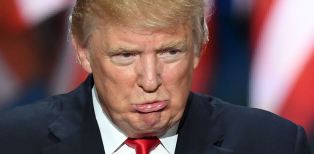
Just look at his childish reaction to the death of John McCain.
The Wall Street Journal reports:
President Trump reversed course and ordered that the U.S. flag be flown at half-staff for the rest of the week to mark the death of John McCain, after drawing fire from lawmakers and veterans groups who said the Republican senator hadn’t been appropriately honored….
White House battled with Trump over whether to keep the flag lowered until McCain’s burial.
The White House initially lowered its flag to half-staff on Saturday but returned it to full-staff by Monday morning. It was lowered to half-staff again Monday afternoon, shortly before Mr. Trump released his statement. The president’s proclamation covers the White House as well as all federal buildings, military bases and embassies.
White House officials said they prodded Mr. Trump for two days to put out a kind word about Mr. McCain. Mr. Trump resisted, and viewed the news coverage of the former senator’s death as over-the-top and more befitting a president, according to people familiar with the situation. They said cable networks’ focus on the flag controversy came at the expense of more coverage of Mr. Trump’s trade deal with Mexico.

Trump is wrong, of course. The flag has been kept at half-staff until the interment of other prominent Americans, most recently for Senator Ted Kennedy and former First Lady Barbara Bush.
One of the reasons Trump despised John McCain was because of his vote against repealing the ACA, but why is he given all the credit for the bill’s defeat? If it hadn’t been for two Republican women, Susan Collins and Lisa Merkowski, McCain’s no vote would have been meaningless. That’s one of the simple truths about the lionizing of McCain that Holly Baxter points out at The Independent: Why can’t anyone be honest about John McCain’s legacy?
It is difficult to encapsulate a political legacy without sliding into enraged hyperbole or saccharine fawning. With John McCain, it is even harder.
That’s because we’re not in Kansas anymore, politically speaking: in the surreal presidential landscape we’ve found ourselves in, it seems almost quaint to refer to McCain as a dinosaur or a right-wing reactionary, or to say that his cruel streak could sometimes be shocking. After all, he called his wife a “c***” on the campaign trail only once (reportedly reacting to being gently teased about his thinning hair); he only joked about the teenage Chelsea Clinton being the “ugly” love child of Hillary Clinton and Janet Reno. It’s not like he said he could grab any woman “by the pussy” because he was famous; it’s not like he dismissed Mexicans as “rapists”. So what’s the problem?
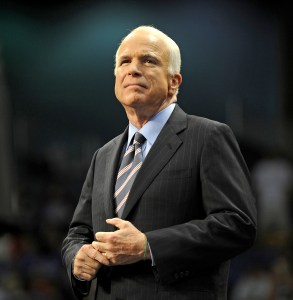
Republican presidential candidate John McCain waits to be introduced at a campaign rally at the Crown Center in Fayetteville, North Carolina on October 28, 2008. AFP PHOTO / Robyn BECK (Photo credit should read ROBYN BECK/AFP/Getty Images)
The very fact that a sitting US president made such shocking remarks, however, shouldn’t blind us to the fact that McCain had some very serious flaws. His Chelsea/Hillary Clinton barb continues a long tradition of dismissing women in politics because of their perceived bad looks. (Remember the “plain facts and plain faces” propaganda against women’s votes during the Suffragette movement, and the depictions of them as ugly harridans who wanted to participate in democracy because they couldn’t get husbands?) Needless to say, the memory of McCain’s mean jibe very probably underpins the reason Chelsea Clinton recently defended Barron Trump against media nastiness, tweeting pointedly that he should be “allowed to have the private childhood he deserves”.
Words are just words, but McCain’s voting record where women’s rights are concerned speaks for itself. He voted to restrict abortion and, in 2015, to defund Planned Parenthood if it carried on providing abortions to women with unwanted pregnancies. We know that votes like these can lead to serious consequences: deaths from backstreet abortions, increased levels of poverty, the perpetuation of cycles of social and economic inequality. McCain also voted against the Protect Women’s Health from Corporate Interference Act in 2014: the bill was an effort to ensure women could access contraception and gynaecological services without being denied healthcare benefits by their providers because of those providers’ “beliefs”. Nor was he prejudiced against women only when it concerned contraception or abortion: he also voted against a bill that would have made it illegal to discriminate against female employees with the same experience being paid less their male counterparts doing exactly the same job.
Read the rest at The Independent.
More articles to check out, links only:
Literary Hub: Rebecca Solnit: Why the President Must Be Impeached.
NYT: Bruce Ohr Fought Russian Organized Crime. Now He’s a Target of Trump.
NYT: Kushner Companies and Michael Cohen Accused of Falsifying Building Permits to Push Out Tenants.
Natasha Bertrand at The Atlantic: Devin Nunes’s Curious Trip to London.
Vice News: This toddler got sick in ICE detention. Six weeks later she was dead.
What else is happening? What stories are you following today?
Lazy Saturday Reads: What Does the Allen Weisselberg Immunity Deal Mean?
Posted: August 25, 2018 Filed under: Afternoon Reads, U.S. Politics | Tags: Allen Weisselberg, David Pecker, Donald Trump, Fox News, Karen McDougal, Michael Cohen, Rudy Giuliani, use immunity 14 Comments
Summer Afternoon (Tea in the Garden), Théo van Rysselberghe
Good Afternoon!!
This has been a disastrous week for Trump. The Guardian summarizes: Trump’s terrible week: stunning news and whispers of impeachment.
…even by the standards of the Trump universe, this week has been a blur. And at its heart was a single, devastating hour on Tuesday 21 August that effectively turned the president of the United States into an unindicted co-conspirator in a federal crime….
…first, there was Rudy Giuliani. Trump’s lawyer, the former New York mayor, set the tone last Sunday with an Orwellian comment on the NBC network’s Meet the Press. Asked whether the president would give his version of events in testimony to Robert Mueller, the special counsel who is investigating Russian interference in the 2016 presidential election, Giuliani warned of a perjury trap and said: “Truth isn’t truth.”
Monday passed with just an embarrassing White House event to celebrate ICE during which Trump
…said that a border patrol agent, who is Latino, “speaks perfect English” as he beckoned him to the stage. He also misstated the acronym for US Customs and Border Protection at least eight times, referring to it as “CBC”, as in Canadian Broadcasting Corporation.
On Tuesday, the shit really hit the fan.
But then came, to use primary election parlance, Super Tuesday. At around 4.30pm, in courtrooms 200 miles apart, a pair of Trump associates delivered a one-two punch that stunned the White House and revived whispers of impeachment.
In New York, Trump’s longtime lawyer and “fixer” Michael Cohen implicated the president in a crime to influence the 2016 presidential election. Pleading guilty to dodging taxes and campaign finance violations, he alleged that Trump directed him to pay hush money to prevent two women – a Playboy model and pornographic actor – speaking out about extramarital affairs.
In Alexandria, Virginia, Paul Manafort, Trump’s former campaign chairman, was found guilty of eight tax and bank fraud charges and could now spend the rest of his life behind bars – unless Trump chooses to pardon him.
On Wednesday morning, Fox aired Trump’s interview in which he claimed that the campaign finance violations Cohen had pleaded guilty to were not crimes and that it should be illegal for people accused of crimes to turn states evidence in order to reduce their sentences. Then on Wednesday night he watched Tucker Carlson’s show.
There he saw a spurious Tucker Carlson report pushing a white nationalist conspiracy theory that white farmers in South Africa are being persecuted and murdered in Zimbabwe-style land grabs. Trump tweeted his outrage and promised to consult the state department, whose own human rights report on South Africa had made no mention of the issue.
It was one more white grievance dog whistle to add to all the rest. The South African government issued a swift rebuke and summoned US officials. Patrick Gaspard, the former US ambassador to South Africa, described the intervention as “astounding and deeply disturbing”. He said: “I can draw a line from the irresponsible statements he made in the wake of the violence in Charlottesville and him lifting up tropes from white nationalists in South Africa.”
 On Thursday,
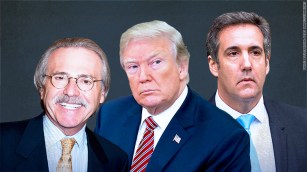
It emerged that David Pecker, chairman of American Media Inc, which owns the pro-Trump National Enquirer, had been granted immunity to provide information about Cohen and Trump’s involvement with payments to the two women who allege sexual affairs. The Associated Press added fuel to the fire by reporting thatthe Enquirer kept such secrets locked in a safe, lending it extraordinary power.
That night, the New York Times reported that the Manhattan district attorney’s office was considering pursuing criminal charges against the Trump Organization and two senior company officials in connection with one of the hush money payments.
The coup de grâce came with the news that Allen Weisselberg, the CFO of the Trump Organization had been given immunity to testify against Trump’s former personal lawyer Michael Cohen.
Clearly the news about Weisselberg is the most damaging to Trump, but it’s not clear exactly kind of immunity the long-time “financial gatekeeper” has. According the The New York Times, it’s limited to the case against Cohen .
The person briefed on the deal said that it was narrow in scope, protecting Mr. Weisselberg from self-incrimination in sharing information with prosecutors about Mr. Cohen, Mr. Trump’s former personal lawyer, who pleaded guilty on Tuesday to tax and campaign finance charges. The latter charges stemmed from payments during the campaign to two women who said they had affairs with Mr. Trump. It was not, the person said, a blanket immunity extending beyond the information he shared, and Mr. Weisselberg remains in his job at the Trump Organization.
Allen Weisselberg
Mr. Weisselberg figured into the charges filed against Mr. Cohen this week, having facilitated the processing of what prosecutors described as “sham invoices” at the Trump Organization, through which Mr. Cohen was reimbursed for the money he had paid to quiet one of the women alleging an affair with Mr. Trump, the pornographic film actress Stephanie Clifford.

It sounds like it’s use immunity, which protects Weisselberg from being prosecuted based on the specific information he provided about the hush money deals. It’s likely that Weisselberg indicated he would take the fifth and prosecutors used immunity to force him to talk. Weisselberg could still be charged with a crime if investigators find independent evidence that he was involved in criminal activities. If he’s eventually charged with a crime, Weisselberg might agree to cooperate fully with prosecutors, but so far that doesn’t seem to be happening.
Nevertheless, the fact that prosecutors have gotten testimony from the man who supposedly “knows where the bodies are buried” in the Trump Organization is huge. And some knowledgeable writers are claiming Weisselberg has agreed to cooperate fully and are speculating about what he could reveal about Trump.
On Twitter, Renato Mariotti says he would be surprised if Weisselberg only got use immunity.
Obviously he knows a hell of a lot more than I do.
Luppe B. Luppen (AKA @NYCsouthpaw) and Hunter Walker at Yahoo News: For Trump, Allen Weisselberg may be the man who knew too much.
Prosecutors investigating Trump’s inner circle reportedly now reportedly have a limited deal with Weisselberg, who has provided testimony against former Trump lawyer Michael Cohen. If his cooperation expanded, it could play a crucial role in multiple ongoing investigations.
According to the Wall Street Journal, federal prosecutors granted immunity to Weisselberg in exchange for information about payments to Cohen, which were made to two women during the 2016 presidential campaign in order to suppress their stories of alleged affairs with Trump….
The Associated Press subsequently reported that the immunity deal was “restricted to Weisselberg’s grand jury testimony last month in the Cohen case.”
What could Weisselberg reveal if he were forced to cooperate fully?
If Weisselberg decided to fully open his kimono and reveal all he knows, the federal investigation in the Southern District of New York would be the most obvious potential beneficiary. However, in some ways, the nature of that office’s interest in Trump is the most mysterious. As of Friday afternoon, it is not known what other subjects that federal investigation is pursuing. If Trump Organization executives, or even the president, are in its cross hairs, then Weisselberg could offer key insights.
Special counsel Mueller’s investigation, headquartered in Washington, D.C., is another potential beneficiary. For Mueller’s investigators, Weisselberg could detail the nature and extent of the financing the Trump Organization has received from sources connected to Russia. He could also offer them insight into any investments or potential investments Trump has made either in Russia or with Russian partners. A spokesperson for the special counsel’s office declined to comment for this story.
Weisselberg could also potentially be a valuable material witness in the New York attorney general’s state-level investigation into President Trump’s charitable foundation. In June, New York Attorney General Barbara Underwood filed a lawsuit against the Trump Foundation alleging a “pattern of illegal conduct,” including “willful self-dealing.” Weisselberg has long been the treasurer of the Trump Foundation. In preparation for its lawsuit, the attorney general’s office conducted a lengthy interview with Weisselberg and obtained his emails. The investigators allege that Weisselberg collaborated with Trump and campaign officials in advance of the 2016 Iowa primary to use the charity’s funds to benefit the campaign.
At The New Yorker, the very knowledgeable Adam Davidson has more:
As the C.F.O., Weisselberg tracked the money that came into the Trump Organization and the money that went out of it, former employees told me. I often found myself wondering what the Weisselberg part of the operation looked like. (I called and e-mailed him a few times, but, not surprisingly, never heard back.) Some told me he had a couple of bookkeepers, but that he personally handled most of the paperwork. Weisselberg knew who was paying or lending money to Trump, and he knew to whom Trump was giving money. When Trump became President, he placed his business interests in a revocable trust overseen by his son Donald Trump, Jr., and Weisselberg….
Trump with his wife, daughter, Karen Mcdougal (far right) and other playboy models.
This summer…Weisselberg’s role in the organization came into sharper focus. In a recording that Michael Cohen made of a conversation he had with Donald Trump about a payment to keep secret an affair, Cohen described setting up a shell company to pay hush money during the 2016 campaign to Karen McDougal, a woman who claimed to have had an affair with Trump. This week, Cohen pleaded guilty to violating campaign-finance laws, in part by setting up this secretive payment. He said that he knew at the time that it was illegal to secretly make a payment for campaign-related activity, but he did so anyway at Trump’s direction. Strikingly, Cohen makes it clear on the tape that Weisselberg also knew about the shell company and payment. “I’ve spoken to Allen Weisselberg about how to set the whole thing up,” Cohen explains to Trump.
It is difficult to hear the tape and not wonder how Weisselberg developed this particular expertise and whether he had deployed it before.

Here’s what Davidson has to say about Weisselberg’s immunity deal:
The Journal story and other news coverage suggest that Weisselberg has narrow immunity, related, solely, to the payments that Michael Cohen made to silence two women with whom Trump had affairs. With evidence of that crime in hand, prosecutors can subpoena other records from the company. If they have a reasonable basis to believe another crime has been committed, they can ask Weisselberg about it. Weisselberg, fearing jail time himself, could broaden his coöperation. The fact that Weisselberg has “flipped”— and may flip further—could shift the calculus of other figures in the Trump orbit as well. Weisselberg is a big fish—perhaps the biggest fish of all. Fearing that Weisselberg might implicate them in a crime, any cronies, dealmakers, attorneys, and others who might want to exchange information for leniency from prosecutors, will now do so.
If you’re interested in what kinds of crimes Weisselberg might know about, I’d suggest reading the entire article as well as Davidson’s other New Yorker pieces about Trump’s business dealings.
What else is happening? What stories have you been following?
Tuesday Reads: Breaking News and A Change of Pace
Posted: August 21, 2018 Filed under: Afternoon Reads, Crime, Criminal Justice System, morning reads, U.S. Politics | Tags: Alexander C. Ewing, Donald Trump, Golden State Killer, Hammer Man, Joseph DeAngelo, Matthew Sullivan, Michael Cohen, Paul Manafort, Steve Dennis 34 Comments
Girls under Trees, August Macke, 1914
Good Afternoon!!
There’s been a development in the Manafort case. The jury has sent out a note with a question for the judge. Unfortunately, the question is somewhat ambiguous.
It sounds like they are saying they are deadlocked on one of the 18 counts, but it’s also possible they are saying they can’t reach a unanimous decision on any of the counts. The judge is taking a five minute recess to prepare his response. I’ll update when I learn more.
Joyce Vance responds:
More breaking news on MSNBC, a report from WNBC that Michael Cohen is in talks with the prosecutors in the Southern District of New York, and a plea deal could be reached as early as today. It’s possible that we will learn something this afternoon.
The jury is back in the courtroom. Ken Dilanian says they are probably deadlocked on only one count, and they need guidance on how to enter that into the verdict sheet. Expert on MSNBC is saying it would be highly unlikely that there would be not guilty decisions on 17 counts.
The jury has now received instruction from the judge and has returned to the jury room. Ken Dilanian says the indecision is on only one count. So maybe we’ll get a verdict today. I sure hope so.
WNBC: Ex-Trump Lawyer Michael Cohen Discussing Plea Deal With Federal Prosecutors in Manhattan.
President Trump’s former personal attorney Michael Cohen is discussing a possible guilty plea with federal prosecutors in Manhattan in connection with tax fraud and banking-related matters, multiple sources familiar with the matter tell NBC News and News 4.
U.S. President Donald Trump’s personal lawyer Michael Cohen leaves federal court in the Manhattan borough of New York City, New York, U.S., April 16, 2018. REUTERS/Lucas Jackson
Those sources stress no deal has been reached but do say the potential deal could be reached as early as Tuesday.
The plea could have significant implications for Trump, who has blasted Cohen ever since his former fixer and his attorney, old Clinton hand Lanny Davis, began signaling this summer that Cohen might cooperate with special counsel Robert Mueller’s investigation.
When reached by NBC, Davis said he cannot comment on advice of counsel since there is an ongoing investigation.

Maybe that partially explains Trump’s hysterical behavior over the past several days.
Jonathan Dienst of WNBC is now reporting on MSNBC that we should know something in an hour or so. The two sides are close, but if the deal falls through, the prosecutors will proceed to prepare charges against Cohen and indict him in the next week or two.
Some stories to check out while we wait for these breaking stories to resolve themselves:
The Hill: Paul Manafort never believed the rules applied to him; I know — I worked with him for a decade, by K. Riva Levinson.
A good plot, most writers will tell you, is built on conflict. Working for Washington’s first bipartisan lobbying firm, Black, Manafort, Stone & Kelly, reporting to Paul Manafort, was my conflict; what came thereafter, my self-reckoning.
I was a recent college grad, broke, with no political connections when I managed to talk my way into an interview with Manafort and told him, boldly — and naively — “There is no place I will not go.” And from 1985 to 1995 (the beginning and end of BMS&K), there was no place that Manafort wouldn’t send me: war zones, states under armed occupation, the African bush or the cocaine-trafficked jungles of Latin America.
I had a front-row seat to a world changing in fast-forward with the collapse of the Soviet Union. It was thrilling, scary and, at times, overwhelming. But I never said no to a mission, or turned back. And despite all that unfolded, I will always remain grateful to Manafort for giving me a chance to learn first-hand how world events are often shaped.
BMS&K was where my mettle was tested, my foundational skills acquired, and where I struggled with my conscience, asking myself, “What am I doing here?”
Manafort had no such concerns about right and wrong.
I saw in Manafort no evident distress about the collateral damage that unfolded, the lives that were damaged or lost. He could self-justify anything. And as time went on, it seemed to me that he became all about the money. I and my colleagues were left to defend the extravagant expenses he charged to our clients.
I watched Manafort bend the rules, and so did everyone else, until eventually the firm’s new management asked him to leave. I left him, too.
I haven’t seen nor spoken directly with Paul since 1995, though I did receive an angry email when The Guardian wrote a story upon the release of my book in June 2016, quoting a passage where I call him “mercenary.”
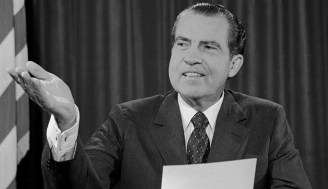 The Washington Post: I miss Richard Nixon, by Philip Allen Lacovara.
I am hardly a Nixon defender. I was part of the special prosecutor investigation that led to his downfall. I was and remain shocked at the extent of his crass and criminal behavior, which first became palpable to me listening to the secret Oval Office tapes that we pried away from him, eventually including the “smoking gun” tape the Supreme Court ordered him to turn over. It was that evidence that convinced Nixon’s closest supporters that his defense against impeachment and removal from office would have been unsustainable, and that he had no choice but to resign in disgrace.
I even created a rift with Leon Jaworski, Archibald Cox’s successor as Watergate special prosecutor, when I publicly protested the pardon that President Gerald Ford issued to Nixon shortly after the resignation, thereby shielding Nixon from the legal consequences that were soon to be visited upon his co-conspirators, who, after conviction, spent years in prison for the coverup.
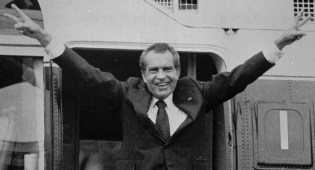 But then I look at the incumbent, and I become wistful.
…unlike Nixon, Trump was born with a golden spoon in his mouth and has exploited his family’s power and wealth from his earliest days. Supposed bone spurs insulated him from the crucible of military service, when many of his contemporaries were called to duty to fight in Vietnam. He relishes the flamboyant and the superficial, though the glitz comes with hefty dose of cheesiness — which I can attest to as someone who lived briefly in one of his “Trump Towers.”
Except for Trump’s own unsupported braggadocio, he entered the Oval Office ignorant of even the rudiments of American history and world affairs. He is a man of no particular political principles; his vacillation between parties (and occasionally as an “independent”) reveals the lack of any political core. Nor did he have any experience in public office, civil or military, or familiarity with the practical art of governing.
Nixon, on the other hand, grew up impoverished and was the archetypical self-made man. He was demonstrably thoughtful — even brilliant. At a conference several years ago at Duke University, where he attended law school during the Depression, I heard stories of his struggles living in a cold-water flat but achieving a distinguished record that was respected decades later.
Lacavera notes that Nixon, unlike Trump, “understood government and policy,” and he “had enough decency and respect for the office to cloak his conniving in secret.” Nixon also had a consistent political philosophy, while Trump clearly has no moral or political core. Read more at the WaPo.

Joseph James DeAngelo, the “golden state killer” via REUTERS
Now for a change of pace, I want to share a couple of nonpolitical reads. This spring the sensational serial rape and murder case of the so-called “golden state killer” was solved through research on an open source DNA website. The suspect was identified as Joseph James DeAngelo of Citrus Heights, CA, a suburb of Sacramento. In the past few days, I came across two similar stories.
Novelist Matthew Sullivan writes at The Daily Beast: I Grew Up in the Shadow of a Neighborhood Killer. He May Have Finally Been Caught.
To anyone living in the suburban boomtown of Aurora, Colorado in the 1980s, the horror story is familiar: at some point after midnight on the night on January 16, 1984, on a quiet cul-de-sac in a newer housing development near the Aurora Mall, an intruder armed with a hammer entered the home of Bruce and Debra Bennett.
They were a young couple with two young daughters, aged 7 and 3, and they had recently moved to Aurora to raise their girls after the 27-year-old Bruce wrapped up a stint in the Navy.
The Bennet family
As of now there’s no way to know the exact sequence of events that happened in the house that night, but the whole family was likely asleep when the intruder slipped in.
Using the hammer he brought with him and a knife he may have taken from their kitchen, the intruder attacked Bruce and Debra. Bruce fought back, grappling with the man in the bedroom and up and down the stairs, but the man overcame him, slit his throat and left him on the steps to die.
By the time the man left, he had also violently attacked and sexually assaulted both Bennett daughters.
The three older Bennetts were dead. The intruder had bludgeoned the three-year-old daughter and left her for dead as well, but according to Kirk Mitchell, who has spent years reporting on this case for the Denver Post, when her grandmother arrived the next morning, worried because Bruce hadn’t shown up for work, she found the youngster in her bed, barely alive. The littlest Bennett had survived.

There had been similar attacks and murders in the area. The crimes cast a shadow over the entire community; but the killer that kids in the neighborhood called “The Hammer Man” was never caught. Sullivan’s descriptions of how the crimes affected him and the community as a whole is fascinating. But now a suspect has been identified through DNA.

Alexander C. Ewing, “the Hammer Man”
One afternoon in early August, 2018, my phone began to erupt with messages from friends and family, co-workers and classmates, all of them living in Denver. Each said the same thing:
They got him.
They got him.
They got him! [….]
Each night, the Colorado Bureau of Investigation runs a comparison against the Combined DNA Index System database (CODIS), run by the FBI, which collects and indexes DNA from different states and agencies.
In early July of this year, the agency got a hit: a match was found between the DNA of the wanted John Doe suspect—the unknown man whose semen was traced to both the Bennett and the Smith crime scenes—and that of a 57-year-old prisoner in Nevada whose cheek was swabbed in 2013 as part of a new state law, his data uploaded.
The man, Alexander C. Ewing, was serving a 40-year sentence for two counts of attempted murder and other crimes and was eligible for parole in three years. According to a Washington Post report, he lived in Denver in 1984—and worked in construction.
One more story from The Washington Post: A baby was abandoned in a phone booth 64 years ago. Now, DNA has helped explain why.
Steve Dennis’s birth certificate didn’t say where he was born or when, or to whom. It just said he was found in a telephone booth.
Steve Dennis
Two bread deliverymen had found him there early one January morning in 1954, back when Dennis didn’t yet have a name. They found the “big blue-eyed infant” wrapped in blankets inside a cardboard box in the phone booth just outside Yielky’s Drive-In near Lancaster, Ohio, the Lancaster Eagle-Gazette reported at the time. There was no telling how long he had been there, perhaps only a few hours. The baby was very cold to the touch, the paper reported, and so was the bottle of milk left with him in the box.
The mystery soon captivated the residents of Lancaster. In just two days, dozens inquired about adoption, and “literally scores of persons” tried to help police identify the baby abandoned in the phone booth, the Eagle-Gazette reported in 1954. Nobody knew who put him there or why, and for a long time in the decades that followed, Dennis didn’t know either.
For years, the whole story struck him as too bizarre to even be true, as he told the Eagle-Gazette’s Spencer Remoquillo in a follow-up story 64 years later, on Friday. Dennis had always known he was adopted as a baby, but he didn’t learn about the phone booth until he was a teenager. He got curious. He traveled all the way to Lancaster just to see it for himself. But he didn’t find very much there, he told the Eagle-Gazette. He didn’t think he would ever find his birth parents, and for most of his life he didn’t think anything of it, either.
But that changed when his two children, 18 and 14 years old, started asking questions.
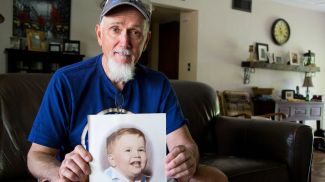
Dennis solved the mystery of his origins through Ancestry DNA. Read the rest at the WaPo. It’s quite a story.
So . . . what stories have you been following?

 peej
peej Carissa
 bostonboomer
 dakinikat
 ecocatwoman
 mablue2
 Mama Lopez
 peggysue22
 quixote
 skydancingguestblogger
 Mona (aka Wonk the Vote)



 Sky Dancing
Recent Comments