
Friday Reads: When Black Friday Comes …
Posted: November 23, 2018 Filed under: Afternoon Reads | Tags: Mueller investigation 21 Comments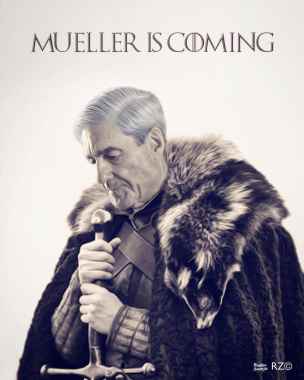
It’s Friday! And Mueller is Coming! He’s an even better holiday guest than Santa!
Today’s news in traitors includes crazy conspiratorial nut Jerome Corsi. Yes! Another domino falls and brings us closer to the Cretin holding the White House hostage. From WAPO and really hot off the presses: “Stone associate Jerome Corsi is in plea negotiations with special counsel, according to a person with knowledge of the talks”. Stone and Dumb Junior cannot be too far behind. Too borrow a turn of phrase, “I love it!”.
Conservative writer and conspiracy theorist Jerome Corsi is in plea negotiations with special counsel Robert S. Mueller III, according to a person with knowledge of the talks.
The talks with Corsi — an associate of both President Trump and GOP operative Roger Stone — could bring Mueller’s team closer to determining whether Trump or his advisers were linked to WikiLeaks’ release of hacked Democratic emails in 2016, a key part of his long-running inquiry.
Corsi provided research on Democratic figures during the campaign to Stone, a longtime Trump adviser. For months, the special counsel has been scrutinizing Stone’s activities in an effort to determine whether he coordinated with WikiLeaks. Stone and WikiLeaks have repeatedly denied any such coordination.
Stone has said that Corsi also has a relationship with Trump, built on their shared interest in the falsehood that President Barack Obama was not born in the United States.
David Gray, an attorney for Corsi, declined to comment, as did a spokesman for Mueller. Stone declined to comment on Corsi’s plea negotiations. An attorney for Trump declined to comment.
The deal is not yet complete and could still be derailed. Last week, Corsi said his efforts to cooperate with prosecutors had broken down and that he expected to be indicted on a charge of allegedly lying. He described feeling under enormous pressure from Mueller and assured his supporters that he remains supportive of the president.
In a webcast and a series of interviews, Corsi said he had spoken to prosecutors for 40 hours and feared that he could spend much of the remainder of his life in prison.
After two months of interviews, Corsi, 72, said he felt his brain was “mush.”
“Trying to explain yourself to these people is impossible . . . I guess I couldn’t tell the special prosecutor what he wanted to hear,” he added.
Meanwhile, His Lazy and Greediness is costing us money which is going directly into the pockets of the Trump Family Crime Syndicate.

Krampus is coming and he better bring a lot of sacks and cages! A lot of discussion has been held in the media about the idea of collusions being an actual crime as compared to something along the lines of conspiracy. Here’s an interesting take from Sidebars blog. There’s a lot of legal wonky goodness here.
Is collusion a crime? Since the beginning of special counsel Robert Mueller’s investigation, allegations of “collusion” have dominated the debate. President Trump regularly claims there was “no collusion” with the Russians seeking to influence the 2016 presidential election. His attorneys and other supporters also have repeatedly argued that even if collusion took place, that would not be criminal. But last week, in a case brought by Mueller, a federal judge upheld the legal theory under which “collusion” may indeed be a crime.
I’m not sure how the term “collusion” became so central to discussions of the Mueller investigation. It really should be banned altogether. (I know, I know — this from the guy who just wrote a blog post with “collusion” in the title, right? But hey, I can’t unilaterally disarm.) All it does is breed confusion and lead to diversionary arguments about whether collusion is criminal.
It’s true there is no criminal statute titled “collusion.” But as I’ve noted in several places (here and here, for example) the relevant crime is conspiracy under 18 U.S.C. 371. Collusion refers to an agreement with others to achieve some improper end. In criminal law, we call that a conspiracy – a partnership in crime. And the breadth of the federal conspiracy statute makes it particularly well-suited for cases like Mueller’s probe of Russian interference with the election.
Title 18 Section 371 prohibits conspiracies to commit an offense against the United States, which means a conspiracy to commit any federal crime. But it also broadly prohibits conspiracies to defraud the United States “in any manner or for any purpose.” For nearly a century the Supreme Court has held that conspiracies to defraud the United States include conspiracies to impair, obstruct, or defeat the lawful functions of the federal government through deceit or dishonesty. This is true even if the actions of the conspirators are not independently illegal, and even if the government is not deprived of any money or property.
In this post in the summer of 2017, I argued Mueller could use this theory to charge that individuals who agreed to work together to interfere with the election through deceptive and dishonest methods conspired to impair, obstruct, or defeat the function of the Federal Election Commission to administer a fair and honest election. This legal theory would apply not only to Russians but also to any members of the Trump campaign or other Americans who worked — or colluded — with them. And it applies whether or not the actions taken by the co-conspirators are otherwise illegal; in other words, the “collusion” itself can be the crime

So, this outing out to burn like a yuletide bonfire by the Mississippi. Here’s hoping it works on the Ptomac too! I even get to quote Page Six which I believe is unique for me. I do not plan to read the book but it should be an interesting topic on the pundit circuit. Page Six presents: “National Enquirer editor writing book about ‘Trump and his women’”
The National Enquirer’s long-held secrets about Donald Trump may be about to get substantially less secret.
Page Six is told that the longtime executive editor of the tabloid, Barry Levine, is penning a book for Hachette about the president.
A source says that the book will look into “Trump and his women,” although other insiders tell us that it could be more wide-ranging, even looking at the formerly cozy relationship between the Enquirer’s owner, David Pecker, and Trump. That said, it’s unclear exactly what Levine’s contract with the Enquirer would allow him to reveal about Pecker.
Of course, Pecker has been at the center of an investigation into alleged hush money payouts made to Karen McDougal and Stormy Daniels — who both claim to have had affairs with Trump while he was married to First Lady Melania Trump. In August, Pecker was granted immunity in the probe.
Either way, Levine — who left the Enquirer in 2016 after 17 years — will have plenty of previously unreported material for the tome.
In its reporting on the relationship between Pecker and Trump, the Wall Street Journal wrote in June, that, “Tips about Mr. Trump poured into the tabloid after his television show ‘Celebrity Apprentice’ took off in 2002, but the Enquirer turned away stories that could paint him in a bad light, two former American Media employees said,” adding, “Barry Levine … reminded them that Mr. Pecker wouldn’t allow it, these former employees said.” No impediment now exists.
Let’s watch those fundi preachers swallow this.
The Guardian has an exclusive interview with Hillary that’s worth a read: “US media must ‘get smarter’ to tackle Trump, says Hillary Clinton”. Well, again, she speaks the truth to idiots.
Hillary Clinton has criticised the US media over its coverage of Donald Trump, calling on the press to “get smarter” about holding to account a president who is a master of diversion and distraction.
In an exclusive interview with the Guardian, Clinton also offered a stinging rebuke of the Republican party’s base, saying it had become enthralled by the president’s “insults and attacks and entertainment and spectacle”.
“The Republican party has collapsed in the face of Trump,” she said.
Clinton also criticised Trump’s repeated attacks on the press, behaviour she suggested had echoes of authoritarian and fascist political leaders who erode faith in facts and evidence. She said Trump had proved himself skilled at “tweeting and insulting and dominating the news cycles” and said he was too often left unchallenged by the press.
“I believe that where we are now in the political cycle is that the press does not know how to cover these candidates who are setting themselves on fire every day, who are masters of diversion and distraction,” she said.
The former Democratic presidential nominee specifically called out CBS 60 Minutes over its interview with the Trump last month for not asking the president about a major New York Times investigation into alleged tax dodging in his family real estate empire.
“I have a high regard for 60 Minutes and for Lesley Stahl who’s a terrific journalist,” Clinton said, before noting there was “not a single question” about the New York Times story
“So at some point, the press has to get smarter because that’s basically how most voters get their information,” she said, adding that often the quest for “balance” resulted in facts being relegated in favour of opinion.
“If you’re into both-side-ism – so, you know, on the one hand this, and on the other hand that – really there’s no factual basis, there’s no evidence, there’s no record. Everybody lies, everybody gilds the lily. It doesn’t really matter. That just opens a door to somebody like him.”
https://twitter.com/kenkschultz/status/1066024872525090823
Is this the beginning of the end? Is the Mueller investigation getting active publicly so we can get a good hint at when our national nightmare ends?
The odds are high that special counsel Robert Mueller will soon announce dramatic news that will escalate our national discussion of the Russia scandal to red-hot levels of intensity that may well compel Congress to begin a serious discussion of impeachment.
Three critical matters were long obvious to informed observers of the Russia investigation. First, Mueller was well aware of the possibility that President Trump would attempt to execute a “Saturday Night Massacre” attack against him and the Russia investigation shortly after the midterm voting was concluded.
Second, Mueller has used the “silent period” during the midterm campaign to advance the investigation assertively without public discussion, under the radar of the media until now. Third, the issues of obstruction of justice and abuse of power are far more grave than is generally realized.
If it is true that Trump aggressively pushed for criminal prosecution of his political opponents and that then-White House counsel Donald McGahn had to intervene, keep in mind that McGahn has spent dozens of hours cooperating with Mueller and his team.
The quiet period for Mueller will soon end. Recently, Mueller and lawyers for Paul Manafort agreed to seek a delay in filing court documents that would detail Manafort’s cooperation with the investigation until next Monday.
In other words, in a few days, there will almost certainly be publicly known major news that will give the court and the American people a much clearer idea of exactly how Manafort has been cooperating with Mueller.
It is very possible, and in my view likely, that there have already been indictments issued and plea bargain agreements reached that for now remain under seal, which will be unsealed and announced in the coming days and weeks.
Trump attempting to name Matthew Whitaker as acting attorney general can be seen as a desperate last-ditch effort by Trump — which is ultimately doomed to fail — to derail the Mueller investigation.
This speculation is written for HuffPo by BRENT BUDOWSKY. And here’s one from The Atlantic that tries to explain why so many white women vote themselves into second class citzenship so people of color may be put down to 3rd class citizenship.
Okay, Here we go … wtf is wrong with them? And this is by Katha Pollitt.
For almost three years now, reporters have been begging tired farmers and miners eating their pancakes at Josie’s Diner in Smallville, Nebraska, to say they’ve seen the light. They never do. White evangelical women sneaking away from the Republican Party make for a good story—but they didn’t stop Ted Cruz from getting 81 percent of the white evangelical vote in Texas.
After Trump took the White House, and even after political scientists and pollsters figured out that many Trump supporters were not out-of-work Rust Belters but just your basic well-off Republicans, there was an orgy of self-criticism among Democrats and progressives. Somehow, those voters were our fault; we had neglected them, disrespected them, not felt their pain. The important sociologist Arlie Hochschild wrote a whole book about right-wingers in the Louisiana bayous who rejected curbs on the oil and gas industry that was destroying their way of life and instead blamed their problems on others (people of color, immigrants, women) “cutting in line.” In Strangers in Their Own Land, Hochschild called on us to climb the “empathy wall.” The unstated implication was that liberal condescension—not Trumpers’ racism, say—is the problem.
Another version of this idea is to call on progressive white women to convert other white women who support Trump. Nobody calls on white men to convert white men, because everyone assumes that’s impossible, but for some reason, white women who hate abortion and taxes and Obamacare, who want to “build the wall” and “lock her up,” are supposed to be pliable—and it’s the duty of liberal white women to expiate their own racism by bringing them around. It reminds me of the time years ago when a group of Nation interns came back after spending a weekend at a conference of Evangelical women. They beat themselves up about how those women weren’t feminists; again, it was all our fault.
The assumption is that we have the right ideas; we just haven’t been conveying them persuasively enough to win the other side over. But let me ask a question: When was the last time someone persuaded you to change your worldview? I have written this column for over 20 years, and I doubt I’ve brought more than a handful of people to my way of thinking. So far as I know, the converts were mostly young people who hadn’t given the matter much thought or were leaning that way already. Mostly, what changes people’s minds about important convictions is experience: something new and unusual that shakes their settled views. One of the evangelical Beto fans profiled by the Times was moved by her time meeting with a family separated at the border; it could just as easily have been new friends, a religious experience, falling in love, a charismatic teacher, or being surrounded by people with different beliefs.
Of course, people do change their minds, but probably not after being proselytized by someone they barely know (or, in the case of family, know all too well). You won’t get far inviting your Trumpie co-worker out for coffee so you can politely suggest she’s a racist, or giving your Trumpie cousin a hard time about her Facebook posts at a baby shower.
So why is it so hard to believe that white women who voted for Trump are mostly as fixed in their views as you are? They voted for him for dozens of reasons: to fit in with their family and community, to preserve or gain status, to piss off the libtards, to ally with their menfolk, to keep MS-13 from killing their children, to bring back jobs stolen by Mexico and China, to keep taxes low and black children out of their schools, or because it’s what Jesus wants. You may think their beliefs are bigoted and ill-informed and illogical—which they are. You may marvel that women who think the polite and scandal-free Barack Obama is the Antichrist can believe that foul-mouthed, abusive Donald Trump is God’s instrument, like King David. What you are not going to do is make them see it differently by reminding them that at least 15 women have accused Trump of a range of sexual offenses.
Calling them out as racist, xenophobic foot soldiers of the patriarchy isn’t going to make a dent. Just as you don’t want to be the obedient wife of some porn-addicted Christian bully, they don’t want to be a slutty baby-killer like you. I’m not saying that, given enough time and a pleasing, patient personality—you’ve got one of those, don’t you?—you couldn’t eventually bring one or two around. But is this a good use of your energies?
Go read the rest. It’s full of holiday joy and good advice. I was especially glad to see this as I’ve been called out to “make inroads” as if I haven’t tried in my 40 plus years of committed feminist work. Believe me, when Phyliss Schafly came out of that orange smoke from the trap door with her green make up and cackling, I was as surprised as any other woman just wanting to live her life. I fought them in the 80s and 90s. I tried talking to them in the 80s and 90s and some where in the mid 90s I gave up and decided to spend the rest of my life in liberal enclaves where I just don’t have to deal with them so all these younger women asking me to talk to them can just shove it. I got Kate Millett and Bette Friedan to talk to each other after years of throwing shade at each other in a bar in West Omaha. I consider that my last best diplomatic moment. So, bookmark Katha’s article and send it to any one that’s trying to talk you into creating a bridge that will go no where.
The deal is there are more of us than them. There are more of us coming up all the time and less of them. Just organize and outvote them. Pay attention to judicial appointments and gerrymandering in your state and fight that. Don’t engage in building a bridge to no where.
Have a good long weekend of stuffing yourself with leftovers! And remember, It’s Mueller Time!!!
What’s on your blogging and reading list today?
Monday Reads: Raking Bad
Posted: November 19, 2018 Filed under: Afternoon Reads | Tags: California Wild Fires, Paradise California, Pledge of Allegiance 33 Comments
Finnish woman trolls Trump
Good Afternoon Sky Dancers!
I’m one tired old lady and there’s a long list of things wearing me out including a record breaking cold snap which always bests me and my drafty old house. Then, there’s me waiting and listening for the status of my many friends in California and their various fur babies. I have one friend still sitting in his apartment in Chico, basically surrounded by smoke.
The pictures are overwhelming and the stories even more so. What makes it even more awful is that the Placeholder in the White House thinks that lazy Californians just don’t rake enough leaves and so they ask for these deadly, destructive infernos. Oh, and he can’t even keep the name of the totally destroyed Paradise, California straight. He miscalled it “Pleasure” several times while visiting what remains. This man is a clear and present danger to all living things.
The people he visited were less than enthusiastic. This included some of his voters.
When President Donald Trump rolled into town Saturday, some Camp Fire evacuees in Chico shelters felt like they were a world away, though they were mere miles apart.
Trump joined Gov. Jerry Brown and Gov.-elect Gavin Newsom in the morning for a tour of the devastation to the Paradise area and a visit to the incident base in Chico before heading to Southern California in the early afternoon.
Some evacuees were grateful for his visit. Others were relieved they didn’t have to shake his hand. A few had no idea the president was in Butte County at all.
Paradise resident Michael Reasons, who has been staying at the Neighborhood Church evacuation center in Chico, said that Trump’s visit meant “nothing” to him. Reasons, 50, was walking around with signs for his missing dog Saturday afternoon.
“For me, it doesn’t make a bit of difference,” he said. “I know what kind of person he really is.”
What those impacted by the fire really need right now is positivity, and to know that they are genuinely cared about, Reasons said.
“He really has a hard time showing compassion for, you know, people,” Reasons said. “I don’t really have a lot of respect for the guy.”
Ambrose Reuter, a 68-year-old Paradise resident, said he didn’t vote for Trump or Hillary Clinton in 2016 because he didn’t like either candidate, but he appreciated the president paying a visit.
“It meant a lot that he came out personally,” Reuter said between bites of KFC chicken outside of the church.
Paradise resident Laura Owens, who described herself as a Trump supporter, struggled to answer when asked what it meant to her that the President came out. Owens, 46, has been staying at the East Avenue Church in Chico with her three teenagers, parents and two dogs.
The first night, they slept in a tent outside because the shelter was at capacity, she said.
“I heard he was coming, but that’s so far out of this realm,” Owens said. “Even though that’s amazing and it would have been nice if he had come here, I can’t think about that.”
Meanwhile, Paradise resident Joe Redfern, 72, said he was relieved that Trump didn’t make a stop at the East Avenue Church. He suggested that the visit was purely politically motivated.
“He’s only doing this because politically, he’s being forced to do it,” Redfern said. “I don’t think he knows how to show empathy, sympathy. I don’t know how else to describe it, but Donald is for Donald.”
Glenn Murray, of Chico, held a similar opinion. Murray, 53, evacuated to the church from Chico on Nov. 8 and even though the evacuation has been lifted from east Chico, he has returned night after night to visit with the friends he made there.
“He realized California has a lot of money and a lot of power,” he said. “He realized he can’t do what he did in Puerto Rico.”
Paradise resident Kimberly Comeau, age 50, who lost her home on Clark Road, had just a few words about the president’s trip.
“Is he going to throw paper towels at us?” she asked.

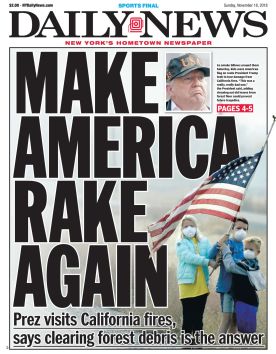
Probably the weirdest Trump thing on the fires is what we now know as the “Finnish Forest Raking” method of Forest Fire prevention which is another one of those things cooked up from the Dotard’s brain.
You gotta rake it till you make it.
After President Donald Trump suggested Finland has few wildfires because the nation spends a lot of time “raking and cleaning” forest floors, many were confused. Not least of all the Finns themselves — or the Californians Trump was visiting, whose state has been devastated by fires that have killed at least 76 and burned hundreds of thousands of acres in the past two weeks.
But confused or not, Finns took to social media — vacuum at hand — to prove their dedication to their newfound civic duty.
Under the hashtag #haravointi (“raking”), some Finns spent this weekend grabbing their gardening tools — with the more creative types picking up their vacuums and Roomba devices — and visiting the woods to document their public service.
“Just this afternoon I was busy meeting my raking quota,” one tweet reads.
“Taking pride in a good day’s work maintaining the forest,” says another.
The Finns might not have been serious, but the US president seemed to be. During his visit to Northern California Saturday, Trump told reporters that America should follow the lead of Scandinavian nations like Finland, which “spend a lot of time” on forest preservation.
The Finnish President, of course, denies the entire thing.

Finnish President Sauli Niinistö said in an interview published Sunday that although President Donald Trump claimed the European leader told him Finns rarely have forest fires because they “spend a lot of time raking,” he doesn’t recall discussing that with Trump when they met last weekend in Paris.
Niinistö told the Finnish newspaper Ilta-Sanomat, a CNN affiliate, that the subject of raking was never brought up in his conversations with Trump. He said that they did discuss the California wildfires when they met, and that he told Trump “we take care of our forests.”
The Finnish President told the newspaper that he intended to convey that although Finland is covered by forests, the nation has a good monitoring system which has helped to prevent catastrophic wildfires. He added that he only sees raking in his own yard, and surmised that raking perhaps came to Trump’s mind after he saw firefighters raking some of the burned areas in California.
Still, Trump mentioned raking while surveying the devastation in Northern California on Saturday.
Trump always turns a national disaster into some kind of Monty Python parody of the Minstry of Mayem and Mishap. But, the devastation and loss of life from the fire is real. As usual, the heros are local.
Jeff Evans steers his white Dodge Ram along a narrow dirt road, scanning the blackened trees and ashen ground for two skittish dogs
They come running when they hear the truck, and Evans offers them dog biscuits from the big red box of Milk-Bones he keeps on his floorboard. Good, he said, giving them a pat. They’re doing OK. He can move along.
Checking on the dogs is just one chore on Evans’ list. He’s one of a handful of people left in Concow, Calif., a mountain hamlet tucked deep in the woods that has been under mandatory evacuation orders since the Camp fire tore through here Nov. 8. If he leaves, he can’t get back in.
His neighbors stuck on the outside have been emailing him requests. Because the gas in the generator powering his electricity — and his internet — is limited, he hops online for a few minutes each day, answers their questions and gets going.
“Every single morning until the afternoon, I’m huffing it,” Evans said. “I’m going and going and going. There’s pigs to feed and goats and ducks and chickens.”
Not to mention the eight dogs he’s rescued.
“We’re stuck here anyhow,” he added. “We may as well do something valuable.”
A thin man with a bushy mustache and a quick laugh, Evans, 59, has become an unofficial keeper of Concow. Neighbors send him addresses and ask if he could please go see whether their houses burned down. Almost always, the answer is yes.
From Chico, the nearest city outside the massive evacuation zone, thick smoke obscures the Sierra foothills towns and their devastation.

Okay, this is a story near and dear to my heart because as a fifth grader I started asking my school if I could just opt out of the pledge of allegiance. I felt that there were a lot of nice countries–naming England as one–with flags and similar stated goals. Why not do something like recite the Preamble to the Constitution instead? I remember being being threatened by a Girl Scout Troop leader who thought I shouldn’t be a scout if that’s how I felt.
I do remember suddenly, the pledge disappeared from classrooms in all of the District. I was never sure why though. It could’ve been a visit from my mother or quite likely a District lawyer that showed them they were on the wrong side of the constitution and a SCOTUS decision and any law suit. So, that was around 1966 and you would think since the big court decision was way back in the 1940s that would be that. But, then there is this: “Student who refuses to stand for the Pledge of Allegiance expelled, Texas attorney general backs school” from USA Today.
Months after a student was expelled for refusing to stand for her school’s Pledge of Allegiance, the Texas Attorney General is intervening on the school’s behalf.
The mother of Windfern High School senior India Landry launched a legal battle against the Houston-area school, saying her daughter wasn’t able to practice free speech.
India, now 18, was sent home last year after sitting during the pledge. Her mother, Kizzy Landry, said when she came to pick up India, the school provided little details as to why her daughter was kicked out. Later, the principal told the mother”She can’t come to my school if she won’t stand for the pledge.”
India said she sat during the pledge before this incident, and wasn’t punished.
“I don’t think that the flag is what it says it’s for, for liberty and justice and all that. It’s not obviously what’s going on in America today,” India said last year.
Months after a student was expelled for refusing to stand for her school’s Pledge of Allegiance, the Texas Attorney General is intervening on the school’s behalf.
The mother of Windfern High School senior India Landry launched a legal battle against the Houston-area school, saying her daughter wasn’t able to practice free speech.
India, now 18, was sent home last year after sitting during the pledge. Her mother, Kizzy Landry, said when she came to pick up India, the school provided little details as to why her daughter was kicked out. Later, the principal told the mother”She can’t come to my school if she won’t stand for the pledge.”
India said she sat during the pledge before this incident, and wasn’t punished.
“I don’t think that the flag is what it says it’s for, for liberty and justice and all that. It’s not obviously what’s going on in America today,” India said last year.
There was also a lot of ruckus about this when students started refusing to stand for the pledge during Vietnam War protests. This isn’t a new thing and it’s certainly something that I thought was decided by the courts decades again. But then, everything unconstitutional is now up for debate again. From Lawyers.com:
As far back as 1943, the U.S. Supreme Court ruled that requiring all public school students to recite the pledge of allegiance was a violation of their First Amendment rights, because free speech includes the right not to speak against your beliefs (West Virginia State Board of Education v. Barnette, 319 U.S. 624 (1943)). And as the Court made clear more than 20 years later, public schools must also respect students right to express their opinions through actions (known as “symbolic speech”), as long as they aren’t being too disruptive (Tinker v. Des Moines Independent Community School Dist., 393 U.S. 503 (1969).)
The Supreme Court hasn’t directly addressed the issue of students refusing to stand for the pledge or the national anthem—clear examples of symbolic speech. But federal appellate courts have agreed that public schools may not force students to stand during the pledge. And just as public schools (including colleges and universities) shouldn’t punish students for exercising their First Amendment rights, they also shouldn’t withhold privileges—like participation in school sports—for the same actions.
Texas is wrong on this but then I assume they’re going to keep dragging it through the court process to see if Trump has stacked the courts enough to get a different result. Some folks will just not be convinced that this country and its people are not their personal christianist pisspot.
So, that’s it for me. I need to get back to grading oh, and maybe some raking around Swamplandia.
What’s on your reading and blogging list today?
Lazy Saturday Reads: Trump and Fascism
Posted: November 3, 2018 Filed under: Afternoon Reads, U.S. Politics | Tags: Donald Trump, fascism, fascist playbook, fascist tricks 18 Comments
By Edward B. Gordon
Good Afternoon!!
Over the past couple of weeks, Trump has downplayed an attempt to assassinate at least 13 present and former Democratic officials and prominent Democrats as well as the hate crime murder of 11 Jews in a Pittsburgh synagogue. His deepest expressed concern about these horrific events has been that they interfered with media coverage of his Hitler rallies. In addition, Trump has blatantly lied about a group of Honduran asylum-seekers, claiming their “caravan” represents a national emergency that requires the deployment of thousands of active-duty troops on the Southern border. I think at this point it’s appropriate to label Trump’s behavior and rhetoric as fascism. I’m far from the only one saying this.
The Washington Post: Trump deploys the fascist playbook for the midterms, by Ishaan Tharoor
President Trump’s message is as clear as it is ugly: Fearmongering about illegal immigration will deliver his party the votes it needs to retain control of Congress. And so, in the final stretch before next week’s midterm election, the president and his allies have launched a blitzkrieg of misinformation.
By Henri Lebasque (1865 – 1937)
In a move unprecedented in modern American history, Trump ordered thousands of active-duty troops to the border to intercept a caravan of Central American migrants, casting them as a menacing “invasion” of “unknown Middle Easterners” and other shadowy elements. His allies at right-wing media outlets spread lurid conspiracy theories about liberals enabling disease-bearing foreigners to infiltrate the country.
Even as attention shifted to a spate of right-wing violence, including the slaughter of 11 people at a Pittsburgh synagogue that critics linked to the president’s rhetoric, Trump barreled on, undaunted. On Thursday, he gave a speech at the White House where he warned that U.S. troops would shoot violent migrants at the border. He also shared an ad that sought to connect the Democratic Party to murders carried out by a man twice deported to Mexico, and then to link the man’s murderous behavior to the supposed threat posed by all migrants.

Taroor links to several other writers on the subject, including:
Timothy Snyder at The Guardian: Donald Trump borrows from the old tricks of fascism.
The governing principle of the Trump administration is total irresponsibility, a claim of innocence from a position of power, something which happens to be an old fascist trick. As we see in the president’s reactions to American rightwing terrorism, he will always claim victimhood for himself and shift blame to the actual victims. As we see in the motivations of the terrorists themselves, and in the long history of fascism, this maneuver can lead to murder.
Comfy Chair, by Rae Andrews
The Nazis claimed a monopoly on victimhood. Mein Kampf includes a lengthy pout about how Jews and other non-Germans made Hitler’s life as a young man in the Habsburg monarchy difficult. After stormtroopers attacked others in Germany in the early 1930s, they made a great fuss if one of their own was injured. The Horst Wessel Song, recalling a single Nazi who was killed, was on the lips of Germans who killed millions of people. The second world war was for the Nazis’ self-defense against “global Jewry”.
The idea that the powerful must be coddled arose in a setting that recalls the United States of today. The Habsburg monarchy of Hitler’s youth was a multinational country with democratic institutions and a free press. Some Germans, members of the dominant nationality, felt threatened because others could vote and publish. Hitler was an extreme example of this kind of sentiment. Today, some white Americans are similarly threatened by the presence of others in institutions they think of as their own. Among the targets of the accused pipe bomber were four women, five black people and two Jews. Just as (some) Germans were the only serious national problem within the Habsburg monarchy, so today are (some) white Americans the only serious threat to their own republic.

How does this apply to Trump?
Trump and some of his supporters mount a strategy of deterrence by narcissism: if you note our debts to fascism, we will up the pitch of the whining. Thus Trump can base his rhetoric on the fascist idea of us and them, lead fascist chants at rallies, encourage his supporters to use violence, praise a politician who attacked a journalist, muse that Hillary Clinton should be assassinated, denigrate the intelligence of African Americans, associate migrants with criminality, run an antisemitic advertisement, spread the Nazi trope of Jews as “globalists”, and endorse the antisemitic idea that the Jewish financier George Soros is responsible for political opposition – but he and his followers will puff chests and swell sinuses if anyone points this out.
By Ivan Stepanovich Ivanov-Sakachev
If Trump is not a fascist, this is only in the precise sense that he is not even a fascist. He strikes a fascist pose, and then issues generic palliative remarks and denies responsibility for his words and actions. But since total irresponsibility is a central part of the fascist tradition, it is perhaps best to give Trump his due credit as an innovator.

The next piece is very long, but I hope you’ll go read it. I can’t do it justice with excerpts. From the Literary Hub, Aleksandar Hemon on Civility: Fascism is Not an Idea to Be Debated, It’s a Set of Actions to Fight. Hemon is from Bosnia. His essay responds to The New Yorker’s quickly aborted invitation to Steve Bannon to discuss his “ideas” with editor-in-chief David Remnick.
The public discussion prompted by the (dis)invitation confirmed to me that only those safe from fascism and its practices are far more likely to think that there might be a benefit in exchanging ideas with fascists. What for such a privileged group is a matter of a potentially productive difference in opinion is, for many of us, a matter of basic survival. The essential quality of fascism (and its attendant racism) is that it kills people and destroys their lives—and it does so because it openly aims so.
Witness Stephen Miller and Donald Trump’s “zero tolerance for illegal immigration” policy. Fascism’s central idea, appearing in a small repertoire of familiar guises, is that there are classes of human beings who deserve diminishment and destruction because they’re for some reason (genetic, cultural, whatever) inherently inferior to “us.” Every fucking fascist, Bannon included, strives to enact that idea, even if he (and it is usually a he—fascism is a masculine ideology, and therefore inherently misogynist) bittercoats it in a discourse of victimization and national self-defense. You know: they are contaminating our nation/race; they are destroying our culture; we must do something about them or perish. At the end of such an ideological trajectory is always genocide, as it was the case in Bosnia.
By Kenton Nelson
The effects and consequences of fascism, however, are not equally distributed along that trajectory. Its ideas are enacted first and foremost upon the bodies and lives of the people whose presence within “our” national domain is prohibitive. In Bannon/Trump’s case, that domain is nativist and white. Presently, their ideas are inflicted upon people of color and immigrants, who do not experience them as ideas but as violence. The practice of fascism supersedes its ideas, which is why people affected and diminished by it are not all that interested in a marketplace of ideas in which fascists have prime purchasing power.
The error in Bannon’s headlining The New Yorker Festival would not have been in giving him a platform to spew his hateful rhetoric, for he was as likely to convert anyone as he himself was to be shown the light in conversation with Remnick. The catastrophic error would’ve been in allowing him to divorce his ideas from the fascist practices in which they’re actualized with brutality. If he is at all relevant, it is not as a thinker, but as a (former) executive who has worked to build the Trumpist edifice of power that cages children and is dismantling mechanisms of democracy.

Relevant reading from Today’s news:
The Washington Post: Trump’s election-eve border mission puts the military in partisan crosshairs.
The Washington Post: Army assessment of migrant caravans undermines Trump’s rhetoric.
Think Progress: These prominent white supremacists interacted with the Pittsburgh shooting suspect on social media.
The Independent: Fascism has arrived in Brazil – Jair Bolsonaro’s presidency will be worse than you think.
The New York Times: Nigerian Army Uses Trump’s Words to Justify Fatal Shooting of Rock-Throwing Protesters.
Buzzfeed News: Trump Said US Soldiers Should Shoot Rock-Throwing Migrants, And Vets Were Having None Of That.
What stories are you following today?
Monday Reads: The Midterms are coming
Posted: October 22, 2018 Filed under: Afternoon Reads | Tags: hate groups, Krewe of Boo, Proud Boys, voting 17 Comments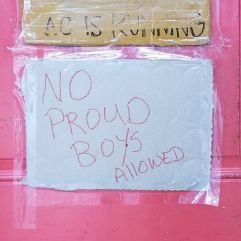
Not in here Magats per “The Bank Street Bar”
Good Afternoon Sky Dancers!
I usually go down to the Quarter to see the Krewe of Boo this time of year. I had grades to do and there were some unwelcome visitors there this weekend. I can’t take any more of the Magats so I stayed home.
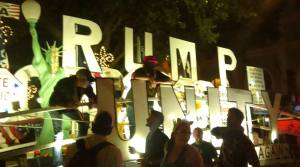
We got a visit from the hate group “Proud Boys” who seemed to stage a deliberate breakdown of their vehicle in front of Jackson Square so they could set up a really offensive float called “The Trump Bridge.” Of course, they did not have the appropriate paperwork, even selling those terrible red Magat hats illegally from the truck bed. All activities were without licenses so quite illegal. The NOPD watched them but did nothing.
 With the exception of a few lone bars that I really didn’t know existed down there anyway, they were refused service and forced to drink in the streets. All in all, the entire city did a great job of ignoring them.
Several “watchers” from progressive groups spent time documenting and following them in the hopes of catching any of their usual hateful antics. We do have a local chapter of them and recently, a Plaquemines Parish Deputy Sheriff lost his job for his association with them
The Proud Boys say they’re not a hate group and that they’re not a part of the alt-right, the catch-all euphemism for various groups of Nazis, white nationalists and white supremacists. The founder of the Proud Boys criticized the eruption of violence in Charlottesville, but a prominent member of that organization had organized the “Unite the Right” rally and later tweeted that “Heather Heyer was a fat, disgusting Communist. Communists killed 94 million. Looks like it was payback time.” According to the Southern Poverty Law Center, the founder of the Proud Boys says he expelled the writer of that tweet from his group “once his racist views became known.” To hear that founder tell it, the Proud Boys is a multi-racial, multi-ethnic group of Western chauvinists who part ways with the alt-right on “the JQ,” that is, “the Jewish question.”
In its website’s HateWatch feature, the SPLC notes that the founder of the Proud Boys “denies any connection between his group and the far right, dismissing the fact that they show up to the same events, take fashion cues from each other, read the same books, sympathize with each other’s viewpoints — including, at times, anti-Semitism — and joust in the shadows of the same windmills.”
Green, the Plaquemines deputy, scrubbed his Facebook feed of his Proud Boys posts, but not before they’d been screen shot and sent to his employer. His Facebook profile described him as “Deputy Sheriff, Father, Proud Boy.” His profile photo showed him in his law enforcement uniform with the words “The West Is The Best” superimposed on the picture.
Also in his Facebook feed, there had been posted a video in which Green appears to recite the Proud Boys oath, “I’m Brian Green and I’m a proud western chauvinist who refuses to apologize for creating the modern world.”
There is nothing positive about chauvinism of any kind. Furthermore, it’s safe to say that nobody reciting the Proud Boys oath had anything to do with the creation of this modern world. That oath makes as much sense as me refusing to apologize for having created blues music, jazz and rock-and-roll when all those things were here when I was born.
 I do have a few reports from friends that I will put up here just so you have some first hand accounts as well as they pictures and videos taken. I’m going to leave their names off because I don’t want to accidentally dox them to the wrong people.
So can we talk about the fact that the NOLA Proudboys (an SPLC-recognized violent white supremacist hate group) managed to have the “Trump Unity Bridge” (basically a giant mobile hate-campaign) ‘break down’ conveniently right in front of Jackson Square before the Krewe of Boo parade this evening– a halloween parade largely attended by families and kids. The police didn’t even tow that junk off of Decatur, and instead let them set up shop right along the parade route where they (illegally) sold MAGA hats to the crowd, yelled racial slurs at kids and passers by, threatened a few people who took their picture, tried to provoke violence, paraded around in blackface masks, oh and I’m told finally punched a woman and beat somebody with a flagpole shortly after I left. If you find that state of affairs as disappointing as I do, please call or write the Mayor’s office and tell her that you expect better in the so-called “city of yes” . . . that oughtn’t to mean ‘yes’ to every kind of white supremacist intimidation and depravity, especially anywhere that children are concerned. 504-658-4900, mayor@nola.gov
Here’s the link to the SPLC site that gives you more information about them.
As you know, a number of them were arrested in New York for a brawl which is basically what they always go looking for.
The founder of the far-right group the Proud Boys said on Friday that he was arranging the surrender of several members whom the police are seeking in connection with a violent brawl outside a Republican club in Manhattan last weekend.
At the same time, a senior official said the police had opened a broad criminal inquiry into the group’s activities.
Gavin McInnes, 48, a polemical far-right speaker who started the Proud Boys in 2016, said several suspects would turn themselves in. By late Friday afternoon, two of the nine men sought by the police had been arrested. A police official said a lawyer representing at least four of the suspects had called the 19th Precinct on Friday to work out the details of their surrender.
Though it was unclear how many might face charges, Mr. McInnes said the rest would soon be in custody. “They are going to be in the Tombs,” he said.
The Proud Boys are a fraternal organization of so-called Western chauvinists that Mr. McInnes has sometimes referred to as a gang. The group has clashed with anarchists and left-wing protesters at political events across the country several times in recent years.
They fought with anti-fascist demonstrators on Oct. 12 shortly after Mr. McInnes gave a speech at the Metropolitan Republican Club, a bastion of establishment conservatism on the Upper East Side.
 There’s some national news about the midterms and other things we should discuss. This headline is startling. From Time: “Trump Plans to Tear Up a 31-Year-Old Nuclear Weapons Treaty. Now What?”.
President Donald Trump revealed Saturday the United States intends to withdraw from a 31-year-old nuclear weapons agreement with Russia, delivering a severe blow to the arms control regime that helped preserve peace since the Cold War.
“We’re going to terminate the agreement and we’re going to pull out,” Trump told reporters after a rally in Elko, Nevada, without indicating what the next steps might be.
The Intermediate-Range Nuclear Forces (INF) Treaty, first signed by President Ronald Reagan and Soviet Union leader Mikhail Gorbachev in December 1987, was the first and only nuclear arms control agreement that ever eliminated an entire class of nuclear weapons. The treaty forced the superpowers to scrap more than 2,600 missiles with ranges 310 to 3,420 miles — weapons considered destabilizing to the European continent because of their capability to launch a nuclear strike from anywhere without early warning.
 Gorbachev has called the move ‘Not the Work of a Great Mind’.
President Trump’s announcement that the United States would withdraw from a nuclear disarmament treaty with Russia drew sharp criticism Sunday from one of the men who signed it, Mikhail S. Gorbachev, who called the decision reckless and not the work of “a great mind.”
In making his announcement Saturday, Mr. Trump cited Russian violations of the pact, the Intermediate-Range Nuclear Forces Treaty, which was signed in Washington in 1987 by President Ronald Reagan and Mr. Gorbachev.
Mr. Gorbachev, who is now 87 years old, cast Mr. Trump’s decision as a threat to peace.
In an interview with the Interfax news agency, Mr. Gorbachev called Mr. Trump’s rollback of the disarmament agreement “very strange.” He added: “Do they really not understand in Washington what this can lead to?”
The last Soviet leader, who is perceived more warmly in the West than inside Russia, has already watched his domestic reform agendas supporting democracy and greater freedom of the press unravel in recent years. Nuclear disarmament also defined his legacy.
 Eric Levitz opines this for New York Magazine today: Tribalism Isn’t Our Democracy’s Main Problem. The Conservative Movement Is.
In the middle of the 20th century, America was home to liberal Republicans and conservative Democrats. The most important fault-lines in Congress weren’t partisan but regional; on many issues, southern Democrats and western Republicans united in battle against northern (and typically, liberal and/or labor-aligned) members of their respective caucuses. On economics, the two parties’ agendas were distinct, but far less disparate than they are today. On civil rights and immigration, the divisions within each side of the aisle were more important than those between them.
This utter dearth of partisan polarization undermined democratic accountability. A liberal could vote for Democratic candidates in New York, and unwittingly empower arch-segregationists in the Senate; many voters had no clear heuristic telling them which party would best represent their interests and ideological goals, nor which one was to blame for Congress’s failure to advance such aims.
In response, the American Political Science Association (APSA) released a report in 1950 that called on Republicans and Democrats to heighten their contradictions, arguing that “popular government in a nation of 150 million people requires political parties which provide the electorate with a proper range of choices between alternatives of action.”
Sixty-eight years later, we’ve done just as the APSA advised.
Today’s party system offers voters a wide — and clearly labeled — range of alternatives. While myriad policy debates remain stifled by bipartisan consensus (the proper size and role of the U.S. military, for example), it is nevertheless the case that Democrats and Republicans now provide the electorate with stark choices on health care, taxation, social spending, immigration, racial justice, abortion, environmental regulation, labor rights, and myriad other issues. It has rarely, if ever, been more clear what — and whom — each party in the U.S. stands for.
And rarely, if ever, has “popular government” been a worse misnomer for what transpires in our nation’s state and federal capitals.
In 2018, polarization still looms large in the discourse on our democracy’s failings. But these days, it’s seen less as an elixir than a cancer. In fact, some pundits and political scientists regard it as the root of all the Trump era’s evils. In this new telling, our republic may be suffering from a variety of disfiguring illnesses, but all trace back to the damage that hyperpartisanship did to its immune system: Our president may be a kleptocratic conspiracy theorist who oozes contempt for America’s highest ideals (and ignorance of high-school civics) — but only because conservative voters came to despise the Democratic Party more than they loathe self-proclaimed pussy-grabbers. Congress might be barely able to fund its own paychecks, let alone find consensus solutions to policy challenges — but voters only tolerate such gridlock because they’ve come to see compromise as a synonym for their side’s defeat. And Americans might be losing confidence in public institutions, the integrity of their nation’s elections, and the value of democracy itself — but this is largely because so many of them have decided that one of their nation’s two political parties poses an existential threat to their bedrock ideals.
 I was happy to see Tallahassee Mayor Andrew Gillum pull ahead in the polls. Evidently, the group of old white fogies at The Villages fear him. Being an old fogie myself, I wonder why they hate their Medicare and Social Security so much, but then, I don’t think in terms of black people taking things away from me. I think in terms of Republicans doing that.
President Donald Trump’s loyalists here at Florida’s premier retirement community fear Andrew Gillum.
It has nothing to do with his race, they insist, when asked about the 39-year-old Democrat who could become the state’s first African-American governor. Instead, The Villages’ deeply conservative residents are convinced a Gillum victory would trigger an era of high crime, higher taxes and moral failing.
“He’ll kill everything that’s good about Florida,” says Talmadge Strickland, a 66-year-old retired firefighter wearing a “Trump 2020″ baseball cap at a rally for Gillum’s opponent. “He will hurt us; he will physically hurt us with his socialist mentality.”
In an era defined by deep political partisanship, there’s perhaps no state where the divide runs deeper than Florida, which is in the grip of a fierce culture clash over guns, race, climate change and the president. Gillum sits at the center of the melee, his campaign a proxy for the larger fight between Democrats and President Donald Trump’s GOP.
Gillum’s fate is inexorably linked to fellow Democrats whose success could determine control of Congress. That’s especially true for three-term Democratic Sen. Bill Nelson, who could benefit from Gillum’s appeal among young voters and minorities.
As early voting begins in Florida this week, that link is tenuous.
“New voters and infrequent voters are everything to us winning,” Gillum told The Associated Press when asked about his impact on Nelson’s race. “I think they will vote for both of us, and that will be to his benefit.”
Young people and minorities are traditionally among the least reliable voters, particularly in midterm elections. Meanwhile, white voters in place like The Villages are lining up behind his opponent, former Republican Rep. Ron DeSantis.
The electorate in Florida this year is especially unpredictable due to an unusual collision of events: a massive hurricane, the nation’s deadliest high school shooting and Gillum’s historic candidacy.
Those of us that have had anything to hear from or do with a Trump voter know exactly how angry and ugly they are. But, be prepared for ads from the RNC that basically say that Dems are the angry mob. We may be angry, but our protests are hardly mob like and Greg Sargent of WAPO’s Plum line explains why we’re angry right back at them.
President Trump and Republicans have adopted a closing electoral strategy that depicts the Democratic Party and “angry” leftist protests against Trumpian rule as the only real reigning threat to our country’s civic fabric and the rule of law. A new Republican National Committee video juxtaposes footage of leading mainstream Democratic figures with that of angry protesters, while decrying “the left” as an “unhinged mob.”
As absurd as this conflation is on its face, it has smuggled itself into the mainstream debate, where it is getting a quasi-respectful hearing, in the form of a public argument over whether Democrats are “going low,” or tacitly egging on their voters to violence, or, by adopting the smashmouth media tactics of Michael Avenatti, succumbing to “Avenatti-ism.”
But much of the resulting debate over all this is hollow, because it is not putting these basic realities front and center: Trump, more than any leading U.S. figure in recent memory, has actively tried to stoke civil conflict on as many fronts as possible. He has concertedly subverted the rule of law, not just to shield himself from accountability, but, more to the point for present purposes, with the deliberate purpose of exciting his minority base — and enraging millions on the other side of the cultural divide — in a manner that is thoroughly corrupt to its core.
 Here in New Orleans we like our food, our parades, our holidays, and our music. Most of us like our beer and bongs and whatever libations that goes along with watching the Saints or celebrating 300 years here. Yet, every time we have one of those celebrations we get angry white people doing disrespectful things. We get Westborough Baptist during our Southern Decadence celebration of the GLBT community here. We get big ol’ sign carrying christians telling us that we’re all about as sinful as you can get during Carnivale. Now, we get the Proud Boys and their ugly little float during Mardi Gras and our annual celebration of Halloween. None of them are loving of people or fun. They are here to buzz saw any one that isn’t like them.
We used to have to endure them during small little windows of time, but now, they assault us daily on all forms of media and in every walk of life. I get weary of all that resentment, hate, and privilege rattling.
Why do they come here to piss on other people’s celebrations? Why do they have to have laws that cause other people to live their lives according to some other person’s idea of how life needs to be.
We have a few more weeks of these awful rallies and the even worse pictures and words of these poor excuses for human beings. I’m not sure where the 20 million voters that never show up are, but please, please, please, get rid of these Ugly Americans. Get them back under their rocks and out of our lives and sight.
 I want to go back to a January article by Rebbecca Solnit at the Literary Hub. ” 20 MILLION MISSING PEOPLE COULD SAVE AMERICA. ON LIFE IN THE DARK TIMELINE, AND THE MORAL CAUSE OF OUR MOMENT”.
But who is missing? It’s not only the women directors, the black screenwriters, the not-so-misogynist lead journalists in the mainstream.
It’s voters.
Voting is a form of speech, a way you say who you believe in, what kind of world you want to see. Having a voice doesn’t just mean literally being able to say things; it means having a role, having agency, being able to say things that have an impact whether it’s I witnessed this police brutality, or no I don’t want to have sex with you, or this is my vision of society.
As far as I can estimate, about 20 million voters were disenfranchised in the last election. Voter ID laws, the cross-check system, purging voter rolls, the undermining of the Voting Rights Act, making sure there were not enough polling stations or cutting back polling hours, harassing people when they showed up at those stations, taking the vote away from ex-felons—the means are many, and the consequences are that a lot of people have been denied their rights, so much so that it’s the other new Jim Crow. (There is no clear tally of how many voters are missing, and it’s also complicated by the fact that some populations—more than six million Americans with felony convictions, for example—are prevented outright from voting, some face obstacles and harassment—via voter ID laws, for example—that thin out their numbers.)
Politics is how we tell the stories we live by, how we decide if we value the health and well-being of children or not, the autonomy of women’s bodies and equality of our lives, or not, if we protect the Dreamers who came here as small children, or not, if we act on climate change, or not. Voting is far from the only way, but is a key way we decide on what story to base our actions on. We choose a story about who and what matters; we act on that story to rearrange the world around it—and then there are tax cuts to billionaires and children kicked off healthcare, or there are climate agreements and millions of acres of federal land protected and support for universities. We live inside what, during postmodernism’s heyday, we’d call master narratives—so there’s always a question of who’s telling the story, who is in charge of the narrative, and what happens if that changes.
Sometimes when journalists like Ari Berman at Mother Jones—the best voice on this issue—write about the suppression of the votes, people assume they’re saying Hillary Clinton should have won the last presidential election. If you changed who had access to the ballot in 2016, that might be the outcome, but the story is so much bigger than that, and the potential outcomes are so much more radical than that. The Republican Party has maintained a toehold on national power by systematically, strategically, increasingly suppressing the votes of people of color over decades. They are a minority party. They could never win a fair election nationally with their current platform of white grievance and misogyny and favors for the one percent, so they’ve set about to have unfair elections. (And they have also gerrymandered the daylights out of a lot of states to hang onto majorities at the state and national level; in 2012, they took the majority of seats in the lower house of Congress with a minority of overall votes.)
Imagine that those 20 million votes were not suppressed. The Republican Party would be defunct or be unrecognizably different from what it is today. But the Democratic Party would be different too. Imagine that the Democratic Party had to answer to more young people, more poor people, more nonwhite people, more people who believe in strengthening human rights and social service safety nets, economic justice, stronger action on climate change. Imagine a country where Democrats weren’t competing for moderate-to-conservative voters because the electorate was far more progressive—as it would be if all those people who lost their voting rights actually had them (and yeah, more younger people showed up). It wouldn’t change something as small as the outcome of the 2016 election. It would mean different political parties with different platforms and different candidates, different news coverage, different outcomes. It would change the story. It would change who gets to tell the story.
 By voting, we can remove the tyranny of the shrinking minority before they completely set the game up so that we never can.
What’s on your reading and blogging list today?
Friday Readings: Vote because Our Lives depend on it
Posted: October 19, 2018 Filed under: 2018 elections, Afternoon Reads, Voting Rights | Tags: Louisiana Ballot Initiative 2, VOTE DAMMIT!, voter suppression 24 Comments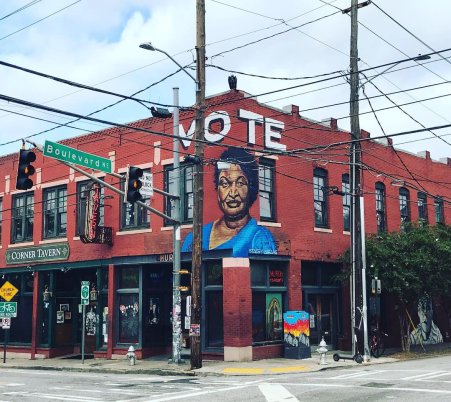 Good Morning Sky Dancers!
The mural to the left is of Georgia gubernatorial Candidate Stacey Abrams located on a building in the Edgewood neighborhood of Atlanta. This building is just blocks from MLK Jr.’s childhood home. White Republicans in Georgia are actively trying to beat her any way they can.
You can tell there is a lot at stake in this election due to the SCOTUS gutting of the Voting Rights Act because there is increasing opportunity and effort to suppress the votes of indigenous peoples in North Dakota and Black people in every southern state and else where. Republicans are trying to hold power in the Senate to continue the reign of terror and murder of US democracy.
The struggle continues . Dozens of black seniors on their way to early voting in Georgia were ordered off a bus in Jefferson County.
As early voting began Monday in Georgia,a group of black senior citizens gathered for a voter outreach event at Jefferson County’s Leisure Center. Members of Black Voters Matter, one of the groups behind the event, offered to drive the group of about 40 seniors to the polls.
But shortly after the seniors boarded the organization’s bus, county officials stopped the trip, prompting new accusations of voter suppression in a state already dealing with several such controversies.
The event, according to ThinkProgress’s Kira Lerner, was a part of Black Voters Matter’s “The South is Rising” bus tour across seven states to host voter outreach and engagement events. Black Voters Matter is nonpartisan, and the group’s leadership did not encourage the senior citizens to vote for a particular candidate or political party, according to LaTosha Brown, the organization’s co-founder.
Jefferson County Administrator Adam Brett countered that the Monday event constituted “political activity,” noting that a local Democratic Party chair helped sponsor it.
“This is voter suppression, Southern style,” Brown told Think Progress. According to recent Census figures, Jefferson County is 53 percent black, and voting rights advocates cite a lack of transportation as a particularly high barrier to voting for black Georgians. Civil rights groups most recently raised this point in August when a majority-black Georgia county proposed closing all but two of its polling places.
 There seems to be nothing White Republican men will do these days to hold on to power. It’s astonishing but not surprising. It’s not even subtle any more. One of the more strange things coming out of Georgia is forcing voter registration clerks to “match signatures” as if they’re experts on handing writing analysis. From Slate: “Georgia Is Using Amateur Handwriting Analysis to Disenfranchise Minority Voters. The scourge of “signature mismatch” laws strikes again.”
Say you live in Georgia. You’re eager to vote in this year’s election—a tight race between Democrat Stacey Abrams and Republican Trump acolyte Brian Kemp—so you fill out an absentee ballot and mail it in. Then, days or weeks after the election, you receive a notice in the mail. The signature on your absentee ballot, it explains, looked different from the signature on your voter-registration card. So an election official threw out your ballot. There is nothing you can do. Your vote has been voided.
If Georgia’s signature-mismatch law remains in effect through the November election, this fate will befall thousands of would-be voters. The statute directs elections officials to apply amateur handwriting analysis to voters’ signatures and reject any potential “mismatch.” Nearly 500 ballots in Gwinnett County alone have already been rejected for mismatch, a disproportionate number of them cast by minority voters. Now the American Civil Liberties Union of Georgia is suing, demanding that the state give all citizens an opportunity to cure ballots rejected for mismatch. Its suit will help determine how successfully Georgia will suppress minority votes in the upcoming race.
Signature-mismatch laws are a scourge of American elections. The very premise makes no sense: In a similar lawsuit filed in New Hampshire, a forensic document examiner testifiedthat effective signature comparison requires 10 signature samples “at a minimum” to account for variability. Even then, experts may struggle to verify a signature, because our signatures often change over time. Voters who are disabled or elderly, or are nonnative English speakers, are especially likely to have variation between signatures. That’s one reason why New Hampshire’s mismatch law disproportionately impacted seniors, California’s disproportionately impacts first-generation Asian Americans, and Florida’s disproportionately impacts Hispanics.
But there’s likely something more insidious going on here too. The extreme racial disparitiesamong those affected by mismatch laws may also reflect the broad discretion that election officials have to toss ballots. In states with stringent mismatch rules, a handful of election officials are frequently responsible for the vast majority of ballots voided for mismatch. And those officials routinely work in counties with large minority communities.
 One of the most important ways to circumvent being stopped at the polls or slowed down at the polls on election day is to vote early. Early votes are pouring into Virginia. The number of absentee ballots arriving to be counted is nearly unbelievable. It’s another reason that Republican legislatures are trying to shorten early voting periods and create long drives to early voting sites.
The number of voters in Virginia who have cast early ballots ahead of the November elections is dramatically up compared with last year, suggesting an electorate that is energized by several hotly contested races for Congress that are spread across the state.
Virginia allows voters to cast “absentee” ballots in person if they have valid excuses for not being able to vote on Election Day.
Nearly 78,000 people have completed ballots since absentee voting began Sept. 15 — more than double the number who voted early by this point last year, according to an analysis of voting data by the nonprofit Virginia Public Access Project.
That number is still shy of the 123,221 absentee ballots cast during the 2014 midterm elections, state data shows.
But with a little less than three weeks before the Nov. 6 elections, local election officials say this year’s absentee totals are on pace to eclipse 2014 and may even approach the turnout for the presidential election of 2016, when a near-record 496,452 Virginians cast their ballots early.
“It’s actually quite shocking,” said Richard Keech, deputy director of the elections office in Loudoun County, which has seen a 239 percent jump in absentee voting this year, with 11,106 ballots either already cast or mailed to voters so far.
“This would be the first time without a president on the ballot that we’ve seen this kind of increase,” Keech said
Fairfax County, the state’s largest jurisdiction, has seen a roughly 100 percent increase since last year, with 21,582 absentee votes cast so far, officials said. Nearby, Prince William County, the second-largest jurisdiction, has climbed by about 114 percent to 4,693 absentee ballots cast.
 Here’s a suggestion from MIchelle Goldberg to prevent “political despair”. She suggests we “join the women trying to save America from Trump.”
This week, a friend texted me, “I feel a panic that won’t stop.” I didn’t have to ask what she meant; we are, after all, less than three weeks from the midterms. “#MeToo,” I replied.
Many women I know — though, of course, not only women — are walking around with a churning knot of terror in their stomachs. The confirmation of the cruel former frat boy Brett Kavanaugh to the Supreme Court brought back the anguish and degradation so many of us felt after the 2016 election. Donald Trump grows more thuggish and mendacious by the day; “gaslighting,” a term taken from a play about an abusive husband trying to drive his wife insane, has become a byword of our national life.
Republicans are increasingly explicit about campaigning to preserve male power. Criticizing the #MeToo movementearly this month, Trump said it’s “a very scary time for young men in America.” Republican congressman Andy Barr of Kentucky ran a commercial attacking his opponent, former Marine fighter pilot Amy McGrath, for describing herself as a feminist. The Washington Post wrote about how an “outbreak of male resentment” is poised to play a “defining role” in the midterms.
I too have this underlying, nagging anxiety all the time. No matter how many times I say the mani and take deep breaths. I cannot shake the feeling that the bad guys are pulling out all the stops to stop the rest of us from rising.
Meanwhile, Georgia still stands out as the worst example while the ghost of Lester Maddox grins somewhere from hell.
A handful of states, most of them led by Republicans, are using someone’s decision not to vote as the trigger for removing them from the rolls. No state has been more aggressive with this approach than Georgia, where Brian Kemp, the secretary of state, oversaw the purging of a growing number of voters ahead of his own run for governor, according to an APM Reports investigation. Voting rights advocates call it a new form of voter suppression, and they fear it will soon spread to other states.
Even by Georgia standards, the voter purge of late July 2017 was remarkable. In a single day, more than half a million people — 8 percent of Georgia’s registered voters — were cut from the voter rolls. Republican Secretary of State Brian Kemp, an avid supporter of President Donald Trump who has described himself as a “politically incorrect conservative,” oversaw the removals eight months after he’d declared himself a candidate for governor.
The purge was noteworthy for another reason: For an estimated 107,000 of those people, their removal from the voter rolls was triggered not because they moved or died or went to prison, but rather because they had decided not to vote in prior elections, according to an APM Reports analysis. Many of those previously registered voters may not even realize they’ve been dropped from the rolls. If they show up at the polls on Nov. 6 to vote in the heated Georgia governor’s race, they won’t be allowed to cast a ballot.
Kemp’s opponent, Democrat Stacey Abrams, is vying to become the first African-American woman in U.S. history to serve as a governor. The state has undergone a dramatic influx of African Americans and Latinos whose votes could challenge Republican dominance, and her campaign is trying to turn out people of color, who are more likely to be infrequent voters. If the race is close, the July 2017 purge could affect the outcome.
The APM Reports analysis is the first estimate of the so-called “use it or lose it” policy’s possible impact in Georgia. While 107,000 people may seem like a small number in a state with a population of 10.4 million, elections have been decided by far smaller margins. For instance, the 2016 presidential election was decided in favor of Donald Trump by a total of 77,744 votes in Wisconsin, Michigan and Pennsylvania.
Using someone’s decision not to vote as the trigger to remove that person from the rolls is a highly controversial — yet legal — tactic that voting rights advocates say is a potential tool for voter suppression. And its use is on the rise.
APM Reports found that at least nine states — most of them with Republican leadership, including the key battlegrounds of Georgia and Ohio — have purged an estimated hundreds of thousands of people from the rolls for infrequent voting since the 2014 general election. States with these policies are removing voters at some of the highest rates in the nation, no matter the reason.
People are fighting for our right to vote. They have fought over the years and decades to expand the right to vote for all of us. We have the duty and obligation to honor their hard work. I live in a state that seems hopeless and a city that is well represented by Americans of all backgrounds. This election will send my Congressman Cedric Richmond back to the leader of the Congressional Black Caucus. But, I have to admit that I am paying a lot more attention to the judicial races than I used to. Every race counts these days.
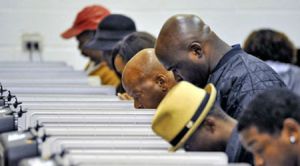 There is one ballot amendment here that will be a statewide vote that would bring significant justice to those incarcerated for major crimes with juries that are not unanimous. Overturning this law would be a significant step forward for Louisiana and I fully support this ballot effort to do so.
What would this ballot measure change about convictions?
Amendment 2 would require the unanimous agreement of jurors to convict people charged with felonies. As of 2018, Louisiana requires the agreement of 10 of 12, or 83 percent, jurors to convict people charged with felonies. Amendment 2 would not affect juries for offenses that were committed before January 1, 2019.[1]
Do other states allow for non-unanimous jury convictions?
As of 2018, Louisiana is one of two states—the other being Oregon—that does not require the unanimous agreement of jurors to convict people charged with felonies. Oregon does, however, require unanimous convictions in murder trials.[2][3]
Have the courts addressed the non-unanimous juries rule?
In Apodaca v. Oregon (1972), the U.S. Supreme Court ruled that the Sixth Amendment of the U.S. Constitution required unanimous juries to convict persons in federal criminal trials, but that the Fourteenth Amendment did not extend the requirement of unanimous juries to state criminal trials.[4][5]
 Oddly enough, the Koch network is supporting this ballot initiative too. As we say, politics can sometimes make for odd bedfellows.
A conservative organization funded by the Koch network launched a digital ad Monday aimed at ending Louisiana’s law that allows split juries to convict people of serious felony crimes, an outreach effort that puts the group at odds with some of its usual allies.
Americans for Prosperity-Louisiana announced the online advertising campaign will be combined with direct-mail pieces and other outreach in support of the constitutional change on the Nov. 6 ballot that would do away with the Jim Crow-era law.
Currently, some serious felony trials in Louisiana, including some murder cases, can be resolved when 10 out of 12 jurors agree on a person’s guilt. Louisiana and Oregon are the only two states that allow non-unanimous verdicts in felony cases. But even Oregon requires a unanimous verdict in murder trials.
Amendment 2 would require jury verdicts in Louisiana to be unanimous to convict someone in all felony cases.
Americans for Prosperity’s 30-second online ad — set to music and without narration — targets libertarian-leaning and conservative voters with a focus on constitutional rights, saying Amendment 2 will “protect American freedom and liberty.” It says Louisiana’s current law makes it “easier to send innocent people to prison.”
“Louisianans deserve a justice system that values, above all else, the rights of the accused in a jury trial. A system that places a higher value on conviction rates than the pursuit of the truth is a system that has no place in our society,” John Kay, Louisiana state director of Americans for Prosperity, said in a statement.
The organization is the main political advocacy group for billionaire Charles Koch, who has supported criminal justice overhauls in several states, including Louisiana. With support of the unanimous jury amendment, along with the criminal-sentencing-law changes, the Koch network has diverged from some other high-profile conservatives in Louisiana, including Republican Attorney General Jeff Landry and several tough-on-crime district attorneys.
But Amendment 2 has drawn an unlikely, bipartisan coalition of support across the political spectrum, from conservative and religious groups to liberal activists.
The constitutional amendment required two-thirds support of lawmakers to reach the November ballot. When Sen. J.P. Morrell, a New Orleans Democrat, first proposed the idea, passage during the regular legislative session was seen as a longshot.
The legislation became the surprise measure of the session, reaching a public vote with widespread support from Democrats and Republicans, picking up steam each step of the process.
 I would like to say the only stand out thing about the Louisiana Election this year is that we are working to remove this Jim Crow Era law . Our Republican Secretary of State has also purged voter rolls. I made sure I checked my registration earlier this week. Our State AG is a doozy. We pretty much hate him here in New Orleans. “AG Landry: Free election day bus rides illegal”.
Lafayette City-Parish Councilman Bruce Conque withdrew a resolution from Tuesday’s agenda that would have provided free bus rides in the city of Lafayette on election days.
Conque said he spoke with Louisiana Attorney General Jeff Landry who concurred with city-parish attorneys’ advice that free bus service is not legal.
“Jeff (Landry) … said he considers it a violation of the Louisiana constitution and he would legally challenge it if we moved forward,” Conque said.
Landry told The Daily Advertiser the Louisiana Secretary of State asked for advice on the matter, so Landry sent him a 1996 Attorney General opinion. That opinion said a school board could not use school buses to bring voters to election polls.
Even though the Lafayette buses would not directly bring riders to the polls, Landry said it is not allowed. The facts of the opinion may differ from the Lafayette case, he said, but the principle behind the conclusion is the same.
This impacts the poor and the elderly. Additionally, here’s some evidence of the Secretary of State’s voter suppression tactics from the Daily Beast. Rachel Maddow has been focusing on this issue of voter suppression over the country. We have not yet been featured but Louisiana has done it too. Here’s our experience with voter purges from Louisiana Weekly.
In July 2018, the Brennan Center for Justice released a report analyzing voter purging across the country showing that between 2014 and 2016 officials removed more than 16 million people from voting rolls nationwide. That’s four million more names than states removed between 2006 and 2008 (the last time frame analyzed).
The center attributes this increase in purging to an increase in the use of sometimes flawed data matching software across states to remove names, as well as conservative activist groups lobbying for, and sometimes suing to get, more purges and tougher legislation to protect against potential non-citizen voters.
Louisiana’s last voter purge was in 2017, a routine post-election clean up that resulted in 55,000 names removed from an inactive voter list of more than 100,000. (There are some three million registered voters in total in the state).
Voters become inactive after they don’t vote in a federal election and, “we don’t have a way to reach them by mail or phone,” says Louisiana secretary of state’s spokeswoman Meg Casper Sunstrom. “In other words, we can’t verify they are living where they are registered to vote. As soon as they participate and vote, they can be removed from the inactive list.”
Some voting rights advocates have criticized past purges in Louisiana, particularly a post-Katrina purge that resulted in a federal lawsuit against the state in 2007. Many displaced people registered for driver’s licenses and acquired temporary residences in other states, and data matching systems subsequently flagged their names as potential “double voters” – people registered to vote in multiple states. Millions of people are registered in two places, and research shows that since 2000, around 30 cases of voter fraud have been validated in the United States.
Despite little to no evidence of illegal voting across the country, the Trump Administration has aggressively pursued efforts to curtail even the possibility of fraud – creating a now defunct national voter fraud task force and asking states to turn over detailed information on individual voters. Then, Louisiana secretary of state Tom Schedler declined the task force’s request, offering only the same (less extensive) data available for purchase to political candidates online.
 We must stop this dreadful disenfranchisement and removal of rights from citizens. If we don’t attack it by voting and by bringing attention to voter suppression efforts it will only get worse. It can only benefit Trump and the white patriarchy who oppresses the majority of people in the country and can only contain them with gerrymandering and voter suppression. Increased voter participation by the rest of this lessens the chance they are successful.
Don’t forget to vote!
What’s on your reading and blogging list today?

 peej
peej Carissa
 bostonboomer
 dakinikat
 ecocatwoman
 mablue2
 Mama Lopez
 peggysue22
 quixote
 skydancingguestblogger
 Mona (aka Wonk the Vote)



 Sky Dancing
Recent Comments