As usual, the news is pretty depressing today–Covid-19 is still raging and the media is still viciously attacking President Biden on Afghanistan while ignoring the roles of Trump, Pompeo, and Stephen Miller in setting up the current state of affairs. I have a mix of reads to share, beginning with the obituary of a brilliant author and anti-racist who worked to change Americans’ understanding of our history.
James W. Loewen, a sociologist and civil rights champion who took high school teachers and textbook publishers to task for distorting American history, particularly the struggle of Black people in the South, by oversimplifying their experience and omitting the ugly parts, died on Thursday in Bethesda, Md. He was 79.
His death, in a hospital, was confirmed by Ellen Adler, his publisher at the New Press, who said he died after an unspecified “long illness.”
“Those who don’t remember the past are condemned to repeat the 11th grade,” Dr. Loewen wrote in “Lies My Teacher Told Me: Everything Your American History Textbook Got Wrong” (1995), the best known of his dozen books attacking historical misconceptions.
Dr. Loewen was a relentless contrarian who challenged anyone who imagined academic life as a passage through genteel lectures on settled matters for drowsy students on leafy campuses. He charged through history like a warrior, dismantling fictions and exposing towns for excluding minorities; teachers and historians for dumbing lessons down; and defendants in 50 class-action lawsuits who, according to his expert testimony, victimized people in civil rights, voting rights and job discrimination cases.
A Northerner fascinated with Mississippi, he wrote his first book about the Chinese population there. He wrote another about how America’s historic sites distort our knowledge of the past. And it was a mistake to get him started on the origin of Thanksgiving: Plymouth was already a village with cleared fields when the Pilgrims found it deserted by plague victims. No turkey was served in 1621 — perhaps it was duck. And there was no pie. The settlers had no wheat flour for crust and no oven for baking. The holiday Americans celebrate has nothing to do with the Pilgrims. It was invented 242 years later by Abraham Lincoln to celebrate the North’s victory at Gettysburg.
“History is by far our worst-taught subject in high school,” Dr. Loewen told The Atlantic in 2018. “I think we’re stupider in thinking about the past than we are, say, in thinking about Shakespeare, or algebra, or other subjects. Historians tend to make everything so nuanced that the idea of truth almost disappears.”
Loewen’s work is more important than ever with the current rise of disinformation and conspiracy theories.
Painting by Rose Freymuth-Frazier
Trumpists are organizing a pro-January 6 rally in Washington D.C. on September 18, and this time the Metropolitan Police are taking the warnings seriously. The purpose of the rally is to free the “political prisoners” who are being prosecuted for attacking the U.S. Capitol building.
WASHINGTON — In a flash notice sent to all officers and members of the department Thursday, Metropolitan Police activated the entire force and postponed vacation days, in anticipation of a Sept. 18 protest organized by supporters of Jan. 6 defendants.
The rally, known as “Justice for J6,” is planned for the Union Square area of the Capitol grounds, the section of the west front encompassing the Ulysses S. Grant Memorial and Capitol reflecting pool.
The full activation alert, sent as Thursday’s Capitol Hill bomb threat investigation continued, assigned specific notice to MPD civil disturbance units trained for First Amendment demonstrations. The department-wide notification has not been previously reported.
When asked for comment, MPD responded with this statement:
“In anticipation of First Amendment activities on Saturday, September 18, 2021, the Metropolitan Police Department will be fully prepared. As with all First Amendment demonstrations, MPD will be monitoring and assessing the activities and planning accordingly with our federal law enforcement partners. MPD will have an increased presence around the city where demonstrations will be taking place and will be prepared to make street closures for public safety.”
The event, organized by former Donald Trump flack Matt Braynard, hopes to seek justice for those who stormed and defiled the Capitol on Jan. 6. Braynard announced the rally on former Trump adviser and current crackpot Steve Bannon’s podcast. “As we continue to raise the profile of these individuals, it makes it harder and harder for the left’s phony narrative about an insurrection to stick,” Braynard said, according to WUSA9. “What’s going to define [the rally] is where it’s going to take place: we’re going back to the Capitol.” He said the event has obtained permits. U.S. Capitol Police said it was aware of the event, but declined to comment.
Overall hospitalizations are continuing to increase across Alabama as the “pandemic of unvaccinated people continues,” state health officer Dr. Scott Harris said on Friday. Alabama hospitals have a negative capacity of ICU beds available, he said, and the state is seeing the highest number of Covid-19 cases among children than at any other time during the pandemic.
Louisiana has seen an “astronomical” number of Covid-19 cases during the latest surge, according to Gov. John Bel Edwards, as infections are increasing particularly among younger populations.
“I can tell you that for the last couple of days, 28% of all the new cases that we’re reporting are in children zero to 17,” he said on Friday.
The city of Orlando and its water utility made an urgent appeal Friday afternoon for residents to cut back sharply on water usage for weeks because of a pandemic-triggered shortage of liquid oxygen used to purify water.
If commercial and residential customers are unable to reduce water usage quickly and sufficiently, Orlando Utilities Commission may issue a system-wide alert for boiling water needed for drinking and cooking. Without reductions in water usage, a boil-water alert would come within a week, utility officials said.
Orlando Mayor Buddy Dyer asked residents to immediately stop watering their lawns, washing their cars and using pressure washers. Landscape irrigation consumes about 40% of the water provided by OUC….
Medical authorities have reported that along with a spike in hospitalizations for COVID cases, hospitals are relying increasingly on treatment involving high flows of supplemental oxygen for patients.
That has spurred a nationwide shortage for liquid oxygen, which has been exacerbated by a lack of available tanker trucks and drivers.
Mississippi’s poison control center has seen an increase in calls of people taking ivermectin, including versions of the deworming drug intended for livestock, to treat or prevent COVID-19, according to state health officials.
The Mississippi Health Department took to social media Friday to issue a warning about the phenomenon, which has been reported throughout the pandemic.
“Do not use ivermectin products made for animals,” it said in a Facebook post.
The Mississippi Health Department also issued an alert Friday to health care providers in the state regarding the increase in poison control calls due to potential ivermectin toxicity.
“At least 70% of the recent calls have been related to ingestion of livestock or animal formulations of ivermectin purchased at livestock supply centers,” stated the alert, which did not specify the number of total calls.
Meanwhile, there’s a free vaccine readily available that has emergency approval from the FDA.
Mississippi’s top health official Friday threatened jail time for people diagnosed with Covid-19 who don’t isolate in their homes.
State Health Officer Dr. Thomas Dobbs issued an “isolation order” that states, “All persons residing in Mississippi must immediately home-isolate on first knowledge of infection with COVID-19.”
Failure to do so could result in fines and jail time. Dobbs’ order mentions two possible levels of violation. One, a refusal to obey a health officer, comes with a $500 fine and, possibly, six months behind bars.
But the order says that where a life-threatening disease is involved in a refusal to obey, violators could face a fine of up to $5,000 and possibly five years behind bars.
State epidemiologist Paul Byers said Mississippi has the highest number of new Covid-19 cases per 100,000 residents in the nation. “These numbers are staggering guys,” he said during a weekly Mississippi pandemic update.
Marc Dennis, Night Out
Big media is still focused tearing down Joe Biden, so much so that they hardly paid any attention to bomb threat standoff in DC.
Peter Baker is a reporter for the Times. He said this yesterday: “The Biden team’s cold political calculation is that Americans won’t care what happens in Afghanistan as long as Americans are safe. To their point, today there are no front-page stories on Afghanistan in cities like Boston, Austin, Chicago, Atlanta, Indianapolis, Fresno or Miami.”
This is in keeping what I’ve been saying in the Editorial Board. Most people most of the time have something better to do than pay attention to politics. This goes double for August, that time of the year when normal people are thinking about vacations or preparing for the reopening of school. The Washington press corps barely paid any attention at all to Afghanistan, because most people most of the time stopped paying attention to it a decade ago, after the US killed the man responsible for murdering nearly 3,000 Americans a decade prior.
But Baker’s use of “cold political calculation” carries with it at least one presumption. It’s that Joe Biden is doing something obviously morally wrong; that “informed people” (i.e., elites) know he’s doing something obviously morally wrong; and that the obvious moral wrong is rooted in the fact that US forces are leaving Afghanistan. Moreover, it’s that Biden is betting he won’t pay a price for that obvious moral wrong given that voters have short attention spans and short memories, especially in August. It’s a presumption that itself presumes everything is as good or bad as everything else and nothing really matters.
“Cold political calculation” does not accurately represent reality, however. The Associated Press released this week the results of a new poll showing that two-thirds of the population does not think “America’s longest war was worth fighting.” That’s 67 percent of Democrats and 57 percent of Republicans. The poll, moreover, shows a gigantic switcher-roo over the duration of the “forever war.” In 2001, most people were worried about foreign terrorists. Now, according to the AP’s poll, most people see “major national security threats as being internal. Roughly two-thirds say they are extremely or very concerned about the threat of extremist groups based inside the United States.”
Small Game Hunter, by Rose Freymuth
My point here isn’t to pick on Peter Baker. My point is to note how the press corps often overlooks, or ignores, majority opinion, especially as it relates to the dynamics of power in Washington. When put in its proper context, you can see the president and his team were not making a “cold political calculation.” To the contrary, they were acting in accord with the will of the majority. Everything is not as good or bad as everything else. Some things are good. Some things are bad. Some things are so clearly and morally one or the other, there’s a bipartisan consensus. A president is wise to take such preferences into account. I wouldn’t call this “cold political calculation.” I’d call it good politics.
I’m really struggling to write a post this morning. I’ve been having a powerful sense of deja vu as the Afghanistan withdrawal and the media reaction to it have played out. I had a similar helpless, despairing feeling when I realized George W. Bush was going to push us into a war in Iraq that would very likely mire us in another Vietnam-type conflict and the mainstream media was going to help him.
I didn’t think we should have gone into Afghanistan, and now Bush wanted to start a completely unnecessary war in Iraq, based on obvious lies and exaggerations. Naturally, big media was thrilled and pushed hard for the war–particularly at The New York Times. Now I’m watching helplessly as the NYT and other outlets gleefully tear down Joe Biden and in the process possibly help Republicans retake the House and Senate in 2022.
I don’t know if anyone here has been watching Lawrence O’Donnell this week on MSNBC, but I agree with his take on what’s happening in Afghanistan. On Tuesday night he talked about how people who weren’t even born yet when we withdrew from Vietnam are claiming that the Afghanistan situation is even worse. That’s insane. As O’Donnell said, “Everything about Vietnam was much worse than what has happened in Afghanistan.” It’s not even close.
“Here’s the link to O’Donnell’s commentary. I hope you’ll watch it if you didn’t see it already. He also argues that the Pentagon and military have no idea how to conduct a withdrawal after losing a war, and it would likely be chaotic no matter what we did to prepare. Also see this interview with marine captain Timothy Kudo, who served in Afghanistan.
I see a report that the American Embassy will destroy its American flags to deny the Taliban a propaganda victory. I think of the star-spangled banner that flew over my old patrol base, called Habib, Arabic for “beloved.” Five men died under that flag, for what?
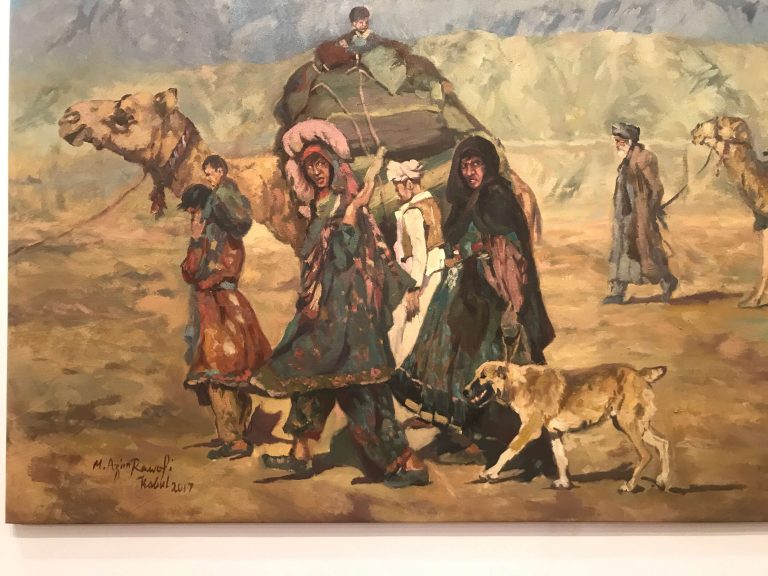
Moheb Sadiq, Impressionist painting of Afghani landscape
The hawks still circle and screech. The voices from the past 20 years who prodded us forward into battle return to the evening news to sell us on staying. “It’s not too late,” the former generals, secretaries and ambassadors say. “More troops can hold the line. Victory is just around the corner.”
But the speed of the Taliban’s advance makes clear that this outcome was always inevitable. The enemy had no reason to negotiate and no reputation for restraint. The only question before President Biden was how many American troops should die before it happened. But if leaving now was the right decision for America, it is a catastrophe for the Afghan people whom we have betrayed.
The Afghans are forced back into living under religious tyranny, an existence made all the more painful by their brief experience with freedom. Now they see the light from the far end of a dark tunnel. The school doors will close for girls, and the boys will return to their religious studies. For them, the arc of the moral universe will bend backward and break.
It’s my old unit, First Battalion, Eighth Marines, that is sent in to secure the airport in Kabul. I am jealous. I would give anything to return right now, to give what last full measure remains.
Yes, what is happening is unbearably tragic, but is it Joe Biden’s fault as the media “analysts” keep telling us? How can Biden, after 6 months in office, suddenly be responsible for 20 years of failures? It just makes no sense.
Eric Levitz at New York Magazine: The Media Is Helping Hawks Win the War Over Biden’s Withdrawal. This piece is critical of Biden’s Afghanistan policy, but even more critical of those who fought to extend the war for two decades and now want it to continue.
Biden’s failure of moral courage and contingency planning is this moment’s lesser scandal. The bigger one is the war that he is ending, which recent events have certified as an unmitigated disaster. Yet you might not know this from the many ostensibly objective news reports that have cast Biden’s troop withdrawal as the source of our nation’s “humiliation.”
Critical observers understood that the Afghan army was a paper tiger whose true ranks were far thinner than advertised and whose loyalty to the government was rooted less in patriotism than a mercenary’s interest in gainful employment. But the fact that America had invested $80 billion into training an army that was so incapable of independent action that it could not feed itself in the absence of U.S. air support — and so disenchanted with its own government that it would forfeit its capital with little fight — was not readily apparent until now.
Those who fought to extend America’s war in Afghanistan have every incentive to divert our attention from these revelations. They would like the public to miss the forest for the trees — by mistaking Biden’s tactical errors for strategic ones. The primary lesson of the past week could be that the U.S. war in Afghanistan was a catastrophe and that those who misled the public about the Afghan army’s strength deserve little input on future policy, no matter how many stars they have on their uniforms or diplomas they have on their walls. Alternatively, if news coverage focuses exhaustively on the shortcomings of Biden’s withdrawal, while largely ignoring what our client state’s abrupt collapse tells us about our two-decade-long occupation, then the lesson of Kabul’s fall could be quite favorable for Beltway hawks: Presidents shouldn’t end wars in defiance of the military brass unless they wish to become unpopular.
Artist Mohibullah Attaie (Moheb Sadiq)
Unfortunately, we are currently hurtling toward that latter outcome. In recent days, much of the mainstream media has comported itself as the Pentagon’s Pravda. Reporters have indignantly asked the White House how it could say that America doesn’t have a vital national security interest in maintaining a military presence near Tajikistan. NBC’s Richard Engel has devoted his Twitter feed to scolding Biden for suggesting that America’s nation-building project in Afghanistan was always hopeless, and that the Kabul government was “basically a failed state.” CNN’s Jim Sciutto lamented on Twitter Wednesday, “Too many times, I’ve witnessed the US military attempt to dutifully carry out difficult & dangerous missions left to them by the miscalculations of civilian leaders.” This sentiment is disconcerting in the abstract, since it seems to suggest that civilian control of the military may be unwise. But it’s even stranger in context. As we learned just two years ago, American military leaders in Kabul systematically lied to the public about how well the war against the Taliban was going, so as to insulate their preferred foreign policy from democratic contestation.
For more context and the critique of Biden, read the whole thing at New York Magazine.
Yesterday’s newsletter detailed how the media is largely overlooking voices that supported Biden’s decision to withdraw from Afghanistan. Instead media reports are almost exclusively highlighting criticism of the withdrawal — often from people complicit in two decades of failed policy in Afghanistan.
We have reason to believe that this is not an accident. On Wednesday, Popular Information spoke to a veteran communications professional who has been trying to place prominent voices supportive of the withdrawal on television and in print. The source said that it has been next to impossible:
“I’ve been in political media for over two decades, and I have never experienced something like this before. Not only can I not get people booked on shows, but I can’t even get TV bookers who frequently book my guests to give me a call back…
I’ve fed sources to reporters, who end up not quoting the sources, but do quote multiple voices who are critical of the president and/or put the withdrawal in a negative light.
I turn on TV and watch CNN and, frankly, a lot of MSNBC shows, and they’re presenting it as if there’s not a voice out there willing to defend the president and his decision to withdraw. But I offered those very shows those voices, and the shows purposely decided to shut them out.
In so many ways this feels like Iraq and 2003 all over again. The media has coalesced around a narrative, and any threat to that narrative needs to be shut out.”
Who is on TV? As Media Matters has documented, there are plenty of former Bush administration officials criticizing the withdrawal.
Is it really about execution?
Much of the criticism of Biden’s decision to withdraw has focused on the administration’s “execution.” The critics claim the withdrawal was poorly planned, chaotic, and unnecessarily put Americans — and their Afghan allies — in danger.
Some of these claims may be true. It’s hard to know, for example, how many people have been left behind since evacuations are ongoing. But, with a few exceptions, the criticisms of Biden’s execution are being made by people who opposed withdrawal altogether.
Click the link to read the rest.
An Afghan “war rug” at the College of New Jersey Art Gallery
I’m honestly depressed and disheartened by what is happening in the Afghanistan coverage. That’s about all I can say about it for now. Here are some other stories to check out today:
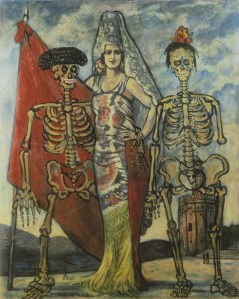
I was thinking a lot about the Spanish Civil War because BB has been reading a book on it. So, I chose these pictures today that are from that period about the event. They are mostly Modernist and Avant-Garde. Some, as you may see at this link, are propaganda. I think it’s important to remember that history has lessons for us if we’re really to listen.
From The Guardian story:
The United States is becoming a land filled with “democracy deserts”, where gerrymandering and voting restrictions are making voters powerless to make change. And this round of redistricting could make things even worse.
Why is Wisconsin so bad? Consider that, among other things, its a swing-state that helped decide the 2016 election. Control the outcome in Wisconsin, and you could control the nation. But Wisconsin isn’t the only democracy desert. Alabama (31), North Carolina (32), Michigan (37), Ohio (33), Texas (35), Florida (37) and Georgia (39) scored only nominally higher. Nations that join them in the 30s include Hungary, Turkey and Syria.
Now redistricting is upon us again. This week, the US Census Bureau will release the first round of population data to the states, and the decennial gerrymandering Olympics will begin in state capitols nationwide. And while there has been much coverage of the national stakes – Republicans could win more than the five seats they need to control of Congress next fall through redrawing Texas, Georgia, North Carolina and Florida alone, and they’ve made clear that’s their plan – much less alarm has been raised about the long-term consequences of entrenched Republican minority rule in the states.
Joan Miró, Help Spain, 1937, Museum of Modern Art, New York
The peril we face as a democratic Republic is great. John Nichols writes this for The Nation: “The Next Gerrymandering Nightmare Has Begun. With the release of 2020 Census data, GOP legislators will rush to draw new maps. If they get their way, they’re likely to flip the US House.”
It may not be too late to prevent the partisan gerrymandering of electoral maps that Republicans believe will deliver them control of the US House of Representatives in 2022—as well as a tighter grip on the statehouses that will set so many of the rules for the 2024 presidential election. But it is almost too late.
Ten years ago, Republican governors and legislators used the redistricting process that extended from the 2010 Census to gain dramatic political advantages. Now, with the release of fresh Census data, they are poised to do so again. No one should doubt what is at stake. If the supporters of voter suppression succeed, they could deny Americans representation based on the racial and ethnic diversity that the new data reveals.
“States have long been preparing for this moment, and they now have the green light to start gerrymandering. If left unchecked, this year’s redistricting cycle represents a severe threat to our democracy,” explains Josh Silver, who heads the nonpartisan reform group RepresentUs. “Gerrymandering is one of the worst forms of political corruption, and leads to extremism and partisan gridlock. The maps drawn this year will shape American politics and policy for the next decade.”
The best scenario for American democracy would have been for Senate Democrats to scrap the filibuster and enact the For the People Act before Thursday’s release of the Census data. That legislation seeks to ban partisan gerrymandering and strengthen the position of advocates for communities of color in the redistricting process. “It would also,” notes the Brennan Center for Justice, “enhance the ability of voters to challenge racially or politically discriminatory maps in court, require meaningful transparency in the map-drawing process, and mandate the use of independent commissions to draw maps.”
When senators failed to pass the For the People Act before the August recess, they left an opening for partisans to warp district lines in the 35 states where maps will be drawn by legislators, as opposed to nonpartisan commissions. That gives Republicans a substantial advantage. As Drew DeSilver of the Pew Research Center reminds us, “Republicans will drive that process in 20 states, versus 11 for Democrats.” In four states, divided government makes it most likely that the final decision could be made in the state courts.
Republicans are in full control of states that will be adding seats based on patterns of population growth confirmed by the Census data, such as Texas and Florida. They also control several large states, such as Georgia, where seats will not be added but where a redrawing of lines could be used to tip existing seats to the GOP candidates. In contrast, a number of states where Democrats are in charge, such as New York and Illinois, will lose congressional seats. So, too, will heavily Democratic California, where lines are drawn by a nonpartisan commission.
The Party Road Painting Aurelio Arteta
This discussion has yet to reach the level of coverage it deserves. Here’s an interesting article on the role of Math and stopping gerrymandering from The MIT Technology Review. Basically, there’s an algorithm for that!
The maps for US congressional and state legislative races often resemble electoral bestiaries, with bizarrely shaped districts emerging from wonky hybrids of counties, precincts, and census blocks.
It’s the drawing of these maps, more than anything—more than voter suppression laws, more than voter fraud—that determines how votes translate into who gets elected. “You can take the same set of votes, with different district maps, and get very different outcomes,” says Jonathan Mattingly, a mathematician at Duke University in the purple state of North Carolina. “The question is, if the choice of maps is so important to how we interpret these votes, which map should we choose, and how should we decide if someone has done a good job in choosing that map?”
Over recent months, Mattingly and like-minded mathematicians have been busy in anticipation of a data release expected today, August 12, from the US Census Bureau. Every decade, new census data launches the decennial redistricting cycle—state legislators (or sometimes appointed commissions) draw new maps, moving district lines to account for demographic shifts.
In preparation, mathematicians are sharpening new algorithms—open-source tools, developed over recent years—that detect and counter gerrymandering, the egregious practice giving rise to those bestiaries, whereby politicians rig the maps and skew the results to favor one political party over another. Republicans have openly declared that with this redistricting cycle they intend to gerrymander a path to retaking the US House of Representatives in 2022.
Francis Picabia. La Révolution espagnole (The Spanish Revolution). 1937
According to the U.S. Census Bureau’s diversity index — which measures the likelihood that two people chosen at random would be from different racial and ethnic groups — Maryland is now one of the most diverse states in the nation, surpassed only by Nevada, California and Hawaii.
Nevada also was the only other state in the country to become majority non-White over the last decade.
The change in Maryland’s demographic makeup was driven by growing Asian and Latino populations in the District’s inner suburbs and areas around Baltimore.
The article primarily focuses on the states surround the District. The New York Times provides information on what you need to know when the data is released. It was released on Thursday, but we still are waiting for the major slice and dice to come. This is written by Nick Corasaniti.
With Democrats clinging to a slim margin in the House of Representatives, control of the chamber in 2022 could be decided through congressional redistricting alone: Republican-leaning states like Texas and Florida are adding new seats through reapportionment, and G.O.P.-dominated state legislatures will steer much more of the redistricting process, allowing them to draw more maps than Democrats.
In a matter of days — if history is any guide — as soon as state officials can crunch census data files into their more modern formats, an intense process of mapmaking, political contention, legal wrangling, well-financed opinion-shaping and ornery public feedback will unfold in statehouses, courthouses, on the air and even on the streets in regions of special contention.
The redistricting fight arrives amid one of the most protracted assaults on voting access since the Voting Rights Act was passed in 1965, an effort that has made the right to vote among the most divisive issues in American politics. And redistricting will take place this fall without critical guardrails that the Voting Rights Act had erected: a process known as preclearance that ensured oversight of states with a history of discrimination. The Supreme Court effectively neutered that provision in a 2013 ruling, meaning that it could take lawsuits — and years — to force the redrawing of districts that dilute the voting power of minority communities.
Every 10 years, states redraw their legislative and congressional district lines following the census. Because communities change, redistricting is critical to our democracy: maps must be redrawn to ensure that districts are equally populated, comply with laws such as the Voting Rights Act, and are otherwise representative of a state’s population. Done right, redistricting is a chance to create maps that, in the words of John Adams, are an “exact portrait, a miniature” of the people as a whole.
But sometimes the process is used to draw maps that put a thumb on the scale to manufacture election outcomes that are detached from the preferences of voters. Rather than voters choosing their representatives, gerrymandering empowers politicians to choose their voters. This tends to occur especially when linedrawing is left to legislatures and one political party controls the process, as has become increasingly common. When that happens, partisan concerns almost invariably take precedence over all else. That produces maps where electoral results are virtually guaranteed even in years where the party drawing maps has a bad year.
There are multiple ways to gerrymander.
While legislative and congressional district shapes may look wildly different from state to state, most attempts to gerrymander can best be understood through the lens of two basic techniques: cracking and packing.
Cracking splits groups of people with similar characteristics, such as voters of the same party affiliation, across multiple districts. With their voting strength divided, these groups struggle to elect their preferred candidates in any of the districts.
Packing is the opposite of cracking: map drawers cram certain groups of voters into as few districts as possible. In these few districts, the “packed” groups are likely to elect their preferred candidates, but the groups’ voting strength is weakened everywhere else.
The Politico link has good coverage of the broader population trends released in April. It follows up describing the “mad-dash to redistricting.
Broadly, the data released on Thursday shows a country that has become more urbanized” and more diverse over the last decade. Metro areas across the country grew by 9 percent, and all ten of America’s largest cities have over 1 million people for the first time in U.S. history.
The country has also become less white over the last decade. White Americans still make up the largest demographic in the country, but decreased by 8.6 percent over the last decade.
The dataset could also give an indication of whether the Census undercounted people of color in certain regions, and a state-by-state review will revealwhether individual states need to add additional opportunity districts for Blacks and Latinos, as required by the Voting Rights Act. That officially sets the stage for a wave of lawsuits expected from both parties as redistricting moves forward.
The process is also at the center of the battle for control of Congress. Redistricting decisions made in the coming months will be perhaps the largest determining factor in whether Democrats can hang onto to their razor-thin House majority.
“These data play an important role in our democracy, and also begin to illuminate how the local and demographic makeup of our nation has changed over the last decade,” said Ron Jarmin, the acting director of the Census Bureau, during a presentation Thursday.
So, this will be something we must continue to watch over the next two months. It’s vital to our democracy that we minimize gerrymandering. Gerrymandering is the basic tool of voter disenfranchisement. It happens even if the worst voter suppression measures are defeated.
What’s on your reading and blogging list today?
Did you like this post? Please share it with your friends:
More news broke yesterday about Trump’s intense efforts to overturn the results of the election so he could stay in office. It’s becoming clear that his inciting of the January 5 insurrection was just a last ditch effort after repeated coup attempts had failed.
Remember when the U.S. Attorney in Atlanta suddenly resigned early this year around the time when Trump’s phone calls pressuring Georgia Secretary of State Brad Raffensperger to find enough votes to change the state’s election results?
Byung J. Pak, a former U.S. attorney in Atlanta, told congressional investigators on Wednesday that his abrupt resignation in January had been prompted by Justice Department officials’ warning that President Donald J. BTrump intended to fire him for refusing to say that widespread voter fraud had been found in Georgia, according to a person familiar with his testimony.
Mr. Pak, who provided more than three hours of closed-door testimony to the Senate Judiciary Committee, stepped down with no notice on Jan. 4, saying that he had done his best “to be thoughtful and consistent, and to provide justice for my fellow citizens in a fair, effective and efficient manner.”
While he did not discuss Mr. Trump’s role in his decision to resign at the time, he told the Senate panel that the president had been dismayed that Mr. Pak had investigated allegations of voter fraud in Fulton County, Ga., and not found evidence to support them, according to the person familiar with the statements.
Mr. Pak testified that top department officials had made clear that Mr. Trump intended to fire him over his refusal to say that the results in Georgia had been undermined by voter fraud, the person said. Resigning would pre-empt a public dismissal.
Kenneth Rowntree, The Balcony
He also described work done by state officials and the F.B.I. to vet Mr. Trump’s claims of voter fraud, and said they had not found evidence to support those allegations.
The Senate Judiciary Committee is examining Mr. Pak’s departure as part of its broader investigation into the final weeks of the Trump administration and the White House’s efforts to pressure the Justice Department to falsely assert that the election was corrupt. The Justice Department’s inspector general is also looking at Mr. Pak’s resignation.
During a phone call with Secretary of State Brad Raffensperger of Georgia on Jan. 2, two days before Mr. Pak resigned, Mr. Trump asked Mr. Raffensperger to find enough votes to reverse the state’s presidential election results and described fraud allegations that Mr. Raffensperger said were not supported by facts, according to leaked audio of the call.
Mr. Pak had refused to support similar election fraud claims because of the lack of evidence, according to two people familiar with his investigation. “You have your never-Trumper U.S. attorney there,” Mr. Trump told Mr. Raffensperger during their phone call.
President Donald Trump’s last acting attorney general has told U.S. senators his boss was “persistent” in trying to pressure the Justice Department to discredit the results of the 2020 election.
In closed-door testimony Saturday before the Senate Judiciary Committee, Jeffrey Rosen said he had to “persuade the president not to pursue a different path” at a high-stakes January meeting in which Trump considered ousting Rosen as the nation’s most powerful law enforcement officer.
Late Summer, Hermann Wessel, 1924
According to a person familiar with the testimony, Rosen’s opening statement also characterized as “inexplicable” the actions of his Justice Department colleague, Jeffrey Clark, who was willing to push Trump’s false claims of election fraud and whom Trump considered installing as acting attorney general to replace Rosen….
On Saturday, Rosen appeared before the Senate committee to deliver his account directly. Donoghue testified as well. During a seven-hour interview, Rosen emphasized how he and other senior leaders resisted Trump’s entreaties.
“The president was persistent with his inquiries, and I would have strongly preferred that he had chosen a different focus in the last month of his presidency,” he said in his opening statement, according to a person familiar with the testimony, who spoke on the condition of anonymity to discuss the closed-door session. “But as to the actual issues put to the Justice Department, DOJ consistently acted with integrity, and the rule of law held fast.”
Rosen said he thought Trump’s claims about voting irregularities were “misguided, and I disagreed with things that President Trump suggested the Justice Department do with regard to the election. So we did not do them.”
Click the link to read the rest.
Mary Harris at Slate: A Rogue DOJ Lawyer Almost Kept Trump in Office. This is a report of an interview with Mark Joseph Stern, a Slate writer who has been reporting on Trump’s coup attempts. Stern argues that the DOJ’s Jeffrey Clark was supporting the efforts of Trump’s lawyers to get courts to declare various states’ election results invalid.
Mark Joseph Stern: …[Y]ou’ve got Sidney Powell and Rudy Giuliani claiming there’s mass voter fraud. You’ve got state attorneys general in 18 different states, as well as a lot of conservative intellectuals and Republican politicians, claiming that the election was conducted in an unconstitutional way….
Gari Melchers, The Sun Porch
So these folks talked about voter fraud, but they focused on this idea that only state legislatures get to decide the rules for a presidential election. And here, you had a lot of other players—governors, state courts, election boards—tweaking these rules in part because legislatures can’t foresee every possible election regulation, and sometimes state courts or secretaries of state or governors will have to step in and clarify things. But also, because of the COVID-19 crisis, you had a lot of states trying new things for the first time. And you also had a lot of states that refused to try new things, whose restrictive voting laws were going to force people to potentially wait in line indoors for a very long time and expose themselves to COVID. But all the modifications certain states made were modest.
Mary Harris: The neatness of making this argument that somehow the election was unconstitutional is that it potentially allows state legislatures to step in and override the vote, right?
That’s exactly right. That’s the endgame here. It’s not as if these folks were flailing and screaming and accusing the election results of being illegitimate. They had a purpose, which was to throw the procedure of the election into sufficient legal doubt so state legislatures would have an excuse to reconvene, step in, essentially ignore the results of the actual vote, and appoint their states’ electors in the Electoral College to Donald Trump….
It looks like most Justice Department officials balked at this idea, but Jeffrey Bossert Clark was all for it. And what we’ve seen in the release of documents that the House Oversight Committee has provided, and also from other reporting, is that he eagerly wanted to have the Justice Department step in in several different ways, specifically in Georgia, to push the state legislature to call its own special session, overturn the actual results, and declare Trump the real winner.
Winslow Homer, Sunshine and Shadow
We’ve actually seen the drafts of the letters and lawsuits that Clark was typing up furiously and trying to issue on behalf of the entire Justice Department—and that would have potentially nudged Georgia and its legislature toward overthrowing its own election results….
There are a number of reports from high-level Justice Department officials that are somewhat corroborated by other emails we’ve seen about various meetings that were taking place at this time. They show that at this point, Clark had decided that Rosen didn’t have the backbone to steal the election or to intervene on Trump’s behalf. So Clark apparently held unauthorized conversations behind the backs of his superiors with the president himself, and seems to have floated this idea of using the Justice Department to make these state legislatures reconvene and reassign their electoral votes. Trump seems to have really liked this idea and even said to Rosen, Why am I having to deal with you and these state suits when I could be dealing with Clark, who would do everything I say? All I need to do is fire you and make Clark the new acting attorney general, and then he’ll do whatever I want.
During Donald Trump’s final weeks in office, top Justice Department officials wrangled over how the FBI should handle a particularly wacky voter fraud allegation promoted by the then-president and his allies. Unreleased emails obtained by POLITICO show just how tense the episode got.
The dispute pitted a senior career section chief against one of the DOJ’s top officials, with the FBI caught in the crossfire. Trump’s appointees at DOJ ultimately prevailed, and their investigation — a probe into a viral video from Georgia that didn’t actually find any evidence of fraud — ended up playing a role in torpedoing the president’s narrative. While Trump’s opponents fretted that the FBI’s involvementwould undermine public confidence in elections and boost Republican talking points, it had the opposite effect.
Summer Porch at Mr. and Mrs. C.E.S. Woods, 1904, Child Hassam
At the time of the email dispute, Trump and his allies were lobbing a host of allegations about voter fraud, claiming wide-reaching and nefarious forces had conspired to steal the election for Biden. One allegation in particular commanded the president’s attention:a video showing election workers counting ballots at State Farm Arena in Atlanta. Trump’s allies claimed it showed the workers secretly pulling ballots out of “suitcases” and using them to commit election fraud.
Officials in the office of Georgia’s secretary of state quickly debunked those claims. But on Dec. 5, Trump alluded to the video at a rally in Georgia, suggesting it proved poll workers were stuffing ballot boxes to help the Democrats.
This led to this dispute between DOJ officials involving the FBI. It’s a convoluted story that I can’s easily summarize, but the story is worth reading.
Unfortunately, the ravages of the Delta variant of the coronavirus are still the top story of the day. Here’s the latest depressing news, links only:
The landmark report, compiled by 234 authors relying on more than 14,000 studies from around the globe, bluntly lays out for policymakers and the public the most up-to-date understanding of the physical science on climate change. Released amid a summer of deadly fires, floods and heat waves, it arrives less than three months before a critical summit this November in Scotland, where world leaders face mounting pressure to move more urgently to slow the Earth’s warming.
Monday’s sprawling assessment states that there is no remaining scientific doubt that humans are fueling climate change. That much is “unequivocal.” The only real uncertainty that remains, its authors say, is whether the world can muster the will to stave off a darker future than the one it already has carved in stone.
…
“What the world requires now is real action,” John F. Kerry, the Biden administration’s special envoy for climate, said in a statement about Monday’s findings. “We can get to the low carbon economy we urgently need, but time is not on our side.”
It certainly is not, according to Monday’s report.
Humans can unleash less than 500 additional gigatons of carbon dioxide — the equivalent of about 10 years of current global emissions — to have an even chance of limiting warming to 1.5 degrees Celsius (2.7 Fahrenheit) above preindustrial levels.
But hopes for remaining below that threshold — the most ambitious goal outlined in the Paris agreement — are undeniably slipping away. The world has already warmed more than 1 degree Celsius (1.8 degrees Fahrenheit), with few signs of slowing, and could pass the 1.5-degree mark early in the 2030s.
As the world battles historic droughts, landscape-altering wildfires and deadly floods, a landmark report from global scientists says the window is rapidly closing to cut our reliance on fossil fuels and avoid catastrophic changes that would transform life as we know it.
The state-of-the-science report from the United Nations’ Intergovernmental Panel on Climate Change says the world has rapidly warmed 1.1 degrees Celsius higher than pre-industrial levels, and is now careening toward 1.5 degrees — a critical threshold that world leaders agreed warming should remain below to avoid worsening impacts.
Only by making deep cuts to greenhouse gas emissions, while also removing carbon dioxide from the atmosphere, can we halt the precipitous trend. “Bottom line is that we have zero years left to avoid dangerous climate change, because it’s here,” Michael E. Mann, a lead author of the IPCC’s 2001 report, told CNN.
Unlike previous assessments, Monday’s report concludes it is “unequivocal” that humans have caused the climate crisis and confirms that “widespread and rapid changes” have already occurred, some of them irreversibly.
Every time the scientists take another look at the data, it just gets clearer and clearer: We don’t have any time to waste. We’ve got to tackle this crisis head on, with every tool we can get our hands on, and pass a #GreenNewDeal to save our planet.https://t.co/bFWSppF8qP
The authors — nearly 200 leading climate scientists — hope the report’s findings will be front and center when world leaders meet for a major climate conference in November.
The effects of that warming are obvious and deadly around the world. Heat waves, droughts and floods are killing people and disrupting lives around the world this summer. Wildfires are burning with unprecedented frequency and intensity, including in places that used to rarely burn. Smoke and smog are choking people in cities and towns from Asia to the Arctic. Ocean heat waves are threatening entire ecosystems and supercharging hurricanes and typhoons.
The science is clear: Human-caused emissions of carbon dioxide and other greenhouse gases are the primary driver of such changes.
One of the biggest recent advances in climate research is in the field of so-called attribution science, which ties global warming to individual weather events such as hurricanes or heat waves. Scientists can now say with certainty that humans are causing more extreme weather, including heavy downpours and extended heat waves and droughts.
“This whiplash — this increase in both extreme wet and dry events — is projected to increase through the 21st century,” says Kim Cobb, one of the report authors and a paleoclimate scientist at Georgia Institute of Technology.
This is the first time that paleoclimate researchers, who study the climate of the past to understand how Earth will change in the future, have helped write every chapter of the report. Their work helps put today’s climate in perspective. “We can now say global surface temps are reaching levels not seen in 100,000 years,” says Cobb. “The rate of warming since 1970 is higher than any 50-year period in the last 2,000 years.”
The report also confirms that global sea level rise is accelerating. Globally, sea levels rose about 8 inches on average between 1901 and 2018, although the water rose much more in some places, including in some cities on the East Coast and Gulf Coast of the United States.
Sea level rise is primarily driven by melting glaciers, and Arctic ice. There’s a lag between emissions and ice melting, which means even if humans were to stop all greenhouse gas emissions today, sea levels would continue to rise for a few decades, the report notes.
“Sea level change through the middle of this century has largely been locked in,” says Bob Kopp, one of the report’s authors and the director of the Institute of Earth, Ocean and Atmospheric Sciences at Rutgers University. That means no matter what, people living in coastal areas will need to adapt to higher seas.
Scientists are observing changes in the Earth’s climate in every region & across the whole climate system, says the IPCC’s latest #ClimateReport, released today.
“The Rainy Season in the Amazon Rainforest ” , Kazuya Akimoto. ‘2008
Of course, nothing changes if we can’t get the world to change or even change things at the local level. My state’s politics are somewhat driven by the priorities of the Oil and Gas industry. They throw money around to ensure it stays that way. This is from Forbes. “Fugitive Methane Worsens Warming: New Assessments Point To Urgent Oil And Gas Fix.” Methane is the third leg of this discussion.
The word fugitive methane conjures up the Harrison Ford movie, where the hero was always running and hiding. It’s a good concept for methane leakages that occur in all phases of natural gas production and processing, except they are not heroes.
Methane has also been hiding from the press which has paid most attention to controlling carbon dioxide (CO2), the main greenhouse gas (GHG). But the poor sister has now awakened to tell us she is responsible for 25% of present global warming. The world should have had a second Paris Agreement for methane back in 2015.
But its not too late as the “methane lever” can still be moved to make a substantial change to current warming by global GHG emissions.
Methane is the second important greenhouse gas. Methane emissions are surreptitious and really bad. The global warming effect of methane is 20-80 times that of carbon dioxide, depending on duration (how many warming years are counted).
The amount of methane in the atmosphere has more than doubled in the past 250 years since the industrial revolution
Fossil fuels, agriculture, and waste management comprise the big three sources of man-made methane. In the US, methane emissions from oil and gas are almost half of all man-made methane emissions.
The United Nations panel on climate change told the world that global warming was dangerously close to being out of control – and that humans were ‘unequivocally’ to blame https://t.co/vrPBPVdu1Qpic.twitter.com/nzCWSTTng9
The Sky Dancing banner headline uses a snippet from a work by artist Tashi Mannox called 'Rainbow Study'. The work is described as a" study of typical Tibetan rainbow clouds, that feature in Thanka painting, temple decoration and silk brocades". dakinikat was immediately drawn to the image when trying to find stylized Tibetan Clouds to represent Sky Dancing. It is probably because Tashi's practice is similar to her own. His updated take on the clouds that fill the collection of traditional thankas is quite special.
You can find his work at his website by clicking on his logo below. He is also a calligraphy artist that uses important vajrayana syllables. We encourage you to visit his on line studio.









 “I’ve been in political media for over two decades, and I have never experienced something like this before. Not only can I not get people booked on shows, but I can’t even get TV bookers who frequently book my guests to give me a call back…













 peej
peej Carissa
 bostonboomer
 dakinikat
 ecocatwoman
 jjlo
jjlo mablue2
 Mama Lopez
 peggysue22
 quixote
 skydancingguestblogger
 Mona (aka Wonk the Vote)





Recent Comments