I spent Thanksgiving with my neighbors, which is so lovely on many levels. It really felt like the first typical holiday for me in a few years. The last one was the Mardi Gras, where I woke up with something that made me highly ill for weeks. I was really hoping to make it to Seattle, but I’m still afraid of crazies on planes and the maskless roaming airports. Now, I’m delighted I just zoomed the grandbabies and enjoyed the bags of groceries my daughter sent me so I could do my own family-style Thanksgiving at home. The Dow has fallen this morning, and countries are racing to end flight contact with South Africa. There’s a new Covid-19 variant. This is the headline from WAPO: “Announcement of new virus variant alarms world, crashing stocks and banning flights.”
A new, possibly more infectious coronavirus variant, with an unusual number of mutations, had scientists sounding the alarm, countries moving to impose travel bans and financial markets tumbling on Friday, as the world feared another setback on the long road out of the pandemic.
Major questions remain about the variant’s transmissibility, whether it might make people sicker and whether it might be able to evade vaccines, but Susan Hopkins, chief medical adviser to Britain’s Health and Security Agency, warned that the new variant found in southern Africa is the “most worrying we’ve seen.”
The variant, known as B.1.1.529, was first detected in Botswana, but scientists in South Africa convened a news conference Thursday and said they had linked it to an exponential rise of infections in their country. Cases have also been identified in Hong Kong and Belgium.
By the next morning, the Dow Jones industrial average plunged about 800 points or 2.2 percent, the S&P 500 index fell 1.5 percent, and the Nasdaq composite index was off 1.1 percent. Crude oil prices tumbled as well.
France, Britain, Japan and Israel began to ban or order quarantines for air passengers arriving from the southern African region. The European Union is also expected to also propose a ban on air travel arriving from southern Africa.
“Our view is very clear,” Dana Spinant, deputy chief spokeswoman for the European Commission, said at a news conference Friday. “We need to act very fast, we need to be vigilant, and we need to take all measures that are appropriate at this stage to prevent this virus from entering Europe.”
Anthony S. Fauci, the top U.S. infectious-disease official, said banning flights to the United States from southern Africa is a “possibility,” but that a decision has not been made yet.
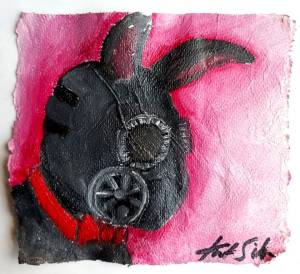
Kat’s paintings, including these done on toilet paper which has been available for $20
I keep telling all my Mardi Gras-loving friends not to get overly excited about the possibility of parades again. This thing is not through with us yet. It should be called the Trump Virus by now. Reuters reports on Dr. Fauci’s comments.
“There is always the possibility of doing what the UK has done, namely block travel from South Africa and related countries,” Fauci said in an interview on CNN.
“That’s certainly something you think about and get prepared to do. You’re prepared to do everything you need to protect the American public. But you want to make sure there’s a basis for doing that,” he said.
“Obviously as soon as we find out more information we’ll make a decision as quickly as we possibly can.”
Fauci said U.S. scientists would speak with South African counterparts on Friday about the new variant, called B.1.1.529, which has raised concern about its transmissibility and whether it might evade immune responses.
He added that there was no indication that the new variant was already in the United States.
Five quick tweets on the new variant B.1.1.529
Caveat first: data here is *very* preliminary, so everything could change. Nonetheless, better safe than sorry.
1) Based on the data we have, this variant is out-competing others *far* faster than Beta and even Delta did 🚩🚩 pic.twitter.com/R2Ac4e4N6s
A few weeks after Texas adopted the most restrictive abortion law in the nation, Dr. Andrea Palmer delivered terrible news to a Fort Worth patient who was midway through her pregnancy.
The fetus had a rare neural tube defect. The brain would not develop, and the infant would die at birth or shortly afterward. Carrying the pregnancy to term would be emotionally grueling and would also raise the mother’s risk of blood clots and severe postpartum bleeding, the doctor warned.
But the patient was past six weeks’ gestation, and under the new law, an abortion was not an option in Texas because the woman was not immediately facing a life-threatening medical crisis or risk of permanent disability.
“So we look at them like a ticking time bomb and wait for the complications to develop,” Dr. Palmer said of her patients.
In this case, the woman had the means to travel, and she obtained an abortion in another state, an option unavailable to many low-income and working class women.
Texas’ new measure was intended to impose stringent limits on abortion. But it is also affecting women who have no desire for termination but are experiencing medically risky pregnancies. Many doctors say they are unable to discuss the procedure as an option until the patient’s condition deteriorates and her life is at risk.
Abortion is permitted in Texas after six weeks only when a woman is facing a life-threatening or disabling medical emergency linked to her pregnancy. The law makes no exceptions for nonviable pregnancies in which the fetus has no chance of survival.
Even crazier are these calls to action by the QAnon Queen of Canada reported in VIce. “QAnon’s ‘Queen of Canada’ Calls for Followers to ‘Kill’ People Vaccinating Children. QAnon influencer Romana Didulo told her 70,000 followers that “duck-hunting season is open” and by ducks, she means healthcare workers, politicians, and journalists.” Vigilantism is sure en vogue with these dangerous nutters. Oh, Canada!
Now, to be clear, we aren’t talking about hunters in hip waders going after our fine-feathered friends with a loyal hound by their side. These “duck hunters” are “soldiers” of Roman Didulo—a Canadian woman who has convinced thousands of QAnon adherents that she’s the secret ruler of Canada—targeting health care workers administering COVID-19 vaccines to children, politicians, journalists, and others who make up the cabal at the heart of the QAnon conspiracy.
In a post on Sunday to her over 70,000 followers on Telegram, Didulo issued an order to the soldiers of her “Kingdom of Canada’s Military.” She demanded the mass arrests of those they consider opposition, and wanted her soldiers to take control of newspapers and seize the border.
“Shoot to kill anyone who tries to inject Children under the age of 19 years old with Coronavirus19 vaccines/ bioweapons or any other Vaccines,” she wrote. “This order is effective immediately.”
A follow-up post on Tuesday changed the wording from “shoot to kill” to “arrest.”
“Please, use airports, hospitals, schools, stadiums, and other public venues to hold and detain all traitors,” the post said. “They will stay there until Military Tribunal is held for each one of them until the day they are executed via firing squad or hanging.”
As Ian Bassin, executive director of Protect Democracy, put it: “The United States just allowed an autocratic person to ascend to the presidency, to serve in it for four years and to very nearly extend that term. The big question is: how did that happen, what went wrong there?”
Sherrilyn Ifill, president of the NAACP Legal Defense Fund, expressed a similar thought in Slate: “Our voting system is fundamentally broken,” she wrote. “The future of our country unequivocally depends on our ability to reform it.”
— Dr. Kat PhD. … not your kiddo, buddy🇺🇦🌻 (@Dakinikat) November 26, 2021
This Op-Ed by Cynthia Miller-Idriss–a MSNBC Opinion Columnist–is provocative because we really have not faced these threats head-on.
There are a lot of different ways that democracies can fail. Some collapse under the weight of political leaders who assume authoritarian control, arrest opponents, or refuse to allow new elections to take place. Others suffer at the hands of citizens who support political violence, dehumanize other political parties as “evil,” or call for civil war. Still others struggle with voter suppression and intimidation efforts, weakened trust in institutions, and falling political participation.
The U.S. is facing all these problems, and more. We are witnessing challenges to the integrity of elections, rooted in disinformation spread by our own elected officials and in widespread conspiracies that circulate online. A third of election poll workers reported feeling unsafe this year, after an “unprecedented” number of them received threats. The violent insurrection at the U.S. Capitol on Jan. 6 came at the hands of thousands of ordinary citizens who aimed to disrupt the democratic certification of the presidential election and prevent President Joe Biden from taking office.
We also face rising harassment and violence from extremist groups, citizen vigilantes, and unlawful militias who threaten minority groups, disrupt our freedom of assembly and demonstration with shows of violent force, and violate civil rights like the right to “public accommodations,” as recent court rulings have shown. We have seen repeated violent attacks, harassment, and even death threats directed at front-line workers and public officials, including school board members, health care workers, teachers, flight attendants, and restaurant hostesses.
The U.S. isn’t the only democracy that is eroding. Democratic stability is backsliding across the globe, as nations suffer from compromised elections, dismantled checks on government, challenges to a free media, and reductions of minority protections. But there is a particular urgency in the U.S. warning signs, not least because we are a nation of citizens who are now armed at previously unimaginable levels. This year is on track to be the second-highest year of firearm sales in history, following a “record shattering” year in 2020, in which 21 million background checks for firearms sales took place — far above the average of about 8.6 million annual checks.
Luckily, just because a democracy is in crisis does not mean it will collapse. On average, it takes about a decade from the onset of democratic backsliding to end in either democratic breakdown or recovery. But we are long overdue for a course correction.
We are facing back-sliding on so many civil liberties issues that I am astounded daily. Will SCOTUS overturn Roe v. Wade? Will we be able to correct the inequities that its decision on the Voting Rights Act caused? How do we deal with vigilantism; especially in communities where the police encourage it! Can we get some criminal justice reform? Haven’t we all seen enough to know how necessary it is?
These are all eyes-on-the-prize questions to me. What are yours?
What’s on your reading and blogging list today?
Did you like this post? Please share it with your friends:
House Democrats on Friday morning passed a more than $2 trillion bill to overhaul the country’s health care, climate, education and tax laws, moving beyond months of disputes between liberals and moderates that have stalled President Biden’s economic agenda.
The legislation builds off a framework that Biden unveiled to party lawmakers and includes new spending to enhance child care, provide free prekindergarten, combat climate change and advance a slew of tax benefits that chiefly aid low-income Americans.
But the bill omits many of Democrats’ top priorities, a reflection of the party’s difficult work to scale back a package once valued at $3.5 trillion. It now moves to the Senate, where it may face further cuts.
What follows is a guide to the legislation, one of the most significant overhauls of domestic policy in generations.
Head over to the WaPo to read summaries of all the important ways the bill could change the country.
And while the jury’s decision drew harsh criticism from the victims’ loved ones, legal experts say they were not surprised by the verdict….
Among the trial’s most key moments was the testimony from Rittenhouse, who told the court he acted in self-defense when he shot Rosenbaum, who he said threatened him earlier, chased him, threw a bag at him and lunged for his gun. At one point, 18-year-old Rittenhouse broke down in tears while on the stand.
Cat’s Pause, by Bonnie Mason
“If I would have let Mr. Rosenbaum take my firearm from me, he would have used it and killed me with it and probably killed more people,” he testified.
Rittenhouse referred to the other people he shot at as part of a “mob” chasing him, telling the court Huber came at him, struck him with a skateboard, and grabbed his gun. Rittenhouse shot him once in the chest, killing him. Finally, he said he saw Grosskreutz lunge at him and point a pistol at his head, so Rittenhouse shot him, he testified.
“Number one, you humanize him… More important, number two, he explained his uses of force,” CNN legal analyst Joey Jackson said.
Rittenhouse’s testimony gave jurors the ability to hear what he thought at the time and whether he believed he was in danger — a claim the prosecution, ultimately failed to undermine, former federal prosecutor Elie Honig said.
“They (prosecutors) pointed out some sort of minor inconsistencies and things he said on the night of, and said later, but nothing that undermines sort of the core defense argument, which was, he was attacked,” Honig told CNN’s Alisyn Camerota on Friday. “Every time he shot, he was attacked.”
“The prosecution did not make enough of a dent in Kyle Rittenhouse,” Honig added.
More experts:
What the trial came down to, according to civil rights attorney Charles F. Coleman Jr. were two competing narratives: one of Rittenhouse being a victim who was attacked, and one of being a vigilante who provoked the violence.
“The jury bought the narrative of Kyle Rittenhouse being a victim, they thought that his self-defense claim was a lot stronger than the prosecution’s provocation claim,” he said.
Wisconsin law allows the use of deadly force only if “necessary to prevent imminent death or great bodily harm.” And because Rittenhouse’s attorneys claimed self-defense, state law meant the burden fell on prosecutors to disprove Rittenhouse was acting in self-defense beyond a reasonable doubt.
And it was an uphill battle to climb from the start, because of the facts in this case, experts said.
“(Prosecutors) weren’t able to show that his response to each of these men, to each of these sets of threats was unreasonable,” criminal defense attorney Sara Azari told CNN’s Pamela Brown.
Kyle Rittenhouse, who was 17 years old when he shot three people, killing two, officially got away with murder. A jury of his white peers ruled that Rittenhouse acted in self-defense when he illegally acquired a gun, traveled across state lines, lied about his status as a medic, pointed his gun at protesters, and then used it to kill others.
The verdict is not surprising, if you are familiar with how the criminal justice system works for white people. Wisconsin Judge Bruce Schroeder, who presided over the Rittenhouse trial, consistently made rulings in the best interest of the white gunman. He refused to punish Rittenhouse for violating the terms of his bail; excluded evidence of Rittenhouse’s behavior before and after the shooting that spoke to his intent and lack of remorse; allowed the defense to mischaracterize the people Rittenhouse killed as “rioters”; yelled at prosecutors in front of the jury; dismissed an illegal gun charge against the gunman; and had the jury clap for one of Rittenhouse’s expert witnesses.
Others might want to argue about why Schroeder was biased toward the defendant (I think the judge’s MAGA ringtones and off-color jokes tell you all you need to know about why he was sympathetic to a white gunman who shot up anti–police violence protesters at the height of the Black Lives Matter movement). But that he was biased toward Rittenhouse was obvious to those watching the trial without blinders.
Still, a sympathetic judge and a predominately white jury are just standard gifts the criminal justice system gives to white boys accused of criminal violence. Rittenhouse also enjoyed hero status among white supremacists and Republicans as well as favorable media coverage from Fox News and The New York Times.
No doubt, some people will express shock at the verdict over the next few days. But Rittenhouse’s freedom is not a “miscarriage” of justice—it is our white justice system working as intended. This system is designed to free people like Rittenhouse: white vigilantes who kill to maintain the best interests of whiteness. It doesn’t always work (I still believe the people who lynched Ahmaud Arbery will be found guilty). But it works often enough (see George Zimmerman) that it gives comfort and confidence to any white person who clearly realizes that they might do an obviously illegal and violent thing (like, say, storm the US Capitol) and either get away with it completely or receive a light punishment.
Morris Hirshfield, Angora Cat, 1937-39
I wholeheartedly agree with Mystal. As he writes in the article, a black 17-year-old who did what Rittenhouse did would suffer a completely different fate. Frankly, that black teenager would most likely be killed by police before he had a chance to stand trial.
The specter of the angry Black man has been evoked in politics and popular culture to convince White folks that a big, bad Black man is coming to get them and their daughters.
I’ve seen viral videos of innocent Black men losing their lives because of this stereotype. I’ve watched White people lock their car doors or clutch their purses when men who look like me approach. I’ve been racially profiled….
But as I’ve watched three separate trials about White male violence unfold across the US these past few weeks — the Kyle Rittenhouse trial, the Ahmaud Arbery death trial and the civil case against organizers of the 2017 Unite the Right rally in Charlottesville — I’ve come to a sobering conclusion:
There is nothing more frightening in America today than an angry White man.
It’s not the “radical Islamic terrorist” that I fear the most. Nor is it the brown immigrant or the fiery Black Lives Matter protester, or whatever the latest bogeyman is that some politician tells me I should dread.
It’s encountering an armed White man in public who has been inspired by the White men on trial in these three cases.
Of course it’s not all White men, Blake writes.
But recent events have convinced me it’s time to put another character on trial: A vision of White masculinity that allows some White men to feel as if they “can rule and brutalize without consequence.”
Reynaldo Fonseca, Figure and Cats, 2003
This angry White man has been a major character throughout US history. He gave the country slavery, the slaughter of Native Americans, and Jim Crow laws. His anger also helped fuel the January 6 insurrection at the Capitol.
It’s this angry White man — not the Black or brown man you see approaching on the street at night — who poses the most dangerous threat to democracy in America.
That’s a sweeping claim. But these trials represent something bigger than questions of individual guilt or innocence. They offer a disturbing vision of the future, and a choice about what kind of country we want to live in.
Congressman Jerrold Nadler (D- NY) called for the Justice Department to review the Kyle Rittenhouse case after a jury found Rittenhouse not guilty on all charges Friday.
Nadler, the Chairman of the House Judiciary Committee, reacted to the verdict by remarking, “This heartbreaking verdict is a miscarriage of justice and sets a dangerous precedent which justifies federal review by DOJ. Justice cannot tolerate armed persons crossing state lines looking for trouble while people engage in First Amendment-protected protest.”
I’m having trouble getting going this today. I looked around at the latest news, and I started to feel exhausted. But I’m resisting sinking into that feeling. I have to believe there is some way for us as a country to recover from the Trump poison. At least we got some good news yesterday when Biden signed the bipartisan infrastructure bill and Pelosi announced that the House could vote on the Build Back Better bill this week.
We did it (again!) Joe!! @VP Harris and President Biden on the South Lawn for the historic signing of the bipartisan infrastructure bill! pic.twitter.com/pd6y0agugI
— Madam Auntie VP Kamala Harris is THEE GOAT! (@flywithkamala) November 15, 2021
Major pieces of legislation signed within the first 10 months:
Now Democrats will need to convince voters how great these accomplishments are.
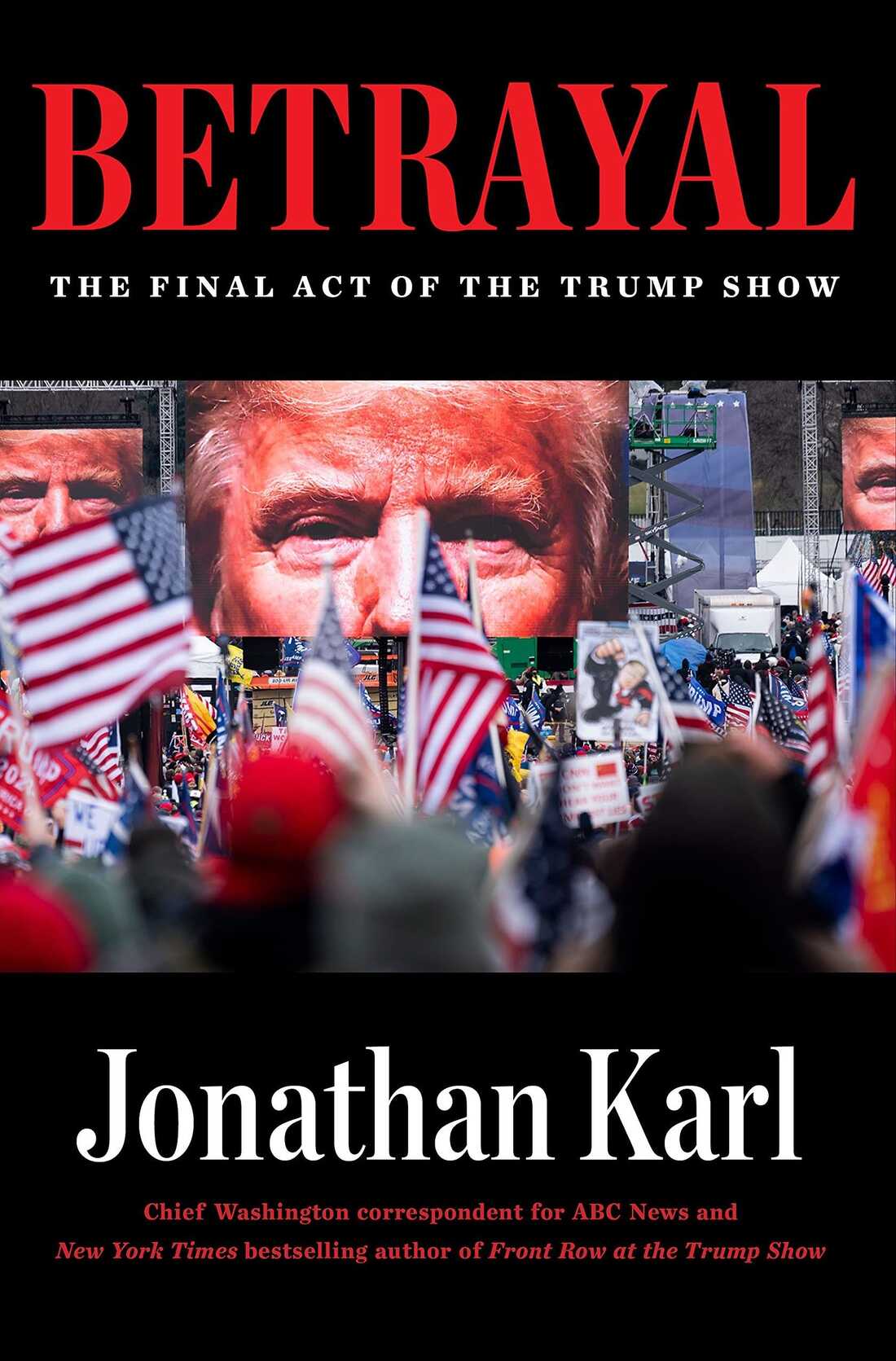
Today’s news is filled with revelations from the book “Betrayal,” by Jonathan Karl, released today. In her review of the book in The New York Times, Jennifer Szalai focuses on Karl’s (along with other journalists) apparent blindness about who and what Trump was: In Another Trump Book, a Journalist’s Belated Awareness Steals the Show.
…[I]n his new book, “Betrayal: The Final Act of the Trump Show,” Karl comes across as almost poignantly ingenuous and polite to a fault, repeatedly flummoxed by what he saw in the last year of the Trump administration. “Front Row,” which had the unfortunate timing of being published in March 2020, before the consequences of Trump’s governance were fully laid bare, began with a solemn tribute to “objectivity and balance” and a complaint that “the mainstream media coverage of Donald Trump is relentlessly and exhaustively negative.” Just a year-and-a-half later, after 750,000 American Covid deaths and an attack on the Capitol, Karl allows that the “Trump show” may have in fact been more sinister than mere theatrics after all.
“I have never wavered from my belief that journalists are not the opposition party and should not act like we are,” Karl maintains in “Betrayal.” “But the first obligation of a journalist is to pursue truth and accuracy. And the simple truth about the last year of the Trump presidency is that his lies turned deadly and shook the foundations of our democracy.”
According to Szalai, Karl repeated writes in the book that he is shocked by Trump’s behavior. From a description of Karl’s face-to-face interview with Trump:
During the…interview, Trump reminisced about the speech he gave on Jan. 6, 2021, shortly before the attack on the Capitol, calling it “a very beautiful time with extremely loving and friendly people.” Karl, at least inwardly, was aghast. “I was taken aback by how fondly he remembers a day I will always remember as one of the darkest I have ever witnessed,” he writes, adding that Trump seemed to justify the death threats made against his own vice president. “It boggled my mind,” Karl says.
It did? The author’s expressions of surprise are so frequent and over-the-top that they are perhaps the most surprising parts of this book. “Betrayal” is less insightful about the Trump White House and more revealing of Karl’s own gradual, extremely belated awareness that something in the White House might in fact be awry. Events strike him as “wacky,” “crazy,” “nuts.” He delves into the outlandish conspiracy theories around the presidential election, earnestly explaining why each of them is wrong. He scores a number of on-the-record interviews with Trumpworld insiders — nearly all of whom insist that even as they publicly sided with Trump, they were bravely telling the president some very tough truths in private.
This is so typical of what we saw from journalists during the Trump years. They repeatedly tried to normalize Trump’s behavior and some are still doing it. But Trump showed us who again and again before he ran for president and especially during the 2016 campaign. Yet Karl was still shocked by what Trump said in the interview–even after he (Trump) refused to concede the election and led a serious coup attempt.
In “Betrayal: The Final Act of the Trump Show,” scheduled to be released today, Karl reports that former Trump national security adviser Michael Flynn and former Trump attorney Sidney Powell tried to enlist a Pentagon official to help overturn the election.
According to the book, Flynn — who had just received an unconditional pardon from President Trump after pleading guilty in 2017 to lying to the FBI during the Russia probe — made a frantic phone call to a senior Trump intelligence official named Ezra Cohen (sometimes referred to as Ezra Cohen-Watnick), who previously worked under Flynn at both the Defense Intelligence Agency (DIA) and the National Security Council.
“Where are you?” Flynn asked the DoD official, who said he was traveling in the Middle East.
“Flynn told him to cut his trip short and get back to the United States immediately because there were big things about to happen,” according to the book. Karl writes that Flynn told Cohen, “We need you,” and told the DoD official that “there was going to be an epic showdown over the election results.”
Flynn, according to the book, urged Cohen that “he needed to get orders signed, that ballots needed to be seized, and that extraordinary measures needed to be taken to stop Democrats from stealing the election.”
“As Flynn ranted about the election fight, [Cohen] felt his old boss sounded manic,” Karl writes in the book. “He didn’t sound like the same guy he had worked for.”
It gets even crazier.
“Betrayal” also reports that Sydney Powell, Flynn’s former lawyer who was then advising President Trump, called Cohen shortly after the Flynn conversation and tried to enlist his help with one the most far-fetched claims about the election, involving then-CIA Director Gina Haspel.
“Gina Haspel has been hurt and taken into custody in Germany,” Powell told Cohen, pushing a false conspiracy theory that had been gaining steam among QAnon followers, according to the book. “You need to launch a special operations mission to get her,” Powell said.
Powell, according to the book, was pushing the outlandish claim that Haspel had been injured while on a secret CIA operation to seize an election-related computer server that belonged to a company named Scytl — none of which was true.
“The server, Powell claimed, contained evidence that hundreds of thousands, maybe millions, of votes had been switched using rigged voting machines. Powell believed Haspel had embarked on this secret mission to get the server and destroy the evidence — in other words, the CIA director was part of the conspiracy,” Karl writes.
Powell wanted the Defense Department to send a special operations team over to Germany immediately: “They needed to get the server and force Haspel to confess,” Karl writes.
All of this was too crazy even for Trump loyalist Cohen, yet these are the people Trump was listening to after the election.
After losing the 2020 presidential election, former President Donald Trump was obsessed with finding a route to remain in power. In September, we learned that John Eastman, a conservative lawyer working with Trump’s legal team, went so far as to write a two-page memo for how to throw out President Joe Biden’s win before Congress could certify it in January.
And in the last week, we’ve learned that Eastman wasn’t alone in taking notes on a criminal conspiracy. At least two other people prepared memos to justify Trump’s reinstallation as president. This collection of memos shows more clearly than ever that those closest to the former president were dedicated to finding some loophole to keep him in power. Their mentally thin, ultimately self-serving assertions acted as fuel to Trump’s delusions, which he then passed on to his followers — most spectacularly, of course, at his rally ahead of the riot on Jan. 6….
Jenna Ellis with Trump
ABC News first reported Sunday that White House chief of staff Mark Meadows emailed Vice President Mike Pence’s chief of staff on Dec. 31 to pass on a memo from Trump campaign lawyer Jenna Ellis. Ellis — whom you may recall from her many failed attempts to reverse the election in court — “outlined a multi-step strategy,” according to Karl:
On Jan. 6, the day Congress was to certify the 2020 election results, Pence was to send back the electoral votes from six battleground states that Trump falsely claimed he had won.
The memo said that Pence would give the states a deadline of “7pm eastern standard time on January 15th” to send back a new set of votes, according to Karl.
Then, Ellis wrote, if any state legislature missed that deadline, “no electoral votes can be opened and counted from that state.”
That scheme aligns with one of the scenarios that Eastman laid out in his longer Jan. 3 memo. And at first glance it seems like a valid off-ramp that would let Trump save face and allow time to investigate the “fraud” that he had alleged. It’s not dissimilar in that sense from the arguments that Sens. Ted Cruz, R-Texas, and Josh Hawley, R-Mo., made in their refusal to vote to certify the election.
Crucially, though, the plan’s real goal depended on another plot that was underway inside the Trump administration. The Justice Department was under pressure in the weeks after the election to issue a letter to the states Trump falsely claimed to have won declaring that there was enough “significant concern” of fraud to warrant special sessions of their legislatures. Those legislatures controlled by the GOP — like Georgia’s and Arizona’s — would then provide the electoral votes needed to put Trump over the top under Ellis’ proposal.
According to Watergate reporter Carl Bernstein, the infamous memos drafted for Mike Pence to overturn the election results is a blueprint of a coup.
Bernstein weighed in on a recording of Trump and ABC journalist Jonathan Karl’s conversation, where the former president did not deny that he told Pence that if he does not overturn the 2020 election results, he is a “p***y.” The Watergate reporter said that there is more to the former president’s comments and touched on the memos drafted by lawyers John Eastman and Jenna Ellis. The memos detailed how Pence could overturn the 2020 elections, which Pence ultimately refused to do.
“I think what we’re seeing in these memos particularly are blueprints for a coup,” said Bernstein. “The actual blueprints in document form in which the president of the United States, through his chief of staff, is sending to Mike Pence’s, the vice president’s staff, a blueprint to overturn an election, a blueprint for a conspiracy led by a president of the United States to result in an authoritarian coup in which the election is stolen.”
Bernstein added that there is nothing that comes close to what happened in the 2020 elections and that it is all documented in writing. The Watergate reporter noted that more records are needed to determine what the former president said and did, especially on January 5 and January 6. Bernstein added that the House Committee must act fast to find the answers in case the GOP regains the majority in the House in 2022.
That’s it for me today. It is all so exhausting. But we have to hold onto hope somehow, don’t we? Please let me know your thoughts on this or any topic in the comment thread.
Did you like this post? Please share it with your friends:
The state of Louisiana and the City of New Orleans opened up right before Halloween dropping some of the mask mandates. I’m not sure how smart of an idea that was given that we’ve seen the same pattern of plague rat invasion as tourists come back to the city from places where vaccine adoption is low. The 4th of July comes to mind. However, we did have good numbers, and I’m now starting the countdown to Thanksgiving to see if we surge again. I’m still masking and staying my fat ass home mostly. I’ve come to enjoy having things delivered. Halloween should have been a big party with best mask awards.
They proved so powerful, and the partisan attitudes toward them so different, that a gap in Covid’s death toll quickly emerged. I have covered that gap in two newsletters — one this summer, one last month — and today’s newsletter offers an update.
The brief version: The gap in Covid’s death toll between red and blue America has grown faster over the past month than at any previous point.
In October, 25 out of every 100,000 residents of heavily Trump counties died from Covid, more than three times higher than the rate in heavily Biden counties (7.8 per 100,000). October was the fifth consecutive month that the percentage gap between the death rates in Trump counties and Biden counties widened.
Some conservative writers have tried to claim that the gap may stem from regional differences in weather or age, but those arguments fall apart under scrutiny. (If weather or age were a major reason, the pattern would have begun to appear last year.) The true explanation is straightforward: The vaccines are remarkably effective at preventing severe Covid, and almost 40 percent of Republican adults remain unvaccinated, compared with about 10 percent of Democratic adults.
And while we’re on the subject, how can you possibly get triggered by Big Bird?
Big Bird got 'vaccinated' against COVID-19, drawing outrage from Republicans https://t.co/dYpGn8whGB
Plague rats indeed. Red is Dead. Meanwhile, the worst of them are triggered by Big Bird talking to kids about his vaccine. There’s a lot of a pearl-clutching about doing mass vaccinations in schools while many of us are old enough to have stood in line for a lot of those in the 1950s and 1960s. Many Republicans are acting like that never happened.
So, if they think public health actions are a governmental overreach, why are they down with authoritarianism? Is it because it wears a white face? This is from The Bulwark. ” Notes on an Authoritarian Conspiracy: Inside the Claremont Institute’s “79 Days to Inauguration” Report. Claremont’s post-election war game provides a window into the group’s ambitions.”
John Eastman has a prominent place in all of this along with all the white nationalist domestic terrorists. It’s a tough read but a necessary one.
My latest for @BulwarkOnline, on the Claremont Institute and Texas Public Policy Foundation's pre-2020 election wargame that turned cops into pro-Trump foot-soldiers… with help from the Proud Boys, Oath Keepers and Three Percenters.https://t.co/LUptFuyKvy
The sun rises on January 6, 2021 while a nation is in crisis.
Michigan’s presidential electors are in dispute after a mysterious fire in Detroit destroyed thousands of mail-in ballots, ultimately throwing the election to Congress.
The nation’s capital is overwhelmed by riots organized by left-wing radicals.
A Republican member of Congress is attacked and critically injured in the violence, potentially depriving Donald Trump of the decisive vote.
However, the representative heroically insists on being taken to the House floor. “With IVs and blood transfusions being administered, the member casts the deciding vote, giving Trump 26 state delegations and the needed majority.”
This is the grisly climax of a report published in mid-October 2020 by the Claremont Institute and Texas Public Policy Foundation’s (TPPF) called “79 Days to Inauguration,” prepared by “Constitutional scholars, along with experts in election law, foreign affairs, law enforcement, and media . . . coordinated by a retired military officer experienced in running hundreds of wargames.”
Among these luminaries were figures such as John Eastman—lawyer for Donald Trump and author of a memo advising Vice President Mike Pence to unilaterally block certification of Joe Biden’s win in order to buy time for GOP-controlled state legislatures to send competing slates of electors—and K.T. McFarland, who served as deputy national security advisor under Michael Flynn in the Trump White House.
The MSM needs to be screaming a lot louder about this than talking about sausage-making behind any policy. Leave the latter worry to Nancy, Chuck, Kamala, and Joe. More from that Bulwark article:
Remember, this narrative is the result of a role-playing exercise in which the participants imagined themselves as key decision-makers in the federal government. The actions described, therefore, might be best understood as a combination of group therapy and suggestions for how they believe the federal government and law enforcement should behave in a moment of constitutional crisis.
Some of the report is revealing. Some of it is sad. Some of it is darkly funny. For instance, the authors’ recommendation for mass, politically motivated arrests “to remove the players from the picture” sits oddly next to the right’s outraged reaction to the prosecution of Trump supporters who stormed the U.S. Capitol on January 6.
There’s more irony in how the task force imagines right-wing gangs would operate during such a period: with quiet discipline and in cooperation with law enforcement.
A lack of social media activity and overt action by the rioting by members of the Proud Boys draws the attention of law enforcement officials suspecting they may be operating covertly on the ground in several major urban rioting areas, but their exact involvement is unknown. Reports of militias moving into suburban areas is being monitored. Several groups affiliated with the Three Percenters and Oath Keepers have openly offered to assist law enforcement in putting down the violence via social media, touting significant current and retired law enforcement and military membership.
A man who allegedly participated in the Capitol riot Jan. 6 and is wanted by the FBI is now seeking asylum in Belarus, the country’s state media reported Monday, presenting him as a “simple American whose shops were burned by Black Lives Matter activists.”
Evan Neumann, who appears to have sat down for an interview with Belarusian state television in a segment titled “Goodbye, America,” is wanted in the United States on charges of violent entry and disorderly conduct on the Capitol grounds, as well as for assaulting, resisting and obstructing law enforcement during civil disorder.
Both Belarusian President Alexander Lukashenko and his close ally, Russian President Vladimir Putin, have frequently referenced the Capitol riot, calling the prosecution of those involved an example of “double standards” by the United States because it frequently criticizes crackdowns on anti-government protests abroad.
When mass protests broke out across Belarus last year over its presidential election, which the international community has widely denounced as rigged, thousands of demonstrators were brutally beaten by police and arrested. Many said they were tortured in prison.
But Neumann could be welcomed in Belarus as part of the regime’s anti-Western propaganda efforts. Lukashenko, who has been in power since 1994, has said the United States stoked last year’s opposition movement to unseat him.
Tim O’Connor, a spokesman for the U.S. Embassy in Belarus, which is based in Vilnius, Lithuania, said in a statement that the embassy has “seen Belarusian state media reporting about Mr. Neumann. Due to U.S. privacy laws, we are limited in what we can say about individual U.S. citizens.”
“The United States is a country where the rule of law is respected and where government is transparent and accountable for its actions,” O’Connor added. “Every citizen can count on an impartial and objective court system. There has not been a single case of transparent, accountable investigation into and prosecution of the actions of Belarusian police that resulted in deaths, systemic torture and the continued repression of Belarusian citizens, of whom over 800 remain in jail for peaceful protest against the regime.”
Our most recent NBC News poll asked respondents about their social media consumption, and the results told a clear story that doesn’t require 280 characters.
Twitter isn’t real life — at least when it comes to party identification and political attitudes.
In the poll, 69 percent of adults say they have an account on Facebook, 28 percent say they use Twitter, 27 percent use TikTok and 27 percent don’t have an account on any of these social media platforms.
And those who use Twitter and TikTok are more likely to be Democrats than Republicans; are more likely to be Democrats who supported Bernie Sanders or Elizabeth Warren than Joe Biden during the 2020 Democratic primary season; and are — not surprisingly — more likely to be younger than the general population.
That figures. Most people I know on Twitter use it to find breaking news. I don’t really look for news on Facebook other than that related to my friends’ cats, dogs, bunnies, and grandchildren.
So, I’ll leave all this to you to discuss. Are you still masking everywhere? I walk Temple sans mask but I don’t go near people without one in a building if I go at all. Like I said, I’m beginning to enjoy front door service.
What’s on your news and reading list today?
Did you like this post? Please share it with your friends:
But while Democratic leaders managed to unify House progressives and moderates to hold a vote on the Senate-passed bill, not all members of the party ultimately supported it.
A number of progressives — who have consistently called for both the infrastructure and the separate economic package, known as the Build Back Better Act, to move together — voted “no” on the legislation.
Here are the six House Democrats who broke from their party to vote against the bill: Rep. Jamaal Bowman of New York, Rep. Cori Bush of Missouri, Rep. Alexandria Ocasio-Cortez of New York, Rep. Ilhan Omar of Minnesota, Rep. Ayanna Pressley of Massachusetts, Rep. Rashida Tlaib of Michigan
Thirteen Republicans in the House voted with Democrats to approve the bill. They are: Rep. Don Bacon of Nebraska, Rep. Brian Fitzpatrick of Pennsylvania, Rep. Andrew Gabarino of New York, Rep. Anthony Gonzalez of Ohio, Rep. John Katko of New York, Rep. Adam Kinzinger of Illinois, Rep. Nicole Malliotakis of New York, Rep. David McKinley of West Virginia, Rep. Tom Reed of New York, Rep. Chris Smith of New Jersey, Fred Upton of Michigan, Rep. Jeff Van Drew of New Jersey, Rep. Don Young of Alaska.
The bill calls for investing $110 billion for roads, bridges and major infrastructure projects. That’s significantly less than the $159 billion that Biden initially requested in the American Jobs Plan.
Included is $40 billion for bridge repair, replacement and rehabilitation, according to the bill text. The White House says it would be the single, largest dedicated bridge investment since the construction of the interstate highway system, which started in the 1950s.
The deal also contains $16 billion for major projects that would be too large or complex for traditional funding programs, according to the White House.
Photo by Hisakata Hiroyuki
Some 20%, or 173,000 miles, of the nation’s highways and major roads are in poor condition, as are 45,000 bridges, according to the White House.
The investments would focus on climate change mitigation, resilience, equity and safety for all users, including cyclists and pedestrians.
Also in the package is $11 billion for transportation safety, including a program to help states and localities reduce crashes and fatalities, especially of cyclists and pedestrians, according to the White House. It would direct funding for safety efforts involving highways, trucks, and pipeline and hazardous materials.
And it contains $1 billion to reconnect communities — mainly disproportionately Black neighborhoods — that were divided by highways and other infrastructure, according to the White House. It will fund planning, design, demolition and reconstruction of street grids, parks or other infrastructure.
The bill will provide funding for public transit and rail, broadband upgrade, upgrading airports, ports and waterways, electric vehicles, improving power and water systems, and environmental remediation. Read more details at the CNN link. See also this article at The New York Times: This Is Where the States Want Billions in Infrastructure Funding Spent.
Biden’s $1.2 trillion infrastructure bill passed late Friday night and is headed for his signature after months of intense wrangling over the details — particularly whether it would be tied to a larger spending plan that progressives insisted upon passing alongside it. But in the end it wasn’t really those progressives who provided the key votes, but rather 13 Republicans. The final vote count was 228 to 206, meaning if no Republicans had voted for the bill, it wouldn’t have passed.
And some Republicans are predictably furious — with undersold questions about House Minority Leader Kevin McCarthy’s (R-Calif.) future leadership of the party potentially in the offing.
“I can’t believe Republicans just gave the Democrats their socialism bill,” Rep. Matt Gaetz (R-Fla.) said….
“That 13 House Republicans provided the votes needed to pass this is absurd,” Rep. Chip Roy (R-Tex.) said.
By Andrei Salokhin
Others threatened before the vote to target or launch primaries against the defectors in their midst.
“Vote for this infrastructure bill and I will primary the hell out of you,” Rep. Madison Cawthorn (R-N.C.) said shortly before the vote.
Rep. Marjorie Taylor Greene (R-Ga.), in her typically understated fashion, warned last week that any Republican who voted for the bill would be “a traitor to our party, a traitor to their voters and a traitor to our donors.” After the vote, she accused the 13 of having voted to “pass Joe Biden’s Communist takeover of America” and tweeted the phone numbers to their congressional offices (while for some reason only listing 12 of the 13)….
“That 13 House Republicans provided the votes needed to pass this is absurd,” Rep. Chip Roy (R-Tex.) said.
Others threatened before the vote to target or launch primaries against the defectors in their midst.
“Vote for this infrastructure bill and I will primary the hell out of you,” Rep. Madison Cawthorn (R-N.C.) said shortly before the vote.
This is pretty interesting. I wonder if the DC press will begin writing about Republicans in disarray? Just kidding.
Friday’s GOP defections were even more significant than during the last Trump impeachment, when 10 Republicans voted to impeach the president — a historically high number. And the fact that on Friday they provided the votes necessary for passage makes this even more fraught.
Circumstances change, but the defections from McCarthy’s party line were significant for the modern era. They also notably included Rep. Nicole Malliotakis (R-N.Y.), who had been made part of the team led by Minority Whip Steve Scalise (R-La.) just earlier this year — the same whipping operation that failed Friday.
Malliotakis comes from a region which stood to benefit more than others from the bill and accounted for many of the GOP yes votes; 5 of the 13 came from New York and New Jersey. But that one in particular has to sting. We knew at least a few Republicans would vote yes and others were seemingly freed up to vote for a bill once it was headed for passage. But 10 Republicans voted for the bill rather quickly, and the eventual total number of defections gave the bill more than just a veneer of bipartisanship (especially when combined with the Senate vote).
Retiring Rep. Anthony Gonzalez has a warning for his fellow Republicans: former President Donald Trump will try to steal the next election.
Gonzalez was one of 10 House Republicans who voted to impeach Trump in the wake of the January 6 attack on the Capitol. In the face of relentless attacks and threats directed toward him and his family afterward, the Ohio Republican chose to retire from Congress at the end of his term and avoid facing off with a Trump-backed primary challenger next year.
With Trump appearing to prepare for another presidential run in 2024, Gonzalez told CNN he will try to stop Trump from running the same 2020 playbook to overturn another election, but he warned that Trump could have more help next time from those in charge of running — and certifying — elections.
“January 6 was an unconstitutional attempt led by the President of the United States to overturn an American election and reinstall himself in power illegitimately. That’s fallen nation territory, that’s third world country territory. My family left Cuba to avoid that fate. I will not let it happen here,” Gonzalez said.
“I think it’s all pushing towards one of two outcomes: He either wins legitimately, which he may do, or if he loses again, you just try to steal it,” he added.
Photo by Hisakata Hiroyuki2
The quotes are from CNN’s excellent special “Trumping Democracy: An American Coup,” If you didn’t watch it last night, I hope you will see it next time it airs. More Gonzalez quotes:
Gonzalez pointed to election officials like Gates as a key reason Trump was unsuccessful in his attempts to subvert the election result in 2020.
“The institutions don’t hold themselves,” he said. “In the moments of truth, you need the right people to pass the most difficult tests. We had just enough people on January 6 pass the test. We have to make sure we have equal number of people to continue to pass the test going forward.”
But Gonzalez and other Republicans fear the officials who stopped Trump in 2020 may be replaced by those “more beholden to him than their oath,” thanks to the former President’s revenge campaign against those who opposed his election lies.
Trump has endorsed Republicans who have embraced his lies about the election in key battleground states for normally low-key secretary of state races, seeking to replace officials who rebuffed his pressure campaign such as Georgia Republican Brad Raffensperger.
“It looks to me that he has evaluated what went wrong on January 6: Why is it that he wasn’t able to steal the election? Who stood in his way?” Gonzalez said. “And he’s going methodically state by state at races from, you know, state Senate races all the way down to county commissioner races trying to get the people who — the Republicans, the RINOs, in his words — who stopped this, who stopped him from stealing the election.”
In other news, those professors who were ordered not to testify in a voting rights case have filed a lawsuit.
Three professors filed a lawsuit against the University of Florida on Friday, claiming school officials violated their right to free speech by trying to prevent them from offering testimony in a voting rights case.
The case further inflames a heated debate over academic freedom, one that has brought national attention and criticism to the state flagship university.
It was filed on the same day school officials reversed course: After a week of controversy and pushback from faculty, alumni and academics across the country, the University of Florida on Friday said the three political science professors should not be barred from testifying in a voting rights lawsuit against the administration of Gov. Ron DeSantis (R).
The complaint by the professors contends the university is discriminating against them based on viewpoints they wish to express, and by trying to prevent them from offering expert testimony on issues of overwhelming public importance, UF violated their First Amendment rights.
Seeking to restrict the professors from testifying is contrary to UF’s stated mission as a public research institution — “to share the benefits of its research and knowledge for the public good,” and to the principles of academic freedom and free speech, the complaint says.
The lawsuit asks the court to declare unlawful the policy of “stifling faculty speech against the State.”
Houston authorities are investigating what officials described as a crowd surge that killed at least eight people and injured “scores” of others during the annual Astroworld music festival in Houston while rapper Travis Scott performed.
Officials declared a “mass casualty incident” at 9:38 p.m. Friday local time during the festival at NRG Park, where an estimated 50,000 people were in attendance, Houston Fire Chief Samuel Peña told reporters during an overnight news briefing.
“The crowd began to compress toward the front of the stage, and that caused some panic, and it started causing some injuries, said Peña. “People began to fall out, become unconscious, and it created additional panic.”
As first responders rushed to the scene, 17 people were transported to local hospitals, including 11 who were in cardiac arrest, the fire chief said. There were scores of other injuries, he added.
Peña said officials did not yet know the cause of death for the eight victims. It was not immediately clear whether they were among those transported to hospitals.
Many people were also treated at the scene, where a field hospital had been set up. About 300 people were examined at that site throughout the day, said Peña.
Astroworld promoters had medical personnel and an emergency transport component at the festival, but “they were quickly overwhelmed” as the injury count mounted at “really a chaotic event,” the fire chief said.
Read more at the link.
That’s all I have for you today. What stories are you following?
Did you like this post? Please share it with your friends:
The Sky Dancing banner headline uses a snippet from a work by artist Tashi Mannox called 'Rainbow Study'. The work is described as a" study of typical Tibetan rainbow clouds, that feature in Thanka painting, temple decoration and silk brocades". dakinikat was immediately drawn to the image when trying to find stylized Tibetan Clouds to represent Sky Dancing. It is probably because Tashi's practice is similar to her own. His updated take on the clouds that fill the collection of traditional thankas is quite special.
You can find his work at his website by clicking on his logo below. He is also a calligraphy artist that uses important vajrayana syllables. We encourage you to visit his on line studio.


 Here we go again! Our healthcare continues to be threatened by right-wing Trumperz and Trumperz clones.
 Even crazier are these calls to action by the
  This Guardian article is specific and prescient. It comes from 2020 directly after the election. Have we made any progress since a year ago?




 According to Szalai, Karl repeated writes in the book that he is shocked by Trump’s behavior. From a description of Karl’s face-to-face interview with Trump:
 It gets even crazier.









 The complaint by the professors contends the university is discriminating against them based on viewpoints they wish to express, and by trying to prevent them from offering expert testimony on issues of overwhelming public importance, UF violated their First Amendment rights.
 peej
peej Carissa
 bostonboomer
 dakinikat
 ecocatwoman
 jjlo
jjlo mablue2
 Mama Lopez
 peggysue22
 quixote
 skydancingguestblogger
 Mona (aka Wonk the Vote)





Recent Comments