St.Gertrude herself and cats Zarathustra and David Bowie captured in stained glass
It’s been a long time since I posted Fat Cat Art by Svetlana Petrova & Zarathustra the Cat / FatCatArt.com. Dakinikat posted a comment on Thursday about St. Gertrude, the patron saint of cats, whose feast day is the same as St. Patrick’s day. I was looking for paintings of her when I came across this one at the Fat Cat Art site. The other images in this post are also by Petrova and her late beloved ginger cat Zarathustra.
The Ukraine war rages on, as Putin continues to commit ghastly war crimes by attacking civilians. Reading about what’s happening, let alone watching the images on TV is horrifying. It’s a terribly helpless feeling, and there’s a temptation to want the U.S. to get more actively involved, but that is simply impossible.
Last night on MSNBC, Lawrence O’Donnell gave a powerful explanation of what the U.S. trying to enforce a no fly zone over Ukraine would mean. You can watch it on The Last Word website. It lasts about 7 minutes. Basically, O’Donnell said that the very idea is a fantasy and that a no fly zone has never been enforced against a nuclear power. It would mean U.S. and Russian pilots being shot down and killed and would also involve U.S. planes flying over Russian territory. I recommend watching it if you didn’t see it last night.
Ukrainian president Volodymyr Zelenskiysays the time has come for peace talks, warning that it will otherwise take generations for Russia to recover from losses suffered during the war. He released a video address saying Ukraine wanted meaningful and honest negotiations with Moscow on peace and security without delay, Reuters reported. “The time has come for a meeting – it is time to talk.” Zelenskiy said Russian forces were deliberately blocking humanitarian supplies to cities under attack.
Russia says it has used a hypersonic weapon for the first time, to destroy an underground military depot in western Ukraine. Hypersonic missiles are fast weapons that can evade detection by missile defence systems. The defence ministry said it had destroyed a large underground depot for missiles and aircraft ammunition in the Ivano-Frankivsk region.
Ukraine’s interior minster told Associated Press it would take years to find and defuse all of the unexploded ordnance from the country. Denys Monastyrsky said: “A huge number of shells and mines have been fired at Ukraine and a large part haven’t exploded. They remain under the rubble and pose a real threat. It will take years, not months, to defuse them.”
Sergei Lavrov, Russia’s foreign minister, praised Fox News for its coverage of the war in Ukraine during an in-studio interview with the Russian state-controlled RT network. “We know the manners and the tricks that are being used by the western countries to manipulate media … If you take the United States, only Fox News is trying to present some alternative point of view,” he said.
Click the link for more updates.
Boris Kustodiev. Merchant’s Wife at Cat’s Tea
In other news, Republicans are of course trying to smear Supreme Court nominee Ketanji Brown Jackson and it is sickening.
Ruth Marcus at The Washington Post: Opinion: How low will the GOP go in taking on Ketanji Brown Jackson? Josh Hawley lets us know.
“I’ve noticed an alarming pattern when it comes to Judge Jackson’s treatment of sex offenders, especially those preying on children,” Hawley tweeted. “I’m concerned that this [is] a record that endangers our children.” [….]
In the cherry-picked, context-free Hawley-verse, Jackson has been lying in wait to foist this child-endangerment scheme on the country since her law school days. Count one is her writing as a student editor on the Harvard Law Review, about sex-offender registries, DNA databanks and civil-commitment laws that states were busy enacting.
In her article, Jackson grappled with the tension between constitutional limits on permissible punishment and the community’s need for self-protection. Given conservatives’ focus on analyzing the text of a law rather than divining lawmakers’ intent, you might have thought that Hawley would cheer Jackson’s argument that in assessing the constitutionality of sex offender laws, “courts have relied too heavily on the legislatures’ intent.” But no.
Instead, Hawley wrenches a few lines out of context. “As far back as her time in law school, Judge Jackson has questioned making convicts register as sex offenders — saying it leads to ‘stigmatization and ostracism.’ ”
Hello, Senator? That is in a section headlined “The Critics” that outlines the views of the statute’s opponents. Hawley might just have easily quoted from the previous section — “commitment legislation literally immobilizes dangerous sexual deviants and, thus, presumably promotes both immediate and long-term public safety.”
And that’s just from Jackson’s law school days. Hawley also attacks Jackson for supporting a review of minimum sentencing guidelines for child porn along with every other member of the U.S. Sentencing Commission. Finally he criticizes her work as a judge:
Vincent van Gogh, The Starry Night, true version, aka The Furry Night
The final count against Jackson involves how she, in Hawley’s assessment, “put her troubling views into action. In every single child porn case for which we can find records, Judge Jackson deviated from the federal sentencing guidelines in favor of child porn offenders.”
Sounds terrible, right? Except because the guidelines are so outdated and therefore unfair, that’s what judges do in almost every case — 70 percent, according to the latest statistics.
According to data compiled by the U.S. Sentencing Commission, judges imposed below-guidelines sentences in nearly 80 percoent of child pornography cases in the District of Columbia, where Jackson was a trial court judge before being elevated to the appeals court. In Missouri, Hawley’s home state, judges imposed sentences below the guidelines in more than 77 percent of cases.
Following Sen. Josh Hawley’s (R-MO) Twitter rant yesterday against Supreme Court nominee Judge Ketanji Brown Jackson, a segment on OAN took his unfounded and misleading attacks against her record in a more deranged direction. The host and her guest falsely accused Jackson of being “kind” to pedophiles, echoing the long-running QAnon conspiracy theory accusing liberal elites of engaging in pedophilia.
During the March 17 segment on OAN’s Tipping Point, host Kara McKinney outlined the conspiratorial accusations against Jackson before RedState editor Brandon Morse immediately dove into QAnon-like commentary about what he described as “the pedophilia problem that is currently happening in the left”
Here’s what Morse had to say:
Andrew Wyeth, The Cat in Christina’s World
Morse claimed that the “corporate media” is ignoring this issue because of self-interest:
They have been doing their absolute best to try to eliminate any substantial talk about the pedophilia problem that is currently in the left and especially the radical left. They have been trying to make this almost a normal thing for some time. And if they come down hard on it, then it’ll reinforce the idea to society that pedophilia is a bad thing. And it is a very bad thing. It should be come down on hard. But they’re not.
And I’m afraid that the reason that they’re not doing this is because there’s probably more pedophiles, or at least people who are friendly to pedophiles out there, than we might think in positions of power, especially on the left. You know, you had a ton of people suddenly go into hiding or shut up, you know, once Jeffrey Epstein was back in the spotlight for this. And it’s scary to think that you have a lot of these leftists, these Democrats, politicians, activists, media figures who have been caught, or who have been trying to ease the pain of any of these pedophiles who are to be — who should be suffering for their crimes. You see this a lot, lately.
And it’s scary to think that this new judge that’s come up here is one of these people who is going to be very kind to them.
It sounds like the upcoming hearings on Jackson’s nomination are going to be an embarrassing clown show.
South Carolina has given the greenlight to firing-squad executions, a method codified into state law last year after a decade-long pause in carrying out death sentences because of the state’s inability to procure lethal injection drugs.
The state Corrections Department said Friday that renovations have been completed on the death chamber in Columbia and that the agency had notified Attorney General Alan Wilson that it was able to carry out a firing-squad execution.
Lawmakers set about tweaking state law to get around the lethal injection drug situation. Legislation that went into effect in May made the electric chair the state’s primary means of execution while giving inmates the option of choosing death by firing squad or lethal injection, if those methods are available.
During South Carolina’s lengthy debate, Democratic state Sen. Dick Harpootlian — a prosecutor-turned-criminal-defense lawyer — introduced the firing squad option. He argued that it presented “the least painful” execution method available.
Gustav Klimt, Portrait of Adele Bloch-Bauer with the Cat
“The death penalty is going to stay the law here for a while,” Harpootlian said. “If we’re going to have it, it ought to be humane.”
According to officials, the death chamber now also includes a metal chair, with restraints, in the corner of the room in which inmates will sit if they choose execution by firing squad. That chair faces a wall with a rectangular opening, 15 feet away, through which the three shooters will fire their weapons.
State officials also have created protocols for carrying out the executions. The three shooters, all volunteers who are employees of the Corrections Department, will have rifles loaded with live ammunition, with their weapons trained on the inmate’s heart.
A hood will be placed over the head of the inmate, who will be given the opportunity to make a last statement.
The House is set to hit the snooze button on the Senate’s plan to permanently change the nation’s clocks.
“It could be weeks — or it could be months” before House Democratic leaders decide whether to tee up a vote on eliminating the biannual clock changes that have governed daily life in most states for decades, said Rep. Frank Pallone Jr. (D.-N.J.), who chairs the House Energy and Commerce Committee that oversees time change policies. While the Sunshine Protection Act, which unanimously passed the Senate on Tuesday, would nationally shift clocks an hour later to maximize daylight, some doctors have argued that adopting permanent standard time would be a healthier option and better align with humans’ natural rhythms.
Pallone, who held a hearing last week on daylight saving time, said he shares the Senate’s goal to end the “spring forward” and “fall back” clock changes linked to more strokes, heart attacks and car accidents. But he wants to collect more information, asking for a long-delayed federal analysis on how time changes might affect productivity, traffic and energy costs, among other issues.
Pablo Picasso, Woman with a Fan and a Cat, having fun
“There isn’t a consensus, in my opinion in the House, or even generally at this point, about whether we should have standard versus daylight saving as the permanent time,” Pallone said. “Immediately after the Senate passed the bill, I had members come up to me on the floor and say, ‘Oh, don’t do that. I want the standard time,’ ” he added, declining to identify the lawmakers.
The White House also has not communicated its position on permanent daylight saving time, congressional aides said. While President Biden, as a freshman senator, voted for that in December 1973 — the last time that Congress attempted to institute the policy nationwide — he also witnessed the near-immediate collapse of support amid widespread reports that darker winter mornings were contributing to more car accidents and worsened moods. Members of Congress introduced nearly 100 pieces of legislation to change or do away with the law before it was finally repealed in October 1974.
The war in Ukraine continues, and although the Ukrainian military is fighting valiantly and the Russians are struggling, the bad guys are likely to win in the end. IMHO, the U.S. and NATO need to do more to help Ukraine. I’ll offer some serious reads on the situation, but first a little furry break from the madness.
Cat cafes are a purrfect way to enjoy the company of felines while you sip a tasty drink. The beloved Cat Cafe Lviv is no exception. It’s been open for six years and the small team in Lviv, Ukraine, is devoted to its 20 furry residents. So devoted, in fact, that owner Serhii Oliinyk is choosing to stay at the cafe despite the Russian invasion in his country.
“Our cats have been living in [the] cat cafe since the age of 4 months,” Oliinyk explained. “They are like family. We realized that we would never leave our country, that this was the only place where we could see ourselves in the future.”
Cat Cafe Lviv is open (according to its Facebook page) and is dedicated to providing a safe space for people to stop by and see the kitties who reside there. Hopefully, the cats’ presence and purrs offer a momentary reprieve to the stark realities of what’s going on just beyond the walls.
“We currently have fewer regular visitors, but there are people who have come from other cities and need hot food and positive emotions,” Oliinyk said. “There are three large rooms in our cafe, two of which are located in the basement, so in case of an air raid warning, there is a safe shelter for our guests and cats.”
Alongside images of destruction and resistance, the visual story of Russia’s invasion of Ukraine has included a fair bit of cats and dogs. The Albanian Times shared a story of Ukrainian soldiers taking in a puppy left in the cold. Facebook posts tout soldiers cuddling cats and show families refusing to leave their pets behind as they flee. Famed Twitter Maine coon Lorenzo the Cat shared the story of Aleksandra Polischuk, a breeder of sphinx cats who was killed when her home was destroyed. And of course, Twitter couldn’t help but go aww at the photos of Ukrainian President Volodymyr Zelensky and his dogs.
Kateryna Zavadska, Cool cat
It would be easy to position cat and dog content in a warzone as contradictory to conflict. But pet and animal content aren’t the opposite of war—they’re a part of it. Every pet image coming out of Ukraine right now shows a human impacted by the war in some way. In the above-listed examples, every story of a rescued dog or a cuddling cat was bookended by the actions of people.
Animals remind us of our own humanity, and they can be stark reminders of the human face of geopolitical strife. These cat and dog images coming out of Ukraine remind us, paradoxically, that there are real, individual people on the frontlines. There are real, individual people whose lives are forever changed by this aggression. These aren’t just images of animals in conflict, but reminders of the humans who take care of them and fight on the ground.
It is no accident that we flock to cat content online. It is also not a coincidence that these stories of pets and animal in war circulate widely on the internet. The internet is an ideal space for this type of sharing, as pet and animal images help keep digital spaces lighthearted and fun. Pet and animal images are often the opposite to “doomscrolling,” or the endless scrolling through negative, serious, and depressing news online. Right now, as we doomscroll through a war, cute pet and animal content provides relief, but in conjunction with the war photos themselves, reminds us of the human cost of conflict.
There’s also another side to this phenomenon. Read about it at Slate.
Now back to the news of the day.
At the New Yorker, an interview with Russia scholar that is getting a lot of attention: The Weakness of the Despot. An expert on Stalin discusses Putin, Russia, and the West, by David Remnick
Stephen Kotkin is one of our most profound and prodigious scholars of Russian history. His masterwork is a biography of Josef Stalin. So far he has published two volumes––“Paradoxes of Power, 1878-1928,” which was a finalist for the Pulitzer Prize, and “Waiting for Hitler, 1929-1941.” A third volume will take the story through the Second World War; Stalin’s death, in 1953; and the totalitarian legacy that shaped the remainder of the Soviet experience….
Olena Kamenetska-Ostapchuk, Siesta
Kotkin has a distinguished reputation in academic circles. He is a professor of history at Princeton University and a senior fellow at the Hoover Institution, at Stanford University. He has myriad sources in various realms of contemporary Russia: government, business, culture….
Earlier this week, I spoke with Kotkin about Putin, the invasion of Ukraine, the American and European response, and what comes next, including the possibility of a palace coup in Moscow.
You’ll need to go to The New Yorker to read the whole interview, but here’s an excerpt.
What is Putinism? It’s not the same as Stalinism. It’s certainly not the same as Xi Jinping’s China or the regime in Iran. What are its special characteristics, and why would those special characteristics lead it to want to invade Ukraine, which seems a singularly stupid, let alone brutal, act?
Yes, well, war usually is a miscalculation. It’s based upon assumptions that don’t pan out, things that you believe to be true or want to be true. Of course, this isn’t the same regime as Stalin’s or the tsar’s, either. There’s been tremendous change: urbanization, higher levels of education. The world outside has been transformed. And that’s the shock. The shock is that so much has changed, and yet we’re still seeing this pattern that they can’t escape from.
You have an autocrat in power—or even now a despot—making decisions completely by himself. Does he get input from others? Perhaps. We don’t know what the inside looks like. Does he pay attention? We don’t know. Do they bring him information that he doesn’t want to hear? That seems unlikely. Does he think he knows better than everybody else? That seems highly likely. Does he believe his own propaganda or his own conspiratorial view of the world? That also seems likely. These are surmises. Very few people talk to Putin, either Russians on the inside or foreigners.
Anastasiia Atamanchuk, Fuji Cats
And so we think, but we don’t know, that he is not getting the full gamut of information. He’s getting what he wants to hear. In any case, he believes that he’s superior and smarter. This is the problem of despotism. It’s why despotism, or even just authoritarianism, is all-powerful and brittle at the same time. Despotism creates the circumstances of its own undermining. The information gets worse. The sycophants get greater in number. The corrective mechanisms become fewer. And the mistakes become much more consequential.
Putin believed, it seems, that Ukraine is not a real country, and that the Ukrainian people are not a real people, that they are one people with the Russians. He believed that the Ukrainian government was a pushover. He believed what he was told or wanted to believe about his own military, that it had been modernized to the point where it could organize not a military invasion but a lightning coup, to take Kyiv in a few days and either install a puppet government or force the current government and President to sign some paperwork.
I haven’t read the whole piece yet, but I plan to read the rest–even though some of it is over my head. There’s also a video of the entire interview at the New Yorker link.
In describing Vladimir Putin and his inner circle, I have often thought of a remark by John Maynard Keynes about Georges Clemenceau, French prime minister during the first world war: that he was an utterly disillusioned individual who “had one illusion — France”.
Something similar could be said of Russia’s governing elite, and helps to explain the appallingly risky collective gamble they have taken by invading Ukraine. Ruthless, greedy and cynical they may be — but they are not cynical about the idea of Russian greatness.
The western media employ the term “oligarch” to describe super-wealthy Russians in general, including those now wholly or largely resident in the west. The term gained traction in the 1990s, and has long been seriously misused. In the time of President Boris Yeltsin, a small group of wealthy businessmen did indeed dominate the state, which they plundered in collaboration with senior officials. This group was, however, broken by Putin during his first years in power.
Ivan Kolisnyk, A Fly
Three of the top seven “oligarchs” tried to defy Putin politically. Boris Berezovsky and Vladimir Gusinsky were driven abroad, and Mikhail Khodorkovsky was jailed and then exiled. The others, and their numerous lesser equivalents, were allowed to keep their businesses within Russia in return for unconditional public subservience to Putin. When Putin met (by video link) leading Russian businessmen after launching the invasion of Ukraine, there was no question of who was giving the orders.
The force that broke the oligarchs was the former KGB, reorganised in its various successor services. Putin himself, of course, came from the KGB, and a large majority of the top elite under Putin are from the KGB or associated state backgrounds (though not the armed forces).
This group have remained remarkably stable and homogenous under Putin, and are (or used to be) close to him personally. Under his leadership, they have plundered their country (though unlike the previous oligarchs, they have kept most of their wealth within Russia) and have participated or acquiesced in his crimes, including the greatest of them all, the invasion of Ukraine. They have echoed both Putin’s vicious propaganda against Ukraine and his denunciations of western decadence.
The Biden administration, under pressure to expand the arsenal of weapons that Ukraine has in its conflict with Russia, is working with European allies to expedite more sophisticated air-defense systems and other armaments into the war zone, U.S. officials said Friday.
Discussions were ongoing ahead of Defense Secretary Lloyd Austin’s planned trip next week to meet with NATO allies in Brussels and Slovakia, which along with Poland and Romania has indicated a willingness to transfer military aid to its embattled neighbor. Slovakia also possesses the S-300 surface-to-air missile system, which is used to shoot down enemy aircraft and is familiar to the Ukrainians.
Pentagon spokesman John Kirby told reporters that the United States is committed to arming the government in Kyiv with “the kinds of capabilities that we know the Ukrainians need and are using very well.” He declined to specify what types of weapons could be included in the next wave of shipments.
“Some of that material we have and are providing. Some of that material we don’t have but we know others have, and we’re helping coordinate that as well,” Kirby said.
The administration is facing backlash over its decision earlier this week to scuttle Poland’s proposal that would have sent a number of its MiG-29 fighter jets to Ukraine via a transfer “free of charge” to the United States. Washington, citing concerns that Russia would view the move as a provocation, said the offer from Warsaw was not “tenable.”
American officials are examining the ownership of a $700 million superyacht currently in a dry dock at an Italian seacoast town, and believe it could be associated with President Vladimir V. Putin of Russia, according to multiple people briefed on the information.
United States intelligence agencies have made no final conclusions about the ownership of the superyacht — called the Scheherazade — but American officials said they had found initial indications that it was linked to Mr. Putin. The information from the U.S. officials came after The New York Times reported on Tuesday that Italian authorities were looking into the 459-foot long vessel’s ownership and that a former crew member said it was for the use of Mr. Putin….
American officials said Mr. Putin kept little of his wealth in his own name. Instead he uses homes and boats nominally owned by Russian oligarchs. Still, it is possible that through various shell companies, Mr. Putin could have more direct control of the Scheherazade.
Both the Treasury Department’s Office of Intelligence and Analysis and the Navy’s Office of Naval Intelligence are investigating the ownership of superyachts associated with Russian oligarchs. A spokesman for the Navy and a spokeswoman for the Treasury both declined to comment.
The Justice Department has set up a task force to go after the assets of sanctioned Russian oligarchs. In a discussion with reporters on Friday, a Justice Department official said the task force would be investigating individuals who help sanctioned Russian officials or oligarchs hide their assets. Those individuals could face charges related to sanctions violations or international money laundering charges.
Head over to the NYT to read details about the yacht and how it and other Russian oligarch-owned super yachts could be seized.
There are lots of serious articles on the Ukraine crisis today. Here are a few more to check out:
I’m getting exhausted emotionally by the war news. I want to read more today, but I guess I need to pace myself. I hope you all are taking good care of yourselves amid all the scary news.
Did you like this post? Please share it with your friends:
An icy winter storm marched across Massachusetts Friday, pushing temperatures well below freezing and leading to hundreds of car crashes on slick roadways, including one fatality, officials said.
State Police said they had responded to over 200 crashes, starting from about 5 p.m. Thursday, when the temperatures started to drop, through Friday afternoon.
“Patrols were going from one crash to another,” State Police said on Twitter.
A Worcester man was killed in a crash with a tractor trailer on Interstate 495 north in Chelmsford, State Police said.
Boston police responded to 48 crashes across the city between 7 a.m. and 5 p.m. Friday, according to Sergeant Detective John Boyle, the department’s chief spokesman.
Elsewhere, a car overturned on Route 2 eastbound in Belmont and caught fire around 5 p.m., but there were no injuries, local police said.
There was little hope conditions would improve anytime soon on Friday evening.
A winter weather advisory remained in effect until 10 p.m. for much of Massachusetts, all of Rhode Island, and northern Connecticut, according to the National Weather Service.
Today the temperatures remain below zero. I’m so glad I don’t need to go anywhere.
About six months after the Jan. 6, 2021, Capitol riot, Erin Smith was talking to a psychiatrist who was working on a report on her husband’s death. Jeffrey Smith, an officer with the D.C. Metropolitan Police Department, had died by suicide on Jan. 15, just nine days after the attack on the Capitol.
The psychiatrist, hired by a lawyer for Jeffrey’s estate, was examining whether the injuries Jeffrey suffered on Jan. 6 had caused his death. Erin didn’t know precisely what her husband had gone through on Jan. 6; the couple had a general understanding that they wouldn’t get into too many specifics about his police work. But from what he did share, it was awful.
Cat from Alien
“He internalized things. He said it was the worst day of his life,” Erin told the psychiatrist. “He said, you train all the time but it’s different when you experience it. I’d never seen him that way before. He was extremely even tempered. He was very calm about everything.”
When officers heard over the radio that shots were fired, Jeffrey told her, they didn’t know whether it was rioters or police who were shooting. Jeffrey, according to the psychiatrist’s subsequent report, told another friend that his adrenaline was pumping like crazy and called the scene “crazy.”
“We were literally in the halls of the Capitol pushing people out,” Jeffrey reportedly texted the friend. “It was like a movie.” [….]
“He didn’t know the layout of the Capitol. The last time he was in the Capitol was when he was 10 years old,” Erin said. “He didn’t know if he was going to get out alive.”
Erin recalled to the psychiatrist that Jeffrey told her when he arrived home that he’d been “punched in the face, hit in the head with a metal pole.”
Erin had to fight get any information from the Metropolitan Police, but she did get some help from on-line investigators where were able to locate Jeffrey in videos. She was eventually aespeble to get his body cam footage through a lawsuit. What that footage revealed was horrifying. Reilly has a long thread on Twitter that everyone should read (including Merrick Garland). Here’s some of what Jeffrey experience on January 6, 2021.
But there’s more to this story–the tale of a Washington DC chiropractor named David Walls-Kaufman, who was outed to HuffPo by a client, who asked to be called “Elizabeth.”
About this time a year ago, a woman who agreed to be identified by HuffPost as Elizabeth was stressed. So, not long after the Jan. 6 attack, she went to see her chiropractor on Capitol Hill at his shop on East Capitol Street, barely 500 yards from the Capitol grounds….
Elizabeth had been going to the chiropractor for years. She shared a bit of what brought her to see him that day, perhaps thinking that a man so close to the Capitol who had clients who worked on the Hill might have similar feelings of unease in the aftermath of a violent mob’s attempt to stop the transfer of power in the United States.
“I said I had been stressed out and upset and scared by the attack on the Capitol,” Elizabeth told HuffPost. But, with her chiropractor’s hands on her body, she realized he had a very different perspective.
“While he was adjusting me, he said, ‘I thought it was just a few broken windows,’” Elizabeth said.
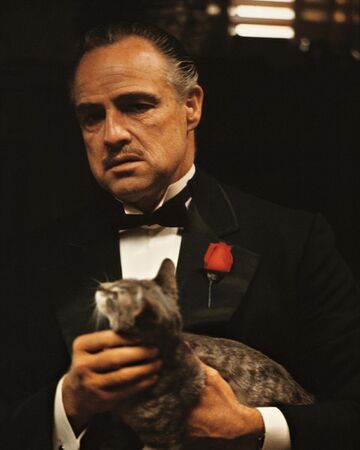
Vito’s cat from The Godfather
It turns out that Walls-Kaufmann was one of the rioters in the Capitol building and he appears in Jeffrey Smith’s body cam footage. You can see shots of him in the article and in Reilly’s Twitter thread.
Members of the sleuthing group Deep State Dogs, who began a volunteer investigative effort for Jeffrey’s widow after her attorney reached out to HuffPost, confirmed Walls-Kaufman’s identity. Nearly six months after he was identified, he has not yet been arrested.
HuffPost also recently discovered how Walls-Kaufman entered the Capitol on Jan. 6. Newly released surveillance footage from the Capitol shows Walls-Kaufman, with his hoodie on his head, barreling through the building’s eastern doors, which are visible from the street outside his shop. He enters the Capitol seconds after a member of the mob violently pulls down a cop from behind and the mob rushes in. Another officer, wearing no protective gear, has to hurry over to help the fallen officer, and the mob surges through the doors. That’s when Walls-Kaufman rushes in, right behind Capitol riot defendants Simone Gold and John Strand, who ― like Walls-Kaufman ― promote conspiracy theories about the COVID-19 pandemic.
I’ve quoted a great deal from Reilly’s article, but there is much more to read at the HuffPo link. This is such an important story.
As we learned yesterday, the Republican National Committee thinks the people who marched on the capitol after Trump incited them were just “ordinary citizens who engaged in legitimate political discourse.” RNC chair Ronna McDaniel tried to clean the mess up on Twitter, but no one’s buying it.
McDaniel in a tweet on Friday said that she has repeatedly condemned the violence on January 6. The resolution contained no mention of the violence and criminal acts by Trump loyalists during the riot.
Democrats, historians, and democracy experts, among others, ripped into the Republican party for framing the deadly riot in this way.
Mr. Bigglesworth from Austin Powers
“Today @GOPChairwoman said Jan 6th insurrectionists were ‘ordinary citizens who engaged in legitimate political discourse,'” Jaime Harrison, chair of the Democratic National Committee, said in a tweet. “They stormed the Capitol. Threatened the VP & Speaker. Injured police. Broke windows. Smeared feces on walls. GOP is truly the Party of #FraudFearFascism.”
Walter Shaub, a former director of the Office of Government Ethics, said the “deadly insurrection that sought to stop the transfer of power was not ‘legitimate political discourse,’ and any persons or groups who say so are declaring war on democracy and aligning themselves with terrorists.”
Democratic Rep. Don Beyer of Virginia echoed the sentiment.
“The Republican Party just declared the January 6th attack on the Capitol – 140+ police officers wounded, multiple deaths, and criminal charges for sedition – ‘legitimate political discourse,'” Beyer tweeted. “The GOP officially supports violent criminal assaults on police, and on our democracy.”
Jennifer Mercieca, a historian of American political rhetoric at Texas A&M University, said she can say with “certainty that the January 6th insurrection was not legitimate, nor was it ‘political discourse,'” adding that the riot “was political violence.”
Read more at the link.
Also in the news yesterday, Mike Pence kinda sorta stood up to his hold boss, saying “Trump was wrong” about the vice president have a the power to overturn the election by refusing to certify electoral votes. Naturally Trump was enraged and hit back.
In a statement issued by his Save America PAC more than six hours later, Trump said, “Just saw Mike Pence’s statement on the fact that he had no right to do anything with respect to the Electoral Vote Count, other than being an automatic conveyor belt for the Old Crow Mitch McConnell to get Biden elected President as quickly as possible.”
“Well, the Vice President’s position is not an automatic conveyor if obvious signs of voter fraud or irregularities exist,” Trump added. “That’s why the Democrats and RINOs are working feverishly together to change the very law that Mike Pence and his unwitting advisors used on January 6 to say he had no choice. The reason they want it changed is because they now say they don’t want the Vice President to have the right to ensure an honest vote. In other words, I was right and everyone knows it. If there is fraud or large scale irregularities, it would have been appropriate to send those votes back to the legislatures to figure it out. The Dems and RINOs want to take that right away. A great opportunity lost, but not forever, in the meantime our Country is going to hell!”
Late Friday night the Justice Department released new videos from the January 6th Capitol riot where one insurrectionist pledged to drag former vice president Miek Pence through the streets for treason that led to him calling for Donald Trump’s former running mate to be decapitated.
CNN’s Amara Walker shared the videos — with a warning about the language — that showed the bearded rioter looking into his camera and raging at Pence for betraying supporters of the former president.
In the video the unidentified man can be heard asking if Pence held up the certification of Joe Biden as president before launching into a profanity-laden attack on the former vice president.
“I’m hearing that Pence just caved. Is that true?” he asked. “I’m telling you, if Pence caved we’re going to drag motherf*ckers through the streets. You f*cking politicians are going to get drug through the streets because we’re not going to have our f*cking sh*t stolen.”
“If we find out you politicians voted for it we’re going to drag your f*cking asses through the street,” he continued before turning back to Pence.
“Let me find out Pence — let me find out you treasoned (sic) the country. I’ll f*cking drag your ass too” he shouted. “Cut their head off! You do the right thing or we’re going to force you to do the right thing.”
On that grisly note, I’ll wrap this up and turn over the floor to you. What stories are you following today?
Did you like this post? Please share it with your friends:
The news about the January 6th Insurrection is getting crazier all the time. There’s so much for the Justice Department to move on that impatience spills over into every conversation you hear. The Republican Party has simply become a massive propaganda machine with no actual political agenda other than to find underhanded ways to stay in power.
The Republican Party on Friday officially declared the Jan. 6, 2021, attack on the Capitol and events that led to it “legitimate political discourse,” formally rebuking two lawmakers in the party who have been most outspoken in condemning the deadly riot and the role of Donald J. Trump in spreading the election lies that fueled it.
The Republican National Committee’s overwhelming voice vote to censure Representatives Liz Cheney of Wyoming and Adam Kinzinger of Illinois at its winter meeting in Salt Lake City culminated more than a year of vacillation, which started with party leaders condemning the Capitol attack and Mr. Trump’s conduct, then shifted to downplaying and denying it.
On Friday, the party went further in a resolution slamming Ms. Cheney and Mr. Kinzinger for taking part in the House investigation of the assault, saying they were participating in “persecution of ordinary citizens engaged in legitimate political discourse.”
It was an extraordinary statement about the deadliest attack on the Capitol in 200 years, in which a mob of Mr. Trump’s supporters stormed the complex, brutalizing police officers and sending lawmakers into hiding. Nine people died in connection with the attack, and more than 150 officers were injured. The party passed the resolution without discussion and almost without dissent.
One entry in the White House records shows a request from Trump to get Jordan on the phone from the White House residence on the morning of January 6. A second entry shows that the length of the call was 10 minutes.
These call logs are among the documents the National Archives turned over to the House select committee investigating the riot after Trump last month lost his bid at the Supreme Court to keep them secret. The records have been crucial for congressional investigators as they try to build a complete narrative of what happened that day, and the call logs help to deepen that understanding.
Records show Trump did not leave the White House until 11:40 a.m. ET on January 6, 2021, to give a speech to thousands of his supporters gathered at the Ellipse. According to footage of House proceedings that day, Jordan spoke on the floor for five minutes starting at 1:32 p.m. ET during the debate over whether to reject Biden’s electors from Arizona.
Jordan later spoke to request a roll call vote on the Arizona challenge at 10:27 p.m. when lawmakers returned to the chamber after being evacuated as rioters interrupted the congressional proceedings.
On Friday, Jordan said, “I don’t recall,” when asked specifically if he spoke with Trump in the morning before the violence started. “I know I talked to him after we left off the floor,” adding that he did not remember how long his calls with the former President lasted that day.
Jordan’s previous recollections of his conversations with Trump on January 6 have been inconsistent.
And, once again, Senator Cassiday actually does a right thing. However, his policies still are completely uniformed for the most part so he made it up by saying stupid about gun laws to make up for it. Oh, well, I have to take what I can get and given Kennedy acts like a certified moran, nothing ever good will come from him.
The RNC is censuring Liz Cheney and Adam Kinzinger because they are trying to find out what happened on January 6th – HUH?
— U.S. Senator Bill Cassidy, M.D. (@SenBillCassidy) February 4, 2022
None of the officials assembled here for the Republican National Committee’s winter meetings are writing off former President Donald Trump. They all recognize his singular hold over the party’s electoral base.
But a distinct chasm is emerging between Trump’s obsessions and the issues many GOP operatives consider crucial to winning the midterm elections in November. Republican candidates need to make voters’ concerns a central focus, as opposed to Trump’s day-to-day attacks, RNC members suggested this week.
Few will put it quite so bluntly; they are loath to antagonize Trump and possibly drive off his hard-core followers. Yet in interviews, party officials showed little appetite for organizing the GOP around Trump’s grievances.
A winning message would emphasize inflation and parental rights, they said — not the 2020 election, which Trump falsely insists he won. Strengthening the party would require opening it up to new voters — not punishing Republicans who have disagreed with Trump, they added.
The sentiments echo those of local GOP leaders, who said late last year that they were ready to move beyond the 2020 election, even if Trump wasn’t. They wanted to put issues like border security, the Afghanistan troop withdrawal and education front and center.
A goal of the RNC winter meetings, members said, was for Republicans to project “unity.” Yet Trump remains a source of division that has spilled into the party’s gathering. One of his allies, RNC member David Bossie of Maryland, submitted a symbolic resolution that would call upon congressional Republicans to expel Reps. Liz Cheney, R-Wyo., and Adam Kinzinger, R-Ill., from the House GOP conference. Both voted last year to impeach Trump.
The resolution was watered down to a censure Thursday amid criticism from some members that it undercut efforts to show the party tolerated dissenting views.
The Manneport, Etretat in the Rain Claude Monet Date: 1885 – 1886
Weeks after the 2020 election, Donald Trump reviewed a draft executive order that authorized the national guard to seize voting machines and verbally agreed to appoint Sidney Powell, a campaign lawyer and conspiracy theorist, as special counsel to investigate election fraud.
The two previously unreported actions of the former president – which is certain to interest the House select committee investigating the Capitol attack and Trump’s efforts to overturn his defeat – came during a contentious White House meeting on 18 December 2020.
Trump never followed through with issuing a formal executive order authorizing the seizure of voting machines or appointing a special counsel. But four sources with detailed knowledge of what transpired during the 18 December meeting described to the Guardian how close he came to doing so.
Paths to power and winning electionsinside the GOP are changing rapidly and radically, spawning a new generation of kingmakers while diminishing the clout of many who lorded over the party for years.
Why it matters: Fourteen of the Republican Party’s top consultants and operatives across the country spoke in detail with Axios about how profoundly primary races have changed since 2014 — the last pre-Donald Trump midterm election and the last midterms in which a Democrat occupied the White House.
What we found: Those sources — whose clients range from as Trumpy as they come to establishment Republicans — described a clear shift in the party’s power brokers. They spoke of changes to the ecosystem across four categories: institutional upheaval, endorsements, conservative media and donors.
Axios granted them anonymity so they could speak with a degree of candor that’s not possible on the record because of personal and business relationships. Here’s what they told us:
Who had the power:
The U.S. Chamber of Commerce
The NRA
The Koch network
Heritage Action
The Drudge Report
National Review
Conservative movement groups such as Tea Party Express, FreedomWorks, and the Senate Conservatives Fund.
Who has power now:
Donald Trump
Tucker Carlson
Family and former aides to Trump
Fox News
Club for Growth
Daily Wire
Breitbart News
Online influencers including Candace Owens, Ben Shapiro, Dan Bongino, Joe Rogan, Jack Posobiec, Charlie Kirk and Marjorie Taylor-Greene.
Steve Bannon
Susan B. Anthony List
Between the lines: Most of these changes weren’t gradual. They were triggered by the shockwave of 2016.
It’s that right-wing populism that has the patricians on the run. But, it’s the voter disenfranchment that has American citizens on the run. I want to close with this miscarriage of justice.
Pamela Moses, a Black woman, has been sentenced to six years in prison because of a voting error. Meanwhile, white individuals who are known to have committed blatant voter fraud have only received probation.
New: A Black woman in Memphis tried to figure out if she was eligible to vote. She wound up getting sentenced to six years in prison. This is the story of Pamela Moses: https://t.co/SsNNeH7BmL
It’s obvious that there’s one justice system for white men and another one for the rest of us.
The case caught my attention for a few reasons. First, it is rare to see a prosecutor bring criminal charges against someone for election crimes, and I was curious whether this was a bona fide case of fraud or of someone who had made a mistake. Second, there has been growing awareness of racial disparities in punishments for election-related crimes. Black people such as Crystal Mason and Hervis Rogers have faced years in prison for making mistakes about their voting eligibility. White voters have received much lighter sentences for election-related crimes.
Hope the weather is gives us all a break here. We could sure use it.
What’s on your reading and blogging list today?
Did you like this post? Please share it with your friends:
The temperature here in the Boston area was 1 degree this morning. We had wind chill temperatures around -20 overnight and today will see -11 wind chills. Winter weather this year has been weird everywhere. For the past couple of weeks here, we have been alternating between freezing cold and unseasonably warm days.
Today a massive winter storm is moving from the upper Midwest into the South. Eventually the storm will move up the coast and into New England as a “southeaster.” So far it looks like my area will miss the heavy snow. I hope that prediction holds! I feel for those of you who live down south.
A massive storm system that’s dumping several inches of snow on the central US is expected to move toward the southeast Saturday, prompting the governors of Georgia, North Carolina, South Carolina and Virginia to declare states of emergency ahead of a crippling ice and snow event.
More than 65 million people in the affected areas are under winter weather alerts, the National Weather Service said.
“A strong developing storm over the Lower Mississippi Valley will move eastward to the Southeast by Sunday morning, then head northeastward to the northern mid-Atlantic by Monday,” the National Weather Service Prediction Center said early Saturday.
Rain, snow, sleet, and freezing rain — or a combination of all of those — will make travel difficult over the three-day holiday weekend across the Eastern US.
A swath of 8 to 12 inches of snow was recorded across portions of North Dakota on Friday.
From there, the system dove deeper south, heading into Missouri, Arkansas and Kansas where it delivered rain and snowfall.
“How fast surface temperatures fall below freezing, and therefore, how fast rain changes to snow will play a big role in determining just how much snow accumulates,” said the NWS office in Topeka, Kansas.
Throughout Saturday the storm system will bring heavy bands of snowfall to the Mid-South and Tennessee Valley.
Localized areas of Tennessee could see snow totals exceeding 6 inches as the storm continues its eastward track toward the Southern Appalachians.
There’s lots more winter weather news to read at that CNN link.
A four-foot tsunami wave was reported to have hit Tonga’s capital, Nuku’alofa, on Saturday, sending people rushing to higher ground. Witnesses said ash had fallen from the sky, after an underwater volcano erupted earlier near the remote Pacific nation.
The volcano, Hunga Tonga-Hunga Ha’apai, is about 40 miles north of the Pacific archipelago’s main island, Tongatapu.
The Bureau of Meteorology in Australia reported the tsunami on Twitter. But communication with Tonga was disrupted, according to The Associated Press, so there were no immediate official reports of injuries or the extent of the damage.
The Tonga Meteorological Service issued a tsunami warning for the archipelago on Saturday evening. On their Facebook pages, the meteorological services for nearby Fiji and Samoa also issued alerts, advising people to stay away from low-lying coastal areas.
The National Tsunami WarninI g Center in the United States issued a tsunami advisory for the West Coast on Saturday morning Pacific time, including the Washington and Oregon coast, with the National Weather Service in Portland reporting possible one- to three-foot waves in Newport, Ore., Long Beach, Wash., and Seaside, Ore. “First wave may not be the highest,” and later waves may “be larger,” the tweet said.
I think I’d rather have a snowstorm.
Unfortunately, I guess I’ll have to get to the politics news now. I want to recommend three long reads and then I’ll list some links to other interesting stories.
Let us be reminded that before there is a final solution, there must be a first solution, a second one, even a third. The move toward a final solution is not a jump. It takes one step, then another, then another.”
So began Toni Morrison’s 1995 address to Howard University, entitled Racism and Fascism, which delineated 10 step-by-step procedures to carry a society from first to last.
Morrison saw, in the history of US racism, fascist practices – ones that could enable a fascist social and political movement in the United States.
Cats out for a walk, Rudi Hurzlmeier
Writing in the era of the “super-predator” myth (a Newsweek headline the next year read, “Superpredators: Should we cage the new breed of vicious kids?”), Morrison unflinchingly read fascism into the practices of US racism. Twenty-five years later, those “forces interested in fascist solutions to national problems” are closer than ever to winning a multi-decade national fight.
The contemporary American fascist movement is led by oligarchical interests for whom the public good is an impediment, such as those in the hydrocarbon business, as well as a social, political, and religious movement with roots in the Confederacy. As in all fascist movements, these forces have found a popular leader unconstrained by the rules of democracy, this time in the figure of Donald Trump.
Morrison’s interest was not in fascist demagogues or fascist regimes. It was rather in “forces interested in fascist solutions to national problems”. The procedures she described were methods to normalize such solutions, to “construct an internal enemy”, isolate, demonize and criminalize it and sympathizers to its ideology and their allies, and, using the media, provide the illusion of power and influence to one’s supporters.
Philosophers have always been at the forefront in the analysis of fascist ideology and movements. In keeping with a tradition that includes the philosophers Hannah Arendt and Theodor Adorno, I have been writing for a decade on the way politicians and movement leaders employ propaganda, centrally including fascist propaganda, to win elections and gain power.
Often, those who employ fascist tactics do so cynically – they do not really believe the enemies they target are so malign, or so powerful, as their rhetoric suggests. Nevertheless, there comes a tipping point, where rhetoric becomes policy. Donald Trump and the party that is now in thrall to him have long been exploiting fascist propaganda. They are now inscribing it into fascist policy.
In the lead-up to the Capitol siege, the FBI received at least a dozen warnings about the possibility of violence that day (see timeline below.) When the day came and the Capitol barricades fell, it became evident the FBI largely ignored them all.
The warnings came from all sides: regional law enforcement, social media platforms, Congress (specifically the House and Senate intelligence committees), a top defense official, extremist watchdogs, right-wing experts, journalists and even three different components within the FBI itself.
By Rudi Herzlmeier
Grid reviewed every public statement FBI officials made about the bureau’s intelligence leading up to the siege to understand how the FBI explained its posture on Jan. 6. We read hundreds of pages of FBI briefings and press statements, FBI officials’ testimony before Congress and public comments in news reports.
We found that the FBI has given at least five different explanations for why it failed to heed these warnings and take steps to foil the Capitol attack or help other agencies prepare a sufficient response. Some of them support arguments the FBI should get more money and legal authorities. But given what we now know, none of them holds up.
“They’re following the same blueprint as 9/11,” said Mike German, a former undercover FBI agent and author of “Disrupt, Discredit and Divide: How the New FBI Damages Democracy.” He is a fellow at the Brennan Center for Justice. “First they say, ‘We had no intelligence,’ then say, ‘Our authorities prevented us from getting the intelligence,’ which is not true.”
The institutional lack of introspection, while unsurprising, is deeply worrisome, German and others agree. The threat of political violence — particularly from the right, and targeting democratic institutions and political leaders — is higher than at any point in modern history. Many key indicators point in one direction: Extremist violence is reportedly surging, and threats against election officials and members of Congress are increasing. The threat of lethality from domestic violent extremist groups “is higher than it ever was,” Attorney General Merrick Garland told Congress last May.
If the FBI remains blinkered to the most serious and likely threats, Jan. 6 might not be its last major failure. American democracy has largely survived the violence of Jan. 6, and the Department of Justice has undertaken a historic effort to investigate, indict and prosecute hundreds of participants — who might never have stormed the Capitol in the first place if the FBI had heeded clear warnings and taken proper steps to prevent the attack.
Palidino goes on to refute the five main excuses the FBI has given for it’s failure to respond to the many warnings they received before January 6. It appears that the bureau is still focusing more on left wing protestors than on right wing violence, despite the public claims of director Chris Wray.
Timing is everything. When it comes to free and fair elections and ensuring that Donald Trump and fellow authoritarians do not pull off a successful coup, we are nearly out of time. At least 19 states have added laws that make it more difficult to vote, according to the Brennan Center for Justice, and 49 state legislatures are considering voting restrictions, including, most ominously, measures that would take election management out of the hands of secretaries of state and hand it over to GOP-controlled legislatures. We have until November 8to fix this.
Espresso by rudi Hurzlmeier
The prosecution of the former president is on a slower timeline. This includes not only the criminal investigations being pursued in Georgia by the Fulton County district attorney, and in New York by the state attorney general and the Manhattan district attorney, but also any investigations emanating from the U.S. Department of Justice. But that’s okay; Merrick Garland is no longer the problem or the solution.
I came to this conclusion after Attorney General Garland delivered a much-hyped speech commemorating the anniversary of the January 6 attack on the Capitol. After considering his words, I opened a calendar and did the math. We’ll get to that math in a moment. But first, let’s be clear about what Garland did and didn’t promise.
After watching his talk and then reading the prepared remarks published on the DOJ website, I have this take: I fully trust Garland to prosecute Trump in connection with the events directly leading up to and surrounding the certification of the electoral vote on January 6. But I’m less sure how much Trump mischief that will include.
Why do I believe DOJ is currently investigating the former president? Some doubt it. There have been no leaks to the press. By comparison, the Select Committee to Investigate the January 6th Attack on the United States Capitol has been less circumspect. Committee members, including Republican Representative Liz Cheney, have made it clear that they are examining Trump’s legal culpability on a number of grounds. Garland will have access to whatever the committee uncovers, including the report they plan to issue as early as this summer. And if the panel, chaired by Representative Bennie Thompson, makes criminal referrals to DOJ, committee staff will turn over the evidence they have gathered.
In such a referral, the committee might reference several statutes that DOJ can use to prosecute the former president and others, including obstruction of an official proceeding, conspiracy, and seditious conspiracy. They might also use the wire fraud statute to charge those who raised funds off the Big Lie.
The Sky Dancing banner headline uses a snippet from a work by artist Tashi Mannox called 'Rainbow Study'. The work is described as a" study of typical Tibetan rainbow clouds, that feature in Thanka painting, temple decoration and silk brocades". dakinikat was immediately drawn to the image when trying to find stylized Tibetan Clouds to represent Sky Dancing. It is probably because Tashi's practice is similar to her own. His updated take on the clouds that fill the collection of traditional thankas is quite special.
You can find his work at his website by clicking on his logo below. He is also a calligraphy artist that uses important vajrayana syllables. We encourage you to visit his on line studio.













 Greetings from the land of ice and snow! Massachusetts was covered in ice yesterday after the latest winter storm hit New England. Lots of people ventured out in their cars anyway. It didn’t go well. The Boston Globe:

 Raw Story









 peej
peej Carissa
 bostonboomer
 dakinikat
 ecocatwoman
 mablue2
 Mama Lopez
 peggysue22
 quixote
 skydancingguestblogger
 Mona (aka Wonk the Vote)



 Sky Dancing
Recent Comments