Where I live it already feels like the long weekend has begun. Even yesterday, there was very little traffic in my town. I welcome the peace and quiet. I had a very lazy day yesterday, and today is feeling pretty lazy too. I started another mystery and I’m thinking about doing some TV binge watching over the weekend. I hope there won’t be a whole lot of horrible news for the next four-and-a-half days.
Today, I’m seeing tons of negative stories about Donald Trump. I can’t figure out if the man is just plain stupid or cognitively impaired. It’s obvious he’s a malignant narcissist, as Dakinikat has repeatedly pointed out. But we’ve also discussed the possibility that Trump could be suffering from some kind of dementia–after all, his father had Alzheimer’s disease. Anyway here are a few interesting links on Trump’s latest fiascos.
When Donald Trump said last Thursday he was forgiving over $45 million in personal loans he made to his campaign, the announcement drew plenty of coverage. Many even reported Trump’s statement as if the deal was done.
But it’s not.
A week later, NBC News has learned the FEC has posted no record of Trump converting his loans to donations. The Trump Campaign has also declined requests to share the legal paperwork required to execute the transaction, though they suggest it has been submitted.
Last week, campaign spokesperson Hope Hicks said Trump was submitting formal paperwork forgiving the loan on Thursday, according to the Wall Street Journal.
Reached by NBC this week, she said the paperwork “will be filed with the next regularly scheduled FEC report,” and declined to provide any documentation.
The delay could matter, because until Trump formally forgives the loans, he maintains the legal option to use new donations to reimburse himself. (He can do so until August, under federal law.)
Henri Matisse working in bed, with cat
Trump is either a real cheapskate or he can’t spare that money. This is reminiscent of the time he lied about having given $1 million to veterans groups and only coughed up the money when the Washington Post called him out.
At Mar-a-Lago, the Palm Beach resort he runs as a club for paying guests and celebrities, Donald Trump had a telephone console installed in his bedroom that acted like a switchboard, connecting to every phone extension on the estate, according to six former workers. Several of them said he used that console to eavesdrop on calls involving staff.
Trump’s spokeswoman Hope Hicks responded to written questions with one sentence: “This is totally and completely untrue.”
The managing director of Mar-a-Lago, Bernd Lembcke, did not respond to emails. Reached by phone, he said he referred the email query to Trump’s headquarters and said, “I have no knowledge of what you wrote.” ….
BuzzFeed News spoke with six former employees familiar with the phone system at the estate.
Four of them — speaking on condition of anonymity because they signed nondisclosure agreements — said that Trump listened in on phone calls at the club during the mid-2000s. They did not know if he eavesdropped more recently.
They said he listened in on calls between club employees or, in some cases, between staff and guests. None of them knew of Trump eavesdropping on guests or members talking on private calls with people who were not employees of Mar-a-Lago. They also said that Trump could eavesdrop only on calls made on the club’s landlines and not on calls made from guests’ cell phones.
Each of these four sources said they personally saw the telephone console, which some referred to as a switchboard, in Trump’s bedroom.
More at the link. Maybe Trump could have spent his time more fruitfully by reading a book or two.
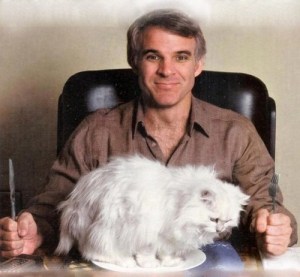
Steve Martin with cat
Chris Cillizza has done a public service by reprinting an interview with Donald Trump on the Bill O’Reilly Show: Donald Trump’s Bill O’Reilly interview is an instant classic. I hope you’ll read the whole thing, because it clearly demonstrates that Trump is a complete idiot. This is my favorite part (emphasis added):
HILLARY CLINTON (D), PRESUMPTIVE DEMOCRATIC PRESIDENTIAL NOMINEE: I am determined to say look, you may not vote for me, Trump supporters, I get that because you really are upset about immigration or you are upset about trade or you are upset about, you know, the feeling that the jobs that you had that gave you a good living are gone. So, I’m very sympathetic to that. I am not sympathetic to the xenophobia, the misogyny, the homophobia, the Islamophobia and all of the other.
(APPLAUSE)
Sort of dog whistles that Trump uses to create that fervor among a lot of his supporters.
(END VIDEO CLIP)
O’REILLY: Okay. That was about 45 seconds to be fair. We will give Mr. Trump the same amount of time to reply. Go.
TRUMP: All of the phobias that nobody even knows what she is talking about to be honest with you. Why doesn’t she say it like it is? I mean, it’s just ridiculous. And frankly, you know, she knows exactly what’s happening. She sees what’s happening. People are tired. They are losing their jobs. Their jobs are being taken away. Companies are moving to Mexico. I mean, just moving. They just pick up and move. You look at what went on with carrier. You look at Ford. You look at so many different. They are a mile long and we are losing our jobs.
We are losing everything in this country. We are losing our spirit. I was in Ohio. I was in Pennsylvania. Yesterday I was in Ohio, Pennsylvania, and West Virginia. And I want to tell you, the lines of people that we have, they are so sick and tired of hearing things like what she is just saying. Nobody even knows what she is talking about. And you tell me, that’s presidential? She is presidential? Sitting there. I don’t think so.
Poor Donald. He just doesn’t understand all those multi-syllable words, and he assumes no one else does either.
Billy Idol with cat
The New York Times commissioned a short story about the Trumps by novelist Chimamanda Ngozi Adiche: The Arrangements: A Work of Fiction. Here are the first few paragraphs:
Melania decided she would order the flowers herself. Donald was too busy now anyway to call Alessandra’s as usual and ask for “something amazing.” Once, in the early years, before she fully understood him, she had asked what his favorite flowers were.
“I use the best florists in the city, they’re terrific,” he replied, and she realized that taste, for him, was something to be determined by somebody else, and then flaunted.
At first, she wished he would not keep asking their guests, “How do you like these great flowers?” and that he would not be so nakedly in need of their praise, but now she felt a small tug of annoyance if a guest did not gush as Donald expected. The florists were indeed good, their peonies delicate as tissue, even if a little boring, and the interior decorators Donald had brought in — all the top guys used them, he said — were good, too, even if all that gold yellowness bordered on staleness, and so she did not disagree because Donald disliked dissent, and he only wanted the best for them, and she had what she really needed, this luxurious peace. But today, she would order herself. It was her dinner party to celebrate her parents’ anniversary. Unusual orchids, maybe. Her mother loved uncommon things.
Her Pilates instructor, Janelle, would arrive in half an hour. She had just enough time to order the flowers and complete her morning skin routine. She would use a different florist, she decided, where Donald did not have an account, and pay by herself. Donald might like that; he always liked the small efforts she made. Do the little things, don’t ask for big things and he will give them to you, her mother advised her, after she first met Donald. She gently patted three different serums on her face and then, with her fingertips, applied an eye cream and sunscreen.
Truman Capote with cat
What a bright morning. Summer sunlight raised her spirits. And Tiffany was leaving today. It felt good. The girl had been staying for the past week, and came and went, mostly staying out of her way. Still, it felt good. Yesterday she had taken Tiffany to lunch, so that she could tell Donald that she had taken Tiffany to lunch.
“She adores all my kids, it’s amazing,” Donald once told a reporter — he was happily blind to the strangeness in the air whenever she was with his children.
Read the rest at the link. The Times plans to publish another short story about the 2016 campaign by a different author. I supposed that one will be a very vicious piece about the Clinton family. Maybe they can get Maureen Dowd to write it.
Former London mayor Boris Johnson, favorite to become Britain’s prime minister, abruptly pulled out of the race on Thursday, upending the contest less than a week after leading the campaign to take the country out of the EU.
Johnson’s announcement, to audible gasps from a roomful of journalists and supporters, was the biggest political surprise since Prime Minister David Cameron quit on Friday, the morning after losing the referendum on British membership in the bloc.
Drew Barrymore with cat
It makes Theresa May, the interior minister who backed remaining in the European Union, the new favorite to succeed Cameron.
May, a party stalwart seen as a steady hand, announced her own candidacy earlier on Thursday, promising to deliver the withdrawal from the EU voters had demanded, despite having campaigned for the other side.
“Brexit means Brexit,” she told a news conference.
“The campaign was fought, the vote was held, turnout was high and the public gave their verdict. There must be no attempts to remain inside the EU, no attempts to rejoin it through the back door and no second referendum.”
The decision to quit the EU has cost Britain its top credit rating, pushed the pound to its lowest level since the mid-1980s and wiped a record $3 trillion off global shares. EU leaders are scrambling to prevent further unraveling of a bloc that helped guarantee peace in post-war Europe.
Hope you’re not going to get tired of me posting Nina Simone songs because I just had to do it again. I woke up and feel optimistic for a nice change. I would like to say that my life is on the up and up but this is much less specific than that. I feel better about being a woman in the USA and that’s a big deal.
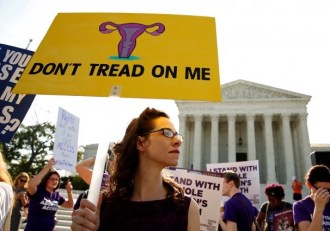
Two really great SCOTUS decisions came down today that protect women’s right to choose and the victims of domestic abuse who are overwhelmingly women and children. The Supremes have thrown out the Texas Trap Law and refused to water down gun bans for domestic abusers. Then, there was some campaign excitement! Senator Elizabeth Warren tore up the stage with a Donald Burning and an enthusiastic Hillary support speech in Cincinnati. Women on the Supreme Court made a huge difference! Can you imagine the difference a woman President may make?
It felt as if, for the first time in history, the gender playing field at the high court was finally leveled, and as a consequence the court’s female justices were emboldened to just ignore the rules. Time limits were flouted to such a degree that Chief Justice John Roberts pretty much gave up enforcing them. I counted two instances in which Roberts tried to get advocates to wrap up as Justices Ruth Bader Ginsburg and Sonia Sotomayor simply blew past him with more questions. There was something wonderful and symbolic about Roberts losing almost complete control over the court’s indignant women, who are just not inclined to play nice anymore.
The case involves a crucial constitutional challenge to two provisions in Texas’ HB 2, the state’s omnibus abortion bill from 2013. The first requires doctors to obtain admitting privileges from a hospital 30 miles from the clinic where they perform abortions; the second requires abortion clinics to be elaborately retrofitted to comply with building regulations that would make them “ambulatory surgical centers.” If these provisions go into full effect, Texas would see a 75 percent reduction in the number of clinics serving 5.4 million women of childbearing age. The constitutional question is whether having 10 clinics to serve all these women, including many who would live 200 miles away from the nearest facility, represents an “undue burden” on the right to abortion deemed impermissible after the Casey decision. Each of the female justices takes a whacking stick to the very notion that abortion—one of the safest procedures on record—requires rural women to haul ass across land masses larger than the whole state of California in order to take a pill, in the presence of a doctor, in a surgical theater.
The morning starts with an arcane and technical debate that eats up most of Stephanie Toti’s time. Toti, arguing on behalf on the Texas clinics, first has to answer an argument—raised by Ginsburg—that the clinics were precluded from even bringing some of their claims. Between this and factual challenges from Roberts and Justice Samuel Alito as to whether there was any evidence on the record to show that the law itself triggered the closings of Texas clinics, she doesn’t have much time to get to the merits. So frustrated is Justice Elena Kagan by the conservatives’ repeated insistence that perhaps the clinics just coincidentally all closed within days of HB 2’s passage that she finally has to intervene. “Is it right,” she asks Toti, “that in the two-week period that the ASC requirement was in effect, that over a dozen facilities shut their doors, and then when that was stayed, when that was lifted, they reopened again immediately?” Toti agrees. “It’s almost like the perfect controlled experiment,” continues Kagan, “as to the effect of the law, isn’t it? It’s like you put the law into effect, 12 clinics closed. You take the law out of effect, they reopen?”
The Supreme Court on Monday struck down Texas abortion restrictions that have been widely duplicated in other states, a resounding win for abortion rights advocates in the court’s most important consideration of the controversial issue in 25 years.
Justice Anthony M. Kennedy joined the court’s liberals in the 5 to 3 decision, which said Texas’s arguments that the clinic restrictions were to protect women’s health were cover for making it more difficult to obtain an abortion.
The challenged Texas provisions required doctors who perform abortions at clinics to have admitting privileges at a nearby hospital and said that clinics must meet hospital-like standards of surgical centers.
Similar restrictions have been passed in other states, and officials say they protect patients. But the court’s majority sided with abortion providers and medical associations who said the rules are unnecessary and so expensive or hard to satisfy that they force clinics to close.
In a 6-2 decision, the Supreme Court on Monday ruled that reckless domestic assaults can be considered misdemeanor crimes to restrict gun ownership. The decision comes as a major victory for women’s rights and domestic violence advocacy groups.
The Supreme Court ruled Monday against a Maine resident who argued he should not have been stripped of his ability to possess a firearm despite a prior domestic violence charge in state court.
Stephen Voisine pled guilty to a misdemeanor assault charge in 2004 against a girlfriend. Five years later, he was investigated for shooting a bald eagle and as part of the investigation he turned over a firearm to authorities.
After reviewing his criminal record, Voisine was then charged with unlawful possession of a firearm pursuant to a federal law which makes it unlawful for a person who has been convicted of a “misdemeanor crime of domestic violence” to possess a firearm or ammunition.
Lawyers for Voisine argued that his misdemeanor offense did not rise to the level to trigger the federal law.
The justices agreed to take the case to interpret the reach of a federal statute. But Justice Clarence Thomas during oral arguments was also interested in the 2nd Amendment implications, breaking in to ask a series of questions for the first time in 10 years during oral arguments.
The three-judge panel of the 1st U.S. Circuit Court of Appeals ruled against Voisine and another defendant, holding that the “question before us is a narrow one.”
Congress recognized that “guns and domestic violence are a lethal combination,” the panel said.
Is it really possible that we may see a woman President and Vice President next year? The rally in Cincinnati this morning with Hillary Clinton and Elizabeth Warren held out that tantalizing option.
BB caught me in bed with a cup of coffee this morning. Turn on the TV! There they were and there it was. No more Texas Trap Laws! Two Powerful women thrashing a Republican Bully while the world and Cincinnati cheered them on! It’s a new day! It’s a new dawn! Warren definitely put the B in the Trump Burn. She was amazing and you could see that Hillary loved every minute of it.
Donald Trump is “a small, insecure money-grubber who fights for no one but himself,” Sen. Elizabeth Warren of Massachusetts said Monday morning at the Cincinnati’s Union Terminal, as the possible vice presidential candidate lit up the crowd in her first appearance with Hillary Clinton.
“What kind of a man?” Warren said of the presumptive GOP nominee, with whom she has had drawn out Twitter battles. “A nasty man who will never become president of the United States, because Hillary Clinton will be the next president of the United States.”
Warren, who is popular with many progressives who backed Sen. Bernie Sanders of Vermont in the primary, lobbed attacks at Trump as she stood below the terminal lobby’s large mosaic of of iron-workers, railroad men and farmers. Clinton stood beside her, grinning and clapping.
The joint appearance, and Warren’s enthusiasm for attacking Trump, added to speculation about her likelihood of receiving the nod to join Clinton as the vice presidential candidate on the Democratic ticket. Clinton and her supporters have touted Warren’s endorsement as the former first lady seeks to unite Democrats after a long primary battle with Sanders.
At Union Terminal, Warren punctuated her criticisms of Trump and praise of Clinton by raising her fist and shouting “Yes!” Drawing applause and supportive laughter, Warren turned and clapped wildly for Clinton, then joined the crowd in shouts of “Hillary! Hillary!” and a “Woo!”
“Donald Trump thinks poor, sad little Wall Street brokers need to be free to defraud everyone they want,” said Warren, known for her anti-Wall Street stances. “Hillary fights for us.”
“You know I could do this all day. I really could,” Warren said of attacking Trump. “But I won’t. OK, one more.”
“You just saw why she is considered so terrific, so formidable, because she tells it like it is,” Clinton said of Warren. “I just love how she gets under Donald Trump’s skin.”
These two are a great tag team. I can’t wait to watch the thin, orange-skinned one’s twitter feed. He hates it when women put him in his place.
Hillary Clinton after being introduced by Senator Elizabeth Warren at a campaign rally in Cincinnati, Ohio. REUTERS/Aaron Josefczyk
Warren and Clinton both share a desire to do everything they can to “stop Donald Trump” from becoming president, and, according to a campaign aide, they will both warn of the risks Trump would have on the economy during their event today, according to HASKELL and KREUTZ. “The Republicans underestimated and underestimated and underestimated Donald Trump. Look where that got them. They kept saying, no, no, no, that’s not going to happen, we don’t have to worry about that,” Warren said when she endorsed Clinton. “Donald Trump is a genuine threat to this country. He is a threat economically to this country. But he is a threat to who we are as a people. There is an ugly side to Donald Trump that we all have to stop and think about what’s going on here.” As Clinton and Warren’s relationship continues to evolve and Warren’s stock grows as a possible choice for vice president, it appears the senator is diving head first into helping elect Clinton. She even stopped by Clinton’s Brooklyn presidential campaign headquarters 10 days ago to give staffers a pep talk telling them “Don’t screw this up.”
They didn’t screw it up. It was marvelous, darlin’!
So, there’s some good news!
What’s on your reading and blogging list today?
Did you like this post? Please share it with your friends:
Last night Twitter was agog over Donald Trump’s May FEC filing. There’s been a lot of talk lately about chaos in Trump’s campaign and speculation about how wealthy he actually is. But the Trump campaign is in even worse condition than anyone suspected. Mother Jones breaks down the stunning news from his campaign finance documents:
The first glance: Hillary Clinton’s campaign has more than 35 times the cash Trump’s does.
Here’s the second glance: Ted Cruz dropped out of the GOP primary on May 3, meaning that for the month of May, Trump was all but assured the nomination and the campaign should have been in prime fundraising mode. But it wasn’t. Even taking into account Trump’s long-stated claims that he had no interest in raising money from others (something he has reversed himself on)—filings the campaign made with the Federal Election Commission late Monday evening show that Trump simply couldn’t get any fundraising momentum going. He raised a grand total of $5.6 million from May 1 to May 31, $2.2 million of which was in the form of loans from Trump personally….
Trump, who spent more than he raised, has $1.2 million in cash on hand. True, Trump has always had very little cash on hand at the end of a reporting period. But this was because he was writing the checks and didn’t need to keep cash on hand. But now that Trump insists he won’t be self-financing, those low numbers are a problem. Even if Trump significantly increased his fundraising since May 31, he would have to be raising money at an almost unprecedented rate to catch up to Clinton.
It’s not just the low numbers that portend potential disaster for the GOP’s man. It’s the way he arrives at the low numbers that looks scary. There’s no real significant support from top donors—the bedrock of a strong monthly fundraising report. But the Trump campaign picked up just 133 donations that hit the maximum allowed amount of $2,700. Clinton had more donations of $2,700 on just May 17 (140) than Trump had all month, and almost 15 times as many for the entire month (1,981).
Not only is Trump getting lapped by Clinton financially, but his fundraising has been going so poorly that he’s actually behind a good number of U.S. House candidates….
The news sparked renewed concerns that Trump simply won’t be able to fundraise to the extent necessary to run a viable presidential campaign. But during a phone interview on the Today show Tuesday morning, Trump said that if worst comes to worst and Republican donors don’t come around, he could always just self-fund.
“If it gets to a point, what I’ll do is just do what I did in the primaries. I spent $55 million of my own money to win the primaries,” Trump said. “I may do that again in the general election… I have a lot of cash and I may do it again in the general election, but it would be nice to have some help from the party.”
But if he has so much cash, why isn’t he spending it instead of having to deal with being the butt of endless jokes in the media and on Twitter?
I got onto thinking about this when I saw John McQuaid’s short piece in Forbes. As McQuaid notes, this is the gaping hole, the burning question at the center of Trump’s campaign. Reports suggest that Trump has been unwilling to undergo the ego effacement of calling high dollar Republican donors and asking for money. His campaign has virtually no money in the bank ($2.4m at last count).
Even if Trump can’t not be Trump, the damage of being Trump could at least be off-set by pouring money into advertising in key swing states and field work. But at this moment, the Clinton campaign (and pro-Clinton superPACs) is rolling out a barrage of targeted swing state advertising focused on solidifying and embedding the highly negative image Trump has built for himself over the last year and especially the last eight weeks. That advertising is going entirely unanswered by the Trump campaign.
Why isn’t Trump using his own money, as he keeps threatening to do?
It may take a billion dollars to run a presidential campaign. But at this moment Trump is in dire need of a few million dollars. To go back to cash on hand, Trump currently has $2.4 million and Clinton has just over $30 million. Remember, Trump is allegedly worth $10 billion, which at the risk of stating the obvious means he is worth ten thousand million dollars. Someone in that position might be hard pressed to quickly produce billions of dollars or even hundreds of million in actual cash. But we’re talking tens of millions or even just a few million dollars he needs right now.
Trump may be stingy. He may be saying that the RNC should take responsibility for fundraising, which is something it’s clearly not capable of doing. (The RNC has massive fundraising capacity but it can’t simply take on singlehanded what the candidate was expected to raise.) But as big a disaster as Trump’s campaign is at the moment he stands a real shot at being the next president of the United States. It is simply not credible that he is standing on principle in not giving his campaign any more money at such a critical moment when his bid is being so deeply damaged.
The only credible answer is that it is difficult or perhaps even impossible for him to produce these comparatively small sums. If that’s true, his claim to be worth billions of dollars must either be a pure sham and a fraud or some artful concoction of extreme leverage and accounting gimmickry, which makes it impossible to come up with actual cash.
Here’s Marshall’s reaction to the FEC report (emphasis added):
I confess even I’m surprised at what the overnight FEC filings revealed about the Trump campaign. Posting the ‘Trump is Broke‘ column yesterday made me feel at least a touch exposed since I figured he’d add (either from his own money or fundraising) at least some additional funds to the paltry $2.4 million cash on hand in his previous filing. Appears not. Now on top of that it’s revealed that he’s been using his presidential campaign to funnel millions of dollars back into his own businesses. The new filing shows the campaign had only $1.3 million in cash on hand at the beginning of this month, in comparison to $42 million on hand for the Hillary campaign.
It’s important to see those numbers in the proper perspective.
Yes, Clinton has massively more money than Trump. But that’s about the amount of money she should have. This isn’t to take away from the accomplishment. It’s a lot of money and it came while she was still having to spend money on the on-going primaries. But it’s in the range of what you would expect from a well-oiled team of professionals drawing on a robust fundraising apparatus. Trump’s amount of cash wouldn’t be terribly impressive for a competitive House race. His campaign is essentially broke. Which, as I noted yesterday, means Trump must be broke, too, or so cash poor as to amount to the same thing for the purposes of this campaign….
Perhaps the most revealing detail about the May filing is that Trump actually did loan his campaign additional funds – a bit over $2 million. But this shows more just how hard up Trump is. His campaign is in desperate need of funds.
Let’s face it. Trump is an arrogant man and he’s going through a relentless public shaming right now. If he had the money to get paid staff on the ground and ads on the air, he’d be using it, if only to demonstrate his yuuuuge wealth.
But what really had folks on twitter busy last night was the part about Trump using his campaign funds to reimburse his own businesses and his family members. AP reports: Trump’s campaign cycles $6 million into Trump companies.
Donald Trump’s campaign likes to keep it in the family.
When Trump flies, he uses his airplane. When he campaigns, he often chooses his properties or his own Trump Tower in New York City, which serves as headquarters. His campaign even buys Trump bottled water and Trump wine.
The presumptive Republican presidential nominee has been on the campaign trail for a year now, and federal finance reports detail a campaign unafraid to co-mingle political and business endeavors in an unprecedented way — even as he is making appeals for donations.
Through the end of May, Trump’s campaign had plunged at least $6.2 million back into Trump corporate products and services, a review of Federal Election Commission filings shows. That’s about 10 percent of his total campaign expenditures…..
Wealthy political candidates in the past have walled off their business from their campaigns, but Trump embraces his companies. Public documents indicate his revenue has risen along with his presidential aspirations.
While Trump’s controversial comments have cost his businesses money — for example, the PGA Tour recently announced it would move its World Golf Championship from a Trump course to one in Mexico City — Trump reported in documents filed in May with federal regulators that his revenue had increased by roughly $190 million over the previous 17 months.
Apparently, running for the presidency is just another money-making scheme to Trump. You can read the details about how how Trump spent his campaign money in May at The Washington Post.
One more interesting bit from the Trump FEC filings: Trump paid $35,000 each to “Draper Sterling,” at an address in New Hampshire. It sounds a little like the fictional ad agency in Mad Men, and late last night lots of people were trying to figure out if it is a legitimate company. Josh Legum at Think Progress: The Weird Story Behind The Trump Campaign’s $35,000 Payment To ‘Draper Sterling’
The Trump campaign made $35,000 in payments to an entity called “Draper Sterling” for “web advertising.” Three $10,000 payments and one $5,000 payment were placed on the campaign’s American Express card on the same day (see the FEC details at the link) ….
Draper Sterling was registered with the New Hampshire Secretary of State to Jon Adkins, the co-founder of a medical device startup. Its headquarters is Adkins’ home address in residential New Hampshire.
Adkins co-founded the medical device company with Paul Holzer, a former Navy Seal and current medical student at Dartmouth. Holzer was involved in Charlie Baker’s run for governor in 2014 — he ran the campaign’s “voter contact strategy.” He was also part of the “management and strategy team” for Missourians For John Brunner, a candidate for governor.
Trump paid an additional $3,000 each to Holzer and Adkins in May for “field consulting.” Holzer listed Adkins’ home as his address.
Legum learned “Draper Sterling” was also mentioned in an FEC complaint. You’ll have to read about that in the article at Think Progress. It’s still not clear what these guys did for Trump.
I’m in an absolute haze from a summer cold that popped up yesterday and sent me directly to bed. I’m trying to write and work right now but it’s not easy at all. I want to try to discuss a lot of upcoming things that will be important including the SCOTUS decision on the Texas Trap laws regarding abortion and abortion clinics. These law certainly create an undue burden and they reflect specific religious view rather than medical or biological science. Here’s a few reads to prepare us all because it’s important for all of us to understand this basic constitutional right.
Abortion opponents regularly talk as though no restriction is off the table when it comes to stripping away reproductive rights. And supporters of abortion rights don’t always set them straight. If we don’t know what our established rights are, we can’t defend them. Pro-choicers need to know why abortion is a constitutional right and what boundaries the U.S. Supreme Court has set out to protect it.
1. Abortion is protected by the rights to bodily integrity and to make decisions about family. The Court explained that decades ago.
The 14th Amendment prohibits states from depriving a person of liberty without due process of law. A person has the right to end a pregnancy without undue interference from the government because that right to liberty includes (1) the right to make decisions about family and (2) the right to bodily integrity.
However, in order to portray abortion rights as illegitimate, conservatives like to argue—inaccurately—thatthe Court legalized abortion in Roe v. Wade by inventing a right to privacy that is not grounded in the Constitution’s actual text.
In the pre-Roe contraception case Griswold v. Connecticut (1965), the Court did hold that “penumbras, formed by emanations” or various interpretations of the First, Third, Fourth, Fifth, and Ninth Amendments protect a right to privacy. But in deciding Roe, the Warren court located the right to privacy in the 14th Amendment’s explicit protection of the right to liberty. Regardless, the Court’s understanding of the rights that protect reproductive freedom expanded beyond just privacy decades ago.
Privacy is barely mentioned in Planned Parenthood v. Casey, which established the current law governing abortion rights more than 20 years ago. “The controlling word in the cases before us is ‘liberty,’” the decision explained. It was settled law prior to Roe that liberty includes “the right to make family decisions and the right to physical autonomy.”
Privacy is also a constitutional right, and it was indeed violated by the laws at issue in Roe and its companion case,Doe v. Bolton. Those laws required a woman seeking an abortion to share her reasons for wanting the procedure with legal or medical authorities to have any hope of receiving legal abortion care. However, the law and discourse around privacy at the time of Roe implied a woman should be permitted to use contraception or end a pregnancy because the state should not interfere in decisions made in secret with the permission of her doctor, husband, father, pastor, or others. Casey instead properly recognized that the 14th Amendment protects a person’s right to control her body and destiny.
So why has the idea persistedthat all we’ve got is a privacy right made up out of thin air? A counterintuitive and less textually based right serves abortion opponents, but abortion rights advocates also have a history of telling us abortion restrictions are primarily a threat to privacy. As William Saletan documented in Bearing Right: How Conservatives Won the War on Abortion, in the run-up to Casey, pro-choice leaders emphasized privacy on the advice of pollsters and political consultants to appeal to anti-government, anti-welfare, anti-tax, and anti-integration sentiments. While reproductive rights lawyers argued to the Supreme Court that the Constitution’s protection of autonomy, bodily integrity, and equality protected abortion access, outside of court pro-choice leaders told the public the right at stake was privacy. But, ultimately, the Casey decision provided a much fuller discussion of why abortion is constitutionally protected by rights beyond privacy.
Abortion is protected by the due process clauses of the Fifth Amendment (which restricts the federal government) and the 14th Amendment (which was added to the Constitution to restrict the states). As Casey explained, “It is a promise of the Constitution that there is a realm of personal liberty which the government may not enter.” Using the force of law to compel a person to use her body against her will to bring a pregnancy to term is a violation of her physical autonomy and decisional freedom—which the Constitution does not allow.
Follow the link to read about the other two basic rights that include:” 2. Any pre-viability ban is unconstitutional. Period.” and “3. Casey‘s “undue burden” standard is a meaningful protection of abortion rights when courts apply it properly.”
The war on abortion access in Texas has already fundamentally shifted the landscape of women’s lives in the state. Now, the fallout continues: The closure of Planned Parenthood (PP) clinics in the state—which once served as primary sources of reproductive health care for women there—has left the few clinics remaining in west Texas underfunded, understaffed, and overwhelmed by demand.
According to new research, 60 percent of women receiving a low salary who were of reproductive age accessed health care through PP before the cuts and defunding which took place in 2013. The majority of those patients have since been directed to Texas Tech University and Midland County Health Services (MCHS) after PP’s clinics in west Texas closed—increasing demand at an overwhelming rate for their capacity to provide services.
“There are women [who] need these services but can’t afford them and we see as many as we can,” Michael Austin, director of MCHS, told Women’s Health Policy Report. “But the state program to help these folks along has basically evaporated. So I’m afraid there are probably a lot of folks flying under the radar who need care and aren’t getting it.” Austin pointed to the challenges of seeking funding in a state that has “eliminated or severely messed up” many of their programs which provide reproductive health care to women.
In 2011, the Texas State Assembly passed legislation which blocked funding to women’s health clinics, including Planned Parenthood, and cut the state’s family planning budget by two-thirds. Two years later, the draconian anti-abortion bill known as HB2 was signed into law by Governor Rick Perry, putting in place numerous obstacles meant to shutter clinics and restrict women’s access to safe and legal abortion. HB2 requires that abortion providers have admitting privileges at a local hospital and clinics are licensed ambulatory centers. It also bans surgical abortion after 20 weeks and medication abortion after seven. (Medication abortion is the most cost- and time-effective abortion procedure.)
HB2’s impact was immediate and drastic. 82 percent of family planning clinics closed. The number of abortion practitioners decreased by over 75 percent. Over half of the clinics performing abortion closed, which in turn drastically increased the time it would take for women to make an appointment to 28 days— essentially rendering the option of medication abortion moot. When it comes to clinics, Texas is in crisis.
The Supreme Court has rejected challenges to assault weapons bans in Connecticut and New York, in the aftermath of the shooting attack on a gay nightclub in Orlando, Florida, that left 50 people dead.
The justices on Monday left in place a lower court ruling that upheld laws that were passed in response to another mass shooting involving a semi-automatic weapon, the elementary school attack in Newtown, Connecticut.
The Supreme Court has repeatedly turned away challenges to gun restrictions since two landmark decisions that spelled out the right to a handgun to defend one’s own home.
The Supreme Court announced Monday that it will take up a case exploring when immigrants detained solely for immigration violations have the right to be released from jail.
The justices agreed to consider a federal appeals court decision that essentially found detained immigrants were entitled to a bond hearing after six months in custody and every six months thereafter.
The high court’s announcement comes as immigrant rights advocates are awaiting a Supreme Court decision on the legality of President Barack Obama’s executive actions granting quasi-legal status and work permits to millions of immigrants who entered or stayed in the U.S. illegally.
In that case, the Obama administration is aligned with most immigrants rights groups. However, in the case the court said Monday that it would take up, the Obama administration is pressing for fewer rights for detained immigrants. In fact, the administration is asking the justices to overturn the 9th Circuit Court of Appeals ruling that found immigrants have the right to regular review of their detention.
The newly-accepted case, Jennings v. Rodriguez, could also explore when immigrants accused of ties to terrorism have to be released if authorities are having difficulty deporting them.
Between tomorrow morning, when the Justices will take the bench at ten o’clock, and the end of June, the Court is expected to issue thirteen rulings in cases involving everything from tribal-court jurisdiction to abortion, immigration, and the scope of federal laws prohibiting political corruption. Here are summaries of each pending case:
Dollar General Stores v. Mississippi Band of Choctaw Indians (argued December 7, 2015). This case stems from accusations by a thirteen-year-old member of the tribe that a manager at a Dollar General store within the tribe’s reservation had sexually molested him while the boy was interning at the store. The child and his parents filed a lawsuit against the manager and the store in tribal court, arguing that the store was liable for the manager’s conduct. The issue before the Court is whether the tribal court has jurisdiction over tort claims against defendants, like Dollar General, who are not members of the tribe.
Fisher v. University of Texas at Austin (argued December 9, 2015). This case, a challenge to the university’s consideration of race in its undergraduate admissions process, is on its second trip to the Court. In 2013, the Court sent the case back to the lower courts for a more critical look at whether the university really needed to consider race to achieve a diverse student body. After the Fifth Circuit once again upheld the policy, the Court agreed to weigh in. Unlike some of the Court’s other high-profile cases this Term, no one expects the Court to deadlock: Justice Elena Kagan is not participating, which in the wake of Justice Antonin Scalia’s death leaves the Court with just seven Justices to decide the case.
Utah v. Strieff (argued February 22, 2016). When a police officer stops a pedestrian in violation of the law, asks him for identification, discovers that there is a traffic warrant for his arrest, arrests him, and in the process of searching him discovers drug paraphernalia and methamphetamines, can the evidence found in the search of the pedestrian be used against him? Edward Strieff argues that it cannot: because the police officer’s stop was illegal, then anything obtained as a result of the stop is also tainted. The state, on the other hand, contends that the evidence should be admitted because it resulted from the lawful warrant for his arrest, rather than the illegal stop.
Taylor v. United States (argued February 23, 2016). The petitioner in this case, David Taylor, was part of a Virginia gang that robbed drug dealers. The two robberies that led to this case, however, did not yield any drugs – only cellphones, jewelry, and a small amount of money. Taylor was indicted on federal charges that he had violated the Hobbs Act, which punishes robberies and extortion but applies only when the defendant “obstructs, delays, or affects commerce or the movement of any article or commodity in commerce.” The question before the Court is whether the federal government is required to prove facts to show that the defendant’s conduct actually affects commerce.
Voisine v. United States (argued February 29, 2016). Stephen Voisine and William Armstrong, the other petitioner in this case, both pleaded guilty in state court to misdemeanor assaults on their respective domestic partners. Several years later, each man was charged with violating a federal law that prohibits the possession of firearms and ammunition by individuals who have previously been convicted of a misdemeanor crime of domestic violence. Voisine and Armstrong contend their state convictions do not automatically qualify as misdemeanor crimes of domestic violence because the state-law provisions can be violated by conduct that is merely reckless, rather than intentional.
Whole Woman’s Health v. Hellerstedt (argued March 2, 2016). This is a challenge to the constitutionality of two provisions of a Texas law regulating abortion in that state. One provision requires doctors who perform abortions to have privileges to admit patients to a local hospital; the other requires abortion clinics to have facilities that are comparable to outpatient surgical centers. Texas contends that these new laws are constitutional because they were intended to protect women’s health, while the challengers argue that the law was actually intended to close most clinics and therefore limit women’s access to abortions.
RJR Nabisco v. The European Community (argued March 21, 2016). The issue in this case is whether and to what extent the Racketeer Influenced and Corrupt Organizations Act (RICO), a 1970 law that was originally enacted to target organized crime, applies outside the United States. The European Community filed a lawsuit in the United States, seeking to hold RJR liable for what it says is the company’s role in an international money-laundering plot that harmed European countries. RJR counters that nothing in the law suggests that Congress intended it to apply to a situation like this. Justice Samuel Alito is almost certainly writing the Court’s opinion in this case, because he is the only Justice who has not yet written for the Court’s March sitting; based on the oral argument, that could bode well for RJR.
United States v. Texas (argued April 18, 2016). This case is a challenge to an Obama administration policy, announced in November 2014, that would allow some undocumented immigrants to apply to stay in the country and work legally for three years. Before the policy could go into effect, Texas and a large group of other states went to court to block its implementation, arguing that the administration lacks the authority to issue a policy like this. But before the Supreme Court can weigh in on that question, it will also have to agree that the states have the legal right, known as “standing,” to challenge the policy at all; the lower courts ruled that they did, because at least Texas would incur additional costs from the undocumented immigrants who would become eligible for driver’s licenses if the policy goes into effect.
Birchfield v. North Dakota (argued April 20, 2016). Twelve states and the National Park Service impose criminal penalties on suspected drunk drivers who refuse to submit to testing to measure their blood-alcohol levels. The question before the Court is whether those penalties violate the Fourth Amendment, which only allows police to “search” someone if they have a warrant or one of a handful of exceptions to the warrant requirement applies. Three drivers from North Dakota and Minnesota argue that neither of those conditions is met, and so the laws must fall.
Encino Motorcars v. Navarro (argued April 20, 2016). This case requires the Court to weigh in on the interpretation of the Fair Labor Standards Act, which generally requires employers to pay overtime to employees who work for more than forty hours in a week but also contains a variety of exceptions – including for a salesman whose primary job is selling or servicing cars. The respondents in this case are service advisors at a car dealership, who argue that they are not included in the exemption and are therefore entitled to overtime.
You can check out the rest on the link to SCOTUS blog. So, there’s a lot of interesting things coming down the pipe. We’ll definitely be following a lot of them.
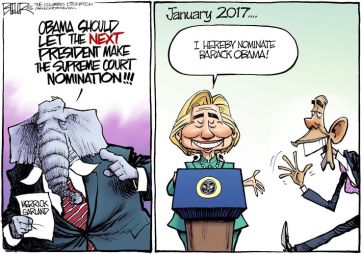
The Washington Examiner Sunday afternoon posted a piece by DC insider columnist Paul Bedard that claims uber-conservative Supreme Court Justice Clarence Thomas “is mulling retirement after the presidential election, according to court watchers.” Those “court watchers” of course are unnamed, so the actual source of the claim is unknown.
It could be true, it could be false, but the implications of course are tremendous. Assuming Republicans in the Senate successfully keeps their vow to not confirm any SCOTUS justice nominated by President Obama, and wait until the next president takes office, this would mean the next president would automatically nominate not one but two justices to the nation’s top court, controlling its destiny for decades.
So naturally, Clarence Thomas began trending on Twitter.
I’m feeling particularly lazy today–mostly I just don’t want to read any news. I’d rather be reading a novel, a true crime book, or maybe a biography. But I’ve been forcing myself to surf around to see what’s going on, and here’s what I’ve come up with.
The primaries are over, but Bernie Sanders is still hanging around like party guest who won’t leave even after everyone else has gone home and the party-givers have done the dishes and are dying to get some sleep.
Bernie Sanders is going to delay getting into the fight against Donald Trump so that he can get a few good ideas, a few iffy ideas, and a few bad ideas into the Democratic Party platform, a document that is about as useful as a roll of Charmin, but considerably less soothing to the skin. Just for good measure, he wants to get rid of Superdelegates and open up the primaries, which will work out great for Bernie Sanders from a year ago, but which will suck the first time Democrats have to run a primary against an incumbent Republican president, and Republican voters decide to vote in Democratic primaries just to mess with us. Brilliant, but none of which required him to continue to slight Hillary Clinton, except he might make Susan Sarandon and her purse dog mad.
Those Lazy Days of Summer, Jan Matson
Instead, Bernie will wait until he’s good and ready to make a half-assed endorsement of Hillary Clinton that will succeed only in winning a news cycle or two for Donald Trump, as he and the media rehash every attack he’s made against her, and every painstaking yank of the pliers it took to extract said half-assed endorsement.
But there’s something even more revealing about Bernie’s speech to supporters, because wrapped around those relevant 107 seconds was about 22 other minutes of Bernie boilerplate that neatly laid out his priorities. Throughout this campaign, Bernie and his supporters have continually insisted that if black voters would only stop and listen and give him a chance, they’d be dazzled by his down-ness and abandon their habitual support for Hillary….
Black people got tacked onto a few lists of other things, and some lines about failing schools and criminal justice reform. Or to put it another way, what black voters could expect from a Rand Paul speech. Not a syllable about ending police brutality or racial profiling, nothing about the Voting Rights Act or any other Republican schemes to disenfranchise black voters, and those are just the easy ones. Fifty-six seconds out of 23 minutes, and none of the bullet points he rushed up onto his website when #BlackLivesMatter protesters hassled him almost a year ago. Yeah, black voters had Bernie all wrong, didn’t they?
Watch Sanders’ almost-nonexistent thoughts on the Black vote at Mediaite.
As you can probably guess, most Democratic Party insiders were really hoping Bernie Sanders would formally drop out of the race this week and offer Hillary Clinton a fulsome endorsement. But they also recognize that he’s stopped attacking her, is promising to work against Donald Trump, and has basically accepted that the race is over — so if he wants to fade away slowly, they are happy to live with that.
The aspect of Sanders’s speech that really set them off last night was something entirely different. Not the fact that Sanders said he wanted his supporters to continue to influence the direction of the party but the specific way he characterized this direction:
I also look forward to working with Secretary Clinton to transform the Democratic Party so that it becomes a party of working people and young people, and not just wealthy campaign contributors: a party that has the courage to take on Wall Street, the pharmaceutical industry, the fossil fuel industry and the other powerful special interests that dominate our political and economic life.
It’s incredibly frustrating for people who’ve been working in mainstream Democratic Party politics to hear their party described as something other than a party for “working people.” Clinton won the votes of millions of working-class Americans, primarily people of color, throughout the 2016 primaries; and in the 2012, 2008, 2004, and 2000 election cycles there’s been a pronounced tendency for lower-income voters to back the Democratic candidate and higher-income ones to back the Republican.
Similarly, it comes as a shock to people who participated in the passage of the Dodd-Frank financial reform bill (or the White House’s series of later anti-bank regulatory actions) or who’ve worked to uphold the Obama administration’s Clean Power Plant rule that they apparently lack the courage to stand up to Wall Street and fossil fuel interests.
It’s one thing to disagree with people about policy substance or political tactics. But something Sanders has done throughout his campaign and very pointedly did here is straightforwardly challenge the good faith of the vast majority of his colleagues in Democratic Party politics. It’s worked pretty well for him on the stump, but it doesn’t win you a lot of friends. And to be honest, it’s simply wrong — you can raise a lot of objections to Obama’s approach to Wall Street or climate change, but the fact is that the financial services industry and the fossil fuel industries have been fighting him every step of the way.
Barney Frank was right. Bernie Sanders alienates his natural allies, whether deliberately or because he’s simply a terrible politician.
on Thursday, the Vermont senator announced he had an announcement to make. It’s been a long campaign, and Hillary Clinton bested him on every conceivable metric—albeit narrowly in some—other than the party-liquefying convention nuclear option to which Sanders doesn’t have the codes anyway. So, on Thursday night, the Vermont senator gathered friends, loved ones, and supporters around the country to huddle around a live video feed to humbly announce: He’s still running for president.
To be fair, Sanders hinted that soon he will be done and his “role” will change in a “very short period of time,” but he notably stopped well short of even remotely ending his campaign or endorsing Hillary Clinton.
Frankly, I doubt if he’ll ever endorse her, and I just don’t care. I don’t want him to campaign for her; I just want him to disappear.
Even with his path to the Democratic presidential nomination rapidly disappearing, Bernie Sanders couldn’t bring himself to publicly accept defeat. Along the way, he overplayed his hand and squandered the political capital he’ll need to force policy and procedural reforms on the Democratic Party, according to allies and party strategists.
“We’re already way past the maximum point of leverage that he and his movement built up. It’s definitely dissipating every day,” said Joe Trippi, a Democratic strategist and veteran of presidential campaigns.
Trippi put the high point of Sanders’ clout at April 9, after he won seven straight contests ending with Wyoming. But he lost seven of the last nine contests, walloped by 58 points in the District of Columbia, which held the final primary of the season on Tuesday. Hillary Clinton already had locked up the nomination with a decisive victory in California a week earlier, and some of the highest-profile Sanders supporters—including Senator Jeff Merkley, Representative Raul Grijalva, and the liberal activist group MoveOn—are now lining up behind her.
Read the rest at the link.
While Bernie continues to wallow in sour grapes, Hillary Clinton has been very busy defining Donald Trump for the folks who are just beginning to pay attention.
Lazy Summer, Mitch Caster
FirstPost.com: Hillary Clinton brings out ads to give Donald Trump “rude awakening.”
Hillary Clinton and her Democratic allies have invested at least $41 million in commercials in crucial states such as Ohio, Florida and Nevada over the next six weeks, a series of summer broadsides against her Republican opponent. Those messages will be echoed by hundreds of Clinton workers in those same states and amplified by President Barack Obama and other top Democrats.
Trump has made few preparations for contending with that sort of well-oiled political machine. His campaign has no advertising plans and is just now hiring employees in important states. Republican leaders are far from agreement on how best to talk to voters about the polarising billionaire, or if they will at all. And Trump is running out of time: Early voting starts in Iowa in just three and a half months.
“It’s political malpractice,” said Mitch Stewart, Obama’s 2012 battleground states director and a Clinton backer. “He’s in for a rude awakening. This isn’t a national vote contest where you can be on cable news every day and dominate coverage. This is literally going state by state and coming up with a plan in each.”
Clinton’s large June and July ad buy comes as a reward for her near-constant fundraising. In May, she raised $27 million in primary election money that must be used before she accepts her party’s nomination at the convention in late July.
Trump is playing catch up. He did not begin raising money in earnest until 25 May, having largely financed his primary bid through personal loans to his campaign.
Clinton’s latest spots, highlighting her past advocacy for children, are an attempt to reintroduce the returning presidential candidate — she lost the 2008 Democratic primary to Obama — to general election voters. Her campaign is spending about $23 million on ads by the convention, according to advertising tracker Kantar Media’s CMAG.
But those voters are also hearing from Priorities USA, a super political action committee financed by millions of dollars from Clinton’s staunchest supporters. The goal of those that $18.7 million batch of ads: cast Trump as a con-man and bully unprepared to be commander in chief.
Key West, Thomas Kinkade
As I wrote on Thursday, it’s beginning to look like Trump isn’t making even a halfhearted attempt to run for president. He seems to be focusing on deep red and deep blue states and ignoring the swing states he would have to win in order to have any hope of beating Hillary. He spent yesterday in Texas.
His campaign roiled by infighting and Republican revolt, Donald Trump is working to address a battleground state staffing shortage that highlights his reliance on a skeptical GOP establishment.
The New York billionaire has slowly begun to add paid staff in a handful of swing states — Wisconsin and Iowa, among them — even as campaign officials concede the presumptive presidential nominee has little desire or capacity to construct the kind of massive national operation that has come to define modern-day White House campaigns. Trump plans instead to depend upon the national Republican Party to lead state-based efforts on his behalf, while Democrat Hillary Clinton has had an army of staff dedicated specifically to her campaign in general election battlegrounds for months.
“It would be disingenuous and wrongheaded to take a playbook that has been used over and over again,” said Trump senior aide Karen Giorno, in charge of an 11-state Southeastern bloc including battlegrounds Florida, North Carolina and Virginia. “We are creating the playbook.
The unconventional approach reflects Trump’s disdain for traditional Republican campaign practices and inclination to implement businesslike decision-making. It also carries substantial risk.If, for instance, Trump is lagging Clinton badly in polls come early fall, there is nothing to stop the RNC from cutting its losses and focusing instead on saving Republican control of the Senate or other competitive contests also on the ballot this November. Beth Myers, who managed 2012 presidential nominee Mitt Romney’s campaign, said White House candidates have unique needs that a broader-brush approach cannot always meet.
“We are creating the playbook.” Unbelievable.
What stories are you following today?
Did you like this post? Please share it with your friends:
The Sky Dancing banner headline uses a snippet from a work by artist Tashi Mannox called 'Rainbow Study'. The work is described as a" study of typical Tibetan rainbow clouds, that feature in Thanka painting, temple decoration and silk brocades". dakinikat was immediately drawn to the image when trying to find stylized Tibetan Clouds to represent Sky Dancing. It is probably because Tashi's practice is similar to her own. His updated take on the clouds that fill the collection of traditional thankas is quite special.
You can find his work at his website by clicking on his logo below. He is also a calligraphy artist that uses important vajrayana syllables. We encourage you to visit his on line studio.























 peej
peej Carissa
 bostonboomer
 dakinikat
 ecocatwoman
 jjlo
jjlo mablue2
 Mama Lopez
 peggysue22
 quixote
 skydancingguestblogger
 Mona (aka Wonk the Vote)





Recent Comments