The world is shifting towards a superheated climate not seen in the past 1m years, prior to human existence, because “we are damned fools” for not acting upon warnings over the climate crisis, according to James Hansen, the US scientist who alerted the world to the greenhouse effect in the 1980s.
Hansen, whose testimony to the US Senate in 1988 is cited as the first high-profile revelation of global heating, warned in a statement with two other scientists that the world was moving towards a “new climate frontier” with temperatures higher than at any point over the past million years, bringing impacts such as stronger storms, heatwaves and droughts.
The world has already warmed by about 1.2C since mass industrialization, causing a 20% chance of having the sort of extreme summer temperatures currently seen in many parts of the northern hemisphere, up from a 1% chance 50 years ago, Hansen said.
“There’s a lot more in the pipeline, unless we reduce the greenhouse gas amounts,” Hansen, who is 82, told the Guardian. “These superstorms are a taste of the storms of my grandchildren. We are headed wittingly into the new reality – we knew it was coming.”
Hansen was a Nasa climate scientist when he warned lawmakers of growing global heating and has since taken part in protests alongside activists to decry the lack of action to reduce planet-heating emissions in the decades since.
He said the record heatwaves that have roiled the US, Europe, China and elsewhere in recent weeks have heightened “a sense of disappointment that we scientists did not communicate more clearly and that we did not elect leaders capable of a more intelligent response”.
“It means we are damned fools,” Hansen said of humanity’s ponderous response to the climate crisis. “We have to taste it to believe it.”
This year looks likely to be the hottest ever recorded globally, with the summer already seeing the hottest June and, possibly, hottest week ever reliably measured. Conversely, 2023 may in time be considered an average or even mild year, as temperatures continue to climb. “Things will get worse before they get better,” Hansen said.
“This does not mean that the extreme heat at a particular place this year will recur and grow each year. Weather fluctuations move things around. But the global average temperature will go up and the climate dice will be more and more loaded, including more extreme events.”
Read the rest at The Guardian.
Now on to the Trump Crimes:
The news that Trump received a target letter from Jack Smith warning him he is about to be indicted in the January 6 case has pushed the stolen documents case in Florida into the background. Judge Cannon can dither about setting a date for the stolen documents trial all she wants; the January 6 case will be tried in Washington DC, will likely be on a fast track, and will be higher profile. Trump could be indicted for the third time as early as Friday.
Tao Fung Shan (2019), by Stephen Wong Chun Hei (Hong Kong b. 1986),
Special counsel Jack Smith has informed former President Donald Trump by letter that he is a target in his investigationSp into efforts to overturn the 2020 election, sources familiar with the matter tell ABC News.
The target letter mentions three federal statutes: conspiracy to commit offense or to defraud the United States, deprivation of rights under color of law, and tampering with a witness, victim or an informant, sources familiar with the matter told ABC News.
There are no additional details in the letter and it does not say how the special counsel’s office claims Trump may have violated the statutes listed, sources said.
Trump, appearing Tuesday night at a town hall in Cedar Rapids, Iowa, told Fox News’ Sean Hannity that he received the letter on Sunday.
“It bothers me,” said the former president. “I got the letter on Sunday night. Think of it, I don’t think they’ve ever sent a letter on Sunday night. And they’re in a rush because they want to interfere, it’s election interference, never been done like this in the history of our country and it’s a disgrace what’s happening to our country.”
Target letters are typically given to subjects in a criminal investigation to put them on notice that they are facing the prospect of indictment.
The letter mentions three federal statutes: Conspiracy to commit offense or to defraud the United States; deprivation of rights under color of law; and tampering with a witness, victim, or an informant. It does not offer further details, nor does it detail how the special counsel believes Trump may have violated the statutes, the source tells Rolling Stone.
The letter does not mention statutes on sedition or insurrection, according to the source….
The source said the statutes listed likely refer to the prosecutor’s interest in charging Trump with obstructing the election certification process, including Trump efforts to pressure Mike Pence to stop the certification of President Biden’s 2020 victory.
A federal judge on Wednesday rejected Donald Trump’s request for a new trial in a civil case brought by E. Jean Carroll, where a jury found the former U.S. president liable for sexually abusing and defaming the writer and awarded her $5 million in damages.
In a 59-page decision, U.S. District Judge Lewis Kaplan in Manhattan said the jury did not reach a “seriously erroneous result,” and the May 9 verdict was not a “miscarriage of justice.”
Carroll had accused Trump of raping her in a Manhattan department store dressing room in the mid-1990s, and then branding the incident a hoax in an October 2022 post on his Truth Social platform.
Trump had argued that awarding Carroll $2 million in compensatory damages for sexual assault was “excessive” because the jury found he had not raped her, while the award for defamation was based on “pure speculation.”
The judge also found that Trump did rape Carroll, despite his claims of being exhonerated of that charge, according to the “common definition.”
JUST IN: Judge Kaplan rejects Trump's bid to throw out the verdict in the Carroll sexual assault lawsuit — and he says the Carroll jury did, in fact, find Trump raped her, based on the common definition of the word. https://t.co/3i62YnLA6Mpic.twitter.com/UqPd2VTFQE
Attorney General Dana Nessel is leveling felony charges against 16 Republicans who signed a certificate falsely stating that Donald Trump won Michigan’s 2020 presidential election, launching criminal cases against top political figures inside the state GOP.
Each of the 16 electors, including former Michigan Republican Party Co-Chairwoman Meshawn Maddock and Shelby Township Clerk Stan Grot, have been charged with eight felony counts, including forgery and conspiracy to commit election law forgery, according to Nessel’s office.
Moonlight Dance, by Paul Batch,, 1979
The revelation capped six months of investigation and produced the most serious allegations yet in Michigan over the campaign to overturn Trump’s loss to Democrat Joe Biden in 2020. Biden won the state by 154,000 votes or 3 percentage points, but Trump and his supporters maintained false and unproven claims that fraud swung the result.
As part of the push to undermine Biden’s victory, Trump supporters gathered inside the then-Michigan Republican Party headquarters on Dec. 14, 2020, and signed a certificate, claiming to cast the state’s 16 electoral votes for Trump.
Eventually, the false certificate was sent to the National Archives and Congress. The document inaccurately claimed the Trump electors had met inside the Michigan Capitol. However, they hadn’t. Biden’s electors convened inside the Capitol, and the building was closed to others on Dec. 14, 2020.
“The false electors’ actions undermined the public’s faith in the integrity of our elections and, we believe, also plainly violated the laws by which we administer our elections in Michigan,” said Nessel, a Democrat, in a statement.
“My department has prosecuted numerous cases of election law violations throughout my tenure, and it would be malfeasance of the greatest magnitude if my department failed to act here in the face of overwhelming evidence of an organized effort to circumvent the lawfully cast ballots of millions of Michigan voters in a presidential election.”
Special counsel Jack Smith’s team has contacted former Arizona Gov. Doug Ducey, who Donald Trump pressured to overturn the 2020 election, a source familiar with the outreach confirmed first to CNN.
A spokesman for Ducey confirmed the outreach from Smith’s team, which has not been previously reported.
Phil Greenwood (UK ,Wales. b.1943), Moon Lights, etching and aquating
“Yes, he’s been contacted. He’s been responsive, and just as he’s done since the election, he will do the right thing,” Ducey spokesman Daniel Scarpinato told CNN.
Trump narrowly lost Arizona to Joe Biden by less than 11,000 votes. Trump publicly attacked Ducey, a former ally, over the state’s certification of the results. As Ducey was certifying the election results in November 2020, Trump appeared to call the governor – with a “Hail to the Chief” ringtone heard playing on Ducey’s phone. Ducey did not take that call but later said he spoke with Trump, though he did not describe the specifics of the conversation.
Ducey, behind closed doors, said that the former president was pressuring him to find fraud in the presidential election in Arizona that would help him overturn the election, a source with knowledge told CNN earlier this month after The Washington Post first reported the news. There was no recording made of that call, a source familiar with the matter said.
Then-Vice President Mike Pence also spoke with Ducey in the wake of the 2020 election.
Federal prosecutors examining former President Donald Trump’s attempt to hold onto power following the 2020 election requested surveillance and other security footage recorded at Atlanta’s State Farm Arena, according to a subpoena obtained by The Atlanta Journal-Constitution.
In a grand jury subpoena dated May 31, the Georgia Secretary of State’s office was directed to hand over “any and all security video or security footage, or any other video of any kind, depicting or taken at or near” State Farm and “any associated data.”
The subpoena, which was obtained by The AJC through an open records request and had not been previously reported, shows the widening interest in Georgia from Justice Department special counsel Jack Smith, who sent a so-called “target” letter to Trump on Sunday.
It also demonstrated the growing areas of overlap between the DOJ probe and the Fulton County investigation of interference in Georgia’s 2020 elections, which is expected to result in indictments against Trump and others next month.
Previous subpoenas and grand jury appearances show that Fulton and federal prosecutors are both interested in the appointment of a slate of “alternate” Trump electors in swing states like Georgia, as well as the pressure the former president placed on Georgia Secretary of State Brad Raffensperger.
The federal judge overseeing former President Donald J. Trump’s classified documents case expressed skepticism on Tuesday about the government’s request to go to trial as early as December, but she also seemed disinclined to accede immediately to Mr. Trump’s desire to have the trial put off until after the 2024 election.
Appearing for the first time at a hearing in the case, the judge, Aileen M. Cannon, came to no decision about when to schedule the trial, saying she would issue a written order “promptly.”
George Wesley Bellows (USA 1882-1925), A Fresh Breeze, 1913
The question of the trial’s timing could be hugely consequential, given that the legal proceeding is intertwined with the calendar of a presidential campaign in which Mr. Trump is now the front-runner for the Republican nomination.
For nearly two hours in Federal District Court in Fort Pierce, Fla., Judge Cannon, a Trump appointee, peppered prosecutors and the former president’s lawyers with questions that suggested she was in command of her courtroom and well-versed in the facts of the case.
Her decision about when to schedule the trial will be an early test for the judge, who came under widespread criticism last year after she rendered some decisions in a related case that were favorable to Mr. Trump at an early stage of the investigation.
At one point, Judge Cannon directly asked one of Mr. Trump’s lawyers, Christopher Kise, if he wanted to put off the trial until after the election. When Mr. Kise said he did, Judge Cannon told him that she wanted to focus on near-term issues like the amount of discovery evidence the defense had to review and the types of motions the lawyers planned to file.
As the hearing came to end, Todd Blanche, another one of Mr. Trump’s lawyers, asked Judge Cannon if the defense could return to court in November and reassess the trial schedule then. Appearing to pick up on the judge’s desire to create what she called “a road map” for the case, Mr. Blanche said that if a trial date absolutely had to be chosen, he would ask for one in mid-November 2024, after the election.
Timing is particularly important in this case because if the trial is delayed until after votes are cast and Mr. Trump wins the race, he could try to pardon himself or have his attorney general dismiss the matter entirely.
I imagine the Special Counsel would appeal to the 11th Circuit if Cannon has the nerve to schedule the trial after the election, as Trump wants.
Former New York City police commissioner Bernie Kerik is in talks to be interviewed by special counsel Jack Smith’s team investigating efforts to overturn the result of the 2020 presidential election, Kerik’s attorney said Tuesday. Kerik worked with Rudy Giuliani after the election to find evidence of voter fraud and later provided documents about a plan to keep Donald Trump in power to the House Jan. 6 committee. Tim Parlatore, a lawyer who quit Trump’s legal team in May and who now represents Kerik, was asked by Kaitlan Collins on CNN if he expected the former commissioner to receive a letter like the one Trump received informing him that he was a target of Smith’s investigation. Parlatore said Kerik hasn’t received a target letter and does not expect him to at any point. But when asked if Parlatore is “in talks” about Kerik having an interview with the special counsel, the attorney said: “Yeah sure, absolutely. Mr. Kerik has nothing to hide. He’s happy to sit down and explain everything to them.”
Finally, news broke of another astonishing Trump crime yesterday–theft of valuable Israeli antiquities.
Trump’s Mar-a-Lago bathrooms and ballrooms were not just filled with top secret government documents. He apparently has also been hoarding temporarily loaned Israeli antiquities there for four years.
Haaretzreports that Israel lent the Trump White House antiquities, including ancient ceramic lamps from its national treasures collection, for a Hanukkah candle-lighting event in 2019. Israel Hasson, the then-director of the Israeli Antiquities Authority, approved the loan of the antiquities so long as they were returned within weeks.
Hasson told Haaretz that “we wanted our man to go and bring it back, but then Covid broke out, and everything got stuck.” So Hasson’s agency had asked Saul Fox, a major Jewish-American donor to the Antiquities Authority, to keep the items in tow until they could be brought back to Israel. But, Haaretz reports, Israeli authorities discovered several months ago that the antiquites instead ended up at Mar-a-Lago, “where they still remain.”
Eli Eskozido, the new Antiquities Authority head, has asked the Israeli government and Trump’s former U.S. ambassador to Israel to coordinate a return of the antiquities, but to no avail. One source told Haaretz that he wouldn’t be surprised if “the items Israel seeks are also eventually found in some bathroom.”
Republicans have bent over backward to show their inextinguishable support for Israel, but it’s unclear whether they will question why Trump has been harboring Israeli antiquities. After all, they had barely any criticism for his stealing of U.S. national security documents.
The extent of Trump criming is breathtaking, but his comeuppance is coming. As we say in the Midwest, he is up shit creek.
Have a wonderful Wednesday, Sky Dancers!!
Did you like this post? Please share it with your friends:
I can assuredly say that everyone I know has been so worn down by the Trump years that I cannot imagine this election season could get any worse than the last four. But, the more Trump wannabes enter races and the likelihood that Trump will prevail in the Republican party means that Republicans will amp up the campaign rhetoric as well as the trash passed by the House. Their infighting spills into the news also. Get ready to stock up on all your comfort items! It’s not even Labor Day, and the Crazy Train has left the station.
You might think, in a two-party democracy where the man who is a dead-on bet to be the presidential nominee of one of those parties has all but pledged to wipe out said democracy and promised to use his second term to destroy all internal enemies, that the rest of the society would band together to try to prevent that from happening.
That Donald Trump has so pledged is, to everyone who is not a supporter of his, beyond dispute. He has stated many times some version of his belief that “the greatest threat to Western civilization” is “some of the horrible, USA-hating people” in our midst, by which he means the many millions who disagree with him. When he was president, his people were preparing a plan for a possible second term that involved firing thousands of government employees and replacing them with staff loyal to him. He called for the termination of the Constitution’s rules that allowed Joe Biden to win in 2020, even though those rules worked properly to elect the person who won. He led a riot against the U.S. government to overthrow the election results. He calls the press the “enemy of the people.” There’s no telling what a new Trump term would bring. Our democracy would be disfigured at best and, at worst, destroyed.
You’d think people would take that pretty seriously. If we were all watching a Star Trek episode in which a teetering democratic society faced an imminent, dangerous threat, we’d be cheering for the society to come to its senses and work in unison to defeat the threat. That’s what should be happening in real life. But instead, a lot of people have chosen this moment, when the democracy is hanging by a few tattered threads and its future depends directly on the result of next year’s election, to say, Hey, let’s have some fun!This is all a game anyway.
Well, it’s not a game. And it’s astonishing to me that people can be so blithe about it. Let’s look at four (or four and a half) examples.
First, Robert F. Kennedy Jr. has decided that this is the right time to run a quixotic and corrosive presidential campaign whose end result can only be to fuel cynicism not just about Biden but about the whole system. That’s the inevitable outcome when a crackpot conspiracy theorist who spouts nothing but lies is given a platform like the one Kennedy now has.
His latest WTF moment, that Covid was “targeted to attack Caucasian and Black people” and that Jewish and Chinese people were most immune, may finally have signaled to the political-media establishment that this guy should not be indulged any further. Let us hope so. He won’t come close to winning the nomination. His support has slipped since the spring—he’s been polling at single digits in some state polls.
That isn’t the threat. The threat is that his out-there beliefs and cuckoo theories and refusal to denounce expressions of support from right-wing extremists up to and including Alex Jones (in his recent interview with David Remnick) lend support to the Trumpian view of the world. If his Democratic support ends up being a disgruntled 6 or 7 percent, without him on the November ballot, won’t the bulk of that 6 or 7 percent turn to the guy who sounds most like him? And in Wisconsin, Georgia, and a few other close states, that could be the ball game.
The top contributors to Robert F. Kennedy Jr.’s presidential campaign included donors who typically give to Republicans, according to campaign finance filings — underscoring the extent to which Kennedy, running as a Democrat, is resonating with the other party.
Kennedy’s campaign committee reported raising $6.3 million since his April launch, according to documents filed with the Federal Election Commission on Saturday. He spent $1.8 million and had $4.5 million cash on hand as of June 30.
Some of that money came from donors who have more recently supported Republicans. Kennedy’s campaign raked in at least $100,000 from donors who previously gave to committees associated with Florida Gov. Ron DeSantis or former President Donald Trump, according to a POLITICO analysis of federal and state campaign finance filings. The analysis is based solely on Kennedy’s itemized donations, although he also raised more than $2 million from small-dollar donors, whose names the campaign does not have to disclose.
Such crossover giving is unusual, but Kennedy is running on a platform that includes opposition to efforts to vaccinate against Covid-19, which is increasingly resonating with the Republican base. Though there has been an uptick in vaccine skepticism in recent years, the biggest increases tend to be among voters who identify as Republican.
Kennedy has also been a frequent guest on Fox News since launching his campaign in April, criticizing President Joe Biden on issues including the war in Ukraine and the response to the COVID-19 pandemic.
Among the donors who maxed out donating to Kennedy despite having recent histories of giving to Republicans is banking executive Omeed Malik, who Axios reported is hosting separate fundraisers for DeSantis and Kennedy in the Hamptons this summer.
We can always hope he drains voters from DeSantis, but DeSantis is doing a great job of that on his own.
This is from the Traister analysis. “RFK Jr.’s Inside Job. How a conspiracy-spewing literal Kennedy posing as a populist outsider jolted the Democratic Party.”
But they aren’t the only ones who took exploitative advantage of the suffering of millions: Kennedy’s vilification of Fauci as a fascist sold more than 1 million copies, and his public profile grew with his every outsize utterance, including that vaccine mandates “will make you a slave” and that “even in Hitler’s Germany, you could cross the Alps to Switzerland. You could hide in an attic like Anne Frank did,” a nadir so low that even his wife, the actress Cheryl Hines, had to issue a statement condemning it.
But however off-kilter he sounded — indeed, precisely because he was extra off-kilter in his attacks on lockdowns and vaccines and masks — Kennedy’s COVID performance became the springboard that launched his current campaign against Biden for the Democratic nomination for the presidency in 2024. Kennedy kicked off his bid in Boston in April, addressing a roomful of people cheering and holding signs with his name in the air. He had the look of a man getting the reception he’d been waiting for his whole life, and his extemporaneous remarks stretched to almost two hours, his expensive education and resemblance to his famous forebears covering for quite a bit of rambling. “He can look and sound so thoughtful and contemplative,” said one person who has known him a very long time. “And he’s just bursting with madness.” Kennedy soon began polling at an eye-catching nearly 20 percent in multiple surveys, and though a recent New Hampshire poll showed him at 9 percent in June, he earned higher favorability numbers in an Economist-YouGov poll than either Biden or Donald Trump.
He has spent the summer traveling to every dark-web–cancel-cultured–just-asking-questions–anti-woke whistle-stop that’ll have him, appearing on podcasts with Bari Weiss, Joe Rogan, Russell Brand, and Jordan Peterson, among others. He can count among his reply guys and fans (and, in some cases, early endorsers) a clutch of Silicon Valley CEOs and financiers, including hedge-fund manager Bill Ackman; venture capitalists Chamath Palihapitiya and David Sacks; and Elon Musk and Jack Dorsey, the current and former overlords of Twitter, respectively. He has been friendly with many in the media, including Salon founder and former editor-in-chief David Talbot and Rolling Stone co-founder and longtime editor Jann Wenner. Kennedy’s campaign manager is Dennis Kucinich, the former Cleveland mayor and Ohio congressman. A super-PAC called American Values 2024 has reportedly raised millions in support of Kennedy’s campaign, and Sacks held a fundraising dinner for him in June for which diners paid $10,000 a ticket. Kennedy’s drive to speak his mind has been praised by those on the far right, including Tucker Carlson and Steve Bannon, and some on the self-described left, like Matt Taibbi and Max Blumenthal.
Kennedy crowed to me about his horseshoe coalition gathered round a campaign he views as fundamentally populist. And it’s quite a band he has put together: crunchy Whole Foods–shopping anti-vaxxers, paunchy architects of hard-right authoritarianism looking to boost a chaos agent, Nader-Stein third-party perma-gremlins, some Kennedy-family superfans, and rich tech bros seeking a lone wolf to legitimize them. Their convening can give the impression of weightiness, but if you so much as blew on them, the alliance would shatter into a million pieces. The only thing that seems to bind them is Kennedy, the current embodiment of a warped fantasy of marginalization and martyrdom that has become ever more appealing — and thus politically significant — in an age of disinformation and distrust in government and institutions.
But nobody who covers elections (including us) seems to be taking Williamson and Kennedy particularly seriously. So I come to the FiveThirtyEight brain trust with two questions today:
There’s plainly some kind of appetite for a non-Biden candidate on the Democratic side — so why are oddball candidates like Williamson and Kennedy the only ones who have jumped in?
Are we underestimating Williamson and Kennedy’s ability to make Biden’s life difficult as we get closer to the Democratic primaries?
nrakich (Nathaniel Rakich, senior elections analyst): Interesting, Amelia, I’m not sure I agree with your premise there! I think a lot of people are taking Williamson and Kennedy more seriously than I’d like them to.
ameliatd: ((Amelia Thomson-DeVeaux, senior reporter) Ooh, we’re bickering already! I love it. Please say more …
nrakich: Basically, they’re being covered like serious candidates. Reporters are going to their rallies and writing exposés on them. Even if they say they are extreme long-shot candidates, they aren’t treating them that way. Actions speak louder than words.
Gov. Ron DeSantis of Florida has started cutting campaign staff just months into his presidential bid, as he has struggled to gain traction in the Republican primary and lost ground in some public polls to former President Donald J. Trump.
The exact number of people let go by the DeSantis team was unclear, but one campaign aide said it was fewer than 10. The development was earlier reported by Politico.
The dismissals are an ominous sign for the campaign and also underscore the challenges that Mr. DeSantis faces with both his fund-raising and his spending, at a time when a number of major donors who had expressed interest in him have grown concerned about his performance.
[…]
Mr. DeSantis’s struggles appear to be not just about the numbers, but also with the campaign’s message. Late last week, two top DeSantis advisers, Dave Abrams and Tucker Obenshain, were announced to be leaving to join an outside group supporting Mr. DeSantis.
Mr. DeSantis’s campaign finance disclosure with the Federal Election Commission shows he raised roughly $20 million but spent almost $8 million, a so-called burn rate that leaves him with just $12 million in cash on hand. Only about $9 million of that cash can be spent in the primary, with the rest counting toward the general election if he is the nominee.
The filing indicated a surprisingly large staff for a campaign so early in a candidacy, particularly for one with a super PAC that has made a show of how much of the load it is prepared to handle. More than $1 million in expenditures were listed as “payroll” and payroll processing.
Ah, the “burning tons of cash to go backward” trajectory. To be fair, there is no precedent for a Florida Republican becoming an establishment darling, raising lots of money, and having his presidential campaign become a pathetic joke.
Former President Trump’s campaign described Iowa state Sen. Jeff Reichman (R) as “lily-livered” for flipping his endorsement to Florida Gov. Ron DeSantis (R) following Trump’s attack on Iowa Gov. Kim Reynolds (R) earlier this week.
In a statement to The Hill, Trump campaign spokesperson Steven Cheung stated, “There is no room for weak-kneed and lily-livered people on Team Trump.”
Reichman, an Iraq veteran, announced Thursday he would be flipping his endorsement of Trump, and backing DeSantis instead. The state senator, who is serving his first term in Iowa’s upper chamber, was included on a list of around a dozen Iowa officials who the Trump campaign considered early endorsers of the former president.
In his statement, Cheung goes on to claim DeSantis is “so desperate that he’s willing to offer buyouts in the form of fundraisers for endorsements.”
“The truth is that those who have been promised financial support are now regretting their deal with the devil because none of them have been able to schedule fundraisers with DeSantis,” the statement continued.
Reichman’s decision to flip support comes days after Trump lashed out at Reynolds on Truth Social on Monday for not endorsing a presidential candidate in the 2024 election. The social media post followed a New York Times report describing the Trump campaign’s frustration with Reynolds’s multiple appearances with DeSantis during his stops in Iowa.
Crow’s lawyer argues that Congress has no authority to probe the GOP donor’s generosity and that doing so violates a constitutional separation of powers between Congress and the Supreme Court.
Members of Congress say there are federal tax laws underlying their interest and a known propensity by the ultrarich to use their yachts to skirt those laws.
Tax data obtained by ProPublica provides a glimpse of what congressional investigators would find if Crow were to open his books to them. Crow’s voyages with Thomas, the data shows, contributed to a nice side benefit: They helped reduce Crow’s tax bill.
The rich, as we’ve reported, often deduct millions of dollars from their taxes related to buying and operating their jets and yachts. Crow followed that formula through a company that purported to charter his superyacht. But a closer examination of how Crow used the yacht raises questions about his compliance with the tax code, experts said. Despite Crow’s representations to the IRS, ProPublica reporters could find no evidence that his yacht company was actually a profit-seeking business, as the law requires.
“Based on what information is available, this has the look of a textbook billionaire tax scam,” said Senate Finance Committee chair Ron Wyden, D-Ore. “These new details only raise more questions about Mr. Crow’s tax practices, which could begin to explain why he’s been stonewalling the Finance Committee’s investigation for months.”
Crow, through a spokesperson, declined to respond to ProPublica’s questions.
So, ‘Ain’t That Pretty at All.’
Well, I’ve seen all there is to see And I’ve heard all they have to say I’ve done everything I wanted to do . . . I’ve done that too And it ain’t that pretty at all Ain’t that pretty at all So I’m going to hurl myself against the wall ‘Cause I’d rather feel bad than not feel anything at all
Warren Zevon
What’s on your reading and blogging list today?
Did you like this post? Please share it with your friends:
There’s always been a debate within the belief communities that embrace karma concerning its application to a group of people, a nation-state, or perhaps, even a global community. I’ve always been on the side that embraces something akin to the psychological concept of gestalt. That is the idea that “an organized whole that is perceived as more than the sum of its parts.”
Sometimes, you have to make the parts matter.
While mainstream America was complacent and asleep, a group of radical right Republicans began scheming a way to shape the courts and state government bodies into entities where they could capture American Laws. It took a manic form in the 90s. Now, just as the states began sending lawsuits up to courts packed with their minions, it appears other states are using means to put their states back on track to normalcy and constitutional law.
You can see the struggles clearly if you watch the headlines from state to state. It’s clearest in the so-called culture war issues. Blue state governors and citizens are finding legal ways to bypass the Supreme Court by changing their state laws or using the tools they’ve already been given. This is driving the right-wingers crazy, so they are now looking for more Federal intervention to save their crusades.
“The Republican budgets were a complete mess, and today I used my executive powers to clean them up to protect Michiganders,” said Governor Whitmer. “The state’s budget is a reflection of our values, and make no mistake that public health and safety, access to health care, and protecting classroom spending is more important than handouts to lobbyists and vendors.”
This week, Wisconsin’s Democratic Gov. Tony Evers made key changes to the state budget passed by the Republican-controlled legislature, slashing GOP tax cuts and guaranteeing education funding increases for the next 402 years. It was a staggering maneuver that follows years of battles between Evers and GOP lawmakers. And it’s one that highlights how a Democratic state leader can use singular executive powers to combat a legislature dominated by Republicans.
Evers pulled these changes off by leveraging a tool known as the line-item veto, a power granted to governors in 44 states, which allows them to veto parts of a budget bill instead of the entire measure. Wisconsin, in particular, gives governors “uniquely powerful” line-item veto authorities for appropriations bills that allow them to target “sentences, words or in some cases even a single character or digit,” according to WisContext’s Will Cushman.
Evers made full use of this power when changing a phrase that increased funding for the “2023–24 school year and the 2024–25 school year” to the “2023–2425” school years by vetoing parts of that sentence. On Wednesday, Evers signed the new $99 billion budget, which will span the next two years, into law.
Gov. Josh Shapiro says he plans to scrap his push for private school vouchers in Pennsylvania’s state budget in order to close a deal with the commonwealth’s divided legislature five days after the deadline.
The Democrat issued a statement Wednesday acknowledging that talks had deadlocked over a $100 million voucher program, which he had supported and which state Senate Republicans passed as part of their budget proposal last week. Pennsylvania House Democratic leaders oppose vouchers and had refused to act on the Senate’s bill.
Shapiro’s solution, he said, was to promise state House Democrats that if they pass the Senate’s budget, he will then line-item veto the vouchers from the $45.5 billion spending plan.
“Our Commonwealth should not be plunged into a painful, protracted budget impasse while our communities wait for the help and resources this commonsense budget will deliver,” Shapiro said in a statement.
See, elected officials from the Democratic Party can hold up a budget too.
Adults in Arizona can now obtain contraceptive medications over the counter at a pharmacy without a doctor’s prescription under a governor’s order announced Thursday.
Gov. Katie Hobbs said the rule will go into effect immediately. It applies to self-administered birth control such as hormonal and oral contraceptives, and patients 18 or older need only complete a screening and a blood pressure test.
“We are building an Arizona for everyone, which means ensuring people across the state have what they need to live a free and healthy life,” the Democratic governor said in a statement.
Over 20 states have statutes that let pharmacists dispense FDA-approved hormonal contraceptives without a prescription, according to a statement from the Arizona Department of Health Services.
Hobbs has used her executive powers in recent weeks to promote reproductive freedom. In June she issued a sweeping executive order effectively stripping prosecutors of their ability to pursue charges against anyone involved with a legally obtained abortion.
Ohio moved one step closer to becoming the next big test case in the nation’s fight over abortion, after supporters of a measure that would ask voters to establish a right to abortion in the state’s Constitution this week said they had filed more than enough signatures to put it on the ballot in November.
Ohioans United for Reproductive Rights said on Wednesday that it had collected roughly 710,000 signatures across all of the state’s 88 counties over the last 12 weeks. Under state law, the coalition needed 413,466 to qualify for the ballot. State election officials now have until July 25 to verify the signatures.
Supporters of abortion rights are turning to ballot measures in the aftermath of the ruling last year by the United States Supreme Court overturning Roe v. Wade, which for 50 years had guaranteed a right to abortion in the federal Constitution. They are betting on polls showing that public opinion increasingly supports some right to abortion, and opposes the bans and stricter laws that conservative state legislatures have enacted since the court’s decision.
Voters in six states, including conservative ones such as Kentucky and Kansas, voted to protect or establish a right to abortion in their constitutions in last year’s elections, and abortion rights advocates in about 10 other states are considering similar plans.
Far-right Oklahoma State Superintendent Ryan Walters suggested at a public hearing in Norman that lessons about the infamous racial massacre that destroyed the most prosperous Black community in Oklahoma don’t have to mention race, reported Fox 25 News.
“The Cleveland County Republican Party invited him to speak at the Norman Central Library. The room was packed with many unhappy Oklahomans, making for an hour of chaos,” reported David Chasanov.
“It doesn’t matter how much the radical left attacks me,” Walters told the crowd. ‘It doesn’t matter how much the teachers union spends against me. I will never stop speaking truth.”
However, things got tricky for Walters when someone asked him if teaching about the infamous “Black Wall Street” massacre in the city of Tulsa would be banned under his restrictions on teaching “Critical Race Theory.”
“Let’s not tie it to the skin color and say that the skin color determined that,” Walters replied.
The Tulsa massacre was an act of racial mass terrorism in 1921 that destroyed the Greenwood District of Tulsa, a nationally-renowned prosperous community nicknamed “Black Wall Street.” After a 19-year-old Black shoeshiner named Dick Rowland was arrested on trumped-up charges for allegedly assaulting a white elevator operator named Sarah Page, white residents of Tulsa rioted, looting and burning down the Greenwood District. Roughly 300 people were killed, and when the National Guard was sent in, the Black residents were arrested by the thousands.
Meanwhile, down here in Lousyana, our Democratic Governor John Bel Edwards put his personal religion above the health of women. My tax dollars will support pregnancy propaganda centers. This is from the Louisiana Illuminator and was reported by Julie O’Donohue. “Tax credit approved for donors to Louisiana anti-abortion centers.” I’d like to challenge this one as going against many of our religious views. Wonder if the ACLU is up to it?
Donors to the organizations, which have been renamed maternal wellness centers in the state law, will be able to benefit from $30 million worth of income tax breaks that will be issued from 2025 through 2030.
A donor will be able to claim an income tax credit equal to 50% of their contribution to a center or 50% of their total state income tax liability in the year the contribution was made, whichever is lower.
The total amount of tax credits that can be given out will be generally limited to $5 million per year, except that credits from years where the $5 million maximum is not reached can be rolled forward and made available in subsequent years.
If the $5 million is maxed out early in a given year, then donors who weren’t able to receive a credit that year are put to the front of the line for getting the tax break in the following year. No one center is allowed to benefit from more than 20% of the tax credits made available, according to the law.
Anti-abortion groups pushed for the law sponsored by Senate President Pro Tempore Beth Mizell, R-Franklinton.
“It is critical for the pro-life movement to find every avenue to support Louisiana mothers, whether that be through private or public resources,” said Ben Clapper, executive director of Louisiana Right to Life, one of the state’s large anti-abortion advocacy organizations.
“We believe this important law permitting Louisiana citizens to receive a tax credit when they donate to a maternal wellness center will strengthen resources for families,” he said.”
Mizell, in hearings during the legislative session, said she thought the centers could help improve women’s health in Louisiana.
Here’s the deception. This will undoubtedly include child trafficking (i.e., coerced letting babies go up for adoption).
Donors to the organizations, which have been renamed maternal wellness centers in the state law, will be able to benefit from $30 million worth of income tax breaks that will be issued from 2025 through 2030…
Everyone is waiting to see if it is possible for the AG of Colorado to take on the Supreme Court in that Fake Wedding Planner Case. Neal Katyal suggested it was possible. Other Legal Scholars do not think it is possible. This is from Salon. “Legal scholars: SCOTUS can’t be forced to reconsider “made-up” case — but lawyers can be punished. Professors push back on ex-solicitor general’s claim that SCOTUS can be compelled to reexamine 303 Creative cases”
But legal scholars pushed back on Katyal’s argument.
“I think this is a nonstarter,” former U.S. Attorney Barb McQuade, a University of Michigan law professor, told Salon. “The Court glossed over standing in this case because a plaintiff is permitted to make a facial challenge to a law on the ground that yet violates the First Amendment.”
“If the allegations about fabrication are true, then the lawyers may have an ethics problem to address with their state bar, but it will not affect the outcome of the case,” McQuade added.
Leah Litman, a law professor at the University of Michigan, told Salon that parties are “free to file a motion for reconsideration or rehearing,” but ultimately, it will be up to the court to decide whether to do anything about it.
“Attorneys are subject to judicial discipline & discipline from bar organizations if they lie to the court,” Litman said.
Longtime Harvard Constitutional scholar Laurence Tribe told Salon that Katyal “certainly knows that no state attorney general has any such authority,” adding that he doesn’t take Katyal literally when he suggests that.
“But it would be a mistake to let that obscure the central fact that the entire case was based on entirely hypothetical ‘worries’ that the web designer claimed to have about how the state’s officers might come after her under the state anti-discrimination laws if a same-sex couple were to ask her to design a wedding site for them and if she were to refuse,” Tribe said. “In my view, the disgraceful fact, which in no way depends on the falsity of the allegations about the fellow who supposedly asked Lorie Smith to design a website for a same-sex wedding, is the very fact that the Supreme Court’s majority was willing to render what amounted to an advisory opinion that it would never have done but for its eagerness to denigrate same-sex marriage and LGBTQ rights generally and that, under Article III, it had no business doing.”
There are 486 days to the next President Election. Be sure to check your state’s primaries, and carefully choose all the candidates from POTUS to your dog catcher. It can make a difference.
What’s on your reading and blogging list today?
Did you like this post? Please share it with your friends:
ROUND HILL, Va. — They said goodbye to Aimee outside her elementary school, watching nervously as she joined the other children streaming into a low brick building framed by the foothills of the Blue Ridge Mountains. Christina and Aaron Beall stood among many families resuming an emotional but familiar routine: the first day of full-time,in-person classes since public schools closed at the beginning of the pandemic.
incomprehensible to the parents around them. Their 6-year-old daughter, wearing a sequined blue dress and a pink backpack that almost obscured her small body, hesitated as she reached the doors. Although Aaron had told her again and again how brave she was, he knewit would be years before she understood how much he meant it — understood that for her mother and father, the decision to send her to school was nothing less than a revolt.
Aaron and Christina had never attended school when they were children. Until a few days earlier, when Round Hill Elementary held a back-to-school open house, they had rarely set foot inside a school building. Both had been raised to believe that public schools were tools of a demonic social order, government “indoctrination camps” devoted to the propagation of lies and the subversion of Christian families.
At a time when home education was still a fringe phenomenon, the Bealls had grown up in the most powerful and ideologically committed faction of the modern home-schooling movement. That movement, led by deeply conservative Christians, saw home schooling as a way of life — a conscious rejection of contemporary ideas about biology, history, gender equality and the role of religion in American government.
Christina and Aaron were supposed to advance the banner of that movement, instilling its codes in their children through the same forms of corporal punishment once inflicted upon them. Yet instead, along with many others of their age and upbringing, they had walked away.
Jamison describes how right wing Christians have used home schooling to indoctrinate their children and tie them to their religious beliefs.
Among conservative Christians, home schooling became a tool for binding children to fundamentalist beliefs they felt were threatened by exposure to other points of view. Rightly educated, those children would grow into what HSLDA founder Michael Farris called a “Joshua Generation” that would seek the political power and cultural influence to reshape America according to biblical principles.
Over decades, they have eroded state regulations, ensuring that parents who home-school face little oversight in much of the country.More recently, they have inflamed the nation’s culture wars, fueling attacks on public-school lessonsabout race and gender with the politically potent language of “parental rights.”
But now younger generations are rebelling.
Former home-schoolers have been at the forefront of those arguing for greater oversight of home schooling, forming the nonprofit Coalition for Responsible Home Education to make their case.
“As an adult I can say, ‘No. What happened to me as a child was wrong,’” said Samantha Field, the coalition’s government relations director.
More about Christina and Aaron Beall:
Christina, 34, and Aaron, 37, had joined no coalitions.They had published no memoirs. Their rebellion played out in angry text messages and emails with their parents, in tense conversations conducted at the edges of birthday parties and Easter gatherings. Their own children — four of them, including Aimee — knew little of their reasons for abandoning home schooling: the physical and emotional trauma of the “biblical discipline” to which they had been subjected, the regrets over what Aaron called “a life robbed” by strictures on what and how they learned.
Aaron had grown up believing Christians could out-populate atheists and Muslims by scorning birth control; Christina had been taught the Bible-based arithmetic necessary to calculate the age of a universe less than 8,000 years old. Their education was one in which dinosaurs were herdedaboard Noah’s ark — and in which the penalty for doubt or disobedience was swift. Sometimes they still flinched when they remembered their parents’ literal adherence to the words of the Old Testament: “Do not withhold correction from a child, for if you beat him with a rod, he will not die.”
The Bealls knew that many home-schooling families didn’t share the religious doctrines that had so warped their own lives. But they also knew that the same laws that had failed to protect them would continue to fail other children.
“It’s specifically a system that is set up to hide the abuse, to make them invisible, to strip them of any capability of getting help. And not just in a physical way,” Christina said. “At some point, you become so mentally imprisoned you don’t even realize you need help.”
I’ve quoted a lot, but there is much more to this fascinating story. Much of it was new to me, although I was not completely surprised. I hope you will check it out.
Next up a story about infighting among Trump’s many lawyers.
With three anticipated indictments, two ongoing court cases, and an ever-expanding cadre of lawyers, former President Donald Trump is at a critical juncture—and yet his legal advisers are starting to turn on each other.
According to five sources with direct knowledge of the situation, clashing personalities and the increasing outside threat of law enforcement has sown deep divisions that have only worsened in recent months. The internal bickering has already sparked one departure in recent weeks—and that could be just the beginning.
As Trump’s legal troubles keep growing—with criminal and civil investigations in New York City, Washington, and Atlanta—so too does the unwieldy band of attorneys who simply can’t get along.
The cast of characters includes an accused meddler who has Trump’s ear, a young attorney who lawyers on the team suggested is only there because the former president likes the way she looks, and a celebrity lawyer who’s increasingly viewed with disdain. Worst of all, now that federal investigators have turned the interrogation spotlight on some of Trump’s lawyers themselves, defense attorneys on the team seem to be questioning whether their colleagues may actually turn into snitches.
“There’s a lot of lawyers and a lot of jealousy,” said one person on Trump’s legal team, explaining that the sheer number of lawyers protecting a single man accused of so many crimes is without parallel.
At the center of the controversy is Boris Epshteyn, who has been in Trump’s orbit since 2016 and now is so close to Trump that he’s been compared to a presidential chief of staff.
Part of the concern over lawyers turning on each other is due to the fact that the Department of Justice already has one Trump attorney’s professional notes, which could position him as a future witness against his own client, and the DOJ has another lawyer who said too much in an unrelated case and has positioned herself as yet another potential witness against her client.
But much of the anger from Trump’s lawyers is directed at the former president’s right-hand man, Boris Epshteyn, who’s accused of running interference on certain legal advice from more experienced courtroom gladiators.
Boris Epshteyn
Epshteyn, who’s a lawyer himself, has risen through the ranks in Trumpworld over the years, first as an adviser for Trump’s 2016 campaign, then as a more senior adviser for 2020, and now part of Trump’s innermost circle for 2024.
Ephsteyn seems to have the former president’s supreme confidence, with what’s described as a final say on all matters related to public relations and legal issues. But there’s snickering in the shadows. Several sources ridiculed the way Ephsteyn refers to himself as “in-house counsel”—normally a term for a company’s corporate attorney—noting how it echoes the way John Gotti’s mafia lawyer used to describe his services for the infamous Gambino crime family.
Epshteyn’s meddling has particularly affected the lawyers working to defend Trump from Department of Justice Special Counsel Jack Smith and his investigation into whether the former president broke the law when he took top secret documents on his way out of the White House in January 2021 and hoarded them at Mar-a-Lago.
Another complication is there are separate groups of lawyers working on different cases in Georgia, New York, and Washington DC.
The Manhattan District Attorney’s Office, which indicted Trump in March for faking business records, is about to dump thousands of documents of evidence on defense lawyers Todd Blanche, Susan Necheles, and Joe Tacopina—who aren’t allowed to freely share those documents with the former president. They may even have to fight Trump to prevent him from stupidly posting sensitive details on social media.
The DA’s prosecutors are already trying to fracture Trump’s legal team by attempting to disqualify Tacopina and make him seem like a weak link, because he has a tenuous connection to a key witness in the case, the porn star Stormy Daniels whose hush money payment Trump tried to hide while running for president back in 2016.
Meanwhile, defense attorneys Alina Habba and Christopher Kise are gearing up for a civil trial in October against the New York Attorney General, who seeks to bleed the Trump Organization dry and destroy Trump’s ability to do conduct business in the financial capital of the world by holding him personally liable for bank and insurance fraud.
In Georgia, the defense lawyers Drew Findling, Melissa Goldberg, and Jennifer L. Little are preparing for the Fulton County District Attorney to indict Trump in July or August over the way he intimidated the state’s top elections official in 2021 while trying to overturn his loss there—a recorded phone call where he was advised by yet other lawyers he trusted.
And an entirely different team of lawyers split up between the nation’s capital and his oceanside Florida estate—former federal prosecutors M. Evan Corcoran, John P. Rowley, and Jim Trusty up north and Halligan down south—are gearing up for two different fights with the Department of Justice.
Again, I’ve quote quite a bit, but there is much much more to this story.
The third long read is from Marcy Wheeler at Emptywheel. It’s about the media’s failure to include Trump’s many legal problems in their analysis of his chances at winning the nomination in 2024.
Over the weekend I argued that all horserace coverage of the GOP primary is useless if it doesn't account for possible Trump indictments. https://t.co/5Gxud33hvJ
Its analysis of the numbers and Ron DeSantis’ early failures isn’t bad. But because it is silent about how the expanding field might play in the likelihood of Trump indictments, it is entirely worthless.
For example, the content and timing of indictments may have an utterly central impact on the two dynamics described in the piece: Trump’s diehard base and the unwillingness of others in the party to criticize Trump directly.
The rapidly ballooning field, combined with Mr. Trump’s seemingly unbreakable core of support, represents a grave threat to Mr. DeSantis, imperiling his ability to consolidate the non-Trump vote, and could mirror the dynamics that powered Mr. Trump’s takeover of the party in 2016.
It’s a matter of math: Each new entrant threatens to steal a small piece of Mr. DeSantis’s potential coalition — whether it be Mr. Pence with Iowa evangelicals or Mr. Scott with college-educated suburbanites. And these new candidates are unlikely to eat into Mr. Trump’s votes. The former president’s base — more than 30 percent of Republicans — remains strongly devoted to him.
[snip]
The reluctance to go after Mr. Trump, for many Republicans, feels eerily like a repeat of 2016. Then, Mr. Trump’s rivals left him mostly alone for months, assuming that he would implode or that they were destined to beat him the moment they could narrow the field to a one-on-one matchup, a situation that never transpired.
Consider how each of three legal risks (and these are only the most obvious) might affect these issues. This post builds on this series I did last month:
The folks in DC are still arguing about whether the U.S. government should pay its bills or not. Republicans think it’s much more important to make poor, disabled, and elderly Americans, as well as federal employees–including the military–suffer than to simply write those checks and then sit down and work on the next budget. If Congress doesn’t get its act together, millions of people in those categories will be unable to pay their rent and bills and buy food. I suppose this will go down to the wire and then be worked out, but I think the whole mess is getting dangerous.
The United States has a few more days than expected before it runs out of money, Treasury Secretary Janet Yellen said in a letter Friday afternoon.
The new deadline to act or risk breaching the debt ceiling is June 5, Yellen said, setting a hard deadline for the first time. She had previously been less specific, saying the breach could occur “potentially as early as June 1.”
The Treasury Department hit the statutory borrowing limit in January and has since been using “extraordinary measures” to pay the country’s bills.
“Based on the most recent available data, we now estimate that Treasury will have insufficient resources to satisfy the government’s obligations if Congress has not raised or suspended the debt limit by June 5,” Yellen wrote to congressional leaders.
This is just about paying the bills that we’ve already run up, but Republicans want hold the funds hostage so they can punish people who need help from the government.
The two parties have been sorting through their differences on spending levels. But a major hangup is the Republican demand to impose tougher work requirements for Americans to receive federal benefits like SNAP, the Supplemental Nutrition Assistance Program, two sources familiar with the talks said.
Rep. Garret Graves of Louisiana, who is leading negotiations for House Republicans, said it’s “totally appropriate” for an older group of able-bodied Americans without dependents to be subject to work requirements in order to get federal aid….
Democrats say work requirements already exist for federal programs and argue that stricter policies would create more red tape and throw eligible Americans who don’t complete the paperwork correctly off the rolls, and that work requirements have little impact on unemployment.
Painting by Quint Bucholz
Republicans know they’d never win this argument without holding the full faith and credit of our country hostage, so that is what they are doing. If only Democrats had listened to Yellen when they still held a majority in both houses for a brief time after the midterms, this wouldn’t be happening now.
In the days after November’s midterm elections, Treasury Secretary Janet L. Yellen was feeling upbeat about the fact that Democrats had performed better than expected and maintained control of the Senate.
But as she traveled to the Group of 20 leaders summit in Indonesia that month, she said Republicans taking control of the House posed a new threat to the U.S. economy.
“I always worry about the debt ceiling,” Ms. Yellen told The New York Times in an interview on her flight from New Delhi to Bali, Indonesia, in which she urged Democrats to use their remaining time in control of Washington to lift the debt limit beyond the 2024 elections. “Any way that Congress can find to get it done, I’m all for.”
Democrats did not heed Ms. Yellen’s advice. Instead, the United States has spent most of this year inching toward the brink of default as Republicans refused to raise or suspend the nation’s $31.4 trillion borrowing limit without capping spending and rolling back parts of President Biden’s agenda.
So what will Yellen do in the worst case scenario?
Ms. Yellen has held her contingency plans close to the vest but signaled this week that she had been thinking about how to prepare for the worst. Speaking at a WSJ CEO Council event, the Treasury secretary laid out the difficult decisions she would face if the Treasury was forced to choose which bills to prioritize.
Most market watchers expect that the Treasury Department would opt to make interest and principal payments to bondholders before paying other bills, yet Ms. Yellen would say only that she would face “very tough choices.”
White House officials have refused to say if any contingency planning is underway. Early this year, Biden administration officials said they were not planning for how to prioritize payments. As the U.S. edges closer to default, the Treasury Department declined to say whether that has changed.
Yet former Treasury and Federal Reserve officials said it was nearly certain that emergency plans were being devised.
Sen. Kyrsten Sinema (I-Ariz.) has inserted herself into the debt ceiling negotiations, working with both sides to try to bridge differences on permitting reform, according to people familiar with the matter.
Why it matters: Her late entrance is a sign that negotiators are willing to explore new avenues to resolve thorny issues before June 5, the new deadline from Treasury Secretary Janet Yellen for when the U.S. government will run out of money.
— Permitting reform — a catch-all category that includes both Republican and Democratic plans to improve energy production and transmission — is emerging as a tough-to-resolve disagreement between the White House and congressional negotiators.
— Republicans want to change the National Environmental Policy Act (NEPA) with the goal of cutting red tape for oil and gas companies when they develop new projects. Democrats want to make it easier for solar and wind farms to access transmission lines.
Negotiators also are at an impasse on a demand from House Speaker Kevin McCarthy (R-Calif.) to add new work requirements to welfare benefits, according to Biden administration officials.
— But the two sides are making progress on overall spending levels, with the goal of capping spending for two years at lower levels. In exchange, the debt ceiling would be raised past the 2024 elections.
After a debt limit negotiating session at the White House this week, House Speaker Kevin McCarthy returned to the Capitol and offered reporters an update.
“Let me be very clear,” he said. “From the first day I sat with the president, there’s two criterias I told him,” McCarthy said, raising two fingers. “We’re not going to raise taxes because we bring in more money than we ever have. And we’re not going to pass a clean debt ceiling. And we’ve got to spend less than we spent this year.”
Let me be very clear, Mr. Speaker. Those are three, er, “criterias.”
Filippo Corelli, Cat in a Doorway, early 20th century
This might be the most worrying aspect of the default standoff: The full faith and credit of the United States hangs in the balance, and the man sitting across the negotiating table from the president seems to be genuinely off-kilter.
Whipsawed by public pressure from the far-right House Freedom Caucus and from former president Donald Trump, McCarthy has at one moment praised the “honesty” and “professionalism” of White House negotiators and the next moment attacked the other side as “socialist.” He gives daily (sometimes hourly) updates packed with fake statistics, nonsense anecdotes and malapropisms. His negotiators have walked out of talks only to resume them hours later. This week, at a meeting of the House Republican Conference during the height of negotiations, he decided it was the right moment to auction off a stick of his used lip balm as a fundraiser for House Republicans’ political campaigns. (Rep. Marjorie Taylor “Jewish Space Lasers” Greene won the bidding at $100,000.)
The speaker’s erraticism has an obvious origin. As usual, he isn’t leading. He’s being buffeted by crosscurrents. If he bends too much in talks, he’ll lose his GOP hardliners and could therefore lose his job. If he pleases the hardliners, he keeps his job but throws the country and perhaps the world into economic calamity. His job security or the world economy? McCarthy just can’t decide.
Prosecutors in former President Donald Trump’s Manhattan criminal case have released to his attorneys a recording of Trump and a witness, whose identity was not disclosed, according to a document the office made public Friday.
The document, called an automatic discovery form, describes the nature of the charges against a defendant and a broad overview of the evidence that prosecutors will present at Trump’s preliminary hearing or at trial. Trump’s attorneys and media organizations, including CBS News, had repeatedly requested that such a form be made public in the weeks since Trump’s arrest on April 4….
The document lists the dates of 34 instances between Feb. 14, 2017 and Dec. 5, 2017 when he allegedly falsified records.
In a section devoted to electronic evidence that will be turned over, a prosecutor for Manhattan District Attorney Alvin Bragg’s office indicated they have disclosed to the defense a “recording of a conversation between defendant and a witness.”
The section also indicates prosecutors intend to disclose recordings of calls between witnesses and others.
Dressed in white coats, Drs. Tracey Wilkinson and Caroline Rouse were among the first to arrive at Caitlin Bernard’s Thursday hearing in front of the Indiana medical licensing board. When the hearing ended nearly 15 hours later, they were among the last to leave.
Six months after Indiana’s Republican attorney general filed a complaint against the Indianapolis obstetrician-gynecologist, the board voted to reprimand and fine Bernard on Thursday, finding that she violated privacy laws in giving a reporter information about a 10-year-old rape victim.
But representatives of the medical community nationwide – from individual doctors to the American Medical Association to an author of HIPAA – don’t think Bernard did anything wrong. Further, they say, the decision will have a chilling effect on those involved with patient care.
“This sends a message to all doctors everywhere that political persecution can be happening to you next for providing health care to your patients,” Wilkinson said.
“It’s terrible,” Rouse said. They’d just spent hours “listening to our friend and our colleague be put on trial for taking care of her patient and providing evidence-based health care, and that is incredibly demoralizing as a physician.”
Guess what? Republicans don’t care.
Ron DeSantis has been announcing some of the things he would do if he were elected president in 2024.
Florida Gov. Ron DeSantis (R) said Thursday that if elected president, he will consider pardoning all the Jan. 6 defendants — including former President Trump — on his first day in office.
“On day one, I will have folks that will get together and look at all these cases, who people are victims of weaponization or political targeting, and we will be aggressive in issuing pardons,” DeSantis said on “The Clay Travis & Buck Sexton Show” podcast when asked about whether he will consider pardoning Jan. 6 defendants, including Trump, who is currently facing a federal investigation over his role on Jan. 6.
Nineteenth Century cat in doorway, Boston School, artist unknown
“I would say any example of disfavored treatment based on politics, or weaponization would be included in that review, no matter how small or how big,” he added.
DeSantis also accused the Justice Department and the FBI of weaponizing its authority by pursuing ongoing investigations into the Jan. 6 attack on the Capitol. The Justice Department said earlier this month that 1,033 arrests have been made in connection to the Capitol attacks and about 485 people have been sentenced due to criminal activity conducted that day.
DeSantis also claimed that the FBI is targeting anti-abortion groups, as well as parents who want to attend school board meetings. He said that if elected, his administration would determine on a “case-by-case” basis if the government was weaponized against certain groups.
“We’re going to find examples where the government’s been weaponized against disfavored groups, and we will apply relief as appropriate, but it will be done on a case-by-case basis,” he said.
Florida Gov. Ron DeSantis (R) said Friday that if elected president, he would call on Congress to repeal the criminal justice reform bill signed into law by then-President Trump, his latest attack on Trump from the right.
DeSantis, appearing on “The Ben Shapiro Show,” criticized the First Step Act, a bipartisan bill passed in 2018 that reduced mandatory minimum sentences, expanded credits for well-behaved prisoners looking for shorter sentences and aimed to reduce recidivism.
The Florida governor, who officially entered the 2024 White House race on Wednesday, called the legislation “basically a jailbreak bill.”
“So one of the things I would want to do as president is go to Congress and seek the repeal of the First Step Act,” he said. “If you are in jail, you should serve your time. And the idea that they’re releasing people who have not been rehabilitated early, so that they can prey on people in our society is a huge, huge mistake.”
DeSantis voted for the initial House version of the bill while serving as a congressman in 2018, something Trump’s team has highlighted.
Top aides to Gov. Ron DeSantis were involved in rounding up endorsements for his presidential campaign from members of the Florida Legislature during a time when lawmaker’s bills and budget priorities were at the mercy of the governor’s office, according to three GOP sources with knowledge of the conversations.
A Republican lawmaker says DeSantis’ top budget official called earlier this month to discuss the lawmaker endorsing DeSantis’ presidential campaign.
The lawmaker and a GOP consultant who was told about the endorsement conversation with DeSantis’ budget chief Chris Spencer immediately after it happened said the call was inappropriate and raised ethical questions.
Blinking in the Sun, by Ralph Hedley, 1881
Having state employees in the governor’s office, instead of staff on the governor’s political team, asking for endorsements raises concerns about whether the governor’s staff was improperly leveraging state resources to help his campaign.
That includes using taxpayer-funded employees for political purposes, which is allowed if it’s not during work hours but still inappropriate in this circumstance in the mind of the lawmaker contacted by Spencer. It also relates to what some saw as an implied threat that lawmakers’ bills and state budget items could be vetoed if they didn’t back DeSantis.
The lawmaker who spoke to Spencer said budget priorities didn’t come up during the call, but the fact that DeSantis’ budget director was calling about an endorsement implicitly tied the budget items to the political ask….
Another top DeSantis aide — legislative affairs director Stephanie Kopelousos — did discuss budget items during calls with multiple lawmakers that included Kopelousos asking them to endorse DeSantis, according to the GOP lawmaker who spoke with Spencer.
That lawmaker later spoke with at least five legislators who were asked by Kopelousos to endorse DeSantis. Another prominent GOP leader in Florida said he spoke to a lawmaker who relayed that he repeatedly was contacted by Kopelousos about endorsing DeSantis.
This guy should never get anywhere near the presidency.
That’s it for me today. What stories have captured your interest lately?
Did you like this post? Please share it with your friends:
The Sky Dancing banner headline uses a snippet from a work by artist Tashi Mannox called 'Rainbow Study'. The work is described as a" study of typical Tibetan rainbow clouds, that feature in Thanka painting, temple decoration and silk brocades". dakinikat was immediately drawn to the image when trying to find stylized Tibetan Clouds to represent Sky Dancing. It is probably because Tashi's practice is similar to her own. His updated take on the clouds that fill the collection of traditional thankas is quite special.
You can find his work at his website by clicking on his logo below. He is also a calligraphy artist that uses important vajrayana syllables. We encourage you to visit his on line studio.






 Finally, news broke of another astonishing Trump crime yesterday–theft of valuable Israeli antiquities.
 Good Day, Sky Dancers!
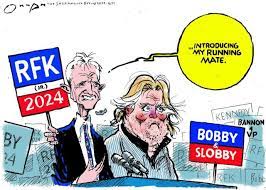 RFK, Jr. belongs in the Loony Tunes universe right next to the QAnon creeps. Think of what Bugs Bunny or the Road Runner could do to them! That’s why Junior is managing to get Republican support. I also believe that he’ll drive the narratives in the press of the BothSiderists. You know who they are. This article from Politico is a depressing look at political funding by billionaire Republicans.
 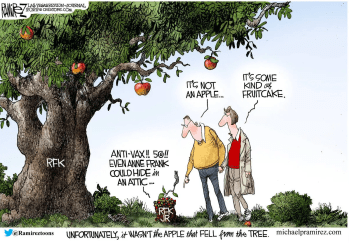 Que Susan Sarandon, or does she only hate Hillary?
  The Republicans are just vile.
 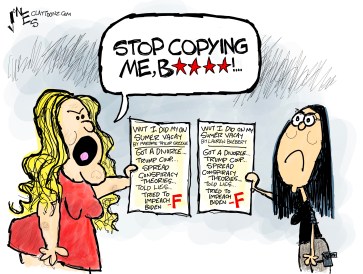 Speaking of Pathetic Jokes … “The Standoff Between Marjorie Taylor Greene and Lauren Boebert Is Worse Than You Think” from
 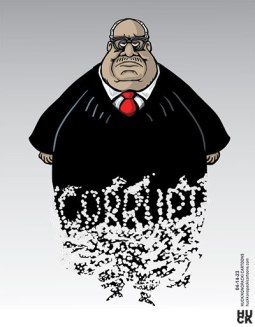 My final offering today is from ProPublica, which is still investigating the roles of Billionaires in Political and SCOTUS decisions.
  Good Day, Sky Dancer!
 A similar move happened in Pennslyvania. This is from
  Catch this move by Arizona’s governor Katie Hobbs.
  Meanwhile, Ohio voters take matters into their own hands just like Kansas did last year. This is from the New York Times.
  Meanwhile, we have to remember that School Boards and the State Superintendent of Schools’ position is crucial. Checking down-ballot in your state is as important as voting for President. T
 Meanwhile, down here in Lousyana, our Democratic Governor John Bel Edwards put his personal religion above the health of women. My tax dollars will support pregnancy propaganda centers.
  Everyone is waiting to see if it is possible for the AG of Colorado to take on the Supreme Court in that Fake Wedding Planner Case.
  Jamison describes how right wing Christians have used home schooling to indoctrinate their children and tie them to their religious beliefs.








 peej
peej Carissa
 bostonboomer
 dakinikat
 ecocatwoman
 mablue2
 Mama Lopez
 peggysue22
 quixote
 skydancingguestblogger
 Mona (aka Wonk the Vote)



 Sky Dancing
Recent Comments