
I See Dead People
Posted: February 27, 2012 Filed under: 2012 elections, 2012 primaries, corruption, Democratic Politics, Environment, Environmentalists, George W. Bush, Politics as Usual, Republican politics, Tea Party activists 23 CommentsMaybe this should be the new Republican mantra for a suitable candidate in 2012. If Republican politicians aren’t conjuring up the ghost of  Ronald Reagan every fifteen minutes, they can go back further into the annals of GOP glory and dig up another Republican corpse. Say . . . Ike Eisenhower. And lo and behold, that’s exactly what NY Times columnist Ross Douthat attempts in his recent “The Greatness of Ike” piece, which extolls the General’s many virtues, bemoans the fact that Eisenhower is overshadowed by the likes of FDR, ties for twelfth-place in POTUS rankings with Jimmy Carter and is generally under appreciated.
The man may have a point.
I recall Eisenhower’s warnings about the industrial/military complex being aired frequently throughout my living memory. Yet no one has paid much attention beyond nodding and saying: yes, the man was right. I suspect the current state of affairs, the country involved in a decade of senseless war, where defense contractors and mercenaries have been made fat and happy, proves the General’s point. Only problem for the Republicans is that it was likes of George W. Bush, Dick Cheney and Donald Rumsfeld who led the disastrous charge into Iraq on false allegations, hyped-up claims about weapons of mass destruction, and then offered a breath-taking defense of torture for national security purposes. Even more startling, they got away with it, leaving the country bleeding and bankrupt in their wake. All in the name of democracy, freedom and ‘shop ‘till you drop’ exhortations.
It was a moment of infamy, as someone once said.
This is why the glance backwards always skips over those inconvenient years of woeful mismanagement and fiscal insanity. No doubt the current batch of 2012 candidates, the Fearless Four, bring angst to all Republican hopefuls convinced, only a few, short months ago, that a 2012 victory was inevitable, a piece of cake.
A powerful dose of nostalgia makes the medicine go down easier.
Surely, the good ole days seem ever more grand as Rick Santorum raises the flag for a home-grown theocracy and dances with the Devil, Mitt Romney continues to stumble over his own tongue [revealing his wife drives ‘two’ Caddies], Newt Gingrich beats his breast over the secular plot to undermine America and Ron Paul, the cuddly libertarian, begins to look and sound strangely reasonable.
 What’s a true-blue Republican to do?
Dig up some corpses.
Am I, a thoroughly disenchanted Democrat gloating? In a pinch, yes. In the long-term, no, because I’m stuck with a candidate I did not vote for in 2008, a man who has proven himself less a champion of Democratic principles than even I ever expected.
As a Nation, we are stuck in a rut for which there seem few alternatives. The legacy parties offer nothing but more of the same—craziness on one side and the uninspiring ‘we suck less than they do’ on the other. As a voter, I’ve vowed to go 3rd party in November [unless the Republicans were to choose Santorum, then I’ll vote directly against him]. However, in the larger frame all I see are monied interests, directing and maneuvering what is suppose to be a ‘free’ election. It has virtually nothing to do with me or my values. On the contrary, it’s all about the persistence of a political class and their cash-soaked benefactors calling for war and protecting their national interests, the gutting of our social contract; the unwillingness to formulate a sensible energy program sans the giant fossil fuel companies’ interference or address the critical and devastating slippage in education, infrastructure, healthcare and employment opportunities.
We have plenty of money for bombs. But not our people. Bailouts are bad. Unless our representatives are saving the asses of and colluding with the corrupt TBTFs. Water and food is the stuff of life until there’s a pipeline, gushing with sludgy oil and money, to compromise both.
Ed Rollins, former Reagan strategist, made a statement recently about the 2012 Republican field:
“Six months before this thing got going, every Republican I know was saying, ‘We’re gonna win, we’re gonna beat Obama.’ Now even those who’ve endorsed Romney say, ‘My God, what a fucking mess.’
That about sums it up, not simply about the Republican field but the entire country. It is an effing mess. And there’s no savior on the horizon. In fact, there’s no savior anywhere. Unless we, the American public, do the saving. But that means coming together on issues where we can agree. The gridlock in DC gets us absolutely nowhere. It’s enough to put anyone into a funk.
But then this morning I read an article about environmentalists and Tea Party activists coming together to fight Keystone XL, the pipeline extension from Nebraska to Texas. For the Tea Party, it’s all about individual property rights and the way TransCanada, a foreign company, has attempted to strong-arm property owners. For the environmentalists it’s about preserving fertile farm land and a major aquifer from the too real danger of irreversible contamination. The nexus of agreement between these two wildly divergent political groups is this: the Keystone pipeline does not serve the public’s interest.
That’s the winning hand: the public’s interest. Not the oil companies, not the 196 people funding the SuperPacs, not the banks, not the Democratic or Republican parties.
What serves the public’s interest.
We, American citizens, can find ways to work together or continue to be spectators to the endless political theater, the Kabuki dance we call elections. And once more we’ll be digging up corpses, which could very well be our own.

Rick Santorum “Almost Threw Up” after Reading JFK Speech on Separation of Church and State
Posted: February 26, 2012 Filed under: 2012 presidential campaign, 2012 primaries, Republican presidential politics, U.S. Politics | Tags: Ave Maria University, Barack Obama, College of Saint Mary Magdalen, George W. Bush, great speeches, ignorance, John F. Kennedy, religious bigotry, Rick Santorum, Satan, separation of church and state 16 Comments
The quote comes from a speech Santorum gave last October at the College of Saint Mary Magdalen in Warner, New Hampshire:
“Earlier in my political career I had opportunity to read the speech, and I almost threw up.”
How nice of him to share. This morning on This Week, George Stephanopoulos asked Santorum why JFK’s speech made him feel like throwing up. Here’s his reply:
Because the first line, first substantive line in the speech says, “I believe in America where the separation of church and state is absolute.” I don’t believe in an America where the separation of church and state is absolute. The idea that the church can have no influence or no involvement in the operation of the state is absolutely antithetical to the objectives and vision of our country.
This is the First Amendment. The First Amendment says the free exercise of religion. That means bringing everybody, people of faith and no faith, into the public square. Kennedy for the first time articulated the vision saying, no, faith is not allowed in the public square. I will keep it separate. Go on and read the speech. I will have nothing to do with faith. I won’t consult with people of faith. It was an absolutist doctrine that was abhorrent (ph) at the time of 1960. And I went down to Houston, Texas 50 years almost to the day, and gave a speech and talked about how important it is for everybody to feel welcome in the public square. People of faith, people of no faith, and be able to bring their ideas, to bring their passions into the public square and have it out.
As most minimally educated Americans know, Kennedy’s speech on his religion is considered one of the great speeches of the 20th Century. On September 12, 1960, in Houston, Texas, Kennedy spoke to the Greater Houston Ministerial Association in an effort to calm the fears of Protestants who believed that a Catholic President would take orders from the Vatican or other members of the Church hierarchy.
I remember watching the speech on TV. It was a big deal for Kennedy and for Catholics generally. In 1960, Catholics were considered a little weird, and many people even insisted they weren’t Christians. The speech was a success, and Kennedy went on to become the first Catholic President of the U.S.
But according to Rick Santorum, who apparently didn’t get a very good education at Penn State or Dickinson College Law School, Kennedy was opposing the First Amendment. More from This Week:
…to say that people of faith have no role in the public square? You bet that makes you throw up. What kind of country do we live that says only people of non-faith can come into the public square and make their case? That makes me throw up and it should make every American who is seen from the president, someone who is now trying to tell people of faith that you will do what the government says, we are going to impose our values on you, not that you can’t come to the public square and argue against it, but now we’re going to turn around and say we’re going to impose our values from the government on people of faith, which of course is the next logical step when people of faith, at least according to John Kennedy, have no role in the public square.
Of course Kennedy said no such thing. He was trying to assure Americans that he (Kennedy) would never impose his own religious beliefs on other Americans. Did Santorum actually read the speech? I doubt it. Either he didn’t read past the first line or he’s just mouthing propaganda he heard from someone like James Dobson. On the other hand, I get the feeling that Santorum would very happily impose his religious beliefs on the rest of us–which is a very scary thought.
Let’s take a look at what Kennedy actually said. He began by arguing that the country had much more important problems than the question of his religion:
While the so-called religious issue is necessarily and properly the chief topic here tonight, I want to emphasize from the outset that I believe that we have far more critical issues in the 1960 campaign; the spread of Communist influence, until it now festers only 90 miles from the coast of Florida — the humiliating treatment of our President and Vice President by those who no longer respect our power — the hungry children I saw in West Virginia, the old people who cannot pay their doctors bills, the families forced to give up their farms — an America with too many slums, with too few schools, and too late to the moon and outer space. These are the real issues which should decide this campaign. And they are not religious issues — for war and hunger and ignorance and despair know no religious barrier.
But Kennedy understood that the religious issue had become a distraction and wanted to deal with it up front, once and for all.
I believe in an America where the separation of church and state is absolute; where no Catholic prelate would tell the President — should he be Catholic — how to act, and no Protestant minister would tell his parishioners for whom to vote; where no church or church school is granted any public funds or political preference, and where no man is denied public office merely because his religion differs from the President who might appoint him, or the people who might elect him.
I believe in an America that is officially neither Catholic, Protestant nor Jewish; where no public official either requests or accept instructions on public policy from the Pope, the National Council of Churches or any other ecclesiastical source; where no religious body seeks to impose its will directly or indirectly upon the general populace or the public acts of its officials, and where religious liberty is so indivisible that an act against one church is treated as an act against all.
Kennedy then argued that while “the finger of suspicion” was “pointed” at him in 1960, the next time it could be someone of another religion and this kind of questioning of each others’ religious beliefs could lead someday to “the whole fabric of our harmonious society [being] ripped apart at a time of great national peril.” Imagine if he could see what has happened to this country 50 years after that day in Houston!
Kennedy continued:
Finally, I believe in an America where religious intolerance will someday end, where all men and all churches are treated as equals, where every man has the same right to attend or not to attend the church of his choice, where there is no Catholic vote, no anti-Catholic vote, no bloc voting of any kind, and where Catholics, Protestants, and Jews, at both the lay and the pastoral levels, will refrain from those attitudes of disdain and division which have so often marred their works in the past, and promote instead the American ideal of brotherhood.
That is the kind of America in which I believe. And it represents the kind of Presidency in which I believe, a great office that must be neither humbled by making it the instrument of any religious group nor tarnished by arbitrarily withholding it — its occupancy from the members of any one religious group. I believe in a President whose views on religion are his own private affair, neither imposed upon him by the nation, nor imposed by the nation upon him as a condition to holding that office.
One wonders how Rick Santorum would react to a presidential candidate who was a Muslim. Kennedy notes that he and his brother fought in WWII to preserve this freedom.
This is the kind of America I believe in — and this is the kind of America I fought for in the South Pacific, and the kind my brother died for in Europe. No one suggested then that we might have a divided loyalty, that we did not believe in liberty, or that we belonged to a disloyal group that threatened — I quote — “the freedoms for which our forefathers died.”
Did Rick Santorum go into battle and risk his life for his country? I think not. His battle is with an invisible enemy: “Satan.”
Rereading Kennedy’s speech calls attention to the fact that the separation of church and state has broken down since his day. Kennedy asked the assembled ministers to
judge me on the basis of 14 years in the Congress, on my declared stands against an Ambassador to the Vatican, against unconstitutional aid to parochial schools, and against any boycott of the public schools — which I attended myself.
We now have an ambassador to the Vatican, the government provides aid to Catholic schools through voucher programs, and we have a White House Office of Faith-Based and Neighborhood Parnerships which, under Bush at least, funded religious-based abstinence programs. While Kennedy said he wouldn’t consult from religious leaders, George W. Bush and Barack Obama have both done so, most recently when Obama met with Catholic Bishops about his contraception policy. Kennedy:
I do not speak for my church on public matters; and the church does not speak for me. Whatever issue may come before me as President, if I should be elected, on birth control, divorce, censorship, gambling or any other subject, I will make my decision in accordance with these views — in accordance with what my conscience tells me to be in the national interest, and without regard to outside religious pressure or dictates. And no power or threat of punishment could cause me to decide otherwise.
Kennedy went on to say that if the day ever came
when my office would require me to either violate my conscience or violate the national interest, then I would resign the office; and I hope any conscientious public servant would do likewise.
Those are the sentiments that made Rick Santorum “almost throw up.” What more do you need to know about this man? He is not fit to serve as dogcatcher, let alone hold high public office. Below is video of Kennedy’s speech.
More WTF moments via the GOP
Posted: February 25, 2012 Filed under: 2012 elections, 2012 presidential campaign, 2012 primaries, Republican presidential politics 28 Comments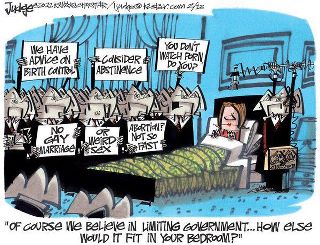 I’m not sure if some one has placed some significant chemicals into our water supply to produce hefty moments of political self-destruction but I have to say that I am open to just about any explanation as to why the party of 19th century social and civil rights has turned into The Mean Crusades. I’ve known for some time there’s been a concerted effort by the extreme right wing and its zombie religious flakes to take over any and all institutions possible. There’s been this quiet attempt to co-opt many institutions by religious fanatics and neoconfederates for some time. But, there’s been a certain subtlety to their jihad. Suddenly, they’ve all gone shrill and public. Part of me is glad because now every one really really knows. The rest of me knows that we’ve passed some kind of Rubicon. I’ve hoped for a third party for some time. I’m not sure what we’re going to get out of all of this, but it doesn’t seem like it’s going to be as neatly packaged as some reasonable alternative to the political status quo.
I am not alone in that thought. I heard Reagan appointee Bruce Bartlett tell Jon Stewart last week that one of the parties is crazy, Saint Ronnie wouldn’t be extreme enough any more and it is unlikely to produce a third option. Oh woe is us.
I’ve had a difficult time pointing out the crazy without being thought melodramatic until recently. It’s been obvious here in the great fly over for some time. I think the east coast punditry who write from the lofty penthouses of New York and the District finally see it. The Republican Primary screams out for analysis. What has gone really wrong with both the parties? Why has the Republican Party unleashed its Kraken? John Heilemann is calling Republicans “The Lost Party” in a new NY Magazine think piece. I’ve kept fleeing their red state strongholds for about 15 years now only to find myself smack in the middle of the next take over. What’s a person that appreciates science, rational thought, and modernity do? Even Jeb Bush and Allan Simpson are scratching their heads. It’s obvious the Republican establishment has lost control. They’ve got a bad case of Nixon Southern Strategy, Dubya Born Agains, and Goldwater reactionaries all rolled into one toxic primary season.
The transfiguration of the GOP isn’t only about ideology, however. It is also about demography and temperament, as the party has grown whiter, less well schooled, more blue-collar, and more hair-curlingly populist. The result has been a party divided along the lines of culture and class: Establishment versus grassroots, secular versus religious, upscale versus downscale, highfalutin versus hoi polloi. And with those divisions have arisen the competing electoral coalitions—shirts versus skins, regulars versus red-hots—represented by Romney and Santorum, which are now increasingly likely to duke it out all spring.
Few Republicans greet that prospect sanguinely, though some argue that it will do little to hamper the party’s capacity to defeat Obama in the fall. “It’s reminiscent of the contest between Obama and Clinton,” Senate Minority Leader Mitch McConnell recently opined. “[That] didn’t seem to have done [Democrats] any harm in the general election, and I don’t think this contest is going to do us any harm, either.”
Yeah. Right. I don’t think McConnell has quite gotten the message that there’s not really litmus tests in the Democratic Party. There are for Republicans and Mittens was on the wrong side of all of them before he’s tried to convince every one that he’s now on the right side of them. Santorum’s surge isn’t a fluke. The anti-Romney group has always been there. There’s just fewer candidates struggling to capture their fury. This is your karma when you go for the worst segment of society under the “southern” strategy.
For many Republicans, Romney’s maladroitness in addressing the issues at hand was worrisome, to put it mildly. Here he was handing Obama’s people a blooper reel that would let them paint him as a hybrid of Gordon Gekko and Thurston Howell III. “Republicans were saying, ‘This is the guy who’s gonna be carrying the ball for our side, defending the private sector?’ ” Rollins says incredulously. “Warren Buffett would kick his ass in a debate, let alone Obama.”
Nor were Romney’s rehearsed turns on the hustings appreciably better. From Iowa through New Hampshire, his campaign events had been progressively pared back and whittled down. By the time he reached South Carolina, they had achieved a certain purity—the purity of the null set. The climactic moment in them came when Romney would recite (and offer attendant textual analysis that would make Stanley Fish beat his head against a wall) the lyrics of “America the Beautiful.” Even staunch Romney allies were abashed by this sadly persistent, and persistently sad, rhetorical trope. “I have never seen anything more ridiculous or belittling,” a prominent Romney fund-raiser says.
This would be fun to watch if it wasn’t the worst time possible for a two party system to have one party in complete melt down. The Republicans are always good at spitting out their establishment, cookie cutter pro-business ever so sanctimonious pompadour adorned white dudes. Nixon and his creeps handed them the formula to capture all those religious whacky southerners who hate people of color and will suffer through a lot of crap as long as their women are kept in line for them. The problem is the reality around them makes the formula look lame. Fool them for about 30 years and they eventually catch on and demand some real blood instead of the symbolic stuff. The Gingrich renaissance uncovered the mother lode of whack.
The coalescence of the various elements of that wing around Gingrich accounted for the 40 to 28 percent pistol-whipping he administered to Romney on Primary Day—and marked the sharpening of the shirts-skins schism that would play out from then on. According to the exit polls, Gingrich captured 45 percent (to Romney’s 21) of Evangelical voters, 48 percent (to 21) of strong tea-party supporters, and 47 percent (to 22) of non–college graduates. Romney, meanwhile, held his own with the groups making up what the journalist Ron Brownstein has dubbed the GOP’s “managerial wing”—richer, better-educated, less godly, more pragmatic voters. One trouble for Romney was that this assemblage constitutes less than half his party now. But even more disconcerting was that he lost badly to Gingrich among South Carolinians who said that the most crucial candidate quality was the ability to beat Obama—which suggested not simply that ideology trumped electability but that for many Republicans, hard-core conservative ideology was tantamount to electability.
Here we go gain with the “hard-core conservative” label. I’ve watched Bruce Bartlett on his book promo tour. I’ve read interviews with Senator Simpson and now former Governor Jeb Bush. This isn’t Nixon’s or even Reagan’s Republican Party. This is the whack-a-doo John Birch Society reactionary right that the Koch Brothers funded and Pat Roberson raised from zombie congregations. Sarah Palin, Michelle Bachmann, Rick Santorum, Jan Brewer, Bobby Jindal, and the rest are not the least bit conservative. They represent an anti-intellectual right that would prefer to put us all back on the plantation. Of course, they get to pick those banjos while the rest of us work all day just to live in shacks and survive on weeds. Don’t think the rest of us haven’t noticed it. The more Romney strikes up that band, the more his numbers with independents crumble. He can’t possibly juggle this many story lines. This is a candidate that “severely” compromises every thing and anything at all costs.
An NBC News–Wall Street Journal poll in late January found Romney’s unfavorability rating among independents had risen twenty points, from 22 to 42 percent, over the previous two months. “It’s not as though they have said Bain has disqualified him or that he can’t be trusted because of his taxes, but this has created a gulf between him and the average voter,” one of the pollsters behind the survey, Peter Hart, told the Washington Post. “Bain and the taxes just reinforce the sense that this person is in a different world.”
Every presidential candidate faces a trade-off between maintaining his viability with independents and catering to his party’s base. The difficulty for Romney is that, even as his appeal to the middle has sharply waned, the lack of enthusiasm for him on the right has remained acute. Even in Florida, where Romney’s fourteen-point victory was broad and sweeping, he was beaten soundly by Gingrich among very conservative voters and strong tea-party adherents.
To a large extent, Romney’s concurrent problems with conservatives and independents are of his own making. His campaign’s incineration of Gingrich in Florida, though perhaps necessary and certainly skillful, also contributed mightily to alienating the center while doing nothing to remedy his main malady in the eyes of conservatives: the absence of a positive message that resonates with them, coupled with a tic-like tendency to commit unforced errors that exacerbate their doubts that he is one of their own. Crystallizing this phenomenon was an episode that took place the morning after Florida, when, on CNN, Romney disgorged another gem: “I’m in this race because I care about Americans. I’m not concerned about the very poor. We have a safety net there. If it needs repair, I’ll fix it.”
With these few short sentences in what should have been a moment of triumph for him, Romney managed to send the wrong message to an array of factions. To independent voters, “I’m not concerned about the very poor” sounds callous. To conservative intellectuals and activists, talk about fixing the safety net—as opposed to pursuing policies that enable the poor to free themselves from government dependency—is rank apostasy. And to congressional Republicans, the comment reflected a glaring lack of familiarity with the party’s anti-poverty positions. “Electeds were flabbergasted,” says a veteran K Street player. “Even moderate Republican members, if they’ve been here for more than four months, get dipped in the empowerment agenda.”
A week later, Romney attempted to repair part of the damage with his speech at the annual Conservative Political Action Conference—and promptly put his foot in it again. In an address in which he employed the word conservative or some variation of it 24 times, as if trying to prove he is a member of the tribe through sheer incantation, his use of the adverb severely to express the depth of his conviction raised eyebrows inside and outside the hall. “The most retarded thing I have ever heard a Republican candidate say” was the verdict of one strategist with ample experience in GOP presidential campaigns.
If only the Democrats were bright enough and principled enough to take advantage of all this chaos. But they are not. The deal is that what is going on is jaw dropping to many of us. To many of the Republican and Tea Party base, this is what they’ve been asking for and denied for many years.
For many Democrats, the idea of Santorum elevating beyond the level of a punch line is all but inconceivable. The extremeness of the former Pennsylvania senator’s views on social issues—from the out-front homophobia that led him to compare gay sex to “man-on-child, man-on-dog, or whatever the case may be,” to his adamant opposition to contraception and abortion even in cases of rape or incest—have long made him the subject of scorn and ridicule on the left, in the center, and on the Internet. (Even with his newfound fame, the first result of a Google search for his name is spreading santorum.com, a site dealing with “frothy” matters too coarse to discuss in a family magazine, and also in this one.)
But in a Republican-nomination contest, these views are not necessarily liabilities, and are even assets in some quarters—which doesn’t mean Santorum is without vulnerabilities in the context of his party. On spending, earmarks, and labor relations, he is by no means pure in conservative terms. He has been embroiled in ethics issues and is a bone-deep creature of the Beltway. Then there is his personality: “In the Senate as well as his home state, Santorum often struck people as arrogant and headstrong, preachy and judgmental,” writes Byron York in the Washington Examiner. Or, as a Republican lobbyist puts it to me, “When he was in the Senate, he was probably the most friendless guy there.”
The more I read about all of this, the more depressed I become. It is as if everything that’s been problematic about our country has coalesced into our politics. The brilliance of our heritage with its roots in the Age of Enlightenment and Reason seem lost in today’s campaign for donations and emphatic voters. There are no ideas. There is only ideology and working the plan of the politics of usual. Our system seems custom made to destroy the best and deliver the crazy and mediocre. So, this Republican Primary unfolds with its horrors and its lessons. All of it is hard to watch for any one that likes government by synthesis. Anyway, read the article. Embrace what modern American has become and weep. One party will not raise taxes under any exigent circumstances. It cannot produce candidates that don’t strictly adhere to specific religious dogma on reproductive issues. One party will not separate the markets that require supervision to be efficient from the markets that are best let alone. One party thinks there is no nuance to foreign policy, only picking and choosing which countries deserve our bombs. Then, there’s the other party. The party of words and no actions. The party of negotiate away anything as long as the policy, the next election and the candidate looks like a win. No single election or poll seems to send either of them any kind of message and that is what’s most disturbing to me. Democrats get the default vote because the Republicans have totally lost their sanity. This is not the government my children or yours deserve. What can we do about it?
Open Thread: Oops! Rick Santorum Just Can’t Help Himself
Posted: February 25, 2012 Filed under: 2012 presidential campaign, 2012 primaries, open thread, racism, U.S. Politics | Tags: "blah people", government dependency, Michigan primary, minority communities, Rick Santorum 60 CommentsEarlier today Rick Santorum spoke to a Tea Party crowd in Troy, Michigan and, as he did about a month ago, suggested that people in “minority communities” are especially reliant on food stamps and welfare.
Speaking to a large crowd at the conservative Americans for Prosperity Presidential forum here, Santorum said he planned to “talk to minority communities, not about giving them food stamps and government dependency, but about creating jobs so that they can participate in the rise of this country.”
Here’s the video:
In Iowa in January, Santorum said what most people thought sounded like this:
“I don’t want to make black people’s lives better by giving them somebody else’s money. I want to give them the opportunity to go out and earn the money and provide for themselves and their families.”
Watch it:
Later he claimed he had really said “blah people.”
Today Santorum was pretty clear in linking food stamps and “dependency” to minorities, even though most of the people using government programs are white. How will he try to weasel out this time? This guy just can’t seem to keep from saying whatever pops into his head.
The Puppet Masters
Posted: February 23, 2012 Filed under: 2012 elections, 2012 presidential campaign, 2012 primaries, Republican politics, Republican presidential politics | Tags: Super Donors, Super PACs 12 CommentsLast week, we learned that the primary bank roller behind Santorum’s Super PAC is an odd and out-of-it old billionaire that probably still calls women “tomatoes” when he’s not on TV explaining how 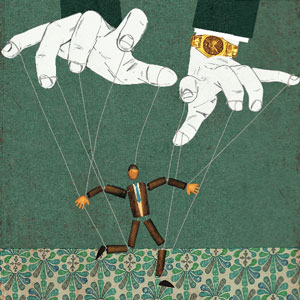 birth control in his day was aspirin-enhanced nonslutiness. Oh what fresh hell has the Supreme Court wrought with its Citizens United decision? We’ve long known that negative, nasty political ads work. Now, each candidate seems to have an endless supply of funds so that proxies can say what ever they want in such ads with absolutely no accountability. We’re all so finding out these Super PAC ads are being funded by a few “Super Donors”. This adds a new twist to voter beware homework. We know have to investigate the candidate’s funding sources. After all, money screams in elections these days. We now have Swift Boat Idiots for Lies on steroids. Each candidate seems to collect billionaire gadflies with specific agendas in mind.
Robert Reich just wrote a blog piece on the GOP’s Big Investors. The GOP has always been a magnet for big money so it’s really interesting to see the Super Pac Super Money play out on in their primary dynamics. I think we’ve seen that Romney’s Super Pac had some effect on Florida and the Gingrich rising star. We’re really going to get some of the flavor of this ruling since the final four have now gotten some cash infusion from various billionaires. The lead up to Super Tuesday on March 6th should be very very interesting and telling. Since we know they bankroll the garbage, who are these enablers of smack?
Have you heard of William Dore, Foster Friess, Sheldon Adelson, Harold Simmons, Peter Thiel, or Bruce Kovner? If not, let me introduce them to you. They’re running for the Republican nomination for president.
I know, I know. You think Rick Santorum, Newt Gingrich, Ron Paul, and Mitt Romney are running. They are – but only because the people listed in the first paragraph have given them huge sums of money to do so. In a sense, Santorum, Gingrich, Paul, and Romney are the fronts. Dore et al. are the real investors.
According to January’s Federal Election Commission report, William Dore and Foster Friess supplied more than three-fourths of the $2.1 million raked in by Rick Santorum’s super PAC in January. Dore, president of the Dore Energy Corporation in Lake Charles, Louisiana, gave $1 million; Freis, a fund manager based in Jackson Hole, Wyoming, gave $669,000 (he had given the Santorum super PAC $331,000 last year, bringing Freis’s total to $1 million).
Sheldon Adelson and his wife Miriam provided $10 million of the $11 million that went into Gingrich’s super PAC in January. Adelson is chairman of the Las Vegas Sands Corporation. Texas billionaire Harold Simmons donated $500,000.
Peter Thiel, co-founder of PayPal, provided $1.7 million of the $2.4 million raised by Ron Paul’s super PAC in January.
Mitt Romney’s super PAC raised $6.6 million last month – almost all from just forty donors. Bruce Kovner, co-founder of the New York-based hedge fund Caxton Associates, gave $500,000, as did two others. David Tepper of Appaloosa Management gave $375,000. J.W. Marriott and Richard Marriott gave a total of $500,000. Julian Robertson, co-founder of hedge fund Tiger Management, gave $250,0000. Hewlett-Packard CEO Meg Whitman gave $100,000.
Welcome to the tyranny of the Super Donor.
About two dozen individuals, couples or corporations have given $1 million or more to Republican super PACs this year, an exclusive club empowered by the Supreme Court’s Citizens United decision and other rulings to pool their money into federal political committees and pour it directly into this year’s presidential campaign.
Collectively, their contributions have totaled more than $50 million this cycle, making them easily the most influential and powerful political donors in politics today. They have relatively few Democratic counterparts so far, with most of the leading liberal donors from past years giving relatively small amounts — or not at all — to the Democratic super PACs.
And unlike in past years, when wealthy donors of both parties donated chiefly to groups that were active in the general election campaign, the top Republican donors are contributing money far earlier, in contests that will determine the party’s presidential nominee.
“What unites them? They’re economic conservatives,” said Christopher J. LaCivita, a Republican strategist who helped advise Swift Boat Veterans for Truth, a forerunner of this cycle’s super PACs, and who in 2008 co-founded another Republican advocacy group, the American Issues Project, that ran advertisements against President Obama.
“Most of these guys are serious business tycoons,” Mr. LaCivita added. “They’ve built something big — usually something bigger than themselves.”
We’re lucky some of these guys are open about their donations. They have some tools available to them to avoid the public exposure. It will be interesting to see if more or less of that occurs as we study their influence on candidates and races.
A few of the megadonors gave through limited liability companies, shielding their identity. One $1 million donation to Restore Our Future came from F8 LLC, a company whose listed address in Utah leads to an accounting firm. A charitable foundation linked to Sandra N. Tillotson, co-founder of the skin care company Nu Skin, uses the same address. Ms. Tillotson was reimbursed by Restore Our Future in July for what appeared to be costs associated with a fund-raiser at her New York apartment. But Ms. Tillotson said in an e-mail Wednesday that she did not know who the owner of F8 LLC was and had not made a donation backing Mr. Romney’s campaign.
So, I’ve been on a Google Trek to try to figure out who some of these people are and what their agenda might be. Bruce Kovner is a hedge fund executive and seems to have a fairly traceable history via the Wall Street set. He’s been likened to a Republican version of George Soros. He has been active in Republican circles for some time.
Some investors, like George Soros and Stanley Druckenmiller, have decided that rather than weather the whims of outside investors, they would prefer to manage their own money as a family office, a designation that allows them to largely avoid regulation.
Like Mr. Soros, Mr. Kovner has grown extremely wealthy betting on global market trends using stocks, currencies and commodities, among other things. He bought the former International Center for Photography on Fifth Avenue and 94th street for $17 million and spent another $10 million renovating it. An avid collector of rare books, Mr. Kovner named his hedge fund after the first printer of English-language books. Forbes magazine estimated Mr. Kovner’s wealth to be in excess of $4.5 billion.
Unlike Mr. Soros, a generous donor to liberal causes, Mr. Kovner is a conservative supporter who counts among his associates former President George W. Bush and former Vice President Dick Cheney. He is a trustee of the American Enterprise Institute, a conservative research organization, and has given more than $100,000 to Republican causes and candidates since 2010.
William Dore has a lower public profile. Interestingly enough, a couple of these super donors appear to come from Louisiana. I suppose it only makes sense since the state has a seriously regressive atmosphere when it comes to taxes, spending, and outside New Orleans Culture. Dore’s money comes from marine construction and diving which translates into connections to the oil platforms that dot the Gulf. So, Kovner represents Wall Street interests while Dore is most likely more interested in the treatment of the Oil Industry. Sheldon Adelson is a gambling industry tycoon who is extremely interested in the interests of Israel.
Two rumours are circulating around Sheldon Adelson, the Jewish Las Vegas casino magnate and publisher of pro-Netanyahu tabloid Israel Hayom. One is that he is about to pump another $10 million into Newt Gingrich’s presidency bid. The other, apparently contradictory, piece of speculation is that he is shifting his support to Mitt Romney.
Evidence that can be marshalled in favour of the first rumour is that Mr Adelson and his family have already donated $11m to a pro-Gingrich super PAC – a group that lobbies on behalf of a political candidate. Meanwhile, he told Forbes magazine this week he may increase that to $100m.
What is going on? Fred Zeidman, a close friend of Adelson and a major fundraiser for Mr Romney, explained: “As long as Newt is in the race it appears that Sheldon is going to continue to support him. I don’t know what that means in terms of money, but I think… when Newt is out of the race, you will see Sheldon devote that money directly to supporting whoever is running against Barack Obama.” Mr Adelson’s overriding objective, said Mr Zeidman, is to ensure Mr Obama does not win.
Peter Thiel’s money comes from Pay Pal. He’s a major libertarian, has a foundation, and goes out on the lecture circuit to proselytize for Ayn Randish ideas. Here’s an account from one true believer on another. I still don’t understand the idea of how libertarians worship at the alter of out spoken fascists like Ludwig Von Mises and enjoy the support of the KKK, storm front and all those old Confederate Crusaders. I think it comes from spending too much time in fantasy worlds. Anyway, they all seem to be the new 21st century Marxist ideologues. Damn all the evidence, let’s just put into effect a lot of things that have been proven to not work just because it sounds all ideologically sexy. Try not to imagine this writer masturbating as he’s writing this. I dare you. Of course, Thiel’s is a Paultard.
Whatever their number, these young libertarians are the potential saviors of the country. Peter Thiel – co-founder of PayPal and Facebook angel investor – made this argument as the SFL conference keynote speaker. According to Thiel, the United States is in a bad position: Innovation drives the U.S. industry and our innovation (with a few exceptions, namely the computer/internet world) has stagnated. Witness the airplane – the planes we now fly go the same speed as they did in 1990. We use coal for large amounts of energy, just as we did in the nineteenth century. The number of new drugs we produce has slowed. Life expectancy is no longer rising at the rate it once did. Etc.
Unreasonable explanations for this include: 1) We’ve reached the end of history; it’s impossible for us to improve on the technology of the plane, and 2) We’re not as smart as we used to be.
Peter’s alternative explanation – developed in his essay “The End of the Future” – is far more feasible: the modern regulatory system has choked invention.
And the only people in the place to fix this aren’t the statists on the right or on the left, but the libertarians. As Peter said, “It’s an exciting time to be a libertarian.”
Armed with new enthusiasm, I spent the rest of the weekend at SFL learning more about how the state is choking development, and I met the people who are going to fix this course in the near future.
My theory is that these Paulbot guys know the only way they will EVER have sex outside of the virtual world, pot induced hallucinations, and hookers is to have enough money to buy a trophy mistress and wife. Since I’m not a voyeur to self abuse, I’ll leave you to google more on this dude in the privacy of your own home, By Onan’s withered Balls!
So, all this googling has left me feeling like the plutocracy is live and well. If you didn’t think America’s government was basically up for sale these days, reading about any of these folks will do it. I’ve been boycotting Marriott for decades since all that Mormon money went heavily into running anti-ERA efforts in the late 70s. I watched that unfold first hand as a baby feminist and activist. It’s now creeping and crawling around the Romney campaign. There’s a lot of Mormon corporate money behind the Romney Super Pac.
Several of the biggest donors to Restore Our Future, the super PAC backing Mr. Romney, share the candidate’s Mormon faith. A quartet of companies connected to Melaleuca, a company based in Idaho that makes nutritional supplements and home care products, donated a combined $1 million to Restore Our Future.
The company is headed by Frank VanderSloot, a national finance co-chairman of the Romney campaign and a graduate of Brigham Young University, Mr. Romney’s alma mater. “I am very concerned about the direction of the country and especially the administration’s constant attacks on free enterprise,” Mr. VanderSloot said in an e-mail.
Many of the biggest givers to the pro-Romney super PAC hail from the world of finance, particularly private equity and hedge funds. Julian H. Robertson Jr., who has given at least $1.25 million to Restore Our Future, is considered one of the godfathers of the hedge fund industry.
The one thing these Super PACS have done is put the agendas right out there if you look for them. You can clearly see the Romney agenda from your front porch. If you like women’s unequal status and gamed financial markets,by all means support Willard just like his SuperPac Puppet Masters do! Any way, I suggest you try to keep track of these ballers and who they buy. I also wonder if these billionaires will be happy if the press starts focusing laserlike on their activities. Right now, Forbes appears to be the only magazine with the lives and ideology of the rich and not so famous. I figure if they want to buy our elections, the least we can do is out their activities for all to see.

 peej
peej Carissa
 bostonboomer
 dakinikat
 ecocatwoman
 mablue2
 Mama Lopez
 peggysue22
 quixote
 skydancingguestblogger
 Mona (aka Wonk the Vote)



 Sky Dancing
Recent Comments