
The Awakening
Posted: September 3, 2011 Filed under: 2012 presidential campaign, Surreality, Team Obama, We are so F'd, WE TOLD THEM SO | Tags: Cave In, Obama, Villagers 17 Commentsa little too late … oh, and some of these folks deserve a swift kick for what they did a few years ago
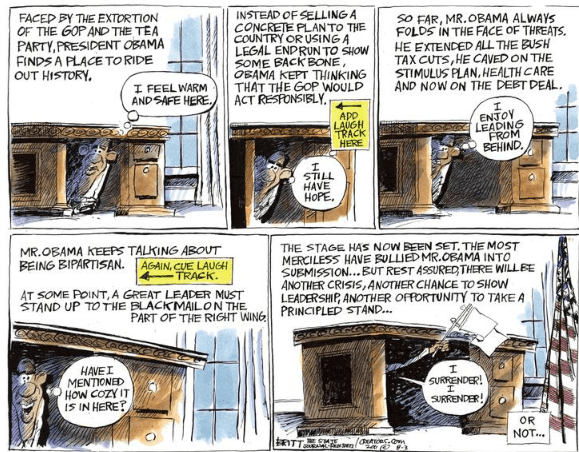
I’ve actually been avoiding thinking about the latest Obama cave-in, on ozone regulation; these repeated retreats are getting painful to watch. For what it’s worth, I think it’s bad politics. The Obama political people seem to think that their route to victory is to avoid doing anything that the GOP might attack — but the GOP will call Obama a socialist job-killer no matter what they do. Meanwhile, they just keep reinforcing the perception of mush from the wimp, of a president who doesn’t stand for anything.
Obama’s re-election chances depend on painting the Republicans as disrespectful. So why would the White House act disrespectful by scheduling a speech to a joint session of Congress at the exact time when the Republicans already had a debate planned?
And why is the White House so cocky about Obama as a TV draw against quick-draw Rick Perry? As James Carville acerbically noted, given a choice between watching an Obama speech and a G.O.P. debate, “I’d watch the debate, and I’m not even a Republican.”
The White House caved, of course, and moved to Thursday, because there’s nothing the Republicans say that he won’t eagerly meet halfway.
No. 2 on David Letterman’s Top Ten List of the president’s plans for Labor Day: “Pretty much whatever the Republicans tell him he can do.”
On MSNBC, the anchors were wistfully listening to old F.D.R. speeches, wishing that this president had some of that fight. But Obama can’t turn into F.D.R. for the campaign because he aspires to the class that F.D.R. was a traitor to; and he can’t turn into Harry Truman because he lacks the common touch. He has an acquired elitism.
MSNBC’s Matt Miller offered “a public service” to journalists talking about Obama — a list of synonyms for cave: “Buckle, fold, concede, bend, defer, submit, give in, knuckle under, kowtow, surrender, yield, comply, capitulate.”
And it wasn’t exactly Morning in America when Obama sent out a mass e-mail to supporters Wednesday under the heading “Frustrated.”
It unfortunately echoed a November 2010 parody in The Onion with the headline, “Frustrated Obama Sends Nation Rambling 75,000-Word E-Mail.”
Barack Obama has pretty much caved in to the Republican contention that budget deficits are the biggest problem our economy faces. He’s pretty much caved in to the Republican contention that higher taxes are bad for the economy. And he’s pretty much caved in to the Republican contention that nothing big can done to improve the unemployment picture.
So what’s his next cave-in on the economy? Apparently this. I guess regulatory uncertainty is what’s holding us back after all. So much for the agenda-setting power of the presidency.
Open thread … have at it!!!
(Here’s some info on Chris Britt who penned this great political Cartoon.)
Friday Morning Reads
Posted: September 2, 2011 Filed under: 2012 presidential campaign, abortion rights, Barack Obama, commercial banking, Domestic terrorism, Economy, Elections, fetus fetishists, financial institutions, House of Representatives, morning reads, Planned Parenthood, Reproductive Health, Reproductive Rights, Republican politics | Tags: FED, fiscal stimulus, Goldman Sachs investigation, James Carville, Litton, Obama Polls, Obama speech schedule, Stonehenge, Subprime mortgages 24 Comments Well, it looks like I’m in a tropical storm warning right now. I’m just hoping the electricity stays on as TD 13 becomes TS Lee when it drifts around and comes on shore some time on Saturday. I’m also hoping Hurricane Katia stays a fish storm but that’s looking less likely at the moment. Lot’s of us may get flooded yet again. I’m just hoping we can go get NJ Governor Chris Christie to go beat up Eric Cantor in the interim. Poor Vermont looks like it needs a lot of help right now! We’re expected to get rain that may fall at 2-3 inches an hour. I’m not sure if our pumps can handle that; especially the crappy ones the Corps bought from Jeb Bush that have been problematic since they were installed.
So, it’s nice to see that the FED has decided that Goldman Sachs is now under its jurisdiction and is ordering it to review its foreclosure practices of a former subsidiary. So many heads should roll over the subprime mortgage market mess and so few have to date. The Fed’s a pretty aggressive regulator when it feels some institution is in its charter. It’s good to see the charter is extending beyond commercial banks and thrifts now that the cheap lending has been extended to other financial institutions too. They take the truth-in-lending laws very seriously.
The Federal Reserve ordered Goldman Sachs Group Inc to hire a consultant to review practices of a former mortgage subsidiary on Thursday and said it plans to assess a monetary penalty for wrongful foreclosures.
The Fed’s crackdown sent Goldman shares down 3.5 percent on Thursday, even as the bank announced that it had completed the sale of Litton Loan Servicing LP, the mortgage-servicing business at the heart of its foreclosure problems.
Litton’s regulatory troubles stem largely from the practice of “robosigning,” in which bank employees signed foreclosure documents without reviewing case files as required by law.
Many large banks, including Bank of America Corp, JPMorgan Chase & Co, Wells Fargo & Co and Citigroup Inc, have been targets of probes by state and federal regulators over the same issue, in the clean-up after a world financial crisis triggered in large part by bad mortgages in the United States and bonds backed by those loans.
The Fed cited “a pattern of misconduct and negligence” at Litton in announcing its enforcement action against Goldman.
The Economist has been having a reader debate on the necessity of Fiscal stimulus for the US. The Hell, Yes! vote appears to have it. The comments are about as interesting as the two economists debating the motion.
The American economy has remained extremely weak since officially leaving recession in mid-2009. The unemployment rate has barely fallen. Recent figures suggest GDP grew at less than a 1% annualised rate through the first half of the year and the odds of a return to recession have risen. The headwinds facing the economy are considerable: the private sector is still trying to reduce the burden of debt it is carrying from the pre-crisis boom years. House prices are still in the doldrums and mortgage credit is hard to get. State and local governments, which are required to balance their budgets, have been forced to cut spending, workers and hours to cope with falling tax collections. Many argue that in such a situation, the federal government is the only entity left that can provide a boost to overall demand and keep the economy from slipping back into recession or prolonged stagnation. At present, however, federal fiscal policy is scheduled to do the opposite: at the end of this year, a temporary payroll tax cut and enhanced jobless benefits expire.
“I do think this is a really big debate and I think the White House was out of bounds…in trying to schedule a speech during a debate,” Carville said on “GMA.”
This will be Gov. Rick Perry’s first debate, and as Carville said this morning the stakes are high.
“Given a choice between watching a debate and the speech I would have watched the debate and I’m not even a Republican or even close to being a Republican,” he said, adding it will be a “barn burner.”
The administration agreed to move the speech to Thursday- possibly competing with the kick off of the NFL season instead. The White House has been touting this jobs plan telling ABC News that he will propose tax relief, infrastructure investment and assistance for the long term unemployed.
Obama has received advice from both sides with some arguing for an ambitious proposal and others recommending finding middle ground.
Carville, an ABC News consultant, told me it doesn’t matter what Obama proposes, it won’t get through Congress.
For the first time this year, Texas Governor Rick Perry leads President Obama in a national Election 2012 survey. Other Republican candidates trail the president by single digits.
A new Rasmussen Reports national telephone survey shows Perry picking up 44% of the vote while the president earns support from 41%. Given the margin of sampling error (+/- 3 percentage points) and the fact that the election is more than a year away, the race between the two men is effectively a toss-up. Just over a week ago, the president held a three-point advantage over Perry. (To see question wording, click here.)
Perry leads by nine among men but trails by five among women. Among voters under 30, the president leads while Perry has the edge among those over 30. The president leads Perry by 16 percentage points among union members while Perry leads among those who do not belong to a union.
I’d vote for a dead dog before I’d vote for Rick Perry, just in case you’re wondering where I stand. A Quinnipiac University poll also shows the President’s approval on handling of unemployment and the economy is still bleak.
President Barack Obama’s overall job approval rating has sunk to an all-time low, as American voters disapprove 52 – 42 percent, compared to 47 – 46 percent approval in July, and among whites and men his approval has dropped into the 30s, according to a Quinnipiac University poll released today. Congressional leaders rate even lower in the public eye. Voters nationwide are more pessimistic about the economy, saying 49 – 11 percent that it is getting worse rather than improving, a precipitous drop from a July 14 survey by the independent Quinnipiac (KWIN-uh-pe-ack) University, in which voters said 32 – 23 percent the economy was worsening and January 18, when voters said 36 – 20 percent it was improving. The economy is in a recession, 76 percent of voters say, and is not beginning to recover, voters say 68 – 28 percent. Voters trust Obama more than congressional Republicans to handle the economy 44 – 41 percent, but they say 46 – 42 percent that Republican presidential candidate Mitt Romney would do a better job than Obama. They are split 43 – 41 percent on whether Obama or GOP candidate Rick Perry would be better on the economy.
This should be an interesting political season. My guess is that it’s going to get very ugly.
There’s some good news from NPR about the Obama Justice Department. It seems they have made a priority of keeping abortion providers and women seeking abortions safe from violence and protestor harassment.
The Obama Justice Department has been taking a more aggressive approach against people who block access to abortion clinics, using a 1994 law to bring cases in greater numbers than its predecessor.
The numbers are most stark when it comes to civil lawsuits, which seek to create buffer zones around clinic entrances for people who have blocked access in the past. Under the Freedom of Access to Clinic Entrances Act, or FACE Act, the Justice Department’s civil rights division has filed eight civil cases since the start of the Obama administration. That’s a big increase over the George W. Bush years, when one case was filed in eight years.
“There’s been a substantial difference between this administration and the one immediately prior,” says Ellen Gertzog, director of security for Planned Parenthood. “From where we sit, there’s currently much greater willingness to carefully assess incidents when they occur and to proceed with legal action when appropriate.”
Over the past two years, the Justice Department and FBI have been meeting with abortion-rights groups and medical providers all over the country to explain their work and talk about a federal task force designed to prevent violence against doctors and women seeking abortions.
The National Abortion Federation, which tracks violent incidents, says major violence is down since the 2009 murder of abortion doctor George Tiller. The man who killed Tiller has been convicted, and a federal grand jury is investigating the conduct of his alleged accomplices.
But Sharon Levin, a vice president at the National Abortion Federation, says there are still some signs of trouble, including two incidents this summer involving Molotov cocktails and the arrest of a man who told police he wanted to shoot two abortion doctors in Wisconsin.
So I admit to being totally fascinated by Stonehenge. I wanted to share this Tomb find in the place where the famous stones were most likely quarried.
The tomb for the original builders of Stonehenge could have been unearthed by an excavation at a site in Wales.
The Carn Menyn site in the Preseli Hills is where the bluestones used to construct the first stone phase of the henge were quarried in 2300BC.
Organic material from the site will be radiocarbon dated, but it is thought any remains have already been removed.
Archaeologists believe this could prove a conclusive link between the site and Stonehenge.
The remains of a ceremonial monument were found with a bank that appears to have a pair of standing stones embedded in it.
The bluestones at the earliest phase of Stonehenge – also set in pairs – give a direct architectural link from the iconic site to this newly discovered henge-like monument in Wales.
The central site had already been disturbed so archaeologists chose to excavate around the edges
The tomb, which is a passage cairn – a style typical of Neolithic burial monument – was placed over this henge.
How cool is that?
So, that’s my contribution for the day. Hopefully, I’ll be on line through the weekend but if you don’t see me, you’ll know what happened!
What’s on your reading and blogging list today?
Monday Reads
Posted: August 29, 2011 Filed under: 2012 presidential campaign, morning reads | Tags: 2012 election, Colin Powell, Hurricane Irene Hype, Republicans against Science, Super PACs, Women in high positions in business in emergin markets 37 Comments Good Morning!
Paul Krugman has a great piece in the NYT on how Republicans are against science. They do appear to ignore it in favor of myth, conspiracy theories and wishful thinking. However, it does us no good to send Democrats into office that won’t fight for science and rational thought, either. How much more nonsense do you think will come out during the 2012 political season?
Mr. Perry, the governor of Texas, recently made headlines by dismissing evolution as “just a theory,” one that has “got some gaps in it” — an observation that will come as news to the vast majority of biologists. But what really got peoples’ attention was what he said about climate change: “I think there are a substantial number of scientists who have manipulated data so that they will have dollars rolling into their projects. And I think we are seeing almost weekly, or even daily, scientists are coming forward and questioning the original idea that man-made global warming is what is causing the climate to change.”
That’s a remarkable statement — or maybe the right adjective is “vile.”
The second part of Mr. Perry’s statement is, as it happens, just false: the scientific consensus about man-made global warming — which includes 97 percent to 98 percent of researchers in the field, according to the National Academy of Sciences — is getting stronger, not weaker, as the evidence for climate change just keeps mounting.
In fact, if you follow climate science at all you know that the main development over the past few years has been growing concern that projections of future climate are underestimating the likely amount of warming. Warnings that we may face civilization-threatening temperature change by the end of the century, once considered outlandish, are now coming out of mainstream research groups.
But never mind that, Mr. Perry suggests; those scientists are just in it for the money, “manipulating data” to create a fake threat. In his book “Fed Up,” he dismissed climate science as a “contrived phony mess that is falling apart.”
I could point out that Mr. Perry is buying into a truly crazy conspiracy theory, which asserts that thousands of scientists all around the world are on the take, with not one willing to break the code of silence. I could also point out that multiple investigations into charges of intellectual malpractice on the part of climate scientists have ended up exonerating the accused researchers of all accusations. But never mind: Mr. Perry and those who think like him know what they want to believe, and their response to anyone who contradicts them is to start a witch hunt.
All the candidates are pushing bad economics as well.
I’ve been kind’ve “blown away” by the news coverage of the remnants of Irene today. It seems like most of the TV coverage has been 24 hours now worth of people saying we dodged a bullet and trying to find people impacted by the storm. You’re beginning to see headlines like this now: Get Real: Hurricane Irene Should Be Renamed “Hurricane Hype”. Last night Geraldo looked like he’d just re-opened that silly empty vault again.
Irene has put on a remarkably similar show. Within the limits of forecasting error, Irene’s projected path makes it was impossible to rule out a major disaster. But, as a dangerous Category 3 storm within two days of land, something similar to what happened to Gloria occurred. Instead of going slightly off course, the power of her winds dropped markedly, at least as measured by hurricane hunter aircraft. Because it is prudent to not respond to every little tropical cyclone twitch (such as Gloria’s jog or Thursday’s wind drop), the Thursday evening forecast was virtually unchanged, the Internet went thermonuclear, and the Weather Channel’s advertising rates skyrocketed. From that point on, it became all Irene, all the time. With this level of noise, the political process has to respond with full mobilization. Hype begets hype.
A day later, the smart money is still riding a very Gloria-like track, but with a cyclone that will be weaker than projected. It is doubtful that Irene will even cough up eight bodies (the number killed by Gloria), though power outages east of where the center makes landfall (probably on Long Island) may be extensive.
I think the body count’s at 21 now which kind’ve makes this hype on all the hype look like hype. Well, at least all the governors of the mid Atlantic states got some air time praising civil servants instead of demonizing them for a change. Is it just me or does Chris Christine remind you of those big boy statues in front of those 1960s hamburger joints? That man looks like a heart attack about to happen.
Former Secretary of State Colin Powell–who cross party lines last year to hype Obama–is having second thoughts about hyping an Obama second term. Powell was on Face the Nation yesterday.
“I haven’t decided who I’m going to vote for,” Powell said on CBS’ “Face the Nation.” “Just as was the case in 2008, I am going to watch the campaign unfold. In the course of my life I have voted for Democrats, I have voted for Republicans, I have changed from one four-year cycle to another.
“I’ve always felt it my responsibility as a citizen to take a look at the issues, examine the candidates, and pick the person that I think is best qualified for the office of the president in that year. And not just solely on the basis of party affiliation,” he said.
Asked about the Republican field, Powell said there are some “interesting candidates,” but no one who has “emerged into the leading position.”
“So let’s see if anybody else is going to join, and we’ve got a long way to go,” he added.
Powell, the nation’s first African-American secretary of state, praised Obama’s leadership style in 2008 in endorsing him, saying shortly before the election that Obama “has a definite way of doing business that will serve us well.” He also said at the time that he didn’t think the GOP vice-presidential candidate, Sarah Palin, was “ready” to be president.
The really, really bad thing about the political system these days is that PACs are getting bigger and more powerful. They also seem more closely aligned with candidates. Here’s an interesting story from the NYT. The Supreme Court decision on corporations and first amendment rights has definitely impacted the political money machine.
But some advocates for tighter campaign regulation say existing rules on independent groups did not anticipate the emergence of Super PACs so closely tied to a single candidate, leaving so much room to maneuver that the independent groups are able to act as surrogates for the candidates.
“There’s not a big difference between these candidate-specific Super PACs and candidate campaign committees,” said Paul S. Ryan, associate legal counsel at the Campaign Legal Center. “I think it’s a joke. What they are doing is abiding by the very meager restrictions on coordinations on expenditures and solicitations. But that leaves a wide swath of activities that can be fully coordinated under present law.”
Increasingly, the new Super PACs are taking on tasks that in previous years were handled by — and paid for — the candidates themselves. But instead of using money raised in the $2,500 increments that federal law imposes on candidates, the Super PACs can accept donations of unlimited amounts. (The groups must disclose their donors, though some Super PACs, including Priorities USA and the Karl Rove-founded American Crossroads, have affiliated nonprofit arms that do not have to disclose donors.)
Just in case you haven’t read Rick Perry’s outrageous lies about Social Security, here’s some more information. Perry calls the popular government program unconstitutional and refers to it as a Ponzi Scheme. I want to hear him say this in Florida.
But Perry returned to the “Ponzi scheme” description on the campaign trail in Iowa last night:
“It is a Ponzi scheme for these young people. The idea that they’re working and paying into Social Security today, that the current program is going to be there for them, is a lie,” Perry said. “It is a monstrous lie on this generation, and we can’t do that to them.”
Later, in Des Moines, when a reporter asked about the suggestion that his campaign was backing off some positions in the staunch states-rights book, Perry said, “I haven’t backed off anything in my book. So read the book again and get it right.”
Kay Henderson has more on this:
Another reporter pressed the issue, asking if Perry believes Medicare is “unconstitutional” as well.
“I never said it was unconstitutional,” Perry said. “I look at Medicare just like I look at Social Security. They’re programs that aren’t working and we ought to have a national conversation about it. You know, those that have said I’ve said they’re unconstitutional — I’m going to have them read the book. That’s not what I said.”
In his book, Perry called Social Security something akin to a “bad disease” that was created “at the expense of respect for the Constitution and limited government.”
This is going to be one weird, strange, political season. I’ve never seen so many people pushing so many unpopular positions.
Women may have hit the glass ceiling in the US, but women in emerging market countries are winding up in board rooms more and more all the time. Remember, many of these countries have already had women presidents and prime ministers.
Seven of the 14 women identified on Forbes magazine’s list of self-made billionaires are Chinese. Many firms in emerging markets do a better job of promoting women than their Western rivals, some surveys suggest. In China, 32% of senior managers are female, compared with 23% in America and 19% in Britain. In India, 11% of chief executives of large companies are female, compared with 3% of Fortune 500 bosses in America and 3% of FTSE 100 bosses in Britain. Turkey and Brazil come third and joint fourth (behind Finland and Norway) in the World Economic Forum’s ranking of countries by the proportion of CEOs who are women. In Brazil, 11% of chief executives and 30% of senior executives are women.
Young, middle-class women are overtaking their male peers when it comes to education. In the United Arab Emirates 65% of university graduates are female. In Brazil and China the figures are 60% and 47% respectively. In Russia 57% of college-age women are enrolled in tertiary education; only 43% of men are. Business schools, those hothouses of capitalism, are feminising fast. Some 33% of students at the China Europe International Business School (CEIBS) in Shanghai and 26% at the Indian School of Business are female, a figure comparable with those of Western schools such as the Harvard Business School and INSEAD.
In “Winning the War for Talent in Emerging Markets: Why Women are the Solution”, Sylvia Ann Hewlett and Ripa Rashid point out that businesswomen face steep obstacles in emerging markets. How can they stay on the fast track if, as in the UAE, they cannot travel without a male chaperone? And how can they be taken seriously if, as in Russia, the term “businesswoman” is synonymous with prostitute? In every emerging market women bear the lioness’s share of family responsibilities. In many places, deals are sealed with booze and male bonding.
So, there’s some things to get us started on this Monday. Hopefully, those of you on the east coast are getting back to normal after the storm. Let us know how you’re doing! What’s on your reading and blogging list today?
Friday Reads
Posted: August 26, 2011 Filed under: 2012 presidential campaign, Economy, Environment, Environmental Protection, morning reads, U.S. Economy, unemployment | Tags: bernanke, fiscal policy, fracking, Mitt Romney, monetary policy, Oil companies guilty of killing birds 29 Comments good morning!
We’ve talked about the earthquake in Virginia some. This is one of the most interesting op eds I’ve seen for some time and it’s written by Dr. Stuart Jeanne Bramhall who is actually a psychologist but has done some research on the subject. She argues that fracking in neaby West Virginia could’ve been responsible for the unusual and unusually large quake. I know there’s a lot of controversy about fracking but I had no idea it could cause earthquakes. Actually, fracking itself doesn’t, its another step in the process and it’s happened before in Arkansas.
According to geologists, it isn’t the fracking itself that is linked to earthquakes, but the re-injection of waste salt water (as much as 3 million gallons per well) deep into rock beds.
Braxton County West Virginia (160 miles from Mineral) has experienced a rash of freak earthquakes (eight in 2010) since fracking operations started there several years ago. According to geologists fracking also caused an outbreak of thousands of minor earthquakes in Arkansas (as many as two dozen in a single day). It’s also linked to freak earthquakes in Texas, western New York, Oklahoma and Blackpool, England (which had never recorded an earthquake before).
Industry scientists deny the link to earthquakes, arguing that energy companies have been fracking for nearly sixty years. However it’s only a dozen years ago that “slick-water fracks” were introduced. This form of fracking uses huge amounts of water mixed with sand and dozens of toxic chemicals like benzene, all of which is injected under extreme pressure to shatter the underground rock reservoir and release gas trapped in the rock pores. Not only does the practice utilize millions of gallons of freshwater per frack (taken from lakes, rivers, or municipal water supplies), the toxic chemicals mixed in the water to make it “slick” endanger groundwater aquifers and threaten to pollute nearby water-wells.
Horizontal drilling and multi-stage fracking (which extend fractures across several kilometres) were introduced in 2004.
The op ed provides links and information on the the related research and information on the prior quake experience in Arkansas.
Mitt Romney lost his cool last night in a New Hampshire Town Meeting. The dust-up was over Romney’s support of a balanced budget amendment which is basically anathema to economists. You can watch the video and the resultant hair malfunction that results. Also, interesting to note is Mediate’s use of the word “former” in front of front runner.
Former GOP presidential frontrunner Mitt Romney got into a heated exchange with a voter at a New Hampshire town hall event Wednesday over his support for a balanced budget amendment, and by the mainstream media’s selective standards, lost his cool when she tried to engage him. In clips played on MSNBC’s The Daily Rundownthis morning, Romney certainly appeared angry by those standards, and the full exchange, while slightly less damning, demonstrated a marked contrast with how President Obamadealt with an aggressive questioner recently.
The snippets that MSNBC played, of Romney snippily asking the town hall attendee to let him answer her question, were obviously designed to show the candidate as impatient and besieged, but placing them in context doesn’t change things all that much. Romney aggressively interrupts the woman’s calm, if rambling, question by asking her, “Did somebody in the room say that we don’t need any government?”
When she tries to engage his question, calling the balanced budget amendment “irresponsible,” he interrupts her again, abruptly asking, “Do you have a question, and let me answer your question.”
“Yes, how do you think the government can not provide funds for the people, its citizens?”
Romney begins to answer the question, and from there, you can’t hear what the woman is saying, but Romney reacts angrily to her attempts to follow up, saying, “You had your turn madam, now let me have mine!”
Frum Forum mentions the number of economists that think a double dip recession is inevitable. I want to bring this up now so that when you hear the villagers say most economists didn’t think that it was going to happen that you’ll see that a lot–if not most–of us do think that. Also, note that the majority of us have been saying that the Federal government has been doing the wrong Fiscal Policy things since about 2007 too. Paul Krugman mentions that the fiscal policy response has just been gunning for another recession tool.
At this point the entire advanced world is doing exactly what basic macroeconomics says it shouldn’t be doing: slashing spending in the face of high unemployment, slow growth, and a liquidity trap. It’s a global 1937. And if the result is another recession, the witch-doctors will just demand more bleeding.
Yup, the austerity demons will undoubtedly howl for more budget cuts and more tax cuts for the unjob creators.
The U.N., U.S. and NATO have unfroze Libyan assets so the transitional government can provide critical humanitarian aid to the Libyan People. This news comes from the US State Department.
The UN Security Council’s Libya Sanctions Committee approved a U.S. proposal to unfreeze $1.5 billion of Libyan assets to be used to provide critical humanitarian and other assistance to the Libyan people. The U.S. request to unfreeze Libyan assets is divided into three key portions:
Transfers to International Humanitarian Organizations (up to $500 million):
- Up to $120 million will be transferred quickly to meet unfulfilled United Nations Appeal requests responding to the needs of the Libyan people (including critical assistance to displaced Libyans). Up to $380 million will be used for the revised UN Appeals for Libya and other humanitarian needs as they are identified by the UN or other international or humanitarian organizations.
Transfers to suppliers for fuel and other goods for strictly civilian purposes (up to $500 million):
- Up to $500 million will be used to pay for fuel costs for strictly civilian needs (e.g., hospitals, electricity and desalinization) and for other humanitarian purchases.
Transfers to the Temporary Financial Mechanism established by the Contact Group to assist the Libyan people (up to $500 million):
- Up to $400 million will be used for providing key social services, including education and health. Up to $100 million will be used to address food and other humanitarian needs.
The United States crafted this proposal in close coordination with the Transitional National Council, as they assessed the needs of the Libyan people throughout the country. It responds to humanitarian concerns in a diversified way that prioritizes key needs. The United States will work urgently with the Transitional National Council to facilitate the release of these funds within days.
The President of the AFL-CIO continues his harsh criticism of President Obama. This should be interesting since labor unions provide a lot of GOTV work for elections at all levels.
The most powerful union official in the country offered reporters his harshest critique of President Obama to date Thursday, questioning Obama’s policy and strategic decisions, and claiming he aligned himself with the Tea Party in the debt limit fight.
“This is a moment that working people and quite frankly history will judge President Obama on his presidency; will he commit all his energy and focus on bold solutions on the job crisis or will he continue to work with the Tea Party to offer cuts to middle class programs like Social Security all the while pretending the deficit is where our economic problems really lie,” AFL-CIO President Richard Trumka told reporters at a breakfast roundtable hosted by the Christian Science Monitor.
Trumka dismissed Obama’s recent job creation proposals — an extended payroll tax cut, patent reform, free trade deals — as “nibbly things that aren’t going to make a difference,” and said the AFL-CIO might sit out the Democratic convention if he and the party don’t get serious.
“If they don’t have a jobs program I think we’d better use our money doing other things,” Trumka said.
The editors of Bloomberg are down on monetary policy and are asking for more relevant fiscal policy in this op ed: The U.S. Needs a Jobs Policy, Not More Cheap Money. Well, at least some body gets it. The Federal Government can create jobs. Some one just needs to get the President to believe that and fight for it.
While the Fed can only print money, the government has the power to create jobs directly. And jobs are what the economy needs now, to break the chain in which high unemployment, weak consumer demand and low business confidence reinforce one another. Bloomberg View has laid out some of the best options available for a national jobs policy:
— Public-works spending can lift demand and put people to work in capital-intensive industries such as construction.
— A tax credit for companies that increase their headcount can encourage hesitant employers to hire at minimal cost to taxpayers.
— Programs that pay the wages of new hires as they gain on-the-job training can efficiently target the long-term unemployed.
— Allowing the unemployed to collect benefits while starting up new businesses can prompt older, better-educated people to create their own opportunities.
— For some entry-level jobs, scrapping the reporting of criminal records on applications can help qualified workers get a foot in the door and stay out of prison.
— And to make the spending more palatable to congressional opponents, President Barack Obama could offer to cut some of the red tape holding back hiring and economic growth, such as the outdated Davis-Bacon Act, which artificially raises the cost of public-works projects.
Altogether, a meaningful jobs package might cost taxpayers more than $200 billion over a couple years. To provide the government the leeway it needs to support the economy in the short term, it’s crucial that the congressional supercommittee, which must find $1.5 trillion in deficit reduction over the next 10 years, recommend a combination of new revenue, spending cuts, tax reforms and entitlement changes that would put the government’s long-term finances on a sustainable path.
Whatever Bernanke says today, he can’t rescue the economy alone
Yup. But, we’ve been talking about that here for a long time. I feel a bit blue in the face, do you?
So, here’s some news from North Dakota where seven oil companies are charged with killing birds.
Seven oil companies have been charged in federal court with illegally killing 28 migratory birds in Williams County.
Slawson Exploration Company of Kansas, ConocoPhillips Company, Petro Hunt, LLC and Newfield Production Company, all of Texas, Brigham Oil and Gas, LP of Williston, Continental Resources, Inc. of Oklahoma, Fidelity Exploration and Production Company of Colorado face charges of violating the Migratory Bird Treaty Act.
Most of the dead birds were found in un-netted oil reserve pits in May. An employee of one company alerted the Fish and Wildlife service to some of the dead birds. Others were found by inspectors.
In one case, an oil spill leaked into a nearby wetland, where several ducks died as a result of exposure to the oil.
The U.S. Fish and Wildlife Service says netting is the most effective way of keeping birds from entering waste pits.
The maximum sentence they face is six months in federal prison and a $15,000 fine.
So corporations have all these people rights now, how do we get them into prison for those six months? Perhaps Uncle Clarence Thomas has a suggestion?
What’s on your reading and blogging list today?
UPDATE:
Via Corrente and Lambert/DC Blogger:
Update on Susie at Suburban Guerilla
Susie was taken to the hospital early this morning for a possible heart attack and is being kept there for observation and testing until tomorrow morning.
Finally, but is it for real?
Posted: August 25, 2011 Filed under: 2012 presidential campaign, Economy, unemployment, voodoo economics | Tags: bad economy, joblessness, lousy poll numbers, Obama 10 Comments When Obama swept into office, there was an ongoing, left-over Bush program in place to rescue the financial system which focused on getting banks recapitalized through the Fed. Despite worsening unemployment and rising bankruptcies, a stimulus that was top heavy in worthless tax cuts was hurried to congress and a program–that was more of a plea to banks than an actual program–was pasted together to focus on refinancing underwater mortgage holders. The stimulus may have changed the momentum of GDP growth and the FED program definitely stabilized the banking system, but the programs for homeowners and the unemployed were less-than-successful. The President was itching to put something together on health care to prove that he could do something that hadn’t been achieved by the Clintons. It looks now like his primary economic advisers were warning him that just feeding tax breaks to choice businesses and and cheap loans to banks was not going to solve a major financial crisis. Obama’s focus never really appeared to be on things that mattered at the time. As a result, serious improvement in key areas of the economy never materialized.
It’s not a surprise to any of us around here that Obama’s handling of the US economy is souring voters. James Carville’s mantra–it’s the economy stupid–has never been more relevant to the vast majority of Americans who have been made worse off by the policies of the last ten years.
Americans’ views on the economy have dimmed this summer. But so far, the growing pessimism doesn’t seem to be taking a toll on President Barack Obama’s re-election prospects.
More people now believe the country is headed in the wrong direction, a new Associated Press-GfK poll shows, and confidence in Obama’s handling of the economy has slipped from just a few months ago, notably among fellow Democrats.
The survey found that 86 percent of adults see the economy as “poor,” up from 80 percent in June. About half — 49 percent — said it worsened just in the past month. Only 27 percent responded that way in the June survey.
That can’t be good news for a president revving up his re-election campaign.
There’s a good chance that GDP–now growing at a miserably slow rate–may go into negative territories shortly, forcing the NBER to date the  start of yet another recession when the recovery from this one has not really taken hold. There’s indications in the market that another crash could be on the horizon. After all, businesses can only wring so much profit out of restructuring debt to take advantage of cheap interest rates and cutting costs primarily by dumping workers. Here’s some really frightening news on reinsurance on banks which is also causing weird stuff in the CDS market. That’s the same damned market that messed up the economies of Europe and US the last time around which really needs some restructuring, standardization, and reform that has not been done despite Dodd-Frank and similar efforts on the other side of the pond. Bankers have fought new regulation and we’re likely to see the same problems revisit us in a different sector of the same market for the same kinds of vehicles.
Insurance on the debt of several major European banks has now hit historic levels, higher even than those recorded during financial crisis caused by the US financial group’s implosion nearly three years ago.
Credit default swaps on the bonds of Royal Bank of Scotland, BNP Paribas, Deutsche Bank and Intesa Sanpaolo, among others, flashed warning signals on Wednesday. Credit default swaps (CDS) on RBS were trading at 343.54 basis points, meaning the annual cost to insure £10m of the state-backed lender’s bonds against default is now £343,540.
The cost of insuring RBS bonds is now higher than before the taxpayer was forced to step in and rescue the bank in October 2008, and shows the recent dramatic downturn in sentiment among credit investors towards banks.
“The problem is a shortage of liquidity – that is what is causing the problems with the banks. It feels exactly as it felt in 2008,” said one senior London-based bank executive.
“I think we are heading for a market shock in September or October that will match anything we have ever seen before,” said a senior credit banker at a major European bank.
While Obama is on vacation, White House gnomes are pasting together two programs for the poll-beleaguered President to announce when Congress gets back into session. The first is a “jobs” package. The second is a plan for massive mortgage refinancing. This is something that should’ve been on the front burner years ago so now I’m actually wondering if it’s going to work in time to stymy the right wing nut jobs coming up through the Republican primary process or it’s actually going to be serious rather than some lame ass attempt at some neoReaganesque policy that will move farther right when Republicans start saying no to clearly Republican policy.
Here’s the “Contours of Obama jobs package” via Reuters.
The president is widely expected to repeat his calls for an extension of a payroll tax cut, push for patent reform and bilateral free trade deals, and suggest an infrastructure bank to upgrade the country’s roads, airports and other facilities.
Retrofitting schools with energy efficient technology would allow the government to directly hire for labor-intensive work and also give a boost to the clean energy sector that Obama has said could be an important U.S. economic motor.
Other measures being considered, according to economists who have advised the White House, include tax credits for firms hiring more workers, funds for local governments to hire teachers, and retraining help for the long-term unemployed. Steps to boost the ailing housing market are also under review.
“What’s going to be included in this plan are some reasonable ideas that could have a tangible impact on improving our economy and creating jobs … the kinds of things that Republicans should be able to support,” Earnest said. “These are bipartisan ideas that the president is going to offer up.”
Republicans have made it perfectly clear that their only priority is to make Obama a one term president. So, in yet another attempt at trying to look above the fray instead of fighting for what is right, we’re going to see another lukewarm policy that won’t have any immediate effect and will undoubtedly be pushed further to the right and further into the ineffective zone. Plus, it will probably just be offset by other spending cuts in key areas which are likely to have stronger recessionary multiplier effects attached than any positive multiplier effect of the new legislation. I still can’t figure out what the obsession is with tax cuts for new employees. The big cost of new employees is health insurance for one and you can avoid that cost by going any where in the developed and developing world BUT the US. Plus, no business is going to hire any one when the have no customers. I feel like a broke record on the number of repeats on that one. Having spent my life doing strategic planning and budgeting for corporations and having one of my PhD field areas in corporate finance, I can tell you that the US looks like one of those offshore tax havens right now for most major corporations. Also, more ‘free trade’ deals are likely to have just the opposite effect on unemployment anyway as prices tend to equilibriate in the countries involved and we’re the cheap capital market, not the cheap labor market part of that equation. (Hence, in our country, incomes to capital go up and incomes to labor go down as the market goes towards price parity for our country.)
So, the second program is no a way for the US to back mortgage refinancing. This is also something that should’ve been done years ago.
One proposal would allow millions of homeowners with government-backed mortgages to refinance them at today’s lower interest rates, about 4 percent, according to two people briefed on the administration’s discussions who asked not to be identified because they were not allowed to talk about the information.
A wave of refinancing could be a strong stimulus to the economy, because it would lower consumers’ mortgage bills right away and allow them to spend elsewhere. But such a sweeping change could face opposition from the regulator who oversees Fannie Mae and Freddie Mac, and from investors in government-backed mortgage bonds.
Administration officials said on Wednesday that they were weighing a range of proposals, including changes to its previous refinancing programs to increase the number of homeowners taking part. They are also working on a home rental program that would try to shore up housing prices by preventing hundreds of thousands of foreclosed homes from flooding the market. That program is further along — the administration requested ideas for execution from the private sector earlier this month.
But refinancing could have far greater breadth, saving homeowners, by one estimate, $85 billion a year. Despite record low interest rates, many homeowners have been unable to refinance their loans either because they owe more than their houses are now worth or because their credit is tarnished.
I’ve already looked into refinancing my FHA/VA loan from 7% to 4%. I have good credit and my loan balance is about one half of what my house is worth–even with the recent decrease in home prices–because I’ve owned it for 11 years. I didn’t follow through because the points charged by Wells Fargo–who processes my mortgage at the moment–were ridiculous. They’d have to pick up the fees or points to intrigue me, frankly. The people with the worst problems are the ones that are now strategically defaulting because they are underwater. Interesting enough, I’m set to discuss just that topic this fall in the Denver FMA meetings using this Philadelphia FED working paper. Their findings suggest that people have the ability to pay these mortgages but they are defaulting anyway because they are underwater. The weird thing is they are defaulting on first mortgages while keeping their second liens current. This means they are ‘strategically’ defaulting to get rid of the house because it’s a stupid investment for them. Any plan that doesn’t deal directly with underwater mortgage holders specifically will not work. Banks really don’t have any incentive to work with them now because they get more fee income from processing defaults than they do from renegotiating the mortgage. The incentives on both sides of the market are totally warped at this point in time. Again, quoting from the NYT article, this isn’t in the plan.
A broader criticism of a refinancing expansion is that it would not do enough to address the two main drivers of foreclosures: homes worth less than their mortgages, and a sudden loss of income, like unemployment. American homeowners currently owe some $700 billion more than their homes are worth.
I don’t see how the issues in the housing market are going to be solved until you solve this problem. Dumping houses on the market is going to continually depress prices and cause this problem to regenerate.
So, this gets back to sort’ve my main point about both these big ideas. First, they are a little too little and way too late. The inside and outside lags on these kinds of fiscal policy measures are long and getting them through congress and into fruition is likely to lag-filled. We’re also likely to get a lecture and ransom demand from the austerity demons. So, is this a real effort or a symbolic effort? Second, the policy prescriptions are anemic. Neither of them focus on the real problems or the known solutions. So, again, is this a real effort or symbolic effort? Third, these aren’t very aggressive policies nor or they what you would call traditionally Democratic policies so who are they really aimed at? Again, it seems like a symbolic offering to voters. If you’re getting the impression that I’m not impressed at all with this, you’re right. I suppose this is all to make the confidence fairy come home to roost. It still seems to me that she’s on her honey moon with the high priest of voodoo economics. Imaginary beings are symbolic too.

 peej
peej Carissa
 bostonboomer
 dakinikat
 ecocatwoman
 mablue2
 Mama Lopez
 peggysue22
 quixote
 skydancingguestblogger
 Mona (aka Wonk the Vote)



 Sky Dancing
Recent Comments