
The bin Laden “Narrative”: Obama Campaign Needs to Get on this Stat!
Posted: May 1, 2012 Filed under: 2012 presidential campaign, Team Obama, U.S. Military, U.S. Politics | Tags: Barack Obama, John Kerry, Michael Hastings, Mitt Romney, Navy Seals, Osama bin Laden, Stanley McChrystal, Swift Boating 31 Comments
Taylor Marsh has some very good advice for the Obama Campaign, and I hope they’re paying attention.
The partisan back and forth on the bin Laden raid began a few days ago when the Obama campaign released a video of Bill Clinton praising President Obama for his decision to order a raid on the bin Laden compound in Pakistan one year ago tomorrow.
Romney has been hammering Obama, with the help of the media, with fake outrage over the “politicization” of the raid. That seems like a pretty ridiculous considering the way the Bush administration–and the Republican Party as a whole–politicized 9/11 again and again and again for seven straight years.
But today, there’s a new threat. Michael Hastings, the Rolling Stone Reporter who brought down General Stanley McChrysal, has a piece at Buzzflash headlined “Will the Navy Seals Swift Boat Obama?”
The question arose based on a piece by Toby Harden in the Daily Mail. Harnden claims that “serving and former Seals” are angry that Obama is “using [them] as ammunition” in his reelection campaign.
According to Hastings,
The frustration—or, even anger—within the SEAL community is real, and has been brewing for months, particularly among a politically conservative core of operators. It started immediately after the raid, with questions among the Special Forces and intelligence community of whether the president should have waited to announce the kill to exploit the intelligence cache at Osama’s compound. It simmered after a Chinook helicopter was shot down, killing 30 Americans, 22 of them Navy SEALs from Team Six.
Was it a coincidence, SEALs asked themselves, catastrophe hit Team Six so soon after being named as the team responsible for the killing?
As Taylor Marsh points out, this is a serious issue and one the White House and the Obama Campaign need to get out ahead of unless they want to end up like John Kerry, who didn’t believe that anyone would take attacks on his heroic military record seriously. Marsh writes:
Coming from Hastings, whose reporting has been golden since the career ending interview with Lt. Gen. Stanley McChrystal, continuing in his book, which has been widely lauded, this should send shock waves through Obama reelect, with someone in the “war room” investigating it immediately, if only to be prepared.
John Kerry wasn’t prepared.
May the gods help Obama reelect if the right-wing rabble of Rush and Sean decide to take hold of this one, because they’ll never let go. Jerome Corsi is likely investigating it as you read this column. Having been burned on his birther book, he’s got to be chomping at the bit to find another angle to try to take down Obama….
Everyone’s still writing about the political gamesmanship going on, missing the potential news in Hastings’ Buzzfeed piece.
In addition, Hastings indicates that White House insiders are talking out of school:
But as the stagey outrage over the politicization of foreign policy from Mitt Romney and his Republican allies gained momentum over this past weekend, White House officials started to have their doubts. Was spiking the football, again, and again, and again, in a public such a good idea? Was it necessary? Was the campaign in Chicago, White House officials wondered, going too far?
I agree with Marsh that:
One can only imagine who these unnamed “White House officials” are, but someone at 1600 better get a grip on these leaks, because in a tough election cycle they can be a politician’s undoing, especially when it revolves a story so potentially explosive.
How Do You Measure Success?
Posted: April 29, 2012 Filed under: 2012 presidential campaign, Republican politics, U.S. Economy, U.S. Politics | Tags: business, character, empathy, Mitt Romney, success, values, wealth 22 Comments
“If people think there’s something wrong with being successful in America, then they’d better vote for the other guy,” Romney said. “Because I’ve been extraordinarily successful, and I want to use that success and that know-how to help the American people.”
I’ve been thinking about the definition of success for quite a while, ever since Mitt Romney started bragging about how “extraordinarily successful” he is and whining about how anyone who talks about income inequality (outside of “quiet rooms”) is motivated by envy.
It seems that Romney defines success as amassing vast wealth in business by any means necessary. In Romney’s case, he made a fortune at Bain Capital by buying up other businesses and–in many cases–destroying them in order to enrich Bain’s stockholders. In the process, he put countless people out of work and drove families and even towns into ruin. Is that success? Should we applaud him for that?
Even if we acknowledge that Romney has been successful by a number of societal measures–graduating from Harvard, running a business, being elected Governor of Massachusetts–isn’t his definition of success still pretty shallow and limited? I think so.
I think my dad was successful. He grew up in poverty, survived the Great Depression, fought in World War II, worked his way through college and graduate school, taught thousands of college students and inspired many of them to go into teaching themselves. He earned the title of full professor in his department and served as a Dean at his university. He helped my mom raise five children and did what he could to help us as adults. He was a loving and supportive grandfather and great grandfather.
My dad was honest and hard-working. He didn’t believe in cheating on his taxes or hurting other people in order to advance himself. He cared about his students, and they could tell he cared. He was loved and admired by both top students and average ones. I know because for two years I attended the university where he taught, and I met many students who enthusiastically told me what a great teacher he was. Some of dad’s students even wrote grateful letters to him after he retired–and we heard from others after he died two years ago.
That’s just one very personal example, but I think there are endless ways that people can be successful in life. It’s not all about money and holding high positions, as Romney seems to believe. Not too long ago, Romney became very defensive about a speech that President Obama made to a community college audience in Ohio:
Obama addressed GOP charges of class-warfare rhetoric while touting government programs before a group of community college students in job-training programs.
“These investments are not part of some grand scheme to redistribute wealth. They’ve been made by Democrats and Republicans for generations, because they benefit all of us,” the president remarked.
“We created a foundation for those of us to prosper. Somebody gave me an education. I wasn’t born with a silver spoon in my mouth. Michelle wasn’t. But somebody gave us a chance.”
Obama never mentioned Romney, but he drew a contrast between the Democratic notion that society provides opportunities for people and the Republican claim that individuals make it on their own–even if, like Romney, they begin with much greater opportunities than most. Romney responded:
“I’m certainly not going to apologize for my dad and his success in life,” Romney said Thursday morning on “Fox and Friends.” “He was born poor. He worked his way to become very successful despite the fact that he didn’t have a college degree, and one of the things he wanted to do was provide for me and for my brother and sisters. I’m not going to apologize for my dad’s success.”
….
“I know the president likes to attack fellow Americans. He’s always looking for a scapegoat, particularly those that have been successful like my dad.”
No one asked Romney to apologize, but why is he so incapable of seeing that he has received rich benefits from his parents and from American society? Why doesn’t his phenomenal success in amassing great wealth arouse in him a desire to give back to other Americans who weren’t as privileged as he was? It seems that all wants is to look down his nose at 99% of the population and give us holier-than-thou lectures about self-reliance when he never once had to rely only on himself!
A couple of weeks ago, Michael Kinsley wrote about Romney’s “failed definition of success.”
Among the secrets of success that Romney might wish to share is how you arrange to be born to a rich family. Or, to be less vulgar, an intact and loving family that valued education. Or, for that matter, to be born smart. The neocon controversialist Charles Murray writes books arguing that the second and third factors (family and innate intelligence) are more important than the first (money). You can argue about this all day, but in Romney’s case it doesn’t matter because he had all three factors hard at work, paving his way to success.
Is he even aware of it? Maybe Romney’s not so smart, because he goes on and on about how successful he is in a way that strikes people as obnoxious. “I stand ready to lead us down a different path, where we are lifted up by our desire to succeed, not dragged down by a resentment of success.”
Is there a “resentment of success” in this country? I don’t sense it. Certainly you do not need to resent success in order to believe that successful people are, for the most part, adequately rewarded for their success.
And Kinsley asks, what about people who fail according to Romney’s definition? Should they just roll over and die?
A society that rewards success is good for the successful, and no doubt good for society as a whole. Romney is right about that. But not everyone can be successful. How many people did Romney have to elbow out of his way on the path to success?
“It is not enough to succeed. Others must fail.” That’s Gore Vidal, and it’s unnecessarily vicious. The pleasure of success shouldn’t depend on the prospect of others failing, but the reality of success usually does.
But failures are people, too! If success is mostly luck, then so is failure. When a government policy rewards success in a way that actually does lift all of society, that’s fine. But the policies advocated by Republicans, including Romney — primarily lower taxes on the higher brackets — would only make success more successful. They would do nothing to distinguish success for the few from success that really does benefit us all.
Last week, after Romney became the presumptive Republican presidential nominee, he gave a speech in New Hampshire to kick off his general election campaign. He again bragged about his “success in business” and talked about “character.”
In the America I see, character and choices matter. And education, hard work, and living within our means are valued and rewarded. And poverty will be defeated, not with a government check, but with respect and achievement that is taught by parents, learned in school, and practiced in the workplace.
Well, I don’t think much of Mitt Romney’s character. To me, character implies empathy, caring for other people, and giving back to the society that has provided opportunities to succeed in whatever way we define success. I don’t buy Romney’s notion that only the rich and powerful are successful. I’d rather live in poverty until the day I die that have the kind of “success” that is built on hurting other people, as Romney’s is.
Billionaire Who Cleaned Up on Subprime Mortgage Foreclosures Hosts Secret Romney Fund Raiser
Posted: April 28, 2012 Filed under: 2012 presidential campaign, Surreality, U.S. Economy, U.S. Politics, Voter Ignorance | Tags: auto bailout, Boston Consulting Group, hedge-funds billionaires, John Paulson, Mitt Romney, Paul Singer, vulture capitalists 42 Comments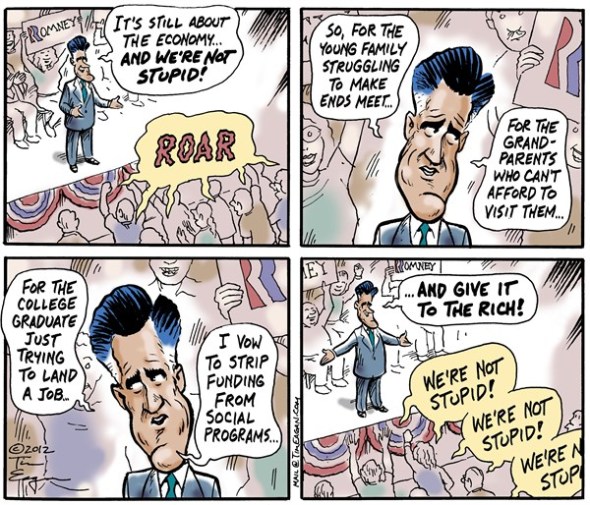
I just came across this in The Daily Beast and had to share.
Mitt Romney held a high-dollar fundraiser Thursday night at the home of John Paulson, the controversial hedge-fund billionaire who made a fortune shorting the housing market and subprime mortgages in 2007.
New York grocery billionaire John Catsimatidis told The Daily Beast the fundraiser, at Paulson’s posh townhouse at 9 East 86th Street on the Upper East Side of Manhattan, was a “big-dollar event” for wealthy donors like himself “fighting for the soul of America.” The Romney campaign did not return requests for information about the fundraiser—which was not listed on the candidate’s public schedule. Paulson’s publicist, Armel Leslie, also did not return calls seeking comment.
A neighbor who witnessed the event from across the street described it to The Daily Beast as a large crowd of “older white people, mostly men,” who started showing up around 7:30 p.m. Thursday. Around 8 p.m., sirens started blaring as more and more people started to show. There was security at the door as well as a police car on the street.
Then things became quiet until the sirens started up at 9:30 p.m. An SUV tried to block 86th Street, but New York drivers characteristically went around it. Then, as the security stood in the street, Romney emerged from the townhouse, “looking tall and neat.” He took off his suit jacket and climbed into the SUV.
The Daily Beast says this is a departure for Romney, since Paulson is one of the people who caused the economic crisis and who made obscene profits from it–Paulson made 3.7 billion on foreclosures. But I googled and found that Paulson also hosted a ritzy fundraiser for Romney at his (Paulson’s) Southhampton home last summer.
Interestingly, Paulson and fellow hedge fund billionaire Paul Singer (another big Romney donor) also made big bucks from the auto industry bailout, according to a February article by Greg Palast.
Gov. Romney…asserted that the Obama Administration’s support for General Motors was a, “payoff for the auto workers union.” However, union workers in GM’s former auto parts division, Delphi, the unit taken over by Romney’s funders, did not fare so well. The speculators eliminated every single union job from the parts factories once manned by 25,200 UAW members.
The two hedge fund operators turned a breathtaking three-thousand percent profit on a relatively negligible investment by using hardball tactics against the US Treasury and their own employees.
Under the control of the speculators, Delphi, which had 45 plants in the US and Canada, is now reduced to just four factories with only 1,500 hourly workers, none of them UAW members, despite the union agreeing to cut contract wages by two thirds.
It wasn’t supposed to be quite so bad. The Obama Administration and GM had arranged for a private equity investor to provide half a billion dollars in new capital for Delphi, but that would have cut the pay-out to Singer and Paulson. The speculators blocked the Obama-GM plan, taking the entire government bail-out hostage. Even the Wall Street Journal’s Dealmaker column was outraged, accusing Paul Singer of treating the auto company, “like a third world country.”
Romney and Paulson both graduated from Harvard Business School and each went to work for The Boston Consulting Group soon after. I don’t know if they were at Harvard and BCG at the same time, but it seems possible. Wikipedia has a list of famous people who came out of BCG, including Jeffrey Immelt and Benjamin Netanyahu. These are truly Romney’s people.
As I’ve written a number of times, Barack Obama was Wall Street’s candidate in 2008, but Mitt Romney IS Wall Street. Just reading about these guys scares the sh%t out of me!
Romney Career Advice Open Thread
Posted: April 28, 2012 Filed under: 2012 presidential campaign, U.S. Economy, U.S. Politics | Tags: economy, Jimmy John's, John Kasich, Labor Relations Board, Mitt Romney, sick leave, stimulus funds, tone-deaf, work-study 16 Comments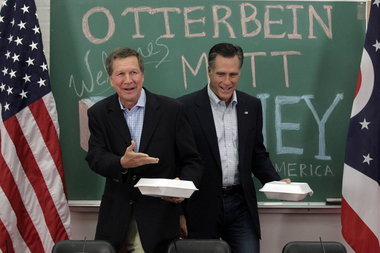
Gov. John Kasich and Mitt Romney at Otterbein U.
Yesterday, presumed Republican Presidential standard bearer Mitt Romney managed a stunning quadruple-gaffe. In one “lecture” at Ohio’s Otterbein University he demonstrated his ignorance about ordinary American families, his disdain for working people, and his cluelessness about the American economy. On top of that, he managed to put his audience to sleep! Watch the video and note the dozing students behind Romney:
Yes, Jimmy John’s! Romney’s pal Jimmy John Liautaud started a sandwich store franchise in 1983 with a $25,000 loan from his dad. Romney advised Otterbein students to do the same:
Accusing the president of attacking successful Americans, Romney urged students to borrow money from their parents — as John did — if they need to do so to succeed in starting their own businesses.
“Even now, I believe you’re watching a president who is trying to deflect and divert from his record by trying to find ways to, if you will, attack fellow Americans, between rich and poor, and other dimensions,” said Romney. “This kind of divisiveness, this attack of success, is very different than what we’ve seen in our country’s history.”
“We’ve always encouraged young people, take a shot, go for it, take a risk, get the education, borrow money if you have to from your parents, start a business,” he said.
Of course! Because everyone has parents with an extra $25,000 lying around. Why didn’t I think of that? It’s a simple answer to the economic crisis–stop attacking rich people and borrow money from your rich parents instead.
And be like Jimmy John’s–a company cited for illegal labor practices! Great idea!
Judge Rules Jimmy John’s Must Re-Hire Workers Fired for Sick Leave Complaints
A National Labor Relations Board administrative law judge has ruled six former Minneapolis Jimmy John’s sandwich shop employees must be re-hired and paid back wages.
The workers in question said if they called in sick and couldn’t find replacements for their shifts they risked being fired. So, they started warning Jimmy John’s customers that they could be eating sandwiches made by under-the-weather sandwich makers….
Davis Ritsema, one of the fired workers, explained how sick leave policy challenge began. “One day I was coughing and had a high temperature, but I felt pressured to work.”
Mike Wilkow, another former Jimmy John’s worker, added, “I was vomiting and handling sandwiches. They made me stay until the end of my shift.”
Yes, take Mitt Romney’s advice: borrow money from your wealthy parents, hire minimum-wage workers and deny them sick leave. That’ll help the economy recover!
Romney also attacked Obama’s economic stimulus, apparently unaware that Otterbein University received more than $80,000 in stimulus funds used for a federal work-study program.
ROMNEY: Then there was the stimulus itself. $787 billion of borrowing. It could have been entirely focused on getting getting the private sector to buy capital equipment, for instance. That puts people to work. Or to hire people. Instead, it primary [sic] protected people in the governmental sector, which is probably the sector that should have been shrinking.
Of course, as Dr. Dakinikat has repeatedly explained, businesses aren’t going to invest capital in equipment to produce products when Americans have so little money to spend. Furthermore, Ohio college are now suffering the loss of stimulus funds, because Governor Kasich, who accompanied Romney at Otterbein, hasn’t done anything to replace them.
What’s on your mind this lovely Saturday morning?
Partisan Rules and the Agonizing Death of a Functional Republic
Posted: April 26, 2012 Filed under: 2012 elections, 2012 presidential campaign, 2012 primaries, Republican politics, right wing hate grouups 10 Comments
My very Republican father and I were talking about the high levels of unemployment and the impact that was having on the deficit and the current problems with Social Security and Medicare. He was trying to reconcile how long this thing has drug on and why he wasn’t seeing any efforts being made that were similar to what happened during the Great Depression. He’s no FDR fan either. Even he had the sense that there were forces that were at work that were preventing a recovery. I muttered something about partisan politics and he had to agree. It’s gotten so that beating your opponent takes precedence over what you’re supposed to do once elected. We’re electing people that don’t want our government to work. They only want to win and spin.
You’ll undoubtedly hear a lot in the upcoming days about Robert Draper’s new book ‘Do Not Ask What Good We Do.’ It’s a book about the Republicans in Congress and their political agenda. There’s a focus on Tea Party politicians as well as the gang of stubborn white patriarchs. We knew from the very beginning–as announced almost immediately by Mitch McConnell–that the Republicans were intent on making Obama a one term president. The book details some very ugly things about the effort. It also details how elected Republican pols have begin to act like an angry mob at times because many have come with their own brand of “kill the beast” that is our Constitutional Republic. Still, the Draper book does not appear to be about one vast monolithic, stereotypical Republican right winger as it profiles some of the most controversial members. The anger binds them and divides them in intriguing ways.
At what point does ugly partisanship and sour grapes become such an issue that voters will wake up and vote their own interests for a change? Why are we such a nation of Angry Birds these days?
As President Barack Obama was celebrating his inauguration at various balls, top Republican lawmakers and strategists were conjuring up ways to submarine his presidency at a private dinner in Washington.
The event — which provides a telling revelation for how quickly the post-election climate soured — serves as the prologue of Robert Draper’s much-discussed and heavily-reported new book, “Do Not Ask What Good We Do: Inside the U.S. House of Representatives.”
According to Draper, the guest list that night (which was just over 15 people in total) included Republican Reps. Eric Cantor (Va.), Kevin McCarthy (Calif.), Paul Ryan (Wis.), Pete Sessions (Texas), Jeb Hensarling (Texas), Pete Hoekstra (Mich.) and Dan Lungren (Calif.), along with Republican Sens. Jim DeMint (S.C.), Jon Kyl (Ariz.), Tom Coburn (Okla.), John Ensign (Nev.) and Bob Corker (Tenn.). The non-lawmakers present included Newt Gingrich, several years removed from his presidential campaign, and Frank Luntz, the long-time Republican wordsmith. Notably absent were Senate Minority Leader Mitch McConnell (R-Ky.) and House Minority Leader John Boehner (R-Ohio) — who, Draper writes, had an acrimonious relationship with Luntz.
For several hours in the Caucus Room (a high-end D.C. establishment), the book says they plotted out ways to not just win back political power, but to also put the brakes on Obama’s legislative platform.
“If you act like you’re the minority, you’re going to stay in the minority,” Draper quotes McCarthy as saying. “We’ve gotta challenge them on every single bill and challenge them on every single campaign.”
The conversation got only more specific from there, Draper reports. Kyl suggested going after incoming Treasury Secretary Timothy Geithner for failing to pay Social Security and Medicare taxes while at the International Monetary Fund. Gingrich noted that House Ways and Means Chairman Charlie Rangel (D-N.Y.) had a similar tax problem. McCarthy chimed in to declare “there’s a web” before arguing that Republicans could put pressure on any Democrat who accepted campaign money from Rangel to give it back.
As most of you know, I was not a supporter of candidate Obama. However, there are no words to express how I feel about the idea of a group of elected officials planning a political coup during some of the worst days of our Republic over what seems like a bunch of partisan sour grapes. In this tale, there is little care or thought given to the suffering of the country in the grips of a recession and endless, worthless wars. There is only plotting for personal power. There are a lot of details about how the election of the Tea Party candidates has led to more problems that make our country look ungovernable and our differences irreconcilable. In some ways, the Republican take over of the House sandbagged the very people that plotted to make it so.
The anti-big-government zealotry that swept the Republicans into power turned out to be a major obstacle in the debt-ceiling negotiations with the White House. As Eric Cantor told Joe Biden in the talks, the best compromise House Republicans could offer was “giving you a vote on the debt ceiling. You may not think that’s a big deal. But you’ve got to understand, I’ve got a lot of guys that think that not raising the debt ceiling may not be such a bad thing—that in fact it may be just what we need.” Cantor then added wistfully “We’re working hard to educate our guys.”
The House Majority Leader didn’t want to wind up suffering the same fate during the debt ceiling negotiations as the No. 2 House Republican, Roy Blunt, who became a pariah among conservatives for his role in negotiating the details of TARP in 2008. When Cantor saw that he couldn’t bridge the differences between the Republicans and the White House on revenue increases, he backed out of the talks. To avoid blame, Cantor claimed that the Democrats were intending to do the same and he just wanted to preempt them. This “had no basis in fact,” Draper wrote.
Draper profiles many of the strongest Republican Tea Party characters in the book. This includes Allen West who appears to be completely out of touch with any form of reality as we know it.
Draper profiles firebrands like Florida’s Allen West, a former Army lieutenant colonel who attempts to induce his draconian brand of military discipline on America’s finances and security apparatus. West is also the only Republican member of the Congressional Black Caucus. West comes across as someone whose mouth gets him in trouble (he recently nabbed coverage for labeling 81 of his House colleagues communists, and then got more coverage for refusing to back down from the accusation); his hand-wringing paranoia would have more bite if it weren’t so nostalgic. But in Draper’s reporting, he becomes a surprisingly nuanced person who isn’t afraid to defy the more conservative elements of his base (including a vote clearing the way for that Republican whipping-horse, the Environmental Protection Agency, to clean Florida’s waterways after farmers in his district encouraged him to vote that way).
This may not be one of those books that stands the test of time. But, we need this kind of hand book right now. Here’s a headline that will give you some pause: “Dick Lugar trails by 5, poll says”.
Indiana Sen. Dick Lugar has fallen behind state Treasurer Richard Mourdock by five points, according to a new poll released Thursday.
The survey, taken Tuesday and Wednesday by Wenzel Strategies on behalf of Citizens United, places Mourdock at 44 percent and Lugar at 39 percent. Nearly 17 percent remain undecided with just 12 days to go until the Indiana Senate primary.Citizens United is backing Mourdock in the May 8 contest.
Wenzel found that Mourdock’s lead is powered by self-described tea party conservatives, who comprise 36 percent of the GOP electorate.
Among that group of voters, Mourdock holds a commanding 63 percent to 24 percent lead. Lugar’s ability to keep the race close is due to moderates and traditional conservatives, which both favor the incumbent, according to Wenzel.
It seems like we had the birth of our nation in the Age of Reason and we may experience our death throes in the Age of the Angry Mob.

 peej
peej Carissa
 bostonboomer
 dakinikat
 ecocatwoman
 mablue2
 Mama Lopez
 peggysue22
 quixote
 skydancingguestblogger
 Mona (aka Wonk the Vote)



 Sky Dancing
Recent Comments