
Eric Holder Speaks the Truth: Voter ID Laws = Poll Taxes
Posted: July 10, 2012 Filed under: 2012 elections, Civil Liberties, Civil Rights, racism, U.S. Politics | Tags: 24th Amendment to the Constitution, Benjamin Jealous, Eric Holder, Mitt Romney, NAACP, poll taxes, Voter ID laws, voter suppression 60 Comments
Today Eric Holder spoke to the annual NAACP convention in Houston, TX, and as he was discussing the Texas voter ID law, which the Justice Department believes is illegal, he “deviated from his prepared remarks,” and said something I have long wanted him to say:
“Under the proposed law, concealed handgun licenses would be acceptable forms of photo ID, but student IDs would not,” Holder said, referring specifically to the voter ID law passed in Texas. “Many of those without IDs would have to travel great distances to get them, and some would struggle to pay for the documents they might need to obtain them. We call those poll taxes.”
That last line was not part of Holder’s prepared remarks released to the press.
Holder has been very critical of voter ID laws in the past, but this appears to be the first time he’s gone as far as to compare them to the Jim Crow-era effort to purposefully disenfranchise African-Americans.
I wasn’t able to find video of Holder’s speech on Youtube, but you can watch it at the above link to Talking Points Memo.
According to Huffington Post, Holder added:
“I don’t know what will happen as this case moves forward, but I can assure you that the Justice Department’s efforts to uphold and enforce voting rights will remain aggressive,” the attorney general said.
Holder said the arc of American history has always moved toward expanding the electorate and that “we will simply not allow this era to be the beginning of the reversal of that historic progress.”
“I will not allow that to happen,” he added.
In 1962, the 24th Amendment to the U.S. Constitution made poll taxes unconstitutional in federal elections. Virginia, Alabama, Texas, Arkansas, and Mississippi still had the poll tax requirement at that time.
However, it was not until the U.S. Supreme Court ruled 6–3 in Harper v. Virginia Board of Elections (1966) that poll taxes for state elections were declared unconstitutional because they violated the Equal Protection Clause of the Fourteenth Amendment.
Poll taxes were used in conjunction with literacy tests and other means–including violence–to prevent African Americans from voting beginning with Reconstruction and continuing until the SCOTUS decision in 1966.
I can still recall the days when poll taxes, literacy tests, and other means of disenfranchisement were used in Southern states. Even the secret ballot was originally designed to prevent illiterate voters from getting help to fill out their ballots.
Now the Republican Party, along with enablers like ALEC, are trying to return us to the ugliness of deliberate voter disenfranchisment. Republicans should be ashamed for trying to effectively reinstate poll taxes by forcing people to pay for an ID as a condition of voting. This time, in addition to African Americans, the targets are students, senior citizens, and people with disabilities.
Mitt Romney will be speaking to the NAACP convention tomorrow. Will he address the voter ID issue? I doubt it, but if he had the guts this could be an opportunity for him to pick up some votes. Ben Jealous told the NYT that many African American voters are disappointed in President Obama.
“Romney could do much better than John McCain,” said Benjamin Todd Jealous, the president of the N.A.A.C.P., the 103-year-old group Mr. Romney plans to address Wednesday at its annual convention in Houston….
“If he’s going to pick up more support in the black community,” Mr. Jealous said, “he has to send a message that he’s prepared to lead on issues that we care about.”
Topping the list is a wave of voter identification laws that Democrats say will suppress minority participation in November. “We are living through the greatest wave of legislative assaults on voting rights in more than a century,” Mr. Jealous said Monday in his opening speech at the convention. “In the past year, more states have passed more laws pushing more voters out of the ballot box than at any time since the rise of Jim Crow.”
Nearly a dozen states have passed strict voter ID laws in the last two years largely with the support of Republican lawmakers, who say that they are needed to prevent fraud. Democrats argue that the laws are really meant to suppress turnout by poor and minority voters, who tend to vote Democratic and who disproportionately lack government-issued identification.
It’s highly unlikely that Romney will address the voter ID issue, but stranger things have happened.
In any case, I’m glad that Holder has finally spoken the truth about the motives behind these laws and called them what they are–deliberate attempts to reinstate poll taxes. And this time, it’s not just in the South. We cannot allow the Republicans to get away with this outrage.
American Entrepreneurship on the Decline … Yet … not for the reasons you’d think
Posted: July 10, 2012 Filed under: 2012 elections, Economic Develpment, Economy | Tags: How Republican Policies kill Small Businesses, Regulation, Small Businesses, taxes 7 Comments One of the great symbols of US spirit has always been its small businesses. It’s one of those myths that seems to carry everywhere including to views of us in other countries. There are two related memes that go along with this mythic American institution that are not borne out by statistics. The first is that small businesses are the source of employment growth in the country. This is not true. Most small businesses that do not fail stay small. The majority of job growth comes from medium to large businesses. Midsize business are far more important. (Data from the BLS.) The second meme is that either too much regulation or uncertainty created by the government is causing depressed job growth. This is simply not true either.
What does this mean? By any reasonable interpretation, it is mid-size companies that are generating the bulk of the jobs in the recovery. From an economic development perspective, it means that job growth is more likely to come from mid-size companies that are adding several workers or perhaps a couple of dozen new employees, rather than the smallest or largest businesses.
And what are these businesses most worried about today? According to a recent survey by the National Federation of Independent Business (here):
“The two principal impediments to current small-business growth are business uncertainty and weak sales… The single most important indicator that would renew small-business owner confidence in business conditions is increased sales in their businesses.”
The economic recovery is a demand issue.
There is also some strange set of lies out there that the increase in taxes proposed by the Obama Administration on those making over $250k is going to kill small business. Not true again! This tax hike would likely impact only about 3.5% of small businesses. The majority of these are partnerships formed by doctors and lawyers. They are not your average mom and pop store. I just heard Haley Barbor repeat this lie on CNN last night.
But to what extent would Obama’s tax plan actually affect small businesses?
In its latest estimate last month, Congress’s nonpartisan Joint Committee on Taxation found that in 2013, just 3.5 percent of small business tax filers would pay a higher rate — about 940,000 individuals, many of whom are lawyers and doctors in partnerships. But those few percent account for 53 percent of all small business income.
GOP aides accept those facts but they say those few small businesses are the ones overseeing growing companies whom the nation is counting on to hire. According to a variety of analyses, the lion’s share of the tax hike would be absorbed by Americans earning well over $1 million.
Late in 2010, when the same debate played out, William Gale, co-director of the nonpartisan Tax Policy Center, called it a “myth” to suggest that ending the tax cut on top marginal rates would hurt small businesses.
“This claim is misleading,” Gale wrote in the Washington Post. “If the objective is to help small businesses, continuing the Bush tax cuts on high-income taxpayers isn’t the way to go — it would miss more than 98 percent of small-business owners and would primarily help people who don’t make most of their money off those businesses.”
There’s a new study covered by The Washington Monthly that shows that entrepreneurship and small business ownership is on the decline. Get ready for this result. It’s primarily Republican policies that are killing small businesses and not over regulation, over taxation or over anything else. Here’s some interesting information about the decline and how some of it is due to other things too.
Data kept by the Small Business Administration, for instance, shows that the share of the working-age population that is self-employed has been declining since 1994. The share fell steadily until 2002, stayed level between 2003 and 2006, then began to drop again. Overall, between 1994 and 2009, the share declined nearly 25 percent.
This drop in the number of self-employed citizens relative to the overall working population is also captured by the Bureau of Labor Statistics, which isolates nonfarm workers. The BLS survey asks workers if they are employed by a private company, a nonprofit organization, or the government, or are self-employed. Self-employed workers are further separated into those who have incorporated their businesses and those who have not.
According to the BLS, the number of Americans who are both self-employed and not incorporated has fallen significantly as a share of the working-age population, from 461 per 10,000 in 1990 to 359 in 2011. This decline—more than 22 percent—reversed a long trend in the opposite direction during the 1970s and ’80s. The BLS data shows a somewhat different picture when it comes to self-employed persons who incorporate their businesses. As a share of the working-age population, their ranks grew 35 percent between 1989 and 2008, before dropping off sharply in 2009. Yet this increase in incorporation may be evidence not so much of rising entrepreneurship as of existing unincorporated one-person firms deciding to change their legal status—to take better advantage of new limited liability laws in many states, for instance, in order to cut their tax bills.
Even if we accept this number without question, however, the total share of the self-employed dropped steadily over the last two decades. In 1994 there were roughly 663 self-employed (incorporated and unincorporated) for every 10,000 working-age Americans; by 2009 this number was down to 606, an 8.5 percent decline.
If anything, there’s good reason to believe that this decline in entrepreneurship is even steeper than government data shows, thanks to what appears to be systematic miscategorization by the government of what counts as a true independent company. Since the 1990s, large companies have increasingly relied on temporary help to do work that formerly was performed by permanent salaried employees. These arrangements enable firms to hire and fire workers with far greater flexibility and free them from having to provide traditional benefits like unemployment insurance, health insurance, retirement plans, and paid vacations. The workers themselves go by many different names: temps, contingent workers, contractors, freelancers. But while some fit the traditional sense of what it means to be an entrepreneur or independent business owner, many, if not most, do not—precisely because they remain entirely dependent on a single power for their employment.
Again, it’s not taxes and it’s not over-regulation responsible for the decline. Here are the two major reasons.
Perhaps the most common complaint among small business entrepreneurs is a shortage of financing. While the rise of the venture capital business might give the impression that financial support for entrepreneurs has never been easier to obtain, the truth is that only a tiny fraction of start-ups have access to venture funds. To get their businesses up and running, the vast majority of entrepreneurs today tend to rely at first, as they always have, on a combination of personal savings and contributions from family and friends. But with family balance sheets ravaged by stagnant wages and skyrocketing costs for health care and higher education, fewer and fewer average families have the savings needed to invest in a small business.
The effects of the radical consolidation in the banking industry that began in the 1980s are equally dramatic. Relatively few bank officers today have the leeway and local knowledge to lend to established local businesses, much less new ventures. This is especially true in bad times, when big institutions come under great pressure both from Wall Street and regulators. In Maryland, for example, Bank of America made 312 SBA-guaranteed loans to local businesses in 2007. In 2010, it made two. Consolidation also concentrates the power of a few financial institutions over small businesses, and radically raises the risk that entire funding systems can collapse all at once. The near breakdown of CIT Group in early 2009—averted only by a last-minute deal with bondholders—would have cut more than a million small businesses off from some of the most important forms of day-to-day business financing.
The single biggest factor driving down entrepreneurship is precisely the radical concentration of power we have seen not only in the banking industry but throughout the U.S. economy over the last thirty years. This revolutionary remaking of almost every economic activity in the nation was set in motion in 1981, when officials in the Reagan administration all but suspended traditional enforcement of America’s antimonopoly laws, a change in policy then adopted by every subsequent administration. Since then, regulators have done almost nothing to stop the great waves of mergers and acquisitions, with the result that control over most major economic activities is now more consolidated than at any time since the Gilded Age.
The effects have been nowhere more dramatic than in those sectors that have always been most congenial to individual proprietorships, like retail, services, farming, and small manufacturing. These were the activities most affected, for instance, by the type of “roll-up” strategies pioneered by financiers like Mitt Romney’s Bain Capital. In the case of the office-supply retailer Staples, Bain’s investment helped propel the company from a one-store operation to a 2,000-store international behemoth. Similar plays resulted in Home Depot capturing a vast proportion of the nation’s hardware business, in Best Buy capturing a vast proportion of America’s electronics business, and in Macy’s capturing a vast proportion of all department store sales. Just one company, Wal-Mart, now controls upward of 50 percent of some lines of grocery and general merchandise business—commerce that a generation ago was divided among tens of thousands of families.
So, next time you think that Republicans are the small business friendly party, think again. It’s clearly the drive towards monopoly, market concentration and policies that benefit the One Percenters that’s killing US small business.
Thursday Reads: Holder Witchhunt, SCOTUS and Health Care, Colorado Wildfires, and Mocking Mitt
Posted: June 28, 2012 Filed under: 2012 elections, 2012 presidential campaign, immigration, Mitt Romney, morning reads, Rush Limbaugh, Scott Brown, SCOTUS, U.S. Military, U.S. Politics, War on Women, Women's Healthcare | Tags: Air Force Academy, alien invasion, Antonin Scalia, Barack Obama, Colorado wildfires, Darrell Issa, Eric Cantor, Eric Holder, FEMA, witchhunt 33 CommentsUPDATE: Supreme Court upholds Affordable Care Act, Including Individual Mandate!

Good Morning!!
Since today is going to be a mostly serious news day, I’ll begin with a silly story. A new survey by the National Geographic Channel found that 65% of Americans think President Obama is more qualified to handle an invasion from outer space than Mitt Romney.
And lest you are tempted to dismiss this poll as pure silliness, the study also found that 36 percent of Americans think UFOs exist, while another 48 percent aren’t sure. Which means that at least some of the respondents judging the presidential candidates’ alien-fighting abilities may see it as a plausible scenario. (According to the poll, 79 percent also say the federal government has been hiding information about UFOs from the public – which may actually say more about the public’s overall distrust of government than its views on aliens.)
UFO = Unidentified Flying Object. Of course UFOs exist. Haven’t we all seen things in the sky that we didn’t recognize? Whether these objects are of extraterrestrial origin would have been a better question. Now the ones who want to “befriend” a visiting alien–those people have got to be looney tunes. But this story isn’t as silly as I originally thought, since it’s obviously just an ad for the National Geographic Channel.
And now the real news. Today will be a big day for politics junkies. Will the House go through their idiotic plan to find Attorney General Eric Holder in contempt of Congress? Will Chief Justice John Roberts and Justice Anthony Kennedy decide to vote to keep the current Supreme Court from going down in history as a laughingstock?
Eric Holder Witchhunt
On the Holder issue, I think the House probably will call the vote, especially since some Democrats are planning to vote for the contempt resolution because they’re scared of the NRA.
Cognitively challenged Massachusetts Senator Scott Brown today called on Holder to resign.
“He can’t effectively serve the president,” Brown said last night on “NightSide” with Dan Rea — in a one-man debate after Democratic challenger Elizabeth Warren chose to sit the event out.
Going at Holder on the eve of an expected contempt of Congress vote tomorrow, Brown said, “For the best interest of the country, I think he should step down and resign. He’s lost the confidence of the American people. Certainly he’s lost the confidence of Congress. He misled Congress. They have a right to know.”
That quote is from the ultra-conservative Boston Herald, so I’ll interpret for you. The “debate” referred to in the article was an appearance on a conservative radio talk show that Brown proposed as an alternative to the public debate that would have been sponsored by U. Mass. Boston and the Edward M. Kennedy Institute.
The announcement came shortly after representatives of Vicki Kennedy said she would not agree to Brown’s demand that she remain neutral in the race, in exchange for the senator’s participation in a late September debate she had proposed be hosted by the University of Massachusetts Boston and Edward M. Kennedy Institute for the United States Senate.
Barnett had said Monday that Brown would participate only if Kennedy, president of the board at the Kennedy Institute, not endorse in the race and that MSNBC not be the broadcast sponsor of the debate.
Instead of “debating” with Scott Brown on a rinky-dink local conservative radio talk show, Elizabeth Warren appeared on Rachel Maddow’s national cable show last night.
Scott Brown and Darrell Issa are both complete idiots, IMNSHO.
The SCOTUS Decision on Health Care
I’m going to go out on a limb and predict that the Roberts and Kennedy will both vote to uphold the Affordable Care Act. I think, based on what they did with Arizona’s immigration law, that Roberts and Kennedy will also vote to uphold “Obamacare.”
When this happens, Antonin Scalia may freak out completely and embarrass himself even more than he did after the Arizona decision. And then perhaps his friends and colleagues will sit him down and suggest that he retire and get his own radio talk show.
At Slate, Judge Richard Posner harshly criticized Scalia’s behavior as political.
The nation is in the midst of a hard-fought presidential election campaign; the outcome is in doubt. Illegal immigration is a campaign issue. It wouldn’t surprise me if Justice Scalia’s opinion were quoted in campaign ads.
Would Chief Justice Roberts be proud of his Court if that happened?
House progressives say they will introduce a single-payer plan if the law is struck down.
The last thing House progressives want is for the Supreme Court to strike down President Barack Obama’s health care law. But if the high court rules Thursday that some or all of the law is unconstitutional, progressives are ready to renew their push for the model of health care they wanted all along: the single-payer option.
“It’s easy to see it’s a good idea,” Rep. Keith Ellison (D-Minn.), co-chairman of the Congressional Progressive Caucus, told The Huffington Post. “It’s the cheapest way to cover everybody.”
Ellison said all 75 members of the caucus have already signed onto a bill by Rep. John Conyers (D-Mich.) to create a single-payer, publicly financed, privately delivered universal health care program. The proposal would essentially build on and expand Medicare, under which all Americans would be guaranteed access to health care regardless of an ability to pay or pre-existing health conditions.
Now, now. We don’t want to give Scalia a conniption fit, do we? He would be more likely to agree with libertarian economics blogger Tyler Cowan who thinks the wealthy naturally will have better health care and poor people should just die if they can’t afford health insurance.
A rejection of health care egalitarianism, namely a recognition that the wealthy will purchase more and better health care than the poor. Trying to equalize health care consumption hurts the poor, since most feasible policies to do this take away cash from the poor, either directly or through the operation of tax incidence. We need to accept the principle that sometimes poor people will die just because they are poor. Some of you don’t like the sound of that, but we already let the wealthy enjoy all sorts of other goods — most importantly status — which lengthen their lives and which the poor enjoy to a much lesser degree. We shouldn’t screw up our health care institutions by being determined to fight inegalitarian principles for one very select set of factors which determine health care outcomes.
The health care decision should come out around 10AM, and I’ll update this post when the news breaks.
Mitt Romney Report
I know everyone is just dying to know what Mitt Romney is up to. Well yesterday he had quite a hissy fit about the Washington Post article on how he pioneered outsourcing when he was at Bain Capital. He actually sent some of his representatives to the Post to demand a retraction! As you might imagine, the Post wasn’t intimidated.
Good grief! They even gave a Power Point presentation! What a bunch of crybabies. And on Hardball today, Howard Fineman reported that Romney campaign staffers complained to him that Obama has been running lots of negative ads against Romney. Hey Mitt, politics ain’t beanbag.
From today’s Washington Post: Mitt Romney shifts focus from Post article on Bain to health-care law.
On the eve of the Supreme Court decision on President Obama’s health-care law, Republican presidential candidate Mitt Romney predicted Wednesday that “they’re not sleeping real well at the White House tonight.”
He said that the court’s decision is a constitutional one, but that “one thing we already know, however, we already know it’s bad policy and it’s gotta go.”
Romney’s comments marked a shift in focus after several days in which his campaign sought to deflect attacks from the Obama campaign over the role that Bain Capital, his former firm, played in the overseas outsourcing trend that accelerated in the 1990s.
Obama, Vice President Biden and top campaign operatives have seized on a Washington Post article published Friday that said Bain Capital invested in companies that specialized in moving work overseas. The Obama team released tough ads in the swing states of Iowa, Ohio and Virginia on the subject.
Romney tried to “work the refs,” but he forgot that you catch more flies with honey than vinegar. Now he’s irritated the Washington Post. Not real smart, Mitt. Yesterday, even Rush Limbaugh dissed the Republican candidate.
Colorado Wildfires (and More Mitt)
The wildfires in Colorado are really getting out of control.
Firefighters struggled on Wednesday to beat back a fiercely aggressive wildfire raging at the edge of Colorado Springs that has forced at least 35,000 people from their homes and was nipping at the edges of the U.S. Air Force Academy.
The so-called Waldo Canyon Fire, fanned by gusting winds, has gutted an unknown number of homes on the wooded fringes of Colorado’s second-most populous city and prompted more evacuations as flames roared out of control for a fifth day.
President Barack Obama plans to pay a visit to the area on Friday to view the damage, the White House said.
The blaze flared Tuesday night with sudden ferocity and quickly overran fire containment lines, invading the northwestern corner of the city. But officials have declined to characterize the extent of property damage there….
The blaze left an orange hue over Colorado Springs, and a smoky haze hung in the air, so thick in places that the giant, roiling pall of smoke that continued to billow into the sky over the city was obscured from the ground.
Local TV station channel 9 news provides a summary of fires in many different locations. It’s really shocking how widespread they are. Yesterday the fires threatened the Air Force Academy, and many residents there were evacuated.
Voters who live in Colorado and other states where there are disasters like fires, mudslides, hurricanes, tornadoes, and floods, should be aware that Republican presidential candidate Mitt Romney opposes federal disaster relief and would probably eliminate FEMA if he were elected. He thinks natural disasters should be handled by individual states. From one of the debates last year:
Here’s a transcript:
KING: Governor Romney? You’ve been a chief executive of a state. I was just in Joplin, Missouri. I’ve been in Mississippi and Louisiana and Tennessee and other communities dealing with whether it’s the tornadoes, the flooding, and worse. FEMA is about to run out of money, and there are some people who say do it on a case-by-case basis and some people who say, you know, maybe we’re learning a lesson here that the states should take on more of this role. How do you deal with something like that?
ROMNEY: Absolutely. Every time you have an occasion to take something from the federal government and send it back to the states, that’s the right direction. And if you can go even further and send it back to the private sector, that’s even better. Instead of thinking in the federal budget, what we should cut — we should ask ourselves the opposite question. What should we keep? We should take all of what we’re doing at the federal level and say, what are the things we’re doing that we don’t have to do? And those things we’ve got to stop doing, because we’re borrowing $1.6 trillion more this year than we’re taking in. We cannot…
KING: Including disaster relief, though?
ROMNEY: We cannot — we cannot afford to do those things without jeopardizing the future for our kids. It is simply immoral, in my view, for us to continue to rack up larger and larger debts and pass them on to our kids, knowing full well that we’ll all be dead and gone before it’s paid off. It makes no sense at all.
Because “our kids” will have a great future if they go through an earthquake or other horrible disaster and there’s no federal help for the state they live in to recover. Brilliant!
That’s about it for me. I’ll just leave you with this bit of good news: Eric Cantor may be in trouble
New polling from Virginia’s 7th Congressional District, one of the more reliably conservative districts in the country, shows surprising vulnerabilities for Republican House Majority Leader Eric Cantor, especially on the issue of women’s health.
In the poll from from Harrison Hickman obtained exclusively by ThinkProgress, voters say they would support a pro-choice candidate over a candidate who is pro-life by an unexpectedly large margin, 68 percent to 23 percent. The finding comes after intense media coverage of efforts by state Republicans to mandate transvaginal ultrasounds prior to obtaining an abortion, a procedure described by critics as “state-sponsored rape.” The resulting backlash from women in Virginia forced Governor Bob McDonnell (R) and his allies at the statehouse to moderate their efforts.
Eric Cantor has a 100% rating from the National Right To Life Committee.
AND
asked about Cantor specifically, voters disapprove of his handling of government spending, health care and reigning in the budget deficit, three key issues that Cantor and House Republicans have campaigned heavily on since 2008.
While Cantor is not among Republicans who are considered at risk by political prognosticators, 43 percent of voters would replace Cantor compared to just 41 percent who would reelect him.
So…..what’s on your reading and blogging list today?
Forging the Middle Path while taking Friendly Fire
Posted: June 21, 2012 Filed under: 2012 elections, John Birch Society in Charge, right wing hate grouups, The Right Wing, We are so F'd | Tags: christofascists, moderate republicans, republican politics, right wing radicals 32 CommentsI’ve seen several articles in Business Week recently bemoaning the loss of moderation in the Republican Party. I wonder where these folks were when hordes of evangelicals were overtaking county parties with orders written on recipe cards back in the 1980s? I had a front row seat to the insanity. I couldn’t get any one to listen back then. However, now it’s a major topic in the press. The first article showed up in May. I got a pretty good  laugh out of this quote by Dwight Eisenhower who was thought to be a Communist infiltrator by Daddy Koch and his John Birch Society. They were marginalized back then and now are front and center at the leadership table.
“Their number is negligible and they are stupid,” Dwight Eisenhower once said of conservatives, according to another panelist, Geoffrey Kabaservice, the author of Rule and Ruin: The Downfall of Moderation and the Destruction of the Republican Party, From Eisenhower to the Tea Party. Alas, moderates have all but disappeared. “They might even be forced into breeding programs to keep them alive,” Kabaservice said, citing a recent Onion article. (Worth a click for the picture alone.)
The article discussed a panel that was wondering where all the moderate Republicans went. I have a pretty good answer for that. There’s been an ongoing purge since the 1980s. Most of the state parties have a litmus test on several issues. You’re made to suffer if you don’t goose step along to the evangelicals and voodoo economics true believers. Any one not capable of lies or magical thinking is decidedly unwelcome and hounded out.
The second article of interest interviews some senators that are exiting because they can’t take the atmosphere any more. Here’s a few choice comments from retiring pro-choice Republican Olympia Snow. I used to write a lot of good sized checks to her campaigns in the 1980s.
BBW: Senator Snowe, you’ve deviated from your party more than just about anyone. What is it really like when you go against the leadership?
SNOWE: People within your party used to understand that it is essential. People have to represent either their district or their state on the issues that matter and take those positions accordingly. But today there is no reward for that. In fact, there is this party adherence, and as a result if we don’t get past the party platforms that are offered by either side of the political aisle, then we can’t solve the problem. And we are not transcending those differences. That is a huge departure from the past.
Here’s another interesting comment on the role of money and the Citizens United ruling by SCOTUS. The other senators interviewed include Senators Olympia Snowe (R-Maine) and Kent Conrad (D-North Dakota), and Congressmen Gary Ackerman (D-New York) and Geoff Davis (R-Kentucky).
BBW: What harms the process more, the media or money?
CONRAD: Money is a huge problem. There are really two reasons I decided not to run again. One is I really wanted to come here to do big things, and we haven’t been doing big things. The second was I saw super PACs coming and I knew as a centrist who was not particularly supported very strongly by any group, I could have [a super PAC] roll in and just dump a load of money on me and I’m not going to be able to answer.
DAVIS: I don’t believe we should check speech by any measure or merit, but left unchecked, you could end up with the 21st century version of Tammany Hall, where you have a small number of political bosses who control the flow of money around the country, limiting the discourse and debate for personal advantage, whether left, right, or center.
SNOWE: I regret that the Supreme Court rolled back 100 years of case law and precedence. It was my initial provision in the McCain-Feingold bill that was struck down a second time in the court. But then obviously they went quantum leaps further, unfortunately, and unraveled all the case law, allowing corporations and unions to dump unlimited money into these campaigns.
What Kent says is true. Because we are trying to build what I describe as a sensible center, you don’t have a base in terms of raising money. You are almost always confined to the MSNBC or the Fox News prism. That’s the way I describe it because it’s true. People see you in one channel or another and nothing in between.
ACKERMAN: We are probably the only ones who watch both Fox and MSNBC. The public watches either one or the other, and they watch one or the other hoping that the guys on my side will kill the guys on the other side. You can accuse any and every one of us, at least at times, of going for the ratings and doing and saying things that are popular or to try to raise more money so that we can get reelected. The media does that in spades. They really do.
These seem to be the same topics we spend a lot of time on here. The media has taken sides in order to attract audiences and returns to stockholders. The more partisan hoopla they can drum up, the better it is for them. Fox News is nothing more than a propaganda channel and MSNBC is trying to find a niche offering up an alternative. Papers are so dumb downed and watered down these days that it’s hard to find much use for them. Corporate money and profit seeking has completely gummed up the process and it uses the anger of specific interest groups like the fetus and gun obsessed to further its power and money grab.The Tea Party is totally orchestrated, yet, its members are so angry they can’t see the strings that pull them.
Reading basic obituaries of whatever was left of commonsense in the party of Lincoln is a saddening experience. I say this as we watch Ron Paul’s delegates play the same game on the radical right that they played 30 years ago on the Rockefeller Republicans. Can you imagine the Republican party’s soul is up for grabs by Ayn Rand groupies now? Basically, Republicans adhere to works of fiction and drive off any attempt to ground them in reality.
Paul has stopped actively campaigning and has conceded that Romney will be the GOP nominee. It’s unclear whether Paul’s name will be submitted for nomination; mathematically, he does not have the numbers to derail Romney. But his supporters can have an effect on the party in other ways.
“We want to have a real big voice on the platform; we want to influence the direction of the party more than anything else,” said Joel Kurtinitis, a Paul supporter who was pleased after the Saturday vote.
He was Paul’s state director in Iowa until Paul suspended his presidential bid in May, and he said that although he would love to see Paul awarded a prime speaking spot at the convention, his followers’ efforts are about more than one man.
“We’re going to hold up our values and we’re going to bring conservatism back to the mainline of the Republican Party. That’s where my hopes are at and that’s my hope for this convention more than seeing Ron Paul do X, Y and Z,” Kurtinitis said.
What exactly happens to a republic built on a two party system when one of those parties becomes captured by purists? Perhaps, the Republican christofacist army is about to have its tables turned. I still have the feeling, however, that the corporate money will rule no matter what the platform says.
By working arcane rules at district, county and state gatherings around the country, his supporters have amassed an army of delegates who will try to ensure that his libertarian message about the economy, states’ rights and a noninterventionist foreign policy is loudly proclaimed.
Paul’s backers will also try to shape the party platform as they dare Republicans to take them for granted – much as social conservatives did years ago before they ascended in importance.
“We want to influence the direction of the party more than anything else,” said Joel Kurtinitis, who was Paul’s state director in Iowa until the congressman effectively ended his presidential bid in May. He said efforts by followers of Paul, a 76-year-old who will retire when his current term ends, are about more than him or his son Rand, a senator from Kentucky.
“We’re going to hold up our values and we’re going to bring conservatism back to the mainline of the Republican Party,” Kurtinitis said.
But others say the move by the Iowa GOP is a black eye for the state’s first-in-the-nation voting status and for Romney.
“Embarrassment is the word that comes to my mind,” said Jamie Johnson, who served as Santorum’s state coalitions director in Iowa. The former Pennsylvania senator, who endorsed Romney after ending his presidential bid in April, appears to have a solitary Iowa delegate heading into the convention.
There are far fewer of these insurgents than there were die-hard Hillary supporters last presidential election cycle. Yet, they seem to be much more fanatical and organized. Will they up end the dominance of the party by the Guns, God, and No-Gays fanatics that have ruled the party with Torquemada like fanaticism since the Reagan years?
How do we survive this craziness? Seriously, I’ve gotten to the point where I think voting Republican is basically voting for the end of the country as we know it. What needs to change? I’m going to give the last word to the last word to the departing senators.
BBW: I’m going to give you one magic power. As you leave here, you can change one thing about the legislative process, about the federal government, anything you want. What would you do?
CONRAD: I would do away with super PACs. I think it’s a cancer.
DAVIS: It is critical that those who are being regulated in various constituencies—be it the business community, the job creators, or other institutions—need to be an active part of that dialogue. Great Britain revolutionized parts of their regulatory process by actually bringing the people who were going to be regulated to the table and suddenly found that they could solve the problems at a lot lower cost by, again, going back to the thing that tends to be most uninteresting, particularly in cable news, and looking at the actual process. Solve the problem or prevent the problem from happening.
SNOWE: We are not doing our jobs, frankly. If I was in charge, I would be canceling recess and getting everybody here and start focusing on the issues that matter to this country because we are at a tipping point.
Legislating isn’t easy on these complex matters. You can’t just instantaneously come up with solutions to problems. Somehow we have dumbed down the process. Somehow we think, “Oh gosh, are you for or against?” Well, geez, it just came up. Can I give it some thought? Can I think about it? Can I read about it? Maybe I should learn more about the facts on the issue. But there is no time, no deference paid to thoughtfulness in the legislative process today. We have got to get back to spending some time here to get the job done for the American people. That’s what it’s all about. The American people understand it. They see it because they see on TV on C-SPAN and they recognize, “Well, where are they?”
ACKERMAN: Inasmuch as it’s a magical power that you are bestowing I would do away with hypocrisy. [Laughter] Looking at it a little bit more realistically, we have to try to find some practical approaches. I came here so many years ago as a rather liberal kid from New York City. I’m still pretty liberal. I changed a little bit on foreign policy and worldview, but I came here as a pacifist. I disagreed with Ronald Reagan, who was the first president that I served with, but I didn’t want him to fail. This pacifist wound up voting for war under the guidance of two Republican presidents because we only have one president at a time, and if he fails, my country fails. That is not acceptable. The Congress, both houses, both parties have to act like grown-ups and say that this is about policy. If it is about the presidency or if it’s about the majority in my House or your House, then it is never going to be about policy. Somebody is going to have to—not the four of us, but somebody is going to have to walk that back a few steps.
Justice Department Sues Florida Over Voter Purge
Posted: June 11, 2012 Filed under: 2012 elections, Civil Rights, U.S. Politics | Tags: ACLU, Florida voter purge, Rick Perry, Rick Scott, U.S. Justice Department, Voting Rights Act 4 Comments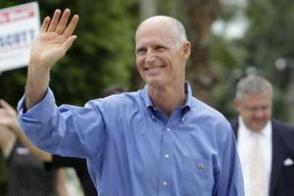
How did this guy ever get elected?
Today the U.S. Justice Department and Governor Rick Scott of Florida announced dueling lawsuits over the Florida voter purge. The Miami Sun-Sentinel:
Gov. Rick Scott announced Monday that the state is suing the Obama administration over its refusal to share a Homeland Security database that Scott says Florida needs to adequately clear its voting rolls of any non-citizens who wrongly registered to vote.
“We want to have fair, honest elections in our state, and so we’ve been put in the position that we have to sue to get it,” he told Fox News in an interview just prior to the Department of State announcing it had filed the suit.
But in a letter that seemed certain to intensify the battle between the Scott administration and Washington, the U.S. Department of Justice demanded that Florida halt efforts to purge its voters rolls – telling the state to “immediately cease this unlawful conduct” – and said it was suing the state.
“It appears that the State of Florida is unwilling to conform its behavior to the requirements of federal law,” wrote Assistant Attorney General Thomas Perez, adding that he had authorized “the initiation of an enforcement action against Florida in federal court.”
The Homeland Security list the Scott wants lists only people with green cards and naturalized citizens. The state has already admitted that the list is inappropriate for the purpose of identifying eligible voters. I suppose Scott wants it so he can make life a living hell for Florida immigrants.
Florida election supervisors have already told Scott that they won’t execute his plan, because it appears that he simply wants to get rid of eligible voters who are likely to vote Democratic.
The ACLU has also sued Florida to stop the illegal voter purge.
The ACLU of Florida says the state’s attempt to remove ineligible voters from the rolls violates the 1965 Voting Rights Act, which was designed to protect minority groups from voter discrimination. Their claims mirror those made by the U.S. Department of Justice, which earlier this month ordered Florida to cease its controversial program.
“The illegal program to purge eligible voters uses inaccurate information to remove eligible citizens from the voter rolls,” said Howard Simon, Executive Director of ACLUFL, in a statement when the suit was filed Friday. “It seems that Governor Scott and his Secretary of State cannot speak without hiding what they mean in political spin. They mislead Floridians by calling their illegal list purge ‘protecting citizen’s voting rights.’ This is precisely why Congress has re-enacted, and why we continue to need, the Voting Rights Act – to prevent state officials from interfering with the constitutional rights of minorities. We now look to the courts to stop the Scott administration from assaulting democracy by denying American citizens the right to vote.”
The ACLUFL is joined by the Lawyers’ Committee for Civil Rights Under Law (LCCRUL) and the law firm of Weil, Gotshal & Manges LLP in the suit.
If Rick Scott doesn’t like being told what to based on Federal law, perhaps he should get together with Texas Governor Rick Perry and secede from the union.

 peej
peej Carissa
 bostonboomer
 dakinikat
 ecocatwoman
 mablue2
 Mama Lopez
 peggysue22
 quixote
 skydancingguestblogger
 Mona (aka Wonk the Vote)



 Sky Dancing
Recent Comments