
Saturday Night Treats
Posted: November 6, 2010 Filed under: open thread, Treats | Tags: Open threads, recipe sharing 69 CommentsIt’s Saturday night!!!
Got something to share?
Bring it on!!!
Hot Spinach-Artichoke Dip
Show: Paula’s Home CookingEpisode: Neighborhood Cocktail Party
Cook Time: 30 min Level: Easy Yield: about 4 cups
Ingredients
- 1 (10-ounce) package frozen chopped spinach
- 2 (13 3/4-ounce) cans artichoke hearts
- 1/2 cup mayonnaise
- 1/2 cup sour cream
- 1 cup freshly grated Parmesan
- 1 cup grated pepper jack cheese
Directions:
Preheat the oven to 350 degrees F. Grease a casserole dish with nonstick spray.
Heat the spinach in a microwave oven on high for 5 minutes and squeeze dry. Drain the artichoke hearts and coarsely chop in a food processor.
Combine all the ingredients except the jack cheese in a large bowl. Stir well. Scrape into the prepared casserole dish and sprinkle the jack cheese on top. Bake for 30 minutes. Transfer to a chafing dish and keep warm over a low flame. Serve with bagel chips.

p.s I like the old fashion thing we do down here in New Orleans. We put it on either fresh French or Italian bread!
This is an open thread.
Gulf Gusher Update: Oil Does NOT Vanish
Posted: November 6, 2010 Filed under: Gulf Oil Spill, New Orleans | Tags: Gulf Of Mexico, Oil still coming ashore, seafood and wildlife response to oil spill 43 Comments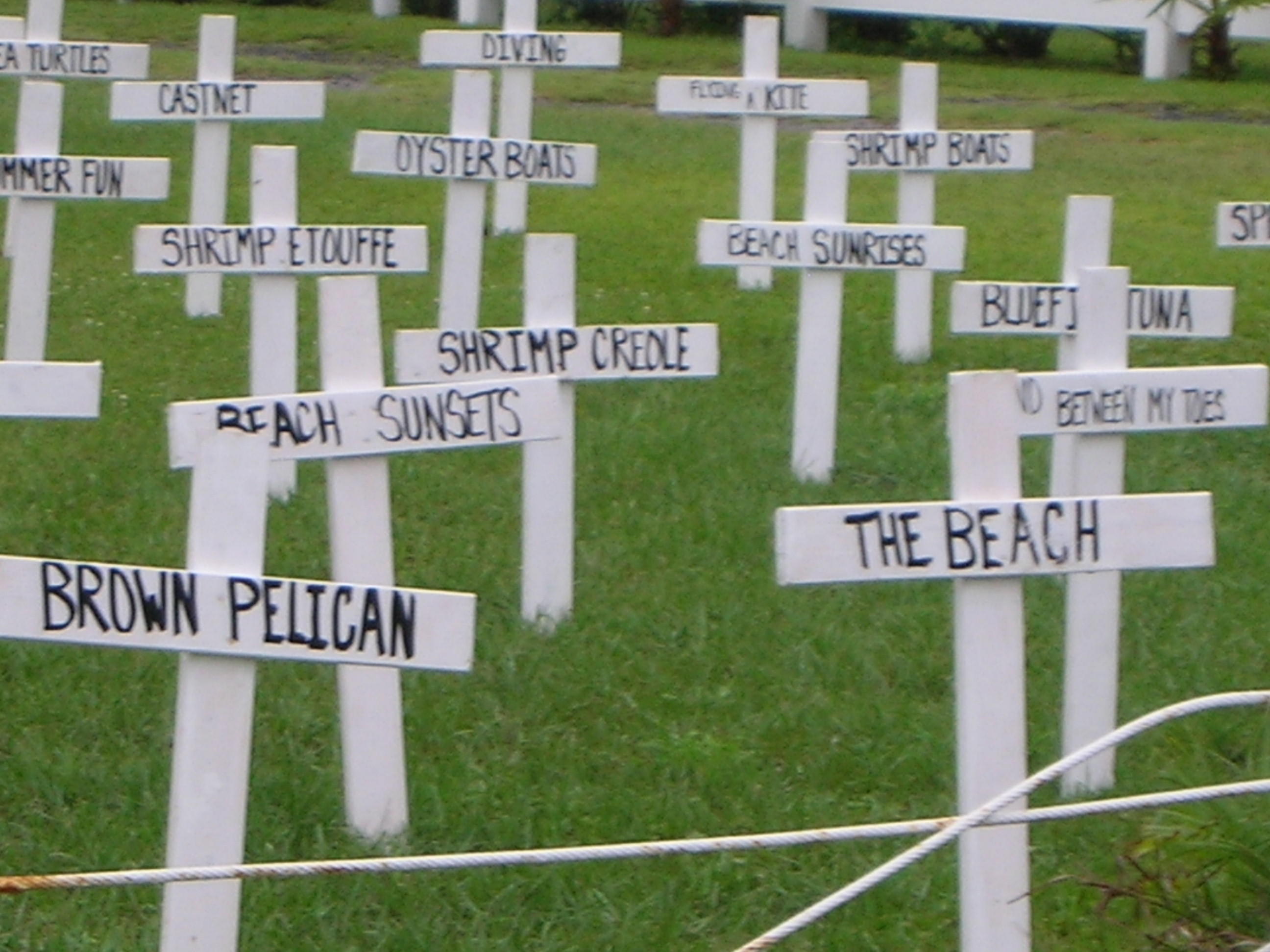 They may have killed the well, but don’t believe any one when they say that the worst is over. The problem is that you’re probably not hearing anything or seeing anything about the aftermath because there seems to be no media around the Gulf Coast other than the locals. Here’s the latest one that I was tweeted today that sent me off to a blogging state of mind. This is from Project Gulf Impact and you really need to watch their video.
This is of special interest to me because I swear the last batch of shrimp I got at the ghetto Winn Dixie had something greasy in the intestine. It was so bad, I threw them away. When I rubbed the black gunk between my fingers, it smeared and stayed there. It took quite a bit of Dawn to get it to go away. It also tasted gritty and greasy.
Despite repeated statements from the EPA and NOAA assuring residents that thorough Gulf of Mexico seafood testing has revealed levels safe for human consumption, public skepticism has continued to deter many locals from their usual seafood medley. Independent scientists have expressed concern over the published methods and protocols used by federal agencies to open sensitive fishing grounds & determine seafood safety. Invertebrates, such as shrimp, crab, & oysters, are of particular concern due to their feeding habits, relatively stationary lifestyle, and inability to process highly toxic compounds found in crude oil called Polycyclic Aromatic Hydrocarbons (PAH). Unfortunately, their concerns have proven valid.
One local activist, “Mac” Mackenzie of NOLA Emergency Response, decided that it was time to take matters into her own hands. After an incessant 7-week investigation, Mac was able to obtain crucial information from our government regarding the specifics of Gulf shrimp testing. Particularly in the Gulf of Mexico, it is common for shrimp to be prepared and even served whole, with the shell and digestive tract intact. When Mac learned that the Gulf shrimp testing performed to date had not included an analysis of whole shrimp with intact shells or digestive tract, she decided to mobilize. She obtained two pounds of locally caught shrimp from Venice, a small town located in the heart of Southern Louisiana. The samples were promptly transported on ice to a laboratory in Mobile Alabama, where Chemist Dr. Robert Namen tested the digestive tracts of the shrimp for components of crude oil. What they found was an alarming 193 parts per million of “Oil & Grease.”
This story came on top of another one this week concerning dead and dying Coral close to the killer wellhead. This is from The Times Picayune.

Image courtesy of Lophelia II 2010 Expedition, NOAA-OER/BOEMRE A single colony of coral with dying and dead sections on left, apparently living tissue at right, and bare skeleton with sickly looking brittle star on the base.
A brown substance is killing coral organisms in colonies located 4,600 feet deep about seven miles southwest of the failed BP Macondo oil well, according to scientists who returned Thursday from a three-week cruise studying coral reefs in the northern Gulf of Mexico.
The finding is the first case in which researchers have found evidence that living organisms in the deepwater area near the well site might have been killed by oil from the spill.
Penn State University biology professor Charles Fisher, chief scientist aboard the NOAA ship Ronald H. Brown said soft coral in a 15-meter to 40-meter area was covered by what appeared to be a brown substance.
“Ninety percent of 40 large corals were heavily affected and showed dead and dying parts and discoloration,” according to a news release reporting the findings by Fisher and other scientists issued jointly by NOAA and the Bureau of Ocean Energy Managment, Regulation and Enforcement, which co-sponsored the research. “Another site 400 meters away had a colony of stony coral similarly affected and partially covered with a similar brown substance.”
“While this mission was not designed to be focused on oil spill research, the timing and location provided an opportunity to observe any impacts to our research areas,” Fisher said in the news release. Fisher was unavailable for further comment on Thursday night.
The release said the scientists “observed dead and dying corals with sloughing tissue and discoloration.”
That’s just some of the continued impact on the ecosystem down here. The town of Gulf Shores, Alabama reports they are still owed $2 million in lost revenues. A city meeting also discussed outstanding claims by businesses and individuals. This, despite the uptick in local advertising I’ve seen on ad ‘stories’ of how BP has made me whole again run by BP here on our local TV stations. The ad revenues for this things must be unbelievably large.
A BP spokesman did not respond to inquiries about the lost revenue claims.
Also at Monday’s meeting, Dyken reported that officials were still trying to work out problems with the lack of claims paid by Ken Feinberg’s Gulf Coast Claims Facility to individuals and businesses.
Officials in south Baldwin County were expected to meet with Feinberg this week, Dyken said.
Baldwin County had received about $219 million, Dyken said.
“Some people still haven’t been paid on claims that are legitimate,” he said. “They have distributed a large amount of money. It’s just whether that money has gone to the appropriate parties in the appropriate places. There’s not a lot of rhyme or reason to some payments being made and others not. There’s also not the degree of transparency we would like in the process.”
In order to ensure that the oil spill’s lingering affects do not carry into next year, Doughty suggested expanding the tourist season.
“We need rebranding of the Gulf so that people understand the Gulf is safe, whether it’s Gulf seafood, Gulf beach, air whatever,” she said. “With tourism being our No. 1 economic engine here, anything we can do to help tourism would be great.”
This is particularly weird given the report by a Pensacola/Mobile TV station that a tourist was slimed with aging Oil last week. You can see the pictures and the news report here at the Channel 5 website.
Jonathan Jones’ palm still has an oil mark. He says he emerged from the water after a brief swim in Gulf Shores with trace amounts of crude.
“We looked at it and kind of smeared it a bit and figured out it was oil,” says Jones. He says he had to bathe with dish soap to get it off. At first he was worried about dispersants but then he quickly calmed down.
“There are hundreds of people on this beach and no one else had this happen,” says Jones. It’s probably important to put what happened to Jonathan in perspective. This appears to be an isolated incident and the beaches are most certainly still open
Meanwhile, future troubles lurk too. MoJo has identified the BP Atlantis–something BostonBoomer has written about–as another ‘Ticking Time Bomb in the Gulf’.
Located 124 miles off the Louisiana coast, the Atlantis platform produces 200,000 barrels of oil daily, more than triple the amount of oil that spilled from the Horizon site each day. But long before the Deepwater Horizon disaster, a whistleblowing former BP contractor tipped off regulators that the Atlantis may be violating the law, and environmental groups and members of Congress have been publicly questioning the platform’s safety ever since.
According to Kenneth Abbott, a former BP contractor who worked on the platform from 2008 through early 2009, more than 7,000 documents necessary to operate the platform safely are missing or incomplete. Abbott says the vast majority of the project’s subsea piping and instrument diagrams were not approved by engineers, and the safety systems are out of date. In practice, the lack of documentation on this platform would make it extremely difficult to respond in the event of an accident like the Deepwater Horizon blowout, critics say, because no one really has an accurate picture of the Atlantis’ design.
This seems to be the forgotten disaster and environmental disasters do not just disappear. Down here, the big election

Tony Bologna apologizes endlessly in the new series of BP spoofs on South Park at Comedy Central.
story was between Vitter and Melancon and both were fighting over who could be the most welcoming to the drillers and spillers. The MSM appeared more fixated on political personalities than issues. The only program still properly fixated on the BP Gusher is South Park that has a completely hilarious bit where Tony continually apologizes and then keeps on with making worse decisions. You can click on the picture to watch the episodes at Comedy Central or just the apology ad campaign send up.
If you live down here were there are daily reports of “massive stretches of weathered oil spotted in the Gulf of Mexico”. This report on a sighting is dated from October 23, 2010. That means it’s post well plugging. Again, this is from the Times Picayune here in New Orleans.
Just three days after the U.S. Coast Guard admiral in charge of the BP oil spill cleanup declared little recoverable surface oil remained in the Gulf of Mexico, Louisiana fishers Friday found miles-long strings of weathered oil floating toward fragile marshes on the Mississippi River delta.
The discovery, which comes as millions of birds begin moving toward the region in the fall migration, gave ammunition to groups that have insisted the government has overstated clean-up progress, and could force reclosure of key fishing areas only recently reopened.
The oil was sighted in West Bay, which covers approximately 35 square miles of open water between Southwest Pass, the main shipping channel of the river, and Tiger Pass near Venice. Boat captains working the BP clean-up effort said they have been reporting large areas of surface oil off the delta for more than a week but have seen little response from BP or the Coast Guard, which is in charge of the clean-up. The captains said most of their sightings have occurred during stretches of calm weather, similar to what the area has experienced most of this week.
The Coast Guard is saying parts of it are just algae but frankly, I believe the captains of Louisiana’s Cajun/Creole fishing fleet. Again, this thing and its impact are not over by a long shot. It’s absolutely necessary to continue to hold our elected officials and BP accountable for all the damage done and still happening to the ecosystem, wildlife, and people of the Gulf.
Saturday Reads
Posted: November 6, 2010 Filed under: morning reads | Tags: Post 2010 election analysis, U.S. Economy 37 CommentsGood Morning!!!
File this one from The Hill under no surprises! Sean J Miller’s headline says it all: ‘Hillary voters’ abandon Democrats”. I even voted for a blue dawg congressman to become a blue dawg senator, it did no good whatsoever. I think when every one was told they didn’t need the votes, a lot of people took them seriously.
The blue-collar voters who supported Hillary Clinton’s 2008 presidential run deserted her party in droves on Tuesday, according to a new poll.
Democrats’ support from white, non-college-educated male voters dropped 12 percent from 2008, according to a survey Greenberg Quinlan Rosner conducted Nov. 2-3 for Democracy Corps and Campaign for America’s Future.
Only 29 percent of blue-collar men support Democrats in 2010, down from 41 percent last cycle, according to the survey of 1,000 2008 voters, of which 897 voted on Tuesday.
“These are gigantic losses,” Democratic pollster Stan Greenberg, whose firm conducted the survey, said on a conference call with reporters Friday.
Greenberg said President Obama and the Democratic leadership failed to articulate a clear economic message.
The process surrounding the healthcare bill, which passed in March, reinforced the perception voters’ had that the Democrats were spending too much time bickering with the GOP, increasing federal spending and listening to lobbyists instead of average people on major legislation.
I’ve been writing about one or another version of it’s the jobs stupid or it’s the economy stupid for about around two years. You’d have to really be deaf not to understand how folks are hurting for a decent wage and a decent job these days.
The more conservative side of Politico has this headline that’s a grabber too: ‘The ego factor: Can Obama change?’ I guess one of the reasons that I want to quote this some is that it interviews two Louisiana folks; James Carville and Douglas Brinkley.
“Humility is a great quality, and it’s one that people will respect,” said historian Douglas Brinkley, who teaches at Rice University. “Ronald Reagan could be seen as a polarizing presence, but he also knew how to play humble when it was necessary. Where is President Obama’s self-deprecating humor? Kennedy and Reagan could both be very self-deprecating. People liked that.”
“The worst thing that happened to Obama is he’s lost a lot of his aura. Even his friends think he’s thin-skinned and a bit highfalutin,” he said.
It’s the sort of complaint that comes to the fore in background conversations with lawmakers, lobbyists and veterans of previous administrations who interact with Obama’s West Wing staffers: that they’ve created a cult of personality around Obama, having followed their boss on his rapid and improbable ascent to the presidency. Many of these devotees do, indeed, feel that he is the political equivalent of NBA phenom LeBron James. The view is based on a belief that Obama’s outsize political skills and uncommon personal poise make him different than conventional politicians and immune to conventional political laws of gravity.
One Obama insider said it is a view that starts at the top. Having triumphed over an early perception by political insiders and many journalists that he could not defeat front-runner Hillary Clinton, Obama, this person said, frequently invokes the 2008 experience and what he believes was its lesson — always stay the course, don’t be distracted by ephemeral controversies or smart-set importuning for a change of direction.
Some believe this is an admirable instinct carried to a dangerous degree.
“Obama would sort of say, ‘Look, I’m smart. I know what I’m doing. You’ll just have to trust me,’” said Democratic strategist and commentator James Carville. “It was kind of beneath him to explain the reasons behind his actions to people — how TARP really worked, how the stimulus was helping. … You had a lot of signs — New Jersey, Virginia, Scott Brown — but they thought what they were doing was going to turn out all right.”
If you don’t read James K. Galbraith at New Deal 2.0, you really should. He’s got a great piece up over there that says Obama has to ‘break his devil’s pact with the banks to succeed’.
The original sin of Obama’s presidency was to assign economic policy to a closed circle of bank-friendly economists and Bush carryovers. Larry Summers. Timothy Geithner. Ben Bernanke. These men had no personal commitment to the goal of an early recovery, no stake in the Democratic Party, no interest in the larger success of Barack Obama. Their primary goal, instead, was and remains to protect their own past decisions and their own professional futures.
Up to a point, one can defend the decisions taken in September-October 2008 under the stress of a rapidly collapsing financial system. The Bush administration was, by that time, nearly defunct. Panic was in the air, as was political blackmail — with the threat that the October through January months might be irreparably brutal. Stopgaps were needed, they were concocted, and they held the line.
But one cannot defend the actions of Team Obama on taking office. Law, policy and politics all pointed in one direction: turn the systemically dangerous banks over to Sheila Bair and the Federal Deposit Insurance Corporation. Insure the depositors, replace the management, fire the lobbyists, audit the books, prosecute the frauds, and restructure and downsize the institutions. The financial system would have been cleaned up. And the big bankers would have been beaten as a political force.
The job market figures were released yesterday and they definitely had an impact on the financial markets. This is from Bloomberg.
Treasuries fell, with five-year note yields rising for the first time in seven days, while U.S. benchmark equity indexes gained to two-year highs and the dollar strengthened as jobs growth bolstered optimism in the economy
The 5-year Treasury note’s yield rose six basis points to 1.09 percent at 4 p.m. in New York, rebounding from a record low this week. The Standard & Poor’s 500 Index advanced 0.4 percent to 1,225.85, its highest level since Sept. 19, 2008. The Dollar Index, which tracks the U.S. currency against six peers, snapped a three-day drop to climb from its 2010 low. Commodity indexes rose to the highest levels since October 2008 as copper surged to a 28-month high amid a mining strike in Chile.
The jobs market data itself wasn’t great but it certainly wasn’t bad. Economist Mark Thoma explains the wishy washy view.
I’ve seen some people calling this a strong report. It’s certainly better than lower job growth numbers, so it could have been worse, but in past recoveries we’ve had job growth of hundreds of thousands, far more that this. So let’s try to put it in perspective. Many people estimate that 7.5 million jobs have been lost since the start of the recession (and some people estimate it’s even more than this). Suppose it takes 100,000 jobs per month to keep up with population growth. I think it’s a bit more than this, but let’s take an estimate that is generous in terms of making up lost ground. With a net gain of 50,000 jobs (rounding from 51,000), how long would it take to reemploy the 7.5 million who need jobs? The answer is (7.5 million)/(50,000) = 150 months = 12.5 years.
Iraqi prisoners were not only abused by Americans but also by the UK. This is a horrifying report at The Guardian.
Evidence of the alleged systematic and brutal mistreatment of Iraqi prisoners at a secret British military interrogation centre that is being described as “the UK’s Abu Ghraib” emerged yesterday during high court proceedings brought by more than 200 former inmates.
The court was told there was evidence that detainees were starved, deprived of sleep, subjected to sensory deprivation and threatened with execution at the shadowy facilities near Basra operated by the Joint Forces Interrogation Team, or JFIT.
It also received allegations that JFIT’s prisoners were beaten, forced to kneel in stressful positions for up to 30 hours at a time, and that some were subjected to electric shocks. Some of the prisoners say that they were subject to sexual humiliation by women soldiers, while others allege that they were held for days in cells as small as one metre square.
Michael Fordham QC, for the former inmates, said the question needed to be asked: “Is this Britain’s Abu Ghraib?”
I can’t even think up a response to the video or information shared in that article.
Okay, so I’m going to end with another ‘no surprises here’ post. Ozzy Osbourne is actually a mutant. No really.
A study of the hard-partying rocker revealed he actually has several genetic mutations that may explain how he’s lived so long, scientists say.
Some of them “we’ve never seen before,” said geneticist Nathaniel Pearson, who was part of the team that sequenced Osbourne’s DNA for Massachusetts lab Knome Inc.
“I’ve always said that at the end of the world there will be roaches, Ozzy and Keith Richards,” the Prince of Darkness’ wife Sharon Osbourne said.
“He’s going to outlive us all. That fascinated me – how can his body endure so much.”
The 61-year-old “Black Sabbath” singer is as famous for his colossal intake as he is for his voice. He once said he did LSD every day for two years and he drank booze like water.
No surprisingly, many of the anomalies scientists discovered had to do with how he processes drugs and alcohol.
Ozzy was just here in town for voodoo fest. I imagine he left DNA samples all over the place if the scientists still are looking for more. Since it’s still the morning, I’ll treat you to some mellow Ozzy.
So, that’s my contribution today.
What’s on you reading and blogging list?
Currency Devaluations + Nifty Graph
Posted: November 5, 2010 Filed under: Global Financial Crisis | Tags: APEC, currency devaluation, trade imbalances 8 CommentsYou had to know that it was eventually coming. I can’t pass up the chance to use a nifty graph for discussing stuff surrounding economics. This is from Der Spiegel. It will show you the value of trade between the U.S., China and the Eurozone plus a few other stylized facts. One set of data is GDP which is in the table down in the left. The other set in the right corner is foreign currency reserves which is a bunch of money sitting out there with lots of places to go. That is, unless you don’t have a pile and the EU and the U.S. don’t have a pile. (China had been using its pile to purchase U.S. Treasuries. )
 Here’s a bit of a primer on APEC from the WSJ. The issues of currency devaluation and QE2 are bound to come up, eventually.
Korn, noting that many Asian central banks have been intervening to defend the dollar and slow their own currencies’ rises, complained that the baht’s 11% gain this year is hurting Thai exporters by making them less price-competitive.
In one possible rift, APEC ministers from Southeast Asia countered a U.S. push to quantify the goals for reducing imbalances. At the recent G-20 meeting, the U.S. sought to specify that countries would aim to limit their current-account imbalances to 4% of gross domestic product by 2015, but the group rejected putting any numbers on what were watered down to “indicative guidelines.”
Members of the Association of Southeast Asian Nations, meeting on the APEC sidelines, were set to warn that such a move would promote protectionism and hamper free trade.
“Asean has concerns that specific targeting of the current account could lead to measures being employed that may be detrimental to the principle of free trade,” says a draft statement from the group, seen by Dow Jones.
The Asean ministers are likely to take this issue up with U.S. Treasury Secretary Timothy Geithner early Saturday.
If you’d like to learn more about Currency Devaluation and Revaluation, here’s a link to a short FAQ from the NYFED.
Under What Circumstances Might a Country Devalue?
When a government devalues its currency, it is often because the interaction of market forces and policy decisions has made the currency’s fixed exchange rate untenable. In order to sustain a fixed exchange rate, a country must have sufficient foreign exchange reserves, often dollars, and be willing to spend them, to purchase all offers of its currency at the established exchange rate. When a country is unable or unwilling to do so, then it must devalue its currency to a level that it is able and willing to support with its foreign exchange reserves.A key effect of devaluation is that it makes the domestic currency cheaper relative to other currencies. There are two implications of a devaluation. First, devaluation makes the country’s exports relatively less expensive for foreigners. Second, the devaluation makes foreign products relatively more expensive for domestic consumers, thus discouraging imports. This may help to increase the country’s exports and decrease imports, and may therefore help to reduce the current account deficit.
There are other policy issues that might lead a country to change its fixed exchange rate. For example, rather than implementing unpopular fiscal spending policies, a government might try to use devaluation to boost aggregate demand in the economy in an effort to fight unemployment. Revaluation, which makes a currency more expensive, might be undertaken in an effort to reduce a current account surplus, where exports exceed imports, or to attempt to contain inflationary pressures.
The APEC meetings are going on now and we’re sure to get some news in the morning.
KO for KO?
Posted: November 5, 2010 Filed under: Elections, Main Stream Media, The DNC, The Media SUCKS | Tags: Olbermann suspended, Pelosi runs for minority leader, Van Hollen resigns DCCC 67 CommentsTwo breaking news stories worth front paging are sweeping blog headlines.
 First, Keith Olbermann has been suspended indefinitely without pay at MSNBC for donationg to three Democratic candidates during the last election. This is from Politico.
Olbermann made campaign contributions to two Arizona members of Congress and failed Kentucky Senate candidate Jack Conway ahead of Tuesday’s election.
Olbermann, who acknowledged the contributions in a statement to POLITICO, made the maximum legal donations of $2,400 apiece to Conway and to Arizona Reps. Raul Grijalva and Gabrielle Giffords. He donated to the Arizona pair on Oct. 28 — the same day that Grijalva appeared as a guest on Olbermann’s “Countdown” show.
NBC has a rule against employees contributing to political campaigns, and a wide range of news organizations prohibit political contributions — considering it a breach of journalistic independence to contribute to the candidates they cover.
Other links:
The second breaking news story of interest is that Nancy Pelosi will run for Minority Leader. This is from Ryan Griffin  at Huffpo. Pelosi Tweeted the announcement.
House Speaker Nancy Pelosi (D-Calif.) will make a bid to be Democratic minority leader, she announced Friday via Twitter. “Driven by the urgency of creating jobs & protecting #hcr, #wsr, Social Security & Medicare, I am running for Dem Leader,” she tweeted.
Other Links:
In related news, Rep. Van Hollen is leaving his chairmanship at the DCCC.

 peej
peej Carissa
 bostonboomer
 dakinikat
 ecocatwoman
 jjlo
jjlo mablue2
 Mama Lopez
 peggysue22
 quixote
 skydancingguestblogger
 Mona (aka Wonk the Vote)





Recent Comments