
The Year of Dangerous Rhetoric
Posted: March 7, 2011 Filed under: Federal Budget, U.S. Economy | Tags: John Boehner, Treasuries, US government debt 25 Comments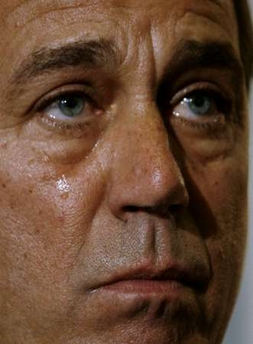 Pols always seem to use over-the-top rhetoric when trying to get elected. We’ve had smear campaigns and unfulfilled campaign promises for as long as there has been some one running for an elected office. Journalists enjoy making headlines out of this rhetoric and we’ve entered an age where they don’t even hesitate to join in on the pitch. The Supremes have upheld free speech rights for NAZIs parading in Jewish neighborhoods, opportunistic gay hating religionists spewing bile at the funerals of US soldiers, and megacorporations. No one wants to draw any lines on freedom of expression these days.
The first amendment is a beautiful thing. So is, however, self-restraint. Just because you have a broad right, a big mouth, and some urge to purge doesn’t necessarily mean you should avail yourself of the opportunity. This was always made clear to me as a kid with the example of ‘Don’t yell fire in a crowded theater if there’s no fire’. Evidently Weeper of the House John Boehner slept through that part of the social studies curriculum.
Markets–especially financial markets–thrive on information. Financial markets even trade on them. I remember working in the Treasury area of a large savings and loan in the 1980s while we were trying to package and sell mortgages, hedge using GNMA futures, and then price jumbo CDs to customers. All of this was in the era of Paul Volcker and yo yo interest rates. The Fed used to make announcements on Friday afternoons. The entire market would shut down in anticipation of the Fed’s announcements. The last few hours of business would screech to a halt until the information came out. We had one bond salesman that used to call us and read us jokes from a file box during the waiting hour. It was a weird time for all.
The Fed noticed how disruptive that was and ended the practice. Current Fed Chair Bernanke is so aware of how his words impact the market he even has a policy of ‘managing expectations’ in that he always makes some kind of statement on monetary policy when releasing any information. He also does speeches to businesses where he clarifies how the Fed will be dealing with the markets for Treasuries. This is supposed to end a lot of instability and speculation that can damage investment positions unnecessarily. You really don’t want to mess with Treasury markets because they represent the base, risk-free rate upon which everything else gets priced.
That brings me to to a few people in politics that don’t seem to connect market instability to policy maker rhetoric. It seems every one has learned that lesson except the outrageous Speaker of the House John Boehner who appears to want to make the markets as shaky as his hands.
House Speaker John Boehner routinely offers this diagnosis of the U.S.’s fiscal condition: “We’re broke; Broke going on bankrupt,” he said in a Feb. 28 speech in Nashville.
Boehner’s assessment dominates a debate over the federal budget that could lead to a government shutdown. It is a widely shared view with just one flaw: It’s wrong.
“The U.S. government is not broke,” said Marc Chandler, global head of currency strategy for Brown Brothers Harriman & Co. in New York. “There’s no evidence that the market is treating the U.S. government like it’s broke.”
The U.S. today is able to borrow at historically low interest rates, paying 0.68 percent on a two-year note that it had to offer at 5.1 percent before the financial crisis began in 2007. Financial products that pay off if Uncle Sam defaults aren’t attracting unusual investor demand. And tax revenue as a percentage of the economy is at a 60-year low, meaning if the government needs to raise cash and can summon the political will, it could do so.
Speaker Boehner’s staff answers any criticism of his rhetoric with the usual false equivalency. Interestingly enough, the Bloomberg article I’m quoting is finally taking on the ridiculousness of equating our government with family finances. Every financial economist loses a bowtie whenever that happens.
“If an American family is spending more money than they’re making year after year after year, they’re broke,” said Michael Steel, a spokesman for Boehner.
A person, company or nation would be defined as “broke” if it couldn’t pay its bills, and that is not the case with the U.S. Despite an annual budget deficit expected to reach $1.6 trillion this year, the government continues to meet its financial obligations, and investors say there is little concern that will change.
Still, a rhetorical drumbeat has spread that the U.S. is tapped out. Republicans, including Representative Ron Paul of Texas, chairman of the House domestic monetary policy subcommittee, and Fox News commentator Bill O’Reilly, have labeled the U.S. “broke” in recent days.
Chris Christie, the Republican governor of New Jersey, said in a speech last month that the Medicare program is “going to bankrupt us.” Julian Robertson, chairman of Tiger Management LLC in New York, told The Australian newspaper March 2: “we’re broke, broker than all get out.”
The U.S. government is not one big dysfunctional family unit. People die. Their estates have to be settled. They can’t print money. They can’t tax any one else’s assets. Their incomes don’t grow in perpetuity into the trillions of dollars. Politicians who continually make this false equivalency are not only wrong, they are dangerously wrong.
When Governor Christie makes these ridiculous statements the biggest damage he can do is limited. At the very worst, the market may price New Jersey’s bond issues as riskier. The resale market for NJ bonds may get thinner. This is especially true if Christie shows any willingness to entertain the idea of state bankruptcy which at this point can’t even happen. If he shows unwillingness to use the state’s taxing powers to clear up the mess, he can also create some havoc in the market. Every one knows a government can get the funds to pay its debt one way or another. Showing the world you won’t do it in a timely way just makes your bondholders extra nervous.
Speaker of the House Boehner has a bigger job that includes the budget of the U.S. He can unnecessarily influence financial markets while repeating such craziness. The U.S. cannot technically go bankrupt but speculation and uncertainty can impact the rate of interest we will pay on our debt. It can also cause the FED to enact money supply increases to maintain low levels of interest which can create inflationary pressures. Boehner is at a level of power that careless political rhetoric can influence markets. He needs to be more mature and less cavalier with his ignorant pronouncements on US debt and the US economy.
I swear that these guys are purposefully trying to tank the economy.
Kewl Science
Posted: March 5, 2011 Filed under: just because | Tags: alien life, life in outter space, science 8 CommentsThere’s always been a hypothesis out there in science world that argues that meteors may actually have planted the  seeds of life on earth. It appears NASA has evidence that this hypothesis may make it theory status.
That’s the stunning conclusion one NASA scientist has come to, releasing his groundbreaking revelations in a new study in the March edition of the Journal of Cosmology.
Dr. Richard B. Hoover, an astrobiologist with NASA’s Marshall Space Flight Center, has traveled to remote areas in Antarctica, Siberia, and Alaska, amongst others, for over ten years now, collecting and studying meteorites. He gave FoxNews.com early access to the out-of-this-world research, published late Friday evening in the March edition of the Journal of Cosmology. In it, Hoover describes the latest findings in his study of an extremely rare class of meteorites, called CI1 carbonaceous chondrites — only nine such meteorites are known to exist on Earth.
Though it may be hard to swallow, Hoover is convinced that his findings reveal fossil evidence of bacterial life within such meteorites, the remains of living organisms from their parent bodies — comets, moons and other astral bodies. By extension, the findings suggest we are not alone in the universe, he said.
“I interpret it as indicating that life is more broadly distributed than restricted strictly to the planet earth,” Hoover told FoxNews.com. “This field of study has just barely been touched — because quite frankly, a great many scientist would say that this is impossible.”
You can consider this an open thread.

Oh, and Tashi Deleg! It’s Tibetan New Year!!!!
Unemployment Details
Posted: March 4, 2011 Filed under: jobs, U.S. Economy, unemployment | Tags: BLS, Economic policy, Job Market, jobs, unemployment 12 Comments
Here’s the details on the current BLS job survey for February. It came in pretty much as anticipated. The nifty graph and the following analysis come via Calculated Risk. We can say definitively that this is the worst job market since World War 2. The recovery path has created far few jobs than any of the previous post WW2 recessions. You can’t judge a jobs market by the unemployment rate alone. The devil is definitely in the details so let’s get into the report’s finer points.
This wasn’t a great report. Heck, it wasn’t a “good” report. But it was a little better than most recent reports.
If we average the last two months together, the 63,000 payroll jobs added in January and the 192,000 payroll jobs in February, that gives 127,500 payroll jobs per month. And that is a barely enough to keep up with the growth in the labor force. Private payrolls were a little better at an average of 145,000 per month, as state and local governments continued to lay off workers (something we expect all year).
The decline in the unemployment rate from 9.0% to 8.9%, was good news, especially since the participation rate was unchanged at 64.2%. Note: This is the percentage of the working age population in the labor force.
The decreases for the long term unemployed, and for the number of part time workers for economic reasons, and the decline in U-6 to 15.9% is all welcome news – although the levels are still very high.
The average workweek was unchanged at 34.2 hours, and average hourly earnings ticked up 1 cent. Both disappointing.
You can see the details here at the BLS site. The details that are most overlooked by people that don’t know how to view unemployment statistics representing people that have become so discouraged they either leave the labor force or become what is known as ‘marginally attached’. Another tell tale sign of problems are the underemployed, workers who can only find part time jobs when they really want to work full time, and workers that are stuck working as temporary workers.
The number of persons employed part time for economic reasons (sometimes referred to as involuntary part-time workers) was essentially unchanged at 8.3 million in February. These individuals were working part time because their hours had been cut back or because they were unable to find a full-time job. (See table A-8.)
In February, 2.7 million persons were marginally attached to the labor force, up from 2.5 million a year earlier. (These data are not seasonally adjusted.) These individuals were not in the labor force, wanted and were available for work, and had looked for a job sometime in the prior 12 months. They were not counted as unemployed because they had not searched for work in the 4 weeks preceding the survey. (See table A-16.)
Among the marginally attached, there were 1.0 million discouraged workers in February, a decrease of 184,000 from a year earlier. (These data are not seasonally adjusted.) Discouraged workers are persons not currently looking for work because they believe no jobs are available for them. The remaining 1.7 million persons marginally attached to the labor force in February had not searched for work in the 4 weeks preceding the survey for reasons such as school attendance or family responsibilities. (See table A-16.)
This is a very sluggish recovery that suggests policymakers are just letting the recession take its ‘natural path’ to recovery. We definitely have do-nothing economic policy right now. What really frightens me is the forthcoming do-damage austerity policy coming from states and the federal government. We wouldn’t have the size of budget deficits that we know have if the government had spent last time healing the capital positions of Wall Street shadow banks and more time healing the jobs and household situation. After all, the real wealth and well-being in an economy comes from actual goods and services produced that add-value. There is a lot more economic well-being derived from better roads, households with modern cars and appliances, and more thriving small businesses than paperwork mills that stand between buyers and sellers of goods and services and financial gambling that drives prices of things unrealistically high through speculation.
What we need is some real leadership with knowledge of economic policy. It’s obvious from these sluggish numbers that we don’t have that at all.
There’s a good article up at Truth Out that you may want to check out. It’s called “How the Rich Soaked the Rest of Us”. It’s got some nifty graphs too. It basically explains how hoarding of money in the hands of a very few has cut off the kind of growth in industries, jobs, and commerce that would allow every one to share in a robust economy.
Over the last half-century, the richest Americans have shifted the burden of the federal individual income tax off themselves and onto everybody else. The three convenient and accurate Wikipedia graphs below show the details. The first graph compares the official tax rates paid by the top and bottom income earners. Note especially that from the end of the Second World War into the early 1960s, the highest income earners paid a tax rate over 90 percent for many years. Today, the top earners pay a rate of only 35 percent. Note, also, how the gap between the rates paid by the richest and the poorest has narrowed. If we take into account the many loopholes the rich can and do use far more than the poor, the gap narrows even more.
One conclusion is clear and obvious: the richest Americans have dramatically lowered their income tax burden since 1945, both absolutely and relative to the tax burdens of the middle income groups and the poor.
It’s obvious this tax policy has contributed to this horrible middle class against middle class anger that is contributing to the current war on teachers, firefighters, and police. The wealth accumulated from the last few decades of economic growth has shifted to the top while the burden of taking care of everything has shifted to the middle and bottom. This has fueled this dangerous resentment. Many people are clearly mad at the wrong folks. The old conservative adage is that these rich people create businesses and jobs. Evidence shows that this clearly isn’t the case.
How do the rich justify and excuse this record? They claim that they can invest the money they save from taxes and thereby create jobs etc. But do they? In fact, cutting rich people’s taxes is often very bad for the rest of us (beyond the worsening inequality and hobbled government it produces).
Several examples show this. First, a good part of the money the rich save from taxes is then lent by them to the government (in the form of buying US Treasury securities for their personal investment portfolios). It would obviously be better for the government to tax the rich to maintain its expenditures, and thereby avoid deficits and debts. Then, the government would not need to tax the rest of us to pay interest on those debts to the rich.
Second, the richest Americans take the money they save from taxes and invest big parts of it in China, India, and elsewhere. That often produces more jobs over there, fewer jobs here, and more imports of goods produced abroad. US dollars flow out to pay for those imports and so accumulate in the hands of foreign banks and foreign governments. They, in turn, lend from that wealth to the US government because it does not tax our rich, and so we get taxed to pay for the interest Washington has to give those foreign banks and governments. The largest single recipient of such interest payments today is the People’s Republic of China.
Third, the richest Americans take the money they don’t pay in taxes and invest it in hedge funds and with stockbrokers to make profitable investments. These days, that often means speculating in oil and food, which drives up their prices, undermines economic recovery for the mass of Americans and produces acute suffering around the globe. Those hedge funds and brokers likewise use part of the money rich people save from taxes to speculate in the US stock markets. That has recently driven stock prices higher: hence, the stock market recovery. And that mostly helps – you guessed it – the richest Americans who own most of the stocks.
It’s obvious that we’ve basically slowed the US jobs and growth machine down with policy that siphons off economic growth to wealth hoarding instead of job-creating businesses and infrastructure. It’s time to find some leaders that realize this and will do what it takes to get us off the ‘natural’ sluggish path and on the path to a better future for every one. Until we actually have real commerce producing real goods and services being serviced by people with real jobs, we’re not going to see much of a change. Shuffling paper, creating exotic financial instruments and bubbles, and devastating people’s home values and savings through speculative quagmires isn’t getting the majority of us anywhere. It’s time for the majority of us to stand up and demand that our tax dollars and policies represent improvements for all. It’s time to end privatization schemes, excessive speculation, and captured regulators and move back to the days of when our economy benefited more than just the privileged few.
update: You may want to check out this study at Brookings Institute: Have Earnings Actually Declined?
This analysis suggests that earnings have not stagnated but have declined sharply. The median wage of the American male has declined by almost $13,000 after accounting for inflation in the four decades since 1969. This is a reduction of 28 percent!
Friday Reads
Posted: March 4, 2011 Filed under: GLBT Rights, jobs, Marriage Equality, morning reads, U.S. Economy | Tags: joblessness, marriage equality, retiring Democratic Senators 33 Comments Good Morning!
I’ve turned into a bit of broken record on the inability of the U.S. economy to produce not only jobs, but well-paying jobs. This article at The Nation basically says a lot of the same things I’ve been saying and thinking for several years. It’s called ‘Why Washington Doesn’t Care About Jobs’.
This disconnect between the jobs crisis in the country and the blithe dismissal thereof in Washington is the most incomprehensible aspect of the political moment. But I think there are two numbers that go a long way toward explaining it.
The first is 4.2. That’s the percentage of Americans with a four-year college degree who are unemployed. It’s less than half the official unemployment rate of 9 percent for the labor force as a whole and one-fourth the underemployment rate (which counts those who have given up looking for work or are working part time but want full-time work) of 16.1 percent. So while the overall economy continues to suffer through the worst labor market since the Great Depression, the elite centers of power have recovered. For those of us fortunate enough to have graduated from college—and to have escaped foreclosure or an underwater mortgage—normalcy has returned.
The other number is 5.7 percent. That’s the unemployment rate for the Washington/Arlington/Alexandria metro area and just so happens to be lowest among large metropolitan areas in the entire country. In 2010 the DC metro area added 57,000 jobs, more than any in the nation, and now boasts the hottest market for commercial office space. In other words: DC is booming. You can see it in the restaurants opening all over North West, the high prices that condos fetch in the real estate market and the general placid sense of bourgeois comfort that suffuses the affluent upper- and upper-middle-class pockets of the region.
What these two numbers add up to is a governing elite that is profoundly alienated from the lived experiences of the millions of Americans who are barely surviving the ravages of the Great Recession. As much as the pernicious influence of big money and the plutocrats’ pseudo-obsession with budget deficits, it is this social distance between decision-makers and citizens that explains the almost surreal detachment of the current Washington political conversation from the economic realities working-class, middle-class and poor people face.
It is unbelievable we could be facing such a serious level of unemployment and underemployment at this time in our history. We have full knowledge of what it takes to deal with this problem and yet our policy makers do nothing. No less than Ronald Reagan would’ve found this situation intolerable who once said:
“Idle industries have cast workers into unemployment, human misery and personal indignity.”
Our economy is seriously under-performing.  At the same time, our politicians are slashing both taxes and budgets which have been shown by nearly 70 years of economic data and history to be a short road to disaster. Our politicians are only responsive to their political donor base and to their own personal whims. Christopher Hayes’s continues this theme in his article cited above in The Nation.
In a 2007 paper titled “Inequality and Democratic Responsiveness in the United States,” Princeton political scientist Martin Gilens analyzed 2,000 survey questions from 1981 to 2002, looking for the relationship between public opinion and policy outcomes. He found that “when Americans with different income levels differ in their policy preferences, actual policy outcomes strongly reflect the preferences of the most affluent but bear little relationship to the preferences of poor or middle income Americans.”
There is only so much social distance a society can take. The social science literature shows that as social distance increases, trust declines and aberrant and predatory behavior increases. The basic mechanisms of representation erode, and the social fabric tears. “An imbalance between rich and poor,” Plutarch warned, “is the oldest and most fatal ailment of all republics.”
I’ve posted a graph from FRBSF Economic Research that shows our ‘output’ gap and its trajectory. I don’t think you have to be a mathematical genius to extrapolate how many years it’s going to take before we close the gap and return to our potential. It looks at least between 6 -8 years just from eyeballing that graph. The output gap represents what our economy should be producing–implying more jobs–and our production shortfall. We not only have a huge output gap but a measurable and significant income gap between those who actually produce something and those that skim money off of transactions or gamble themselves into a profit via arbitrage. It is never a good sign when wealth goes to gamblers and third party payers who drive a wedge between buyers and sellers and distort market prices and quantities. I continue to be amazed at the callous disregard for history, economics, and people that characterize our policy makers. We have too many lawyers and not enough economists at the helm.
Agent Orange is promising “GOP cover” for slashing “entitlements”. I still hate the way that benefits that I have paid for since I was 14 years old and held my first job down as a docent at a museum could be called an “entitlement” . They spit that word out with the implication that only lazy and shiftless people collect THAT kind of money. We’re entitled to it because we paid for it dear Speaker! Anyway, raise you’re hand if you think this is a honey trap of sorts! This is from The Hill.
Moreover, Boehner has personally promised Obama that he will stand side-by-side with him to weather the strong political backlash expected from any proposal to cut entitlement costs.
So far, Obama has not taken Boehner up on the deal, as Democratic strategists have warned the White House not to cut payments from the Social Security trust fund or to reopen the acrimonious debate over healthcare.
Social Security reform has been prominent in behind-the-scenes talks about entitlement spending because it is relatively easy to reduce its cost projections — at least, compared to the complex morass of healthcare policy reform.
Social Security has been known traditionally as the “third rail” of politics, because grappling with the issue is considered as deadly as touching an electrified subway rail.
President George W. Bush saw his post-election political capital plummet in 2005 after Democrats led by Sen. Max Baucus (D-Mont.) excoriated his administration’s proposal to divert a portion of Social Security revenues into private retirement accounts.
Boehner has promised that Republicans will not exploit entitlement reform for political gains if Obama shows leadership on curbing the cost of Social Security and other mandatory spending programs, according to sources familiar with the offer.
An interesting post has shown up at Politico implying that many Democratic Senators have decided to retire. It’s a rather long bit but I’d like to concentrate on one senator I will not miss.
Five senators from the Democratic side of the aisle have already decided to hang ’em up after this term. Each has his own reasons, but it mostly boils down to this: For some senators, a job in the “most exclusive club” is not worth the hassle anymore.
“It’s about campaigns,” Sen. Joe Lieberman (I-Conn.), a retiring member of the Democratic Caucus, told POLITICO. “It’s about both the unremitting — that’s a bad word to use — about the constant pressure to raise money and travel all over the country doing that and the nastiness of the campaign. … I have no second thoughts about it.”
Here’s the list of the five retirees: Kent Conrad (ND), Joe Lieberman (CT), Daniel Akaka (HI), Jeff Bingaham (NM), and Jim Webb (VA). Does this make life easy or difficult for Patty Murray who gets the job of funding and re-electing Democratic Senators?
“As Republicans face a brutal primary between a flawed Washington establishment candidate and a right-wing extremist who is raising money at a good clip, Democrats will field a strong candidate,” promised Democratic Senatorial Campaign Committee Chairwoman Patty Murray (Wash.). “The 2012 Virginia Senate race will be competitive but Democrats will prevail there just like we did in 2006 and 2008.”
Given Democrats’ near-certain difficulties in holding the North Dakota open seat and its incumbents representing Republican-leaning states like Nebraska, Missouri and Montana, the party has to hope Murray is right.
So, I’ve got one last item to leave you with before I turn the comments and the reading suggestions over to you. It comes from WAPO columnist Jonathan Capehart. It seems GLBT activists are having a difficult time holding on Congressman to his promise on the issue of marriage equality. Congressman Sam Arora from Maryland holds a key vote in the Judiciary Committee and is being noncommittal after accepting a lot of dollars and support from GLBT groups.
According to the Baltimore Sun, Arora has said he will vote for the marriage equality bill in the judiciary committee, but has yet to commit to voting for the measure when it hits the floor, possibly next week. “This bill deserves an up-or-down vote, so I’m voting to send it to the floor,” he told the Sun. That sudden reluctance to say he will vote for a bill he co-sponsored has friends mystified and former supporters fuming, at best, calling him a liar and demanding their donations back, at worst.
Even Arora’s friends from Democratic Party politics and Hillary Clinton’s presidential campaign are mystified. Democratic strategist Karen Finney called his apparent change of heart “[v]ery disappointing” in a post on Arora’s Facebook page. And Neera Tanden, policy director for Clinton’s campaign and then the domestic policy adviser on the Obama-Biden campaign, is among those who wants her contribution refunded.
This brings me back to my neighbor Antwoine’s sage advice on politicians. It doesn’t matter who they are or where they come from, you elect them and then they turn on you. That about sums it up for me.
What’s on your reading and blogging list today?
Unemployment is still the Nation’s Number 1 problem
Posted: March 3, 2011 Filed under: jobs, unemployment | Tags: jobs, unemployment 16 CommentsThe Gallup unemployment survey shows U.S. unemployment back up to 10.3% in February. It finds underemployment to be 19.9%.
The percentage of part-time workers who want full-time work worsened considerably in February, increasing to 9.6% of the workforce from 9.1% at the end of January. A larger percentage of the U.S. workforce is working part time and wanting full-time work now than was the case a year ago (9.3%).
This is undoubtedly due to the austerity budgets of states and municipalities combined with the inaction on the part of the Federal Government. The original Obama stimulus was 40% tax cuts and the recent tax cuts enacted and extended in December continue to prove to be worthless in terms of stimulating the economy and creating jobs as many economists–including this one–have warned.
The labor market continues to show mixed results for job creation depending on which study you read.
The report from ADP (.pdf) also shows continued improvement. It says that 217,000 jobs were added to the private sector in February. That’s the second best result, after it’s tally for December of 247,000, since the recovery began last year. It’s also slightly higher than the 189,000 it recorded for January. Of course, the Bureau of Labor Statistics only indicated 50,000 private sector jobs added that month, so the divergence between ADP and the BLS could continue.
Next, there’s the Challenger, Gray & Christmas report (.pdf). It doesn’t provide good news. The report says planned job cuts rose to 50,702 in February — the most since March 2010. This also marks the second straight month of rising planned layoffs, according to the firm. A big chunk of February’s layoffs came from government and non-profit employers, which reported 16,380 planned cuts — up 154% from January. If firings are increasing, then they will make it more difficult for the economy to add net new jobs.
Calculated Risk added two points to consider
• Remember that the weak payroll report in January (only 36,000 jobs added) was blamed on the snow. Usually I don’t buy the weather excuse, but it did appear weather played a role this time. If there is a bounce back, it will be useful to average the last two months together to estimate the current pace of payroll growth. If there is no bounce back – that would definitely be bad news.
• Even if the payroll report shows improvement, the employment situation remains grim. There are 7.7 million fewer payroll jobs now than before the recession started in 2007 with almost 14 million Americans currently unemployed. Another 8.4 million are working part time for economic reasons, and about 4 million more workers have left the labor force. Of those unemployed, 6.2 million have been unemployed for six months or more.
The official rate as measured by the BLS comes out tomorrow morning. Given the ongoing mixed signals in various labor and job statistics, it seems clear that we need some kind of jobs program. NFL negotiations are going down to the wire. Perhaps, a potential NFL lockout will get some people to at least notice what’s going on with jobs, jobs losses, and collective bargaining. We have to do something to get policy makers to realize that what they’ve been doing isn’t working because it’s not getting people back to work.

 peej
peej Carissa
 bostonboomer
 dakinikat
 ecocatwoman
 jjlo
jjlo mablue2
 Mama Lopez
 peggysue22
 quixote
 skydancingguestblogger
 Mona (aka Wonk the Vote)





Recent Comments