
VooDoo Politics
Posted: May 18, 2011 Filed under: 2012 presidential campaign | Tags: Mitch Daniels, Republicans, the return of the House of Bush 22 Comments
Is this little man the great white hope of the Republican Elite?
According to Politico, the GOP “elite” are looking to Mitch Daniels in 2012 to save the Republican party from itself. Excuse me while I laugh. Have you seen Mitch Daniels or actually heard him speak? He may be the most sane person on deck at the moment, but when you’ve spent decades dredging the voting pool for the dim-witted that will believe your made-up tales on things like extreme tax cuts and “clean” coal, you’ve got to figure that eventually one of them or maybe a half dozen of them will decide to run for national office. Remember, this is the man that’s helping the religious right defund Planned Parenthood in Indiana too. I remember when Planned Parenthood was the darling charity of the Republican elite like Babs Bush. This isn’t Nixon’s Republican party any more. It’s more like George Wallace’s.
Despairing Republican lobbyists say their colleagues don’t ask, “Who do you like?” but instead, “Who do we back?”
“It’s not that they’re up in arms,” said a central player in the GOP money machine. “It’s just that they’re depressed.”
And a huge swath of operatives, donors and strategists remain uncommitted, in the hope that the field is not yet set.
So instead of solidifying against the overwhelming force being amassed by Obama’s reelection campaign, the GOP is indulging in an embarrassingly public — and probably futile — search for a more compelling standard-bearer.
They’ve started a war against women so it only figures that two of the standard bearers are two women that don’t know anything about anything but cutsey hyperbole based on wishful thinking. Also, don’t forget what the southern strategy has bought them either. They’ve now developed code words for immigration and civil rights so they don’t sound so much like the Ku Klux Klan. You would think Mitt Romney would have a chance but he’s got two problems. Evangelical Christians think Mormons are a cult and he put the Lincoln Chaffee/Heritage Foundation’s Republican Health Plan into law in Massachusetts. He just can’t seem to get away from the fact that it looks very much like “Obamacare” because they’re basically one and the same. Oh, and look who at the other names coming up with Mitch Daniels.
Two of the nation’s best-known Republicans, in background interviews, predicted this week that Daniels would run, although wishful thinking seems to be at least part of the animating force behind the latest wave of pro-Daniels buzz.
One veteran of several Republican presidential campaigns said party strategists consider Obama beatable and are asking themselves, “How can we beat this guy?”
“People are worried we don’t have the right elements on the field,” the campaign veteran said.
So Republicans are conjuring up far-fetched — even fanciful — scenarios, including the possibility that Jeb Bush will change his mind in late fall if the field still looks weak.
George Will, the conservative columnist, and Bill Kristol, editor of The Weekly Standard, have openly fantasized about an entry by House Budget Committee Chairman Paul Ryan (R-Wis.). Ryan’s advisers say he is focused instead on his role as a central player in the grand fiscal debate unfolding in Washington.
While these elite Republicans have been amassing their personal fortunes in places like Washington DC and New York City, Grass Roots, Republican activists–like the insane Tea Party Organizers or the ever fanatical RTLers–have been swamping party structures with whackos for years. Any one that’s attended a county or state Republican convention will tell you that most of them are stacked with members from evangelical churches that were told who to vote for by their whack-a-d00 preachers. So, where do Republican elites get the idea that they can use these folks for votes without eventually tarnishing their free-wheeling business agenda with messy candidates? Did they really think they could just sit there and manipulate their dumb right wing activists with promises of another pablum President like Ronald Reagan? These folks are dying to bring down Roe v. Wade and shove the GLBT civil rights movement back into the national closet. They want true believers where it counts.
Gallup Polls shows there is no clear front runner since Huckabee expressed his preference for a life with cash in his wallet.
With Mike Huckabee out of the race for the 2012 GOP presidential nomination, three well-known politicians, Mitt Romney, Sarah Palin, and Newt Gingrich, emerge as leaders in Republicans’ preferences. Republicans, however, have less intensely positive feelings about these three than they did about Huckabee. Two less well-known potential candidates, Michele Bachmann and Herman Cain, generate high levels of enthusiasm among Republicans who recognize them.
Each of these Republicans appear to have groupies, but not one of them has enough widespread appeal to break out of the pack. Newt Gingrich is as bombastic as ever. Herman Cain has basically come out of no where so he has no background in what it takes to fund raise, appeal to the shrieking masses, and figure out what he has to say to attract the core voting blocks.
I’d almost like to watch this circus except there is so much at stake right now that it would be nice to have a functional two party system. We have anything but that now.
Steve Benen of the Political Animal explains the nuts and bolts electioneering impact of a donor base made nervous by the current crop of presidential wannabes.
The Republicans’ malaise isn’t just fodder for pundits; it carries real-world consequences. Major donors, activists, and staffers, for example, are waiting on the sidelines, hoping that more compelling candidates will come along. Allen added, “[I]nstead of solidifying against the overwhelming force being amassed by Obama’s reelection campaign, the GOP is indulging in an embarrassingly public — and probably futile — search for a more compelling standard-bearer.”
Party officials are pleading with New Jersey Gov. Chris Christie (R), who has foresworn the possibility. Texas Gov. Rick Perry (R) is the subject of a new round of scuttlebutt, but as of yesterday, he’s not running. Former Florida Gov. Jeb Bush (R) is apparently eyeing 2016. Sarah Palin hasn’t ruled out the race, but by all appearances, the party establishment would much prefer she stay out of it. (Allen said D.C. Republicans are “terrified” that she or a similar insurgent candidate, such as Bachmann, will make matters worse.)
And that leaves Daniels — the former Bush official largely responsible for creating a fiscally irresponsible snowball — to play the role of the rescuing hero. Some of this seems to be the result of affection for Daniels, and some is the result of panic-stricken Republicans surveying the current GOP field.
This puts the President clearly in the cat bird seat even with his polls returning to normal after the OBL kill bounce. It appears it was only a brief vacation from every one’s concern with the lousy economy. Color me unsurprised.
So, yes, the President got a bump and, yes, it was short lived. We suspect that in the end, the impact will be approximately a 3-5 percent bump in approval and corresponding drop in disapproval that puts him somewhere around 50-51 percent approval rating and 43-45 percent disapproval. In addition, perceptions of the President’s handling of foreign policy and Afghanistan have gone up considerably. All in all, a good few weeks for the President.
Unfortunately for the White House, the dominant issue in the country remains the state of the economy, and the news on that front is not nearly as good. Here is our take on the economic situation and the overall political climate leading up to the 2012 elections:
The country remains in a prolonged period of national pessimism that seems at this point to be intractable. The political impact of this cannot be overstated. Six-in-ten Americans think the country is off on the wrong track. According to the Real Clear Politics average of public polls, only 34 percent of voters think the country is going in the right direction.
Meanwhile, both of the political parties refuse to address the real elephant in the room with real solutions. The job market continues to be awful, the housing market is still slumping, and the costs of health care, college, gas and food are high. So, what’s the discussion? It’s all about dismantling medicare and arguing over the nuances of the federal debt ceiling. Way to go elected officials!
This has me all depressed. It’s never been more obvious that our two party system continues to bring to leadership people that are completely out of touch with the realities of the dwindling working and middle class. The dead cat bounce in Tea Party popularity as well as the electorate’s response to the populist Obama campaign message struck the chord. However, both turned out to be astroturf messages and as usual, there’s no place to go.
What’s a voter to do?
Late Night: Chinese put Gallagher’s Act to Shame
Posted: May 18, 2011 Filed under: just because | Tags: exploding chinese watermelons 7 Comments I’m beginning to get pretty fussy about my food sources. This news item from The Guardian just made me even more so. The picture shows some pretty huge watermelons that look like they just went through a Gallagher show. What happened is much more perverse.
The flying pips, shattered shells and wet shrapnel still haunt farmer Liu Mingsuo after an effort to chemically boost his fruit crop went spectacularly wrong.
Fields of watermelons exploded when he and other agricultural workers in eastern China mistakenly applied forchlorfenuron, a growth accelerator. The incident has become a focus of a Chinese media drive to expose the lax farming practices, shortcuts and excessive use of fertiliser behind a rash of food safety scandals
So, this is a late night open thread because I just had to share this …
The Important Twin Safety Nets
Posted: May 17, 2011 Filed under: 2012 presidential campaign, Medicare, Social Security, We are so F'd | Tags: medicare, Social Security 21 Comments It’s pretty much a given that people do not save or cannot save for a secure retirement these days. The cost of every day items has been going up more than wages. The returns on safe investments are rock bottom. Health insurance costs have been rocketing. That is why social security and medicare are still the most important investment that we make in planning for our old age. They shouldn’t be the only thing we rely on, but they have been the safest pillar. The stock market has been volatile, risky, and not as lucrative as it was 20 or 30 years ago. Home values have plummeted. Medicines are unbelievably expensive as are tests and hospital stays. The only security most people really have in their old age are these twin safety nets for old age. Recently, the wealthiest demographic has been the elderly. Prior to the New Deal, it was the most poverty ridden. Unfortunately, the most poverty ridden title now goes to young children.
Bruce Bartlett, an economist that used to adviser Ronald Reagan, has a fairly good article up in the NYT that provides some fodder for discussion. Bartlett has not thrown his economics degrees to the wind for political expediency like many Republicans. Recently, the Republicans have been doing everything they can to make the country and the Twin Safety nets appear “bankrupt”. This is chilling on two accounts. First, they’ve been primarily responsible for the recent structures of medicare, social security, and the high level of government spending. It’s interesting to see them try to blame this on others. Dubya morphed medicare last. Ronald Reagan “reformed’ social security. Both of these guys ran up expenditures on the military like crazy. Dubya and the Republicans have passed excessive, unproductive and draining tax cuts. Bartlett straightens up some of this disinformation basically by introducing shock therapy.
The trust fund for Social Security and Medicare are something most people don’t understand. Government accounting is unlike any other type of accounting. They can’t amortize or depreciate or otherwise defer capital expenditures. They also don’t market assets to market. When they buy a Space Shuttle, it gets paid for the year it is bought. The land they own is on the books for whenever value it had when it was put on there. They also have the power to tax and print money. No business or household does any of this. Also, the trust fund for Social Security and benefits for medicare aren’t exactly like what a business does or a household does either.
Benefits are not paid out of a trust fund filled with income-producing assets, like a private pension fund; benefits are paid out of tax revenues. The trust funds are merely accounting devices best thought of as budget authority. As the trust funds draw down their assets, general revenues — that is, tax revenues besides the payroll taxes earmarked for these programs — are injected into the trust funds to redeem bonds that had previously been placed there during years when revenue from the payroll tax exceeded costs.
Although there is often speculation that Social Security and Medicare benefits would have to be slashed to the level of payroll tax revenue on the day the trust funds are empty, this is simply nonsense. It would take Congress a matter of hours to change the law to allow explicit general revenue financing for these programs.
There is never going to be a day when Social Security checks are cut across the board because the Social Security trust fund became exhausted.
That’s a pretty succinct explanation of things. Scaring old people and folks like me that have small time lines to re-plan their retirement is just plan immoral. There are plenty of ways to change things including raising the ceiling on wages exempt from Social Security. Most of these never get discussed, however. They’d rather scare us with disinformation. Just raising the joint contribution would solve problems too. The deal is that the Republicans don’t want to fund anything. They didn’t even adequately fund the last two wars.
Monday Reads
Posted: May 16, 2011 Filed under: 2012 presidential campaign, Economy, Federal Budget and Budget deficit, fundamentalist Christians, Global Financial Crisis, income inequality, Medicare, religion, religious extremists, Republican politics, Republican presidential politics, Team Obama, The Bonus Class, The Great Recession, U.S. Economy, U.S. Politics | Tags: Debt Ceiling, End Times, evangelical Christians, Harold Campaign, Mark Thoma, Newt Gingrich, Rapture, the plutocracy, Timothy Giethner 52 Comments Good Morning!
Are you reading for the end of the world next Saturday? Nope, it’s not 2012 yet and we’re not talking about the Mayan Prophecy. Harold Campaign has convinced a group of evangelicals that the date is May 21, 2011. I wonder if any of them would like me to take care of their left behind pets for all their money? You can read more about the man and his end of days wishes at Salon.
The self-appointed harbingers are not tied to any particular church — they claim organized religion has been corrupted by the devil — but rather to Internet- and radio-based ministries. And their lone mission is to tell anyone and everyone that the end of days is May 21. That’s when, they insist, God’s true believers will be lifted into heaven and saved, during a biblical event widely referred to as the Rapture.
The finer points of Christian eschatology have long been the subject of dispute (not to mention the inspiration for movies and books, like the blockbuster “Left Behind” series). Though mainstream churches reject the the notion that doomsday can be predicted by any man, fringe scholars continue to work feverishly pinpointing the moment of the final, divine revelation. And one such man — 89-year-old radio host Harold Camping — has been at the game for decades.
In the early ’90s, Camping published a book titled “1994?,” which claimed judgment day would arrive in September of that year. When confronted with such a staggering anticlimax — the world, after all, kept on spinning — Camping chose not to be discouraged, but to learn from his mistakes. (He hadn’t considered the Book of Jeremiah, he says.) A civil engineer by trade, Camping went back to the drawing board and continued to crunch the numbers, before arriving at the adamant determination that Rapture would come on May 21, 2011. He began to spread the word through his broadcasting network, Family Radio, in 2009, and quickly built up a fervid following.
I guess it takes all kinds. That’s what my mother used to tell me when she was alive, anyway. Speaking of that, MoJo has a great list of Newtisms that will take you a trip back in time with Gingrich’s greatest tongue trips. Here’s some of his earliest hits.
1978 In an address to College Republicans before he was elected to the House, Gingrich says: “I think one of the great problems we have in the Republican party is that we don’t encourage you to be nasty. We encourage you to be neat, obedient, and loyal and faithful and all those Boy Scout words.” He added, “Richard Nixon…Gerald Ford…They have done a terrible job, a pathetic job. In my lifetime, in my lifetime—I was born in 1943—we have not had a competent national Republican leader. Not ever.”
1980 On the House floor, Gingrich states, “The reality is that this country is in greater danger than at any time since 1939.”
1980 Gingrich says: “We need a military four times the size of our present defense system.” (See 1984.)
1983 A major milestone: Gingrich cites former British Prime Minister Neville Chamberlain on the House floor: “If in fact we are to follow the Chamberlain liberal Democratic line of withdrawal from the planet,” he explains, “we would truly have tyranny everywhere, and we in America could experience the joys of Soviet-style brutality and murdering of women and children.”
What is it that Republicans put in their formula that turns out people like this? Newt was on Meet the Press yesterday where he mouthed off on a number of subject’s including Paul Ryan’s Medicare pogrome. This is the National Review’s take so read with caution.
Newt Gingrich’s appearance on “Meet the Press” today could leave some wondering which party’s nomination he is running for. The former speaker had some harsh words for Paul Ryan’s (and by extension, nearly every House Republican’s) plan to reform Medicare, calling it “radical.”
“I don’t think right-wing social engineering is any more desirable than left-wing social engineering,” he said when asked about Ryan’s plan to transition to a “premium support” model for Medicare. “I don’t think imposing radical change from the right or the left is a very good way for a free society to operate.”
As far as an alternative, Gingrich trotted out the same appeal employed by Obama/Reid/Pelosi — for a “national conversation” on how to “improve” Medicare, and promised to eliminate ‘waste, fraud and abuse,’ etc.
“I think what you want to have is a system where people voluntarily migrate to better outcomes, better solutions, better options,” Gingrich said. Ryan’s plan was simply “too big a jump.”
He even went so far as to compare it the Obama health-care plan.”I’m against Obamacare, which is imposing radical change, and I would be against a conservative imposing radical change.”
I have to say that having Trump, Gingrich, Santorum and Paul all debating each other on one stage would probably be highly entertaining. They could have a contest for who would make the craziest old uncle.
The White House is out on the road trying to head off problems with the national debt ceiling. Timothy Geithner says that the economy will double-dip if the Republicans don’t raise the ceiling.
In a heavily-anticipated response to Sen. Michael Bennet, D-Colo., who asked Geithner to document the economic and fiscal impacts of failing to lift the statutory debt limit, the Treasury secretary detailed a chain reaction that would cripple the economy, costing jobs and income.
“A default would inflict catastrophic far-reaching damage on our nation’s economy, significantly reducing growth and increasing unemployment,” said Geithner in the letter to Bennet which was dated May 13. “Even a short-term default could cause irrevocable damage to the economy.”
Geithner has imposed an August deadline for Congress to lift the $14.3 trillion debt ceiling, but lawmakers are still negotiating over Republican demands to tie the move to spending cuts. And a portion of the GOP still remains skeptical about the need to act by the deadline at all, arguing that the consequences have been overstates.
Economist Mark Thoma has a better explanation of how the refusal to increase the debt ceiling would impact the economy on CBS Money Watch. This explanation is much more precise.
If politicians fail to reach a deal to increase the debt ceiling, there would be a large fall in federal spending. The decline in federal purchases of private sector goods and services would reduce aggregate demand, and this could slow or even reverse the recovery (it could also threaten the delivery of critical services that some people depend upon). In addition, the failure to pay wages to federal workers would disrupt household finances and cause a further decline in demand, as would the failure of the government to pay its bills for the goods and services it has already purchased from the private sector (and it could even threaten some households and businesses with bankruptcy should the problem persist). There may be some room for the Treasury to use accounting tricks to avoid the worst problems, at least for a time, but it is not at all clear how well this would work to insulate the economy from problems and eventually this strategy will come to an end.
That’s potentially bad enough, but it’s far from the end of the problems that could occur. Failure to raise the debt ceiling could also undermine faith in the safety of US Treasury bills. If we default on bond payments, or appear willing to do so even if it doesn’t actually occur and investors lose faith in US Treasury Bills, they will begin demanding higher interest rates to cover the increased perception of risk. This could be very costly. We depend upon the rest of the world to finance our debt at extremely low interest rates. If the willingness of other countries to do this diminishes, then the cost of financing our debt would rise substantially. And that’s not all. In addition to increased debt servicing costs, an increase in interest rates would also choke off business investment potentially lowering economic growth, and the consumption of durable goods by households would fall as well. Rising interest rates would also be bad for the housing recovery (such as it is). Thus, failure to reach an agreement could be very costly.
The Economist‘s Blog on American Politics: Democracy in America has an interesting post right now on ‘The Road to 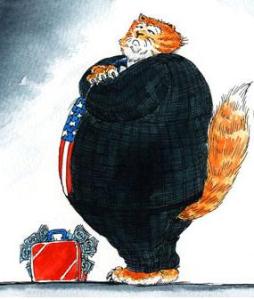 Plutocracy’. It’s an interesting read with a lot of quotes from other pundits.
THE word “plutocracy” is in the air these days. Some say the era of the de facto rule of the mighty top 10%, or top 1%, or whatever insidious sliver of the income distribution is thought to constitute the moneyed power elite, is upon us, or nearly so. I’m not so sure. I am sold on the proposition that there’s something deeply whacked about the American financial system, and that whatever that’s whacked about it is significantly responsible for the top 1% pulling so far away from the rest of the income distribution. This needs to be fixed, whatever its other consequences. It’s not clear to me, however, what exactly is whacked. I don’t know whether to sign up for Tyler Cowen’s “going short on volatility” story, Daron Acemoglu’s “financial-sector lobbying and campaign contributions ‘bought’ an enriching (and destabilising) regulatory structure” story, or some other story. No doubt the truth is in some subtle combination of stories. In any case, accounts such as Mr Acemoglu’s, according to which big players in certain sectors over time manage to rig the regulatory climate to their advantage, are quite compelling for reasons both theoretical and empirical
Newsweek has an interesting article up on why the megarich manage to have such a sweet tax deal. Even if we raise their income taxes, it really doesn’t hit them where it counts. Here’s why.
It drives economist Bruce Bartlett crazy every time he hears another bazillionaire announce he’s in favor of paying higher taxes. Most recently it was Mark Zuckerberg who got Bartlett’s blood boiling when the Facebook founder declared himself “cool” with paying more in federal taxes, joining such tycoons as Bill Gates, Warren Buffett, Ted Turner, and even a stray hedge-fund manager or two.
Bartlett, a former member of the Reagan White House, isn’t against the wealthy paying higher taxes. He’s that rare conservative who thinks higher taxes need to be part of the deficit debate. His beef? It’s a hollow gesture to say the federal government should raise the tax rate on the country’s top wage earners when the likes of Zuckerberg have most of their wealth tied up in stock. Many of the super-rich see virtually all their income as capital gains, and capital gains are taxed at a much lower rate—15 percent—than ordinary income. When Warren Buffett talks about paying a lower tax rate than his secretary, that’s because she sees most of her pay through a paycheck, while the bulk of his compensation comes in the form of capital gains and dividends. In 2006, for instance, Buffett paid 17.7 percent in taxes on the $46 million he booked that year, while his secretary lost 30 percent of her $60,000 salary to the government.
“It’s easy to say ‘Raise taxes’ when you know you’re not going to have to pay those taxes,” Bartlett says. “What I don’t hear is ‘Let’s raise the capital-gains tax.’” Instead the focus has been on the federal tax rate paid by those with an annual income of $250,000 or more—the top 3 percent of earners. Bartlett argues that while raising taxes on the country’s richest individuals would go a long way in easing the debt crisis, it makes no sense to treat the professional making a few hundred thousand dollars a year the same as the Richie Rich set. Maybe it’s hard to muster sympathy for an executive pulling down $1 million a year. But ours is a tax system where a person in the top tax bracket (those earning more than $374,000 in 2010) pays a tax rate of 35 percent on the upper portions of his or her income (37.9 percent if you include Medicare), whereas a hedge-fund manager or mogul earning 10 or 100 times that amount pays less than half that tax rate.
Well, now I’m thinking we’re all just so f’ked that I might as well stop while I’m ahead. What’s on your reading and blogging list today?
Misery Index hits Reagan Years High
Posted: May 15, 2011 Filed under: Economy, U.S. Economy | Tags: inflation, measurement issues, misery index, unemployment 9 Comments One of the measurements of economic well-being that got some play in the Carter/Reagan years was the Misery Index. It basically measures the impact of price increases and unemployment on people. There’s some new information coming out of this index. It seems it’s as bad as it was in 1983.
John Williams, over at Shadow Stats, compiles economic data for inflation and unemployment the way it used to be calculated pre-1990. Based on that data, the CPI inflation rate is over 10%, and the unemployment rate is over 15% (see charts). The Misery Index is the sum of the current inflation rate and the unemployment rate. If it were to be calculated using the older methods, the Index would now be over 25, a record high. It surpasses the old index high of 21.98, which occurred in June 1980, when Jimmy Carter was president. Most believe the height of the Index along with the Iranian hostage crisis is what caused Carter to lose his re-election bid.
We’ve changed a lot of the way we measure inflation and unemployment since then partially because we’ve tried to focus more narrowly on measures of both inflation and unemployment but also because the measures were consistently high during the 1970s and 1980s. The inflation rate as stated by the CPI was frequently overstated because of its use of a base market basket that didn’t always reflect the introduction of new goods and services, the places people shop, and the switching or substitution behavior of people. It had a fix budget apportionment that was used to weight prices and those weights were frequently stale.
The changes in the way the unemployment rate was measured had to do with the shift away from reliance on the traditional 40 hour work week job by both businesses and job seekers. The unemployment rate was changed so that you only had to work at least one hour a week at paid work to be excluded. This is why economists look at a bunch of different statistics to get a handle on the job market. People that don’t want to work part time but are stuck there are now considered underemployed and are tracked separately. If you visit Shadow Government Statistics you can see comparisons of the old and the new way of doing things.
Some of the most salient points are that long-term, discouraged workers were taken out of the unemployment statistic in 1994. SGS calls this being “defined out of existence”. Again, the statistic is still being tracked so you have to go look for it at the BLS. I will say that economics reporters have been doing a better job of providing more than just the unemployment rate in their analysis. You have to look at the underemployed and the discouraged worker to get a good idea of what’s going on. We’ve talked about the changes in the make up of the labor force around here because it’s one of the reasons that you’re seeing the unemployment rate go up and down recently. When discouraged workers re-enter the labor force, the new unemployment rate will go up because the number of people in the labor force–the denominator in the statistic–goes up.
I actually have less problems with the changes in the inflation right but then again, the problem is that people need to realize that the definitions of the measures have changed and narrowed so it is important to look at more than just one rate. This does explain, however, why people whose budgets are being impacted by food and gas prices aren’t seeing the pain in the new inflation rates. We’ve talked about this before also.
So, what does this mean? I think it’s significant that the Misery Index is basically at similar levels to the last time the country was expressing discontent with the economy because it gives us a historical perspective. Ronald Reagan probably would not have won a second term if the Federal Reserve didn’t start significantly loosing monetary policy during that same time which brought down the inflation included in the Misery Index.The first Reagan term was the last time the economy was this bad. Changes in monetary policy were the real reason for the worst of the Carter Recession and much of the eventual Reagan Recovery although some of the Reagan Recovery was due to the incredible increase in government purchases which are typical Keynesian economic aggregate demand stimulation policies. Paul Volcker and the Fed brought on a recession by increasing interest rates in an attempt to reign in inflation and inflation expectations. They did so. It happened with some extreme economic pain and that was what the Misery Index was supposed to reflect at the time. The drivers for the misery right now are different. We have record loose monetary policy. The incredible shock to the economy of the financial crisis is the root of our issues now.

 peej
peej Carissa
 bostonboomer
 dakinikat
 ecocatwoman
 jjlo
jjlo mablue2
 Mama Lopez
 peggysue22
 quixote
 skydancingguestblogger
 Mona (aka Wonk the Vote)





Recent Comments