
Vacation first, Jobs Package Next Month
Posted: August 18, 2011 Filed under: just because 15 Comments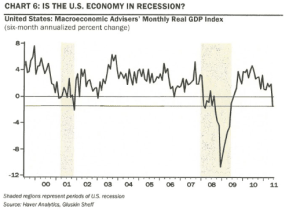 So, there’s discussion on the magical misery tour bus about a potential jobs package and some swagger, posturing and double dog dare yas to Republican Congress members in this pre-Martha’s Vineyard vacay speechification. The suggested policy pretty much sounds like the same tax cut crap that usually comes out of Republican mouth pieces. This leaves Republicans with the actual party affiliation hemming and hawing and reverting to the Nancy Reagan policy prescription of Just Say No. I’m dubious on any policy prescriptions at the moment because it’s simply way too late. If you believe the stock market is a fairly good barometer of economic health, and I do, economic recovery Elvis has left the building. I double dog dare you to find an upward trend in the last 9 months or so in that Real GDP index over in the nifty graph up there, top right. (Wonky aside: That’s a log linear series over there so it represents a growth rate or percentage change in GDP from month to month and it’s been annualized.)
So what’s on the horizon in terms of potential policy? Former Biden economic policy Adviser Jared Bernstein inkles that the President is keen to continue his pay roll tax holiday and extend unemployment benefits but all that must wait until at least September. Bernstein admits there would be too much political heavy lifting to get a “Recovery-Style state fiscal aid” package through congress. This undoubtedly means that more teachers, fire fighters, policemen, and state workers will get the boot in most of the 50 states some time after October. Too bad we can’t extend the successful parts of the stimulus like aids to states to cover their shortfalls.
So, what will/should President Obama say in September on jobs?
–Given everything he’s been saying so far, he most likely starts out with a strong call to renew the payroll tax holiday and extend UI benefits.
–These are both essential—EPI estimates that to lose them next year would cost over one million jobs. But since they’re already in the system, they don’t add anything new, so it’s like keeping your foot where it is now on the accelerator. If they expire on schedule at years’ end, your foot comes off. But keeping them going only maintains current speed, such that it is.
–He then pushes an infrastructure plan.
Robert Reich is going so far as to call the President “bold”. Well, it’s a backhanded sort’ve bold label, because he gives it and takes it away in the same blog thread Yes, giving speeches and saying things that you never see through to reality is bold alright. Let’s face it, Robert, sounding like a fighter while trying to crawl out of a hell hole of bad polling numbers is not exactly the same as bold action.
The President is sounding like a fighter these days. He even says he’ll be proposing a jobs bill in September – and if Republicans don’t go along he’ll fight for it through Election Day (or beyond).
That’s a start. But read the small print and all he’s talked about so far is extending the payroll tax cut and unemployment benefits (good, but small potatoes), ratifying the Columbia and South Korea free trade agreements (not necessarily a job-creating move), and creating an infrastructure bank.
An infrastructure bank might be helpful, depending on its size.
Which is the real question hovering over the entire putative jobs bill – its size.
Some of the President’s political advisors have been pushing for small-bore initiatives that they believe might have a chance of getting through the Republican just-say-no House. They also figure policy miniatures won’t give aspiring GOP candidates more ammunition to tar Obama as a big-government liberal.
But the President is sounding as if he’s rejected their advice.
Reich does finally give a blue print on what would actually be a bold and Democratic plan for jobs. Here’s one that’s not a shocker at all but unlikely to pass Presidential–let alone congressional–muster. After all, it’s so very unlike the legendary Saint Ronnie’s fare. Yeah, I know, never mind about what the real Ronald Reagan did. Let’s just stay with the myth.
Recreate the WPA and Civilian Conservation Corps to put long-term unemployed directly to work.
Something, however, tells me the President has yet to crack any macroeconomics text books when I read a headline like this: “Obama: We’re Not In Danger of Another Recession”. I just never know if its subterfuge or basic ignorance when I read these things. Of course, he must knows more than your average Wall Street analyst. Just ask Valerie Jarret, I’m sure she’ll tell you he’s so smart that to actually read anything about fiscal policy is beneath his IQ. He just magically knows what’s right after reading Ronald Reagan fanzines biographies and talking to lawyers from Chicago.
President Obama countered many Wall Street analysts, saying on Wednesday that the U.S. is not going to have another recession.
“I don’t think we’re in danger of another recession,” Obama told CBS News. Obama did note that the recovery has not been fast enough, blaming the Arab spring, high gas prices, and March’s earthquake and tsunami in Japan.
Obama said the volatility in the markets recently has been due to a lack of economic growth.
“The markets were reacting to the economy not growing as quick as it used to,” he said.
He also lamented the politics that surrounded the debt ceiling deal.
“We should not have had any brinksmanship around the debt ceiling,” he said.
Instead, let’s look at David Rosenberg’s 12 Bullet points that suggest we probably are already in a recession and remembering that recessions aren’t actually dated until they’re well usually under way or nearly over. Oh, Dr. David Rosenberg, btw, is the chief economist at Gluskin Sheff so he actually cracked more than a few Newsweek articles on the subject. Here’s a few of those bullet points.
Challenger layoffs have surged 80% in the past three months. That will lead to higher jobless claims in the near-term.
Consumer buying intentions for big-ticket items has sagged to recession levels. Watch the savings rate in the next six months — this will be key to the macro outlook.
Productivity has declined for two straight quarters and actually, unless companies willfully want their margins to implode, will soon respond by shedding labour input.
This already goes down as the weakest recovery on record despite unprecedented policy stimulus. Every dollar of balance sheet expansion at the Fed and the Treasury since the beginning of 2009 has generated 80 cents of incremental GDP gains. Not only is that a pitiful multiplier but now that there is no more stimulus, it is a legitimate question as to how an economy that only operated on policy steroids for the past two-and-change years is going to perform.
There is no doubt that the economy is not yet contracting, but the debate is whether it will start to by year-end. The withdrawal of stimulus is feeling like a policy tightening. And after coming off a mere 0.8% annual rate of gain in GDP so far this year, the question is how the financial shock since mid-year in the form of higher debt levels and equity cost of capital is going to impact an already near-stagnant economy.
The data on a three-month basis are following a classic pre-recession pattern and so is the stock market.
Indeed, today’s markets seem to be indicating there is a looming recession or even the suspicion of an onset. It’s not just the equity and gold markets, however. The job market remains extremely weak as Jobless Claims today shows. Lay offs are on the increase.
More Americans than forecast filed applications for unemployment benefits last week, signaling the labor market is struggling two years into the economic recovery.
Jobless claims climbed by 9,000 to 408,000 in the week ended Aug. 13, the highest in a month, Labor Department figures showed today in Washington. Economists surveyed by Bloomberg News projected a rise in claims to 400,000, according to the median forecast. The number of people on unemployment benefit rolls rose, while those receiving extended payments fell.
Lousy real estate numbers were also released today. We have record numbers of empty housing stock and no demand. We also have no plan for dealing with the problem.
What is obvious is the flight to safety. Investors worried about both the US economy and the Eurozone are headed for the US bond markets. This makes it a perfect time to borrow for a real bold job creating initiative. The problem is that things like creative energy policies, tax credits for new workers, and infrastructure banks are policies that should’ve been put into place two years ago. They take time to work through the bureaucracy and through the economy. Fiscal policy has very long lags between passing laws and actually get things into the economy. If we are slipping into a recession–and many signs say that we are–there is actually little to be done at this point other than hang on. That’s why traditional Republican Wall Streeters are horrified by rhetoric coming from the likes of Ron Paul, Michelle Bachmann, and Rick Perry. Get this quote from David Rosenberg and think about Perry who just said such an act was “treasonous”.
So the markets are saying we’re in a depression?
That’s why you have gold at $1700 an ounce. That’s why 10-year Treasury bond yields are lower now. The bond market is saying we are in for weak growth. Gold is saying the government is going to try to reinflate their way out of it.What can we expect to further happen while riding out the recession/depression?
Growth rates are going to be much weaker globally. There is going to be a prolonged period of very weak activity. Consumer confidence is lower today than after the 1987 crash and after 9/11.How do we get back to a sustainable bull market and expansion?
In the end, you print money.
Is there any wonder why traditional Republican interests are scrambling for a traditional Republican candidate at the moment? They’re looking all over the place for one that knows economics and speaks rationally. Now, if traditional Democratic interests would only scramble for a traditional Democratic candidate. You know, one that knows economics and actually speaks about things they intend to do rather than aspire to.
It’s still not Gone, It’s still harming Sea Life
Posted: August 17, 2011 Filed under: Environment, Environmental Protection, Gulf Oil Spill, New Orleans | Tags: Gulf oil Gusher 11 CommentsSo, just when you thought it was safe to go back into the Gulf of Mexico–because all those tourist ads paid for by BP told you so–you can clearly see that the nasty oil that spewed from the BP oil gusher still isn’t gone. Not only is it still not gone, it’s still harming the ecosystem and the sea life in the area. I know, they keep telling you the seafood is safe too, right? Well, think twice before you eat that blackened red snapper. We’re suffering a sick fish epidemic down here.
The fear is palpable on the docks from Galveston to Panama City. Commercial fishermen working the waters hardest hit by the BP oil spill are worried sick about their future. It keeps them up at night. Many are convinced the 200 million gallons of crude that spewed into the Gulf last year have done irreparable damage to the fragile fisheries that provide their livelihood. According to a new CBS News segment, Gulf fishermen “have started catching fish with sores, fin rot, and infections at a greater frequency than ever before.”
It would seem BP’s oil is coming home to roost in an epidemic of sick fish and devastated lives. An Aug. 15 CBS News video – that’s going viral as we speak – captures the uncertainty of tens of thousands of commercial Gulf fishermen: “I don’t think we’ll be fishing in five years,” says Lucky Russell. “My opinion. …Everybody is worried.”
Everybody includes LSU oceanography Professor Jim Cowan, who has been studying the Gulf ecosystem for years:
“When one of these things comes on deck, it’s sort of horrifying,” Cowan said. “I mean, there these large dark lesions and eroded fins and areas on the body where scales have been removed. I’d imagine I’ve seen 30 or 40,000 red snapper in my career, and I’ve never seen anything like this. At all. Ever.”
 You can watch a news report and interviews on the nasty looking fish at CBS News. There’s more coverage at the St Petersburg Times too.
“The fish have a bacterial infection and a parasite infection that’s consistent with a compromised immune system,” said Jim Cowan, an oceanographer at Louisiana State University, who has been examining them. “There’s no doubt it’s associated with a chronic exposure to a toxin.”
He believes the toxin in question is oil, given where and when the fish were caught, their symptoms, and the similarity to other incidents involving oil spills. But he is awaiting toxicology tests to be certain.
Cowan said he hasn’t seen anything like these fish in 25 years of studying the gulf, which persuades him that “it would be a pretty big coincidence if it wasn’t associated with the oil spill.”
If he were a detective, he’d be ready to make an arrest.
“It’s a circumstantial case,” he said, “but at the same time I think we can get a conviction.”
Red snapper are reef fish that feed on mantis shrimp, swimming crabs and other small creatures found in the sediment on the gulf floor. Anglers catch them at anywhere from 60 to 200 feet deep. In addition to the snapper, some sheepshead have turned up with similar symptoms, Cowan said.
The fish with lesions and other woes have been caught anywhere from 10 to 80 miles offshore between Pensacola and the mouth of the Mississippi River, an area hit hard by last year’s oil spill, Cowan said.
“They’re finding them out near the shelf edge, near the spill site,” said Will Patterson, a marine biology professor at the University of West Florida.
Patterson, who has been studying reef fish in the gulf for past two years, has sent some of the strange catches to a laboratory for toxicology tests. He suspects Cowan is correct about the oil being the culprit but is withholding judgment.
Red snapper are a popular seafood, with a delicate sweet flavor whether served broiled, baked, steamed, poached, fried or grilled. Asked whether the sick fish might pose a hazard to humans who ate them, Cowan said nobody would want to touch these, much less cook them.
“It’s pretty nasty,” Cowan said. “If you saw this, you wouldn’t eat it.”

One of the most worrisome accounts I’ve heard to date is from a veteran local crabber (and client of mine), who was kind enough to send me photos of what he’s been seeing just off the coast of Pensacola.
I should note that this is a followup to my June 24 post, Gulf “Seafood Safety” Update: Fisherman Pulls Up Sick, Visibly Oiled Crabs and “Black Goo” Off Florida Panhandle that went viral all the way up to a handful of reporters and producers at some of the most well-respected media outlets in the country (see link below). I can only hope those national outlets step up and shed some light on the grave state of our fisheries.
Here is the crabber’s report from off Pensacola in early July:
Our observation from the last two weeks is the number of these sick crabs has increased while the overall catch is down more than 70 percent since mid-April. As we have reported to the national marine fishery on our daily trip tickets, every crab we have sampled this year has come from a batch that, unfortunately, went to market. The copper-colored “stains” and holes and burns in the shell have just shown up in the last week. The stains are in the shell, so you can’t scrub them off.
BP and cronies refuse refuse to take full responsibility for the terrible accident on the rig that exploded over a year ago. They continually blame contractors and operators on the rig itself. This includes the dead crew that can’t defend themselves. BP has essentially rolled up and left the area. Problems with spills claims abound. There’s evidence that BP’s claim process has been fraught with political decisions that may have even disenfranchised blacks impacted by the gusher. Many locals have been asking an US Federal Judge to oversee the claims process. The biggest complaint is that quick payment of a claim comes with signing away your future right to sue BP. Obama appointee Kenneth Feinberg believes the process is fair.
Feinberg’s “near-complete failure to pay interim claims” is signaling victims that “the only way to ever get any more compensation is to take the quick payment amount and sign a release” agreeing not to sue for more, the lawyers said.
Feinberg’s lawyers counter in their filing that the fund has paid almost $2.6 billion in emergency payments to Gulf Coast residents damaged by the spill and another $250 million in interim payments.
“It’s hard to grasp how plaintiffs can assert as fact that GCCF has failed to provide interim relief,” Pitofsky said in the filing.
On the question of whether the fund is strong-arming Gulf Coast residents into signing away their rights to sue in exchange for inadequate compensation, Feinberg’s lawyer noted some claimants are drawn by the prospect of immediate cash for their claims.
Ongoing evidence that the impact of the spill continues shows that signing away future right to sue is not a prudent decision for Gulf Coast residents whose livelihood has been decimated. However, they are left between having no money to live on now versus continuing problems stemming from the spill that are being well-documented by local scientists and regional universities.
This is worse than the continuing impact we’ve seen down here from Hurricanes Katrina and Rita. My local police district is still operating out of a temporary facility, just to give you an idea of what it’s still like. Damage from the Gulf Spill is likely to accrue for some time if experience from the EXXON Valdez spill is any indicator. Still, the pressure to to start up and expand drilling continues simply because of its short term profitability. Here’s an article that contends there’s an “overreaction to the spill” that’s costing jobs. There seems to be no indication that these business interests are aware of the number of small family businesses whose health, lifestyle, and economics have been forever impacted.
Voodoo Economics on Steroids
Posted: August 16, 2011 Filed under: 2012 presidential campaign, Surreality, The Media SUCKS, We are so F'd 26 CommentsI’ve been ranting about how there is a confederacy of dunces between journalists who refuse to fact check their guests and themselves and people with absolutely no knowledge of economics making absurd comments on the economy. Here’s a premier example from Media Matters. Rush Limbaugh–the usual big, fat liar–has been saying on air that Obama inherited an unemployment rate of 5.7. Hannity has now gone on Fox claiming the rate was 5.6. Fact checking these idiots and liars shows the unemployment rate in January 2009 was 7.2 percent. That’s the real inherited rate that the horrible Dubya economy left the intellectually and morally adrift Obama administration.
How are we supposed to get any significant and correct economic policy when so many people listen to media punditry that can’t even get the basic facts straight?
There’s this continual meme dancing around the media now that says nothing can be done about the current economic situation and that we just have to live with it. That’s unbelievably false. There’s even a fear among mainstream Democrats of using the word “stimulus”. Stimulus is an act committed by Reagan in the 1980s, Nixon in the 1970s, and Eisenhower in the 1950s and yes, Democratic presidents before, in between and after them. Much of this is Obama’s fault who pushed through an inadequately sized, tax cut heavy stimulus after the Great Recession when much more bold action was required. From what I now know, administration economists Larry Summers, Christine Romer, and Jared Bernstein warned him. He took the politically expedient cave-in path. Also, he completely took his eye off the economy to chase down his vanity Health Care Reform which spawned the Tea Party nonsense and a series of law suits. He spent his first two years when something could be done doing something that was unsupported by the public and led to his current issues with the House of Representatives. Now, even the White House says there are no options. This is simply not true.
Economists all over the world are calling for the same policy prescription and it’s the same BIG option. Here’s the latest from former French Minister of Finance and now Madam President of the IMF, Christine Lagarde writing in the FT.
So there are no easy answers. But that does not mean there are no options. For the advanced economies, there is an unmistakable need to restore fiscal sustainability through credible consolidation plans. At the same time we know that slamming on the brakes too quickly will hurt the recovery and worsen job prospects. So fiscal adjustment must resolve the conundrum of being neither too fast nor too slow.
Shaping a Goldilocks fiscal consolidation is all about timing. What is needed is a dual focus on medium-term consolidation and short-term support for growth and jobs. That may sound contradictory, but the two are mutually reinforcing. Decisions on future consolidation, tackling the issues that will bring sustained fiscal improvement, create space in the near term for policies that support growth and jobs.
By the same token, support for growth in the near term is vital to the credibility of any agreement on consolidation. After all, who will believe that commitments to cuts are going to survive a lengthy stagnation with prolonged high unemployment and social dissatisfaction?
Will the markets buy such an approach? In some countries, they seem to be pushing for sharp fiscal adjustments. And some policymakers have decided that is the road to follow. But in many countries a short-term focus would be wrong. We should remember that markets can be of two minds: while they dislike high public debt – and may applaud sharp fiscal consolidation – as we saw last week they dislike low or negative growth even more.
Many resources in this country were spent bailing out investment banks, commercial banks, and other financial institutions whose policies and actions brought this country and Europe into a terrible recession from which recovery has been extremely lacking. No one is discussing the fact that solid economic growth is one way to return sovereign debt to sustainable levels. Instead, emphasis is being placed on policies that will continue to shrink economies, cause joblessness, bankrupt productive businesses that lack customers, and remove programs meant to sustain economies in recession. Insanity continues because ignorance rules supreme.
There’s a really good discussion of inter-macroeconomist tit-for-tat going on at Brad DeLong’s blog right now where obvious Republican shill Greg Mankiw is trying to walk back earlier assertions on stimulus. You can wade through the back and forth if you want, but I’d like to call attention to DeLong’s conclusions.
The U.S. government right now can borrow at a nominal rate of 2.24%/year for ten years in an environment where expected ten-year inflation is around 2.5%/year. The short-term nominal interest rates the Fed usually targets are zero, turning its preferred policy tool–open-market operations–into relatively ineffective swaps of one zero-yield government asset for another. Asset prices tell us that our current macroeconomic distress is that the private sector is desperately hungry not for liquidity (which could be provided for the Federal Reserve) or savings vehicles of substantial duration (which could be provided by inducing businesses to invest) but rather for safe assets, which right now can most easily be provided by having credit-worthy governments spend and borrow.
An open-minded and nuanced look at the current situation strongly leads to the conclusion that conventional fiscal policy is, in situations like today, the demand management tool of first resort.
Exactly. The bond market continues to see yields drop and prices rise despite S&P downgrades and bond vigilante politics. Here is one of our biggest problems via Jeffrey Goldberg at Bloomberg.
I thought about this man when I heard, at the end of 2008, that GM was shuttering the Janesville plant, and I thought about him again as I read a compelling and disturbing new book about the U.S. unemployment crisis called “Pinched,” by Don Peck. (Peck is a colleague of mine at the Atlantic magazine, but I’m not involved in his coverage of the economy.)
Peck explains, with coolness and concision, the brutal new realities faced by Americans without college degrees. And he delivers a dystopian vision of a country in which the American dream will soon be dead to the majority of its citizens.
He describes an already entrenched two-tiered U.S. economy. The upper tier is populated by people without elaborate toolboxes but with advanced degrees and superior analytical, creative and interpersonal skills. These people congregate in places like Washington, Boston and San Francisco. They feel few, if any, effects of the recession.
The lower tier is made up of people in places like Phoenix and Las Vegas and Tampa, Florida, who are educationally and even dispositionally ill-equipped for a globalized economy. The recession was a body blow to these people, of course, but they are also suffering because of some longer-term and more systematic problems, such as our neglect of our national infrastructure (think of the jobs that would have been created if we had taken care of our bridges, highways and airports over the past 30 years), our long journey away from manufacturing, and the painful consequences of increased automation and globalization.
As much as I hate referring to John Edwards, I will lift one of his political themes. There are two Americas. The vast majority of people live in the second America that never reaches the lying eyes or mouths of Rush Limbaugh, Sean Hannity, or any other Washington Journalist or Politician. This is the America that yells disapproval in polls and is ignored because only money counts in politics these days. Here’s some disturbing evidence of that. Congressional Asshole Paul Ryan is no long holding free, in-person town halls. He’s only holding appearances in pay-for-view, friendly environments like local Rotary Clubs. That’s one helluva obvious way of ignoring the voters and pandering to your donors. That’s a prime way to stay in the frame of mind that everything you think and do is hunky dory when it is actually hurting the very people you are elected to represent. He’s thinking of running for president now. The voters in Wisconsin should throw him into one of their rivers instead.
Right now, there’s a bus some where in Iowa with a President that’s talking about what a hopeless situation he’s found himself in because every one else won’t do his homework. There’s a few other buses in places where there’s elected officials saying gay families aren’t real families, monetary policy is treason, and that all the answers to our problems lie in the gold standard and confederate ideas of state’s rights. As of right now, we can either elect people whose ideas are firmly planted in 19th century ignorance or a person that refuses to fight for anything. That’s Second America’s Hobson’s choice.
I realize that I’ve just inadvertently written yet, another rant. Economists all over the world are talking until they are blue in the face. The only ones that understand what’s really necessary are those majority of folks that live in Second America. Unfortunately, our elected officials and media pundits all appear blissfully ignorant and dwell in that small little gated corner of First America where only the upper 2% of the population can afford to live.
The Last of the Mohicans
Posted: August 15, 2011 Filed under: Hillary Clinton, Hillary Clinton: Her Campaign for All of Us | Tags: Ed Rendell, Hillary Clinton: A Campaign for All of Us 14 CommentsOkay, so I just couldn’t resist Ed Rendell’s speculation on the possibility of a Hillary Clinton run for the Presidency. He’s bullish on 2016.
“I think, and this is just my thinking, that if she leaves after the president’s first term is over and she leaves and she teaches, does something like that, and rests, I think the possibility of being president and being the first woman president in history would probably be too much for her to resist,” Rendell told POLITICO.
“Her life is public service, that’s all she cares about, and I dont think she’s ready to retire,” he added.
Rendell was quoted in Monday’s New York PostOne as saying, “It’s going to be Hillary Clinton in 2016.”
Rendell told POLITICO that what he meant was that Clinton would decide whether to make another run for the White House only after she leaves the State Department. That means she wouldn’t run until at least 2016 because Clinton has said she will stay in office until President Barack Obama’s first term is over.
Clinton has said in many recent interviews that she is looking forward to returning to private life when Obama’s first term is complete and that Secretary of State will be her last public job.
Rendell said there is a core group of 2008 Hillary Clinton supporters — they call themselves “The Last of the Mohicans” — who continue to urge her to run for president again.
Anyway, it’s a fun read and much more inspiring than any of the crap coming out of the 2012 race. We can dream, can’t we?
Monday Reads
Posted: August 15, 2011 Filed under: Domestic Policy, income inequality, morning reads, The Great Recession | Tags: Christine Romer, Income Inequality, repeating the 1937 recession, the disappearing american middle class 24 Comments Good Morning!
I’ve been wondering quite a bit recently about what is becoming of the American Middle Class. Some times it seems that the kind of situation that I grew up in is a far grasp from what any potential grandchildren of mine will have. Both of my daughters are highly educated and I still feel this way. While I study so much on the rise of a strong, vibrant middle class in many South East Asian countries, I cannot help but wonder what’s gone so wrong that we seem to be losing ours? This month has been a very violent one here in Louisiana. We’ve had a 7 year old boy with cerebral palsy killed–dismembered actually–by a mother’s boyfriend and a number of gang shootings recently. These kinds of crimes always increase with economic hopelessness and summer heat. It gets to me a lot these days.
Here’s a good question from September’s The Atlantic: “Can the Middle Class be Saved?”
It’s hard to miss just how unevenly the Great Recession has affected different classes of people in different places. From 2009 to 2010, wages were essentially flat nationwide—but they grew by 11.9 percent in Manhattan and 8.7 percent in Silicon Valley. In the Washington, D.C., and San Jose (Silicon Valley) metro areas—both primary habitats for America’s meritocratic winners—job postings in February of this year were almost as numerous as job candidates. In Miami and Detroit, by contrast, for every job posting, six people were unemployed. In March, the national unemployment rate was 12 percent for people with only a high-school diploma, 4.5 percent for college grads, and 2 percent for those with a professional degree.
Housing crashed hardest in the exurbs and in more-affordable, once fast-growing areas like Phoenix, Las Vegas, and much of Florida—all meccas for aspiring middle-class families with limited savings and education. The professional class, clustered most densely in the closer suburbs of expensive but resilient cities like San Francisco, Seattle, Boston, and Chicago, has lost little in comparison. And indeed, because the stock market has rebounded while housing values have not, the middle class as a whole has seen more of its wealth erased than the rich, who hold more-diverse portfolios. A 2010 Pew study showed that the typical middle-class family had lost 23 percent of its wealth since the recession began, versus just 12 percent in the upper class.
The ease with which the rich and well educated have shrugged off the recession shouldn’t be surprising; strong winds have been at their backs for many years. The recession, meanwhile, has restrained wage growth and enabled faster restructuring and offshoring, leaving many corporations with lower production costs and higher profits—and their executives with higher pay.
The entire issue covers the disappearing US middle class and it’s worth checking out. Yes, it was happening prior to the 2007-2008 meltdown, but the acceleration of the decline of the standards of living for most Americans is hard to miss. We shouldn’t forget how that happened. Steven Pearlstein at the WP places blame squarely with the corporate lobby.
When it started out all you really wanted was to push back against a few meddlesome regulators or shave a point or two off your tax rate, but you were concerned it would look like special-interest rent-seeking. So when the Washington lobbyists came up with the clever idea of launching a campaign against over-regulation and over-taxation, you threw in some money, backed some candidates and financed a few lawsuits.
The more successful it was, however, the more you put in — hundreds of millions of the shareholders’ dollars, laundered through once-respected organizations such as the Chamber of Commerce and the National Association of Manufacturers, phoney front organizations with innocent-sounding names such as Americans for a Sound Economy, and a burgeoning network of Republican PACs and financing vehicles. And thanks to your clever lawyers and a Supreme Court majority that is intent on removing all checks to corporate power, it’s perfectly legal.
Somewhere along the way, however, this effort took on a life of its own. What started as a reasonable attempt at political rebalancing turned into a jihad against all regulation, all taxes and all government, waged by right-wing zealots who want to privatize the public schools that educate your workers, cut back on the basic research on which your products are based, shut down the regulatory agencies that protect you from unscrupulous competitors and privatize the public infrastructure that transports your supplies and your finished goods. For them, this isn’t just a tactic to brush back government. It’s a holy war to destroy it — and one that is now out of your control.
Dr. Christine Romer suggests that all we have to do is look to our history for good lessons. Yes, she’s the Obama economic advisor that kept having to explain continually why all those labor market numbers were looking so bad for two years while not having much input into the change that would’ve made things different right now.
One reason the Depression dragged on so long was that the rapid recovery of the mid-1930s was interrupted by a second severe recession in late 1937. Though many factors had a role in the “recession within a recession,” monetary and fiscal policy retrenchment were central. In monetary policy, the Fed doubled bank reserve requirements and the Treasury stopped monetizing the gold inflow. In fiscal policy, the federal budget swung sharply, from a stimulative deficit of 3.8 percent of G.D.P. in 1936 to a small surplus in 1937.
The lesson here is to beware of withdrawing policy support too soon. A switch to contractionary policy before the economy is fully recovered can cause the economy to decline again. Such a downturn may be particularly large when an economy is still traumatized from an earlier crisis.
The recent downgrade of American government debt by Standard & Poor’s makes this point especially crucial. It would be a mistake to respond by reducing the deficit more sharply in the near term. That would almost surely condemn us to a repeat of the 1937 downturn. And higher unemployment would make it all that much harder to get the deficit under control.
A new survey found that 64% of the public doesn’t have enough funds on hand to cope with a $1000 emergency. Wages are falling for 90% of the population. And disabuse yourself of the idea that the rich might decide to bestow their largesse on the rest of us. Various studies have found that upper class individuals are less empathetic and altruistic than lower status individuals.
This outcome is not accidental. Taxes on top earners are the lowest in three generations. Yet their complaints about the prospect of an increase to a level that is still awfully low by recent historical standards is remarkable.
Given that this rise in wealth has been accompanied by an increase in the power of those at the top, is there any hope for achieving a more just society? Bizarrely, the self interest of the upper crust argues in favor of it. Profoundly unequal societies are bad for everyone, including the rich.
First, numerous studies have ascertained that more money does not make people happier beyond a threshold level that is not all that high. Once people have enough to pay for a reasonable level of expenses and build up a safety buffer, more money does not produce more happiness.
But even more important is that high levels of income inequality exert a toll on all, particularly on health. Would you trade a shorter lifespan for a much higher level of wealth? Most people would say no, yet that is precisely the effect that the redesigning of economic arrangements to serve the needs at the very top is producing. Highly unequal societies are unhealthy for their members, even members of the highest strata. Not only do these societies score worse on all sorts of indicators of social well-being, but they exert a toll even on the rich. Not only do the plutocrats have less fun, but a number of studies have found that income inequality lowers the life expectancy even of the rich.
All the economists that I follow have been abuzz about that NYT’s article on Sunday on how politics and not economics is driving Obama’s policy. Here’s some thoughts from Mark Thoma.
When you are arguing that deficit reduction — less spending — creates jobs because it’s politically expedient to make this point and you care more about votes than fixing the economy, the truth can be uncomfortable. Is it so hard to explain that yes, in the long-run deficit reduction can be helpful. When the economy is near full employment and the demand for investment funding is high, the government’s use of funds to finance its deficit can slow investment activity. Near full employment, government spending can crowd out private investment so we need a long-run plan for deficit reduction.
But presently, with so much idle capacity and with so much liquidity looking unsuccessfully for a place to earn profits, no such fear exists. Government spending won’t crowd out private sector investment, it will provide a needed net addition to output and provide jobs for struggling households. Borrowing costs are extraordinarily cheap and there are plenty of infrastructure needs for the government to invest in, so it’s not as though we wouldn’t get something of value for our money over and above the needed help it provides to working class households. It’s a short-run and a long-run win.
Deficit reduction in the short-run makes things worse, not better, and hence harms rather than helps reelection chances. I understand that the administration is doing its best to prevent immediate cuts, and that the recent deficit agreement doesn’t put large cuts into place until 2013. But there are still small cuts endorsed by the administration — we are still going in the wrong direction — and if employment remains sluggish come election time, and if the administration has no public record of trying to do anything about it, what argument will they have? We could have provided more jobs, but we didn’t bother to try because we didn’t think we could explain ourselves to the public? We knew better, but the polls were unfavorable so we didn’t bother to pursue it?
I’ve spent the entire day flummoxed by the obvious cynicism that underlies the idea that it’s easier to sell out all principles than actually elucidate an answer to the problem that we know we have and that we know every one cares about which is lack of jobs and lack of economic growth to due lack of aggregate demand. We should all go to the White House and start pitching macroeconomics textbooks over the fences.
Anyway, that’ll get things started today. What’s on your reading and blogging list?

 peej
peej Carissa
 bostonboomer
 dakinikat
 ecocatwoman
 jjlo
jjlo mablue2
 Mama Lopez
 peggysue22
 quixote
 skydancingguestblogger
 Mona (aka Wonk the Vote)





Recent Comments