
Late Night Post: Oddities
Posted: August 25, 2011 Filed under: open thread | Tags: Gadhafi loves Condi, Planet made of diamonds, Spilled Bull Seman causes havoc on Tennessee HIghway, weird news 2 CommentsHere’s a few kewl things I found today while reading things around the web.
The new planet is far denser than any other known so far and consists largely of carbon. Because it is so dense, scientists calculate the carbon must be crystalline, so a large part of this strange world will effectively be diamond.
“The evolutionary history and amazing density of the planet all suggest it is comprised of carbon — i.e. a massive diamond orbiting a neutron star every two hours in an orbit so tight it would fit inside our own Sun,” said Matthew Bailes of Swinburne University of Technology in Melbourne.
Lying 4,000 light years away, or around an eighth of the way toward the center of the Milky Way from the Earth, the planet is probably the remnant of a once-massive star that has lost its outer layers to the so-called pulsar star it orbits.
 Gadhafi has a thing for Condoleeza Rice
“Deeply bizarre and deeply creepy.”
That’s how the State Department is describing a surprising find inside the compound of Libyan leader Moammar Gadhafi: a photo album with pictures of Condoleezza Rice.
Rebel fighters who ransacked Gadhafi’s Bab al-Aziziya compound have been turning up some bizarre loot, including the Libyan leader’s eccentric fashion accessories and his daughter’s golden mermaid couch. The latest discovery is a photo album filled with page after page of pictures of Rice, the former secretary of state who visited Tripoli in 2008.
“I support my darling black African woman,” he said. “I admire and am very proud of the way she leans back and gives orders to the Arab leaders. … Leezza, Leezza, Leezza. … I love her very much. I admire her, and I’m proud of her, because she’s a black woman of African origin.”
Okay, this is my last entry and it’s really weird! A Bull semen spill caused a scare and closed highway a highway near Nashville Tennessee.
A spill of frozen bull semen bound for a breeder in the state of Texas triggered a scare on Tuesday that temporarily shut down a U.S. interstate highway during the morning rush hour.
The incident began when the driver of a Greyhound bus carrying the freight alerted the fire department he had lost a part of his load while negotiating the ramp on a highway near Nashville.
“We didn’t know what it was, but we were told (the canisters) were non-toxic,” said Maggie Lawrence, a fire department spokeswoman.
When firefighters arrived on the ramp, they saw “four small propane-sized canisters (that) began to emit a light vapor,” Lawrence said.
In addition to the vapor, the canisters also let off an unpleasant odor and the ramp was closed while emergency personnel tried to determine what was in the containers.
The bus driver turned around to retrieve the canisters. Once emergency personnel learned the smoking canisters were nothing hazardous and that they simply contained frozen bull semen that had been stored on dry ice, Tennessee Department of Transportation and fire department workers cleared the ramp.
So, this is an open thread!! Any weird things have happened to you today?
Finally, but is it for real?
Posted: August 25, 2011 Filed under: 2012 presidential campaign, Economy, unemployment, voodoo economics | Tags: bad economy, joblessness, lousy poll numbers, Obama 10 Comments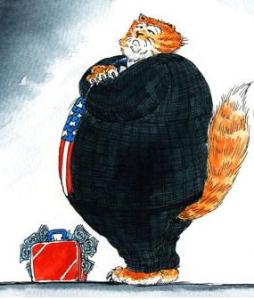 When Obama swept into office, there was an ongoing, left-over Bush program in place to rescue the financial system which focused on getting banks recapitalized through the Fed. Despite worsening unemployment and rising bankruptcies, a stimulus that was top heavy in worthless tax cuts was hurried to congress and a program–that was more of a plea to banks than an actual program–was pasted together to focus on refinancing underwater mortgage holders. The stimulus may have changed the momentum of GDP growth and the FED program definitely stabilized the banking system, but the programs for homeowners and the unemployed were less-than-successful. The President was itching to put something together on health care to prove that he could do something that hadn’t been achieved by the Clintons. It looks now like his primary economic advisers were warning him that just feeding tax breaks to choice businesses and and cheap loans to banks was not going to solve a major financial crisis. Obama’s focus never really appeared to be on things that mattered at the time. As a result, serious improvement in key areas of the economy never materialized.
It’s not a surprise to any of us around here that Obama’s handling of the US economy is souring voters. James Carville’s mantra–it’s the economy stupid–has never been more relevant to the vast majority of Americans who have been made worse off by the policies of the last ten years.
Americans’ views on the economy have dimmed this summer. But so far, the growing pessimism doesn’t seem to be taking a toll on President Barack Obama’s re-election prospects.
More people now believe the country is headed in the wrong direction, a new Associated Press-GfK poll shows, and confidence in Obama’s handling of the economy has slipped from just a few months ago, notably among fellow Democrats.
The survey found that 86 percent of adults see the economy as “poor,” up from 80 percent in June. About half — 49 percent — said it worsened just in the past month. Only 27 percent responded that way in the June survey.
That can’t be good news for a president revving up his re-election campaign.
There’s a good chance that GDP–now growing at a miserably slow rate–may go into negative territories shortly, forcing the NBER to date the  start of yet another recession when the recovery from this one has not really taken hold. There’s indications in the market that another crash could be on the horizon. After all, businesses can only wring so much profit out of restructuring debt to take advantage of cheap interest rates and cutting costs primarily by dumping workers. Here’s some really frightening news on reinsurance on banks which is also causing weird stuff in the CDS market. That’s the same damned market that messed up the economies of Europe and US the last time around which really needs some restructuring, standardization, and reform that has not been done despite Dodd-Frank and similar efforts on the other side of the pond. Bankers have fought new regulation and we’re likely to see the same problems revisit us in a different sector of the same market for the same kinds of vehicles.
Insurance on the debt of several major European banks has now hit historic levels, higher even than those recorded during financial crisis caused by the US financial group’s implosion nearly three years ago.
Credit default swaps on the bonds of Royal Bank of Scotland, BNP Paribas, Deutsche Bank and Intesa Sanpaolo, among others, flashed warning signals on Wednesday. Credit default swaps (CDS) on RBS were trading at 343.54 basis points, meaning the annual cost to insure £10m of the state-backed lender’s bonds against default is now £343,540.
The cost of insuring RBS bonds is now higher than before the taxpayer was forced to step in and rescue the bank in October 2008, and shows the recent dramatic downturn in sentiment among credit investors towards banks.
“The problem is a shortage of liquidity – that is what is causing the problems with the banks. It feels exactly as it felt in 2008,” said one senior London-based bank executive.
“I think we are heading for a market shock in September or October that will match anything we have ever seen before,” said a senior credit banker at a major European bank.
While Obama is on vacation, White House gnomes are pasting together two programs for the poll-beleaguered President to announce when Congress gets back into session. The first is a “jobs” package. The second is a plan for massive mortgage refinancing. This is something that should’ve been on the front burner years ago so now I’m actually wondering if it’s going to work in time to stymy the right wing nut jobs coming up through the Republican primary process or it’s actually going to be serious rather than some lame ass attempt at some neoReaganesque policy that will move farther right when Republicans start saying no to clearly Republican policy.
Here’s the “Contours of Obama jobs package” via Reuters.
The president is widely expected to repeat his calls for an extension of a payroll tax cut, push for patent reform and bilateral free trade deals, and suggest an infrastructure bank to upgrade the country’s roads, airports and other facilities.
Retrofitting schools with energy efficient technology would allow the government to directly hire for labor-intensive work and also give a boost to the clean energy sector that Obama has said could be an important U.S. economic motor.
Other measures being considered, according to economists who have advised the White House, include tax credits for firms hiring more workers, funds for local governments to hire teachers, and retraining help for the long-term unemployed. Steps to boost the ailing housing market are also under review.
“What’s going to be included in this plan are some reasonable ideas that could have a tangible impact on improving our economy and creating jobs … the kinds of things that Republicans should be able to support,” Earnest said. “These are bipartisan ideas that the president is going to offer up.”
Republicans have made it perfectly clear that their only priority is to make Obama a one term president. So, in yet another attempt at trying to look above the fray instead of fighting for what is right, we’re going to see another lukewarm policy that won’t have any immediate effect and will undoubtedly be pushed further to the right and further into the ineffective zone. Plus, it will probably just be offset by other spending cuts in key areas which are likely to have stronger recessionary multiplier effects attached than any positive multiplier effect of the new legislation. I still can’t figure out what the obsession is with tax cuts for new employees. The big cost of new employees is health insurance for one and you can avoid that cost by going any where in the developed and developing world BUT the US. Plus, no business is going to hire any one when the have no customers. I feel like a broke record on the number of repeats on that one. Having spent my life doing strategic planning and budgeting for corporations and having one of my PhD field areas in corporate finance, I can tell you that the US looks like one of those offshore tax havens right now for most major corporations. Also, more ‘free trade’ deals are likely to have just the opposite effect on unemployment anyway as prices tend to equilibriate in the countries involved and we’re the cheap capital market, not the cheap labor market part of that equation. (Hence, in our country, incomes to capital go up and incomes to labor go down as the market goes towards price parity for our country.)
So, the second program is no a way for the US to back mortgage refinancing. This is also something that should’ve been done years ago.
One proposal would allow millions of homeowners with government-backed mortgages to refinance them at today’s lower interest rates, about 4 percent, according to two people briefed on the administration’s discussions who asked not to be identified because they were not allowed to talk about the information.
A wave of refinancing could be a strong stimulus to the economy, because it would lower consumers’ mortgage bills right away and allow them to spend elsewhere. But such a sweeping change could face opposition from the regulator who oversees Fannie Mae and Freddie Mac, and from investors in government-backed mortgage bonds.
Administration officials said on Wednesday that they were weighing a range of proposals, including changes to its previous refinancing programs to increase the number of homeowners taking part. They are also working on a home rental program that would try to shore up housing prices by preventing hundreds of thousands of foreclosed homes from flooding the market. That program is further along — the administration requested ideas for execution from the private sector earlier this month.
But refinancing could have far greater breadth, saving homeowners, by one estimate, $85 billion a year. Despite record low interest rates, many homeowners have been unable to refinance their loans either because they owe more than their houses are now worth or because their credit is tarnished.
I’ve already looked into refinancing my FHA/VA loan from 7% to 4%. I have good credit and my loan balance is about one half of what my house is worth–even with the recent decrease in home prices–because I’ve owned it for 11 years. I didn’t follow through because the points charged by Wells Fargo–who processes my mortgage at the moment–were ridiculous. They’d have to pick up the fees or points to intrigue me, frankly. The people with the worst problems are the ones that are now strategically defaulting because they are underwater. Interesting enough, I’m set to discuss just that topic this fall in the Denver FMA meetings using this Philadelphia FED working paper. Their findings suggest that people have the ability to pay these mortgages but they are defaulting anyway because they are underwater. The weird thing is they are defaulting on first mortgages while keeping their second liens current. This means they are ‘strategically’ defaulting to get rid of the house because it’s a stupid investment for them. Any plan that doesn’t deal directly with underwater mortgage holders specifically will not work. Banks really don’t have any incentive to work with them now because they get more fee income from processing defaults than they do from renegotiating the mortgage. The incentives on both sides of the market are totally warped at this point in time. Again, quoting from the NYT article, this isn’t in the plan.
A broader criticism of a refinancing expansion is that it would not do enough to address the two main drivers of foreclosures: homes worth less than their mortgages, and a sudden loss of income, like unemployment. American homeowners currently owe some $700 billion more than their homes are worth.
I don’t see how the issues in the housing market are going to be solved until you solve this problem. Dumping houses on the market is going to continually depress prices and cause this problem to regenerate.
So, this gets back to sort’ve my main point about both these big ideas. First, they are a little too little and way too late. The inside and outside lags on these kinds of fiscal policy measures are long and getting them through congress and into fruition is likely to lag-filled. We’re also likely to get a lecture and ransom demand from the austerity demons. So, is this a real effort or a symbolic effort? Second, the policy prescriptions are anemic. Neither of them focus on the real problems or the known solutions. So, again, is this a real effort or symbolic effort? Third, these aren’t very aggressive policies nor or they what you would call traditionally Democratic policies so who are they really aimed at? Again, it seems like a symbolic offering to voters. If you’re getting the impression that I’m not impressed at all with this, you’re right. I suppose this is all to make the confidence fairy come home to roost. It still seems to me that she’s on her honey moon with the high priest of voodoo economics. Imaginary beings are symbolic too.
Yanking the Chains of People who Wag the Dog
Posted: August 24, 2011 Filed under: just because | Tags: Paul Krugman identity theft 19 Comments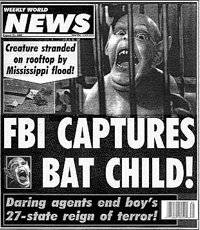
More of the latest headlines from Red State and the National Review
The Right Wing blogosphere and propaganda media are all in a tizzy about about something Paul Krugman didn’t say. You expect this kind of behavior from the likes of Hot Air or Red State. Now that Bill Buckley’s dead, the National Review appears to have gone the way of Fox News. Just check out this search on Fact Check. They’ve gotten it wrong so many times recently it’s not even funny. No wonder right wing Republicans can’t even get their American History straight. So, this is the crux of the story. Yesterday, a Google+ account from “Paul Krugman” posted this about the earthquake.
People on twitter might be joking, but in all seriousness, we would see a bigger boost in spending and hence economic growth if the earthquake had done more damage.
Problem is, the account didn’t belong to Dr. Paul Krugman. It belongs to some right winger who was trying to make a point. No one in the right wing village actually checked to see if the real Paul Krugman even had a Google+account. Why would he? He gets a lot of mileage from his blog at the NYT and other places.
Approximately a month ago, having been laid off and having too much time on my hands, I finally decided to create my own personal account on Google+. I found it to be extremely boring, mostly because no one I knew had an account and my needs for instant news had long been satisfied by twitter. To kill some time and fully delve into what Google+ had to offer, I decided to create a gimmick account of Paul Krugman and see what happened.
Last night, I made this post which caused quite a stir on twitter and blogosphere.
People on twitter might be joking, but in all seriousness, we would see a bigger boost in spending and hence economic growth if the earthquake had done more damage.
I do not regret writing it and I hope it will enlighten many on the perverse economic views held by a Nobel winning economist writing for the New York Times who also lectures at Princeton University. While Paul Krugman did not write the above statement, he has made similar statements within the year and I would not be surprised if Paul Krugman did not in fact hold this view.
On March 15, 2011 Paul Krugman wrote this on his blog.
And yes, this does mean that the nuclear catastrophe could end up being expansionary, if not for Japan then at least for the world as a whole. If this sounds crazy, well, liquidity-trap economics is like that — remember, World War II ended the Great Depression.
Three days after the 9/11 tragedy Paul Krugman had this to say.
Nonetheless, we must ask about the economic aftershocks from Tuesday’s horror.These aftershocks need not be major. Ghastly as it may seem to say this, the terror attack — like the original day of infamy, which brought an end to the Great Depression — could even do some economic good.
If you showed any disgust at my fake comment written on Google+, I expect you would show equal antipathy for the two quotes above. For too long now, Krugman along with other Keynesian economists such as Nouriel Roubini have supported Keynesian policies which advocate for more taxation of the job creating private sector to contribute to the job destroying public sector. While he public sector has “created” jobs, one must remember and take into account the opportunity cost of taxing the private sector.
Beyond identity theft, this guy has made the cardinal mistake you’re warned against in your first class on your first day in economics 101. That is assuming a positive statement has any moral judgement or advocacy attached to it. As an example, I could say legalizing marijuana and taxing it would provide enough revenues to pay off a substantial part of the public debt and still be against legalizing marijuana. The first statement is a positive statement and could be proved with data and analysis rather easily. Normative statements are based on personal norms. There is nothing in that first statement that actually advocates for doing that policy like adding, well, that’s the best policy at this point to pay off the debt. That’s a normative statement and it advocates the policy. When you’re trained as an economist, you’re taught to separate the two types of thinking because as a number cruncher and researcher, you are supposed to dispassionately crunch through possibilities and come out with results based on logic and data not wishful thinking. That is something right wingers never seem capable of doing. They always go with wishful thinking despite facts.
The perfect example of that was making the rounds last week. That example would be Rick Perry and his continual insistence that “abstinence works” despite overwhelming evidence to the contrary. His mind simply won’t wrap itself around something he doesn’t want to see. He just insists he’s right despite the evidence. Other examples include people that literally believe the world is less than 8000 years old, there’s a god that exactly looks like the god in the Sistine chapel ceiling, and the Garden of Eden was a literal place on earth about 8000 years ago in time. It’s how these same people claim–despite it not being true now–that there are ‘holes’ in the theory of evolution and that climate change is some kind of numbers hoax. Their lives are ruled by off the wall moral judgements rather than dispassionate assessment of data and facts via the scientific method where conclusions come from careful, rational thought instead of myth and moral judgement. It doesn’t occur to them that thought exercises are part of getting out of the box because they want to stay in the box.
Here’s what the real Paul Krugman had to say in a blog post called “Identity Theft” on the NYT.
Well, this is interesting. I hear that the not-so-good people at National Review are attacking me over something I said on my Google+ page. Except, I don’t have a Google+ page.
This is the third incident I’m aware of — there may well be more — in which people are claiming to be me. There was also my nonexistent connection with academia.edu, and at least one web opinion piece by someone claiming to be me (and sounding not at all like me).
This is really cute, not. Apparently some people can’t find enough things to attack in what I actually say, so they’re busy creating fake quotes. And I have enough on my plate without trying to chase all this stuff down.
So if you see me quoted as saying something really stupid or outrageous, and it didn’t come from the Times or some other verifiable site, you should probably assume it was a fake.
So here’s two off the wall idiot winger sources that perpetually refuse to fact check, because facts are so damned inconvenient: The American Thinker and The National Review. I put the link up top to Hot Air that at least updated and corrected the story. Of course, the right wing story is some take on what I printed from the person committing the identity theft is, well, it sounded like something he’d say!
It’s one thing to spoof the Bronx Zoo Python or the Satan Shit Sandwich. It’s completely another to steal a real person’s identity. I frankly hope the police go after him. The lesson it teaches me is that you can never trust true believers. They fall for anything. Villagers, take note! Yes, any natural disaster or man made disaster will create a situation where you have to rebuild or build-up which creates jobs and customers. Saying that it will happen is not the same as saying you’re all for creating disasters. Idiots!
Tuesday Reads
Posted: August 23, 2011 Filed under: Domestic Policy, income inequality, jobs, morning reads, New Orleans, Regulation, the blogosphere | Tags: Charges dropped against DSK, Dogs identify early stage lung cancer, FCC kills the Fairness Doctrine, Hurricane Katrina anniversary, jobless recovery, New Orleans, Rising Tide 6 31 Comments Good Morning!
I’ll be attending Rising Tide 6 at Xavier on Saturday morning and will try to live blog as many of the seminars I’ll be attending as possible. Last year, I enjoyed the politics and criminal justice panels best. This year, there will be two session running simultaneously including some technical stuff on blogging and fun stuff on brass bands, food, and the HBO series Treme. The conference is a way for activists and bloggers in New Orleans to continue to see that New Orleans makes some progress post-Katrina and that information gets out to the public. Conference attendance has been growing each year.
Alright, so I choose the cute dog picture for a reason. Turns out they are some of our best friends and diagnosticians!! Check this headline out from Forbes: How Dogs Beat Doctors in Identifying Early-Stage Lung Cancer.
A new study in the European Respitory Journal shows that dogs are better at sniffing out the early markers of lung cancer than the latest medical technologies at our disposal. Lung cancer is the second most frequent form of cancer in men and women across the United States and Europe, accounting for approximately 500,000 deaths per year.
Part of the reason for the high mortality rate is that lung cancer is notoriously difficult to identify early. In many cases, the patient doesn’t show any symptoms and detection of the disease happens by chance. If someone isn’t that lucky, the cancer is likely to have already progressed by the time it is found.
The study investigated whether dogs could be trained to reliably identify specific volatile organic compounds (VOCs) that are linked to the presence of lung cancer. The latest medical methods for identifying lung cancer VOCs are generally unreliable because there is a high risk of interference in the results, especially from the residuals of tobacco smoke, and the results can take a long time to process.
Trained dogs were asked to sniff out a study group that included lung cancer patients, chronic obstructive pulmonary disease (COPD) patients, and healthy volunteers. The dogs successfully identified 71 samples of lung cancer out of a possible 100. They also correctly detected 372 samples that did not have lung cancer out of a possible 400 – a 93% success rate.
As impressive, the dogs were able to detect lung cancer markers independently from COPD and tobacco smoke – showing that Fido, unlike our latest technologies, can separate out lung cancer markers from the most confounding variables.
My friend Michelle swears that my late golden lab, Honey, saved her life. Honey kept jumping on her and putting her paws up on her breast until one day, her breast implant popped. We soon discovered it was leaking and she went to the doctor who discovered a tumor underneath the implant. Honey had some other amazing tricks too. She had an uncanny sense of who were criminals and cornered two of them when we lived in the quarter. I’d frequently walk Karma and Honey down to Pirate’s Alley after my gigs to rest and have a bit of wine with friends. Kids and tourists use to pet her, feed her, and roll all over her all the time. She was like a big stuffed toy. Only twice did I here her growl and found out she was nothing to be messed with. Both times she pushed young gutter punks up against the Cathedral until the security guard came around the corner to figure out why she was barking. Both of them were were wanted by the police. One had been stealing tip jars from the local street entertainers and the other was wanted for grabbing plates of food from tourists dining on the street. After that, Honey became one spoiled dog.  Every time she would walk by the galleries or restaurants all the business owners would see her, come out, and give her treats. The restaurant in Pirate’s alley always kept a big serving of pate for her. Honey died suddenly about 8 months after Katrina from a brain aneurysm. She was one heckuva dog. Karma and I miss her lots!! She was blind in one eye as you can see from her picture there to the right.
Politico reports that the FCC has finally killed off the fairness doctrine.
The FCC gave the coup de grace to the fairness doctrine Monday as the commission axed more than 80 media industry rules.
Earlier this summer FCC Chairman Julius Genachowski agreed to erase the post WWII-era rule, but the action Monday puts the last nail into the coffin for the regulation that sought to ensure discussion over the airwaves of controversial issues did not exclude any particular point of view. A broadcaster that violated the rule risked losing its license.
While the commission voted in 1987 to do away with the rule — a legacy to a time when broadcasting was a much more dominant voice than it is today — the language implementing it was never removed. The move Monday, once published in the federal register, effectively erases the rule.
Monday’s move is part of the commission’s response to a White House executive order directing a “government-wide review of regulations already on the books” designed to eliminate unnecessary regulations.
Also consigned to the regulatory dustbin are the “broadcast flag” digital copy protection rule that was struck down by the courts and the cable programming service tier rate. Altogether, the agency tossed 83 rules and regs.
“The nature and number of the complainant’s falsehoods leave us unable to credit her version of events beyond a reasonable doubt, whatever the truth may be about the encounter between the complainant and the defendant,” the papers state. “If we do not believe her beyond a reasonable doubt, we cannot ask a jury to do so.”
At about the same time as the papers were filed, the lawyer for Nafissatou Diallo, the hotel housekeeper who accused Mr. Strauss-Kahn of sexual assault, emerged from a brief meeting with prosecutors to offer harsh criticism of Mr. Vance.
“The Manhattan district attorney, Cyrus Vance, has denied the right of a woman to get justice in a rape case,” the lawyer, Kenneth P. Thompson, said. “He has not only turned his back on this victim but he has also turned his back on the forensic, medical and other physical evidence in this case. If the Manhattan district attorney, who is elected to protect our mothers, our daughters, our sisters, our wives and our loved ones, is not going to stand up for them when they’re raped or sexually assaulted, who will?”
Ms. Diallo stood by his side, but said nothing.
There’s an extremely interesting article up at VoxEU by Economist Dr. Robert Gordan of Northwestern University. It talks in detail about our persistently jobless recovery. One important question is how and why did our economy destroy over 10 million jobs? Basically, we are now a nation of disposable workers.
When the economy begins to sink—like the Titanic after the iceberg struck—firms begin to cut costs any way they can; tossing employees overboard is the most direct way. For every worker tossed overboard in a sinking economy prior to 1986, about 1.5 are now tossed overboard. Why are firms so much more aggressive in cutting employment costs? My “disposable worker hypothesis” (Gordon 2010) attributes this shift of behaviour to a complementary set of factors that amounts to “workers are weak and management is strong.” The weakened bargaining position of workers is explained by the same set of four factors that underlie higher inequality among the bottom 90% of the American income distribution since the 1970s—weaker unions, a lower real minimum wage, competition from imports, and competition from low-skilled immigrants.
But the rise of inequality has also boosted the income share of the top 1% relative to the rest of the top 10%. In the 1990s corporate management values shifted toward more emphasis on shareholder value and executive compensation, with less importance placed on the welfare of workers, and a key driver of this change in attitudes was the sharply higher role of stock options in executive compensation. When stock market values plunged by 50% in 2000–02, corporate managers, seeing their compensation collapse with profits and the stock market, turned with all guns blazing to every type of costs, laying off employees in unprecedented numbers. This hypothesis was validated by Steven Oliner et al (2007), who showed using cross-sectional data that industries experiencing the steepest declines in profits in 2000–02 had the largest declines in employment and largest increases in productivity.
Why was employment cut by so much in 2008–09? Again, as in 2000–02, profits collapsed and the stock market fell by half. Beyond that was the psychological trauma of the crisis; fear was evident in risk spreads on junk bonds, and the market for many types of securities dried up. Firms naturally feared for their own survival and tossed many workers overboard.
So, that will give you some things to think about today!! What’s on your reading and blogging list today?
Left Behind
Posted: August 22, 2011 Filed under: financial institutions, U.S. Economy, U.S. Politics | Tags: bad economy, bad housing market, foreclosure, HOLC, homeowners, housing crisis, mortgage-backed securities, SEC, Standard & Poor's, TARP 16 Comments The Great Recession of 2007-2008 took out some one in every sector of the economy. Worst hit, however, was the housing sector where the financial contagion was hatched by folks betting on the forever upward trend in real estate prices. Prices and sales of homes have plummeted. However, the government focused clearly on reviving the same group of people that were most responsible for the damage. Both the Bush and Obama administrations have raptured Wall Street while leaving US families behind. Granted, many homeowners jumped into loans they could not afford and bought houses at price levels that should’ve sent them clear warning symbols. But remember, even the most sophisticated investors–like AIG and Lehman Brothers–got sucked into the mortgage and housing madness. You can’t exactly expect every home owner to read through the fine print and look for trends in underlying home values using the Case-Shiller Index. Buying a home is an emotional process. Investing is supposed to be the cautious practice.
So, what’s really different between this housing crisis and the two previous, similar crises that happened during the Great Depression and Savings & Loan crisis is that there is no vehicle to redress homeowners’ wiped-out balance sheets and foreclosure problems. There has been largess all over the place for banks and other financial institutions. During the 2008 elections, then-candidate Hillary Clinton emphasized the important role of the HOLC during the Great Depression and argued that something akin to it should be considered today. The purpose of the HOLC was to renegotiate mortgages so that people could stay in their homes. The HOLC was dismantled in 1951 when the last of its assets–dating from as late as 1935–were liquidated.
There were some efforts by the Obama administration that accompanied the Bush 43 TARP program to try to get private financial institutions to renegotiate loans in lieu of foreclosure, but those programs have failed miserably. At least the SEC is beginning to look into possible criminality leading to the financial crisis like the role of rater Standard & Poor’s in overrating toxic mortgage-backed securities. Still, the victims of these practices have had little to no relief. The NYT reminds us today that many homeowners need help. We should be further reminded that the overall economy will not improve until the housing market stabilizes.
Tens of millions of Americans are being crushed by the overhang of mortgage debt. And Congress and the White House have yet to figure out that the economy will not recover until housing recovers — and that won’t happen without a robust effort to curb foreclosures by modifying troubled mortgage loans.
Instead of pushing the banks to do what is needed, the Obama administration has basically urged them to do their best to help, mainly by reducing interest rates for troubled borrowers. The banks haven’t done nearly enough. In many instances, they can make more from fees and charges on defaulted loans than on modifications.
The administration needs better ideas. It can start by working with Fannie Mae and Freddie Mac, the government-run mortgage companies, to aggressively reduce the principal balances on underwater loans and to make refinancing easier for underwater borrowers. If the president championed aggressive action, and Fannie and Freddie, which back most new mortgages, also made it clear to banks that they expect principal reductions, the banks would feel considerable pressure to go along.
The housing numbers are chilling. Sales of existing homes fell in July by 3.5 percent, while prices were down 4.4 percent in July from a year earlier. In all, prices have declined 33 percent since the peak of the market five years ago, for a total loss of home equity of $6.6 trillion.
There’s no letup in sight. Currently, 14.6 million homeowners owe more on their mortgages than their homes are worth, and nearly half of them are underwater by more than 30 percent. At present, 3.5 million homes are in some stage of foreclosure. Nearly six million borrowers have already lost their homes in the bust.
There are 10 states where basically no one is buying a house. That’s a pretty good indicator of a still sick market. What’s most appalling is that on top of these statistics comes the story about how much money the creators of both the housing bubble and the housing crash were bailed out by both the FED and the Federal Government. The FED’s main purpose is to stabilize the financial system and thet basically did what they had to do under the charter they were given, but the numbers are beyond astounding. None of these institutions were punished for their bad decisions or fined. The SEC and the FED seem toothless in the face of such perfidy.
Citigroup Inc. (C) and Bank of America Corp. (BAC) were the reigning champions of finance in 2006 as home prices peaked, leading the 10 biggest U.S. banks and brokerage firms to their best year ever with $104 billion of profits.
By 2008, the housing market’s collapse forced those companies to take more than six times as much, $669 billion, in emergency loans from the U.S. Federal Reserve. The loans dwarfed the $160 billion in public bailouts the top 10 got from the U.S. Treasury, yet until now the full amounts have remained secret.
Fed Chairman Ben S. Bernanke’s unprecedented effort to keep the economy from plunging into depression included lending banks and other companies as much as $1.2 trillion of public money, about the same amount U.S. homeowners currently owe on 6.5 million delinquent and foreclosed mortgages. The largest borrower, Morgan Stanley (MS), got as much as $107.3 billion, while Citigroup took $99.5 billion and Bank of America $91.4 billion, according to a Bloomberg News compilation of data obtained through Freedom of Information Act requests, months of litigation and an act of Congress.
“These are all whopping numbers,” said Robert Litan, a former Justice Department official who in the 1990s served on a commission probing the causes of the savings and loan crisis. “You’re talking about the aristocracy of American finance going down the tubes without the federal money.”
The FED is mandated with stabilizing the financial system. It’s sole connection to borrowers is to ensure truth in lending laws are applied which still leaves borrowers stuck reading the fine print. The Federal Government, however, has a completely different mandate. There’s a lot of fuzziness surrounding the idea of promoting the general welfare. I’m pretty sure that letting business put a market on steroids then helping them recover while letting home owners swing in the wind isn’t promoting any one’s general welfare. However, the government has chosen to stabilize mortgage investors while still leaving the actual market for houses in a declining state. Then, they wonder why the economy is so bad. Folks with declining incomes and wealth do not go on spending sprees. They retreat.
There is so much unfinished business left over from the 2007-2008 financial crisis it’s hard to know where to start the complaints. It’s one of the major reasons for budget shortfalls all over the country. But, you wouldn’t know that if you listen to political rhetoric. Again, undoing the damage that caused the problems from the start would be a lot more judicious than creating additional ones. We don’t need deficit commissions. We need to deal with the root causes of the current deficit. That would be too many wars, too many tax cuts, and way too many people who don’t have jobs and homes because Wall Street broke the economy.

 peej
peej Carissa
 bostonboomer
 dakinikat
 ecocatwoman
 jjlo
jjlo mablue2
 Mama Lopez
 peggysue22
 quixote
 skydancingguestblogger
 Mona (aka Wonk the Vote)





Recent Comments