
What Exactly Does S&P stand for?
Posted: September 1, 2011 Filed under: financial institutions | Tags: mortgage backed bonds, ratings, S&P, Subprime mortgages, US Debt 4 CommentsI don’t often put on the finance hat part of the financial economist moniker ’round these parts, but I couldn’t resist donning it long enough to pooh pooh S&P. It’s hard to take the bond rating portion of 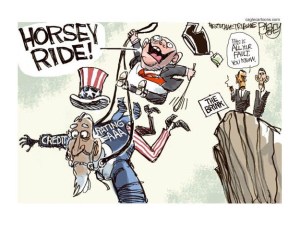 their business seriously when they do things like this: “Subprime Mortgage Bonds Getting AAA Rating S&P Denies to U.S. Treasuries”. How much sense does that make?
Standard & Poor’s is giving a higher rating to securities backed by subprime home loans, the same type of investments that led to the worst financial crisis since the Great Depression, than it assigns the U.S. government.
S&P is poised to provide AAA grades to 59 percent of Springleaf Mortgage Loan Trust 2011-1, a set of bonds tied to $497 million lent to homeowners with below-average credit scores and almost no equity in their properties. New York-based S&P stripped the U.S. of its top rank on Aug. 5, saying Washington politics were making the country less creditworthy.
Treasuries gained about 1.95 percent and U.S. borrowing costs have fallen to record lows as investors repudiated the downgrade, according to Bank of America Merrill Lynch indexes. S&P has awarded AAAs to more than $36 billion of securities in the U.S. this year that were created by bankers who continue to gather thousands of loans, bundle them into bonds of varying risk and pay ratings firms a fee to assign credit rankings.
“Everybody has been led to believe over the years that AAA means AAA means AAA across the board,” Gregory W. Smith, the general counsel for the $41 billion Public Employees’ Retirement Association of Colorado, said in a telephone interview on Aug. 24. “Anybody that didn’t learn in the 2008 crisis that doesn’t apply should find another line of work.”
Yup, that’s right. The same bonds in a still stinky market are getting better ratings than assets that are basically still serving as a universal safe haven and are showing signs of being about the only bull market among the surly August bears. Lest we forget, even a Senate subcommittee found that S&P’s inflated ratings significantly contributed to the financial crisis of 2007-2008. It’s somewhat obvious the market doesn’t believe the raters given the current pricing of US Treasuries. However, these kinds of ratings still remain important in some circles around Wall Street despite what seems like monumental problems and conflicts of interest. It’s difficult to imagine a for profit business not being influenced by large, paying customers. The reason they remain key is that many charters of institutional investment funds have minimum ratings requirements and institutional funds are a huge chunk of the market.
Even after Congress included rules in the Dodd-Frank Act last year designed to cut reliance on ratings, S&P and its competitors remain a key part of the financial markets. Pension and mutual funds often require minimum ratings to buy debt securities. Banks are generally required to hold less capital to back higher rated bonds as regulators including the Federal Reserve have yet to find an alternative.
The Justice Department is probing S&P and Moody’s over mortgage-bond ratings between 2005 and 2008, according to three former analysts who said they were interviewed by investigators. The Senate Banking Committee and the Securities and Exchange Commission are scrutinizing the decision to downgrade the U.S. rating, according to people with knowledge of the inquiries.
The Justice Department probe is fairly new, but details show that the probe is based on these potential conflicts of interest. Still, there are hints that the probe was also a possible political strategy to press the rater to raise the rating on U.S. sovereign debt. The Justice Department does have to prove a case before a judge so that could offset any political motivation in the long run.
The Justice Department has been asking about instances in which S&P analysts wanted to assign lower ratings to mortgage bonds but may have been overruled by S&P business managers, the newspaper reported. Its story cited unidentified sources familiar with the matter.
It was unclear whether the Justice Department investigation involves the other two ratings agencies. A Justice Department spokesman was not immediately available for comment.
Ed Sweeney, a spokesman for S&P, told the newspaper in an e-mail that the agency had received several requests from different government agencies over the last few years and that it was cooperating.
The newspaper said that despite the outcry over the ratings agencies’ failures in the financial crisis, investors still rely heavily on ratings from the three main agencies for their purchases of sovereign and corporate debt, as well as other complex financial products.
Companies and some countries, though not the United States, pay the agencies to receive a rating. For decades, the government issued rules that banks, mutual funds and others could rely on a AAA stamp of approval for investing decisions — which bolstered the agencies’ power, the newspaper said.
A successful case or settlement against a giant like S&P could accelerate the shift away from the traditional ratings system, the report said.
Collateralized loan obligations are probably among some of the most difficult assets to price and rate. S&P handles a boatload of them. They also have a history of being wrong.
More than 14,000 securitized bonds in the U.S. are rated AAA by S&P, backed by everything from houses and malls to auto- dealer loans and farm-equipment leases, according to data compiled by Bloomberg.
S&P has said it made mistakes in structured finance since the crisis including misunderstanding cash flows and using conflicting methods to analyze the securities. Its owner, New York-based McGraw-Hill Cos., depended on credit ratings for 27 percent of its $6.19 billion of revenue last year, down from 33 percent of $6.77 billion in 2007, Bloomberg data show.
“These are errors that could cause airplanes to crash if this was aerospace engineering,” said Sylvain Raynes, a principal at R&R Consulting in New York and a former analyst at Moody’s Investors Service.
There really is a need for reform and regulation in the way ratings institutions operate. That’s unlikely to happen as long as Republicans have any say in Congress and financial institutions hold sway in places like the U.S. Treasury.
The Big Smokey?
Posted: August 31, 2011 Filed under: The Media SUCKS, U.S. Politics | Tags: FEMA, flood insurance, Hurricane Irene, New Orleans Marsh fire 19 Comments So, I have to go to the Daily Mail to really get some good coverage of this since the US corporate media isn’t quite up to getting to news anywhere in the Great Fly Over. New Orleans has spent 4 days now in a blanket of nasty white smoke from what was one and now is two marsh fires. The second marsh fire is more threatening and is supposedly the result of arson.
This incredible image that looks straight out of Star Wars shows how smoke from a raging marsh fire in New Orleans has surrounded the iconic Superdome, as an emergency is declared in the city.
Helicopters are dropping water from 500-gallon baskets, hundreds of acres of land have been burned and now a second marsh fire has started in what is turning into a city-wide disaster.
New Orleans Mayor Mitch Landrieu spotted a second marsh fire during a flight over one that has hazed the metro area with smoke for three days and he has now declared an emergency.
Okay, as of yesterday, we’re beginning to get some attention. It’s not exactly as bad as when I was screaming to every media outlet I could about the BP Oil Spill that all of them ignored for weeks.
Haze from the fire was reported as far west as the Baton Rouge metro area, the National Weather Service said. It expanded its smoke alert from New Orleans and six suburban parishes to 23 parishes, including towns 100 miles from New Orleans.
As of Tuesday morning, the original fire had burned all but about 537 acres — about eight-tenths of a square mile — of the trees, shrubs and grass on a 1,552.5-acre area surrounded by canals, said Ryan Berni, spokesman for Landrieu. It started in the center of the area and has been spreading outward.
“It would take an armada of helicopters” to drop water on it and douse it, said state Rep. Austin J. Badon, Jr., D-New Orleans, who flew over the fires separately from Landrieu.
Landrieu said he was told that each basket of water, when it hits earth, covers an area about the size of a pickup truck.
Along the East Coast, some 40 hot spots in the Great Dismal Swamp were still smoldering even after Hurricane Irene dumped 10 to 15 inches of rain on the area, according to a news release posted Tuesday on the U.S. Fish and Wildlife Service website. That fire that lightning started on Aug. 4 has burned more than 6,000 acres in southeastern Virginia and northeastern North Carolina.
Some New Orleans schools had canceled outdoor activities because of smoke which has spread across the metropolitan area for three days. Meteorologists expected the smoke to move north over Lake Pontchartrain by evening, but to settle over the metro area again overnight.
I’ve had a nearly constant headache and sick feeling since Sunday when I went out to walk the dog through what looked like white fog. The smell definitely will let you know that this is not fog. It’s an acrid, nasty smoky smell and its full of particulates. We’ve had unhealthy air now for several days and the hospitals are filling up with people whose respiratory ailments cannot handle the excess stress.
What I really want to point your attention to is an appearance by Tulane Professor Melissa Harris Perry as the Guest host of the Rachel Maddow Show on MSNBC. I can’t pick up the video at the moment so you’ll have to go check it out yourself here. She explains how this health disaster might be better managed than it is being handled now if we had marsh buggies or the funds to get to big planes to drop substantial amounts of water on the fire. We don’t have any of those because the state doesn’t have money at the moment. Yes, a lot of that is due to the fact that our Governor is obsessed with getting his ass ready to run for President 4 years from now and has even vetoed the cigarette tax in the state since it could be used against him as a possible tax increase by the Grover Norquist crowd.
This brings me to the larger topic of Eric Cantor who is insisting that any disaster aid to any of the victims of the flooding in Irene or any place else right now including tornado ravaged Joplin Missouri be offset by spending cuts. Also, nasty little neoconfederate Ron Paul wants to eliminate FEMA. I have no idea what it’s going to take to get these folks to understand simple things like economies of scale and public goods that exist because the private sector can’t or won’t do it, but you’d think these kinds of disasters would be no-brainers on just the it’s our country and their our people argument. Cantor isn’t busily cutting off his own but others while Ron Paul thinks the recent response to Galveston flooding was a lot more worse than the horrible Galveston hurricane of 1900 where thousands died.
House Majority Leader Eric Cantor’s (R-Va.) insistence that federal disaster aid be offset elsewhere in the budget runs directly counter to his position in the past when the money went to help his district.
In the summer of 2004, after Tropical Storm Gaston slammed into Richmond, Cantor was on the front lines of efforts to secure millions of dollars in federal assistance to clean the wreckage and repair damaged infrastructure. Although the funding was not offset, Cantor cheered its arrival.
“The magnitude of the damage suffered by the Richmond area is beyond what the Commonwealth can handle,” Cantor said in a news release at the time, “and that is why I asked the president to make federal funds available for the citizens affected by Gaston.”
That episode is raising eyebrows this week, after Cantor told Fox News that disaster aid in the wake of Hurricane Irene should not be funded with borrowed money. Instead, Cantor said Monday, all federal assistance should be offset by cuts elsewhere in the budget.
“Yes, we are going to find the money. We are just going to have to make sure there are savings elsewhere to continue to do so,” Cantor told Fox. “Just like any family would operate when it’s struck with disaster, it finds the money to take care of a sick loved one or what have you, and then goes without trying to buy a new car or [putting] an addition onto the house.”
Yes, Eric, even if the metaphor worked–which it doesn’t–most families do find the money. They get loans and grants from the Federal Government just in case you didn’t know. But, back to that metaphor, when I can print money that every one universally accepts or when I can sell bonds that every one in the world wants at nearly zero interest rates, I’ll get back to you with some support for your lunacy. I can tell you how devastated my grandparents were by the 1927 flood too and how it took them decades to recover because they had no help and were dirt poor too. They had exactly one porcelain pig cream pitcher to show for their first decades of marriage and work and had to crawl out of poverty yet one more time after that flood.
I have no idea what it is going to take to get these neanderthal Republicans out of the 1900s and into the 21st century where we know that evolution is a scientific theory because there is tons of proof and no holes, where we know there is a role for the federal government in creating jobs and jumpstarting a bad economy, where we know that global warming exists and that climate science isn’t a hoax. I imagine that it’s going to take something of a miracle to get the Koch brothers money and the religious right’s tentacles out of our government, but whatever ever it takes, it’s a battle we need to wage.
Here’s a good example of the problem from Matt Yglesias who for some reason keeps getting lumped in with liberals. It’s a pretty good indicator that progressive is a misnomer and more than just Neanderthal Republicans can jump the shark on public goods.
Suzy Khimm asks, sensibly, “Why are we subsidizing the building of homes in flood-prone areas?”
As she explains, the National Flood Insurance Program offers sub-market insurance rates to people who want to build houses in very flood prone areas. It’d be as if we had a special program to offer subsidized health insurance to people who refuse to wear seatbelts. Sounds nuts? And yet there it is. But I do think it’s important to note that this kind of program, generally the worst kind of thing the federal government does, tends to be totally uncontroversial politically. The National Flood Insurance Program Reextension Act of 2010 was sponsored by a bipartisan group, it passed the filibuster-ridden Senate by unanimous consent on September 21, it passed the House of Representatives on a voice vote on September 23, and was signed into law by President Obama a week later. The lead sponsor of the current Flood Insurance Reauthorization is Senator Roger Wicker, Republican of Mississippi. Amidst fierce ideological debate about the size and scope of the federal government, in other words, there’s no serious budget-cutting move to stop subsidizing people from living in dangerous flood zones.
Risk Theory is not the easiest topic to study unless you love calculus and probabilities. This is the theoretical basis for insurance and it does explain a lot of things like moral hazard or information asymmetry. Risk theory and basic microeconomics also explains why some public goods are necessary because the private sector won’t provide them or they provide them at such a cost that nearly no one can afford them. The deal is this. FEMA does provide flood insurance. It also provides a plan to folks who repeatedly live in areas that flood with a that plan buys them out or makes them do something to offset the risk–called hazard mitigation–so that these kinds of repetitive losses do not recur on our tax dollars or any one else’s money. But then, journalist memes and lore are so much more fun that facts!! FEMA also provides flood insurance because no private company will do it at a reasonable cost. Private insurance is basically a Mafia-type gambling activity. They only provide insurance when there’s a distinct house advantage. For example, my Allstate homeowner’s insurance policy for which I pay more than I ever used to now has a wind and rain deductible that exactly equals my loss during Katrina. That’s the only claim I’ve ever had in the 11 years of living here. Also, sit down with me and a beer some time and let me tell you all the things that they were supposed to cover which they never did. FEMA flood insurance provides a small sum of money that would barely cover the rebuilding cost of my small house, should it have flooded. I know that no one back east that has the insurance is going to get an amount close to rebuilding their house. Yet, what little they do get will stop them from going into complete personal devastation and that’s the point. A sum of $250,000 will get you back on your feet a lot quicker than the fisting you’ll get from the good hands people, believe me.
So, my rant is not that an act of lightening set a marsh on fire or that some idiot arsonist compulsively made life a lot worse for a lot more folks for some reason. It isn’t that that mother nature shouldn’t send floods or prairie fires or hurricanes. It’s that in a huge country, there are huge risks. Huge risk pools are only possible when you opt in the population and you go around the private sector that wants to cherry pick its way to executive bonuses. Economies of scale in standardized processing, ratings, policies and administration is only possible at the public good level. Same deal goes with health insurance which is something every other developed nation figured out a long time ago. However, they obviously don’t have to deal with lobbyists and neanderthals and neoconfederates like we do.
Profiting from Torture, War, Outing CIA agents, and Ruining America
Posted: August 30, 2011 Filed under: Central Intelligence Agency, Civil Liberties, Civil Rights, Crime, cyber security, Democratic Politics, Diplomacy Nightmares, Domestic terrorism, toxic waste, U.S. Military | Tags: Dick Cheney 18 Comments Now, ask me how I really feel about the dueling book tours of war criminals Dick Cheney and Donald Rumsfeld?
Better yet, ask me why I disagree with President Obama who hasn’t said anything about the Dark Lords’ Book Tours and still thinks we should just put all this behind us?
MSNBC and NBC interviewed the vile creature that was our vice president, and I’ve actually watched the interviews. One of the most disgusting parts of the book and of the interviews was his continued plea for exoneration of Scooter Libby for all the lying and law breaking he did to cover up Cheney’s role in the outing of Valerie Plame. He continues to point the finger at Colin Powell for the investigation and seethes about Dubya’s refusal to pardon Libby. He also characterizes Condoleeza Rice as “tearful” for her public apology on the 16 words that drove Joe Wilson to the op-ed pages to try to stop the incredible mistake that was and is the Iraq war. If there ever was a reason to never bring Republicans back to a realm where they can influence the foreign policy of the U.S., Cheney is out there making that case right now. How can so few people cost one nation so much in lives and treasure and then be allowed to go out and profit from their reckless, stupid, costly, deadly ideology and policy?
Here’s a link to The Atlantic to remind us “Why Americans Loathe Dick Cheney”. There’s a huge, long list that includes Halliburton, spying on Americans, indefinite detentions, torture, and the radical view of executive power that haunts us today. Each item on the list comes from a long list of books that investigated Cheney’s misdeeds and each of them should be enough to start a righteous Justice Department investigation of his actions while in office. Here’s the conclusions from author Conor Friedersdorf.
Dick Cheney was a self-aggrandizing criminal who used his knowledge as a Washington insider to subvert both informed public debate about matters of war and peace and to manipulate presidential decision-making, sometimes in ways that angered even George W. Bush.
After his early years of public service, he capitalized on connections he made while being paid by taxpayers to earn tens of millions of dollars presiding over Halliburton. While there, he did business with corrupt Arab autocrats, including some in countries that were enemies of the United States. Upon returning to government, he advanced a theory of the executive that is at odds with the intentions of the founders, successfully encouraged the federal government to illegally spy on innocent Americans, passed on to the public false information about weapons of mass destruction in Iraq, and became directly complicit in a regime of torture for which he should be in jail.
Glenn Greenwald got a jump on the corporate media by publishing his diatribe in Salon on Thursday. Oh, wait the corporate media is being somewhat deferential to grab the interviews. Greenwald lists the results of the poison fruits of elite immunity. While CNN is fretting about the dying Lockerbie bomber who killed hundreds, here’s what’s going on with Dick Cheney, who is responsible for the senseless deaths of hundreds of thousands.
That’s what happens when the Government — marching under the deceitful Orwellian banner of Look Forward, Not Backward — demands that its citizens avert their eyes from the crimes of their leaders so that all can be forgotten: the crimes become non-crimes, legitimate acts of political choice, and the criminals become instantly rehabilitated by the message that nothing they did warrants punishment. That’s the same reason people like John Yoo and Alberto Gonzales are defending their torture and illegal spying actions not in a courtroom but in a lush conference of elites in Aspen.
The U.S. Government loves to demand that other countries hold their political leaders accountable for serious crimes, dispensing lectures on the imperatives of the rule of law. Numerous states bar ordinary convicts from profiting from their crimes with books. David Hicks, an Australian citizen imprisoned without charges for six years at Cheney’s Guantanamo, just had $10,000 seized by the Australian government in revenue from his book about his time in that prison camp on the ground that he is barred from profiting from his uncharged, unproven crimes.
By rather stark contrast, Dick Cheney will prance around the next several weeks in the nation’s largest media venues, engaging in civil, Serious debates about whether he was right to invade other countries, torture, and illegally spy on Americans, and will profit greatly by doing so. There are many factors accounting for his good fortune, the most important of which are the protective shield of immunity bestowed upon him by the current administration and the more generalized American principle that criminal accountability is only for ordinary citizens and other nations’ (unfriendly) rulers.
Even George Will says that Dick Cheney–at the very least–owes the world and the US an apology.
Five hundred and sixty five pages and a simple apology would have been in order in some of them. Which is to say, the great fact of those eight years is we went to war—big war, costly war—under false pretenses. And…to write a memoir in which you say essentially nothing seriously went wrong…if I wrote a memoir of my last week, I would have things to apologize for.
From what I can tell from these bits and blurbs from the interviews with NBC, Cheney thinks everything he did was right and every one else is wrong. This includes the President he served and the people he served with maybe the exception of Donald Rumsfeld. It’s a little odd, don’t you think, that Rumsfeld, Cheney, and Dubya can’t leave the country for fear of being sent directly to The Hague to be tried for Crimes against humanity? Yet, Cheney can’t think of one thing that he wasn’t right about.
If you can stomach it, here’s a Youtube of NBC’s ‘exclusive” with Dick Cheney. Isn’t this just ducky? Oh, and his book is up there on the bestseller list now. How on earth could we let this vile creature out on a rehabilitation tour and enrich him for his inhumane agenda?
Oh, and just in case you’re inclined to give our President a Break, here’s a little reminder on something from Wikileaks via Jonathan Turley and David Corn from 2010 w/ht to Susie Madrak.
One of the little reported details from the latest batch of Wikileaks material are cables showing that the Obama Administration worked hard behind the scenes not only to prevent any investigation of torture in the United States but shutdown efforts abroad to enforce the Geneva Conventions and the Convention Against Torture. This includes threatening the Spanish that, if they did not derail a judicial investigation, it would have serious consequences in bilateral relations. I discussed these cables on Countdown.
For two years, President Obama has worked to block the investigation of torture under the Bush Administration — even as both Dick Cheney and George Bush publicly admit to ordering waterboarding of suspects.
David Corn in Mother Jones has an interesting posting today on the issue.
A “confidential” April 17, 2009, cable sent from the US embassy in Madrid to the State Department discloses how the Administration discarded any respect for the independence of the judiciary in Spain and pressured the government to derail the prosecution of Bush officials. Human rights groups around the world had called for such enforcement in light of Obama promise that no torturers would be prosecuted and Holder’s blocking of any investigation into war crimes.
The Association for the Dignity of Spanish Prisoners had filed a demand for prosecution with Spain’s National Court to indict former Attorney General Alberto Gonzales; David Addington, former chief of staff and legal adviser to Vice President Dick Cheney; William Haynes, the Pentagon’s former general counsel; Douglas Feith, former undersecretary of defense for policy; Jay Bybee, former head of the Justice Department’s Office of Legal Counsel; and John Yoo, a former official in the Office of Legal Counsel. It had a compelled factual basis that these men ordered or facilitated war crimes — a record that has only become stronger since this confrontation.
American officials pressured government officials, including prosecutors and judges, not to enforce international law and that this was “a very serious matter for the USG.” It was Obama’s own effort at creating a “Coalition of the Unwilling” — nations unwilling to enforce treaties on torture and war crimes when the alleged culprits are American officials.
Sen. Judd Gregg (R-N.H.) joined the embassy’s charge d’affaires in the secret campaign to block the prosection of Judge Baltasar Garzón.
It’s still the jobs, stupid
Posted: August 29, 2011 Filed under: Economy, jobs, unemployment, voodoo economics | Tags: Alan Krueger, Dean Baker, Economists, jobs policy, labor market, Mark Thoma, unemployment 17 Comments In what I hope is not some symbolic hype, Alan Krueger–an actual economist and a labor one at that–was nominated by President Obama today to head the Council of Economic Advisors. He will replace Austin Goolsbee.
As the Wall Street Journal noted, Krueger’s scholarship suggests he will “likely provide a voice inside the administration for more-aggressive government action to bring down unemployment and, particularly, to address long-term joblessness.”
If his name sounds familiar, it’s because Krueger’s academic work has frequently played a valuable role in the political discourse. When congressional Republicans blatantly lied about the costs of a cap-and-trade plan, it was Krueger who set the record straight. When conservatives said in 2009 that slashing the minimum wage would boost the economy, Krueger explained why the opposite is true.
The economist also brings relevant experience to the table.
I’m hoping this finally brings the correct policy priorities and prescriptions to the table. We’ve had nearly three years of confused messages and results and the economy is clearly the worse for it. There’s an article up at The Guardian by economist Dean Baker that pretty much sums up all of my economic posts for the past few years. Obama never seemed to understand that high unemployment is a problem and never instituted any kind of policy to target the problem directly. He says he gets it now, but I’d just like to remind every one that he said he got it after the election that delivered the House of Representatives to the Tea Party terrorists and still has shown no sign that he understands that people expect bold fiscal policy in the face of low economic growth. All we keep getting is tax breaks for rich people and opposites day fiscal policy.
President Obama has discovered how serious the recession is. That’s what he told an audience in Chicago last week. To be fair, he was referring to revised data from the commerce department showing that the falloff in GDP was larger than originally reported.
But ridicule is appropriate. He and we knew all along how many people were out of work. The employment numbers told us the size of the hole and the desperate need for government action.
This sort of ridiculous comment, and President Obama’s weak response to the recession over the first two and a half years of his presidency, explains the tidal wave of scepticism facing his widely hyped upcoming speech on jobs after the Labor Day weekend. The list of remedies leaked ahead of time does little to inspire hope.
At the top of the list of job-creating measures is extending the 2 percentage-point reduction in the social security payroll tax. This provides no boost to the economy, since it just keeps in place a tax cut that was already there, but if the cut is allowed to end at the start of 2012, it will be a drag on growth.
As it stands, the social security programme is being fully reimbursed for the lost tax revenue, but there is always the possibility that Republicans will use this as a basis for attacking the programme. Given President Obama’s willingness to support cuts to social security, it is understandable that this part of his jobs agenda doesn’t generate much enthusiasm.
Baker goes on to call for a new CCC and explains why trade agreements, tax cuts to business yet again that undermine social security, and all the rest of the “jobs” agenda touted by the President aren’t going to do much of anything. Economist Nancy Folbre has a great piece of analysis up at the NYT explaining why letting this high level of unemployment go on for a period of time has an increasingly negative impact on the entire economy because things multiply over time. However, a new study covered by Folber shows that the unemployed just don’t sit around and act like they are on vacation. They create value by doing unpaid work. The same folks that think that the unemployed just lie around are the same ones that push the meme that homemakers spend their days eating bon bons and watching soap operas.
The overall increase in non-market work implies that household consumption among the unemployed fell less than market income, but it’s hard to put a dollar value on the unpaid work. When people make a voluntary decision to substitute time for money, we can infer something about the relative value they place on it.
But most unemployment is involuntary, and some unpaid work probably represents an effort to stay busy more than a significant contribution to household living standards.
The authors emphasize the relatively large impact of unemployment on unpaid work, in part because this is a new finding, and in part because it counters the wrong impression that, as Professor Hurst put it, the Great Recession was a Great Vacation.
But it is also important to note that most of the unemployed can’t allocate more of the free time they gain to productive uses, even if they want to. They lack the capital, land, tools and skills needed to flexibly shift from wage employment to production for their own use. Even when they can make a partial shift, their productivity is likely to be lower in unpaid work than paid work.
That’s why involuntary unemployment represents such a waste of human capabilities and loss of productive output for the economy as a whole.
So, what can Alan Krueger bring to the White House if the President will listen to this economist? This is economist Mark Thoma’s take on the appointee.
His most well known research is on the minimum wage and immigration, The work is somewhat controversial in that the results show small negative effects from raising the minimum wage and from increasing immigration. In my view that is a sign of an economist who is willing to let the evidence do the talking, and that is a good trait to have in this job.
He has also worked in many other areas, including occupational licensing, the economics of terrorism, and more recently on job search in periods when unemployment is high, including how job search is affected by things such as unemployment insurance. But that is just a small taste of the large amount of research he has done.
Krueger’s been working at the Treasury so maybe that will give him access that many of the other Obama economic advisers seemed without. Time is running out for policy to help the unemployed in any meaningful way. I say this because as we get closer to the election, it will make the Republicans more surly and less likely to do anything to help a Democratic administration. They’ve already been rewarded for hostage-taking behavior. Then, there’s the policy lags. Things like infrastructure banks take a lot of time to set up. Ideas like patent reform are laughable as job creation tools. I have no idea why the Obama administration won’t embrace things that worked in the past, but that doesn’t appear to be their MO. They seemed to get their jobs mojo from reheating failed Republican canards and presenting them as the higher, middle ground. I continue to be discouraged.
Monday Reads
Posted: August 29, 2011 Filed under: 2012 presidential campaign, morning reads | Tags: 2012 election, Colin Powell, Hurricane Irene Hype, Republicans against Science, Super PACs, Women in high positions in business in emergin markets 37 Comments Good Morning!
Paul Krugman has a great piece in the NYT on how Republicans are against science. They do appear to ignore it in favor of myth, conspiracy theories and wishful thinking. However, it does us no good to send Democrats into office that won’t fight for science and rational thought, either. How much more nonsense do you think will come out during the 2012 political season?
Mr. Perry, the governor of Texas, recently made headlines by dismissing evolution as “just a theory,” one that has “got some gaps in it” — an observation that will come as news to the vast majority of biologists. But what really got peoples’ attention was what he said about climate change: “I think there are a substantial number of scientists who have manipulated data so that they will have dollars rolling into their projects. And I think we are seeing almost weekly, or even daily, scientists are coming forward and questioning the original idea that man-made global warming is what is causing the climate to change.”
That’s a remarkable statement — or maybe the right adjective is “vile.”
The second part of Mr. Perry’s statement is, as it happens, just false: the scientific consensus about man-made global warming — which includes 97 percent to 98 percent of researchers in the field, according to the National Academy of Sciences — is getting stronger, not weaker, as the evidence for climate change just keeps mounting.
In fact, if you follow climate science at all you know that the main development over the past few years has been growing concern that projections of future climate are underestimating the likely amount of warming. Warnings that we may face civilization-threatening temperature change by the end of the century, once considered outlandish, are now coming out of mainstream research groups.
But never mind that, Mr. Perry suggests; those scientists are just in it for the money, “manipulating data” to create a fake threat. In his book “Fed Up,” he dismissed climate science as a “contrived phony mess that is falling apart.”
I could point out that Mr. Perry is buying into a truly crazy conspiracy theory, which asserts that thousands of scientists all around the world are on the take, with not one willing to break the code of silence. I could also point out that multiple investigations into charges of intellectual malpractice on the part of climate scientists have ended up exonerating the accused researchers of all accusations. But never mind: Mr. Perry and those who think like him know what they want to believe, and their response to anyone who contradicts them is to start a witch hunt.
All the candidates are pushing bad economics as well.
I’ve been kind’ve “blown away” by the news coverage of the remnants of Irene today. It seems like most of the TV coverage has been 24 hours now worth of people saying we dodged a bullet and trying to find people impacted by the storm. You’re beginning to see headlines like this now: Get Real: Hurricane Irene Should Be Renamed “Hurricane Hype”. Last night Geraldo looked like he’d just re-opened that silly empty vault again.
Irene has put on a remarkably similar show. Within the limits of forecasting error, Irene’s projected path makes it was impossible to rule out a major disaster. But, as a dangerous Category 3 storm within two days of land, something similar to what happened to Gloria occurred. Instead of going slightly off course, the power of her winds dropped markedly, at least as measured by hurricane hunter aircraft. Because it is prudent to not respond to every little tropical cyclone twitch (such as Gloria’s jog or Thursday’s wind drop), the Thursday evening forecast was virtually unchanged, the Internet went thermonuclear, and the Weather Channel’s advertising rates skyrocketed. From that point on, it became all Irene, all the time. With this level of noise, the political process has to respond with full mobilization. Hype begets hype.
A day later, the smart money is still riding a very Gloria-like track, but with a cyclone that will be weaker than projected. It is doubtful that Irene will even cough up eight bodies (the number killed by Gloria), though power outages east of where the center makes landfall (probably on Long Island) may be extensive.
I think the body count’s at 21 now which kind’ve makes this hype on all the hype look like hype. Well, at least all the governors of the mid Atlantic states got some air time praising civil servants instead of demonizing them for a change. Is it just me or does Chris Christine remind you of those big boy statues in front of those 1960s hamburger joints? That man looks like a heart attack about to happen.
Former Secretary of State Colin Powell–who cross party lines last year to hype Obama–is having second thoughts about hyping an Obama second term. Powell was on Face the Nation yesterday.
“I haven’t decided who I’m going to vote for,” Powell said on CBS’ “Face the Nation.” “Just as was the case in 2008, I am going to watch the campaign unfold. In the course of my life I have voted for Democrats, I have voted for Republicans, I have changed from one four-year cycle to another.
“I’ve always felt it my responsibility as a citizen to take a look at the issues, examine the candidates, and pick the person that I think is best qualified for the office of the president in that year. And not just solely on the basis of party affiliation,” he said.
Asked about the Republican field, Powell said there are some “interesting candidates,” but no one who has “emerged into the leading position.”
“So let’s see if anybody else is going to join, and we’ve got a long way to go,” he added.
Powell, the nation’s first African-American secretary of state, praised Obama’s leadership style in 2008 in endorsing him, saying shortly before the election that Obama “has a definite way of doing business that will serve us well.” He also said at the time that he didn’t think the GOP vice-presidential candidate, Sarah Palin, was “ready” to be president.
The really, really bad thing about the political system these days is that PACs are getting bigger and more powerful. They also seem more closely aligned with candidates. Here’s an interesting story from the NYT. The Supreme Court decision on corporations and first amendment rights has definitely impacted the political money machine.
But some advocates for tighter campaign regulation say existing rules on independent groups did not anticipate the emergence of Super PACs so closely tied to a single candidate, leaving so much room to maneuver that the independent groups are able to act as surrogates for the candidates.
“There’s not a big difference between these candidate-specific Super PACs and candidate campaign committees,” said Paul S. Ryan, associate legal counsel at the Campaign Legal Center. “I think it’s a joke. What they are doing is abiding by the very meager restrictions on coordinations on expenditures and solicitations. But that leaves a wide swath of activities that can be fully coordinated under present law.”
Increasingly, the new Super PACs are taking on tasks that in previous years were handled by — and paid for — the candidates themselves. But instead of using money raised in the $2,500 increments that federal law imposes on candidates, the Super PACs can accept donations of unlimited amounts. (The groups must disclose their donors, though some Super PACs, including Priorities USA and the Karl Rove-founded American Crossroads, have affiliated nonprofit arms that do not have to disclose donors.)
Just in case you haven’t read Rick Perry’s outrageous lies about Social Security, here’s some more information. Perry calls the popular government program unconstitutional and refers to it as a Ponzi Scheme. I want to hear him say this in Florida.
But Perry returned to the “Ponzi scheme” description on the campaign trail in Iowa last night:
“It is a Ponzi scheme for these young people. The idea that they’re working and paying into Social Security today, that the current program is going to be there for them, is a lie,” Perry said. “It is a monstrous lie on this generation, and we can’t do that to them.”
Later, in Des Moines, when a reporter asked about the suggestion that his campaign was backing off some positions in the staunch states-rights book, Perry said, “I haven’t backed off anything in my book. So read the book again and get it right.”
Kay Henderson has more on this:
Another reporter pressed the issue, asking if Perry believes Medicare is “unconstitutional” as well.
“I never said it was unconstitutional,” Perry said. “I look at Medicare just like I look at Social Security. They’re programs that aren’t working and we ought to have a national conversation about it. You know, those that have said I’ve said they’re unconstitutional — I’m going to have them read the book. That’s not what I said.”
In his book, Perry called Social Security something akin to a “bad disease” that was created “at the expense of respect for the Constitution and limited government.”
This is going to be one weird, strange, political season. I’ve never seen so many people pushing so many unpopular positions.
Women may have hit the glass ceiling in the US, but women in emerging market countries are winding up in board rooms more and more all the time. Remember, many of these countries have already had women presidents and prime ministers.
Seven of the 14 women identified on Forbes magazine’s list of self-made billionaires are Chinese. Many firms in emerging markets do a better job of promoting women than their Western rivals, some surveys suggest. In China, 32% of senior managers are female, compared with 23% in America and 19% in Britain. In India, 11% of chief executives of large companies are female, compared with 3% of Fortune 500 bosses in America and 3% of FTSE 100 bosses in Britain. Turkey and Brazil come third and joint fourth (behind Finland and Norway) in the World Economic Forum’s ranking of countries by the proportion of CEOs who are women. In Brazil, 11% of chief executives and 30% of senior executives are women.
Young, middle-class women are overtaking their male peers when it comes to education. In the United Arab Emirates 65% of university graduates are female. In Brazil and China the figures are 60% and 47% respectively. In Russia 57% of college-age women are enrolled in tertiary education; only 43% of men are. Business schools, those hothouses of capitalism, are feminising fast. Some 33% of students at the China Europe International Business School (CEIBS) in Shanghai and 26% at the Indian School of Business are female, a figure comparable with those of Western schools such as the Harvard Business School and INSEAD.
In “Winning the War for Talent in Emerging Markets: Why Women are the Solution”, Sylvia Ann Hewlett and Ripa Rashid point out that businesswomen face steep obstacles in emerging markets. How can they stay on the fast track if, as in the UAE, they cannot travel without a male chaperone? And how can they be taken seriously if, as in Russia, the term “businesswoman” is synonymous with prostitute? In every emerging market women bear the lioness’s share of family responsibilities. In many places, deals are sealed with booze and male bonding.
So, there’s some things to get us started on this Monday. Hopefully, those of you on the east coast are getting back to normal after the storm. Let us know how you’re doing! What’s on your reading and blogging list today?

 peej
peej Carissa
 bostonboomer
 dakinikat
 ecocatwoman
 jjlo
jjlo mablue2
 Mama Lopez
 peggysue22
 quixote
 skydancingguestblogger
 Mona (aka Wonk the Vote)





Recent Comments