
Friday Reads
Posted: September 16, 2011 Filed under: morning reads | Tags: bigotry, Elizabeth Warren, Isalmaphobia, religious indoctrination at the FBI and in the Air Force, Social Security 28 Comments Good Morning!
It’s one of those mornings where I could really use room service. I’m getting to that age where rush deadlines do me in. Fortunately, Bostonboomer helped me with some great links so I’m going to share them with you! This first one is from Boston as well as Bostonboomer and it’s about the Elizabeth Warren campaign and some interesting local dynamics. Senator John Kerry has committed to supporting another candidate in the primary.
In the video announcing her candidacy released this morning, Warren eschews the ivory tower in favor of a populist pitch.
“I’m going to do this,” she declares. Middle-class families, says Warren, have been “chipped at, hacked at, squeezed and hammered for a generation now, and I don’t think Washington gets it.”
She adds: “The pressures on middle class families are worse than ever, but it is the big corporations that get their way in Washington. I want to change that. I will work my heart out to earn the trust of the people of Massachusetts.”
Not since the Weld-Kerry race in 1996 could Massachusetts see a general election campaign like this.
As in that battle royale between two bluebloods, then-Governor William F. Weld and still-Senator John Kerry, the candidates would be well-financed, nationally supported, and adept at debating.
Like Brown, Weld had tremendous personal appeal, with voters seemingly entranced by his devil-may-care attitude and his decidedly non-Cantabrigian persona.
And like Warren, Kerry was viewed as too stiff to connect, especially in contrast with Weld.
But Kerry ended up besting Weld on the strength of his personal campaigning, the experience of the large cadre of Democratic operatives, and an electorate that still tilted to the left despite being in the outset of electing Republican governors for 16 consecutive years.
Warren’s first challenge, though, is to overcome a field of a half-dozen challengers who are incensed the party establishments in both Washington and Boston have largely pooh-poohed campaigns in which they have put their lives on hold to stump around the state and beg for money to finance their travels.
Here’s an item from Wired that’s bound to make you mad. It seems the FBI is profiling all muslim believers as radicals and terrorists. What on earth has the last ten years done to our civil liberties?
The FBI is teaching its counterterrorism agents that “main stream” [sic] American Muslims are likely to be terrorist sympathizers; that the Prophet Mohammed was a “cult leader”; and that the Islamic practice of giving charity is no more than a “funding mechanism for combat.”
At the Bureau’s training ground in Quantico, Virginia, agents are shown a chart contending that the more “devout” a Muslim, the more likely he is to be “violent.” Those destructive tendencies cannot be reversed, an FBI instructional presentation adds: “Any war against non-believers is justified” under Muslim law; a “moderating process cannot happen if the Koran continues to be regarded as theunalterable word of Allah.”
These are excerpts from dozens of pages of recent FBI training material on Islam that Danger Room has acquired. In them, the Constitutionally protected religious faith of millions of Americans is portrayed as an indicator of terrorist activity.“There may not be a ‘radical’ threat as much as it is simply a normal assertion of the orthodox ideology,” one FBI presentation notes. “The strategic themes animating these Islamic values are not fringe; they are main stream.”
The FBI isn’t just treading on thin legal ice by portraying ordinary, observant Americans as terrorists-in-waiting, former counterterrorism agents say. It’s also playing into al-Qaida’s hands.
Focusing on the religious behavior of American citizens instead of proven indicators of criminal activity like stockpiling guns or using shady financing makes it more likely that the FBI will miss the real warning signs of terrorism. And depicting Islam as inseparable from political violence is exactly the narrative al-Qaida spins — as is the related idea that America and Islam are necessarily in conflict. That’s why FBI whistleblowers provided Danger Room with these materials.
Over the past few years, American Muslim civil rights groups have raised alarm about increased FBI and police presence in Islamic community centers and mosques, fearing that their lawful behavior is being targeted under the broad brush of counterterrorism. The documents may help explain the heavy scrutiny.
Sam Stein at HuffPo thinks that Obama won’t include social security in the list of program cuts in the catfood commision redux movement.
Jilted by Republican leadership during the deficit-reduction talks that accompanied the debt ceiling debate, the Obama administration is now pulling back an offer to put Social Security reform on the negotiating table.
The president will not include changes to that program in the series of deficit reduction measures that he will offer to the congressional super committee next Monday, administration officials confirm.
During talks with House Speaker John Boehner (R-Ohio) this past summer, President Barack Obama had discussed changing the way that Social Security benefits were paid so that a lower level of benefits were paid over time. Boehner walked away from that deal, which was part of a much broader package, because of concern over a corresponding tax increase. Now, Obama is putting off support for that idea of changing the inflation formula of Social Security to chained consumer price index (CPI).
“The president’s recommendation for deficit reduction will not include any changes to Social Security because, as the president has consistently said, he does not believe that Social Security is a driver of our near and medium term deficits,” said White House spokeswoman Amy Brundage. “He believes that both parties need to work together on a parallel track to strengthen Social Security for future generations rather than taking a piecemeal approach as part of a deficit reduction plan.”
“There will be no Social Security in the recommendations,” Brundage added.
The White House’s decision to take Social Security reform off the table for the time being, which was first reported by the Wall Street Journal, is largely consistent with the president’s viewpoint that the program is not a contributor to the deficit and should be dealt with in separate discussions. The administration brought it in to the “grand bargain” talks with Boehner, an official relayed, because the president was a party to those talks. With respect to the super committee’s negotiations, he will have no seat at the table and is merely outlining his preferences for reform.
The move also makes obvious political sense. Democrats have long worried that they would upset their base should they be seen as the ones chipping away at retirement benefits, certainly after House Republicans took heat for passing a budget that would convert Medicare into a voucher-based program.
Many radical christianists have infiltrated places like the armed services and law enforcement in hopes of gathering steam come the great war against whatever the end war is supposed to be. I’ve never been much for fiction reading and the left behind series seems like as bad as fiction can get. There’s been complaints at the Air Force academy for years. One of my cousins who is a devote catholic was told be students in her math class that she needed to come to prayer services and become a real christian. That was back in the early 90s and I don’t think it’s got much better. Evidently, one top air force general is switching the air force back to neutral.
A top US Air Force official, in an attempt to ensure the Air Force adheres to the Constitution as well as its own regulations and policies, issued guidelines that calls on “leaders at all levels” to take immediate steps to maintain “government neutrality regarding religion.”
In his policy memorandum dated September 1, but sent Tuesday to all major commands, Air Force Chief of Staff Gen. Norton A. Schwartz said, “Leaders … must balance Constitutional protections for an individual’s free exercise of religion or other personal beliefs and its prohibition against governmental establishment of religion.”
The First Amendment establishes a wall of separation between church and state and Clause 3, Article 6 of the Constitution specifically prohibits a “religious test.”
The memo was issued a month after Truthout published an exclusive report revealing how, for two decades, the Air Force used numerous Bible passages and religious imagery to teach nuclear missile officers about the morals and ethics of launching nuclear weapons, a decision that one senior Air Force officer told Truthout last month should have “instantly” resulted in the firing of the commanders who allowed it to take place.
The Air Force immediately suspended the mandatory Nuclear Ethics and Nuclear Warfare training immediately following the publication of Truthout’s report. David Smith, a spokesman for the Air Education and Training Command told Truthout last month the ethics training “has been taken out of the curriculum and is being reviewed.”
“The commander reviewed it and decided we needed to have a good hard look at it and make sure it reflected views of modern society,” Smith said.
The decison angered Sen. John Cornyn (R-Texas) who fired off an angry letter to Secretary of the Air Force Michael B. Donley criticizing the move and demanding Donley provide him with a report detailing “actions taken” by the Air Force that led to the suspension of the ethics training.
One more interesting political piece via the Christian Science Monitor that says that Romney may actually be a “tougher foe” than Governor Goodhair for Obama. My guess is because he sounds sane compared to Perry, but here’s what the CSM says.
Cal Jillson, a political scientist at Southern Methodist University in Dallas, frames Obama’s prospects this way: “He’s eminently beatable, and Republicans smell this. But in electoral politics, it’s always compared to whom.”
As of now, the GOP race seems to have boiled down to a choice between Texas Gov. Rick Perry and former Massachusetts Gov. Mitt Romney. That, of course, could change, especially if a major new prospect enters the race. But for the sake of argument, let’s say either Governor Perry or Mr. Romney will get the nod.
Polls show that GOP voters believe Perry is electable, but polls of general election voters show Romney faring better than Perry against Obama. The Real Clear Politics average gives Obama a four-point lead over Perry but just a one-point lead over Romney.
Among independent voters, Romney has the clear advantage. In the latest survey by the Democratic firm Public Policy Polling (PPP), Perry’s favorability with independents is just 23 percent (with 51 percent seeing him unfavorably). Romney is seen favorably by 44 percent of independents, and unfavorably by 39 percent.
I’ve just got a bad case of noodley brain today, so do let us know what’s on your reading and blogging list this morning and I’ll head back to the coffee pot?
Who ya Gonna Call?
Posted: September 14, 2011 Filed under: jobs, unemployment, voodoo economics | Tags: jobs, Martin Wolf, Obama American Jobs Act, Robert Reich, unemployment 5 Comments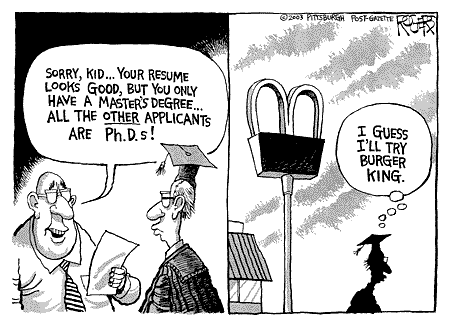 Evidently, the new Jobs Plan is a Jobs Bust in the eyes of the electorate. A few villagers may have gotten those tingly leg sensations, but the public is much more skeptical. Try this one on for size!
A majority of Americans don’t believe President Barack Obama’s $447 billion jobs plan will help lower the unemployment rate, skepticism he must overcome as he presses Congress for action and positions himself for re- election.
The downbeat assessment of the American Jobs Act reflects a growing and broad sense of dissatisfaction with the president. Americans disapprove of his handling of the economy by 62 percent to 33 percent, a Bloomberg National Poll conducted Sept. 9-12 shows. The disapproval number represents a nine point increase from six months ago.
The president’s job approval rating also stands at the lowest of his presidency — 45 percent. That rating is driven down in part by a majority of independents, 53 percent, who disapprove of his performance.
“I don’t think he’s done as good a job as I think he could have,” said Paul Kaplan, 58, an unemployed Democrat from Philadelphia. “We were hopeful that things would improve in the economy and they’ve only gotten worse. People in Washington just don’t seem to want to cooperate with each other and work for the people.”
The poll hands Obama new lows in each of the categories that measures his performance on the economy: only 36 percent of respondents approve of his efforts to create jobs, 30 percent approve of how he’s tackled the budget deficit and 39 percent approve of his handling of health care.
I still have to think that some of this has to do with the fact that we all were glad to be rid of Dubya and his horrible policies and now we realize it’s just more of the same!
By a margin of 51 percent to 40 percent, Americans doubt the package of tax cuts and spending proposals intended to jumpstart job creation that Obama submitted to Congress this week will bring down the 9.1 percent jobless rate. That sentiment undermines one of the core arguments the president is making on the job act’s behalf in a nationwide campaign to build public support.
Compounding Obama’s challenge is that 56 percent of independents, whom the president won in 2008 and will need to win in 2012, are skeptical it will work.
Even members of the Democratic Party in Congress are skeptical. Notice that the bottom line is still all about the politics instead of the people.
President Barack Obama’s new jobs plan is hitting some unexpected turbulence in the halls of Congress: lawmakers from his own party.
As he demands Congress quickly approve his ambitious proposal aimed at reviving the sagging economy, many Democrats on Capitol Hill appear far from sold that the president has the right antidote to spur major job growth and turn around their party’s political fortunes.
“Terrible,” Sen. Jim Webb (D-Va.) told POLITICO when asked about the president’s ideas for how to pay for the $450 billion price tag. “We shouldn’t increase taxes on ordinary income. … There are other ways to get there.”
“That offset is not going to fly, and he should know that,” said Democratic Sen. Mary Landrieu from the energy-producing Louisiana, referring to Obama’s elimination of oil and gas subsidies. “Maybe it’s just for his election, which I hope isn’t the case.”
“I think the best jobs bill that can be passed is a comprehensive long-term deficit-reduction plan,” said Sen. Tom Carper (D-Del.), discussing proposals to slash the debt by $4 trillion by overhauling entitlement programs and raising revenue through tax reforms. “That’s better than everything else the president is talking about — combined.”
And those are just the moderates in the party. Some liberals also have concerns.
“There is serious discomfort with potentially setting up Social Security as a fall guy because you’re taking this contribution out,” said Rep. Raul Grijalva of Arizona, referring to Obama’s proposal to further slash payroll taxes.
Democrats in large numbers will still back the president’s overall jobs package, and when the plan heads for House and Senate consideration, some of these same skeptics will very likely vote to advance the measure. But as details of the plan began to be vetted on Capitol Hill on Tuesday, it was clear that the White House needed to redouble its sales job — or tweak its plan — to force Democrats to fall in line at a pivotal point in Obama’s presidency.
Wow! I’d like to think it’s all those economists–like Robert Reich and Martin Wolf and the IMF–getting out there and explaining that austerity is killing middle class incomes, the basic problem is a lack of aggregate demand and that tax cuts are kind’ve worthless right now that’s moving the people. I actually believe that most people have a lot more common sense when it comes to economics than beltway-disabled politicians. You can see the contrast right up there in all those quotes from people v. politicians.
The centerpiece of the proposal — and the plank that Republicans have said they are most willing to consider — is a cut in payroll taxes, which cover the first $106,800 in earnings and are evenly split between employers and employees.
Respondents are evenly split at 45 percent on this approach, which would cost $240 billion to the U.S. Treasury. Independents oppose it 47 percent versus 43 percent who favor it.
Think about it. We’ve had 11 years of deregulation of financial markets and banks, tax cuts, bail outs for failing businesses, government largess to corporations, and your basic Republican Voodoo economics and what do we have to show for it? Higher Poverty rates. Lower median incomes. Huge long term joblessness. High unemployment. What rational person thinks that more of the same is going to do anything? You don’t need an economics degree to see that none of this stuff has worked in the past. But, thankfully, you do have some economists out there backing up our gut feeling with solid economic theory. Here’s something from Martin Wolf at FT just as a reminder.
Contrary to conventional wisdom, fiscal policy is not exhausted. This is what Christine Lagarde, new managing director of the International Monetary Fund, argued at the Jackson Hole monetary conference last month. The need is to combine borrowing of cheap funds now with credible curbs on spending in the longer term. The need is no less for surplus countries with the ability to expand demand to do so.
It is becoming ever clearer that the developed world is making Japan’s mistake of premature retrenchment during a balance-sheet depression, but on a more dangerous – far more global – scale. Conventional wisdom is that fiscal retrenchment will lead to resurgent investment and growth. An alternative wisdom is that suffering is good. The former is foolish. The latter is immoral.
Reconsidering fiscal policy is not all that is needed. Monetary policy still has an important role. So, too, do supply-side reforms, particularly changes in taxation that promote investment. So, not least, does global rebalancing. Yet now, in a world of excess saving, the last thing we need is for creditworthy governments to slash their borrowings. Markets are loudly saying exactly this. So listen.
Here’s Robert Reich showing his chops on what the real problem is in our economy. If only Obama, would find out the real problem from real economists and stop it with the political pandering to the Republican Party.
We don’t need a Texas Economy.
States don’t have their own monetary policies so they can’t lower interest rates to spur job growth. They can’t spur demand through fiscal policies because state budgets are small, and 49 out of 50 are barred by their constitutions from running deficits.
States can cut corporate taxes and regulations, and dole out corporate welfare, in efforts to improve the states’ “business climate.” But studies show these strategies have little or no effect on where companies locate. Location decisions are driven by much larger factors — where customers are, transportation links, and energy costs.
If governors try hard enough, though, they can create lots of lousy jobs. They can drive out unions, attract low-wage immigrants, and turn a blind eye to businesses that fail to protect worker health and safety.
Rick Perry seems to have done exactly this. While Texas leads the nation in job growth, a majority of Texas’s workforce is paid hourly wages rather than salaries. And the median hourly wage there was $11.20, compared to the national median of $12.50 an hour.
Texas has also been specializing in minimum-wage jobs. From 2007 to 2010, the number of minimum wage workers there rose from 221,000 to 550,000 – that’s an increase of nearly 150 percent. And 9.5 percent of Texas workers earn the minimum wage or below – compared to about 6 percent for the rest of the nation, according to the Bureau of Labor Statistics. The state also has the highest percentage of workers without health insurance. Texas schools rank 44th in the nation in per-pupil spending.
The Perry model of creating more jobs through low wages seems to be catching on around America.
According to a report out today from the Commerce Department, the median income of U.S. households fell 2.3 percent last year – to the lowest level in fifteen years (adjusted for inflation). That’s the third straight year of declining household incomes. Part of this is loss of jobs. Part is loss of earnings.
More and more Americans are retaining their jobs by settling for lower wages and benefits, or going without cost-of-living increases. Or they’ve lost a higher-paying job and have taken one that pays less. Or they’ve joined the great army of contingent workers, self-employed “consultants,” temps, and contract workers – without healthcare benefits, without pensions, without job security, without decent wages.
It’s no great feat to create lots of lousy jobs.
We just don’t need no stinkin’ jobs. We need real jobs. For that, it takes a lot more than tax cuts, rhetoric, and political pandering. So, I’m not calling Rick Perry or Barrack Obama any time soon. It’s real jobs or bust for me.
Dems lose Weiner Seat
Posted: September 13, 2011 Filed under: 2012 presidential campaign | Tags: Anthony Weiner's seat turns Republican, Republican House 4 Comments This can’t be good news for Congressional Dems.
Republicans won an upset victory in a Democratic stronghold in New York on Tuesday in a special U.S. House of Representatives election for the seat vacated by former Representative Anthony Weiner, who resigned after a Twitter sex scandal.
Republican Bob Turner, a retired media executive who called the election a referendum on President Barack Obama, defeated Democrat David Weprin, a state assemblyman, a New York cable television station said.
More proof that some one has nonexistent coattails: Republican wins easily in Nevada special election. Hmmmm.
Oh, and here’s the new congressman in Nevada. Complete RIGHT WING NUT JOB!
The Call of the Loons
Posted: September 13, 2011 Filed under: 2012 presidential campaign, Republican politics, Voter Ignorance | Tags: health insurance, Let them Die, Poverty, Right Wing Nut Jobs, Right Wing Policies, Universal Coverage 12 CommentsWell, I did manage to watch a little of the “tea party” debate last night. I’m one of those independents that every one should be after this season. I  was more appalled at this one than the last which I didn’t think possible. It’s amazing to me how far off a right wing cliff the party has gone. If the rest of them were trying to make Romney look sane, they sure did a good job of it. I’d like to cover a few of the more outrageous points made by the worst of them by point you to see stylized facts this morning. This is from a press release from the U.S. Census Bureau. Oh, and for any of you Republicans reading this out there, the U.S. Census Bureau is not and has not have been a member of the Communist Party. It’s a release of information on US citizens. The most incredible part of the data is the poverty statistics. This decade is driving families into poverty. It’s a statistically significant trend.
- The poverty rate in 2010 was the highest since 1993 but was 7.3 percentage points lower than the poverty rate in 1959, the first year for which poverty estimates are available. Since 2007, the poverty rate has increased by 2.6 percentage points.
- In 2010, the family poverty rate and the number of families in poverty were 11.7 percent and 9.2 million, respectively, up from 11.1 percent and 8.8 million in 2009.
You can read more about it in BostonBoomer’s post below. You should, because poverty is at it’s the highest rate in 18 years. This is the part that I want to blog about. People are also losing private insurance and moving to government plans. One of the few bright notes is that the high flawed 2010 HRCA let parents keep their young adult children on their insurance until age 26 so coverage for the 18-24 year old group went up. Every one else was not so fortunate. They’ve been left to the wolves.
The White House sought to find a silver lining in the census figures by noting, as Health and Human Services Secretary Kathleen Sebelius blogged at healthcare.gov, that the percentage of 18-to-24-year-olds covered by health insurance increased by 2.1 percentage points from 2009 to 2010.
So, you already now what I’m going to do as my segue way back to the current crop of Republicans. I’ll give Mittens Romney a pass at the moment. Most of the people on that stage actively promote policies that create statistics like these. Texas is the worst state in the union on nearly every development statistic. It is one huge underdeveloped nation. We also get to know the heart and soul of the current crop of Republicans who have whooped and cheered at executions by Perry–many of the questionable and undoubtedly wrong–and now we get “let them die” on the plight of the uninsured. This answer from Doctor Ron Paul–who should have taken the Hippocratic Oath at one point in his life–was leave them to the churches. Let the charities sort them out!!!
A bit of a startling moment happened near the end of Monday night’s CNN debate when a hypothetical question was posed to Rep. Ron Paul (R-Texas).
What do you tell a guy who is sick, goes into a coma and doesn’t have health insurance? Who pays for his coverage? “Are you saying society should just let him die?” Wolf Blitzer asked.
“Yeah!” several members of the crowd yelled out.Paul interjected to offer an explanation for how this was, more-or-less, the root choice of a free society. He added that communities and non-government institutions can fill the void that the public sector is currently playing.
“We never turned anybody away from the hospital,” he said of his volunteer work for churches and his career as a doctor. “We have given up on this whole concept that we might take care of ourselves, assume responsibility for ourselves … that’s the reason the cost is so high.
The question by Blitzer should’ve just used one of the statistics above. What about the number of people that basically cannot afford private insurance under any circumstance and the many of them that don’t qualify for state medicaid plans? Well, just in case you want a little more back ground on how committed Ron Paul is to the Let them Die wing of the Right to Life party, let me point to a 2008 event.
What a testament to the Libertarian creed, which abhors the idea of universal health care. This loyal, passionate man, who died too young, left his family a debt of $400,000 in medical bills.
Who knows whether he put off getting treatment for the pneumonia that killed him because he was uninsured.
Kent Snyder did some amazing work on the Ron Paul Campaign and is remembered as a “libertarian giant”- by Lew Rockwell, on the libertarian site, Lew Rockwell.com.
The Wall Street journal reports that Kent, more than anyone else, persuaded Ron Paul to run for president. And Kent, according the the WSJ, developed what “ultimately became a $35 million operation with 250 employees that helped deliver more than one million votes for the Texas congressman’s bid in the Republican nominating contest.”-
Ron Paul posted this message about Snyder on his website: “”Like so many in our movement, Kent sacrificed much for the cause of liberty, Kent poured every ounce of his being into our fight for freedom. He will always hold a place in my heart and in the hearts of my family.”
Sadly, the Libertarian heart apparently does not include health care. The poor guy raised tens of millions of dollars and couldn’t afford the $300-$600 a month that COBRA medical insurance would have cost.
Along with this we get Michelle Bachmann’ screed about endangering little girls with forced government vaccines that cause “mental retardation”. Rick Santorum–not to be left out–reminded every one that the HPV virus wasn’t transmitted like the measles and the mumps would be in a Texas classroom and maybe they did things differently down there. Now, in this case I have to give a mild pass to Perry, because he did err on the side of life on this one. Have you ever seen the rape and incest statistics for minors? Would you think it was worth risking a girl’s life because of the way the disease is transmitted? I’d like to turn this part of my post over to Doctor Daughter who has to operate on cervices showing signs of abnormality. These are the ones that don’t get sent directly to the oncologists. Yes, there are 20 year olds that have to undergo radical hysterectomies, Rick and Michelle!! Nice of you both to toss them aside to advance your whacky political ideals.
We are the biggest developed nation in the world that refuses to deal with our broken down health system. The existence of third party payers in a market means the market is broken, the pricing mechanism does not work, the market will effectively provide the necessary supply, and there will be a huge dead weight loss which is the economics term for the result of a dysfunctional market. It’s the value of loss based on what the market misallocates because of the presence of third party payers. This is one of those instances where a government has to step in to make it a working market. If you’ve got third party payers, the market will never be a normal market and it doesn’t matter who the third party payer is. That’s why you have to go for efficiency and a market choice that mimics what the market would look like without them. Insurance is not like buying hamburgers, accounting services, or number 5 red grain wheat. It exists because of moral hazard, information asymmetry, and all the bad things that happen when a market isn’t suited for pure privatization. Every other developed nation has taken the burden of providing private insurance off of private business. Every other developed nation puts every one in the public basic plan so they don’t die in the streets or leave their families impoverished and reliant on government safety net programs the rest of their days trying to pay off the bills. We need a simple, generic, public plan that’s provided to every one that replaces medicare, medicaid, and basic private insurance. It should be standardized so the paper work is simple. Prices should be negotiate on all health-related products and services. The plan can be administered by private insurance companies who can also provide supplemental plans or gap plans. At the very minimum, this plan should provide major medical insurance. It would be most efficient and cheapest with every one opted in, everything standardized, and every price negotiated. PERIOD. This is the situation chosen by every other developed nation in one format or another. It’s called universal coverage and it would save the country a heckuva lot of money and angst.
To date, we have haphazard policy that has basically played into making the market more dysfunctional because it enriches the already parasitic third party payers as well as lets the producers of the end goods or services avoid price negotiations. ObamaCare and RomneyCare are the 1993 Republican Health Plan first put out by Lincoln Chaffee that was the Republican alternative to Bill Clinton’s plan. It later became known as DoleCare and was probably the first sign of Republicans deciding not to negotiate in good faith in order to tank a US President. The source of this plan was the American Heritage Institute. This is basically the plan that Michelle Bachmann says she’ll never stop trying to recall.
The debate last night has really shown the degree of extremism that has infiltrated the Republican Party. It also shows that ideology will triumph over everything. I said it in a thread, but I’ll say it again, watching people cheer on the idea of executing living, breathing human beings and shouting let them die when discussing human beings with devastating, life threatening, costly illness was like being present in Rome when prisoners were sentenced ad bestias. Through out history, public executions have always brought out the worst in society. This debate went way beyond let them eat cake. It was blood lust set loose on a mad mob. The heirs of Nero were in full regalia last night.
Monday Reads
Posted: September 12, 2011 Filed under: morning reads, We are so F'd | Tags: one term presidents, repeating the 1937 recession, Social Security 11 Comments Good Morning!
Well, it’s yet another Monday. I’ve been busy checking out the jobs listings for next academic year and one Hawaii posting is looking pretty interesting right now. Anyway, I’ve got a little more writing on stuff to do before I go full force on that in a few weeks. I spent all weekend with my nose in numbers and didn’t even turn on the TV once. Let’s start with an academic post at VOXEU on “What caused the recession of 1937- 1938?” for a good start. It’s on monetary policy and gold. It shows how worrying about inflation when a recovery hasn’t really taken hold yet can create further problems. It also is an area that was investigated by economist Christine Romer who showed how tight fiscal policy (i.e. less government spending) and a tightening of monetary policy led to a recession within the Depression. Sounds familiar!
The recession of 1937-38 is sometimes called “the recession within the Depression.” It came at a time when the recovery from the Great Depression was far from complete and the unemployment rate was still very high. In fact, it was a disastrous setback to the recovery. Real GDP fell 11% and industrial production fell 32%, making it the third-worst US recession in the 20th century (after 1929-32 and 1920-21).
The recession is often attributed to a tightening of fiscal and monetary policy. Christina Romer (2009) and others have argued that it is relevant to today’s situation because it illustrates the dangers of a premature withdrawal of stimulus when the economy is still weak.
But the recession remains somewhat of a mystery because the two most frequently mentioned causes – the reduction in the fiscal deficit and the Federal Reserve’s decision to double reserve requirements – do not appear to have been powerful enough to generate a recession of the magnitude seen. For example, Romer (1992) herself has argued that “it would be very difficult” to attribute much of the decline in output to changes in fiscal policy.1 And most studies of the Fed’s doubling of reserve requirements – most recently, Calomiris et al (2011) – have concluded that it had little impact on banks because they held abundant excess reserves, which they did not seek to rebuild after the new requirements took effect.
If fiscal retrenchment and higher reserve requirements cannot fully explain the recession, then what can? There is no doubt that there was a severe monetary shock. As Figure 1 shows, the money supply (M2) grew at a consistent rate of about 12% a year from 1934 to 1936, but then suddenly stopped growing in early 1937 and even fell later in the year. The monetary shock, however, was not the Federal Reserve’s decision to increase reserve requirements, but the often overlooked Treasury Department decision to sterilise all gold inflows starting in December 1936.
Historian Julian Zelizer is wondering about Obama becoming a one-term President. Minx sent me this link and I found it interesting. Zelizer seems to think that the midterm election created a timid Obama. It seems like every where I turn I read an article on Obama plus one term president these days.
With waning approval ratings and a stagnant economy, the possibility that Mr. Obama will not be re-elected has entered the political bloodstream. Suddenly, the opposition party envisions a scenario in which its presidential candidate could defeat Mr. Obama in a referendum on his job performance. Mr. Obama needs to think hard about his own statement and consider what it takes to be a successful one-term president, in the light of history.
One-term presidents usually leave office with their parties divided, the economy in crisis, wars unresolved, approval ratings in the tank and a sullen public rejecting them. Becoming a one-term president means joining a gallery of dashed hopes and crushed ambitions. Among those who were elected for just one term were men who, like Mr. Obama, came to the White House with enormous promise.
Interestingly enough, it may just be the Republicans that defend Social Security in an effort to stop the momentum of Governor Goodhair. First up, a bit of ass-kicking on the subject from Mittens. Romney knows where to play the Social Security card; FLORIDA!
Mitt Romney didn’t wait long to begin his attack on Rick Perry over Social Security—his campaign is doing door-to-door distribution of a flier attacking Perry on the issue.
The flier, which a campagn spokesman said is being left at the doors of Florida GOP primary voters, portrays the GOP primary as a two-candidate race—“Two candidates. Only one will protect what’s important to you,” is the headline.
Of those two, it says, Perry is “reckless and wrong on Social Security.” The bold-face tagline: “Rick Perry: How can we trust anyone who wants to kill Social Security?”
Romney, it says, favors “entitlement reform,” but “wants to save Social Security.”
Perry has not directly advocated abolishing Social Security, although he has called it a “Ponzi scheme” and questioned whether it’s constitutional. In last week’s candidates debate at the Reagan Library debate, the two clashed on the issue, and Romney accused Perry of being “committed to abolishing Social Security. But during the debate, Perry promised emphatically that he wouldn’t do anything to affect the benefits of current retirees or those nearing retirement.
Romney isn’t paying attention to the nuances, however. In the nation’s biggest swing state, which happens to have the second-largest population of 65-plus residents, he clearly hopes to put Perry’s views into question.
Bachmann is not about to be left out of the situation. She’s got plans in the work to attack Goodhair on Social Security too.
“Bernie Madoff deals with Ponzi schemes, not the grandparents of America,” says a Bachmann adviser. “Clearly she feels differently about the value of Social Security than Gov. Perry does. She believes Social Security needs to be saved, that it’s an important safety net for Americans who have paid into it all their lives.”
Bachmann is in Florida for private meetings and to prepare for Monday night’s GOP debate in Tampa. It’s no secret the Bachmann camp was unhappy with the moderators of last Wednesday’s Republican debate at the Reagan Library, a debate which began as a Perry-Romney showdown and gave less time to other candidates. This time, in Tampa, it seems safe to predict that moderators will ask at least some other candidates whether they agree with Perry’s characterization of Social Security.
“Certainly not,” the adviser says. “She strongly disagrees with his position on that, and it’s clearly not something that’s going to sit well with the people of Florida and Iowa and South Carolina and many of the early states, where there is a large population of seniors who rely heavily on Social Security. For [Perry] to scare them is wrong.”
This should get interesting. Oh, a friend and I were having a conversation on Michelle and Marcus last night. I really though they should be part of a Tennessee Williams like play with John Goodman cast as Marcus. I think Goodman could stretch his chops enough to do a Blanche Dubois like character, don’t you?
Steve Pearlstein at WAPO has come up with the newest Republican slogan and I like it. “Repeal the 20th century”. Actually, it’s more like repeal everything prior to the civil war but what’s a few decades between friends?
It’s not just the 21st century they want to turn the clock back on — health-care reform, global warming and the financial regulations passed in the wake of the recent financial crises and accounting scandals.
These folks are actually talking about repealing the Clean Air Act, the Clean Water Act and the Environmental Protection Agency, created in 1970s.
They’re talking about abolishing Medicare and Medicaid, which passed in the 1960s, and Social Security, created in the 1930s.
They reject as thoroughly discredited all of Keynesian economics, including the efficacy of fiscal stimulus, preferring the budget-balancing economic policies that turned the 1929 stock market crash into the Great Depression.
They also reject the efficacy of monetary stimulus to fight recession, and give the strong impression they wouldn’t mind abolishing the Federal Reserve and putting the country back on the gold standard.
They refuse to embrace Darwin’s theory of evolution, which has been widely accepted since the Scopes Trial of the 1920s.
One of them is even talking about repealing the 16th and 17th amendments to the Constitution, allowing for a federal income tax and the direct election of senators — landmarks of the Progressive Era.
What’s next — repeal of quantum physics?
Cannonfire has an excellent analysis up of a NYT piece on Obama and covert activities. Cannon talks about Obama’s entire background as being spookier than a gothic novel, with Halloween coming up, you could read all the links to his past posts and get in the mood or read his summary at that link.
In 1981, Obama was allegedly an ill-to-do student at Occidental University in L.A. Yet he chose to make a covert trip to Pakistan — his first trip out of the country — at a time when the place was under martial law; the State Department was advising Americans not to travel to that part of the world. Pakistan was, of course, a key part of the covert resupply effort for the anti-Soviet effort in Afghanistan.
There, a local “diplomat” at the U.S. embassy (obviously CIA) set up a meeting with one of the most powerful players in Pakistan — Ahmadmian Soomro. We are given no explanation as to why a poor student would meet with the nation’s most powerful banker and deputy speaker of the Assembly.
At Oxy, Obama took classes in politics, and one of his likely professors (whom I have never named) has a “former” CIA background. (With the CIA, you always have to put the “former” in quotes.) This man was also close to Zbigniew Brzezinski — who later became a key adviser to and influence on Barack Obama.
At the time, young Obama had an Indonesian passport. It’s known that the Agency likes to recruit young men with multiple passports, which can aid in plausible deniability. (For example: Obama’s passport would not have a Pakistan stamp.)
Obama never seemed to have any trouble paying for his expensive university career. After college, he went to work for a firm which was later exposed as offering cover for CIA personnel oversees.
His mother, Ann Dunham, had a remarkably spooky background, working for AID and the Ford Foundation, both well-known for offering cover for the CIA. Although an alleged leftist, she married a man who was the key liaison between Mobil oil and the CIA-installed Suharto regime, which came to power on the backs of some 500,000 corpses. I think it is fair to posit that no real leftist would even have lunch with a guy like that. (Ann made her own mystery trip to Pakistan in 1981 — and was even learning Urdu!)
Pardon me while I get my shoe phone …
Okay, well, that’s a start to the morning for me. So, what’s on your reading and blogging list today?

 peej
peej Carissa
 bostonboomer
 dakinikat
 ecocatwoman
 jjlo
jjlo mablue2
 Mama Lopez
 peggysue22
 quixote
 skydancingguestblogger
 Mona (aka Wonk the Vote)





Recent Comments