
The Politics of No Real Choice
Posted: September 27, 2011 Filed under: 2012 presidential campaign, abortion rights, Surreality, U.S. Politics | Tags: money in politics, single issue crusaders, special interest groups, the lesser of evils, voting 24 Comments
One of the moments where I'm outed as Gay Friendly and Pro Choice in Nebraska.
Each year, I go to vote and am struck by the number of votes I cast that basically represent the least of evils. What is it about our system that continually produces an entire line up of candidates that makes me want to choose none of the above? Well, that’s a some what rhetorical question because my answer is that we have two demons in the process right now. The more salient question is how do we exorcise the demons?
The first reason we get terrible candidates is purity pledges forced by special interest groups. I’ve got my personal example on hand again for you. You have no idea what it’s like to be a Republican trying to run for an office and be pro-choice or gay friendly. You find out really quickly that there are people living within blocks of your house that are worse than the Taliban. There’s a huge chance that they are sitting in the pews of churches near you and your children go to school with them. They just look normal and sane until they’ve determined you’re their enemy and apostate on some near and dear creed which they feel the need force on us all. Then, you start living through Invasion of the Body Snatchers and you see that Donald Sutherland look in their eyes, hear their screeches, and show up on the bad end of that accusatory finger.
This sort’ve goose step ideological mentality ensures only the worst of the worst come through or people that refuse to stand up for what they believe least they get on the receiving end of a bloody awful witch hunt. When I ran for office I was told over and over again that it would really make my life a bit easier if I’d give up my principles and not try to buck the crazy base on that one issue. Believe me, that base is crazy. They will say and do anything to stop you and I mean that literally to the most extreme degree. Now there are tax pledges, anti-GLBT civil rights pledges, pro “only my definition of marriage” pledges, “guns and no butter” pledges and all others sorts of pledges you have to sign to pass muster. Purity tests do not bring normal people into a process. Normal people have nuances and subtleties and recognize that life has them too.
The second reason is the money. It takes a lot to buy yourself a seat in a statehouse, a mansion, or any where near Capital Hill. This also puts you in the position of having to listen a little more closely to the people that fund you instead of the people that vote for you. This gives some advantages to incumbents. You almost have to wait for their inevitable sex scandal to get a foot in the door. Well, that or they piss off one of those wild eyed special interest groups who go on a holy crusade. Most incumbents have inoculated themselves against these things unless a new group of single minded crusaders–like the tea party–rises to the occasion. Look at the Tea Party. That is basically an insurgency funded by the Koch Brothers who specialize in unleashing demons that wreck our government so they can become more rich and powerful. They foist crazies and money on the process.
I guess I’m talking about this because there’s yet another poll that says a pox on both your houses. Regular voters sending poxes never seem to work as well as the poxes cast by multibillion dollar corporations and holy war crusaders, I guess. Polls continually say the majority of people in this country think that neither part is actually good for the country or its economy right now.
A CNN/ORC International Poll released Tuesday indicates that 56 percent of Americans say the congressional Republicans’ policies will move the country in the wrong direction, with 53 percent of the public saying the same about policies of the Democrats in Congress.
“Men and women agree that the GOP policies are a bust, but women are split on the Democratic policies while men continue to dislike them. There is a generation gap as well, with younger Americans tending to favor the Democrats’ policies and older Americans more in the GOP camp,” says CNN Polling Director Keating Holland.
The survey was conducted Friday through Sunday, during the congressional standoff between Democrats and Republicans over disaster relief funding threatened to possibly force a federal government shutdown. An agreement preventing a government shutdown was reached late Monday night.
According to the poll, a majority of Americans don’t like either the Republican Party or the Democratic Party and the favorable ratings for the tea party movement are even lower.
My father has adopted the standpoint of voting all incumbents out. My problem with that strategy is that it brings in the worst of the purity politicians who don’t comprise and still wind up with full coffers. The other thing is that when you prove you’re a good water bearer for the party, they’ll gerrymander a district for you that’s like kryptonite to even the most super of challengers. Again, some part of the system will protect you. Either a group like the values crusaders or the biggest industry in your state will let you do the worst job in the world as long as you go along with their strict and narrow agenda.
Here’s a good example on a potential presidential candidate I really can’t stand. The gray flannel suit crowd of the Republican party likes Chris Christie for some odd reason. They’re pleading him to jump into the race. Already, there’s a list out of why he won’t pass the purity tests even though he seems like a fairly conventional republican candidate to me. Evidently, he’s got the Perry problem on immigrants and worse than that, he’s shown a little laxity on the Guns and no Butter republican mantra.
HANNITY: Are there any issues where you are, quote, moderate to left as a Republican?
CHRISTIE: Listen, I favor some of the gun-control measures we have in New Jersey.
HANNITY: Bad idea.
CHRISTIE: Listen, we have a densely-populated state, and there’s a big hand gun problem in New Jersey. Now, I don’t support all the things that the governor supports by a long stretch. But I think on guns — certain gun control issues, looking at it from a law-enforcement perspective, seeing how many police officers were killed, we have an illegal gun problem in New Jersey.
So, Christie has a purity problem in key areas that may stop him from getting through a primary. His name may not make it onto one of those little polling cards of marching orders they hand out in churches and corporate offices. Now, I’m not fond of Tony Christie Soprano, but you have to give him credit for being a little out of the box on a few items in a party that demands purity. Notice how Hannity slams him for his pragmatic stance on guns in NJ.
When I finally noticed I was continually voting democrat out of the lesser of two evils strategy, I switched parties when I got down here to New Orleans. (Now, I’m an independent.) Democrats seem to be willing to vote for any one that says the right things and does the complete opposite when in office. I don’t find that particularly admirable either. There’s a certain amount of consistency in goosestepping ideologues that you just don’t see in people that are forced to continually vote for the lesser of evils. I am truly tired of voting for the candidate that I perceive will damage the country the least. That strategy explains like 98% of my votes since I turned 18.
This brings me back around to the question of how do we change this? How do we get the people that benefit from organizations that can megafund them to put down the crack pipes? How do we stop these single issue crusaders from continually sending us their zombies? What’s a voter to do? My voting strategy next year is looking to be stay home because no matter how I try, I’m still voting for evil. I shouldn’t have to vote for evil even when it’s a lesser evil.
Un-politicizing Fiscal Policy?
Posted: September 26, 2011 Filed under: U.S. Economy | Tags: automatic stablizers 10 Comments
Your cyborg economist is ready to flip the switch.
This Op Ed by Peter Orzag at TNR from about a week ago is causing a flurry of tweets back and forth between people whose blogs I follow like Marcy at Empty Wheel, Atrios, and Matt Yglesias at TP. Orzag suggests we work at creating laws to take fiscal policy out of the hands of politicians. Vast amounts of economic research show that a politicized Fed creates economic havoc in an economy with bad monetary policy. Orzag suggests more automatic stabilizers as a way to depoliticize fiscal policy and get the right prescription to kick in without all the political grandstanding and gridlock. This means creating laws that work to correct business cycle frictions that make the correct impact without any political and legal action by Congress and the President. He frames it as embracing less democracy.
In an 1814 letter to John Taylor, John Adams wrote that “there never was a democracy yet that did not commit suicide.” That may read today like an overstatement, but it is certainly true that our democracy finds itself facing a deep challenge: During my recent stint in the Obama administration as director of the Office of Management and Budget, it was clear to me that the country’s political polarization was growing worse—harming Washington’s ability to do the basic, necessary work of governing. If you need confirmation of this, look no further than the recent debt-limit debacle, which clearly showed that we are becoming two nations governed by a single Congress—and that paralyzing gridlock is the result. So what to do? To solve the serious problems facing our country, we need to minimize the harm from legislative inertia by relying more on automatic policies and depoliticized commissions for certain policy decisions. In other words, radical as it sounds, we need to counter the gridlock of our political institutions by making them a bit less democratic.
Just as the founders feared, American democracy has gotten way too democratic. This new la-la-la-la-la-la refusenik approach to politics is especially wrong in the Senate, which was created to be the “temperate and respectable body of citizens” that could, owing to its more gentlemanly size and longer terms, ride above populist political hysteria. And it’s ironic that the most effective tool on behalf of tea-party purity, the cloture-proof filibuster, is a crudely undemocratic maneuver, permitting a minority of 41 to defeat a majority of 59. (How fitting that “filibuster” and “tea party” both derive from maritime criminality—to filibuster is to freeboot, or hijack debate like a pirate.) Senate filibusters used to be rare, a monkey wrench used only in cases of emergency, meant to allow debate to continue unimpeded and to protect minority opinion from being ignored. In the sixties, the decade of civil rights and the Great Society and Vietnam, there were never more than seven filibusters during one Senate term; in 2007–2008, scores of Republican filibuster threats resulted in cloture motions. The Democrats aren’t innocent in this downward spiral of truculence: Under Bush, they regularly filibustered to stop the confirmation of judicial nominees. On health care, even though the Senate bill isn’t remotely radical, the Republicans’ refusal to play along at least follows the contours of principle. But on the issue supposedly animating the post-Bush GOP and the tea-partiers, the massive deficit, a bi-partisan Senate bill to establish a bi-partisan commission to rein in future budgets was just defeated with 23 of 40 Republicans voting no—including a half-dozen of the bill’s original co-sponsors. The framers worried about democratic government working in a country as large as this one, and it’s possible that we’ve finally reached the unmanageable tipping point they feared: Maybe our republic’s constitutional operating system simply can’t scale up to deal satisfactorily with a heterogeneous population of 310 million.
Fiscal policy has a notorious inside and outside lag because it has to get through two houses of congress,a President, and then usually through some form of bureaucratic implementation. It’s been estimated that it can take 2 years to implement. In comparison, monetary policy general shoots through the economy in about 6 months. Orzag isn’t exactly suggesting we set up some kind of czar or political commission to deal with economic policy, he suggests we pass more laws that respond to the situation so the situation handles itself a little bit better. We already have plenty of automatic fiscal stabilizers that do kick in when the economy gets bad–like unemployment insurance–or when it overheats with inflation–like cola clauses–but this is a little more high powered than that.
Automatic stabilizers are features of the tax and transfer systems that tend by their design to offset fluctuations in economic activity without direct intervention by policymakers. When incomes are high, tax liabilities rise and eligibility for government benefits falls, without any change in the tax code or other legislation. Conversely, when incomes slip, tax liabilities drop and more families become eligible for government transfer programs, such as food stamps and unemployment insurance, that help buttress their income.
This would build in more fiscal responses to business cycle fluctuations by law. Here’s a few more specifics from Orzag.
What we need, then, are ways around our politicians. The first would be to expand automatic stabilizers—those tax and spending provisions that automatically expand when the economy weakens, thereby cushioning the blow, and automatically contract as the economy recovers, thereby helping to reduce the deficit. A progressive tax code is one such automatic stabilizer. The tax code takes less of your income as that income declines, so after-tax income tends to decline less in response to an economic shock than pre-tax income. Since spending is based on after-tax income, the impact on the economy is cushioned. Alan Auerbach of the University of California at Berkeley has found that, as a result, the tax code has, over the past 50 years, offset about 8 percent of the initial shock to GDP from economic downturns. For the same reason, making the tax code more progressive would strengthen its role as an automatic stabilizer. Unemployment insurance is another automatic stabilizer; as the economy weakens, unemployment insurance expands, providing a boost to demand right when the economy needs it. Other automatic stabilizers are possible as well. For instance, rather than simply extending and expanding the existing payroll-tax holiday, as President Obama has proposed, policymakers should permanently link the tax to the unemployment rate. Consider a system under which the payroll tax would be reduced by 6 percentage points whenever the quarterly average unemployment rate exceeded 7.5 percent or increased by more than 2 percentage points over the previous year. Since a cut in the payroll tax is a powerful form of stimulus, this would be a built-in way to ensure a quick and effective government response to an economic downturn.
I’m not convinced payroll tax cuts are powerful, but that’s just an example for Orzag given his role in the Obama policy making group until recently. Is that a good idea and is framing it as less democracy a bad sell?
Here’s the criticism from Empty Wheel.
Peter Orszag opines from the politically sheltered comfort of his gig at Citigroup that we have too much democracy.
I’ll say more about specific claims he makes below, but first, let me point out a fundamental problem with his argument. He suggests we need to establish institutions insulated from our so-called polarization to tackle the important issues facing this country. That argument is all premised on the assumption that policy wonks sheltered from politics, as he now is, make the right decisions. But not only is his own logic faulty in several ways–for example, he never proves that polarization (and not, say, money in politics or crappy political journalism or a number of other potential causes) is the problem. More importantly, he never once explains why the Fed–that archetypal independent policy institution–hasn’t been more effective at counteracting our economic problems.
If the Fed doesn’t work–and it arguably has not and at the very least has ignored the full employment half of its dual mandate–then there’s no reason to think Orszag’s proposed solution of taking policy out of the political arena would work.
As you undoubtedly know, I can’t agree with her take on the Fed because I’ve just seen way too much research and history of other countries with central banks that have been politicized and the results are horrible. I think that the statement she makes after the charge of “archetypal independent policy institution” isn’t a sound argument. She’s mistaking the impotency of monetary policy in the face of a liquidity trap for problems with the Fed itself. All you have to do is google central bank independence and you’ll get the decades old studies that show just how bad it can get if there’s a central bank invaded by pols. The Fed needs to be monitored but it no way should any politician get close to the Open Market Committee. She makes her usual great points though and it’s worth the read.
So, there’s some food for thought. Chew Away!
Monday Morning Reads
Posted: September 26, 2011 Filed under: morning reads | Tags: institutional racism, liberal racism, personal racism, Racism 66 Comments Good Morning!
I’ve been reading some things that have really gotten me thinking lately. The topic of racism has crept back into the public arena since the campaign season is now in full force. There have been two high profile media stories that have created a stir and one story that’s been percolating in my mind all last week.
There is the coverage of the President who opened the can of worms yesterday during a speech in front of a black audience. The other story was that of Morgan Freeman who called the Tea Party racist on the Piers Morgan Show. Herman Cain shot back on Sunday saying Freeman didn’t get what the Tea Party was about. Before both events, I had actually read this post at The Nation written by Melissa Harris-Perry–who I admire–on white liberal racism that evoked a really strong tweet from Max Blumenthal yesterday. Then, LGF sent me over to Andrew Breitbart’s site where I got an eyeful of comments left there by republicans and teabots on the President’s words that were characterized as black power dog whistles by folks over there. Calls of reverse racism filled the comments section.
So there’s my links to the re-emergence of the racism conversation. It hasn’t been pretty or civil. I really am not looking forward to any 2008 repeat of all that. Thankfully, Sky Dancing has been a refuge from trolls for the most part. I can tell you that Bostonboomer and I have had conversations on the phone about racism in the Tea Party before and I know we both feel there is overt racism in their ‘movement’. This doesn’t mean every one that’s attended one of their rallies is a racist, but all you have to do is look at their placards and you can’t deny it’s there. So, I have to admit to agreeing with Morgan Freeman on his comments. Obama’s presidency has brought a lot of the worst stuff out on to the streets again. I will also send you over to the LGF link to read the comments by Breitbart’s readers if you want to see exactly how alive, well, and thriving racism is in parts of the Republican party. The weird thing is that the folks in the Breitbart comments section think the President is playing the race card. It’s an odd juxtaposition of arguments to watch people screaming reverse racism using really overtly racist language and frames. I mean, how can you talk about reverse racism when writing out your screed in some form of perverted ‘ebonics’ ? Well, any way go look for yourself and you’ll see what I mean.
I agree with the Freeman comments that there has to be some underlying bit of racism in the republican obsession to get Obama out of office. The republicans did some pretty nasty things to Clinton, but I’ve never EVER seen so many people willing to take our entire country down over the election of one man. They’ve been at it consistently for nearly three years now. It’s like watching the confederacy rise again. All we hear is state’s rights and complete mis-characterizations of the president’s policies which have been very conventionally Republican. Draw out a game theory decision tree and tell me what sort’ve end game they have in mind when every strategic move they make is aimed at making Obama a one term president at WHATEVER the cost to the country. It’s just not rational.
Freeman said it unnerves him that the conservative movement is garnering momentum during an appearance on CNN last week.
“Their stated policy, publicly stated, is to do whatever it takes to see to it that Obama only serves one term,” he said. “What underlines that? Screw the country. We’re going to do whatever we do to get this black man, we can, we’re going to do whatever we can to get this black man out of here.”
Freeman characterized the actions of the Tea Party as “racist” and suggested that Obama’s presidency has only fueled the rise of the coalition of conservative activists, and in that context has made the issue of racism “worse.” He said, “It just shows the weak, dark underside of America. We’re supposed to be better than that. We really are. That’s why all those people were in tears when Obama was elected president. Look at what we are, you know? And then it just sort of started turning, because these people surfaced like stirring up muddy water.”
We know Obama’s candidacy stirred up the issue and we know he’s not beneath playing politics with racism when it behooves him to do so. However, his “Come march with me” speech is a narrative that tries to put the President in the same light as MLK when the President is no MLK. I do not think Obama is playing any race card because it feels to me like your basic pandering to a voting segment while trying to shore up your base. I don’t think it’s going to be very effective and I don’t think it’s a black power dog whistle. The Republican reaction to the speech idoes expose some of that overt racism to which Morgan Freeman alludes. When people act like Obama’s going Black Panther every time he gives a speech to black people there has to be something in there that’s above and beyond basic political differences.
However, back to where I agree with Blumenthal and draw the line at Melissa’s statements at The Nation painting those of us who criticize Obama with a huge brush of having double standards for blacks and whites. I had thought about posting this article before but I didn’t really want to go there. I have had my fill of that three years ago. However, in light of these other things, I thought I’d post the link and have the conversation.
Elements of racism are every where. The Tea Party can’t seriously deny that its attracted a pretty virulent strain. I’m not about to say that I didn’t notice it in the likes of people like Orly Taitz and other former Hillary supporters that jumped on the birther and secret Muslim wagon. However, some of this activity by die hard Obama supporters still strikes me as a hunt for communists under the bed and making excuses for the man. Maybe when you’re so vested in some one else’s success and they fail you repeatedly you just keep grasping for all the straws you can.
Dr. Harris-Perry thinks when we try to hold President Obama to his campaign rhetoric and criticize the deals that he makes with Republicans, we are holding Obama to a different standard than we did President Clinton because of Obama’s race. She believes that there has been unequal liberal criticism of Clinton’s triangulations and Obama’s “cave-ins”. I see more contextual differences than that. Clinton had a huge up hill battle given he got elected so close to the Reagan “morning in America myth”. There was less of an outcry for change then. Obama, to me, came in with a much stronger push for change and Dubya’s legacy was incredibly negative. Changing Dubya’s course would’ve been welcome. Trampling on the Reagan legacy would’ve gotten blowback.
This is Blumenthal’s response.
MaxBlumenthal Max Blumenthal
The Obamabot “you’re a racist” strategy may have shielded Obama from legit criticism in 2008, but it’s spent by now.
If even liberal-left critics of Obama are tarred as racists, critiques of real anti-Obama racism are cheapened, can be discredited by right
….if not discredited then dismissed.
Here’s Dr. Harris Perry’s closing thoughts after naming some disappointing things done by Clinton and Obama.
These comparisons are neither an attack on the Clinton administration nor an apology for the Obama administration. They are comparisons of two centrist Democratic presidents who faced hostile Republican majorities in the second half of their first terms, forcing a number of political compromises. One president is white. The other is black.
In 1996 President Clinton was re-elected with a coalition more robust and a general election result more favorable than his first win. His vote share among women increased from 46 to 53 percent, among blacks from 83 to 84 percent, among independents from 38 to 42 percent, and among whites from 39 to 43 percent.
President Obama has experienced a swift and steep decline in support among white Americans—from 61 percent in 2009 to 33 percent now. I believe much of that decline can be attributed to their disappointment that choosing a black man for president did not prove to be salvific for them or the nation. His record is, at the very least, comparable to that of President Clinton, who was enthusiastically re-elected. The 2012 election is a test of whether Obama will be held to standards never before imposed on an incumbent. If he is, it may be possible to read that result as the triumph of a more subtle form of racism.
My suggestion is that you read the comments column for her post and then go back and look at the actual comments in the Brietbart piece and not just the LGF slice of it. You’ll get a quick lesson in spot the overt racism.
I did see some rethink of her position last night on Twitter after a bit of a pile on.
MHarrisPerry Melissa Harris-Perry
It’s completely possible that I’m wrong & economy is only meaningful variable. But race is worth discussing. Expect allies to agree to that.
Joan Walsh has a response at Salon. I suggest you read it because it’s full of examples of liberals criticizing Clinton. In deed, much of that criticism of Clinton’s triangulations is what sent progressives away from Hillary Clinton in 2008 as I recall. So, it’s a good perspective.
Outside of Congress, many of the white progressives giving Obama the most trouble weren’t uncritical Clinton supporters, either. While we remember Moveon.org getting its start to back Clinton during impeachment, it’s worth recalling that it wanted Congress to censure Clinton for his misdeeds; its slogan was “censure, and move on.” Also, the progressive online group was tiny back then, with nothing like the reach it has now. Obama critic Michael Moore was also a Clinton critic, who famously supported Ralph Nader over Gore in 2000. Nader and Michael Lerner, two organizers of the recent letter calling for a primary challenge to Obama, both regularly attacked Clinton.
For a final perspective, I suggest you go to Black Agenda Report–which btw is holding a fundraiser and could use some support–for some other thoughts on Obama’s form of triangulation. I’m sending you to a recent article called: Barack Obama VS Those Craaaazy Republicans: Is He the Lesser Evil, or the More Effective Evil? Bruce A. Dixon characterizes what he calls Black Misleadership. I’d say he has the same criticism we’ve had and it’s certainly not sourced in white liberalism. However, he frames the complaints using race dynamics.
Since the forces financing Republicans are the same as those financing Democrats the directors of US political theater have the power to play games with us. For them, Obama is the preferable alternative. Only the First Black President could have disbanded the peace movement and rolled into town promising to “cut entitlements” without provoking a firestorm of protest. Only the First Black President could have accepted a Nobel Peace Prize with a war speech, and invaded an African country without millions of protesters in the street worldwide. Only the First Black President with a strong Democratic majority in Congress could have resumed offshore drilling after the Gulf BP disaster, and blocked any new regulation on the oil industry. Only the First Black President could have given GM back to its managers after sticking the unions with its underfunded health care and pension load. Only candidate Obama could have come in off the campaign trail in September 2008 to whip Democratic votes in the Democrat-dominated congress for the $3 trillion Bush bailout, and only the First black President could have quintupled down on that bailout, giving the banksters $15 trillion more once in office.
From their standpoint, Obama needed, and continues to need two things. First, Obama needs running room to his right. In order for Obama to enact the neoliberal policies of his militarist and bankster sponsors, the policy demands of Republicans had to move further and still further rightward. In other words, he needs Republicans to play crazy and crazier, so that wherever he lands can credibly be claimed to be a little better than what might have been under a Republican regime, even when Obama’s position is actually to the right of Bush or Reagan. Secondly, the bankster favorite Obama needs to distract the attention of his voter base with a loud and persistent clamor over cultural issues and sustained furor over instances of personal (but not institutional) racism among Republican candidates and supporters. Like in any production, every actor has a job to do, and everybody does their job.
Since the purpose of Sky Dancing is to discuss real issues, I really couldn’t let some of this burbling boiling social vibe stew stay on the fire without a bit of a stir. So, the links are there for you. Make of them what you will. Since this post has run so long, I want to share one more topic with you.
Back to economists where I’m not such a fish out of water. I had to point out this blog thread on frames by Jared Bernstein because I spent two huge blog posts on Saturday elucidating frames and their impact on markets and the economy. What a co-inky-dink! He talks about a related idea which is how the Republicans are ‘framing’ our historically progressive tax codes as class war fare instigated by that secret muslim, commie, Kenyan president of ours! The same things have been making him think of frames.
That said, ever since the R’s countered President Obama’s emphasis on fairness in the tax code with shrieks of “class warfare,” I’ve been thinking a lot about framing. These thoughts were amplified by this smart piece in today’s NYT, arguing that as the language of budgets (“fiscal sustainability,” “deficit reduction”) has replaced that of economic security, progressives have ceded key intellectual ground.
The piece compares, to great effect, the rhetoric of FDR during the Depression to that of today. But that led me to reflect on the
points Stan Greenberg made, as I reviewed them here. In this regard, the most salient difference in this context between today versus the days of FDR is not just the rhetoric or framing. It’s the underlying faith in American institutions, most notably government.
Greenberg’s point is that absent that faith, a positive frame, even if it’s based in fact (we really do have the right ideas re economic security and they really don’t) will fail to resonate.
This means progressives have some heavy lifting to do. Our work must be to re-establish faith in the institution of government…the belief that this institution is a force for good in your lives and can be more so. And that has to come from explanation, evidence, and effective implementation of government programs.
It also underscores the importance of the current fight for fairness: if people continue to believe that government has devolved into an ATM for the wealthy, an enforcer of the inequality-inducing policy agenda, and a bailer-outer of the rich and the reckless, no frame will be smart enough to convince them otherwise.
So, any way. What’s on your reading and blogging list today?
Sympathy for the Devil
Posted: September 24, 2011 Filed under: income inequality, just because | Tags: Income Inequality, millionaires, poor little rich boys 13 Comments
“Please allow me to introduce myself
I’m a man of wealth and taste”Mick Jagger sings in “Sympathy for the Devil”
I was raised with a rather limited view of the world in a suburb of Omaha, Nebraska. There were millionaires in my family then and there are many now. I was told I was middle class and I felt actually rather poor when I would go to Kansas City every weekend and play department store in the elevator in my uncle’s library going up and down between the three floors of his very huge mansion there. My aunt’s house was in the same neighborhood and didn’t have an elevator but was pretty much the same size. I thought my house was average. I laughed when my soon to be husband’s friends from Bellevue called my house “the mansion”.
I was told we were middle class much in the same way Mittens Romney thinks he’s middle class albeit he’s got more money than my parents ever did. I was raised in a very good size house in a very good neighborhood and went to very good public schools with nearly every other new car dealer’s kid in the city. I didn’t really think that was an unusual circumstance. I’m not in that form of Kansas any more although all I have to do is choose to visit a family member and I’m back there any time I want. I have limited patience for an environment where the big crisis of the day is the worry that you may not have enough of your special Holiday China to go around a table bearing a perverse amount of food and drinks.
Now, I live in really mixed poor, working, middle class neighborhood. My income basically has matched the US median family income and my house basically matches the median price for houses in the US. I did that on my own by working and it feels good. Happiness to me are paid bills and phone calls from the daughters. I left all the above income stuff when I left my husband. To be honest, people that are very very rich have odd problems and the more I got out in the real world, the more I discovered that. They feel miserable and down about themselves for very odd reasons. This is one of the reasons I dropped out of that entire scene. I always felt a lot more comfortable with my dad’s family that was solidly working/middle class than my mom’s relatives described above. They were all great and loving people, but there was always this tinge of surreality, unreality, or not quite real world about the side of my family that seriously had more money than most people would know what to do with. Most of their days was spent trying to figure out odd ways to spend it.
So, why am I bringing this up? It’s because all of that has tinged my adverse reaction to a WAPO item called “Five myths about Millionaires“. The crux of the article is that a million dollars really isn’t what it used to be, millionaires do pay taxes, and like my family, they don’t really feel rich. They feel just ordinary and middle class, and shucks folks, they’re just likeable people who create jobs and pay their share of taxes. Well, that’s all fine but that shouldn’t be the point. My extremely rich family used their white, educated, WASPY background to the best of their advantage and worked the system well. The system rewarded them. I’ve seen equally sincere and good people have just the opposite happen for factors completely out of their control. The deal is we have to pay for all the benefits of a modern society and who is in the best position to do that?
The very rich don’t need any one defending them at all because, it is what it is and they are what they are. They are mostly nice people for whom the system worked very well because they were precisely poised to take advantage of all that the system offers. Rich people are as diversely nice or bad as any one else. However, having all that money warps your perspective a lot. My thought is that John Steele Gordon–author of the article–probably gets up earnestly and says like Mittens Romney and my family used to do: ” You know, we’re just simple middle class Americans” right before he gets in his new car and goes from his big house to his well paying job. You can insert a lot of private club references into the day too. Yup, that’s all every one does every single day unless they are lazy and want to engage in the president’s class war, right? There is something about having huge amounts of money that puts people in a different frame of mind. They invent struggles where there are none.
“I tell you the truth, it is hard for a rich man to enter the kingdom of heaven. Again I tell you, it is easier for a camel to go through the eye of a needle than for a rich man to enter the kingdom of God.”
Let me just give you a quote from the article about why a million dollars isn’t that much money for poor middle class millionaires.
On Thursday, 44 percent of people voting in an online surveyas part of the GOP debate coverage said that a $1 million annual income made a person “rich.”In a 2008 survey of affluent Chicago households, only 22 percent thought a nest egg of $1 million was rich. In March, four out of 10 millionaires surveyed by Fidelity Investments said they do not feel rich. That same month, a majority of investment advisers surveyed in a Scottrade poll said that $1 million isn’t enough for retirement.
Though the average American family is rich beyond the wildest dreams of the average family in Bangladesh, where per capita income recently rose above $700, it’s not much compared with those who summer on beachfront properties in the Hamptons. When John D. Rockefeller learned in 1913 that the late J.P. Morgan had left an estate of $60 million, including a fabulous art collection, he reportedly said: “And to think — he wasn’t even rich.”
So, here I am in the upper ninth ward of New Orleans thinking that just about every one within a few miles of me would think that life had just about gotten as good as it could get if they could hit that median family income of around $60,000 a year consistently. There would probably be a lot more of them–like me–that actually would own the house in which they live for one. Also, they probably would be overjoyed to see a tax base so healthy that we could actually support good roads, good schools, and better cops for a change. Whatever the house in Southampton equivalent would be down here isn’t even on any one’s wish list on this side of the French Quarter. The daily concerns are: Will I keep my job or find a job? Can I pay all my bills this month? Can I feed my family? Will the car and my health stay together long enough so that I won’t become a homeless person? The thing that makes millionaires different is that real life is not at the top of their lists of concerns every day and believe me it changes your perspective mightily when it is.
Let’s put those survey results in context by using the 2011 Statistical Abstract. I’m going to cut and paste the income distribution table for you. It’s for U.S. families in 2009 stated in 2008 dollars. Okay, so look down there at the percentage of families that make more than $250,000 a year. It’s more than it was a few years ago, but it’s still less than 3% for every one and 4% for whites and Asians. Black and Hispanic families that earn that much are less than 1% of their entire demographic.
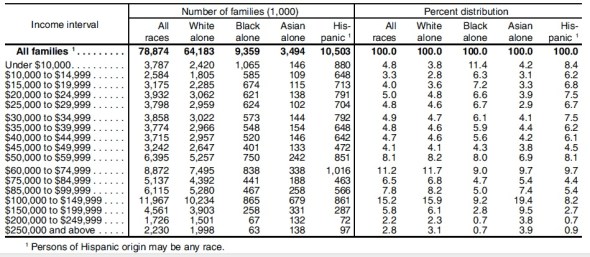
Here’s a slightly broader view of income distribution from the same source.
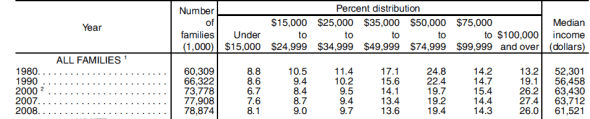
You can see that about 74% of US families don’t even clear $100,000 annually given the median income is $61,521. That’s a skewed distribution if there ever was one. I think the skewed distributions leads to some pretty skewed perspectives too.
I’m reminded of this little news item from one of my state’s Congressman whose math was fuzzy and priorities reflect that of some one whose not worried about the normal things in life. I’m still trying to figure out exactly what he pays the employees at his Subway Shops in Northwest Louisiana given the numbers he provides. As best I can figure, it’s about $12,000 a year. If he feels so put out and poor with an annual income of $400,000 a year that I wonder whatever do his charitable contributions look like?
Taking up the typical GOP talking point, Fleming said raising taxes on wealthy “job creators” is a terrible idea that kills jobs because many of these people are small business owners who pay taxes through personal income rates. Fleming is himself a businesses owner, so Jansing asked, “If you have to pay more in taxes, you would get rid of some of those employees?” Fleming responded by saying that while his businesses made $6.3 million last year, after you “pay 500 employees, you pay rent, you pay equipment, and food,” his profits “a mere fraction of that” — “by the time I feed my family, I have maybe $400,000 left over.”
All of this puts me in mind of F Scott Fitzgerald who was the chronicler of the wealthy point of view during the Gilded Age.
Let me tell you about the very rich. They are different from you and me. They possess and enjoy early, and it does something to them, makes them soft where we are hard, and cynical where we are trustful, in a way that, unless you were born rich, it is very difficult to understand. They think, deep in their hearts, that they are better than we are because we had to discover the compensations and refuges of life for ourselves. Even when they enter deep into our world or sink below us, they still think that they are better than we are. They are different.
F. SCOTT FITZGERALD writes in “The Rich Boy” in 1926
This is the stuff that makes Elizabeth Warren’s video on the stump the other day go viral. This isn’t class warfare. I don’t think there’s an awful lot of people that truly begrudge folks their wealth. Speaking only for myself, I don’t want to have my sense of perspective or priorities that warped any more and am happy when ends meet. I think people only want to feel like they have a decent living and that people that have more than that should pull their own weight and not make these weirdish justifications for wealth that most folks just plain don’t get. Back to the article by the poor little rich boy.
Taxes on the rich are taxes on people who create jobs. And jobs are an unalloyed good thing for an economy. Excessively taxing the capital that makes the economy go is poor public policy. And we have a recent example of how the opposite works well: Unemployment declined by a third in the four years after the Bush tax cuts were fully implemented in 2003, dropping to 4.2 percent from 6.2 percent. Meanwhile, federal revenue increased 44 percent in those years. If these tax cuts put people to work and generated money for the government, shouldn’t Obama consider the possibility that tax increases should be avoided?
Most of this analysis is incredibly disingenuous because it fails to mention that the country was coming out of a recession and a severe macro shock from 9/11. It wasn’t the fiscal policies that did these things at all. Plus, these were the early warning signs of Allan Greenspan blowing a housing bubble and a construction and financing boom about to crash the economy. Economists don’t like to see the rate of unemployment fall significantly below its natural rate. It means the government is doing WAY too much and will probably create some kind of inflation and the economic activity won’t be sustainable. All that war and anti terrorism spending overheated the economy.
The argument of capital gains cuts = job creations is the core argument here that I will never understand from a simple common sense view. That doesn’t even count all that book learning views from the degrees and the doctorate in Financial Economics that sets off alarms in my brain. These were tax cuts that subsidized excessive speculation. The argument that values hoarded wealth over hard work and says that all that money floating around financial markets does is create jobs is a false one.
The deal is this. It’s one thing to put your money into a business like a small or medium sized business owner does but that money is counted as regular income. That is job creating but it has nothing to do with capital gains taxes. Second, if you do buy stock in GE and you put in there for years on end and others do the same then, yes, that’s basically a good source of funding for a business and that resembles business ownership albeit a very detached one. Possibly, you could reward the buy and hold investor but a huge amount of market activity is not buy and hold unless you’re an institution. Also, why does putting your money in a bank and collecting interest– because bank deposits get pooled and loaned to businesses–not get the same treatment? My thought is that it’s because it’s the middle class way of holding wealth and the view is that it is inferior income like wages and salaries. Interest income gets taxed like work income. But, AND MOST OF ALL, how are day traders who bop in and out of investments daily, speculating away on stuff, buying exotic derivatives that have nothing to do with the underlying business create jobs, value or anything else worthy of the label job creators and why do they deserve special tax treatment? Are you prepared to tell me that this form of speculation creates more jobs than say, the gambling casinos on the strip in Las Vegas? At least we can point to cocktail waitresses, bartenders and dealers in Las Vegas style gambling.
A lot of money income that comes from capital gains is just another form of gambling income. It isn’t there long enough to encourage businesses to make long term decisions that would actually help the economy. The only thing it really does is make CEOs short-sighted by forcing them to focus on short term stock prices so they invariably don’t invest in positive net present value projects which means no attendant jobs. That’s what the research says. So, Gordon’s thinking is as fuzzy as gee, since I only get $400,000 a year, I guess I’ll just have to get rid of a few people that are doing the work for me that I pay only $12,000 a year. The “bringing liquidity to the market” isn’t really a great rationalization here either because the wham bam thank you approach of speculators these days doesn’t offset the increased risk and price volatility they bring to markets. They screw up the pricing mechanism when they do all that momentum trading. Recent gas prices and house prices are good examples of speculation gone wild. Also, riddle me this. What value do hedge fund managers bring to the table when they bet against US businesses and the US government? Why do they get special tax treatment for that? What jobs does that create? I’m not reading specifics on those things at all in Gordon’s blessed are the millionaires for they are the job creators spiel. Why subsidize this behavior and these extraordinarily rich people?
So, I’m not in any way shape or form saying that millionaires are bad or evil or whatever the nasty implications are that underlie the class war charge. What I’m saying is that there’s a difference in your perspective when you’ve got hungry kids than some one is whining they can’t make it on $400,000 a year. I don’t think we need articles lecturing us on the proper perspective we should take on millionaires. I think a few millionaires need to develop a different perspective on reality and life and quit whining when some one asks them to pay for the roads they drive on, support the schools they attended, pay for the protection provided by soldiers, cops, and firefighters, and basically pull their fair share of the load of living in a civilized society.
Markets (e.g. Herds of PEOPLE) aren’t very Rational a Lot of the Time
Posted: September 24, 2011 Filed under: Economy, Equity Markets | Tags: behavioral economics, behavioral finance, rational markets 7 Comments
The Confidence Fairy is coming for your Savings!!!
One of the primary reasons I didn’t do an investments specialization for my PHD in financial economics is the overwhelming and pervasive group think on Rational Expectations or what’s called the Efficient Market Hypothesis. I’ve never really bought into this. I think it is more an occasional circumstance or specific market behavior at that point when everything is going just dandy which is why I am more the sunspot equilibrium type. I never found compelling reasons for the efficient markets view to be considered an overarching framework for all circumstances. That kind of unorthodox outlook doesn’t buy you much print space in finance journals which means no tenure for you cupcake!! (Although for some reason I can get it passed reviewers when it’s couched in the term “bubble” which is so very sunspot.)
Economists have become a little more accepting of the warts and faults inherent in the hypothesis–notice it is still a hypothesis and not a theory–but finance people still have a tendency to worship at its alter. Economists started out as philosopher social scientists–which is also why the big money is in finance–so they’re a little more open to the idea that markets aren’t all that efficient all the time. I linked to the Wikipedia explanation of the idea for you which is adequate for our purposes. The deal is when you build rational expectations into an economics model or investment model this is what you assume.
To assume rational expectations is to assume that agents‘ expectations may be individually wrong, but are correct on average. In other words, although the future is not fully predictable, agents’ expectations are assumed not to be systematically biased and use all relevant information in forming expectations of economic variables.
This basically rules out wrong group think that won’t deny “relevant information”. If that was the case in reality, there would be no holocaust deniers, evolution deniers, climate change deniers, or flat earthers of substantial numbers to influence the average. Basically, we’d have to accept the “average” rationality of today’s Republican Party and given the existence, electability and popularity of Rick Santorum, Michelle Bachmann, and Ron Paul, I’ll rest my case and reject that. We have a major political party that’s basically a cult of irrationality these days.
There are two really important real life phenomenon that make that assumption look really bad in finance research. One is a little paradox called the Home Bias Puzzle where research has basically shown that most people will still buy investments from their own country despite the availability of better deals abroad. The second is momentum. This is the pack animal behavior in the market where you see something hit the market and suddenly every one is moving that direction when it doesn’t make much sense on a fundamentals level. This is when I sell all my stock holdings. The little voice inside of me will go: “wtf is this rally for? The economy isn’t all that great! I think I better get out of here before they realize they’re all on something!” This is how I’ve managed to remove my “ass”ets and avoid the major crashes since way back in the 1980s.
Whenever you get a financial crises or financial bubbles, you tend to get the panicked cow phenomenon in that if one is spooked the rest chase wildly along. They’ve even programed this behavior into their computers oddly enough. Oh, and btw, none of the strategies and no market guru like Cramer or Buffet or Jesus your neighborhood grocer could ever be right and beat the market consistently if the financial markets were truly rational and efficient. That’s another story, just accept my word for it right now.
I took an Advanced Investments Seminar because I had to for my final elective having no other choice and was subjected the entire semester to the work of Eugene Fama whose big fat head will be in Denver with me next month. Fama is considered the father of modern finance and efficient markets is his dogma. He’s one of the jerks that was drinking the two overly expensive bottles of wine with Paul Ryan that BB wrote about awhile back. The other jerk being his son in law John Cochrane whose asset pricing models always assume the same efficient markets hypothesis. The two of them have dominated finance for decades now and in my mind it’s held the entire field back and caused much damage in the real world. I had to recreate the research in many of Fama’s seminal papers and the most noticeable lunacy to me was how his data sets back then always skipped the Great Depression Era. His data sets usually involved equity market indices like the Dow Jones average during periods that excluded financial panics. That never struck me as honest, but then, I’m not one of the Finance gods–there really are no goddesses–and so I don’t really get a say.
Again, I don’t want to teach this stuff so I generally avoid classes where the textbooks ooze it. I inherited the sincerity gene from my father which causes me to go apostate on my students which may help their critical thinking skills but won’t further the ass-kissing group think skills required in today’s finance jobs. Also, I’m late to academic life and spent the 80s doing hedging, forecasting interest rates, pricing financial assets and liabilities, and generally surrounded by rational senior management thoughts like: “Gee, we’ll get bigger if we do this merger and I’ll get a bonus! Who cares if it drags our income and balance sheet into the depths of hell?” I can also give you examples from the 90s too. Irrational market decisions ooze from marketing divisions and departments daily.
So, behavioral finance and economics looks at the herd mentality that was originally identified as “animal spirits” by J.M. Keynes during the time period and stock market behavior that Eugene Fama likes to systematically ignore. Keynes didn’t have the luxury of skipping over the data of the Great Depression. The kind of apostate philosophy that drives me actually has a label and basically looks at decision making under risky and generally unpredictable situations. In a lot of cases, people don’t make decisions in these circumstances rationally. BB and I have been having some phone conversations about the topic because as a psychologist, she’s very interested in human behavior. Human behavior very much causes people to do different things under times of risk. Let’s face it, people and hence markets aren’t very rational a lot of the time when they’re panicked about losing their jobs, their businesses, their homes, and their savings. They’re a lot more efficient, rational decision makers when circumstances are not risky and unpredictable or when the biggest decision variables are messy and not well understood. Then, there’s the existence of powerful “deciders” who think their egos have a better understanding of alchemy than their necromancers and are on the look out for narratives to reinforce their beliefs. Remember the word narrative because it plays a big role here in where I’m going and where Robert J. Shiller went.
So, this background chat brings me to the topic of this blog post which is a project syndicate article by Robert J. Shiller who is a very well respected economist and dabbles in behavioral economics. He is well known for the Case-Shiller index which measures activity in the housing market in some key markets. (BTW, Case is a big sunspot equilibrium sort as is Douglas Diamond who the Republicans ran out of the District earlier this year.) I’ve taught out of his textbooks. He teaches at Yale and co-authored a book with Nobel Prize winning George “market for lemons” Akerlof called “Animal Spirits: How Human Psychology Drives the Economy and Why It Matters for Global Capitalism.”. His voice is important in this day and age of people chasing confidence fairies and reacting to events here and in Europe rather irrationally which frequently happens during periods of great uncertainty and increased risk.
I’m consistently amazed at the success of the narrative that Republicans have managed to push into the national psyche that we’re over taxed and that our national debt is horrendous as its never been before and that our children and grand children will be crushed by it. You even hear President Obama spew the stuff and he should know better given his ability to access any of the aforementioned economists by phone easily. As I’ve said before with the use of data and nifty graphs, the debt was far worse after World War 2, the tax rates far higher and none of us or the US economy was the worse for it. Really, would you have rather they not borrowed money to fight World War 2 and lived with those results instead? We had nothing but debt when started out as a country and also after the Civil War. As long as you have lots of really high quality assets and people and the power to tax and print money, it’s NO BIG DEAL! Greece does not have Bill Gates and Microsoft continually pumping out huge amounts of value. We have him and lots more like them! People have been reacting to ideological nonsense and narratives. We have a failure of governance and policy because of this. That’s hardly rational. It’s also causing bad effects in our home prices, the value of our savings, and our ability get and keep jobs.
So, here’s Shiller writing on “The Great Debt Scare” about how this ideological nonsense has shaken consumer confidence in both Europe and the U.S. causing a “perverse dynamic” that has been discouraging consumption and investment which has brought about economic weakness. What this basically shows is that the psychology of self-fulfilling prophecies is alive and well in financial markets. Rational Markets my swamp people ass!
We now have a daily index for the US, the Gallup Economic Confidence Index, so we can pinpoint changes in confidence over time. The Gallup Index dropped sharply between the first week of July and the first week of August – the period when US political leaders worried everyone that they would be unable to raise the federal government’s debt ceiling and prevent the US from defaulting on August 2. The story played out in the news media every day. August 2 came and went, with no default, but, three days later, a Friday, Standard & Poor’s lowered its rating on long-term US debt from AAA to AA+. The following Monday, the S&P 500 dropped almost 7%.
Apparently, the specter of government deadlock causing a humiliating default suddenly made the US resemble the European countries that really are teetering on the brink. Europe’s story became America’s story.
There is something—most likely hard wired–in people that creates highly irrational narratives ( we call them frames) to justify stuff that occurs even in the face of incredible evidence against the frame. It’s why there are so many evolution and climate change deniers. The narrative makes them feel better than the reality. We all edit out the data coming from those periods of intense irrationality–like Fama did with the Great Depression–to justify our pet juicy rationalizations. It’s like the post-trauma narrative you create to justify something you did when your lizard brain kicked in. Republican and so called conservative operatives seem to thrive on spinning lizard brain activity into parable like narratives to hone their advantage.
Changes in public confidence are built upon such narratives, because the human mind is very receptive to them, particularly human-interest stories. The story of a possible US default is resonant in precisely this way, implicating as it does America’s sense of pride, fragile world dominance, and political upheavals.
Indeed, this is arguably a more captivating story than was the most intense moment of the financial crisis, in 2008, when Lehman Brothers collapsed. The drop in the Gallup Economic Confidence Index was sharper in July 2011 than it was in 2008, although the index has not yet fallen to a lower level than it reached then.
So, what do these current confidence surveys tell us according to Shiller?
The timing and substance of these consumer-survey results suggest that our fundamental outlook about the economy, at the level of the average person, is closely bound up with stories of excessive borrowing, loss of governmental and personal responsibility, and a sense that matters are beyond control. That kind of loss of confidence may well last for years.
That said, the economic outlook can never be fully analyzed with conventional statistical models, for it may hinge on something that such models do not include: our finding some way to replace one narrative – currently a tale of out-of-control debt – with a more inspiring story.
So after our lizard brain causes fight or flight, the Captain Picard part of our brain tells us to make our narratives so. What we are building into our psyche is not any kind of analysis based on rational views of historical data, economic theory, or for that matter, common sense. What we are building into our psyche is a narrative that isn’t very rational and that’s impacting our behavior and the behavior of markets. Now, if we could just stop the press from reinforcing all the irrational crap out and about these days maybe we could sit down, take a few deep breaths, and peel back the layers of skin on the onion of those destructive narratives. Think about it. Yes, the Garden of Eden story is a great narrative, but what explains the carbon dating data on rocks, the dinosaur bones, and the vast existence of several varieties of protohumans’ remains better? Dinosaurs and Neanderthals in the Garden of Eden with Adam and Eve (not Steve or Lilith) or the Big Bang THEORY and the THEORY of evolution? What explains the financial crisis and the fallout better? The narrative that it’s too much government debt, too high taxes, and too much regulation that were all at much lower levels now than after the World War 2 economic boom or excessive speculation in the markets and exotic, difficult to price, unregulated derivatives, NINJA loans, government encouragement of monopoly and oligopoly power, and fiscal policy known to suppress economic growth? Your choice. Theory or comforting bed time tale.

 peej
peej Carissa
 bostonboomer
 dakinikat
 ecocatwoman
 jjlo
jjlo mablue2
 Mama Lopez
 peggysue22
 quixote
 skydancingguestblogger
 Mona (aka Wonk the Vote)





Recent Comments