
Toxic Journalism
Posted: October 30, 2011 Filed under: Social Security, The Media SUCKS, the villagers | Tags: hack, Journalistic HACKS, Lori Montgomer, Lori Montgomery 13 CommentsI really could write a very long essay on all the things that are wrong with Lori Montgomery’s WAPO “article” on Social Security. Problem is, I’m trying to get published in a peer-reviewed journal right now and actually have to respond to questions about my methodology and data so I don’t have time to do it. Plus, I don’t really have to peel apart a lot of the  economic falsehoods because Dean Baker has done a really great job at his blog over at CEPR. I actually bumped into this bit of yellow journalism earlier today via a Paul Krugman tweet. It seems to promote every right wing meme, canard and lie about Social Security but for some reason it didn’t end up on the Op-Ed page. It was out there on the front page. Bad WAPO! Very VERY BAD WAPO!
BB and I had a conversation about it over the phone after both of us spent a considerable amount of time trying to figure out exactly what qualified Lori Montgomery for rigorous economic analysis. Actually, BB even wrote her an email. I’m going to post her response to BB because it was kind’ve appalling all on its own given all BB asked was for some idea of how many classes the woman had actually had in finance or economics. Evidently, WAPO thinks you don’t need to know a damn thing to write a huge front page article. Hopefully, no senior citizens leave for the Alaskan ice floes after reading it. Also, hopefully no miserable millennium yuppie sent their grandparents to the floes either. Maybe we should call Montgomery’s parents and see if they’ve committed ritual suicide yet. Here’s her response to BB’s request for her academic background.
I am a journalist, not an economist. If you view dean baker as the voice of
god, then I’m afraid we’re not going to get very far.
My article is as accurate and as objective as I could make it. Perhaps you’d
like to point out some of these blatant falsehoods so I can respond to them
directly.
Alrighty then … let me just quote the first paragraph, then I’ll put a question to you.
Last year, as a debate over the runaway national debt gathered steam in Washington, Social Security passed a treacherous milestone. It went “cash negative.”
So, the question is this: is “treacherous milestone” perhaps the most concrete example of purple prose you’ve ever seen or is it just me? Or, do you agree with Lori, that “treacherous” is just one of those words people pull out of their asses when they are trying to be ” as accurate and as objective” as possible?
Now, let me quote economist Dean Baker on that particular paragraph too. Let me just mention this is about a 2700 word article and we’ve only hit the first few sentences. It’s so bad I feel like I should do about 10 installments. That would be eight on the bad economics and two on the bad journalism. Well, maybe tomorrow.
The basic premise of the story, as expressed in the headline (“the debt fallout: how Social Security went ‘cash negative’ earlier than expected”) and the first paragraph (“Last year, as a debate over the runaway national debt gathered steam in Washington, Social Security passed a treacherous milestone. It went ‘cash negative.'”) is that Social Security faces some sort of crisis because it is paying out more in benefits than it collects in taxes. [The “runaway national debt” is also a Washington Post invention. The deficits have soared in recent years because of the economic downturn following the collapse of the housing bubble. No responsible newspaper would discuss this as problem of the budget as opposed to a problem with a horribly underemployed economy.]
This “treacherous milestone” is entirely the Post’s invention, it has absolutely nothing to do with the law that governs Social Security benefit payments. Under the law, as long as their is money in the trust fund, then Social Security is able to pay full benefits. There is literally no other possible interpretation of the law.
As the article notes the trust fund currently holds $2.6 trillion in government bonds, so it is nowhere close to being unable to pay benefits. The whole point of building up the trust fund was to help cover costs at a future date when taxes would not be sufficient to cover full benefits. Rather than posing any sort of crisis, this is exactly what had been planned when Congress last made major changes to the program in 1983 based on the recommendations of the Greenspan commission.
The article makes great efforts to confuse readers about the status of the trust fund.
Here’s another economist–Richard Eskow–with a similar take.
How can a 2,363 word piece in on Social Securitybe so densely packed with inaccuracies, falsehoods, and downright lies?
It almost takes a cryptographer to unpack the deceptions contain in an article published Saturday with the headline, “The debt fallout: How Social Security went ‘cash negative’ earlier than expected.”
The piece’s author sits us down by the campfire, holds the flashlight up to her chin, and spins a yarn filled with quotes from right-wing ideologues from both parties. Most of her “sources” have a long history of trying to gut Social Security, often under the employ of billionaire former Nixon Cabinet member Pete Peterson (whose own organization, Fiscal Times, provides financial journalism services for thePost. Coincidence? You decide.)
How many quotes are included from the organizations and groups defending Social Security? None.
I’ve actually read most of the feedback on the article from the major economic blogs and I’d say that Ms. Montgomery should definitely rethink her career as a reporter on the economy–which as far as I can tell she’s only done for a few years–and should possibly go back to writing obits in Texas or Michigan or where ever else she did her work. She wouldn’t even let BB know where she got her degrees and in what, remember? I’m thinking it must be the Judith Miller School of Journalism of Koch Brothers University, inc. Just a guess.
So, I’m not going to dissect that horrible article. I’ll only tell you that it contradicts all the research I’ve ever done on the subject including the series of posts I did about a year or so ago. It basically contradicts all the literature I’ve ever seen on the topic too unless you count junk stuff that’s come out of Koch Brother’s wholly owned subsidiary institutes and junk scientists. Frankly, I kind’ve agree with Eskow and think we should call it a Halloween prank gone bad and ignore it.
However, go read some of the stuff and if you have any questions, I’ll be glad to actually do some research for you or to check earlier sources I did for my research. Or, perhaps just answer it since I spent all these years getting a doctorate in financial economics so I could teach people about this stuff and actually do real research.
Meanwhile, I’ll close with Brad DeLong’s long standing tag line: “Why-oh-why can’t we have a better press?”
I hate to say this, but I’d like to know how she got that job in the first place. Let’s just say inquiring minds are suspicious.
Happiness is one year of Sky Dancing Blog
Posted: October 30, 2011 Filed under: Festivities | Tags: Sky Dancing Blog 26 Comments One year ago, I began the process of turning my file cabinet into a functioning blog where people could come to discuss a variety of issues in a positive environment. I
  remember how in 2008 the blogosphere turned toxic for Hillary supporters. It took some searching to find safe havens where the name calling was kept to a minimum, the implied misogyny was fully understood, and the company of like minds was appreciated. But, as in the nature of life, things change. Pretty soon, some of the same goosestepping cult of personality type things that chased me off of other blogs left me feeling out of sorts again in blogs that had once been safe havens. I don’t know about you, but I blog and visit blogs for a variety of reasons. I can guarantee you that refereeing pie fights is not one of them. I do not like spectating or fighting them either. I can attend a family reunion or a department meeting for that sort of thing if I thrived on the stress and chaos.
It’s been surprisingly peaceful here at sky dancing as we’ve picked up both readership and other bloggers who are like minded. We seek information; not diatribes and lectures. We seek the ability to share that information in a constructive way that values strong voices and opinions that don’t also require belittling other people in the process of being heard.
I was absolutely sure-at first–that I had just sent myself to blog Siberia one year ago. Instead, the community of people that I have come to admire and care about over the past three or so years keep coming here, throwing logs on the warm fireplace, refilling the kettle on the hearth, and bringing cups of warm, heady stuff to share. For that, I am happy, appreciative, and humbled beyond words. I can point to our Alexa numbers or our Technorati rating–we continue to stay in the top 100 US political blogs— for verification that we are not alone in this and we are doing something right. But, I’d rather point out that a bad day is usually when one fetus fetishists shows up in pending to tell us we should be more in awe of a clump of cells and its importance over our lives or there’s about 20 spambot ads captured in the filter. We dump them all into trash immediately. Usually, only the spambots persist. A good day is when we have a great wonk post on Hillary and we can all come and share in our awe, or a fascinating BB people piece or a barnburning minx diatribe on how our rights are disappearing even as we type our dissent. I can put down my work, pick up a cup of coffee and read the caring voices of our community and think, wow, I’m not the only one!
There are a number of people that really do keep this blog moving. The admin team is amazing. I often wonder what we could do if I had some venture capital and a board of directors with Boston Boomer, Minkoff Minx, and Wonk the Vote sitting there daily. We have some great frontpagers too in various stages of active and process. Then, there’s every one down page that continues to add links and comments and shared experience. I learn something new every day here.
So, it takes a village to raise a blog and we have one great village.
So, besides wishing us all a happy one day birthday where we’ve gone from crawling to standing to walking, I have to also ask for some help. First, please promise me that you’ll visit us daily and add your voice because that’s important. Second, if you can help with the annual bills, please click on the paypal button on the right. We tried the ad thing and that didn’t work so well, so in order to keep the buttons and whistles–like the current design and format–we need a few bucks! The little reminder at the top of the dashboard says the custom formatting will be the first to expire at the end of Novemeber. I believe the domain name will go at about the same time. So, if you have some change, we’d appreciate it so we can keep on keeping on.
Then, sit back and relax as we begin year number two together!!!
Confronting the Austerity Agenda
Posted: October 28, 2011 Filed under: Economy, Foreign Affairs, Iceland | Tags: austerity, banking crises, economics, iceland 13 Comments Paul Krugman takes on the idea that after we bail out economically destructive banks, we all have to pay with downsized lives and a bad economy in his NYT column today. He continues to fight the idea that austerity–not prosperity–will bring back confidence and the economy. He’s right that the austerity hawks push a ridiculous assertion that denies past history as well as logic.
The doctrine in question amounts to the assertion that, in the aftermath of a financial crisis, banks must be bailed out but the general public must pay the price. So a crisis brought on by deregulation becomes a reason to move even further to the right; a time of mass unemployment, instead of spurring public efforts to create jobs, becomes an era of austerity, in which government spending and social programs are slashed.
This doctrine was sold both with claims that there was no alternative — that both bailouts and spending cuts were necessary to satisfy financial markets — and with claims that fiscal austerity would actually create jobs. The idea was that spending cuts would make consumers and businesses more confident. And this confidence would supposedly stimulate private spending, more than offsetting the depressing effects of government cutbacks.
Some economists weren’t convinced. One caustic critic referred to claims about the expansionary effects of austerity as amounting to belief in the “confidence fairy.” O.K., that was me.
But the doctrine has, nonetheless, been extremely influential. Expansionary austerity, in particular, has been championed both by Republicans in Congress and by the European Central Bank, which last year urged all European governments — not just those in fiscal distress — to engage in “fiscal consolidation.”
And when David Cameron became Britain’s prime minster last year, he immediately embarked on a program of spending cuts in the belief that this would actually boost the economy — a decision that was greeted with fawning praise by many American pundits.
Now, however, the results are in, and the picture isn’t pretty
Example one: The economy of Greece. It has been pushed into an even bigger slump. Example two: The economy of the UK. Austerity has stalled its economy and the confidence fairy is no where to be seen. Example three: Iceland. They did the exact opposite and they’re none the worse for wear. So, which example are we following? Well, it’s not Iceland.
Krugman, Icelanders, and the IMF are taking stock of the Iceland experience this week in a conference. You can read many articles at the IMF on how Iceland is recovering from its 2008 economic catastrophe. You can watch a video explaining what went on there with Dr. Joseph Stiglitz below.
Today, three years later, it is worth reflecting on how far Iceland―a country of just 320,000 people―has come since those dark days back in 2008. Growth has returned to the economy, and new jobs are being created: unemployment, although still unacceptably high for a country used to near-full employment, has dropped below 7 percent of the work force. In June this year, the government successfully issued a $1 billion sovereign bond, marking a return to international financial markets.
And while public debt, currently at around 100 percent of GDP, is much higher than before the crisis, an impressive consolidation program has put the country’s finances back on a sustainable path during the past couple of years. As for the banks, they have been shrunk to about 200 percent of GDP, and are now fully recapitalized.
So, how did they do it? Did they embrace austerity for their citizens after rescuing and enriching their errant banking/financier class?
- First, a team of lawyers was put to work to ensure that losses in the banks were not absorbed by the public sector. In the end, the public sector did of course have to step in and ensure the new banks had adequate capital, but it was insulated from vast private sector losses. This was a major achievement.
- Second, the initial focus of the program was exclusively on stabilizing the exchange rate. Here, we reached for unconventional measures, notably capital controls.
- Third, automatic stabilizers were allowed to operate in full during the first year of the program—effectively delaying fiscal adjustment. This helped support the economy at a time of severe strain.
- Fourth, conditionality was streamlined and focused on the key issue at hand—rebuilding the financial sector. While there are some issues in the broader economy where reforms will eventually be needed, these were not a part of the program.
Wow. Just Wow.
Posted: October 27, 2011 Filed under: Foreign Affairs, Hillary Clinton, Women's Rights 41 Comments
A national poll conducted for TIME on Oct. 9 and 10 found that if Clinton were the Democratic nominee for President in 2012, she would best Mitt Romney 55% to 38%, Rick Perry 58% to 32% and Herman Cain 56% to 34% among likely voters in a general election. The same poll found that President Obama would edge Romney by just 46% to 43%, Perry by 50% to 38% and Cain by 49% to 37% among likely voters.
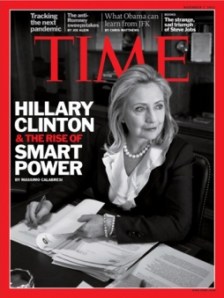 This weeks’ Time Magazine features Secretary of State Hillary Clinton. It has interviews and some great Diana Walker Photos. The interview is on the idea of “smart power” which may become known as the Clinton Doctrine.
Hillary Clinton argues in our cover story this week, now available online to subscribers, that America is not so much in decline as adjusting to a world of increasingly diffuse power, where like-minded networked individuals, non-governmental organizations and other non-traditional global actors may steer events as much as great power capitals. Clinton lays out “smart power” strategies for protecting and advancing U.S. interests in that new non-polar world.
We argue that Clinton is something of an expert at coming up with strategies for maximizing limited power given her life experiences, including being a First Lady with high visibility but little official swat, and a Secretary of State in the administration of her former rival, President Obama, who makes the final call on most major foreign policy and national security decisions with a small group of aides at the White House—and without Clinton.
The story is told largely through the lens of the very limited war in Libya, which is in many ways Clinton’s war, thanks to her efforts lining up the Arab and European coalitions that fought it. We have some good reporting on her trip there last week, as well as on the internal and external challenges she faced in advancing the cause of intervention. We also lay out the ways in which Libya remains dangerously unpredictable, and underscore areas where her new strategies are more talk than action.
Lastly, we polled her against Romney and Perry, and found that she does better, by far, than Obama, leading Romney by 17 points and Perry by 26*. Her closest aides strongly dismiss any 2012 ambitions and say 2016 is very unlikely: she’d be 69 the day of the vote that year. We don’t speculate on the source of her popularity.
Thursday Reads
Posted: October 27, 2011 Filed under: #Occupy and We are the 99 percent!, Catfood Commission, Super Committee | Tags: derivatives, Dodd Frank, Euro, Euro Debt Crisis, Herman Cain, Right Wing Lies, Super Committee, Tax Dodging, Volcker Rule, Wall Street 27 Comments Good Morning!
It’s amazing what kind of nonsense the right wing can come up with when their interests and myths are threatened. Here’s the latest Faux News canard about Occupy. It’s an ACORN plot! If any one believes that, I have a few bridges across the Mississippi I’d like to sell them. The Crescent City Connection even comes with tolls!!
How can a group that folded 19 months ago secretly conspire to bolster Occupy protests? Apparently, “sources tell” Fox News that people who used to work for ACORN have now taken on roles helping organize Occupy protests. In fact, Fox News reports that the former director of New York ACORN and his aides are now working for New York Communities for Change (NYCC), which is turn supporting demonstrations.
I’m not sure why this would be especially interesting if true — if folks who used to be involved with one group then started playing a role with another, who cares? — but as it turns out, a spokesperson for Occupy Wall Street said the NYCC isn’t playing a role in the protests anyway. But don’t worry, Fox News’ unnamed “source” said the group really is up to secret misdeeds, adding, “And yes, we’re still ACORN, there is a still a national ACORN.”
It’s safe to assume that Fox News has reliable contacts among progressive activist organizations, right? There’s bound to be plenty of former ACORN staffers and Occupy activists eager to dish to the Republicans’ cable news outlet, right?
Please. It’s really no wonder at all why Fox News’ audience ends up believing so much nonsense.
They do believe the nonsense, which makes Fox News watchers very dangerous in the voting booth.
Dems on the Super Committee are offering up Medicaid and other ‘entitlements’ in order to get tax increases from Republicans. It didn’t work, but you have to wonder exactly what all they’re willing to put on the table.
Republicans have pressured supercommittee members to reject any deficit-reduction deal that raises taxes — including stimulus spending for the economy would almost certainly be a non-starter for most in the party.
Democrats have said from the beginning that the supercommittee should produce a “jobs plan” that includes “investments” to help the economy.
The supercommittee is charged with devising a plan that will cut at least $1.2 trillion over 10 years from annual deficits, but deep divisions exist on the panel over whether to raise taxes and cut entitlements to meet that goal.
The members met again Wednesday afternoon and Democrats were looking to see if the GOP would present an alternative path to the grand bargain.
You may recall that the grand bargain was the giveaway President Obama offered to Boehner last summer during the debt ceiling talks. More details are available at this WAPO link.
The panel has floundered since meetings began in September. If the supercommittee fails to reach agreement to trim borrowing by at least $1.2 trillion through 2021, automatic spending cuts of an equal amount would be triggered in January 2013. These cuts would strike especially hard at the Pentagon, an outcome that Republicans are eager to avoid.
Ralph B posted this tidbit downthread last night. Chelsea Clinton is said to be considering a congressional run.
Clinton has been approached by “the right people” in the New York Democratic Party, according to one source in Albany. While no decision has been made, Clinton is said to be “actively considering” a Congressional run from New York State in 2012.
Chelsea Clinton, 31, is the only child of former U.S. President Bill Clinton and U.S. Secretary of State Hillary Rodham Clinton.
The discussions of running Chelsea Clinton for a house seat grew out of the redistricting plans currently underway in the New York State legislature in Albany.
The plan is to identify an open seat for Clinton in or around New York City where she currently resides with her husband, Marc Mezvinsky. While no specific district has been determined, New York City and Westchester are said to be the focus with New York’s 18th District considered a strong possibility. The 18th encompasses much of Westchester County, just south of where her parents have maintained a home for the past 12 years.
The Daily Beast reports that Herman Cain was delinquent in paying taxes in 2006. Additionally, he fought paying the bill.
According to court documents obtained by The Beast, Cain and his wife, Gloria, were served in February 2008 with a tax lien totaling $8,558.46 for unpaid income taxes and penalty due for the 2006 calendar year.
Gordon said Cain had filed with the IRS and won a six-month reprieve in paying his 2006 federal taxes as he was undergoing his treatment for stage four lymphoma and believed that filing should also have bought him time with the state of Georgia. “In Georgia, a taxpayer can submit a copy of his federal extension to request an extension of state income taxes,” Gordon said.
But instead, the state sent a notice of overdue taxes in October 2007, and then proceeded with the tax lien four months later, he said.
Cain’s accountant fought the Georgia Department of Revenue on behalf of his client well into 2008 and the two sides finally settled the matter in November 2008. A court formally withdrew the state tax lien on Dec. 8, 2008, court records show.
Gordon said the campaign was researching the exact date on which Cain made the payment to extinguish the lien
Robert Reich thinks that Wall Street is still out of control.
Dodd-Frank is rife with so many loopholes and exemptions that the largest Wall Street banks – larger by far then they were before the bailout – are back to many of their old tricks.
It’s impossible to know, for example, the exposure of the Street to European banks in danger of going under. To stay afloat, Europe’s banks will be forced to sell mountains of assets – among them, derivatives originating on the Street – and may have to reneg on or delay some repayments on loans from Wall Street banks.
The Street says it’s not worried because these assets are insured. But remember AIG? The fact Morgan Stanley and other big U.S. banks are taking a beating in the market suggests investors don’t believe the Street. This itself proves financial reform hasn’t gone far enough.
If you want more evidence, consider the fancy footwork by Bank of America in recent days. Hit by a credit downgrade last month, BofA just moved its riskiest derivatives from its Merrill Lynch unit to a retail subsidiary flush with insured deposits. That unit has a higher credit rating because the Federal Deposit Insurance Corporation (that is, you and me and other taxpayers) are backing the deposits. Result: BofA improves its bottom line at the expense of American taxpayers.
Wasn’t this supposed to be illegal? Keeping risky assets away from insured deposits had been a key principle of U.S. regulation for decades before the repeal of Glass-Steagall.
The so-called “Volcker rule” was supposed to remedy that. But under pressure of Wall Street’s lobbyists, the rule – as officially proposed last week – has morphed into almost 300 pages of regulatory mumbo-jumbo, riddled with exemptions and loopholes.
It would have been far simpler simply to ban proprietary trading from the jump. Why should banks ever be permitted to use peoples’ bank deposits – insured by the federal government – to place risky bets on the banks’ own behalf? Bring back Glass-Steagall.
The MSCI Asia Pacific Index gained 0.9 percent to 120.25 as of 11 a.m. in Tokyo, set for the highest close since Sept. 9. Standard & Poor’s 500 Index futures added 0.8 percent. The 17- nation euro climbed 0.5 percent to $1.3979 and rose 0.3 percent to 106.26 yen. Treasury 10-year notes erased earlier gains. Copper, zinc and lead jumped more than 1.4 percent in London and crude climbed 1.9 percent in New York.
French President Nicolas Sarkozy said the euro region’s bailout fund will be leveraged by four to five times, and investors have agreed to a voluntary writedown of 50 percent on Greek debt. Sarkozy plans to call Chinese leader Hu Jintao today to discuss contributions from the Asian nation to a fund European leaders may set up to fight the crisis, a person familiar with the matter said.
The news of a deal is “certainly mildly positive news for markets,” Adarsh Sinha, head of strategy for Group of 10 foreign exchange at Bank of America, said in a Bloomberg Television interview in Hong Kong. “We have got a plan out but a lot of the details aren’t in place.”
CNN announced the details late last night.
French President Nicolas Sarkozy said Greek bondholders voluntarily agreed to write down the value of Greek bonds by 50%, which translates to €100 billion and will reduce the nation’s debt load to 120% from 150%.
Sarkozy said the leaders agreed to boost the firepower of the EU bailout fund, known as the European Financial Stability Facility, “by four or five fold.” He added that officials have negotiated additional funding from the International Monetary Fund.
The writedowns were one of three inter-related problems political leaders must solve to devise a comprehensive solution to Europe’s debt crisis. They must also determine how to leverage a government-backed bailout fund and stabilize the banking sector.
EU leaders had pledged to resolve these issues Wednesday at their summit in Brussels. But given the bondholders’ resistance, it was unclear until the early hours of Thursday if the leaders would be able to follow through.
Earlier, the European Council issued a statement saying heads of state had agreed to raise capital requirements for banks vulnerable to losses on euro-area government bonds.
Under the terms outlined by EU officials, banks would be required to sharply increase core capital levels to 9% to create a buffer against potential losses. The amount to be raised would be determined after accounting for declines in the value of euro-area government bonds, including debt issued by Greece.
Based on market rates in September, banks will need to raise a total of €106 billion to meet the new targets, according to the European Banking Authority.
So, that’s the headlines that have grabbed my attention today. What’s on your blogging and reading list today?

 peej
peej Carissa
 bostonboomer
 dakinikat
 ecocatwoman
 jjlo
jjlo mablue2
 Mama Lopez
 peggysue22
 quixote
 skydancingguestblogger
 Mona (aka Wonk the Vote)





Recent Comments