
Deadly Long Term Unemployment
Posted: December 2, 2011 Filed under: Economy, unemployment | Tags: long term unemployed, policy, unemployment 8 Comments We have a new unemployment rate of 8.6% that looks much improved on the surface. Notice I had to qualify that statement. This is because of the flows in and out of labor markets and the patterns of jobs. Ever since they changed the measures of “employed” to mean any one working at least one hour of work, the rate is less meaningful than the underlying patterns. There are several underlying numbers that make this unemployment report a mixed bag.
On the good side, there was some job creation and there appears to be a larger number of people working more hours. This means that underemployment is improving. I should mention that unemployment can actually get worse for awhile after a recession–making it a lagging indicator–because improving job markets encourage unhappy job holders to start looking for a different situation. What we are seeing is that people are able to pick up more hours. That’s not part of the job switch behavior. It means the situation for current job holders is improving.
The bad news is for the long term unemployed whose unemployment levels stayed the same. There are also indications of an outflow of “discouraged” workers who have simply given up looking for work and are likely off the unemployment roles now. This is very troubling and requires immediate policy response.
In November, the number of job losers and persons who completed temporary jobs declined by 432,000 to 7.6 million. The number of long-term unemployed (those
jobless for 27 weeks and over) was little changed at 5.7 million and accounted for 43.0 percent of the unemployed. (See tables A-11 and A-12.)The civilian labor force participation rate declined by 0.2 percentage point to 64.0 percent. The employment-population ratio, at 58.5 percent, changed little.
(See table A-1.)The number of persons employed part time for economic reasons (sometimes referred to as involuntary part-time workers) dropped by 378,000 over the month to 8.5 million. These individuals were working part time because their hours had been cut back or because they were unable to find a full-time job. (See table A-8.)
There are two ways the government could deal with this long term unemployment. The first would be most direct. That would be hiring them directly. Given the current political situation, that is unlikely to happen. The second way would be to pay for the first year or two of their salaries and benefits. This would probably be more acceptable to republicans–however I do question their commitment to improving the economy and the job situation in general–but it would take some work to get the apparatus in place. President Obama has made policy suggestions that would pay states to keep education, public health, and public safety employees but that has met with demands for cuts elsewhere to pay for reimbursements. This is a good suggestion, but doesn’t do anything to deal with the number of long term unemployed who are know disenfranchised from the work environment, are losing skills, and are less likely to be hired due to discrimination by employers who don’t like large, “unexplained job gaps. A program needs to be directly targeted to this group.
Why am I suggesting this? It is because the number of labor market economists that are crunching numbers at the moment show us that it’s taking forever at this rate to bring down unemployment and we are likely creating a permanent underclass. Felix Salmon has a graph and some analysis this demonstrates the problem.
When employed people become unemployed, that’s bad news, and immediately visible in the unemployment rate. When unemployed people leave the labor force entirely, that’s equally bad news, but it’s a tougher measure for the public to connect with, since at that point they’re no longer counted in the unemployment rate. Everybody knows what “unemployment” is; the population which cares about the “employment-to-population ratio”, by contrast, is wholly comprised of wonks.
The plunge in the employment-to-population ratio over the course of the Great Recession is going to be its biggest and most lasting legacy. We’re now back to the levels last seen in the days before most women worked, but we live in a very different world now. In the late 1970s, a woman without a job was much less likely to consider herself unemployed than in the early 2010s. And when she casts her vote in November, the degree to which she’s happy or unhappy with the current administration is going to be much more connected to her actual employment status than it is to whether she’s officially showing up in the unemployment rolls.
Over the next few months, we’ll get a better sense of the signal-to-noise ratio in the 8.6% number. I’m hopeful that we’ve seen the last 9 handle in the headline unemployment data series, and if I’m right, then the optics of the unemployment rate are, at the margin, good for Ds and bad for Rs. But the unemployment rate is not a particularly good gauge of how well the economy is functioning, or how many people have jobs. And I’m very pessimistic that the employment-to-population ratio is going to get back above 60% even over the medium term. It’s certainly not going to get there before the election.
Here’s some more composite analysis from NBC interviews with economists.
Long-term unemployment remains a big problem: The average duration for joblessness surged to a record-high 40.9 weeks. Stagnation in wages also continues, as more employed workers took on second jobs. There were just under seven million multiple job-holders for the month, the highest total in 2011 and the most since May 2010.
Traders offered little reaction to the report. Futures already had been indicating a positive open but lost some ground in the ensuing minutes after the Labor Department report hit the tape.
“At this pace of job growth, it will be more than two decades before we get back down to the pre-recession unemployment rate. Moreover, a shrinking labor force is not the way we want to see unemployment drop,” said Heidi Shierholz, economist at the Economic Policy Institute. “At this rate of growth we are looking at a long, long schlep before our sick labor market recovers.”
Here’s a bleak assessment from Dean Baker via Taylor Marsh.
It takes roughly 90,000 jobs to keep even with the growth of the labor force. At this rate, it will take close to 200 months, or 16 2/3 years to make up for the 10 million job deficit in the economy.
Even the White House is admitting that we’re a long way from the pre-recession employment numbers. Here’s the nifty graph that Calculated Risk has been updating over 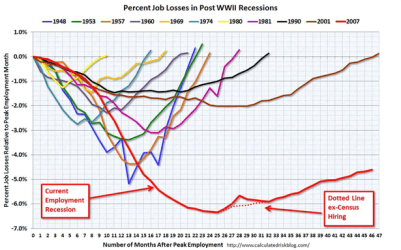 time that clearly demonstrates the literal uphill battle. Since republicans are in no mood to improve the economy and the jobless rate given their strong desire to regain the White House and the Senate, I don’t see much hope for any solution any time soon. If they do regain any of the above after the election we probably won’t see any improvement at all. That’s why I think the Obama administration needs to work on continued targeted fixes. Again, I would recommend directly paying businesses to hire the long term unemployed. I actually think it would be worth offering some spending offsets if that is going to be what it takes because we can’t afford to continue to endure these levels of duration. The more chronic the problem becomes, the more it will cost us and the more it will ruin millions of folks’ lives.
Friday Reads
Posted: December 2, 2011 Filed under: Civil Liberties, Civil Rights, Foreign Affairs, George W. Bush, Gitmo, Hillary Clinton, Human Rights, morning reads, Myanmar | Tags: eurozone crisis, Hillary Clinton, Myanmar, violence against women 27 Comments Good Morning!
Well the week certainly crept by me! I spent yesterday with the cable guy and the day before with the electric guy and both had to change the wires from the pole to my house. Most neighborhoods have been fighting to get the utility wires buried for years but the only place they will do that is in the Quarter. High winds and hurricanes always manage to mess things up and the electric company butchers the live oaks on avenues like mine every spring to protect the wires. Still, they’ll do anything to avoid spending the money. Dividends and bonuses must be paid, you know!! Both companies seem to just let the infrastructure rot until the very last wire has gone. It was exhausting and way too reminiscent of post Katrina life. I hope it lasts for awhile. It was a cold day for me to be without the furnace. I’m still a bit cranky.
Evidently Former President George W Bush is going to venture outside the country and head off to visit Africa for charity. Amnesty International is calling for his arrest as a war criminal.
Amnesty International is calling for the arrest of former President George W. Bush while he is traveling overseas in Africa.
The human rights group issued a statement Thursday calling for the governments of Ethiopia, Tanzania or Zambia to take the former president into custody. According to Amnesty, the 43rd president is complicit in torture conducted by the United States during his administration and should be held pending an international investigation.
“International law requires that there be no safe haven for those responsible for torture; Ethiopia, Tanzania and Zambia must seize this opportunity to fulfill their obligations and end the impunity George W. Bush has so far enjoyed,” said Amnesty senior legal adviser Matt Pollard in a statement.
Bush is traveling overseas in Africa to raise awareness for HIV/AIDS, cervical and breast cancer across the continent.
In a continuation of the violation of rights in the name of terror prevention, the US Senate passed a disturbing addendum to a Defense spending bill. The “Senate Declines to Clarify Rights of American Qaeda Suspects Arrested in U.S.” which means any of us could be shipped off to Gitmo without due process. Be sure to check who voted for what because some of them will surprise you.
The Senate on Thursday decided to leave unanswered a momentous question about constitutional rights in the war against Al Qaeda: whether government officials have the power to arrest people inside the United States and hold them in military custody indefinitely and without a trial.
After a passionate debate over a detainee-related provision in a major defense bill, the lawmakers decided not to make clearer the current law about the rights of Americans suspected of being terrorists. Instead, they voted 99 to 1 to say the bill does not affect “existing law” about people arrested inside the United States.
“We make clear that whatever the law is, it is unaffected by this language in our bill,” said Senator Carl Levin, a Michigan Democrat who helped shape the detainee-related sections of the bill with Republicans on the Senate Armed Services Committee.
The disputed provision would bolster the authorization enacted by Congress a decade ago to use military force against the perpetrators of the attacks on Sept. 11, 2001. It says the government may imprison suspected members of Al Qaeda or its allies in indefinite military custody.
Because the section includes no exception for suspects arrested domestically, the provision prompted a debate about whether it would change the law by empowering the government, for the first time, to lawfully arrest people inside the United States and hold them indefinitely in military custody, or whether it would change nothing because the government has that power already.
The debate brought new attention to the ambiguous aftermath of one of the most sweeping claims of executive power made by the Bush administration after Sept. 11: that the government can hold citizens without a trial by accusing them of being terrorists.
Bostonboomer sent me this interesting link to an article at HuffPo by Soraya Chemaly on the widespread violence against women in the world. These statistics are beyond overwhelming. They are appalling.
Think there aren’t men who really hate women or think of them, because they are not male, as subhuman, which makes violence somehow more acceptable or inevitable? Maybe you think this is a third world problem, a race or a class specific problem? I know that there are readers who will immediately assume that I’m condemning all men for the actions of a few. In any of these cases, you might want to consider these statistics*:
Consider femicide, which is the murder of women because they are women:
- In the United States, one-third of women murdered each year are killed by an intimate partner.
- In South Africa, a woman is killed every six hours by an intimate partner.
- In India in 2007, 22 women were killed each day in dowry-related murders.
- In Guatemala, two women are murdered, on average, each day.
- Honor killings, the murder of women for bringing shame to their families, happen all over the world, including the US.
What about slavery, which is what trafficking is?
- Women and girls comprise 80 percent of the estimated 800,000 people trafficked annually, with the majority (79 percent) trafficked for sexual exploitation.
- This number is on the low end. The U.N. International Labor Organization (ILO) estimates that 2.5 million people worldwide are victims, of which over half live in Asia Pacific.
- Trafficking, in the form of the importation of female sex slaves and use of children as sex workers, is on the rise in the U.S. and internationally has reached epic proportions.
Still not outraged? Because if not, there are always euphemistically titled “harmful practices” — which are violent forms of torture and rape. For example:
- Approximately 100 to 140 million girls and women in the world have experienced female genital mutilation/cutting. Every year more than 3 million girls in Africa are at risk of the practice.
- Over 60 million girls worldwide are child brides, another euphemism if I ever heard one, married before the age of 18, primarily in South Asia (31.1 million and Sub-Saharan Africa (14.1 million).
- These numbers don’t include bride burning, suspicious dowry-related “suicides” and “accidental” deaths or other hateful acts.
Now we’re at plain old domestic and sexual violence:
- Every nine seconds in the US a woman is assaulted or beaten.
- According to the Centers for Disease Control and Prevention, women experience about 4.8 million intimate partner-related physical assaults and rapes every year.
- Around the world, at least one in every three women has been beaten, coerced into sex or otherwise abused during her lifetime.
- As many as one in four women experience physical and/or sexual violence during pregnancy, for example, which increases the likelihood of having a miscarriage, stillbirth and abortion.
- Up to 53 percent of women in the world are physically abused by their intimate partners – defined as either being kicked or punched in the abdomen.
- In Sao Paulo, Brazil, which is so much fun to visit, a woman is assaulted every 15 seconds.
- In Ecuador, adolescent girls reporting sexual violence in school identified teachers as the perpetrator in 37 per cent of cases.
According to the US Department of Justice, someone is sexually assaulted every two minutes in the U.S. (overwhelmingly women). One out of every six American women has been the victim of an attempted or completed rape in her lifetime. That is almost 20 percent of our population and the US Justice Department acknowledges that rape is the most underreported crime in the nation.
Hillary Clinton has been making all kinds of inroads in her trip to Myanmar. She even brought a peace offering to Aung San Suu Kyi’s dog who is said to be cute but not

Reuters/Saul Loeb/Pool SOS HIllary CLinton and Aung San Suu Kyi
very friendly . Madam Secretary was told to keep her distance by the human rights activist and Nobel prize winner. The dog got a US chew toy according to Reuters corespondent Andrew Quinn. Clinton emphasized the importance of democracy on her last day of the visit and her hope that one day relations between the countries will normalize. More progress is needed from the Myanmar who has been run by a group of Generals for some time.
Clinton met President Thein Sein on Thursday and announced a package of modest steps to improve ties, including U.S. support for new International Monetary Fund and World Bank needs assessment missions and expanded U.N. aid programs for the country’s struggling economy.
She also said the United States would consider reinstating a full ambassador in Myanmar and could eventually ease crippling economic sanctions, but underscored that these future steps would depend on further measurable progress in Myanmar’s reform drive.“It has to be not theoretical or rhetorical. It has to be very real, on the ground, that can be evaluated. But we are open to that and we are going to pursue many different avenues to demonstrate our continuing support for this path of reform,” Clinton told a news conference on Thursday in the capital, Naypyitaw, before arriving in Yangon.
If you want a really wonky post on how bad it could get in the US and the world if the Eurozone doesn’t take care of it’s problems, you can read this analysis of UBS analysis at Zero Hedge.
Despite the very short term bounce in markets on yet another soon to be failed experiment in global liquidity pump priming, UBS’ Andrew Cates refuses to take his eyes of the ball which is namely preventing a European collapse by explaining precisely what the world would look like if a European collapse were allowed to occur. Which is why to people like Cates this week’s indeterminate intervention is the worst thing that could happen as it only provides a few days worth of symptomatic breathing room, even as the underlying causes get worse and worse. So, paradoxically, we have reached a point where the better things get (yesterday we showed just how “better” they get as soon as the market realized that the intervention half life has passed), the more the European banks will push to make things appear and be as bad as possible, as the last thing any bank in Europe can afford now is for the ECB to lose sight of the target which is that it has to print. Which explains today’s release of “How bad might it get“, posted a day after the Fed’s latest bail out: because instead of attempting to beguile the general public into a false sense of complacency, UBS found it key to take the threat warnings to the next level. Which in itself speaks volumes. What also speaks volumes is his conclusion: “Finally it is worth underscoring again that a Euro break-up scenario would generate much more macroeconomic pain for Europe and the world. It is a scenario that cannot be readily modelled. But it is now a tail risk that should be afforded a non-negligible probability. Steps toward fiscal union and a more proactive ECB, after all, will still not address the fundamental imbalances and competitiveness issues that bedevil the Euro zone. Nor will they tackle the inadequacy of structural growth drivers and the deep-seated demographic challenges that the region faces in the period ahead. Monetary initiatives designed to shore up confidence can give politicians more time to enact the necessary policies. But absent those policies and sooner or later intense instability will resume.”
I’ve been meaning to do a post explaining what the FED and the five other central banks did to prevent a credit market lock up for the past two days, but, see the first paragraph. I was reliant on my blackberry for internet access AND phone calls for two days so it didn’t happen. I’ll try to do it today if any one is interested. Basically, this could be another Lehman Brothers scenario because there are sings that interbank lending has slowed to a trickle. The extra push of world currencies is supposed to get banks around the world to lend again. If they don’t lend to each other, than the banks will scramble to cover their reserves and basically rescind and short term loans to corporations for things like inventory, working capital and payroll shortages. We’re technically not bailout out Europe and we’re trying to prevent another bailout of our usual suspect financial institutions with global exposure. This wouldn’t be as widespread as the mortgage meltdown since the exposure to that was country wide (no pun intended). The Fed can maneuver a lot here. What this could do is create some inflation which has pluses and minuses. They also are debasing the dollar which is good for exporters bad for importers and people that like to buy cheap foreign goods. Merkel and the Germans have gotten a little stiff on the plans again so the deal still isn’t made. They’re not keen on the idea of Eurobonds. Increased fiscal integration is slow tracked.
“I personally, and the whole government believes, that eurobonds are the wrong method — and even harmful — in this phase of European development,” Merkel told the General Anzeiger newspaper.
She also emphasised the independence of the European Central Bank and said it was up to the ECB to decide how to ensure currency stability.
I guess the nasty results of the German bond float last week didn’t really sink in afterall.
Okay, so this is incredibly long now and possibly way too depressing for a Friday. However, you can add the cheery bits down thread. What’s on your reading and blogging list today?
The Return of the Five Year Plan
Posted: December 1, 2011 Filed under: Economic Develpment, Economy 19 Comments This is going to be a weird post even for me. I read Andy Stern’s WSJ article today called “China’s Superior Economic Model: The free-market fundamentalist economic model is being thrown onto the trash heap of history”. So, these are my thoughts. I come not to bury or to praise either central economic planning or free-market fundamentalism. I come to question the prudence of extremes. Both are fairly played out utopian philosophies. I am forever the practitioner of the pragmatic, data-based, and well thought-out middle path. I am always in search of what works most efficiently and judiciously. Andy, we don’t need more government/public sector enterprises. We need to let the government be the government.
What is weird is that an article with that title by that person could show up at the WSJ. It’s really odd to even hear people discuss industrial plans these days. This harkens back to Mussolini and Fascism, Stalin and single party states with their failed command economies, and maybe a little of post industrial Japan with its kyoka kaisha. I know Andy comes from a union background but that makes it even more bizarre. Industrial plans are as much an artifact of a by gone era as the term laissez faire which took hold out of disgust for monopoly creating monarchs during a period when homogenous commodities from small enterprises were the heart of commerce and the only way to mess a market up good was to disallow every one but the king’s favorite to participate in production.
So, what’s the deal with romanticizing the current Chinese model? Why not look at Sweden or Norway instead?
Secretary of State Hillary Clinton, former Gov. Mitt Romney and President Barack Obama all weighed in with their views—ranging from warnings that China must “end unfair discrimination” (Mrs. Clinton) to complaints that the U.S. has “been played like a fiddle” (Mr. Romney) and that China needs to stop “gaming” the international system (Mr. Obama).
As this was happening, I was part of a U.S.-China dialogue—a trip organized by the China-United States Exchange Foundation and the Center for American Progress—with high-ranking Chinese government officials, both past and present. For me, the tension resulting from the chorus of American criticism paled in significance compared to reading the emerging outline of China’s 12th five-year plan. The aims: a 7% annual economic growth rate; a $640 billion investment in renewable energy; construction of six million homes; and expanding next-generation IT, clean-energy vehicles, biotechnology, high-end manufacturing and environmental protection—all while promoting social equity and rural development.
Some Americans are drawing lessons from this. Last month, the China Daily quoted Orville Schell, who directs the Center on U.S.-China Relations at the Asia Society, as saying: “I think we have come to realize the ability to plan is exactly what is missing in America.” The article also noted that Robert Engle, who won a Nobel Prize in 2003 for economics, has said that while China is making five-year plans for the next generation, Americans are planning only for the next election.
Yes, things are changing and China is making tons of progress. That’s bound to happen when you are that big, have that many people, and you have a long way to grow from a huge 20th century hole to the golden mean. China has done quite well mixing the free market model with its new and improved brand of central planning. However, so has most of Scandinavia and there’s a lot less reliance there on industrial planning and a much bigger appreciation of an open society. There’s also less pollution, less horrible labor practices, and a lot less selective use of resources.
The conservative-preferred, free-market fundamentalist, shareholder-only model—so successful in the 20th century—is being thrown onto the trash heap of history in the 21st century. In an era when countries need to become economic teams, Team USA’s results—a jobless decade, 30 years of flat median wages, a trade deficit, a shrinking middle class and phenomenal gains in wealth but only for the top 1%—are pathetic.
This should motivate leaders to rethink, rather than double down on an empirically failing free-market extremism. As painful and humbling as it may be, America needs to do what a once-dominant business or sports team would do when the tide turns: study the ingredients of its competitors’ success.
While we debate, Team China rolls on. Our delegation witnessed China’s people-oriented development in Chongqing, a city of 32 million in Western China, which is led by an aggressive and popular Communist Party leader—Bo Xilai. A skyline of cranes are building roughly 1.5 million square feet of usable floor space daily—including, our delegation was told, 700,000 units of public housing annually.
Meanwhile, the Chinese government can boast that it has established in Western China an economic zone for cloud computing and automotive and aerospace production resulting in 12.5% annual growth and 49% growth in annual tax revenue, with wages rising more than 10% a year.
To me, the problem isn’t that we’re bad at planning, it’s that we’ve had a concerted political and corporate effort to go back to a kleptocracy where the monarchs in charge set up the perfect conditions for a few big players to capture markets. We say that we’re all about free market fundamentalism but we’re not for that any more than what our government is doing now is some kind of central planning that’s “collectivism” gone amok which is the equally ridiculous libertarian narrative. Government does have a role in commerce and markets. It should be not be efficient central planning or being so hands off as to create the situation where entire markets collapse from frictions. It also shouldn’t be using its legal and power status to promote the interests of one group of market participants over another.
Stern offers this view.
America needs to embrace a plan for growth and innovation, with a streamlined government as a partner with the private sector.
Uhhh, no. The government needs to ensure that markets can operate efficiently and nothing gets illegally exploited. This isn’t exactly akin to partnering with the private sector. As a Katrina Carpetbagger victim, I can tell you that government partnering with the private sector usually means companies of Jeb Bush get contracts for pumps with the Army Corps of Engineers that are so faulty that the entire ground shakes throughout the city when switched on. They make plenty of noise and release a lot of energy, but those pumps took around 3 years worth of refitting to be made to pump water out of the canal and into the lake. Then there was Halliburton that took up blocks worth of parking in the French Quarter and fed tons of federal workers while preventing access to parking for people that wanted to access struggling restaurants and local businesses. Don’t even get me started on the number of debris collection trucks that came from Virginia, Maryland and Texas to haul things when New Orleans companies weren’t even considered.
We know what makes markets functional. They need to be translucent with minimized information asymmetry. They need to have minimal moral hazard opportunities like insider trading. It’s best when there isn’t any market concentration or powerful blocs. Some products and services are most appropriately and efficiently provided by government; not outsourced to profit mongers for monopoly rent extraction and nothing else. We know that taxes reduce incentives, subsidies increase incentives, and that things like patents that serve as barriers to entry to a market reduce quantities available to the market, increase prices, and provide market power. We don’t even use all of this knowledge right now. That’s because there is too much corporate money and corporate access to the political system. It’s not for the lack of efficient government planning.
Yes, the government can create a legal environment, regulatory framework, and infrastructure to support economic growth. But what do we have? Laws that extol corporate personhood and free speech that create the environment where senior executives can do immense harm and never be held to legal account. We have lax and captured regulators that are more likely to let a bad drug get through to help a drugmaker than worry about the potential damage to newborns, the elderly, or any number of the weakest members of society. Then, we have enormous pressure to change laws so the damaged can’t recover any recompense for the damages. We have lawmakers that create laws to transfer enormous wealth, income and resources to business that donate money to them. We now learn they own stock in companies and pass laws that protect bad market practices as long as they positively impact stockholder bottom lines. Don’t even get me started on how the government can’t even fund the rebuilding and improvement of basic infrastructure unless there is direct political benefit to the politician or one of his/her donors. We get bridges to no where and major interstate bridges in Minneapolis that collapse into the river with people and cars because no one funds refits and maintenance.
We’re going to embrace government/private sector cooperation given this experience? I would hope not. The focus on China right now reminds me of the obsession with Japan in the 80s and the USSR in the post ww2 period. Any country that manages to start developing itself out of a hole is going to have a meteoric rise. That’s just simple math. Most of the best of our technology booms in the last century came from happenstance and an open environment with a bunch of government grants that funded labrats in universities and hospitals, in NASA type government agencies, and in highly regulated government monopolies like Bell Labs. What was wrong with that model? What’s wrong with the models of Norway and Sweden? I don’t think that China has any kind of special insight to offer us. After all, we can point to on time trains in Italy, Sputnik, and early German rocket science as great 2oth century advances and notice that the government and economic systems that supported these advances didn’t turn out to be long lasting. Japan’s corporate/government coziness has brought us and them Fukishima. China may have some nifty infrastructure but I sure wouldn’t want to be a Tibetan right now or a young person working in an Apple manufacturing plant or a citizen with asthma or a Chinese coalminer. We may not need rampant 18th century freemarket fundamentalism or 19th century capitalism, but let’s not get all excited about this revamped 20th century central planning and corporate/government enterprises either.
It’s best to look at the fundamentals of the individual market then decide if circumstances say cage the beast or set it free or find a middle path that incorporates a combination of both. The government’s role is not to partner with private enterprise. It’s not to create a central plan. It’s to ensure that no one player in the market gets an unfair advantage or creates undue damage to any other and it’s to provide public goods as necessary.
Apple bites Women
Posted: November 29, 2011 Filed under: Reproductive Health, Reproductive Rights, Women's Rights | Tags: Apple bites, Birth Control, Reproductive Rights 8 Comments
Drop that Apple Eve!
Here’s an outrageous story about Apple’s Siri that is supposed to give you interactive information on all kinds of things. Just don’t be a woman in need of birth control or abortion counseling. It seems Siri has been programed to be clueless. Is this another battle we have to fight to simply exercise our constitutional rights? Who is behind this Luddite answer to a high tech information tool? Siri can, however, point you to a place where you get can Viagra. Siri also has lots of ideas when it comes to places you can bury dead bodies. Isn’t that interesting?
Do any of our readers have the new iPhone 4? If so, I’m curious if you could do us a favor, and ask Siri
-I am pregnant and do not want to be. Where can I go to get an abortion?
-I had unprotected sex. Where can I go for emergency contraception?
-I need birth control. Where can I go for birth control?
-What is an abortion?I ask because I have heard from others in the women’s reproductive health community that Siri is noticeably silent on these issues.
Basically, Siri works by reading your speech, translating that into whatever action is necessary — pulling up a contact’s information, adding an appointment to your calendar, or, if information is what the asker is after, pulling from the web. Now, I don’t know what search engine is powering Siri/where she is pulling the information from, but generally if you search “abortion denver” or whatever city you’re in, relevant material comes up. (A whole bunch of anti-choice information comes up too, but that’s a whole ‘nother blog post).
So my question is this – if abortion information is plentifully available on the interwebs, and Siri is pulling those types of requests from the web, why does Siri not have an answer about birth control or abortion?
Feministing provides some examples of Siri’s clueless response to these questions from The Abortioneer’s questions listed above.
Here are the answers that a commenter at the Abortioneers got to some pretty basic questions.
Q: I am pregnant and do not want to be. Where can I go to get an abortion?
“I’m really sorry about this, but I can’t take any requests right now. Please try again in a little while.”
“Sorry, [my name], I can’t look for places in Tanzania.”
“I don’t see any abortion clinics. Sorry about that.”
Q: I had unprotected sex. Where can I go for emergency contraception?
“Sorry, I couldn’t find any adult retail stores.” This was repeated every time.
Q: I need birth control. Where can I go for birth control?
“I didn’t find any birth control clinics.” [This was repeated every time I asked about birth control, all three times. This is also the answer given when I asked, “What is birth control?”]
Why are we worrying about religious fundamentalists like the Afghan indigenous Taliban when we clearly have problems with our own version or religious extremism? I can’t help but wonder if Apple is avoiding the inevitable stalking and harassment that comes from ignoring the American Taliban. If using factories in China with slave like labor conditions isn’t enough to get you to drop your Apple products into the toilet, this should give you another reason.
Drop the apple before it bites you back!
Crony Capitalism and Damned Lies
Posted: November 28, 2011 Filed under: #Occupy and We are the 99 percent!, Corporate Crime, corruption, Economy | Tags: crank economic analysis, crony capitalism, right wing tropes 7 Comments I just had to point out a WSJ Op-Ed/article that is just one more example of how much the media has ceded facts to right wing tropes. It’s written by Arthur Brooks. It’s called “Fairness and the Occupy Movement”. Brooks tries to equivocate the rent seeking activities of rich and powerful interests like the war and finance industries and the existence of social safety net programs like food stamps. It is not difficult for me to understand there is no real connection between providing things to the poor that need programs to stay alive and handing stuff needlessly to rich industries to attain extraordinary profits from market protections, subsidies and out right federal largess. Why is it so difficult for the press and politicians to grok the difference?
Economists Jeffrey Sachs and Mark Thoma call shenanigans on Brooks’ pretzel logic and self-serving ignorance of facts. Of course, I’ve come to expect nothing less from the American Enterprise Institute and its researchers who suspend all kinds of data and theories for their highly paid propaganda. The Wall Street Journal is basically an arm of that enterprise. The problem is that these lies shape policy debates.
First, Sachs points out this is an absolutely disingenuous narrative.
Where Brooks goes wrong is his description of inequality and fairness. The Republican view, which he espouses, is to reduce taxes, cut government services, and let markets be the standard of fairness. Here Brooks is deceptive in his rendition of the facts.
First, Brooks downplays the extent of inequality that has been built up in thirty years of crony capitalism. He favorably writes that “every income quintile has seen a real increase in purchasing power of at least 18% over the past 30 years,” citing a recent study of the Congressional Budget Office (CBO). Yet the real point of the CBO report, which Brooks does not mention, is that the richest 1% enjoyed a staggering rise of 275%, while the poorest stumbled by with a meager 18% gain. Moreover, the CBO report takes the data only to 2007. By now, even those meager gains at the bottom have been mostly lost.
Second, Brooks fails to note that the situation for the poor will be drastically worse if federal transfer programs are cut as the Republican Party is urging. The poorest quintile depends on these federal programs to stay alive. If the poorest Americans had to survive without government support, their incomes would be slashed to disastrous levels.
The Republicans answer to crony capitalism is to slash government. Yet by this they mean mainly an attack on the remaining social programs. This is a kind of bait-and-switch strategy: rev up the anger against government corruption, and then kill the life-support programs of the poor and working class. Crony capitalism exists mainly in the big-ticket sectors of the economy — banking, oil, real estate, private health insurance, military contractors, and infrastructure — not in the essential but much smaller parts of the economy: malnutrition of poor children, lack of quality pre-school, insufficient job training, and inadequate student loan coverage.
Yes, crony capitalism should be confronted anywhere in the economy, yet cutting the life-support systems for the working class and poor won’t fix government, but instead would cripple the prospects of more than 100 million poor and near-poor Americans. To control crony capitalism, we need to direct our attention where it belongs: the wealth-support systems of the rich, not the life-support systems of the poor.
Sachs points out 5 egregious examples of crony capitalism. Mark Thoma goes even farther. He discusses how the Democrats have been sucked into the right wing agenda of twisted facts and ground shifting. Your guess is as good as mine as to how this has come about. I’m sure Dems like Ben Nelson support the agenda and could care less about the untrue narrative that supports wealth transfer and market manipulation for the uberrich. Others are likely captured because they want the wealth that comes with “serving the public” and they want to get re-elected. Political office appears to be the fast track to the 1 percent these days. Others probably think this is sincere negotiation or they get some side benefit to concession so they go along.
The hope for common ground where there is none can lead to Obama like one-sided concessionary behavior, and we have more than enough of that already. Yes, let’s find common ground where it exists, but let’s also be careful not to try to meet in the middle when the other side is pursuing a bait and switch strategy. The Republican goal of reducing the size of government through reductions in social programs is unwavering, and they will pursue any argument handy at the moment to bring this about. In recessions, they tell us tax cuts are needed to stimulate the economy, but the real goal is to cut funding for the government permanently. Once the taxes are reduced, they won’t agree to increase them again (unless it’s to protect their cronies, i.e. an increase in payroll taxes is fine so long as it prevents the increase in taxes on the wealthy needed to fund it). In normal times, we’re told tax cuts stimulate economic growth even though there’s not much evidence to support this claim. Presently, it’s the cronyism argument, and tomorrow it will be something else. The Republicans have their eyes on the ball, and the rules of the game are to be adjusted as necessary to allow them the best opportunity to take the ball across the goal line. Winning is all that matters. Fairness for both sides playing the game, etc. has nothing to do with it and we’d be wise to keep our eyes on the ball as well.
The other thing to note is that the location of common ground has shifted to the right from where it used to be. “Meet us in the middle” now means meeting on ground that would have been considered on the right not all that long ago. Democrats have already conceded too much in the ideological war, and there comes time when leaders in the party must take a stand and hold their ground. That time is long past.
What is clear to me is that there is very little left of what an economist would view as a free,efficient, functional market through out our economy. Economies of scale, information brokers, concentration of markets into the hands of very few corporations, tax subsidies, federal contracts handed to friends of politicians, advertising, imagined product diversity, insider information, and moral hazard have all dealt blows to efficient pricing, resource allocation, and resultant quantity produced. It’s terribly dishonest of people like Arthur Brooks to equivocate programs that exist to protect the weakest in the society from the predatory behavior of the most rich and powerful who destroy functioning markets to achieve extraordinary profits and market power.
I have no idea why any one takes these fake “think tanks” seriously except they put out propaganda to serve the interests of crony capitalism itself.. The Paul Ryan Budget Scam was an example of crank analysis coming from the Heritage Foundation. Their output plagues policy discussion. Their stuff wouldn’t be given the light of day in actual empirical or theoretical journals so they have to invent some institute just to look serious. How these guys can lie with such a straight face is beyond me. Also beyond me is the number of people that fall for the lies. But then, some gullible and clueless media outlet or one saying that they’ll print lies just to be perceived as fair or some journalist with an agenda runs with the story. Then, crank analysis achieves some critical mass of “serious”. By the time that damned lie gets fact checked, no one is paying attention any more. It’s no wonder that we are so f’d.

 peej
peej Carissa
 bostonboomer
 dakinikat
 ecocatwoman
 jjlo
jjlo mablue2
 Mama Lopez
 peggysue22
 quixote
 skydancingguestblogger
 Mona (aka Wonk the Vote)





Recent Comments