
Red State Menace
Posted: April 27, 2012 Filed under: 2012 elections, Republican politics, right wing hate grouups | Tags: red menance, right wing canards, witchhunt 20 Comments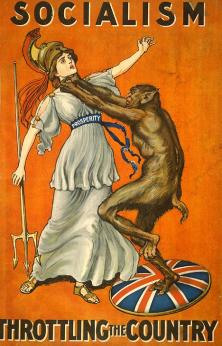 We’ve known for some time that the new politics involves a good deal of Newspeak. That would be the Orwellian term for creating words or recreating existing words that mean exactly the opposite of what they do or should mean. We’ve had “peacekeeping” missiles, “clean” coal, and a bunch of other nonsense terms that find their way into the political lexicon via endless repetition by partisan media hacks with ideological agendas. No monsters seem as selectively reconstructed in modern history as the term “socialism” which actually has a distinct definition in economics and political science and “communism” which is another unique and utopian (i.e. imaginary) system altogether.
Just when you think we are way past the idea of the red menace, right wingers reinvent the threat. If you read much stuff coming from the Tea Party movement, you would think that the USSR is still in existence, no market reforms occurred in the PRC, and every libRUL is a secret commie. Well, reality and data-based thinkers know there is no such thing as a Soviet-style system in place in Russia or China any more. But then, when has this ever been a problem for the folks who prefer magical thinking to reality?
Let’s review the evidence starting with Michelle Bachmann. Remember this one from last year?
Republican presidential candidate Michele Bachmann said Thursday that Americans are alarmed that President Barack Obama may cut defense spending at a time when the Soviet Union is becoming a power in the world.
“When you are traveling — I know you are in South Carolina now, you’re obviously in Iowa, you’re up in New Hampshire — are you hearing different things in these states?” Christian radio host Jay Sekulow asked the candidate.
“I would say it’s a unified message,” Bachmann explained. “It really is about jobs and the economy. That doesn’t mean people haven’t [sic] forgotten about protecting life and marriage and the sanctity of the family. People are very concerned about that as well.”
“But what people recognize is that there’s a fear that the United States is in an unstoppable decline. They see the rise of China, the rise of India, the rise of the Soviet Union and our loss militarily going forward. And especially with this very bad debt ceiling bill, what we have done is given a favor to President Obama and the first thing he’ll whack is five hundred billion out of the military defense at a time when we’re fighting three wars. People recognize that.”
BTW, India is the world’s largest democracy with a rule of law and economic system based on English common law. How did they get lumped in with Russia and China? It’s very interesting to see that so many elected officials seem oblivious to history and reality. There is–of course–no such thing as the Soviet Union. But, lo and behold, just last week we learned that Romney has advisers on foreign policy that also have forgotten there is NO SUCH THING AS THE SOVIET UNION.
Attacking the Obama administration for “withdrawing in leading the free world,” former Navy Secretary John Lehman argued on the call that the president’s policies open the nation up to “huge new vulnerabilities.”
An example?
“We are seeing the Soviets pushing into the Arctic with no response from us. In fact the only response from us is to announce the early retirement of the last remaining ice breaker,” Lehman said.
Also, in a discussion on the new Strategic Arms Reduction Treaty (START) with Russia, former U.S. Ambassador-at-Large for War Crimes Pierre Prosper mistakenly referred to a country that no longer exists.
“You know, Russia is another example where we give and Russia gets, and we get nothing in return,” he said. “The United States abandoned its missile defense sites in Poland and Czechoslovakia, yet Russia does nothing but obstruct us, or efforts in Iran and Syria.”
Czechoslovakia split into two countries–the Czech Republic and Slovakia–in 1993.
Neither country served as a site for the proposed U.S. missile defense system. The U.S. wanted to put part of the system in the Czech Republic, but the country’s prime minister canceled a vote in 2009 that would allow the move to take place.
Later that year, the Obama administration decided to scrap the plan in Eastern Europe, which was first proposed by the Bush administration.
The advisers’ remarks came after Romney’s campaign has had to beat back consistent attacks targeting the candidate as out of touch on matters of foreign policy. The criticism largely stemmed from Romney labeling Russia as the United States’ “number one geopolitical foe” last month.
Of course, the biggest example of Republican baseless fears has been Representative Allen (I see communist democrats) West from Florida. Evidently, he believes liberals, progressives, socialists, and communists are everywhere and basically interchangeable. One would think we learned nothing from our past lives of red baiting. We had two major periods of them. One occurred in the 1920s. The other was the infamous McCarthy version of the 1950s that led to loss of people’s livelihoods, rampant paranoia, and trampling of civil rights. Is this the America that the Tea Party and other right wingers envision?
Bill Moyers resurrects “The Ghost of Joe McCarthy” for those of us that didn’t get a front row seat to the atrocities. He also begins with a reference to 1984–although not the Newspeak one–where we see “amnesia that sets in when we flush events down the memory hole, leaving us at the mercy of only what we know today”. Is this sudden rebirth of the red menace from amnesia or dishonest thinking and belligerence? Scaring people with fully baked lies seems to be the hobgoblin of Republican minds.
Sometimes, though, the past comes back to haunt, like a ghost. It happened recently when we saw Congressman Allen West of Florida on the news.
A Republican and Tea Party favorite, he was asked at a local gathering how many of his fellow members of Congress are “card-carrying Marxists or International Socialists.”
He replied, “I believe there’s about 78 to 81 members of the Democrat Party who are members of the Communist Party. It’s called the Congressional Progressive Caucus.”
By now, little of what Allen West says ever surprises. He has called President Obama “a low level Socialist agitator,” said anyone with an Obama bumper sticker on their car is “a threat to the gene pool” and told liberals like Harry Reid and Nancy Pelosi to “get the hell out of the United States of America.” Apparently, he gets his talking points from Fox News, Rush Limbaugh, or the discredited right wing rocker Ted Nugent.
But this time, we shook our heads in disbelief: “78 to 81 Democrats… members of the Communist Party?” That’s the moment the memory hole opened
up and a ghost slithered into the room. The specter stood there, watching the screen, a snickering smile on its stubbled face. Sure enough, it was the ghost of Senator Joseph McCarthy, the Wisconsin farm boy who grew up to become one of the most contemptible thugs in American politics.
There are a number of ways to disagree with a person’s politics. Goodness knows you can comb through the posts here and find a good long list of all the problems I have with Obama and the Democratic Party. I don’t need to resort to things like “show me your Birth Certificate” or names like “Kenyan Muslim Usurper” to get a point across. Why are we going back to these tactics of our ugly past?
Like McCarthy, the more Allen West is challenged about his comments, the more he doubles down on them. Now he’s blaming the “corrupt liberal media” for stirring the pot against him – a trick for which McCarthy taught the master class. And the congressman’s latest fusillades continue to distort the beliefs and policies of those he smears – no surprise there, either.
To help him continue his fight for “the heart and soul” of America he’s asking his supporters for a contribution of ten dollars or more. There could even be a super PAC in this – with McCarthy’s ghost as its honorary chairman.
Plenty of kindred spirits are there to sign on. Like the author of the book The Grand Jihad, who wrote that whether Obama is Christian or not, “The faith to which Obama actually clings is neocommunism.” Or the blogger who claims Obama is running the country into the ground “by way of the same type of race-baiting and class warfare Communism cannot exist without,” and that his policies are “unbecoming to an American president.”
From there it’s only a short hop to the kind of column that popped up on the right wing website Newsmax hinting of a possible coup “as a last resort to resolve the ‘Obama problem.’” Military intervention, the author wrote, “is what Obama’s exponentially accelerating agenda for ‘fundamental change’ toward a Marxist state is inviting upon America.” The column was quickly withdrawn but not before the website Talking Points Memo exposed it.
The closer we draw to national elections, the more the “silly season” starts. We look to the media and to interviews and debates to separate the good from the bad and the ugly. We need a lot more than that these days. We need folks that are willing to separate the fact from the fiction, the dystopian fiction, and the science fiction. How can any one take any one seriously that still believes there’s a Soviet Union and a communist under every bed? How can a presidential candidate who has no experience in the foreign policy area be taking lessons from people that can’t even get their history right?
At the time, the media had Edward R. Murrow who famously said:
This is no time for men who oppose Senator McCarthy’s methods to keep silent. We can deny our heritage and our history, but we cannot escape responsibility for the result. There is no way for a citizen of a Republic to abdicate his responsibilities.”
There was also Boston Lawyer Joseph Welch who defended the US Army when McCarthy was trying to witch hunt there.
“You’ve done enough. Have you no sense of decency, sir, at long last? Have you left no sense of decency? … If there is a God in heaven it will do neither you nor your cause any good.”
I wonder where our modern counterparts to these two brave men are these days?
Friday Reads
Posted: April 27, 2012 Filed under: Civil Liberties, Civil Rights, education, morning reads, religious extremists | Tags: ALEC, anti-abortion, austerity fails again, Bobby Jindal, school voucher scam, tax payer religious fanatics 46 Comments Good Morning!
I’ve been livid recently about our Governor’s jihad against public education. Here’s some details on how Bobby Jindal used the ALEC play book to turn the state’s public schools upside down.
Gov. Bobby Jindal has remade the Louisiana public schools system with impressive speed over the past legislative session. Last week, he signed into law a suite of landmark reform bills that will likely change the direction of public education in Louisiana forever. But not all change is good, and critics say both Jindal’s agenda and the strategy to move it come right from the playbook of conservative advocacy group ALEC, in an effort to revive Jindal’s national political profile.
Louisiana is now home to the nation’s most expansive school voucher program. Charter school authorization powers have been broadened. And teacher tenure policies have been radically transformed. Louisiana already had something of a reputation as a radical-reform state, thanks to the post-Katrina educational climate in New Orleans. But not all change is good, and education advocates have deep concerns about the efficacy of Jindal’s overhaul, and the interests that have push it.
ALEC has overrun Louisiana at a time when it’s losing corporate sponsors and cronies in various state legislatures. ALEC still has some steam left, however.
ALEC will survive, of course, kept afloat largely by the billionaire Koch brothers and their corporate allies. But as activists keep up the pressure, they must not lose sight of the worst culprits, who must be identified and targeted: the more than 2,000 legislative members of ALEC. The Center for Media and Democracy maintains a list of lawmakers allied with ALEC at ALECexposed.org. The Progressive Change Campaign Committee has begun to pressure dozens of Democrats involved with the overwhelmingly Republican group to quit. Their exit from ALEC would put the lie to the claim that ALEC is nonpartisan.
Common Cause argues that ALEC has abused its tax-exempt status by lobbying, and Wisconsin State Representative Mark Pocan has introduced a bill requiring ALEC to register as a lobbyist in that state. But especially as November approaches, the Exit ALEC movement must go beyond the group to confront some of the damage it has done. In the past two years, thirty-four states have introduced bills to restrict voting for some 5 million eligible voters; nine have passed voter ID laws; dozens of other states have gotten rid of early voting or tried to hobble voter registration drives. In Florida get-out-the-vote efforts by the League of Women Voters and Rock the Vote have been sabotaged. The most affected are blacks, Latinos and other groups that skew Democratic.
If you haven’t been following CISPA, you really should. Here’s a primer from Truth Dig.
What is CISPA?
CISPA, an abbreviation for the Cyber Intelligence Security and Protection Act, was introduced in the House of Representatives on November 30, 2011 by Mike Rogers (R-MI), as well as 111 co-sponsors. Since then, a number of amendments have been introduced. The House is expected to vote on the bill Friday and its author has said that the latest changes brought the number of supporting Congressmen “well past” the threshold of 218 necessary for the adoption of the legislation. It is therefore very likely that the bill will be passed by the House. However, it’s not all that certain whether the bill will be made into law, especially with the White House’s latest statement that President Obama would be advised to veto the legislation.
What does CISPA entail for internet users?
The act says it is meant to create procedures allowing “elements of the intelligence community to share cyber threat intelligence with private-sector entities and to encourage the sharing of such intelligence.” It also states that a cyber-security provider or a self-protected entity may share “cyber threat information” “with any other entity designated by such protected entity, including… the Federal Government.”
But what does that mean?
Unnecessarily broad definitions are the factor which makes CISPA so controversial with web users.
Experts argue that the bill would give the government the ability to circumvent internet privacy laws and obtain information on user activities from private companies – be it providers, hosting companies or social networks – essentially any company involved in the Internet.
The bill does specifically say that the Federal Government can only use the information obtained for a “cybersecurity purpose” or the “protection of the national security of the United States,” but the broad definitions of the terms could potentially lump an average Internet user sending an encrypted e-mail into the same threat category as a terrorist. Privately owned corporations could, under the pretext of cyber and national security, spy on users and transfer their data to a government agency.
“You will get no accountability for that,” explains David Seaman, host of The DL Show. “If findings are turned against you in the worst possible way, you won’t be able to get a lawyer and sue because of the litigation immunity.”
You can find more analysis and links at Cannonfire. The House has already passed CISPA. No surprises there since these guys are standing in line to monitor US women’s menstrual periods and want to peer into every woman’s uterus. As usual, a few Democrats joined in the effort to expand government’s intrusion into your personal lives. Here’s wishing Obama follows through with his threat to veto.
The final tally was 248-168, enough to pass the measure but not enough to override the threatened veto. Forty-two Democrats broke with the White House to vote for the bill, and 28 Republicans voted against it.
The administration and Democratic critics opposed the bill because of privacy and civil liberties concerns. The other main sticking point was that, unlike a Senate bill by Joe Lieberman (I-Conn.), CISPA would not mandate new security requirements for a critical infrastructure network.
Although those disagreements still exist, House Republicans have now jumped ahead of the Senate in a race to avoid the political fallout in the event of a major cyberattack.
At least some of CISPA’s Democratic supporters weren’t happy with their colleagues’ opposition to the bill, nor with the White House.
After the White House issued the veto threat Wednesday, Rep. Dutch Ruppersberger, Rogers’s chief Democratic ally, launched an all-out lobbying effort to persuade his fellow Democrats to back the bill.
Here’s an article that pretty much outlines my worst nightmares: “How Christian Groups Push Right-Wing Religion With the Help of Your Tax Dollars”;Taxpayer-funded crisis pregnancy centers are using religion to oppose abortion, and many of them only hire Christians.
If you want to help carry out the anti-abortion mission of the taxpayer-funded Care Net Pregnancy Resource Center, you have to be a Christian.
It’s right there on the Rapid City, S.D., center’s volunteer application.
“Do you consider yourself a Christian?” “If yes, how long have you been a Christian?” “As a Christian, what is the basis of your salvation?” “Please provide the following information concerning your local church. Church name … Denomination … Pastor’s name.” “This organization is a Christian pro-life ministry. We believe that our faith in Jesus Christ empowers us, enables us, and motivates us to provide pregnancy services in this community. Please write a brief statement about how your faith would affect your volunteer work at this center.”
But that hasn’t stopped the center from receiving federal funding and other forms of government support.
In 2010, it was awarded a $34,000 “capacity building” grant as part of President Obama’s stimulus bill.
Last year, the nonprofit National Fatherhood Initiative, with “support from the US Department of Health and Human Services’ Office of Family Assistance,” awarded the center $25,000 for capacity building.
And when South Dakota passed a law requiring that women get counseling from a “pregnancy help center” before receiving an abortion, the Rapid City center was quick to sign up — becoming one of three such facilities listed on the state’s official website.
When do we get our country back from these whackos and when do we get to say that they don’t get our money?
I’m sending Hugs out today to Senator AL Franken for this.
What’s on your reading and blogging list today?
Holy F$&*! Zimmerman has $200,000 in Pay Pal Accounts
Posted: April 26, 2012 Filed under: just because | Tags: indigent, money, zimmerman 21 Commentsand got off with a $150,000 bond.
His attorney isn’t exactly doing the Snoopy Happy Dance on AC 360 but sheesh, maybe he should be or maybe he’s going to be praying that the judge doesn’t grab his license to practice law. I wish I were that frigging INDIGENT!!!
George Zimmerman raised more than $200,000 to defend himself in the killing of unarmed Florida teenager Trayvon Martin, his lawyer said on
Thursday.
Attorney Mark O’Mara gave the figure in an interview with CNN’s Anderson Cooper, which was set to be broadcast Thursday night.
Zimmerman raised the money through a bizarre website, which he set up before his arrest. This week, the site was ordered shut down by O’Mara.
At a hearing last week, Zimmerman’s wife and father both said they had little money to pay for him to be released from jail should a judge grant him a bond. His father said he might have to take out a second mortgage out on his house to pay for it.
With that in mind, the judge set the bond amount at $150,000. Zimmerman’s family would have had to pay 10 percent, or $15,000, to secure his release.
Prosecutors had asked that Zimmerman be held in jail or granted a bond of no less than $1 million.
Paging JUSTICE? Wow, what is this judge going to do when he stops watching TV tonight?
Partisan Rules and the Agonizing Death of a Functional Republic
Posted: April 26, 2012 Filed under: 2012 elections, 2012 presidential campaign, 2012 primaries, Republican politics, right wing hate grouups 10 Comments
My very Republican father and I were talking about the high levels of unemployment and the impact that was having on the deficit and the current problems with Social Security and Medicare. He was trying to reconcile how long this thing has drug on and why he wasn’t seeing any efforts being made that were similar to what happened during the Great Depression. He’s no FDR fan either. Even he had the sense that there were forces that were at work that were preventing a recovery. I muttered something about partisan politics and he had to agree. It’s gotten so that beating your opponent takes precedence over what you’re supposed to do once elected. We’re electing people that don’t want our government to work. They only want to win and spin.
You’ll undoubtedly hear a lot in the upcoming days about Robert Draper’s new book ‘Do Not Ask What Good We Do.’ It’s a book about the Republicans in Congress and their political agenda. There’s a focus on Tea Party politicians as well as the gang of stubborn white patriarchs. We knew from the very beginning–as announced almost immediately by Mitch McConnell–that the Republicans were intent on making Obama a one term president. The book details some very ugly things about the effort. It also details how elected Republican pols have begin to act like an angry mob at times because many have come with their own brand of “kill the beast” that is our Constitutional Republic. Still, the Draper book does not appear to be about one vast monolithic, stereotypical Republican right winger as it profiles some of the most controversial members. The anger binds them and divides them in intriguing ways.
At what point does ugly partisanship and sour grapes become such an issue that voters will wake up and vote their own interests for a change? Why are we such a nation of Angry Birds these days?
As President Barack Obama was celebrating his inauguration at various balls, top Republican lawmakers and strategists were conjuring up ways to submarine his presidency at a private dinner in Washington.
The event — which provides a telling revelation for how quickly the post-election climate soured — serves as the prologue of Robert Draper’s much-discussed and heavily-reported new book, “Do Not Ask What Good We Do: Inside the U.S. House of Representatives.”
According to Draper, the guest list that night (which was just over 15 people in total) included Republican Reps. Eric Cantor (Va.), Kevin McCarthy (Calif.), Paul Ryan (Wis.), Pete Sessions (Texas), Jeb Hensarling (Texas), Pete Hoekstra (Mich.) and Dan Lungren (Calif.), along with Republican Sens. Jim DeMint (S.C.), Jon Kyl (Ariz.), Tom Coburn (Okla.), John Ensign (Nev.) and Bob Corker (Tenn.). The non-lawmakers present included Newt Gingrich, several years removed from his presidential campaign, and Frank Luntz, the long-time Republican wordsmith. Notably absent were Senate Minority Leader Mitch McConnell (R-Ky.) and House Minority Leader John Boehner (R-Ohio) — who, Draper writes, had an acrimonious relationship with Luntz.
For several hours in the Caucus Room (a high-end D.C. establishment), the book says they plotted out ways to not just win back political power, but to also put the brakes on Obama’s legislative platform.
“If you act like you’re the minority, you’re going to stay in the minority,” Draper quotes McCarthy as saying. “We’ve gotta challenge them on every single bill and challenge them on every single campaign.”
The conversation got only more specific from there, Draper reports. Kyl suggested going after incoming Treasury Secretary Timothy Geithner for failing to pay Social Security and Medicare taxes while at the International Monetary Fund. Gingrich noted that House Ways and Means Chairman Charlie Rangel (D-N.Y.) had a similar tax problem. McCarthy chimed in to declare “there’s a web” before arguing that Republicans could put pressure on any Democrat who accepted campaign money from Rangel to give it back.
As most of you know, I was not a supporter of candidate Obama. However, there are no words to express how I feel about the idea of a group of elected officials planning a political coup during some of the worst days of our Republic over what seems like a bunch of partisan sour grapes. In this tale, there is little care or thought given to the suffering of the country in the grips of a recession and endless, worthless wars. There is only plotting for personal power. There are a lot of details about how the election of the Tea Party candidates has led to more problems that make our country look ungovernable and our differences irreconcilable. In some ways, the Republican take over of the House sandbagged the very people that plotted to make it so.
The anti-big-government zealotry that swept the Republicans into power turned out to be a major obstacle in the debt-ceiling negotiations with the White House. As Eric Cantor told Joe Biden in the talks, the best compromise House Republicans could offer was “giving you a vote on the debt ceiling. You may not think that’s a big deal. But you’ve got to understand, I’ve got a lot of guys that think that not raising the debt ceiling may not be such a bad thing—that in fact it may be just what we need.” Cantor then added wistfully “We’re working hard to educate our guys.”
The House Majority Leader didn’t want to wind up suffering the same fate during the debt ceiling negotiations as the No. 2 House Republican, Roy Blunt, who became a pariah among conservatives for his role in negotiating the details of TARP in 2008. When Cantor saw that he couldn’t bridge the differences between the Republicans and the White House on revenue increases, he backed out of the talks. To avoid blame, Cantor claimed that the Democrats were intending to do the same and he just wanted to preempt them. This “had no basis in fact,” Draper wrote.
Draper profiles many of the strongest Republican Tea Party characters in the book. This includes Allen West who appears to be completely out of touch with any form of reality as we know it.
Draper profiles firebrands like Florida’s Allen West, a former Army lieutenant colonel who attempts to induce his draconian brand of military discipline on America’s finances and security apparatus. West is also the only Republican member of the Congressional Black Caucus. West comes across as someone whose mouth gets him in trouble (he recently nabbed coverage for labeling 81 of his House colleagues communists, and then got more coverage for refusing to back down from the accusation); his hand-wringing paranoia would have more bite if it weren’t so nostalgic. But in Draper’s reporting, he becomes a surprisingly nuanced person who isn’t afraid to defy the more conservative elements of his base (including a vote clearing the way for that Republican whipping-horse, the Environmental Protection Agency, to clean Florida’s waterways after farmers in his district encouraged him to vote that way).
This may not be one of those books that stands the test of time. But, we need this kind of hand book right now. Here’s a headline that will give you some pause: “Dick Lugar trails by 5, poll says”.
Indiana Sen. Dick Lugar has fallen behind state Treasurer Richard Mourdock by five points, according to a new poll released Thursday.
The survey, taken Tuesday and Wednesday by Wenzel Strategies on behalf of Citizens United, places Mourdock at 44 percent and Lugar at 39 percent. Nearly 17 percent remain undecided with just 12 days to go until the Indiana Senate primary.Citizens United is backing Mourdock in the May 8 contest.
Wenzel found that Mourdock’s lead is powered by self-described tea party conservatives, who comprise 36 percent of the GOP electorate.
Among that group of voters, Mourdock holds a commanding 63 percent to 24 percent lead. Lugar’s ability to keep the race close is due to moderates and traditional conservatives, which both favor the incumbent, according to Wenzel.
It seems like we had the birth of our nation in the Age of Reason and we may experience our death throes in the Age of the Angry Mob.
SCOTUS and the Arizona Immigration Law
Posted: April 25, 2012 Filed under: immigration, SCOTUS | Tags: Arizona Immigration Law, SCOTUS 14 CommentsThe Supremes heard arguments on the Arizona Immigration Law today. This is the law that Romney considers to be a blueprint for immigration laws in the US that  has been challenged by the Obama Justice Department. I’m not a lawyer so I can’t offer up any authoritative opinions, but I can offer up some reads for you.
From the NYT: Justices Seem Sympathetic to Central Part of Arizona Law
Mr. Verrilli, representing the federal government, had urged the court to strike down part of the law requiring state law enforcement officials to determine the immigration status of anyone they stop if the officials have reason to believe that the person might be an illegal immigrant.
“Why don’t you try to come up with something else?” Justice Sotomayor asked Mr. Verrilli.
It was harder to read the court’s attitude toward the three other provisions of the law at issue in the case, including ones that make it a crime for illegal immigrants to work or to fail to register with federal authorities. The court’s ruling, expected by June, may thus be a split decision that upholds parts of the law and strikes down others.
Should the court uphold any part of the law, immigration groups are likely to challenge it based on an argument not before that court on Wednesday — that the law discriminates on the basis of race and ethnic background.
Indeed, Chief Justice John G. Roberts Jr. made clear that the case, like last month’s arguments over President Obama’s health care law, was about the allocation of state and federal power.
“No part of your argument has to do with racial or ethnic profiling, does it?” the chief justice asked Mr. Verrilli, who agreed.
SCOTUSblog: Argument recap: A choice between radical and reasonable?
With Justice Antonin Scalia pushing the radical idea that the Constitution gives states clear authority to close their borders entirely to immigrants without a legal right to be in the U.S., seven other Justices on Wednesday went looking for a more reasonable way to judge states’ power in the immigration field. If the Court accepts the word of Arizona’s lawyer that the state is seeking only very limited authority, the state has a real chance to begin enforcing key parts of its controversial law — S.B. 1070 — at least until further legal tests unfold in lower courts.
In an oral argument that ran 20 minutes beyond the scheduled hour, the Justices focused tightly on the actual operation of the four specific provisions of the law at issue, and most of the Court seemed prepared to accept that Arizona police would act in measured ways as they arrest and detain individuals they think might be in the U.S. illegally. And most of the Justices seemed somewhat skeptical that the federal government would have to change its own immigration priorities just because states were becoming more active.
At the end of the argument in Arizona v. United States (11-182), though, the question remained how a final opinion might be written to enlarge states’ power to deal with some 12 million foreign nationals without basing that authority upon the Scalia view that states have a free hand under the Constitution to craft their own immigration policies. The other Justices who spoke up obviously did not want to turn states entirely loose in this field. So perhaps not all of the four clauses would survive — especially vulnerable may be sections that created new state crimes as a way to enforce federal immigration restrictions.
The Hill: Supreme Court seems favorable to Arizona illegal immigration law
Chief Justice John Roberts said he didn’t see a problem with that portion of the Arizona law, S.B. 1070. Under the statute, state officials would be notifying federal officials of the immigration status of the person in question. Roberts argued that the power to decide what to do with the that person still lay within the hands of the federal government. He also said the state, in that instance, would be attempting to help the federal government and supersede its role.
A key element to the government’s objections to the Arizona law rests on the argument that the state law conflicts with federal immigration laws already in place.
Verrilli also argued that immigration enforcement matters were entrusted to the federal government by the framers of the country — and not to the states — because they involve matters of foreign policy.
A final decision will not be reached until June, but the line of questioning from the more liberal and conservative justices alike seemed to indicate a belief that Arizona had a stronger case than the government on at least two of the law’s four provisions under question.
The passage of the law created an uproar last year and renewed the national debate over how to deal with the millions of illegal immigrants living in the United States. It’s expected to be an issue in the election as the Obama administration sued to stop it, and Mitt Romney, the presumptive GOP nominee, has expressed support for parts of it.
This is turning out to be a very interesting SCOTUS session and it appears that most of the justices have a distinct ideological bias. This proves that elections may not always bring the results in other areas but in terms of stacking the supreme court, the election of Presidents with IOUs to an ideological base shows up in how our laws will be interpreted.

 peej
peej Carissa
 bostonboomer
 dakinikat
 ecocatwoman
 jjlo
jjlo mablue2
 Mama Lopez
 peggysue22
 quixote
 skydancingguestblogger
 Mona (aka Wonk the Vote)





Recent Comments