
DOMA Likely to Fall
Posted: March 27, 2013 Filed under: Marriage Equality | Tags: DOMA 16 CommentsIt appears that the arguments and questioning on DOMA during the SCOTUS hearing today have put the 17 year old law into question. As usual, SCOTUSBLOG has some great analysis of the arguments.
That was the overriding impression after just under two hours of argument Wednesday on the fate of the Defense of Marriage Act.
That would happen, it appeared, primarily because Justice Anthony M. Kennedy seemed persuaded that the federal law intruded too deeply into the power of the states to regulate marriage, and that the federal definition cannot prevail. The only barrier to such a ruling, it appeared, was the chance – an outside one, though — that the Court majority might conclude that there is no live case before it at this point.
After a sometimes bewilderingly complex first hour, discussing the Court’s power to decide the case of United States v. Windsor (12-307), the Court moved on to explore DOMA’s constitutionality. And one of the most talented lawyers appearing these days before the Court — Washington attorney Paul D. Clement — faced fervent opposition to his defense of DOMA from enough members of the Court to make the difference. He was there on behalf of the Republican leaders of the House (as majority members of the House’s Bipartisan Legal Advisory Group), defending the law because the Obama administration has stopped doing so.
Justice Kennedy told Clement that there was “a real risk” that DOMA would interfere with the traditional authority of states to regulate marriage. Kennedy also seemed troubled about the sweeping breadth of DOMA’s Section 3, noting that its ban on benefits to already married same-sex couples under 1,100 laws and programs would mean that the federal government was “intertwined with citizens’ daily lives.” He questioned Congress’s very authority to pass such a broad law.
Moreover, Kennedy questioned Clement’s most basic argument — that Congress was only reaching for uniformity, so that federal agencies would not have to sort out who was or was not married legally in deciding who could qualify for federal marital benefits, because some states were on the verge of recognizing same-sex marriage.
Along with sharply negative comments about DOMA by the Court’s four more liberal members, Kennedy’s stance could put the law on the edge of constitutional extinction. But, if the Court were to do that based on states’ rights premises, the final ruling might not say much at all about whether same-sex couples were any closer to gaining an equal right to marry under the Constitution.
There did not appear to be a majority of Justices willing to strike down the 1996 law based on the argument that the Obama administration and gay rights advocates have been pressing: that is, the law violates the Fifth Amendment guarantee of legal equality in general.
Elena Kagan had some interesting moments today.
In discussing the origins of the law, Paul Clement, who represents the Bipartisan Legal Advisory Group, said that Congress’s key interest in passing DOMA was preserving the uniform treatment of couples in various states at a time when there where indications that some states might allow same-sex marriages.
“All these federal statutes were passed with the traditional definition of marriage in mind,” Clement said. “What Congress says is, ‘Let’s take a time out. This is a redefinition of an age-old tradition.’”But Kagan fired back in her questioning, telling Clement that Congress wasn’t preserving tradition, but departing from it when it jumped into the marriage issue. “The only uniformity that the federal government has pursued is that it’s uniformly recognized the marriages that are recognized by the state,” she said. Congress’ foray into the issue in 1996 was so unusual that it “sen[t] up a pretty good red flag,” she said.
A short time later, Kagan read aloud from the House Judiciary Committee report on DOMA. “Congress decided to reflect and honor of collective moral judgment and to express moral disapproval of homosexuality,” she said, quoting the report.
“Is that what happened in 1996?” she asked to gasps, “oohs” and some laughter from many in the gallery who seemed to think she’d managed a rare Supreme Court “gotcha” moment.
Clement said he was not claiming moral disapproval constituted a sufficient basis for the law. “The House report says those things,” he said. But, he added, “we’ve never invoked [the report] in trying to defend the statute.”
The crowd outside the SCOTUS building got rowdy and into some fights. Other interesting analysis can be found on Slate. I loved this line by Ginsberg.
Justice Ruth Bader Ginsburg had the laugh line of the day when she scolded DOMA for creating “two kinds of marriage, full marriage and the skim-milk marriage.” It was easy to see which one you’d want in your coffee.
Please post more things you’ve found on the arguments today!
Monday Reads
Posted: March 25, 2013 Filed under: just because | Tags: assault weapons ban, Cyprus financial crisis, extinction of species, Faux News, gun control, marriage equality, Mike Bloomberg, Prop 8, SCOTUS, Tea Party Extremists 28 Comments Good Morning!
There’s more than just a bit of March madness in the air and you don’t have to be watching basketball to catch it. It seems that the Republican Party’s Teabots have decided to boycott Fox News for being too liberal. Yes, you read that right. Fox is not fair and balanced towards their viewpoints so off with th eir heads!!!!
Among the demands the protesters have is that Fox News “be the right-wing CBS News: to break stories, to break information, and to do what news organizations have always done with such stories: break politicians,” that the network have at least one segment on Benghazi every night on two of its prime-time shows; that Fox similarly devote investigative resources to discovering the truth of Obama’s birth certificate; and that the network cease striving to be “fair and balanced.”
“We need Fox to turn right,” said Hjerlied. “We think this is a coverup and Fox is aiding and abetting it. This is the way Hitler started taking over Germany, by managing and manipulating the news media.”
The descriptions of the boycotters and their preferences for conspiracy sites is pretty obvious. Poor Fox and the Republican Party Establishment just cannot shove these loonies back into their boxes.
Cyprus will close down one of its two biggest banks and restructure the second one as part of an international bailout, Cyprus and
international lenders agreed on Tuesday.
Bank depositors of up to 100,000 euros will not suffer any losses but bigger depositors will contribute to recapitalizing the bank that is to be restructured – Bank of Cyprus.
Shareholders, bondholders and those who held deposits above 100,000 euros in Laiki bank, which will be closed down, will cover the cost of the resolution, euro zone ministers and the International Monetary Fund decided.
Depositors with more than 100,000 euros in the Bank of Cyprus will see their money above that threshold frozen until it is clear how much of it will be needed to recapitalize the bank so that it can reach a capital ratio of 9 percent.
Here’s some discussion of what the Cyprus fallout could be around the world by Marshall Auerback. Moody’s says Cyprus is still at risk of default, euro zone exit should these steps resolve the current crisis. So, what type of precedent does this set for such a risky move with no real guarantee of success?
Regardless of the ultimate form this bailout takes, it is increasingly hard to view Cyprus as a “one-off,” which has no implications for us here in the US. What Cyprus has demonstrated is that even with deposit insurance, your deposits are not in fact a risk-free guaranteed asset, but actually simply another branch in the creditor tree in relation to your bank if it fails. That was made abundantly clear by no less than the Bank for International Settlements (BIS), the central bankers’ bank back in the heart of the financial crisis. The BIS noted that bank failures had become increasingly expensive for governments and taxpayers and therefore recommended an “Open Bank Resolution,” which would ensure that, as far as possible , “any future losses are ultimately borne by the bank’s shareholders and creditors.” (See primer on the Open Market Resolution concept by the Reserve Bank of New Zealand.)
Why does this matter? Because, you, as a depositor are legally considered a “creditor” of your bank, not simply a customer who may have entrusted your entire life savings with the very same institution.
The science editor at BBC News wonders why there is such a fuss about extinction which leads to the question “would the world be a better place if we still had velociraptors? But, is natural extinction different than man-caused extinction?
We are certainly far better off without velociraptors slashing their way through our cities. Our streets are safer with no sabre-toothed tigers. And imagine trying to swat one of those monster prehistoric insects like a vulture-sized dragonfly.
The question of extinction most recently surfaced at the talks on the Convention on International Trade in Endangered Species of Wild Fauna and Flora (CITES) – the treaty meant to save endangered species from the devastating effects of trade.
The slaughter of rhino, the decimation of elephant, the forlorn last stand of the tiger – all had their profiles raised as the delegates in Bangkok negotiated their fate.
And anyone hearing the protests and the campaigns, and the shocking statistics about the losses, might be forgiven for thinking that extinction was some new kind of evil that was not invented until rapacious and uncaring mankind came along.
I should state right now that some of the most ghastly examples are indeed entirely the result of man’s activities, sometimes unwittingly, sometimes carelessly.
 We’re seeing slow, drawn out, death-by-lobbying of the hopes for better gun safety laws. The NRA is pushing the meme that gun-free zones–like the Sandy Hook School–attract mass murderers. Mark Follman takes on this myth.
Ever since the massacres in Aurora, Colo., and Newtown, Conn., this idea has been repeated like some surreal requiem: The reason that mass gun violence keeps happening is because the United States is full of places that ban guns.
Second Amendment activists have long floated this theme, and now lawmaker sacross the nation are using it, too. During a recent floor debate in the Colorado legislature, Republican state Rep. Carole Murray put it this way: “Most of the mass killings that we talk about have been affected in gun-free zones. So when you have a gun-free zone, it’s like saying, ‘Come and get me.'”
The argument claims to explain both the motive behind mass shootings and how they play out. The killers deliberately choose sites where firearms are forbidden, gun-rights advocates say, and because there are no weapons, no “good guy with a gun” will be on hand to stop the crime.
Sound bite sophistry
With its overtones of fear and heroism, the argument makes for slick sound bites. But here’s the problem: Both its underlying assumptions are contradicted by data. Not only is there zero evidence to support them, our examination at Mother Jones of America’s mass shootings indicates they are just plain wrong.
Among the 62 mass shootings over the past 30 years that we studied, not a single case includes evidence that the killer chose to target a place because it banned guns. To the contrary, in many of the cases there was clearly another motive for the choice of location. For example, 20 were workplace shootings, most of which involved perpetrators who felt wronged by employers and colleagues. Last September, when a troubled man working at a sign manufacturer in Minneapolis was told he would be let go, he pulled out a 9mm Glock and killed six people and injured another before putting a bullet in his own head. Similar tragedies unfolded at a beer distributor in Connecticut in 2010 and at a plastics factory in Kentucky in 2008.
Or consider the 12 school shootings we documented, in which all but one of the killers had personal ties to the school they struck.
Or take the man who opened fire in suburban Milwaukee last August: Are we to believe that a white supremacist targeted the Sikh temple there not because it was filled with members of a religious minority he despised, but because it was a place that didn’t allow firearms?

Despite the momentum in Congress of the NRA, Mayor Mike Bloomberg is going to spend beaucoups bux trying to get a better outcome.
New York City Mayor Mike Bloomberg wants new gun control legislation so bad that he’s set to spend a staggering $12 million of his own money on ads targeting US senators in a dozen states.
As the New York Times reports, Bloomberg’s new wave of ads, which begin on Monday, support universal background checks for nearly all gun purchases, but do not mention a ban on assault weapons. The ads, run under the auspices of Mayors Against Illegal Guns, a group funded and co-chaired by Bloomberg, will target Sens. Kay Hagan (D-N.C.), Mary Landrieu (D-La.), Mark Pryor (D-Ark.), Dean Heller (R-Nev.), Rob Portman (R-Ohio), Patrick Toomey (R-Penn.), Saxby Chambliss (R-Ga.), Johnny Isakson (R-Ga.), Dan Coats (R-Ind.), and Jeff Flake (R-Ariz.).
Bloomberg’s $12 million ad buy further cements his position as the main political force challenging the clout of the National Rifle Association. For decades, the NRA has used its money and manpower to oust politicians who support any new regulation of guns in America. The threat of NRA attacks helped stifle any effort at new gun laws, including requiring background checks for most gun purchases and reinstating the ban on assault rifles, which expired in 2004. Now, by pumping money into Mayors Against Illegal Guns and Independence USA, his super-PAC, Bloomberg hopes to counter the might of the NRA, while giving cover to pro-gun-control legislators.
Today, SCOTUS hears arguments on California’s Prop 8 and will begin to hear arguments on the constitutionality of DOMA.
California Attorney General Kemala Harris gave an impassioned, pithy defense of marriage equality during an appearance on CNN’s State of the Union Sunday morning in anticipation of the Supreme Court’s hearing on whether California’s Proposition 8, which overturned the state’s marriage equality law, is itself constitutional.
Asked by CNN’s Candy Crowley to explain why she was refusing to defend the state’s proposition, Harris insisted that the measure undermined the fundamental rights of gay Americans, taking away their equal protections under the law:
I am absolutely against a ban on same-sex marriages because [bans] are simply unconstitutional. And it is one thing to read the polls, which we have discussed which show again that a majority of Americans are in favor of same sex marriage, but it is more important to read the Constitution. And the Constitution of the United States dictates, I believe, under every court precedent that we have discussed in terms of describing marriage as a fundamental right that the same-sex couples that are before the United states supreme court — Mrs. Windsor, Miss Perry — be allowed to have equal protection under the laws as any Americans when it comes to their ability to join themselves with their loving partners in marriage and raise their children. And 61% of Californians are in favor of same-sex marriage.
Harris is considered an up and comer to the national political scene. You can follow the link above to see the interview. We will be following the arguments closely today and will keep you updated as things happen.
So. that’s it for me this morning. What’s on your reading and blogging list today?
Bill O’Reilly jumps the Shark … errrr … Easter Bunny
Posted: March 23, 2013 Filed under: VAGINA Bill O'Reilly | Tags: easter bunny, german pagan rituals, origins of easter, Ostera, spring and fertility goddess, Vagina Bill O'Reilly 46 Comments This is so ridiculous that it almost isn’t worth posting. However, it’s a Saturday and we could use a good laugh. Billy O’Reilly thinks secularizing the Easter Bunny will lead to abortion and drug use. I never knew O’Reilly was such a big fan of German Fertility Goddesses.
O’REILLY: Secular progressives are running wild with President Obama in the White House. They feel unchained, liberated, and they’re trying to diminish any form of religion. The goal is to marginalize religious opposition to secular programs. For example, in Canada and China a woman can have an abortion for any reason at any time. Secular progressives want that here. But traditional forces in America are in opposition. Therefore in this country, you can’t terminate a baby about to be born without a damn good reason. And if you do abort a late term baby, you could be charged with murder. SPs hate that. In Scandanavia, there are laws that say you cannot criticize minorities and if you do, you could be arrested. Secular progressives want laws like that here. Also the legalization of drugs, well under way in many places, and that is a secular cause. So, if the far left can marginalize Santa and the Easter bunny, of they can tell the children those symbols are obsolete and unnecessary, they then set the stage for a totally secular society in the future.
Look for the upcoming children’s book by Snowbilly Snookie right after her astounding literary contribution for children about the war on Santa and Christmas. It’s just amazing to me how early Romano-Christian culture co-opted pagan rituals and symbols and these whackadoodles seem to be upset when every one wants them back. Rabbits and eggs are very ancient fertility symbols. The egg-laying bunny actually wasn’t invented until the 18th century. The actual origin of the bunny comes from Germany and it had nothing to do with a christian “Easter” It had to do with a Germanic Fertility Goddess.
The idea of an egg-laying bunny came to the U.S. in the 18th century. German immigrants in the Pennsylvania Dutch area told their children about the “Osterhase” (sometimes spelled “Oschter Haws“[11]).[12] “Hase” means “hare”, not rabbit, and in Northwest European folklore the “Easter Bunny” indeed is a hare, not a rabbit. According to the legend, only good children received gifts of colored eggs in the nests that they made in their caps and bonnets before Easter.[13] In 1835, Jakob Grimm wrote of long-standing similar myths in Germany itself. Grimm suggested that these derived from legends of the reconstructed continental Germanic goddess *Ostara,
Ostara is the German spring and fertility goddess. Be prepared, the history of this actually links to my interest in extremely old burials and grave goods.
Easter is deeply rooted in German culture: as a time of celebrations,
customs and traditions across the country. The word Ostern is believed to have come from the German Spring and Fertility Goddess Ostara, whose sacred animal was the ‘fertile’ hare, and in pre-Christian days a light cult held a festival in her honor as soon as the days became longer, which, with the introduction of Christianity, was changed in the 2nd century to a celebration for the resurrection of Jesus. As a source of new life the egg had been a symbol of creation, spring and fertility since ancient times, long before Christianity, with its origins traced back to 5000 BC, when the Egyptians and Persians painted eggs to eat and give as presents for spring equinox. The first Christians then placed eggs both in and on graves, believing that just as a grave hid a life the egg also seemed to be dormant but contained life sealed within it, and German archeologists have found centuries old examples of these offerings.
Again, it’s just another example of how Roman culture and religion co-opted pagan culture. The word “easter” is basically an anglicized version of the goddess’ name. The eggs existed as pagan symbols way before the invention of Christianity itself. The entire man-in-bunny-suit is a modern invention.
Bill O’Reilly is continues to prove he’s an ignorant ass.
A Blast from the Past
Posted: March 22, 2013 Filed under: The Media SUCKS, the villagers | Tags: ant-Iraq War journalist, Democracy Now, firing, MSNBC, Phil Donahue 14 Comments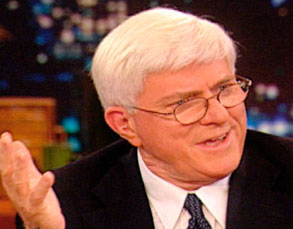 I’d forgotten that Phil Donahue was fired from MSNBC in 2003 for his anti-Iraq views. If you haven’t watched Juan Gonzlez interview Donahue on Democracy Now, you really should. It’s a good reminder of the complicity of the media in the march to war and that there were a brave few that wouldn’t shut up.
In 2003, the legendary television host Phil Donahue was fired from his prime-time MSNBC talk show during the run-up to the U.S. invasion of Iraq. The problem was not Donahue’s ratings, but rather his views: An internal MSNBC memo warned Donahue was a “difficult public face for NBC in a time of war,” providing “a home for the liberal antiwar agenda at the same time that our competitors are waving the flag at every opportunity.” Donahue joins us to look back on his firing 10 years later. “They were terrified of the antiwar voice,” Donahue says.
You definitely need to read the transcript at least to catch the exchange between Amy Goodman and Chris Matthews who always acts like his bathroom never smells when he’s in it. He reminds me a lot of Schultzie in the old TV sitcom Hogan’s Heros. “I know nothing, nothing!”
AMY GOODMAN: I want to congratulate you, Chris, on 10 years of MSNBC, but I wish standing with you was Phil Donahue. He shouldn’t have been fired for expressing an antiwar point of view on the eve of the election. His point of view and the people brought on were also important.
CHRIS MATTHEWS: I don’t know what the reasons were, but I doubt it was that.
AMY GOODMAN: Well, we have the MS—the NBC memo, that was a secret memo—
CHRIS MATTHEWS: Oh, OK, good.
Just a great reminder of the fake meme of liberal bias in our media. Also, more hubris by the press who refuses to admit they really could’ve done something other than be mouthpieces of propaganda.
Friday Reads: Confessions of a Naughty Professor
Posted: March 22, 2013 Filed under: morning reads | Tags: Elizabeth Warren, JIndal's plan to tax mom and pop enterprises, modern day slavery in the USA, Too Big Too Fail 20 Comments Good Morning!
I’ve felt discombobulated all week. I’m hoping this phase passes since it is spring and things are supposed to spring alive right now. Right now, however, does not seem to apply to me. It’s been one of those weeks where I’ve felt like the stereotype of the absent-minded professor fits me like a snug glove. I get distracted easily and hours pass before I realize I’ve done nothing for the day. It fits so do not acquit. Maybe I’ll just lie around in bed this weekend a little bit more and think these kinds of thoughts.
For some time, I’ve been writing how worried I am about the systemic risk involved with all these huge banks that have a near monopoly on credit card and house loans. They also hold the deposits of some our of largest industrial and service corporations that actually provide things people use and need in their daily lives. It’s the same situation in Europe and the UK where the needs of banks–based on their own faulty lending and investing strategies–have passed on tremendous costs to countries, their treasuries and their peoples. I was glad to read that Ben Bernanke made a clear atement yesterday that he was in agreement with Senator Elizabeth Warren on the entire problem of banks considered “too big to fail”. I’d also like to add that it’s refreshing to see a senator on a committee that actually knows what they’re doing for a change.
During that conversation, Bernanke seemed to imply that the problem had been solved, suggesting that the Dodd-Frank financial-reform act had given policy makers the tools to wind down a giant bank without hurting the economy — although his conviction faded as the argument went on. On Wednesday, he wanted it to be known that fully sided with Warren.
“I agree with Elizabeth Warren 100 percent that it’s a real problem,” he said.
He also sided with Warren against those banks and others who suggest that having gigantic banks is not really a problem at all.
“Too Big To Fail was a major source of the crisis,” he added a little later, “and we will not have successfully responded to the crisis if we do not address that successfully.”
He talked about some of the tools policy makers could use to address the problem, including Dodd-Frank rules forcing the biggest banks to hold more capital or pay regulators a little more than smaller banks.
“If we don’t achieve the goal” of solving too big to fail with these measures, Bernanke said, “we will have to take additional steps. It is important.”
You only need to look at the entire senate hearing on JPM’s “Whale” situation to understand how these big bank purport themselves. This analysis is from NYT’s Simon Johnson.
At its heart, the Levin-McCain report reveals executives with a profound misunderstanding of risk in the world’s largest bank (I use the calculations of comparative bank size offered by Thomas Hoenig, vice chairman of the Federal Deposit Insurance Corporation). Even worse, the report shows us in some detail that banks – even after Dodd-Frank – can and do readily manipulate complicated measures of risk in order to make their positions look safer than they really are.
As Jeremy Stein, a Fed governor, pointed out recently, there are strong incentives to do this repeatedly in banking organizations (read the opening few paragraphs of his speech carefully).
The banking regulators – in this case, the Office of the Comptroller of the Currency – are clearly unable to keep up with this form of “financial innovation” (which is really just clever ways to misreport risk).
Did JPMorgan Chase’s top management do this intentionally? Did they mislead investors, particularly in the fateful conference call on April 13, 2012? This is a fascinating question on which the courts will no doubt rule. (You should also review this report by Josh Rosner of Graham Fisher, with the link kindly provided by Better Markets.)
Jamie Dimon will survive because JPMorgan Chase remains profitable. But it is profitable precisely because it receives implicit subsidies from being too big to fail. JPMorgan Chase disputes the precise scale of these subsidies – as I discussed here last week. Let’s just call them humongous.
This is not about individuals, this is about policy. And Richard Fisher has exactly the right approach:
At the Dallas Fed, we believe that whatever the precise subsidy number is, it exists, it is significant, and it allows the biggest banking organizations, along with their many nonbank subsidiaries (investment firms, securities lenders, finance companies), to grow larger and riskier.
This is patently unfair. It makes for an uneven playing field, tilted to the advantage of Wall Street against Main Street, placing the financial system and the economy in constant jeopardy.
It also undermines citizens’ faith in the rule of law and representative democracy.
You can see that regulators at all levels realize they have a problem. I should probably mention here that Fed Branches and the Board of  Governors of the Fed are very independent of one another and each have distinct characters. We have two layers of Fed bureaucracy championing reform. Unfortunately, they can’t do much with out laws passed by Congress and signed by the President who are captured at every turn by the FIRE lobby.
Bernanke also compared himself to Volcker, when talking about the US banking system, which the Fed regulates. Volcker once said, famously, that the only great financial innovation of recent decades was the invention of the automated teller machine. Bernanke smiled as he quoted Volcker’s bellicose quip and said he wouldn’t go that far – but he was surprisingly frank in talking about the failures of the financial system and regulation.
“[‘Too big to fail’] is not solved and gone. It’s still here,” he said, emphasizing the point. He also threw in his lot with Elizabeth Warren, who often opposed Tim Geithner and others in her insistence that banks are of a dangerous size:
“I agree with [Warren] 100% that [‘too big to fail’] is a real problem … We will not have successfully responded to the crisis if we do not address [‘too big to fail’] successfully.”That view is consistent with what Bernanke said as far back as 2009. But the subject of “too big the fail” has been a nonstarter for at least a year, since Occupy Wall Street protests receded.
Bernanke also took an activist view of sorts by plumping for a return to regulatory reform and advocating that banks need to pay higher surcharges to help the country bail them out if things go wrong. Then Bernanke criticized banks again, implicitly, by saying that they had restricted lending too much, making it hard for ordinary Americans to get a mortgage.
He went on to say that the Fed’s bond-buying program has been successful largely because the Fed has learned how to monitor the markets better – implying, correctly, that those trading on Wall Street need a regulator to keep an eye on them. All of this was surprising on two fronts: first, that Bernanke actually shared his own opinion, instead of a technocratic, non-committal vague fluttering of economic opinions, as is often the case. Second, it’s surprising that he took a somewhat controversial view, not designed to make friends on Wall Street.
And that, in fact, may be the most important development of this first press conference of 2013: we already know Ben Bernanke is a savvy politician who knows how to read a room. If Bernanke has thrown his lot in with those who have said that Wall Street needs to come under tighter control, you can be sure that he thinks it’s a historically smart view to take. Those who are against reform should take notice.
I am consistently reminded in many of these conversations of Lenin who wrote a lot about banking. He said that the downfall of capitalism would come from the power of banks and their eventual destruction of the actual productive parts of the economy. I realize when I quote Lenin that I run a very high risk of being called all kinds of things by Republicans looking to demean academics. However, I read his 1916 Treatise Imperialism: The Highest Stage of Capitalism in a comparative economics class in my senior year at the University of Nebraska. Let me tell you that the business school at the University of Nebraska in Lincoln does not harbor any communists to my knowledge and probably is not all that populated with Democrats, either. However, this is an important book to read to understand why the two Roosevelts were able to stop communism from taking root here. A lot of it had to do with the control and regulation of monopolies and huge banks that stalled a lot of what Lenin foresaw. I’ve pointed to this several times over the time I’ve been blogging, but it always bears repeating. Lenin had a point and does now since so much of these kinds of regulations have been removed over the last 30 years.
Lenin provides a careful,5-point definition of imperialism: “(1) the concentration of production and capital has developed to such a high stage that it has created monopolies which play a decisive role in economic life; (2) the merging of bank capital with industrial capital, and the creation, on the basis of this “finance capital”, of a financial oligarchy; (3) the export of capital as distinguished from the export of commodities acquires exceptional importance; (4) the formation of international monopolist capitalist associations which share the world among themselves, and (5) the territorial division of the whole world among the biggest capitalist powers is completed. Imperialism is capitalism at that stage of development at which the dominance of monopolies and finance capital is established; in which the export of capital has acquired pronounced importance; in which the division of the world among the international trusts has begun, in which the division of all territories of the globe among the biggest capitalist powers has been completed.”
 Now, I’m not pushing Lenin’s view of what will happen once capitalism collapses, I’m only saying that he makes some really good points about how banks can play a huge role in bringing down market economies. I also think that Lenin never imagined a world in which nationalism may play a lesser role given the international flavor of bank havens today. Both Roosevelts did their share of trustbusting and bank regulation to make me believe that they saw a lot of the same problems with the JPM of their times that we’ve got with the JPM of our our time. Unfortunately, there is a dearth of Roosevelts these days.
Banks are not the only entities that still employ practices that the government must regulate or we fail to have an economy that allocates benefits to all. It’s not only that but in some very sad cases we have companies that deny the rights and liberties of others and behave criminally. We have a very robust, 21st century version of slavery here in the US. I fully believe that both Rand and Ron Paul are neoconfederates with their views of state’s rights and many of the positions they take. Rand Paul has recently suggested that we make more visas available so foreign workers can come here legally. As I’ve seen in my state in oil rig companies and after Katrina during the clean-up, these visas are just as likely to lead to abuse of workers than those who come here under the wire. So, what’s the real purpose? Do we just need to ‘dog-tag’ every one?
Under a system of “legalized slavery,” foreign workers are routinely thrown in massive debt, cheated out of wages, housed in squalid shacks, held captive by brokers and businesses that seize passports, Social Security cards and return tickets, denied healthcare, rented to other employers (including the military), and sexually harassed and threatened with firing and deportation if they complain, according to two detailed reports by the Southern Poverty Law Center and the National Guestworker Alliance. The reports are based on sworn testimony gathered for lawsuits.
The H-2B visa program that brought 83,000 foreign guestworkers to the U.S. in 2011 for non-farm work has become a stalking ground for some of the worst abuses in American capitalism, according to recentreports by anti-poverty law groups. These reports describe in excruciating detail how predatory capitalists in many manual labor-based industries (supplying national brands like Walmart) lure and prey upon foreigners whose jobs average less than $10 an hour with little regard for human rights, labor law or legal consequence.
“We called it modern-day slavery,” said Daniel Contreras, who borrowed $3,000 to come from Peru and whose story is told in the Guestworker Alliance report. He was one of 300 foreigners brought to New Orleans by a hotel chain after Hurricane Katrina. “Instead of hiring workers from the displaced and jobless African-American community, he sent recruiters to hire us. At around $6 an hour, we were cheaper. As temporary workers, we were more exploitable. We were hostage to debt in our home countries. We were terrified of deporation. And we were bound to [owner Patrick] Quinn and could not work for anyone else. We were Patrick Quinn’s captive workforce.”
These are all circumstances that create revolutionaries and circumstances that both Roosevelts righted by ensuring that both sides of the market have an equal chance to succeed.
So, I can see that this post turned into a really long treatise on two of the factors of production which probably means I must’ve been working and thinking way too much this week. I did not intend this post to be any kind of seminar on how dissimilar we treat the factors of labor and capital in this country. So, don’t take this as a closed thread so much as me going off on a tangent after having gotten very pissed about how badly we treat people that work in this country vs how well we treat people that collect cash and gamble. Perhaps it’s just the impact of watching all those folks get there savings stolen by EUCB.
Btw, if you want to see a most outrageous example of the government discouraging people that actually earn livings, please take a look at the types of things that my Governor Jindal is proposing to tax and tax hugely. He just proposed $1.4 billion in new taxes on services.
Your paycheck will grow larger, but in exchange the price of your haircut, cable TV and Internet service will go up if lawmakers agree to Gov. Bobby Jindal’s rewrite of Louisiana’s tax code.
Jindal wants to do away with state income taxes, but he doesn’t want to shrink the state’s tax revenue overall.
So to help make up the gap, the governor wants to charge $1.4 billion in new sales taxes on items that have not previously been taxed, under the plan outlined to lawmakers this week.
That includes home landscaping, visits to the museum and zoo, a pet’s trip to the veterinarian, time at the tanning salon and more.
Businesses that pay outside accountants, architects, environmental consultants, computer programmers and janitors would see new taxes on those services.
In all, three dozen new categories of services would be swept into the state’s current 4 percent state sales tax to drum up $961 million. They also would be included as the sales tax jumps to 5.88 percent under the governor’s plan, to boost the total to $1.4 billion from the newly-taxed services, according to data from the Department of Revenue.
So basically, every hairdresser and barber, every kid that mows the lawn, every musician on the street corner, every plumber, every independent bookkeeper and tree trimer, and a whole lot of other mom and pop ventures must collect, account for, and pay sales taxes to the State of Louisiana under Jindal’s plan while every huge corporation is off the hook for property and income taxes.
Now, look at me honestly and say that court eunuchs and jesters like Jindal aren’t just asking for a revolution. Shoo-be-doo-wah.
What’s on your reading and blogging list this morning?

 peej
peej Carissa
 bostonboomer
 dakinikat
 ecocatwoman
 jjlo
jjlo mablue2
 Mama Lopez
 peggysue22
 quixote
 skydancingguestblogger
 Mona (aka Wonk the Vote)





Recent Comments