


The Fort Worth Zoo’s new baby elephant is already a big hit with children who visit the zoo.
Their youthful fascination was enhanced Tuesday when zoo officials added a child’s inflatable pool to the elephants’ enclosure for Belle’s enjoyment. Belle could be seen rolling in the pool.
Monday Reads: Lousyana Extra
Posted: August 5, 2013 Filed under: morning reads | Tags: Bobby Jindal, bywater new orleans, deficit ceiling, fiscal cliff, Jindal Scandals, Louisiana, Rick Santorum professional hater, Terror threats in MENA, unfit for any office 44 Comments Good Morning!
I got a lot of things that I didn’t bargain for when I moved South. I’ve been here long enough that you must know that I am a New Orleanian. I usually have dreams about not being able to get back to New Orleans when I am anywhere else; and they are usually high anxiety dreams. It’s like I am Dorothy just trying to find her way home.
I want to share some state news with you because the Jindal administration makes every thing about my state seem so damned backward these days. I know many of you think that these kinds of things can’t come to a state near you because the south is–well–so damned backwards. I am not so sure that a lot of this kind of nonsense isn’t going to sneak into places that might surprise you, so I am going to give you a little feel of the news down here that should make you very afraid of how parts of this country can completely toss modernity and the constitution aside to creep back in time. Take North Carolina or Florida or Ohio or a number of states. We’re living in a time where powers that be want to reassert their right to throw away any one that doesn’t fit their agenda.
This story is from right up the street from me. It is about the urban neighborhood between my Bywater and the French Quarter. We are in the process of gentrification. There are a lot of tensions that go with that. Now, it seems we have our own version of the Zimmerman case and a test of “Stand your Ground” laws. Are you in imminent danger when you’re like 30 feet away from an unarmed teenager? Is a minor break in really worth taking a life for?
Louisiana has its own version of the “stand your ground” law that got so much attention last year after neighborhood watch member George Zimmerman fatally shot 17-year-old Trayvon Martin in a Florida town.
The state’s law also embraces the “castle doctrine,” a centuries-old legal principle that grants people the right to legally protect their property — homes, cars, businesses — from intruders.
But some lawyers and legal experts said neither of those provisions seem to fit in the case of 33-year-old Merritt Landry, who was booked last week on an attempted murder count in the shooting of 14-year-old Marshall Coulter in his front yard.
If Orleans Parish District Attorney Leon Cannizzaro’s office decides to charge Landry, the case boils down to a simple argument over self-defense: Whether Landry could reasonably have felt himself in imminent danger of death or great bodily harm when he fired at Coulter, lawyers said.
Coulter reportedly jumped a gate into Landry’s Faubourg Marigny yard in the early morning hours of July 26. Landry, an inspector with the Historic District Landmarks Commission, told police he approached the boy “from his front yard, near his vehicle. As he grew closer, the victim made a thwarted move, as if to reach for something. At that time, Landry fired one shot, striking the victim.”
A witness, unnamed in the brief police account, gave a conflicting account, though the report doesn’t describe the difference.
Just what “thwarted move” means, or what Coulter did, is unclear. But the report says police found a single, spent shell casing some 30 feet from the boy’s blood — about the span from Landry’s back door to the gate.
That distance suggests Landry wasn’t in a “stand your ground” situation, and it may complicate his case for self-defense, local defense attorney Craig Mordock said.
“This is far worse than Zimmerman for the defendant. If Zimmerman had these facts, I think he would have been convicted,” Mordock said. “If you’re 30 feet away, are you under a threat of imminent harm? Remember, Trayvon Martin is on top of Zimmerman.”
According to police, Coulter was not armed.
 We’ve also made news at Politico and I’m not really proud of how we are “reinventing high school with private sector help.” Here is yet one more way to filter funds to republican donors at the expense of public schools and of children. Also, notice that we’re not the only state trying to do this.
Louisiana Gov. Bobby Jindal’s latest plans to reinvent public education with the aid of the business community will accelerate this fall with the launch of a novel program that lets high school students take classes from the private sector on the public dime.
State Superintendent John White said Monday that nearly 3,000 students have enrolled in an array of private-sector classes that the state has agreed to pay for, from math and literature to Japanese and German to hair styling, welding and nail manicuring. The classes, which carry regular high school credits, are taught by an eclectic mix of nonprofits, unions, trade associations and for-profit companies, as well as local colleges.
White said he had only budgeted $2 million for the program but would find another $1 million to cover demand, perhaps by leaving some open jobs in the state education department unfilled. And he plans to expand the program substantially next year. White said he is particularly interested in adding more vocational classes, though an analysis of enrollments that the state provided to POLITICO shows one of the most popular offerings is ACT Prep.
Louisiana’s Course Choice program represents a first foray into a new approach to public education as an “a la carte” offering. States including Utah, Idaho and Florida let public-school students take some classes online from approved providers.
But Louisiana aims to go further still, allowing students of all income levels to customize their course lists using taxpayer dollars to pay a broad range of public and private providers for classes they can’t get — or don’t believe are well taught — in their neighborhood schools.
It’s hard for me to watch our state move backwards to a plantation system of economy while having these steps touted as progress by the media and right wing politicians. Jindal continues to be our absentee governor as he moves around the country stumping with his unusual gift for bad speeches and confused rhetoric. He was in Iowa recently and now he’s gone to Virginia to dis Terry McAuliffe.
Republican Governors Association Chairman Bobby Jindal called on Democrats on Sunday to drop Terry McAuliffe as their nominee for governor of Virginia.
The governor of Louisiana seized on a report that the Securities and Exchange Commission is investigating GreenTech Automotive, the electric car company McAuliffe co-founded, over its conduct in soliciting foreign investors.
This is laughable given the hot water Jindal is in here at home. Jindal’s in trouble on many fronts. First there is the number and types of donors to his wife’s ‘charity’.
- After Jindal’s administration signed off on Marathon Oil’s request to increase its oil refinery’s output, the oil giant committed $250,000 to the foundation.
- AT&T needed Jindal’s signature on a bill giving the company more freedom to sell cable TV services. It committed $250,000 to his wife’s foundation.
- Northrop Grumman, a military contractor, forged a deal with the government to build a maintenance facility at a former Air Force base. It has pledged $10,000.
- Dow Chemical, a petrochemical company, was under investigation for a spill at one of its plants and, in 2009, the state proposed fining the company. Dow has pledged $100,000 to the charity and thus far hasn’t been fined.
- Alon USA, an Israeli oil company, wanted approval to release more pollutants at one of its refineries. It has pledged $250,000.
- D&J Construction has won $67.6 million in state contracts since 2009. It has pledged $10,000.
- Governor Jindal hasn’t “entirely distanced himself” from the charty, notes the Times. He’s pictured with his wife on the charity’s corporate solicitation web page and his chief fund-raiser is the charity’s treasurer, according to its tax returns.
Did Governor Bobby Jindal’s staff and Louisiana’s state education superintendent conspire to suppress a news story that the state had ”not
performed site visits or extensive review of voucher applications?” It looks like it. From reporter Barbara Leader in the Monroe News-Star:
Emails between Louisiana Education Superintendent John White, Gov. Bobby Jindal’s spokesman Kyle Plotkin and Jindal’s policy adviser Stafford Palmieri show White devising a scheme to “muddy up a narrative” and to “take some air out of the room” after a news report about the new voucher program that was published before his Senate confirmation hearing in May.
In the email exchange, White proposes creating a news story about the “due diligence” process for school voucher approvals to counter the impact of a News-Star article that revealed the sate Department of Education had not performed site visits or extensive review of voucher applications.
Read All of Louisiana’s ( School) Vouchergate Scandal Erupts
Then there is the resignation of the Secretary of Health and Human Services over bid rigging.
Louisiana’s health secretary, Bruce Greenstein, is resigning amid state and federal inquiries into the awarding of a Medicaid contract to a company where Mr. Greenstein once worked. Gov. Bobby Jindal’s administration last week canceled the nearly $200 million state contract with CNSI, which is based in Maryland, after details leaked about a federal grand jury subpoena involving the contract award. The governor’s office announced the resignation on Friday but said Mr. Jindal, a Republican, did not seek it. When the Medicaid contract was awarded two years ago, Mr. Greenstein denied any involvement in the selection of the company, but he acknowledged that a change he promoted in the bid solicitation made CNSI eligible for the contract. Mr. Greenstein gave no explanation for quitting in his resignation letter to the governor.
Immediately after the Southeast Louisiana Flood Protection Authority filed an historic lawsuit against over 100 oil and gas companies, Governor Bobby Jindal “demanded” the authority drop the suit. Curiously, though, neither he nor any member of his administration have ever criticized the actual merits of the litigation; instead, Jindal and company seem to be infuriated with the idea that lawyers may make money off of this. “This is nothing but a windfall for a handful of trial lawyers,” Jindal said. “It boils down to trial lawyers who see dollar signs in their future and who are taking advantage of people who want to restore Louisiana’s coast. These trial lawyers are taking this action at the expense of our coast and thousands of hardworking Louisianians who help fuel America by working in the energy industry.”
Governor Jindal, in doing the bidding of the oil and gas industry, failed to mention that the only way these “trial lawyers” could make a significant amount of money from this litigation is if they win. And if they win, Louisiana stands to gain billions that would be used for coastal restoration. If they lose the case, they make nothing. And if, for some political reason, the lawyers, whose contract was unanimously approved by the authority, are forced to abandon the lawsuit, they can only be compensated for the work they’ve already done. It’s a standard contingency fee agreement. Governor Jindal’s contemptuous comments about “trial lawyers” not only reflect a cynical politicization of the most critical issue in Louisiana, they also promote an insidious and ignorant disdain for the rule of law, the legal profession, and the judicial process.
It is easy to try to write this off as just another Louisiana example of corrupt politics or just another example of a backward Southern state. But, remember, this man is running for president as a main stream republican candidate and on the grounds that he is modernizing and bringing a new environment of openness in government. This is hardly the case. All of these Republican governors need to be watched very carefully. I feel like our state is just one big Tea Pot Dome Scandal eruption every few months.
Here are some other headlines you may want to watch:
The State Department has extended its reaction to Terror threats in key MENA regions.
The State Department announced late Sunday it would extend the closures of 19 foreign embassies across the Middle East and Northern Africa through next Saturday, as the terror threat across the region remained high through the final days of Ramadan.
Santorum is heading to Iowa for three days next week, where he’ll attend a GOP fundraiser, a state fair and a leadership summit — a schedule that’s prompted speculation that he’s laying the groundwork for another presidential campaign. In 2012, he made stops in each of Iowa’s counties, ultimately winning the state by a slim margin.
Obama and the Republicans are likely to come to blows even as the deficit closes. Raise the deficit ceiling? Fiscal Cliff? Shut down the Government? Here we go again!
Obama is insisting Congress raise the debt ceiling with no strings attached, while a group of Republicans say they are willing to stop paying the government’s bills unless the president’s signature health care law is defunded.
“Both sides are more dug in than in the past,” said Jared Bernstein, a former chief economist for Vice President Joe Biden who is senior fellow at the Washington-based Center for Budget and Policy Priorities, a fiscal research group.
Lawmakers return from a five-week break on Sept. 9, just three weeks before government funding runs out. For the new fiscal year starting Oct. 1, House Appropriations Committee Chairman Hal Rogers of Kentucky favors a one- or two-month extension of current yearly spending levels, which are $988 billion, said Jennifer Hing, a spokeswoman.
If Congress concurs, that would push the broader fiscal fight into November, when the U.S. is expected to reach its $16.7 trillion debt limit.
So, thanks for letting me let off steam over my freaking incompetent and corrupt governor. Pictures of the Bywater Riviera–that is the west bank of the Industrial canal two blocks behind my house most famously known for overtaking the Lower 9 after Katrina–are courtesy of Youngest Daughter. Those of you that have ever talked to me on the phone know the sound of the New Orleans Beltway Rail Road really well too. You gotta cross it to get to the Bywater Beach.
So, what is on your reading and blogging list today?
The Media and Policy Makers deliberately misrepresent and ignore Economists
Posted: August 4, 2013 Filed under: The Media SUCKS | Tags: economics, journalists and propaganda tools, unemployment 41 CommentsI use to watch PBS a lot. It’s been rather overrun by nutso libertarians and republicans the same way Europe was over run with Bubonic Plague-carrying fleas  during the middle ages. Back in the middle ages, the “enlightened” religious and kingdom policy makers decided cats were the problem–since they obviously represent all things witchy–when they were really part of the solution. Cats ate rats and mice and a lot of the worst of the flea-bearing vermin. The guilty fleas escaped blame. Nowdays, pundits, policy preachers, and the political class believe that economists are part of the problem and have created a serious amount of snake oil-based explanations that simply do not hold up to analysis or data.
So, PBS Newshour gets David Brooks–dilettante extraordinaire–and Ruth Marcus–professional effete intellectual snob for hire–to explain the recent employment numbers. Yup, why get economists to talk about the consensus in our community when you can have inside-the-beltway surrealism ? Why is David Brooks given a platform to spew lies, nonsense, and propaganda? Dr. Baker, I am excerpting you completely. Forgive me the lapse in fair use.
The PBS Newshour won the gold medal for journalistic malpractice on Friday by having David Brooks and Ruth Marcus tell the countrywhat the Friday jobs report means. Brooks and Marcus got just about everything they said completely wrong.
Starting at the beginning, Brooks noted the slower than projected job growth and told listeners:
“Yes, I think there’s a consensus growing both on left and right that we — the structural problems are becoming super obvious.
“So when the — this recession started a number of years ago, you had 63, something like that, out of 100 Americans in the labor force. Now we’re down, fewer than in [the employment to population ratio is now 58.7 percent] — than when the recession started. And so that suggests we have got some deep structural problems. It probably has a lot to do with technological change. People are not hiring — companies are not hiring human beings. They’re hire machines.”
It’s hard to know what on earth Brooks thinks he is talking about. There is nothing close to a consensus on either the left or right that the economy’s problems are structural, as opposed to a simple lack of demand (i.e. people spending money). This is shown clearly by the overwhelming support on the Federal Reserve Board for its policy of quantitative easing. This policy is about trying to boost demand. A policy that the Republican Chairman, Ben Bernanke, has repeatedly advocated to Congress as well. This policy would not make sense if they viewed the weak demand for labor in the economy as being the result of structural problems. So clearly Brooks’ consensus excludes the Fed.
It also is worth noting the other part of Brooks’ story, that instead of hiring workers firms “hire machines,” is completely contradicted by the data. Investment has actually slowed in the last couples of years. (Non-residential investment is up by just 2.4 percent from its year ago level.) This means that firms are not hiring machines, or at least not as rapidly as they had in prior years. Also the rate of productivity growth has slowed sharply from the pre-recession period. In the last three years productivity growth has averaged less than 1.0 percent a year. This compares to more than 2.5 percent a year from 1995 until the recession in 2007. This means that machines are displacing workers much less rapidly than in a decade when we had much lower unemployment.
How does one get a job speculating on national TV on things one knows nothing about? I think I would like a job like that. It has to be easier than actually going to school and become a research specialist in a field. I think I’d be great at astrophysics commentary. Maybe I can replace Dr. Neil DeGrassi who gets all the kewl special effects-based astronomy gigs on PBS. Hell, there’s a doctor in front of my name too. Who cares if it’s not in anything germane or relevant to astrophysics? Certainly not PBS. But,here’s the shrill one with the facile, data-based debunk.
Indeed: one strong indicator that the problem isn’t structural is that as the economy has (partially) recovered, the recovery has tended to be fastest in precisely the same regions and occupations that were initially hit hardest. Goldman Sachs (no link) looks at unemployment in the “sand states” that had the biggest housing bubbles versus the rest of the country; it looks like this:
So the states that took the biggest hit have recovered faster than the rest of the country, which is what you’d expect if it was all cycle, not structural change.
I’ve done a quick and dirty take on unemployment by occupation, looking at changes in unemployment rates from the 2007 business cycle peak to the unemployment peak in 2009-10, and then the subsequent decline; it looks like this:
It’s the same as the geographical story: the occupations that took the biggest hit have had the strongest recoveries.
In short, the data strongly point toward a cyclical, not a structural story — and there is broad agreement, for once, among economists on this point. Yet somehow, it’s clear, Beltway groupthink has arrived at the opposite conclusion — so much so that the actual economic consensus on this issue wasn’t even represented on the Newshour.
Robert Reich thinks that its basically in Republican best interests to keep people unemployed and suffering. Believe me, people are unemployed and suffering. I can really offer us some anecdotal evidence on that as well as the numbers.
Job-growth is sputtering. So why, exactly, do regressive Republicans continue to say “no” to every idea for boosting it — even last week’s almost absurdly modest proposal by President Obama to combine corporate tax cuts with increased spending on roads and other public works?
It can’t be because Republicans don’t know what’s happening. The data are indisputable. July’s job growth of 162,000 jobs was the weakest in four months. The average workweek was the shortest in six months. The Bureau of Labor Statistics has also lowered its estimates of hiring during May and June.
It can’t be Republicans really believe further spending cuts will help. They’ve seen the effects of austerity economics on Europe. They know the study they relied on by Carmen Reinhart and Kenneth Rogoff has been debunked. They’re no longer even trying to make the case for austerity.
It could be they just want to continue opposing anything Obama proposes, but that’s beginning to seem like a stretch. Republican leaders and aspiring 2016 presidential candidates are warning against being the “party of ‘no.’” Public support for the GOP continues to plummet.
The real answer, I think, is they and their patrons want unemployment to remain high and job-growth to sputter. Why? Three reasons:
First, high unemployment keeps wages down. Workers who are worried about losing their jobs settle for whatever they can get — which is why hourly earnings keep dropping. The median wage is now 4 percent lower than it was at the start of the recovery. Low wages help boost corporate profits, thereby keeping the regressives’ corporate sponsors happy.
Second, high unemployment fuels the bull market on Wall Street. That’s because the Fed is committed to buying long-term bonds as long as unemployment remains high. This keeps bond yields low and pushes investors into equities — which helps boosts executive pay and Wall Street commissions, thereby keeping regressives’ financial sponsors happy.
Third, high unemployment keeps most Americans economically fearful and financially insecure. This sets them up to believe regressive lies — that their biggest worry should be that “big government” will tax away the little they have and give it to “undeserving” minorities; that they should support low taxes on corporations and wealthy “job creators;” and that new immigrants threaten their jobs.
It appalls me that some one classified as a “liberal”–like Ruth Marcus supposedly is–can be a mouthpiece for lies that support a decidedly illiberal agenda. I believe Economist Mark Thoma has the correct take on this one.
The arguments serve an ideological goal. Perhaps we shouldn’t assume that the main motivation of many pundits and policymakers is economic rather than political?
True Dat.
Friday Reads: Summer Vacation Edition
Posted: August 2, 2013 Filed under: morning reads | Tags: Ariel Castro, Baby Elephant, Brad Delong, do NOT google pressure cookers and backpacks, Fed Chair, Ft Worth Texas, Larry, Mitch McConnell polls, Paul Krugman, rape culture, Summers 26 Comments Good Morning!!
Still a little bit left of summer vacation left and I am sure some of you are hitting the road. It’s still hot down here in New Orleans but this weekend is Satchmo Summer Fest. Every little festival weekend is like a ready made holiday for me! I will probably go listen to some music and taste some home cooking!
There’s the usual this and that sorta stuff out there. Here is one helluva depressing take on a man that kidnapped and brutalized women for years. “Most of the sex… was consensual.” Yeah. RIGHT. Three young women held captive for 11 years and of course, they asked for it.
Ariel Castro’s words at his sentencing hearing on Thursday are almost jaw-dropping. Given a chance to speak before he was sentenced to life in prison, plus a thousand years for aggravated murder and for holding three young women captive for 11 years, he repeatedly blamed his victims.
He denied he raped and beat Michelle Knight, Amanda Berry and Gina DeJesus, claiming instead that they asked him for sex and that his sexual addiction was to blame. He even said the abuse couldn’t have been that bad because DeJesus “looks normal.” While many onlookers were astonished, abuse experts said they hear that kind of language and justification every day.
NBC News asked them to weigh in on specific comments Castro made:
“Most of the sex that went on in that house, probably all of it, was consensual,” Castro said. “These allegations about being forceful on them — that is totally wrong. Because there was times where they’d even ask me for sex –many times. And I learned that these girls were not virgins. From their testimony to me, they had multiple partners before me, all three of them.”
The denial and rationalization comes as no shock to experts on rape and abuse. In fact, they say, it’s typical that men who rape or batter women will deny they did anything wrong, and even that the victim was “asking for it”.
“I think it’s actually very typical of an abuser,” says Barbara Paradiso, who directs the center on domestic violence at the University of Colorado-Denver.
“There is a widely held belief that women enjoy rape or that it is ‘just sex at the wrong time, in the wrong place’,” Rape Crisis of England and Wales says on its website. “Often when a woman is raped she is afraid that she will be killed – rapists often use the threat of killing a woman or her children to ensure her ‘submission’ and her silence after the attack. Women do not enjoy sexual violence. Victims of murder, robbery and other crimes are never portrayed as enjoying the experience.”
“I am not a violent person. I simply kept them there without being able to leave.”
“It is not uncommon for offenders to have justified their own behavior, oftentimes to see themselves as a victim,” Paradiso said in a telephone interview. “They often have a sense of righteousness around their behavior, that they had a right to do what they did or it was acceptable to do what they did that they were forced to do what they did because of the victim.”
“I never had a record until I met my children’s mother.My son was on there the other day saying how abusive I was but I was never abusive until I met her. And he failed to say that at the end before she passed away that them two weren’t even talking.
Castro’s son Anthony has said Castro beat him and his mother, Grimilda “Nilda” Figueroa, who died in 2012.
“What he’s saying, that I was a wife beater – that is, that is wrong. This happened because I couldn’t get her to quiet down. I would continuous tell her the children are right there, would you please? She would respond, I don’t care if the children are there and she would just keep going…the situation would escalate until the point where she would put her hands on me and that’s how I reacted, by putting my hands on her.”
It’s familiar thinking to Paradiso. “‘I had to hit her because she did x, y or z’,” she says. “(They are saying) ‘I had to bring her back into line’ … It doesn’t really surprise me at all that he said what he said. That behavior is completely based on power and control and domination, which our society supports. So I am not surprised that he said that.”
While his is an extreme case, experts say the pattern is anything but rare.
“I was taken aback [by Castro’s statements] but at the same time not shocked by it,” says Jennifer Marsh, vice president of victim services for RAINN, the Rape, Abuse and Incest National Network. “It’s somebody who was not willing to accept that what they did was wrong and who may have convinced themselves that what they are doing is not wrong or justified. It read like the way that a perpetrator thinks.”
According to RAINN, someone is sexually assaulted in the United States every two minutes, and only three out of every 100 rapists ever spends any time in jail.
So this is a real interesting story about a writer that basically googled two words and got a visit from the Counter Terrorism People. Those two words are “backpack” and “pressure cooker”.
 It was a confluence of magnificent proportions that led six agents from the joint terrorism task force to knock on my door Wednesday morning. Little did we know our seemingly innocent, if curious to a fault, Googling of certain things was creating a perfect storm of terrorism profiling. Because somewhere out there, someone was watching. Someone whose job it is to piece together the things people do on the internet raised the red flag when they saw our search history.
Most of it was innocent enough. I had researched pressure cookers. My husband was looking for a backpack. And maybe in another time those two things together would have seemed innocuous, but we are in “these times” now. And in these times, when things like the Boston bombing happen, you spend a lot of time on the internet reading about it and, if you are my exceedingly curious news junkie of a twenty-year-old son, you click a lot of links when you read the myriad of stories. You might just read a CNN piece about how bomb making instructions are readily available on the internet and you will in all probability, if you are that kid, click the link provided.
Which might not raise any red flags. Because who wasn’t reading those stories? Who wasn’t clicking those links? But my son’s reading habits combined with my search for a pressure cooker and my husband’s search for a backpack set off an alarm of sorts at the joint terrorism task force headquarters.
That’s how I imagine it played out, anyhow. Lots of bells and whistles and a crowd of task force workers huddled around a computer screen looking at our Google history.
This was weeks ago. I don’t know what took them so long to get here. Maybe they were waiting for some other devious Google search to show up but “what the hell do I do with quinoa” and “Is A-Rod suspended yet” didn’t fit into the equation so they just moved in based on those older searches.
I was at work when it happened. My husband called me as soon as it was over, almost laughing about it but I wasn’t joining in the laughter. His call left me shaken and anxious.
What happened was this: At about 9:00 am, my husband, who happened to be home yesterday, was sitting in the living room with our two dogs when he heard a couple of cars pull up outside. He looked out the window and saw three black SUVs in front of our house; two at the curb in front and one pulled up behind my husband’s Jeep in the driveway, as if to block him from leaving.
Six gentleman in casual clothes emerged from the vehicles and spread out as they walked toward the house, two toward the backyard on one side, two on the other side, two toward the front door.
A million things went through my husband’s head. None of which were right. He walked outside and the men greeted him by flashing badges. He could see they all had guns holstered in their waistbands.
“Are you [name redacted]?” one asked while glancing at a clipboard. He affirmed that was indeed him, and was asked if they could come in. Sure, he said.
They asked if they could search the house, though it turned out to be just a cursory search. They walked around the living room, studied the books on the shelf (nope, no bomb making books, no Anarchist Cookbook), looked at all our pictures, glanced into our bedroom, pet our dogs. They asked if they could go in my son’s bedroom but when my husband said my son was sleeping in there, they let it be.
Meanwhile, they were peppering my husband with questions. Where is he from? Where are his parents from? They asked about me, where was I, where do I work, where do my parents live. Do you have any bombs, they asked. Do you own a pressure cooker? My husband said no, but we have a rice cooker. Can you make a bomb with that? My husband said no, my wife uses it to make quinoa. What the hell is quinoa, they asked.
They searched the backyard. They walked around the garage, as much as one could walk around a garage strewn with yardworking equipment and various junk. They went back in the house and asked more questions.
Jinkies!!!
It seems even Kentucky folks are tired of Mitch McConnell. Can I get a witness?

New poll numbers released Thursday suggested that Senate Minority Leader Mitch McConnell (R-KY) is entering his reelection campaign next year facing two perilous obstacles: an electorate that wants him out of office and a viable Democratic challenger.
The latest survey from Democratic-leaning Public Policy Polling — conducted on behalf of the Progressive Change Campaign Committee (PCCC) and Democracy For America and provided in advance to TPM — found Kentucky Secretary of State Alison Lundergan Grimes, who launched her Senate campaign on Tuesday, drawing the support of 45 percent of Bluegrass State voters and narrowly edging McConnell by a single point. Eleven percent of voters said they are undecided. The two liberal groups to commission the poll are both opposed to McConnell.
A slight majority of Kentucky voters — 51 percent — disapprove of the job McConnell is doing, giving the GOP leader an approval rating of 40 percent. PPP has previously identified McConnell as the least popular senator in the country, but the latest poll marks a marginal improvement It marks for a marginal bump since April, when McConnell nursed a 36 percent approval rating. PPP polled 1,210 Kentucky voters on those two questions, and the margin of error is 2.8 percent.
Kentucky voters may also be experiencing McConnell fatigue, according to PPP’s latest. When the pollsters asked if McConnell deserved reelection “[a]fter 30 years in the U.S. Senate,” 54 percent said he does not, compared with just 38 percent who said he does deserve another term. The pollster asked 625 voters that question, and it has a margin of error of 3.9 percent.
Nonstop cute at the Forth Worth Zoo where I might be spending a bit of time this month relearning the joys of teenagers. Don’t ask yet … I’ll share in good time. Just promise me you won’t faint when I do. Long time relationship curmudgeon–me–is in one and I am trying to relearn the joys of monogamy coupled with the agony of distance. There are pictures but I am trying not to jinx things quite yet. So, anyway, humor and pity me until I figure out wtf I am doing. Okay?
But now, time to OOOOOOOOOOOOO AND ahhhhh at Baby Elephant Belle!

Bell was born July 7 and is just the second Asian elephant to be born at the Fort Worth Zoo in its 104-year history.
Zoo spokeswoman Katie Giangreco says Belle weighed 330 pounds at birth is gaining two pounds per day. She says Belle “is curious and full of personality, learning new things every day, learning what her trunk is for, learning to use her legs.”
Belle’s mother, Rasha, is helping in that instruction.
Asian elephants have been listed as endangered since 1976.
I am gonna close with Krugman on an Op Ed by Brad Delong on Larry Summers. I have no idea why any one thinks Larry Summers has the temperament for the job of Fed Chair despite his credentials, but oh well. Let’s let the shrill one say it better than me.
Brad DeLong asks why the left views Larry Summers as a right-wing hyena. I think that’s a straw man, or maybe a straw hyena. What is true is that a lot of people even on the moderate left don’t trust Summers, even though much of his commentary over the years has been very much center-left — and since leaving office he has become one of our most prominent fiscal doves.
Where does this mistrust come from? Well, let me give you an example: Jackson Hole, 2005, a conference dedicated to celebrating the record of, ahem, Alan Greenspan. Raghuram Rajan had presented a paper warning that the risks of financial instability were much higher than most people were acknowledging. (I think Rajan has been wrong on many issues since then, but that was certainly a prophetic paper). And the response, in general, took the form of ridicule.
The principal discussant was Don Kohn (pdf), who was (barely) polite but completely wrong-headed, celebrating financial innovations such as “the growing ease of housing equity extraction”:
Leading off on the rest of the discussion (pdf) was Larry Summers, who wasn’t polite, dismissing Rajan for being “slightly Luddite” in questioning the value of financial innovation, which he compared (in a really bad analogy) to technological progress in transportation.

Let’s face it. Summers is an asshole. I don’t care about his degrees or whatever. Assholes should not be in places where they have to influence people into doing the right thing on policy that effects the entire globe. Even, if it is a well-educated asshole, it is still just an asshole.
That is all.
What is on your reading and blogging list today?
You gotta be on Prozac to be an economist these days, I swear
Posted: July 31, 2013 Filed under: Economy | Tags: fiscal policy, Larry Summers, the Fed, US economic growth 39 Comments There are so many elegant things about my chosen field that I do, in fact, still get excited when I introduce huge numbers of undergraduates to Economics. I don’t do much of that anymore given that I am better paid and easier employed as a graduate finance teacher churning out hapless MBAs. But, part of me still knows that we have lots of answers to the big policy questions. The problem is that Republican Revisionism and Big Money from Big Finance has totally overwhelmed the main stories and theories that we all know well. The worst situation is that the cult of the Austrian School is being taken seriously by a select group of young, white male journalists and getting more virtual ink than it truly deserves. Then, there is the absolute fail of the urgency of fiscal policy when unemployment is this high and this pervasive. The one bright light–despite the howling of goldbugs and Birchers–has been the FED. There are still economists over there in that outfit. If you’re used to deconstructing markets like I am, you can see that the markets trust the FED’s policy. It’s not that the FED directly benefits them any more. Those days of buying up nasty assets are behind us. It’s that the Fed understands its priorities are stable financial markets and banking systems and tackling either inflation or unemployment depending on the priority.
Inflation is the thing that is most directly impacted by FED policy. It hasn’t been an issue since Paul Volcker got rid of it and the FED announced its Taylor Rule boundaries. It’s the legacy of Milton Friedman and the monetarists which is actually the school that I most fit as a financial economist of a certain age. That legacy and the legacy of fiscal policy as established by the models and hypotheses first provided by J.M. Keyenes and later proved and improved by a slew of brainy economists with computers and databases–like Paul Samuelson–has been under attack with no theoretical or empirical basis. It is all political and screed journalist based. The nonsense has been amplified by a President who seems completely unwilling to trust real economists and relies on lawyers with emphasis on economic policy. That’s like having a biologist that watches bears in the woods go over your blood work imho. I don’t care how much freaking experience you have writing policy law, it’s not the same as being grounded in the theory and totally aware of the empirical proofs and disproofs.
So, as the speculation about a possible new fed chair pops up, we get stuff like this. Obama is defending Larry Summers. The man is an economist but the man is also not what you would call a particularly skillful leader as witnessed by his tenure at Harvard. He also has said some things about women and science and math that are not very artful and certainly not very helpful to those of us that struggle to be credible despite our obvious genitalia.
Barack Obama has strongly defended Larry Summers against opposition from the left to the possible appointment of the president’s former economic adviser as the next chair of the Federal Reserve.
Mr Obama, speaking at a closed meeting of the Democratic caucus of the House of Representatives, reacted strongly at an otherwise friendly meeting when Ed Perlmutter, a congressman from Colorado, urged him not to appoint Mr Summers.
According to members of Congress present at the meeting on Capitol Hill, Mr Obama urged Democrats to give Mr Summers a “fair shake” and said he had been a loyal and important adviser when the president took office in the midst of a deep recession in 2008.
Mr Summers, a former Treasury Secretary and president of Harvard University, and Janet Yellen, the vice-chair of the Fed, are the leading contenders for the job.
Mr Obama also mentioned by name a third person, Don Kohn, as a possible candidate. He said he had yet to make up his mind on whom he would nominate for the job.
The president said there was little in the nature of policy differences between them, saying you “would have to slice the salami very thin” to find areas in which they diverged.
Don Kohn is a Fed insider and pretty well known as a monetary policy dove just as Obama appears to be a fiscal policy dove. Let me qualify that description. They both come from the let people suffer unnecessarily and let the markets work things out school of thought. In good economic times, that’s an okay stand. In the face of persistent unemployment that is basically looking at a huge number of people and saying let them eat cake. That last option is unnecessary because the bottom line is that we know better and can do better by these folks. It kills me to know what I know and watch the passivity of Obama and the retch-inducing ignorance of Republicans in the face of great suffering. If, in the long run we are all dead, in the short run we all suffer and face economic and personal devastation in the face of incremental steps and not whole-hearted policy wars on dire economic situations. Frankly, I think Obama has a problem with the Janet Yellen because she’s likely to tell him to off if she doesn’t like what he has to say. I really do. She’s a hard boiled economist with a no nonsense approach.
It’s not that we’re doing badly. It’s that we’re creeping along and not growing fast enough in the face of all this deep, long, persistent unemployment and no one’s hair is on fire that can do anything about it.
Real gross domestic product — the output of goods and services produced by labor and property located in the United States — increased at an annual rate of 1.7 percent in the second quarter of 2013 (that is, from the first quarter to the second quarter), according to the “advance” estimate released by the Bureau of Economic Analysis. In the first quarter, real GDP increased 1.1 percent (revised).
The Bureau emphasized that the second-quarter advance estimate released today is based on source data that are incomplete or subject to further revision by the source agency (see the box on page 3 and “Comparisons of Revisions to GDP” on page 18). The “second” estimate for the second quarter, based on more complete data, will be released on August 29, 2013.
The increase in real GDP in the second quarter primarily reflected positive contributions from personal consumption expenditures (PCE), exports, nonresidential fixed investment, private inventory investment, and residential investment that were partly offset by a negative contribution from federalgovernment spending. Imports, which are a subtraction in the calculation of GDP, increased.
The acceleration in real GDP in the second quarter primarily reflected upturns in nonresidential fixed investment and in exports, a smaller decrease in federal government spending, and an upturn in state and local government spending that were partly offset by an acceleration in imports and decelerations in private inventory investment and in PCE.
We cannot creep our way back to prosperity.
The fact that the donor class and corporate profits are doing well is what’s driving this anemic policy response. The people most effected by the inactivity are either fighting it out with racial resentment or feeling the usual helplessness that goes with being a picked-on out class. That infighting is helping those at the top ignore the plight of the folks that find they are quickly losing ground. That is why any of these FED appointments is basically a win for the status quo. It is also why the though of Larry Summers as FED chair gives me the heebiejeebies.
Like I said, real economists reacted to this news today like this: Economists React: Better GDP, but Trend Still Sluggish. Here’s some examples.
While this is a better than expected report, it isn’t very strong. If you look at the past three quarters, the economy has not done very much. That is the economic environment facing the Fed as it meets today. –Joel Naroff, Naroff Economic Advisors
The fact that declining federal spending continues to be a drag on economic growth is another reminder that now is not the time for Washington to impose self-inflicted wounds on the economy. The Administration continues to urge Congress to replace the sequester with balanced deficit reduction, and promote the investments our economy needs to put more Americans back to work, such as by rebuilding our roads and bridges. –Alan Krueger, White House Council of Economic Advisers
–The U.S. economy grew modestly in the second quarter because of hefty fiscal restraint, but growth exceeded expectations and looks to turn convincingly higher in the second half of the year. Sequestration chopped federal nondefense spending 3.2% annualized in the quarter, and civic worker furloughs slowed consumer spending to 1.8%, despite motor vehicle sales hitting five-year highs. On the plus side, residential construction clocked in with a fourth consecutive double-digit gain, exports bounced back strongly, and state and local government expenditure rose for the first time in a year. Most importantly, businesses appeared less concerned about the knock-on effects of sequestration. –Sal Guatieri, BMO Capital Markets Economics
All during this economic bust up we’ve had government as a drag on the economy. This has been at every level of government. It is a massive fail on the part of our modern democracy.
Again, we cannot creep our way back to prosperity. This is especially true if all levels of government are holding back everything but the profits of a few large corporations and the taxes of the people who have gained so much over the last three decades. It just ain’t right and it just isn’t good economic policy.
Monday Reads
Posted: July 29, 2013 Filed under: morning reads | Tags: economic insecurity, inequality of opportunity, racial resentment among whites, voting patterns, voting rights 36 CommentsGood Morning!
Damn! Is it hot down here!
Anyway, it’s really hard to get up the ambition to do much of anything and I have a huge long list of stuff to do. A lot of it has to do with my house that I have let get seriously out of control over the past year. I can no longer say, wow, the dissertation comes first. No excuses! I have to throw stuff out before the Hoarders TV series shows up at my door!
So, it is again a matter of looking at the same old stories over and over. Our government is really not getting much done. One of the stories that is so very important is how we deal with the serious threat to voting rights in much of the country coupled with the SCOTUS decision. Why is Texas at the center of every battle for modernity?
In a federal lawsuit first brought by black and Hispanic voters against Texas over its redistricting maps, the Justice Department relied on a rarely used provision of the act, Section 3, to ask a federal court to require Texas to get permission before making any voting changes in the state.
Until last month, Texas already had to get such permission under the act’s “preclearance” process. This process had long been the most effective means of preventing racial bias in voting laws in states with histories of discrimination. It required state and local governments that wanted to change the laws to first show there would be no discriminatory effect. In Shelby County v. Holder, the Supreme Court struck down Section 4 of the act as unconstitutional; that provision laid out the formula that determined which jurisdictions had to get permission.
In theory, the court’s ruling allows Congress to update the list of nine states and parts of six others identified by Section 4. But given the dysfunction of Congress, that will not happen anytime soon.
This is why Mr. Holder’s decision to rely on Section 3 in the Texas case is so significant. Section 3 — also known as the “bail-in” provision — may be the most promising tool we have to protect voting rights after Shelby. It allows courts to identify jurisdictions that are passing intentionally discriminatory voting laws and then “bail” them in as needed — that is, require them to get permission before establishing new voting rules.
This is functionally similar to the system the court struck down last month, but Section 3 has several distinguishing features. It does not contain a preset list of jurisdictions, and it is forward-looking: instead of relying primarily on historical evidence of discrimination, it allows individual voters or the government to ask courts to zero in on any jurisdiction, like Texas, that continues to try to impose racially discriminatory voting laws.
Section 3 is also flexible. The period of coverage for preclearance under Section 3 is determined by court order, and may last for only as long as a federal judge deems it necessary to overcome voting discrimination in that jurisdiction.
These features make Section 3 a useful provision, but it has its weaknesses. The preclearance may be imposed only if a federal judge determines that the jurisdiction’s laws are intentionally discriminatory. When the Voting Rights Act was passed, such laws were much easier to identify. But lawmakers have since discovered countless ways to discriminate on the basis of race without saying so explicitly, and will continue to do so.
In the Texas case, a Federal District Court in Washington found that state redistricting maps showed intentional discrimination — among other things, black and Hispanic lawmakers were excluded from the map-drawing process, and districts were drawn to minimize the power of minority voters in ways that “could not have happened by accident,” including one district shaped like a lightning bolt. While the Texas record is full of clear evidence of discriminatory intent, in most places such a claim is harder to show. To address that problem, the Congressional Black Caucus has called for Section 3 to be amended to apply to voting laws that have a discriminatory effect, whether or not intent can be proved. If Congress
is serious about protecting voting rights, it should pass this amendment immediately.
So,this should be nothing new to any one that isn’t part of the bonus class. Economic insecurity in the US is rampant. It also shouldn’t be too surprising that this is fueling some of the issues we have with racial resentment and the demand to restrict voting access.
The AP is out with a big analysis today about how the American economy is increasingly delivering security and prosperity to only a tiny fraction of the population:
Four out of 5 U.S. adults struggle with joblessness, near poverty or reliance on welfare for at least parts of their lives, a sign of deteriorating economic security and an elusive American dream…
Hardship is particularly on the rise among whites, based on several measures. Pessimism among that racial group about their families’ economic futures has climbed to the highest point since at least 1987. In the most recent AP-GfK poll, 63 percent of whites called the economy “poor.”And here’s their working definition:
The gauge defines “economic insecurity” as a year or more of periodic joblessness, reliance on government aid such as food stamps or income below 150 percent of the poverty line. Measured across all races, the risk of economic insecurity rises to 79 percent.Probably the most striking finding here is just how many poor whites are out there:
Sometimes termed “the invisible poor” by demographers, lower-income whites are generally dispersed in suburbs as well as small rural towns, where more than 60 percent of the poor are white. Concentrated in Appalachia in the East, they are also numerous in the industrial Midwest and spread across America’s heartland, from Missouri, Arkansas and Oklahoma up through the Great Plains.
More than 19 million whites fall below the poverty line of $23,021 for a family of four, accounting for more than 41 percent of the nation’s destitute, nearly double the number of poor blacks.It’s probably fair to say also that poor whites are overwhelmingly Republican, and in large part due to an overhang of racial resentment. After all, the New Deal coalition between poor Southern whites and rich urban liberals was built on racist oppression.
The interesting thing about this particular analysis in the WM is that it is still surprising these folks identify primarily as Republicans. A lot of it has to do with racial resentment. However, here is an additional link you may want to check out.
It’s patronising in the extreme to assume that poorer white people don’t understand that. I may disagree with their decisions to vote on issues like abortion and gay marriage, but it’s a different thing entirely to suggest that when they prioritise those things it’s because they don’t know what’s best for them. Paradoxically, given that this argument comes from liberals, it is underpinned by an insistence not that they be less selfish, but more.
Secondly, if they were voting on economic issues alone, that might be a reason not to vote Republican but it’s not necessarily a reason to vote Democrat. With unemployment still about 8%, many of the benefits of healthcare reform still to kick in and bankers still running amok, it’s not like Democrats are offering much that would support the economic interests of the poor, regardless of their race. It was Bill Clinton who cut welfare, introduced the North American Free Trade Agreement andrepealed the Glass-Steagall Act – which helped make the recent crisis possible. If you were going to trade your religious beliefs for economic gain, you could be forgiven for demanding a better deal than that.
Indeed, the people most likely to have voted Democrat four years ago – the young, the black and Latinos – are among the groups that have fared worse under Obama. And all the polls suggest they’re about to do it again, albeit in lesser numbers. One could just as easily argue that they are the dupes. Democrats have no god-given right to the votes of the poor of any race and for the past 30 years can hardly claim to have earned them.
In a country where class politics and class organisations are weak, it’s too easy to dump on the white working class as a bunch of know-nothings when the problem is a political class that is a bunch of do-nothings.
We may be finding some silence of the jerks on Cumulus anyway. Here are two of the biggest red meat providers of racial resentment and homophobia and misogyny in US culture right now.
In a major shakeup for the radio industry, Cumulus Media, the second-biggest broadcaster in the country, is planning to drop both Rush Limbaugh and Sean Hannity from its stations at the end of the year, an industry source told POLITICO on Sunday.
Cumulus has decided that it will not renew its contracts with either host, the source said, a move that would remove the two most highly rated conservative talk personalities from more than 40 Cumulus channels in major markets.
Okay, for those of you that like a real life spy adventure, try this: “This CIA Operative Indicted for Extraordinary Renditions Vanished from the Map—Twice. After years in absentia, poof! Robert Seldon Lady, convicted of kidnapping by Italy, reappeared out of nowhere. Then he was gone again.”
Recently, Lady proved a one-day wonder. After years in absentia — poof! He reappeared out of nowhere on the border between Panama and Costa Rica, and made the news when Panamanian officials took him into custody on an Interpol warrant. The CIA’s station chief in Milan back in 2003, he had achieved brief notoriety for overseeing a la dolce vita version of extraordinary rendition as part of Washington’s Global War on Terror. His colleagues kidnapped Hassan Mustafa Osama Nasr, a radical Muslim cleric and terror suspect, off the streets of Milan, and rendered him via U.S. airbases in Italy and Germany to the torture chambers of Hosni Mubarak’s Egypt. Lady evidently rode shotgun on that transfer.
His Agency associates proved to be the crew that couldn’t spook straight. They left behind such a traceable trail of five-star-hotel and restaurant bills, charges on false credit cards, and unencrypted cell phone calls that the Italian governmenttracked them down, identified them, and charged 23 of them, Lady included, with kidnapping.
Here’s one more story about how inequality of opportunity begins at birth.
Equality of opportunity means that we are not a caste society. Who we will become is not fixed by the circumstances of our births. Some children will do better than others, but this should result from a fair competition. Nearly every American politician espouses a commitment to equality of opportunity. For example, Majority Leader Eric Cantor wrote yesterday that
We must continue to fight for equal opportunity to a quality education for all children.
I wouldn’t be surprised if many American politicians said the same thing yesterday.
But we don’t appreciate how deep inequality runs. The graph below is from a presentation by Angus Deaton which (I believe) reported data from the National Health Interview Survey. The horizontal axis is the logarithm of family income in 1982 dollars, running from about $3600 to over $80,000. The vertical axis is self-reported ill-health (higher numbers reflect worse health). The parallel lines represent different age groups of respondents.
There are three important facts packed into this slide. First, the lines stack up in order of increasing age, meaning that older people reported worse health than younger people. Second, all the lines slope downward, meaning that the poorer you were, the more likely you had poor health.
These facts are unsurprising, until you notice how powerful the income effect is. The leftmost point of the youngest (turquoise) line is above the rightmost point of the oldest (purple) line. This means that the poorest teenagers reported themselves as less healthy than rich middle-aged people.
Lastly, notice how the age lines are much more dispersed on the left (poorest) side of the graph than the right (richest) side of the graph. This means that health deteriorates more quickly with age among the poor than among the rich.
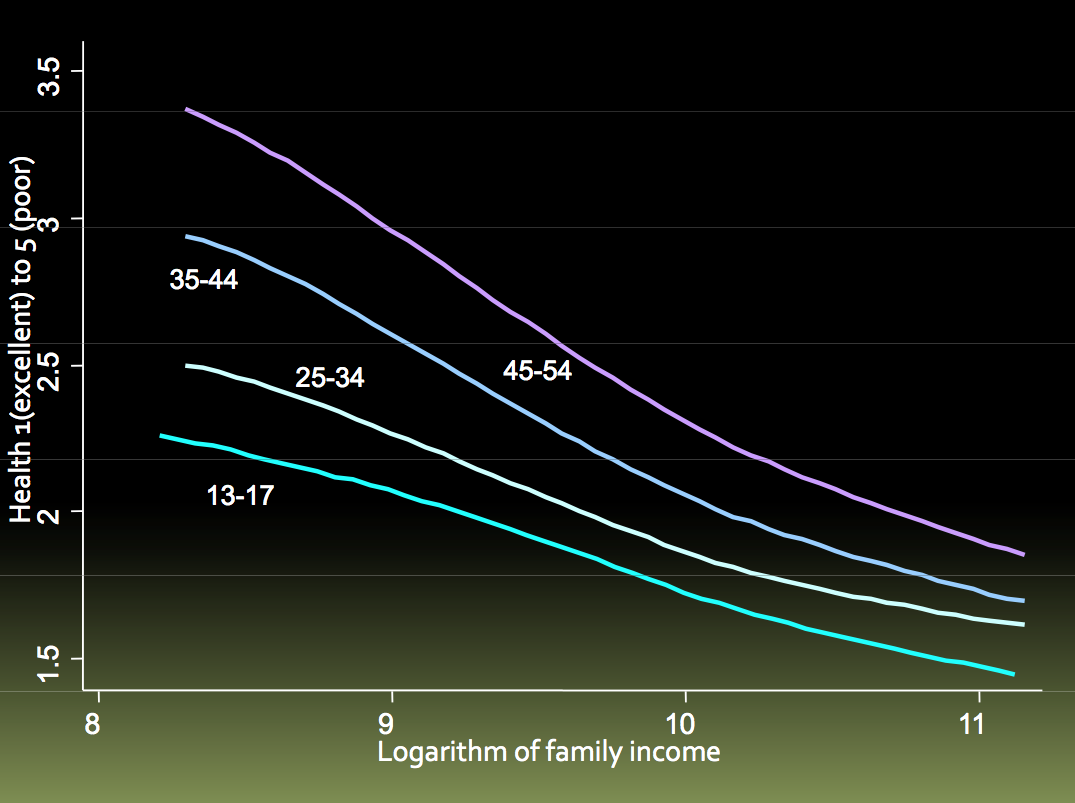
Just in case you aren’t used to the idea of using the log of things, it represents a growth rate. It’s basically a percentage change in thing over time so it’s a dynamic measurement of what ever is being measured.

Well, that is longer than I thought! So, what’s on your reading and blogging list today? Oh, and as usual, let’s play guess the celebrities and the singular location!!!!

 peej
peej Carissa
 bostonboomer
 dakinikat
 ecocatwoman
 jjlo
jjlo mablue2
 Mama Lopez
 peggysue22
 quixote
 skydancingguestblogger
 Mona (aka Wonk the Vote)





Recent Comments