
Friday Reads: Post Cards from the fractious Right Wing
Posted: October 18, 2013 Filed under: morning reads 59 Comments Good Morning!
This is probably going to strike you as a strange Friday Reads post but a few conversations with folks and this op-ed from economist Simon Johnson got me thinking about the great ongoing right wing conspiracy against Federalism, the New Deal, and the American way of life outside of those that were and still are wild about the good old days of the Confederacy. I really had a front seat to the Great Republican Purge of Reason, Secularism, and Modernity as a kid during the 1970s and a young adult in the 1980s and 1990s. I’ve never seen such an enduring crusade in modern times. It has come together to create a perfect storm and a perfect mess. The coalition of the crazy is also coming apart at the seams.
With a last-minute agreement on lifting the debt ceiling, the immediate threat of legal and financial disaster from a default on United States government obligations has been averted. But the last week has provided additional insight into how and why the current governmental arrangement known as the United States of America will end.
The mainstream narrative is that the problem is “dysfunctional government” or “paralysis in Washington.” That’s true, up to a point, but the real problem is the steady decline in legitimacy of the federal government – and the way this is related to what has happened on the right of the political spectrum.
For an earlier view of American government, I recommend the World War II trilogy by Rick Atkinson – the third volume of which came out this year (“The Guns at Last Light”). There was plenty of mismanagement, including by the military at all levels, during that conflict. But there were also remarkable achievements. In the 1940s, many people believed, with good reason, in the ability of the federal government to both organize activities at home and to have a positive impact around the world.
This was, perhaps, the most lasting effect of the Great Depression. In the 1930s, the private economy stumbled and private financial arrangements failed in many ways – but, on the whole, government was perceived as stepping in to help.
This positive view of an expanded federal government never sat well with people on the right, but the organized pushback was limited through the 1950s. It was only with the turmoil of the Vietnam War and other social pressures in the 1960s that the conservatives got their chance – starting with political direct mailing (American Target Advertising was founded in 1965), the rise of talk radio (particularly from the 1980s), and early anti-tax campaigns (including Proposition 13, which cut property taxes sharply in California in 1978).
Johnson argues that the right began to take advantage of the social upheaval occurring in the 1960s and 1970s to spin a tail that the Federal Government is something to fear and basically is some beast that needs to be tamed. As the federal government has acted to expand the rights of women, minorities, and new arrivals to the country, folks empowered by their local governments to suppress anything the local powers that be–white men, the plutocrats, local governments, businesses, and religious institutions–and their ability to abuse the powerless began to coalesce into the Republican party. The Republican Party has attracted business interests from its very beginning having sprung from the industrial north prior to the Civil War. What began to change was the realization that it needed to attract other groups in order to expand its interests. The Southern Strategy was used to attract the racist elements of the old confederacy. The 1980s saw the party attract Pat Robertson, Jerry Falwell and the religious right wing. These folks were incensed at advances made by the women’s movement and the budding GLBT rights movement . Libertarians—another brand of state’s rights and free market true believers–have been brought in by the money of the Kochs and other folks starting think tanks appealing to disenfranchised feeling white men who want their sex lives and pot as they want them, their privileges in tact, and their ability to avoid a draft to a foreign war the way it is.
There is a widening split in the party between these factions.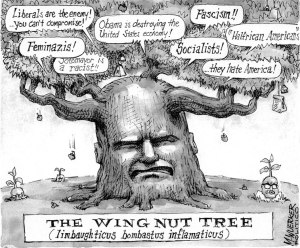
In a sign of the internal backlash against the right wing of the House Republican Conference, Louisiana Republican Charles Boustany questioned the political allegiances and motivations of his tea party-aligned colleagues and said they had put the GOP majority at risk in the current shutdown fight.
“There are members with a different agenda,” Boustany said Wednesday in an interview in his office. “And I’m not sure they’re Republicans and I’m not sure they’re conservative.”
His comments came a day after rank-and-file House Republicans rejected a package to reopen the government authored by their own leader, Speaker John Boehner. The result is that a bipartisan Senate-authored deal to end the two-week government shutdown appears poised to pass with almost nothing of substance gained by House conservatives for the shutdown they precipitated.
“The speaker has said consistently unless we can put 218 votes up, and preferably more than that, our ability to negotiate is pretty much undermined and that’s the problem we’ve repeatedly found ourselves in,” said Boustany, who has served since 2005 and is a senior member of the Ways and Means Committee. “Look at payroll tax. Look at fiscal cliff. You can go on and on. There are a handful of members – the numbers sort of vary, it’s in the 20-30 range – that are enough to derail a Republican conservative agenda in the House.”
Democracy Corp’s recent poll identified some of the major factions within the party. Each of them have extremely strong views and none of them are particularly palatable to the majority of Americans. The base voters have to hang together on each other’s extremist positions or they hang alone. Increasingly it looks like they may hang along. This is recent analysis from Bill Moyers’ group is by Joshua Holland.
Democracy Corps – a Democratic-leaning polling firm – released a study this week based on a series of focus groups they conducted with loyal Republican voters. They divided them up into three sub-groups which together represent the base of the party. Evangelicals represent the largest group, followed by Republicans who identify with the tea party movement. “Moderates,” the third group, make up about a quarter of the party’s base, according to the pollsters.
Fear of a changing society is one thing that unites all three factions. The battle over Obamacare, write the study’s authors, “goes to the heart of Republican base thinking about the essential political battle.”
They think they face a victorious Democratic Party that is intent on expanding government to increase dependency and therefore electoral support. It starts with food stamps and unemployment benefits; expands further if you legalize the illegals; but insuring the uninsured dramatically grows those dependent on government. They believe this is an electoral strategy — not just a political ideology or economic philosophy. If Obamacare happens, the Republican Party may be lost, in their view.
And while few explicitly talk about Obama in racial terms, the base supporters are very conscious of being white in a country with growing minorities. Their party is losing to a Democratic Party of big government whose goal is to expand programs that mainly benefit minorities. Race remains very much alive in the politics of the Republican Party.
They worry that minorities, immigrants, and welfare recipients now believe it is their “right” to claim [public] benefits. Tea Party participants, in particular, were very focused on those who claim “rights” in the form of government services, without taking responsibility for themselves.
They are also unified in their belief that Obama is a usurper who has hoodwinked the public into re-electing him by hiding his true beliefs, which are essentially Marxist. They also think that Democrats have won the major political battles of our time because Republican legislators in Washington didn’t put up a fight.
But there are also deep divisions within the base, according to the analysis. Evangelicals still focus overwhelmingly on social issues. They think gay rights are the biggest threat to our society, but they also worry about the loss of what they see as an idyllic small-town culture. They feel besieged as the cultural ground shifts beneath them, and see themselves as a beleaguered, “politically incorrect” minority.
Tea partiers display a libertarian streak, and are far less concerned with social issues. They are staunchly pro-business. But there’s an easy alliance between these two groups – which make up well over half of the GOP base – because Evangelicals think the tea partiers are fighting back, and vice versa.
Both groups displayed a high level of paranoia, according to the researchers who conducted the study. They noted that this was the first time, in many years of conducting focus groups, that participants worried that their participation might trigger surveillance by the NSA or an audit by the IRS. In addition to thinking that Obama is a liar, and a covert Communist, these two groups were also more likely to express the belief that he is secretly a Muslim.
The moderates were, as one might expect, quite different. Like the tea partiers, they don’t worry as much about social issues. Their concerns are traditionally conservative – they worry about excessive regulation and taxation. They have a hard time taking Fox News seriously, and hold a deep disdain for the tea party faction. They are also keenly aware of their waning influence within the coalition.
Moderates are not so sure about their place in the current Republican Party. They worry about the ability of Republicans in Congress to make government work. They believe the party is stuck, not forward-looking, and representative of old ideas. They worry about the Republican Party’s right turn on social and environmental issues — which makes it difficult, especially for young moderates — to view the Republican Party as a modern party.
Unlike the tea partiers and Evangelicals, the moderate faction desperately wants lawmakers in Washington to find a common middle ground. They are less likely to worry about unauthorized immigration than the rest of the base, and some went so far as to speak positively about immigrants’ contributions to our society and economy.
I had a front seat to the first of the purges of moderates that occurred in the reddest of the red states. The media really didn’t notice it because they 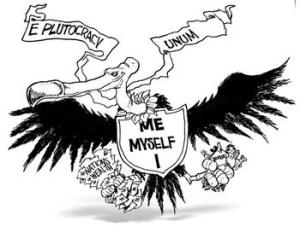 generally don’t spend much time in the great fly over where the first purge came from the religious right and really played out royally during the Clinton Years. They’ve been a little bit more cognizant of the rising power of the Libertarians since many of the young white media males are in their number. These groups are getting increasingly more difficult to herd as John Boehner has found out. They are no longer content to sit in the county and city level party structures working for the usual Republican suspects put forth by the Chamber of Commerce. They’ve infiltrated enough of the state offices to be able to move into the District and Congress. It’s driving the establishment Republicans crazy. But, it’s also what they more or less asked for given their strategies. Did they really think these groups were going to be content with meaningless platform stands and not much else?
The Tea Party which is increasingly made up of not only right wing populists but the religious right is sure to cause more problems for Boehner and the Beltway regulars. There is a future fight ahead to see if the current status quo will hold very long.
The deal extends funding for the government through Jan. 15. Republicans are now very, very invested in not triggering another government shutdown. Much more invested than they were last month, when party leaders got forced into shutting down the government against their better collective judgment.
Democrats won’t shut down the government. They’re not going to make demands unrelated to the issue at hand, like Republicans just did, and refuse to fund the government unless they get their ransom. But they will fight harder than ever to ease sequestration, and their leverage will come both from the deadline and the House GOP’s inability to govern itself. This is where the dynamic between Boehner and his hardliners will become relevant again. The only way for him to beat back Democratic demands without shutting down the government will be to pass appropriations in some form that neither exceed sequestration nor include the kinds of extraneous riders that will invite easy veto threats from Obama.
This will be an immense challenge. Hardliners aren’t particularly interested in funding the government without demanding ransoms, and even if they were, it might not be possible at the funding levels the party supports. Earlier this year they had to yank the one domestic appropriations bill they’d hoped to pass on the floor, because it was too austere for Democrats and moderate Republicans, and not radical enough for the hardliners.
They’re not going to get a lot of help from Democrats if they try to appropriate at 2014 sequestration levels. And if they can’t appropriate on their own, without once again dragging Obamacare into the equation, they’ll have a problem.
At heart, in all of this discussion of the deficit and spending, will be the call for bringing down both Social Security and Medicare. This continues to be a hard sell to the American people but seems like an inevitable discussion as one more bipartisan group sits down for talks.
The last-minute agreement didn’t eliminate the core conflict in Congress over fiscal policy, and the temporary funding extension for the government expires on Jan. 15. The debt ceiling increase expires Feb. 7.
Republicans say that in the next round of budget talks they will still refuse to raise taxes, while Democrats say they won’t cut entitlements such as Social Security and Medicare without more tax revenue.
House Republicans vowed to keep chipping away at the Patient Protection and Affordable Care Act, the president’s signature achievement of his first term.
“We haven’t really resolved any of the big issues,” said Dan Meyer, who was chief of staff to Newt Gingrich when the former House speaker was confronting Clinton over the budget. “He didn’t get more revenue. He didn’t get the sequester caps lifted. All those decisions were punted.”
Everything’s been punted. We’re going to have to see if what we’ve gotten ourselves a new catfood commission. We do know that the Republicans will be coming for whatever they can grab for their extremist factions. Need Birth Control? No way! Want to access your right to an abortion? Try a quick plane trip to a blue state? Need an increase in your Social Security? Nah, too generous granny! I can see it all coming now.
What’s on you reading and blogging list this morning?
Breaking News: Boehner will not block the Senate Agreement
Posted: October 16, 2013 Filed under: Breaking News 64 Comments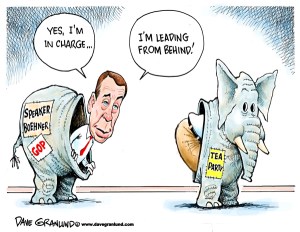 House Republicans have just left a meeting with Leadership. It appears we have an agreement of some kind.
BREAKING: Boehner surrenders: “Blocking the bipartisan agreement reached today by the members of the Senate will not be a tactic for us.”
A vote on the bill to avert a default and reopen the government is expected as early as this evening.
Update 3: House Speaker John Boehner hasreleased a statement about the agreement, promising to support the Senate’s bill: “Blocking the bipartisan agreement reached today by the members of the Senate will not be a tactic for us. In addition to the risk of default, doing so would open the door for the Democratic majority in Washington to raise taxes again…our drive to stop the train wreck that is the president’s health care law will continue. We will rely on aggressive oversight that highlights the law’s massive flaws and smart, targeted strikes that split the legislative coalition the president has relied upon to force his health care law on the American people.”
Senate leaders have forged an 11th-hour deal to end the government shutdown and raise the debt ceiling, and House Speaker John Boehner is expected to bring the bill up for a vote,Politico and other media outlets reported Wednesday morning. If the bill passes and arrives on President Obama’s desk by the October 17 deadline, the US government will reopen until January 15, and the debt ceiling will be raised until February 7, delaying the budgetary and debt ceiling crises and leaving President Obama’s signature health care bill largely intact.
Boehner: We fought the good fight, we just didn’t win.
In an interview on a local radio station, House Speaker John Boehner (R-Ohio) conceded that Republicans “didn’t win” the current budget debate.
“We’ve been locked into a fight over here, trying to bring government down to size, trying to do our best to stop Obamacare,” Boehner said. “We fought the good fight; we just didn’t win.”
Boehner also said he would “absolutely” allow a vote on the Senate plan even if a majority of House Republicans don’t support the bill.
“There’s no reason for our members to vote ‘no’ today,” Boehner said, adding that he expected the vote to happen Thursday.
Ryan Budget Plans Ignored as Lawmakers Craft Debt-Limit Deal
Representative Paul Ryan wanted big policy changes to lift the U.S. debt ceiling: a revamp of Social Security and Medicare, a framework for tax-code changes and approval of the $5.3 billion Keystone XL pipeline.
That’s all on hold now. Lawmakers are moving to adopt legislation to end the 16-day partial government shutdown and continue paying the nation’s bills. Ryan’s ideas for fixing the crisis weren’t included in a Senate compromise that may come up for votes today.
Instead, the Republican Party’s fiscal-policy leader and its 2012 vice presidential nominee will have to wait for budget negotiations in the coming weeks that are envisioned in an emerging Senate agreement to end the current impasse.
Ryan’s limited role in the immediate talks risks diminishing his credentials before 2016, when the Budget Committee chairman could be a White House contender, said Julian Zelizer, a professor of public affairs and history at Princeton University in New Jersey.
“There was a moment in recent days where it seemed like he would try to emerge in the spotlight, to help be the driver. But it didn’t happen,” Zelizer said. “He’s not a key figure.”
Tweets of Note:
.@Newsweek scoop: S&P was minutes from downgrading US credit when the shutdown deal came through: http://ow.ly/pSXlt
Boehner expects the government to reopen tomorrow http://huff.to/19QLdgo
Freedomworks CEO: House GOP ‘yes’ votes on Senate deal should be ready for primary challengers http://bit.ly/19SrU8k
Monday Reads: Coming apart at the seams
Posted: October 14, 2013 Filed under: morning reads 56 Comments Good Morning!
Every time I see a member of the Tea Party talk about “taking their country back”, I wonder which country they mean? Yes, nothing says respect our vets like waving confederate flags and telling our President to put down his Q’uran. Senator Ted Cruz and professional gadfly Sarah Palin have once again proven that their followers are just plain off their proverbial rockers.
“Veterans” – basically Tea Partyers – led by Palin and Cruz, marched today on the World War II memorial in Washington, DC, stole the National Park Service’s protective barriers, and then threw them at the White House.
This was intended to show their ire over the fact that the World War II memorial, along with every other federal land, site, office and program, was closed once the GOP shut down the federal government in the hopes of extorting the President into defunding health care reform, aka Obamacare, aka the Affordable Care Act.
The Tea Party “vets,” led by Palin and Cruz, are apparently so outraged at themselves for shutting down the federal government, that they’re now protesting the President for listening to them.
Tea Party protesters also concerned about Obama being a Muslim
According to CNN, the Tea Party protesters gathered at the White House are also very concerned that President Obama is a Muslim:
One speaker went as far as saying the president was a Muslim and separately urged the crowd of hundreds to initiate a peaceful uprising.
“I call upon all of you to wage a second American nonviolent revolution, to use civil disobedience, and to demand that this president leave town, to get up, to put the Quran down, to get up off his knees, and to figuratively come out with his hands up,” said Larry Klayman of Freedom Watch, a conservative political advocacy group.
Fox’s Brit Hume is quite upset that Politico’s Ben White appears to have a brain
Of course, leave it to Fox News to come to the defense of today’s contradictory Tea Party protest against the very shutdown policy the Tea Party championed.
 Go read the twitter exchange between Hume and White. It’s worth the look. The rally wasn’t very big but the radical right can still grab media attention. That probably explains one of the reasons that Palin showed up given she’s about as relevant as a French Franc these days.
About 200 people, counting among their ranks Republican Senator Mike Lee, Senator Ted Cruz and former Governor of Alaska Sarah Palin, converged on D.C.’s World War II memorialSunday morning. Slightly overselling themselves as the ”Million Vet March on the Memorials,” they cut through barriers to protest the site’s closing during the shutdown.
“This is the people’s memorial,” Cruz said in a speech. “Let me ask a simple question. Why is the federal government spending money to erect barricades to keep veterans out of this memorial?”
Those present weren’t all agreed upon the specifics of their grievances, according to the Washington Times. As one protestor put it: “There’s a three-part focus: veterans, impeachment and the truckers.”
Other Tea Partiers heckled the police at the White House.
The fine, upstanding patriots who protesting at Washington, DC memorials ganged up on police at the White House calling them names like “Gestapo,” “Brown Shirts,” and “Stasi.” They also yelled that the security unit “looked like something out of Kenya.” These Tea Partiers have been making public displays about how much they love Americans serving in uniform, but that, apparently, doesn’t extend to police uniforms.
Stay classy my friends!!!
Meanwhile, the relevant people in the government were trying to figure out a way to open the government and avoid defaulting on the national debt. Reid and McConnell are taking the three day weekend to try to find some common ground. McConnell appears quite wed to the sequester which is devastating essential government services in an outrageous way. There doesn’t appear to be much movement on any one’s part.
In talks between Senate Majority Leader Harry Reid (D-Nev.) and Senate Minority Leader Mitch McConnell (R-Ky.), the main sticking point is now where to establish funding levels for the federal government and for how long. The Republican offer made on Friday — to set spending at sequestration levels of $988 billion for the next six months -– was rejected by Reid and others on Saturday on the grounds that it was too favorable to the GOP position and discouraged future negotiations.
By Sunday morning, little notable progress toward a resolution had been made. McConnell, according to sources, was adamant that the spending cuts of sequestration be maintained in any final arrangement.
“Sen. McConnell will defend the commitment Congress made on spending reductions; he’ll defend the law that Sen. Reid voted for and the president signed — and subsequently bragged about in his campaign,” said McConnell spokesman Don Stewart. “As I recall, Sen. Reid voted for, and President Obama signed the Budget Control Act [which established sequestration]. They may not like that the supercommittee didn’t act and we’re left with sequester, but under their own rhetoric, it’s ‘the law of the land.'”
Some of McConnell’s top deputies that echoed sentiment on the Sunday talk shows. “The president and leaders of Congress need to take the responsibility of dealing with the underlying problem and keep the budget caps in place,” Sen. Rob Portman (R-Ohio) told “Meet The Press.” “My gosh, we just put them in place two years ago.”
“If you break the spending caps, you’re not going to get any Republicans in the Senate,” Sen. Lindsey Graham, (R-S.C.) said on ABC’s “This Week.”
There doesn’t appear to be any movement really on either side. As I’ve written about before, nations around the world are not responding well to any of  these. The Chinese are calling for “De-Americization” saying that Pax America has failed on all fronts.
China’s official news agency has called for the creation of a “de-Americanised world”, saying the destinies of people should not be left in the hands of a hypocritical nation with a dysfunctional government.
Heaping criticism and caustic ridicule on Washington, the Xinhua news agency called the US a civilian slayer, prisoner torturer and meddler in others’ affairs, and said the ‘Pax Americana’ was a failure on all fronts.
The official news agency of China, which is seen as the pretender to the world’s superpower crown, then rubbed in more salt, calling American economic pre-eminence just a seeming dominance.
“As US politicians of both political parties are still shuffling back and forth between the White House and the Capitol Hill without striking a viable deal to bring normality to the body politic they brag about, it is perhaps a good time for the befuddled world to start considering building a de-Americanised world,” the editorial said.
It asks why the self-declared protector of the world is sowing mayhem in thefinancial markets by failing to resolve political differences over key economic policy.
“… the cyclical stagnation in Washington for a viable bipartisan solution over a federal budget and an approval for raising debt ceiling has again left many nations’ tremendous dollar assets in jeopardy and the international community highly agonised,” the agency said.
It is not the first time Chinese leadership and newspapers have criticised Washington over a policy paralysis that threatens to devalue its dollar assets.
According to US Treasury Department data, China is the biggest foreign owner of US Treasuries at $1.28 trillion as of July. Besides, China also holds close to $3.5 trillion of dollar-denominated assets.
A US debt default and consequent credit downgrade would significantly erode the value of China’s holdings.
A U.S.default would put is in the company of some pretty rogue nations including 1933 Germany.
Reneging on its debt obligations would make the U.S. the first major Western government to default since Nazi Germany 80 years ago.
Germany unilaterally ceased payments on long-term borrowings on May 6, 1933, three months after Adolf Hitler was installed as Chancellor. The default helped cement Hitler’s power base following years of political instability as the Weimar Republic struggled with its crushing debts.
“These are generally catastrophic economic events,” said Professor Eugene N. White, an economics historian at Rutgers University in New Brunswick, New Jersey. “There is no happy ending.”
The debt reparations piled onto Germany, which in 1913 was the world’s third-biggest economy, sparked the hyperinflation, borrowings and political deadlock that brought the Nazis to power, and the default. It shows how excessive debt has capricious results, such as the civil war and despotism that ravaged Florence after England’s Edward III refused to pay his obligations from the city-state’s banks in 1339, and the Revolution of 1789 that followed the French Crown’s defaults in 1770 and 1788.
Failure by the world’s biggest economy to pay its debt in an interconnected, globalized world risks an array of devastating consequences that could lay waste to stock markets from Brazil to Zurich and bring the $5 trillion market in Treasury-backed loans to a halt. Borrowing costs would soar, the dollar’s role as the world’s reserve currency would be in doubt and the U.S. and world economies would risk plunging into recession — and potentially depression.
Ever thought about working for Amazon? Well, Business Week’s look at Jeff Bezos may give you pause.
The people who do well at Amazon are often those who thrive in an adversarial atmosphere with almost constant friction. Bezos abhors what he calls “social cohesion,” the natural impulse to seek consensus. He’d rather his minions battle it out backed by numbers and passion, and he has codified this approach in one of Amazon’s 14 leadership principles—the company’s highly prized values that are often discussed and inculcated into new hires:
Leaders are obligated to respectfully challenge decisions when they disagree, even when doing so is uncomfortable or exhausting. Leaders have conviction and are tenacious. They do not compromise for the sake of social cohesion. Once a decision is determined, they commit wholly.
Some employees love this confrontational culture and find they can’t work effectively anywhere else. “Everybody knows how hard it is and chooses to be there,” says Faisal Masud, who spent five years in the retail business. “You are learning constantly, and the pace of innovation is thrilling. I filed patents; I innovated. There is a fierce competitiveness in everything you do.” The professional networking site LinkedIn (LNKD) is full of “boomerangs”—Amazon-speak for executives who left the company and then returned.
But other alumni call Amazon’s internal environment a “gladiator culture” and wouldn’t think of returning. Many last less than two years. “It’s a weird mix of a startup that is trying to be supercorporate and a corporation that is trying hard to still be a startup,” says Jenny Dibble, who was a marketing manager there for five months in 2011. She found her bosses were unreceptive to her ideas about using social media and that the long hours were incompatible with raising a family. “It was not a friendly environment,” she says. Even leaving Amazon can be a combative process—the company is not above sending letters threatening legal action if an employee takes a similar job at a competitor. Masud, who left Amazon for EBay(EBAY) in 2010, received such a threat. (EBay resolved the matter privately.)
 Gladiator Culture? Oy!!!
So, today is a holiday and I have to join a lot of people in asking why the heck do we still celebrate Columbus Day? How do you “discover” something when it’s already been there and you actually were looking for some place else? Then, you basically turn the place into a living hell for those you “discovered”? Just don’t get it at all!
I’m still one of those that believes we should honor the first Americans! That would be the ones who were already here when the Europeans invaded the place.
One issue that came up during our conversation was the fact that Columbus Day really should be renamed to Native American Day, in honor of the millions of people whose heritage has been ridiculed and ruined in mainstream media (when the plight of people living on reservations isn’t being ignored entirely, that is). However, when Brown University exchanged “Columbus Day” language for more neutral “Fall Weekend,” they were met with opposition from their College Republican group, whose leader argued “Columbus should be celebrated for bringing the European political tradition to the New World, which led to the foundation of the United States.”
Oh, dear! I’m back to xenophobic and racist republicans again. How did that happen? Like I said, when they say take ‘our’ country back. What the hell country and who do they mean?
What’s on your reading and blogging list today?
Friday Reads
Posted: October 11, 2013 Filed under: morning reads | Tags: CIA, clandestine services, cocoa shortage, U.S women and longevity 105 Comments Good Morning!
I think most of us that have lived awhile can attest to the fall in lifestyle and standards of living in the country. I think it’s been rather obvious that it’s much more difficult to “get ahead” more than at any other time in recent U.S. history. I ran across some interesting articles that sort’ve validated my gut feeling so I thought I’d share them with you. I hope you don’t find them too depressing. The first one indicates that the longevity of U.S. women just isn’t what it used to be. Why are U.S. women dying younger than their mothers?
Whether you think the Affordable Care Act is the right solution or a dangerous step toward tyranny, it’s hard to dispute that the U.S. health-care system is broken. More than 48 million people lack health insurance, and despite having the world’s highest levels of health-care spending per capita, the U.S. has some of the worst health outcomes among developed nations, lagging behind in key metrics like life expectancy, premature death rates, and death by treatable diseases, according to a July study in theJournal of the American Medicine Association.
For some Americans, the reality is far worse than the national statistics suggest. In particular, growing health disadvantages have disproportionately impacted women over the past three decades, especially those without a high-school diploma or who live in the South or West. In March, a study published by the University of Wisconsin researchers David Kindig and Erika Cheng found that in nearly half of U.S. counties, female mortality rates actually increased between 1992 and 2006, compared to just 3 percent of counties that saw male mortality increase over the same period.
“I was shocked, actually,” Kindig said. “So we went back and did the numbers again, and it came back the same. It’s overwhelming.”
Kindig’s findings were echoed in a July report from University of Washington researcher Chris Murray, which found that inequality in women’s health outcomes steadily increased between 1985 and 2010, with female life expectancy stagnating or declining in 45 percent of U.S. counties. Taken together, the two studies underscore a disturbing trend: While advancements in medicine and technology have prolonged U.S. life expectancy and decreased premature deaths overall, women in parts of the country have been left behind, and in some cases, they are dying younger than they were a generation before. The worst part is no one knows why.
I’ve always thought that the American Lifestyle that you find touted on TV and at most restaurants and stores is really at odds with living well. Here’s an interesting  list of items that also reminds me why I always wanted to just stay in Europe whenever I visited there. Are Europeans better at just living life? Here’s one of the statistics that makes me realize how overworked the U.S. worker is and why we all just sort’ve wear out at some point in time.
Europeans:
The top seven nations in the world, in terms of time off? All European. Austrians get 35 (35!) paid days off per year. Nobody criticizes them for being lazy.
Americans:
Meanwhile, the U.S. is the sole developed nation that requires no paid vacation time or holidays by law.
There’s a lot of fun comparisons there including cars, cheese, and sports. The link is good for a few smiles.
So, I lot of people subscribe to the idea of peak oil. I’ve always thought I’d really rather go solar or some alternative for energy in the future since fossil fuels have such incredible problems. I’m not all that concerned about an oil shortage, but a cocoa bean shortage? That’s a completely different matter!!!
The world will officially run out on October 2, 2020.
Industry experts met in London last week to discuss the impending meltdown.
Confectionery giants revealed there are just not enough cocoa plantations across the globe to feed the demand.
They warned we would need the equivalent of another planet Earth to fill the gap needed to keep the chocolate industry going.
Prices are set to soar over the next few years as chocolate becomes harder to get hold of.
As a result many big-name companies are expected to fill bars that are smaller in size with more nuts and fruit because they are cheaper to produce.
Chocolate taster and expert Angus Kennedy said: “There will be a chocolate shortage and there isn’t a solution to the problem. Seven years is what we think we have left.
“Experts have worked out we need 2.3 globes to accommodate man’s needs for chocolate in terms of forestry and space.
“We need another Earth basically if we carry on at this rate. We are destroying the whole thing.
“The problem we’ve got is that much of the space that was used for cocoa plantations is no longer there.
“The Chinese love their cars and they have found that rubber makes more money than cocoa and at a much quicker pace.
“Cocoa farms are being chopped down and turned into rubber plantations because they get a better yield.
“If you plant a cocoa plant you get cocoa beans in four years, which means the farmers are waiting four years for a profit so obviously they think ‘What is the point?’”
Manufacturers from all over the world including Iran, Belgium, Lebanon, Germany and Switzerland met at the British Library last week for the annual Chocolate Industry Network Conference where they heard the worrying news.
 At all curious about real US CIA agents in clandestine service? Try reading this article at Newsweek.
After a stint in the Marines, Archibald began his CIA career as a weapons man in the agency’s special activities division – the “knuckle-draggers,” as they’re known around headquarters – during the Bosnian civil war. From there, he made it into the agency’s elite spy corps, rising to the rank equivalent of general in Pakistan.
How Archibald got his new job remains a mystery to everyone Newsweektalked to. One source thought he’d caught the eye of David Petraeus, whose brief tenure as CIA chief was short-circuited in 2012 by an extramarital affair. Other agency veterans think current CIA director John Brennan liked the former Marine’s non-confrontational style. Bonus points: There was not a whiff of scandal in his background, unlike that of the acting chief, who was closely identified with harsh interrogations and passed over in favor of Archibald. She stayed on as his deputy.
One agency veteran has a more nuanced take on the appointment: “Brennan is his own clandestine ops chief.” Another added, “[Brennan] doesn’t like anyone to argue with him much.”
But there are plenty of things to argue over, insiders say, starting with the layers upon layers of assistants to deputy assistants that clog the agency’s chains of command. Many agency old-timers are also dismayed that the CIA’s core mission of spying on major adversaries seems to have been eclipsed by constant commando raids and drone strikes against terrorist targets. All that, they contend, diverts the agency’s finite resources, time and attention from finding out what’s really going on inside Vladimir Putin’s Kremlin, China’s weapons labs or Iran’s nuclear program.
What does Frank Archibald think? Sorry. We can’t ask him.
Today is payday for hundreds of thousands of federal workers. What will they get?
The paycheck federal workers have been dreading hit bank accounts across the region Friday, representing salaries cut in half for most idled employees. The next payday will be all zeros, and with furloughs dragging on, civil servants are settling into a financial crouch, slashing expenses, canceling vacations, tapping retirement savings and taking second jobs.
“We have no income coming into the house right now, but the bills haven’t stopped,” said John Ferris of Falls Church. He is in a two-furlough marriage; both he and his wife, Lena, are locked out of jobs at the Environmental Protection Agency. With both of their paychecks dwindling, the family of six has put a scalpel to the household budget.
They’ve cut out restaurants and expensive groceries. Gone are the motel stays at their kids travel softball tournaments; instead, they drive all night. But the most painful cut has been a furlough of their own, laying off their autistic son’s longtime reading specialist.
“He’s been with our family for years, and I love him to death, but I thought, ‘Wow, how am I going to pay him if we don’t have paychecks coming,’ ” Lena Ferris said. She worries that one of the shutdown’s lasting aftershocks could be her son’s having to adjust to a new tutor. “He needs money, too,” she said of the tutor. “I’m worried he’s going to start working for another family.”
Federal workers say they were hugely relieved by last week’s House vote toguarantee the missed pay after the furlough’s over. But that hasn’t eased their anxiety over the bills stacking up in the meantime. Some parents are stretching to pay for day care they don’t need just so they don’t lose their slots while waiting to go back to work. All around the region, the furloughed are looking for money to satisfy their creditors or begging
them for more time to pay their bills.
“A lot of our members have been asking to skip a payment,” said Pamela Hout, chief executive of the Census Federal a Credit Union. Her staff has been working a few hours a week at the nearly deserted Census Bureau headquarters in Prince George’s County to meet the demand. “We’ve been accommodating them; all they have to do is show us their [furlough] letter.”
I need to add one more thing before I sign off this morning. This is the month that we need to renew our domain and our ability to customize things here. The bill is about $100 per year so just a bit of a donation to the blog would be much appreciated. The specialized font comes due in about a month after that so any thing above that will be held until that comes due!!! Thanks so much!!!
So, that’s my little bit of this and that on a Friday. What’s on your reading and blogging list today?
Blessed are the Poor or maybe not …
Posted: October 9, 2013 Filed under: poverty, social justice | Tags: war on the poor 14 CommentsSo, ya’ll know I’m not a deist or a christian. But, I do know a lot about the theology having studied it and basically grown up a Presbyterian by default. I say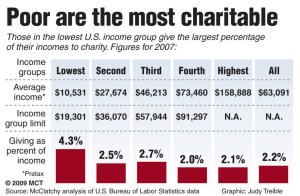 default because I was baptized Presbyterian mostly because my mother’s golf partner at the country club was the Presbyterian minister’s wife. The next time we moved, I was the only one in the family that stuck with the church thing mostly because the best music program in the city was in the Presbyterian church because the minister’s wife was a serious piano teacher. The minister was great. He drove around in an orange fiat convertible with a tweed jacket, a golf tam, and leather gloves. When he wasn’t writing his sermon about what to do the next time you were sitting in the locker room at the country club, he was at the country club golfing. I have to admit to being kind’ve of an outlier in my family since I’m not a millionaire. I’ve seen what kind of trivial concerns the rich tend to have and I really don’t want to be a part of it. I’d much rather appreciate my daily bread instead of a pair of manolo blahniks.
I just don’t care that much about money. I have very simple needs plus I’m a Buddhist and that’s sort’ve a lifestyle thing with us. I say all this because I have been on both sides of the income spectrum and I actually chose downward mobility. However, I didn’t want to choose poverty. That’s a more difficult thing to avoid these days; especially if you’re an aging woman in a red state where the governor hates all teachers and professors.
I guess I was the only rich republican kid that read the four woes listed in Luke 6:24–26 that start with “Woe to you…” when I was a good little Presbyterian in sunday school.
…who are rich, for you have already received your comfort.
…who are well fed now, for you will go hungry.
…who laugh now, for you will mourn and weep.
…when everyone speaks well of you, for that is how their ancestors treated the false prophets.
So, given Republican officials are cross-waving christians and just sort’ve wear the entire thing on their sleeves self righteously, why is there a war on poor people? I also read the four beatitudes in that same sermon on the plain in Luke’s gospel that starts out “Blessed are you…”
…who are poor, for yours is the kingdom of God.
…who hunger now, for you will be satisfied.
…you who weep now, for you will laugh.
I frequently wonder if their new testaments don’t have those particulars. I do have to say that most of my jaunty minister’s sermons had to do with it being easy to forget about reality when you’re sitting in a country club. (I think he may have been reminding himself. You should’ve seen the manse.) Maybe that is the thrust of the problem that we’re witnessing a bunch of self-professed christians declare war on the poor.
American conservatives for the past several decades have shown a remarkable hostility to poor people in our country. The recent effort to slash the SNAP food stamp program in the House (link); the astounding refusal of 26 Republican governors to expand Medicaid coverage in their states — depriving millions of poor people from access to Medicaid health coverage (link); and the general legislative indifference to a rising poverty rate in the United States — all this suggests something beyond ideology or neglect.
I also missed the part where Jesus wanted fetuses to come unto him but poor children and their mothers could just go to bed hungry.
 I left Nebraska nearly 20 years ago to discover a little something different in life down here in New Orleans. About 10 years ago, I bought a very modest house in the ninth ward of New Orleans. My neighborhood is undergoing incredible gentrification and I have to admit that I could not afford my house any more. Neither could any of the neighbors that were here when I moved here. I actually think this is part of a bigger plan to stop the poor and the black from returning to New Orleans but that is another post for another day.
There is a deliberate strategy of punishing the poor put into place by many southern, Republican governors that profess to be pious Christians. This includes my hyper-charismatic Catholic converted Bobby Jindal and both of the freaky Republican governors of the surrounding state. Their position on providing a medicaid expansion to the state to heal the poor is basically let them die in the poorly run privatized hospitals that Jindal sold to his donors at a really cheap price. I guess you have to be a leper to get health care according to biblical fundamentalists.
While Republicans in Congress weren’t able to defund Obamacare, many Republicans at the state level have found a different way to block low-income Americans from receiving cheaper health insurance. An estimated eight million Americans will remain poor and uninsured even after Obamacare is rolled out, due to the decision of many Republican governors and state legislators to reject the Affordable Care Act’s expansion of Medicaid.
When the Supreme Court upheld Obamacare last year, it also issued a less-noticed ruling that states could opt-out of the law’s Medicaid expansion, which broadened eligibility requirements for the program and provided federal funds to help pay for it. As this essentially amounted to free money until 2016 — at which point the federal government would pay for “only” 90 percent of the expansion — you’d think it’d be a no-brainer to accept it, right?
Well, not if you’re Rick Perry! Or Scott Walker, or Nikki Haley, or Bobby Jindal, or a ton of other red-state governors who decided to forego helping their poorest residents get health insurance because, well, that could alienate the GOP base voters next time they face a primary.
In total, 26 states have rejected the expansion, including the state of Mississippi, which has the highest rate of uninsured poor people in the country. Sixty-eight percent of uninsured single mothers live in the states that rejected the expansion, as do 60 percent of the nation’s uninsured working poor.
In general, states that rejected the expansion also have stricter eligibility requirements for Medicaid. While the 24 states that agreed to expand the program have a median income limit of $12,200 for Medicaid applicants, the limit is $5,600 —less than half the federal poverty level — in the states that rejected it.
One piece of the puzzle seems to come down to ideology and a passionate and unquestioning faith in “the market”. If you are poor in a market system, this ideology implies you’ve done something wrong; you aren’t productive; you don’t deserve a better quality of life. You are probably a drug addict, a welfare queen, a slacker. (Remember “slackers” from the 2012 Presidential campaign?)
Another element here seems to have something to do with social distance. Segments of society with whom one has not contact may be easier to treat impersonally and cruelly. How many conservative legislators or governors have actually spent time with poor people, with the working poor, and with poor children? But without exposure to one’s fellow citizens in many different life circumstances, it is hard to acquire the inner qualities of compassion and caring that make one sensitive to the facts about poverty.
A crucial thread here seems to be a familiar American narrative around race. The language of welfare reform, abuse of food stamps, and the inner city is interwoven with racial assumptions and stereotypes. Joan Walsh’s recent column in Salon (link) does a good job of connecting the dots between conservative rhetoric in the past thirty years and racism. She quotes a particularly prophetic passage from Lee Atwater in 1982 that basically lays out the transition from overtly racist language to coded language couched in terms of “big government”.
Finally, it seems unavoidable that some of this hostility derives from a fairly straightforward conflict of group interests. In order to create programs and economic opportunities that would significantly reduce poverty, it takes government spending — on income and food support, on education, on housing allowances, and on public amenities for low-income people. Government spending requires taxation; and taxation reduces the income and wealth of households at the top of the ladder. So there is a fairly obvious connection between an anti-poverty legislative agenda and the material interests of the privileged in our economy.
Many in the U.S. have fallen below the poverty line since the last recession because of loss of jobs combined with the increasing amount of income inequality in this country. It is really through no fault of their own. So, why do these memes and canards about the poor persist?
The bottom 1 percent in the U.S. live on an income that is one six-hundredth of the average for the richest 1 percent of Americans. They live on less than the average GDP per capita of a low-income country such as Afghanistan, Mozambique, or Haiti. And they live at or below the national poverty lines of such countries as Ghana, Congo, and Mongolia. Despite living in one of the richest countries in the world, the bottom 1 percent of Americans see incomes below the global median. The more successful disabled beggars of Addis Ababa in Ethiopia earn more than $2 on a good day, according to the International Labor Organization.
It is true that from an objective standpoint, living on $2 in a richer country is associated with better outcomes than living on $2 in a poor country—you are more likely to live in a house with basic utilities, and your children are less likely to die. In those terms, extremely poor Americans have it better than similarly poor Ghanaians—especially because the poorest in America will spend more than $2 a day even if their incomes are considerably below that. On the other hand, Ghanaians living on $2 a day are around average in their society; they don’t face the social stigma and exclusion of being so far removed from “normal” living standards.
Despite the physical and social costs of poverty, we have done a terrible job at raising the incomes of the poorest Americans over the past 20 years. The proportion of America’s households that live on less than $15,000 a year is as high as it was in 1989, while the proportion on more than $200,000 has gone up by two-thirds. That may be one reason for the country’s sluggish growth over that time—there isevidence that greater income equality is associated with stronger income growth for all.
There’s a solution to America’s extreme poverty problem. The example of countries where considerable proportions of the population live on less than $2 a day, as well as historical experience in the U.S., show that the most powerful tool to make poor people’s lives better is simply to give them cash. Brazil’s program of cash transfers, called Bolsa Familia, reduced inequality and increased both school enrolment and the number of poor people who were working. Perhaps we should try something similar in the U.S., providing an income floor for all Americans.
I’m going to give you a flashback from the past–1968– in an old conversation between William F. Buckley and Noble Prize winning economist Milton Friedman who was a big free market advocate back in the day. This is his suggestion of negative income tax.
I’m not showing you this to say it’s the way to go, I show you to ask a few questions: Would this conversation even be possible today? Have you seen any conversations recently on policies from the party of jaysuz and guns that provides any suggestions on how to actually help the poor?
America faces an opportunity gap. Those born in the bottom ranks have difficulty moving up. Although the United States has long thought of itself as a meritocracy, a place where anyone who gets an education and works hard can make it, the facts tell a somewhat different story. Children born into the top fifth of the income distribution have about twice as much of a chance of becoming middle class or better in their adult years as those born into the bottom fifth (Isaacs, Sawhill, & Haskins, 2008). One way that lower-income children can beat the odds is by getting a college degree.[1]Those who complete four-year degrees have a much better chance of becoming middle class than those who don’t — although still not as good of a chance as their more affluent peers. But the even bigger problem is that few actually manage to get the degree. Moreover, the link between parental income and college-going has increased in recent decades (Bailey & Dynarski, 2011). In short, higher education is not the kind of mobility-enhancing vehicle that it could be.
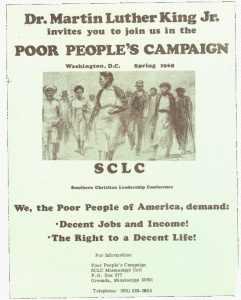
It seems that more of us are facing more uphill battles. It makes me wonder why the social activism and political activism of a Martin Luther King or a Cesar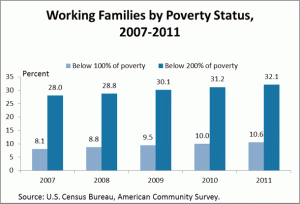 Chavez who fought for rights of the poor has declined?
Two factors seem to be relevant in explaining the political powerlessness of the poor. One is the gerrymandering that has reached an exact science in many state legislatures in recent years, with unassailable majorities for the incumbent party. This means that poor people have little chance of defeating conservative candidates in congressional elections. And second are the resurgent efforts that the Supreme Court enabled last summer to create ever-more onerous voting requirements, once again giving every appearance of serving the purpose of limiting voter participation by poor and minority groups. So conservative incumbents feel largely immune from the political interests that they dis-serve.
It would seem that more and more of us have interests aligned with poor folks. That is why the Republican party has also upped it’s race-baiting, women-baiting, GLBT-baiting, and immigrant-baiting. It is continuing to splinter the vast economic interests of the many into many morality plays. Even the Catholic church–a long time advocate of the poor and disenfranchised–has spent more effort on stomping on the secular rights of women and GLBTs than its usual role of ministering the poor. So, many social institutions have simply fallen prey to the same kind of divide and set-one-on-the other attitudes stoked by the money and the greed of folks like the Kochs.
I have no idea how these distortions have take center stage in our country to the point where our war on poverty has turned to a war on the poor. I can only think that those of us that fall into the category of having a shrinking pie are like dogs fighting over scraps thrown under the table by our 1 percent masters. It’s time for us to regain our perspective, if not our moral base.

 peej
peej Carissa
 bostonboomer
 dakinikat
 ecocatwoman
 jjlo
jjlo mablue2
 Mama Lopez
 peggysue22
 quixote
 skydancingguestblogger
 Mona (aka Wonk the Vote)





Recent Comments