
Monday Reads: News Exhaustion Edition
Posted: July 21, 2014 Filed under: Gaza, Middle East, morning reads, religious extremists, Reproductive Health, Reproductive Rights, Russia 27 CommentsGood Morning!
 We’re going to have to see what I come up with today because I openly admit to being extremely tired. We’ve had all this rain recently and it’s dark and gloomy all the time. Yesterday, it was so hard and heavy that the French Quarter flooded. So, here are a few things to consider before I head back to bed for awhile.
The Boston Globe features an article arguing that Southern Blacks and Hispanics will eventually trump angry, resentful, and backward white Republican voters in the South. If only. The analysis is by Bob Moser. The demographics have to be playing into white backlash which make the South the epicenter of voter suppression laws but it’s also a place where voter turnout is highly irregular.
The question is whether Democrats in these states are better served by following the region’s five-decade-long drift toward the GOP — or by betting that the climate is finally changing in their favor.
It’s a sign of things to come in states like North Carolina, where large influxes of Latino immigrants and “relocated Yankees,” both black and white, are tilting the demographic balance toward the Democrats and inspiring a new progressive movement. But despite Obama’s own surprising Southern breakthroughs — after Al Gore and John Kerry lost the entire region, he won three large Southern states in 2008 and two in 2012, falling just short in North Carolina — the region’s blue future is still a long-term proposition. Candidates like Hagan are stuck between the past, when Southern Democrats’ recipe for victory involved courting white moderates and conservatives, and a future in which they’ll be able to successfully campaign as full-throated, national-style Democrats. To win, Hagan and her compatriots must simultaneously woo independent-minded whites while persuading massive numbers of young voters and nonwhites, who lean left on both economic and social issues, to join them.
It’s an awkward proposition, to be sure. But the Democratic contenders have appeared hell-bent on making it look downright impossible.
But, it appears Georgia may already be in just that state of mind.
In a poll by Landmark Communications released Sunday, Democrat Michelle Nunn has a commanding lead against both of her potential challengers in Georgia’s US Senate race. Against Rep. Jack Kingston (R-GA) Nunn is up by eight points, 49% to 41%. The poll also shows her with a nice lead against businessman David Perdue as Nunn leads him 48% to 42%. Perdue and Kingston are heading into a GOP primary runoff this coming Tuesday. The survey shows Kingston with a sizable lead as he is ahead by seven points, 48% to 41%.
While Nunn holds leads against both men, the thought is that she’d prefer to face Kingston in the general election. Atlanta-based political analyst Bill Crane had the following to say after this poll was released.
“I think Michelle Nunn would prefer to run against Jack Kingston. Twenty-two year incumbent, PAC money, special interest, her preferred race is the race that I think she’s going to get.”
Nunn taking the Georgia Senate seat would put a huge crimp in the plans of Republicans who feel they can take over the US Senate this November. Currently, the GOP needs to net six seats in the midterm to become the majority party in the Upper Chamber. Losing a Senate seat in a deep-red state that was previously held by a Republican will almost certainly prevent Republicans from taking over the Senate. While it is nearly a given that Democrats will lose seats this November, it is looking more and more promising that they will be able to retain control of the Senate.
There’s all kinds of things happening that have caused me to pull the blankets over my head. The horrors in the Gaza strip, the ongoing downed  Malaysian jet catastrophe, and the week long visit of the Army of God to our city. They’re all over our women’s health clinics and they are creepy as creepy gets. Russia’s hand prints are all over the downed commercial airliner. Militants weirdly suggested that the people on the plane were all dead before the plane took off. WTF kind of craziness is this?
In a briefing at the Pentagon on Friday, Rear Admiral John Kirby told reporters that it “strains credulity” to think pro-Russian separatists believed to have shot down MH17 didn’t have at least some help from Moscow. Kirby said the Buk is a “sophisticated piece of technology” that would likely require technical assistance from Russia.
Inside a Buk. As you can see, it’s not as easy as just pushing one big red button.
Indeed, Air Force Gen. Philip Breedlove said in June the U.S. military’s intelligence was that rebels were being trained in tanks and anti-aircraft capability across the border, before heading back into eastern Ukraine to put it into practice.
According to IHS Jane’s Defense, a resource for intelligence and defense analysis, operating a Buk requires a trained crew. While the government of Ukraine also has Buk missile systems, Jane’s notes that the Ukrainian military has none of the systems in the region near the MH17 crash, as they were overtaken by pro-Russian separatists.
“The system is not a simple system to use. You need at least four to six months of training and ongoing training to operate it,” Ronald Bishop, a former U.S. Air Force missile expert, told Australia’s Warwick Daily News. “To fire this system you need to have highly-specialized military training.”
It finally looks like Europe is getting fed up with Russia and their cronies. The response comes because of the careless treatments of the remains of the  victims of the missile attack.
Investigators are still far from an official judgment of what brought down a Malaysia Airlines flight in eastern Ukraine, killing all 298 passengers and crew onboard. But the global court of public opinion, the verdict appears to be rendered.
Vladimir Putin is guilty.
The Russian President could once claim a semblance of a role as a global statesmen. But with the downing of a commercial airliner by what U.S. and Ukrainian officials suggest were pro-Moscow rebels using a missile supplied by Russia, Putin was facing a very personal barrage of worldwide condemnation that threatened to result in further sanctions on Russia if it did not rapidly change course in Ukraine.
Australia raised the prospect of banning Putin from a G-20 meeting of the world’s most powerful nations in November if he did not exert more pressure on the rebels who left corpses strewn on the ground for days,contaminated the crash site, and hampered an international investigation. Britain, meanwhile, openly accused the Russian leader of sponsoring “terrorism.” U.S. Secretary of State John F. Kerry, appearing on multiple political talk shows Sunday, called this a “moment of truth” for Russia.
Particularly in Europe – a continent long leery of going too far to pressure Moscow over its support of separatists in Ukraine – initial shock was quickly gathering into outrage and action.
On Sunday, German Chancellor Angela Merkel, French President François Hollande and British Prime Minister David Cameron held a joint phone call on Russia. A Downing Street spokesman said the three leaders agreed that the European Union “must reconsider its approach to Russia and that foreign ministers should be ready to impose further sanctions on Russia when they meet on Tuesday.”
 John Kerry gave Fox News a perfect opener during an appearance on Sunday. Fox is about as neocon as you can get and they love it when Israel goes on any killing spree. Kerry’s oops moment is interesting. It’s hard to believe some one as skilled in politics as Kerry didn’t assume a hot mike and inquiring minds.
In an unusual moment during “Fox News Sunday,” host Chris Wallace presented Secretary of State John Kerry with video recorded before he came on air.
Wallace introduced the segment as being in reference to civilians killed in fighting in the Gaza Strip. “While you were on camera and while on microphone,” Wallace said, “you spoke to one of your top aides between the interviews about the situation in Israel.” He then played what the network had recorded. In the clip, Kerry is holding a cellphone conversation with someone. The person on the other end of the call isn’t identified, and the audio from the other participant is staticky.
Kerry’s comments are clear. “It’s a hell of a pinpoint operation,” he says, then repeats it. “It’s a hell of a pinpoint operation.” It’s an apparent reference to Israel’s insistence that its incursion into the region would be limited. “It’s escalating significantly,” the person on the phone replies, and Kerry then says: “We’ve got to get over there. I think we ought to go tonight.” He then calls it “crazy” to be “sitting around.”
“When you said it’s a hell of a pinpoint operation,” Wallace asked, are you “upset that the Israelis are going too far?”
“It’s very difficult in these situations,” Kerry said, repeating that the United States supports Israel’s right to defend itself. He then explained his comments by saying, “I reacted, obviously, in a way that anybody does in respect to young children and civilians.”
 I’m getting really tired of every one fellating Bibi. He’s got to be high up there on the War Criminals list now and it’s about time we pressure Israel for a regime change. To hate Bibi is not to hate Jewish people. It’s to abhor genocide. I just really have gotten to the point where I hate religion altogether and the Abrahamic brands are just about the worst of it all. It’s just evil. Here’s the resident evil religious whackos plaguing New Orleans for the week. I’m probably going to go do some clinic escorting midweek.
A week of planned anti-abortion protests in the New Orleans area began Saturday morning (July 19) with about 55 people affiliated with Operation Save America gathered at the Causeway Medical Clinic in Metairie.
Shortly after, 40 picketed a private home in Carrollton, some holding posters with graphic images of aborted fetuses. Organizer Rusty Thomas of Waco, Texas, said activists are still arriving and other demonstrations are planned for coming days.
The organization said it was encouraged by anew Louisiana law that opponents say will likely shut down three of the five clinics in the state that perform abortions. The law, which supporters say is aimed at improving patient safety, goes into effect Sept. 1.
Richard Fegan of Mandeville, outside the Metairie location, said, “We’re trying to shut the place down because God gives life and God takes life … this place is trying to be God.”
Planned Parenthood said the protests are sparked by the organization’s upcoming new facility on South Claiborne Avenue in New Orleans. No one was gathered at the construction site Saturday morning.
“Planned Parenthood’s focus is the health and safety of women, men and families in Louisiana,” said Melissa Flournoy, state director of Planned Parenthood Gulf Coast, in a statement. “These extremist organizations are trying to stop a new health center from serving this community, but in the end they’re only helping us build more support.”
It’s just hard to know what to do with people that just want to inflict their view of the world on the rest of us. What is with all this craziness? It’s like we’ve not gotten much farther than when we crawled out of the caves. At least back then, we could only do limited damage.
Anyway, naptime is calling my name folks! What’s on your reading and blogging list today?
Saturday Reads: A li’l bit of This and That
Posted: July 19, 2014 Filed under: Economy, free market ideology, morning reads, Russia, Ukraine 31 CommentsGood Morning!
I thought I’d just try to put up a bunch of interesting articles that I’ve read recently, so I’m pretty sure there’s no theme here. I guess we’ll see as I meander into each of them.
Economics started out as the study of Political Economy. Many of its early thinkers were definitely more essayists than researchers using data and  statistical methods to look for trends. The study of what we call frictions–or things in markets that cause them to stray from a perfect model—has been really important since we’ve learned to use data to empirically test theoretical models and constructs. It’s interesting to go back to many of these early philosophical writers and notice that their gut feelings–as expressed in their essays–are as germane now as they were then. Karl Polanyi critiqued early market Capitalism in the 20th century in “The Great Transformation.” Polanyi argued that the idea of an efficient market economy was basically as utopian as its Marxist counterpoint. Two sociologists have written a book that revisits the Polanyi critique. Is the Free Market an impossible Utopia? This is from an interview with the two researchers.
Polanyi’s core thesis is that there is no such thing as a free market; there never has been, nor can there ever be. Indeed he calls the very idea of an economy independent of government and political institutions a “stark utopia”—utopian because it is unrealizable, and the effort to bring it into being is doomed to fail and will inevitably produce dystopian consequences. While markets are necessary for any functioning economy, Polanyi argues that the attempt to create a market society is fundamentally threatening to human society and the common good. In the first instance the market is simply one of many different social institutions; the second represents the effort to subject not just real commodities (computers and widgets) to market principles but virtually all of what makes social life possible, including clean air and water, education, health care, personal, legal, and social security, and the right to earn a livelihood. When these public goods and social necessities (what Polanyi calls “fictitious commodities”) are treated as if they are commodities produced for sale on the market, rather than protected rights, our social world is endangered and major crises will ensue.
Free market doctrine aims to liberate the economy from government “interference”, but Polanyi challenges the very idea that markets and governments are separate and autonomous entities. Government action is not some kind of “interference” in the autonomous sphere of economic activity; there simply is no economy without government rules and institutions. It is not just that society depends on roads, schools, a justice system, and other public goods that only government can provide. It is thatall of the key inputs into the economy—land, labor, and money—are only created and sustained through continuous government action. The employment system, the arrangements for buying and selling real estate, and the supplies of money and credit are organized and maintained through the exercise of government’s rules, regulations, and powers.
By claiming it is free-market advocates who are the true utopians, Polanyi helps explain the free market’s otherwise puzzlingly tenacious appeal: It embodies a perfectionist ideal of a world without “coercive” constraints on economic activities while it fiercely represses the fact that power and coercion are the unacknowledged features of all market participation.

In “Judgments About Fact and Fiction by Children From Religious and Nonreligious Backgrounds,” Kathleen Corriveau, Eva Chen, and Paul Harris demonstrate that children typically have a “sensitivity to the implausible or magical elements in a narrative,” and can determine whether the characters in the narrative are real or fictional by references to fantastical elements within the narrative, such as “invisible sails” or “a sword that protects you from danger every time.”
However, children raised in households in which religious narratives are frequently encountered do not treat those narratives with the same skepticism. The authors believed that these children would “think of them as akin to fairy tales,” judging “the events described in them as implausible or magical and conclude that the protagonists in such narratives are only pretend.”
And yet, “this prediction is likely to be wrong,” because “with appropriate testimony from adults” in religious households, children “will conceive of the protagonist in such narratives as a real person — even if the narrative includes impossible events.”
The researchers took 66 children between the ages of five and six and asked them questions about stories — some of which were drawn from fairy tales, others from the Old Testament — in order to determine whether the children believed the characters in them were real or fictional.
“Children with exposure to religion — via church attendance, parochial schooling, or both — judged [characters in religious stories] to be real,” the authors wrote. “By contrast, children with no such exposure judged them to be pretend,” just as they had the characters in fairy tales. But children with exposure to religion judged many characters in fantastical, but not explicitly religious stories, to also be real — the equivalent of being incapable of differentiating between Mark Twain’s character Tom Sawyer and an account of George Washington’s life.
Archaeologists have found an 8000 year old skull containing residual brain matter. 
Archaeologists in Norway have found what could potentially be an 8,000-year-old human skull – which contains traces of brain matter.The finding at a site in Stokke, Vestfold, could shed light on life in the Stone Age, a period that lasted roughly 3.4 million years, and ended between 6000 BC and 2000 BC.It was among a number of discoveries unearthed during the excavation, The Local reported.
It is too early to tell whether the bone remains are those of a human or an animal, but early tests have dated the skull to around 5,900BC, placing it within the prehistoric Stone Age period.
Gaute Reitan, dig site leader, told NRK that the “one of a kind” skull contained a grey substance that appeared to be brain matter.
But he said it was not possible to confirm if it belongs to a human.
 The Guardian reports that the Russian-backed Ukrainian separatists are scurrying to cover up their guilt in the shoot down of the Malaysian commercial jet killing hundreds of people.
The OSCE was trying to gain access to one part of the large crash site but the commander of a rebel unit, known as Commander Glum, blocked them. After the warning shot, the OSCE convoy departed.
There is also confusion over the black boxes and other devices apparently salvaged from the plane. A rebel military commander initially said he was considering what to do with them, while another rebel leader, Aleksandr Borodai, contradicting his colleague, said the rebels had no black boxes or any other devices.
The Ukrainian interior ministry added to fears of a cover-up when it released video purportedly taken by police showing a truck carrying a Buk missile launcher with one of its four missiles apparently missing, rolling towards the Russian border at dawn. The video could not be independently verified.
Other material on rebel social media sites was being deleted, including pictures showing the alleged capture of Buk missile vehicles by rebels from a Ukrainian air base last month.
Rebels said the boast on the social media site on Thursday that a plane had been shot down was not put up by them but by a sympathiser who mistakenly assumed it was a Ukrainian military plane that had been shot down. But in a separate posting a rebel leader also claimed that a plane had been brought down. “We warned you – do not fly in our sky,” he said. That too was removed.
A Nato intelligence specialist quoted by the military analysts Janes said the recordings “show that the Russian ‘helpers’ realise that they now have an international incident on their hands – and they probably also gave the order for separatists to erase all evidence – including those internet postings. It will be interesting to see if we ever find this Buk battery again or if someone now tries to dump it into a river.”
Video footage allegedly taken on Thursday appeared to support the idea that pro-Russia separatists had been to blame. It showed a Buk battery seemingly being moved in the rebel-held area between Snizhne and Torez close to the crash site. A still picture allegedly shows a missile in vertical launch mode beside a supermarket in Torez. However, the location has still to be established.
Ukrainian intelligence has published a tape said to be a recording between rebels and Russian intelligence in which they realise there has been a catastrophic blunder. One recording is said to be between a rebel commander, Igor Bezler, and a Russian intelligence officer in which he says: “We have just shot down a plane.” A second recording from an unidentified source puts the blame on Cossack militiamen.
Defence analysts with Russian expertise shared Power’s scepticism that Russia-backed rebel groups would have had the expertise to fire the missile and suggested it was more likely to have been Russian ground troops who specialise in air defence, seconded to help the rebels.
At the Pentagon, officials said a motive for the operation had yet to be determined, as had the chain of command. One said it would be “surprising to us” if pro-Russia separatists were able to operate the Buk missile battery without Russian technical support. The Ukrainian military confirmed it has Buk batteries but said it had none in the area the missile was fired.
Nato had Awacs surveillance and command-and-control planes flying in the Baltics around the time of the crash, but Pentagon officials did not think the aircraft picked up indications of the disaster.
Bob Latiff, a former US weapons developer for the air force and the CIA and now a professor at Notre Dame University, said he leaned towards a belief that it was a case of mistaken identity on the part of those who pressed the button.
“A radar return from an airplane like this would look very similar to that from a cargo plane, as was initially claimed by the separatists. If radar was all they were using, that is a shame,” he said. “All airliners emit identification signals which identify the aircraft and provide other information like altitude and speed. They also operate on known communications frequencies. It doesn’t sound like the separatists were using any of this.
“My guess is the system’s radar saw a return from a big ‘cargo’ plane flying at 30,000 ft or so and either automatically fired, or some aggressive, itchy operator fired, not wanting to miss an opportunity.”
Latiff said that if they had only one radar, as Ukrainian officials suggest, it would have been pointed at the target. A second, rotating one would normally have been part of a battery to pick up other planes in the immediate vicinity, but he said even that would not have established whether it was a commercial plane and there would normally have been communications equipment to pick up signals showing the plane was non-military.
Igor Sutyagin, a Russian military specialist at the London-based Royal United Services Institute, said he regarded the tape recordings as genuine, as well as postings on social media pointing the finger at pro-Russia separatists or Russia itself.
But getting evidence would be very difficult. He said: “A decision has been made on the Russian side to hide their tracks. It will be hard to find the battery.” Satellites might have been able to catch something, but the trail from the missile would have been very short, Sutyagin said.
So, I still can’t discern much of a pattern here but I just found all these links very interesting. What’s on your reading and blogging list today?
Thursday Reads: No Ambiguity Please! We’re conservatives!!!
Posted: July 17, 2014 Filed under: just because 17 CommentsGood Morning!
 For those of us that wonder wtf is wrong with people that call themselves “conservative”, there are more studies that show that the people that self-identify as such are more “threat oriented”. Conservatives tend to have a bias towards negativity and respond to things they perceive as threats. They also appear to hate ambiguity and gray areas. So, something in their brains causes them to be intimidated by all kinds of things.
The occasion of this revelation is a paper by John Hibbing of the University of Nebraska and his colleagues, arguing that political conservatives have a “negativity bias,” meaning that they are physiologically more attuned to negative (threatening, disgusting) stimuli in their environments. (The paper can be read for free here.) In the process, Hibbing et al. marshal a large body of evidence, including their own experiments using eye trackers and other devices to measure the involuntary responses of political partisans to different types of images. One finding? That conservatives respond much more rapidly to threatening and aversive stimuli (for instance, images of “a very large spider on the face of a frightened person, a dazed individual with a bloody face, and an open wound with maggots in it,” as one of their papers put it).
In other words, the conservative ideology, and especially one of its major facets—centered on a strong military, tough law enforcement, resistance to immigration, widespread availability of guns—would seem well tailored for an underlying, threat-oriented biology.
Hibbing’s Research supports earlier research. (Yes BB! Here’s the link! ) Jost and earlier researchers have found similar patterns in the brains and actions of self-identified conservatives. Researcher’s have found that “conservatives are characterized by traits such as a need for certainty and an intolerance of ambiguity” . Jost’s work in 2003 brought heaps of criticism by the usual suspects. That would be icky George Will, the revolting Ann Coulter, and writers from the National Review. It almost seemed like they were trying to prove the researchers correct. Jost examines the current Hibbing et al study.
There is by now evidence from a variety of laboratories around the world using a variety of methodological techniques leading to the virtually inescapable conclusion that the cognitive-motivational styles of leftists and rightists are quite different. This research consistently finds that conservatism is positively associated with heightened epistemic concerns for order, structure, closure, certainty, consistency, simplicity, and familiarity, as well as existential concerns such as perceptions of danger, sensitivity to threat, and death anxiety. [Italics added]
 Senate Democrats have been trying to fight back some of the most outrageous findings of SCOTUS that force the white male, Opus Dei Catholic’s idea of religion on women. As expected, the Senate Republicans blocked the move.
Senate Republicans on Wednesday blocked legislation that would require companies to provide birth control coverage in their employee healthcare plans.
The bill failed to advance in a 56-43 vote, with Republican Sens. Lisa Murkowski (Alaska), Susan Collins (Maine) and Mark Kirk (Ill.) voting with Democrats.
“Today, Senate Republicans blocked legislation that would have made it illegal for any company to deny their employees and dependents specific health benefits required by federal law, like birth control,” Senate Majority Leader Harry Reid (D-Nev.) said after the vote. “Senate Republicans continue to demonstrate that they are out of touch with women across America.”
Reid switched his vote to “no” on the bill before the vote was closed, giving him the option of bringing it up again.
Democrats put forward the bill to reverse the effects of last month’s Supreme Court ruling, which found that the government could not mandate that certain employers provide birth-control coverage if it conflicts with their religious beliefs.
Republicans have cheered the ruling as a victory for the First Amendment, and say the protections that the high court afforded the Hobby Lobby chain under the Religious Freedom Restoration Act should remain in place.
On the left, the backlash to the ruling has been intense. Democrats want to harness that anger as they try to turn out their voters in the midterm elections.
“Women across the country are watching,” said Sen. Patty Murray (D-Wash.). “Who should be in charge of a woman’s healthcare decisions? Should it be a woman — making those decisions with her partner, her doctor and her faith? Or should it be her boss — making those decisions for her based on his own religious beliefs?”
Patty is right. The anger of women and the ever-widening gender gap may help Senate Democrats maintain majority control. News outlets following  fall races are noting how the gender gap plays out in many races. Here is an NBC report showing recent polls.
When it comes to the Republican Party’s path to a Senate majority, so much of the focus has been on the red states. But the difference between the GOP pursuing a lasting majority and one that is temporary — or even elusive — is how it performs in purple and blue states like Colorado and Michigan. And our brand-new NBC/Marist polls of Colorado and Michigan show Sen. Mark Udall (D-CO) leading Cory Gardner (R) by seven points among registered voters, 48%-41%, in Colorado’s key Senate race. They find Gov. John Hickenlooper (D) ahead of GOP challenger Bob Beauprez by six points, 49%-43%. They have Rep. Gary Peters (D-MI) up over Republican Terri Lynn Land by six, 43%-37%, in Michigan’s Senate contest. And they show Gov. Rick Snyder (R) leading Democratic challenger Mark Schauer by two points, 46%-44%. So why are Udall, Peters, and Snyder all ahead in their contests? Here’s an explanation: mind the gaps — the gender gap, the Latino gap, and the independent gap. In Colorado, Udall is up by 12 points among female voters (50%-38%), as Democratic groups like Senate Majority PAC are up with TV ads (like this one) on abortion and contraception. Indeed, 70% of Colorado voters in the NBC/Marist poll said they were less likely to vote for a candidate who supports restrictions on the use of contraception. And in Michigan, Peters is ahead by 13 points with women (46%-33%).
 Important races will most likely be determined by the level of anger in the black community over voter suppression legislation, hispanic anger over the refugee crisis on the border, and the anger of women who have had it with all the attacks on their reproductive rights and statements to the effect that there is no such thing as work place discrimination. Senate Minority Leader McConnell just announced that workplace sexism is over and things like equal pay laws just are giving women preferential treatment.
Sen. Mitch McConnell (R-Ky.)—challenging the notion that Republicans are waging a war on women—recently told a group of Kentuckians that gender discrimination in the workplace is a thing of the past. “I could be wrong, but most of the barriers have been lowered,” McConnell said while visiting a small business in Buckner, Kentucky. “Women voters will look at the same issues as men are.” His remarks wererecorded and reported by a local newspaper, the Oldham Era.
Speaking last Thursday at Fastline Publications, which produces farm equipment catalogs, McConnell, who’s in a tough reelection fight against Democrat Alison Lundergan Grimes, cited the prevalence of female CEOs as evidence that women are thriving within corporate America. “We’ve come a long way in pay equity, and there are a ton of women CEOs now running major companies,” McConnell said.
“I don’t grant the assumption that we need to sort of give preferential treatment to the majority of our population, which is, in my view, leading and performing,” McConnell said, referring to women in the workplace. He added, “Maybe I’m missing something here.” Noting that Grimes was claiming that McConnell has promoted “policies that are harmful to women,” he criticized her for pursuing an agenda of “exploitation for political purposes.” He asserted that Grimes was trying “to convince people that women should vote for her because she’s a woman.” He noted that the last time he ran for reelection, he won 50 percent of women.
McConnell’s facts are off. Women have had greater success in recent years in reaching the top-tier of corporate America, with a record number of women leading Fortune 500 companies this year. But that number is still small. Of the top 500 corporate CEOs, just 24—4.8 percent—are women. That’s hardly representative of the American public given that, as McConnell noted, women make up more than half of the population. Moreover, in 2013, women held just 16.9 percent of board slots at Fortune 500 companies, according to a study by Catalyst, a nonprofit that tracks gender trends in employment. That same study found that 10 percent of Fortune 500 companies didn’t have any female board members.
As for pay equity, Catalyst’s research shows that women represent only 8.1 percent of the top earner slots at major companies. The specific numbers are often debated, but the data shows that men tend to make more than women throughout the economy. Democrats contend that women earn 77 cents for every dollar pocketed by men, a figure calculated by comparing all full-time female workers to their male counterparts without taking into account differences in occupation. But when men and women in the same career field are compared, the men still come out on top …
The entire Republican party–this includes old cranky white men and the women that cling to them like victims of Stockholm Syndrome–run on  platforms of running scared from science, modernity and racial and religious minorities, women and GLBT humans that won’t stay in their assigned, oppressed roles. This so fits with the research noted above.
Protesters waved “Return to Sender” signs, shoved a group of mariachi musicians and waited for a bus of immigrant children that the local sheriff told them would arrive. At one point, they briefly halted a bus before realizing it was carrying children from a YMCA.
According to USA Today, Arizona Rep. Adam Kwasman was among those who thought that the bus of YMCA campers was full of migrant children, tweeting: “Bus coming in. This is not compassion. This is the abrogation of the rule of law.”
He later deleted the tweet and apologized for the mistake.
A GOP congressman decries the refugee children as diseased and unvaccinated. Ironically, this congressman has opposed mandatory vaccinations. He also feared they would bring Ebola to the US. Ebola is a disease that has been found in Africa and Asia.
Last week, Rep. Phil Gingrey (R-Ga.) wrote a letter to the Centers for Disease Control and Prevention with a dire warning: Some of the child refugeesstreaming across the southern border into the United States might carry deadly diseases. “Reports of illegal immigrants carrying deadly diseases such as swine flu, dengue fever, Ebola virus and tuberculosis are particularly concerning,” Gingrey wrote. “Many of the children who are coming across the border also lack basic vaccinations such as those to prevent chicken pox or measles.”
Gingrey’s analysis carried an aura of credibility among conservatives, because, as Judicial Watch noted, the congressman is “also [a] medical doctor.” But his two-page letter is filled with false charges—there’s no evidence that migrants carry Ebola or that they’re less likely to be vaccinated—from an inconvenient messenger: The congressman has himself pushed legislation to discourage some kinds of mandatory vaccinations in the United States.
According to the World Health Organization, Ebola virus has only ever affected humans in sub-Saharan Africa. (It has been found in China and the Philippines, but has never caused an illness, let alone a fatality.) Central America is far away from sub-Saharan Africa:

A Florida Republican congressman called undocumented immigrant children at the border not children at all but gang-affiliated persons from a culture of thievery, murder, and violence.
“A lot of these children … quote-unquote … ya know, the first caller mentioned it, ya know, they’re gang members. They’re gang affiliated,” Florida Republican Rep. Rich Nugent said on WOCA radio Monday.
Nugent added that the culture the children were coming from was one of violence and there would be a complications in bringing the children into American culture.
“Listen, if you’re 14, 15, 16, 17 years old, and you’re coming from a country that’s gang-infested — particularly with MS-13 types, that is the most aggressive of all the street gangs — when you have those types coming across the border, they’re not children at that point. These kids have been brought up in a culture of thievery. A culture of murder, of rape. And now we are going to infuse them into the American culture. It’s just ludicrous.”
Thousands of children, many under the age of 8, have crossed the border in recent months from Central America.
So, again, small children are made into some kind of perceived threat. They obviously aren’t here for jobs. So, they must fall into some other kind of threat. These examples show how low some minds can go.
Anyway, that’s my contribution for today. Next time you read something one of these nutters says, you can assure yourself it’s all in their minds.
What’s on your reading and blogging list today?
Tuesday WTF Reads
Posted: July 15, 2014 Filed under: just because 12 CommentsGood Morning!
 I’m going to continue my focus on the Central American children seeking safety in the US but today’s post will also include some other gems. The first interesting thing I would like to share and discuss comes from Michael Lind’s essay on the end of social conservatism. This is something that I’ve been sending out prayers to the greater ethos about for literally decades. Here’s a bit on that from The New Geography.
Michael Lind has released a new essay titled “The Coming Realignment” in The Breakthrough Journal, one of the most innovative magazines around today. He predicts that social conservatism as we know it will fade away, but that does not mean we will have political consensus; only that the terms of engagement may change.
Lind suggests will be two camps, one he calls “liberaltarian” based in the denser urban areas that he calls “Densitaria”; the other, “populiberalism,” will flourish in more loosely settled suburban areas he calls “Posturbia.” He contends that Densitaria will be primarily occupied by wealthy urbanites and their poor, often immigrant servants, while Posturbia, being dominated by the single family home, will occupy the middle ground. It may not be accessible to the poorest, and not very desirable to the richest; but it will be, however, racially diverse. In many regions already, suburbs are now more diverse than core cities.
Neither of these cultures will be hostile to the welfare state, but they will have different preferences about what to expect from it. Densitaria will support the means tested welfare programs that have been called “welfare” in American political discourse, but it will want to control their costs, and will want to put restrictions on things that damage the health of potential welfare clients, like smoking and getting fat. The Posturbians will favor the type of welfare that comes out of the New Deal, which in American political discourse has not been called “welfare”; non-means tested programs like Social Security and Medicare and other forms of social insurance, public libraries and schools, and other government programs available to all and not just the “poor.” The Republican Party could actually become representative of either camp, depending on how things go.
I would remark that polls of Millennials seem to indicate that opposition to abortion and euthanasia continue to resonate, even as other forms of social conservatism, such as opposition to gay marriage fade; the effect of social liberalism will primarily mean that sexual abstinence will not be considered by future pro-lifers the ideal solution to unwanted pregnancy, and they will not be opposed to contraception. Hopefully, pro-lifers will not automatically link up with one of the two camps but will operate in both; but the Densitarian concern with controlling the costs of welfare may make them reluctant to accept restrictions on abortion and euthanasia.
On the other hand, if Posturbians develop an obsession with “overpopulation,” which is a very dated concern but still heard among some secular conservatives (perhaps because what growth we have is increasingly non-white), and are obsessed with keeping their neighborhoods from becoming Densitarian when it comes to school vouchers and tax credits, which I consider a matter of social justice. However, these reforms may actually have more appeal to Densitarians, depending on how the quality of government schools in Posturbia is perceived.
Meanwhile, more children from Central America head to our borders seeking a better and safer life. What do child migrants from Guatemala leave  behind them?
In Guatemala, that revolution was stillborn. A democratizing movement in the 1940s tried to institute land reform and rein in the oligarchy and U.S. corporations like United Fruit—until after ten years it was crushed by a CIA-backed counter-revolution. The outrage at the counterrevolution drove a Marxist rebellion, and for the next 30 years the Guatemalan Army rampaged throughout the highlands under the auspices of fighting guerrillas.
But often the guerrillas were only the excuse for old-school wars of conquest. That was what happened in the early 1980s in Rio Negro, where the army attacked a village that had refused to make way for a new hydroelectric project, raping and murdering all but one of the inhabitants. Around the same time, in the Ixil Triangle in the western highlands, the (mostly mestizo) army ran a war of genocide against the indigenous Maya. Most estimates say that around 200,000 people were murdered or disappeared during the war.
These people were murdered, by the Guatemalan state, often with medieval savagery. In the highlands, communities were often forced by the Army to hunt for “subversives,” sometimes to hack their own neighbors to death.
This was a war that happened in living memory; the peace accords were signed in only 1996. After the war, Guatemala put on the trappings of a democratic government. The army returned to the barracks. But there was no accounting, and none of the structural things that had driven the conflict changed. Few soldiers were punished for what they had done in the war, and many were decorated—like the current president, Otto Perez Molina, who in the 1980s participated in the scorched earth campaigns against the Ixil Maya. In his 2012 campaign for president, he was supported by most of the feudal families, who still had a stranglehold of most of the land, wealth, and power in the country.
The only model of power that exists in Guatemala is, in other words, terroristic, extra-legal, and dominated by violence. So is it any surprise that after the war, on the streets—where people grasped for the scraps that weft, where children grew up with no chance at wealth and less at respect—pirate organizations like the MS-13 grew?
What we’re seeing in Guatemala is not quite, in other words, a crime wave. It’s simply the way things have been there for a long time, pushed to the next level. If you are a civilian there, beneath the labels—soldier; gangster; policeman; army; cartel—is but one underlying reality: men with guns who do what they want and take what they want. Your options are to buy your own security and gunmen; to join a gang yourself; or to leave.
 South African novelist and Nobel Prize winner Nadine Gordimer has died. She sought a more perfect union–absent of apartheid–for her country and was an inspiration to many. She was said to inspire Mandala among others.
Ms. Gordimer did not originally choose apartheid as her subject as a young writer, she said, but she found it impossible to dig deeply into South African life without striking repression. And once the Afrikaner nationalists came to power in 1948, the scaffolds of the apartheid system began to rise around her and could not be ignored.
“I am not a political person by nature,” Ms. Gordimer said years later. “I don’t suppose, if I had lived elsewhere, my writing would have reflected politics much, if at all.”
Through Ms. Gordimer’s work, international readers learned the human effects of the “color bar” and the punishing laws that systematically sealed off each avenue of contact among races. Her books are rich with terror: The fear of the security forces pounding on the door in the middle of the night is real, and freedom is impossible. Even the political prisoner released from jail is immediately rearrested after experiencing the briefest illusion of returning to the world.
Critics have described the whole of her work as constituting a social history as told through finely drawn portraits of the characters who peopled it.
I admit to having had a subscription to Betty and Veronica and to really following the Riverdale Gang when I was a kid. I’ve know learned that the gang may have not aged, but the subjects of the comics have changed. Archie will die soon saving his gay friend from a bullet.
The famous freckle-faced comic book icon is meeting his demise in Wednesday’s installment of “Life with Archie” when he intervenes in an assassination attempt on Kevin Keller, Archie Comics’ first openly gay character. Andrews’ death, which was first announced in April, will mark the conclusion of the series that focuses on grown-up renditions of Andrews and his Riverdale pals.
“The way in which Archie dies is everything that you would expect of Archie,” said Jon Goldwater, Archie Comics publisher and co-CEO. “He dies heroically. He dies selflessly. He dies in the manner that epitomizes not only the best of Riverdale but the best of all of us. It’s what Archie has come to represent over the past almost 75 years.”
Keller’s character first joined Veronica Lodge, Betty Cooper, Jughead Jones and Reggie Mantle in the Archie Comics spin-off “Veronica” in 2010. He later appeared in his own solo title. In “Life with Archie,” Keller is a married military veteran and newly elected senator who’s pushing for more gun control in Riverdale after his husband was involved in a shooting.
“We wanted to do something that was impactful that would really resonate with the world and bring home just how important Archie is to everyone,” said Goldwater. “That’s how we came up with the storyline of saving Kevin. He could have saved Betty. He could have saved Veronica. We get that, but metaphorically, by saving Kevin, a new Riverdale is born.”
Here’s hoping there’s still some ability to evolve left in the ol’ human DNA.
What’s on your reading and blogging list today?
Monday Reads: Continued Focus on America’s Refugee Children
Posted: July 14, 2014 Filed under: child sexual abuse, children, Honduras, morning reads, physical abuse, Refugees 29 CommentsGood Morning!
 I’d like to continue to focus on the crisis of Central American children from three countries who are looking for refuge in the United States. This story continues to be a source of misinformation and misunderstanding of U.S. policy. Most countries rise to the occasion of humanitarian crisis and act progressively to help the victims and to try to determine why the countries are in such crisis. Not so with our country. A primary misunderstanding comes from a 2008 law that stipulates children from places other than Canada and Mexico be treated differently.
A 2008 anti-trafficking law that passed Congress nearly unanimously and was signed by President George W. Bush gave new protections to children who were not from neighboring Canada or Mexico, stipulating that their asylum requests be fully adjudicated if they were picked up for being in the country illegally.
Administration officials say smugglers have exploited that statute and the long judicial processes that resulted from it, persuading Central American parents to risk sending their children on a dangerous journey to the United States in hopes that they would be able to stay permanently.
Republicans argue that Obama himself sent a signal that the borders were open to younger immigrants when he issued his 2012 executive order.
There is also the question of whether the Obama administration ignored the signs as the emergency was developing.
As far back as May 2012, Texas Gov. Rick Perry (R) warned Obama in a letter that “there is a surge of unaccompanied illegal minors entering the United States. Apart from being part of an obvious humanitarian crisis, these unaccompanied illegal minors have left the federal government scrambling to triage the results of its failed border security and immigration policies.”
Clearly, there were signs that the numbers of children from Guatemala, Honduras, and El Salvador was increasing phenomenally since 2009 as 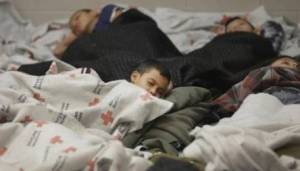 Friday’s post uncovered. What was the rationale for this 2008 Act and what role has it played in this influx?
The William Wilberforce Trafficking Victims Protection Act of 2008, so named in honour of the great British abolitionist, was among the last pieces of legislation of the George W Bush presidency, passed unanimously by the then Democrat-controlled Congress. The measure provided sanctuary for children from countries such as Guatemala and Honduras (though not Mexico) who might have been victims of sex slave trafficking.
Then, a couple of years ago, President Obama issued an order deferring deportation for children who arrived in the country aged under 16, and who had permanently lived in the US since 2007. The aim was to allow two million people who were, to all intents and purposes, Americans, to live a semi-normal life. But for millions of wretched souls in Central America yearning for a foothold in the US, and the gangs that demand an extortionate price to enable them to get it, the two presidents might have posted signs on the bridges across the Rio Grande, saying: “Come in”.
In terms of numbers, the crisis is nothing compared with the tidal waves of refugees forced from first Iraq and now Syria by sectarian conflict. Even so, some 57,000 children, some of them aged as young as four, and many of them unaccompanied, have made their way across the US border since last October, most of them from Honduras, Guatemala and El Salvador, far overwhelming the capacity of immigration services to process them.
The intentions on the part of the US authorities might have been noble. But the result has been a 21st-century nightmare, exposing the children to journeys of danger and suffering, and the US to accusations of incompetence at best, heartlessness at worst, and charges that the country’s politics have reached a nadir of selfish partisanship.
You might have thought that, faced with a crisis of such poignancy and immediacy, Republicans and Democrats would put aside their differences. After all, the root of the problem lies not in the US but in the children’s lawless but not-too-distant homelands.
Honduras may be the most dangerous place on earth, with a murder rate of 90 per 100,000 (compared to five in the US and one in Britain), and Guatemala and El Salvador are in the top six. Along with the violence, there is desperate need: across swathes of Central America, Mexico apart, half the population lives below the poverty line.
True, America contributes to the problem, as the main buyer of the drugs sold by the traffickers, and the main seller of the guns with which they enforce their rule. But the only lasting solution to the crisis lies in ensuring the populations of Central America have a better life in their own countries. On this, at least, you might expect the parties to agree. But you’d be wrong.
 The incredibly hateful response by many Americans towards the children and the crisis itself have made odd bedfellows of several activists. First, this example from the left is from Bill Moyers’group as written by Joshua Holland.
Those seething with so much rage and xenophobia that they’d hurl ugly epithets in the faces of children fleeing bloody violence in Central America bring shame to the whole nation. But the response of mainstream America hasn’t been much better.
The media’s characterization of what’s going on at our southern border as a “crisis,” politicians pointing fingers at one another and Washington’s refusal to provide the resources necessary to care for a small wave of refugees — not to mention the bipartisan push to send them back home — is just as shameful when one considers the context.
In June, the United Nations High Commissioner for Refugees (UNHCR)reported that in 2013, the global population of refugees from war and persecution hit 51.2 million — exceeding 50 million for the first time since World War II.
Half of them were children.
The vast majority were “internally displaced persons,” homeless people within their home countries. Many live in fetid refugee camps run by underfunded NGOs, where they face continuing privation and abuse.
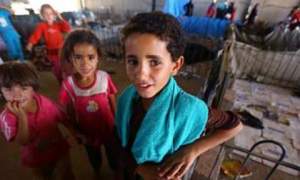
Glenn Beck says he has come under fierce attack from some of his fellow conservatives for a grave transgression.
His crime? He announced plans to bring food, water, teddy bears and soccer balls to at least some of the tens of thousands of Central American children who have crossed the border into the United States.
“Through no fault of their own, they are caught in political crossfire,” Beck said. “Anyone, left or right, seeking political gain at the expense of these desperate, vulnerable, poor and suffering people are reprehensible.”
Beck, not averse to a certain grandiosity, let us know that “I’ve never taken a position more deadly to my career than this.” But assume he’s right — and he may well be. It’s one more sign of how the crisis at our border has brought out the very worst in our political system and a degree of plain nastiness that we should not be proud of as a nation.
Children still leave Honduras to reunite with a parent, or for better educational and economic opportunities. But, as I learned when I returned to Nueva Suyapa last month, a vast majority of child migrants are fleeing not poverty, but violence. As a result, what the United States is seeing on its borders now is not an immigration crisis. It is a refugee crisis.
Gangs arrived in force in Honduras in the 1990s, as 18th Street and Mara Salvatrucha members were deported in large numbers from Los Angeles to Central America, joining homegrown groups like Los Puchos. But the dominance in the past few years of foreign drug cartels in Honduras, especially ones from Mexico, has increased the reach and viciousness of the violence. As the United States and Colombia spent billions of dollars to disrupt the movement of drugs up the Caribbean corridor, traffickers rerouted inland through Honduras, and 79 percent of cocaine-smuggling flights bound for the United States now pass through there.
Narco groups and gangs are vying for control over this turf, neighborhood by neighborhood, to gain more foot soldiers for drug sales and distribution, expand their customer base, and make money through extortion in a country left with an especially weak, corrupt government following a 2009 coup.
Enrique’s 33-year-old sister, Belky, who still lives in Nueva Suyapa, says children began leaving en masse for the United States three years ago. That was around the time that the narcos started putting serious pressure on kids to work for them. At Cristian’s school, older students working with the cartels push drugs on the younger ones — some as young as 6. If they agree, children are recruited to serve as lookouts, make deliveries in backpacks, rob people and extort businesses. They are given food, shoes and money in return. Later, they might work as traffickers or hit men.
Teachers at Cristian’s school described a 12-year-old who demanded that the school release three students one day to help him distribute crack cocaine; he brandished a pistol and threatened to kill a teacher when she tried to question him.
At Nueva Suyapa’s only public high school, narcos “recruit inside the school,” says Yadira Sauceda, a counselor there. Until he was killed a few weeks ago, a 23-year-old “student” controlled the school. Each day, he was checked by security at the door, then had someone sneak his gun to him over the school wall. Five students, mostly 12- and 13-year-olds, tearfully told Ms. Sauceda that the man had ordered them to use and distribute drugs or he would kill their parents. By March, one month into the new school year, 67 of 450 students had left the school.
Teachers must pay a “war tax” to teach in certain neighborhoods, and students must pay to attend.
I urge you to read their stories and decide for yourself.
What’s on your reading and blogging list today?

 peej
peej Carissa
 bostonboomer
 dakinikat
 ecocatwoman
 jjlo
jjlo mablue2
 Mama Lopez
 peggysue22
 quixote
 skydancingguestblogger
 Mona (aka Wonk the Vote)





Recent Comments