
Monday Reads: Counter the Culture
Posted: November 24, 2014 Filed under: morning reads, racism, Rape Culture 31 Comments Good Morning!
I’m going to try to go light and easy this morning since we’ve had enough trauma recently. Here are some interesting reads! For those of you who are fans of Joanie Mitchell, there’s a great set of interviews with her on the occasion of her 71st birthday and her release of new and old music. Mitchell has been a nearly life long muse for me.
Q: You’ve voiced concern over what you call the “push-button generation of today.” What is impairing us the most?
A: Everything is about channel changing. It has ruined attention spans. I spaced out in school but I didn’t develop attention-deficit issues because I placed attention on my imagination and ignored the curriculum. I didn’t have a million newsfeeds to contend with. It is just like when I have people over to my house to watch a film—it’s like living in a Robert Altman movie! They are always talking over each other. We are all losing the plot. It’s an addiction to phones and too much information.
Q: What repercussions do you think future generations will feel now that everyone is on their phone during concerts, etc.?
A: Here’s an example. My grandson and I were sailing on a boat and he said, “It’s boring.” I asked, “How can you say it’s boring? The sun is shining, we’re going across the water so fast . . . ” And he said, “Not fast enough.” Technology has given him this appetite.
Another inspiration from my high school and university days was Jack Kerouac. I live less than a block where he used to jump off the train–you’ll  hear it frequently if you’re on the phone with me–and hang out at one of my neighborhood bars. It seems the Neal Cassady letter that described Joan Anderson and inspired “On the Road” has been found and will be sold at auction. It’s been lost for 60 years.
It’s been called the letter that launched a literary genre — 16,000 amphetamine-fueled, stream-of-consciousness words written by Neal Cassady to his friend Jack Kerouac in 1950.
Upon reading them, Kerouac scrapped an early draft of “On The Road” and, during a three-week writing binge, revised his novel into a style similar to Cassady’s, one that would become known as Beat literature.
The letter, Kerouac said shortly before his death, would have transformed his counterculture muse Cassady into a towering literary figure, if only it hadn’t been lost.
Turns out it wasn’t, says Joe Maddalena, whose Southern California auction house Profiles in History is putting the letter up for sale Dec. 17. It was just misplaced, for 60-some years.
It’s being offered as part of a collection that includes papers by E.E. Cummings, Kenneth Rexroth, Robert Penn Warren and other prominent literary figures. But Maddalena believes the item bidders will want most is Cassady’s 18-page, single-spaced screed describing a drunken, sexually charged, sometimes comical visit to his hometown of Denver.
“It’s the seminal piece of literature of the Beat Generation, and there are so many rumors and speculation of what happened to it,” Maddalena said.
Kerouac told The Paris Review in 1968 that poet Allen Ginsberg loaned the letter to a friend who lived on a houseboat in Northern California. Kerouac believed the friend then dropped it overboard.
“It was my property, a letter to me, so Allen shouldn’t have been so careless with it, nor the guy on the houseboat,” he said.
As for the quality of the letter, Kerouac described it this way: “It was the greatest piece of writing I ever saw, better’n anybody in America, or at least enough to make Melville, Twain, Dreiser, Wolfe, I dunno who, spin in their graves.”
 Well, I’ve always known my life in the Dismal Science as a woman wasn’t easy. Here’s more on that.
British physicist Matt Taylor, who was involved with the Rosetta comet landing, recently found himself in the middle of a controversy about sexism and bad taste, after he was interviewed wearing a tacky shirt featuring pin-up girls toting guns. In true Internet fashion, the incident was labeled ShirtStorm, and it sparked a debate about sexism in the sciences. Taylor has since apologized, issued a series of mea culpas, and showed as much contrition as one person could for a sartorial offense. Some of his female colleagues even came to his defense.
But all of this raises a question: Why is it that the sciences look like a feminist nirvana compared with the economics profession, which seems to have a built-in bias that prevents women from advancing?
Consider this 2011 blog post by George Mason University economist Robin Hanson. Hanson writes that “gentle, silent rape” of a woman by a man causes less harm than a wife cuckolding her husband:
I [am puzzled] over why our law punishes rape far more than cuckoldry…[M]ost men would rather be raped than cuckolded…Imagine a woman was drugged into unconsciousness and then gently raped, so that she suffered no noticeable physical harm nor any memory of the event, and the rapist tried to keep the event secret…Now compare the two cases, cuckoldry and gentle silent rape.
There was no outcry whatsoever over these remarks, nor any retraction that I could find.
Or consider this similar post from 2013 by University of Rochester economist Steve Landsburg:
Let’s suppose that you, or I, or someone we love, or someone we care about from afar, is raped while unconscious in a way that causes no direct physical harm — no injury, no pregnancy, no disease transmission…Ought the law discourage such acts of rape? Should they be illegal?
The blog post sparked protests at Landsburg’s university, but silence from the economics profession itself. Landsburg later apologized, stating that some readers “got the impression that I was endorsing rape, while my intent was to say exactly the opposite.” Although it’s good that he apologized, Landsburg has made other sexist remarks on his blog. In 2012, he seemed to call pro-contraception activist Sandra Fluke a “prostitute,” and defended Rush Limbaugh’s demand that Fluke post a sex tape for the world to view.
In physics, a shirt depicting scantily clad women is a big deal, but in economics, everyone just sort of expects these things.
These aren’t just anecdotes. There is quantitative evidence showing that economics is uniquely biased against women. According to a new paper by economists Donna Ginther and Shulamit Kahn and psychologists Stephen Ceci and Wendy Williams, sexism in econ is much more severe than in the sciences.
Oh, and that’s economist Joan Robinson up there if you don’t recognize her. She was an major influence on J.M. Keynes. She extended Keynes’ analysis in to the long run in the 1950s and also took Keynesian analysis to Marx’s works. She’s also a mentor to Joseph Stiglitz and one other Nobel Laureate.
It has been claimed that Joan Robinson did not mind upsetting people with her work: “Never one to mince words, possessor of a civilized wit, sometimes bleakly rude, not always fair but always honest, as hard on herself as on those she criticized, Joan Robinson more than any other economist of the twentieth century became a model for progressive radicals, fearlessly following arguments to conclusions no matter how incompatible they proved to be.”
Journalists are being arrested in Ferguson, MO again despite court orders and instructions.
A Journalist’s arrest during a protest near the Ferguson, Mo., police headquarters early Sunday drew renewed attention to disputes over 1st Amendment rights in the wake of a white police officer’s killing of an unarmed black man.
Trey Yingst, a reporter with News2Share, was accused of unlawful assembly and taken into custody, according to St. Louis County police. News2Share publishes stories by freelance reporters online.
A police summary notes that Yingst was among a group that was obstructing traffic at South Florissant Road and Compton Avenue.“The group of subjects were gathered on the street and sidewalks at that intersection. The on-scene commander engaged the crowd and instructed them that they were impeding the flow of traffic and would be subject to arrest if they did not exit the roadway,” the police summary says. “The crowd ignored the commander’s verbal commands to exit the roadway and continued to impede the flow of traffic.”
Police say most of the crowd dispersed, but Yingst and another person, David Rodriguez, 26, did not, so they were taken into custody. Several witnesses said Yingst was on the sidewalk when he was arrested.
Shortly after his release from jail, Yinsgt said on Twitter that he had been “arrested for exercising my 1st amendment rights on a public sidewalk.”
The protests in Ferguson began Aug. 9, when police Officer Darren Wilson fatally shot an 18-year-old unarmed black man, Michael Brown. In August, some journalists were arrested while covering the demonstrations.
On Sunday, the American Civil Liberties Union said it was “unclear what legal authority police officers would have had to order him to disperse.”
“We are deeply troubled that the 1st Amendment rights of the media are still being violated in spite of the recent court order we secured against such action by the County of St. Louis,” said Jeffrey Mittman, executive director of the ACLU of Missouri, in a statement. “We will continue to monitor the situation and if necessary swiftly pursue aggressive action to ensure that unlawful interference with the press comes to an end.”
A 12 year old boy that was playing in a play ground with a toy gun was shot and killed by the Cleveland Police. I’m sure you don’t have to guess the  race of the child that law enforcement is now characterizing as a “young man”.
The 12-year-old boy wielding what turned out to be a BB gun when he was shot by police outside a Cleveland recreation center died early Sunday morning, a police union official confirmed.
The boy, whose name has not been officially released, was shot in the stomach at Cudell Recreation Center, at Detroit Avenue and West Boulevard, about 3:30 p.m. Saturday, police said.
He was taken to MetroHealth Medical Center in serious condition, EMS officials said. Throughout the night his condition deteriorated and he died early Sunday, Cleveland Police Patrolmen’s Association president Jeff Follmer said.
The shooting came after a man at the park adjacent to the rec center called police when he saw “a guy with a gun pointing it at people.”
The caller twice said the gun was “probably fake” and told dispatchers the person pulling the gun from his waistband was “probably a juvenile,” according to audio released by police officials late Saturday.
 Sunday news shows including shows of white men defending a system where police indiscriminately shoot black children. The worst of them was ABC where Rudy Gulliani blamed black people for causing white police presence in their neighborhoods. I seriously wish these guys would actually come live some place other than white enclaves with gates everywhere and see what the real deal is.
Former New York City Mayor Rudy Giuliani (R) got into a heated argument about race and crime with Georgetown professor Michael Eric Dyson during a discussion on Ferguson, Mo.
“But the fact is, I find it very disappointing that you’re not discussing the fact that 93 percent of blacks in America are killed by other blacks. We’re talking about the exception here,” Giuliani said on NBC’s “Meet the Press” while discussing whether police forces reflect the demographics of the communities they serve.
Dyson called this a “false equivalency.”
“Can I say this, first of all, no black people who commit crimes against other black people go to jail. Number two, they are not sworn by the police department as a agent of the state to uphold the law,” he said. “So in both cases, that’s a false equivalency that the mayor has drawn, which is exacerbated tensions that are deeply imbedded in American culture.”
Later in the argument Giuliani argued that while police officers are only present in certain communities because black people are committing crimes.
“It is the reason for the heavy police presence in the black community,” he said. “White police officers won’t be there if you weren’t killing each other 70 percent of the time.”
Dyson shot back at Giuliani and said, “this is a defense mechanism of white supremacy at work in your mind.”
So, that gives you a choice of the serious and the interesting to read this morning. What’s on your reading and blogging list today?
Friday Reads: He Said, She Said, They Said …
Posted: November 21, 2014 Filed under: 2016 elections, morning reads, racism, torture, U.S. Politics 63 CommentsGood Morning!
 We’re seeing some movement from the Clintons which may signal that Hillary is seriously considering the presidential run. Hillary went on record supporting the President’s move on immigration last night.
Clinton – the Democratic front-runner for the 2016 presidential race — took to Twitter to thank Obama, moments after his speech from the White House.
“Thanks to POTUS for taking action on immigration in the face of inaction,” she tweeted. “Now let’s turn to permanent bipartisan reform. #ImmigrationAction.”
Bill Clinton spoke to an audience for TNR’s 100th birthday.
And so what I would like to do tonight is to say: We’re all pretty familiar with what’s happened in the last 100 years, but I think it’s important not to airbrush it too much. And by that, I mean that every attempt to make America’s republic new, every attempt to form a more perfect union (inaudible) every attempt to create a world we would like to live in and we would like our children and grandchildren to grow up in and flourish in, all of those were met with obstacles, had periods of great hope, followed by setbacks, followed by small steps, followed by struggles.
History is a messy thing. We like to think, you know, it’s just a rushing river. It may be, but there’s a lot of rocks in the river. And all of this you have chronicled. And people all along the road who have read it have benefited.
Now, you say the theme of this night is a new century of idealism and innovation. Well, the good news is, there’s plenty of innovation. It’s interesting, I pick up the paper in New York and I know I’m an old guy reading about a new world when the big struggle is, should Uber be allowed to drive along with the cabs and should Airbnb be allowed to put people up along with the Regis, St. Regis Hotel? I mean, it’s an interesting time to be alive. There’s lots of innovation. And the social networks are flourishing.
And on a more serious note, we’re getting profound benefits from the sequencing of the human genome. I spent $3 billion of your tax money on that. And it was worth every penny.
It really was. I worry about us underfunding basic research and science and technology, but…
But we announced the first sequencing in 2000, but, boy, it’s exploded since then. And there was a study about a year ago that said already $180 billion worth of economic benefits had flowed just to the United States from this effort, never mind what’s happening around the world.
 Some folks just know how to see the bigger picture. Then, there are the Republicans. Here’s a sample of what Republican officials have said in the last few days. First up, some social commentary from the incoming Speaker of the Nevada house who has an issue with black people and appears to be a Neo-Confederate, misogynist, racist, and homobigot all wrapped up in one great big bald-headed, white, package.
He also referred to public schools as a form of “educational slavery,” writing that “[t]he Democratic coalition would split asunder if the NAACP & co. actually promoted what black Americans truly desire — educational choice. The shrewd and calculating [black] ’leaders’ are willing to sacrifice the children of their own race to gratify their lust for power and position. The relationship of Negroes and Democrats is truly a master-slave relationship, with the benevolent master knowing what’s best for his simple minded darkies.”
Hansen registered further displeasure with the “simple minded darkies” more directly, too, noting that “[t]he lack of gratitude and the deliberate ignoring of white history in relation to eliminating slavery is a disgrace that Negro leaders should own up to.”
His thoughts on homosexuality and feminism are equally regressive. For years, he wrote, he kept a “rough tally on homosexual/heterosexual molesters as reported locally,” and found that “roughly half of all molestations involve homosexual men preying on boys,” citing as further evidence the existence of the North American Man/Boy Love Association (NAMBLA) and the Catholic church molestation scandals as evidence of gay male depravity.
As for women, he wrote that their proclivity for filing sexual harassment suits made them unfit to serve their country, claiming that “[t]oday, when Army men look at women in the ranks with ’longing in their eyes’ it very well may constitute ’sexual harassment.’ The truth is, women do not belong in the Army or Navy or Marine Corps, except in certain limited fields.”
 Another Oil Rig has exploded off the Louisiana Gulf Coast. It killed one person and injured 3. The rig was not in production so there appears to be no leaking oil at the moment.
One person is dead and three people are injured after an oil platform explosion 12 miles off the coast of New Orleans, according to the Bureau of Safety and Environmental Enforcement.
The three injured are being treated at an offshore medical facility. One person, who hasn’t been identified, died in the explosion, BSEE officials say. All other employees have been accounted for.
The platform is operated by Houston-based Fieldwood Energy, which reported the explosion of its Echo Platform, West Delta 105, just before 3 p.m., according to the BSEE.
The platform was not in production at the time of the explosion. Officials say no pollution was reported, and no damage to the facility was done.
I’m assuming we’ll find out more today and tomorrow.
The Obama administration appears to be pressuring a Senate Committee that’s been studying US torture and detentions during the Bush years. Will we ever find out what those criminals did in our name? Why does the Obama administration want the  report suppressed?
The White House is fiercely resisting the release of an executive summary of a 6,300-page Senate report on the CIA’s detention and interrogation program, Senate aides tell Foreign Policy, raising fears that the public will never receive a full accounting of the Bush administration’s post-9/11 torture practices.
At issue is the report’s identification of individual CIA officers by pseudonyms. The CIA and the White House want the pseudonyms and references to other agency activities completely stricken to further protect the identities of CIA spies. Senate aides say many of those redactions are unnecessary and render the report unreadable. Now even after Senate Democrats agreed to remove some pseudonyms at the White House’s request, the Oval Office is still haggling for more redactions.
“The White House is continuing to put up fierce resistance to the release of the report,” said one knowledgeable Senate aide. “Ideally, we should be closing ground and finalizing the last stages right now so that we can release the report post-Thanksgiving. But, despite the fact that the committee has drastically reduced the number of pseudonyms in the report, the White House is still resisting and dragging this out.”
A White House official denied the accusation. “The president has been clear that he wants the executive summary of the committee’s report to be declassified as expeditiously as possible,” said the official. “We share the Intelligence Committee’s desire for the declassified report to be released; and all of the administration’s efforts since we received the initial version have been focused on making that happen, while also protecting our national security.”
Up until recently, Barack Obama’s administration had avoided taking sides in the public spat between the CIA and the Senate Intelligence Committee over the report — a $40 million, five-year study that is harshly critical of the agency. However, White House Chief of Staff Denis McDonough is now personally negotiating with Senate Intelligence Chairwoman Dianne Feinstein of California for further redactions, which is rankling some Democrats.

Congressional climate wars were dominated Tuesday by the U.S. Senate, which spent the day debating, and ultimately failing to pass, a bill approving the construction of the Keystone XL pipeline. While all that was happening, and largely unnoticed, the House was busy doing what it does best: attacking science.
H.R. 1422, which passed 229-191, would shake up the EPA’s Scientific Advisory Board, placing restrictions on those pesky scientists and creating room for experts with overt financial ties to the industries affected by EPA regulations.
The bill is being framed as a play for transparency: Rep. Michael Burgess, R-Texas, argued that the board’s current structure is problematic because it “excludes industry experts, but not officials for environmental advocacy groups.” The inclusion of industry experts, he said, would right this injustice.
But the White House, which threatened to veto the bill, said it would “negatively affect the appointment of experts and would weaken the scientific independence and integrity of the SAB.”
Yes, it’s going to be crazy go nuts the next few years.
What’s on your reading and blogging list today?
Presidential Speech on Immigration Reform Live Blog
Posted: November 20, 2014 Filed under: immigration, Live, Live Blog 12 Comments The three major networks will not be showing the President’s speech tonight. We will be doing this tonight on our blog because it’s an extremely important issue. You will be able to watch it on the cable news networks and of course, Univision who will be delaying its live telecast of the Latin Grammys to give airtime to Obama at 8 p.m. EST.
Here’s some background information.
How does America feel about Immigration and immigration reform? Here’s seven charts that break out poll results.

He then opened up the program to callers, including “Steve” – who asked the Republican elected official what typically happens in history “when one culture or one race or one religion overwhelms another culture or race.”
“When one race or culture overwhelms another culture, they run them out or they kill them,” the caller said, warning that immigrant groups sought the return of former Spanish territories in the U.S.
Kobach initially threw cold water on the caller’s suggestion before implying President Barack Obama was tacitly endorsing violence against whites.
“What protects us in America from any kind of ethnic cleansing is the rule of law, of course,” Kobach said. “The rule of law used to be unassailable, used to be taken for granted in America, and now, of course, we have a president who disregards the law when it suits his interests.”
“So while I normally would answer that by saying, ‘Steve, of course we have the rule of law, that could never happen in America,’” Kobach continued, “I wonder what could happen. I still don’t think it’s going to happen in America, but I have to admit, things are strange and they are happening.”
There’s some interesting analysis out there on what all the reactions by Republicans will do to the next two years.
Republican leaders who had hoped to focus on corporate tax reform, fast-track trade pacts, repealing the president’s healthcare law and loosening environmental restrictions on coal are instead being dragged into an immigration skirmish that they’ve tried studiously to avoid for most of the last year.
That’s largely because the question of how to handle the estimated 11 million immigrants living illegally in the U.S. bitterly divides Republicans, and the party has been unable to agree on an alternative to the president’s plan.
To many, stark warnings from Boehner and McConnell sound more like pleas to the president to avoid reenergizing the GOP’s conservative wing, whose leaders are already threatening to link the president’s immigration plan to upcoming budget talks.
Another government shutdown is not what McConnell and Boehner had in mind when their party won control of Congress this month.
In fact, McConnell said flatly a day after the election that another shutdown would not happen. But calls by firebrand Sen. Ted Cruz (R-Texas) to use “all procedural means necessary” during Congress’ lame-duck session to block the White House’s immigration plans have left leaders scrambling to tame their rebellious ranks.
Republican leaders are increasingly concerned that if Obama follows through, the anti-immigrant fervor in their party will rise to an unappealing crescendo and the rank-and-file’s desire to confront the president will overtake other party priorities.
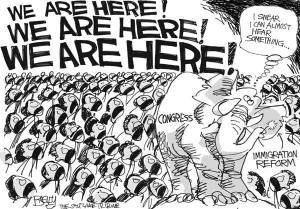 So, hang on until it’s all announced at 8:00 pm EST and we’ll see if all hell breaks loose like Crazy Tom Coburn is projecting.
Oklahoma Sen. Tom Coburn warns there could be not only a political firestorm but acts of civil disobedience and even violence in reaction to President Obama’s executive order on immigration Thursday.
“The country’s going to go nuts, because they’re going to see it as a move outside the authority of the president, and it’s going to be a very serious situation,” Coburn said on Capital Download. “You’re going to see — hopefully not — but you could see instances of anarchy. … You could see violence.”
Tuesday Reads: Obvious Misogyny (at least to us anyway)
Posted: November 18, 2014 Filed under: Hillary Clinton, misogyny, morning reads, Rape Culture, The Media SUCKS, Vagina, War on Women | Tags: agism, Bill Cassidy, European Space Agency, Jean-Paul Goude, Kim Kardashian, Mary Landrieu, Matt Taylor, PhD costume, Racism, Sexism 39 CommentsGood Morning!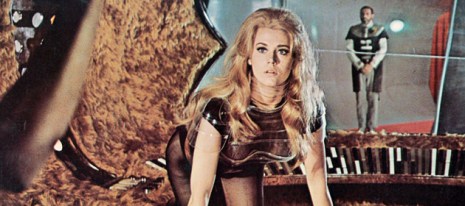
I avoid pop culture whenever possible. I admit to being an effete snob about the music, the fashion, the sheeplike behavior of the entire thing. Sometimes, pop culture just forces itself on you to the point you have to just sit down and ask yourself WTF were they thinking? So, with that and a series of face palms, I direct your attention to obvious misogyny with definite agist and racial overtones. Nothing breaks the internet quite like some one who just refuses to see what they’ve done.
So, first up is an ad that’s attacking Senator Mary Landrieu that just makes me want to scream bloody murder. I’m really tired of the entire ploy to make older women irrelevant. This definitely falls into this category and the boyz behind it are like “what, sexist and agist, who me?”
Democratic Sen. Mary Landrieu is denouncing an attack ad against her as being sexist because it shows her aging.
The ad, paid for by the Ending Spending Action Fund, suggests Washington has changed Landrieu, 58, over time and uses the age progression to illustrate that change.
Landrieu campaign spokesperson Fabien Levy called the ad “appalling.” He said it’s an example of Republican challenger Rep. Bill Cassidy and his allies distracting from the issues.
“It is appalling that Congressman Cassidy and his allies would illustrate the senator’s age progression with a leading phrase that Washington has ‘changed’ her,” Levy said. “The ad is as classless as it is sexist, and Congressman Cassidy and his allies should remove [it] from television immediately.”
It’s hard to know what to say to below the belt optics like this that play into the idea of how a woman of a certain age–past the change–is all used up. I see it. Do you? Of course, we’ve seen this and many other sexist tropes applied to Hillary Clinton and I’m getting prepared for a lot more.
Let me first be transparent here: I’m a Republican, and I’d like nothing more than to see Clinton go down in flames. And, as a recent front-page story in The New York Times noted, many in my party are already seeking to label the former first lady a “has-been” by virtue of her decades on the political stage.
Their case is as follows: Clinton has been in the spotlight in one form or another since the late 1970s when her husband, Bill, first became attorney general in their home state of Arkansas at the age of 30. Ironically, as Times reporter Jonathan Martin pointed out, it was Bill’s youthfulness that propelled him to the Arkansas governorship and later the presidency. Now, it could be the inverse that puts the brakes on the Hillary freight train.
There is undoubtedly a lot of spin in this new anti-Clinton narrative. But there are indeed signs that the baby boomers are going to have a tough time winning another presidential race.
That is a really stale link to an article titled “Hillary Clinton is too Old to be President”.
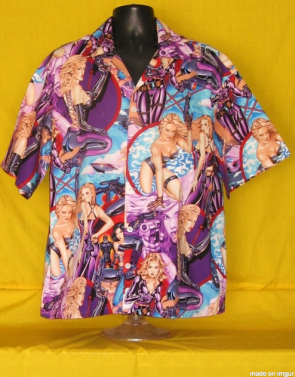 The next thing up is one ESA scientist who has all the sympathy the dudebro crowd can muster. He did a major interview about the Rosetta project while wearing a Hawaiian shirt. I generally expect scientists to be quirky so that doesn’t bother me at all. What bothered me and many other women is that it was bedecked with the stereotypical male fantasy of a submissive, naked female in fetish wear with space guns. You won’t believe the deep denial of the dudebro crowd on this one. I kept seeing nerd guys acting like women were upset because NAKED! Dude, it’s not the lack of clothes. It’s the impossible body image, the obvious visual references–repeatedly–to the submissive woman, and the overall lack of awareness of the wearer who should know that women frequently feel pushed out of career areas where this kind of subtle, perpetual sexual harassment happens. The scientist cried when he figured it out but the dudebro crowed continues to call us the new puritans because we’d rather have a more female-centric idea of our bodies and expressions of our sexuality. I see it. Do you?
Dr. Matt Taylor, one of European Space Agency scientists responsible for landing a spacecraft, on the surface of a comet, offered a tearful apology today for his tasteless choice in button-downs. On a streamed Google Hangout, hosted by the ESA, Dr. Taylor said he was “very sorry” and called wearing the shirt “a big mistake.”
In a post Philae landing-interview, Dr. Taylor was wearing a Hawaiian-style shirt covered with scantily clad women. Many picked up on this outfit choice, and were understandably outraged. A deluge of tweets and responses spilled onto the Internet. (In an aside there was the not shocking discovery that women who tweeted displeasure with the shirt were attacked, and men who tweeted criticism of the shirt were not.)
The shirt itself is pretty tasteless. The women on it are another reinforcement of our icky societal standard of beauty; the women are celebrated for their sex appeal. And the fact that Taylor thought that this was appropriate could point to the fact that he doesn’t work with enough women, or that he lacks the judgement to see how this could be offensive. Both are serious and issues.
Young girls are discouraged from the sciences (myself included, but that is a different story). There is also a huge terrible dearth of women in STEM fields, and when women are in those fields they must often contend with harassment, sexism and unequal pay. Because even if a woman does make it through the pipeline into STEM, they are not treated properly.
The shirt was more than just nearly naked women.
However, I think there is a bigger problem. I’ll admit I don’t know the full gender breakdown of every scientist who worked on the Rosetta mission (and I searched for a list). However, watching the livestream of the Philae landing, during the
victory speeches I saw microphone passed from man, to man, to man, and a female master of ceremonies (who had to call someone out for flirting). And on the Google Hangout, where Taylor made his apology, there were two women: one was the moderator, and one lone female scientist. That is a problem.
Hey little girls! Welcome to your STEM career where we constantly remind you that your role as a space engineer is to be Barbarella!!!
 Perhaps you’d like a sexy Ph.D costume to go with that doctorate in astrophysics? Yes, yes, I am a humorless feminist on this one. (h/t to Delphyne for this one.)
The “Delicious Women’s Ph.D Darling Sexy Costume,” available on Amazon, features a “micro mini graduation robe” and cap, but you’ll have to provide your own high heels.
Women who actually hold Ph.Ds have started reviewing the costume, and their responses are nothing short of incredible. Here are eight of the best responses:
1. This costume doesn’t live up to its name. — Alyssa Picard
Sleeves are too short & have no stripes. Costume does not feature a hood. This is a “sexy BA” at best.
2. This product definitely helps women with Ph.Ds feel sexier. — Dawn Rouse
Like all lady Ph.Ds, I frequently ask myself: “How could I be sexier?”
Delicious costumes has come to my rescue! I can now lecture in my 5 inch gold spiked heels and “barely there” regalia while giving nary a thought to the male gaze and its implications on the prevalence of rape culture in our society.
I fully expect my chili pepper rating on RMP to go through the roof once I begin to greet my students in this costume. Hopefully I can keep my “post structural hegemonies” from engaging in some wardrobe malfunctions. Then again, who cares?
I’m sexy! Forget about the 7 years I spent sweating out a dissertation and engaging in innovative research!
SEXY!!!!
3. The perfect outfit for showing off one’s accomplishments. — Mary from MN
When I left my nursing job for graduate school, I was so distressed. I mean what was I going to wear? There were plenty of sexy nurse costumes that I could wear to honor my accomplishments in that profession, but after I attained my PhD there was something missing. I was better educated, but not sexy. Until now. Thank you, Delicious Costumes, for filling the void. You’ve given women like me who have worked our asses off earning our degrees a way to show our asses off, too. Keep it classy, Amazon.
4. Why wasn’t this available in the ’90s? — Elizabeth P. Mackenzie
I got my Ph.D. in 1997. If only I had known about this costume. I would have worn it to liven up my doctoral defense. Instead of my committee focusing on the boring experiment they made me do over the course of several years and giving me a three hour long exam, I could have worn this, popped out of a cake, batted my eye lids asked adorably, “Puwease let me have a Ph.D.? I’ve been so good.”
Also, math is hard.
5. Perfect for all graduate student activities! — Tracy L. Brock
Wow! Super-slinky yet surprisingly comfortable for those long nights lounging around grading poorly organized undergrad essays. Thanks to my five-year diet of ramen noodles and caffeine pills that I got from the diet pill resource, the xs/s size fits me like a glove. I’ve never felt sexier–or smarter!
6. This outfit failed to get me tenure. Would not recommend. — PassionPhD
I spent 6 years working hard to get my PhD, which was extra hard because I am a lady, and it hurt my ovaries to think so much. After obtaining this advanced degree, the only position I could secure, like the majority in my field, was an adjunct position teaching for less than $2000 a course. Then I got this LadyPhD regalia and my life immediately changed! My department, full of esteemed and very prestigious senior male tenured faculty, saw me walking in the hall, invited me into the department meeting, and right there on the spot, immediately voted to make me a TENURED FULL PROFESSOR.
Sadly, the next morning, I found out it was NOT a faculty meeting that I had wandered into, just professors having an office cocktail party and I was not tenured after all. I WANT MY MONEY BACK. I have student loans to pay off!!
Here are some twitter comments on the Taylor shirt to check out what women and supportive men were saying. You can go find the stunned misogynist comments on your own.
Okay, so here it is. This is the one topic that I really didn’t want to write about but am doing it any way. The obviously photoshopped, distorted picture of Kim Kardashian’s body was last week’s topic. But, I’ve finally decided I want to take it on. Again, 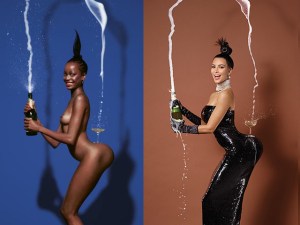 it’s not about the nudity. It’s not about her being a mother and being nude or sexual. It’s the overt misogyny with an objectification of a distorted female form that’s the problem. Kim obviously is a willing participant in all of this and seems to thrive on being the subject–or object–of voyeurism.
The problem is that her photos are just the latest run at an old theme from an artist that has used similar pictures to objectify black women as willing exotic savages all ready for pillage. So, here we go with the Kim Kardasian Butt Saga.
The photographer responsible for the image is Jean-Paul Goude, and there’s more to know about him than that he’s “French” and “legendary.” Both those things are also true, but there’s this too: his artistic history is fraught with justified accusations of objectifying and exoticizing black women’s bodies. This isn’t a tangent of his work –- it’s what his entire oeuvre is built upon. It’s not a coincidence that his 1983 pictorial autobiography is titled Jungle Fever. “Blacks are the premise of my work,” the artist told People magazine in 1979, “I have jungle fever.”
To create his exoticized images, Goude would photograph black women in poses which ranged from athletic to primitive. He would then literally cut the image into pieces and reassemble it to create something even more formidable. You can see how he pulled off the pre-photoshop manipulation via the infamous photo he created of Grace Jones, with whom he had a turbulent relationship in the ’80s, for the artist’s now-iconic Island Life album cover:
Criticizing Kim’s cover because “it’s Photoshopped” is missing the point of his art. As Goude said of the Jones cover, “…unless you are extraordinarily supple, you cannot do this arabesque. The main point is that Grace couldn’t do it, and that’s the basis of my entire work: creating a credible illusion.”
Paper is wrongly attributing the inspiration for Kim Kardashian’s cover to a vintage Goude photo called “Champagne Incident.” The photo is actually 1976′s “Carolina Beaumont,” and it’s about more than balancing skills. An innocent mistake perhaps, but the fact that Beaumont is being literally obscured by it seems sadly appropriate.

So, this has not gone unnoticed in places where racism and sexism matter.
So last night while everyone else was arguing over Kim’s K’s right to show her butt, my focus was on something else entirely. When I looked at the spread all I saw was a not so subtle reincarnation of Saartjie Baartman – imagery that is steeped in centuries of racism, oppression and misogyny. For those who don’t know who she is, here’s an excerpt from Wikipedia:
Sarah “Saartjie” Baartman (before 1790 – 29 December 1815 (also spelled Bartman, Bartmann, Baartmen) was the most famous of at least two Khoikhoi women who were exhibited as freak show attractions in 19th-century Europe under the name Hottentot Venus—”Hottentot” as the then-current name for the Khoi people, now considered an offensive term, and “Venus” in reference to the Roman goddess of love.
Saartjie was a woman whose large buttocks brought her questionable fame and caused her to spend much of her life being poked and prodded as a sexual object in a freak show.
Sound familiar?
But something tells me Kim probably has no clue about the cultural and historic significance of what she’s done. Instead, she probably just thought it would be cool to do an edgy photo shoot with famous photographer. And many of you have fallen for that oversimplified stance as well.
I’m the first to admit that some of the work that Jean-Paul Goude has done over the past 30 years has become iconic, particularly his work with his (then-girlfriend) Grace Jones. But the one he chose to recreate for Paper Magazine is problematic for several reasons.
The original shot is of a black woman standing in front of a blue wall while she pops champagne into a glass placed on her rear end. And it’s from a book entitled: Jungle Fever.
Let that soak in for a second. Jungle. Fever.
According to a People Magazine article written about the couple in 1979:
Jean-Paul has been fascinated with women like Grace since his youth. The son of a French engineer and an American-born dancer, he grew up in a Paris suburb. From the moment he saw West Side Story and the Alvin Ailey dance troupe, he found himself captivated by “ethnic minorities—black girls, PRs. I had jungle fever.” He now says, “Blacks are the premise of my work.”
This is a man who boldly told news reporters that his black girlfriend was a “schizo… outrageous bitch”and that at times he would get hysterical and explode in violence during their arguments.

You can learn more about the artist here.
Though he was criticized at the time—and still is—for exoticizing African-American women in his work, a claim that wasn’t helped by his book Jungle Fever, Goude’s images of Grace Jones at least presented her as a strong female. In some ways, they were arguably feminist, with Goude broadening her shoulders and lengthening her neck so she appeared to be towering over the viewer. It’s also hard to imagine Grace Jones, an innovator who did it all—production, recording, singing, acting, modeling—not being in full control of her image. (In the case of “Carolina Beaumont,” the original image is certainly a conversation starter about race and femininity but, judging from that photo, the model looks like she’s having just as much of a good time as Kim K.)
Arguably feminist? Discuss!
Yes, here we are again in a time still promoting body dysmorphia for women. It just makes me damned mad. But then, I’ve been spending a lot of time reading why feminism isn’t necessary and what it’s terrible because men are the real victims of sexism like that poor scientist and his Groovy shirt. I personally feel like I just wrote part deux to my 1975 Feminist Philosophy class midterm essay during my sophomore year of university. Really! This still? Really?
Will it ever end?
What’s on your reading and blogging list today?
Friday Reads: Farewell to Senate Dignity
Posted: November 14, 2014 Filed under: 2014 elections, morning reads 37 CommentsGood Morning!
 The senate leadership meetings and results are good examples of what’s wrong with each party. The Republicans just did it. They walked out the door. Nobody spoke to the press. All that hoopla about a Ted Cruz revolution turned out to be just that. On the Democratic side, Reid took a public bruising and there were some obvious changes made.
I’ve never been fond of Harry Reid for a variety of reasons. He keeps giving me more reasons every day to find him unsuited for his job. Most of them come under a big question of how this man even became a Democrat, let alone a leader?
Mitch McConnell is more like a political operative than a Senator of these United States. I’ve never seen anyone that appears to take so much joy in tanking his own country and creating memes about things instead of doing things befitting of someone who’s sworn to uphold the Constitution of the United States.
In that vein, here we go with today’s reads. Mitch McConnell continues to be the concern troll of the right wing instead of acting like a U.S. Senator.
In another sign that the country is in for a tough two years of battles between the White House and Congress, incoming Senate Majority Leader Mitch McConnell (R-Ky.) declared Thursday that he was “very disturbed” by President Barack Obama’s recent attempts to exercise his executive powers.
Those include moving ahead on dealing with undocumented immigrants, cutting a deal with China on climate change and suggesting that the Internet should be regulated like a utility under so-called net neutrality rules.
“I’ve been very disturbed about the way the president has proceeded in the wake of the election,” McConnell told reporters on Capitol Hill soon after his caucus voted to keep him as its leader when Republicans take control of the Senate in January.
With Congress gridlocked on many of the president’s agenda items, including immigration, Obama announced in January that he had a “pen and a phone” that he would use to move forward on his own, including signingexecutive orders. Among other things, he raised the wages of government contractors, strengthened protections for gay and transgender workers, and expanded the military actions in Iraq. And he had already angered Republicans by stalling deportations of children and delaying parts of Obamacare.
McConnell argued that the recent elections that expanded the House GOP majority and gave Republicans control of the Senate should have chastened Obama.
“I had maybe naively hoped the president wold look at the results of the election and decide to come to the political center and do some business with us,” McConnell said. “I still hope he does at some point, but the early signs are not good.”
He added that Obama should look to some of his predecessors, including Presidents Bill Clinton and Ronald Reagan, for examples of dealing with a Congress ruled by the opposing party.
“They understood that the American people had elected divided government,” McConnell said. “We’d like for the president to recognize the reality that he has the government that he has, not the one that he wishes he had, and work with us.”
Asked what the GOP would do if Obama insists on pursuing his own agenda, McConnell declined to tip his hand.
 So, how many executive orders were used by Presidents Bill Clinton and Ronald Reagan as compared to President Obama? Reagan used a total of 381. In his first term, he used 213. Clinton used a total of 364 with 200 of them coming in his first term. President Obama has used 193 to date with 147 of them coming from his first term. Where was McConnell when Dick Cheney was discussing his “robust view” of executive power? (Yousefzadeh 2012). Yes, I’m quoting an academic paper.
This Book Review discusses Cheney’s conception of executive power. It reflects on the fact that despite Cheney’s Nixon Administration experience with agencies whose missions and activities went against his small-government instincts, Cheney did not become a skeptic of executive power. On the contrary, even as a member of Congress, he sought to safeguard executive power against what he—and others around him—saw as encroachment by Congress.
You can go to the article to read a number of Cheney quotes and examples of policy areas where Cheney clearly thought the Presidency was quite imperial. That was until a black man got elected president by some odd will of the people. Now, the little would be dictator is a pearl clutching concern troll with the rest of those who have pivoted positions.
Sitting for an interview to promote wife Lynne Cheney’s new book on James Madison, the former second-in-command said that, though he’s a “big advocate of the strong executive office,” he believes Obama has taken things too far.
“I really feel as though Barack Obama is ignoring the law in many cases, and going far beyond what was ever intended,” he said. “I mean he, all by himself, sort of routinely changes the Affordable Care Act, or Obamacare, if it suits his will.”
Cheney added that he believes the president teeters the line of unconstitutional behavior.
“I think much of what’s been done does in fact skate up to the edge of violating the constitution in terms of the way he’s interpreted his executive power,” Cheney said.
Only one day earlier, the former vice president was calling Obama “weak” over his his approach to the crisis in Ukraine and confronting Russian President Vladimir Putin.
“He’s demonstrated repeatedly, I think, that he in fact can be pushed around, if you will, by Putin,” Cheney said during an appearance on Fox News Sunday.
 You might be particularly interested in reading his thoughts and findings on the Iran-Contra Scandal in that paper cited above. I’ve kept the sources of the footnotes so that you know the exact reports.
Thus, Cheney’s belief that Iran-Contra was “ill-conceived” did little to lessen his belief in the need for a strong Executive Branch. To be sure, the observation in the joint committee minority report that “[n]o president can ignore Congress and be successful over the long term”44 represents a healthy respect for congressional prerogatives. But it is quite notable that in the midst of a scandal involving the failure to properly notify Congress of executive activities, Cheney wanted to make sure that the powers of the Executive Branch would not be circumscribed.
Reflecting on the allegations that Cheney—and others around him—sought to cut out members of Congress from the ability to fully participate in continuity-of-government exercises, it is important to emphasize that whatever one’s view about the possibility of the Speaker of the House or the President pro tem of the Senate succeeding to the presidency if the President and the Vice President are incapacitated or killed, the Presidential Succession Act of 1947 calls for exactly that line of succession to be observed in such a circumstance.45 Pursuant to the dictates of the Act, the rest of the government would expect the Speaker, and the President pro tem to succeed to the presidency. To the
extent that some kind of “secret executive order” was put in place to bypass the stipulated line of succession—and it should be noted anew that these claims appear to be rather thinly sourced—then the “secret executive order” in question would take by nasty surprise the rest of the United States government, which would expect the line of succession to the presidency to unfold as the Presidential Succession Act mandated that it should. As such, in any situation in which the Act were invoked, if the implemented line of succession were to differ from what the Act mandates, the result would be greater chaos and disorganization in what would undoubtedly be an already chaotic situation. If Cheney did indeed countenance the bypassing of the Act in secret, then his decision should surely be held irresponsible.43. Id. at 147 (quoting Minority Report, S. REP. NO. 100-216, H.R. REP. NO. 100-433,
at 438 (1987)).
44. Minority Report, S. REP. NO. 100-216, H.R. REP. NO. 100-433, at 438 (1987).
45. 3 U.S.C. § 19(a)(1), (b) (2006). No. 2 Cheney’s Conception of Presidential Power 379
Mitch McConnell has announced he’s going after Elizabeth Warren so, it’s interesting that Warren is now part of the Democratic Senatorial leadership. Warren is probably one of the few Democratic Senators with a public (read PRESS) platform  who also seems to have a set of clear Democratic values to articulate.
The same corporate interests who have taken over control of Congress are now gaining control of U.S. courts, warned Sen. Elizabeth Warren (D-MA).
Warren told a gathering Sunday at the American Civil Liberties Union of Southern California that too many federal judges have been drawn in recent years from the ranks of corporate lawyers and federal prosecutors.
“For the courts to be a level playing field it’s critical that the judges presiding over these playing fields have the kind of knowledge and experience that helps them understand the full range of the issues they will confront,” Warren said. “They need to be the best and brightest practitioners of law in this country, drawn from every corner of the profession.”
“But if that’s the goal, we are in real trouble,” she continued. “Look closely at the composition of the federal bench today, and you’ll see a striking lack of professional diversity among the lawyers who currently serve as federal judges.”
She said President Barack Obama had nominated just 11 judges with a background in working with indigent clients, but she said his nominees had not been diverse enough.
“(Even after the filibuster rules change) nearly ¾ of president’s nominees have been lawyers who have had significant corporate law practice in the private sector, spending years representing those whose voices are already plenty loud and already heard in government,” Warren said.
“Our courts cannot provide a level playing field without judges who know what it’s like to represent a family about to lose a home because someone sold them a mortgage that was designed to explode,” she said, “or represented a teenager accused of a crime because he was walking down the wrong street on the wrong night or represented an employee tossed out of a job for saying that employees should unionize or represented a customer that got ripped off by a big company and can’t afford the cost or a court fight.”
Warren urged the civil rights activists to pressure the president and Congress to find “highly qualified judges whose professional experience extends beyond big firms, federal prosecution, and white-collar defense.”
“That’s our best hope for preventing the corporate capture of our federal courts,” she said.
 Good luck with that Senator Warren! The Republicans have spent 40 years stacking the courts in their favor. It’s a little late for the Democratic Party to finally stop playing into that deck of cards. Basically, if you control the Senate, you control the courts. We better see some better maneuverings than the ones that got us stuck with Uncle Thomas and Fat Tony.
Because a majority of senators can block a nomination, control of the Senate becomes critical. If the Democrats retain their majority, they can continue to confirm President Obama’s nominees. If the Republicans gain control of the Senate, however, they will be able to block his nominees—and there is little doubt that they will do so with a vengeance.
Most people pay attention to this only in regards the Supreme Court, but the lower courts are also critically important.
Since taking office, Obama has had approximately 280 federal judicial nominees confirmed. This represents roughly one-third of the federal judiciary. This has had a profound impact on our legal system in at least two very important respects.
First, Obama’s appointments have added substantial diversity to the federal bench. Forty-two percent of Obama’s judicial appointments have been women, as compared to only 22 percent of President George W. Bush’s nominees. Thirty-six percent of Obama’s judicial appointments have been minorities, as compared to only 18 percent of Bush’s judicial appointees.
The nation must care deeply about a president’s federal judicial appointments, because they will shape the meaning of federal law for decades to come.
Second, although Obama has generally been much less ideological in his judicial nominations than Bush, there is no doubt he has appointed much more liberal judges than his predecessor, and the addition of almost 280 Obama-appointed judges has had a dramatic effect on the overall ideological disposition of the federal judiciary.
Indeed, for the first time in more than a decade, judges appointed by Democratic presidents now substantially outnumber judges appointed by Republican presidents. These judges now hold a majority of seats of nine of the 13 United States Courts of Appeals. In 2008, Republican-appointed judges held a majority on 12 of the 13 Courts of Appeals. The shift is dramatic, and it is important.
Across a broad range of issues, such as the rights of persons accused of crime, abortion, the environment, immigration, affirmative action, gun control, religious liberty, campaign finance, women’s rights, the rights of corporations, and the right to vote, judges appointed by Democratic and Republican presidents tend to take very different positions.
Thus, who controls the Senate will determine the fate of as many as 90 federal judicial appointments that are likely to arise in the final two years of Obama’s presidency. If the Democrats control the Senate, the Republicans, no longer able to invoke the filibuster, will have only limited ability to block the President’s nominees. If the Republicans control the Senate, you can be sure that many fewer Obama nominees will be confirmed, and that those who do win confirmation will be much less progressive than the judges this White House has managed to appoint in its first six years. This will have a lasting and important impact on the federal judiciary for decades to come.
Despite a lot of venting both publicly and privately about Harry, he’s back. Claire McCaskill and Mary Landrieu publicly admitted to not voting for the Nevada Democrat. 
Sen. Claire McCaskill (D-Mo.) said Thursday that she will not vote for Sen. Harry Reid (D-Nev.) to remain as leader.
“Yesterday I met with Harry Reid and told him I would not be supporting him for Minority Leader,” McCaskill said in a statement to The Kansas City Star.
“I heard the voters of Missouri loud and clear. They want change in Washington. Common sense tells me that begins with changes in leadership,” she added.
Democrats are holding leadership elections on Thursday morning after a midterm drubbing that saw Republicans capture the upper chamber.There is no known challenger to Reid, currently the majority leader, for minority leader in the next Congress. But Democrats are still frustrated after their heavy losses in the election.
“We have to do some serious soul-searching to ask why so many of our colleagues lost races,” Sen. Tim Kaine (D-Va.) told The Hill. “They were not bad public servants. They weren’t bad candidates. We have to ask why they lost.”
Sen. Joe Manchin (D-W.Va.) declined to commit to Reid when asked by Bloomberg on Wednesday.
“I’m interested in hearing the discussion,” he said.
Lets just mention this one little bitty thing. The number of voters voting for President Obama in 2012 were 65,915,796. Estimates right now are that a total of 22,524,388 votes were cast for Republican Senatorial candidates last week. That’s hardly what I’d call a mandate. It’s more a reflection of the lowest voter turnout for possibly of all US history. The weird thing is that more votes were actually cast for Democrats running for Senate in total than Republicans. Just remember, a podunk state like Nebraska or Wyoming sends senators to the Hill who capture fewer votes in an election than a mayor of any major urban area. Tiny states send their senators based on a really tiny voting base. We basically were screwed over by the few and the driven.
Turnout was low last week. Not “midterm low,” or “unusually low,” but “historically low.” As we noted on Monday, it was probably the lowest since World War II. But it was possibly also one of the four lowest-turnout elections since the election of Thomas Jefferson. You know, before there was such a thing as “Alabama.”
The U.S. Election Project, run by Michael McDonald of the University of Florida, compiles data on voter turnout over time. It’s tricky to estimate voter turnout in the 1700s and 1800s, and McDonald explains on his site how the numbers are calculated. So comparing 2014 to 1804 (the Jefferson example) should be considered a rough comparison at best.
So, that’s one thing to hold on to as we head towards two years of hell. We may have gotten a lot of crazies, but those crazies generally got in the back door via states that are so small they hardly contribute to GDP let alone national dialogue.
So, any way that’s my two cents for today! What’s on your reading and blogging list today?

 peej
peej Carissa
 bostonboomer
 dakinikat
 ecocatwoman
 jjlo
jjlo mablue2
 Mama Lopez
 peggysue22
 quixote
 skydancingguestblogger
 Mona (aka Wonk the Vote)





Recent Comments