
Tuesday Reads: Diary of a Mad Meme
Posted: December 30, 2014 Filed under: morning reads, New Orleans, racism 29 Comments Good Morning!
So I thought I’d start off with a local story that’s gone rather viral. My fellow Louisiana Blogger and buddy Lamar White has broken a story that’s even bigger than soon-to-be Senator Double Dip’s payroll fraud. I’ve watched it go completely viral over the last two days. It’s the stuff political junkie dreams are made from.
Metarie Louisiana is a small town that was one of the first white flight suburbs of New Orleans. My first real exposure to it was watching Sheriff Harry Lee give a speech to a Republican women’s club 20 years ago in a restaurant in Fat City where I happened to be dining with the guy that brought me here. The fact a big ol’ huge southern sheriff was Chinese and talking some really right wing stuff to a bunch of little old gray-haired white ladies was a hoot.
This was slightly after the entire Edwin Edwards/David Duke Governor race so I knew what the area was infamous for, believe me. News of that affair even drifted its way up the Mississippi and Missouri rivers to the backwater of Omaha, Nebraska. Then, there’s the fact that the various congressional and lege seats were and are held by some of the worst people in the state (e.g. Vitter and David Duke). It’s a wingnut haven. I drive through it on the way to the airport and try not to let the air waft into the car.
So, the current seatholder–whom I refer to as Congressman Sleaze–is Steve Scalise. He’s just been elected to the majority whip position under Boehner and his goosesteppers. Jindal and most republicans in that part of the state have always gotten in a lather at the idea of getting David Duke’s contact list for obvious reasons. Scalise, however, appeared at one of his events. What’s really odd is his response. It’s a combination of ‘I didn’t know’ and ‘The one aid I had at the time is responsible’ and the usual ‘Who me racist? Anti-Semitic?’ By Monday afternoon, the findings had gone from Lamar’s blog to TPM to WAPO. All the major news stations were on it by yesterday afternoon. Way to go DUDE!!!
Bad news for incoming majority whip Steve Scalise. He has admitted that in 2002 he addressed a group called the European-American Unity and Rights Organization — founded by David Duke, whom the Anti-Defamation League calls “perhaps America’s most well-known racist and anti-Semite,” formerly of the KKK and known for his theory that Jews were behind 9/11.
Why would Scalise attend an event sponsored by Neo-Nazis and KKK members then admit to being confused about the event? Why would you possibly think speaking at this event was a good idea? Why would you think attending this event was a good idea as a human being let alone if you had the faintest glimmer of public office in your eye? NOTHING ABOUT THIS WAS A GOOD IDEA.
In his defense, Scalise’s advisers are saying that “he addressed them, sure, but only because he had no idea where he was or whom he was talking to at any given time until 2007.”
I’m not making this up:
Here is an actual thing that one of Scalise’s former advisers wrote:
“It was a crazy time and I doubt there was a lot of checking up on who was who. . . . It really wasn’t until 2004 that he started sitting down and evaluating speaking engagements and questionnaires. Even then he really didn’t get a handle on schedule until he ran for state senate in 2007 and then congress the year after.”
That is certainly one tactic. “Until 2004, I had LITERALLY NO IDEA whom I was speaking to at any given time. My schedule was a total mystery to me. If a man came off the street, wrapped in a Confederate flag, and said, ‘Come address my group,’ I would have said, ‘Yessir, no question, I want to popularize my proposal to end slush funds.’ I didn’t know my own name until 2005, in case you discover that I’ve signed any unfortunate petitions.”
Okay, I knew about David Duke and I didn’t live in the state until 20 years ago to this month actually. How could this little guy not know who he was speaking to? David Duke was a Louisiana Republican Party fixture until his run-in with the IRS and his later self expatriation to Russia. As previously mentioned, every one of these Republican officeholders went for his voter list. You can’t tell me Scalise wasn’t just trying to get at the member list and grab as many potential votes as he could. He probably figured it wouldn’t matter to his constituents or he’d never get caught. He obviously had no idea about Google at the time so the way back machine must be way over his mental capacity. Roll Call has this little gem up about conversation that Vitter and Scalise had about Duke in 1999. 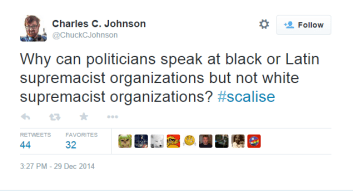
Back in 1999, Roll Call interviewed white supremacist leader David Duke about the possibility he would seek the House seat vacated by the resignation of Republican Rep. Bob Livingston. As part of that report, reporter John Mercurio also talked to up-and-coming Louisiana politicians, current Sen. David Vitter and current House Majority Whip Steve Scalise.
“I honestly think his 15 minutes of fame have come and gone,” said state Rep. David Vitter (R), a wealthy Metairie attorney who holds Duke’s old seat in the state House and is “seriously considering” a Congressional bid. “When he’s competed in a field with real conservatives, real Republicans, Duke has not done well at all.”
Another potential candidate, state Rep. Steve Scalise (R), said he embraces many of the same “conservative” views as Duke, but is far more viable.
“The novelty of David Duke has worn off,” said Scalise. “The voters in this district are smart enough to realize that they need to get behind someone who not only believes in the issues they care about, but also can get elected. Duke has proven that he can’t get elected, and that’s the first and most important thing.”
In light of Monday’s news reports about the likelihood that Scalise addressed Duke’s European-American Unity and Rights Organization back in 2002, here is the full report from the Jan. 7, 1999, edition of Roll Call:
 Duke was a former state representative holding the same lege seat that both Vitter and Scalise once had. He made a comment about him prior to his damned appearance. How could he not know who he was speaking to? Anyway, the blogosphere lit up like a candle on Sunday and it’s been one big rolling ball ever since then. Are people really going to believe this weak excuse? And here’s a good idea of why I call the dude Congressman Stevie Sleaze.
By 2004, according to New Orleans CityBusiness, Scalise was condemning Duke, who by then was in federal prison on tax charges. Still, Duke was again considering a runfor the 1st District seat.
“David Duke is an embarrassment to our district and his message of hate only serves to divide us,” Scalise told the newspaper.
Scalise’s own message has not always been one of inclusion. Months after criticizing Duke, he was one of six state representatives who voted against making Martin Luther King Jr. Day a state holiday. He had also voted against a similar bill in 1999.
In a 2008 ad during his first successful bid for Congress, Scalise accused Democratic rival Jim Harlan of “endorsing Obama’s liberal and dangerous agenda shaped by radicals like Rev. [Jeremiah] Wright.” His campaign also put out a flier with Harlan’s photo near the star and crescent symbol, commonly associated with Islam.
Here he is again with his excuses flying.
Please walk me through how you came to appear at the white nationalist event.
“I don’t have any records from back in 2002, but when people called and asked me to speak to groups, I went and spoke to groups. It was myself and [former state Sen.] James David Cain who were opposed to the Stelly tax plan.
I was the only legislator from the New Orleans area who was opposed to the plan publicly, so I was asked to speak all around the New Orleans region. I would go and speak about how this tax plan was bad.
I didn’t know who all of these groups were and I detest any kind of hate group. For anyone to suggest that I was involved with a group like that is insulting and ludicrous.
I was opposed to a lot of spending of spending at the state level. When people asked me to go speak, I went and spoke to any group that called.”
You don’t remember speaking at the event?
“I don’t. I mean I’ve seen the blog about it. When you look at the kind of things they stand for, I detest these kinds of views. As a Catholic, I think some of the things they profess target people like me. At lot of their views run contradictory to the way I run my life.
I don’t support some of the things I have read about this group. I don’t support any of the things I have read about this group, but I spoke to a lot of groups during that period. I went all throughout South Louisiana.
I spoke to the League of Women Voters, a pretty liberal group. … I still went and spoke to them. I spoke to any group that called, and there were a lot of groups calling.
I had one person that was working for me. When someone called and asked me to speak, I would go. I was, in no way, affiliated with that group or the other groups I was talking to. ”
You don’t remember speaking to a group affiliated with David Duke?
“David Duke was never at any group I spoke to.”
Were you avoiding him?
“He was a state representative before me. Everyone knew who he was. I would not go to any group he was a part of.”
Why do you think this [controversy] is coming out right now?
“Clearly, some people are trying to infer some things that just aren’t true. As a conservative…there are a lot of groups that don’t like conservative beliefs.
From what I’ve read about this group, they don’t like Catholics like myself.”
Yes, and the dog ate his campaign schedule.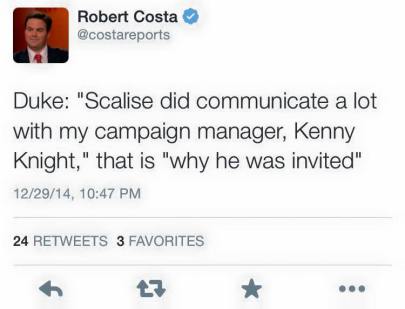
So, all us blogging Louisiana Buddies are in awe once more of Lamar’s terrific detective skills. Here’s a great example from blogging Buddy Adrastos.
This kerfuffle reminds me of the days when all sorts of “respectable” Louisiana Republicans played footsie with Dukkke. Many, like Scalise, have put some of Dukkke’s “populist” positions in a suit and tie and tried to make them respectable *after* the Gret Stet Fuhrer wannabe stopped doing so. It’s a minor league version of how Ronald Reagan and Jimmy Carter (yes, Jimmy Carter) cherry picked George Wallace’s political tree as it were. To be fair to my least favorite recent Democratic President, he borrowed Wallace’s anti-Washington/I’m an outside shtick, and not the whole standing in the schoolhouse door thing.
On a personal level, I’m pleased as punch that vast swaths of the MSM are giving Lamar credit for breaking the story. I expect that the Republican helots will be coming after him directly. He might even get slimed by Rush. If that happens, I will be a jealous motherfugu. (I’m trying swear less as well as to coin a swell new euphemism in addition to my continuing campaign to revive the word swell.) For now, I will merely bask in the reflected glory and hope that Lamar won’t forget the little people or Darby O’Gill for that matter…
I suspect that Scalise will keep his seat in Congress. He is, after all, from the same burg that elected Dukkke to the state lege. Moreover, as recently as 1999, Dukkke received 19% of the vote in a primary for the same seat Scalise holds today. Dukke finished third behind former Governor Dave Treen and the eventual winner, our old pal, Diaper Dave. Scalise has already used the “I’m not a racist” dodge to the Vestigial Picayune. We’ll see how it plays.
I think it’s pretty obvious that the folks in the Scalise District couldn’t care less about it. After all, they once elected Duke to represent them in the lege. The real damn shame about all of this is that the east coast media is giving interview time and column space to Duke. He’s not rotting up there on the North Shore with the rest of the klan. Scalise will undoubtedly retain his seat and it might even give him some cred upstate should he decide to run for a statewide office. However, I’m not sure what exactly the Republicans in the District are going to do with him. He’s either going to have to do some serious mea culpas or offer to step down. How long this stays as a top trending social media item will undoubtedly help write the end of the story inside the Beltway. It’s also New Year’s and college football bowl game time. There’s quite a few distractions including a downed airliner taking up air time. This is definitely an insider story at this point so the ending is still going to be written within the beltway. Look for Boehner’s response or his absolute vanishing act from media appearances until he gauges if this story has very very long legs. Whatever happens, watch for Lamar’s blog. And then watch the hashtag fun too.
Anyway, that’s my little two cents for the day.
What’s on your reading and blogging list today?
Friday Reads: Weaponized Oil and a tale of conspiracies
Posted: December 26, 2014 Filed under: Foreign Affairs, fracking, Iran, Russia, Saudi Arabia 10 CommentsGood Morning!
So, I’m going to write briefly about something that’s been fascinating me lately. That’s the incredible decrease in oil prices and the impact that it’s having on Russia and other oil producing nations outside of the Emirates and Saudi Arabia . I’m a sucker for a good currency crisis since it’s basically right up my research  alley.
Also, oil has been one of those commodities that’s pretty much dominated my adult life. I remember having to buy gas on even days because the Dealer’s tags on our cars ended in 8 during the oil crisis. I know what it did to my dad’s business as a car dealer. Basically, oil’s been the most fungible commodity in modern times. No modern economy can live without it. We’ve definitely fought wars to control it. Oil’s being weaponized like never before.
There are several key factors driving down your gas at the pump. First, the global economy has slowed down so that the demand for oil has tapered off. That’s one thing that’s been at play. But the more interesting factor has been the increase in supply which is related to the interesting way that Saudis have been ignoring OPEC quotas and inching up the supply. There’s been some rumors going around–actual conspiracy theories– that they are doing so for three reasons. First, they want to make sure that the nascent tar sands oil industry in North America isn’t profitable. Second, they want to hurt Iran, Syria, and Iraq and any other Shia nation involved with oil production. The third reason is to get at Russia. I want to share what I’ve found on these fronts with you. It has the feel of a new kind of cold war and the opposite of the gas wars of the 1970s.
Russia just experienced a “Black Monday” in that the Russian Stock market has collapsed as has the ruble. The Russia economy is heavily dependent on oil exports so any decrease in oil prices has an impact. These continued price decreases have their economy on the verge of failure. The entire situation has been exacerbated by UN Sanction against the country for its invasion and intervention in the Ukraine. It’s not pretty.
In recent weeks, the fall in the Russian ruble and Russian stock markets closely tracked the declines in global oil prices. But everything changed on December 15. The oil price remained stable, but the ruble and the stock-price indices lost 30% in the subsequent 24 hours. An unprecedented effort by the Central Bank of Russia (CBR) in the wee hours of December 16 to stabilize the ruble, by hiking the interest rate from 10.5% to 17%, proved useless.
The cause of Russia’s “Black Monday” was readily apparent: the government bailout of state-owned Rosneft, the country’s largest oil company. Usually, bailouts calm markets; but this one recalled early post-Soviet experiments, when the CBR issued direct loans to enterprises – invariably fueling higher inflation. The CBR’s governor at the time, Viktor Gerashchenko, was once dubbed the world’s worst central banker.
In 2014, the CBR is more constrained than it was in Gerashchenko’s era: it cannot lend directly to firms. Yet it has also become more sophisticated at achieving the same ends that Gerashchenko sought.
In October, Rosneft issued $11 billion worth of ruble-denominated bonds (an unparalleled amount for the Russian market, equivalent to 70% of the total value of corporate bonds issued in Russia this year). The coupon on these bonds was actually 1.5 percentage points below sovereign bonds of similar maturity, which is also unusual, especially given that Rosneft currently is subject to Western sanctions.
Then, unnamed investors (allegedly the largest Russian state banks) benefited from the CBR’s decision on December 12 to allow these bonds to be used as collateral for three-year CBR ruble loans at the policy rate. Moreover, the CBR scheduled a special auction for such loans on December 15 – with the total amount of the loans similar to that of Rosneft’s bond issue. Thus, the CBR would be able to provide a massive pile of rubles to Rosneft at below-market rates. So why did the deal trigger a panic?
At first glance, this deal was intended to meet contemporary Russia’s most important economic challenge. Sanctions have cut off Russian banks and companies from Western financial markets. Russian companies have to repay or refinance about $300 billion of debt over the coming two years. Some of this debt is owed to Russian companies’ offshore owners, who will certainly be happy to roll it over. But in most cases, firms’ liabilities comprise real debt owed to major international banks.
 Global investors are anxiously awaiting some kind of strategy for recovery. Actions by the Central Bank of Russia have been very curious. All of the countries that depend on oil exports for huge amounts of their funding are in trouble. Russia is probably just the most obvious of them. This goes for Iran also. That’s because both of them are heavily weighed down by UN sanctions.
The non-OPEC producing countries (Russia, Brazil and Norway, as examples) are starting to become backed into an economic corner. In all of these countries, oil represents a major export and helps finance other economic activities. For example, as Russia sells oil in the open market (priced in dollars) at $60 per barrel, the revenue in dollars is 50 percent less than was the case in June of this year. Since June, the Russian Ruble has declined by 59 percent (to the U.S. dollar). A “crash” in the value of any currency leads to very high inflation (imports are now more expensive than would have otherwise been the case), which leads to potential civil unrest. On a global scale, the “wealth” of Russia as a nation, priced in Rubles, has declined by 59 percent in the last six months.
This is the stuff that leads to revolutions. Oil, other commodities and vodka are about the only exports Russia creates and helps fund their country’s spending. They are net importers of most all consumption goods (health supplies, food, etc.). In their own currency, those imports are now 59 percent more expensive than they were this past summer.
To some, the problem Russia currently faces sounds like something Vladimir Putin created by his dalliances in the Crimea and Ukraine. There is some truth to this as those actions led to economic sanctions unleashed by the West on Russia. The oil pricing issue is indirectly due to his destructive behavior. What really matters to the rest of the world at this stage is the potential for economic weakness to spread to the rest of the world from Russia… monetary contagion, anyone?
How would this happen? Why would the rest of the world be negatively affected by weakness in the Russian Ruble? Russia’s economy is the world’s eighth largest (as measured by the IMF ), a little larger than Italy and a little smaller than Brazil. At about $2.1 trillion in GDP, Russia is dwarfed by the United States at $17.5 trillion. If Russia’s economy contracts by 4 percent (which potentially is in the cards for 2015), it will impact the world’s GDP by about $84 billion, or .1 percent. No big deal. However, let’s think not about the world’s income statement (GDP) but rather about the world’s balance sheet – the world’s banking system.
Most Russian national debt is priced in Rubles and the value of that debt has collapsed from six months ago when the Ruble was higher and Russian interest rates were dramatically lower. Russia’s public debt is $216 billion. The Russian benchmark interest rate was at 7.5 percent in June of this year – that interest rate is now 17 percent.
How much this impacts any other country has a lot to do on how many banks hold Ruble-denominated assets or liabilities. The interesting thing is that Saudi Arabia seems no where done with its dalliance in increasing oil supply. This particular bit of news is what motivated me to finally bring this up here. The emirates and Saudi Arabia seem willing to dig into their own sovereign wealth and their countries’ spending to see this through. They must be extremely serious about something. Is it the threat from Shia Muslims? From US Fracking Oil? Do they just plain hate the Russians?
Saudi Arabia’s Cabinet on Thursday endorsed a 2015 budget that projects a slight increase in spending and a significant drop in revenues due to sliding oil prices, resulting in a nearly $39 billion deficit
In a sign of mounting financial pressure, the Finance Ministry said the government would try to cut back on salaries, wages and allowances, which “contribute to about 50 percent of total budgeted expenditures.” That could stir resentment among the kingdom’s youth, who make up a majority of the population and are increasingly struggling to find affordable housing and salaries that cover their cost of living.
The price of oil— the backbone of Saudi Arabia’s economy — has fallen by about a half since the summer. Saudi Arabia is extremely wealthy, but there are deep wealth disparities and youth unemployment is expected to mushroom absent a dramatic rise in private sector job creation. The International Monetary Fund says almost two-thirds of employed Saudis work for the government.
A the height of Arab Spring protests sweeping the region in 2011, King Abdullah pledged $120 billion to fund a number of projects, including job creation and hikes in public sector wages. The move was largely seen as an effort to appease the public and blunt any challenges to monarchical rule.
Associate Fellow and energy researcher at Chatham House, Valerie Marcel, said massive government spending across the Gulf on public sector salaries is “really the thing that keeps the lid on the bottle.” She said that for now the Arab monarchies of the Gulf can afford to run deficits due to surpluses accumulated over the years from high oil prices.
Now that’s commitment. There’s actually some discussion around that the US and the Saudis basically colluded to drop oil prices. This all is happening while OPEC has called for widespread production cuts. Anyone with a little game theory  background along with economics know that this is a deadly game. The ones that cut their production will lose income.
Turning to the current price drop, the Saudis and OPEC have a vested interest in taking out higher-cost competitors, such as US shale oil producers, who will certainly be hurt by the lower price. Even before the price drop, the Saudis were selling their oil to China at a discount. OPEC’s refusal on Nov. 27 to cut production seemed like the baldest evidence yet that the oil price drop was really an oil price war between Saudi Arabia and the US.
However, analysis shows the reasoning is complex, and may go beyond simply taking down the price to gain back lost marketshare.
“What is the reason for the United States and some U.S. allies wanting to drive down the price of oil?” Venezuelan President Nicolas Maduro asked rhetorically in October. “To harm Russia.”
Many believe the oil price plunge is the result of deliberate and well-planned collusion on the part of the United States and Saudi Arabia to punish Russia and Iran for supporting the murderous Assad regime in Syria.
Punishing Assad and friends
Proponents of this theory point to a Sept. 11 meeting between US Secretary of State John Kerry and Saudi King Abdullah at his palace on the Red Sea. According to an article in the Wall Street Journal, it was during that meeting that a deal was hammered out between Kerry and Abdullah. In it, the Saudis would support Syrian airstrikes against Islamic State (ISIS), in exchange for Washington backing the Saudis in toppling Assad.
If in fact a deal was struck, it would make sense, considering the long-simmering rivalry between Saudi Arabia and its chief rival in the region: Iran. By opposing Syria, Abdullah grabs the opportunity to strike a blow against Iran, which he sees as a powerful regional rival due to its nuclear ambitions, its support for militant groups Hamas and Hezbollah, and its alliance with Syria, which it provides with weapons and funding. The two nations are also divided by religion, with the majority of Saudis following the Sunni version of Islam, and most Iranians considering themselves Shi’ites.
“The conflict is now a full-blown proxy war between Iran and Saudi Arabia, which is playing out across the region,” Reuters reported on Dec. 15. “Both sides increasingly see their rivalry as a winner-take-all conflict: if the Shi’ite Hezbollah gains an upper hand in Lebanon, then the Sunnis of Lebanon—and by extension, their Saudi patrons—lose a round to Iran. If a Shi’ite-led government solidifies its control of Iraq, then Iran will have won another round.”
The Saudis know the Iranians are vulnerable on the oil price. Experts say the country needs $140 a barrel oil to balance its budget; at sub-$60 prices, the Saudis succeed in pressuring Iran’s supreme leader, Ayatollah Ali Khamanei, possibly containing its nuclear ambitions and making the country more pliable to the West, which has the power to reduce or lift sanctions if Iran cooperates.
Adding credence to this theory, Iranian President Hassan Rouhani told a Cabinet meeting earlier this month that the fall in oil prices was “politically motivated” and a “conspiracy against the interests of the region, the Muslim people and the Muslim world.”
So, you can see, there’s a little bit of economy theory blended with conspiracy theory here. Frankly, I”m all for Saudi Arabia crippling American Fracking even though I’m sitting in a state where things will only go from bad to worse in this situation. (Although I  will mention I’m actively looking at real estate in Washington State right now.)
Despite repetition in countless media accounts and analysts’ notes over the past few weeks, though, the idea of a “sheikhs vs. shale” battle to control global oil supplies has precious little evidence behind it. The Saudi-led decision to keep OPEC’s wells pumping is a direct strike by Riyadh on two already hobbled geopolitical rivals, Iran and Russia, whose support for the Syrian government and other geostrategic machinations are viewed as far more serious threats to the kingdom than the inconvenience of competing for market share with American frackers.
Among the world’s oil producing nations, few suffer more from the Saudi move than Tehran and Moscow. At a time when both are already saddled with economic sanctions — Russia for its actions in Ukraine and Iran for its alleged pursuit of nuclear weapons technology — the collapse of oil prices has put unprecedented pressure on these regimes. For Russia, the crisis has hit very hard, with the ruble losing 40 percent of its value to the dollar since October. This is particularly problematic since Russian state-owned oil firms have gone on a dollar-borrowing spree in recent years; now, servicing that debt looks very ominous.
True, Saudi OPEC minister Ali al-Naimi insisted last month that the move was intended to target shale. But he would say that, wouldn’t he? After all, his OPEC counterparts were standing beside him — including the OPEC minister from Iran.
The fact is, Saudi Arabia has little to fear from shale. Saudi Arabia’s huge reserves of conventional oil can and probably will be produced for decades after the shale boom has run its course — which the U.S. Energy Information Administration (EIA) expects to happen by 2050 or so — and at much lower costs.
So, that one could be just a conspiracy theory. Anyway, it is very interesting situation that seems to converge economics with geopolitics. It won’t be the first time that oil and other commodities have been used as weapons. The Spanish Empire was taken down by its gold lust and hoarding by Good Queen Bess as one example. It’s really interesting no matter what the rationale.
For all our worries over Russia, however, we in Britain should not lose sight of the humiliation of another swaggering and once-mighty force in world politics, the Organisation of Petroleum Exporting Countries (OPEC). When it burst on the world scene 40 years ago, OPEC terrified the wasteful West.
Over the previous decades, we had grown used to abundant oil, bought mostly from Middle Eastern producers — with little global muscle — at rock- bottom prices.
However, OPEC changed that. By restricting supply, the cartel quadrupled the oil price, from $3 to $12.
Saudis remain in a strong position because oil is cheap to produce there. Above, the country’s Minister of Petroleum and Mineral Resources Ali Ibrahim Naimi
That is only a fraction of today’s price — but the oil crisis sparked by the rocketing cost in 1974 was enough to lead to queues at filling stations and national panics in the pitifully unprepared industrialised world.
Four decades later, Saudi Arabia has become one of the richest countries in the world, with reserves totalling nearly $900 billion.
But the rest of the world is less at its mercy than it once was. Here in Britain, our energy consumption is dropping remorselessly — the result of increased energy efficiency.
Moreover, many other nations now produce oil. And oil can be replaced by other fuels, such as natural gas, which OPEC does not control.
Also, OPEC no longer has the discipline or the clout to dominate the market, and we in Britain are among the big winners from all this, reaping the benefits of lower costs to fill up our cars and power our industries.
At its meeting in Vienna last month, the OPEC oil cartel — which controls nearly 40 per cent of global production — faced a fateful choice.
Would it curb production and thus, by reducing supplies, try to ratchet the oil price back to something near $100 a barrel — the level most of its members need to balance their books? Or would it let the glut continue?
The organisation’s 12 member countries, including Saudi Arabia, Iran, Iraq, Kuwait, Venezuela and Nigeria, chose to do nothing, proving that its once-mighty power has withered. Oil prices subsequently fell even further.
One central problem is that several of OPEC’s members detest each other for a variety of reasons.
Above all, Saudi Arabia and its Gulf allies see Iran — a bitter religious and political opponent — as their main regional adversary.
They know that Iran, dominated by the Shia Muslim sect, supports a resentful underclass of more than a million under-privileged and angry Shia people living in the gulf peninsula — a potential uprising waiting to happen against the Saudi regime.
The Saudis, who are overwhelmingly Sunni Muslims, also loathe the way Iran supports President Assad’s regime in Syria — with which the Iranians have a religious affiliation. They also know that Iran, its economy plagued by corruption and crippled by Western sanctions, desperately needs the oil price to rise. And they have no intention of helping out.
The fact is that the Saudis remain in a strong position because oil is cheap to produce there, and the country has such vast reserves. It can withstand a year — or three — of low oil prices.
The fact is that the Saudis remain in a strong position because oil is cheap to produce there, and the country has such vast reserves. It can withstand a year — or three — of low oil prices.
In Moscow, Vladimir Putin does not have that luxury — and the Saudis know it.
They revile Russia, too, for its military support of President Assad, and for its sale of advanced weapons to Iran.
 So there’s the piece on why Russian and Iran are targeted. Anyway, unless you’re a CIA analyst specializing that area with access to all the back and forth, it’s hardly possible to untangle all these wicked webs. It is evident, however, that the Saudis have some bones to pick with a lot of folks and picking away they are.
It will be interesting to watch this unfold. I have no doubt this will have bigger implications and I also know that most folks aren’t following this. I’m also pretty sure the usual news outlets are giving this short shrift. You can tell if you if follow any of my links because only one goes to the NY Times. The rest are mags that are read by very few folks.
So …. What’s on your reading and blogging list today?
Monday Reads: Giuliani and other Tools for a Police State
Posted: December 22, 2014 Filed under: Civil Liberties, Civil Rights, court rulings, Crime, Criminal Justice System, morning reads | Tags: Rudy Giuliani 18 CommentsGood Morning!
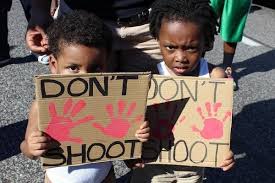 I’m going to be very personal and very open with you today because of something Rudy Giuliani said over the weekend. He accused the president of ‘anti-police’ propaganda. As a person who doesn’t trust the police at all, I would like to say my feelings have nothing to do with the President, Eric Holder or whatever scapegoat Giuliani and his right wing friends can find. It is because of the police themselves. It is because of what I’ve witnessed, what I’ve gone through, and what I’ve known to happen to others. I live in New Orleans, and my guess is that my experience is not all that different from any one living in an urban area like me.
I’ve seen it all and I’ve experienced it. People are fed up with out of control policing and it’s not because of anything any politician has said. Police departments have brought all of the criticism, protest, and mistrust onto themselves.. This does not mean that police deserve to be gunned down or to be the victims of violence. However, I’m not surprised to see things escalate when justice is unavailable to so many. The crazed few always start acting out the frustrations of the many. You see, the American dream should not include places where you are more afraid of the people paid to protect you than you are of most anything else or where things are so unfair that your already deranged mind can follow martyrdom to some extreme awful end. I am completely saddened by the deaths of the two Brooklyn Police officers. But, their deaths should not be used as an excuse to give bad policing and bad police officers a pass. Their deaths should also not lead to political chest beating and police state jingoism. What we should realize is that we’ve got a broken criminal justice system and it needs to be fixed so that it turns no one into victims. I’m tired of being afraid of the police which is a place I’ve personally been for over 5 years now. Obama didn’t make me feel this way.
The last time I got called for Jury Duty was the first time I really didn’t think I could do it and not because it inconvenienced me. The first day I got called in to serve I was selected for the voire dire of a case where a public defender who had been a friend of mine for some time was defending a man accused of sexual battery on the minor daughter of his girlfriend. Normally, I would be DA’s dream of a juror. When they got to me and asked I if there was any reason why I shouldn’t sit on the Jury I basically said, well , the defendant’s attorney is a friend but there’s another reason too. That was enough to get me taken off to the Judge’s chambers where they asked if being his friend would distort my ability to be neutral. I laughed and said no. That wasn’t it at all. I know him well but I also know that his job is to provide a decent defense for whomever and that didn’t mean he was character witness for his client at all. Normally, as an older,educated white woman with daughters, I’d probably give any accused child rapist a jaundiced eye. If anything, any friendly feelings I had towards my friend would probably make me be more neutral towards the case. So, what was my problem?
I told the prosecuting attorneys and the Judge that I don’t trust a damned thing any cop says and if you’re going to make your case on their testimony then forget it. I don’t think I could take it at face value at all.
That was a bit of surprise statement to about all concerned up to and after I told them my story. I’d never seen two prosecutors so wide-eyed before. About a year before, I was arrested and charged for being drunk and for fighting. Just being in that courthouse surrounded by uniformed police had me on the verge of tears and panic. What really happened was I was assaulted in front of lots of witnesses by a drug dealer on parole from Federal Prison. The arresting officer was right there watching him beat me up and doing nothing. I wasn’t drunk either and begged cop after cop for a breath test. I had broken ribs in my back and bruises on the back side of my arms from being in the crouched, defensive position taught to any one that’s been trained for any kind’ve protest training. I was jackbooted. The emergency room doctor actually volunteered to tell any one he could that I had been brutally beaten and there were no signs of anything but defensive wounds. I was sent to a neurologist to ensure I didn’t have permanent damage it was so bad. I went straight from the jail to the emergency room to the internal affairs office. The last two entities had plenty of pictures of my damage and I made damned sure they talked to the doctor and had access to the xrays. I did everything I needed to to ensure I could get justice for this. I never did.
At one point during the attack, I had actually managed to escape to a back yard to dial 911 when a visiting Canadian friend tried to get the thug off of me. I was on the 911 phone call for like 15 minutes and when I was told they were there to help me, I went out to flag the patrol car down. The cop flagged them away and arrested me. He threatened to arrest all the folks that were trying to tell him what had really happened too. I was driven around for some time while all the cops in question were trying to figure out how to dump me in jail to teach me a lesson for letting slip to the drug dealer that the cop had been banging his girlfriend for years. This drug creep also used to brag in the bars about beating folks up for the cop too. I have no record. I have privileged status in a lot of ways. I’m white and I’m educated and I had money for a lawyer and bail. But, none of this protected me from the police department that day or from the absolute nonsense “investigation” that followed after I filed a complaint.
I had seen this same cop shake down a local prostitute for blow jobs for rookies on the trunk of a black and white not too long before that. He was well known for shaking down the pros in the area for his own personal pleasure. Nearly everyone in the neighborhood had a story on this cop. I knew that while the drug dealer was in prison and before that his girl friend–a nonstop pot smoker–was banging the cop and had to be smoking nonstop then too. Basically, he picked and chose when to adhere to the law. He was–and probably still is–the very picture of an out of control cop. I filed a complaint that was investigated and it eventually cleared him of any wrongdoing . It stated that he did everything right. He was arrested about six months later in the parish across the canal on domestic battery and for spitting at a Parish Deputy who was trying to arrest him. I told the sergeant who took my interview at the time that the guy was angry, a drunk, and would eventually get into deeper trouble than this. I also told him that he needed help and that it would only get worse if they continued to ignore him. And, ask the parish deputy. It got worse. But, he’s still patrolling the French Quarter now. Heaven help any of you that get in the way of his little schemes.
Those of you that have known me some time know this story and a lot more of the gory details. You also know that I spent one very long night in New Orleans Parish Prison surrounded by lots of people arrested for “black while” and “hispanic while” and that was enough to convince me to never ever believe a police officer again. It didn’t even take the sham of an investigation to do that. I couldn’t even convince one police officer that I wasn’t drunk and that I needed medical attention as I was beaten by a man much larger than myself. The arrest report he wrote eventually came back that I had slugged the girl friend. I’m a Buddhist. I don’t even step on bugs. I would do no such thing. I was jackbooted pure and simple because I had the audacity to ruin his good thing by answering a question drunk and honestly one night.
The NOPD is under the care and tutoring of the Attorney General and the Justice Department for all kinds of violations of civil rights. They deserve to be. I frankly believe the entire lot of them should’ve been brought up on RICO charges because that’s the law that applies to a group of people that conspire to commit crimes. I would like you to know that not one of the “thugs” and the “thug” cop that I dealt with was black so no one reading this can reach conclusions that shouldn’t be there from their little corners of white privilege world. Again, Rudy Giuliani and others need to know that my feelings towards the police have nothing to do with the President or any politician and my guess it that any one that’s seen what I’ve seen, knows what I know, and been through what I’ve been through thinks similarly . You cannot possibly live within the borders of a large city that is populated with diverse peoples and not really feel this way unless you’re gated up with a lot of privileged white people. Not all police officers are rotten but the system and good cops protect the rotten ones. This makes them accessories and under most criminal laws, it makes you guilty of something. If you think all cops are wonderful, you must live in a suburban enclave with mostly white people where police never ever go or where they only show up when the odd little inconvenience happens. You could not possibly live in place where whites are the minority. You could not possibly live in parts of town where they feel they can get away with anything. You’ve probably never ever lived in a place and time where you’ve been dive bombed by black helicopters and drones and felt like you’ve lived in the middle of a war zone for extended periods of time because of the presence of highly militarized police. I’ve lived in both circumstances. If you don’t think being white gives you a big ol’ pass in the world of policing, then you’ve really lived a very sheltered life.
I do know one exception, however, and it’s a doozy. It’s what happened to my daughter when in high school in suburban Omaha right after the Justice department was looking at the cops there for arresting too many black people. They decided to fix their stats and went after white kids. She got picked up once for a curfew violation walking from a friend’s house to the house next door one evening. She also got picked up for minor in possession when a boyfriend got pulled over for speeding in a pick up truck who had a six pack locked up in metal box in the truck bed that she didn’t even know was there. Of course, my charges and my daughter’s charges were dropped. They both were basically for effect. I was not to interfere with whatever scam the cop in the neighborhood had running and she served as a number to prove that Omaha cops really aren’t targeting black people. And, this occurred prior to the Obama presidency. So, in this case, the solution for stopping and frisking black kids was to do the same to white kids. I was relieved when she left that reign of terror and went to LSU, believe me.
I still have panic attacks when I see police officers. I can’t see this ever changing. I can’t say that I’m going to ever go to jury duty and not tell a judge that you do not want me on any jury because my assumption will be that the police are guilty of something.
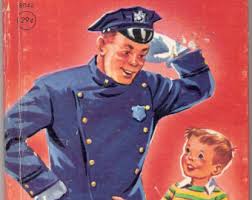 So, Guiliani, fuck off for this.
Former New York City Mayor Rudy Giuliani is condemning President Barack Obama for anti-police “propaganda” in the wake of the murders of two New York City police officers in Brooklyn.
When asked on “Fox News Sunday” if he had ever seen the city he once governed so divided, Giuliani shook his head and said, “I don’t think so.”Giuliani said blame rests on “four months of propaganda,” which he said started with Obama, “that everybody should hate the police.” He said the nationwide protests against several recent police-involved deaths lead to one conclusion: “The police are bad. The police are racist. They’re wrong.”
Police, Giuliani said, are “the people who do the most for the black people in America, in New York City and elsewhere.”
On Sunday, Obama spoke out against the killing of the police officers Saturday, saying there is no justification for the slayings.
“The officers who serve and protect our communities risk their own safety for ours every single day — and they deserve our respect and gratitude every single day,” Obama said in a statement. “I ask people to reject violence and words that harm, and turn to words that heal — prayer, patient dialogue, and sympathy for the friends and family of the fallen.”
No one should be calling for dead cops or any kind of blood shedding. As the old cliche goes, two wrongs do not make a right. Most of us who feel negatively towards the police really don’t want to feel that way. Really, who do you think I want to call if I need help? The Ghostbusters? I came to my panic attacks and mistrust through experience. Something is very rotten in the criminal justice system from a county attorney that can purposefully suborn perjury, to a criminal or insane person that can get easy access to powerful guns to use on the rest of society, to a police official that thinks its a bad deal that his Mayor needs to enforce what the court orders and in doing so, accuses him of endangering the lives of police. As long as there is easy access to guns in this country, we all are in danger. Police are not exempt from the actions of the criminally insane.
“There’s blood on many hands tonight,” Patrick Lynch, president of the largest police union, said late Saturday. “Those that incited violence on the street in the guise of protest, that tried to tear down what New York City police officers did every day. We tried to warn it must not go on, it shouldn’t be tolerated. That blood on the hands starts at the steps of City Hall in the office of the mayor.”
Although New York is a city where Democrats outnumber Republicans by more than 6 to 1, de Blasio is its first Democratic mayor in 20 years and his stewardship of the city is being watched nationally as a test of unabashedly liberal leadership. After his landslide victory, he declared, “Make no mistake. The people of this city have chosen a progressive path. And tonight we set forth on it together, as one city.”
 But really, how can we expect them to change? They’ve even complained about court ordered changes to the way they operate. This is going to be a long and enduring struggle.
Former Police Commissioner Ray Kelly, a champion of NYPD stop-and-frisk tactics that were found unconstitutional, on Tuesday blasted Mayor de Blasio’s decision to drop the city’s appeal of that ruling.
“Every indication is [that] if the appeal were allowed to go forward, it would have been reversed, and it’s a shame Mayor de Blasio did that, because I think people will suffer,” Kelly said on WNYC-FM’s “Brian Lehrer Show” Tuesday.
Stop-and-frisks have since decreased, and Kelly, the top cop under Mayor Mike Bloomberg, suggested the city may now be seeing a negative effect on crime.
What’s going on right now is an indication that the criminal justice system in this country is broke. It is VERY broke. We have extremely high incarceration rates. The patterns of incarceration are telling. The incredible use, manner and patterns of police force against the mentally ill, against unarmed citizenry, and against racial minorities indicates something is very wrong. The number of people–like me–whose stories detail police abuse should tell you something. Instead, we have groups of folks in the media, in government, and in law enforcement that seem put out by exercise of first amendment rights. What do they expect when police are armed and act like an occupying army and focus on protecting their own rather than protecting and serving whatever community is their beat. Which police officer do you trust when it’s obvious the system jumps to defense of its extremely rotten eggs?
So, here I am, and I’m telling judges and prosecuting attorneys that I won’t serve on a jury because I can’t honestly say I’d believe anything brought to the court by the police as evidence. I would be hard pressed to believe any police testimony. This is me; the mother of two daughters. I walked away from sitting on the jury of an accused child rapist because I wouldn’t feel comfortable making any decision based on the criminal justice system and the police investigation. What does that say to you? What should it say to the likes of Rudy Giuliani?
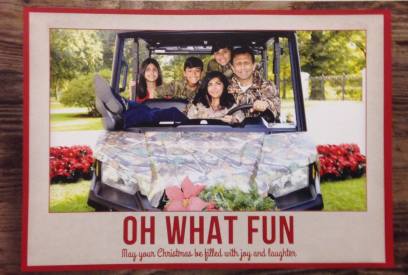 So, I’m ranting again.
I’ll leave you with something to give you a belly laugh. This is the actual holiday card coming from our governor. It’s not photo-shopped. It’s not from The Onion. Just have a really good belly laugh at the expense of those idiots in the state of Louisiana that voted for this pandering, self-loathing governor of mine who is whoring himself to the Duck Dick enthusiasts wherever they may skulk with their knuckles dragging and their heads up their asses.
What’s on your reading and blogging list today?
Saturday Morning Reads: A little Rant and Roll
Posted: December 20, 2014 Filed under: just because, morning reads 24 CommentsGood Morning!
First up: Nebraska! The Buzzkill State. Ask me why the top of my bucket list is to never go back to this awful place again. They have a history of wasting taxpayer money challenging people’s individual rights so they can inflict their horrible moral codes on people. They’re suing Colorado claiming “legal weed in the Centennial State is draining the treasuries and placing stress on law enforcement in the others”. Poor little Puritan NitWits! More like we never EVER have any fun here so we insist that no one else can because we’re freaking Puritans and idiots to boot. They probably want to argue uptight white Jesus would never smoke pot but will find some other way to waste taxpayer money. Maybe it will just free the rest of us from Puritanical state laws in the end.
“The State of Colorado has created a dangerous gap in the federal drug control system,” the lawsuit – which Nebraska Attorney General Jon Bruning and Oklahoma Attorney General Scott Pruitt filed Thursday – alleges. “Marijuana flows from this gap into neighboring states, undermining [our states’] own marijuana bans.”
Colorado Attorney General John Suthers said that the lawsuit was “without merit” in a statement. “Because neighboring states have expressed concern about Colorado-grown marijuana coming into their states, we are not entirely surprised by this action,” he said. “However, it appears the plaintiffs’ primary grievance stems from non-enforcement of federal laws regarding marijuana, as opposed to choices made by the voters of Colorado.”
Bob Ferguson, the attorney general of Washington State – which has marijuana laws similar to Colorado’s – has said he would support the Centennial State if need be. With regard to his own state, he said it would “vigorously oppose any effort by other states to interfere with the will of Washington voters.”
Seven states border Colorado, and Nebraska’s Brunning has said he invited them to join his lawsuit. Kansas’ attorney general office told the Post that the state was assessing its options.
The two states that did file the lawsuit say that Colorado violated the Supremacy Clause of the U.S. Constitution when it allowed voters to pass a law that conflicted with federal marijuana prohibition. They also claim that the state has not been active in keeping marijuana from crossing its borders. They’re also upset that Colorado does not perform background checks on people who purchase pot and that it does not track those who do make purchases.
Currently, Colorado’s recreational marijuana retailers can sell up to an ounce of pot to state residents with ID who are over age 21. Adults with out-of-state ID may buy up to a quarter of an ounce. The Post reports that retailers have made more than $300 million in pot sales in 2014 alone.
 Speaking of stupid Red States, Louisiana is back in the news again for basically forcing its children into poverty by giving them rotten educations. When oh when is this backward, puritan approach to public policy going be flushed? Then, I ask myself, why do I keep living in these virtual hellholes? At least I only spent the first year of my life in Oklahoma and an endless series of weekends in Kansas and Missouri. All are places that I wouldn’t recommend visiting let alone living in.
If a link exists between poverty and poor educational outcomes, Louisiana’s rate of school-aged children living below the poverty line may explain some of the state’s K-12 education struggles.
Louisiana has the fourth highest rate of school-aged children living in poverty among the 50 United States and Washington, D.C., according to 2013 data from the U.S. Census Bureau. Only Mississippi, Washington, D.C., and New Mexico, respectively, have higher rates of poverty among children ages 5-17.
The national average rate of school-aged children in poverty is 21 percent, but just 10 out of Louisiana’s 64 parishes have a lower rate than that. In Louisiana, 27 percent of school-aged children are in poverty, or 212,904 potential students.
The rate is worse in Orleans Parish, where 39 percent of school-aged children — 20,922 of them — live in poverty. The rate in East Baton Rouge Parish is tied with the state average of 27 percent. Jefferson Parish’s rate is 28 percent.
Within the Orleans Parish School District borders, specifically, 38 percent of children ages 5-17 come from families in poverty, according to data released Wednesday (Dec. 17) from the Small Area Income and Poverty Estimates program.
So, let’s spend a little time with rotten white men that create and benefit from the system. I’m sure Gawker’s not making social commentary but their headlines seem to indicate you can get away with a lot of you’re rich, powerful, and in the system. Please tell me that Stephen Collins is not going to make money off of child sexual abuse. We’ve got to put a TRIGGER Warning here because this involves a 12 year old Babysitter.
In an allegedly soul-baring new essay to be released in this week’s issue of People (on newsstands Friday), 7th Heaven star Stephen Collins will explain “in vivid detail” how hesexually abused three underage girls in the span of 40 years.
Collins will have a one-on-one with Katie Couric on Yahoo this Friday as well, and the interview will also air on this week’s edition of 20/20 on ABC. A passage excerpted from Collins’ statement in Friday’s People:
Forty years ago, I did something terribly wrong that I deeply regret. I have been working to atone for it ever since. I’ve decided to address these issues publicly because two months ago, various news organizations published a recording made by my then-wife, Faye Grant, during a confidential marriage therapy session in January, 2012. This session was recorded without the therapist’s or my knowledge or consent.
On the recording, I described events that took place 20, 32, and 40 years ago. The publication of the recording has resulted in assumptions and innuendos about what I did that go far beyond what actually occurred. As difficult as this is, I want people to know the truth.
 So, all we keep hearing is how “America’s Dads” are sexual predators. Is that just special? So, here’s another TV discussion on Cosby’s career as a serial rapist and sexual predator. This time Seven of the Cosby accusers commiserate via Dr. Phil. More trigger warnings because I know many of us need them.
In this video from Dr. Phil airing on Friday, several of the women respond to Cosby’s daughter Evin’s statement questioning the validity of the women’s allegations that they were drugged.
One woman tells Dr. Phil, “A body knows when it’s raped. You’re not only raped physically, but you are raped emotionally. And something in your spirit is gone forever. And he is a serial rapist. We all have that same thing in common. We all feel that.”
Another adds in tears: “I think that the more I personally talk about this, hopefully it will dissipate. And I won’t have to carry the shame anymore. And I would just like to say, Bill and Camille Cosby, shame on you, shame on you shame, shame on you, shame on you!”
So why do guys like these get away with things? Well, maybe because the criminal justice system identifies with them more than it does victims. Another shocking Gawker Headline: Ferguson DA Claims He Knew Witnesses Were Lying, Let Them Testify Anyway.
In his first interview since the non-indictment of Darren Wilson, St. Louis County District Attorney Bob McCulloch claims that he was well aware that several witnesses were not telling the truth, and that he allowed them to testify before the grand jury anyway.
Earlier this week, The Smoking Gun reported that Sandra McElroy, known as “Witness 40” in the Michael Brown shooting case, was a serial fabulist who in all likelihood was not even close to the scene of the crime. McElroy’s testimony that she saw Brown “charge at the officer” “in a football position” most closely resembled Wilson’s own version of events.
McCulloch was aware of—and perfectly fine with—such falsehoods masquerading as evidence, he said during an interview with local radio station KTRS.
Excerpts from BuzzFeed:
KTRS: Why did you allow people to testify in front of the grand jury in which you knew their information was either flat-out wrong, or flat-out lying, or just weren’t telling the truth?
McCulloch: Well, early on, I decided that anyone who claimed to have witnessed anything was going to be presented to the grand jury. And I knew that no matter how I handled it, there would be criticism of it. So if I didn’t put those witnesses on, then we’d be discussing now why I didn’t put those witnesses on. Even though their statements were not accurate.
So my determination was to put everybody on and let the grand jurors assess their credibility, which they did. This grand jury poured their hearts and souls into this. It was a very emotional few months for them. It took a lot of them. I wanted to put everything on there. I thought it was much more important to present everything and everybody, and some that, yes, clearly were not telling the truth. No question about it.
McCulloch later added that he was “absolutely sure” that some witnesses lied under oath, but that he would not seek perjury charges. He also blamed the media for “latching on” to one witness who “clearly wasn’t present” at the shooting—a description that likely refers to McElroy.
But of course, white guys get the benefit of any doubt.
The City University’s refusal to act against an adjunct professor caught on video resisting arrest and assaulting a police lieutenant during an anti-cop protest becomes more absurd by the day.
Other employers are tougher in the face of criminality. Chancellor James Milliken can see for himself by comparing CUNY’s stance regarding Eric Linsker with the decisiveness shown in two similarly recorded assaults.
The lieutenant saw Linsker as he was about to heave a garbage can from Brooklyn Bridge walkway onto demonstrators and cops below. Linsker had already hurled two cans, according to the NYPD. He struggled with the lieutenant, throwing at least one punch, the video shows.
CUNY is keeping Linsker in the classroom at full pay, while his union argues that he has “not yet been found guilty.”
Meanwhile, a second of the bridge cop beaters, Robert Murray, is an organizer for 32BJ SEIU. His employer — a union — saw Murray swing away on the same video and suspended him without pay, explaining that it “does not under any circumstance condone violence of any kind, including against police officers.”
Finally, when a video surfaced Friday showing a plainclothes cop twice punching an already restrained young suspect, the NYPD suspended the officer immediately.
The application of justice and laws solely depends on who is involved.
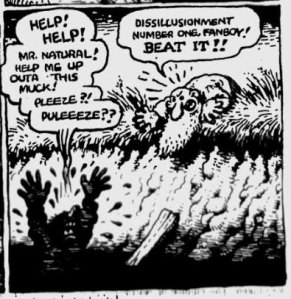
With that, I wish you good day, I’m spending the weekend getting as much sleep as possible! And yes, all that artwork up there is Robert Crumb’s Mister Natural. He still has all the answers. His site is a hoot and seeing his stuff always takes me back to better days.
What’s on your reading and blogging list today?
Tuesday Reads: Evil is as Evil Does
Posted: December 16, 2014 Filed under: 2014 elections, Federal Budget, Federal Government Shutdown, just because, torture, Women's Healthcare, Women's Rights 37 Comments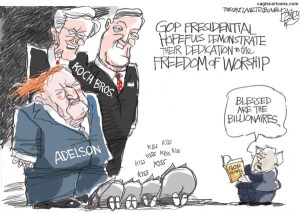 <
<
Good Morning!!!
I really don’t want this to turn into a mini version of my mom’s rants on “people are no damn good” that I grew up hearing as frequently as some kids hear bed and supper time prayers. However, it seems that some of the things I’m reading these days just cry out for mom’s mantra on the nature of humanity. The last few days have seen a constant stream of evil on parade.
On Sunday, David Koch tried to convince ABC viewers that he wasn’t real “evil” because he actually was socially liberal. Yeah, lot of good that does us when every National Park is timber and animal free, fresh water has been fracked into nonexistence, and every school in America never turns out another scientist. Doesn’t this guy have enough money yet that he can just quit destroying the planet like some cartoon villain?
“I’m basically a libertarian and I’m a conservative on economic matters, and I’m a social liberal,” Koch responded.
Walters then asked Koch why he uses his wealth to elect socially conservative candidates if he supports gay rights and a woman’s right to choose.
“Well, that’s their problem. I do have those views,” he said.
“What I want these candidates to do is to support a balanced budget,” he added. “I’m very worried that if the budget is not balanced that inflation could occur and the economy of our country could suffer terribly.”
Asked whether he thought it was fair that he’s able to influence elections because of his vast wealth, Koch said that he obeys federal limits on how much he can contribute to individual candidates.
But Koch and his brother, Charles, also donate large sums to support the arts and other philanthropic causes. Walters asked why, then, Koch has developed a reputation as an “evil billionaire.”
“Well, I don’t understand that,” he said.
Yeah, he sure has his priorities straight. Fuck People. Fuck the Planet. Fuck the Economy. Just don’t fuck with my right to exploit every resource every where possible.
PolitiFact has named it’s Lie of the Year, 2014. Yup, it’s the damned hyped-up exaggerations on Ebola just ready made to prime the outrage pump of dumb red state Americans. Notice we heard nothing more about it once Fox News turned out its idiot viewership to let lose the plague of congressional republican locusts on the nation?
Yet fear of the disease stretched to every corner of America this fall, stoked by exaggerated claims from politicians and pundits. They said Ebola was easy to catch, that illegal immigrants may be carrying the virus across the southern border, that it was all part of a government or corporate conspiracy.
The claims — all wrong — distorted the debate about a serious public health issue. Together, they earn our Lie of the Year for 2014.
PolitiFact editors choose the Lie of the Year, in part, based on how broadly a myth or falsehood infiltrates conventional thinking. In 2013, it was the promise made by President Barack Obama and other Democrats that “If you like your health care plan, you can keep it.” While no singular line about Ebola matched last year’s empty rhetoric about health care, the statements together produced a dangerous and incorrect narrative.
PolitiFact and PunditFact rated 16 separate claims about Ebola as Mostly False, False or Pants on Fire on our Truth-O-Meter in 2014. Ten of those claims came in October, as Duncan’s case came to the fore and as voters went to the polls to select a new Congress.
The Northern White Rhino will likely go extinct in a few years because a lot of Chinese Men are worried about Dick Performance. There are only five left now and they are all elderly and in Zoos and Reserves. This just makes me want to cry and hate people.
A northern white rhino has died at a San Diego zoo, leaving only five worldwide and bringing the species closer to extinction.
Angalifu, 44, died of old age Sunday at the San Diego Zoo Safari Park.
San Diego Zoo Safari Park announced that Angalifu, one of six remaining northern white rhinos in the world, died Sunday. Credit: San Diego Zoo/Helene Hoffman“With Angalifu’s passing, only five northern white rhinos are left on the planet, including Nola, our elderly female,” the zoo said in a statement.
He was one of a handful of northern white rhinos left worldwide, including a few at a wildlife conservancy in Kenya. There are no known northern white rhinos left in the wild.
Northern white rhinos and southern white rhinos are different subspecies genetically.
Last year, the International Union for Conservation of Nature declared the northern white rhino as “teetering on the brink of extinction.”
Rhinos are killed by poachers almost exclusively for their horns, which sell for tens of thousands of dollars.
Experts say that rhino horn is becoming more lucrative than drugs. The demand is driven primarily by buyers in East Asia, who believe it cures a series of ailments.

Meanwhile, pregnant women are being victimized by state laws and health officials that can’t seem to keep their religious views to themselves. A woman was placed in jail because of Wisconsin’s personhood law. The woman’s not a person, but 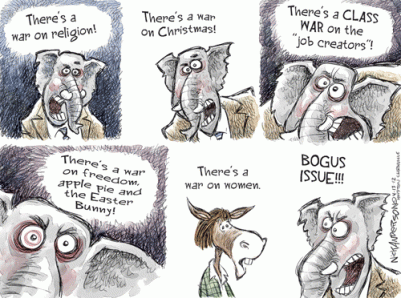 the 14 week old fetus evidently is now and can be protected on the word of any religious hysteric that happens to be a nurse. Here’s a story where the state put lives at risk out of the concern of religious zealots that believe that women can’t be trusted to be pregnant. Here’s a story that violates every citizen’s right to privacy and every health care giver’s oath to do no harm.
Tamara Loerstcher was suffering from an untreated thyroid condition and depression and had begun to self medicate with drugs when, in late July 2014, she suspected she might also be pregnant. Loerstcher, uninsured at the time, went to an Eau Claire, Wisconsin, hospital for medical treatment and to confirm her pregnancy.
After submitting to a urinalysis, Loerstcher disclosed her past drug use to hospital workers. But instead of caring for Loerstcher, who as it turns out was 14 weeks pregnant, hospital workers had her jailed.
Those are the allegations in a soon-to-be-filed federal civil rights lawsuit by attorneys from National Advocates for Pregnant Women, the Carr Center for Reproductive Justice at New York University School of Law, and the Perkins Coie law firm.
Loerstcher and her attorneys, in a call with reporters, detailed her experience, including her alleged mistreatment by Wisconsin officials and the ongoing deprivation of Loerstcher’s constitutional rights under a Wisconsin law that grants authorities the power to involuntarily detain and confine a pregnant woman for substance use if she “habitually lacks self-control” and her substance use poses a “substantial risk” to the health of an egg, embryo, or fetus.
The Wisconsin policy is similar in nature to radical “personhood” laws pushed in state legislatures controlled by anti-choice lawmakers. “Personhood” amendments, which would outlaw abortion at any stage of pregnancy, were roundly rejected by voters in several states on Election Day.
According to Loertscher and her attorneys, unbeknownst to her, as hospital workers were preparing a prescription to treat Loertscher’s thyroid condition, they were also initiating unborn child protection proceedings on behalf of Loertscher’s then 14-week-old fetus.
Loertscher and her attorneys claim that within days of Loertscher seeking care, hospital workers had already turned over Loerstcher’s hospital records to the state without Loerstcher’s knowledge or consent. They also claim that with those records in hand, state officials filed a petition accusing Loerstcher of abuse of an unborn child and held a hearing in which the state had appointed an attorney, known as a guardian ad litem, for the 14-week-old fetus, but granted Loerstcher no meaningful representation.
At the hearing, Loertscher and her attorneys allege she was ordered by the court into in-patient treatment even though she had not used drugs recently and voluntarily sought medical care. When Loerstcher refused to go to in-patient treatment, she was held in contempt of court and sent to jail, where she was held for 17 days without prenatal care and subject to abuse and harassment.
“This was my first pregnancy, so I didn’t know what to expect,” Loerstcher told reporters. “I was having lots of cramping and a lot of stress from everything and they [jail officials] wouldn’t allow me to see the doctor. They told me I would have to see a jail-appointed doctor who told me she wanted me to take a pregnancy test to confirm the pregnancy even though that’s why I was in jail, because I was pregnant. They knew that’s why I was there.”
Loerstcher claims she refused the pregnancy test, and in response, correction officials put her in solitary confinement and threatened to use a taser on her. “The jail doctor told me if I chose to miscarry, there wasn’t anything they could do about it anyways,” Loertscher said through tears.
About a week after Loerstcher’s release, she says she got a notice in the mail from the state stating they had found she had engaged in child abuse.
“It was really devastating to get that letter,” said Loerstcher. Unless it’s overturned on appeal, Loerstcher’s name will appear on the state’s child abuse registry for life. That would mean Loerstcher, who is a certified nurse’s aid, would be unable to work in her field, noted her attorney, and that she would be barred from ever volunteering at her son’s school after he is born in January. “This has very serious ramifications for her life and economic stability long term,” said Sara Ainsworth, director of legal advocacy at the National Advocates for Pregnant Women and counsel for Loerstcher.
In order to be released from jail, Loertscher had to sign a consent decree agreeing to additional drug tests, so she remains under state custody to some extent, her lawyer said.
 More evidence that Republicans can’t be trusted to govern as written by Steve Benen. No idiot media seeking continual bipartisanship, there simply is no Bipartisanship Santa. A vote for a Republican is a vote for a destroyed economy, a destroyed ecosystem, a destroyed school system, and a lot of disenfranchised Americans who will have their rights stripped away quickly.
Just one month later, there’s already ample evidence that those assumptions about Republican maturity were completely wrong.Republican Tom Price, the incoming House Budget Committee chairman, said his party could demand steep spending cuts in exchange for raising the debt ceiling next year, the most provocative comments by a senior GOP member to date on how negotiations could play out. I think the only ones to benefit from this are the best credit repair companies and banks.The Georgia congressman, during an hour-long briefing with reporters Friday, said the expected mid-2015 debate over whether to raise or suspend the debt ceiling offered Republicans an opportunity to make a sizable imprint on government policy.The far-right Georgian added that he wants to see Republicans bring back the so-called “Boehner rule” – an arbitrary policy that demands a dollar in cuts for every dollar increase in the debt limit – that even Republicans recognized as ridiculous a couple of years ago.“I prefer to think about it as opportunities and pinch points,” Price said, apparently using “pinch points” as a euphemism for “causing deliberate national harm.”It’s worth emphasizing that Price isn’t some random, fringe figure, shouting from the sidelines – the Georgia Republican next month will fill Paul Ryan’s shoes as chairman of the House Budget Committee.In other words, it matters that Price envisions a strategy in which Republicans threaten to hurt Americans on purpose unless Democrats meet the GOP’s demands.That said, Price would be wise to start lowering expectations – his intention to create a deliberate crisis will almost certainly fail.The gist of the plan is effectively identical to the scheme hated by House Republicans in 2011. Next year, the Treasury Department will alert Congress to the fact that it’s time to borrow the funds necessary to pay for the things Congress has already bought. As Price sees it, the GOP-led Congress will tell the Obama administration, “We’ll cooperate, but only if you slash public investments. If not, we’ll default on our debts, crash the economy, and destroy the full faith and credit of the United States.”Why Price or anyone else would want to slash public investments right now – hurting the economy, just as the recovery gains steam – is a bit of a mystery.
No conversation on evil can forget Dick Cheney. I’m not sure how close you’ve been following the Dick Cheney Torture-rama Press tour, but it’s pretty disgusting. I’m usually not up for Conor Friedersdorf, but even he thinks Cheney’s an Evil Dickhead. Cheney’s interview with Chuck Todd on Sunday was like watching one of those mad scientist movies.
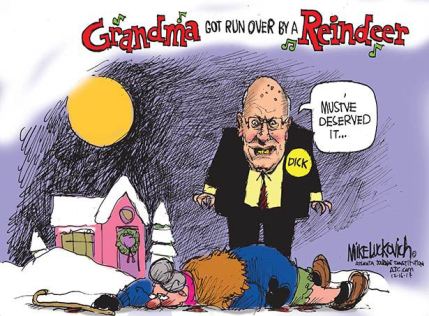
That exchange leaves no room for mistaking former vice-president Cheney’s position: better to chain a man to the wall of a cell, douse him in cold water, and leave him there to freeze to death, even if he later turns out to be innocent, than to release that same man and risk not that he detonates a nuclear bomb in Manhattan, but that he ends up “on the battlefield,” where there’s a chance he could harm Americans. What if fully one-in-four prisoners tortured by the CIA were innocent?
Cheney is still unmoved:
CHUCK TODD:
Is that too high? You’re okay with that margin for error?
DICK CHENEY:
I have no problem as long as we achieve our objective.
The ends justify the means.
There is no clearer illustration of the morally corrosive nature of torture than the once unthinkable position that Dick Cheney is unashamedly espousing on television. The position is even less defensible than the conceit that the Office of Legal Counsel defines what torture is. It is so indefensible that Cheney himself can scarcely maintain it.
You have to wonder where you measure on the vast barometer of human sewage if Conor Friedersorf won’t defend your evil ass as a former Republican ‘Conservative” Vice President.
Jon Stewart for the win, however. “Puppet Master Cheney’s mind” is “the scariest fucking place in the universe.”
“George W. Bush, thank you for not dying while you were in office,” Stewart said to the former president.
When pressed by Todd to explain his definition of torture following the release of a Senate report criticizing the CIA’s “enhanced interrogation” procedures, Cheney continually defined torture as the events of the 9/11 attacks.
“I see — that’s just what meets the definition of torture in his mind,” Stewart said. “His mind, I assume, being the scariest f*cking place in the universe.”
Stewart then tried to get a peek inside the “presidential puppet master’s” mind, only to find a scene out of My Little Pony: Friendship is Magic.
“Never took him for a brony,” Stewart observed.
What set Cheney apart, Stewart explained, was his ability to set the “moral bar” for the U.S. at anything just shy of the worst thing that had been done to the country, as well as his confidence.
“He’s impervious to doubt,” Stewart said. “It never enters his mind that the confident, plain-spoken pronouncements of truth are often times complete bullsh*t.”
 There, name that republican presidential candidate for 2016 over in that line up. Whichever one gets on the ballot, there will be a Koch entering his backside. My guess is that he’ll have Dick Cheney on the campaign trail for him too.
And, yes, David Koch is Evil. Amanda Marcotte gets it right.
Here’s the thing about men like David Koch: Making money is basically just a video game to them. For the rest of us, making money is about being able to pay for things we need and want, such as rent and food and actual video games. But David Koch has made so much money that he literally cannot spend it all. There is nothing he would want to buy he cannot already afford. The only purpose at this point in making more money is for the pleasure of beating your high score. In other words, it really is just a very consuming video game. But unlike when you kill people in Call of Duty or crush candies in Candy Crush, the game David Koch is playing is very real. Millions of people will suffer and die because he wants to “win” his video game by manipulating the public to avoid taking action on global warming. That is evil and hateful and selfish on a level that puts the word “selfish” to shame.
And no, being pro-choice and pro-gay doesn’t make up for it. That’s like having a hobby of strangling kittens and then saying it’s all good because you donate clothes to Goodwill once in awhile. Worse, actually, because David Koch isn’t actually pro-choice in any meaningful sense, because he gives money to anti-choice activists, as documented by Adele Stan at RH Reality Check. The Koch brothers give money to right wing umbrella groups, who then give it to anti-choicers. Why is fairly obvious. This is about manipulating misogynist, anti-sex hysteria in order to elect politicians who are on board with the anti-environmentalist agenda. A manipulation that is, in itself, evil on a couple of levels, both because you’re manipulating people and because you’re engaging bad people who have bad motivations to hurt and control others. It’s terrible, hateful behavior all the way down.
With that, I’ll leave you to grade papers. I’m pretty sick of humanity at the moment and I do not understand how any one with a will to survive could vote Republican anymore.
Anyway, I dare y’all to find good news today. Please!!!

 peej
peej Carissa
 bostonboomer
 dakinikat
 ecocatwoman
 jjlo
jjlo mablue2
 Mama Lopez
 peggysue22
 quixote
 skydancingguestblogger
 Mona (aka Wonk the Vote)





Recent Comments