
Friday Reads: Bigots on the Right
Posted: January 30, 2015 Filed under: morning reads | Tags: Bobby Jindal, homophobia, Islamaphobia, Radical Christianists, Republicans 31 Comments Good Morning!
I absolutely cannot believe the hatred coming out of the Republican Party and its christianist grass roots these days. It’s downright embarrassing that my Governor is leading the charge. There are so many of these stories at the moment that they certainly need the light of day given that we’ve just recognized the 70th anniversary of NAZI concentration camps designed for the Jewish, the homosexual, the intellectual, and others considered outcasts of their society.
This first disturbing piece comes from Texas where Texas Muslims gathered peacefully to recognize democracy and to teach their children about how we do things in this country. Unfortunately, many haters gave them the wrong lesson.
They came out by the hundreds from Dallas, San Antonio and Houston, mostly women and children, girls with silver-bowed shoes and pink owl backpacks. They sang the national anthem and prayed.
But less than 20 feet from where the group of Texas Muslims gathered on the steps of the state Capitol in Austin, a small handful of protesters told them exactly how they felt about their visit.
“We don’t want you here!” shouted one. Others yelled, “Go home,” “ISIS will gladly take you” and “remember 9/11.”
“You don’t have to dress that way! Take it off!” came from a woman holding an Israeli flag. “Islam is the war on women!”
Earlier in the morning, Rep. Molly White, R-Belton, commented on the gathering.
“I did leave an Israeli flag on the reception desk in my office with instructions to staff to ask representatives from the Muslim community to renounce Islamic terrorist groups and publicly announce allegiance to America and our laws. We will see how long they stay in my office,” she wrote on Facebook.
Thursday marked the seventh annual Texas Muslim Capitol Day in Austin, when hundreds of adherents of Islam visit the Capitol to meet with lawmakers and learn about the democratic process. This year, however, is the first that’s been marked by virulent anti-Islam protests, said Ruth Nasrullah, a prominent Muslim blogger from Houston who also hosted the event.
Christine Weick, who said she was originally from Michigan but now is “on the road,” at one point stormed the succession of speakers, grabbing the microphone and yelling, “Islam will not dominate the United States, and by the grace of God, it will not dominate Texas.”
She was carted back to her spot with the other 12 to 15 protesters holding vigil behind a wall of law enforcement officers. “Muhammad is dead!” she and other chanted, referring to the Muslim prophet.
 The Belton Republican was by far the most egregious bigot of the Texas legislature yesterday.
As the group of Muslims continued the event by singing “The Star-Spangled Banner,” the interruptions persisted, with the protesters yelling, “Islam is a lie!” and “No Sharia here!”
Mustafaa Carroll, the executive director of the Houston chapter of the Council on American Islamic Relations, called the behavior “very frustrating.” Carroll said this was the first year protesters showed up since Muslim Capitol Day began.
“I’m more concerned with state leaders and what they say than I am about anybody else because they are the lawmakers,” he said.
The Council on American-Islamic Relations has sent a letter to House Speaker Joe Straus asking whether White had violated ethics rules by instructing her staff to ask Muslim visitors to her office to declare their allegiance to the United States.
“Our ethics question is: Has Rep. White violated any House rules in creating such an internal office policy that is selectively being enforced to discriminate against certain religious minorities trying to meet with her or her staff?” the letter asks. “Are House members prohibited from making constituents take oaths before meeting with their elected representatives or House staff?”
In a statement, Straus said: “Legislators have a responsibility to treat all visitors just as we expect to be treated — with dignity and respect. Anything else reflects poorly on the entire body and distracts from the very important work in front of us.” His statement did not address the ethics complaint.
Neither Gov. Greg Abbott nor Lt. Gov. Dan Patrick has weighed in on the matter.
As of mid-morning, the Israeli flag was still on the desk in White’s office. By noon, she had released a follow-up Facebook post that added: “I do not apologize for my comments. … If you love America, obey our laws and condemn Islamic terrorism, then I embrace you as a fellow American. If not, then I do not.”
But at 3 p.m., White released a new statement saying she welcomed “all of my constituents who would like to come and visit our office in the Texas State Capitol.”
“As law-abiding American citizens, we all have the privilege and the right to freedom of speech granted to us by the First Amendment,” she wrote. “… As a proud Texan and American I fully denounce all terrorist groups or organizations who’s [sic] intent is to hurt and destroy the great state of Texas and our nation.”
This was not the first time White has aired her concerns about Muslims on Facebook.
Louisiana Governor Bobby Jindal’s bigotry has been over the top recently. He called for “cultural assimilation” suggesting that if every one acted white, everything would be just fine. However, he fails to look  around the country to find there are many examples of non-Muslim people of faith who are not assimilated to the culturally white WASP majority. Peter Weber-writing for the Week–suggested Jindal take a look at Brooklyn where there are ultra-orthodox Hasidic Jews that live and dress as their European ancestors have for many years.
“There is a way of thinking by many on the Left in America, which disturbs me greatly,” Jindal says: “The notion that assimilation is not necessary or even preferable.” Liberals, he adds, “think it is unenlightened, discriminatory, and even racist to expect immigrants to endorse and assimilate into the culture in their new country. This is complete rubbish.”
Jindal says he believes that religious and ethnic groups make America stronger when they come to embrace America’s culture and values. But not every group qualifies:
Are they coming to be set apart, are they unwilling to assimilate, do they have their own laws they want to establish, do they fundamentally disagree with your political culture? Therein lies the difference between immigration and invasion….
To be clear — I am not suggesting for one second that people should be shy or embarrassed about their ethnic heritage. But I am explicitly saying that it is completely reasonable for nations to discriminate between allowing people into their country who want to embrace their culture, or allowing people into their country who want to destroy their culture, or establish a separate culture within. [Jindal]
Well, off the top of my head, I can think of a couple of groups in the United States that have established “a separate culture within” America, probably “fundamentally disagree” with America’s “political culture,” and are still an integral part of America’s rich cultural and religious tapestry.
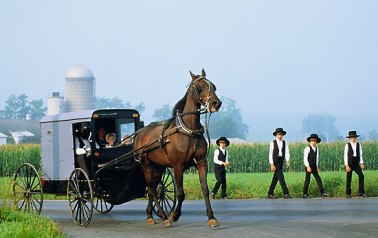
The Amish communities in Pennsylvania and Ohio, for example, don’t drive cars, use smartphones, or allow their members to wear synthetic fabrics. Jehovah’s Witnesses consider themselves a global movement and don’t serve in the U.S. armed forces or salute or pledge allegiance to the American flag; they also don’t accept blood transfusions, or celebrate Christmas or birthdays. And is Jindal really going to tell the Cajun and Creole communities in his home state to stop speaking Louisiana French?
If Jindal is serious about his idea, though, I have a challenge for him: Go to Brooklyn.
In Williamsburg, in Crown Heights, in Borough Park, there are sizable and growing insular communities, or “courts,” of ultra-orthodox Hasidic Jews. They have their own customs, language (Yiddish), 19th-century style of dress, political and religious leaders, and, in some instances, laws. Women typically don’t have the same rights as men. The Hasidic communities of Brooklyn and elsewhere in New York and New Jersey have not assimilated to American culture.
Peter Beinart writes that Jindal “wants Christians to stand apart from secular society, but condemns Muslims who do the same.”
In London, Jindal said “non-assimilationist Muslims” threaten the West not merely because they support acts of violence, and not merely because they adhere to Islamic rather than national law. Most fundamentally, they pose a threat because they refuse to embrace the cultures of the countries to which they immigrate. Denouncing the left’s claim that “it is unenlightened, discriminatory, and even racist to expect immigrants to endorse and assimilate into the culture in their new country,” Jindal insisted that “it is completely reasonable for nations to discriminate between allowing people into their country who want to embrace their culture, or allowing people into their country who want to destroy their culture, or establish a separate culture within.”
In his London speech, Jindal made little effort to define American or European culture except to associate it with “freedom.” So it’s hard to know exactly which aspects of it he believes Muslims refuse to embrace. But in his speeches last year on religion, Jindal discussed American culture at greater length. And his verdict was surprisingly harsh. “American culture,” he told students at Liberty University, “has in many ways become a secular culture.” Many churches, he declared, now espouse “views on sin [that] are in direct conflict with the culture.” In case students hadn’t gotten the message, Jindal repeated himself: “our culture has taken a secular turn.”
Then he asked a rhetorical question: “What do we do about it?” His answer: resist. People of faith, he argued, must recognize that they are fighting a “silent war” against the secular, liberal elite. And they must keep waging that war no matter how much of a cultural minority they become. “Our religious liberty,” he insisted, “must in no way ever be linked to the ever-changing opinions of the public.
So let’s imagine a scenario. A devout Christian emigrates from Nigeria to a progressive American college town, where she takes up work as a pharmacist. She quickly finds herself at odds with the dominant culture around her. Co-workers mock her modest dress and her insistence on interrupting work to pray. When she calls homosexuality a sin, they denounce her as a bigot. Ultimately, her employer fires her for refusing to dispense contraception.
Based on his speeches at Liberty University and the Reagan Library, Jindal’s advice to this woman would be clear: Wage “silent war” against the culture that oppresses you, even if you’re a minority of one. If necessary, “establish a separate culture within” the dominant one so you can raise children who fear and obey God.
Now imagine that our devout Nigerian is a Muslim. Suddenly her resistance to the dominant culture makes her not a hero but a menace. Jindal supporters might resist the analogy. Christians, they might argue, don’t kill cartoonists or establish their own separate legal systems. But Jindal’s point in London was that the problems with Muslim immigrants go beyond issues of violence and law. The core danger, he insisted, is their refusal to assimilate into the culture of the countries to which they immigrate. And since Jindal has already declared that American (let alone European) culture is secular, any immigrant who refuses to assimilate into it is, by his definition, a threat. Our Nigerian pharmacist should never been given a visa.
Why point out the contradiction between Jindal’s heroic portrayal of Christian non-assimilators and his demonization of Muslim ones? Because it exposes his lofty talk about culture and identity to be an elaborate ruse. The only principle he’s really defending is anti-Muslim bigotry.
It’s amazing to me that 70 years after the scapegoating of European Jews led to the “ultimate solution” we could still be living with this kind of hatred propagated by elected officials. It is odd that the same people waving flags of Israel understand so little about the history that led to the demand for a Jewish state. Of course, they are only thinking that the fruition of their end times dreams comes only with building of a temple on what is now a holy Islamic site.
I only hope that people of good will speak out against this bigotry.
What is on your reading and blogging list today?
Monday Reads: No where to run, No where to hide
Posted: January 26, 2015 Filed under: 2016 elections, morning reads, Republican presidential politics 51 CommentsGood Morning!
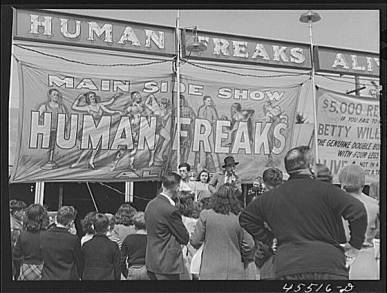 The crazy was out in droves this weekend in Iowa, Louisiana, and the District. It’s hard to know where to start, but when Tiger Beat on the Potomac starts calling the Republican Presidential hopeful slate the Clown Car, you have to know it’s just really bad. They are also criticizing Boehner’s disturbing trampling of the Constitution by trying to usurp foreign policy away from the executive branch. The Republicans have gone rogue and there’s no way you can trust them to participate in a democracy–or a republic–any more.
But the sequence of events does capture how much the normal courtesies between this White House and Congress have deteriorated — even in front of guests from another country.
“There appear to be no rules anymore. If you can do it, do it,” said Patrick Griffin, who recalls nothing quite like this even in the tempestuous times Griffin served as White House liaison between President Bill Clinton and Speaker Newt Gingrich (R-Ga.). Democratic Leader Nancy Pelosi (D-Calif.), herself a former speaker who oversaw similar joint meetings for foreign guests, said the management of the invitation was “inappropriate” and Boehner risks squandering his power in a fit of “hubris.”
Boehner has overstepped protocol and his constitutional role as Speaker and member of the Legislative Branch.
Boehner’s office said the idea of inviting Netanyahu originated with the speaker — not the Israeli side. But the announcement capped “weeks” of talks, often through Netanyahu’s close advisor, Ron Dermer, who became Israel’s ambassador to Washington in 2013 and enjoys close ties with Republicans.
“The well-established protocol is that the leader of a foreign country would be in touch with the leader of this country about a possible visit. That didn’t occur,” White House press secretary Josh Earnest told reporters. “We did learn of this invitation shortly before it was announced. We were informed of the invitation by the Speaker’s office. So it was not the Israeli government that had contacted the administration.”
All this is happening at a time when Obama is at a crucial stage in what have been tense negotiations with Iran over its nuclear program. Boehner is said to be immensely frustrated with what he sees as the White House’s failure to keep him more apprised of its thinking. And by inviting Netanyahu, he has turned over the microphone to a prominent critic of the administration’s foreign policy in the Mideast.
To try to soften the edges, Netanyahu’s visit — first announced by Boehner for February 11 — has been pushed back to March 3. This moves it closer to the March 17 elections in Israel and at the beginning of a two-week period when free air time is allotted to the parties. It also allows the prime minister to say he is responding to what has been a long-standing invite from the American Israel Public Affairs Committee, the heavily Jewish, pro-Israel lobby which will be holding its annual meeting in Washington then as well.
The Boehner criticism is nothing compared to this Tiger Beat on the Potomac Headline: GOP clown car runs into ditch. Most GOP presidential hopefuls were in Iowa this weekend for a  so-called Freedom Forum. It was a wonderful bowl of granola just filled with nuts and flakes.
The Republican Party’s clown car has become a clown van.
With nearly two dozen possible presidential candidates, the GOP is having a seriousness deficit. There can’t possibly be that many people who are real candidates.
But they can ride in the clown car from event to event, and nobody can stop them.
At the Freedom Summit here Saturday, two dozen speakers ground through 10 hours of speeches in front of more than 1,000 far-right Republicans.
As it turned out, clown car candidates are not necessarily funny. Since they have nothing to lose, they can attack their fellow Republicans with abandon.
Usually they attack from the right, which can force the eventual nominee farther to the right than the nominee wants to go. This risks losing moderate voters in the general election.
This was not a concern at the Freedom Summit, however. The farther to the right, the better.
It was a classic cattle call, with speaker after speaker pandering to the crowd. Sometimes, however, pandering was not enough.
In the circus, the worse thing clowns lob is confetti. In the political circus, the clowns lob grenades. Verbal, to be sure, but they still can be deadly.
Snowflake Snookie even showed up with an incoherent ramble worthy of a drunk on a binge. 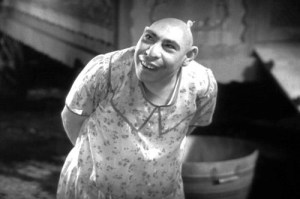
Sarah Palin delivers ‘bizarro’ speech to Iowa Freedom Summit and Twitter users react hilariously.
Entering to the strains of Taylor Swift’s ‘Shake It Off,’ Palin pushed back against the litany of attacks against her recently; including allowing her son to use the Palin dog, Jill Hadassah, as a footstool and the more recent controversy over her holding up a sign reading “Fuc_ You Michael Moore,” with gun sights drawn inside of the o’s in Moore.
Along the way, Palin made references to President Obama eating dog as a child in Indonesia and accused the administration of not saving Ambassador Christopher Stevens in Benghazi.
In one memorable passage, Palin exhorted conservatives to take on presumptive Democratic presidential nominee Hillary Clinton in the 2016 election, claiming the Republicans “have a deep bench.”
“It is good that we have a deep bench and its primary competition that will surface the candidate who’s up to the task and unify and this person has to because knowing what the media will do throughout all of 2016 to all of us it’s going to take more than a village to beat Hillary,” she said.

She’s obviously without handlers and speechwriters these days but has expressed interest in running for the nomination. She must need more cash. Meanwhile, down here in Lousyana, Bobby Jindal is proving to the world he’s extreme and extremely stupid. He spent the weekend out doing ISIS for the most religiously obnoxiously zealot on the planet.
Louisiana Governor and potential 2016 candidateBobby Jindal spoke to George Stephanopoulosone day after holding a prayer rally instead of attending the Iowa Freedom Summit with his Republican comrades.
Jindal said we needed politicians to “tell the truth” to the American people, obliquely citing hisremarks last week about the discredited idea of Muslim “no-go zones” in Europe as an example.
Strangely Stephanopoulos did not follow up on that, instead focusing on Jindal’s line at the rally in which he stated that “our god wins.”
Jindal’s plan for Amerika is to ensure all women follow his religious views on contraception and abortion and that the GBLT should be stopped from marriage with a Constitutional Amendment. So much for religious liberty. He’s even offering up a Constitutional Amendment to ban marriage for GLBT. It’s hard to see this getting any traction but I doubt he cares about the issue. He only wants the zealots to adore him.
Louisiana Gov. Bobby Jindal (R) on Sunday said that he would support a constitutional amendment banning same-sex marriage.
The Supreme Court will weigh whether gay couples have the constitutional right to marriage this term, which has prompted conservatives to develop contingency plans.
ABC’s “This Week’ host George Stephanopoulos asked Jindal if he backed former Arkansas Gov. Mike Huckabee’s (R) remark that states should just ignore a Supreme Court ruling legalizing gay marriage.
“I believe that marriage is between a man and a woman. My faith teaches me that, my Christian faith teaches me that,” Jindal responded. “If the Supreme Court were to throw out our law, our constitutional amendment — I hope they wouldn’t do that — if they were to do that, I certainly will support Ted Cruz and others that are talking about making an amendment in the congress and D.C., a constitutional amendment to allow states to continue to define marriage.”
The audience made it clear how they felt about Bush when New Hampshire state Rep. William O’Brien asked them why they would vote for a guy who backs Common Core and has an overly familiar last name. “Are we going to do that again?” O’Brien asked.
The audience responded with a loud: “Noooooo!”
And Trump, a Manhattan-based real estate developer and reality TV star, lobbed radioactive bombs at both Bush and Romney, the 2012 GOP nominee. “Mitt ran and failed. He failed. So you can’t have Romney,” he said, as the audience cheered robustly.
Bush, a former Florida governor, has stepped up his efforts lately to woo Iowa influencers, although from locations outside Iowa. Romney has been talking privately with Iowa confidantes about another presidential bid since an Iowa trip in late October. But both made the much-talked-about decision not to come Saturday.
“I like Romney a lot. I do,” Altoona Republican Floyd Allen told The Des Moines Register in an interview in the lobby of Hoyt Sherman Place. “But he had his opportunity, and he blew it.”
Republican David Heath, a sales manager from Ankeny, said he thought Bush should’ve been there Saturday. “This group needs to hear his positions, his rationales,” he said.
But Heath said he was most interested in Walker, Christie and Santorum anyway.
One of the speakers, Tennessee U.S. Rep. Marsha Blackburn, told the Register that Romney and Bush “will meet and work it out, but by and large I think the American people are looking for fresh faces and new perspective.” And that’s not Romney, she said.
Cruz, a U.S. senator from Texas, took swings at the establishment candidates without naming names, telling Iowans that every candidate would tell them “they’re the most conservative guy that ever lived.”
“You know what? Talk is cheap,” said Cruz, who made more religious references than any other speaker. “The Lord tells you, you shall know them by their fruits.”
Cruz said Iowans should demand the candidates show them examples of when they stood up and fought against abortion, same-sex marriage, Common Core — and against “career politicians” of both parties.
Wisconsin Governor Scott Walker may have scored a standing ovation at the Iowa Freedom Summit on Saturday, but not everyone was happy with his appearance.
As Walker entered the auditorium in Des Moines and waved to the crowd, the Dropkick Murphys’ hit “I’m Shipping Up to Boston,” which was featured in the film The Departed, played in the background. (You can hear it clearly during the first 15 seconds of this video from C-SPAN.)
The musical choice didn’t slip by the band unnoticed, and on Saturday night, Ken Casey, the lead singer for the Massachusetts-based band tweeted about the song’s placement.
It’s hard to say what exactly the future of our country is going to be like when we rely on a two party system for governance and one of the two parties is so far off the rails of reality to be in a  different reality. The party’s coalition of religious nuts, gun nuts, neoconfederate nuts, and economic and science illiterates seem intent on insurrection rather than governance. I’m hoping people are paying attention to these kinds of shindigs because the entire party needs a complete rework. All you have to do is look at the states where they’ve taken over to see the results. They’ve all got bad economies, extreme spending deficits, and problems with schools and their environments. That doesn’t even begin to cover their treatment of women’s health and safety.
I saw some one post a poll the other day on twitter asking which Republican that folks wanted to run for President. I saw several people answer Theodore Roosevelt.
That just about sums it up.
What’s on your reading and blogging list today?
Friday Reads: The Overlords are winning
Posted: January 23, 2015 Filed under: morning reads, U.S. Politics | Tags: brine spill, Fair Housing Act, oil spill, Roe v. Wade, Southern Strategy 8 Comments Good Morning!
The combination of low voting patterns and big money in politics is finally coming to an ugly fruition. The plan was all laid out in the Powell memo of 1971. Its leaking to Jack Anderson will probably be remembered as one of the last acts of a press free of uber-corporate ownership and manipulation. It was also the beginning of the framework that ultimately led to the Citizen’s United case 5 years ago establishing a freedom of speech right for corporations best encapsulated by Mitt Romney’s famous gaffe in Iowa of “Corporations are people, my friend”.
Though Powell’s memo was not the sole influence, the Chamber and corporate activists took his advice to heart and began building a powerful array of institutions designed to shift public attitudes and beliefs over the course of years and decades. The memo influenced or inspired the creation of the Heritage Foundation, the Manhattan Institute, the Cato Institute, Citizens for a Sound Economy, Accuracy in Academe, and other powerful organizations. Their long-term focus began paying off handsomely in the 1980s, in coordination with the Reagan Administration’s “hands-off business” philosophy.
Most notable about these institutions was their focus on education, shifting values, and movement-building — a focus we share, though often with sharply contrasting goals.* (See our endnote for more on this.)
So did Powell’s political views influence his judicial decisions? The evidence is mixed. Powell did embrace expansion of corporate privilege and wrote the majority opinion in First National Bank of Boston v. Bellotti, a 1978 decision that effectively invented a First Amendment “right” for corporations to influence ballot questions. On social issues, he was a moderate, whose votes often surprised his backers.
The combination of the Southern Strategy, the business interests behind the Powell Memo, and the insipid and wrongly labelled “Moral Majority” has created an unholy trinity of neoconfederates, billionaire plutocrats, and christianist extremists that now drive the Republican Party. We now have a SCOTUS and majority in Congress set to undo many of the advances of the late 20th century. A lot of this came from the mind of Nixon and his cronies.
… Democrats were expanding rights while the Republicans wanted to narrow them or keep them restrictive.
This realignment did not exactly start with Nixon or end with him. Barry Goldwater had voted against the 1964 Civil Rights Act (although he had supported other civil rights bills), but the GOP in general then was unencumbered by a Southern constituency and its leadership often favored civil rights.
After Nixon, though, there was no turning back. In 1980, Ronald Reagan — ever the innocent — went to Mississippi and the Neshoba County Fair to tastelessly proclaim his belief in “states’ rights.” Nearby, three civil rights worked had been killed just 16 years earlier, protesting one of those bogus rights — the right to segregate the races. Reagan never acknowledged any appeal to racism. Racists took it as a wink anyway.
At one time, a good many African-Americans voted Republican — the party of Lincoln, after all. Jackie Robinson initially supported Nixon , as did Joe Louis. The former heavyweight champion had even supported a Republican in the 1946 congressional campaign against Rep. Helen Gahagan Douglas, a liberal civil rights advocate, whose California district was substantially black. As late as the 1970s, there were African-American enclaves in Maryland that voted Republican.
The damage Nixon did to his own party, not to mention the rights of African-Americans and the cause of racial comity, has lasted long after the stench of Watergate has dispersed. It not only persuaded blacks that the Republican Party was inhospitable to them, but it in effect welcomed racists to the GOP fold. Dixiecrats moved smartly to the right.
Excuse me for extrapolating, but segregationists are not merit scholarship winners. Racism is dumb, and so are racists. The Democratic Party showed racists the door.
The GOP welcomed them and, of course, their fellow travelers — creationists, gun nuts, anti-abortion zealots, immigrant haters of all sorts and homophobes. Increasingly, the Republican Party has come to be defined by what it opposes and not what it proposes. Its abiding enemy is modernity.
The first death knell of democracy was probably the undoing of the Fairness Doctrine followed closely by the demonization of labor via the busting of the Air  Traffic Controller’s Union. There are a lot of reasons why the FCC should try to bring it back. The primary one I can think of is the disservice the Fox Propaganda network does to the country in terms of Science and truth. There was some paranoia in the right wing last year that the FCC was thinking about a Fairness Doctrine 2.0.
Under the controversial doctrine, which the FCC abandoned in 1987 and formally took off the books in 2011, the agency required radio and TV stations to air opposing views on controversial issues.
Pai expressed alarm that the FCC could soon start questioning why Fox spends so much time covering the attacks in Benghazi, or why NBC has focused on the controversy over lane closures in New Jersey.
House Republicans made a similar accusation in December, claiming the FCC was working on a “Fairness Doctrine 2.0.”
“Given the widespread calls for the commission to respect the First Amendment and stay out of the editorial decisions of reporters and broadcasters, we were shocked to see that the FCC is putting itself back in the business of attempting to control the political speech of journalists,” Republican members of the House Energy and Commerce Committee wrote in a letter to the FCC.
“It is wrong, it is unconstitutional, and we urge you to put a stop to this most recent attempt to engage the FCC as the ‘news police.’
The controversy stems from a study the agency plans to conduct on “critical information needs.” The FCC is required by law to study ways to eliminate barriers to entry for small media businesses.
Among other things, the agency plans to ask TV journalists about their “news philosophy” and “the process by which stories are selected.” The study will gather data on “perceived station bias” and “perceived responsiveness to underserved populations.” The FCC also wants to examine how local TV stations cover “critical information” such as “economic opportunities” and the “environment”.
 There have been many more instances of cases sent to the Supreme Court and end runs by states around civil rights and liberties like the christianists’ obsession with ending a woman’s right to an abortion without exception in the first two trimesters. We’re beginning to see some of the final steps in the plan this year. We’ve watched the court gut the Voting Rights Act. Are they now set to gut the major provisions of the Fair Housing Act?
A sharply divided US Supreme Court on Wednesday took up a challenge to the Fair Housing Act (FHA) in an action that liberal critics say could gut the major civil rights provision.
At issue in a case from Dallas, Texas, is whether the housing law authorizes lawsuits over racially neutral measures that nonetheless disproportionately impact minority residents.
Liberals support the so-called disparate impact theory of civil rights enforcement, while conservatives warn that such an approach could lead to racial quotas in housing and other areas.
The case has attracted significant attention, with friend-of-the-court briefs filed by various civil rights groups, 17 states, and 20 cities and counties. On the other side, briefs have been filed by a number of conservative groups and business associations, including insurance companies, banks, finance companies, and home builders.
The FHA prohibits anyone from refusing to sell, rent, or otherwise make unavailable a house or apartment to a person because of their race, religion, or national origin. There is no dispute about this aspect of the law.
After the FHA was enacted in 1968, federal courts and agencies began embracing a broader interpretation of the law’s scope, concluding that, in addition to barring intentional discrimination, the statute also authorizes lawsuits when housing decisions disproportionately harm minority groups.
The case before the high court involves a lawsuit challenging decisions by the Texas Department of Housing and Community Affairs in awarding tax credits for low-income housing in Dallas. The Housing Department sought to provide new affordable housing in areas where existing housing was blighted or nonexistent. It sought to do so under race-neutral criteria.
Despite that goal, not everyone was satisfied with the agency’s performance. A Dallas-based group seeking to foster racial integration, the Inclusive Communities Project, sued the Housing Department because it said the agency had failed to provide adequate opportunities for low-income housing in Dallas’ more affluent suburbs.
Also percolating its way through Congress is a ban on all abortions after 20 weeks based on the nonscientific nonsense that the nervous system of a fetus is developed enough at that point to experience pain. It is not. It’s the usual, sneaky, lying way that religionists use to confuse the easily confused. A controversial provision caused the bill to be tabled. Republican Congresswomen were upset by a redefinition of rape tucked away in the bill that sought to ensure that only narrowly approved definitions of “rape” would be treated differently.
It’s one thing to campaign on stopping abortion—it has been a largely successful GOP plank since Roe v. Wade, and one that helped create a juggernaut connection between evangelical Christians and the Republican Party. (Yes, there have been occasional hiccups.) But it’s a different and more complicated matter to actually institute sweeping restrictions successfully.
Republicans have sought for years to ban abortions after 20 weeks. (Molly Redden has a definitive history.) The House GOP has been trying directly for the last few years, but each attempt has come to nought. Besides, even a successful House bill would have run into the Democratic Senate. But with a newly enormous majority in the House and a newly minted majority in the Senate, Republicans finally had a chance to get a bill to the president. While Obama would surely reject it, it would be a powerful political gesture and please the party’s pro-life allies. Even better, they had the opportunity to schedule the vote to coincide with the March for Life in Washington on Thursday.
They almost made it, but then the GOP coalition fell apart—not on wavering opposition to abortion overall, but on the technicalities. Like many such proposals, the bill would have allowed for exceptions in a few limited cases, such as rape. This bill made rape an exception, but only if a woman reported it to law enforcement. As Ed O’Keefe reports, that set off alarms for a bloc of female Republican lawmakers. They worried that the rape-reporting restriction was too strict, and that the bill would alienate young voters and women from the party. And so Wednesday evening, GOP leaders abruptly yanked the bill. Instead, the House passed a less restrictive bill Thursday, permanently banning federal money from going to pay for abortions. A ban already exists, but it has to be renewed every year.
The vise in which the party finds itself is easy to understand but hard to loosen. On the one hand, the party’s religious base has worked hard for Republicans and expects to see results, and most elected officeholders are personally pro-life. (Pulling the bill when thousands of the most fervent pro-lifers are in Washington must be an especially bitter pill for leaders.) But everyone knows the GOP faces a demographic time bomb, since its voters are older and whiter and more pro-life than the general population, so it’s risky to do anything that might make it harder to win them over.
North Carolina’s Renee Ellmers, one of the prominent dissenters in this case and now a target for grassroots conservative fury, is no swing-district moderate. She won reelection in November by defeating American Idol also-ran Clay Aiken by a whopping 18 points. Ellmers removed her name as a sponsor, then said she would vote for the bill—but still requested that no vote be held until concerns could be addressed.
It’s a surprising and little-known fact that opinions about abortion have barely budged in the American public in the 42 years since Roe. As Karlyn Bowman and Jennifer Marsico wrote for The Atlantic, despite years of heated debate, a slight majority of Americans still consistently back legal abortion, even as they personally oppose it. The GOP has found great success at enacting restrictions in states it dominates.
Indeed, it seems that Republican men want certain exemptions to the act of “rape”. It’s amazing to see that Republican women rebelled at the idea of “legitimate rape”.
In sum, some Republican women basically shamed the House into dropping the vote for the bill, mostly because they’re worried it’s going to kick off another “legitimate rape” debacle as male Republicans go on cable TV to brag about the bill and are asked to explain why they only allow for rape exceptions if the victims have reported to the police.
What’s really amazing about this story is that Rep. Renee Ellmers and other female Republicans were pretty much guaranteed to support the bill if the male Republicans allowed for what is really a minor tweak in the language, allowing the rape exception to cover all rape victims, not just the minority that file police reports. After all, this bill is just a symbolic gesture, a wet kiss to the Bible-thumpers amassing on the Hill today for the annual rite of lady-hating sex phobia known as the March for Life. Obama was going to veto it anyway. They had nothing to lose by expanding the definition of “rape” to mean any time a man forces sex on a woman. In fact, they should have welcomed the change, because the original language would have meant reporters asking male Republicans why they require women to file police reports to be believed, which in turn means someone was bound to start talking about “legitimate rape”. Ellmers is hardly some kind of political genius. It doesn’t take a rocket scientist to see where this was headed.
So I’m forced to conclude the reason that so many male Republicans were unwilling to concede this teeny weeny issue is that it was really important to them to pass a bill that formally suggests that women frequently lie about being raped and should be assumed to be lying until a man, in this case a police officer, blesses her account of what happened.
It would be easy to see all of this as the last vestiges of old, white male privilege. Afterall, the news is full of things like this: “A Shocking Number of Americans Under 30 Have No Religion — This Country Is Going to Change.” Again, I keep hoping that we’ll be able to dance on the graves of the Koch Brothers, Pat Robertson, Antonin Scalia, Phyliss Schafly and the like and that it will all go away. Still, it took like 40 years for them to undo so many things. It seems like it will take longer than that to put it all back together again and actually make progress.
And as the Keystone Pipeline Boondoggle snakes its way through this very corrupt Congress, we get news of two pipeline disasters. The first one is in Montana.

A second large oil spill into Montana’s Yellowstone River in less than four years is reviving questions about oversight of the nation’s aging pipeline network.
Investigators and company officials on Wednesday were trying to determine the cause of the 40,000-gallon spill that contaminated downstream water supplies in the city of Glendive.
Sen. Jon Tester said Saturday’s spill from the decades-old Poplar Pipeline was avoidable, but “we just didn’t have the folks on the ground” to prevent it.
The Montana Democrat told The Associated Press more frequent inspections by regulators are needed, and older pipelines should face stricter safety standards.
“We need to take a look at some of these pipelines that have been in the ground for half a century and say, ‘Are they still doing a good job?'” Tester said.
The latest spill comes as Republicans and some Democrats, including Tester, want the Obama administration to approve TransCanada’s Keystone XL pipeline from Canada to the Gulf.
Keystone would cross the Yellowstone roughly 20 miles upstream of the Poplar Pipeline spill.
The second is in North Dakota where three million gallons of fracking brine spilled.
Almost 3 million gallons of saltwater drilling waste spilled from a North Dakota pipeline earlier this month, a spill that’s now being called the state’s largest since the North Dakota oil boom began.
The brine, which leaked from a ruptured pipeline about 15 miles from the city of Williston, has affected two creeks, but it doesn’t currently pose a threat to drinking water or public health. The pipeline’s operator — Summit Midstream Partners — discovered the spill on Jan. 6, but officials didn’t find out about the true size of the spill until this week.
The pipeline company has been trying to clean up the spill by vacuuming water from the creek, but in doing so, they’re also capturing a lot of fresh water.
“The problem is that … the creekbed is kinda being replenished with water so we extract, it fills; we extract, it fills,” John Morgan, a spokesman for Summit Midstream told the Grand Forks-Herald.
North Dakota Department of Health Environmental Health Section Chief Dave Glatt said he hasn’t seen any impacts to wildlife yet, but officials won’t likely know the full impact until all the ice melts. Officials have discovered chloride concentrations in Blacktail Creek as high as 92,000 milligrams per liter — far higher than normal concentrations of about 10 to 20 milligrams per liter.
“That has the ability to kill aquatic life and so we’ll want to see if the aquatic life was able to get out of the way, and if they weren’t, how badly they were impacted,” Glatt said.
Greed, religious extremism, and bigotry! Say hello to SCOTUS and the new Congress!
I find all of this very, very depressing. What’s on your reading and blogging list today?
State of the Union Live Blog
Posted: January 20, 2015 Filed under: Live, Live Blog, SOTU | Tags: 2015 State of the Union Live Blog 105 Comments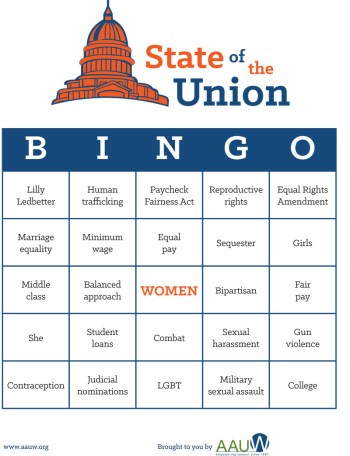 Tonight we’re watching the State of the Union address to see exactly what the last two years of the Obama presidency may bring. It will be a tough few years given the group that was sent to Congress last fall. We’re about to see a bunch of whackadoodle dandies go wild. There are several rumors up on the internet concerning possible executive orders that will be announced to tonight. Here is one of the more interesting ones.
It is being reported that one of President Obama’s surprises at the State Of The Union will be an announcement of an executive order that will take on the Koch Brothers and Citizens United.
Eleanor Clift of The Daily Beast reported:
Wednesday is the fifth anniversary of Citizens United, and reformers have been told that the president may announce executive action in his SOTU speech that would require businesses contracting with the government to disclose political contributions after contracts have been awarded. This would ensure that the contracting process is blind, but also give the public (and the media) the information needed to connect the dots to look for backroom deals or conflicts of interest.
Guess who happens to have multi-million dollar contracts with the Department of Defense? The federal government hatingKoch Brothers have tens of millions of dollars in defense contracts with the federal government. Rush Limbaugh also has a federal government contract that allows his showto be broadcast on the American Forces Network.
It is possible that the president will announce this executive order tonight, but he may also decide to wait and make a separate announcement. When/if the president does decide to make this announcement it will be a huge boost to transparency. The Koch brothers have a web of secret organizations that they route their money through, so most of their campaign spending will remain a secret, but it will become a bit easier to connect the dots and figure how much direct influence campaign donations are having on public policy decisions.
Ron Fournier of the National Journal suggests we just the President’s agenda with this set of criteria. Progress or Politics?
Republicans just seized control of Congress. President Obama’s job-approval ratings just jumped. Gas prices and the unemployment rate are down. The gross domestic product is up. Now what? Democratic and Republican leaders face a choice: Begin governing together, or treat this moment like just another stop on a perpetual campaign.
Unfortunately, both the White House and the GOP-led Congress seem focused prematurely on 2016. Republicans are sending to the White House legislation they know Obama will veto. The president is pushing an agenda he knows Congress won’t pass. It’s a recipe for more gridlock, more fighting, more courting of donors and ignoring the needs of a country in transition.
In other words: The state of the union is the status quo.
If you’re OK with that, stop reading. If you’d rather see progress than partisan gains, consider this: The State of the Union address is an opportunity for the president to chart a path toward consensus on issues like jobs, social mobility, education, infrastructure, energy, the debt, the environment, and terrorism.
Is Obama more interested in politics or progress? Here are five ways to tell from his address tonight.
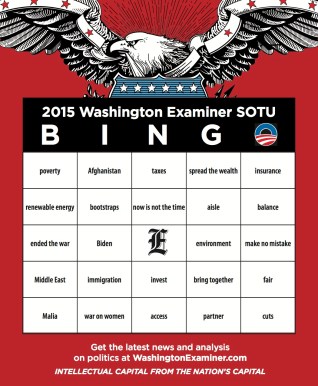
Isn’t Obama a lame duck? After all, this speech comes after Republicans won control of both chambers for the first time this presidency. Here’s a trivia question: When was the last time a President gave his seventh year State of the Union to a Congress that wasn’t controlled by the other party? Answer: Franklin Roosevelt in 1939. Every other two termer had lost control of Congress by the last lap of his presidency. They all faced a steeper political terrain than Obama does. Dwight Eisenhower faced Cold War setbacks. Ronald Reagan spoke in 1987 right after the Iran-Contra scandal broke, and he had to lead the speech with a discussion and apology. Bill Clinton was in the middle of his Senate impeachment trial in 1999. And George W. Bush spoke at a time when we were losing in Iraq. He faced withering controversy over the “surge” of troops, which proved a good policy, but made for a challenging speech environment. Some of them had productive last two years; some didn’t. But there is much room for a creative president and Congress to achieve things, even by fighting.
For President Obama, the new party balance offers some unexpected benefits. In recent years, Congress has been paralyzed, polarized, and entirely dysfunctional. Now conservatives control it, but at least it might actually pass legislation. Obama suddenly will be more central, more relevant than he has been in domestic politics over the past year. His veto pen will be all that stands between the Republican agenda and enactment. He can draw lines, pick fights, or choose cooperation. In so doing, too, he will have the ability to make broad public arguments in the context of a real debate—on the economy, on the role of government, on contentious long-term issues such as climate change.
How can the President use this diminished but still potent platform?
So, grab the popcorn and let’s see if this year’s hostile audience pulls any big tricks.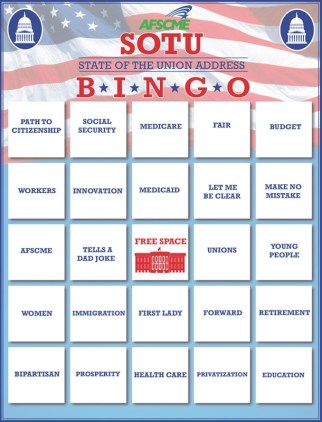
President Obama is courting controversy with his decision to address a group that has become dominated in recent years by extremists.
Some have questioned the appropriateness of the President speaking to such an extremist group, especially because in the past it has issued threats against the United States government.
The SOTU will be streaming at CSPAN and on the White House Website if you want to avoid the District Puppetry errrrr Punditry.
MLK Holiday Reads
Posted: January 19, 2015 Filed under: morning reads, SOTU | Tags: 2016 presidential race, Martin Luther King's Birthday 22 Comments Good Morning!
It’s our holiday to celebrate the contributions of Reverend Doctor Martin Luther King! No holiday celebration is complete without drawings by grade school children!!
President Obama will give his SOTU address tomorrow and will call for raising taxes on the wealthy to provide tax cuts for the middle class. This is an interesting strategy and I’m sure the Republicans are planning on screaming “class war” for the next few days.
President Obama will use his State of the Union address to call on Congress to raise taxes and fees on the wealthiest taxpayers and the largest financial firms to finance an array of tax cuts for the middle class, pressing to reshape the tax code to help working families, administration officials said on Saturday.
The proposal faces long odds in the Republican-controlled Congress, led by lawmakers who have long opposed raising taxes and who argue that doing so would hamper economic growth at a time the country cannot afford it. And it was quickly dismissed by leading Republicans as a nonstarter.
But the decision to present the plan during Tuesday’s speech marks the start of a debate over taxes and the economy that will shape both Mr. Obama’s legacy and the 2016 presidential campaign.
It is also the latest indication that the president, untethered from political constraints after Democratic losses in the midterm elections, is moving aggressively to set the terms of that discussion, even as he pushes audacious moves in other areas, like immigration and relations with Cuba.
The president’s plan would raise $320 billion over the next decade, while adding new provisions cutting taxes by $175 billion over the same period. The revenue generated would also cover an initiative Mr. Obama announced this month, offering some students two years of tuition-free community college, which the White House has said would cost $60 billion over 10 years.
The centerpiece of the plan, described by administration officials on the condition of anonymity ahead of the president’s speech, would eliminate what Mr. Obama’s advisers call the “trust-fund loophole,” a provision governing inherited assets that shields hundreds of billions of dollars from taxation each year. The plan would also increase the top capital-gains tax rate, to 28 percent from 23.8 percent, for couples with incomes above $500,000 annually.
Those changes and a new fee on banks with assets over $50 billion would be used to finance a set of tax breaks for middle-income earners, including a $500 credit for families in which both spouses work; increased child care and education credits; and incentives to save for retirement.
The initiative signals a turnabout for Mr. Obama, who has spoken repeatedly about the potential for a deal with Republicans on business tax reform but little about individual taxation, an area fraught with disagreements.
“Slapping American small businesses, savers and investors with more tax hikes only negates the benefits of the tax policies that have been successful in helping to expand the economy, promote savings and create jobs,” said Senator Orrin G. Hatch, Republican of Utah and chairman of the Finance Committee. “The president needs to stop listening to his liberal allies who want to raise taxes at all costs and start working with Congress to fix our broken tax code.”
Republicans have already referred to it as “trolling” given that they run both houses of the US Congress and will pass neither one. This does,  however, have very bad optics for them. It puts them squarely in league with the uberwealthy.
“It’s not surprising to see the president call for tax hikes, but now he’s asking Congress to reverse bipartisan tax relief that he signed into law,” said Don Stewart, deputy chief of staff to Senate Majority Leader Mitch McConnell (R-Ky.).
Stewart said that “Republicans believe we should simplify America’s outdated tax code; that tax filing should be easier for you, not just those with fancy accountants; and that tax reform should create jobs for families, not the [Internal Revenue Service].”
Meanwhile, a spokeswoman for Rep. Paul Ryan (R-Wis.), who chairs the House Ways and Means Committee, also criticized the proposal.
“This is not a serious proposal,” said Ryan spokesman Brendan Buck in a public statement. “We lift families up and grow the economy with a simpler, flatter tax code, not big tax increases to pay for more Washington spending.”
 Plan details include hitting big banks and inheritance taxes. These suggestions really go at the types of tax cuts that incent gambling and increase financial wealth rather than industrial and business wealth that create jobs and economic growth.
During his State of the Union address on Tuesday, President Barack Obama will lay out a plan to extend tax credits to the middle class by hiking taxes on wealthier Americans and big banks, according to senior administration officials.
Under the plan, the capital gains tax for couples with income over $500,000 per year would be raised from its current level of 23.8 percent up to 28. The plan would also strip a tax break, known as a “step-up,” that allows heirs to avoid capital gains taxes on large inheritances.
In addition, the plan would institute a new tax on the biggest financial institutions, basing the fee on liabilities in order to discourage risky borrowing. The administration says the fee would hit the roughly 100 banks that have assets of $50 billion or more.
The president’s plan would use revenues from those tax code changes to finance credits aimed at the middle class, officials said. That includes extending the earned income tax credits to families without children, which would benefit an estimated 13 million low-income workers, while also tripling the maximum tax credits for child care in low- and middle-income homes.
“This proposal is probably the most impactful way we can address the manifest unfairness in our tax system,” an administration official said.
The tax hikes on capital gains would run into heavy opposition from Republicans in the GOP-controlled Congress. Other elements of the president’s plan, however, have enjoyed some degree of bipartisan support. House Ways and Means Committee Chairman Dave Camp (R-Mich.) has proposed a similar tax on big banks, and many Republicans favor the idea of broadening the earned income tax credit.
According to officials, the capital gains tax reforms would impact “almost exclusively” the top 1 percent of earners, carving out the majority of middle-income families from the hikes.
![scan0002[17]](https://skydancingblog.com/wp-content/uploads/2015/01/scan000217.jpg?w=234&h=300) Here’s an essential outline for the items up for revision in the President’s plan. Is it his Piketty moment? This one is my personal favorite but they’re all good.
Here’s an essential outline for the items up for revision in the President’s plan. Is it his Piketty moment? This one is my personal favorite but they’re all good.
Raise the top capital gains tax rate from 23.8 to 28 percent. This is straightforward enough. Money you get from investments is taxed less than money you get from, you know, actually working, and while that might be good for the economy, it’s not good for a basic sense of fairness. Not when the top 400 households are getting 16 percent of all capital gains, and the top 0.1 percent are getting half of them. That’s why, as theCongressional Budget Office (CBO) dryly puts it, “preferential tax rates on dividends and capital gains provide almost no benefit to households in the bottom four quintiles, but provide notable benefits to households in the top quintile”.
So Obama wants to push the top capital gains tax rate, which only applies to couples making more than $500,000, up from its current level of 23.8 percent to 28 percent, where it was when Ronald Reagan left office. In all, the White House calculates that increasing the capital gains tax and getting rid of step-up basis would raise 99 percent of its money from the top 1 percent, with 80 percent of that coming from the top 0.1 percent.
This is one of the items that has really drawn money out of doing business and into stock market gambling. Why work when you can day trade your life into a lower tax bracket as a wealthy person?
Here’s a few political things sure to give you some fits and giggles. Lady Lindsey is said to be considering a run at the Presidency.
Sen. Lindsey Graham acknowledged on Sunday he’s seriously exploring a bid for the Republican presidential nomination.
Asked on NBC’s “Meet the Press” if he had started polling voters about his chances in 2016, Graham said he is not polling, “but we set up a testing-the-waters committee under the IRS code that will allow me to look beyond South Carolina as to whether or not a guy like Lindsey Graham has a viable path.”
“I don’t know where this will go, but I’m definitely going to look at it,” said Graham, the senior senator from South Carolina.
![MLK picture_thumb[1]](https://skydancingblog.com/wp-content/uploads/2015/01/mlk-picture_thumb1.jpg?w=590)
A new CBS poll shows 29 percent of Republicans would like to see Christie run for the Republican nomination for president. But 44 percent say no. CBS points out “Only former Alaska Gov. Sarah Palin’s numbers are more underwater: 30 percent of Republicans say they’d like to see her run, but 59 percent disagree.”
Fifty-nine percent of Republicans would like to see Mitt Romney jump into the 2016 race, while 26 percent believe he should stay out.
“Fifty percent of Republicans would like to see former Florida Gov. Jeb Bush on the campaign trail as well, while 27 percent disagree,” pollsters said. “If both Romney and Bush run, analysts expect them to wage a competitive battle for the allegiance of the Republican establishment.”
Numbers for some of the others often mentioned:
– Former Arkansas Gov. Mike Huckabee: 40 percent of Republicans urge him to get in, and 29 percent say stay out.
– “Twenty-seven percent of Republicans would like Kentucky Sen. Rand Paul to mount a bid, but 34 percent disagree. Twenty-six percent would like Florida Sen. Marco Rubio to run, while 19 percent would not. Twenty-one percent want Texas Sen. Ted Cruz to run, while 25 percent want him to not run.”
– Gov. Rick Perry of Texas: 21 percent yes, 29 percent no.
– Gov. Bobby Jindal of Louisiana: 14 percent yes, 20 percent no.
– Gov. Scott Walker of Wisconsin: 22 percent yes, 12 percent no.
Maybe winning isn’t everything after all. “Republicans, by a 61 to 35 percent margin, believe it’s more important to have a nominee who agrees with them on the issues than a nominee who can win the general election,” according to the poll.
Eeeshhh.
Well, that’s it for today! We’ll see you with a live blog for the SOTU tomorrow!! Have a great holiday!
What’s on your reading and blogging list today?

 peej
peej Carissa
 bostonboomer
 dakinikat
 ecocatwoman
 jjlo
jjlo mablue2
 Mama Lopez
 peggysue22
 quixote
 skydancingguestblogger
 Mona (aka Wonk the Vote)





Recent Comments