
Monday Reads
Posted: November 23, 2015 Filed under: 2016 elections, morning reads, Republican politics, Republican presidential politics, Surreality | Tags: Ben Carson, Ben Nevers, Bobby Jindal, Donald Trump, John Bel Edwards, Louisiana 13 Comments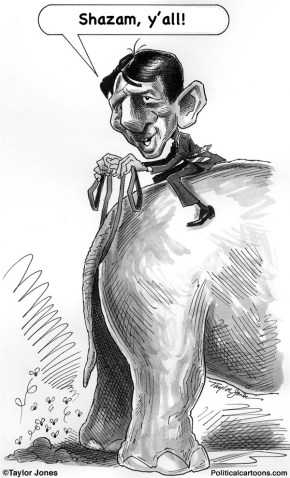 Hello Monday and Sky Dancers!!!
I’m beginning to think we should offer free psychotropics and mental health screenings for folks voting Republican these days. You might consider putting a candy bowl of them out for your crazy uncle and cousins still voting Republican as a holiday treat. Tolerance and displays of so much delusion should definitely be on the radars of what’s left of our mental health systems. It’s hard to know where to start but the fact that Donald Trump is the leading presidential candidate and basically doing it by taking pages and policies out of Hitler’s playbook is one example worthy of discussion.
However, let me start locally with Slum Dog Governor Piyush Jindal who has decided he needs to take a “victory lap” around the state before he fades into oblivion. You might think I’m kidding on this so I’m going to include some quotes from the state’s major newspaper for good measure because I am not kidding. He’s finally retreated from the cornfields of Iowa. We’re expecting a huge budget deficit mid term thanks to his stupid accounting tricks and tax giveaways. A Blue Dog Democrat–John Bel Edwards–supported by many Republicans is set to follow him into the statehouse.
Jindal wants to travel the state for some local accolades. Good luck with that Governor! All but about 20% of us can’t stand the sight or sound of you.
With only weeks remaining in office, Gov. Bobby Jindal has returned home to try to shore up his Louisiana legacy after his presidential campaign ended unsurprisingly with him headed to a new home in Baton Rouge, rather than the White House.
A statewide tour and press releases touting his accomplishments might be too little too late to win kind thoughts from the folks in Louisiana, where his approval ratings have dropped to record lows.
The term-limited Republican is seeking to exit the governor’s mansion in January with Louisiana residents remembering his economic development wins and education overhaul, rather than prevailing criticisms that he put his national ambitions over the state’s needs.
Jindal dismissed such criticisms in the press conference he held in Baton Rouge, a post mortem of sorts, after scrapping his bid for the 2016 Republican presidential nomination.
“We’ve continued to work every single day that I’ve been governor to work hard to move our state forward. I’m proud of the result,” he said. He added: “I think that I will be leaving our state better off than we were eight years ago.”
Yes indeed! Well, about that leaving the state better that it was eight years ago part …
Now that his campaign is officially dead, however, it’s worth highlighting Jindal’s record as governor of Louisiana. This is what the man did. This is what he accomplished. This is what he leaves behind. And this what he should be remembered for.
- He entered office with an $865 million surplus and he will exit with a $1.6 billion deficit.
- Funding for higher education has been cut by more than 80 percent, and the entire system is experiencing a fiscal crisis.
- Funding for youth services has been cut by 40 percent.
- Funding for Veterans Affairs programs has been cut by 69 percent.
- The Department of Environmental Quality has been cut by 96 percent (in a state with a rapidly eroding coastline).
- He rejected a Medicaid expansion in order to protest Obamacare, and thousands of low-income Louisianans remain without health care as a result.
- Louisiana has the highest infant mortality rate in the nation; the highest diabetes-related death rate; the highest rate of death from breast cancer; the third highest rate of cancers deaths overall; and the eighth highest rate of teenage pregnancy.
- He rejected $300 million of federal stimulus money (one his favorite talking points at the time), despite Louisiana’s underfunded and crumbling infrastructure.
- He issued a symbolic executive order that defended discrimination under the guise of “religious freedom.”
- He sold out his state to protect BP against legitimate lawsuits. (Side note: Jindal’s brother is a lawyer for the firm representing BP).
- He held a massive “prayer rally” on the state’s flagship campus, a rally that promoted his presidential campaign and distributed materials blaming gay people for hurricanes and natural disasters.
- He signed the Louisiana Science Education Act, which allowed creationism to be taught in science courses at public schools.
There are countless other examples of Jindal’s failures, but this list is fairly illustrative of his career as Governor of Louisiana. This is what he did in order to pitch himself as a fiscally responsible, small government conservative in GOP primary states. It explains why 70 percent of Louisianans now disapprove of the job he has done. And it explains why he won’t be missed and why the Republican gubernatorial candidate following him, David Vitter, has tried unsuccessfully to run away from Jindal’s record.
The stench of Jindal’s administration will linger for years in Louisiana, and everyone here knows it. His presidential campaign was and is a punchline, but his governorship was a moral and political failure, and a tragedy for thousands of Louisianans. If he’s ever elected again for public office, I can assure you it won’t be as a Louisianan.
I’d say Sean Illing’s list is a pretty decent capsule of the wreckage. I’d have to add that you can put many a sad face on how bad life has gotten with Jindal administration including mine.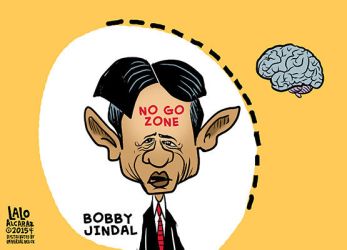
We have a kinda sorta Democrat now whose first act was to appoint the former Republican State Senator responsible for the Creationism in public schools disguised as science to be his chief of staff. His transition team is remarkably full of Republicans. However, he still says that the Medicaid expansion is priority one and it could be one of the reasons why Nevers got the job. I’m trying to be optimistic here. You can hold my hand if you want to help.
“The expansion of health care coverage for working families is among the highest priorities. It’s something I’ve been working on for three years, and I never once during this campaign shied away from that particular issue,” Edwards said during a news conference with reporters in New Orleans. “So we are going to expand the Medicaid program in Louisiana. We’re going to do it as soon as we possibly can and as responsibly as we possibly can.”
The strongest signal yet of Edwards’ commitment to Medicaid expansion is his appointment of state Sen. Ben Nevers to be his chief of staff. Nevers has been one of the foremost advocates of Medicaid expansion in the Legislature, at times offering tearful testimony as he pleaded with colleagues to expand the federal program to cover people who aren’t paid enough to purchase their own insurance.
Asked about the significance of Medicaid expansion to the working poor, Nevers said, “it means life or death to many people across this state.”
“There are over 242,000 people without medical insurance in this state who go to work everyday; who have been dependable employees,” Nevers said. “It would mean the opportunity for them to have insurance for them and their families. I can tell you that there’s many people across this state who’ve suffered tremendously because we’ve refused to expand Medicaid.”
When asked what it means to him personally, Nevers said, “It means a tremendous amount to me.
“As you know, I filed bills the last three years to expand Medicaid and could not get them out of the Senate or the House,” Nevers said. “It’s been a very frustrating experience because I know we’re sending dollars to Washington D.C. that we refuse to take back in our own state. Now that’s just ludicrous.”
This state is among the poorest of the poor and the sickest of the sick. Things certainly could not get much worse.
People here and all around the country certainly do not trust their governments. Is this the real legacy of Reagan’s dementia and eagerness to poor shame? 
A year ahead of the presidential election, the American public is deeply cynical about government, politics and the nation’s elected leaders in a way that has become quite familiar.
Currently, just 19% say they can trust the government always or most of the time,among the lowest levels in the past half-century. Only 20% would describe government programs as being well-run. And elected officials are held in such low regard that 55% of the public says “ordinary Americans” would do a better job of solving national problems.
Yet at the same time, most Americans have a lengthy to-do list for this object of their frustration: Majorities want the federal government to have a major role in addressing issues ranging from terrorism and disaster response to education and the environment.
And most Americans like the way the federal government handles many of these same issues, though they are broadly critical of its handling of others – especially poverty and immigration.
A new national survey by Pew Research Center, based on more than 6,000 interviews conducted between August 27 and October 4, 2015, finds that public attitudes about government and politics defy easy categorization. The study builds upon previous reports about the government’s role and performance in 2010 and 1998. This report was made possible by The Pew Charitable Trusts, which received support for the survey from The William and Flora Hewlett Foundation.
The partisan divide over the size and scope of government remains as wide as ever: Support for smaller government endures as a Republican touchstone. Fully 80% of Republicans and Republican-leaning independents say they prefer a smaller government with fewer services, compared with just 31% of Democrats and Democratic leaners.
Yet both Republicans and Democrats favor significant government involvement on an array of specific issues. Among the public overall, majorities say the federal government should have a major role in dealing with 12 of 13 issues included in the survey, all except advancing space exploration.
There is bipartisan agreement that the federal government should play a major role in dealing with terrorism, natural disasters, food and medicine safety, and roads and infrastructure. And while the presidential campaign has exposed sharp partisan divisions over immigration policy, large majorities of both Republicans (85%) and Democrats (80%) say the government should have a major role in managing the immigration system.
But the partisan differences over government’s appropriate role are revealing – with the widest gaps on several issues relating to the social safety net.
 That last bit certainly shows up in the Trumpettes and his followers who don’t appear to understand that offering up the same policies as Hitler isn’t a good thing.
Only about a third of Republicans and Republican leaners see a major role for the federal government in helping people get out of poverty (36%) and ensuring access to health care (34%), by far the lowest percentages for any of the 13 issues tested. Fully 72% of Democrats and Democratic leaners say the government should have a major role in helping people out of poverty, and 83% say it should play a major role in ensuring access to health care.
Moreover, while majorities of Republicans favor a major government role in ensuring a basic income for people 65 and older (59%), protecting the environment (58%) and ensuring access to high-quality education (55%), much larger shares of Democrats – 80% or more in each case – favor a large government role.
So what explains the Republican base’s fascination with some one touring the country touting a book written on the Constitution that believes the Constitution was written by Thomas Jefferson? Is this the result of whackadoo Texans controlling the nation’s textbook content or deliberate, delusional ignorance?
It’s a common misconception that Thomas Jefferson participated in drafting the U.S. Constitution in 1787. But as Republican presidential candidate and retired pediatric neurosurgeon Ben Carson points out in his latest book, “A More Perfect Union,” Jefferson was “missing in action,” serving in Paris as minister to France.
That did not stop Carson from praising Jefferson in a C-Span interview Sunday as one of the most impressive of the Founding Fathers because he “tried to craft our Constitution in a way that it would control peoples’ natural tendencies and control the natural growth of the government.”
It’s not the first time Carson has abused Jefferson’s history. “Thomas Jefferson himself said, ‘Gun control works great for the people who are law-abiding citizens and it does nothing for the criminals, and all it does is put the people at risk,’ ” he told Fox’s Neil Cavuto after the shootings at Umpqua Community College in Roseburg, Ore., in early October. Jefferson never said that.
In his book, Carson repeated a version of the same statement, noting what he called “Thomas Jefferson’s warning: ‘Laws that forbid the carrying of arms … disarm only those who are neither inclined nor determined to commit crimes. … Such laws make things worse for the assaulted and better for the assailants; they serve rather than encourage than to prevent homicides, for an unarmed man may be attacked with greater confidence than an armed man.”
The supposed Jefferson comment on gun control is listed among many “spurious” quotations by the Monticello Web site. “This is not something Jefferson wrote,” say the researchers at Monticello, but rather comes from a passage he included in his “Legal Commonplace Book.” The passage, they note, was written by Cesare Beccaria in his “Essay on Crimes and Punishments” and was copied by Jefferson.
Oddly, Carson’s footnote to the quote duly notes that it comes from Beccaria and not Jefferson.
Republican obsession with all things not true but that play into their views of the world is on full display in the Trump poll numbers. The more outrageously untrue and appalling things that spew out of Trump’s  mouth yields a bump up in the polls. I mean, what kind’ve person could get a huge number of the Jewish population volunteering to register as Muslims just to express their outrage at the suggestion we start a database of the nation’s followers of Islam. Trump’s latest outrages include the huge lie that thousands of Muslims celebrated the 9/11 attacks. This earned him another Pinnochio from WAPO’s fact checkers and the NYC police.
GEORGE STEPHANOPOULOS: You raised some eyebrows yesterday with comments you made at your latest rally. I want to show them, relating to 9/11.
VIDEO CLIP OF DONALD TRUMP, IN WHICH HE SAYS: “Hey, I watched when the World Trade Center came tumbling down. And I watched in Jersey City, New Jersey, where thousands and thousands of people were cheering as that building was coming down. Thousands of people were cheering.”
STEPHANOPOULOS: “You know, the police say that didn’t happen and all those rumors have been on the Internet for some time. So did you misspeak yesterday?”
TRUMP: “It did happen. I saw it.”
STEPHANOPOULOS: “You saw that…”
TRUMP: It was on television. I saw it.
STEPHANOPOULOS: “…with your own eyes?”
TRUMP: “George, it did happen.”
STEPHANOPOULOS: “Police say it didn’t happen.”
TRUMP: “There were people that were cheering on the other side of New Jersey, where you have large Arab populations. They were cheering as the World Trade Center came down. I know it might be not politically correct for you to talk about it, but there were people cheering as that building came down — as those buildings came down. And that tells you something. It was well covered at the time, George. Now, I know they don’t like to talk about it, but it was well covered at the time. There were people over in New Jersey that were watching it, a heavy Arab population, that were cheering as the buildings came down. Not good.”
STEPHANOPOULOS: “As I said, the police have said it didn’t happen.”
— Exchange on ABC’s “This Week,” Nov. 22, 2015
This exchange demonstrates the folly of trying to fact-check Donald Trump. Even when confronted with contrary information — “police say it didn’t happen” — he insists that with his own eyes he saw “thousands and thousands” of cheering Arabs in New Jersey celebrating as the World Trade Center collapsed during the Sept. 11 attacks.
Trump has already earned more Four-Pinocchio ratings than any other candidate this year. He is about to earn another one.
The Jersey City Mayor says the “account is absurd” too.
He also is race baiting and just bragged about his audience beating up a Black Lives Matter protester. He upped the ante by tweeting the right wing trope that blacks are murdering blacks with an appalling racist graphic attached. He still has yet to suggest any thing policy related. He seems perfectly happy to just spew vitriol. That is also what the base seems to love. His tweet about black murder rates is definitely creating consternation from every one but the Republican base.
Donald Trump is taking heat on social media for a Sunday afternoon tweet of statistics purporting to show that the vast majority of murdered black people in the U.S. are killed by other black people.
The tweet was apparently Trump’s response to a Twitter thread about support from white supremacists for the GOP front-runner.
It also comes the day after a Black Lives Matter protester said he was physically and verbally assaulted at a Trump rally.
The image Trump posted includes a list of “USA Crime Statistics ~ 2015.” The two that are highlighted are “Blacks Killed by Police ~~ 1%” and “Blacks Killed by Blacks ~~ 97%.”
A drawing of a black man wielding a sideways pistol and wearing army pants, military boots and a bandana and mask accompanies the statistics, which are sourced to the “Crime Statistics Bureau” in San Francisco.
The message immediately took off on the social media platform, with thousands of people retweeting it and liking it within an hour. But many also lashed out angrily against the real estate mogul, calling Trump a racist and questioning the veracity of the stats.
Indeed, an initial search to confirm the numbers couldn’t turn up a “Crime Statistic Bureau” in San Francisco.
However, the percentages do, in some ways, align with Department of Justice (DOJ) findings from several years ago. A DOJ study released in 2011 reported that 93 percent of black homicides were committed by other blacks between 1980 and 2008.
In 2014, that figure was roughly 90 percent in 2014, according to the latest DOJ numbers.
The category tweeted out by Trump that doesn’t fit with DOJ statistics is “Whites Killed by Whites,” which Trump’s tweet indicated was 16 percent.
According to the department’s 2011 report, 84 percent of white homicides were committed by whites between 1980 and 2008. That number was 82 percent in 2014.
Trump has been roundly bashed during his presidential campaign for disparaging comments made about Mexican immigrants, Syrian refugees, Muslims and black people.
We’ve written a lot about the alternative reality were Republicans and their elected officials and candidates reside. I’ve noticed the disconnect is getting worse on many levels. But, again, look at Louisiana. People down here got fed up with it. Maybe the rest of the places that have Republican governors that are beyond delusional–Kansas, Wisconsin, Ohio, Michigan,Indiana etc.–will wake up to what’s actually going on. But then again, take Kentucky.
Please.
What’s on your reading and blogging list today?
Friday Reads: Perpetuating Lies, Hate, and Stereotypes
Posted: November 20, 2015 Filed under: 2016 elections, Migrant and Refugee Crisis in Europe and Mediterranean, morning reads, the GOP | Tags: David Vitter, Donald Trump, Hillary Clinton, Marco Rubio, Right Wing Hysteria and paranoia, Syrian refugees, xenophobia 20 Comments Happy Friday!!!
It’s coming up on the weekend here in Louisiana and we will be voting for Governor tomorrow. It really, really looks like we will have a Blue Dog Democrat for governor. The polls are consistently showing Senator David Vitter losing the race. You can tell how badly Vitter’s doing by the way his ads have gotten increasingly shameful on so many levels. They are full of lies, distortion, racism, and hate. A number of Republicans from Vitter’s home parish and congressional district have come out in support of his Democratic opponent John Bel Edwards. Edwards is not my idea of a Democratic candidate, but I’m firmly in the any one but Vitter column. I will go to the polls tomorrow. The fact that Louisiana could be creeping back into the purple state category should be a lesson for many. The fact the vitriol is not working should also. Bel Edwards is dishing it right back out to him with a cherry on top.
Edwards is a Democrat, Vitter a Republican, and both are Catholics in a state with a strong evangelical presence—and a state that thrives on politics as blood sport. The central issue in this election campaign is a 2007 prostitution scandal that Vitter thought he had put behind him.
This election has become the dirtiest slug fest since the 1991 “race from hell” when Edwin Edwards (no kin to John Bel), though trailed by corruption scandals, won a record fourth term, crushing David Duke, the former Klan leader and closet Nazi. Both men later went to prison. Duke for mail fraud, Edwards for extortion tied to casino licenses. Such are the vagaries of democracy in the Bayou State.
The pivotal question this year is whether Edwards’s growing lead is a purely anti-Vitter phenomenon—and whether the senator is capable of reversing it. Vitter does possess samurai-level skills in slash-attack politics.
But a November 12 University of New Orleans (UNO) poll has Edwards at 54 percent, with a 22 point lead, gaining two points since the Tuesday debate.
A larger question looms: If the margin holds, does the Edwards surge signal a sputtering of the Republican Southern strategy that exploits racial division by demonizing President Obama?
Either way, if Edwards wins big, you can bet the car that Hillary Rodham Clinton will try to make him her new best friend.
A lawyer and West Point graduate who frequently cites the military academy’s honor code and touts himself as “pro-life and pro-gun,” Edwards is a blue dog Democrat—one of the last of the centrist-conservative Democrats, blue dogs being an endangered species in Congress and nearly extinct in statewide offices across the beef red South. But there is nothing cookie-cutter about Edwards’s views: Since taking his seat in the state legislature in 2006 and particularly since 2012, when he became state House minority leader, Edwards has spearheaded the opposition to Gov. Bobby Jindal’s deep cuts to higher education and his refusal to take Medicaid funds under Obamacare—to no avail.
The state race isn’t the only one where lies, distortion, racism, and vitriol is rampant. Donald Trump’s rhetoric is just the most overt example of
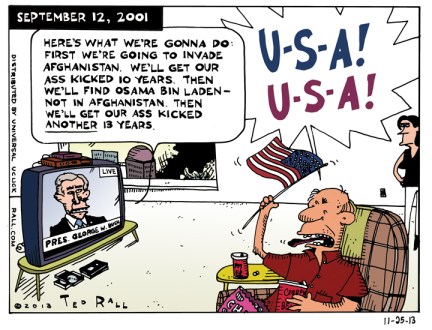
The U.S. has committed at least 15,000 combat troops and billions of dollars to extend the war of Afghanistan another 10 years, to 2024. Imagine what Americans would have thought if Bush had told them what was in store after 9/11.
what’s left in the Republican Party. His suggestion to keep a federal register of Muslims in the U.S. is rightly drawing comparisons to the registrations of Jewish populations in Hitler’s NAZI Germany. I’m not one to appreciate the tendency of folks to Godwin but Trump has clearly jumped into the fascism part of the political spectrum and should be shamed. Hillary tweeted condemnation of Trump’s suggestion yesterday and characterized his rhetoric as “shocking”. She was joined by the other Democrats in the race for the Democratic Presidential nomination.
Hillary Clinton condemned Donald Trump’s call to require Muslims to register in a database, calling his idea “shocking.”
“This is shocking rhetoric. It should be denounced by all seeking to lead this country. –H,” she tweeted, linking to a New York Times story, quoting Trump as saying he’d “absolutely” require Muslims to do so.
In an interview with NBC news Thursday night, Trump was asked to clarify comments he had made to Yahoo News, saying he would not rule out such a registry for Muslims if he were president.
“Should there be a database system that tracks the Muslims in this country?” an NBC reporter asked Trump at an event in Newton, Iowa.
“There should be a lot of systems. Beyond database, we should have a lot of systems. And today, you can do it,” Trump said. “I would certainly implement that — absolutely.”
He said the database would stop people from coming into the United States illegally. And he could accomplish it with “good management procedures,” he said.
The other two Democratic presidential candidates also rebuked Trump.
Bernie Sanders called the statement “outrageous and bigoted.”
“What an outrageous and bigoted statement. @realDonaldTrump should be ashamed of himself,” the Vermont senator tweeted.
Former Maryland Gov. Martin O’Malley addressed Trump’s comments Friday on MSNBC’s “Morning Joe.”
“When you hear people like Donald Trump talking about wanting to do ID cards based on religion, what the hell is that? I mean, how is that at all American?” he asked.
 Even Texas whackadoo Ted Cruz rejected the idea. Cruz may be getting a whiff of doom for the Donald.
Ted Cruz on Friday disavowed Donald Trump’s support for requiring American Muslims register as such, a rare public break with the current GOP frontrunner.
“I’m a big fan of Donald Trump’s but I’m not a fan of government registries of American citizens,” he told reporters of a plan Trump said he backed a day earlier. “The First Amendment protects religious liberty, I’ve spent the past several decades defending religious liberty.”
Marco Rubio, however, has adopted similar over-the-top xenophobic and unconstitutional policy calling for a shut down of any place where Muslims might gather and be inspired. This leaves Jeb Bush as the voice of reason in the little tent of horror.
Sen. Marco Rubio (R-FL) seems to be going further than even Republican frontrunner Donald Trump in advocating the crackdown of U.S. Muslims. He doesn’t just want to consider shutting down mosques, as Trump says, but wants to shut down “any place where radicals are being inspired.”
“It’s not about closing down mosques. It’s about closing down any place — whether it’s a cafe, a diner, an internet site — any place where radicals are being inspired,” Rubio said on Fox News’ The Kelly File on Thursday night when asked if he agreed with Trump. “The bigger problem we have is our inability to find out where these places are, because we’ve crippled our intelligence programs, both through unauthorized disclosures by a traitor, in Edward Snowden, or by some of the things this president has put in place with the support even of some from my own party to diminish our intelligence capabilities.”
“So whatever facility is being used — it’s not just a mosque — any facility that’s being used to radicalize and inspire attacks against the United States, should be a place that we look at,” he continued.
Trump first articulated potentially shutting down U.S. mosques on Monday during a call in to MSNBC’s Morning Joe, when hosts asked if he would consider doing the same thing France did and shut down U.S. mosques with direct terrorist ties. Trump said he would “strongly consider” it, then lamented NYPD shutting down its domestic surveillance program targeting Muslims in New York City. Later this week he suggested the U.S. would “absolutely” create a federal database of Muslimsif he were elected president.
Both Trump and Rubio could be putting forth these ideas because polling suggests that limiting rights of Muslims is popular with Republican voters. A poll released this week found that 25 percent of Rubio supporters liked the idea of shutting down U.S. mosques.
Meanwhile establishment candidate Jeb Bush has resisted targeting of U.S. mosques: “You talk about closing mosques, you talk about registering people, that’s just wrong …. it’s manipulating people’s angst and their fears. That’s not strength. That’s weakness.”
These are typical chicken hawks. They speak of bombing everything in sight and the run in fear of widows and orphans and healthcare workers tending to the Ebola stricken. Paul Krugman is quick to point to the right wing’s tendency to panic under infinitesimally small odds of bad things. His op ed today is focused on the Erick Erickson who is very high on my list of worst human being on the planet.
The French themselves are making a point of staying calm, indeed of going out to cafes to show that they refuse to be intimidated. But Mr. Erickson declared on his website that he won’t be going to see the new “Star Wars” movie on opening day, because “there are no metal detectors at American theaters.”
Lightsabers aside, are Mr. Erickson’s fears any sillier than those of the dozens of governors — almost all Republicans — who want to ban Syrian refugees from their states?
Mr. Obama certainly thinks they’re being ridiculous; he mocked politicians who claim that they’re so tough that they could stare down America’s enemies, but are “scared of widows and orphans.” (He was probably talking in particular about Chris Christie, who has said that he even wants to ban young children.) Again, the contrast with France, where President François Hollande has reaffirmed the nation’s willingness to take in refugees, is striking.
I didn’t hear similar rhetoric when folks in a theatre were shot up and many murdered in either Colorado or Louisiana. I just read calls for more armed citizens to join in the shoot ups. But, Krugman believes the paranoia is part and parcel of their basic reaction to what goes on framed in terms of an Obama Presidency. As mentioned in the Vitter-Edwards fight above, Republics seem to connect every little bad thing to the President and state it in completely hyped up terms. Connecting Mary Landrieu to Obama certainly worked in the negative Louisiana Senatorial race last year.
What explains the modern right’s propensity for panic? Part of it, no doubt, is the familiar point that many bullies are also cowards. But I think it’s also linked to the apocalyptic mind-set that has developed among Republicans during the Obama years.
Think about it. From the day Mr. Obama took office, his political foes have warned about imminent catastrophe. Fiscal crisis! Hyperinflation! Economic collapse, brought on by the scourge of health insurance! And nobody on the right dares point out the failure of the promised disasters to materialize, or suggest a more nuanced approach.
Given this context, it’s only natural that the right would seize on a terrorist attack in France as proof that Mr. Obama has left America undefended and vulnerable. Ted Cruz, who has a real chance of becoming the Republican nominee, goes so far as to declare that the president “does not wish to defend this country.”
The context also explains why Beltway insiders were so foolish when they imagined that the Paris attacks would deflate Donald Trump’s candidacy, that Republican voters would turn to establishment candidates who are serious about national security.
Who, exactly, are these serious candidates? And why would the establishment, which has spent years encouraging the base to indulge its fears and reject nuance, now expect that base to understand the difference between tough talk and actual effectiveness?
Sure enough, polling since the Paris attack suggests that Mr. Trump has actually gained ground.
The point is that at this point panic is what the right is all about, and the Republican nomination will go to whoever can most effectively channel that panic. Will the same hold true in the general election?
The fact that all of the Paris bombers were European nationals is completely ignored by the right wing media. I grew up in a a hell hole of backwardness called Omaha, Nebraska. Most of the folks that I know that basically never left or moved into neighboring hellholes are putting up some of the most ridiculous things I’ve ever seen including linking refugees to the Fort Hood Shooter who was born in Virginia. I also actually had some one point out to me that if we didn’t stop the Syrian refugees we might go the way of Native Americans when the Colonists came over. I’ve never seen such an level of panic that people appear to have left any sense of proportion in a gutter somewhere. It seems worse than the Ebola hysteria of a few years ago.
We’ve had an attack today on a Western Hotel in Malia. Additionally, there have been recent attacks in Kenya and Lebanon that appear to be Isis-inspired and possibly planned. I can understand being extremely careful in places like this. How do these events or events in Paris translate to being paranoid in small towns in the middle of the country where even most Americans wouldn’t and don’t want to live? We’ve had plenty of pressers by NYC officials–NYC is definitely always a potential terrorist target–and they’re doing their usual thing and not particularly worried.
What should be worrying is the weird attraction of any extremist philosophy–including fundamentalist religions of all types–to young people. What is it that is causing many young people to feel so disenfranchised from the mainstream they hook up with cults? This has always been a challenge in the developed world.
You may want to spend some time with a profile at the Daily Mail on the female jihadi killed in St.-Denis. People who do not live countries with abject poverty and little opportunity for education and economic advancement are less of a concern than our homemade terrorists. This includes folks drawn to white supremacy as well as the violent jihadi mentality.
The woman killed in the Saint-Denis siege was a party animal with a string of boyfriends who had shown no interest in religion, it emerged today.
Hasna Ait Boulahcen, 26, was blown to bits when a second unnamed terrorist detonated a bomb after anti-terror police closed in on the safehouse where she was hiding with her cousin, the mastermind of the Paris attacks.
Just a day after her death, family and acquaintances gave extraordinary accounts of a young woman with a ‘bad reputation’ who was known for her love of alcohol and cigarettes rather than devotion to Islam.
Her brother Youssouf Ait Boulahcen said that she had had no interest in religion, never read the Koran and had only started wearing a Muslim veil a month ago.
A photograph has also emerged of Ait Boulahcen posing for a selfie in the bath. Her face is covered in heavy make-up and she wears nothing but jewellery.
She’s not exactly the posterchild for your basic practicing cafeteria Muslim let alone a Jihadi. What on earth happened to flip her?
Home grown white male christian extremists are far more of a danger here in this country yet, law enforcement has to keep its concerns underwrap for fear of inciting a Fox Nation backlash. The NRA isn’t concerned about any terrorist, felon, or mentally ill person getting access to an arsenal. How do we explain right wing paranoia in light of that? In this country, toddlers kill more people that radical jihadists.
All I know is that I’m very sick and tired of this racist, hateful, unconstitutional and down right UnAmerican response to the latest panic from the right. A few years ago it was stopping all flights from an entire continent. Now, it’s stopping refugees from one single country that’s in the middle of a civil war.
It’s ridiculous and it’s unbecoming.
What’s on your reading and blogging list today?
Monday Reads: The Barbed Wire Fence Treatment
Posted: November 16, 2015 Filed under: 2016 elections, Bobby Jindal, morning reads, Republican presidential politics, right wing hate grouups | Tags: Bigoted First Generation Republican Politicians, Bobby Jindal, Marco Rubio, Syrian Refugee Crisis 43 Comments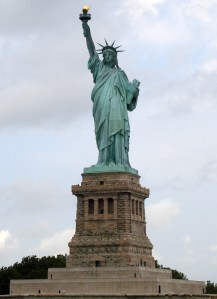 It’s a Monday and it feels like it!!!
The one thing Martin O’Malley said Saturday night that really stayed with me was his assertion that the symbol of the United States is not the barbed wire fence but the Statue of Liberty. We’re having our principles and values tested and many of our elected leaders are coming up short. This includes my absentee Governor Bobby “the Jingoist” Jindal and the Governor of Texas both who profess to belong to a religion where the guru clearly states this:
“Then He will also say to those on His left, ‘Depart from Me, accursed ones, into the eternal fire which has been prepared for the devil and his angels; 42 for I was hungry, and you gave Me nothing to eat; I was thirsty, and you gave Me nothing to drink; 43 I was a stranger, and you did not invite Me in; naked, and you did not clothe Me; sick, and in prison, and you did not visit Me.’…
Matthew 25:42
I am not one to quote folks’ imaginary friends. But, this is ridiculous. You can’t profess that religion and then totally ignore the overwhelming message of its primary teacher which is basically to love one another and help the least among us.
Unlike the self aggrandizing election propaganda pushed by the likes of David “Spy Master and professional John” Vitter and Bobby Jindal (alleged christians), there have not been 10,000 Syrian refuges sent to Louisiana. There have been 14 relocated to the state. Jindal and others want our doors slammed shut to the refugees fleeing an enemy of our own creation.
A day after Gov. Bobby Jindal sent a letter to the White House demanding to hear from President Barack Obama the number of Syrian refugees who have been allowed into Louisiana, the State Department confirmed the number this year was 14.
“As Governor of Louisiana, I demand information about the Syrian refugees being placed in Louisiana in hopes that the night of horror in Paris is not duplicated here,” Jindal wrote in his letter Saturday.
Jindal’s letter came at the end of a day in which multiple blogs reporting that 10,000 Syrian refugees had already made their way to New Orleans went viral. Many of the blogs were published earlier this month but appeared to gain new life following Friday’s terror attacks in Paris.
Seven Syrian refugees have been resettled in Kenner, while six have been placed in New Orleans with one placed in Baton Rouge, a State Department spokesperson said Sunday in response to a request for the numbers from WWL-TV.
The blogs that cited the figure of 10,000 refugees also include an image, purportedly of Syrian men in New Orleans, which actually is a photograph of migrants protesting outside of a train station in Budapest, Hungary, on Sept. 3.
While the Obama administration has announced plans to resettle 10,000 Syrian refuges in the United States in 2016, the State Department on Sunday said those people will be spread across the country, not in one area.
“We do not have projections on how many Syrians will be resettled in each state. However, those allocations are made in close collaboration with the nongovernmental organizations that resettle refugees as well as with state and local government officials,” the State Department said in a statement.
Indeed, the State Department already has a rigorous background check and process in place to assure that our country is safe and that we can welcome refugees and folks that want to become part of the United States. Here’s a transcript of a briefing on the process. You can read more to find more about the programs in each of the countries generally impacted by the current refugee crisis.
So we refer to the program as the USRAP, the U.S. Refugee Admissions Program, so if I use that acronym that’s what that means. So the USRAP is an interagency process that includes three primary U.S. Government agencies. That’s us, the Department of State, as the primary lead agency; the Department of Homeland Security, specifically U.S. Citizenship and Immigration Services; and the Department of Health and Human Services, their Office of Refugee Resettlement.
So this USRAP involves those three government agencies as well as international organizations like the United Nations High Commissioner for Refugees, the International Organization for Migration, a number of nongovernmental organizations – these we normally refer to as resettlement agencies in the United States – as well as U.S. states, cities, private citizens, churches and mosques, and community groups. So it’s a lot of people involved, big process, fairly standard procedures.
So there are a number of processing requirements within the USRAP that cannot be waived, such as an in-person DHS interview, security checks, and a medical exam, including a TB test. And this is one way – one of the many ways in which our Refugee Resettlement Program differs from a lot of other countries’ resettlement programs. A lot of other countries can do things like waive an in-person interview. They can take a case based on dossier. They do very few security checks in some cases. Those are not options that are available to us. So because of these very strict requirements that we have and because at any given time we’re processing cases in 70 or more locations worldwide with a limited amount of resources, it currently takes anywhere from 18 to 24 months or even longer to process a case from referral or application to arrival in the United States.
And I want to focus on that for just a second and repeat that, because it’s an important point. If we had a much smaller case load – let’s say if we processed 5,000 or 10,000 or even 20,000 people a year, and if we only processed in capitals where we have a physical presence, like Amman or Nairobi – processing times would be much shorter. But because we accept referrals from UNHCR for refugees in remote locations and camps all over the world – places like eastern Chad and western Tanzania that are pretty difficult to get to – we can’t send our staff up to interview a case as soon as we have one referral or ten referrals or even a hundred referrals. We’re constantly looking for a critical mass of cases before we go and start processing those cases.
The USRAP is a labor-intensive program. Between the three government agencies, we spent last year a little bit more than $1.1 billion, so it is a labor-intensive and fairly resource-intensive program.
So I’m going to go over the main steps on the overseas processing side first. And the first important step in getting access to the USRAP is either a referral or an application. The vast majority of our referrals come from UNHCR, the UN High Commissioner for Refugees, also known as the UN Refugee Agency. U.S. embassies and certain NGOs are also qualified to refer cases to us, but we get very few from those two sources. About 75 percent of our referrals to the program come from UNHCR. Another 25 percent of the program – so about a quarter of the program – a quarter of our applicants gain access through direct applications. And so some of you are probably familiar with some of these direct application programs.

At least four Republican governors are moving to block Syrian refugees from entering their states after Friday’s terrorist attacks in Paris that killed more than 125 people and wounded hundreds more.
Texas Gov. Greg Abbott and Arkansas Gov. Asa Hutchinson on Monday joined Alabama Gov. Robert Bentley and Michigan Gov. Rick Snyder in refusing to accept refugees from Syria. “A Syrian ‘refugee’ appears to have been part of the Paris terror attack,” Abbott wrote in a letter informing President Barack Obama of his plans not to allow Syrian refugees into Texas. “American humanitarian compassion could be exploited to expose Americans to similar deadly danger.”
Abbott argued that neither the president nor any federal official could guarantee the refugees wouldn’t be part of any terrorist activity. “As such, opening our door to them irresponsibly exposes our fellow Americans to unacceptable peril,” he wrote.
Despite Friday’s deadly attacks, the White House has said Obama still plans to accept 10,000 Syrian refugees in 2016.
Hutchinson, Bentley and Snyder have also announced their intentions to halt Syrian refugees from entering their states, with the latter two stating their opposition Sunday.
I cannot be happier that my governor is on his way to oblivion given this executive order. He is a small minded, mean little man who is full of self loathing and hypocrisy. It also looks like Senator David Vitter is about to join him in anonymity and no more jobs based on tax payer dollars. These men can’t even self govern their demons let alone the interests of other people.
Gov. Bobby Jindal issued an executive order Monday (Nov. 16) to prevent Syrian refugees from being resettled in Louisiana.
In issuing the order, Jindal referenced last week’s terrorist attacks in Paris that killed 129 people and injured hundreds more. The Islamic State group has claimed responsibility for the attacks. Jindal said the introduction of Syrian refugees into the U.S. without “proper prior screening and follow-up monitoring could result in a threat to the citizens and property of this state.”
He cited a section of the Louisiana Constitution that says “during times of emergency… the governor has emergency powers to protect the citizens and property of the state of Louisiana.”
Jindal also sent a letter to the Obama administration on Saturday demanding information about the refugees being placed in Louisiana.
The Governors of Alabama and Michigan joined in the lunacy. Way to let the terrorists win dudes!!!! This is mostly symbolic which makes it even more shameful.
Legally, the states have limited power to control the flow of foreigners into their states; that authority is reserved largely to the federal government under the Constitution.
 This is especially shameful because we’ve found out that the passport of a supposed Syrian refugee involved in the Paris Massacre was in fact, a false flag operation. It was a falsified document. The people who staged the Paris attacks are primarily native French and Belgians. They were not Syrian refugees.
As the dust settles on the Paris attacks, intelligence agencies are scrambling to gather information on the reported attackers. Passports collected on-scene have helped identify the nationalities of a few of the attackers, most of whom are from the European Union. A Syrian passport has also been found, though authorities have warned it could be fake.
French authorities believe that as many as 20 people were involved in planning the attack, claimed by ISIS (also known as ISIL or the Islamic State). Most of the released information indicates that the attackers were born and raised either in France or Belgium. Omar Ismail Mostefai (1) and Salah Abdeslam (2) — who is still at large — are the two names to be officially released so far. Mostefai, who detonated himself in a suicide attack on Friday, was a French national who grew up south of Paris while Abdeslam was born and lived in Brussels.
The passport of an Egyptian national was also found. That man was a victim of the attacks and is critically injured.
Additionally, it shows a shameful lack of understanding of ISIS which is a radical Sunni element that is against ANYONE that’s against its interpretation of Islam. The primary military battles right now are with other ethnic Muslims, notably the Kurdish. ISIS has its own strategy and agenda. It is an apocalyptic cult–much like that of many fundamentalist christian sects in our country–with the goal of establishing a path to the end times and a theocracy based on its interpretation of Muslim theology. It’s at war with every one that’s not ISIS. It has not singled out the west or its culture which is why it also did suicide attacks in Lebanon in close proximity to the Paris attacks. All of the Republican candidates for President are terribly ill-informed when it comes to affairs of state as is their base.
But ISIS isn’t a civilization. In parts of Iraq and Syria, it’s a self-declared, though unrecognized, state. Elsewhere, it’s a network of terrorist groups linked by a common ideology. “Civilizations” are cultural groupings. In calling the Paris attack a “clash of civilizations,” Rubio evoked Samuel Huntington’s famed 1993Foreign Affairs essay of the same name. In that essay, Huntington defined “civilization” as “the broadest level of cultural identity people have.” And he suggested that the world contains “seven or eight” major ones: “Western, Confucian, Japanese, Islamic, Hindu, Slavic-Orthodox, Latin American and possibly African.”
The most straightforward way to interpret Rubio’s statement, therefore, is that the civilizational “they” that attacked Paris is Islam. Among the grassroots conservatives Rubio is wooing in his campaign for president, that’s a popular view. After all, recent polling in states like Iowa and North Carolina suggests that upwards of one-third of Republicans would like to make Islam illegal in the United States.
Ben Carson and Donald Trump have indulged that sentiment crudely. Rubio, typically, is doing so more subtly. But it’s worth noting how fundamentally his analysis diverges from that of both of America’s post-9/11 presidents. George W. Bush said America was at war with an ideology that had “hijacked Islam” in the same way Nazism had hijacked Germany or communism had hijacked Russia. Barack Obama has argued that even this assessment gives violent jihadists a stature they don’t deserve. Rubio, by contrast, is going far beyond Bush. And he’s doing exactly what the Islamic State wants: He’s equating ISIS with Islam itself.
These Republican governors are playing into ISIS’ hand. They want the west to look bad to Muslims all over the world. They want us all characterized as ‘Crusaders’ and not loving humanitarians capable of discerning evil from ordinary people. Europe has its own set of right wing xenophobes which parrot similar tropes.
The Islamic State’s strategy is to polarize Western society — to “destroy the grayzone,” as it says in its publications. The group hopes frequent, devastating attacks in its name will provoke overreactions by European governments against innocent Muslims, thereby alienating and radicalizing Muslim communities throughout the continent. The atrocities in Paris are only the most recent instances of this accelerating campaign. Since January, European citizens fighting with the Islamic State in Iraq and Syria have provided online and material support to lethal operations in Paris,Copenhagen and near Lyon, France, as well as attempted attacks in London,Barcelona and near Brussels. Islamic State fighters are likely responsible fordestroying the Russian airliner over the Sinai. These attacks are not random, nor are they aimed primarily at affecting Western policy in the Middle East. They are, rather, part of a militarily capable organization’s campaign to mobilize extremist actors already in Europe and to recruit new ones.
The strategy is explicit. The Islamic State explained after the January attacks on Charlie Hebdo magazine that such attacks “compel the Crusaders to actively destroy the grayzone themselves. . . . Muslims in the West will quickly find themselves between one of two choices, they either apostatize . . . or they [emigrate] to the Islamic State and thereby escape persecution from the Crusader governments and citizens.” The group calculates that a small number of attackers can profoundly shift the way that European society views its 44 million Muslim members and, as a result, the way European Muslims view themselves. Through this provocation, it seeks to set conditions for an apocalyptic war with the West.
Unfortunately, elements of European society are reacting as the Islamic State desires. Far-right parties have gained strength in many European countries. France’s National Front is expected to dominate local elections in northern France this winter; on Saturday, Marine Le Pen, its leader, declared “those who maintain links with Islamism” to be “France’s enemies.” The Danish People’s Party gained 21 percent of the vote in national elections in June on a nationalist, anti-Islamic platform. The anti-foreigner Sweden Democrats is steadily growing in popularity.
I remember taking American History in Junior High School. We were beginning to delve into World War 2 in a much more nuanced way. Since I eventually became a history major, I was fascinated by all aspects of history including our culpability in genocides and injustice. I was horrified to find out that we turned away many European Jewish immigrants prior to the NAZI take over. That, and our internment of Japanese citizens was my first experience at critically looking at our country’s modern history of White Christian Male privilege. I discovered the genocide of indigenous people and the horrors of slavery earlier but had thought we’d evolved with the Civil Rights Era.
I do not want our children to ask us why we did not act to save innocents from evil. Being Jewish in German-occupied Europe was a death sentence for those folks. We were complicit. We should not be complicit in this again because we can do something.
Just as my mind knows the faces of Jewish friends who lost family in Germany, I know Syrians with family dead, dying, and trying to escape the horror there. I condemn strongly the hatred, bigotry, and ignorance of any one playing into the hands of ISIS. This is not the Iron Age. This is not the Dark Ages. American is better than people like David Vitter, Bobby Jindal, Marco Rubio and the likes. Notice that TWO of these folks are the children of immigrants too! What if we had closed our doors on them because they were Catholic? They were dark skinned and from India? How dare they redefine our country?
What’s on your reading and blogging list today?
H/T to Winter Claire Randall for the Matthew quote and to David Bernstein for the State Department link.
Saturday Night Live: The Democratic Party Debate in Des Moines
Posted: November 14, 2015 Filed under: Live Blog | Tags: CBS, Democratic presidential debates, Des Moines Iowa, Drake University 119 Comments Tonight, the three Democratic candidates for president will face off in a debate that has now been adjusted to reflect the deadly terrorist attacks in Paris. This is obviously former Secretary of State Hillary Clinton’s bailiwick. CBS experienced some push back from the Sanders campaign for this move. The debate will be held at my sister’s alma mater Drake University and should prove interesting.
A top aide to Sen. Bernie Sanders, I-Vt., one of the three candidates, got into a lengthy dispute with executives from CBS, the network hosting the debate, during a conference call on Saturday morning. A staffer for one of the other campaigns who was also on the call described the exchange to Yahoo News as “heated” and even “bizarre,” and a second source on the call confirmed the nature of the exchange.
The dispute centered on CBS’s decision to increase the emphasis on terrorism, foreign policy, and national security in the wake of the attacks that left more than 100 people dead in Paris on Friday night. According to the rival staffer, Sanders strategist Mark Longabaugh lit into CBS vice president and Washington bureau chief Christopher Isham when the changes to the debate were detailed on the call.
“It was a little bit of a bizarre scene. The Sanders representative, you know, really laid into CBS and basically … kind of threw, like, a little bit of a fit and said, ‘You are trying to turn this into a foreign policy debate. That’s not what any of us agreed to. How can you change the terms of the debate, you know, on the day of the debate. That’s not right,’” the staffer recounted.
Another person who was on the call confirmed to Yahoo News that Longabaugh had a lengthy dispute about the changed plans for the debate format during the call with CBS. The Sanders campaign declined to comment.

The second Democratic debate will be held at Drake University in Des Moines, Iowa, on Nov. 14. It will air from 9pm to 11pm ET on the CBS Television Network. Pre-debate coverage will begin at 8pm ET.
- What: Second Democratic presidential debate
- Time: 9pm to 11pm ET
- Where to watch/listen:
- On TV: CBS television affiliates or on CBSN streaming on Apple TV,Roku, Amazon Fire TV, Android TV and Xbox One
- Mobile: CBSN streaming on the CBS News apps CBS News for Androidand CBS News for iOS
- Online: CBSNews.com (livestream will include real-time Twitter trends, instant reactions, curated Tweets and other key information)
- On radio: CBS Radio News affiliates
- Pre-debate coverage: Join Senior Political Editor Steve Chaggaris and White House correspondent Major Garrett for CBSN’s livestream coverage of debate preparations will air online at CBSnews.com/live starting at 6pm ET.
CBS News is hosting the debate in conjunction with CBS’ Des Moines affiliate, KCCI, and the Des Moines Register. “Face the Nation” anchor John Dickerson will be the principal moderator, and he will be joined by CBS News Congressional Correspondent Nancy Cordes, KCCI anchor Kevin Cooney and the Des Moines Register’s political columnist, Kathie Obradovich.
With Friday’s attacks in Paris, the debate will also focus on foreign policy differences among the candidates and strategies to fight extremist groups abroad.
 Many folks believe that Sanders will go on the attack and that Clinton will deflect. Oh, and Martin O’Malley will still be looking to make an impression. ABC has made a list of things to look for during the debate tonight.
Hillary Rodham Clinton has been on a hot streak since the first Democratic presidential debate last month. The main question heading into Saturday’s second encounter: Can her two challengers slow down her Big Mo’?
National security will play a prominent role in the debate in the aftermath of deadly terror attacks in Paris that killed more than 125 people and left about 350 injured. The Islamic State group claimed responsibility for the attacks, a development that will bring terror and the U.S. response to the jihadist group to the forefront.
Heading into the debate, Clinton expects to face a more direct challenge from Vermont Sen. Bernie Sanders and former Maryland Gov. Martin O’Malley in their first debate since the Democratic field has winnowed down to three candidates.
Both Sanders and O’Malley have taken steps to point out their differences and the underdog ex-governor is also trying to undercut Sanders as Clinton’s main alternative. But the debate could take a more somber tone following the Paris attacks.
Gregg Levine–writing for AJ–believes the switch in focus does benefit Clinton.
Questions on foreign policy and national security are generally believed to advantage Clinton. Beyond her years as head of the State Department, she has an international presence dating back to her time as first lady and extending through her work with the Clinton Foundation, a non-profit organization she started with her husband, former president Bill Clinton, focused on “global interdependence.”
But with great experience also comes great responsibility. Clinton’s time in the Obama White House ties her to the policies of an administration that has come under attack for its handling of conflicts in Iraq and Syria, specifically for its strategies to counter the rise of the Islamic State in Iraq and the Levant (ISIL). The armed group has claimed responsibility for the violence in Paris.
Clinton’s role in U.S. policy on Libya has proven one of her biggest potential tripwires, at least in the eyes of Republicans. The deaths of four Americans, including the U.S. Ambassador to Libya, J. Christopher Stevens, in Benghazi in 2012, has spawned countless Congressional investigations and near-constant conversation in conservative media. Clinton, an advocate for military intervention in the conflict that ousted Libyan leader Muammar Gaddafi, has defended her beliefs, going so far as to praise the recent Libyan elections during the last presidential debate.
The debate’s shift from the economy to national security would appear to be a setback for Sanders, especially at a time when many feel he needs to communicate his core message to a broad electorate. His focus on income disparity and an under-regulated financial sector fit well with the original focus of tonight’s event, and recent polling shows voters think Sanders is as good or better than Clinton on those issues.
But economic worries and questions of national security are far from mutually exclusive. The debate over economic austerity and its effect on domestic security, for example, has been revived in the last 24 hours. In the wake of the January killings at the offices of Charlie Hebdo and a kosher supermarket, French authorities said that, even though some of the attackers were known to the government, they hadn’t had the resources to track all of them.
Tonight’s debate is also likely to include questions on immigration, especially in light of the European refugee crisis and the intense focus of GOP presidential hopefuls on deporting undocumented immigrants from the United States.
Watch along with the rest of the Sky Dancers as the Democratic candidates take the stage in Des Moines.
Friday Reads: Falling Leaves and Expectations
Posted: November 13, 2015 Filed under: 2016 elections, Iran, Iraq, Middle East, morning reads, Republican politics, Republican presidential politics, Revisionism, Russia | Tags: 9undefineduundefinednundefineddundefinedeundefinedfundefinediundefinednundefinedeundefineddundefineduundefineduundefinednundefineddundefinedeundefinedfundefinediundefinednundefinedeundefineddundefined 42 Comments It’s a beautiful autumn day here in New Orleans. Many of us are voting early to ensure David Vitter’s political career ends this month. There are some interesting dynamics this election cycle. There’s only so much craziness allowed in the Republican Party by the moneyed interested before they start closing down the monkey house that’s become much of the local structure and grass roots. The base and the establishment couldn’t be more at odds. There is real concern that the Trump flame isn’t burning out. Last cycle, they were able to bring the insipid Mitt Romney through the process only to lose big time to the President. They also managed to hoist Dubya Bush on us at a cost of blood and treasure. Nixon really burned the house down. The Southern Strategy has really come back to haunt them.
There are some interesting articles up today analyzing various topics. The first is from WAPO and deals with establishment panic over Donald Trump.
Less than three months before the kickoff Iowa caucuses, there is growing anxiety bordering on panic among Republican elites about the dominance and durability of Donald Trump and Ben Carson and widespread bewilderment over how to defeat them.
Party leaders and donors fear that nominating either man would have negative ramifications for the GOP ticket up and down the ballot, virtually ensuring a Hillary Rodham Clinton presidency and increasing the odds that the Senate falls into Democratic hands.
The party establishment is paralyzed. Big money is still on the sidelines. No consensus alternative to the outsiders has emerged from the pack of governors and senators running, and there is disagreement about how to prosecute the case against them. Recent focus groups of Trump supporters in Iowa and New Hampshire commissioned by rival campaigns revealed no silver bullet.
In normal times, the way forward would be obvious. The wannabes would launch concerted campaigns, including television attack ads, against the front-runners. But even if the other candidates had a sense of what might work this year, it is unclear whether it would ultimately accrue to their benefit. Trump’s counterpunches have been withering, while Carson’s appeal to the base is spiritual, not merely political. If someone was able to do significant damage to them, there’s no telling to whom their supporters would turn, if anyone.
Trump gave an epic rant on Carson and dumb Iowans in Fort Dodge which has really sent the money crowd off the edge. Carson’s response today is to pray for Trump. What kind of people find either of these guys  even attractive as human beings let alone potential presidents?
Ben Carson apparently had a simple response to rival Donald Trump after the real-estate mogul savaged Carson during a Thursday-night stump speech.
“Pray for him,” Carson said, according his business manager Armstrong Williams’ Friday account to CNN.
Williams, who often acts as a Carson surrogate, further lashed into Trump.
“It is so immature,” Williams said. “It is so embarrassing. I feel so sorry for him.”
The day before, Trump launched a no-holds-barred assault against Carson, his top rival in the GOP primary.
Those attacks included Trump doubling down on his comparison of what he has called Carson’s incurable “pathological temper” to child molesters, while at the same time questioning Carson’s account of his violent childhood incidents. This all occurred during a 95-minute speech in Fort Dodge, Iowa.
“How stupid are the people of Iowa? How stupid are the people of the country to believe this crap?” Trump asked his supporters of Carson’s stories.
Trump characterized Carson’s lying as “pathological and akin to child molester’s who can’t be cured. Can you believe this is the level of discourse we’ve come to? Can any of them even talk about a policy that’s remotely good and realistic for the country?
Meanwhile, we’re finally getting some good old fashion press attention to the behavior of the Bush administration prior to the 9/11 attacks. They were all on vacation when a series of warnings crossed their desks. When can we actually get some justice on what they did to this country? This is even from Tiger Beat on the Potomac so will it get enough attention to start the main stream media to focus on the lies to the Iraq War and the intelligence that was ignored or made up at that time?

Bin Laden Determined to Strike in U.S.” The CIA’s famous Presidential Daily Brief, presented to George W. Bush on August 6, 2001, has always been Exhibit A in the case that his administration shrugged off warnings of an Al Qaeda attack. But months earlier, starting in the spring of 2001, the CIA repeatedly and urgently began to warn the White House that an attack was coming.
By May of 2001, says Cofer Black, then chief of the CIA’s counterterrorism center, “it was very evident that we were going to be struck, we were gonna be struck hard and lots of Americans were going to die.” “There were real plots being manifested,” Cofer’s former boss, George Tenet, told me in his first interview in eight years. “The world felt like it was on the edge of eruption. In this time period of June and July, the threat continues to rise. Terrorists were disappearing [as if in hiding, in preparation for an attack]. Camps were closing. Threat reportings on the rise.” The crisis came to a head on July 10. The critical meeting that took place that day was first reported by Bob Woodward in 2006. Tenet also wrote about it in general terms in his 2007 memoir At the Center of the Storm.
But neither he nor Black has spoken about it publicly in such detail until now—or been so emphatic about how specific and pressing their warnings really were. Over the past eight months, in more than a hundred hours of interviews, my partners Jules and Gedeon Naudet and I talked with Tenet and the 11 other living former CIA directors for The Spymasters, a documentary set to air this month on Showtime.
The drama of failed warnings began when Tenet and Black pitched a plan, in the spring of 2001, called “the Blue Sky paper” to Bush’s new national security team. It called for a covert CIA and military campaign to end the Al Qaeda threat—“getting into the Afghan sanctuary, launching a paramilitary operation, creating a bridge with Uzbekistan.” “And the word back,” says Tenet, “‘was ‘we’re not quite ready to consider this. We don’t want the clock to start ticking.’” (Translation: they did not want a paper trail to show that they’d been warned.) Black, a charismatic ex-operative who had helped the French arrest the terrorist known as Carlos the Jackal, says the Bush team just didn’t get the new threat: “I think they were mentally stuck back eight years [before]. They were used to terrorists being Euro-lefties—they drink champagne by night, blow things up during the day, how bad can this be? And it was a very difficult sell to communicate the urgency to this.”
That morning of July 10, the head of the agency’s Al Qaeda unit, Richard Blee, burst into Black’s office. “And he says, ‘Chief, this is it. Roof’s fallen in,’” recounts Black. “The information that we had compiled was absolutely compelling. It was multiple-sourced. And it was sort of the last straw.” Black and his deputy rushed to the director’s office to brief Tenet. All agreed an urgent meeting at the White House was needed. Tenet picked up the white phone to Bush’s National Security Adviser Condoleezza Rice. “I said, ‘Condi, I have to come see you,’” Tenet remembers. “It was one of the rare times in my seven years as director where I said, ‘I have to come see you. We’re comin’ right now. We have to get there.’”
Tenet vividly recalls the White House meeting with Rice and her team. (George W. Bush was on a trip to Boston.) “Rich [Blee] started by saying, ‘There will be significant terrorist attacks against the United States in the coming weeks or months. The attacks will be spectacular. They may be multiple. Al Qaeda’s intention is the destruction of the United States.’” [Condi said:] ‘What do you think we need to do?’ Black responded by slamming his fist on the table, and saying, ‘We need to go on a wartime footing now!’”
“What happened?” I ask Cofer Black. “Yeah. What did happen?” he replies. “To me it remains incomprehensible still. I mean, how is it that you could warn senior people so many times and nothing actually happened? It’s kind of like The Twilight Zone.” Remarkably, in her memoir, Condi Rice writes of the July 10 warnings: “My recollection of the meeting is not very crisp because we were discussing the threat every day.” Having raised threat levels for U.S. personnel overseas, she adds: “I thought we were doing what needed to be done.” (When I asked whether she had any further response to the comments that Tenet, Black and others made to me, her chief of staff said she stands by the account in her memoir.) Inexplicably, although Tenet brought up this meeting in his closed-door testimony before the 9/11 Commission, it was never mentioned in the committee’s final report.
And there was one more chilling warning to come. At the end of July, Tenet and his deputies gathered in the director’s conference room at CIA headquarters. “We were just thinking about all of this and trying to figure out how this attack might occur,” he recalls. “And I’ll never forget this until the day I die. Rich Blee looked at everybody and said, ‘They’re coming here.’ And the silence that followed was deafening. You could feel the oxygen come out of the room. ‘They’re coming here.’”
 It’s amazing to me that major failures of policy by Republican administrations never seem to matter to any one as long as the money keeps funneling its way up to the rich and they can keep their base stupid and angry. The deal is that I truly believe that behavior is backfiring on them finally during this election cycle. It’s bad enough that we suffered through the Reagan years and they were characterized quite differently and that so many people believe the hype and not the reality apparent in the facts. My hope is that entangling the neocon policy will bring about a higher realization since so many Americans died as a result. However, look at the Republican Field. We have folks that are either totally clueless on the entire foreign area. For example, Ben Carson actually stated in the last debate that China was active in the Middle East which is not the least bit true. The other side is Jeb and the like who come with the same advisers as Dubya. How can any of this be representative of one of the two parties seeking leadership of the world’s only superpower?
The Blog “The Progressive Professor” discusses how we’ve gone from a place where the Republicans were perceived as the party most knowledgeable and able when it comes to foreign policy to the party that is completely clueless and inept. This should be worrisome to both the American Electorate and the world.
It used to be that the Republican Party had candidates who had a reputation for foreign policy expertise, including Richard Nixon and George H. W. Bush.
Now, we have Rand Paul, representing the isolationist viewpoint; and the viewpoint of the neoconservatives, which includes just about everyone else, all who have apparently learned nothing from the disastrous policies of George W. Bush and Dick Cheney. They want to commit US military forces to another war, but of course give not a care to veterans once they come home from war, often wounded physically and mentally by their experience.
And some have not a clue as to what is going on in foreign policy, demonstrating unbelievable ignorance, particularly Dr. Benjamin Carson and Donald Trump.
As this blogger has stated many times in the past few years, in the 2012 election cycle, ONLY Jon Huntsman had any legitimate background in foreign policy; and in the 2016 election cycle, only John Kasich demonstrates any experience in foreign policy, although inferior to that of Huntsman.
One may criticize Barack Obama in some areas of foreign policy, but his top aides and advisers on this have included Vice President Joe Biden, former Secretary of State Hillary Clinton, and present Secretary of State John Kerry. Many would criticize all of them, but in comparison to the Republican camp, they are people of experience and awareness of the complex world we live in!
Donald Trump went as far as to state that Russia was going after ISIL when in fact, Russia has been attacking the anti-Assad Forces supported by the US and allies This article is from the Times of London and clearly illustrates that the Russians are not on our side no matter how much The Donald and The Carly want to brag about their green room romps with Putin.
• Iran was on Thursday night moving up its ground forces in Syria in preparation for an attack to reclaim rebel-held territory under the cover of Russian air strikes, according to sources close to Damascus. Hizbollah, the Lebanese Shia militia which has come to the Assad regime’s rescue in battle-fronts across the country in the past two years, is being prepared to capitalise on the strikes, a Syrian figure close to the regime told The Telegraph
• Sources in Lebanon told Reuters that Iran, which is the main sponsor and tactical adviser to Hizbollah, was sending in hundreds of its own troops to reinforce them. Iran made no comment on the claims but Josh Earnest, the White House spokesman, said the move would be an “apt and powerful illustration” that Russia’s military actions had worsened the conflict.
• A Hizbollah-backed advance would fit the pattern of Russian air-strikes, which have predominantly targeted those rebels not aligned to the Islamic State of Iraq and the Levant who currently present the gravest threat on the ground to core regime territory.
• The long-term aim would be to defeat or demoralise the non-Isil opposition, so that Isil became the regime’s only enemy. That would force the West to back President Bashar al-Assad against it. “They want to clean the country of non-Isil rebels, and then the US will work with them as Isil will be the only enemy,” the Damascus source said.
Ben Carson appears to point to the voices in his head has his sources for his ridiculous claims on China and Russia.
But the most amusing category belongs to politicians who defend bogus claims by citing secret evidence that only they have access to. As Rachel noted on the show last night, this comes up more often than it should.
Rep. Duncan Hunter Jr. (R-Calif.), for example, claimed last year to have secret information about ISIS fighters getting caught entering the United States through Mexico, which never happened in reality. Sen. Joni Ernst (R-Iowa) claimed to have secret evidence that Saddam Hussein had weapons of mass destruction, which is the exact opposite of the truth.
And then there’s Ben Carson, who claimed this week that China has deployed troops to Syria, despite the fact that China has not deployed troops to Syria. Yesterday, Armstrong Williams, a top Carson campaign aide, defended the claim by pointing to – you guessed it – secret intelligence. Here was the exchange between Williams and MSNBC’s Tamron Hall:
WILLIAMS: Well, Tamron, from your perspective and what most people know, maybe that is inaccurate, but from my intelligence and what Dr. Carson`s been told by people on the ground involved in that area of the world, it has been told to him many times over and over that the Chinese are there. But as far as our intelligence and the briefings that Dr. Carson`s been in, and I`ve certainly been in with him, he`s certainly been told that the Chinese are there.
Last month, the retired right-wing neurosurgeon claimed Russian President Vladimir Putin, Iran Supreme Leader Ali Khamenei, and Palestinian Authority leader Mahmoud Abbas all went to college together. When told that didn’t make any sense, Carson insisted he’s talked to “various people” who’ve provided him with unique insights.
 You can follow the link to a snippet from Maddow’s show that discusses some absolute bizarre comments from Carson. This includes a really bizarre CBN interview about ties between those three leaders as some kind of dormmates at the same university and that he has secret sources.
So, the question being discussed across coffee at my house is who the hell is supporting these guys and wtf is wrong with them? I’m no psychologist, but what causes a person to go gaga over a pathological liar and a malignant narcissist to the point of thinking they should be president? Why do so many Republicans want Ben Carson in office? (I need to add that this discussion is held between two former Republicans. My friend is a very recent addition to my reformed republican club which I formed 20 years ago having decided that the absolute craziness over gay marriage and adoption was the most bigoted and hateful thing she’d ever seen.)
Here’s some analysis of a poll done by ABC.
Respondents saw Carson’s lack of experience in politics as a strength, not a weakness. Like other Carson supporters we interviewed, Karen Mihalic, 61, loves that the neurosurgeon’s “not like your typical politician.”
“I don’t think politicians are really in tune with the rest of America and what we need,” Mihalic said. “We need someone to shake things up down there.”
Don, 30, who declined to give his last name, said he doesn’t see a difference between Carson’s experience in politics and that of President Obama.
Jeanne Blando, 71, agreed.
“I think Carson will be much more effective than the president we have now,” Blando said.
Carson’s values are important.
But why not support fellow outsider Donald Trump instead? For Blando, it’s all about Carson’s values.
“I love Trump because he says what he thinks, but that won’t work for governing,” Blando said.
Jesse Varoz, 28, called Carson an “upstanding guy.” Richard Medina, 69, said Carson was “truly honest and someone I can depend on.”
“If you listen to [Carson] speak, he thinks about what he’s gonna say, while other candidates do not,” Medina said.
Ignorance is not only bliss, it’s evidently a very attractive and powerful opiate of a good portion of the masses.
What’s on your reading and blogging list today?

 peej
peej Carissa
 bostonboomer
 dakinikat
 ecocatwoman
 jjlo
jjlo mablue2
 Mama Lopez
 peggysue22
 quixote
 skydancingguestblogger
 Mona (aka Wonk the Vote)





Recent Comments