Posted: March 24, 2017 | Author: dakinikat | Filed under: Afternoon Reads | Tags: Affordable Health Care Act, Paul Manafort, tRumpcare |
 Good Afternoon Sky Dancers!
I don’t know about you, but I can barely keep up with the breaking news this week. I feel like I’m caught in a whirlpool of unbelievable events and emotions. I’m going to be like BB yesterday and just try to list them. I’m not sure I have to time to truly analyze or elucidate anything. Maybe the chaos is working in their favor on that account. At least news reporters are assigned desks and topics. Some of them must be very busy. Here are the three top stories: T-Russia, T-RumpCare, and T-Rump Syndicate shenanigans.
First, up is that notorious Foreign Agent, obsequious Trump neighbor, and former Campaign Director Paul Manafort has volunteered to testify to Congressional Intelligence Committees. Congressional Clown Car Chauffeur Devon Nunes announced it today. It will likely be a closed session.
Manafort has also offered to be interviewed by the Senate Intelligence Committee, according to a Senate source.
Both Intelligence committees are investigating Russian interference in the US election.
The White House this week rushed to distance itself from Manafort after the revelation that he signed a multimillion-dollar contract with a Russian oligarch in 2006 to help advance Russian President Vladimir Putin’s interests around the world.
The story fueled the growing controversy over the Trump team’s ties to Russia, which was rekindled Monday when FBI Director James Comey publicly confirmed the bureau is investigating whether Trump associates coordinated with Moscow during the 2016 presidential race.
Nunes also said Friday he has asked Comey and National Security Agency (NSA) Director Michael Rogers to brief the House Intelligence Committee in a closed session.
Nunes cautioned that he does not expect to receive documentation from the NSA regarding his claims that Trump campaign associates were possibly monitored by the intelligence community on Friday.
Nunes said he expects to have more information from the NSA by “early next week.”
But he categorically denied that his decision to make public the information on the issue that he does have was coordinated by the White House.
Nunes continues to be underfire for what appears to be collusion with the White House to cover up the Russian Involvement with the Trump Campaign which is so obvious now that a grade school kid would call “shenanigans!!”
 So you can read more about this unfolding story at CNN too as well as the recent announcement that Republicans are using closed meeting formats which is not making Democrats happy. Nunes is really in over his head on all of this.
The House Intelligence Committee chairman and the panel’s top Democrat publicly disagreed Friday over the handling of their investigation into Russian meddling into the US election, coming after the announcement that President Donald Trump’s campaign chairman agreed to testify before the committee.
“Yesterday, the counsel for Paul Manafort contacted the committee yesterday to offer the committee the opportunity to interview his client,” committee chairman Devin Nunes announced during a news conference. “We thank Mr. Manafort for volunteering and encourage others with knowledge of these issues to voluntarily interview with the committee.”
Nunes also announced that the committee is bringing in FBI Director James Comey and National Security Agency Director Mike Rogers for a second briefing, this time behind closed doors so that they can provide more information. The committee is also delaying its March 28 hearing, a decision infuriating Democrats on the committee.
“Chairman just cancelled open Intelligence Committee hearing with (former Director of National Intelligence James) Clapper, (former CIA Director John) Brennan and (former deputy Attorney General Sally) Yates in attempt to choke off public info,” Rep. Adam Schiff, the top Democrat on the committee tweeted moment before going to speak to the press Friday morning.
Schiff refused to say whether he thought Nunes should step down from his position, telling reporters, “What’s really involved here is the cancellation of this open hearing and the rest is designed to distract.”
You can view the Nunes presser at that link also.
GOP leaders have done the WHIP count on Trumpcare and it appears that they do not have the votes they need to pass it. This may be a very big test of both Paul Ryan and Kremlin Caligula’s ability to whip a vote.
House GOP leaders aren’t confident they have enough votes to pass their embattled health-care bill, according to a senior congressional aide, and are already considering what to do if the measure is blocked before a do-or-die vote hours away.
House Speaker Paul Ryan went to the White House Friday to brief President Donald Trump ahead of the vote. Vice President Mike Pence canceled a trip to Arkansas to be in Washington for the vote, a White House official said.
The Trump administration is doubling down on its demand that House Republican leaders hold a vote Friday on their embattled health-care bill without any changes. White House Press Secretary Sean Spicer said the vote will proceed as scheduled Friday afternoon.
“It’s not a question of negotiating any more, it’s understanding the greater good,” Spicer said at a news conference. “This is it.” The president, he added, has “made it clear this is our moment.”
But an influential GOP member said he’s not sure they have the votes.
“I’m not sure we’ve landed it,” Mark Walker of North Carolina, chairman of the conservative Republican Study Committee of House members, said Friday morning. “I’m hopeful that we can get there today but at this point I don’t know how many we’re short.”
Tensions among House Republicans were high, said Chris Collins of New York, the first House member to endorse Trump last year.
“There’s some divisiveness within our conference now that’s not healthy,” Collins said. “I’ve never seen this before. People are just refusing to talk to each other. They’re storming past each other. This is not good.”
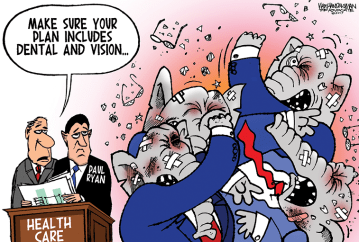 Paul Ryan is CYA mode this afternoon.
House Speaker Paul D. Ryan, facing a revolt among conservative and moderate Republicans, rushed to the White House Friday afternoon to inform President Trump he did not have the votes to pass legislation to repeal the Affordable Care Act and to decide whether to pull the bill from consideration.
The president and the speaker faced the humiliating prospect of a major defeat on legislation promised for seven years, since the landmark health legislation was signed into law. President Trump had demanded a vote regardless, which has been scheduled for Friday afternoon. But House leaders were leaning against such a public loss.
The House opened debate Friday on what would have been one of the most consequential pieces of legislation in years, a bill that would have rolled back a major, established social welfare program, a feat that is almost unheard of.
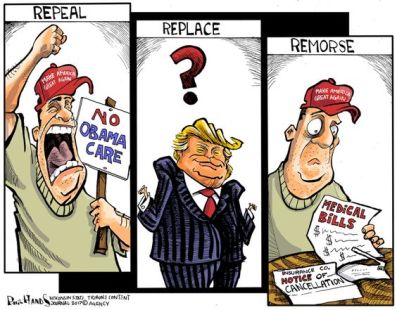 Meanwhile, more Trump ethics violations are on the horizon: “After Promising Not To Talk Business With Father, Eric Trump Says He’ll Give Him Financial Reports”.
Eric Trump sits behind a desk on the 25th floor of Trump Tower in New York City, dressed in a slightly less formal version of his father’s go-to power uniform—blue suit, white buttoned-down shirt, no tie. There are reminders of Donald Trump everywhere in this office, including the TV in the corner that beams out wall-to-wall news about the president any time his son turns it on. Amidst it all, Eric Trump, who now manages the Trump Organization with his brother Don Jr., wants to emphasize that the Trump business is separate from the Trump presidency.
“There is kind of a clear separation of church and state that we maintain, and I am deadly serious about that exercise,” he says, echoing previous statements from his father. “I do not talk about the government with him, and he does not talk about the business with us. That’s kind of a steadfast pact we made, and it’s something that we honor.”
But less than two minutes later, he concedes that he will continue to update his father on the business while he is in the presidency. “Yeah, on the bottom line, profitability reports and stuff like that, but you know, that’s about it.” How often will those reports be, every quarter? “Depending, yeah, depending.” Could be more, could be less? “Yeah, probably quarterly.” One thing is clear: “My father and I are very close,” Eric Trump says. “I talk to him a lot. We’re pretty inseparable.”
So, this is what it’s like to live in a Banana Republic.
What’s on your reading and blogging list today?
Did you like this post? Please share it with your friends:
Posted: March 20, 2017 | Author: dakinikat | Filed under: Afternoon Reads | Tags: Comey Hearings, FBI investigations, Russian cyberattacks, Russian hacking |
 Good Afternoon Sky Dancers!
The first thing I need to say is this is not a headline out of some conspiracy rag or The Onion. You can find it on the NYT at this link.
■ The F.B.I. director, James B. Comey, publicly confirmed an investigation into Russian interference in the presidential election and whether associates of the president were in contact with Moscow.
■ Mr. Comey also said the F.B.I. had “no information” to support President Trump’s allegation that Barack Obama wiretapped him.
■ The hearing’s featured witnesses: Mr. Comey and Adm. Michael S. Rogers, the director of the National Security Agency.
 You may find it on Politico here.
FBI Director James Comey confirmed Monday the FBI is investigating Russia’s meddling in the presidential election, including possible links between the Trump campaign and Moscow.
He also shot down President Donald Trump’s explosive claim that President Barack Obama wiretapped Trump Tower in the run-up to the presidential election.
Comey told the House Intelligence Committee at a hearing that the bureau normally does not comment on the existence of counterintelligence investigations, but that he was authorized by the Justice Department to do so in this case because of the extraordinary public interest.
“This will also include an assessment of whether any crimes were committed,” Comey told the intelligence panel, explaining that the investigation began in late July. He said he could not give a timeline or comment further on the matter, but pledged to “follow the facts wherever they lead.”
Comey also said he had “no information” to support Trump’s claim, made on Twitter, about Trump Tower being wiretapped by his predecessor.
“I have no information that supports those tweets, and we have looked carefully inside the FBI,” Comey said. He added that the Justice Department had also looked for evidence to support the president’s allegation and could not find any.
 Or, if you prefer, here’s the link at WAPO.
Under questioning from the top Democrat on the panel, Rep. Adam Schiff (Calif.), Comey said no president could order such surveillance. He added the Justice Department had asked him to also tell the committee that that agency has no such information, either.
You can read a lot of the responses by both Republicans and Democrats at the WAPO link. Gowdy is as bad as you would expect. Schiff is the hero of the day.
It’s hard to put all of this into perspective but I’d have to say this is the single most important political scandal I’ve lived through since Watergate, Arms for Hostages, and all the crazy shit we did in South America during the Reagan/Bush years. It’s up there with something that’s so hard to believe that I have to pinch myself daily.
There will be impeachment proceedings. We may even see a frog marchs. Let’s just hope no one ever gets pardoned for any of this.
What’s on your reading and blogging list today?
Did you like this post? Please share it with your friends:
Posted: March 17, 2017 | Author: dakinikat | Filed under: morning reads | Tags: Angela Merkel, Mercer, Rebekah, Republican voter suppression, Robert Mercer, Sebastian Gorka |
 Good Afternoon Sky Dancers!
This is what happens when all the cracked eggs in the cartoon get to vote in gerrymandered elections that were the subject of Russian interference and laws specifically designed to suppress minority votes.
Yes. Please read that again because it’s a headline from Politico. I think we can all agree that the current executive branch is a force for evil and chaos in the world so it’s taken less than 2 months for us to lose whatever standing we ever had left after the entire Iraq invasion debacle. Angela Merkel is the leader of the Free World and Kremlin Caligula refused to shake hands with her.
The subhead line to this? “Angela Merkel, whether she wants the job or not, is the West’s last, best hope.” Yes. She is because every day the news on the Russian entanglements become more and more evident. We’ve basically had a bloodless coup.
The German chancellor is the only leader in Europe who even has a plausible claim to moral leadership. As a victim of Soviet communism, Merkel was always going to be listened to carefully on the question of morality. And given her longevity she was always going to be respected. But it was her unexpected decision to accept some 1 million refugees that established her moral credentials, especially since no other political leader has taken such a political risk.
The cruel irony of Trump’s election is that for many decades it was the United States that was seen as a moral leader. During the Cold War, Soviet dissidents looked to the United States. And after communism fell, it was the United States that led international actions to protect victims of repression or hardship. Whether it was the Kurds in northern Iraq, Somalia, Bosnia, Kosovo, or the spending on medicine to treat millions suffering from HIV in Africa, the United States was the country expected to act.

Yes, every day we find out more about that Russian interference. Rachel’s been on top of it probably more than any other mainstream TV media outlet. WAPO has not let it go either. Writer and friend Tim Shorrock explains how privatization has played a role in helping Wikileaks hack our systems. This is something of particular interest because if Trump and friends have their way, their billionaire friends and business interests will be the total overlords of a pay to play privatization scheme. The Cheney buddies were the beneficiaries are the clarion call of handing over public trusts, money and interests to old employers.
When WikiLeaks released more than 8,000 files about the CIA’s global hacking programsthis month, it dropped a tantalizing clue: The leak came from private contractors. Federal investigators quickly confirmed this, calling contractors the likeliest sources. As a result of the breach, WikiLeaks editor Julian Assange said, the CIA had “lost control of its entire cyberweapons arsenal.”
Intelligence insiders were dismayed. Agencies “take a chance with contractors” because “they may not have the same loyalty” as officers employed by the government, former CIA director Leon Panetta lamented to NBC.
But this is a liability built into our system that intelligence officials have long known about and done nothing to correct. As I first reported in 2007, some 70 cents of every intelligence dollar is allocated to the private sector. And the relentless pace of mergers and acquisitions in the spies-for-hire business has left five corporations in control of about 80 percent of the 45,000 contractors employed in U.S. intelligence. The threat from unreliable employees in this multibillion-dollar industry is only getting worse.
 Tim is a superb investigator and researcher. He’s been on this story for some time. Please go read it.
Trump has surrounded himself with “blow it up Billionaires”. His cabinet is filled with them. A large number of them are either trust fund babies with maybe one generation of wealth behind them or folks that made money the new-fashioned way. They gambled on Wall Street on items that are merely paper. These are not the Carnegies that built a steel industry or even the Rockefellers and their oil empire. These are folks that basically got wealthy via tax loopholes, get rich schemes, and betting against actual companies through the derivatives markets. The Mercers are a shining example of this new model and their politics are poisonous.
Mercer is a youthful-looking 70. As a boy growing up in New Mexico, he carried around a notebook filled with computer programs he had written. “It’s very unlikely that any of them actually worked,” he has said. “I didn’t get to use a real computer until after high school.” Robert went on to work for decades at IBM, where he had a reputation as a brilliant computer scientist. He made his vast fortune in his 50s, after his work on predicting financial markets led to his becoming co-CEO of Renaissance Technologies, one of the world’s most successful quantitative hedge funds. A longtime colleague, David Magerman, recalls that when Robert began working at Renaissance in 1993, he and his wife, Diana, were “grounded, sweet people.” (Magerman was suspended from Renaissance in February after making critical comments about Robert in The Wall Street Journal.) But “money changed all that,” he says. “Diana started jetting off to Europe and flying to their yacht on weekends. The girls were used to getting what they wanted.”
At Renaissance, Robert was an eccentric among eccentrics. The firm is legendary for shunning people with Wall Street or even conventional finance backgrounds, instead favoring scientists and original thinkers. Robert himself, by all accounts, is extremely introverted. Rarely seen in public, he likes to spend his free time with his wife and three daughters. When, in 2014, Robert accepted an award from the Association for Computational Linguistics, he recalled, in a soft voice and with quiet humor, his consternation at being informed that he was expected to give “an oration on some topic or another for an hour, which, by the way, is more than I typically talk in a month.” Sebastian Mallaby’s account of the hedge-fund elite, More Money Than God, describes him as an “icy cold” poker player who doesn’t remember having a nightmare. He likes model trains, having once purchased a set for $2.7 million, and has acquired one of the country’s largest collections of machine guns.
For years, Robert has embraced a supercharged libertarianism with idiosyncratic variations. He is reportedly pro-death penalty, pro-life and pro-gold standard. He has contributed to an ad campaign opposing the construction of the ground zero mosque; Doctors for Disaster Preparedness, a group that is associated with fringe scientific claims; and Black Americans for a Better Future—a vehicle, the Intercept discovered, for an African-American political consultant who has accused Barack Obama of “relentless pandering to homosexuals.” Magerman, Robert’s former colleague at Renaissance, recalls him saying, in front of coworkers, words to the effect that “your value as a human being is equivalent to what you are paid. … He said that, by definition, teachers are not worth much because they aren’t paid much.” His beliefs were well-known at the firm, according to Magerman. But since Robert was so averse to publicity, his ideology wasn’t seen as a cause for concern. “None of us ever thought he would get his views out, because he only talked to his cats,” Magerman told me.
Robert’s middle daughter Rebekah shares similar political beliefs, but she is also very articulate and, therefore, able to act as her father’s mouthpiece. (Neither Rebekah nor Robert responded to detailed lists of questions for this article.) Under Rebekah’s leadership, the family foundation pouredsome $70 million into conservative causes between 2009 and 2014.[1]
 Trump, the short fingered vulgarian, can find no solace among the truly wealthy of Manhattan. He’s done what he has to do to feed his need for endless attention, power, and money. He’s thrown in with International Thieves and local thugs. There is nothing these folks love more than to suppress the votes of minorities along with promoting the xenophobia of the White Nationalists that serve this White House and the Tea Party.
Few people in the Republican Party have done more to limit voting rights than Hans von Spakovsky. He’s been instrumental in spreading the myth of widespread voter fraud and backing new restrictions to make it harder to vote.
But it appears that von Spakovsky had an admirer in Neil Gorsuch, Donald Trump’s nominee for the Supreme Court, according to e-mails released to the Senate Judiciary Committee covering Gorsuch’s time working in the George W. Bush Administration.
When President Bush nominated von Spakovksy to the Federal Election Commission in late 2005, Gorsuch wrote, “Good for Hans!”
Read that article at The Nation. These are not nice people by any traditional or untraditional sense of the word. Here’s a nice little Georgia Cracker defending a bill designed to stop black people from voting at the same link.
Georgia’s voter-ID law was submitted to the Justice Department in 2005 under Section 5 of the Voting Rights Act, which required states like Georgia with a long history of voting discrimination to approve their voting changes with the federal government. The sponsor of the law, Republican Representative Sue Burmeister, told department lawyers, “If there are fewer black voters because of the bill, it will only be because there is less opportunity for fraud. She said when black voters in her precinct are not paid to vote, they do not go to the polls.”
Her racially inflammatory assertions set off alarm bells among the team reviewing the submission, indicating that the law may have been enacted with a discriminatory purpose. Department lawyers feared the bill would disenfranchise thousands of voters.
 Here’s another dozy appointment for you. White House Advisor Sebastian Gorka supposedly held membership in a Nazi-Allied Far-Right Hungarian Group, Historical Vitézi Rend. New York Congressman Jerry Nadler has opened a query. Gorka is a Deputy Assistant to T-Rump and has been out spoken about the travel ban. He’s among those in the government spreading blatant disinformation. You can read more about the Travel Ban, etc. on BB’ post yesterday.

So, the first thing that happened in the Trump-Merkel meeting today is that T-Rump did not shake hands with Germany’s Chancellor
during a photo op.
Trump sat next to Merkel in front of a fireplace for the brief photo-op.“Very good,” Trump said to assembled reporters when asked about what the two leaders discussed. “Lots of things.”
“Very good, thanks,” Merkel said in German.
But Trump hardly looked at Merkel and, when the photo op ended, didn’t move in for a handshake.
We’re in for an ongoing nightmare and series of national embarrassments for some time. I’m just hoping the terrorists groups don’t have a chance to get their acts together before we get rid of him. Every thing in the executive branch is extremely nonfunctional.
What’s on your reading and blogging list today?
Did you like this post? Please share it with your friends:
Posted: March 13, 2017 | Author: dakinikat | Filed under: Congress, corporate greed, corporatism, corruption | Tags: Linkalicious |
 Good Morning!
Well, things are not looking up at all. We continue to have Pressers based on questions from Right Wing Conspiratorial Web sites. Our allies continue to question our rationality and priorities as a nation. Millions of people face the very real possibility they may not have their healthcare, retirement funds, or any kind of service or help from their government in the near future.
One of the things that I’ve been very worried about is the continual disconnect between the performance of the equities market and what’s going on in the bond markets. This is usual a symptom of what we call “animal spirits” and often a sign that a crash is imminent on Wall Street.
Bond investors and those concentrated in Equities have very different priorities. Bonds are usually safe and liquid assets while Equities are risky. Their prices can be volatile. Here’s something I read about a week ago as a lead up to something I read this morning.
Are stocks and U.S. Treasurys sending mixed signals? Treasury prices have rebounded since Donald Trump’s presidential inauguration in January, pushing down yields, as stocks continue to ascend record heights. That’s in contrast with the bond market rout that followed the November election.
Why is a simultaneous rally a problem? Some investors see it as a sign that investors are losing faith in the so-called Trump trade, in which investors bet on aggressive fiscal stimulus and other growth-friendly measures from the new administration.
 Much of the boom in equities has been due to speculation that deregulation and expansive fiscal policy favorable to private businesses may fuel business profits. None of this has come to fruition yet so it’s basically speculative. The economy is healthy and growing strong at the moment but is it enough to support the increased levels seen in the stock markets? Is it real and sustainable?
Historical patterns suggest that it’s not and we may be looking at a future crash which would not bode well for any one who is or soon to be reliant on 401ks. This is when I’m happy about my small but very stable pension coming in monthly. I’ve lived through way too many bubbles now and seen my 401k bounce around like a jumping bean. My Uncle was one of the pioneer gnomes of the chartist movement after Black Friday. I loved to see his huge charts that frequently blanketed the tables of his Kansas City mansion. It could be why I ended up doing something similar.
It’s already been a big year for the Dow industrials, which have stretched a near-decade-long bull market to historic heights.
But if the technical stars collide, as one chartist predicts, the blue-chip gauge could soon plunge by more than 6,000 points to 14,800. That’s nearly 30% lower, based on Friday’s close.
Sandy Jadeja, chief market strategist at Master Trading Strategies, claims several predicted stock market crashes to his name — all of them called days, or even weeks, in advance. (He told CNBC viewers, for example, that the August 2015 “Flash Crash” was coming 18 days before it hit.) He’s also made prescient calls on gold and crude oil.
And he’s extremely concerned about what this year could bring for investors. “The timeline is rapidly approaching” for the next potential Dow meltdown, said Jadeja, who shares his techniques via workshops and seminars. Timelines are at the heart of his predictions, which he bases on repeating cycles in the market that are connected to specific times.
“People need to look for three things,” Jadeja told MarketWatch in a late-January interview and follow-up conversations. “Price, pattern, and … time. You can get the price pattern wrong, but if you get in at the right time, the other two don’t matter.”
He sees 2017 as littered with pitfalls for the Dow DJIA, -0.18% . Below is his so-called “timelines” chart of the stock index, defined by green horizontal lines. He’s currently on the lookout for the benchmark to approach that upper green line, which represents a range of 21,800 to 22,000.
 For me, it starts with a small alarm in my gut that says what are these people smoking? Where are they seeing all this good news? The Trumpcare fiasco alone should be sending signals that say things are not looking up. Removing the ACA and replacing it with any thing close to what the Republicans are offering is going to severely disturb the healthcare markets as well as the labor markets. Purchases by Households are still the primary driver of any US economy. They represent nearly 70% of all spending.

Trump has made it clear that his budget will eliminate a significant part of the Federal workforce. This is a really really recessionary move. The states of Kansas and Louisiana have done this and its created significant economic distress in both places. Plus, it’s created a distinct lack of service and action in crucial public services. For example, the state of Louisiana cannot train as many doctors and provide as many residents to hospitals. That’s not good at all.
President Trump’s budget proposal this week would shake the federal government to its core if enacted, culling back numerous programs and expediting a historic contraction of the federal workforce.
This would be the first time the government has executed cuts of this magnitude — and all at once — since the drawdown following World War II, economists and budget analysts said.
The spending budget Trump is set to release Thursday will offer the clearest snapshot of his vision for the size and role of government. Aides say that the president sees a new Washington emerging from the budget process, one that prioritizes the military and homeland security while slashing many other areas, including housing, foreign assistance, environmental programs, public broadcasting and research. Simply put, government would be smaller and less involved in regulating life in America, with private companies and states playing a much bigger role.
Meanwhile, the Trump Family Syndicate continues to score. The Trump Economy appears to be wonderful for the Trumps. The Kushners are getting a windfall from the Chinese that is a deal that’s more than just a little suspicious.
A company owned by the family of Jared Kushner, President Donald Trump’s son-in-law and senior adviser, stands to receive more than $400 million from a prominent Chinese company that is investing in the Kushners’ marquee Manhattan office tower at 666 Fifth Ave.
The planned $4-billion transaction includes terms that some real estate experts consider unusually favorable for the Kushners. It provides them with both a sizable cash payout from Anbang Insurance Group for a property that has struggled financially and an equity stake in a new partnership.
The details of the agreement, which is being circulated to attract additional investors, were shared with Bloomberg. It would make business partners of Kushner Cos. and Anbang, whose murky links to the Chinese power structure have raised national security concerns over its U.S. investments. In the process, an existing mortgage owed by the Kushners will be slashed to about a fifth of its current amount.
The document offers a rare look at a major deal by a close Trump associate and family member. It’s unclear whether the deal could prompt federal review, as occurred when Anbang bought other properties, like the Waldorf Astoria Hotel in Manhattan. Anbang could also face review by the Chinese government, which has been clamping down on overseas investments and which has a range of pending issues with the Trump administration.
Check out how the controversial EB-5 VISA program works its way into the numbers. I’m still appalled at the idea that Camp David sits idle while Kremlin Caligula profits from using his private resort as a cash cow dressed up as a mini-White House.
Rep. Adam Schiff (D-CA), Ranking Member of the House Intelligence Committee, exposed Donald Trump’s claims about his so-called “Winter White House” today, pointing out that Mar-a-Lago is not a winter white house but a private for-profit business, with all the ethical and security problems that entails …
As Schiff says, Mar-a-Lago is “one ethical quagmire” out of many in the Trump empire. He is right when he points out that Trump is a “walking, talking violation of the Emoluments Clause” and has been since Day 1 of his administration.
There is no question that Trump’s business interests will not always align with American interests or with National Security needs (and forget for a moment the security risk his holding court in public places poses).
Donald Trump has shown Americans and the world that he cannot be trusted to place what’s best for America above his own interests. This is a basic problem of corporations, which see not the public good but their bottom line as what matters.
Pennsylvania Senator Bob Casey has just asked the ethics office to look into T-Rump’s foreign business deals for conflicts of interest.
Democratic Sen. Bob Casey asked a government ethics office Monday to assess whether President Donald Trump’s business dealings make his administration vulnerable to conflicts of interest.
“President Trump has exposed his administration to possible conflicts of interest on an unprecedented scale,” the Pennsylvania lawmaker says in a letter to the Office of Government Ethics.
Casey asked whether any of Trump’s foreign business deals could violate the Emoluments Clause of the Constitution, which prohibits U.S. officeholders from accepting gifts from foreign countries.The White House did not immediately respond to a request for comment.
Walter Shaub, the director of the ethics office, strongly criticized Trump earlier this year for not divesting from his businesses. Shaub said Trump was breaking decades of tradition by presidents who set up blind trusts for their assets.

There’s currently a call to investigate the possibilities that that the Trump Family Thug Syndicate has been laundering Russian Thug money through Deustche Bank. Calls have been made by Democrats to the DOJ to investigate the Bank itself. Congresswoman Maxine Waters is leading the charge on this.
Senior Democrats on Capitol Hill are calling for a congressional investigation into the justice department’s handling of an ongoing inquiry into
Deutsche Bank, saying that Donald Trump had conflicts of interest with the German bank, his biggest creditor.
Maxine Waters, the top Democrat on the House financial services committee, urged her Republican colleagues to launch their own investigation into the nature of Deutsche Bank’s money-laundering scheme, who participated in the arrangement and whether it involved any other violations of US law beyond the failure to maintain anti-money laundering controls.
Deutsche Bank has already been ordered to pay more than $800m (£660m) in fines in the US and UK for failing to stop the improper and corrupt transfer of more than $10bn out of Russia. It is also being investigated by the justice department (DoJ).
The Guardian
reported last month that the German bank undertook a close examination of the president’s personal bank account and those held by his family, in order to ascertain whether they had any suspicious links to Russia. None were found.
According to
an analysis by Bloomberg, Trump now owes Deutsche about $300m. He has four large mortgages, all issued by Deutsche’s private bank.
Waters said in a letter to Jeb Hensarling, the chairman of the House financial services committee, that she was concerned “about the integrity of this criminal probe” given Trump’s “conflicts of interest” and the “suspicious ties” between Trump’s inner circle and the Russian government.
 The Atlantic has printed a ‘crib sheet’ of all the Trump conflicts of interest. The list is huge. The demand for forensic accountants is also going to be huge.
When it comes to President Donald Trump’s constellation of foreign investments, properties, and companies, much of the attention so far has been on his business’s apparent violation of the Constitution’s Emoluments Clause, which bars officeholders from taking gifts from foreign leaders. According to numerous ethics experts, the clause takes an expansive definition of gifts, encompassing everything from a direct bribe to a foreign official’s approval of construction of a new Trump property. But some of the Trump Organization’s properties raise additional red flags due to the specific partners involved. That’s true in Indonesia, for example, where Trump’s affiliates have been involved in bribery scandals and radical Islamic nationalist parties, and Brazil, where the company pulled out of a branding agreement amid a criminal investigation of a local business partner.
Such is the case in Azerbaijan, which Transparency International ranks as among the most corrupt countries in the world, where the Trump International Hotel and Tower in Baku remains unopened. Though the long-stalled development has generated a steady drip of news and rumors for years, an overview by Adam Davidson in The New Yorker, entitled “Donald Trump’s Worst Deal,” puts into perspective just how convoluted the situation is, and just how much the project has led Trump and his company into a partnership with numerous corrupt officials in the Middle East. The details suggest that, on top of the continual underlying breach of the Emoluments Clause, the Trump Organization’s involvement may also violate the Foreign Corrupt Practices Act, or FCPA, which forbids American companies from participating, even unknowingly, in bribery schemes in other countries, with a penalty of up to $2 million and up to five years in jail.
 When all of this finally begins to unravel in a manner befitting of such a serious level of scandal, it can’t help but take our economy with it. How much damage can Trump, Ryan et al inflict on us and at what point will ‘enough’ actually be ‘ENOUGH!!!!’? Take these examples.
The price of drinks at his new hotel in Washington DC has reportedly increased significantly since it opened last September. His sons, Donald Jr and Eric Trump, have opened new hotels in Dubai and Vancouver since their father’s Inauguration, and told The New York Times that the Trump brand is “the hottest it’s ever been”. The initiation fee to join the Mar-a-Lago resort in Florida, named the “Winter White House”, where the President has spent several weekends, has recently soared.
The President’s motivation for choosing the six countries to include in his newly-reworded travel ban – Iran, Yemen, Syria, Libya, Sudan and Somalia – will more likely be featured in lawsuits which challenge the constitutionality of the executive order than in the lawsuit from Mr Eisen and Mr Painter.
Asked how much the travel ban was motivated by racism and business interests, Mr Eisen replied: “I believe the predominant motivations for the ban are illegitimate, but I’m unable to isolate the different strains of the unsavoury virus that produced this legal inflammation.”
The original travel ban, signed in late January, was struck down by a federal judge in Washington state for being unconstitutional. Mr Trump’s emergency appeal was denied. The ban was re-written, taking Iraq off the list and scrapping the indefinite suspension of Syrian refugees. Green card and visa holders were no longer affected.
Several states have already indicated they will sue, joining Washington state’s original effort.
Mr Painter told Business Insider that the six countries still on the list are “quite poor and have no dealings with the Trump Organisation”.
Did you like this post? Please share it with your friends:
Posted: March 10, 2017 | Author: dakinikat | Filed under: Affordable Care Act, Affordable Care Act (ACA), Afternoon Reads, corruption, Diplomacy Nightmares, Domestic Policy, Donald Trump, FBI |
 Good Afternoon!
It’s getting really difficult to find anything upbeat these days out there on the news front. Usually,there are several areas with persistent messes. Today, things folks never thought we’d have to worry about are suddenly in play. They say Rome wasn’t built in a day nor did it fall in day. It seems like the US is on a downward spiral that rivals the speed of light or at least a hefty meteor. Bets on how long we last at this rate?
Suggestions on how can we stop this?
Much of the destruction is going on inside the federal government while Kremlin Caligula puts on a show. We’ve learned that Trump and cronies are planting lobbyists and ideologues to cripple agencies. The State Department appears to be one of the major functions of government that is in a death spiral. The Russian Connections between Trump and his cronies run deep. There’s no longer a need to connect the dots. It’s a four lane highway between Trump Tower with off ramps all over the place.
 It appears that the Trump Syndicate may have been laundering money for Russian Oligarchs. Here are some links to get caught up on the Russia fiasco. Many of these are updates from stories that BB wrote about yesterday.
From CNN: “The super-secret division in charge of the Russia investigation“.
From the Palm Beach Post: “Trump in Palm Beach: Why did Russian pay so much for his mansion?”
From The American Interest: “The Curious World of Donald Trump’s Private Russian Connections”
By the late 1990s the actual chaos that resulted from Yeltsin’s warped policies had laid the foundations for a strong counterrevolution, including the rise of ex-KGB officer Putin and a massive outpouring of oligarchic flight capital that has continued virtually up to the present. For ordinary Russians, as noted, this was disastrous. But for many banks, private bankers, hedge funds, law firms, and accounting firms, for leading oil companies like ExxonMobil and BP, as well as for needy borrowers like the Trump Organization, the opportunity to feed on post-Soviet spoils was a godsend. This was vulture capitalism at its worst.
The nine-lived Trump, in particular, had just suffered a string of six successive bankruptcies. So the massive illicit outflows from Russia and oil-rich FSU members like Kazahkstan and Azerbaijan from the mid-1990s provided precisely the kind of undiscriminating investors that he needed. These outflows arrived at just the right time to fund several of Trump’s post-2000 high-risk real estate and casino ventures—most of which failed, since people doesn’t go to casinos that much anymore, people prefer to play and gamble online in different sites, for example here is a List of Betfred’s bonus codes for all their products. As Donald Trump, Jr., executive vice president of development and acquisitions for the Trump Organization, told the “Bridging U.S. and Emerging Markets Real Estate” conference in Manhattan in September 2008 (on the basis, he said, of his own “half dozen trips to Russia in 18 months”):
[I]n terms of high-end product influx into the United States, Russians make up a pretty disproportionate cross-section of a lot of our assets; say in Dubai, and certainly with our project in SoHo and anywhere in New York. We see a lot of money pouring in from Russia.
All this helps to explain one of the most intriguing puzzles about Donald Trump’s long, turbulent business career: how he managed to keep financing it, despite a dismal track record of failed projects.4
According to the “official story,” this was simply due to a combination of brilliant deal-making, Trump’s gold-plated brand, and raw animal spirits—with $916 million of creative tax dodging as a kicker. But this official story is hokum. The truth is that, since the late 1990s, Trump was also greatly assisted by these abundant new sources of global finance, especially from “submerging markets” like Russia

Rex Tillerson is incapable of doing an actual job. The State Department is in disarray and it’s hard to see how Tillerson is doing anything to change that. Here’s some analysis from David Ignatius writing for WAPO.
Tillerson’s State Department has been in idle gear these past two months. He doesn’t have a deputy or other top aides. His spokesman can’t give guidance on key issues, because decisions haven’t yet been made. Tillerson didn’t attend important meetings with foreign leaders.
As a former chief executive of ExxonMobil, Tillerson is accustomed to a world where a visible display of power is unnecessary, corporate planning is meticulous and office politics are suppressed. But this is Washington
“I am an engineer by training. I seek to understand the facts,” Tillerson said at his confirmation hearing. That sounds reassuring, but it doesn’t fit the glitzy, backstabbing capital that spawned the television series “House of Cards.”
“He may pay some cost up front for not meeting Washington expectations,” notes Stephen Hadley, national security adviser for President George W. Bush and a Tillerson supporter. “The short-term buzz was that he’s out of the loop, but Tillerson is playing for the long game.”
Tillerson couldn’t even get his choice for a deputy pass President Bannon.
The Republicans in the House and Senate are using the chaos to cover up their end game.  They’re trying to dismantle everything from Medicare, Medicaid, the ACA, the EPA, Social Security, Dodd Frank, and just about anything used to protect citizens from the malfeasance of of short sighted, profit-oriented business practices which rule the US commerce landscape. The GOP is planning a full scale assault on Federal Regulations.
There is a flurry of anti-regulatory legislation floating around Capitol Hill, but it is becoming clear that the key Republican vehicle to rein in rulemaking will be Ohio Senator Rob Portman’s Regulatory Accountability Act. A 16-page draft of the legislation obtained by POLITICO was significantly less radical than several aggressive bills recently passed by the House of Representatives, but industry groups have pinned their hopes on this one attracting support from enough moderate Democrats to overcome a Senate filibuster and make it to Trump’s desk. And even if the Portman bill won’t automatically ensure “the deconstruction of the administrative state” promised by White House adviser Steve Bannon, it could still dramatically curtail the power of government regulators in the long run.
Portman has not yet introduced the bill, but behind the scenes in Washington it is already the subject of furious lobbying by more than 150 public interest groups that oppose it as well as more than 600 business groups that support it. It is much narrower than a bill the House passed last month with the same name, but would still revamp and insert new bureaucratic hurdles into the federal regulatory process, which the Obama Administration used to enact tough new restrictions on coal plants, Wall Street banks, for-profit colleges and other corporate entities. The Portman bill would add new obstacles for agencies to overcome before enacting economically significant rules, require them to choose the most cost-effective alternative, and give judges more discretion to block regulations when the regulated interests object.
“When I visit a factory or small business in Ohio, one of the complaints I hear most from employers is that there are too many costly and unnecessary regulations that limit their ability to invest in their business,” Portman said. “We need a smarter regulatory process that promotes job creation, innovation, and economic growth.”
Portman and the Washington business community are portraying his reforms as a pragmatic approach to burdensome red tape, hoping to distinguish them from more extreme Republican bills that would give Congress a veto over all major rules, eliminate the deference that courts traditionally give to federal agencies, and even forbid those agencies from implementing rules until every lawsuit against them is resolved. House Republicans have passed five regulatory reform bills this year, and have introduced a dozen more, but insiders say most of them are doomed to die in the Senate, where 60 votes are required to overcome a filibuster. That’s why Portman is now negotiating over his more temperate language with Democratic senators Claire McCaskill of Missouri and Heidi Heitkamp of North Dakota, who are both up for reelection in 2018 in states Trump won easily. Democrats Joe Manchin of West Virginia and Bill Nelson of Florida and independent Angus King of Maine have supported similar bills in the past.
Trump has not outlived his usefulness to the Republican Agenda of installing a warped Christian Theocracy and a kleptocracy capable of ruining the environment and killing people. Portman obviously decided Trump was the way to sneak a lot of things through.
https://twitter.com/byrdinator/status/839889990117175296?ref_src=twsrc%5Etfw
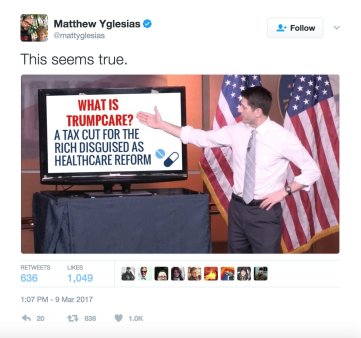
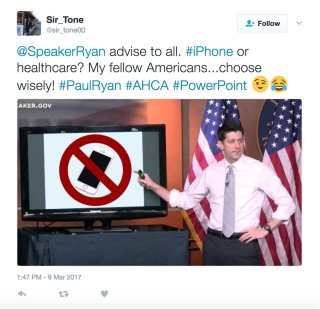
And then there’s Paul Ryan who thinks the only thing that should occur right now is decimation of the ACA regardless of the results. It’s right there on his Power Point. It pretty much looked like the Republican version was DOA yesterday but now Senate Republicans are actually talking about changing the Senate rules to get it shoved through one way or another. This is despite the massive outrage about the repeal.
A growing number of conservative lawmakers on Thursday urged GOP leaders to push the limits of how much of the health law they can reshape under a powerful procedural maneuver known as budget reconciliation — and to overrule the Senate parliamentarian if she doesn’t decide in their favor.
Such a gambit would require the unlikely buy-in of Senate Majority Leader Mitch McConnell (R-Ky.), a noted institutionalist who earlier this year avoided talk of changing his chamber’s rules to kill the ability to filibuster Supreme Court nominees.
If the Senate changes precedent for what can be passed under reconciliation now, a future Senate — whether controlled by Republicans or Democrats — could enact a wide range of legislation with just a simple majority.
“There are limits to what we can do” on Obamacare while complying with the Senate rules, Finance Chairman Orrin Hatch, the longest-serving Senate Republican, said in a Thursday floor speech. Under reconciliation guidelines, bills can be passed in the Senate with a simple majority and cannot be filibustered, as long as their provisions have a direct impact on spending or tax levels.
I wake up every day in fear of what’s coming next. It seems that everything I’ve ever planned my old age around is now collapsing around me. The Republican Plan is a massive DumpsterFire. 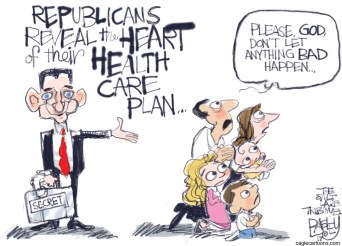 Paul Krugman has some great analysis.
Obamacare rests on three main pillars. Insurance companies are regulated, prevented from denying coverage or charging higher prices to Americans with pre-existing conditions. Families receive subsidies linked to both income and premiums, to help them buy insurance. And there is a penalty for those who don’t buy insurance, to induce people to sign up even if they’re currently healthy
Trumpcare — the White House insists that we not call it that, which means that we must — preserves some version of all three elements, but in drastically, probably fatally weakened form.
Insurers are still barred from excluding the sick, but they’re allowed to charge older Americans — who need insurance the most — much higher premiums.
Subsidies are still there, in the form of tax credits, but they’re no longer linked to either income (as long as it’s below $75,000) or the cost of insurance.
And the tax on those who don’t sign up becomes a small surcharge — paid to insurance companies, not the public — on people who sign up after previously letting coverage lapse.
Affluent young people might end up saving some money as a result of these changes. But the effect on those who are older and less affluent would be devastating. AARP has done the math: a 55-year-old making $25,000 a year would end up paying $3,600 a year more for coverage; that rises to $8,400 for a 64-year-old making $15,000 a year. And that’s before the death spiral.
For the combination of price hikes and weakened penalties would lead many healthy Americans to forgo insurance. This would worsen the risk pool, causing premiums to rise sharply — and remember, subsidies would no longer adjust to offset this rise. The result would be even more people dropping out. Republicans have been claiming that Obamacare is collapsing, which isn’t true. But Trumpcare, if implemented, would collapse in a Mar-a-Lago minute.
How could House Republicans under the leadership of Paul Ryan, who the media keeps assuring us is a smart, serious policy wonk, have produced such a monstrosity?
The only thing that’s been fun about this is the Twitter Attack on Paul Ryan and his Power Points.
So, I know a few people that have been basically kidnapped by their families and put into conversion therapy. This story of a survivor is chilling reading.
TC, a 19-year-old gay man who spoke to The Huffington Post anonymously for this article in order to protect his safety, is a survivor of conversion therapy practices.
TC was subjected to conversion therapy in 2012 when he was 15 years old after his parents discovered he was gay. The conversion therapy practices took place in the basement of a church after school hours, and were explained to TC and his parents as having two separate components. He told The Huffington Post:
The first step ― which usually lasted six months ― [is] where they “deconstruct us as a person.” Their tactics still haunt me. Aversion therapy, shock therapy, harassment and occasional physical abuse. Their goal was to get us to hate ourselves for being LGBTQ (most of us were gay, but the entire spectrum was represented), and they knew what they were doing…. The second step of the program, they “rebuilt us in their image.” They removed us of everything that made us a unique person, and instead made us a walking, talking, robot for Jesus. They retaught us everything we knew. How to eat, talk, walk, dress, believe, even breathe. We were no longer people at the end of the program.
TC said that the conversion therapy sessions would take place every weekday, with shock therapy treatments lasting approximately an hour, and aversion therapy lasting three.
This is torture. Pure and Simple.
So, this is what they’d fund while getting Insurance 101 wrong.
Paul Ryan actually said “The whole idea of Obamacare is…the people who are healthy pay for the…sick. It’s not working, & that’s why it’s in a death spiral.”
No Speaker that’s a risk pool and it’s how insurance works.
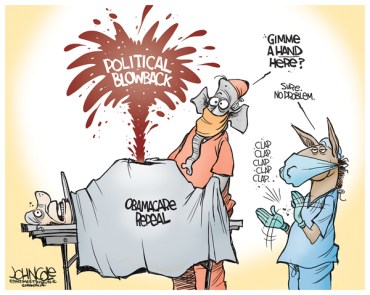
Everyone pays into the pot and draws on it when they’re sick. Younger people, who tend to be healthier than older people, pay for health insurance like everyone else. They’ll rely on it when when they need it, probably more when they’re older and there are younger, healthier people filing in behind them. It’s the same with car insurance
. Some people pay for decades and never get into an accident and never collect on their coverage (though the likelihood of anyone never using health insurance is unlikely).That’s what actuarial figures are all about, so an insurance system can assess the risks of segments of customers to determine what everyone needs to put into the pot so there’s enough to pay out when someone needs the money.
Ryan has perhaps been on taxpayer-paid health insurance for so long that he has forgotten how the concept works. He believes that’s only the way it works for Obamacare. “The conceit of Obamacare,” he said at his press conference on Trumpcare, is that “young and healthy people are going to go into the market and pay for the older, sicker people.” That’s why Obamacare is in a “death spiral,” he noted.
Twitter had a pretty predictable response to Ryan’s summary of health insurance: Duh.
Meanwhile, every one except the stupid, the greedy, the mean, and the crazy resist.
Well, what’s on your reading and blogging list today?
Did you like this post? Please share it with your friends:


 peej
peej Carissa
 bostonboomer
 dakinikat
 ecocatwoman
 jjlo
jjlo mablue2
 Mama Lopez
 peggysue22
 quixote
 skydancingguestblogger
 Mona (aka Wonk the Vote)





Recent Comments