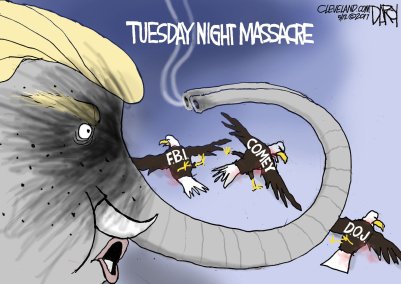
We’re going further down the Nixon road to impeachment hearings except we’re not getting rid of Indiana Spiro Pence first. It’s difficult to imagine who is going to be # 46 at this point. Kremlin Caligula appears to be headed for the Nixon paranoia zone–if you read his tweets–while continuing to do untold damage to the basic functioning of our government and society in the mean time. It’s difficult to find a place to start every time I blog these days.
This headline just about knocked me off my chair. I’m beginning to think that Trump thinks all Black Americans grew up in subsidized housing and therefore are experts on it. I don’t know how else to explain this. Here’s the headline from NYDN: ‘President Trump chooses inexperienced woman who planned his son Eric’s wedding to run N.Y. federal housing programs’. This follows his odd appointment of Dr. Ben Carsons as the head of HUD. It speaks volumes about what he thinks about the life experiences of African American to me.
She’s arranged tournaments at Trump golf courses, served as the liaison to the Trump family during his presidential campaign, and even arranged Eric Trump’s wedding.
Now President Trump has appointed longtime loyalist Lynne Patton — who has zero housing experience and claims a law degree the school says she never earned — to run the office that oversees federal housing programs in New York.
Patton was appointed Wednesday to head up the U.S. Department of Housing and Urban Development’s Region II, which includes New York and New Jersey, where she’ll oversee distribution of billions of taxpayer dollars.
Patton’s tight relationship with the Trump clan dates back to 2009, when she began serving as the family’s “event planner.”
“Responsible for organizing, executing and assisting with upscale events and celebrity golf tournaments,” her LinkedIn profile says. “Handle celebrity talent acquisition for various marketing projects with a specialized digital marketing agency, philanthropic events and golf tournaments.”
He seems to value whatever he thinks loyalty is over competence which explains the series of failed businesses his left in his wake. Charles Pierce has some interesting analysis in his Trumplandia Chronicles.
The deconstruction of the administrative state continues apace, and descends to low comedy, unless you happen to live in federally subsidized housing in the city of New York. Then, it’s not funny at all.
No. It’s not funny at all.
Meanwhile, we have more headlines about the Griftopia set out by the first family of greed and thuggery. Jared Kushner’s business dealings are under investigation by the Mueller team. This should get interesting. This may unravel a number of money laundering scams. It’s likely to involve offshore banking havens.
Special counsel Robert S. Mueller III is investigating the finances and business dealings of Jared Kushner, President Trump’s son-in-law and adviser, as part of the investigation into Russia’s interference in the 2016 presidential election, according to U.S. officials familiar with the matter.
FBI agents and federal prosecutors have also been examining the financial dealings of other Trump associates, including former national security adviser Michael Flynn, former campaign chairman Paul Manafort and Carter Page, who was listed as a foreign-policy adviser for the campaign.
The Washington Post previously reported that investigators were scrutinizing meetings that Kushner held with Russians in December — first with Russian ambassador Sergey Kislyak, and then with Sergey Gorkov, the head of a state-owned Russian development bank. At the time of that report, it was not clear that the FBI was investigating Kushner’s business dealings.
The officials who described the financial focus of the investigation spoke on the condition of anonymity because they were not authorized to speak publicly.
In a spartan office at the Justice Department, a team of experienced prosecutors is conducting a rapidly expanding probe into the Trump campaign’s possible ties to Russia — and into whether President Donald Trump himself may be guilty of obstruction of justice.
Led by special counsel Robert Mueller, a former FBI director, the team includes heavy hitters like Michael Dreeben, an expert on criminal law who has argued more than 100 cases in front of the Supreme Court, and Andrew Weissmann, a seasoned prosecutor who’s spent his career going after organized crime.
Adding to the firepower are James Quarles, a former assistant special prosecutor for the Watergate investigation; Jeannie Rhee, a former senior adviser to former Attorney General Eric Holder and a white-collar crime specialist; and Aaron Zebley, a cybersecurity expert who spent decades in the FBI before joining a private practice.
The appointments come amid growing signs that Trump himself is in Mueller’s crosshairs: On Tuesday night, the Washington Post reported that the special counsel was directly investigating whether the president’s decision to fire former FBI Director James Comey was an effort to obstruct justice.
The Mueller team is setting up interviews with the nation’s top intelligence officials to find out whether Trump had asked them to try to persuade Comey to drop the FBI’s probe into former National Security Adviser Michael Flynn, according to the Post. The New York Times, meanwhile, reported Tuesday night that Mueller was also looking into possible money laundering by Trump campaign staffers and associates.
The fact that Mueller’s team can conduct such a broad probe — one apparently looking into every possible angle of the Trump-Russia scandal, from possible financial crimes to outright collusion with the Kremlin — is a reflection of just how much legal firepower he has assembled.
The special counsel’s investigators are looking into questions of Russian interference in last year’s election, and plan to speak to senior intelligence officials, a source familiar with the matter told CNN.
Mueller is also investigating whether President Donald Trump attempted to obstruct justice, The Washington Post reported Wednesday.
The Post reported that the interviews represent a widening of the probe to include looking into whether the President obstructed justice in suggesting to his former FBI Director James Comey that Comey drop the investigation into Michael Flynn, Trump’s former national security adviser, as well as for his firing of Comey.
Mueller’s investigators have asked for information and will talk to Director of National Intelligence Dan Coats and National Security Agency Director Adm. Mike Rogers, according to a source, who said they have also sought information from recently retired NSA Deputy Director Richard Ledgett. Coats and Rogers have testified that they were not pressured by the Trump administration.
The interviews are some of the first indications of the efforts of Mueller’s newly assembled team
President Trump issued an eyebrow-raising tweet Friday morning.
“I am being investigated for firing the FBI Director by the man who told me to fire the FBI Director! Witch Hunt,” he wrote.
Trump’s tweet comes less than a day after another strange statement from a senior official in his administration.
On Thursday night, Deputy Attorney General Rod Rosenstein issued a statement in which he cautioned Americans against believing stories about the DOJ Russia investigation that cited unnamed sources:
“Americans should exercise caution before accepting as true any stories attributed to anonymous ‘officials,’ particularly when they do not identify the country – let alone the branch or agency of government – with which the alleged sources supposedly are affiliated. Americans should be skeptical about anonymous allegations. The Department of Justice has a long-established policy to neither confirm nor deny such allegations.”
Though Rosenstein did not explain what prompted the statement, many political observers connected it to recent reports that special counsel Robert Mueller, who is leading the Department of Justice investigation into Russian election meddling, is also investigating whether President Trump attempted to obstruct justice — though USA Today also noted that it came shortly after a Washington Post report that Mueller’s team is also investigating Jared Kushner’s business dealings.
Indiana Spiro Pence has lawyered up. You absolutely cannot convince me–at this point–that he does not know where the bodies are buried. His Sargent Schulz act isn’t going to go far but he did get a good, experienced lawyer. He’s also fundraising today for his PAC which means he’s going to be paying top dollar for said lawyer. They go for about $1000+ an hour these days.
The night before, on the eve of Trump’s first foreign trip—and Pence’s private speech—two news outlets published a pair of eyebrow-raising stories that reflected mounting anxiety within the vice president’s inner circle. The sourcing and strategy seemed clearly choreographed. First, both articles aimed to distance Pence from the chaos engulfing Trump’s White House; CNN quoted “a senior administration adviser” who said Pence “looks tired” and never expected such mayhem on the job, while NBC cited “a source close to the administration” who complained of a “pattern” of Pence being kept in the dark on matters relating to the scandal-plagued former national security adviser, Mike Flynn. Second, both stories were authored by former Pence “embeds,” reporters who had spent months traveling with him and are expertly sourced among the vice president’s tight-knit team. And third, the news accounts cast Pence in a sympathetic light at the very moment when the D.C. media was, for the first time, beginning to hammer him. The New York Timeshad reported the day earlier that Flynn informed the Pence-run transition team before Inauguration Day that he was under federal investigation; the implications for Pence were staggering, and the White House categorically denied the story. But Pence had also courted trouble the week earlier by insisting that Trump’s decision to fire Comey was based on the deputy attorney general’s recommendation—a claim Trump promptly contradicted in an interview with NBC’s Lester Holt, embarrassing the vice president and sending an awkward question echoing around Washington: Is Pence being kept out of the loop, or is he being deceitful?
As the Russia investigation continues to expand, for example, Pence took steps this week to protect himself, hiring former U.S. attorney and Virginia attorney general Richard Cullen as his own outside legal counsel, just as Trump has retained attorney Marc Kasowitz.
The vice president’s advisers are also discussing bringing on an additional aide to help with strategy — likely either Nick Ayers, a senior strategist to Pence who is chairman of the vice president’s newly launched super PAC; Marc Short, who currently heads up legislative affairs in the White House; or Marty Obst, the former manager of Pence’s Indiana gubernatorial campaign who is executive director of the super PAC.
Deputy Attorney General Rod Rosenstein, who is overseeing the Russia probe due to Jeff Sessions’ recusal, released an unorthodox statement Thursday night:
“Americans should exercise caution before accepting as true any stories attributed to anonymous ‘officials,’ particularly when they do not identify the country — let alone the branch or agency of government — with which the alleged sources supposedly are affiliated. Americans should be skeptical about anonymous allegations.
The general reaction,summed up by the NY Times’ Maggie Haberman, “Have literally never seen a statement like this.”
The senior Justice Department official with ultimate authority over the special counsel’s probe of Russia’s alleged meddling in the 2016 election has privately acknowledged to colleagues that he may have to recuse himself from the matter, which he took charge of only after Attorney General Jeff Sessions’ own recusal, sources tell ABC News.
Those private remarks from Deputy Attorney General Rod Rosenstein are significant because they reflect the widening nature of the federal probe, which now includes a preliminary inquiry into whether President Donald Trump attempted to obstruct justice when he allegedly tried to curtail the probe and then fired James Comey as FBI director.
Rosenstein, who authored an extensive and publicly-released memorandum recommending Comey’s firing, raised the possibility of his recusal during a recent meeting with Associate Attorney General Rachel Brand, the Justice Department’s new third-in-command, according to sources.
Although Rosenstein appointed a special counsel to lead the federal probe, he still makes the final decisions about resources, personnel and — if necessary — any prosecutions.
In the recent meeting with Brand, Rosenstein told her that if he were to recuse himself, she would have to step in and take over those responsibilities. She was sworn-in little more than a month ago.
This seems like the summer of 1973 on steroids. We shall see.
What’s on your reading and blogging list today?
Did you like this post? Please share it with your friends:
Well, it’s time to watch another reason to regret that we now have a constitutional crisis instead of Taco Trucks on every corner! The 84th AG who is supposed to be upholding the US Constitution instead of enabling those crises will undoubtedly bob and weave the questions like a little white banty rooster pecking or corn. Just exactly how many times did he meet with the Russian Ambassador and why?
When Senator Al Franken asked then-Senator Sessions at his Senate confirmation hearing on January 10 whether he “communicated with the Russian government,” he said, “I’m not aware of any of those activities.” Unprompted, Sessions then went further, saying, “I have been called a surrogate at a time or two in that campaign and I didn’t have—did not have communications with the Russians, and I’m unable to comment on it.” Then less than two months later, on March 1, The Washington Postreported that Sessions had, in fact, met with Russian Ambassador Sergey Kislyak—not once, but twice.
It was a serious omission, especially for the nation’s top law-enforcement officer, and one who is a vocal advocate for law and order. Scrambling to contain the damage, Sessions issued a statement that attempted to draw a very subtle distinction. Calling the report “false,” he said that he had “never met with any Russian officials to discuss issues of the campaign.” His spokeswoman, Sarah Isgur Flores, spelled it out even more clearly: “He was asked during the hearing about communications between Russia and the Trump campaign—not about meetings he took as a senator and a member of the Armed Services Committee,” she said. (In fact, Franken had made no such qualification.) And a White House official insisted that Sessions had “met with the ambassador in an official capacity as a member of the Senate Armed Services Committee,” not a campaign surrogate.
Sessions will dispute James Comey’s characterization of a conversation the two men had in February.
This is a big deal, as Comey gave his account under oath.
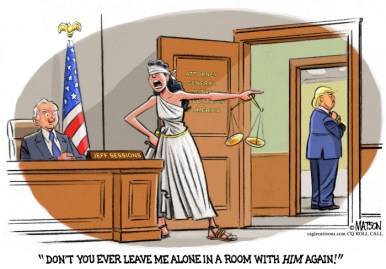
The former FBI director said under oath that after his Feb. 14 conversation with Trump, he told Sessions he didn’t want to have any more direct communication with the President. Comey then said that Sessions remained silent, perhaps shrugging his shoulders and nonverbally indicating that he couldn’t be of help.
Sessions is expected to counter this, saying he responded to Comey by telling him the FBI and DOJ needed to be aware of official protocol regarding communications with the White House. The DOJ released a statement to that effect a few hours after Comey’s testimony. Sessions is expected to make the same statement under oath.
So, if you’re watching or not, we’re going to be following it here! Hang on!
Did you like this post? Please share it with your friends:
As many have noted, the GOP’s plan to “repeal and replace” Obamacare will hit Trump voters hardest. It’s no mystery as to why. As the New York Times explained, “The Republican plan offers less assistance to older and lower income Americans, especially in rural areas.” Due to the lack of competition for insurers and health care providers, as the Center on Budget and Policy Priorities (CBPP) documented, 12 of the 15 states hardest hit by the AHCA’s shriveled tax credits are rural ones. Fourteen of the 15 voted for Donald Trump for president in 2016. And with the GOP’s plan to redirect $880 billion in Medicaid spending to tax cuts for the richest Americans, older Americans—especially those near the poverty line—will face catastrophic increases in premiums, rendering health insurance an impossible acquisition:
Older, sicker people will be priced out of the market altogether.
The millions losing Medicaid under the GOP plan would be unable to buy their own under the AHCA.
(It should be noted that these effects won’t be limited to those obtaining insurance through the individual or non-group market. As the Wall Street Journal (“GOP Health Bill Jeopardizes Out-of-Pocket Caps in Employer Plans”) and the Brookings Institution warned, “Allowing states to define ‘essential health benefits’ could weaken ACA protections against catastrophic costs for people with employer coverage nationwide.”)
Now, it should be said that the version of the AHCA Senate Republicans are contemplating may not be as disastrous as the draconian House bill. It is rumored that the phase-out of the Medicaid expansion may be extended to seven years. While maintaining the ability for states to waive Obamacare’s list of essential health benefits, a Senate bill may limit insurers ability to charge more to those with pre-existing conditions who let their coverage lapse. Regardless, Senate Majority Leader Mitch McConnell is committed to getting a vote on the GOP’s Obamacare replacement bill before the August recess. As for Donald Trump, he’s “all in.”
Continue reading the analysis by Jon Perr at his DKOS Diary. He’s included a pretty decent round up of analysis from a variety of good sources.
Sarah Kliff–writing for Vox–believes that Obamacare is in ‘real danger’ from the Republican Senate led by Creepy Turtle Man. McConnell has been working on all the angles and rules that could create a health crisis for years ahead. As I mentioned on Friday, he’s severely limited discussion, not allowing modification, keeping the bill under wraps, and plans to force it through with the VEEP giving it 50 vote. This on top of all the people that basically hate the idea of it all. What will their constituents do next year?
Behind closed doors, Senate Republicans have worked out a path toward Obamacare repeal. The plans under discussion would end Medicaid expansion, causing millions of low-income Americans to lose health coverage. They may allow health insurance plans to charge higher premiums to people with preexisting conditions, too.
In other words: The emerging bill looks a whole lot like the unpopular bill the House passed last month. It creates the same group of winners (high-income, healthier people) and the same group of losers (low-income, sicker people).
The Republican plan is coming together because moderate senators are beginning to drop some of their initial repeal objections. Sens. Rob Portman (R-OH) and Shelley Moore Capito (R-WV), for example, now back a plan to end the Medicaid expansion.
Both were ardent critics of the House bill’s deep Medicaid cuts, which would cause 14 million Americans who rely on the public program to lose coverage. Portman put out a harsh statement the day the House passed its health care bill.
“I’ve already made clear that I don’t support the House bill as currently constructed because I continue to have concerns that this bill does not do enough to protect Ohio’s Medicaid expansion population,” Portman said plainly.
But now Portman has endorsed a plan to phase out the Medicaid expansion entirely, just to do so on a longer timeline than the House bill. Portman and Moore Capito want a seven-year phase out, rather than the House bill’s three-year off-ramp.
At the end of the day, though, phasing out Medicaid expansion over seven years has the same effect as three years: You end coverage for millions of low-income Americans.
There are still major issues that divide Senate Republicans on repeal. There is disagreement, for example, over how much to cut the Medicaid program and what kind of subsidies to give people in the private market. But the fact that Republicans are coalescing around ending Medicaid expansion — once thought to be a major sticking point — suggests the path to repeal may be easier to find than initial expectations.
Senate Republicans are on track to finish writing their draft health care bill this evening, but have no plans to publicly release the bill, according to two senior Senate GOP aides.
“We aren’t stupid,” said one of the aides. One issue is that Senate Republicans plan to keep talking about it after the draft is done: “We are still in discussions about what will be in the final product so it is premature to release any draft absent further member conversations and consensus.”
Why it matters: Democratic senators are already slamming Republicans for the secrecy of their bill writing process, and this isn’t going to help. Republicans are sure to release the bill at some point, but it’s unclear when — and they want to vote on it in the next three weeks, before the July 4 recess.
What to watch: When the bill is finished, it’ll be sent to the Congressional Budget Office. It’ll take CBO about two weeks to evaluate and score a draft bill. Senate Republicans then want to vote on the bill before the July 4th recess. “Conversations with CBO continue” but there are no new announcements about timing, said Don Stewart, a spokesman for Majority Leader Mitch McConnell, when asked about these plans.
You know it’s pure evil since Lucifer is trying on a new hat. Ted Cruz as Dealmaker? Seriously?
Cruz has been working to pass a health-care bill for several months. He set up a working group of conservatives and moderates, starting with Tennessee Senator Lamar Alexander, which later expanded to include party leaders. They met once a week for two months in Cruz’s conference room without the press catching wind of it — a point of pride for Cruz.
“The week after the election I brought my staff together,” he said, and told them they had a new mission. For the past four years, he told them, they had been fighting “a president with a radical agenda” and had focused on stopping bad things from happening as the loyal opposition.
Republicans are growing increasingly worried that they will lose the House of Representatives. The pervasive pessimism comes as there continues to be a dearth of legislative victories, and a toxic political environment that appears to be worsening. Of course, the midterm elections are nearly a year and a half away. But more than a dozen Republicans we’ve spoken to in the last few weeks say the prospect for political and legislative wins big and small is dimming. And as much as President Donald Trump has worked to woo over fellow Republicans with dinners at the White House and regular meetings with GOP leadership, it hasn’t had much of an impact on the overall state of play.
THE RANK AND FILE has been frustrated with the House committees, which have not produced a drumbeat of legislation to tout as victories. And the party is deeply split on health-care reform, a tax overhaul and infrastructure spending. Passing a budget to set the groundwork for tax reform is still seen as far off. And the congressional schedule doesn’t leave a lot of time to kick things into high gear. The House is in session for 13 more days and the Senate is in session for 14 more days before the July 4 recess. Not to mention, there’s serious concern in the GOP that there could be more revelations about President Donald Trump, and Robert Mueller’s investigation still remains the wild card. Attorney General Jeff Sessions testifying Tuesday before the Senate Intel Committee is expected to just add more drama to distract from the GOP agenda into the mix.
WHAT DOES ALL THIS MEAN? Republicans will be less willing to take risks as they shift into political survival mode.
Attorney General Jeff Sessions’ letter on Saturday offering to testify before the Senate intelligence committee on Tuesday caught members of the panel by surprise, and senators are concerned he’s trying to avoid testifying publicly, a source familiar with the situation says.
The committee has not confirmed the Tuesday date for Sessions’ testimony and are still discussing whether to allow him to testify in open or closed session, or both, as former FBI Director James Comey did last week.
A number of members are concerned Sessions may be attempting to avoid testifying in public by scrapping his previously scheduled Senate and House Appropriations appearances this week, where he was expected to be grilled on issues related to the federal investigation into Russia’s efforts to influence the US election, several sources say. Sen. Mark Warner of Virginia, the vice chairman of the panel, is among those concerned, a source says.
Ed Wexler / politicalcartoons.com
One final note on Trump which always leads me to a good hot shower to get off the scummy feeling that Orange Swamp Thing eminates. Check out this WAPO headline: ‘D.C. and Maryland sue President Trump, alleging breach of constitutional oath’.
Attorneys general for the District of Columbia and the state of Maryland sued President Trump on Monday, alleging that he has violated anti-corruption clauses in the Constitution by accepting millions in payments and benefits from foreign governments since moving into the White House.
The lawsuit, the first of its kind brought by government entities, centers on the fact that Trump chose to retain ownership of his company when he became president. Trump said in January that he was shifting his business assets into a trust managed by his sons to eliminate potential conflicts of interests.
But D.C. Attorney General Karl A. Racine (D) and Maryland Attorney General Brian E. Frosh (D) say Trump has broken many promises to keep separate his public duties and private business interests. For one, his son Eric Trump has said the president would continue to receive regular updates about his company’s financial health.
The lawsuit, a signed copy of which Racine and Frosh provided to The Washington Post on Sunday night, alleges “unprecedented constitutional violations” by Trump. The suit says Trump’s continued ownership of a global business empire has rendered the president “deeply enmeshed with a legion of foreign and domestic government actors” and has undermined the integrity of the U.S. political system.
It’s like Trump’s the clown that runs around in circles trying to keep you from noticing the circus beats the elephants, starves the big cats, and lets the women fall out of sequin costumes as they spin to their deaths from badly serviced equipment.
So, that’s the bad news for this morning. I’m sure more is on its way. After all, we have Republicans and that means greed and bad ideas abound!
What’s on your reading and blogging list today?
Did you like this post? Please share it with your friends:
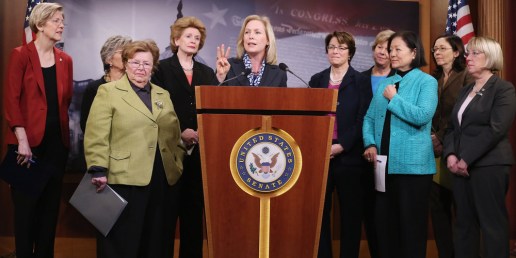
WASHINGTON, DC – JANUARY 30: Women Democratic senators (L-R) U.S. Sen. Elizabeth Warren (D-MA), U.S. Sen. Barbara Boxer (D-CA), U.S. Sen. Barbara Mikulski (D-MD), U.S. Sen. Debbie Stabenow (D-MI), U.S. Sen. Kirsten Gillibrand (D-NY), U.S. Sen. Amy Klobuchar (D-MN), U.S. Sen. Tammy Baldwin (D-WI), U.S. Sen. Mazie Hirono (D-HI), U.S. Sen. Maria Cantwell (D-WA) and U.S. Sen. Patty Murray (D-WA) hold a news conference to announce their support for raising the minimum wage to $10.10 at the U.S. Capitol January 30, 2014 in Washington, DC. Thirteen of the 16 Democratic women senators made appearances during the news conference. (Photo by Chip Somodevilla/Getty Images)
Good Afternoon!
Well, the thing from the Orange Swamp has been sucking all oxygen and energy available to Mother Earth and then some. Women Senators and Representatives have been leading the battle to ensure the entire justice thing is done. Last week the hearings in the Senate were exciting but the focus there let Mitchie and Paulie find ways to circumvent democracy with very little notice or coverage.
I got hit yesterday with weird ass flu and I’m exhausted after spending the day in bed fighting dizziness and stomach ickiness. I wanted to talk about some of the absolutely sneaky shit going on in the House and Senate as the Republicans rush to cram absolutely bad, unpopular, self-serving laws through both houses using arcane rules and your basic slight of hand. They’re trying to rush through the absolutely cringe-inducing, people killing, death panel empowering Unafforadble Health care replacement to the ACA.
They’re also rushing to rid the country of financial regulations again by repealing Dodd Frank. What an economist’s nightmare! These hearings are shocking and important but look what’s going on behind the show tent.
So Comey told Jeff Sessions he didn't want to be alone with Trump. Women across the country can relate.
The House of Representatives passed sweeping legislation Thursday that would strip and replace much of the financial regulations passed under President Obama after the 2008 financial crisis.
Don’t expect the measure to become law, though. It’s not expected to pass in the Senate.
The House passed the Financial CHOICE Act on a party line vote, 233 to 186.
Sponsored by House Financial Services Committee Chairman Jeb Hensarling (R-Texas), the CHOICE Act is the most ambitious Republican effort to roll back the Dodd-Frank Wall Street Reform and Consumer Protection Act, passed in 2010.
It has a completely Orwellian name too. It’s called the Financial Creating Hope and Opportunity for Investors, Consumers and Entrepreneurs (CHOICE) Act, 233-186. The bill passed strictly along party lines and is not expected to pass the Senate.
Democrats have fiercely defended Dodd-Frank. They say the bill has held Wall Street accountable for the risky investment practices that caused the crisis and protected Americans from predatory lending and abusive financial firms.
“It’s shameful that Republicans have voted to do the bidding of Wall Street at the expense of Main Street and our economy,” said Rep. Maxine Waters (Calif.), the ranking Democrat on the Financial Services Committee. “They are setting the stage for Wall Street to run amok and cause another financial crisis. I urge my colleagues in the Senate not to move on this deeply harmful bill.”
The CHOICE Act would roll back much of the Dodd-Frank regulations long targeted by Republicans. It would allow banks that reach certain cash thresholds an off-ramp from Dodd-Frank, reduce the frequency of federal stress tests and restrain oversight powers of several federal agencies that the 2010 law expanded.
Hensarling’s bill would also eliminate orderly liquidation authority — the process through which the federal government takes over and dismantles a major bank before it collapses — and place strict limits on the Consumer Financial Protection Bureau (CFPB).
The CHOICE Act would turn the CFPB, which Republicans consider abusive and unaccountable, into the Consumer Law Enforcement Agency. It would no longer control its own budget, its director would be appointed by the president, and it would lose its authority to crack down on “unfair, abusive and deceptive practices.”
Speaker Paul Ryan (R-Wis.) and GOP leaders touted the bill in the weeks before Thursday’s vote. Ryan, a longtime Hensarling ally who served with him on the House Budget Committee, on Wednesday called the CHOICE Act “the crown jewel” of the GOP deregulation agenda.
“This legislation comes to the rescue of Main Street America,” Ryan said Wednesday. “The Financial CHOICE Act makes it possible for small businesses across this country to stop struggling and to start hiring.”
Paul Ryan never seems to get the basic economics lessons that small businesses across the country will not struggle and will hire and expand their business if they have customers that have the basic incomes to afford their products and services. The smallest contribution to National Income is stuff coming from investments. The largest source of funds in this country for business is consumption by households. Turning the national financial services industry back into a gambling establishment with special tax treatment for gamblers who don’t build businesses but speculate on the face value of paper assets isn’t going to help Main Street America.
An update on an earlier development: The Kansas state legislature told Governor Sam Brownback to pound sand, overriding his veto and upholding its decision to roll back the radical supply-side tax cuts that were central to Brownback’s demolition of the state’s economy. From those Socialist Agitators at Forbes:
Brownback vetoed the legislature’s first attempt to reverse his tax cuts, but two-thirds majorities in both the House and Senate overrode his veto. The measure would boost state taxes by $1.2 billion over two years, in part by raising the top income tax rate from 4.6 percent to 5.7 percent and by once again taxing sole proprietorships, partnerships, and other pass-through businesses. Pressured by Brownback, the legislature had made pass-throughs tax free… Since Kansas enacted tax and spending cuts in 2012 and 2013, Brownback and his allies have argued that this fiscal potion would generate an explosion of economic growth. It didn’t. Overall growth and job creation in Kansas underperformed both the national economy and neighboring states. From January, 2014 (after both tax cuts passed) to April, 2017, Kansas gained only 28,000 net new non-farm jobs. By contrast, Nebraska, an economically similar state with a much smaller labor force, saw a net increase of 35,000 jobs.
Tax cuts balloon deficits and do not lead to growth. Period. This economic theory—to which, it should be noted, the administration and the Republican majorities in the Congress strictly adhere—doesn’t work. It is alchemy. It has no basis in empirical reality. Every argument in its favor has been proven by practical experience to be utter moonshine. It failed under Ronald Reagan and it failed under George W. Bush and, in its purest form, it failed disastrously in Kansas. Its proponents should be drummed out of the respectable national dialogue as thoroughly as Alex Jones has been. Supply-side is the chemtrails of political economies.
Kansas’s moderate ascendance may portend problems for Republicans in Washington, where many in the party, including President Trump, are pushing to adopt federal tax policies similar to the ones Brownback has installed in Kansas. But while Brownback had hoped what he called Kansas’s “real-live experiment” in conservative economic policy would become a national model, it has instead become a cautionary example.
It not only killed Kansas. Jindal let it kill Louisiana: ‘Louisiana has second-worst economy in U.S.: report’. Our current lege session was a total clusterfuck as ignorant Republicans continue to swallow the snakeoil that tax cuts pay for themselves. They do have never and will never do that unless your top marginal tax rate is like way north of like 90 percent. Even then, it’s not the dampening impact is just not that big of a deal.Just imagine if this shit goes nationwide on that kind of a scale.
Louisiana’s economy ranks second-worst among U.S. states and the District of Columbia when examining a wide range of indicators, including employment, building permits, government spending and growth in science and tech industries, according to an analysis WalletHub released Monday (June 5).
Louisiana ranked only better than West Virginia in the study; the bottom five also included Mississippi, Arkansas and Oklahoma. Meanwhile, Washington, California, Utah, Massachusetts and the District of Colombia ranked the top five.
WalletHub used data from the U.S. Census Bureau, the bureaus of Labor Statistics and Economic Analysis, United Health Foundation, American Legislative Exchange Council, CoreLogic, the U.S. Patent and Trademark Office and the National Science Foundation, among others.
Louisiana did shine in one category: the state tied with Texas and Washington for most exports per capita.
Yeah, that’s because that damned President Obama turned us into a net oil exporter. Damn you Obama!!! Thankfully, we have a few Democrats in the District who are fighting like hell.
“Nobody can pretend this was a good day for the state of Louisiana,” the governor said. “We now know that the majority of legislators came here determined to fix these problems and to work in a bipartisan way. We now know that it was a minority in the House that prevented that from happening.”
At least some rank-and-file Republicans in the House appeared to agree with the governor.
Republican Rep. Kenny Havard and Democratic Rep. Major Thibaut, both of whom voted to consider the Senate budget proposal, in unison described the special session as “embarrassing” to the Legislature. Republican Rep. Julie Stokes said she was “disgusted.”
“Petty partisan politics have failed the people of the state today, and it’s time that we grow up and work on solving the people’s problems,” said Stokes, who voted to bring up the Senate budget proposal.
House Republican leaders want to spend less than the full state income forecast, as a cushion to avoid midyear cuts in case the predictions were wrong. The Senate, backed by Edwards and House Democrats, want to spend all available dollars, saying otherwise they’d have to make unnecessary, harmful cuts.
The state’s income forecast has been too optimistic every year for nearly a decade.
Senate President John Alario, a Republican, said he was disappointed at the meltdown.
“My hope is that we complete our work in this special session. It’s too darn important for the people of this state. Education, health care, public safety: there are too many things that would get hurt if we didn’t come to a consensus and make it work,” Alario said.
Senator Claire McCaskill joined the ranks of women in leadership given the misogynist treatment for acting like a leader. McCaskill called Shenanigans on the way the Republicans plan to cram TrumpCare into law.
Thursday in a Senate hearing, Americans were finally presented definitive evidence of a plot so nefarious and cunning, it threatens to upend any remaining trust in our democratic institutions. I am referring, of course, to an exchange between Sen. Claire McCaskill and Sen. Orrin Hatch in the Senate Finance Committee on the progress of the Republican health care bill. McCaskill asked Hatch, the chairman, whether the committee would hold hearings on the as-yet-unreleased legislation.
Hatch: Will we?
McCaskill: Yes.
Hatch: I … I think we’ve already had one. But…
McCaskill: No. I mean on the proposal that you’re planning to bring to the floor of the Senate for a vote. Will there be a hearing?
Hatch, searching for a less damning answer than “No,” was silent as a much younger aide—perhaps young enough to be barred constitutionally from holding the seat Hatch is evidently simply keeping warm—sidled up to him and whispered, audibly enough for his microphone, words that Hatch began to repeat almost verbatim.
Aide: …they’re invited to participate in this process and we’re open to their ideas and suggestions.
Hatch: Well, I don’t know that there’s going to be another hearing, but we’ve invited you to participate and give your ideas and…
McCaskill: No! No, that’s not true, Mr. Chairman. Let me just say I watched carefully all of the hearings that went on on the [Affordable Care Act]. I was not a member of this committee at the time, although I would have liked to be. Sen. Grassley was the ranking member. Dozens of Republican amendments were offered and accepted in that hearing process. And when you say that you’re inviting us—and we heard you, Mr. Secretary, just say, “We’d love your support”—for what? We don’t even know. We have no idea what’s being proposed.
McCaskill might not have any idea, but some details have trickled out in recent days on what the bill is shaping up to be. On Tuesday, Jim Newell described the contents of a presentation on the bill-in-progress that had been shown to Senate Republicans:
Like the House bill, the Senate proposal would allow states to waive the Affordable Care Act’s essential health benefit coverage requirements, as well as loosen the ratio of what older people can be charged relative to younger customers. The Senate bill would not, however, allow states to waive community rating by health status, which bars insurers from charging sick people more than healthy ones. The Washington Examiner reported, too, that the Senate was considering allowing the ACA’s Medicaid expansion to linger past the 2020 deadline set forth in the House bill—and that a program to auto-enroll people into coverage against catastrophic losses was still on the table.
The Senate Republicans’ bill thus far, then, includes only modest changes to a set of proposals the Congressional Budget Office has said would lead to 23 million Americans losing their health insurance. That’s the only understanding of the bill we can surmise, since Republicans have taken the process of transforming one-sixth of the American economy—once again—behind closed doors. This secrecy, McCaskill said—in a classic performance of Democratic indignation—was “hard to take.” “You couldn’t have a more partisan exercise than what you’re engaged in right now,” she said, as though Hatch had simply failed to consider this. “Give me an opportunity to work with you.
They will not. The Bipartisan Policy Center’s Andy Slavitt tweeted Tuesday that Senate Majority Leader Mitch McConnell is pushing to have the text of the bill available to the public for no more than two days.
Oddly enough, McConnel’s procedural jujitsu may be blocked by the Parliamentarian. Guess what issues it’s about?
The Senate parliamentarian has warned Republicans that a provision in their healthcare reform bill related to abortion is unlikely to be allowed, raising a serious threat to the legislation.
The parliamentarian, Elizabeth MacDonough, has flagged language that would bar people from using new refundable tax credits for private insurance plans that cover abortion, according to Senate sources.
If Republicans are forced to strip the so-called Hyde Amendment language from the legislation, which essentially bars federal funds from being used to pay for abortions except to save the life of a mother or in cases of rape and incest, it may doom the bill.
MacDonough declined to comment for this article.
Unless a workaround can be found, conservative senators and groups that advocate against abortion rights are likely to oppose the legislation.
Republicans control 52 seats in the Senate; they can afford only two defections and still pass the bill, assuming Democrats are united against it. Vice President Pence would break a 50-50 tie.
Normally, controversial legislation requires 60 votes to pass the Senate, but Republicans hope to pass the ObamaCare repeal-and-replace bill with a simple majority vote under a special budgetary process known as reconciliation.
The catch is that the legislation must pass a six-part test known as the Byrd Rule, and it’s up to the parliamentarian to advise whether legislative provisions meet its requirements.
The toughest requirement states that a provision cannot produce changes in government outlays or revenues that are merely incidental to the nonbudgetary components of the provision.
In other words, a provision passed under reconciliation cannot be primarily oriented toward making policy change instead of affecting the budget. Arguably, attaching Hyde language to the refundable tax credits is designed more to shape abortion policy than affect how much money is spent to subsidize healthcare coverage.
The abortion language that conservatives want in the healthcare bill may run afoul of a precedent set in 1995, when then-Senate Parliamentarian Robert Dove ruled that an abortion provision affecting a state block grant program failed to meet reconciliation requirements, according to a source briefed on internal Senate discussions.
Not a word of what Senator Claire McCaskill, a Democrat, says here is hyperbolic or inaccurate. The reason Senator Orrin Hatch is acting like he’s been caught here is because he has. What Republicans are attempting to do to the health care system is the legislative equivalent of a mugging.
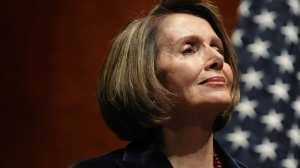
House Democratic leader Nancy Pelosi said President Trump “needs sleep” and questioned his “fitness for office” at a briefing Friday morning. The former Speaker’s statements were made in reference to Trump’s Twitter habits, after he posted one at 6 a.m. The president broke his unusual silence about former FBI Director James Comey’s Thursday testimony, tweeting: “Despite so many false statements and lies, total and complete vindication… and WOW, Comey is a leaker.” Pelosi also said of Trump, “Know your blood type. He will throw you under the bus.” Pelosi added, “I think his statements need some discipline. He needs work.” Comey said Thursday he believes Trump fired him because of the bureau’s investigation into Russia ties to his presidential campaign. On Comey’s testimony, Pelosi said Trump “knew what he was doing and he didn’t want any witnesses” when he asked to speak with Comey alone.
I’ve been absolutely shocked by the attempts at many people in journalism and around the political arena to suggest that either Bernie Sanders or Joe Biden are the likely folks to lead the Democratic Party and run for President when so many young women and men are standing up to the current situation.
There are many standouts.
California Congressman Ted Lieu is an outstanding public servant with a keen mind and a prosecutor’s verbal combat skills.
.@POTUS made 492 false stmts in first 100 days. I can't wait for Trump to testify under oath before trained FBI agents. #TrumpMustTestify
Senator Al Franken is frankly awesome. He’s got an eye for detail, asks damn good questions, and does it with the most wonderful manner that you don’t know you’ve just had your throat cut. His sense of humor serves him well as he dishes out tough questions that show really insight into the problem at hand.
I will oppose this disastrous, backwards bill every step of the way in the Senate, bc I represent MN families & businesses—not Wall Street.
— U.S. Senator Al Franken (@SenFranken) June 9, 2017
And one more shout out to Senator Kamala Harris from California. She’s also got that prosecutor thing going. She’s perfectly aware of what needs to go on the record and that’s a skill we need right now in these committee meetings. She’s also a damn hard fighter and says what needs to be said.
Saving the #ACA will save lives. Take a look back at how insurers used to treat people with preexisting conditions →https://t.co/YUTihU1LI9
I’m always a bit ashamed to admit that I was once Republican, worked for Republican candidates and ran for a statewide office as a Republican. The party left women like me decades ago and when I settled in Minneapolis I took my first step away by registering as an Independent Republican. I’ve been nothing but a Democratic party voter since registering here in New Orleans over two decades ago. I’ve finished pretending that they’re anything but the party of personal greed and religious whackery.
The Republican Party was always a bit more about greed than your average political movement but it was not steered by billionaires whose personal wealth, fortune, and ideology was brought to bear on all levels of office. Well, maybe during the Gilded Age, but not as visibly so as today. There was always some religiousity in the party since the very roots of abolition movements came from churches. This has always been a somewhat pious nation even though it was very much birthed in religious tolerance. It is why it has historically been a place of refuge for the persecuted. The persecuted remember well and generally try to pass the favor on to others. The new Republican Evangelicals seem to live their creeds absent of any knowledge of the Beatitudes or any other lessons attributed to the biblical Jesus.
Republicans used to be the party that gained the majority of educated voters. All of what we see today in them is the poison bought by the likes of the Kochs, the Mercers, and Grover Norquist. It was also the Southern Strategy that brought in the Dixiecrats and the completely unJesus like movements of the evangelical right. These coalitions were supposed to be nice silent partners who just won elections. Now they are not so silent. They sit in Congress. They brought on the likes of Orange Satan and they’re destroying the very fabric of our nation.
I found some rather interesting reads that show how this unholy alliance of greed and religious whackery has so taken over the party that no Republican of the past would even recognize it today. They would probably not want to claim it either.
The NYT’s has a long feature piece today in its politics section called “How G.O.P. Leaders Came to View Climate Change as Fake Science”. You need to break behind its wall or use up your freebies to read it. It’s the twisted tell of the Kochs and Norquist and a pretty good indication of why educated people keep abandoning Republican candidates.
I had just finished shaking my head over some right wing whackadoo that said since it was raining today it must be climate change. Only the exceptionally ignorant these days confuse weather with climate. The weather channel is a most outspoken Cassandra on the dangers of climate change. It’s difficult to turn it on without getting a a brief science lecture on the subject.
The NYT article details how the lies and misinformation of folks vested in fossil fuels and politics of drowning governments in bathtubs deliberately misinforms the public. The article outlines the decades they’ve spent turning Republican officeholders and voters into backwater village idiots. Not all Republicans deny climate change as we’ve seen in the outpouring of business interests and politicians shocked at Kremlin Caligula’s lie-filled exit from the Paris accords. Still, many elected officials are beholden to those that have consistently filled their coffers with donations and minds with lies.
Those divisions did not happen by themselves. Republican lawmakers were moved along by a campaign carefully crafted by fossil fuel industry players, most notably Charles D. and David H. Koch, the Kansas-based billionaires who run a chain of refineries (which can process 600,000 barrels of crude oil per day) as well as a subsidiary that owns or operates 4,000 miles of pipelines that move crude oil.
Government rules intended to slow climate change are “making people’s lives worse rather than better,” Charles Koch explained in a rare interview last year with Fortune, arguing that despite the costs, these efforts would make “very little difference in the future on what the temperature or the weather will be.”
Republican leadership has also been dominated by lawmakers whose constituents were genuinely threatened by policies that would raise the cost of burning fossil fuels, especially coal. Senator Mitch McConnell of Kentucky, always sensitive to the coal fields in his state, rose through the ranks to become majority leader. Senator John Barrasso of Wyoming also climbed into leadership, then the chairmanship of the Committee on Environment and Public Works, as a champion of his coal state.
Beyond the White House, Representative Lamar Smith of Texas, chairman of the House Science Committee, held a hearing this spring aimed at debunking climate science, calling the global scientific consensus “exaggerations, personal agendas and questionable predictions.”
Republicans of the past would certainly not believe it possible an entire Republican Presidential Campaign colluded with the Russians. They would be appalled at the treatment of NATO. Many of today’s Republicans–including a few in the West Wing of Orange Satan’s White House–are still reeling from the idea of participating in outright Treason. The Tweeting Terrorist spent the weekend upending world order as usual.
For a presidency that’s already in crisis — see his 36% job-approval rating per Gallup or this Thursday’s upcoming testimony by former FBI Director James Comey — the last 24 hours or so have been extraordinarily horrendous for President Trump.
For starters, there was his out-of-context shot at London’s mayor after the terrorist attack on the city Saturday night (before playing a round of golf). Then there were his tweets this morning that called his revised travel ban “watered down” and “politically correct,” potentially undermining his administration’s legal defense that the ban doesn’t discriminate against Muslims. And then there’s this stunning Politico article — that Trump deliberately failed to include language in his recent NATO speech reaffirming the alliance’s Article 5 provision.
National Security Adviser H.R. McMaster, Defense Secretary Jim Mattis and Secretary of State Rex Tillerson all supported Trump doing so and had worked in the weeks leading up to the trip to make sure it was included in the speech, according to five sources familiar with the episode. They thought it was, and a White House aide even told the New York Times the day before the line was definitely included.
It was not until the next day, Thursday, May 25, when Trump started talking at an opening ceremony for NATO’s new Brussels headquarters, that the president’s national security team realized their boss had made a decision with major consequences – without consulting or even informing them in advance of the change.
Four and a half months into Trump’s presidency, it’s easy for political observers to become numb to every controversy and crisis coming from the White House. But this bears emphasizing: This is a president who, day after day, is destroying his credibility.
So, let’s look at some odd numbers. Support for Donald Trump’s impeachment stands at 43% according to a Politico/Morning Consult poll taken on 05/31/17. Approval for Donald Trump stands at 36% (Gallup daily tracking poll; 06/04/17). Think about this. Support for Donald Trump’s impeachment is now higher than his approval rating. (h/t to buddy Lamar and Uberfacts)
The press is still obsessing over Trump Voters. I still can’t believe any one would vote for him but the sheer ignorance and anger I see spilling over the threads of friends I have that don’t wipe them from their Facebook friends list tells me they are mostly white, mostly angry, mostly male but a few white women are in there too, and really really really stupid. I have yet to see the noble working class everyyman just looking for a job.They are the voices and faces of the stereotypical ugly American. Most are screaming get a job and pay for it yourself so I can hardly think they’re actually some down on his luck auto worker.
A few weeks ago, the American National Election Study — the longest-running election survey in the United States — released its 2016 survey data. And it showed that in November 2016, the Trump coalition looked a lot like it did during the primaries.
Among people who said they voted for Trump in the general election, 35 percent had household incomes under $50,000 per year (the figure was also 35 percent among non-Hispanic whites), almost exactly the percentage in NBC’s March 2016 survey. Trump’s voters weren’t overwhelmingly poor. In the general election, like the primary, about two thirds of Trump supporters came from the better-off half of the economy.
But, again, what about education? Many analysts have argued that the partisan divide between more and less educated people is bigger than ever. During the general election, 69 percent of Trump voters in the election study didn’t have college degrees. Isn’t that evidence that the working class made up most of Trump’s base?
The truth is more complicated: many of the voters without college educations who supported Trump were relatively affluent. The graph below breaks down white non-Hispanic voters by income and education. Among people making under the median household income of $50,000, there was a 15 to 20 percentage-point difference in Trump support between those with a college degree and those without. But the same gap was present — and actually larger — among Americans making more than $50,000 and $100,000 annually.
To look at it another way, among white people without college degrees who voted for Trump, nearly 60 percent were in the top half of the income distribution. In fact, one in five white Trump voters without a college degree had a household income over $100,000.
Observers have often used the education gap to conjure images of poor people flocking to Trump, but the truth is, many of the people without college degrees who voted for Trump were from middle- and high-income households. That’s the basic problem with using education to measure the working class.
As a swarm of reporters waited in the gilded lobby, the Rev. Patrick O’Connor, the senior pastor at the First Presbyterian Church in Queens, and the Rev. Scott Black Johnston, the senior pastor of Manhattan’s Fifth Avenue Presbyterian Church, arrived to pray with the next president.
From behind his desk on the 26th floor, Trump faced the Celtic cross at the top of the steeple of Johnston’s church, located a block south on Fifth Avenue. When Johnston pointed it out to Trump, the President-elect responded by marveling at the thick glass on the windows of his office — bulletproof panels installed after the election.
It was clear that Trump was still preoccupied with his November victory, and pleased with his performance with one constituency in particular.
“I did very, very well with evangelicals in the polls,” Trump interjected in the middle of the conversation — previously unreported comments that were described to me by both pastors.
They gently reminded Trump that neither of them was an evangelical.
“Well, what are you then?” Trump asked.
They explained they were mainline Protestants, the same Christian tradition in which Trump, a self-described Presbyterian, was raised and claims membership. Like many mainline pastors, they told the President-elect, they lead diverse congregations.
Trump nodded along, then posed another question to the two men: “But you’re all Christians?”
“Yes, we’re all Christians.”
The Sky Dancing banner headline uses a snippet from a work by artist Tashi Mannox called 'Rainbow Study'. The work is described as a" study of typical Tibetan rainbow clouds, that feature in Thanka painting, temple decoration and silk brocades". dakinikat was immediately drawn to the image when trying to find stylized Tibetan Clouds to represent Sky Dancing. It is probably because Tashi's practice is similar to her own. His updated take on the clouds that fill the collection of traditional thankas is quite special.
You can find his work at his website by clicking on his logo below. He is also a calligraphy artist that uses important vajrayana syllables. We encourage you to visit his on line studio.

 Good Morning Sky Dancers!
 No. It’s not funny at all.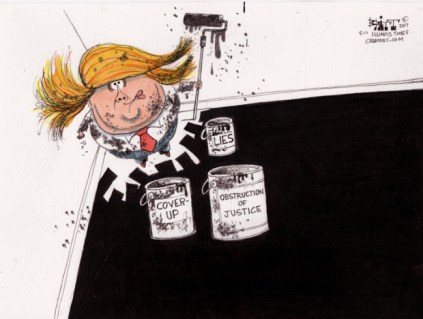

 Indiana Spiro Pence has lawyered up. You absolutely cannot convince me–at this point–that he does not know where the bodies are buried. His Sargent Schulz act isn’t going to go far but he did get a good, experienced lawyer. He’s also fundraising today for his PAC which means he’s going to be paying top dollar for said lawyer. They go for about $1000+ an hour these days.
 Rosenstein may be on his way to recusing himself.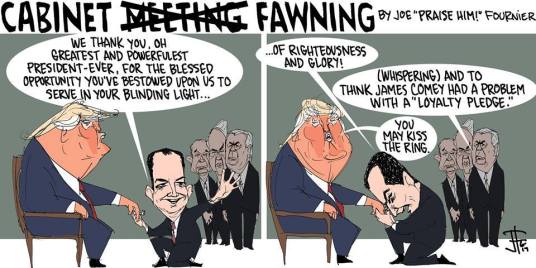
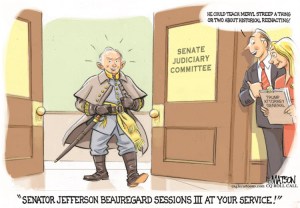 Well, it’s time to watch another reason to regret that we now have a constitutional crisis instead of Taco Trucks on every corner! The 84th AG who is supposed to be upholding the US Constitution instead of enabling those crises will undoubtedly bob and weave the questions like a little white banty rooster pecking or corn. Just exactly how many times did he meet with the Russian Ambassador and why?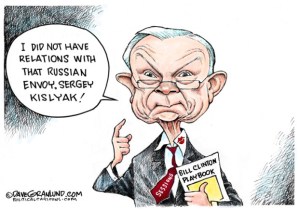



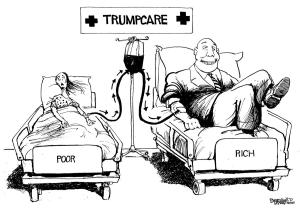 You know it’s pure evil since Lucifer is trying on a new hat. Ted Cruz as Dealmaker? Seriously?
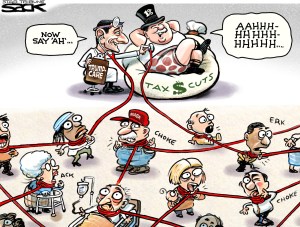 Meanwhile, the Trump Circus of Grift continues to play the big tent. Sessions will testify in an open committee hearing. Check the reporting of CNN’s Manu Raju here.
 Meanwhile,
  Good Afternoon Sky Dancers!
 Republicans used to be the party that gained the majority of educated voters. All of what we see today in them is the poison bought by the likes of the Kochs, the Mercers, and Grover Norquist. It was also the Southern Strategy that brought in the Dixiecrats and the completely unJesus like movements of the evangelical right. These coalitions were supposed to be nice silent partners who just won elections. Now they are not so silent. They sit in Congress. They brought on the likes of Orange Satan and they’re destroying the very fabric of our nation.
 Republicans of the past would certainly not believe it possible an entire Republican Presidential Campaign colluded with the Russians. They would be appalled at the treatment of NATO. Many of today’s Republicans–including a few in the West Wing of Orange Satan’s White House–are still reeling from the idea of participating in outright Treason. The Tweeting Terrorist spent the weekend upending world order as usual.
 So, let’s look at some odd numbers. Support for Donald Trump’s impeachment stands at 43% according to a Politico/Morning Consult poll taken on 05/31/17. Approval for Donald Trump stands at 36% (Gallup daily tracking poll; 06/04/17). Think about this. Support for Donald Trump’s impeachment is now higher than his approval rating. (h/t to buddy Lamar and Uberfacts)
 The press is still obsessing over Trump Voters. I still can’t believe any one would vote for him but the sheer ignorance and anger I see spilling over the threads of friends I have that don’t wipe them from their Facebook friends list tells me they are mostly white, mostly angry, mostly male but a few white women are in there too, and really really really stupid. I have yet to see the noble working class everyyman just looking for a job.They are the voices and faces of the stereotypical ugly American. Most are screaming get a job and pay for it yourself so I can hardly think they’re actually some down on his luck auto worker.
 My guess has always been that if you profile the typical white evangelical, you’ll find the typical Trump voter. Believe me, they may think Trump knows them but it’s rather obvious he doesn’t know them, care about them, or care about their God since his object of worship is himself. This was one of the funniest things I’ve read on line for a long time about him. I guess I found it even funnier because I was raised Presbyterian. Orange Satan had no idea that Presbyterians weren’t evangelical and were Christians. This again speaks volumes about how so many of the Republicans are lined up to just use and abuse the religiously inclined.
 This is it for me today. We have a wonderful world. It’s just a damned shame we’re going to have to fight for it against a lot of bad actors. BTW, go see Wonder Woman. It was wonderful! It’s wonderful news for women and girls fighting injustice everywhere.
 peej
peej Carissa
 bostonboomer
 dakinikat
 ecocatwoman
 jjlo
jjlo mablue2
 Mama Lopez
 peggysue22
 quixote
 skydancingguestblogger
 Mona (aka Wonk the Vote)





Recent Comments