I’m a little late going at this because it’s rained 3 times since about 3 in the morning and the ceiling in my bedroom came down with a thud on my bed yesterday afternoon. We had a deluge Thursday Morning and water basically poured out of one of the late drywall seams that’s now in a bundle with its drywall in a big black trash sack ready for internment in the Crescent City Dump. It poured for like 15 minutes filling up three separate bowls and two turkey roasters with water while sitting on my bed.
It’s almost continually raining here and it’s Friday so you can imagine how much luck I’m having getting any one to do anything. My back wall is now the “weeping wall” and my turkey roaster has a semi-permanent place atop a thick black trash bag on my bed. I’m sleeping on the other side because I don’t want to not be there if it overtops or leaks someplace other than its current choice. It’s a mess. I’m a mess. Actually, the water is backing up the streets and it’s not looking like it’s going to stop. The animals aren’t very happy with the chime sound the emptied turkey roaster makes when it meet the first drip of a drop either.
So, the news would be comical if it wasn’t related to this disaster of an administration. I’m just going to start link dumping and leave the heavy sighs to you. The clank of drops against a thick aluminum turkey roaster is just the right accompaniment to the cacophony of US news today.
First something about John Oliver and King Coal’s Bob Murray. You want a good laugh reading an amicus brief? Try this one from the West Virginia ACLU on the lawsuit Murray has filed against mean John Oliver. Here’s the ACLU Brief on behalf of John Oliver. Total Spew alert!!!
This case is about Plaintiff Robert E. (“Bob”) Murray not liking a television program and somehow believing that is a legally actionable offense. On June 18, 2017, Defendant Home Box Office, Inc. aired an episode of “Last Week Tonight with John Oliver,” a satirical news program about current events. The main topic discussed in the episode was coal. Apparently because Plaintiffs’ delicate sensibilities were offended, they clutched their pearls and filed this suit. Although this brief pokes fun at the absurdity of this case, the legal issues raised by it are anything but comical. This lawsuit, and Plaintiffs’ frequent attempts to use our legal system to chill speech, threaten the fundamental right of the media to criticize public figures and speak candidly on matters of public concern. Speech on a matter of public concern “occupies the highest 2 rung of the hierarchy of First Amendment values, and is entitled to speech protection.”
The next section lists the various media outlets that have been sued by Bob and it’s pretty extensive. Then here’s Bob list of all the ways the bad Brit hury his whiddle fee fees. Tell us where HBO touched you Bob?
Defendants attempted “to advance their biases against the coal industry and their disdain for the coal-related policies of the Trump Administration.”
Defendants “employed techniques designed solely to . . . embarrass Plaintiffs[.]”
“Defendants childishly demeaned and disparaged Bob Murray and his companies, made jokes about Bob Murray’s age, health, and appearance, [and] made light of a tragic mining accident[.]”
“Defendants are persons and organizations fundamentally opposed to any revitalization of the coal industry, having described coal as ‘environmentally catastrophic.”
Defendant Time Warner “is widely reported as a top ten donor of Hillary Clinton[.]”
“As a presidential candidate, Mrs. Clinton’s agenda was to ‘put a lotta [sic] coal miners and coal companies outta [sic] business.’”
“Defendants’ broadcasts have vigorously supported and advanced Mrs. Clinton’s agenda.”
Instead of focusing on what Plaintiffs wanted him to talk about, Defendants “ignored them and ‘doubled-down’ . . . , ending their recorded broadcast with the phrases ‘Eat Shit, Bob’ and ‘Kiss my ass, Bob.’”
When John Olivertore into coal baron Bob Murray back in June, he knew a lawsuit was likely; he even prepared for the possibility by bringing out someone in a squirrel costume, who pre-emptively told Murray to “eat shit.” And like Oliver predicted, the mogul did sue HBO, Time Warner, Oliver, and his writers—but he might live to regret his decision. The West Virginia A.C.L.U. has filed an amicus brief in Oliver’s defense—and it might actually be a harsher takedown than Oliver’s original segment.
The brief, filed on Monday, is well worth reading in full, as it features some truly colorful writing. Consider, for example, the section headings, which include “Anyone Can Legally Say, ‘Eat Shit, Bob!’” and “All of John Oliver’s Speech Was Protected by the First Amendment. You Can’t Sue People for Being Mean to You, Bob.”
“It is a basic concept of free speech that you do not get to sue media organizations because you don’t like their coverage,” Jamie Lynn Crofts writes in the brief. “However, this is apparently a difficult concept for Plaintiffs to grasp. It appears that Bob Murray’s favorite hobby is suing and/or threatening to sue people for making political statements he disagrees with.”
Were he to reach the White House, Trump said, he wouldn’t make the same mistake for which he’d been lambasting Obama since 2011. “I’m going to be working for you,” he told supporters in August 2016. “I’m not going to have time to go play golf.”
Now that he’s president, Trump frequently departs the White House and spends the weekend golfing at either his South Florida resort, Mar-a-Lago, or his country club in the New Jersey suburb of Bedminster. The promise he’d made a year before was discarded so quickly, you have to wonder if he even remembers making it. Politico did the legwork: George W. Bush didn’t golf for the first five months of his presidency, while Obama stayed away from his beloved links for four months following his inauguration. Trump held out for all of two weeks. He has visited a golf club 40 times since taking office in January, according to the self-explanatory site Trump Golf Count, which estimates the forays have cost American taxpayers $55 million. Another Trump tracker, this one by TheNew York Times, finds that his visits to Trump-branded properties total 56 days, nearly a third of his time in office.
Trump’s friends say golf is important to his well-being, just as cycling and rock climbing are de rigueur for the younger titans of Silicon Valley. “He is always working,” longtime confidant Roger J. Stone Jr. tells me, “even while socializing, playing golf or traveling. He is constantly asking questions, taking notes and placing phone calls.
“A better question would be, Does he ever really relax?”
The Boston Globe has a hilarious bit up about the Orange one’s plan to vacation in the land of Spray Tans. It’s to hot for Tacky Largo so why not just vacation in the state that pretty much exists to represent tacky?
President Trump, who delights in thumbing his nose at the country’s cosmopolitan class, is using his first presidential break, starting Friday, to send a fresh version of that message: He’s spending his 17-day summer holiday in New Jersey.
You heard that right: New Jersey.
It’s no Martha’s Vineyard or Kennebunkport. It can’t compare to Hyannis Port, to name the prominent New England playgrounds where modern presidents have gone to unwind. The closest competition for unlikeliest vacation spot is Crawford, Texas, a dusty, brush-generating ranchland where George W. Bush at least evoked the romance and rigor of the American West.
In selecting New Jersey, Trump, a billionaire homebody despite his jet-setting reputation, will settle for the thwack of golf balls and the chirping of birds on his own golf course in a state that conjures spray tans, Snooki, muscle shirts, “The Sopranos,” traffic slowdowns, and toll plazas.
Oh, and those eponymous concrete barriers on the interstate.
Trump will even be able to hear the tractor-trailers from his chosen venue: the Trump National Golf Club in Bedminster, N.J. The seventh hole on one of the club’s two courses is a pitching wedge shot from I-78, a.k.a. the Phillipsburg-Newark Expressway
Remember, all those visits to Trump properties cost the American Taxpayers millions of dollars.
According to The New York Times, Trump’s New Jersey getaway will technically be “his first extended vacation from Washington” as president, and Trump’s White House spokesperson claimed that the president was only leaving due to HVAC system repairs at the West Wing, and that Trump will be continuing to work while he’s away. It certainly won’t be the first time, though, that the president has taken time away from the White House: according to The Washington Post, Trump has made 11 visits to his properties in Palm Beach, Florida and New Jersey since taking office, as well as a weekend at Camp David in June. And of the 28 weekends he’s spent in office, Trump has spent 13 of them away from the White House, according to The New York Times.
Earlier this year, former White House Press Secretary Sean Spicer said that Trump’s visits to his Mar-a-Lago resort in Palm Beach are “where he goes to see his family,” and that they should be considered “part of being president,” according to NBC News. But they also come at a high cost to taxpayers: according to Fortune, the Air Force One flight alone costs roughly $200,000 an hour, and when he arrives, the city is required to cover the cost involved with providing adequate security. In Bedminister, that totals approximately $12,000 per day, while in Palm Beach, the amount is closer to $60,000 per day. Yet the fact that the president chooses to stay at his own private resorts may have created an additional financial benefit for the Trump family: according to NBC News, the membership rates at Trump-owned Mar-a-Lago doubled after Trump took office, and now costs new members $200,000.
According to a recent story by ProPublica and the Real Deal, in April 2016 a limited liability company managed by Trump sold two condominium apartments to a limited liability company managed by Eric Trump. They were on the 13th and 14th floors of a 14-story, full-service, doorman building at 100 Central Park South in Manhattan. This is a prime Midtown neighborhood, yet the sale price for each condo was just $350,000. Although the condition and square footage of apartments 13G and 14G are not readily known, a popular real estate website shows that G-line apartments on both the fifth and eighth floors are one-bedroom, one-bath units of just over 500 square feet. Two years before the Trump transaction, apartment 5G sold for $690,000. Maybe the two units in question were in terrible shape, but two months before the sale to Eric Trump’s LLC, they were advertisedfor $790,000 (on the 13th floor) and $800,000 (on the 14th floor), according to ProPublica.
If a sale between a parent and child is for fair market value, it does not trigger a gift tax. But if a parent sells two expensive condominiums to his son at a highly discounted price, for example, then the parent makes a taxable gift in part. In that case, the seller must pay a gift tax of up to 40 percent. (In this case, that might have run the president somewhere in the neighborhood of $350,000.)
Each taxpayer has a $5.49 million lifetime exemption (a married couple has a combined $10.98 million exemption), meaning you can give away that much money without incurring the tax. To claim that a transaction is covered by the exemption, though, you must file a gift tax return. Well-advised wealthy individuals typically fully use their $5.49 million exemption by making gifts to family members as soon as they have the assets to do so.
So if Donald Trump sold the apartments to his son’s company for less than fair market value, he needed to file a gift tax return, even if he wanted to claim that the sale was not taxable because of the exemption. The government wants to know what gifts people make, because gifts are taken into account when determining the value of a person’s taxable estate at death. If Trump had already used his exemption, he would owe gift tax on the difference between the fair market value of the apartments and the amount paid by Eric Trump.
Donald Trump has sought to rally thousands of diehard supporters against the investigation into his campaign’s alleged collusion with Russia – on the same day news emerged that the special counsel, Robert Mueller, has convened a grand jury in the case.
“They’re trying to cheat you out of the leadership that you want with a fake story,” Trump told a rally in Huntington, West Virginia.
The concerted effort could be a sign that the White House is realising the full gravity of the situation. Mueller, appointed special counsel in May following the dismissal of the former FBI director James Comey, has recruited more than a dozen investigators, including current and former justice department prosecutors with experience in international bribery, organised crime and financial fraud.
On Thursday, it was reported – first by the Wall Street Journal, but later by other outlets including the Associated Press – that Mueller is using a grand jury in Washington, meaning he could subpoena witnesses and records in the coming weeks and months.
The use of a grand jury, a standard prosecution tool in criminal investigations, suggests that Mueller and his team of investigators are likely to hear from witnesses and demand documents in the coming weeks and months.
In what might be seen as a bid to weaponise his populist base, Trump told the crowd in Huntington, a coal country stronghold where he beat Hillary Clinton by 42 percentage points: “Most people know there were no Russians in our campaign; there never were. We didn’t win because of Russia. We won because of you.”
The crowd, many with “Make America great again” hats or signs, erupted in vociferous cheers. Trump continued: “We won because we totally outworked the other side. We won because of millions of patriotic Americans voted to take back their country.”
The president asked mockingly: “Have you seen any Russians in West Virginia or Ohio or Pennsylvania? Are there any Russians here tonight, any Russians? They can’t beat us at the voting booths so they’re trying to cheat you out of the future and the future that you want. They’re trying to cheat you out of the leadership that you want with a fake story that is demeaning to all of us and most importantly demeaning to our country and demeaning to our constitution.”
Well, something demeans all that and that something is talking out its ass. I personally recommending this as your go to Cliff Notes.
Great breakdown from @voxdotcom of everything you need to know about Mueller's probe, esp. helpful w/ new reporting. https://t.co/MemDwDCn0V
Attorney General Jeff Sessions on Friday announced a government-wide crackdown on leakers, which will include a review of the Justice Department’s policies on subpoenas for media outlets that publish sensitive information.
At a press conference with Director of National Intelligence Dan Coats, Sessions announced that the Justice Department, FBI and government intelligence agencies will direct more resources into the investigations of government leaks and would prioritize prosecuting those that pass sensitive information along to the press or foreign officials
Sessions said he had empowered his deputy director Rod Rosenstein and incoming FBI director Christopher Wray to oversee the classified leaks investigations and to monitor the progress of each case.
The national security division of the Justice Department will prioritize cases involving unauthorized disclosures, Sessions said, and the departments “will not hesitate to bring lawful and appropriate criminal charges against those who abuse the public trust.
The Justice Department is considering making changes to its policies on subpoenaing news organizations as part of its crackdown on government leaks, Attorney General Jeff Sessions said Friday.
At a news conference, Sessions said the Justice Department is cracking down on leaks coming out of the government. The department “has more than tripled the number of active leak investigations” since the end of the Obama administration in January, he said.
Much of the effort involves investigating and prosecuting leak suspects, he said, but another aspect is “reviewing policies affecting media subpoenas.” That review, he said, came at the suggestion of FBI agents, career investigators and prosecutors who have weighed in on the leak problem.
“We respect the important role that the press plays, and we’ll give them respect, but it is not unlimited,” Sessions said. “They cannot place lives at risk with impunity. We must balance the press’s role with protecting our national security and the lives of those who serve in the intelligence community, the armed forces and all law-abiding Americans.”
At the news conference, Sessions described the nation as having a problematic “culture of leaks” that must be stamped out. And he issued a blunt warning to “would-be leakers” of classified information: “Don’t do it,” or risk prosecution.
Much has changed in the five years since Trump delivered that self-aware confession. The Manhattan developer is now the least popular first-year president in the history of presidential polling. His oldest son is caught up in a federal investigation involving attempts by Russia to undermine American democracy. Federal prosecutors are also reportedly investigating the finance and business dealings of Trump’s son-in-law, Jared Kushner, who has repeatedly been forced to amend federal disclosure forms to add omitted information on his financial assets and contacts with foreign nationals, including from Russia. Even Trump’s daughter Ivanka, despite her concerted efforts to keep a low profile during the campaign and to round off her father’s roughest edges inside the White House, has become the subject of controversy.
Her decision to sit alongside foreign leaders at the recent Group of 20 summit in Hamburg was slammed as “grotesque” and “banana-republicky.” In a recent tweet, she declared that she would be “serving alongside John Kelly,” just as the retired four-star Marine general let it be known that all access to the Oval Office would go through him. The real estate heiress not only appeared to be claiming the West Wing as her territory, but she also betrayed a troubling sense of entitlement that one might expect from other billionaires’ daughters but not this one. Kelly and White House insiders know that Ivanka Trump is as ill-prepared to face the brutish realities of Washington as her father. And tragically, neither seems to know what they do not know.
Which brings us back to Kushner.
Though Donald Trump might be loath to admit it, Kushner did much to elect his father-in-law. By quietly building a successful online fundraising and targeting operation far beyond his candidate’s comprehension, Kushner gave Trump a fighting chance to keep the 2016 presidential race close, in the hope that lightning would strike at the right time. It did. And that’s when Kushner’s problems began.
The quiet diplomacy Kushner employed so effectively during the campaign gave way to the sort of stubborn arrogance that often infects the winning side of presidential campaigns. Trump’s shocking victory led his son-in-law to believe he could reinvent government like Al Gore, micromanage the White House like James Baker and restructure the Middle East like Moses. Kushner’s confidence seemed to reach its apex whenever the subject turned to Middle East peace. His bizarre belief that the world began anew the day Trump was inaugurated was exposed again this week when a leaked audiotape caught Kushner telling White House interns: “We don’t want a history lesson. We’ve read enough books.”
Americans have seen enough headlines over the past six months to better understand why nepotism does not work in the White House.
Well, the sound of rain pouring into a turkey roaster is less annoying than listening to anything coming from the (it’s a dump!) White House these days. Would you like some ketchup on that overcooked cut of expensive meat?
Have a great weekend. Pray the rain goes where it’s needed. That’s definitely not in my bedroom on my bed.
Did you like this post? Please share it with your friends:
Some times we need to be reminded that behind every individual is the potential to make a small or big difference. I’m celebrating them today.
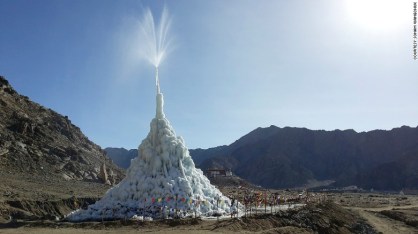
The first picture you see is an artificial glacier that its creator–Sonam Wangchuk–has named an ice stupa. The mechanical engineer’s name means “lord of wisdom” in Tibetan. The stupa is a traditional Himalyan Buddhist representation of Buddha Mind. The ice stupas are turning into water giving oases in the middle of the harsh Ladakh plains and valleys. A tree farm grows in the “land of high passes”.
This is a land of extremes, where rainfall is scarce and temperatures range wildly from torrid to far below freezing.
The locals say it’s the only place in the world where a man, sitting in the sun with his feet in the shade, can suffer sunstroke and frostbite at the same time.
It’s the Ladakh region — meaning “land of high passes” — sandwiched between two of the world’s tallest mountain ranges, the Himalayas and the Kunlun.
Rainfall is rare here. Water, essential for irrigating the farmlands that are the lifeblood of the local population, mostly comes from melting snow and ice.
But climate change is making this land even drier, leaving farmers without water in the crucial planting months of April and May, right before the glaciers start to melt in the summer sun.
One man’s solution to the problem? Make more glaciers.
In 2014 a local mechanical engineer, Sonam Wangchuk, set out to solve the water crisis of the Ladakh.
The natural glaciers are shrinking due to rising global temperatures. For that reason, they provide far less water in early spring but then release a lot in the summer heat, shrinking even more.
Wangchuk had a simple idea: he wanted to balance this natural deficit by collecting water from melting snow and ice in the cold months, which would normally go to waste, and store it until spring, just when farmers need it the most.
“I once saw ice under a bridge in May and understood that it’s the sun that makes the ice melt, not ambient temperature,” he told CNN.
“I realized that ice can last a long time, even at low altitudes.”
Louisiana and Differently-abled Americans every where owe some thanks to Rock Star Rod Stewart.
Rod Stewart. Yes, THE Rod Stewart cut a big check to help this Louisiana group travel to protest Medicaid cuts. https://t.co/CLduHbgUej@CNN
Researchers trying to develop an AI realized two of their machines had created their own language. The code created was more efficient for the purpose of negotiating exchanges but it also creeping far from the English language the AI were supposed to use. Their negotiations led to an entirely new language and their shut-down.
An artificial intelligence system being developed at Facebook has created its own language. It developed a system of code words to make communication more efficient. Researchers shut the system down when they realized the AI was no longer using English.
The observations made at Facebook are the latest in a long line of similar cases. In each instance, an AI being monitored by humans has diverged from its training in English to develop its own language. The resulting phrases appear to be nonsensical gibberish to humans but contain semantic meaning when interpreted by AI “agents.”
The observations made at Facebook are the latest in a long line of similar cases. In each instance, an AI being monitored by humans has diverged from its training in English to develop its own language. The resulting phrases appear to be nonsensical gibberish to humans but contain semantic meaning when interpreted by AI “agents.”
When you’re, say, reading a book about politics, and suddenly interrupted by a man who “hasn’t read that one” but would like to supplement your reading with all of the information he’s heard related to it–maybe this was last week, and maybe this was a book about Russia (okay, this is a specific scenario)–do as Maxine Waters does. Look him in the eye blankly, and state, over and over:
Reclaiming my time.
Reclaiming my time.
Reclaiming my time.
Reclaiming my time.
Reclaiming my time.
Reclaiming my time.
Reclaiming my time.
Reclaiming my time.
For the record, this is a clip from the House Financial Services Committee hearing on Thursday, and Waters is referring to a group of Democrats’ formal request that the Treasury Department disclose President Trump’s financial ties to Russia. It has so far been ignored.
Secretary Mnuchin began his response by thanking Rep. Waters for her service to California. Like Mikayla at the Olympics, Rep. Waters was unimpressed. She cut him off, “We don’t want to take my time up with how great I am,” effectively winning the gold medal in interrogation with a breathtaking move called The You Got The Wrong One Today, Friend.
You don’t have to tell Rep. Waters how great she is. She is aware. Are you new? This isn’t a Lifetime Achievement Award dinner, this is a congressional hearing. Rep. Waters is trying to get the president impeached by lunch time and take the rest of the afternoon off. Let’s speed this up.
Poor Secretary Mnuchin; he never stood a chance. Rep. Waters doesn’t even let bespectacled boo-thang Chris Hayes get a word in and she actually likes him. You think you can just come up in here and give your life story when she wanted a simple answer? No, you cannot. Secretary Mnuchin showed up like that person at church who gives a testimony for 45 minutes and Maxine Waters is the organist who plays him off with a quickness. “Wrap it, buddy. Save it for the Rapture.”
First of all, if Maxine Waters writes you a letter, you better pull out your good stationary with the watermark, brush up on your Mavis Beacon skills and get to replying. How you gonna leave Rep. Waters on read? You tried to ghost her like a Tinder date.
And let’s not forget the Two Republican Women Senators who stood firm in the face of Republican threats and hostility.
The city of Minneapolis has joined cities around the country in posting the U.S. Environmental Protection Agency’s climate data that was deleted after the Trump administration took office. The posted data is a snapshot of the EPA site before climate the change information was removed.
Back in April, the EPA announced its updated page reflected President Trump’s executive order on energy. “Language associated with the Clean Power Plan, written by the last administration, is out of date,” the EPA said. “Similarly, content related to climate and regulation is also being reviewed.”
In addition to Minneapolis, cities including Atlanta, Boston, Houston, San Francisco and Seattle have also posted the information.
“Recognizing that climate change is real, the City is helping make sure people have access to information on it,” the city said in a statement. “The City is committed to taking action to adapt to climate threats while reducing its dependence on fossil fuels.”
Local leaders of sanctuary jurisdictions also lashed out at the Justice Department last week.
“This is not the administration’s first attempt to unlawfully withhold funding, and it probably won’t be their last,” a spokesman for Chicago Mayor Rahm Emanuel told the Chicago Tribune. “But we will not be bullied into abandoning our values.”
San Francisco city attorney Dennis Herrera told Courthouse News that the restriction may be unconstitutional. Supervisor Jane Kim told the news organization that the city would resist federal efforts to alter its policies.
“Threatening to cut San Francisco’s criminal justice grant funding because we are a sanctuary city will not change our commitment to protect our undocumented residents,” she said in a statement provided to Courthouse News.
The Supreme Judicial Court of Massachusetts shows us how we basically have one functional branch of government right now actively protecting the Constitution and looking out for our Bill of Rights.
Last week the Supreme Judicial Court of Massachusetts issued a significant ruling concerning the enforcement of both federal immigration law and local law in the so-called “sanctuary” jurisdictions. In this post I want to summarize the case, Sreynuon Lunn v. Commonwealth, and then briefly scrutinize a very peculiar legal claim advanced by the Trump-Sessions Justice Department. (Note that it is a bit unusual for the federal government to file a brief in state court when the legal issues concern state law, but the Trump administration is being aggressive, to say the least, on matters relating to immigration enforcement.)
First, by way of background, this case involves the power to arrest people. In America, the government’s power to arrest is limited by both constitutional and statutory law. The police may be able to write tickets for certain offenses (littering) but they are not arrestable offenses because that’s they way the legislature wrote the law. In places like North Korea, the police power to arrest is unlimited. The police there can arrest anyone at any time. To keep our country free, we have to be vigilant about governmental attempts to weaken the limits on the power to arrest.
Turning now to the case before the Massachusetts court, Sreynuon Lunn was being held in a jail cell at the Boston Municipal Court. The criminal charge against him, unarmed robbery, was dismissed.
When a criminal charge is dismissed by the court, that ordinarily means the prisoner must be freed. In this case, however, Lunn was not released. Local officials kept Lunn locked away because of a request from federal immigration police.
Hours later, federal police arrived and took Lunn into federal custody. Lunn’s attorneys filed an action in the state court that said the local officials acted unlawfully in keeping Lunn locked up when he was otherwise free to leave the jail.
The legal crux was this: What was the legal source of that power to arrest and detain?
The Massachusetts high court could not un-do what had already been done because it lost jurisdiction when Lunn was taken into federal custody, but it recognized that similar situations might arise—so it decided to go ahead and clarify its own law in this area. That is, whether local officials, going forward, should keep people like Lunn locked up at the request of federal immigration police.
The court’s analysis began with the first principles regarding the power to arrest. Depriving a person of his liberty, holding a person against his will, is an “arrest” under Massachusetts law.
July 22, 2015 Darla Lannert in Madison who served in the United States Navy in Vietnam from 1970-73. Here she sits in front of American Flag mural on VFW Day Post 7591 in Madison. She is an active member of the post. MICHAEL SEARS/MSEARS@JOURNALSENTINEL.COM
President Trump’s announcement that he plans to ban transgender people from serving in the military made an end run around Defense Secretary James Mattis, calling into question a relationship that so far has seemed solid.
Until now, Trump has given Mattis latitude to do as he sees fit, granting the retired four-star general power to manage troop levels and other operational aspects of the United States’ wars in Iraq, Syria and Afghanistan.
But on the issue of transgender troops, conservatives who worried that Mattis was steamrolling them won out, with Trump siding with them less than a month after Mattis committed to a six-month review of the issue.
“It’s never a good sign when a major policy pronouncement is made that was clearly not coordinated with senior leadership,” said a source familiar with the matter. “I can tell you, no matter how they’re spinning it, I was there that day, and everybody was caught — all the senior officers who were left there with Gen. Mattis on vacation — they were all caught totally flat footed. They were all scrambling, because they were getting killed by Congress for not giving a heads up.”
On Wednesday, Trump declared on Twitter the military would have a new policy on transgender service members.
The military, Trump said, would “not accept or allow” transgender people to serve “in any capacity.” Trump claimed he made the decision after consultation with “my generals and military experts.”
The White House said Wednesday that Trump made his decision on Tuesday and informed Mattis that day.
But on Thursday, the Pentagon made clear that it does not consider a tweet an order. Joint Chiefs of Staff Chairman Gen. Joseph Dunford said the current transgender policy will remain unchanged until Trump sends an official directive to the Pentagon.
Transgender troops have been able to serve openly since the Obama administration lifted the ban in summer 2016. New transgender recruits have not been able to enlist, which was supposed to change on July 1.
Part of life is losing people who make small differences.
I’m not sure how many of you watched the late night drama on the floor of the US Senate last night on the so-called “skinny repeal” but it was the first thing that’s ended well for some time. This was old time Senate Drama and not the kind cooked up by Kremlin Caligula and Scary Moochie. for reality TV viewers.
It was the most dramatic night in the United States Senate in recent history. Just ask the senators who witnessed it.
A seven-year quest to undo the Affordable Care Act collapsed — at least for now — as Sen. John McCain (R-Ariz.) kept his colleagues and the press corps in suspense over a little more than two hours late Thursday into early Friday.
Not since September 2008, when the House of Representatives rejected the Troubled Asset Relief Program — causing the Dow Jones industrial average to plunge nearly 800 points in a single afternoon — had such an unexpected vote caused such a striking twist.
The bold move by the nation’s most famous senator stunned his colleagues and possibly put the Senate on the verge of protracted bipartisan talks that McCain is unlikely to witness as he begins treatment for an aggressive form of brain cancer.
“I’ve stated time and time again that one of the major failures of Obamacare was that it was rammed through Congress by Democrats on a strict party-line basis without a single Republican vote,” he said in a statement explaining his vote. “We should not make the mistakes of the past.”
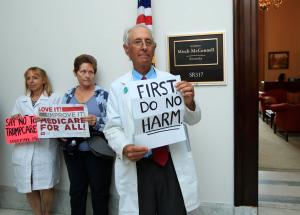
Retired family physician Jay Brock of Fredericksburg, Va., joins other protesters against the Republican health care bill outside the office of Senate Majority Leader Mitch McConnell of Ky., Monday, July 17, 2017, on Capitol Hill in Washington. (AP Photo/Manuel Balce Ceneta)
“From the beginning, I have believed that Obamacare should be repealed and replaced with a solution that increases competition, lowers costs, and improves care for the American people. The so-called ‘skinny repeal’ amendment the Senate voted on today would not accomplish those goals. While the amendment would have repealed some of Obamacare’s most burdensome regulations, it offered no replacement to actually reform our health care system and deliver affordable, quality health care to our citizens. The Speaker’s statement that the House would be ‘willing’ to go to conference does not ease my concern that this shell of a bill could be taken up and passed at any time.
“I’ve stated time and time again that one of the major failures of Obamacare was that it was rammed through Congress by Democrats on a strict-party line basis without a single Republican vote. We should not make the mistakes of the past that has led to Obamacare’s collapse, including in my home state of Arizona where premiums are skyrocketing and health care providers are fleeing the marketplace. We must now return to the correct way of legislating and send the bill back to committee, hold hearings, receive input from both sides of aisle, heed the recommendations of nation’s governors, and produce a bill that finally delivers affordable health care for the American people. We must do the hard work our citizens expect of us and deserve.”
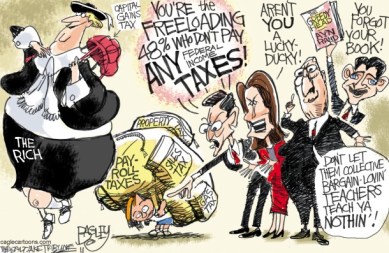
More than 40 percent of the Senate bill’s tax cuts would go to people with annual incomes over $1 million — but even these lucky few would see their after-tax income rise only by a barely noticeable 2 percent.
So it’s vast suffering — including, according to the best estimates, around 200,000 preventable deaths — imposed on many of our fellow citizens in order to give a handful of wealthy people what amounts to some extra pocket change. And the public hates the idea: Polling shows overwhelming popular opposition, even though many voters don’t realize just how cruel the bill really is. For example, only a minority of voters are aware of the plan to make savage cuts to Medicaid.
In fact, my guess is that the bill has low approval even among those who would get a significant tax cut. Warren Buffett has denounced the Senate bill as the “Relief for the Rich Act,” and he’s surely not the only billionaire who feels that way.
Which brings me back to my question: Why would anyone want to do this?
I won’t pretend to have a full answer, but I think there are two big drivers — actually, two big lies — behind Republican cruelty on health care and beyond.
First, the evils of the G.O.P. plan are the flip side of the virtues of Obamacare. Because Republicans spent almost the entire Obama administration railing against the imaginary horrors of the Affordable Care Act — death panels! — repealing Obamacare was bound to be their first priority.
Once the prospect of repeal became real, however, Republicans had to face the fact that Obamacare, far from being the failure they portrayed, has done what it was supposed to do: It used higher taxes on the rich to pay for a vast expansion of health coverage. Correspondingly, trying to reverse the A.C.A. means taking away health care from people who desperately need it in order to cut taxes on the rich.
So one way to understand this ugly health plan is that Republicans, through their political opportunism and dishonesty, boxed themselves into a position that makes them seem cruel and immoral — because they are.
The clerk read the Arizona senator’s surname in the microphone of the tense Senate chamber. The two words were met with silence — McCain had stepped out of the room minutes before.
But moments later, he reappeared. By then, the alphabetical roll call had reached Sen. Gary Peters of Michigan. McCain walked over to the front of the chamber, raising his right arm. He held it up in the air until he had the attention of the clerk.
“No,” he said, with a swift thumbs-down.
It was a “no” that could barely be heard on C-SPAN, and a thumbs-down that viewers would not have been able to easily make out. But the moment was crystal clear for the dozens of reporters watching from the gallery above, who let out a collective gasp and made a stampede exit for the wooden double doors behind them to report the news.
In hindsight, it seems clear: McCain had made up his mind to vote “no” well before he walked into that chamber.
There were hints in his body language, the demeanor of the colleagues who approached him and the way the senator navigated the room. As he huddled with members in a series of hushed conversations while Thursday night turned into Friday morning, there were words that could almost be heard from above and even discerned through lip-reading. The clues were all there.
In other words, those 50 people helped McCain be the political winner. Here are seven people in particular who he can thank for his victory lap this morning.
Sen. Susan Collins (R-Maine). It’s sort of amazing that Collins hasn’t gotten more attention for her role in opposing the health-care bill this week. She was one of two Republican senators who opposed the motion-to-proceed, the procedural vote that allowed the climactic vote on Friday morning to happen at all. She was one of the three votes against the Republican bill.
She also made headlines for bashing President Trump after a hearing when a live microphone caught her conversation with a colleague. The administration’s handling of the budget was just “incredibly irresponsible,” and she was “worried” about what might happen. She delivered bad headlines for Trump on three different days — yet somehow has escaped his Twitter wrath.
Sen. Lisa Murkowski (R-Alaska). Murkowski did not escape that wrath.
She also didn’t escape a phone call from the secretary of the interior in which projects important to her state were tacitly threatened. (That’s according to her colleague from Alaska, who received a similar call. She told reporters on Thursday that she preferred not to use the word “threat.”)
Murkowski’s opposition was driven, among other things, by a desire to protect funding for Planned Parenthood, a commitment she made publicly in the state earlier this year. When McCain’s “no” became known on the floor of the Senate as voting loomed, Murkowski was swarmed by her colleagues, hoping to cajole her into flipping. As on the motion-to-proceed, which she also opposed, Murkowski didn’t budge.
I admit to running the gamut of emotions from anxiety, fear, and depression over the thought of losing my access to health care again. I’ve been on Louisiana’s Medicaid Expansion now for a year. I’m getting preventative care again. It’s something that I will likely need for three more years until I can get on Medicare given it will be there for me as it has been for all other over 65 Americans.
I hugged the soundly sleeping cat on my chest and startled her when I yelped and sprung up from bed to dance. I have a reprieve from unnecessary suffering. My long-gone cancer still haunts my life.
A viral video overnight Thursday night showed protesters outside the Capitol break out into massive cheers the moment they learned the Senate GOP’s ObamaCare repeal bill would fail.
The video, shared by Splinter News reporter Emma Roller, captured protesters chanting “yes we did” after news the repeal bill failed.
So, I’m just going to enjoy #FridayFeeling and hope that the usual ugly Friday night Trump news Dumps can be held at bay for awhile.
Just.Breathe.
What’s on your reading and blogging list today?
Did you like this post? Please share it with your friends:
Nearly every day I wake up thinking that there will never be peace and quiet anywhere again. Every small corner of sanctity is run over by unworthwhile people scampering like the pet lemmings of the parasitically capitalistic into traps to divert them from reality and to take what little power and money they may have. Yeah, I’m that pessimistic these days. The chaos in Westeros looks mild compared to the chaos here. Where are our dragons? Will my face freeze like this from giving so many people the Stink Eye?
I’m going to start at the local level since politics is still essentially said to be all local. I’ve watched my little working class neighborhood evolve into something I don’t recognize. I’m surrounded by your basic nuisance businesses. There’s a good reason why motels and strip joints are usually at the end of town, near the airport, away from dogs and children. We used to keep them there and downtown. We no longer have neighbors. We have folks that could care less about the zoning laws as long as they make a buck.
This is a Cafe that used to be our local video store. It was a pretentious hipster “street food” place prior to morphing into its current state of affairs. Across the street is another place that specializes in whiskey and steaks. It used to be the Bywater BBQ which is a bit of a misnomer because two nice bears served up just about every comfort food you could imagine there for years. It was my favorite place to take my visiting family, my kids, and meet my neighbors. That’s back when the neighborhood was a gay enclave with many families that have lived here for years. Real people lived here. Not so much any more. This is now the deal: ‘How to run a restaurant when your neighbors are AirBnbs’. That’s what’s become of my home and the place I used to find peace and quiet
When Cafe Henri opened in Bywater last summer, the owners, Kirk Estopinal and Neal Bodenheimer of the Uptown cocktail bar Cure, called the menu “dad food.” By that, they meant a steak, a lasagne, a wedge salad and a cocktail menu with nothing more complicated than a Manhattan or a rum and Coke. The kind of food their own dads would understand. Unfussy, comfort food.
Did their dads like the place?
“They liked it,” Estopinal said, but there was a lot of hesitancy in his voice. “It was a hard concept to explain. And to be brutally honest, I don’t think we nailed the execution.”
More than anything, Estopinal and Bodenheimer misjudged Bywater. They thought the area could use a low-key neighborhood restaurant, the kind of spot where you might stop in a few times a week.
“We thought the neighborhood needed services,” Bodenheimer said. “We thought more people actually lived here.”
It turns out a lot of their neighbors were short-term rentals.
Exactly. My neighborhood has transformed into its own little hellhole. We have an incredible homeless problem. I have a bar on the corner that’s hipster drug central along with an underground sex club and really bad burlesque. The loud music is even worse. I have illegal, unregistered motels everywhere. All of it should be a problem to those who govern, but it doesn’t appear to be. We spent the last year pulling down three old statues and letting Uptown get new roads again. Meanwhile, the Katrina potholes still festoon the streets here. I wish they’d swallow the tourists up.
This is what it looks like when you turn democracy over to people whose only interest is making money. This is what happens when the uneducated and propaganda-soaked decide that “draining the swamp” means electing a bunch of angry white men with money and power to drain the swamp. How did so many people get taken to a place where they can’t recognize players when they see them? Let’s go over a list of chaos brought on by the first six months of the Trumpster Dumpsters. We’re living in the days of the Dumbing of America.
Secretary of State Rex Tillerson is growing increasingly frustrated with the Trump administration and could quit before the year is through, according to reports.
Two sources familiar with Tillerson’s conversations with friends told CNN over the weekend that he has grown so frustrated with President Donald Trump and the Trump administration that there may soon be a “Rexit.”
The change in Tillerson’s tone followed a stressful week for Tillerson. He was found to have violated U.S. sanctions against Russia while working as the CEO of Exxon-Mobil and Trump publicly assailed his fellow Cabinet member Attorney General Jeff Sessions, who Trump said he regretted hiring.
President Trump is so unhappy with Attorney General Jeff Sessions that he has raised the possibility of bringing back Rudolph Giuliani to head the Justice Department, according to West Wing confidants.
In internal conversations, Trump has recently pondered the idea of nominating Giuliani, a stalwart of his campaign.
Even before last week’s blast at Sessions in a New York Times interview, Trump had expressed fury at Sessions — also one of the first prominent Republicans to back the Trump campaign — for recusing himself from the Russia investigation.
And in a Monday morning tweet, Trump referred to “our beleaguered A.G.” not investigating Hillary Clinton.
Our thought bubble: Trump often muses about possible personnel moves that he never makes, sometimes just to gauge the listener’s reaction. So the Giuliani balloon may go nowhere.
As Axios reported Saturday, Newt Gingrich — who also went all-in with the Trump campaign — may take a more visible, frequent role as a defender as Trump girds for battle with special counsel Bob Mueller.
Giuliani would have a tough time getting 50 Republicans senators to vote to confirm him. He was such an early and ardent Trump backer that he wouldn’t be seen as an independent guardian of the department in these tumultuous times.
Trump’s decision to bring Wall Street financier Anthony Scaramucci into the role of communications director shows the rising power of political outsiders and the diminished influence of establishment figures — which Priebus, the former chairman of the Republican National Committee, epitomizes.
One White House official and two outside advisers said that while Scaramucci was brought into the White House for the communications job, he’s considered an internal candidate to eventually succeed Priebus as chief of staff.There are also a handful of outside candidates.
The unexpected hire has raised questions of whether more shake-ups are coming, even as the White House has tried to downplay its internal discord. The instability has made it difficult for the administration to fend off questions about ties between Trump’s 2016 campaign and Russia and to move forward an embattled legislative agenda.
Despite frequent reports his position is in jeopardy, Priebus hopes to finish out his year, according to people close to him.He is eyeing another big hurdle this week of getting the health care bill to pass through the Senate, defenders said Sunday.
“Reince is focused on driving the president’s bold agenda, and that has been and always will be his top priority,” White House deputy press secretary Lindsay Walters said.
Still, his stature in the White House appears to be shrinking. Priebus was fiercely opposed to hiring Scaramucci, saying the former financier had no prior experience in government communications.They have been at odds with each other since Scaramucci was passed over for the director of public liaison role in February.
Scaramucci made clear to reporters on Friday that he reports directly to Trump, not Priebus, even though the chief of staff would typically oversee communications and other portfolios.
Special assistant and social media director Dan Scavino also tweeted on Saturday that he reports directly to the president.
“In a normal White House, every staffer reports to the chief of staff,” said Republican strategist Alex Conant. “Any staffer who believes that they don’t report to the chief of staff is going to be a potential headache for the chief of staff.”
By the way, have you counted how many folks from Goldman Sachs now have top positions in the White House? I miss Spicey already. At least he didn’t look like some guy that was going to put a horsehead in every one’s bed if they criticize trump.
The appointment of Scaramucci adds another Goldman Sachs alum to the Trump team. Steven Mnuchin, Treasury Secretary, Gary Cohn, head of the National Economic Council, and Dina Powell, deputy national security advisor, are all former Goldman partners, while Steve Bannon, the president’s top strategist, was a vice president at Goldman Sachs in the 1980s.
President Trump’s reliance on Goldman talent is ironic given his comments during the campaign, when he accused the firm of having “total control” over rivals Hillary Clinton and Sen. Ted Cruz, whose wife Heid Cruz is a Goldman Sachs investment manager.
For its part, Goldman seems to be reveling in the warm Trump welcome. An article in the August issue of Vanity Fair titled “A very Goldman White House,” quotes Goldman CEO Lloyd Blanfein saying, “I find it validating that as he was looking for good people it happens that a lot of them had Goldman Sachs affiliations.”
The Trump administration is readying for a crackdown on marijuana users under Attorney General Jeff Sessions.
President Trump’s Task Force on Crime Reduction and Public Safety, led by Sessions, is expected to release a report next week that criminal justice reform advocates fear will link marijuana to violent crime and recommend tougher sentences for those caught growing, selling and smoking the plant.
Sessions sent a memo in April updating the U.S. Attorney’s Offices and Department of Justice Department (DOJ) component heads on the work of the task force, which he said would be accomplished through various subcommittees. In the memo, Sessions said he has asked for initial recommendations no later than July 27.
“Task Force subcommittees will also undertake a review of existing policies in the areas of charging, sentencing, and marijuana to ensure consistency with the Department’s overall strategy on reducing violent crime and with Administration goals and priorities,” he wrote.
Criminal justice reform advocates fear Sessions’s memo signals stricter enforcement is ahead.
“The task force revolves around reducing violent crime and Sessions and other DOJ officials have been out there over the last month and explicitly the last couple of weeks talking about how immigration and marijuana increases violent crime,” said Inimai Chettiar, director of the Brennan Center’s Justice Program.
Yeah. That’s a good use of taxpayer money. NOT. Speaking of Taxpayer money, we’re not only paying Trump properties for all Trump’s weekend vacations and golf outings, were spending money for Scott Pruitt to run home for the weekends. Yay Republicans sure hate spending don’t they?
Scott Pruitt, the head of the Environmental Protection Agency, traveled to his home state, Oklahoma, 10 times over three months this year, largely at taxpayer expense, according to a report released Monday.
The findings from the Environmental Integrity Project, a nonprofit group founded by former E.P.A. officials, are drawn from Mr. Pruitt’s calendar and the travel expenses he has submitted for reimbursement. Obtained under the Freedom of Information Act, the documents show Mr. Pruitt spent 43 out of 92 days from March through May in Oklahoma or traveling to or from the state.
The report does not assert that Mr. Pruitt’s estimated $12,000 in federally funded airfare, which includes travel to and from his home state, is improper.
Jared Kushner, President Trump’s senior adviser and son-in-law, walked into Senate offices Monday morning to begin answering questions behind closed doors about his contacts with Russian officials.
In written remarks made public prior to his appearance before the Senate Intelligence Committee, Kushner denies any improper contacts or collusion. The 11-page statement by Kushner details four meetings he had with Russian officials during the 2016 campaign and transition period — including one set up by Donald Trump Jr. with a Russian lawyer.
Kushner defends his interactions with Russian Ambassador Sergey Kislyak and other Russian officials as typical contacts in his role as the Trump campaign’s liaison to foreign governments, according to the prepared statement he plans to submit for the record.
Kushner is answering questions behind closed doors, first to the Senate Intelligence Committee on Monday and then again on Tuesday to the House Intelligence Committee. Both panels are probing Russian interference in the 2016 election and contacts between Russia and Trump campaign officials and associates.
U.S. intelligence agencies have concluded that the Russian government orchestrated a far-reaching campaign to meddle with last year’s presidential campaign and influence the outcome in Trump’s favor.
Kushner’s appearances before congressional committees mark a new phase in the investigations of Russian meddling, as he is the first of the president’s closest advisers to appear before them.
In his testimony, which will be submitted to the congressional committees before he answers questions from lawmakers, Kushner says he has had only “limited contacts” with Russian representatives and denies any wrongdoing.
“I did not collude, nor know of anyone else in the campaign who colluded, with any foreign government,” Kushner writes. “I had no improper contacts. I have not relied on Russian funds to finance my business activities in the private sector.”
Is there any one left in the Republican Party that can do the right thing?
Am I just getting old or is stuff out there getting so chaotic? Is it just me that wants the proverbial cabin in the middle of nowhere?
In one shining moment of goodness, preservation is wining for one beautiful old New Orleans Building. It’s the one thing I’m holding on to today as I start my slog to finishing up grades for the term. I’m ending a bit of hope that the outcome for this treasure might be the result of good local politics.
Tree branches sprout from cracks in the building’s façade, windows are broken, part of the roof is caving in, and most of the walls are crumbling, cracked and covered with graffiti.
Even so, things are looking up for the General Laundry, Cleaners and Dyers building, which last week came one step closer to becoming a locally designated historic landmark.
On Thursday, the Historic District Landmarks Commission approved a request to nominate the building for the landmark designation. The commission will now look further into the building’s history and architectural significance and decide on the request at a future meeting.
In the meantime, the building will enjoy temporary landmark status, which gives the city some authority to prevent either deliberate razing or “demolition by neglect.”
It’s a small victory for groups like the Louisiana Landmarks Society, a local organization that works to promote preservation of at-risk historic properties. In 2010, the society named the General Laundry building to its annual Nine Most Endangered list of historic sites in the area.
“It would be a tragic loss, to lose something so beautiful,” said Stephen Chauvin, an architect and assistant treasurer of the nonprofit group.
What’s on your reading and blogging list today?
Did you like this post? Please share it with your friends:
It’s a sad state of affairs when the President of the United States of America is so wrapped up with money laundering and conspiring with Russians that he has to check into his constitutional powers to pardon six months into his first term. The particular features of a presidential pardon of interest are the ability to pardon family, staff, and self. If Trump removes Mueller or seriously starts pardoning any of the Trump Family Crime syndicate, there should be a mad rush to local hardware stores for tar, feathers, and pitchforks. I’m sure France will come to our aid with Les Guillotines.
President Donald Trump may have held more meetings with Vladimir Putin at the G-20 summit earlier this month, Russia’s Foreign Minister Sergey Lavrov said Friday — but he shrugged off the importance of the encounters.
“They might have met even much more than just three times,” he told NBC News’ Keir Simmons in an exclusive interview, dismissing speculation about the leaders’ meetings.
“Maybe they went to the toilet together,” he joked.
Asked whether the two presidents had other conversations or met in the corridors of the G-20 meeting, Lavrov used the analogy of children mingling at a kindergarten.
“When you are bought by your parents to a kindergarten do you mix with the people who are waiting in the same room to start going to a classroom?” he asked.
He added: “I remember when I was in that position I did spend five or ten minutes in the kindergarten before they brought us to the classroom.”
Lavrov echoed the White House account of a third meeting between Trump and Putin during a social-dinner at the summit in Hamburg.
The other two meetings — one a scheduled bilateral meeting and another when the pair shared a handshake — had already been widely reported.
“After the dinner was over…I was not there…President Trump apparently went to pick up his wife and spent some minutes with President Putin…so what?” he said.
Lavrov also said the U.S. presence in Syria was illegitimate and accused C.I.A director Mike Pompeo of having “double standards” regarding the establishment of military bases in the country.
He said Pompeo’s comments criticizing Russia’s presence in Syria and the establishment of military bases on the Mediterranean coast, at the Aspen Security Forum Thursday, showed that “something was wrong with double standards.”
Lavrov cited reports of ten U.S. bases built in Syria, “not to mention hundreds of of military bases of the United States all over the world and all around Russia.”
President Trump’s decision to cut off aid to anti-government rebels in Syria marks a victory for President Bashar Assad in his six-year civil war — as well as allies Russia and Iran — and a defeat for U.S. efforts to remove the Syrian dictator.
Trump has decided to end a covert CIA program under President Barack Obama to train moderate rebels to fight Assad, The Washington Post reported Wednesday.
The report comes two weeks after Trump met with Russian President Vladimir Putin in Germany and after the United States and Russia announced a limited cease-fire in southeastern Syria that promised to end Syrian airstrikes on rebel-held areas there.
Secretary of State Rex Tillerson said at the time that while the U.S. hopes to extend the truce to other parts of the country, U.S. policy remains that Assad and his family have “no long-term role” as rulers in Syria.
The CIA training program was approved by Obama, who called for Assad to step down because of brutal oppression by his regime.
Talking heads appear baffled that Trump is no policy wonk and his only goal is to win at whatever. I argue that his goals are obvious and don’t include US. His goals are to:
1) Enrich his family
2) Appease Putin and the Russian oligarchs
3) Get as much attention as possible
4) Avoid jail for the numerous criminal activities he commits through blustery threats
5) Get rid of everything associated with Barrack Obama
Some of President Trump’s lawyers are exploring ways to limit or undercut special counsel Robert S. Mueller III’s Russia investigation, building a case against what they allege are his conflicts of interest and discussing the president’s authority to grant pardons, according to people familiar with the effort.
Trump has asked his advisers about his power to pardon aides, family members and even himself in connection with the probe, according to one of those people. A second person said Trump’s lawyers have been discussing the president’s pardoning powers among themselves.
One adviser said the president has simply expressed a curiosity in understanding the reach of his pardoning authority, as well as the limits of Mueller’s investigation.
“This is not in the context of, ‘I can’t wait to pardon myself,’ ” a close adviser said.
With the Russia investigation continuing to widen, Trump’s lawyers are working to corral the probe and question the propriety of the special counsel’s work. They are actively compiling a list of Mueller’s alleged potential conflicts of interest, which they say could serve as a way to stymie his work, according to several of Trump’s legal advisers.
It’s only six months into Donald Trump’s presidency — and he’s already looking into his powers to pardon his top aides and family members for unspecified crimes, according to a report from the Washington Post published Thursday night.
One source told the paper that presidential pardon powers were under discussion among Trump’s lawyers. But another source went further, telling the Post that “Trump has asked his advisers about his power to pardon aides, family members and even himself in connection with the probe.” And a Trump adviser seemingly confirmed the report to the paper, saying that the president was simply curious.
Jay Sekulow, a lawyer for Trump, told CBS News Friday morning that “[p]ardons are not being discussed and are not on the table.” But if this report is true, Trump is apparently worried enough about his, his family members’ and his top aides’ legal exposure in special counsel Robert Mueller’s Russia investigation that he’s already looking into pardons before anyone’s been convicted or even charged with any crimes.
To be clear: It would be utterly shocking, and seemingly without any real precedent in US history, for a sitting president to pardon close aides or family members facing investigation.
And it would also seemingly be within the president’s powers. The pardon power is incredibly wide-ranging. A president can pardon essentially all federal crimes at any point after they’ve been committed — even if they haven’t yet been charged or convicted.
What’s prevented past presidents, including Richard Nixon at the height of Watergate, from doing something like this has been the fear of political backlash. And that may yet restrain Trump too — this, for the moment, seems to fall into the category of brainstorming rather than concrete planning.
But of course, Trump has frequently proven himself willing to flout the norms and traditions of American politics with glee, regardless of the backlash that may ensue. And he may yet do so again, calculating that his voters will stick with him regardless.
Brian Beutler argues that ‘We’re on the Brink of an Authoritarian Crisis’. Trump may have hoping to chide Sessions to quitting in the hopes he can find an AG willing to fire the Special Counsel or he could be just have another trumper tantrum. Either way, Mueller is our Jedi and only hope given Republican reluctance to do anything right.
The scope of that crisis is much clearer now that the Washington Post is reporting that Trump is discussing the possibility of pardoning himself, his family, and his closest aides to short-circuit the sprawling investigation of his campaign’s complicity in Russia’s subversion of the 2016 election. Trump’s team is also, according to the Post and another Times story, digging up dirt on the special counsel investigators in an attempt to discredit them.
In light of this dizzying news, it’s worth returning to the Times interview. Trump’s juiciest comments pertained to his attorney general, uber-loyalist Jeff Sessions, whom he resents for recusing from that investigation. But these grievances were already known, as was the fact that Trump has consideredterminating Robert Mueller, the man leading the inquiry. What made the Times interview explosive was Trump’s suggestion that he would fire Mueller for delving too deeply into his finances.
SCHMIDT: Last thing, if Mueller was looking at your finances and your family finances, unrelated to Russia—is that a red line?
HABERMAN: Would that be a breach of what his actual charge is?
TRUMP: I would say yeah. I would say yes.
And what lit the fuse was contemporaneous reporting, first from the Times and then from Bloomberg, that Mueller is indeed investigating Trump’s business entanglements, as it was widely expected he would. “FBI investigators and others,” Bloomberg reported, “are looking at Russian purchases of apartments in Trump buildings, Trump’s involvement in a controversial SoHo development in New York with Russian associates, the 2013 Miss Universe pageant in Moscow and Trump’s sale of a Florida mansion to a Russian oligarch in 2008.”
The confluence of these two developments confronts Trump with a choice between backing down from his threat and making good on it, perhaps while issuing pardons promiscuously and to catastrophic effect.
The loud hum of chaos and spectacle engulfing the Trump administration is drowning out a creeping reality: We are on the brink of an authoritarian crisis that will make the firing of FBI Director James Comey seem quaint in hindsight.
The president’s miscalculation is not about his pardon authority. Rather, it is about the extent to which the legal machinations that worked for him in private, civil litigation against ordinary individuals (or even various state attorneys general) can be applied to a wide-ranging criminal and counterintelligence investigation run by Mueller and what appears to be an All-Star cast of lawyers and investigators. The president can’t try and drag out things and hope Mueller’s investigation runs out of money; the funding is derived from a permanent congressional appropriation account. Nor can the president realistically hope that he will be able to undercut the investigation with “conflicts of interest” or “ethics” complaints. Mueller has already been vetted by the Justice Department’s ethics officers, and the petty complaints raised about the personal political donations made by some on his team reek of desperation.
The president is used to overpowering and overwhelming his legal opponents, but Mueller – who ran the FBI for 12 years and oversaw the transformation of that agency in the aftermath of the tragedy of 9/11 – is unlikely to be intimidated. Mueller’s team appears to be methodically examining the Russian government’s efforts to meddle in the 2016 election, and it borders on axiomatic that his team will uncover whether the Trump campaign colluded with the Kremlin in any way (a question that, of course, remains unresolved).
Mueller’s investigation will go where the facts lead it, but the president is doing himself no favors by providing a fresh set of bread crumbs on a regular basis. His Twitter rants and stream-of-consciousness remarks in media interviews are easy fodder for the special counsel’s team, and provide it with an unusual degree of access to the president’s state of mind and motivations. It may be cathartic for Trump to express these thoughts publicly, and it might rouse his political base, but it is doing nothing to put out the three-alarm political fires that are routinely emerging in the wake of new reports about previously undisclosed contacts with Russian operatives or inquiries into his financial dealings.
If the president truly wishes to survive the mess in which he finds himself, he needs to come to grips with the simple truth that everything he learned before Jan. 20, 2017, is irrelevant. There is no one who can just make this situation “go away.” There is no deal to be made, no financial settlement that can resolve the matter. The investigation will find what it finds, and it very well might ensnare several close associates of the president (and potentially even a family member) along the way.
Special counsel Robert Mueller has asked the White House to preserve all documents relating to the June 2016 meeting at Trump Tower that Donald Trump Jr., Jared Kushner and Paul Manafort had with a Russian lawyer and others, according to a source who has seen the letter.
Mueller sent a notice, called a document preservation request, asking White House staff to save “any subjects discussed in the course of the June 2016 meeting” and also “any decisions made regarding the recent disclosures about the June 2016 meeting,” according to the source, who read portions of the letter to CNN.
The letter from Mueller began: “As you are aware the Special Counsel’s office is investigating the Russian government’s efforts to interfere in the 2016 presidential election, including any links or coordination between the Russian government and individuals associated with the campaign of Donald Trump. Information concerning the June 2016 meeting between Donald J Trump Jr and Natalia Veselnitskaya is relevant to the investigation.”
The Russian lawyer who met Donald Trump Jr. after his father won the Republican nomination for the 2016 U.S. presidential election counted Russia’s FSB security service among her clients for years, Russian court documents seen by Reuters show.
The documents show that the lawyer, Natalia Veselnitskaya, successfully represented the FSB’s interests in a legal wrangle over ownership of an upscale property in northwest Moscow between 2005 and 2013.
The FSB, successor to the Soviet-era KGB service, was headed by Vladimir Putin before he became Russian president.
There’s been a shakeup in President Trump’s legal team.
Marc Kasowitz is out as Mr. Trump’s personal attorney, CBS News chief White House correspondent Major Garrett reports. And Kasowitz’s spokesman, Mark Corallo, has resigned, Garrett says
The reasons for the moves were not immediately known.
Kasowitz recently made headlines when he sent threatening emails to a retired public relations professional who had said Kasowitz should resign. In his first response, Kasowitz wrote “F*** you,” according to ProPublica. Kasowitz wrote a number of emails after that, including one that said, “And you don’t know me, but I will know you How dare you send me an email like that I’m on you now You are f****** with me now Let’s see who you are Watch your back, b****.”
Kasowitz later apologized.
Corallo is a longtime GOP operative who worked for the House committee that investigated President Clinton in the 1990s before going to the Justice Department under former Attorney General John Ashcroft, according to Politico. Politico reports Corallo had been handling the White House’s defense in the Russia investigation.
Keeping up with the chaos and the assaults on the US Constitution is tiring work. It’s also stressful. Can you believe we’re living through this?
White House press secretary Sean Spicer, President Donald Trump’s embattled spokesman during the first six months of his presidency, is resigning his position, according to two people with knowledge of the decision.
Spicer’s decision appears to be linked to the appointment of a new White House communications director, New York financier Anthony Scaramucci. The people with knowledge of the decision spoke on condition of anonymity because they were not authorized to discuss the personnel matter publicly.
The Sky Dancing banner headline uses a snippet from a work by artist Tashi Mannox called 'Rainbow Study'. The work is described as a" study of typical Tibetan rainbow clouds, that feature in Thanka painting, temple decoration and silk brocades". dakinikat was immediately drawn to the image when trying to find stylized Tibetan Clouds to represent Sky Dancing. It is probably because Tashi's practice is similar to her own. His updated take on the clouds that fill the collection of traditional thankas is quite special.
You can find his work at his website by clicking on his logo below. He is also a calligraphy artist that uses important vajrayana syllables. We encourage you to visit his on line studio.

 Good Afternoon Sky Dancers!
 In the words of George Takei “Oh Myyyyyy”.
 Feel adequately milked yet?
 Yeah, no wonder he doesn’t want to show us the taxes.
  The Oldest Living Confederate Widow who currently serves as the country’s AG is also cracking down on free speech. B
 Most of the leaks kinda look like they are
  Good Morning!
 Researchers trying to develop an AI
  The Supreme Judicial Court of Massachusetts

 Paul Krugman tries to make sense of the Republican Cruelty on display during this debacle. The passage of any of these Republican Repeal Bills would have been the definition of winning at any cost. I cannot even believe Louisiana Senator Bill Cassidy–a medical doctor–would throw millions of people into suffering and early death. That’s a cost only an army of demons could love.
 McCain may have put on a show but the closing act was worth it and the wait.
 But with all of the McCain show,
 Good Morning Sky Dancers!
 This is what it looks like when you turn democracy over to people whose only interest is making money. This is what happens when the uneducated and propaganda-soaked decide that “draining the swamp” means electing a bunch of angry white men with money and power to drain the swamp. How did so many people get taken to a place where they can’t recognize players when they see them? Let’s go over a list of chaos brought on by the first six months of the Trumpster Dumpsters. We’re living in the days of the Dumbing of America.
 Yeah. That’s a good use of taxpayer money. NOT. Speaking of Taxpayer money, we’re not only paying Trump properties for all Trump’s weekend vacations and golf outings, were spending money for
  Just to put that into perspective,
  Morning Sky Dancers!
 I have no doubt that part of
 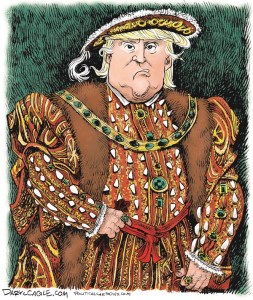 Talking heads appear baffled that Trump is no policy wonk and his only goal is to win at whatever. I argue that his goals are obvious and don’t include US. His goals are to:
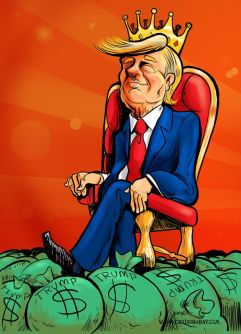 What President talks about pardons six months into his first term?
  Brian Beutler argues that ‘We’re on the Brink of an Authoritarian Crisis’.
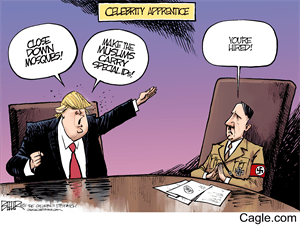 Mueller is indeed hunting down the facts.
 Meanwhile, there’s these other interesting developments.
 peej
peej Carissa
 bostonboomer
 dakinikat
 ecocatwoman
 jjlo
jjlo mablue2
 Mama Lopez
 peggysue22
 quixote
 skydancingguestblogger
 Mona (aka Wonk the Vote)





Recent Comments