
Monday Reads
Posted: April 22, 2019 Filed under: Afternoon Reads 28 Comments
Good Afternoon Sky Dancers!
Well, we made it to another Monday and the Preziditz still considers himself above the law and totally exonerated of all his obvious wrong doing. The headline that I’m reading about is about the Trump Family Crime syndicate and a wild lawsuit trying to stop or delay the investigation of the House Oversight Committee into their Financial Reports. He doesn’t seem to understand that the scrutiny comes with job.
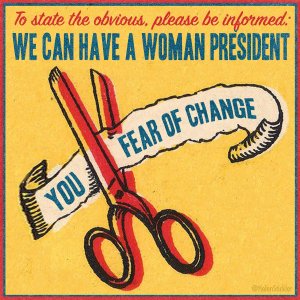
Meanwhile, enjoy the artwork of Helen Stickler (@HelenSticker) as we plow through the headlines today.
I made dozens of memes from repurposed soviet era Russian matchbook cover art, made into
#GOTV and#Democratic ‘propaganda.’ Here’s a collage of them all, and I’m posting them individually several times a day.
From WAPO: “Trump sues in bid to block congressional subpoena of financial records.”
President Trump and his business sued House Oversight Committee Chairman Elijah E. Cummings (D-Md.) in a bid to block a congressional subpoena of his financial records on Monday.
The lawsuit seeks a court order to prevent Trump’s accounting firm from complying with what his lawyers say is an improper use of subpoena power by congressional Democrats.
“Democrats are using their new control of congressional committees to investigate every aspect of President Trump’s personal finances, businesses, and even his family,” the filing by Trump claims. “Instead of working with the President to pass bipartisan legislation that would actually benefit Americans, House Democrats are singularly obsessed with finding something they can use to damage the President politically.”
The filing, in U.S. District Court for the District of Columbia, further escalates a clash between the White House and the Democratic-controlled House over congressional oversight.
Last week, Cummings subpoenaed Mazars USA, an accounting firm long used by Trump.
For more than a decade, Mazars and a predecessor firm signed off on financial statements for Trump that he used when seeking loans. Some of the statements include frequent exaggerations or inaccuracies and were accompanied by a note from the firm saying it was not responsible for the accuracy of the information.
The Oversight Committee on March 20 asked the company for copies of “statements of financial condition” and audits prepared for Trump and several of his companies, including the one that owns the Trump International Hotel in downtown Washington. The panel also requested supporting documents used to produce the reports and communications between the firm and Trump.
 Politico explains the purpose of the information here. As usual, the White House has invented an imaginary term–presidential harassment–to try to smear legitimate checks on the executive branch by its coequal branch.
The committee is investigating allegations from Trump’s former attorney and fixer Michael Cohen that the president at times artificially inflated and deflated his assets for his personal benefit. Cummings requestedsimilar documents last month from financial giant Capital One, which also asked for a friendly subpoena.
Republicans have contended that the investigation is intended to embarrass Trump, and they said the subpoena to Mazars — which Cummings formally issued last week — amounts to an abuse of power. The White House has refused to comply with various congressional demands for documents and witness testimony on a host of subjects including Trump’s tax returns and the White House security clearance process.
Trump’s filing on Monday morning in the U.S. District Court for the District of Columbia reams Democrats for their myriad investigations targeting Trump, his presidential campaign and his business empire. The filing comes a week after attorneys William Consovoy and Stefan Passantino threatened legal action against Mazars’ outside counsel if the company complied with the subpoena.
Daily Beast has further background information on the request.
Cummings’ request came after estranged Trump lawyer Michael Cohen raised questions about whether his former boss used to inflate or deflate the true value of his financial assets to help him carry out his business dealings.
The chairman specifically requested documents related to Trump and the Trump Organization that were used in a failed attempt by the president to purchase the Buffalo Bills NFL franchise.
“Mr. Cohen produced to the committee financial statements from 2011, 2012, and 2013 that raise questions about the president’s representations of his financial affairs on these forms and on other disclosures, particularly relating to the president’s debts,” his letter to Mazars stated. “Several of these documents appear to have been signed by your firm.”
Cummings later explained: “We are following up on specific allegations regarding the president’s actions based on corroborating documents obtained by the committee, and we will continue our efforts to conduct credible, robust, and independent oversight.”
During his testimony before the Oversight Committee, Cohen said that between 2011 and 2013, he gave Trump’s financial statements to Deutsche Bank with the aim of getting a loan to purchase the Bills franchise.
According to Cohen, Trump increased his net worth from $4.56 billion in 2012 to $8.66 billion in 2013, much of it based on the addition of “brand value.” Cohen said Trump would inflate his total assets to get friendlier treatment from banks.

The New Yorker’s Jane Mayer reported last month that in 2017, Mr. Trump ordered Gary Cohn, then the director of the National Economic Council, to persuade antitrust authorities to file against AT&T’s purchase of the cable television company, which includes CNN. “I’ve mentioned it 50 times. And nothing’s happened,” the president allegedly said to John Kelly, who was chief of staff at the time. “I want that deal blocked!” Mr. Cohn, Ms. Mayer writes, told Mr. Kelly not to comply — but the Justice Department did bring suit and eventually lost in court.
Lawmakers have rightly been seeking more information about Mr. Trump’s alleged attempted meddling in the Antitrust Division’s decision, whether it was to reward Fox News because the outlet has been favorable to him or to hurt CNN because it has not. If he did intercede, it was a grave offense to press freedom and the rule of law, and one the president ought to be held accountable for. Unfortunately, accountability is not this administration’s strong suit: This week, the White House rejected a House Judiciary Committee request for documents on related discussions with the Justice Department, claiming executive privilege. The Justice Department, similarly, has yet to respond to multiple requests.
Even the appearance of impropriety in antitrust enforcement is damaging to public trust. T-Mobile executives spent $195,000 at the Trump International Hotel in Washington after the carrier announced its plan to purchase competitor Sprint. Any decision the Justice Department makes on the merger will now be viewed through that lens: The company has at least given the appearance of believing it could exert influence over enforcers through the chief executive. Who could blame consumers for thinking the same thing?
The Justice Department might have made its decision on the merits, as antitrust chief Makan Delrahim has insisted. Or Mr. Trump might have managed to persuade an associate to strong-arm the department. Or he might otherwise have signaled to Mr. Delrahim — who was on the record saying he did not “see this [merger] as a major antitrust problem” before he became Mr. Trump’s pick — what position he was expected to take. Unless the White House changes course or the Justice Department decides to be much more forthcoming, Congress will have to do more than ask nicely to find answers.
 Charles M Blow of the NYT discusses impeaching Trump which is something Peolosi and the House Dems will be discussing this week.
And finally, there was no President Trump in the 1990s producing a head-scratching number of headlines each day. Trump can’t ride a victory nor will he be crestfallen in defeat. There would likely be untold new outrages even after an impeachment.
As for me, I’m afraid of lawlessness and the horrible precedent it would set if Congress does nothing.
On Friday, Senator Elizabeth Warren wrote on Twitterthat “the House should initiate impeachment proceedings against the President of the United States.”
In another tweet she explained:
“To ignore a President’s repeated efforts to obstruct an investigation into his own disloyal behavior would inflict great and lasting damage on this country, and it would suggest that both the current and future Presidents would be free to abuse their power in similar ways.”
I worry that inaction enshrines that idea that the American president is above America’s laws. I worry that silent acquiescence bends our democracy toward monarchy, or dictatorship.
As Thomas Paine wrote in 1776, “In America the law is king.” He continued: “For as in absolute governments the king is law, so in free countries the law ought to be king; and there ought to be no other.”
Who will we let be king in this country, the president or the law?
 We’ve learned today that SCOTUS will take up a case involving LBGT discrimination. How will the Republican Tactics to stack the court with activist judges impact the current laws?]
The Supreme Court is taking on a major test of LGBT rights in cases that look at whether federal civil rights law bans job discrimination on the basis of sexual orientation and gender identity.
The justices said Monday they will hear cases involving people who claim they were fired because of their sexual orientation and another that involves a funeral home employee who was fired after disclosing that she was transitioning from male to female and dressed as a woman.
The cases will be argued in the fall, with decisions likely by June 2020 in the middle of the presidential election campaign.
The issue is whether Title VII of the federal Civil Rights Act of 1964, which prohibits sex discrimination, protects LGBT people from job discrimination. Title VII does not specifically mention sexual orientation or transgender status, but federal appeals courts in Chicago and New York have ruled recently that gay and lesbian employees are entitled to protection from discrimination. The federal appeals court in Cincinnati has extended similar protections for transgender people.
 Amy Howe of SCOTUS BLOG explores the case further.
In Altitude Express v. Zarda, the justices will decide whether federal laws banning employment discrimination protect gay and lesbian employees. The petition for review was filed by a New York skydiving company, now known as Altitude Express. After the company fired Donald Zarda, who worked as an instructor for the company, Zarda went to federal court, where he contended that he was terminated because he was gay – a violation of (among other things) Title VII of the Civil Rights Act of 1964, which bars discrimination “because of sex.”
The trial court threw out Zarda’s Title VII claim, reasoning that Title VII does not allow claims alleging discrimination based on sexual orientation. But the full U.S. Court of Appeals for the 2nd Circuit reversed that holding, concluding that Title VII does apply to discrimination based on sexual orientation because such discrimination “is a subset of sex discrimination.”
Altitude Express took its case to the Supreme Court last year, asking the justices to weigh in. In 2017, the justices had denied review of a similar case, filed by a woman who alleged that she had been harassed and passed over for a promotion at her job as a hospital security officer in Georgia because she was a lesbian. However, that case came to the court in a somewhat unusual posture: Neither the hospital nor the individual employees named in the lawsuit had participated in the proceedings in the lower courts, and they had told the Supreme Court that they would continue to stay out of the case even if review were granted, which may have made the justices wary about reviewing the case on the merits.
Altitude Express’ case will be consolidated for one hour of oral argument with the second case involving the rights of gay and lesbian employees: Bostock v. Clayton County, Georgia. The petitioner in the case, Gerald Bostock, worked as a child-welfare-services coordinator in Clayton County, Georgia. Bostock argued that after the county learned that he was gay, it falsely accused him of mismanaging public money so that it could fire him – when it was in fact firing him because he was gay.
Bostock went to federal court, arguing that his firing violated Title VII. The county urged the court to dismiss the case, arguing that Title VII does not apply to discrimination based on sexual orientation. The district court agreed, and the U.S. Court of Appeals for the 11th Circuit upheld that ruling.
In the third case granted today, R.G. & G.R. Harris Funeral Homes v. EEOC, the justices will consider whether Title VII’s protections apply to transgender employees. The petition for review was filed by a small funeral home in Michigan, owned by Thomas Rost, who describes himself as a devout Christian. In 2007, the funeral home hired Aimee Stephens, whose employment records identified Stephens as a man. Six years later, Stephens told Rost that Stephens identified as a woman and wanted to wear women’s clothing to work. Rost fired Stephens, because Rost believed both that allowing Stephens to wear women’s clothes would violate the funeral home’s dress code and that he would be “violating God’s commands” by allowing Stephens to dress in women’s clothing.
The federal Equal Employment Opportunity Commission filed a lawsuit on Stephens’ behalf, and the U.S. Court of Appeals for the 6th Circuit ruled for the EEOC and Stephens. The funeral home went to the Supreme Court last summer, asking it to review the lower court’s ruling. Today the justices granted the funeral home’s petition for review, agreeing to consider whether Title VII bars discrimination against transgender people based on either their status as transgender or sex stereotyping under the Supreme Court’s 1989 decision in Price Waterhouse v. Hopkins, which indicates that a company can’t discriminate based on stereotypes of how a man or woman should appear or behave. The funeral home’s case will be argued separately from Bostock and Altitude Express.
 The other news is with the Tenacious E. Elizabeth Warren is calling for vast forgiveness of student loan debt. This women releases a policy a week, I swear!
We got into this crisis because state governments and the federal government decided that instead of treating higher education like our public school system — free and accessible to all Americans — they’d rather cut taxes for billionaires and giant corporations and offload the cost of higher education onto students and their families. The student debt crisis is the direct result of this failed experiment.
It’s time to end that experiment, to clean up the mess it’s caused, and to do better — better for people who want to go (or go back) to college, better for current students, better for graduates, better for their families, and better for our entire economy.
The first step in addressing this crisis is to deal head-on with the outstanding debt that is weighing down millions of families and should never have been required in the first place. That’s why I’m calling for something truly transformational — the cancellation of up to $50,000 in student loan debt for 42 million Americans.
My plan for broad student debt cancellation will:
Cancel debt for more than 95% of the nearly 45 million Americans with student loan debt;
Wipe out student loan debt entirely for more than 75% of the Americans with that debt;
Substantially increase wealth for Black and Latinx families and reduce both the Black-White and Latinx-White wealth gaps; and
Provide an enormous middle-class stimulus that will boost economic growth, increase home purchases, and fuel a new wave of small business formation.
Once we’ve cleared out the debt that’s holding down an entire generation of Americans, we must ensure that we never have another student debt crisis again. We can do that by recognizing that a public college education is like a public K-12 education — a basic public good that should be available to everyone with free tuition and zero debt at graduation. My plan for universal free college will:Give every American the opportunity to attend a two-year or four-year public college without paying a dime in tuition or fees;
Make free college truly universal — not just in theory, but in practice — by making higher education of all kinds more inclusive and available to every single American, especially lower-income, Black, and Latinx students, without the need to take on debt to cover costs.
And, yet another white guy enters into the race. This time its MA Congressman Seth Moulton. Well, at least he is a registered Democrat and isn’t on Social Security and Medicare yet.
We need to keep the oxygen going for the alternatives!
What’s on your reading and blogging list today?
Friday Reads: Fucked is Coming
Posted: April 19, 2019 Filed under: Afternoon Reads | Tags: Don McGahn, Mueller report 20 Comments It’s another whirlwind of a Friday and I’m just going to put some odds and ends up before we get started on the Penultimate Mueller Friday
HBO and The Game of Thrones folks told Preziditz Kkkremlin Caligulia to stop using GOT memes (via The Verge).
I have an apt one for him
Fucked is coming.
HBO is asking President Donald Trump, again, to not use Game of Thrones memes on Twitter as a way of sending political messages.
Trump tweeted a meme about the release of special counsel Robert Mueller’s report on his investigation into the Trump campaign and Russia during the 2016 election. The main font featured in the image below is lifted directly from HBO’s most popular series. This isn’t the first time Trump has used a Game of Thrones meme to address a controversy he’s involved in, but HBO has issued a statement essentially asking the president to stop.
“Though we can understand the enthusiasm for Game of Thrones now that the final season has arrived, we still prefer our intellectual property not be used for political purposes,” an HBO spokesperson told Bloomberg.
 Some brief good news from the roof top of Notre Dame de Paris:“Bees Kept on Notre Dame’s Roof Have SURVIVED The Fire!” This is from Bee Keeping Basics.
200.000 bees that were living on the roof of Notre Dame have survived the fire blaze! These three hives were put on the cathedral’s rooftop in 2013 for a biodiversity project by Nicolas Géant. He said that the bees were going in and out of their homes this morning. Each hive produces approximately 25 kg of honey each year which is sold to the Notre Dame staff.
Nicolas Géant was extremely happy to announce that his bees have survived the fire that was raging for over 12 hours on Monday. The fire destroyed the spire and almost all of the ornate centuries-old roof of Notre Dame.
He says: ‘Until this morning, I had had no news,’.
‘At first, I thought that the three hives had burned but I had no information after Monday’s fire. Then I saw from satellite images that this was not the case and then the cathedral spokesman told me that they were going in and out of the hives.’ – he adds.
Well, the Conway family are at it again:
George Conway: Trump is a cancer on the presidency. Congress should remove him. (An Op Ed at WAPO)
 I feel sorry for their kids. Dinner time conversations must be their own private hell realm.
So it turns out that, indeed, President Trump was not exonerated at all, and certainly not “totally” or “completely,” as he claimed. Special counsel Robert S. Mueller III didn’t reach a conclusion about whether Trump committed crimes of obstruction of justice — in part because, while a sitting president, Trump can’t be prosecuted under long-standing Justice Department directives, and in part because of “difficult issues” raised by “the President’s actions and intent.” Those difficult issues involve, among other things, the potentially tricky interplay between the criminal obstruction laws and the president’s constitutional authority, and the difficulty in proving criminal intent beyond a reasonable doubt.
Still, the special counsel’s report is damning. Mueller couldn’t say, with any “confidence,” that the president of the United States is not a criminal. He said, stunningly, that “if we had confidence after a thorough investigation of the facts that the President clearly did not commit obstruction of justice, we would so state.” Mueller did not so state.
That’s especially damning because the ultimate issue shouldn’t be — and isn’t — whether the president committed a criminal act. As I wrote not long ago, Americans should expect far more than merely that their president not be provably a criminal. In fact, the Constitution demands it.
The Constitution commands the president to “take Care that the Laws be faithfully executed.” It requires him to affirm that he will “faithfully execute the Office of President” and to promise to “preserve, protect and defend the Constitution.” And as a result, by taking the presidential oath of office, a president assumes the duty not simply to obey the laws, civil and criminal, that all citizens must obey, but also to be subjected to higher duties — what some excellent recent legal scholarship has termed the “fiduciary obligations of the president.”
 I’m not exactly sure what to say about the entire thing other than the Mueller Report appears to be a roadmap to Impeachment just like the report on Nixon. Will we make it there?
I do know there are always fascinating morality plays and narratives that come out of the inner turmoil that comes from being around a boss that knows nothing but personal ambition at any cost. Sean Spicer and the Huckabeast come off as individuals of bad moral character who lie for whatever purpose whenever asked. Don McGahn comes off as one of the most conflicted yet personally sure of where he has placed his boundaries. There are different narratives today about his role as White House Counsel with a POTUS demanding he behave like a consigliare and fixer. From CNN: “Don McGahn may have single-handedly saved Donald Trump’s presidency”. Trigger Warning: This is Chris Cillizza who frequently has specious opinions.
Here’s the delicious irony of Trump attacking his former top lawyer: McGahn’s refusal to heed the President’s directive to fire Mueller — or to tell the deputy attorney general to fire Mueller — very well may have saved Trump’s presidency.And, no, I am not exaggerating.Let’s go through this step-by-step — starting with how Mueller described Trump’s interaction with McGahn over the special counsel. Here’s the relevant passage (bolding is mine):“On June 17, 2017, the President called McGahn at home and directed him to call the Acting Attorney General and say that the Special Counsel had conflicts of interest and must be removed. McGahn did not carry out the direction, however, deciding that he would resign rather than trigger what he regarded as a potential Saturday Night Massacre.“The “Saturday Night Massacre” refers to then-President Richard Nixon’s order — in October 1973 amid the Watergate probe — that Attorney General Elliot Richardson fire special prosecutor Archibald Cox. Richardson resigned rather than carry out the order, as did deputy Attorney General William Ruckelshaus. Solicitor General Robert Bork, yes, that Robert Bork, then fired Cox.That moment was seen as the beginning of the end for Nixon — a sign that as the walls of the Watergate investigation were closing in, he was panicking. (The spark for Cox’s removal was that he had requested Nixon turn over tapes of private White House conversations — and Nixon refused.)Later in the Mueller report comes this episode when, following The New York Times report in January 2018 that Trump had ordered McGahn to remove Mueller, the President tries to force McGahn into a denial. Here’s that (and again boding is mine):“The President then met with McGahn in the Oval Office and again pressured him to deny the reports. In the same meeting, the President also asked McGahn why he had told the Special Counsel about the President’s effort to remove the Special Counsel and why McGahn took notes of his conversations with the President. McGahn refused to back away from what he remembered happening and perceived the President to be testing his mettle.”McGahn’s two moments of refusal to accede to Trump’s wishes are massive pivot points in the presidency. If McGahn had made different decisions than he did — especially on that day in June 2017 –Trump’s time in the White House might be looking very, very different today.
 That’s a stretch to me. From Axios and Jonathan Swan: “The other Don: McGahn is one of the Mueller report’s biggest stars”. Trigger Warnng: Hyperbole.
Late in Don McGahn’s tenure as White House counsel, President Trump became so suspicious that he wondered aloud whether McGahn was wearing a wire, a source familiar with the president’s private conversations told Axios.
Why it matters: We have no evidence that Trump’s suspicions have any basis in reality. But they reveal the depth of his paranoia about his former counsel, who sat for many hours with Robert Mueller’s team of prosecutors.
 My last offering is from Bob Bauer at NYT. Yes, it’s a bit sycophantic.
 The episode raises the question of the obligations of a White House counsel when he realizes that he is the lawyer for a fundamentally dishonest president who is ready to violate the criminal law to achieve self-interested or political ends. The counsel in these circumstances may have to consider what it means for him to remain in this post for a president who considers him a “lying bastard” for refusing to follow an unlawful order.
Mr. McGahn perhaps stayed on in the belief that the larger objectives of the administration, like moving judicial nominations and achieving deregulation, were well worth pursuing. But that is a judgment more about the administration’s policy imperatives than the working conditions required for the maintenance of the rule of law in the presidency.
The choice Mr. McGahn faced was unprecedented. He was not, for example, in the position of John Dean, White House counsel to Richard Nixon, who did testify against the president in the Watergate affair but who was an original party to the wrongdoing that ended that presidency. There has never been a suggestion that Mr. McGahn ever encouraged or participated in unlawful activities.
In fact, Mr. McGahn acted appropriately and admirably to resist involvement in the president’s scheme to commit obstruction and cooperated truthfully and at length with Mr. Mueller’s investigation. The special counsel declared him a “credible” witness with no discernible motive to lie or exaggerate, and accepted his account over the president’s denials.
But should a future White House counsel have a clear obligation to alert the Department of Justice when the president attempts to obstruct justice? Federal law mandates that department and agency employees alert the attorney general to “any information” that relates to “violations of federal criminal law” involving government officers and employees. The code of ethics for government service requires reporting of “corruption” to the authorities. The application of these requirements to the president’s White House counsel poses unique and difficult issues, but they need to be confronted.
So, we will be talking about this a long time. You may want to read this thread from Norm Ornstein on his thoughts about what the Dems need to do next.
I wonder how much time we will have before this all continues to escalate beyond how status quo works in a not the least bit status quo presidency. When I say Fucked is Coming I somewhat worry that it while be the country. Interviews today on TV and crazy friends from high school dropping shitbombs on Facebook convince me that Trump’s cult is unmoved by any of this. And, the Election is Coming with the news that Biden is entering the race. If Biden and Sanders are the front runners and are careening towards the Trump Cult, then, we are fucked. Remember, Dems can always snatch defeat from the jaws of victory.
However, those hives of bees survived that catastrophic fire … so maybe that’s a lesson in there some where.
What’s on your reading and blogging list today?
Monday Reads: Fire Engulfs Notre Dame de Paris
Posted: April 15, 2019 Filed under: Afternoon Reads | Tags: afternoon reads, Fire at Notre Dame de Paris, Mueller report, Nancy Pelosi Interview, William Barr 42 Comments Well Sky Dancers, we made it to another week!
Right now, I’m watching CNN cover the catastrophic fire destroying Notre Dame de Paris. It’s been quite awhile since I visited this beautiful old Cathedral but I cannot imagine Paris without its spires. All I can think about is that incredible organ.
There is very little that appears to be going on to stop the fire. Its cause is unknown. Its spires look like bones eaten by the flames of bright red lava.
 It is unlikely that the release of the Mueller Report Thursday will create the flames required to purify the stench of the Trump family crime syndicate from our Republic. We know that the new Attorney General is well skilled in burying constitutional scandals undertaken by lawless Presidents. We need look no farther than what we have learned about the Iran Contra Debacle and Barr’s role in suppressing justice, evidence, and the law. Ryan Goodman–writing for tJust Security-– has this headline: “Barr’s Playbook: He Misled Congress When Omitting Parts of Justice Dep’t Memo in 1989”.
On Friday the thirteenth October 1989, by happenstance the same day as the “Black Friday” market crash, news leaked of a legal memo authored by William Barr. He was then serving as head of the Justice Department’s Office of Legal Counsel (OLC). It is highly uncommon for any OLC memo to make headlines. This one did because it was issued in “unusual secrecy” and concluded that the FBI could forcibly abduct people in other countries without the consent of the foreign state. The headline also noted the implication of the legal opinion at that moment in time. It appeared to pave the way for abducting Panama’s leader, Gen. Manuel Noriega.
Members of Congress asked to see the full legal opinion. Barr refused, but said he would provide an account that “summarizes the principal conclusions.” Sound familiar? In March 2019, when Attorney General Barr was handed Robert Mueller’s final report, he wrote that he would “summarize the principal conclusions” of the special counsel’s report for the public.
When Barr withheld the full OLC opinion in 1989 and said to trust his summary of the principal conclusions, Yale law school professor Harold Koh wrote that Barr’s position was “particularly egregious.” Congress also had no appetite for Barr’s stance, and eventually issued a subpoena to successfully wrench the full OLC opinion out of the Department.
What’s different from that struggle and the current struggle over the Mueller report is that we know how the one in 1989 eventually turned out.
When the OLC opinion was finally made public long after Barr left office, it was clear that Barr’s summary had failed to fully disclose the opinion’s principal conclusions. It is better to think of Barr’s summary as a redacted version of the full OLC opinion. That’s because the “summary” took the form of 13 pages of written testimony. The document was replete with quotations from court cases, legal citations, and the language of the OLC opinion itself. Despite its highly detailed analysis, this 13-page version omitted some of the most consequential and incendiary conclusions from the actual opinion. And there was evidently no justifiable reason for having withheld those parts from Congress or the public.

There was some scuttlebutt last night that the West Wing had seen at least some of the report and that KKKremlin Caligula was on a rampage. It’s really still unknown what will see what and it’s likely we’re in for some court time.
Since those findings were announced, congressional Democrats have been sharply critical of Barr’s handling of the Mueller report, accusing the attorney general of soft-pedaling the findings to protect the president.
The House Judiciary Committee is poised to issue a subpoena for the report’s redacted portions.
Barr has spent weeks redacting sensitive information from the report in preparation for its public release. Barr is shielding four specific categories of information: grand jury material, details whose public release could harm ongoing investigations, any information that would “potentially compromise sources and methods” in intelligence collection, and anything that would “unduly infringe on the personal privacy and reputational interests of peripheral third parties.”
That last category of redaction suggests Barr wants to keep secret any derogatory information gathered by investigators about figures who ended up not being central to Mueller’s investigation.
 This analysis is from Darren Samuelsohn of Politic: “The Insiders’ Guide To the Mueller Report. How experts and political operatives are gearing up to read the juiciest Washington info dump in two decades.”
The 400-page Mueller report, expected to land this week, is the most anticipated political read since Ken Starr, Monica Lewinsky and the stained blue dress—and potentially even juicier. But how do you wring that juice out of a behemoth of a legal document, full of redactions, at the speed of social media?
That’s what the tribes of American politics are gearing up to do this week.
From the moment it drops, the scramble will be on—to defend the president, to plan new lines of attack, or to put this whole big crazy story into the wider context of American history. So much material released all at once raises the question of how to dig in on something so dense, with so much buildup, where the feeding frenzy will be instant among the cable TV chattering classes and Twitter piranhas.
The capital has already evolved one model for processing a big tell-all book: “the Washington read,” where you scan the index (assuming there is one) to find everything it says about you, your boss and your enemies and then fake like you’ve read the rest. But this time that won’t be enough. The goods might not come easily. They might be buried in an obscure subsection. And there’s way more at stake than in the typical gossipy memoir.
The report by special counsel Robert Mueller could be the biggest oppo dump in history. It could be a fizzle. Although Mueller didn’t find enough evidence to charge President Donald Trump for conspiring with Russia to win the White House, and Attorney General William Barr has concluded that it doesn’t show Trump obstructed justice, the report itself is expected to be rich with details uncovered by the sweeping 22-month investigation.
We already know something about the way the report will look, courtesy of Barr. The attorney general last week told Congress that the document will be color-coded to explain why lawyers for Mueller and DOJ have redacted some of the most sensitive material. But he promised that, for all the gaps, the report won’t end up looking totally like Swiss cheese. “You will get more than the gist,” Barr told a Senate appropriations subcommittee.
 So, of course, Trump is staging side shows to disrupt the news we may get from the release. Here are some headlines for that effort.
From Greg Sargent at the Washington Post: Just say it: Trump’s attacks on Ilhan Omar are designed to incite hatred
One cannot conclusively establish one way or the other whether Trump actively wants to see physical harm befall Omar. But here’s what we can say right now: Trump’s attacks absolutely are designed to incite hatred of Muslims, and the fact that this could have horrifying consequences does not weigh on him in the slightest.
We know these things, because Trump’s monumentally dishonest treatment of Omar’s quote, as well as his own long history, leave no doubt about them. Trump has used 9/11 to stir up hatred of Muslims before — relying on massively deceptive agitprop to do so — and he has repeatedly continued trafficking in various tropes even after they have been confirmed to potentially play some kind of role in inciting hate and even murder.
 From Andrew Desiderio / Politico: Trump attorneys warn accounting firm not to hand over financial records.
President Donald Trump’s attorneys are warning of potential legal action if an accounting firm turns over a decade of the president’s financial records to the House Oversight and Reform Committee.
Trump attorneys William S. Consovoy and Stefan Passantino are urging Mazars USA not to comply with a subpoena that Oversight Chairman Elijah Cummings (D-Md.) plans to issue on Monday for Trump’s financial documents, calling it a politically motivated scheme to take down the president.
“It is no secret that the Democrat Party has decided to use its new House majority to launch a flood of investigations into the president’s personal affairs in hopes of using anything they can find to damage him politically,” Consovoy and Passantino wrote to Jerry D. Bernstein, Mazars’ outside counsel.
The attorneys said they were formally putting Mazars ”on notice” — an implicit threat of legal action. They also urged Bernstein to hold off on providing the documents to Cummings until the subpoena can be litigated in court, suggesting that a protracted legal battle is likely to ensue.
“The Democrats’ fervor has only intensified after the special counsel squelched their ‘Russia collusion’ narrative,” the attorneys continued, outlining a series of legal precedents that they argue prevents Mazars from complying with Cummings’ subpoena.
 Here are some headlines on the Democratic contenders for the nomination for candidate for President:
Benjy Sarlin / NBC News:Cory Booker unveils plan to cut taxes for half the country
Elizabeth Warren / Team Warren: My plan for public lands
Chris D’Angelo / HuffPost:
Elizabeth Warren Lays Out ‘Climate Solution’ Vision For Public Lands
Jonathan Easley / The Hill: Secret tapes linger over Buttigieg’s meteoric rise
Also, Speaker Pelosi was interviewed by Lesley Stahl on Sixty MInutes last night. If you’re interested in what she said, you may follow this link.
Speaker Nancy Pelosi: The Mueller report is about an attack on our elections by a foreign government. And we want to know about that. We wanna know about that in terms of being able to prevent it from happening again. So it’s bigger even than Donald Trump.
She says she doesn’t trust Attorney General William Barr.
Lesley Stahl: Do you think that the attorney general is covering anything up?
Speaker Nancy Pelosi: I have no idea. I have no idea. He may be whitewashing, but I don’t know if he’s covering anything up. There’s no use having that discussion. All we need to do is see the Mueller report.
Lesley Stahl: And asking for the president’s tax returns?
Speaker Nancy Pelosi: It should not have taken this long for the president– he said he was under audit. When I was in a– I was going to a Martin Luther King breakfast in San Francisco and one of the waiters there said to me, “Madame Speaker, when the president says the Mueller report’s going on too long just tell him not as long as your audit.” (LAUGHTER) Everybody has released their returns and we will have legislation to say that everyone should– must, but for the moment he’s been hi– so what’s he hiding?
She’s just hit her 100th day as speaker. She recently called the president to ask for a meeting on infrastructure, but there’s no sign that the gridlock that has plagued Congress for years is easing.
Lesley Stahl: One of the complaints we’ve heard is that you don’t reach across the aisle because it seems like right now nothing is getting done. You pass things– whatever it is dies in the Senate.
Speaker Nancy Pelosi: Nothing died. Nothing’s died. We already put together 100 days, the fact that we even passed them in the House is a victory. Let’s figure out the places– figure out where we can find common ground. There’s always been bipartisan support for Dreamers, bipartisan support for gun safety, bipartisan support for infrastructure.
Lesley Stahl: But why doesn’t anything get done–
Speaker Nancy Pelosi: We just started.
Lesley Stahl: –with the Dreamers?
Speaker Nancy Pelosi: We just started. We’re three months since we were in– in office.
Lesley Stahl: But you’re talking about 100 days. This president’s been in office for two years plus.
Speaker Nancy Pelosi: And we’ve been here three months. Hey, may I introduce you to the idea of the spout– power of the speaker is to set the agenda. We didn’t have a speaker who would bring a gun bill to the floor. We didn’t have a speaker who would bring a Dreamers issue to the floor. We do now. And that’s a very big difference. The power of the speaker is awesome. Awesome.
But her becoming speaker was in doubt last December when a group in her caucus agitated for a change to someone younger. It was the president, of all people, who rescued her, in that now famous Oval Office meeting.
President Trump in Oval Office meeting: You know, Nancy’s in a situation where it’s not easy for her to talk right now.
That did not sit well with her.Speaker Pelsoi in Oval Office meeting: Mr. President, please don’t characterize the strength I bring to this meeting as a leader of the House Democrats who just won a big victory…
Right after the meeting, she walked to the mics in her orange coat, with a whole new image, her ascendance to the speakership no longer in jeopardy.
Lesley Stahl: You seem to be one of the very, very few people who have stood up to him and won.
Speaker Nancy Pelosi: No, people do. People do. It– it is–
Lesley Stahl: Maybe not so much in public the way– this was televised.
Speaker Nancy Pelosi: Well, that was his problem. In other words I tried to say let’s not have this conversation in the public domain because you’re saying things that we have to contradict because they’re not true. And he said, “Oh, I want the public to see it.” Well, you want them to see that you don’t– don’t know what you’re talking about? Really?
Lesley Stahl: Here’s what you’ve said. You’ve said, “If someone’s ripping your face off. You rip their face off.” (LAUGH)
Speaker Nancy Pelosi: Oh yeah, I would do that.
 So, I’m off to enjoy the sunshine and my very brief spring break. Temple and I are going to walk down to the river and contemplate as much of nothing as possible. And, I will call wordpress about whatever these ads and problems are …
What’s on your reading and blogging list today?
Silent film version of Victor Hugo’s novel about a hunchbacked bellringer who is flogged for trying to kidnap a gypsy girl at the order of an archdeacon’s evil brother. He then saves her from being hung for a false murder charge. Stars whose parents were deaf, Lon Chaney Sr., Ernest Torrence, Patsy Ruth Miller, Brandon Hurst. Public domain film.
Friday Reads: It’s time to Fight for the Rule of Law
Posted: April 12, 2019 Filed under: ICE Immigration and Customs Enforcement, immigration, Injustice system, morning reads, NSA, National Security Agency | Tags: Trump's Enemies list 25 Comments Good Morning Sky Dancers!
I’m busy trying to finish up grades here and get break started so I’m going to put up a series of things that clearly demonstrate that we have a lawless administration that must be stopped. Congress and the Courts must do their jobs more urgently than any time in our history. I know BB did a great job of covering this yesterday but there is more information and some astounding reporting at WAPO on Trump’s plans to disrupt the hometowns of his political rivals using Asylum Seekers and other folks seeking to cross the US Border. He has also installed an eager crony at the helm of the Department of Homeland Security (DHS).
There is continuing evidence that the Trump administration will clearly ignore law and the Constitution’s protections to ethnically cleanse our southern border. Trump massacred the professionals at the DHS to bring this disgrace of a human being to the top.
Most of the renditions today of Lady Liberty can be found at Web Urbanist: “Artistic Liberties: 15 Faces of the Statue of Lady Liberty”.
Trump told reporters last week that he pulled acting director Ron Vitiello’s nomination to lead ICE because he wanted to go in a “tougher” direction. Vitiello informed ICE employees that he will leave the role and resign Friday.
“Beginning tomorrow I will be out of the office, during which time Acting Deputy Director Matt Albence will be leading the agency,” he wrote to ICE employees Thursday.
A former senior ICE official said of Albence: “He’s definitely enforcement minded and has long been working on making [deportation officers] more efficient and more effective at enforcing the immigration laws in the interior. It’s hard to imagine what’s tougher than what Nielsen and Vitiello were doing, but assuming there is such a thing, Matt is certainly up to the task.”
The former official said that Albence “will be very willing to follow through on implementation.”
The new acting leader first began his career at the former Immigration and Naturalization Service in the mid-’90s before moving to the Transportation Security Administration and then returning to ICE in a position overseeing operations and field training among other things. Albence has moved up the ranks at ICE since 2012, when he became a deputy assistant director.

(image from The Saturday Evening Post)
We found out last night that Trump wanted to use ICE to round up aslyum seekers then bus and dump them into sanctuary cities to essentially disrupt their functioning. From CNN: “Trump pressured Nielsen to release detained immigrants into so-called sanctuary cities”.
The Trump administration pressured the Department of Homeland Security to release immigrants detained at the southern border into so-called sanctuary cities in part to retaliate against Democrats who oppose President Donald Trump’s plans for a border wall, a source familiar with the discussions told CNN on Thursday.
Trump personally pushed Homeland Security Secretary Kirstjen Nielsen to follow through on the plan, the source said. Nielsen resisted and the DHS legal team eventually produced an analysis that killed the plan, which was first reported by The Washington Post.The proposal is another example of Trump’s willingness to enact hardline immigration policies to deliver on border security, a key issue for his political base. Thursday’s reports come as the President has amplified his rhetoric on illegal immigration in recent weeks, even threatening to close the southern border if Congress and Mexico don’t take action.White House senior adviser Stephen Miller urged senior DHS officials to make the plan a reality, the source said. The plan finally died after Miller and other White House officials pushed it in February, according to the source.Miller was angered that DHS lawyers refused to produce legal guidance that would make the plan viable, saying the proposal would likely be illegal.DHS officials believe that the legal standoff is one reason why Miller has pushed for the firing of John Mitnick, the general counsel for DHS, who is still with the department.A separate DHS official confirmed there was such a proposal. “These are human beings, not game pieces,” the official said.

(Image via Wired)
In the wake of the attacks on September 11, a seventeen year old by the name of Eliza Gauger sketched this piece called “Mommy Liberty” and posted it on her live journal page.
White House officials have tried to pressure U.S. immigration authorities to release detainees onto the streets of “sanctuary cities” to retaliate against President Trump’s political adversaries, according to Department of Homeland Security officials and email messages reviewed by The Washington Post.
Trump administration officials have proposed transporting detained immigrants to sanctuary cities at least twice in the past six months — once in November, as a migrant caravan approached the U.S. southern border, and again in February, amid a standoff with Democrats over funding for Trump’s border wall.
House Speaker Nancy Pelosi’s district in San Francisco was among those the White House wanted to target, according to DHS officials. The administration also considered releasing detainees in other Democratic strongholds.

(Image via Neatorama)
he actual illustration found on the U.S. patent that was filed by Frenchman Frederic-Auguste Bartholdi, on January 2, 1870.
Besides using the DOJ to stall bringing his crime syndicate to justice, Trump has told Mnunchin to ignore the law that requires the IRS to turn Trump’s Taxes over to Congress. This is from the Daily Beast and David Cay Johnston.
The reason will no doubt surprise those who think Trump can thumb his nose at the law governing congressional access to anyone’s tax returns, including his. It will for sure shock Trump, who claims that “the law is 100 percent on my side.”
The exact opposite is true.
Under Section 6103 of our tax code, Treasury officials “shall” turn over the tax returns “upon written request” of the chair of either congressional tax committee or the federal employee who runs Congress’s Joint Committee on Taxation. No request has ever been refused, a host of former congressional tax aides tell me.
There is, however, a law requiring every federal “employee” who touches the tax system to do their duty or be removed from office.
The crystal-clear language of this law applies to Trump, acting White House Chief of Staff Mick Mulvaney, Mnuchin and Rettig, federal employees all.
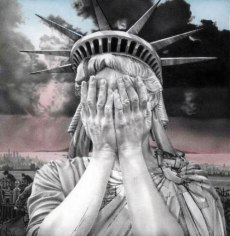
(Image via Art for a Change)
Gee Vaucher is best known for the remarkable graphics she produced for British punk rock acts in the late 70’s and early 80’s. Her works have always been socially conscious depictions of upsetting political realities.
Nancy Cook at Politico writes this lede “Trump bulldozes across the presidency’s red lines.In recent weeks, the president has labored to reshape a federal government he feels is frustrating his agenda.”As BB wrote yesterday, we clearly have a lawless president who has cleared out the government of any professional that will follow the law and replaced them with loyal flying monkeys that will just do his bidding.
President Donald Trump has spent the last few weeks trying to bend to his will what are arguably three of the federal government’s least political institutions – the Department of Homeland Security, Federal Reserve and Department of Justice.
Frustrated by the organizations’ deliberate pace and the substance of their decision-making, Trump has tried to remake them in his own image. He’s purging staffers who disagreed with him, or whom he felt were insufficiently loyal at DHS, and he hopes to stock the Fed with vocal political allies who can do his bidding on monetary policy.
Trump cares little about how such moves will be perceived, former administration officials and Republicans close to the White House say. They argue he always prefers to push the boundaries of what is possible, legally and otherwise. And in year three of his presidency, he’s pushing harder than ever before.
On immigration, Trump has never grasped why the U.S. government could not simply hold undocumented immigrants indefinitely as they awaited immigration court proceedings, according to one person close to DHS. This so-called “catch and release” policy frustrated him, as if the government’s due process should not extend to everyone on U.S. soil. The president reportedly clashed with now-ousted DHS Secretary Kirstjen Nielsen as he sought to bar all asylum seekers from entering the country, in violation of existing law.
Every president chafes at being stymied by Congress or the law, noted Timothy Naftali, a historian and former head of the Nixon Presidential Library. What makes Trump’s actions so unprecedented, he said, is the president’s reaction: Trump appears willing to steamroll through the constraints that American presidents have traditionally respected.
“Instead of learning to become presidential and accepting the structure of the American presidency, he is trying to reshape it,” Naftali said. “He has removed anyone, it appears, who stood up to him and said he cannot do this. This is a huge test of our institutions.”
I’m going to leave all of this here to return to grading but with the fear that the people remaining in the institutions may not have a fighting chance against all this chaos and blatant disrespect for rule of law. We can not afford complacency. This process has been put on overdrive and we must stop it. Congress has remedies. They should start using them.
Monday Reads: Our New Legacy is Not Being Cruel enough to Children
Posted: April 8, 2019 Filed under: Afternoon Reads | Tags: #ChildrenInCages 13 Comments It’s a sad day in American when a cruel woman implementing a cruel policy gets fired for not being cruel enough by an even crueler President and his resident White Nationalist Advisers that appear to have gone all in for a Pol Pot concept of cruel.
From the New York TImes: “Kirstjen Nielsen Resigns as Trump’s Homeland Security Secretary”.
Kirstjen Nielsen, the homeland security secretary, resigned on Sunday after meeting with President Trump, ending a tumultuous tenure in charge of the border security agency that had made her the target of the president’s criticism.
“I have determined that it is the right time for me to step aside,” Ms. Nielsen said in a resignation letter. “I hope that the next secretary will have the support of Congress and the courts in fixing the laws which have impeded our ability to fully secure America’s borders and which have contributed to discord in our nation’s discourse.”
Ms. Nielsen had requested the meeting to plan “a way forward” at the border, in part thinking she could have a reasoned conversation with Mr. Trump about the role, according to three people familiar with the meeting. She came prepared with a list of things that needed to change to improve the relationship with the president.
Mr. Trump in recent weeks had asked Ms. Nielsen to close the ports of entry along the border and to stop accepting asylum seekers, which Ms. Nielsen found ineffective and inappropriate. While the 30-minute meeting was cordial, Mr. Trump was determined to ask for her resignation. After the meeting, she submitted it.
 It appears–like others before her–that Nielsen may have be “sacked by a tweet” per Axios.
Inside the room: She wasn’t intent on quitting but was prepared to, sources tell us. The meeting went poorly, and Trump didn’t even let her announce her “resignation.” While she was racing to put out the letter (not that different from one she wrote after midterms), Trump tweeted that she “will be leaving her position.”
“She was undercut at every turn,” a source close to DHS said. “She’s done everything she can do. The White House is eating their own.”
Between the lines: Nielsen had been on the outs with some in the West Wing for at least six months, top officials tell us.
- National security adviser John Bolton has felt the increase in immigration numbers made it clear that her policies weren’t effective, and he thought the president should relieve her of her duties, a senior administration official said.
- Last fall, Bolton took his advice about Nielsen to Trump, incurring the wrath of then-chief of staff John Kelly, a Nielsen protector.
- Back in October, accounts surfaced of a shouting match between Bolton and Kelly. It turns out that it was over Bolton’s Nielsen conversation with Trump.
Be smart: Nielsen’s departure empowers White House hardliner Stephen Miller.
- A Republican Senate aide tells Axios: “Nielsen leaving will make conservatives who were getting fed up with DHS happy.”
- “Real question will be who’s the [permanent] replacement and does that person have the credentials?”
- “Whoever replaces will have one hell of a confirmation hearing.”
Go deeper: Read the resignation letter
 Yes, Trump wanted more separation of children and families. He wanted more cruelty and babies and kids in cages. Just as he wants to plow under all the nature reserves and Butterfly sanctuaries along the border, no child will be spared his White Nationalist Agenda. His is a scorched earth policy when it comes to children already born and the resplendent beauty of nature. No sanctuary in this country. Only gold piss pots and tyrant curious-toadies allowed. From NBC News: “Trump’s support of renewed child separation policy led to collision with Nielsen. A senior administration official believes Trump is convinced family separation has been the most effective policy at deterring asylum-seekers.”
According to two of the sources, Nielsen told Trump that federal court orders prohibited the Department of Homeland Security from reinstating the policy, and that he would be reversing his own executive order from June that ended family separations.
Three U.S. officials said that Kevin McAleenan, the head of Customs and Border Patrol who is expected to take over as acting DHS secretary, has not ruled out family separation as an option.
The policy McAleenan would consider, according to the officials, is known as “binary choice” and would give migrant parents the option between being separated from their children or bringing their children with them into long term detention.
Trump has been pushing this policy since January, the sources said, when the numbers of undocumented immigrants crossing the border began to rise.
A senior administration official said it seems Trump is convinced that family separation has been the most effective policy at deterring large numbers of asylum-seekers.
 Stephan Miller continues to be the demon whispering in the Devil’s ear according to Politico: “Stephen Miller pressuring Trump officials amid immigration shakeups. The White House hardliner is driving a more aggressive immigration approach.”
Miller has also recently been telephoning mid-level officials at several federal departments and agencies to angrily demand that they do more to stem the flow of immigrants into the country, according to two people familiar with the calls.
The pressure comes as Trump, who forced a government shutdown over his demand for a Mexican border wall, is again making immigration the central theme of his presidency; last week, Trump backed off his threats to shut down the border entirely.
The officials at the Departments of Homeland Security, Justice and State, who each handle different parts of the immigration process, were initially surprised that a high-ranking White House official like Miller would call them directly, rather than contact their bosses.
“It’s intimidation,” one of the people who was briefed on the calls told POLITICO. “Anytime you get a call like this from the White House it’s intimidation … Under normal circumstances, if you were a deputy in one of these agencies, it would be very unusual.”
This makes me incredibly sad and ashamed. I agree with Greg Sargent’s take at WAPO: “Kirstjen Nielsen just revealed how Trump’s pathologies and lawlessness will get worse”.
It’s important to appreciate that this demand of Nielsen flows from what appears to be an actual aspiration on Trump’s part. In recent days, Trump has repeatedly said our country is “full,” which is another way of saying the same thing: If he had his way, we would not take in a single additional asylum seeker.
Indeed, Trump has linked this assertion directly to his threat to close the border, which seems to indicate that, when he threatens to do this, he thinks he’s threatening to end asylum-seeking entirely. This is utter lunacy — because of geographic realities, closing official ports of entry would not prevent people from setting foot on U.S. soil, after which they can exercise their legal right to apply for it.
But Trump actually does appear to want to end this as a right. It’s what he reportedly demanded that Nielsen do, and she refused.
Many other things he and Miller have done are all about progressing toward that goal in some way. In multiple ways, they’ve tried to restrict the ways people can apply or qualify for asylum. They’ve lowered the cap on refugees and used bureaucratic tactics to slash those numbers further.
Now they are pushing for changes to the law that would make it possible to detain asylum-seeking families — including children — for far longer, and to more easily deport Central American migrant children.
These would not address the terrible civil conditions in home countries that are largely causing the migrations in the first place. Trump has ended aid to those countries, while doing everything possible to either slam the door on asylum seekers entirely, or to deter them from fleeing those horrific conditions by threatening unspeakable cruelties here.
 Indeed, he even told her to break the law to get it done.
Add to this the fact that Trump repeatedly instructed Nielsen to break the law, and you get an idea of what Trump might be capable of doing. What those things will look like we don’t know, but we may soon find out.
It’s fitting that this is happening right when an old quote from Trump — in which he called some migrants “animals” — is once again being debated. Reporters rushed forth to proclaim that Trump was only talking about MS-13 gang members, which isn’t even clear to begin with, and doesn’t seriously reckon with how determined Trump is to dehumanize asylum seekers, and the rhetorical tricks he employs to do so.
But the circumstances around Nielsen’s ouster should make it impossible for anyone to feign naivete about the depths of Trump’s depravity and inhumanity any longer.
 Amanda Marcotte believes that children in cages are Trump’s Re-election Strategy. Does this actually work with people? What does that say about us?
Whether the timing was coincidental or not, there can be no doubt that Trump believes that highlighting his racism-fueled cruelty towards migrants is the sort of thing that will excite voters and get them out to the polls to support him in 2020.
At a rally in Michigan last week, Trump mocked asylum seekers, claiming they’ve been coached to say they’re afraid for their life, and telling the audience that it’s “a big fat con job.” (This is more obvious projection from a man who has spent his life as a shameless grifter.
“Our detention areas are maxed out & we will take no more illegals. Next step is to close the Border!” Trump tweeted on Saturday, helping McAleenan and Fox News in pushing the idea that the caged families were visual evidence of this supposed “invasion.”
Whether the timing was coincidental or not, there can be no doubt that Trump believes that highlighting his racism-fueled cruelty towards migrants is the sort of thing that will excite voters and get them out to the polls to support him in 2020.
At a rally in Michigan last week, Trump mocked asylum seekers, claiming they’ve been coached to say they’re afraid for their life, and telling the audience that it’s “a big fat con job.” (This is more obvious projection from a man who has spent his life as a shameless grifter.
“Our detention areas are maxed out & we will take no more illegals. Next step is to close the Border!” Trump tweeted on Saturday, helping McAleenan and Fox News in pushing the idea that the caged families were visual evidence of this supposed “invasion.”
 Is Trump actually doing this to force larger numbers to leave their country so that we can get another full on caravan of evaders heading our way narrative right before this election too? And what of the courts? The House just sued Trump over his “Declaration of Emergency”. How does this play into all of this? Clearly, Trump keeps breaking the law and clearly, the Senate Republicans keep trying to stack the courts with unqualified activists for their agenda.
The House of Representatives sued President Donald Trump’s administration on Friday over the president’s national emergency declaration to build a wall on the southern border.
In their complaint, filed in federal district court in Washington, DC, Democrats named Treasury Secretary Steven Mnuchin, Secretary of Homeland Security Kirstjen Nielsen, Acting Secretary of the Department of Defense Patrick Shanahan, and their corresponding departments.
President Donald Trump declared the national emergency in February in an attempt to stitch together money to build the wall. Democrats have long argued this is an unconstitutional expansion of presidential powers, by taking money Congress already dedicated to other programs to build a wall Congress has repeatedly rejected. Both the House and Senate passed a resolution that would reject the national emergency declaration, but were unable to overcome Trump’s veto.
House Democrats had left the door open to legal action if the resolution failed.
“The House will once again defend our Democracy and our Constitution, this time in the courts,” Speaker Nancy Pelosi said in a statement Thursday. “No one is above the law or the Constitution, not even the President.”
Democrats are asking a judge to declare that the transfer of $1 billion in March from defense funds for border wall construction was unconstitutional, and to block any future transfers from the different pools of money Trump intends to tap. They argue the administration’s plans violate the Appropriations Clause and run afoul of Congress’ authority to decide how federal money is spent.
Clearly, we are in all fighting a battle save our Republic as we know it. But more clearly, we are fighting a battle to save the lives of many living creatures who share this planet with us including children. It’s hard to know how this will end since I truly believe Trump is capable of anything and that the Republicans seem unwilling and unmotivated to stop him. In the case of Mitch McConnell and others, there is active support. Now is the time to ensure the 2020 election will be one we can have faith about.
What’s on your reading and blogging list today?

 peej
peej Carissa
 bostonboomer
 dakinikat
 ecocatwoman
 jjlo
jjlo mablue2
 Mama Lopez
 peggysue22
 quixote
 skydancingguestblogger
 Mona (aka Wonk the Vote)





Recent Comments