Posted: December 20, 2025 | Author: bostonboomer | Filed under: just because | Tags: Bill Clinton, Brown University shooting, cat art, caturday, Claudio Manuel Neves Valente, DOJ, Donald Trump, Epstein Files, Melania Trump, Trump insanity |
Good Afternoon!!

By Zakir Akmedov
The DOJ released a small portion of the Epstein files yesterday, with massive redactions. They seem to have tried to focus on Bill Clinton and conceal anything about Donald Trump. Democrats are angry, noting that the DOJ has broken federal law by holding back and selectively redacting the files that they released.
In this post, I will focus mostly on the Epstein files and reactions to the release. I also include stories on the Brown shooter and Trump’s insanity.
Sam Levine at The Guardian: Trickle release of Epstein files on a Friday signals move to bury Trump ties.
The justice department’s partial release of the Epstein files on Friday signaled how the agency is using a variety of tactics to try to bury and obfuscate Donald Trump’s connection to Jeffrey Epstein.
As the department raced towards a legally mandated Friday deadline to release its files, little emerged about what it planned to release. There never really seemed to be a doubt that the department would release the files late on Friday afternoon, deploying the well-worn Washington trick of burying unflattering news before a weekend.
Then, on Friday morning, Todd Blanche, the deputy attorney general, went on Fox News to say that the department wouldn’t actually be releasing all of the files on Friday as required by the law. “I expect that we’re going to release more documents over the next couple of weeks, so today, several hundred thousand, and then over the next couple weeks, I expect several hundred thousand more,” Blanche said on Fox News. “There’s a lot of eyes looking at these and we want to make sure that when we do produce the materials we are producing, that we are protecting every single victim.”
By the time the department eventually did release thousands of pages of materials on Friday evening – not the hundreds of thousands Blanche promised – many of the documents had been heavily or completely redacted. Other than a few pictures, the materials made no mention of Trump, even though attorney general Pam Bondi reportedly told Trump earlier this year his name was in the files.
The release underscores how the Trump administration is trying to balance both the demand to release the files – something encouraged in large part by the Maga base – while also obfuscating with a slow trickle of document dumps to prevent any embarrassment to Trump, who was friends with Epstein for years before they had a falling out. Blanche has said the department will continue to produce documents on a rolling basis in the coming weeks – a holiday period – a bet that Americans will simply tune out the story as it drags on.
Thomas Massie, a Kentucky Republican who sponsored the law to release the files, was one of many members of Congress to express outrage. He said on Twitter that the release “grossly fails to comply” with the statute….
Trump is mostly missing from the release.
While Trump barely made an appearance in Friday’s release, Bill Clinton appears in several images. The Daily Wire, a Trump-friendly site, obtained a photo of Clinton and Epstein on Thursday, a day before the release. Photos of Clinton lounging in a pool and a hot tub were among those released on Friday. Justice department and White House spokespeople were quick to highlight the images on Twitter.

By Magdalena Lobao-Tello
“Beloved Democrat president. The black box is added to protect a victim,” Gates McGavick, a justice department spokesperson, posted alongside a photo of Clinton in what seems to be a hot tub with another person whose face is redacted. Steven Cheung, the White House communications director, posted another photo of Clinton with someone whose face is redacted and, quoting the song Jumpman by Drake and Future, wrote “them boys is up to something”.
Angel Ureña, a Clinton spokesperson, released a statement on Friday saying the Trump administration was using the former president to try to distract from Trump’s connection to Epstein.
“The White House hasn’t been hiding these files for months only to dump them late on a Friday to protect Bill Clinton. This is about what comes next, or from what they’ll try and hide forever,” he said. “So they can release as many 20-plus-year-old photos as they want, but this isn’t about Bill Clinton. Never has, never will be.”
Several other celebrities appeared in the images released on Friday, including Mick Jagger, Michael Jackson, Richard Branson, Chris Tucker, David Copperfield and Kevin Spacey. Like Clinton, none has been accused of any crime in connection to Epstein. But their immediate appearance in the files benefits Trump, creating the impression that it was not unusual for famous men to hang out with Epstein.
Liz Crampton and Andrew Howard Politico: Epstein files put Bill Clinton under scrutiny – and the White House wants him there.
The Trump administration, initially wary over the Justice Department’s release of Jeffrey Epstein documents, pounced on go-to villain Bill Clinton’s appearance in Friday’s trove of pictures, emails and interviews.
“I wonder why the Biden DOJ refused to release the files…,” DOJ spokesperson Chad Gilmartin posted from his personal X account, alongside one partially-redacted photo of Clinton in a pool with an unidentified woman. Another swimming pool photo Gilmartin posted shows Clinton with Ghislaine Maxwell, Epstein’s longtime co-conspirator who was convicted of sex trafficking charges in 2021….
Clinton has long been linked with Epstein, contributing to his status as MAGA’s favored boogeyman. Some high-profile members of the movement cited him in pushing for the release of the files, and continued that message after the DOJ made public a trove of documents from the government’s investigation into Epstein.
“Slick Willy! @BillClinton just chillin, without a care in the world. Little did he know…” White House Communications Director Steven Cheung posted to X.
“Here is Bill Clinton in a hot tub next to someone whose identity has been redacted. Per the Epstein Files Transparency Act, DOJ was specifically instructed only to redact the faces of victims and/or minors. Time for the media to start asking real questions,” White House deputy press secretary Abigail Jackson posted to her personal X account….
Clinton appears in photos posing with Epstein in coordinating shirts, interacting with a dancer, sitting with a redacted woman on his lap on what looks like an airplane and with someone who appears to be the late pop icon Michael Jackson. The music legend faced his own child sex abuse allegations as early as 1993, though he was never convicted of any crimes.
Edward Helmore at The Guardian: Bill Clinton says White House is using him as scapegoat after Epstein files release.
A spokesperson for Bill Clinton accused the White House late on Friday of using him as a scapegoat after pictures of the former president with sex offender Jeffrey Epstein and Ghislaine Maxwell, as well as with a young woman in a pool, were included as part of congressionally ordered release of government files.
“The White House hasn’t been hiding these files for months only to dump them late on a Friday to protect Bill Clinton,” the spokesperson said in a statement on X.
“This is about shielding themselves from what comes next, or from what they’ll try and hide forever. So they can release as many grainy 20-plus-year-old photos as they want, but this isn’t about Bill Clinton. Never has, never will be,” the statement added.

Lady sitting with Siamese, Sharyn Bursic
It continued: “Even Susie Wiles said Donald Trump was wrong about Bill Clinton,” it said, referring to comments made by White House chief of staff to Vanity Fair in which Wiles acknowledged that Clinton had not been on Epstein’s Caribbean island despite repeated claims by Trump to the contrary.
Clinton has long maintained that he cut ties with Epstein around 2005, before the disgraced financier plead guilty to solicitation of a minor in Florida.
In the statement, Clinton’s spokesperson Angel Ureña said: “There are two types of people here. The first group knew nothing and cut Epstein off before his crimes came to light. The second group continued relationships with him after. We’re in the first. No amount of stalling by people in the second group will change that. Everyone, especially MAGA, expects answers, not scapegoats.” [….]
Epstein visited the White House at least 17 times during the early years of Clinton’s presidency, according to White House visitor records cited in news reports. He later travelled with Epstein on the financier’s private jet in the years after he left office in 2001, including to Asia and Africa, on trips related the Clinton Global Initiative. Clinton has never been formally accused of any wrongdoing in connection with Epstein.
Democrats were outraged. Zachary Schermele at USA Today: ‘Grossly fails.’ Lawmakers behind Epstein files’ release slam DOJ.
The Epstein files are out, and the lawmakers who forced their release are not satisfied.
High-profile Democrats are among the most enraged at the Justice Department’s decision to release hundreds of thousands of documents on a “rolling basis”about the late accused sex trafficker Jeffrey Epstein .
“A fraction of the whole body of evidence,” said Senate Minority Leader Chuck Schumer, D-New York. To demonstrate his point, he highlighted how 119 pages of one document were entirely redacted.
“Simply releasing a mountain of blacked out pages violates the spirit of transparency and the letter of the law,” Schumer said in a statement. “We need answers as to why.”
Schumer wasn’t alone in his criticism. Democratic Rep. Robert Garcia, the ranking member of House Oversight Committee, said on CNN that the Justice Department was “defying the Congress.”
The bipartisan authors of the Epstein Files Transparency Act – Reps. Ro Khanna, D-California, and Thomas Massie, R-Kentucky – also accused the Trump administration of failing to comply with their law, which nearly unanimously passed Congress in November.
“It is an incomplete release with too many redactions,” Khanna said in a social media post.
“Unfortunately, today’s document release … grossly fails to comply with both the spirit and the letter of the law,” Massie added.
The law required the Justice Department by Dec. 19 to fully disclose all information in its possession related to its investigations of the well-connected financier who died by suicide in a jail cell in 2019. DOJ under the law is also required to make the files publicly searchable, but basic searches of what DOJ called the “Epstein Library” show that even basic queries – such as for “Trump” or “Clinton” – come up blank.
Read more at USA Today.
One more from Julie K. Brown, who researched and wrote the series on Epstein at the Miami Herald that forced new investigations into the sweetheart deal that Epstein got from the DOJ in September 2007.
From her Substack: The Epstein Files: My observations. Nothing to See Here.
Pages and pages of blacked-out documents. Photographs of Epstein’s mop closet and HVAC systems in house. Message pads, notes and other material from the Florida case that has been on the Palm Beach County State Attorney’s website since at least 2018. They didn’t even release the victim interviews; just pictures of the tapes of the interviews. Think about that. A photograph of a tape cassette.
This would be funny if it wasn’t about a crime involving the rapes of 14-year-old girls.
It’s clear that the Department of Justice is not only thumbing its nose at the public’s demand for transparency and accountability, it is not taking the crimes committed against children seriously. It’s as if they think we are so hungry for any crumbs about Epstein that stale bread will do.
What’s worse is that the documents and photos they did release were tossed up like a salad and served in such a mixed-up way that few people will even understand the significance of the material that was released on Friday.

Miss Kitty, a lazy afternoon, by Jan Panico
Imagine being a survivor who was raped by Epstein, and having to click, one photo at a time, through hundreds of photographs, just searching for something, anything, to explain how Jeffrey Epstein did what he did, hoping for some shred of hope that the FBI actually investigated your complaint — the story you painfully found the courage to tell.
There were few stories in the thousands of pages released Friday. Even victim Maria Farmer, who found some validation in the fact that her 1996 FBI report about Epstein’ was tucked into the mess, would learn that the FBI did nothing about it. Had they taken some steps, they may have prevented the sexual assaults of countless other girls and young women.
And what about Epstein’s clients? Pam Bondi, the attorney general, said there was no list. But Rep. Tom Massie has said he knows of 20 men who have been implicated in Epstein’s crimes. And what about Ghislaine Maxwell? Well, she filed a habeas corpus petition a few days ago that claims that 25 men arranged civil settlements with Epstein victims who could have “equally been considered as co-conspirators.” She adds: “None of them have been prosecuted.” [….]
Here is a link to the Epstein Files on the Palm Beach State Attorney’s website. You will learn more about the case here than what was released by the DOJ Friday: https://sa15.org/public-records/
Claudio Manuel Neves Valente
The Boston Globe: Brown campus shooter harbored resentment from time as a PhD student in the early 2000s, friend says.
Growing up in Portugal, Claudio Manuel Neves Valente stood out for his intellectual potential. In high school, he traveled to national and international physics competitions. He later graduated from Portugal’s top university for science and engineering.
But when he moved to the United States in 2000 to pursue a doctorate in physics at Brown University, his colleagues experienced an ill-tempered young man who felt that even an American Ivy League college was no match for his own intellect. Neves Valente complained the classes were too easy and left the school months after enrolling, apparently with hard feelings.
“He could be kind and gentle, though he often became frustrated — sometimes angry — about courses, professors, and living conditions,” said Scott Watson, a Syracuse University physics professor who befriended Neves Valente at Brown.
After authorities linked him to the mass shooting on Brown’s campus and the killing of an MIT professor earlier this week, Neves Valente, 48, was found dead by suicide Thursday night. In the immediate aftermath, a fuller picture of the suspect emerged: of a brilliant student whose academic promise seemed to dissipate abruptly, an angry genius with long-simmering resentment, a loner who painstakingly planned and executed extraordinary violence.
His death ended a frantic manhunt that began following the Brown shooting Saturday afternoon, according to police. He entered a storage unit in southern New Hampshire about an hour after shooting the MIT professor Monday night, officials said; based on an autopsy, authorities believe he died on Tuesday from a self-inflicted gunshot wound….
Investigators are still trying to determine what motivated his homicidal rampage after he seemingly abandoned the ambitions of his youth, what pushed him to finally act upon old grudges.

She and her cats, by Madison Moore
What’s clear is that he took careful steps to hide his identity and evade detection both before and after the shootings. Authorities believe he acted alone. They said he had been canvassing Brown’s campus for weeks, targeting a building where he spent significant time as a student in the early 2000s….
Both natives of Portugal, Neves Valente and Loureiro attended university together in Lisbon, authorities said. They graduated from Instituto Superior Técnico, a premier science institution that’s part of the University of Lisbon. Loureiro went on to pursue a lauded career as a professor and fusion researcher, with stops at Princeton University and in Europe; he joined MIT in 2016. Colleagues from across the world overwhelmingly praised his accomplishments and character, but none reported knowing Neves Valente.
More from Scott Watson, Valente’s friend:
Watson, his former classmate, said the two became friends despite Neves Valente’s standoffish nature.
“During orientation he was sitting alone, and I walked up and said hello. He was terse at first, but we eventually broke the ice and became close,” Watson told the Globe in an e-mail Friday, describing himself as essentially Neves Valente’s only friend at the university.
Neves Valente was a brilliant student, but he could be frustrated by the curriculum at Brown, which he found underwhelming, Watson said.
“He was by far the best graduate student in our class. Through our conversations, he was already ready to graduate when he arrived,” Watson said. “I don’t like the word genius, but he was.”
The Boston Globe: How a single anonymous tipster cracked the Brown University shooting case.
Information from a tipster who had a strange encounter with another man on a sidewalk outside Brown University was key to police identifying the suspect they believe killed two students at the school and then two days later gunned down a Massachusetts Institute of Technology professor.
Known only as “John” in a Providence police affidavit, the source is being hailed by investigators as the key figure who gave law enforcement the details needed to determine who was behind the Brown shooting, as well as the killing of a Massachusetts Institute of Technology professor who was shot in his Brookline home Monday.
Ever since a shooter unloaded more than 40 rounds inside a Brown engineering building, anxiety and frustration has plagued the Providence, Rhode Island, community as police appeared no closer to identifying the person.
Yet on the sixth day of the investigation, the case gathered steam, ending with police announcing late Thursday they had found the suspected gunman dead from a self-inflicted gunshot wound….
“John” gave them the information they needed.
According to police, John had several encounters with 48-year-old Claudio Neves Valente before Saturday’s attack. As police posted images of a person of interest — now identified as Neves Valente — John began posting on the social media forum Reddit that he recognized the person and theorized that police should look into “possibly a rental” grey Nissan. Reddit users urged him to tell the FBI, and John said he did. The police affidavit said they learned about the tip on Dec. 16, three days after the shooting and a day after the tip line was created….
Up until that point, the police affidavit says officials had not connected a vehicle to the possible shooter.
That detail led them to get more video of a Nissan Sentra sedan with Florida plates and enabled Providence police officers to tap into a network of more than 70 street cameras operated around the city by surveillance company Flock Safety.

Bedtime Story, by Jeanette Lassen
The affidavit says John gave investigators additional critical details: he encountered Neves Valente in the bathroom of the engineering building just hours before the attack, where John noted the suspect’s clothing was “inappropriate and inadequate for the weather.”
John also bumped into Neves Valente outside, mere blocks from the building, where John watched Neves Valente “suddenly” turn around from the Nissan when he saw John. What ensued was then a “game of cat and mouse,” according to John’s testimony — where the two would encounter each other and Neves Valente would run away.
At one point, John says he yelled out “Your car is back there, why are you circling the block?”
“The Suspect responded, ‘I don’t know you from nobody,’ then Suspect repeatedly asked, ’Why are you harassing me?’” according to the affidavit.
John told police he eventually saw Neves Valente approach the Nissan sedan once more and decided to walk away.
I’ve quote a lot, because The Boston Globe doesn’t allow gift links or readers without subscriptions.
Trump Insanity Report
Jack Revell at The Daily Beast: https://www.thedailybeast.com/trump-79-complains-the-fbi-made-a-mess-of-melanias-panties.
President Donald Trump raged at the FBI for making a “mess” of his wife Melania’s “panties” during a raid on their Mar-a-Lago estate.
In a rambling speech delivered at a rally in Rocky Mount, North Carolina, on Friday night, Trump went off on a wild tangent about federal law enforcement agents, revealing how they had disturbed the First Lady’s underwear drawer during their 2022 search of the Palm Beach, Florida, property.

Her Quiet Companion, by David Arstamyan
“They went into my wife’s closet. I’ll say this. Number one, it’s very bad, but it sounds a little strange. They looked at her drawers,” Trump told the crowd while both himself and the crowd laughed.
“You have drawers, and then you have drawers. They looked at both,” he continued, miming the difference between the storage item and the undergarment.
The unprompted revelation of intimate details did not stop there, however, with Trump going full disclosure on the way his third wife likes to store her underwear.
“She’s a very meticulous person… Everything is perfect. Her undergarments, sometimes referred to as panties, are folded perfect, wrapped, they’re like so perfect. I say, ‘That’s beautiful,’” Trump continued.
“You know, that’s the part of the world she came from. Everything was perfect, no problem. Fold, fold, fold. I think she steams them just to make sure.”
No doubt Melania was thrilled with these revelations, which are likely just Trump fantasies.That’s it for me today. What’s on your mind?
Did you like this post? Please share it with your friends:
Posted: December 17, 2025 | Author: bostonboomer | Filed under: just because | Tags: ACA subsidies, Donald Trump, Marjorie Taylor Greene, Moderate House Republicans, Paul Krugman, Russell Vought, Stephen Miller, Susie Wiles, U.S. Economy |
Good Day!!
I haven’t been feeling well for the past several days, and I’ve only been following the news superficially. There is so much going on, but I’ll do my best. Here’s the latest.
Trump is scheduled to give a speech from the White House tonight at 9PM.
AP: Trump is previewing his 2026 agenda in an address to the nation as his popularity wanes.
President Donald Trump intends to preview his agenda for next year and beyond in a live speech from the White House on Wednesday night. His remarks are coming at a crucial time as he tries to rebuild his steadily eroding popularity.
The White House offered few details about what the Republican president intends to emphasize in the 9 p.m. EST speech. Public polling shows most U.S. adults are frustrated with his handling of the economy as inflation picked up after his tariffs raised prices and hiring slowed.
Trump’s mass deportations of immigrants have also proved unpopular even as he is viewed favorably for halting crossings along the U.S. border with Mexico. The public has generally been nonplussed by his income tax cuts and globe-trotting efforts to end conflicts, attack suspected drug boats near Venezuela and attract investment dollars into the United States.
In 2026, Trump and his party face a referendum on their leadership as the nation heads into the midterm elections that will decide control of the House and the Senate.
Trump has said that he thinks more Americans would back him if they simply heard him describe his track record. Administration officials say investment commitments for new factories will reverse the recent decline in manufacturing jobs and that consumer activity will improve dramatically as people receive increased tax refunds next year.
“It has been a great year for our Country, and THE BEST IS YET TO COME!” Trump said in a Tuesday social media post announcing the speech.
Sorry, Grandpa. Your economy sucks because of your idiotic tariffs, your cruel mass deportations, and your general incompetence.
The New York Times: Trump Dangles Cash Payments to Buoy Voters’ Views of the Economy.
Tariffs are unpopular, prices remain stubbornly high and Americans are souring on President Trump’s handling of the economy.
So Mr. Trump has reprised a familiar political strategy: promise people cash.
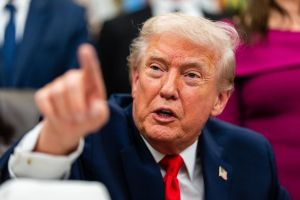
The president has repeatedly floated the idea of sending one-time $2,000 rebate checks to many families.Credit…Eric Lee for The New York Times
The White House is trying to tamp down Americans’ economic anxieties by dangling the prospect of checks and other paydays next year, hoping that the money might assuage voters who blame the president for their rising cost of living.
Mr. Trump, who is set to address the nation on Wednesday night, has repeatedly teased the idea of sending one-time $2,000 rebate checks to many families, funded using money collected from his sweeping global tariffs. But he has not devised a detailed plan for providing the rebates, an expensive policy that Republicans in Congress must approve and one that they have not yet considered.
The president has also begun hyping up the tax refunds that Americans are slated to receive in 2026. For many people, these cash payments are expected to be larger than they were last year, after Republicans adopted a sprawling set of tax cuts in July.
Both Mr. Trump and members of his administration have periodically drawn an equivalence between the supposed tariff rebates and the enacted tax law. They have claimed the money could bolster the economy and alleviate some of the financial strains on families, even at a time when Mr. Trump maintains that much of the talk about affordability is a “hoax.”
“Next year is projected to be the largest tax refund season ever, and we’re going to be giving back refunds out of the tariffs, because we’ve taken in literally trillions of dollars,” Mr. Trump said at a cabinet meeting last week. “And we’re going to be giving a nice dividend to the people, in addition to reducing debt.”
But economists take a dimmer view. Even if Americans were to delight in a series of new government-issued checks, the payments would hardly address the reasons that prices remain so high — including a shortage in housing that has driven up rents and mortgages and the global tariffs that have made imports more expensive. And the money that may soon be sloshing around the economy could end up worsening inflation, undermining Mr. Trump’s own economic goals.
Alex Durante, a senior economist at the Tax Foundation, said that simply “pumping money” into the economy — without any other underlying changes — threatened to “just generate a cycle where you continue to get higher prices.”
Paul Krugman at his Substack: An A+++++ Economy, My A++. Trump made big boasts but he isn’t delivering.
When Politico recently asked Donald Trump to grade the current U.S. economy, he replied “A-plus-plus-plus-plus-plus.” He made this boast at a time when actual economic data were still scarce, a consequence of the government shutdown that stopped or delayed key information about the state of the job market.
Yesterday the report on employment during the month of November finally arrived. And the message of the report on the state of the US economy was clear: A+++++ my A++. While it’s too soon to declare that we’re in a recession, the data are at least pre-recessionary: that is, the numbers are weak enough that we should be seriously worried that a recession is coming. And that’s a state of affairs completely at odds with Trump’s rose-colored — spray-tanned? — picture.
I’ll talk about the reasons the gap between Trump’s big boasts and the glum reality matters in a minute. First, however, let’s talk about what we learned from yesterday’s report.
Most importantly, the data show a weak labor market. Employment isn’t falling off a cliff, but job growth has been weak and hasn’t kept pace with the number of people seeking work. The headline unemployment rate in November was 4.6 percent, up from an average of 4 percent in 2024. That number is close to triggering the Sahm Rule, an economic rule of thumb devised by Claudia Sahm, a former economist at the Board of Governors of the Federal Reserve, that has historically been highly successful at identifying the early stages of a recession.
We can’t do a strict application of the Sahm Rule yet because Sahm’s method is based on the average unemployment rate over the past three months. Unfortunately, the shutdown prevented the Bureau of Labor Statistics from collecting key data in October. But if we do an interpolation of October’s unemployment rate by averaging over September’s rate of 4.4% and November’s rate of 4.6%, we can estimate that October’s unemployment rate was 4.5%. And those 3 months of unemployment numbers bring us within a whisker of the unemployment rise that, according to the Sahm Rule, signals that a recession is on the horizon.
The state of the economy looks even worse if we take a wider view of the labor market. The BLS calculates 6 different measures of unemployment. The most commonly cited number is U-3 — the number of workers who are actively seeking jobs but haven’t found them. But the broadest measure is U-6, which includes underemployed workers stuck in part-time employment and discouraged workers who have temporarily given up job search. And U-6 has risen sharply since January, when Trump took office:

Source: BLS
Further evidence consistent with a poor and deteriorating job market is data showing that the number of job-seekers who are long-term unemployed – that is, have been unemployed for 27 weeks or more – has risen by almost a third (from 1.45 million to 1.91 million) since 2024. This means that the unemployed are finding it harder to find jobs.
Read more details at the Substack link.
Most Americans aren’t stupid. They can see how much prices have gone up on necessities like food and electricity. Trump is losing popularity even with his MAGA base.
Marjorie Taylor Greene: "I think the midterms are gonna be very hard for Republicans. I'm one of the people that's willing to admit the truth and say I don't see Republicans winning the midterms right now, so that doesn't bode well for Mike Johnson."
— Aaron Rupar (@atrupar.com) 2025-12-17T02:20:39.871Z
Marjorie Taylor Greene was once one of Trump’s biggest supporters; now she’s turned on him. Victoria Craw at The Washington Post: Marjorie Taylor Greene says ‘dam is breaking’ within GOP against Trump.
Rep. Marjorie Taylor Greene (R-Georgia) on Tuesday said President Donald Trump has “real problems” within the Republican Party, adding in an interview with CNN that the president is out of touch with voters on key issues such as affordability.
Greene told Kaitlan Collins on “The Source” that the “dam is breaking” in terms of Trump’s hold onsupport within the party and that she expects Republicans to struggle in next year’s midterm elections.
Citingthe backlash to Trump’s comments on the death of director Rob Reiner, the 13 HouseRepublicans who voted with Democrats to overturn Trump’s executive order on collective bargaining and Indiana Republicans’ rejection of the president’s redistricting push, Greene said she expected “pushback” within the party to grow as lawmakers enter the campaign phase for the upcoming elections.
“I think the midterms are going to be very hard for Republicans,” Greene said. “I’m one of the people that’s willing to admit the truth and say I don’t see Republicans winning the midterms right now.” [….]
Greene had carved out a high-profile role as one of Trump’s most vocal allies, first in the “Make America Great Again” movement and then with her support for the “America First” agenda. But after weeks of speaking out against the president on several issues, Greene and Trump had an acrimonious public split last month after she joined with Democrats on a discharge position to compel a House vote calling on the Justice Department to release files related to convicted sex offender Jeffrey Epstein….
Speaking to The Washington Post this week, Greene described herself as a “bellwether” who is closely attuned to Trump’s base. “I say it, and then within four to six months, everybody’s saying the same thing,” she said….
“He’s got real problems with Republicans within the House and the Senate that will be breaking with him on more things to come,” she added.
Greene also said Trump’s supporters “didn’t appreciate” the president’s reaction to the death of Rob Reiner, who was found stabbed to death alongside his wife, photographer Michele Singer Reiner, in their Los Angeles home Sunday. The couple’s son Nick Reiner faces two counts of first-degree murder, among other charges, in their deaths.
Marjorie Taylor Greene: "What I'd like to see from the president is empathy for Americans. Donald Trump is a billionaire and he's the president. When he looks into a camera and says 'affordability is a hoax,' he's talking to Americans that are suffering and have been for many years now."
— Aaron Rupar (@atrupar.com) 2025-12-17T02:17:20.938Z
Moderate Republicans in the House are rebelling against Speaker Mike Johnson and his determination not to extend the ACA subsidies.
Meredith Lee Hill writes at Politico about another sign of Trump’s waning popularity and power: Frustrated GOP moderates join Democrats to force Obamacare extension vote.
Four House Republicans joined Democrats Wednesday to force a House vote on a straight three-year extension of the enhanced Obamacare tax credits that will expire Dec. 31, delivering a sharp rebuke to Speaker Mike Johnson and other GOP leaders.
Reps. Brian Fitzpatrick of Pennsylvania, Mike Lawler of New York, Rob Bresnahan of Pennsylvania and Ryan Mackenzie of Pennsylvania signed the discharge petition filed by House Minority Leader Hakeem Jeffries — hours after House GOP leaders rejected attempts by Fitzpatrick and other Republican moderates to seek a floor vote on extending the subsidies used by more than 20 million Americans.
Fitzpatrick said in a late-night House Rules Committee meeting Tuesday that “the only thing worse than a clean extension … would be expiration, and I would make that decision.” Lawler added that “the only feasible path forward is a discharge petition” if GOP leader reject a floor vote.
Under House rules, a completed discharge petition is subject to a waiting period, meaning no vote could happen until next month — though Johnson could choose to move sooner.
“We have worked for months to craft a two-party solution to address these expiring healthcare credits,” Fitzpatrick said in a statement Wednesday. “Our only request was a Floor vote on this compromise, so that the American People’s voice could be heard on this issue. That request was rejected. … Unfortunately, it is House leadership themselves that have forced this outcome.”
Jeffries told reporters Wednesday his discharge petition is “the most straightforward path to ensuring that tens of millions of Americans don’t have their health care ripped away from them because of the expiration of the Affordable Care Act tax credits.”
"It's idiotic, it's political malpractice," Rep. Mike Lawler (R-N.Y.) told reporters Tuesday of Johnson refusing to give them an ACA extension vote.Lawler, and other moderate Republicans didn't rule out joining Democrats to force a vote on a three-year extension of the subsidies, Axios reported.
— Ken Bazinet (@kenbazinet.bsky.social) 2025-12-16T21:38:46.444Z
Amanda Marcotte writes at Salon about the Republican rebellion: Republicans are quiet quitting on Trump.
Donald Trump is worried that Republicans aren’t as afraid of him as they used to be. Despite his self-billing as a dealmaker, the president has only ever had one tool to control his party: fear. GOP politicians have been afraid of career damage and literal physical harm if they crossed him. Trump is not above reminding elected officials that he has unhinged followers who are known to be violent. But as his approval ratings fall and the 2026 midterm elections inch closer, it seems Republicans are slightly less worried about the president’s wrath.
The first indicator was the House vote on Nov. 18 to release the Epstein files against Trump’s expressed wishes. But the biggest sign that the president’s grip on power is weakening came last week, when a majority of Republicans in the Indiana statehouse struck down a gerrymandering bill Trump had demanded.
As I argued in the latest Standing Room Only newsletter, this context helps explain why Trump responded to the death of beloved director Rob Reiner and his wife Michele with an ugliness that’s shocking — even for this president. Although the Los Angeles Police Department had arrested the couple’s son for the apparent homicide, Trump insinuated on Truth Social that it was one of his own followers who killed the Reiners out of revenge for their anti-Trump activism. He doubled down when asked about it by reporters in the Oval Office on Monday. The message was hard to miss: If you oppose Trump, he wishes you dead.
So far, his escalation doesn’t seem to be intimidating Republicans. Indiana Republicans were subject to an onslaught of death threats and abuse that including text messages sent to the friends of the grandson of one state senator. Most voted against Trump’s gerrymandering bill anyway. While Speaker of the House Mike Johnson, R-La., pretended not to have heard Trump’s response to Reiner’s death, as Salon’s Sophia Tesfaye documented, most right-wing media, including Fox News, actually criticized Trump for his behavior.
These are promising signs, but it’s not worth holding your breath waiting for GOP politicians to openly turn on a president who demands absolute loyalty. Instead of public rebellion, most Republicans seem to be engaged in a form of quiet quitting. They won’t go out of their way to resist Trump, but they are losing enthusiasm for defending him. They’re struggling to hide their frustration or their scheming for a post-Trump world. Overall, the posture is one of lying low, waiting for the old man to be gone so they can begin the project of rebuilding the GOP and their own careers in a post-Trump era.
Read the rest at Salon.
Trump is also becoming noticeably less involved in actually running the government (gift link): The White House Is a Lost Cause.
There is a presidency at work in Washington, but it is not clear that there is a president at work in the Oval Office.
Ask Donald Trump about the goings on of his administration, and there is a good chance he’ll defer to a deputy rather than answer the question. “I don’t know her,” he said when asked about his nominee for surgeon general, Casey Means, earlier this year. “I listened to the recommendation of Bobby,” he said, pointing to Robert F. Kennedy Jr., the secretary of health and human services.
Ask Trump for insight into why his administration made a choice or to explain a particular decision, and he’ll be at a loss for words. Ask him to comment on a scandal? He’ll plead ignorance. “I know nothing about it,” Trump said last week, when asked about the latest tranche of photographs released from the estate of Jeffrey Epstein.
None of this on its own means the president isn’t working or paying attention to the duties of his office. But consider the rest of the evidence. He is by most accounts isolated from the outside world. He does not travel the country and rarely meets with ordinary Americans outside the White House. He is shuttled from one Trump resort to another to play golf and hold court with donors, supporters and hangers-on.
Ronald Reagan took regular meetings with congressional leaders to discuss his legislative agenda; George H.W. Bush spearheaded negotiations with the nation’s allies and led the United States to war in Iraq; and George W. Bush was, for better or worse, “the decider” who performed leadership for the cameras as much as he tried to exercise it from the Oval Office. Trump is a ubiquitous cultural presence, but there is no outward sign that he is an active participant in running the national government. He was mostly absent during discussions of his signature legislation — the One Big, Beautiful Bill Act — and practically AWOL during the monthlong government shutdown.
It is difficult for any president to get a clear read on the state of the nation; it takes work and discipline to clear the distance between the office and the people. But Trump, in his second term, does not seem to care about the disconnect. Abraham Lincoln once remarked that it would “never do for a president to have guards with drawn sabers at his door, as if he fancied he were, or were trying to be, or were assuming to be, an emperor.” A president has to be engaged — attentive to both the government and the public he was elected to serve.
Trump is neither. He is uninterested in anyone except his most devoted fans, and would rather collect gifts from foreign businessmen than take the reins of his administration. “The president doesn’t know and never will,” Susie Wiles, the White House chief of staff, said in an interview with Vanity Fair, commenting on the work of Elon Musk in the first months of the year. “He doesn’t know the details of these smallish agencies.”
A bit more:

Russell Vought
Instead, the work of the White House has been delegated to a handful of high-level advisers. Russell Vought, the director of the Office of Management and Budget, is the de facto shadow president for domestic affairs. As one senior government official told ProPublica, “It feels like we work for Russ Vought. He has centralized decision-making power to an extent that he is the commander in chief.” It was Vought who orchestrated the administration’s assault on the federal bureaucracy, including the wholesale destruction of U.S.A.I.D. It was Vought who either froze or canceled hundreds of billions of dollars in funding for anti-poverty programs, H.I.V. reduction initiatives and research into science, medicine and technology. And it is Vought who has been pushing the boundaries of executive power as he attempts to turn the federal government into little more than an extension of the personal will of the president — as channeled through himself, of course.
If Vought is the nation’s shadow president for domestic policy, then Stephen Miller is its shadow president for internal security. Miller, Trump’s top domestic policy adviser, is using the president’s authority to try to transform the ethnic mix of the country — to make America white again, or at least whiter than it is now. He is the primary force behind the expansion of Immigration and Customs Enforcement and Customs and Border Protection into a roving deportation force. He has pushed both agencies to step up their enforcement operations, targeting schools, restaurants, farms and other work sites and detaining anyone agents can get their hands on, regardless of citizenship or legal status. It is Miller who is behind the militarization of ICE, the use of the National Guard to occupy Democrat-led cities and assist deportation efforts, and the plan to blanket the United States with a network of detention camps for unauthorized immigrants and anyone else caught in his dragnet.
In other words, the Nazis are running White House policy. Use the gift link to read more.
The latest White House mess is the Vanity Fair profile of Chief of Staff Susie Wiles.
Matt Dixon at NBC News: White House scrambles to address Susie Wiles’ explosive Vanity Fair interviews.
Susie Wiles generally helps quietly shape headlines. She is rarely the focus of them.
That changed in dramatic fashion Tuesday after Vanity Fair published a deeply reported profile of the 68-year-old White House chief of staff, whose decades-long career in politics has been defined by a measured, steady-the-ship tone, never one that could be construed as undermining her boss.
In the two-part Vanity Fair piece — which included 11 interviews over nearly a year, with the White House’s cooperation — Wiles comes off as far more candid than her public persona. She not only speaks openly about both President Donald Trump and those who make up the core of his administration, but appears to acknowledge that at times she has been at odds with some of the policies that have been central to Trump’s second term. While not unusual for a chief of staff to disagree with the president they serve, those concerns generally remain part of private conversations.

Susie Wiles
Wiles revealed there had been “huge disagreements” over implementing tariffs, acknowledged that the administration must “look harder” at its process for mass deportation and said she had to “get on board” with Trump’s decision to give blanket pardons to Jan. 6 defendants. She said she initially believed only those who did not commit violent acts should be pardoned.
The profile prompted an all-hands-on-deck pushback from the White House and Trump’s political orbit. The central talking point became that the profile lacked context, and supporters blasted the outlet for being unfair rather than offering any direct refutation of the authenticity of quotes or what was reported.
Wiles herself also offered rare public condemnation.
“Significant context was disregarded and much of what I, and others, said about the team and the President was left out of the story,” she posted on social media. “I assume, after reading it, that this was done to paint an overwhelmingly chaotic and negative narrative about the President and our team.”
In an interview with the New York Post, Trump defended his top staffer.
“I think from what I hear, the facts were wrong, and it was a very misguided interviewer, purposely misguided,”he said.
Trump added “she’s fantastic” when asked if he continues to have full confidence in Wiles.
More interesting stories:
AP: Trump orders blockade of ‘sanctioned oil tankers’ into Venezuela, ramping up pressure on Maduro.
CNN: Second near midair collision reported near Venezuela involving US Air Force tanker.
The Independent: Bari Weiss’ much-hyped CBS News town hall with Erika Kirk was a massive ratings flop.
Jacob Ware at Lawfare: A Terrorism of Vengeance. Understanding incels, school shooters, and the new category of terrorism, “nihilistic violent extremism.”
Politico: Judge lets Trump’s ballroom construction proceed.
That’s it for me today. What’s on your mind?
Did you like this post? Please share it with your friends:
Posted: December 13, 2025 | Author: bostonboomer | Filed under: just because | Tags: Affordable Care Act, cat art, caturday, Donald Trump, Health care, Indiana Senate Republicans, Obamacare, redistricting |
Good Afternoon!!

Cat and Butterfly, Ohara Koson
Trump is still “president,” and he continues to do terrible things; but there are beginning to be a few positive signs that his grip on the GOP is waning as his approval ratings continue to drop. One of those signs is the refusal of Republicans in the state senate to follow his demand for redistricting. As some people here know, I grew up in Indiana. I can’t help feeling a bit of Hoosier pride about this.
Thomas Beaumont and Isabella Volmert: Trump was unable to insult his way to victory in Indiana redistricting battle.
If Indiana Republican senators had any doubt about what to do with President Donald Trump’s redistricting proposal, he helped them make up their minds the night before this week’s vote.
In a social media screed, Trump accused the state’s top senator of being “a bad guy, or a very stupid one.”
“That kind of language doesn’t help,” said Sen. Travis Holdman, a banker and lawyer from near Fort Wayne who voted against the plan.
He was among 21 Republican senators who dealt Trump one of the most significant political defeats of his second term by rejecting redistricting in Indiana. The decision undermined the president’s national campaign to redraw congressional maps to boost his party’s chances in the upcoming midterm elections.
In interviews after Thursday’s vote, several Republican senators said they were leaning against the plan from the start because their constituents didn’t like it. But in a Midwest nice rebuttal to America’s increasingly coarse political discourse, some said they simply didn’t like the president’s tone, like when he called senators “suckers.”
Trump didn’t seem to get the message. Asked about the vote, the president once again took aim at Indiana’s top senator, Rodric Bray.
“He’ll probably lose his next primary, whenever that is,” Trump said. “I hope he does, because he’s done a tremendous disservice.”
Sen. Sue Glick, an attorney from La Grange who also opposed redistricting, brushed off Trump’s threat to unseat lawmakers who defied him.
“I would think he would have better things to do,” she said. “It would be money better spent electing the individuals he wants to represent his agenda in Congress.”
My mother used to say that you catch more flies with honey than with vinegar. Trump never learned that simple lesson.
Jonathan Chait at The Atlantic (gift link): The Indiana Vote Is an Inflection Point.
In rejecting yesterday a redistricting plan backed by President Donald Trump, Indiana’s Republican-controlled senate did not merely deny Republicans two new U.S. House seats in next year’s midterm elections. They also engaged in a mass revolt against the president. The stakes of their defiance reach far beyond the midterms. This vote was possibly the most significant blow yet against the authoritarian ambitions that have defined Trump’s second term.

Tabby Cat. Benson b. Moore
The significance of Indiana’s noncompliance lies not in the specifics of what was refused—attempts to gerrymander electoral maps are hardly unprecedented, even though a mid-decade battle violates norms—but in the act of refusal itself. Trump’s authoritarian project relies on the cultlike hold he has over his party. Republicans have come to understand that the cost of defying Trump is the death of their political career. Trump has proved time and again that he will go to any lengths to destroy his intra-party critics, even if doing so harms the party.
That method was on vivid display in Indiana. Trump expected the state to go along with his plans to redraw its map to help his party in the midterms. When the state’s Republicans held back their support, Trump and his allies went on the attack.
Indiana Republican legislators faced bomb threats and intimidation in their homes (such as “swatting,” phone calls, and the like)—a climate of fear, my colleague Russell Berman reports, unlike anything the state has seen.
Heritage Action delivered a Mafia-like threat, as high-minded scholars apparently do these days: “President Trump has made it clear to Indiana leaders: if the Indiana Senate fails to pass the map, all federal funding will be stripped from the state. Roads will not be paved. Guard bases will close. Major projects will stop. These are the stakes and every NO vote will be to blame.”
This kind of pressure typically bends targets to Trump’s will. What politician is willing to sacrifice their career or their family’s safety for a single act of defiance?
Yet the spines of Indiana Republicans stiffened where so many others snapped. One reason for this may be that the state contains an unusually strong concentration of Trump-skeptical former governors. Mitch Daniels and Mike Pence remain influential in the state, despite having given up national ambitions by failing to submit fully to Trump. Daniels praised the vote as an act of “principled courageous leadership.”
Indiana’s Republicans also demonstrated strength in numbers. Trump employs the psychology of a schoolyard bully who isolates and targets victims one by one. By engineering a 31–19 vote, Indiana’s Republicans worked together to ensure that no single legislator could be blamed for defying Trump.
Use the gift link to read more.
At The Daily Beast, David Rothkopf enumerates the many ways that Trump’s grip on power is waning: President Trump Is Now Triggering His Very Own MAGApocalypse.
It is hard to know whether Donald Trump or the MAGA movement he created is falling apart faster.
The 79-year-old president is deteriorating rapidly before our eyes—cankles puffier, bruises and bandages on his hand more ever present. He’s nodding off at event after event, slurring his words, his behavior increasingly erratic. And he has become painfully sensitive to the fact that his decay is so apparent, going as far as suggesting that media outlets reporting about his health are guilty of treason.
Of course, every effort he makes to prove he’s not one step away from melting into a bubbling orange puddle seems to make it clearer that he’s losing it.

Gertrude Abercrombie, 17 Feb 1909 – 3 Apr 1977
As bad as all that is, however, MAGA may be collapsing even more quickly than its creator. Prominent Republicans are defecting—like Marjorie Taylor Greene—and more are rumored to be threatening to do likewise. More former loyalists are willing to stand up to him—whether Indiana legislators rejecting Trumpian demands that they gerrymander the state or GOP senators leading inquiries into the possibility that war crimes were committed as part of Trump’s “Pirates of the Caribbean” phase.
Others are speaking out against Trump’s opposition to extending vital health subsidies to Americans—including hardliners like Missouri Senator Josh Hawley—or to express their discomfort with new executive orders seeking to block states from enacting AI regulation.
Trump is losing in the courts. His illegal picks to be U.S.
attorneys are being kicked out; his efforts to, well, trump up charges against opponents like
James Comey and Letitia James have been shot down by grand juries that simply will not go along with cases so obviously fabricated and motivated by retribution rather than any respect for the law.
And he is losing at the ballot box. Recent election results suggest that the onetime star to whom so many MAGA upstarts have hitched their wagons to in the past decade is now electoral poison. Across the country, elections last month produced resounding defeats for the GOP, while in the few elections in which Republicans squeaked out victories, their margins shrank considerably compared to 2024 support for Trump.
The economy is floundering. Deficits are exploding. Tariffs are unpopular. Trump’s inhumane and draconian immigration crackdowns are alienating substantial numbers of his erstwhile supporters, while his foreign policy plans have alienated our allies and empowered our enemies. His overt corruption and catering to billionaires at the expense of average Americans is driving real backlash.
Donald Trump has fallen and, given projections of a rough year ahead, it seems increasingly likely that he can’t get up.
There’s more at the link.
In a guest essay at The New York Times (gift link), E.J. Dionne writes: Trump Is Losing the Reasonable Majority.
Believing in democracy does not require faith that majorities are always right. It does mean having confidence that most of your fellow citizens will, over time, approach public questions with a basic reasonableness. Abraham Lincoln, tradition has it, said it more pithily: “You cannot fool all the people all the time.”
A corollary to Lincoln, that you can’t fool all the people who voted for you all the time, explains the sharp decline in President Trump’s approval ratings.

Cat in Bamboo, Hiroshima, by Jimmy Tsutomu Mirikitani
A significant share of the voters who backed Mr. Trump have decided that he has largely ignored the primary issue that pushed them his way, the cost of living. A billionaire regularly mocking concern about affordability only makes matters worse. They see him as distracted by personal obsessions and guilty of overreach, even when they sympathize with his objectives. Many of his former supporters see him breaking promises he made, notably on not messing with their access to health care.
Some abuses are too blatant to be ignored. A recent The Economist/You Gov poll found that 56 percent of Americans said Mr. Trump was using his office for personal gain; only 32 percent didn’t. A similar 56 percent saw Mr. Trump as directing the Justice Department to go after people he saw as his political enemies; just 24 percent didn’t.
The upshot: A great many Americans who helped put Mr. Trump in office have absorbed what’s happened since. They may not be glued to every chaotic twist of this presidency, but they do pay attention and have concluded, reasonably, that this is not what they voted for.
How many? Let’s take Mr. Trump’s 49.8 percent of the 2024 popular vote as a base line and compare it with his approval ratings. A New York Times analysis of public polling this month found his net approval rating had dropped to 42 percent. A A.P./NORC poll and a Gallup poll pegged it at 36 percent. This suggests that 15 to 25 percent of his voters have changed their minds
I think of these shifts as the triumph of reasonableness — and not because I agree with where these fellow citizens have landed (although I do). I’m buoyed by the capacity of citizens to absorb new facts and take in information even when it challenges decisions they previously made. It turns out that swing voters are what their label implies. The evidence of their own lives and from their own eyes matters.
Use the gift link to read the rest.
So, there really are some positive signs.
Republicans also continue to hurt themselves by refusing to help millions of Americans who are about to lose access to health care because of the drastically increased costs Republicans instituted with their Big Ugly Bill.
Ali Swenson at the AP: Higher cost, worse coverage: Affordable Care Act enrollees say expiring subsidies will hit them hard.
For one Wisconsin couple, the loss of government-sponsored health subsidies next year means choosing a lower-quality insurance plan with a higher deductible. For a Michigan family, it means going without insurance altogether.
For a single mom in Nevada, the spiking costs mean fewer Christmas gifts this year. She is stretching her budget already while she waits to see if Congress will act.
Less than three weeks remain until the expiration of COVID-era enhanced tax credits that have helped millions of Americans pay their monthly fees for Affordable Care Act coverage for the past four years.
The Senate on Thursday rejected two proposals to address the problem and an emerging health care package from House Republicans does not include an extension, all but guaranteeing that many Americans will see much higher insurance costs in 2026.

Young Cat Sleeping, by Mabel Wellington Jack
Here are a few of their stories.
Chad Bruns comes from a family of savers. That came in handy when the 58-year-old military veteran had to leave his firefighting career early because of arm and back injuries he incurred on the job.
He and his wife, Kelley, 60, both retirees, cut their own firewood to reduce their electricity costs in their home in Sawyer County, Wisconsin. They rarely eat out and hardly ever buy groceries unless they are on sale.
But to the extent that they have always been frugal, they will be forced to be even more so now, Bruns said. That is because their coverage under the health law enacted under former President Barack Obama is getting more expensive -– and for worse coverage.
This year, the Brunses were paying $2 per month for a top-tier gold-level plan with less than a $4,000 deductible. Their income was low enough to help them qualify for a lot of financial assistance.
But in 2026, that same plan is rising to an unattainable $1,600 per month, forcing them to downgrade to a bronze plan with a $15,000 deductible.
Kelley Bruns said she is concerned that if something happens to their health in the next year, they could go bankrupt. While their monthly fees are low at about $25, their new out-of-pocket maximum at $21,000 amounts to nearly half their joint income.
“We have to pray that we don’t have to have surgery or don’t have to have some medical procedure done that we’re not aware of,” she said. “It would be very devastating.”
Read more health care stories a the link.
Speaker Mike Johnson will allow a vote on an Obamacare extension next week, but it is expected to fail. From Politico:
House GOP leadership will permit a floor vote to extend enhanced Obamacare subsidies — an olive branch to moderate members who have been clamoring for a chance to go on record in support of an extension.
Republican leaders unveiled text of their health care package Friday evening, which they plan to put on the floor next week.
“The process” for considering that package “will allow” a vote on an amendment to prevent the subsidies from lapsing Dec. 31, according to a House Republican leadership aide granted anonymity to share the unannounced plans.
It’s a concession from leaders who have been reluctant to endorse an extension of the subsidies, which divides congressional Republicans. It’s a win for centrists and vulnerable incumbents, who see political peril in not acting on the tax credits and have been promising to push discharge petitions that would circumvent leadership and force votes on their own legislative proposals.
Speaker Mike Johnson and senior Republicans met Friday morning on the topic to chart a path forward.
But Republicans leaders ultimately expect the extension vote to fail, resulting in skyrocketing premiums for millions of Americans when the subsidies expire at the end of the year.
You read that right: Johnson has come up with a Republican “health care plan.” AP: Speaker Johnson unveils health care plan as divided Republicans scramble for alternative.
The Senate failed to get anywhere on the health care issue this week. Now it’s the House’s turn to show what it can do.
Speaker Mike Johnson unveiled a Republican alternative late Friday, a last-minute sprint as his party refuses to extend the enhanced tax subsidies for those who buy policies through the Affordable Care Act, also called Obamacare, which are expiring at the end of the year. Those subsidies help lower the cost of coverage.

Two Cats, Eleanore G. Cohen
Johnson, R-La., huddled behind closed doors in the morning — as he did days earlier this week — working to assemble the package for consideration as the House focuses the final days of its 2025 work on health care.
“House Republicans are tackling the real drivers of health care costs to provide affordable care,” Johnson said in a statement announcing the package. He said it would be voted on next week.
Later Friday, though, House Democratic Leader Hakeem Jeffries said: “House Republicans have introduced toxic legislation that is completely unserious, hurts hardworking America taxpayers and is not designed to secure bipartisan support. If the bill reaches the House floor, I will strongly oppose it.”
So what’s the GOP plan?
The House Republicans offered a 100-plus-page package that focuses on long-sought GOP proposals to enhance access to employer-sponsored health insurance plans and clamp down on so-called pharmacy benefit managers.
Republicans propose expanding access to what’s referred to as association health plans, which would allow more small businesses and self-employed individuals to band together and purchase health coverage.
Proponents say such plans increase the leverage businesses have to negotiate a lower rate. But critics say the plans provide skimpier coverage than what is required under the Affordable Care Act.
The Republicans’ proposal would also require more data from pharmacy benefit managers, or PBMs, as a way to help control drug costs. Critics say PBMs have padded their bottom line and made it more difficult for independent pharmacists to survive.
Additionally, the GOP plan includes mention of cost-sharing reductions for some lower-income people who rely on Obamacare, but those do not take effect until January 2027.
The emerging package from the House Republicans does not include an extension of an enhanced tax credit for millions of Americans who get insurance coverage through the Affordable Care Act. Put in place during the COVID-19 crisis, that enhanced subsidy expires Dec. 31, leaving most families in the program facing more than double their current out-of-pocket premiums, and in some cases, much more.
I think Republicans will find that this issue will destroy them in the midterm elections.
More news stories to check out:
The Washington Post: VA plans to abruptly eliminate tens of thousands of health care jobs.
The New York Times: Hundreds Quarantined in South Carolina as Measles Spreads.
The Hill: US set to lose measles elimination status: The ‘house is on fire.’
The New York Times: Immigration Agents Are Using Air Passenger Data for Deportation Effort.
City Beat: Cincinnati ICE Leader Accused of Strangling Woman Held on $400k Bond.
The Washington Post: Trump takes first step in possible bid to control D.C.’s public golf courses.
Politico: Trump seems to wave the white flag on his US attorneys gambit.
That’s all I have for today. I tried to stick with somewhat positive stories. (FYI, the images in this post comes from the Smithsonian collection of cat art.)
Did you like this post? Please share it with your friends:
Posted: December 10, 2025 | Author: bostonboomer | Filed under: just because | Tags: boat strike survivors, boat strikes, Donald Trump, Eileen HIggins, Eric Gisler, Paul Krugman, Pete Hegseth, Scott Bessent, Trump affordability speech in PA |
Good Day!!
I’m still in my “avoiding the news” phase. Of course, I can’t help hearing about big events–I’m just not spending huge swaths of time reading Substacks and social media posts. Unread emails pile up as I fritter away my time indulging my guilty TV pleasures–animal shows and true crime dramas. So this morning I’ve been looking around to see what’s been happening while I was checked out. Here are the stories that grabbed my attention.
Hopeful Signs?
Democrats are continuing to do well in off-year elections. Yesterday, there were big wins in Florida and Georgia.
Kimberly Leonard at Politico: Miami elects first woman mayor, marking first win by Democrat in 28 years.
MIAMI — Democrats can now add a major city in Donald Trump’s home state — and one set to host his future presidential library — to its list of off-cycle election wins.
In a Tuesday runoff, Miamians elected Eileen Higgins as mayor, the first woman in the city’s history to hold the job and the first Democrat in 28 years. Higgins, a former county commissioner, defeated Republican Emilio González, an ex-city manager who had the endorsement of Trump and Gov. Ron DeSantis, with 60 percent of the vote.

Eileen Higgins
“Miami chose a new direction,” Higgins said during her victory speech at the Miami Woman’s Club. “You chose competence over chaos, results over excuses and a city government that finally works for you.”
Though the race and the job of mayor are nominally nonpartisan, the election generated sizable interest from national Democrats and Republicans. Higgins’ win adds to the slew of victories and close calls Democrats have seen this year, including last week’s strong performance in a House special election in Tennessee.
The election could boost messaging for Florida Democrats, who’ve faced setbacks in recent election cycles and have a 1.4 million registered voter disadvantage in this former swing state.
“Tonight’s victory shows that the pendulum is swinging in our favor and that when we commit to relentless, year-round organizing and invest in a long-term strategic field program, we can, in fact, win,” FDP Chair Nikki Fried said in a statement Tuesday night.
Democrats continued their run of successes in special elections by flipping a state House seat in Georgia Tuesday, according to a projection from the CNN Decision Desk.
The Democratic victory, in a district that voted for President Donald Trump by about 12 percentage points last year, comes ahead of next year’s critical midterms, when Georgians will vote in closely watched races for Senate and governor.

Eric Gisler
Eric Gisler, a Democrat who owns a local olive oil store, will defeat Republican Mack “Dutch” Guest in the 121st House District, in the northeastern part of the state, near the college town of Athens.
Between regularly scheduled elections in Virginia and New Jersey and special elections held on newly redrawn maps in Mississippi, Democrats flipped about 20 state legislative seats on Election Day last month. Those victories came after Democrats flipped two seats in Iowa and one in Pennsylvania during special elections earlier in the year.
Republicans still control a significant majority in the Georgia House, but Tuesday’s results come just a month after Democrats won two statewide elections to flip two seats on the state’s Public Service Commission….
The Democratic Party of Georgia congratulated Gisler in a statement Tuesday evening, “This isn’t just a win for Georgia Democrats – it’s a win for every family in Oconee and Clarke Counties who has been struggling to get ahead under 22 years of failed Republican leadership.”
Trump’s “Affordability” Speech in Mount Pocono, Pennsylvania
Matt Viser at The Washington Post: At the first stop on his affordability tour, Trump mocks affordability.
He mocked the word “affordability,” touted how high the stock market had risen and said Americans didn’t need so many pencils. He launched into a number of digressions to disparage the country of Somalia, the concept of climate change and the news media in the back of the room.
Trump spoke from a 1,200-capacity ballroom at the Mount Airy Resort and Casino in the Pocono Mountains for what White House officials have suggested would be a kickoff to promote Trump’s economic policies — and an attempt to wrangle an issue that has become a political liability ahead of the 2026 midterm elections.
Instead, the 90-minute speech was a greatest hits of his campaign trail appearances — complimenting the power of his chief of staff, Susie Wiles, and “the lips that don’t stop” of White House press secretary Karoline Leavitt — with occasional nods to the current economic anxieties. He promoted his trade policies, without speaking to the impact they’ve had on consumer prices, and he promised lower energy costs.
“We inherited the highest prices ever, and we’re bringing them down,” he said several times.
“We’re getting inflation — we’re crushing it, and you’re getting much higher wages,” he said. “I mean, the only thing that is really going up big, it’s called the stock market and your 401(k).”
While suggesting prices were no longer going up, Trump also ridiculed Democrats for suggesting that voters cared about affordability, an issue that was a focus of their successful campaigns last month in New Jersey, Virginia and New York City.
“They said, ‘Oh, he doesn’t realize prices are higher.’ Prices are coming down very substantially,” Trump said. “But they have a new word. You know, they always have a hoax. The new word is affordability. So they look at the camera and they say, ‘This election is all about affordability.’”

Trump talks affordability in PA.
The election may very well be about people’s ability to afford basics–food, clothing, and housing. Trump has never had to worry about those things, so he mocks people who do.
Later, he attempted to clarify.
“I can’t say affordability is a hoax because I agree the prices were too high. So I can’t go to call it a hoax because they’ll misconstrue that,” he said. “But they use the word affordability. And that’s the only word they say. Affordability. And that’s their only word. They say, ‘Affordability.’ And everyone says, ‘Oh, that must mean Trump has high prices.’ No. Our prices are coming down tremendously from the highest prices in the history of our country.”
Trump also returned to a comment he made earlier in his presidency, saying that Americans needed to go without.
“You know, you can give up certain products. You can give up pencils,” he said, suggesting that he was focused on promoting American-made steel while China was focused on providing multiple pencils to its citizens.
“You always need steel. You don’t need 37 dolls for your daughter,” he said. “Two or three is nice, but you don’t need 37 dolls. So, we’re doing things right. We’re running this country right well.”
“Affordability” is another word like “groceries” to Trump–words for things outside his own experience. He doesn’t have to worry about getting enough to eat or staying warm in his home–so other people shouldn’t care about those things either. Just deal with it while he has fun with his tariffs.
Paul Krugman at his Substack: Trump Says That You Are the Problem. Everything is perfect. Why aren’t you grateful?
Last night Donald Trump gave an important speech on the economy in Pennsylvania — supposedly in a working-class area, although the actual venue was a luxury casino resort. The event was initially touted as the start of an “affordability tour,” the first of a series of speeches intended to reverse Trump’s cratering approval on his handling of inflation and the economy. A number of news analyses suggested that he would use the occasion to blame Democrats for the economy’s troubles.
King Trump doesn’t care about your affordability concerns.
That was never going to happen. Trump did, of course, take many swipes at Joe Biden, as well as attacking immigrants, women and windmills. But to blame Democrats for the economy’s problems he would have to admit that the Trump economy has problems. And the speech was important because it revealed that he won’t make any such admission, and will continue to gaslight the public.
On Monday Politico interviewed Trump, asking him, among other things, what grade he would give the current economy. His answer: “A-plus-plus-plus-plus-plus.”
In fact, until very recently Trump wouldn’t even accept the reality that ordinary Americans don’t share his triumphalism. When Fox News’s Laura Ingraham asked him a month ago why people are anxious about the economy, Trump replied
“I don’t know they are saying that. The polls are fake. We have the greatest economy we’ve ever had.”

Scott Bessent, billionaire
Since then Trump and his minions seem to have come around to admitting that Americans are, in fact, unhappy with the state of the economy. But if the economy is A+++++, why don’t people see it? The problem can’t possibly lie with him — so it must lie with you. “The American people don’t know how good they have it.”
I put that line in quotes because it isn’t a caricature or a paraphrase. It is, in fact, literally what Scott Bessent, the Treasury secretary, said the other day:
“We’ve made a lot of gains, but remember, we’ve got this embedded inflation from the Biden years, where mainstream media, whether it’s Greg Ip at the Wall Street Journal, toxic Paul Krugman at New York Times or former Vice Chair, Alan Blinder, all said it was a vibecession. The American people don’t know how good they have it.”
Krugman’s response:
I may not be a political strategist, but I don’t think “You’re all a bunch of ingrates” is a winning message. It was, however, really the only message Trump could deliver, given his utter lack of empathy or humility.
At this point I could bombard you with a lot of data showing that the economy is not, in fact, A+++++. But it isn’t a disaster area, at least not yet. So why are Americans feeling so down? The main culprit is Trump himself.
First, during the 2024 campaign Trump repeatedly promised to bring consumer prices way down beginning on “day one.” We’re now 11 months in, prices are still rising, and voters who believed him feel, with reason, that they were lied to. Last night Trump insisted that prices are, in fact, coming way down. Again, “Who you gonna believe, me or your lying eyes?” is a self-destructive political strategy.
Second, Trump would be in much better political shape right now if he had basically continued Biden’s policies, with only a few cosmetic changes. When he took office inflation was on a declining trajectory. Consumer sentiment was relatively favorable at the start of 2025. Americans were still angry about high prices, but the inflation surge of 2021-3 had happened on Biden’s watch and was receding into the past. My guess is that many voters would have accepted Trump’s claims that high prices were Democrats’ fault and given him the benefit of the doubt about the economy’s future if he had simply done nothing drastic and left policies mostly as they were.
Instead, he brought chaos: Massive and massively unpopular tariffs, DOGE disruptions, masked ICE agents grabbing people off the street, saber-rattling and war crimes in the Caribbean. Many swing voters, I believe, supported Trump out of nostalgia for the relative calm that prevailed before Covid struck. They didn’t think they were voting for nonstop political PTSD.
And there’s more to come. Health insurance costs are about to spike, because Republicans refuse to extend Biden-era subsidies. Inflation may pick up in the next few months as retailers, who have so far absorbed much of the cost of Trump’s tariffs, begin passing them on to consumers.
Chris Cameron at The New York Times: Trump’s Speech on Economy Veers Into an Anti-Immigrant Tirade.
In a speech that the White House billed as an address on the economy, amid a backlash driven in part by Mr. Trump’s sweeping tariffs, Mr. Trump veered between assurances that life was better than ever under his administration and blaming immigrants for the country’s economic woes.
Mr. Trump revived what had been an effective campaign message, promising that sending immigrants home would mean “more jobs, better wages and higher income for American citizens,” though the early stages of his mass deportation campaign have so far coincided with widespread economic anxiety.
He earned raucous cheers from his supporters as he spoke of “reverse migration” and trumpeted what he called a “permanent pause” on immigration from “hellholes like Afghanistan, Haiti, Somalia and many other countries.”
Soon after, a member of the crowd yelled out a crude term that Mr. Trump used during his first administration to disparage Haiti and some nations in Africa. The president laughed.
“I didn’t say ‘shithole,’ you did!” Mr. Trump replied with a grin. He then recounted his use of the term at a White House meeting in 2018 to describe countries that he was balking at accepting immigrants from. Mr. Trump had then denied saying that after it was publicly reported. Nearly six years later, he appeared proud of the remark.

Quiet, Piggy!
Throughout the speech, Mr. Trump doubled down on a barrage of incendiary attacks that he has unleashed against immigrants since the shooting of two National Guard members near the White House last month. The day after the shooting, Mr. Trump floated the possibility of stripping naturalized American citizens of their citizenship (which is only done in rare cases) and vowed to deport all immigrants that he saw as “non-compatible with Western civilization.”
During his xenophobic tirade, Mr. Trump made little distinction between unauthorized migrants and those who followed all the correct procedures to enter the country and eventually become American citizens. He described Somali immigrants as lazy, murderous and “garbage,” and said the home countries of many immigrants were “filthy, dirty, disgusting.”
Quiet, Piggy!! He is disgusting.
Politico polled Americans on what they really think of Trump’s economy. Erin Doherty writes: New poll paints a grim picture of a nation under financial strain.
Americans are struggling with affordability pressures that are squeezing everything from their everyday necessities to their biggest-ticket expenses
Nearly half of Americans said they find groceries, utility bills, health care, housing and transportation difficult to afford, according to The POLITICO Poll conducted last month by Public First. The results paint a grim portrait of spending constraints: More than a quarter, 27 percent, said they have skipped a medical check-up because of costs within the last two years, and 23 percent said they have skipped a prescription dose for the same reason.
The strain is also reshaping how Americans spend their free time. More than a third — 37 percent — said they could not afford to attend a professional sports event with their family or friends, and almost half — 46 percent — said they could not pay for a vacation that involves air travel.
![]() While President Donald Trump gave himself an “A-plus-plus-plus-plus-plus” grade on the economy during an exclusive interview with POLITICO’s Dasha Burns, the poll results underscore that voters’ financial anxieties have become deeply intertwined with their politics, shaping how they evaluate the White House’s response to rising costs.
While President Donald Trump gave himself an “A-plus-plus-plus-plus-plus” grade on the economy during an exclusive interview with POLITICO’s Dasha Burns, the poll results underscore that voters’ financial anxieties have become deeply intertwined with their politics, shaping how they evaluate the White House’s response to rising costs.
Trump insists that “prices are all coming down,” as he told Burns, but the results pose a challenge for Trump and the Republican Party ahead of the 2026 midterms, with even some of the president’s own voters showing signs that their patience with high costs is wearing thin.
POLITICO reporters covering a variety of beats have spent the past few weeks poring over the poll results. We asked some of them to unpack the data for us and tell us what stood out most.
Read about these specific findings at the link.
Trump/Hegseth’s Boat Strikes
Damien Cave, Edward Wong, and Maria Abi-Habib at The New York Times (gift link): Inside the Pentagon’s Scramble to Deal With Boat Strike Survivors.
The Pentagon was in a bind. The military had plucked two survivors from the Caribbean Sea in mid-October after striking a boat that U.S. officials said was carrying drugs, and it needed to figure out what to do with them.
On a call with counterparts at the State Department, Pentagon lawyers floated an idea. They asked whether the two survivors could be put into a notorious prison in El Salvador to which the Trump administration had sent hundreds of Venezuelan deportees, three officials said.
The State Department lawyers were stunned, one official said, and rejected the idea. The survivors ended up being repatriated to their home countries of Colombia and Ecuador.
 A little under two weeks later, on Oct. 29, Pentagon officials convened another session about boat strike survivors, a video conference involving dozens of American diplomats from across the Western Hemisphere. The message was that any rescued survivors should be sent back to their home countries or to a third country, said three other officials, who, like others interviewed for this article, spoke on the condition of anonymity to discuss internal deliberations.
Behind that policy was a quieter goal: to ensure survivors did not end up in the U.S. judicial system, where court cases could force the administration to show evidence justifying President Trump’s military campaign in the region.
The previously unreported calls demonstrate the haphazard and sometimes tense nature of the process within the Trump administration to weigh what to do with the survivors of U.S. attacks on boats that the military asserts — without presenting evidence — are drug-smuggling vessels posing an immediate threat to Americans.
Pentagon officials largely kept State Department counterparts in the dark about strike operations, then scrambled to try to enlist diplomats to help deal with survivors, whom military officials referred to by specific terms that included “distressed mariners.” That phrase is usually used in a peacetime and civilian context.
The talks took place after the first attack on Sept. 2, when the U.S. military killed two survivors with a second strike. Pentagon officials have not fully explained the process for handling survivors to other agencies or Congress, even as the campaign has continued, killing at least 87 people in 22 attacks.
Use the gift link to read the rest.
Haley Britzky at CNN: 3 separate US strikes on alleged drug boats have initially left survivors. Each time they’ve been treated differently
As the US military has undertaken a campaign of attacks against alleged drug boats in the Caribbean Sea and eastern Pacific Ocean, at least five people have survived initial strikes ending up in the water after explosions killed fellow crew members and disabled their ships.
But what happened next to the survivors varied greatly – two were detained by the US Navy only to be returned to their home countries, one was left to float in the ocean and is presumed dead, and two more have been at the center of intense scrutiny in recent weeks following reporting that the US military conducted a second strike killing them as they clung to their flipped and damaged boat on September 2.
The contrast in treatment has happened while policy on how the military will handle survivors remains steady, according to defense officials….
Democratic lawmakers have demanded answers about the follow-up strike with some suggesting that the US military may have violated international law by killing the survivors.
Last week, Adm. Frank “Mitch” Bradley met with lawmakers on Capitol Hill in closed-door meetings to explain the attack. Bradley was the commander of Joint Special Operations Command at the time of the strike and oversaw the attack; Secretary of Defense Pete Hegseth and the White House have said Bradley was ultimately the official who directed the follow-on strikes, and that they support his decision.
Bradley told lawmakers he ordered a second strike to destroy the remains of the vessel, killing the two survivors, on the grounds that it appeared that part of the vessel remained afloat because it still held cocaine, CNN has reported. The survivors could hypothetically have floated to safety, been rescued, and carried on with trafficking the drugs, the logic went.
People briefed on the follow-up strike said they were concerned that it could violate the law of armed conflict, which prohibits the execution of an enemy combatant who is “hors de combat,” or taken out of the fight due to injury or surrender.
Read more at CNN.
More Interesting Stories to Check Out
Media Matters: Right-wing media are poised to escalate attacks on women as MAGA cracks emerge.
AP: Justice Department can unseal records from Epstein’s 2019 sex trafficking case, judge says.
CNN: Third federal judge grants request to unseal Jeffrey Epstein-related court records.
The New York Times: Judge Says Trump Must End Guard Deployment in Los Angeles.
The New York Times: U.S. Plans to Scrutinize Foreign Tourists’ Social Media History.
Politico: Trump aides and allies float potential Noem successors as speculation grows over her tenure.
Boston.com: Rümeysa Öztürk can return to research at Tufts after judge orders reinstatement of student immigration record.
That’s it for me today. What’s on your mind?
Did you like this post? Please share it with your friends:
Posted: December 6, 2025 | Author: bostonboomer | Filed under: just because | Tags: Affordability crisis, boat strikes, Bruna Caroline Ferreira, Donald Trump, immigrants, Karoline Leavitt, naturalization, Pete Hegseth, Signalgate, Trump Administration Security Strategy |
Good Afternoon!!

By Susan McLaughlin
I wonder if we will ever see another slow news day. Before Trump came on the political scene, I can recall days when I struggled to find interesting stories to post. It has been a decade now since that happened. Even when Biden was president, Trump managed to dominate the news. I’m just so sick and tired of him. But he will continue to be the top story even if Democrats take over the House and Senate next year. If that happens, he’ll be impeached and–I hope–prosecuted. If only he would just go away!
It’s the weekend, and the news is once again overwhelming. I’m going to begin with a couple of immigration stories from my home territory.
Sarah Betancourt at WGBH: Immigrants kept from Faneuil Hall citizenship ceremony as feds crackdown nationwide.
Becoming a U.S. citizen takes years and involves immigrants acquiring a green card, extensive interviews, background checks, classes and a citizenship test. The naturalization ceremony is the final step to the process, where the oath of allegiance and a citizenship certificate are granted.
Immigrants approved to be naturalized went to Faneuil Hall Thursday — known as the country’s cradle of liberty — for that long-awaited moment to pledge allegiance to the United States. But instead, as they lined up, some were told by U.S. Citizenship and Immigration Services officials that they couldn’t proceed due to their countries of origin.
The same situation is playing out at naturalization events across the country as USCIS directed its employees to halt adjudicating all immigration pathways for people from 19 countries deemed to be “high risk”.
“One of our clients said that she had gone to her oath ceremony because she hadn’t received the cancellation notice in time,” said Gail Breslow, executive director of Project Citizenship. “She showed up as scheduled, and when she arrived, officers were asking everyone what country they were from, and if they said a certain country, they were told to step out of line and that their oath ceremonies were canceled.”
That client, a Haitian woman in her 50s, has had a green card since the early 2000s and started working with Project Citizenship in January. She declined an interview request through Breslow.
“People are devastated and they’re frightened,” Breslow told GBH News. “People were plucked out of line. They didn’t cancel the whole ceremony.”
She said many clients with upcoming ceremonies and USCIS appointments have received cancellations via an online portal. She shared an example of the notices they’re receiving, which provide no further guidance or instructions.
“One person was, you know, asking … what did I do wrong? Why is this happening to me? And, you know, needed to be reassured that it wasn’t anything she had done. This wasn’t her fault,” Breslow said.
Read more at the link. This is so heartbreaking. Trump is destroying our country’s image around the world. I doubt if we can recover from his destruction in my lifetime.

Man and Cat by Stu Morris 2020
A couple of weeks ago, I posted about the arrest of the mother of White House spokesperson Karoline Leavitt’s nephew. Her name is Bruna Caroline Ferreira, and she is still in ICE custody in Louisiana.
Here’s an update on this story published at WBUR on Thursday: Brother of White House press secretary Leavitt had contentious custody battle with ex, now in ICE custody.
PLAISTOW, N.H. — In this rural town just across the Massachusetts line, the Leavitt family runs a used-car dealership, with hulking work trucks lined up in the front lot. Inside the lobby, a giant TV blares Fox News, and a framed photo features President Donald Trump, posing with owners Bob and Erin Leavitt.
A New Hampshire family once best known for selling cars and ice cream, the Leavitts were thrust into the national spotlight this year when their 27-year-old daughter, Karoline, was named White House press secretary. Ten months later, the administration’s war on illegal immigration landed in the Leavitts’ backyard.
Bruna Ferreira — a Brazilian immigrant who shares an 11-year-old child with Karoline’s brother Michael Leavitt — was arrested by ICE in mid-November. Ferreira, 33, remains in custody in Louisiana. The boy lives with his father in New Hampshire.
Ferreira’s sister and lawyer had claimed there was no animosity between Ferreira and the Leavitts. But court records, police reports and family text chains reviewed by WBUR tell a vastly different story — one of a bitter custody battle, years-old allegations of a threat to call immigration authorities, and concerns for the well-being of the child when his mother was staying in a vacant mansion in Cohasset.
The arrest, first reported by WBUR, has sparked questions about whether the Leavitts used their inroads to the White House to put ICE onto Ferreira’s trail. Karoline Leavitt has denied any involvement in the arrest. And Michael Leavitt, 35, told WBUR on Thursday that neither he nor anyone else in his family called ICE on the mother of his son: “Absolutely not,” he said in a text response to questions.
ICE accused Ferreira of overstaying a visa that ran out in 1999 and of a battery arrest. Ferreira’s lawyer has said he’s unaware of crimes on her record. He said she’d been unable to renew the legal status she had under the Deferred Action for Childhood Arrivals program.
Leavitt’s brother was asked about this.
Asked whether Karoline Leavitt would do anything to help Ferreira get released, Michael Leavitt told WBUR, “I would never ask my sister to abuse her government position to help anyone, including me — nor would I ever assume she would do so.”
Instead, Leavitt said, he and his father urged Ferreira’s sister to get her to self-deport. Leavitt said by agreeing to be deported — rather than being forced to leave through the removal process — she could one day return to the U.S.
The sister, Graziela Dos Santos Rodrigues, said she called Karoline Leavitt after the arrest. She still hasn’t heard back.
There quite a bit of interesting detail in the story about the relationship between Leavitt’s brother and his ex-wife. Among other things, Ferreira claims that Leavitt owes $70,000 in child support. I would not be at all surprised if Ferreira was specifically targeted by the White House.

Prisac Nicholai, Self, Portrait with My Cat
It’s beginning to look like Pete Hegseth may be in trouble following the uproar about the double strike on a “drug” boat in September, reported by The Washington Post and the recent report on “Signalgate,” the scandal about Hegseth using Signal to discuss top secret information.
Joseph Gedeon at The Guardian: Pressure grows on ‘reckless’ Hegseth as twin scandals engulf Pentagon chief.
Pete Hegseth is facing the most serious crisis of his tenure as defense secretary, engulfed by allegations of war crimes in the Caribbean and a blistering inspector general report accusing him of mishandling classified military intelligence. Yet despite the long list of trouble and as lawmakers from both parties call for his resignation, Hegseth shows no signs of stepping down and still holds Donald Trump’s support.
The twin crises have engulfed the former Fox News personality in separate but overlapping allegations that lawmakers, policy experts and former officials say reveal a pattern of dangerous recklessness at the helm of the Pentagon. Democratic legislators have reignited calls for his ouster after revelations that survivors clinging to wreckage from a September boat strike were deliberately killed in a “double-tap” attack, while a defense department investigation released on Thursday concluded he violated Pentagon policies by sharing sensitive details via the Signal messaging app hours before airstrikes in Yemen.
The most recent controversy comes as the Caribbean campaign centers on the Trump administration’s extrajudicial strikes against suspected drug smugglers, which have killed at least 87 people across 22 attacks since September. Trump has justified the operation as essential to combating fentanyl trafficking, claiming each destroyed vessel saves 25,000 American lives, though factcheckers, former officials and drug policy experts have called this figure absurd, noting that fentanyl primarily enters the United States overland from Mexico, not via Caribbean boats from Venezuela.
The legality of the strikes came under intense scrutiny after the public learned that two men who survived the initial 2 September attack could been seen amid the wreckage when a lethal follow-up strike was ordered. While Hegseth initially dismissed the reporting as fabricated, he later confirmed the basic facts during a cabinet meeting this week, saying he acted in the “fog of war” but “didn’t stick around” to observe the rest of the mission.
Senator Patty Murray, the Democratic vice-chair of the Senate appropriations committee, called for Hegseth’s firing following a bipartisan briefing on the incident on Thursday. “Between overseeing this campaign in the Caribbean, risking US servicemembers’ lives by sharing war plans on Signal, and so much else, it could not be more obvious that Secretary Hegseth is unfit for the role, and it is past time for him to go,” Murray said.
Hegseth is an incompetent moron, but so are all of Trump’s other cabinet members.
Garrett Owen at Salon: “It’s bad”: Lawmakers shocked at video of strike on survivors of alleged drug boat.
Video footage of a highly controversial second strike on an alleged drug boat in September was shown to lawmakers in Washington, shocking and disgusting some, while others defended the decision to target survivors.
Members of the House Permanent Select Committee on Intelligence and the Senate and House Armed Services committees viewed the footage in a closed-door meeting with military brass involved in the strikes. The video showed a suspected drug boat operating in the Caribbean, being struck, and then being struck again as two survivors appeared to cling to wreckage.
“This is a big, big problem, and we need a full investigation,” Rep. Adam Smith, D-Wash., told The New Republic in an interview. Smith, the ranking Democrat on the Armed Services Committee, was told that the survivors were “capable of returning to the fight.” He disagrees, though he contends that the boats may have been transporting drugs.
“It looks like two classically shipwrecked people,” Smith said, calling it a “highly questionable decision that these two people on that obviously incapacitated vessel were still in any kind of fight.”
Fellow lawmakers Rep. Jim Himes, D-Conn., and Sen. Jack Reed, D-R.I., were appalled by the footage. Himes called it “one of the most troubling scenes I’ve ever seen in my time in public service.” Reed said he was “deeply disturbed” by the video.
“The Department of Defense has no choice but to release the complete, unedited footage of the September 2 strike, as the President has agreed to do,” Reed said.
Some Republican tried to defend the strikes.
Sen. Tom Cotton, R-Ark. called the second strike “righteous” and “highly lawful and lethal.” Rep. Rick Crawford, R-Ark., said the strikes were carried out in a “highly professional manner.”
I guess we’ll find out, since Trump has said he would release the complete film of the attacks.

Cats Painting, by Fred Bell
If you’re interested in a deep dive about Hegseth’s situation, here’s a gift link to a piece at the Atlantic by Missy Ryan, Nancy A. Youssef, Sarah Fitzpatrick, and Jonathan Lemire: Pete Hegseth Is Seriously Testing Trump’s ‘No Scalps’ Rule.
The suspected drug traffickers, the lone survivors of a U.S. airstrike, were sprawled on a table-size piece of floating wreckage in the Caribbean for more than 40 minutes. They were unarmed, incommunicado, and adrift as they repeatedly attempted to right what remained of their boat. At one point, the men raised their arms and seemed to signal to the U.S. aircraft above, a gesture some who watched a video of the incident interpreted as a sign of surrender. Then a second explosion finished the men off, leaving only a bloody stain on the surface of the sea. Footage of the two men’s desperate final moments made some viewers nauseated, leading one to nearly vomit. “It was worse than we had been led to believe,” one person told us.
The video was part of a briefing that Admiral Frank “Mitch” Bradley, the head of U.S. Special Operations Command, gave lawmakers yesterday about the September 2 attack. Bradley told legislators that, after consulting military lawyers, he authorized the follow-on strike, judging that the men still posed a threat because of what they could have done: radioed for help or been picked up with what remained of their cargo of suspected cocaine. The video suggested they didn’t actually do any of that, but Bradley defended his decisions in the first episode of the Trump administration’s newly militarized counternarcotics campaign.
Republicans and Democrats who watched the grainy footage drew different conclusions about whether Bradley’s actions were justified. But many also sounded exasperated that once again they were dealing with controversy sparked by Bradley’s boss, Secretary of Defense Pete Hegseth. And after 10 months of turbulence under Hegseth’s leadership, the Republican-led Congress is now showing signs of exercising its oversight powers.
Read the whole thing at The Atlantic.
Andrew Solender at Axios: Scoop: Democrats call Trump’s bluff on releasing boat strike video.
Democrats on the House Armed Services Committee are pressing Secretary of Defense Pete Hegseth to release video of U.S. military strikes on an alleged Venezuelan drug boat that have inflamed tensions on Capitol Hill.
Why it matters: The lawmakers are seizing on to President Trump’s own comments this week that he would have “no problem” releasing the footage to the public.
“We look forward to your prompt response and release of this footage to the public, as has already been promised by President Trump,” the lawmakers, led by Rep. Pat Ryan (D-N.Y.) wrote in a letter to Hegseth that was obtained by Axios.
“The American people deserve transparency on these attacks,” they wrote, “it is your obligation to release the footage.” [….]
What they’re saying: “We write to request that you release all audio and video footage from the kinetic strikes on alleged drug boats in the Caribbean on September 2, 2025, including the follow-on strikes,” the Democrats wrote in their letter.
“Our concern stems from reports that you, as Secretary of Defense, issued an order to ‘kill everybody,’ followed by additional strikes seeking to kill the two remaining unarmed, shipwrecked individuals.”
The letter was signed by 19 of the 27 Democrats on the Armed Services Committee. Ryan’s office told Axios they reached out to Republicans as well, but none signed.
Yesterday, Dakinikat posted an article from The Economist about the Trump administration’s newly announced “security strategy” which denigrates Europe and praises Russia.
Here’s another analysis of the “strategy” by Anton Troianovski at The New York Times (gift link): Trump’s Security Strategy Focuses on Profit, Not Spreading Democracy.
Latin American countries must grant no-bid contracts to U.S. companies. Taiwan’s significance boils down to semiconductors and shipping lanes. Washington’s “hectoring” of the wealthy Gulf monarchies needs to stop.
The world as seen from the White House is a place where America can use its vast powers to make money.

Михалыч и Васильич», 2023
President Trump has shown all year that his second term would make it a priority to squeeze less powerful countries to benefit American companies. But late Thursday, his administration made that profit-driven approach a core element of its official foreign policy, publishing its long-anticipated update to U.S. national security aims around the world.
The document, known as the National Security Strategy, describes a world in which American interests are far narrower than how prior administrations — even in Mr. Trump’s first term — had portrayed them. Gone is the long-familiar picture of the United States as a global force for freedom, replaced by a country that is focused on reducing migration while avoiding passing judgment on authoritarians, instead seeing them as sources of cash.
“We seek good relations and peaceful commercial relations with the nations of the world,” it says, “without imposing on them democratic or other social change that differs widely from their traditions and histories.”
The National Security Strategy of Mr. Trump’s first term, by contrast, cast the world as a contest “between those who favor repressive systems and those who favor free societies.”
The National Security Strategy has no binding force, and some analysts cautioned against reading too much into it as a guide to future actions given Mr. Trump’s mercurial nature.
But the release of the strategy, which recent presidents have generally updated just once in every term, did carry significance as a snapshot in time. Amid the debates swirling among Republicans over American policy toward the Middle East, Russia, China and elsewhere, the document showed how the administration has appeared to coalesce around a commitment to avoid military entanglements and promote commerce.
In an interview, Dan Caldwell, a former senior adviser to Defense Secretary Pete Hegseth who argues in favor of American military restraint, hailed the new strategy as a “true break from the failed bipartisan post-Cold War foreign policy consensus.”
Personally, I don’t see that as a good thing. Use the gift link to read more.
I wonder if Donald Trump has ever been in a grocery store. I really doubt it. He doesn’t seem to understand the lives of ordinary Americans at all. He has no concept of what it’s like to worry about having enough money to pay the bills or to put food on the table. Someone else handles all those things for him. And frankly, he couldn’t care less if children are starving and families can’t pay the rent or mortgage. The only reason he has to care at all is because those people can vote. Right now, he’s making it clear he doesn’t give a shit.
Naftali Bendavid at The Washington Post: Trump struggles to persuade Americans to ignore affordability issues.
President Donald Trump has said drug prices are falling by as much as 1,500 percent, a mathematical impossibility. He has declared himself “the affordability president,” while dismissing the affordability issue as “a con job by the Democrats.”
Trump also vows that good times are coming. He has predicted that gas prices, which now hover around $3 a gallon, will plummet to $2. He has promised Americans $2,000 refund checks from the revenue raised by tariffs. He has suggested that “in the not-too-distant future,” no one will have to pay income tax.
This flurry of sometimes extravagant claims comes amid a growing Republican fear, fueled by recent election results, that high prices could set the stage for a Democratic sweep in next year’s midterms. So far, there is little evidence that Trump’s urgent attempt to shift the economic storyline is working.

By Sergey Levin
“Any Republican who refuses to admit we have an affordability problem is not listening to the American people,” former House speaker Newt Gingrich (R-Georgia) said. “It’s real because the American people think it’s real. I cannot overstate that — in a free country it’s the people who define what is real, not the politicians.” [….]
Trump’s plight is a striking turnabout. In last year’s campaign, Trump scored political points by highlighting Americans’ inflation concerns, and President Joe Biden faced the almost impossible task of convincing voters they were not as bad off as they thought.
Strategists of both parties note that Trump — who has often seemed to defy the laws of politics — is struggling with the affordability issue as he has with few others. The president shrugged off criticism after he accepted a luxury plane from a foreign country, pardoned unsavory figures and demolished a third of the White House, for example — episodes that might be devastating to another politician.
This seems different. Alarm bells have gone off for Republicans since Democrats swept last month’s off-year elections, then performed better than usual in Tuesday’s House race in a bright-red Tennessee district. A Democrat could capture the Miami mayor’s office next Tuesday in heavily Republican Florida.
“He often exists in an alternative reality that many of his followers are happy to follow him into, but the affordability issue is kryptonite for him, because even his most devoted followers know which way is up when it comes to prices,” said Jared Bernstein, who chaired Biden’s Council of Economic Advisers. “He may be able to convince people of his alternative vision in lots of different areas, but not this one.”
Economic issues are going to kill the Republicans in 2026 if Trump continues to live in a fantasy world.
NBC News: ‘People aren’t dumb’: Republicans worry they’re not doing enough on affordability.
Congressional Republicans are starting to publicly and privately sound the alarm about their party’s disjointed strategy to address Americans’ affordability concerns, with some growing increasingly frustrated with President Donald Trump’s sometimes cavalier attitude toward the subject.
While Republicans say the high cost of living is a problem they inherited from President Joe Biden, many GOP lawmakers still think their party needs to sharpen its own message and platform ahead of the midterms — or else it could cost them their tenuous majorities in Congress.
“If we don’t do that, we would be morons, because the economy is very much on people’s minds,” Rep. Tony Gonzales, a Texas Republican, told NBC News. Democrats “failed to really hammer the economy, and it cost them the election,” he added. “If we as Republicans fail to do the same, it wouldn’t surprise me if we had a similar turnout.”
Nearly two dozen Republican senators, House members, strategists and congressional aides shared their concerns about their party’s handling of affordability in interviews with NBC News. Another six acknowledged the issue but said the party will settle on the right strategy to address it.
Their comments come after Democrats have secured wins in many of this year’s elections, with voters citing economic concerns, and as Trump has dismissed the issue as a Democratic “hoax,” rhetoric that has privately frustrated some Republicans.
Read the rest at NBC News.
Those are the stories that captured my interest today. What’s on your mind?
Did you like this post? Please share it with your friends:


 peej
peej Carissa
 bostonboomer
 dakinikat
 ecocatwoman
 mablue2
 Mama Lopez
 peggysue22
 quixote
 skydancingguestblogger
 Mona (aka Wonk the Vote)



 Sky Dancing

Recent Comments