Posted: November 19, 2021 | Author: bostonboomer | Filed under: morning reads, U.S. Politics | Tags: Build Back Better Act, Joseph McCarthy, Kevin McCarthy, Louis De Joy, Project Veritas, Ron Bloom, Saule Omarova, Sen. John Kennedy, USPS |
Happy Friday!!
Today is a busy news day, even though it’s the Friday before Thanksgiving week.
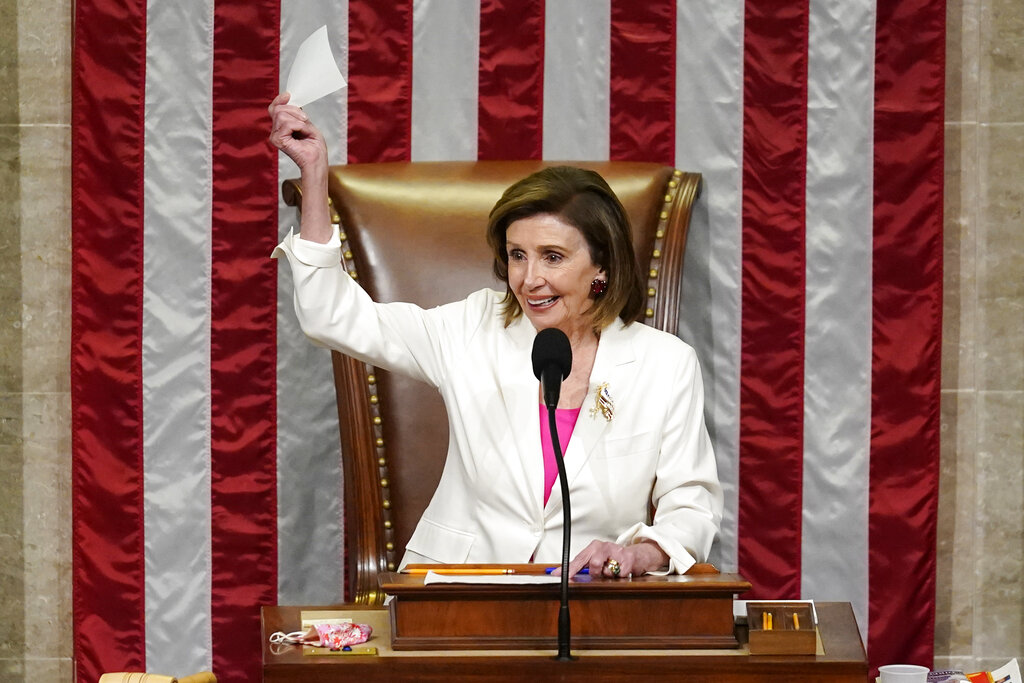
Speaker of the House Nancy Pelosi, D-Calif., presides over House passage of President Joe Biden’s expansive social and environment bill, at the Capitol in Washington, Friday, Nov. 19, 2021. (AP Photo/J. Scott Applewhite)
The breaking news: The House passed the Build Back Better bill this morning. CNBC: House passes $1.75 trillion Biden plan that funds universal pre-K, Medicare expansion and renewable energy credits.
The House of Representatives on Friday passed the largest expansion of the social safety net in decades, a $1.75 trillion bill that funds universal pre-K, Medicare expansion, renewable energy credits, affordable housing, a year of expanded Child Tax Credits and major Obamacare subsidies.
The final vote was 220-213, and only one Democrat, Jared Golden of Maine voted against the bill.
Now that it has cleared the House, President Joe Biden’s Build Back Better Act goes to the Senate, where it is likely to be revised in the coming weeks. Senate Majority Leader Chuck Schumer said he aims to have the chamber pass the bill before Christmas. The House will need to vote on it again if the bill is altered.
If the measure is signed into law, the bill will profoundly change how many Americans live, especially families with children, the elderly and low income Americans.
What’s in the current version of the bill:
- Universal preschool for all 3- and 4-year olds. In addition to helping millions of children prepare better for school, the benefit would enable parents of young children to return to the work force earlier.
- Capping childcare costs at 7% of income for parents earning up to 250% of a state’s median income.
- 4 weeks of federal paid parental, sick or caregiver leave.
- A year of expanded Child Tax Credits. During the past year, these credits have raised households with more than 3 million children out of poverty, and cut overall child poverty in America by 25%.
- Extended pandemic-era Affordable Care Act subsidies. So far this year, these subsidies have increased ACA enrollment by more than 2 million.
- New hearing benefits for Medicare beneficiaries, including coverage for a new hearing aid every five years.
- A $35 per-month limit on the cost of insulin under Medicare, and a cap on out-of-pocket prescription drug costs at $2,000 per year.
- $500 billion to combat climate change, largely through clean energy tax credits. This represents the largest ever federal investment in clean energy.
- Raising the State and Local Tax deduction limit from $10,000 to $80,000.
The bill represents a major victory for House Speaker Nancy Pelosi, D-Calif., who pulled together a divided caucus with conflicting interests and united it behind a sprawling, 2,000-plus-page bill, passing it with a thin majority.
The vote was supposed to be last night, but a deranged Kevin McCarthy decided to make a last ditch effort to prevent it from going forward. The New York Times: Kevin McCarthy Speaks for More Than Eight Hours to Delay a House Vote.
House Minority Leader Kevin McCarthy of California early Friday concluded a marathon speech in opposition to the Democrats’ social policy bill, after talking for eight hours and 32 minutes, surpassing the length of one by Representative Nancy Pelosi in 2018 that held the record for the longest continuous House speech in modern history.
“Personally I didn’t think I could go this long,” Mr. McCarthy said toward the end of his monologue as some of the people behind him struggled to keep their eyes open. Finally, after 5 a.m., he finished. “With that, Madam Speaker, I yield back,” he said.
Mr. McCarthy, the top Republican in the House, railed against President Biden and his agenda in an effort to delay the passage of the Democrats’ $1.85 trillion social policy and climate change bill.
The debate over the bill had been scheduled to last 20 minutes before Mr. McCarthy took over after 8 p.m. to deliver an at times rambling speech stuffed with Republican talking points against the legislation and punctuated with riffs about history.
“I know some of you are mad at me, think I spoke too long,” he said at one point. “But I’ve had enough. America has had enough.”
Shortly after midnight Friday, when Mr. McCarthy showed no sign of yielding control of the House floor, Democratic leaders sent lawmakers home, with plans to return at 8 a.m. to finish debate and vote on the sprawling package.
The horror! The notion of the government helping regular Americans instead of enriching the already super-rich was just too much for McCarthy and the rest of the Trumpist goons.
The Daily Beast: Democrats Finally Unite—to Mock Kevin McCarthy All Night as He Breaks Stupid Record.
Curiously, McCarthy stopped talking shortly after surpassing the eight hour, seven minute record set by Nancy Pelosi in 2018—yielding after eight hours and 32 minutes.
Starting at 8:38 p.m., McCarthy took full advantage of the “Magic Minute”—in which leaders from both parties are allowed to speak for as long as they want with it only counting as one minute against the time allocated for debate—and delivered a stemwinder of half-truths, outright lies, aggrieved arguments, unrelated tangents, and recycled rhetoric….
As McCarthy began his lecture on the floor Thursday, the Democratic heckling started almost immediately. McCarthy told members he had “all night,” to which Democrats responded, “So do we!”
And both sides really did.
When McCarthy baselessly claimed the bill would cost $5 trillion, Democrats started yelling out increasingly large numbers. “$6 trillion!” one shouted, before another topped him with “$7 trillion!”—with more Democrats joining in with even more farcical projections.
When McCarthy said, “If I sound angry, I am,” Democrats chimed in with a prolonged “awww” sound, like they were watching a baby do something cute.
Read more at the link. Democrats mocked McCarthy on Twitter too. Read more at Mediaite: House Democrats Roast Kevin McCarthy on Twitter for Marathon Speech: ‘Please Saw Me in Half and Put Me Out of My Misery.’
Biden appears to be working up to getting rid of Postmaster General Louis DeJoy. The Washington Post: Biden expected to replace Ron Bloom, USPS board chair and key DeJoy ally, on postal board.
President Biden is expected to announce Friday that he will not renominate Ron Bloom, the chair the U.S. Postal Service board and a key ally of Postmaster General Louis DeJoy, when his term expires next month, according to three people with knowledge of the situation.
The move casts doubt on DeJoy’s future at the agency, the people said, who spoke on the condition of anonymity to discuss private conversations.
The decision potentially gives liberals on the panel another crucial vote to oust the postmaster general, who can only be removed by the board of governors. The nine-member board currently comprises four Democrats, four Republicans and one independent, though Biden has only appointed three members.
Bloom, a Democrat, has backed DeJoy as the agency permanently slowed mail delivery standards and raised prices.
Biden’s decision reflects the White House’s continued antipathy toward DeJoy, who is widely viewed as a loyalist to former president Donald Trump.
Read the rest at the WaPo.
Yesterday, Dakinikat posted a video of Louisiana Senator John Kennedy going full Joseph McCarthy on a Biden appointee.
At The Guardian, David Smith writes: ‘Professor or comrade?’ Republicans go full red scare on Soviet-born Biden pick.
Saule Omarova, 55, was nominated in September to be America’s next comptroller of the currency. If confirmed, she would be the first woman and person of colour in the role in its 158-year-history.
Omarova was born in Kazakhstan when it was part of the Soviet Union and moved to the US in 1991. For John Kennedy of Louisiana, a member of the Senate banking committee, this was like a red rag to a bull.
Questioning whether Omarova was still a member of communist youth organisations, Kennedy said: “I don’t mean any disrespect: I don’t know whether to call you professor or comrade.”
The remark prompted gasps in the hearing room on Capitol Hill.
Omarova replied, slowly and firmly: “Senator, I’m not a communist. I do not subscribe to that ideology. I could not choose where I was born.
“I do not remember joining any Facebook group that subscribes to that ideology. I would never knowingly join any such group. There is no record of me actually participating in any Marxist or communist discussions of any kind.”
Omarova then told how her family suffered under the communist regime.
“I grew up without knowing half of my family. My grandmother herself escaped death twice under the Stalin regime. This is what’s seared in my mind. That’s who I am. I remember that history. I came to this country. I’m proud to be an American and this is why I’m here today, Senator.”
Omarova has worked mainly as a lawyer and most recently as a law professor at Cornell University. She has testified often as an expert witness on financial regulation and even worked briefly in the administration of George W Bush.
Kennedy wasn’t the only one to attack Omarova.
…in a letter to Omarova after she was nominated, Senator Pat Toomey of Pennsylvania requested a copy of a graduation paper she wrote about Karl Marx when she was an undergraduate at Moscow State University – “in the original Russian” .
At Thursday’s hearing, Toomey noted that Omarova has written several academic papers that propose sweeping changes to the banking system.
“Taken in totality, her ideas do amount to a socialist manifesto for American financial services,” he said.
A judge is trying to muzzle the NYT in the Project Veritas case. The New York Times: Judge Tries to Block New York Times’s Coverage of Project Veritas.
A New York trial court judge ordered The New York Times on Thursday to temporarily refrain from publishing or seeking out certain documents related to the conservative group Project Veritas, an unusual instance of a court blocking coverage by a major news organization.
The order raised immediate concerns among First Amendment advocates, who called it a violation of basic constitutional protections for journalists, a viewpoint echoed by The Times. Project Veritas issued a statement in support of the order, arguing that it did not amount to a significant imposition on the newspaper’s rights.
The judge’s order is part of a pending libel lawsuit filed by Project Veritas against The Times in 2020. That suit accuses the newspaper of defaming Project Veritas in its reporting on a video produced by the group that made unverified claims of voter fraud in Minnesota.
Led by the provocateur James O’Keefe, Project Veritas often conducts sting operations — including the use of fake identities and hidden cameras — aimed at embarrassing Democratic campaigns, labor organizations, news outlets and other entities. It is the subject of a Justice Department investigation into its possible involvement in the reported theft of a diary that apparently belonged to President Biden’s daughter, Ashley.
Theodore J. Boutrous Jr., a lawyer who represents media outlets including CNN, called the court’s order “ridiculous.”
“Even though it’s temporary, the Supreme Court has said even the most modest, minute-by-minute deprivations of these First Amendment rights cannot be tolerated,” Mr. Boutrous said. “To go further and suggest a limit on news gathering, I’ve never heard of such a thing.”
Read the rest at the NYT. See also The Washington Post: Court bars New York Times from publishing Project Veritas memos in move called ‘unconstitutional.’
More stories to check out today:
Will Bunch at The Philadelphia Inquirer: The impeachment of President Biden and other American nightmares coming in 2023.
The Daily Beast: Europe Locking Back Down With COVID Winter Surge Coming for Us All.
The Washington Post: Prominent scientist who said lab-leak theory of covid-19 origin should be probed now believes evidence points to Wuhan market.
The Chicago Tribune: Man spotted with AR-15 outside Kyle Rittenhouse trial confirms he is a fired Ferguson police officer.
Politico Magazine: The Bonnie and Clyde of MAGA World. For a decade, Dustin Stockton and Jennifer Lawrence had surfed the wave of populist-right politics like few other people in America. Then came Jan. 6.
CNN: Trump’s ire grows as DeSantis’ popularity with Republicans takes off.
The Washington Post: ‘No one tells me what to do’: Sinema praises infrastructure, questions spending and inflation in wide-ranging interview.
What stories are you following today?
Did you like this post? Please share it with your friends:
Posted: November 16, 2021 | Author: bostonboomer | Filed under: Afternoon Reads | Tags: Carl Bernstein, Coup attempt, Donald Trump, Ezra Cohen, Jenna Ellis, Jonathan Karl, Michael Flynn, Sidney Powell |
Good Afternoon!!
I’m having trouble getting going this today. I looked around at the latest news, and I started to feel exhausted. But I’m resisting sinking into that feeling. I have to believe there is some way for us as a country to recover from the Trump poison. At least we got some good news yesterday when Biden signed the bipartisan infrastructure bill and Pelosi announced that the House could vote on the Build Back Better bill this week.
Now Democrats will need to convince voters how great these accomplishments are.
Today’s news is filled with revelations from the book “Betrayal,” by Jonathan Karl, released today. In her review of the book in The New York Times, Jennifer Szalai focuses on Karl’s (along with other journalists) apparent blindness about who and what Trump was: In Another Trump Book, a Journalist’s Belated Awareness Steals the Show.
…[I]n his new book, “Betrayal: The Final Act of the Trump Show,” Karl comes across as almost poignantly ingenuous and polite to a fault, repeatedly flummoxed by what he saw in the last year of the Trump administration. “Front Row,” which had the unfortunate timing of being published in March 2020, before the consequences of Trump’s governance were fully laid bare, began with a solemn tribute to “objectivity and balance” and a complaint that “the mainstream media coverage of Donald Trump is relentlessly and exhaustively negative.” Just a year-and-a-half later, after 750,000 American Covid deaths and an attack on the Capitol, Karl allows that the “Trump show” may have in fact been more sinister than mere theatrics after all.
“I have never wavered from my belief that journalists are not the opposition party and should not act like we are,” Karl maintains in “Betrayal.” “But the first obligation of a journalist is to pursue truth and accuracy. And the simple truth about the last year of the Trump presidency is that his lies turned deadly and shook the foundations of our democracy.”
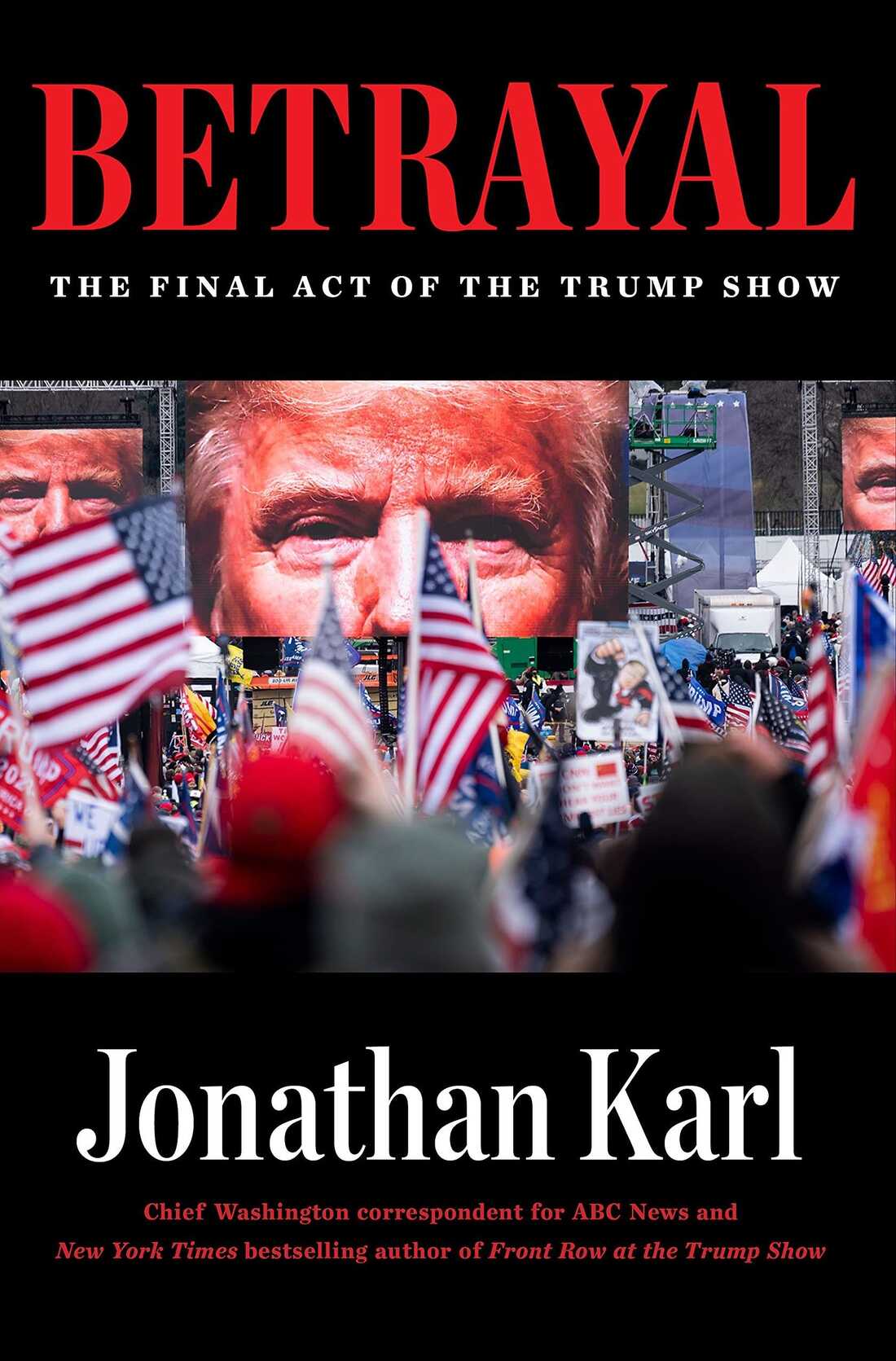 According to Szalai, Karl repeated writes in the book that he is shocked by Trump’s behavior. From a description of Karl’s face-to-face interview with Trump:
During the…interview, Trump reminisced about the speech he gave on Jan. 6, 2021, shortly before the attack on the Capitol, calling it “a very beautiful time with extremely loving and friendly people.” Karl, at least inwardly, was aghast. “I was taken aback by how fondly he remembers a day I will always remember as one of the darkest I have ever witnessed,” he writes, adding that Trump seemed to justify the death threats made against his own vice president. “It boggled my mind,” Karl says.
It did? The author’s expressions of surprise are so frequent and over-the-top that they are perhaps the most surprising parts of this book. “Betrayal” is less insightful about the Trump White House and more revealing of Karl’s own gradual, extremely belated awareness that something in the White House might in fact be awry. Events strike him as “wacky,” “crazy,” “nuts.” He delves into the outlandish conspiracy theories around the presidential election, earnestly explaining why each of them is wrong. He scores a number of on-the-record interviews with Trumpworld insiders — nearly all of whom insist that even as they publicly sided with Trump, they were bravely telling the president some very tough truths in private.
This is so typical of what we saw from journalists during the Trump years. They repeatedly tried to normalize Trump’s behavior and some are still doing it. But Trump showed us who again and again before he ran for president and especially during the 2016 campaign. Yet Karl was still shocked by what Trump said in the interview–even after he (Trump) refused to concede the election and led a serious coup attempt.
More revelations from the book:
ABC News: Trump allies pressed Defense Department to help overturn election, new book says.
In “Betrayal: The Final Act of the Trump Show,” scheduled to be released today, Karl reports that former Trump national security adviser Michael Flynn and former Trump attorney Sidney Powell tried to enlist a Pentagon official to help overturn the election.
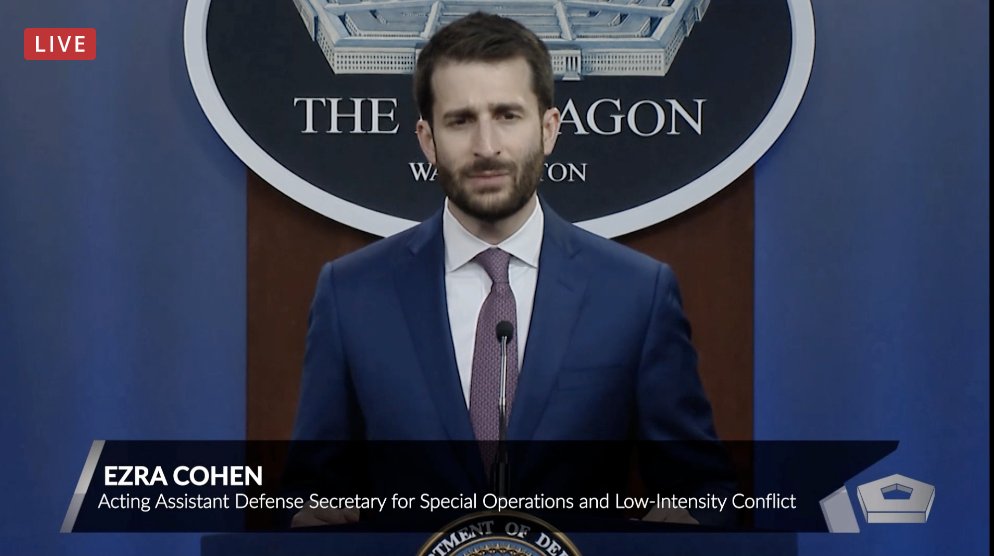
According to the book, Flynn — who had just received an unconditional pardon from President Trump after pleading guilty in 2017 to lying to the FBI during the Russia probe — made a frantic phone call to a senior Trump intelligence official named Ezra Cohen (sometimes referred to as Ezra Cohen-Watnick), who previously worked under Flynn at both the Defense Intelligence Agency (DIA) and the National Security Council.
“Where are you?” Flynn asked the DoD official, who said he was traveling in the Middle East.
“Flynn told him to cut his trip short and get back to the United States immediately because there were big things about to happen,” according to the book. Karl writes that Flynn told Cohen, “We need you,” and told the DoD official that “there was going to be an epic showdown over the election results.”
Flynn, according to the book, urged Cohen that “he needed to get orders signed, that ballots needed to be seized, and that extraordinary measures needed to be taken to stop Democrats from stealing the election.”
“As Flynn ranted about the election fight, [Cohen] felt his old boss sounded manic,” Karl writes in the book. “He didn’t sound like the same guy he had worked for.”
 It gets even crazier.
“Betrayal” also reports that Sydney Powell, Flynn’s former lawyer who was then advising President Trump, called Cohen shortly after the Flynn conversation and tried to enlist his help with one the most far-fetched claims about the election, involving then-CIA Director Gina Haspel.
“Gina Haspel has been hurt and taken into custody in Germany,” Powell told Cohen, pushing a false conspiracy theory that had been gaining steam among QAnon followers, according to the book. “You need to launch a special operations mission to get her,” Powell said.
Powell, according to the book, was pushing the outlandish claim that Haspel had been injured while on a secret CIA operation to seize an election-related computer server that belonged to a company named Scytl — none of which was true.
“The server, Powell claimed, contained evidence that hundreds of thousands, maybe millions, of votes had been switched using rigged voting machines. Powell believed Haspel had embarked on this secret mission to get the server and destroy the evidence — in other words, the CIA director was part of the conspiracy,” Karl writes.
Powell wanted the Defense Department to send a special operations team over to Germany immediately: “They needed to get the server and force Haspel to confess,” Karl writes.
All of this was too crazy even for Trump loyalist Cohen, yet these are the people Trump was listening to after the election.
Hayes Brown at MSNBC: Jenna Ellis’ memo on stealing the 2020 election holds a lesson for Democrats.
After losing the 2020 presidential election, former President Donald Trump was obsessed with finding a route to remain in power. In September, we learned that John Eastman, a conservative lawyer working with Trump’s legal team, went so far as to write a two-page memo for how to throw out President Joe Biden’s win before Congress could certify it in January.
And in the last week, we’ve learned that Eastman wasn’t alone in taking notes on a criminal conspiracy. At least two other people prepared memos to justify Trump’s reinstallation as president. This collection of memos shows more clearly than ever that those closest to the former president were dedicated to finding some loophole to keep him in power. Their mentally thin, ultimately self-serving assertions acted as fuel to Trump’s delusions, which he then passed on to his followers — most spectacularly, of course, at his rally ahead of the riot on Jan. 6….

Jenna Ellis with Trump
ABC News first reported Sunday that White House chief of staff Mark Meadows emailed Vice President Mike Pence’s chief of staff on Dec. 31 to pass on a memo from Trump campaign lawyer Jenna Ellis. Ellis — whom you may recall from her many failed attempts to reverse the election in court — “outlined a multi-step strategy,” according to Karl:
On Jan. 6, the day Congress was to certify the 2020 election results, Pence was to send back the electoral votes from six battleground states that Trump falsely claimed he had won.
The memo said that Pence would give the states a deadline of “7pm eastern standard time on January 15th” to send back a new set of votes, according to Karl.
Then, Ellis wrote, if any state legislature missed that deadline, “no electoral votes can be opened and counted from that state.”
That scheme aligns with one of the scenarios that Eastman laid out in his longer Jan. 3 memo. And at first glance it seems like a valid off-ramp that would let Trump save face and allow time to investigate the “fraud” that he had alleged. It’s not dissimilar in that sense from the arguments that Sens. Ted Cruz, R-Texas, and Josh Hawley, R-Mo., made in their refusal to vote to certify the election.
Crucially, though, the plan’s real goal depended on another plot that was underway inside the Trump administration. The Justice Department was under pressure in the weeks after the election to issue a letter to the states Trump falsely claimed to have won declaring that there was enough “significant concern” of fraud to warrant special sessions of their legislatures. Those legislatures controlled by the GOP — like Georgia’s and Arizona’s — would then provide the electoral votes needed to put Trump over the top under Ellis’ proposal.
Here’s the promised warning for Democrats:
Whether we like it or not, there are numerous loopholes and vagaries in our method of choosing a president. None of them have been remedied since 2020. And there are now multiple examples for the next would-be coup leader to draw from when exploiting the flaws inherent in the electoral system. If anything, Republican-controlled states have been moving to codify those flaws for their own benefit, making it easier for legislatures to overturn the will of the people.

Jonathan Karl
I’ll end with this from EconoTimes: Capitol insurrection: Carl Bernstein says infamous memos are ‘blueprints’ of a coup.
According to Watergate reporter Carl Bernstein, the infamous memos drafted for Mike Pence to overturn the election results is a blueprint of a coup.
Bernstein weighed in on a recording of Trump and ABC journalist Jonathan Karl’s conversation, where the former president did not deny that he told Pence that if he does not overturn the 2020 election results, he is a “p***y.” The Watergate reporter said that there is more to the former president’s comments and touched on the memos drafted by lawyers John Eastman and Jenna Ellis. The memos detailed how Pence could overturn the 2020 elections, which Pence ultimately refused to do.
“I think what we’re seeing in these memos particularly are blueprints for a coup,” said Bernstein. “The actual blueprints in document form in which the president of the United States, through his chief of staff, is sending to Mike Pence’s, the vice president’s staff, a blueprint to overturn an election, a blueprint for a conspiracy led by a president of the United States to result in an authoritarian coup in which the election is stolen.”
Bernstein added that there is nothing that comes close to what happened in the 2020 elections and that it is all documented in writing. The Watergate reporter noted that more records are needed to determine what the former president said and did, especially on January 5 and January 6. Bernstein added that the House Committee must act fast to find the answers in case the GOP regains the majority in the House in 2022.
That’s it for me today. It is all so exhausting. But we have to hold onto hope somehow, don’t we? Please let me know your thoughts on this or any topic in the comment thread.
Did you like this post? Please share it with your friends:
Posted: November 13, 2021 | Author: bostonboomer | Filed under: morning reads | Tags: coronavirus pandemic, Department of Justice, Donald Trump, Fulton County DA Fani Willis, Georgia, January 6 Committee, Jeffrey Clark, Mark Meadows, Merrick Garland, Steve Bannon, violent threats against public officials |

Reading Sociology, by Kurt Solmssen
Good Morning!!
I know this isn’t breaking news to any Sky Dancers, but it’s still the best news in a long time. Steve Bannon has been indicted for contempt of Congress. More good news: it appears that Merrick Garland actually is taking the insurrection seriously. From the DOJ statement issued yesterday:
Stephen K. Bannon was indicted today by a federal grand jury on two counts of contempt of Congress stemming from his failure to comply with a subpoena issued by the House Select Committee investigating the Jan. 6 breach of the U.S. Capitol.
Bannon, 67, is charged with one contempt count involving his refusal to appear for a deposition and another involving his refusal to produce documents, despite a subpoena from the House Select Committee to Investigate the January 6 Attack on the U.S. Capitol. An arraignment date has not yet been set in the U.S. District Court for the District of Columbia.
“Since my first day in office, I have promised Justice Department employees that together we would show the American people by word and deed that the department adheres to the rule of law, follows the facts and the law and pursues equal justice under the law,” said Attorney General Merrick B. Garland. “Today’s charges reflect the department’s steadfast commitment to these principles.”
Katie Benner and Luke Broadwater at The New York Times: Bannon Indicted on Contempt Charges Over House’s Capitol Riot Inquiry.
A Justice Department spokesman said Mr. Bannon was expected to turn himself in to authorities on Monday, and make his first appearance in Federal District Court in Washington later that day.
A lawyer for Mr. Bannon did not immediately respond to a request for comment.
The politically and legally complex case was widely seen as a litmus test for whether the Justice Department would take an aggressive stance against one of Mr. Trump’s top allies as the House seeks to develop a fuller picture of the actions of the former president and his aides and advisers before and during the attack on the Capitol.
At a time of deep political polarization, the Biden Justice Department now finds itself prosecuting a top adviser to the previous president of another party in relation to an extraordinary attack by Mr. Trump’s supporters on a fundamental element of democracy, the peaceful transfer of power….
After the referral from the House in Mr. Bannon’s case, F.B.I. agents in the Washington field office investigated the matter. Career prosecutors in the public integrity unit of the U.S. attorney’s office in Washington determined that it would be appropriate to charge Mr. Bannon with two counts of contempt, and a person familiar with the deliberations said they received the full support of Attorney General Merrick B. Garland.

White cat at an open window’, 1855 – Jacobus van Looy
The indictment of Bannon serves as a warning to other Trump goons who have refused to testify before the House January 6 committee.
The charges against Mr. Bannon come as the committee is considering criminal contempt referrals against two other allies of Mr. Trump who have refused to comply with its subpoenas: Mr. Meadows and Jeffrey Clark, a Justice Department official who participated in Mr. Trump’s effort to overturn the results of the 2020 election.
“Steve Bannon’s indictment should send a clear message to anyone who thinks they can ignore the select committee or try to stonewall our investigation: No one is above the law,” the leaders of the panel, Representative Bennie Thompson, Democrat of Mississippi, and Representative Liz Cheney, Republican of Wyoming, said in a statement. “We will not hesitate to use the tools at our disposal to get the information we need.”
Earlier they had released another blistering statement after Mr. Meadows failed to appear to answer questions at a scheduled deposition. Mr. Meadows’s lawyer, George J. Terwilliger III, informed the committee that his client felt “duty bound” to follow Mr. Trump’s instructions to defy the committee, citing executive privilege.
“Mr. Meadows’s actions today — choosing to defy the law — will force the select committee to consider pursuing contempt or other proceedings to enforce the subpoena,” Mr. Thompson and Ms. Cheney said.
They said Mr. Meadows refused to answer even basic questions, such as whether he was using a private cellphone to communicate on Jan. 6, and the location of his text messages from that day.
Aaron Blake at The Washington Post: The big warning signal Stephen Bannon’s indictment sends.
For more than two years, the Democratic-controlled House struggled to obtain crucial testimony from Trump White House counsel Donald McGahn in its Russia investigation. When he declined to submit to a subpoena, they fought it out in court. By the time an agreement was reached for McGahn to testify this year, Donald Trump was no longer in the White House, and the Russia issue had faded in both import and memories. McGahn said frequently in his testimony that he no longer fully recalled important episodes….
This time, though, the House and its select committee investigating the Jan. 6 attack on the U.S. Capitol by a pro-Trump mob took a very different tack. And it resulted in both a legally and practically significant result.
Rather than try to get a court to make former White House adviser Stephen K. Bannon testify, the Jan. 6 committee instead moved quickly to recommend he be held in contempt of Congress. That put the decision into the hands of the Justice Department, which would need to decide whether to file criminal charges. But it would at least be quicker.
On Friday, this approach — an extraordinary gambit necessitated by an extraordinary effort to stymie investigators for most of the past five years — led to an extraordinary outcome: Bannon has been indicted by a federal grand jury, making him the first person charged with contempt of Congress since 1983.

Black cat on the front porch, by Bonnie Mason
While an indictment is significant — it’s actually the second time Bannon has been indicted in fewer than 15 months, with the first earning a preemptive Trump pardon — the move is less punitive than it is precedent-setting.
Other witnesses, including former Trump White House chief of staff Mark Meadows, who are also resisting cooperation with the inquiry, now have to contend with the prospect of potential criminal charges….an indictment is a bell that can’t be un-rung. Those like Meadows might defy the subpoenas in the hope of some kind of accommodation — perhaps allowing them to withhold a certain part of their testimony or documents that have been requested. Bannon’s indictment serves notice that the Jan. 6 committee can threaten to play hardball, with plenty to back it up….
Bannon and Meadows are among the first against whom this could even be deployed. Theirs were among the first batch of subpoenas, along with White House communications aide Dan Scavino and national security aide Kashyap Patel. In other words, plenty of others will now have very important decisions to make. Another big one will be Trump DOJ official Jeffrey Clark, who spearheaded the effort to get his department to legitimize Trump’s false stolen-election claims.
Fulton County District Attorney Fani Willis is likely to impanel a special grand jury to support her probe of former President Donald Trump, a move that could aid prosecutors in what’s expected to be a complicated and drawn-out investigative process.
A person with direct knowledge of the discussions confirmed the development to The Atlanta Journal-Constitution, saying the move could be imminent.
Some legal observers viewed the news, first reported by the New York Times, as a sign that the probe is entering a new phase.
“My interpretation is that she’s gotten as far as she can interviewing witnesses and dealing with people who are cooperating by producing documents voluntarily,” former Gwinnett County DA Danny Porter said of Willis. “She needs the muscle. She needs the subpoena power.”

Deborah Dewit, Birdwatching
Special grand juries are rarely used but could be a valuable tool for Willis as she takes the unprecedented step of investigating the conduct of a former president while he was in office.
Her probe, launched in February, is centered on the Jan. 2 phone call Trump placed to Secretary of State Brad Raffensperger, in which he urged the Republican to “find” the votes to reverse Joe Biden’s win in Georgia last November. The veteran prosecutor previously told Gov. Brian Kemp, Raffensperger and other state officials that her office would be probing potential violations of Georgia law prohibiting criminal solicitation to commit election fraud, intentional interference with the performance of election duties, conspiracy and racketeering, among others.
The investigation could also include Trump attorney Rudy Giuliani, who promoted lies about election fraud in a state legislative hearing; and U.S. Sen. Lindsey Graham of South Carolina, who was accused by Raffensperger of urging him to toss mail-in ballots in certain counties. Both men have denied wrongdoing.
In other news, another Congressional committee is investigating efforts by the Trump administration to downplay the coronavirus pandemic. The Washington Post: Messonnier, Birx detail political interference in last year’s coronavirus response.
The Trump administration repeatedly interfered with efforts by the Centers for Disease Control and Prevention last year to issue warnings and guidance about the evolving coronavirus pandemic, six current and former health officials told congressional investigators in recent interviews.
One of those officials, former CDC senior health expert Nancy Messonnier, warned in a Feb. 25, 2020, news briefing that the virus’s spread in the United States was inevitable — a statement that prompted anger from President Donald Trump and led to the agency’s media appearances being curtailed, according to interview excerpts and other documents released Friday by the House select subcommittee on the pandemic.
The new information, including statements from former White House coronavirus coordinator Deborah Birx, confirms prior reporting and offers additional detail on how the pandemic response unfolded at the highest levels of government.
“Our intention was certainly to get the public’s attention about the likelihood … that it was going to spread and that we thought that there was a high risk that it would be disruptive,” Messonnier told the panel in an Oct. 8 interview. But her public warning led to private reprimands, including from then-Health and Human Services Secretary Alex Azar, she said….
Anne Schuchat, who served as the CDC’s No. 2 official before retiring this year, also depicted chaotic efforts to control the government’s messages in those early months, telling the panel that Trump officials scrambled to schedule a briefing several hours after Messonnier’s public warning, even though “there was nothing new to report.”

Cat’s Siesta, Ksenia Yarovaya
Schuchat joined Trump and other officials for a briefing the very next day,where Trump insisted that the pandemic’s spreadto the United States was not “inevitable,” even as Schuchat tried to warn Americans to prepare for “more cases.” [….]
Other officials detailed why the CDC held no news briefings between March 9 and May 29, 2020, in the earliest days of the pandemic, effectively muzzling the scientific agency as the coronavirus spread rapidly across the United States.
Kate Galatas, a senior CDC communications official, told the panel that the White House repeatedly blocked the agency’s media requests, including a planned April 2020 briefing that she said would have addressed the importance of wearing face coverings to contain the virus’s spread.
Read the rest at the WaPo.
I’ll end with this article at The New York Times addresses the alarming number of violent threats against public figures we are seeing in U.S.: Menace Enters the Republican Mainstream.
At a conservative rally in western Idaho last month, a young man stepped up to a microphone to ask when he could start killing Democrats.
“When do we get to use the guns?” he said as the audience applauded. “How many elections are they going to steal before we kill these people?” The local state representative, a Republican, later called it a “fair” question.
In Ohio, the leading candidate in the Republican primary for Senate blasted out a video urging Republicans to resist the “tyranny” of a federal government that pushed them to wear masks and take F.D.A.-authorized vaccines.
“When the Gestapo show up at your front door,” the candidate, Josh Mandel, a grandson of Holocaust survivors, said in the video in September, “you know what to do.”
And in Congress, violent threats against lawmakers are on track to double this year. Republicans who break party ranks and defy former President Donald J. Trump have come to expect insults, invective and death threats — often stoked by their own colleagues and conservative activists, who have denounced them as traitors.
From congressional offices to community meeting rooms, threats of violence are becoming commonplace among a significant segment of the Republican Party. Ten months after rioters attacked the United States Capitol on Jan. 6, and after four years of a president who often spoke in violent terms about his adversaries, right-wing Republicans are talking more openly and frequently about the use of force as justifiable in opposition to those who dislodged him from power.
Click the link to read the rest.
What do you think? What stories are you following today?
Did you like this post? Please share it with your friends:
Posted: November 11, 2021 | Author: bostonboomer | Filed under: just because |

Egon Schiele, Four Trees, 1917, Belvedere, Vienna, Austria
Good Afternoon!!
Today is Veterans Day and for the first time in 20 years, the U.S. is not involved in a major war.
NPR explains the difference between this holiday and Memorial Day, which originated with honoring those who died during the Civil War and later was designated as a day to honor the dead from all wars. Veterans Day was originally called Armistice Day, in honor of the end of World War I:
Celebrated every November, Veterans Day honors all who have served in the U.S. military.
The federal holiday is observed on Nov. 11, the day World War I ended in 1918.
A year later, President Woodrow Wilson celebrated what was originally known as Armistice Day for the first time. But it wasn’t until 1938 that Congress recognized it as an official federal holiday.
In 1954, the holiday’s name was changed to Veterans Day, to honor the veterans of all wars the U.S. has fought. In France and elsewhere in Europe, the day continues to be known as Armistice Day.
Veteran’s Day was actually celebrated in October for several years, though.
The Uniform Holiday Act of 1968 moved the holiday from Nov. 11 to the “fourth Monday in October” to move ensure a long weekend for workers.
But in 1975 President Gerald Ford returned the holiday to its original November date, due to the significance in marking the the end of the war.
From an opinion piece by Jeremy Butler at CNN: What Veterans Day means to me and my family.
This past year and a half has come with its unique set of challenges for the veteran community — a significant portion being mental-health related. This year, a study about the impact of Covid-19 on veterans’ mental health found that nearly one year into the pandemic, the prevalence of generalized anxiety disorder increased, particularly among middle-aged veterans. Additionally, one of seven veterans experienced increased distress. Quick Reaction Force, veteran organization Iraq and Afghanistan Veterans of America’s (IAVA) comprehensive care program, reported a nearly 500% increase in veterans reaching out for support since the beginning of Covid-19 (compared to the previous 18 month period). The program also saw a 50% increase in mental-health-related needs since the pandemic hit.

Wassily Kandinsky, Autumn in Murnau, 1908
Between a once-in-a-century global pandemic, the abrupt end of the war in Afghanistan, the 20th anniversary of 9/11 and the ongoing fight to attain veteran benefits for some — like those unfairly discharged for being part of the LGBTQ+ community, to veterans seeking health care benefits for exposure to burn pits and toxic exposures — one thing is abundantly clear: veterans deserve access to quality resources and support when they return home from service.
Transitioning from the military can be difficult and some veterans experience challenges reintegrating into civilian life — including employment, homelessness, and mental health related needs. We’ve heard mentions in the news that the withdrawal of American troops from Afghanistan coupled with the lingering effects of the pandemic has compounded feelings of anger, sadness, despair and isolation among veterans, spurring increased mental health concerns in our community.
However, the following stats might be less familiar to most. According to the Department of Veterans Affairs’ 2021 veteran suicide prevention report, about 17 veterans died by suicide every day in 2019. A recent membership survey by IAVA, an organization representing over 425,000 veterans and allies nationwide, also found that 43% of its members have considered suicide following joining the military. There are many factors that contribute to a veteran taking their own life — from mental health related needs, employment struggles, threat of homelessness, isolation, and difficulty accessing care, to name a few. These jarring statistics are neon signs to invest in and provide swift access to better care for all transition related challenges veterans may be experiencing.
E.J. Dionne at The Washington Post: Opinion: Asking military service of so few takes a toll on our democracy.
We rely on fewer and fewer of our fellow Americans to bear the burdens of war.
Nowhere is this narrowing of the responsibilities of military service more obvious than in the halls of Congress. Half a century ago, roughly three-quarters of the members of the House and Senate had served in the military. Today, veterans account for less than a fifth of Congress.

Paul Gauguin, Landscape in Arles near the Alyscamps, 1888
This is, in part, a natural outcome of the end of the draft. But that does not reduce our national obligation to make Veterans Day more than a one-off occasion for gratitude.
We need to take stock of the burdens that 20 years of war have imposed on a remarkably limited share of American families.And we need to consider what it means that a large proportion of our nation’s leadership has never known what it is like to face combat. Its members have never had to risk their lives carrying out decisions made far away. They do not have to bear the physical and emotional scars of battle long after the wars end.
Perhaps because they are a self-chosen few, military veterans in Congress feel a special responsibility — to other vets, to the nation and to each other. Twenty-five veterans from both parties formed the For Country Caucus, with the goal of “a less polarized Congress.”
Read Veterans Day thoughts from caucus members at the link.
At Newsweek, William N. Arkin looks back on Veterans day in 2020: ‘We Are On the Way to a Right-wing Coup,’ the CIA Director Privately Warned.
It was the president’s first public appearance since the election—apart from his golf outings. On Veterans Day, November 11, Donald Trump and Vice President Mike Pence attended a wreath-laying ceremony at the Tomb of the Unknown Soldier at Arlington National Ceremony. It was a somber occasion amid a steady rain, shadowed by the president’s refusal to concede the election and by his firing of Secretary of Defense Mark Esper so close to a transition.
Trump and Pence, accompanied by their wives, were late; their motorcade arrived well after the ceremony had started. The Army honor guard had already gone through most of their drill and the 21-gun salute rang out as the country’s elected leaders were driving up.
At the appointed moment, Trump walked to the wreath and laid a hand on it before returning to his spot to stand for the rest of the ceremony, about a half-hour. He made no public remarks, according to the White House pool reporters there.
Trump had actually pushed to hold the service, despite the recommendations of public health officials that the event should be cancelled because of the pandemic.
Behind the scenes, military leaders were worried about what Trump might do to remain in power despite losing the election. Chairman of the Joint Chiefs of Staff General Mark Milley had heard rumors that Trump might try to have him removed.

Georgia O’Keefe, Autumn Leaves
Milley was taken aback by the prospect of such an unprecedented action, afraid that he was witnessing the unfolding of a coup. CIA Director Gina Haspel, who also expected to be fired, shared his fear. “We are on the way to a right-wing coup,” she told Milley.
In the “tank,” the military-only chamber famous for deliberations and private discussion, the seven joint chiefs, plus Milley and the vice chairman, quietly and privately began talking about what their options would be if they had to block an unlawful order from the commander-in-chief. According to a retired general officer who spoke to one of the participants, in the tank the discussions were frank and emotional. “They grappled with wide-ranging questions,” the senior officer said. “Not just how to protect the republic should Trump threaten, but also ways to protect the military institution, a goal that didn’t always easily mesh with what needed to get done.”
After the ceremony at Arlington National Cemetery, acting secretary Miller and Gen. Milley went on to a celebration at the new National Museum of the United States Army. Speaking of the history of the armed forces and the role that the military played in American society, nonpartisan and now “professional,” Milley drew his line in the sand.
“We are unique among militaries,” he said in his speech. “We do not take an oath to a king or a queen, a tyrant or a dictator. We do not take an oath to an individual. No, we do not take an oath to a country, a tribe or religion. We take an oath to the Constitution. And every soldier that is represented in this museum, every sailor, airman, Marine, Coast Guardsman, each of us will protect and defend that document, regardless of personal price.” [….]
Meanwhile on television, retired four-star Army Gen. Barry McCaffrey also voiced what many in the brass were thinking, warning that Americans were “watching a slow-moving Trump coup to defy the Biden election and refuse to leave office by diktat.”
What was unfolding, though, was unique among coups. Nobody really thought the disorganized and isolated Trump was capable of organizing anything. And the president didn’t have the support of the military or the CIA or the FBI, or any of the other national security agencies, perhaps, with the exception of the Department of Homeland Security, which had become embarrassingly partisan. Milley even remarked privately that a coup wasn’t possible because his camp had all the guns—a comment that was both comforting and chilling, one that showed how perilous the post-election period had become.
It’s difficult to believe that happened only a year ago and January 6 was still to come. Malcolm Nance argues that we are still in the middle of a “political/paramilitary insurgency.”
There is some good news today. Trump continues to lose his legal battle to hide his presidential records from Congress. CNN: Judge rejects another Trump attempt to slow down documents from going to House January 6 committee.
Did you like this post? Please share it with your friends:
Posted: November 9, 2021 | Author: bostonboomer | Filed under: morning reads | Tags: anti-semitism, Donald Trump, extremist threats and violence, fascism, Fred Upton, harassment of election officials, January 6 insurrection, Kristallnacht, Nazi Germany, Paul Gosar, Racism |
Good Morning!!
Today is the anniversary of Kristallnacht.
John Farmer at The Jerusalem Post: Kristallnacht and today’s extremist violence – opinion.
Synagogues, shops, homes were vandalized and burned in the thousands. Over ninety Jews were murdered, countless others beaten. Some 20,000 Jews were seized and sent to the concentration camps at Dachau, Buchenwald, and Sachsenhausen. Several hundred died at the hands of the guards.
It may have appeared a spontaneous, chaotic, unplanned riot. In the smokescreen of chaos and violence, it was easy to miss the careful underlying planning.
Earlier that day, orders were issued to the German Police and Fire Brigades by Reinhard Heidrich that spelled out in specific detail the rules of engagement. No violent acts could be carried out that threatened German lives or property; stores and residences of Jews could be “destroyed but not looted”; non-Jewish businesses were to be “completely secured against damage”; demonstrations “which are in progress should not be prevented by the police but only supervised.” In Frankfurt, the commander of the 50th brigade passed on the order, noting that “all the Jewish synagogues within the 50th Brigade are to be blown up or set on fire immediately. Neighboring houses occupied by Aryans are not to be damaged. The action is to be carried out in civilian clothes.”
Kristallnacht’s significance as an inflection point in the campaign to destroy the Jewish population is undeniable. As David Frum has put it, “Through the end of 1937, it remained possible to hope that the Nazi persecution might still respect some last limits of humanity. …” On Kristallnacht, “the last of those illusions was smashed like broken glass.”
But Kristallnacht is significant also for the template it set forth for organizing seemingly spontaneous extremist violence. First, subject a population to unremitting sole-source propaganda for a period of time to lay a groundwork of popular belief. Second, summon that population to demonstrate its grievances. Third, enlist a relatively few trained participants to blend in with the demonstrators and incite specific acts of violence. Fourth, claim after the fact that the whole thing was an expression of spontaneous outrage.
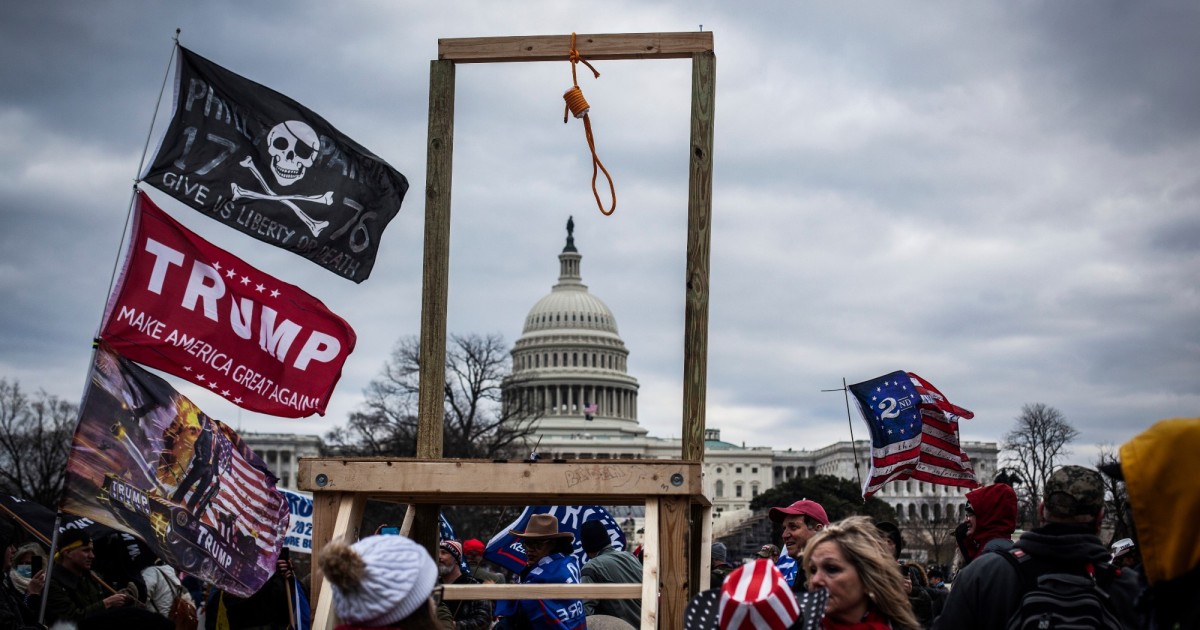
We now know that the January 6 insurrection was not spontaneous either. Trump and his goons were planning for months to claim the 2020 election was rigged and to overturn the result if Joe Biden won. If it hadn’t been for a few Republican officials who resisted Trump’s high-pressure tactics in Georgia, Michigan, Arizona, and Pennsylvania, the coup might have been successful. Next time there could be a different result.
We must always be mindful that January 6 was only the beginning of the Trumpist attacks on U.S. democracy. Since Trump began running for president we’ve seen an escalation of anti-Semitism, racism, and anti-immigrant extremism as Trump gave permission for his followers to act out their prejudices. We are still in great danger of losing our democracy.
 More from the Farmer article:
A report from June 2020 entitled “COVID-19, Conspiracy, and Contagious Sedition: A Case Study on the Militia-Sphere,” noted that “[t]he Militia-sphere’s messaging has grown increasingly extreme as the pandemic lockdowns have continued, promoting theories that the pandemic is being exaggerated to justify a police state; exploiting recent protests regarding the George Floyd incident, and transforming peaceful protests into violent chaos.” The report also noted “how the largest online conspiracy group in the U.S., QAnon, exploits the opportunity presented by these events to draw populist support for increasingly violent and apocalyptic confrontations against the lockdown, law enforcement, and an ill-defined ‘elite.’”
These trends culminated in the events of January 6, 2021 at the nation’s Capitol. The groundwork of propaganda having been laid for months, both before the election and after, and the masses having been summoned to Washington to protest the election of President Biden, the appearance of a spontaneous groundswell of outrage was well established. But as the Miller Center/NCRI’s “Assessment of the Capitol Riots” made clear, the violence associated with the protest was anything but spontaneous: “Explicit plans to `Occupy the Capitol’ were circulating across social media suggesting that the Capitol building was an explicit target of the violent vanguard from the beginning.”
I still can’t get over that Bulwark article that Dakinikat posted yesterday: Notes on an Authoritarian Conspiracy: Inside the Claremont Institute’s “79 Days to Inauguration” Report. If you haven’t read the whole piece yet, I hope you will do it now. These people were literally gaming out a coup to keep Trump in office. You can also check out this summary at The Daily Beast: Claremont Institute’s MAGA Fanfic Report Predicted Antifa Riots to Stop a Trump ‘Win’ in 2020. The final two paragraphs:
While the scenario is extremely ridiculous at points, The Bulwark notes that several of its authors, particularly Eastman, had Trump’s ear following his election defeat—so the report also serves as a chilling alternative history as to how things could have played out under different circumstances.
As reporter Christian Vanderbrouk notes in the Bulwark article: “Practically, the report is an instruction manual for how Trump partisans at all levels of government—aided by citizen ‘posses’ of Proud Boys and Oath Keepers—could, quite literally, round up opposition activists, kill their leaders, and install Donald Trump for a second term in office.”
One of the authors of the report was John Eastman, the so-called lawyer who wrote the memo outlining how Mike Pence could overturn the electoral college results.
This is how much Republican violence and hate have been normalized: Yesterday a member of Congress threatened a colleague and the president with a violent video, and so far nothing has happened to him.
The Washington Post: Rep. Paul Gosar tweets altered anime video showing him killing Rep. Ocasio-Cortez and attacking President Biden.
Rep. Paul A. Gosar (R-Ariz.) shared an altered, animated video that depicts him killing Rep. Alexandria Ocasio-Cortez (D-N.Y.) and swinging two swords at President Biden, prompting condemnation and calls for his Twitter and Instagram accounts to be suspended.
Ocasio-Cortez responded Monday night after arriving in Glasgow, Scotland, as part of a congressional delegation. Gosar, she said, will probably “face no consequences” because House Minority Leader Kevin McCarthy (R-Calif.) “cheers him on with excuses.”
A Gosar staffer defended the video Monday night, dismissing claims that it glorifies violence.
“Everyone needs to relax,” Gosar’s digital director, Jessica Lycos, said in a statement.
A Twitter spokesperson said late Monday that a “public interest notice” had been placed on Gosar’s tweet because it violates the company’s policy against hateful conduct.
Gosar has long drawn criticism for his extremist views, including his spreading of conspiracy theories about the Jan. 6 attack on the U.S. Capitol by a pro-Trump mob and the deadly white-nationalist rally in Charlottesville in 2017. In February, he appeared at an event whose organizer called for white supremacy. Gosar later distanced himself from the organizer’s remarks.
The congressman’s Sunday night post — which he shared on Twitter and Instagram — appeared to go further than his previous contentious remarks and social media posts, raising the specter of political violence in a manner similar to former president Donald Trump’s frequent allusions to armed revolution.
Read much more about this horrible situation at the WaPo. This is the atmosphere we are living in today, thanks to Trump’s influence on the Republican Party.
Trump’s followers are even attacking Republicans who fail to follow the party line in every instance. CNN: Republican congressman details threatening voicemail he received after voting for bipartisan infrastructure bill.
Republican Rep. Fred Upton on Monday shared a threatening voicemail he had received after voting for the bipartisan infrastructure bill last week.
In the voicemail, which Upton played during an interview with CNN’s Anderson Cooper on “AC360,” a caller told the Michigan Republican: “I hope you die. I hope everybody in your f**king family dies,” while labeling him a “f**king piece of sh*t traitor.”
Upton was one of just 13 House Republicans who voted with Democrats on Friday to pass the $1.2 trillion infrastructure bill after hours of delays and debating among Democrats. The legislation, which passed the Senate in August, will deliver $550 billion in new federal investments in America’s infrastructure over five years, including roads, bridges, mass transit, rail, airports, ports and waterways.
Following the Friday vote, Upton tweeted in part, “I regret that this good, bipartisan bill became a political football in recent weeks. Our country can’t afford this partisan dysfunction any longer.” [….]
Upton’s office said the voicemail was not an isolated incident. The calls came after GOP Rep. Marjorie Taylor Greene of Georgia tweeted the phone numbers of those who had voted for the bill and later called them traitors.
Reuters unmasks Trump supporters who terrified U.S. election officials.
In Arizona, a stay-at-home dad and part-time Lyft driver told the state’s chief election officer she would hang for treason. In Utah, a youth treatment center staffer warned Colorado’s election chief that he knew where she lived and watched her as she slept.
In Vermont, a man who says he works in construction told workers at the state election office and at Dominion Voting Systems that they were about to die.
“This might be a good time to put a f‑‑‑‑‑‑ pistol in your f‑‑‑‑‑‑ mouth and pull the trigger,” the man shouted at Vermont officials in a thick New England accent last December. “Your days are f‑‑‑‑‑‑ numbered.”
The three had much in common. All described themselves as patriots fighting a conspiracy that robbed Donald Trump of the 2020 election. They are regular consumers of far-right websites that embrace Trump’s stolen-election falsehoods. And none have been charged with a crime by the law enforcement agencies alerted to their threats.
They were among nine people who told Reuters in interviews that they made threats or left other hostile messages to election workers. In all, they are responsible for nearly two dozen harassing communications to six election officials in four states. Seven made threats explicit enough to put a reasonable person in fear of bodily harm or death, the U.S. federal standard for criminal prosecution, according to four legal experts who reviewed their messages at Reuters’ request.
These cases provide a unique perspective into how people with everyday jobs and lives have become radicalized to the point of terrorizing public officials. They are part of a broader campaign of fear waged against frontline workers of American democracy chronicled by Reuters this year. The news organization has documented nearly 800 intimidating messages to election officials in 12 states, including more than 100 that could warrant prosecution, according to legal experts.
The examination of the threats also highlights the paralysis of law enforcement in responding to this extraordinary assault on the nation’s electoral machinery. After Reuters reported the widespread intimidation in June, the U.S. Department of Justice launched a task force to investigate threats against election staff and said it would aggressively pursue such cases. But law enforcement agencies have made almost no arrests and won no convictions.
In many cases, they didn’t investigate. Some messages were too hard to trace, officials said. Other instances were complicated by America’s patchwork of state laws governing criminal threats, which provide varying levels of protection for free speech and make local officials in some states reluctant to prosecute such cases. Adding to the confusion, legal scholars say, the U.S. Supreme Court hasn’t formulated a clear definition of a criminal threat.
This is a long article, but it’s well worth reading the whole thing.
The hate is really out in the open now, and it seems to be getting worse. I thought it might get better once Trump was gone, but I was wrong. Please share your thoughts and links on this or any other topic in the comment thread.
Did you like this post? Please share it with your friends:



 peej
peej Carissa
 bostonboomer
 dakinikat
 ecocatwoman
 jjlo
jjlo mablue2
 Mama Lopez
 peggysue22
 quixote
 skydancingguestblogger
 Mona (aka Wonk the Vote)



 Sky Dancing
Recent Comments