Posted: July 31, 2021 | Author: bostonboomer | Filed under: morning reads | Tags: Capitol insurrection, cat art, caturday, Department of Justice, Donald Trump, Jeffrey Rosen, Mark Meadows, Mike Lindell |

Painting by Arsen Kurbanov
Good Morning!!
Yesterday was a busy news day and a very bad day for Donald Trump. The Justice Department has ordered the IRS to hand over his taxes to the House Ways and Means Committee and new evidence was revealed about his efforts to get Acting Attorney General Jeffrey Rosen to help overturn the 2020 election.
The New York Times: Treasury must turn over Trump’s taxes to Congress, the Justice Dept. says.
The Treasury Department must turn over six years of former President Donald J. Trump’s tax returns to House investigators, the Justice Department said in a legal opinion issued on Friday that most likely paves the way for their eventual release to Congress and potentially to the public.
Hours later, the Treasury told a federal judge that it planned to move ahead.
The 39-page opinion from the Justice Department’s Office of Legal Counsel dealt a sharp legal blow to a yearslong campaign by Mr. Trump to keep his tax information secret, reversing a Trump administration position that had shielded the documents from Congress.

Portrait of Gerrit Komrij, by Theo Daamen, 1986 Dutch, b.1939
Rejecting that view, the Biden administration opinion said that a request for the tax information first lodged in 2019 by the House Ways and Means Committee was legitimate and that the Treasury Department had no valid grounds to refuse it.
“The chairman of the House Ways and Means Committee has invoked sufficient reasons for requesting the former president’s tax information,” the opinion said. “Treasury must furnish the information to the committee.”
Democrats on Capitol Hill, who said they aim to examine the I.R.S.’s presidential audit program and Mr. Trump’s conflicts of interest, hailed the decision as a victory for congressional oversight powers and for national security. The House had sued to enforce the request after the Trump Treasury Department objected, and litigation continues.
“The American people deserve to know the facts of his troubling conflicts of interest and undermining of our security and democracy as president,” Speaker Nancy Pelosi said in a valedictory statement.
Katie Benner at The New York Times: Trump Pressed Justice Dept. to Declare Election Results Corrupt, Notes Show.
President Donald J. Trump pressed top Justice Department officials late last year to declare that the election was corrupt even though they had found no instances of widespread fraud, so he and his allies in Congress could use the assertion to try to overturn the results, according to new documents provided to lawmakers.
The demands were an extraordinary instance of a president interfering with an agency that is typically more independent from the White House to advance his personal agenda. They are also the latest example of Mr. Trump’s wide-ranging campaign during his final weeks in office to delegitimize the election results.

White Cat with Crescent Moon, Gertrude-Abercrombie, 1909-1977
The exchange unfolded during a phone call on Dec. 27 in which Mr. Trump pressed the acting attorney general at the time, Jeffrey A. Rosen, and his deputy, Richard P. Donoghue, on voter fraud claims that the Justice Department had found no evidence for. Mr. Donoghue warned that the department had no power to change the outcome of the election. Mr. Trump replied that he did not expect that, according to notes Mr. Donoghue took memorializing the conversation.
“Just say that the election was corrupt + leave the rest to me” and to congressional allies, Mr. Donoghue wrote in summarizing Mr. Trump’s response.
Mr. Trump did not name the lawmakers, but at other points during the call, he mentioned Representative Jim Jordan, Republican of Ohio, whom he described as a “fighter”; Representative Scott Perry, Republican of Pennsylvania, who at the time promoted the idea that the election was stolen from Mr. Trump; and Senator Ron Johnson, Republican of Wisconsin, whom Mr. Trump praised for “getting to bottom of things.”
A bit more:
The phone call by Mr. Trump was perhaps the most audacious moment in a monthslong pressure campaign aimed at enlisting the Justice Department in his crusade to overturn the election results.
After the departure of Mr. Rosen’s predecessor, William P. Barr, became public on Dec. 14, Mr. Trump and his allies harangued Mr. Rosen and his top deputies nearly every day until Jan. 6, when Congress met to certify the Electoral College and was disrupted by Mr. Trump’s supporters storming the Capitol, according to emails and other documents obtained by Congress and interviews with former Trump administration officials.
The conversations often included complaints about unfounded voter fraud conspiracy theories, frustration that the Justice Department would not ask the Supreme Court to invalidate the election and admonishments that department leaders had failed to fight hard enough for Mr. Trump, the officials said.
The Justice Department provided Mr. Donoghue’s notes to the House Oversight and Reform Committee, which is investigating the Trump administration’s efforts to unlawfully reverse the election results.

Leonard Tsuguharu Foujita, Japanese-French, 1886-1968
So it looks like we’ll be following more Congressional investigations of the the former guy in the near future. You can read specifics of Trump’s demands at that link.
David A. Graham at The Atlantic: The Insurrection Was Just Part of the Plot.
…[T]he House Oversight Committee shed more light this week on just how and why January 6 happened, releasing handwritten notes by Richard Donoghue, a top Justice Department official in the waning days of the Trump administration. The violence of the day has taken center stage, but these notes help put it in context: The angry crowd was just one part of President Donald Trump’s long-running effort to overturn the results of the election in the House of Representatives.
Trump’s effort to call the election results into doubt began long before the votes were cast, but it accelerated immediately after the election. As I wrote on January 26, Trump’s coup attempt started not on January 6 but in the wee hours of November 4, when Trump said at the White House, “This is a fraud on the American public. This is an embarrassment to our country. We were getting ready to win this election.” He added: “Frankly, we did win this election.” (He did not, and was not being frank.)
In November and early December, the focus of Trump’s efforts was pressuring state officials in places such as Arizona and Georgia to decline to certify results in favor of Biden, and pressing Attorney General William Barr to cast doubt on the results. But Barr declined, breaking with Trump, and so did pivotal Republicans including Georgia Secretary of State Brad Raffensperger and Arizona Governor Doug Ducey. Once Barr was pushed aside, The Washington Post reported this week, Trump began a daily campaign to pressure Acting Attorney General Jeffrey Rosen into doing what Barr would not, trying to place new claims of fraud before the Justice Department. Unbeknownst to Rosen, Trump was also orchestrating a plan to topple him.

Pierre Bonnard, 1867-1947
What Trump hoped to achieve from these efforts has always been a little hazy. The Justice Department doesn’t certify elections, and at most could have pursued fraud claims in court—had there been any credible ones, which there were not. The new releases by the House Oversight Committee, first reported by The New York Times,connect the dots. Donoghue explained to Trump that the DOJ couldn’t overturn the result, but the president was unruffled.
“Don’t expect you to do that, just say that the election was corrupt + leave the rest to me and the R[epublican] Congressmen” is how Donoghue recorded Trump’s response in handwritten notes.
All Trump wanted was some semi-independent arbiter to declare the election fraudulent—whether that was the governor of Arizona, the Georgia secretary of state, or the U.S. Justice Department. This much was clear even then, but Trump’s endgame was not. After all, Democrat Joe Biden’s lead was wide enough that a single state declining to certify or a single fraud case couldn’t have erased it. Trump, despite his weakness for conspiracy theories, understood that. But he didn’t need any of these officials to set aside the results on their own. He just needed enough ammunition, no matter how tenuous, that he could derail certification of the election in Congress.
If the election couldn’t be decided based on the results, then it would go to the House of Representatives. Though Democrats held a majority there, the presidency would have been decided by state delegations, of which Republicans controlled more.
Read the rest at The Atlantic.
More stories on Trump’s attempts to subvert the DOJ and his coup attempt:
Margaret Carlson at The Daily Beast: Damn Right Jan. 6 Was a Coup—This Was Trump’s Call That Led There.
Andy Wright at Just Security: Trump inadvertently made key admission in calls to DOJ: impeachment counsel Daniel Goldman.
Raw Story: Trump inadvertently made key admission in calls to DOJ: impeachment counsel Daniel Goldman.

Carel Willink, Crayon drawing of a cat with attitude, 1976
Is Trump still trying to get himself “reinstated” as president? I wouldn’t be surprised. A couple of stories that suggest there’s still something going on.
Tommy Christopher at Mediaite: WATCH: Mark Meadows Says Trump Meeting with ‘Cabinet Members’ at Jersey Golf Club About ‘Moving Forward in a Real Way.’
Former White House Chief of Staff Mark Meadows said that former President Donald Trump has been meeting with “cabinet members” at his New Jersey golf resort, mysteriously adding that they’re planning to “move forward in a real way.”
On Friday night’s edition of Newsmax’s Cortes & Pellegrino, Meadows defended Trump’s failed endorsement in a Texas special election runoff, saying “the magic is still there.”
He added that Trump is “a president that is fully engaged, highly focused, and remaining on task.” [….]
As he did throughout the interview, Meadows referred to Trump in the present-tense “the president,” and described meeting with “members of our cabinet”:
“Well, we met with several of our cabinet members tonight, we actually had a follow-up member, meeting with some of our cabinet members, and as we were looking at that, we were looking at what does come next. I’m not authorized to speak on behalf of the president, but I can tell you this steve. We wouldn’t be meeting tonight if we weren’t making plans to move forward in a real way, with president Trump at the head of that ticket.”
Although Meadows’ linguistic cues suggested some sort of alt-presidency, the rest of his remarks appeared to refer only to future elections. Meadows did not mention any discussion of a potential Trump “reinstatement” to the presidency, a notion that has been popular with Trump supporters, and reportedly with Trump himself.
Then why did he refer to Trump as “the president?”

Hernán Valdovinos, 1948
Raw Story: Mike Lindell is now hoping Supreme Court allows a do-over election: ‘Maybe that’s a thing.’
On the far-right Brandon Howse Live radio program on Friday, MyPillow CEO and conspiracy theorist Mike Lindell suggested that perhaps the Supreme Court will allow a do-over of the election without electronic voting machines.
“So maybe the Supreme Court will say, hey, let’s have another — let’s do another election without machines,” said Lindell. “You know. Maybe that’s a thing.”
Lindell, who this week withdrew all his advertising from Fox News due to his belief they are insufficiently loyal to former President Donald Trump, has been a key purveyor of the nonsense idea that Trump could be “reinstated” as president later this year — although he has recently backed off that idea.
He has also spread false claims about Dominion Voting Systems equipment rigging votes, which has resulted in a lawsuit against him.
Yes, he’s nuts, but does he still have Trump’s ear? I wouldn’t be surprised.
Have a great weekend Sky Dancers! As always, this is an open thread.
Did you like this post? Please share it with your friends:
Posted: July 29, 2021 | Author: bostonboomer | Filed under: morning reads | Tags: Department of Justice, Donald Trump, infrastructure bill, insurrection, January 6 investigation, Jeffrey Rosen, Mo Brooks |

Max Beckman, Woman in Chair Reading at Beach, 1939
Good Morning!!
Yesterday Joe Biden got another big win when his infrastructure bill got more than 60 votes to begin consideration in the Senate.
The Washington Post: Bipartisan infrastructure pact clears key Senate vote after breakthrough in talks.
Senate Democrats and Republicans banded together on Wednesday to advance a roughly $1 trillion proposal to improve the country’s aging infrastructure, overcoming months of political deadlock on one of President Biden’s signature economic policy priorities.
The day of breakthroughs began with news of a deal, as a bipartisan bloc of 10 negotiators coalesced around a package to upgrade the nation’s roads, bridges, pipes, ports and Internet connections. The announcement from some of the group’s leaders, including Sens. Rob Portman (R-Ohio) and Kyrsten Sinema (D-Ariz.), capped off a series of frenetic talks that nearly collapsed amid behind-the-scenes battles about the new spending and how to pay for it.
With that once-elusive agreement finally in hand, the Senate hours later then took its first formal legislative step. Lawmakers voted 67-32 to put themselves on track to begin debating infrastructure reform this week, clearing the first of many hurdles toward adopting a proposal that the White House has described as historic.
The twin developments marked an early victory for lawmakers who have struggled for years to turn their shared enthusiasm for infrastructure into actual investments in the country’s inner-workings. Several past presidents had called for robust, new public-works spending to replace old pipes and fix cracked bridges, yet only on Wednesday did the Senate actually move toward delivering on those promises….
The news sparked jubilation at the White House, where Biden this spring put forward a roughly $2 trillion jobs and infrastructure plan funded largely through tax increases that Republicans swiftly rejected. But the administration’s top aides ultimately proved willing to be flexible in the months that followed in how they pursued some of the president’s priorities. Asked about the deal while traveling in Pennsylvania, Biden sounded a hopeful note, telling reporters: “I feel confident about it.”
The infrastructure bill that started moving forward again Wednesday is undeniably large: It calls for new federal spending of about $550 billion, an amount roughly equivalent to the cost of the Interstate Highway System, after adjusting for inflation.

Irving R. Wiles, Sunshine and Shadow Woman
But the bipartisan deal is less than a quarter the size of the $2.6 trillion plan that President Biden proposed in March, which included $2.2 trillion in spending and around $400 billion in tax credits. It’s also significantly smaller than the counteroffer the White House proposed in May, which scaled back spending by $500 billion, and it leaves out many of the Democrats’ biggest ambitions.
Democrats have also put forward a $3.5 trillion budget proposal that they intend to pass through a process known as budget reconciliation, which requires fewer votes.
This budget is expected to contain some of the pieces that were left out of the bipartisan infrastructure agreement — including investments in housing and education; child care; research and development; manufacturing; and clean energy. But moderate and progressive Democrats currently disagree on what will be included.
There were six major areas in Mr. Biden’s original infrastructure proposal: transportation, utilities, pollution, innovation, in-home care and buildings. Almost all these areas were scaled back or eliminated in the bipartisan plan, with one exception: pollution cleanup.
Three major areas of President Biden’s original proposal were not included in the bipartisan deal: buildings, in-home care and innovation. The bipartisan plan also left out $363 billion in clean energy tax credits.
Trump Crimes Breaking News
Josh Dawsey and Devlin Barrett at The Washington Post: As Trump pushed for probes of 2020 election, he called acting AG Rosen almost daily.
President Donald Trump called his acting attorney general nearly every day at the end of last year to alert him to claims of voter fraud or alleged improper vote counts in the 2020 election, according to two people familiar with the conversations.
The personal pressure campaign, which has not been previously reported, involved repeated phone calls to acting attorney general Jeffrey Rosen in which Trump raised various allegations he had heard about and asked what the Justice Department was doing about the issue. The people familiar with the conversations spoke on the condition of anonymity to discuss sensitive legal and political issues that are not yet public.
Rosen told few people about the phone calls, even in his inner circle. But there are notes of some of the calls that were written by a top aide to Rosen, Richard Donoghue, who was present for some of the conversations, these people said.

David Brayne, Woman reading
Donoghue’s notes could be turned over to Congress in a matter of days, they added, if Trump does not file papers in court seeking to block such a handover. In addition, both Rosen and Donoghue could be questioned about the conversations by congressional committees examining Trump’s actions in the days after the election.
The Justice Department recently notified Rosen, Donoghue and others who were serving there during the end of Trump’s presidency that the agency would not seek to invoke executive privilege if they are asked about their contacts with the president during that period.
That posture — which the letter to Rosen calls a departure from normal agency practice — means that individuals who are questioned by Congress would not have to say the conversations with the president were off-limits. They would be able to share details that give a firsthand account of Trump’s frantic attempts to overturn the 2020 election and involve the Justice Department in that effort.
January 6 Investigation News
Politico: Jan. 6 select-panel Dems confident they can corral ex-Trump aides.
Lawmakers on the Jan. 6 select committee describe their probe’s reach as still undefined, saying in interviews that they have yet to formalize the confines of an already closely watched and fast-moving investigation. Minutesbefore the panel’s first hearing on Tuesday, however, its members scored a key win thanks to a legal opinion from President Joe Biden’s Justice Department that allowed them to freely seek witness statements from former Trump administration officials.
“That means the likelihood of any resistance from the committee’s work from former [Trump] employees or current employees is not an impediment,” Rep. Bennie Thompson (D-Miss.), who chairs the Jan. 6 probe, said in an interview. The Biden DOJ’s decision “expedites” the panel’s work digging into the insurrection, he added….
The panel only recently hired its senior staff and launched its website — and it has more work to do before it can seek out potential Trump-adjacent witnesses such as Minority Leader Kevin McCarthy (R-Calif.) or Gen. Mark Milley, the chair of the Joint Chiefs of Staff.

Woman Reading at a Dressing Table, Henri Matisse, 1919
“I think the true scope of the investigation is still under development,” Rep. Elaine Luria (D-Va.), a member of the select panel, said in a brief interview. “I know that we will build on work that’s already been done by other committees.” [….]
Rep. Jamie Raskin (D-Md.), another select committee member, echoed Luria and Thompson about the still-undefined scope of the investigation. But he said it was critical that the panel examine coordination efforts by the extremist groups that marched on the Capitol that day — a process that includes studying the hundreds of criminal prosecutions helmed by the Justice Department.
“[We] want to know who was the ultimate organizer and who paid for all of this action and how did it come about and are they still out there,” Raskin said.
Alabama Rep. Mo Brooks, who on January 6 told the insurrectionists to “start taking names and kicking ass,” has been busy destroying his own defenses for his actions on the day of the attempted coup.
Mark Joseph Stern at Slate: Mo Brooks Accidentally Gave Up His Immunity From Eric Swalwell’s Insurrection Lawsuit.
On Tuesday, the Department of Justice announced that it would not shield Rep. Mo Brooks from Rep. Eric Swalwell’s lawsuit against the fomenters of the Jan. 6 insurrection. The DOJ’s decision may seem surprising: After all, Attorney General Merrick Garland has continued to protect Donald Trump from E. Jean Carroll’s defamation lawsuit, signaling a broad view of elected officials’ immunity from civil suits. In Swalwell’s case, however, the Justice Department seized upon comments demonstrating that, at the Jan. 6 rally, Brooks was acting not as an elected official, but as a politician seeking to influence future elections. Ironically, it was Brooks himself who made these statements, under oath, in an effort to evade this very lawsuit. The congressman’s legal defense has turned into a legal liability.

Frédéric Soulacroix (1858-1933), French painter.
Swalwell’s lawsuit marks a serious effort to hold Brooks, Trump, and Rudy Giuliani accountable for their conduct at the rally that preceded—and incited—the Jan. 6 insurrection. He sued all three defendants for civil rights violations, as well as more garden variety misdeeds known as torts. In this case, Brooks’ alleged torts included negligence, aiding and abetting common law assault, intentional infliction of emotional distress, and bias-related crimes. Brooks sought to dismiss these tort claims by invoking the Westfall Act. Under this statute, a federal official facing a civil suit can ask the Department of Justice to certify that they were acting within the scope of their employment when the alleged tort occurred. If the DOJ agrees, the United States is substituted as the defendant. And because the U.S. cannot be sued for a wide range of torts, that substitution usually ends the case.
Predictably, Brooks asked the Justice Department to certify that he was acting as an employee of the federal government carrying out his official duties at the Jan. 6 rally. This argument is hard to swallow. Then again, so was Trump’s assertion that defaming E. Jean Carroll was a presidential act, yet Garland’s Justice Department still endorsed his theory. What appears to have made the difference in this case is Brooks’ own inadvertent admission that he was acting as a campaigner, not a congressman, on the morning of Jan. 6.
This admission was prompted by a claim at the heart of Swalwell’s lawsuit: that Brooks urged the crowd to commit violence at the Capitol. Central to Swalwell’s theory was a segment of Brooks’ speech in which he declared: “Today is the day American patriots start taking down names and kicking ass!” Brooks continued:
“Now, our ancestors sacrificed their blood, their sweat, their tears, their fortunes, and sometimes their lives, to give us, their descendants, an America that is the greatest nation in world history. So I have a question for you: Are you willing to do the same? My answer is yes. Louder! Are you willing to do what it takes to fight for America? Louder! Will you fight for America?”
In a long, rambling affidavit, Brooks tried to counter this allegation by reframing his call to begin “kicking ass.” He testified that, in this passage, “I am talking about ‘kicking ass’ in the 2022 and 2024 ELECTIONS!” [….]
This narrative provides perhaps the most self-defeating explanation Brooks could possibly muster at this stage in litigation. As the Justice Department pointed out in its Tuesday filing, “activities specifically directed toward the success of a candidate for a partisan political office in a campaign context” are “not within the scope of the office or employment of a Member of the House of Representatives.” That’s because it is not the “business of the United States to pick sides among candidates in federal elections.” Representatives thus cannot invoke the Westfall Act’s protections when they are engaged in “campaign efforts.”
Jim Newell at Slate: Turns Out Mo Brooks Was Wearing Body Armor to Trump’s Very Peaceful Jan. 6 Rally.
 Back in December, Brooks was the first House Republican to say ahead of the congressional Electoral College certification that he would object to certain states’ electors. On the day of the certification, Jan. 6, he then gave a fiery speech at President Donald Trump’s rally at the Ellipse where he told the assembled crowd that “today is the day American patriots start taking down names and kicking ass!” Months later, he still argues that Trump would have won the election if only “lawful votes” were counted.
Brooks, like Republican leaders who tried to counterprogram the hearing with a press conference yesterday, thinks a proper investigation would look at why House Speaker Nancy Pelosi’s office wasn’t “doing a better job with respect to the Capitol Police and their level of preparation.”
Then, to prove his point about preparation, he revealed a new detail to me: that because of a tip he’d received about potential violence, he’d been wearing body armor at the very same Ellipse speech in which he encouraged rally attendees to “start taking down names and kicking ass.”
“I was warned on Monday that there might be risks associated with the next few days,” he said. “And as a consequence of those warnings, I did not go to my condo. Instead, I slept on the floor of my office. And when I gave my speech at the Ellipse, I was wearing body armor.
“That’s why I was wearing that nice little windbreaker,” he told me with a grin. “To cover up the body armor.”
Who was this source? The Committee is probably going to want to hear from Brooks about all this.
Could it have been this guy?
I have a few more links to add in the comments. What’s on your mind today? This is an open thread.
Did you like this post? Please share it with your friends:
Posted: July 27, 2021 | Author: bostonboomer | Filed under: just because |
Good Morning!!
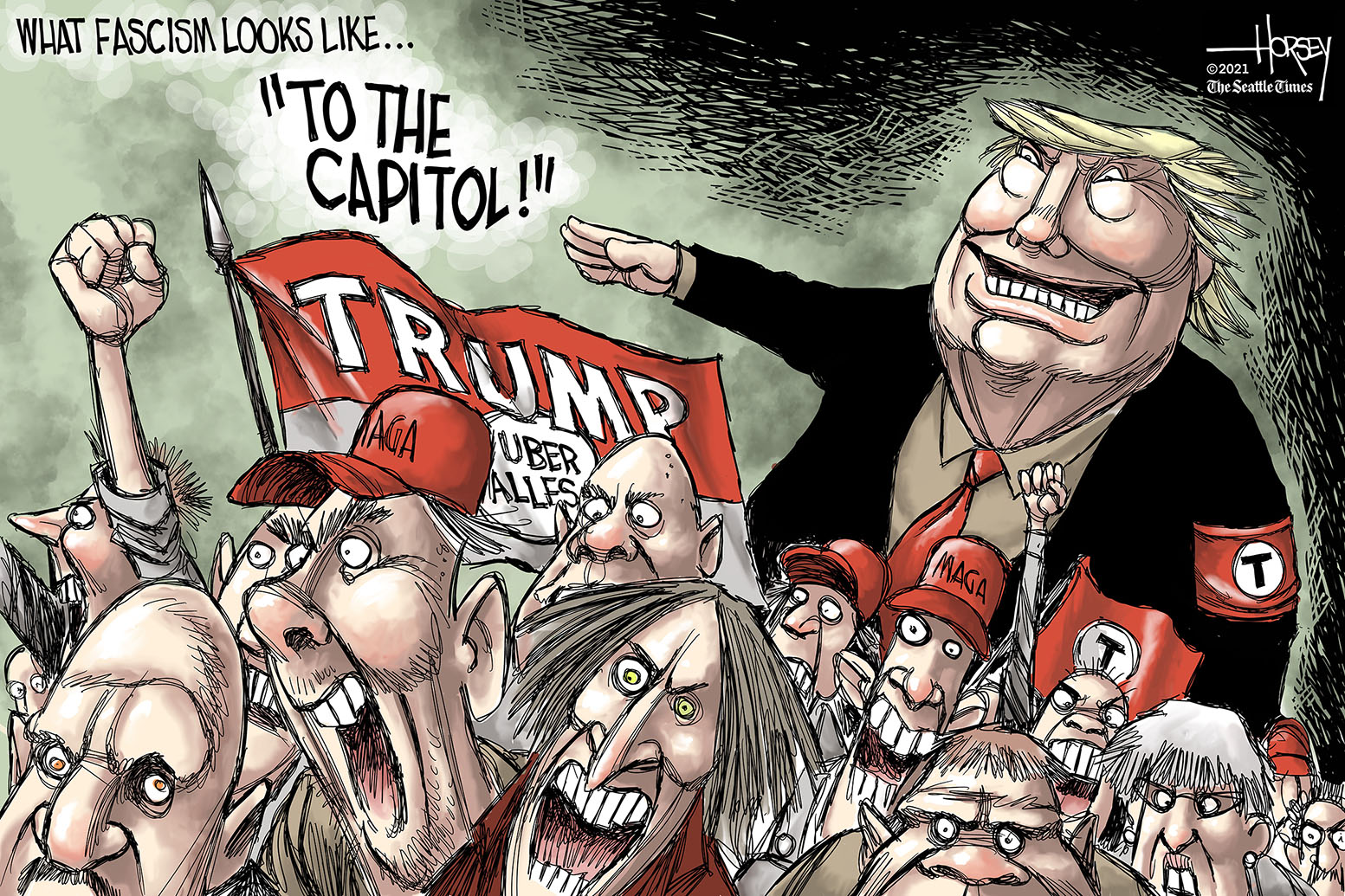 The House Select Committee investigating the January 6 insurrection begins this morning by interviewing police officers who fought the invading Trump army in the Capitol. I’d like to watch as much of the testimony as I can, so I’ll get right to it. Here’s the latest news and commentary I’ve come across so far.
Committee Chairman Bennie G. Thompson at The Washington Post: Opinion: We have started investigating the Jan. 6 attack on the Capitol. Nothing will be off-limits.
On Tuesday, the bipartisan Select Committee on the January 6th Attack on the United States Capitol begins its work investigating the facts, circumstances and causes of this assault on our democracy.
I had hoped that such an investigation would be carried out by an independent commission composed of national security experts, like the panel created by Congress after the terrorist attacks of Sept. 11, 2001. However, once the House Republican leadership rejected — and Senate Minority Leader Mitch McConnell filibustered — bipartisan legislation to establish such a commission, we in the House believed we had no choice but to establish a select committee. In a recent poll, 72 percent of Americans agree there is more we must learn about that day.
Many of the Jan. 6 rioters have stated in their court pleadings that they stormed the Capitol believing they were acting on behalf of, or even at the behest of, then-President Donald Trump. The protection of our democracy demands that we comprehensively investigate what drove Americans to riot and violently assault Capitol Police, Metropolitan Police and other law enforcement officers to access the inner sanctum of Congress and private offices of top congressional leaders, including the speaker of the House.
Jan. 6 was supposed to be about the peaceful transfer of power after an election, a hallmark of democracy and our American tradition. The rioters went to the Capitol that day to obstruct this solemn action — and nearly succeeded while defacing and looting the halls of the Capitol in the process. The committee will provide the definitive accounting of one of the darkest days in our history. Armed with answers, we hope to identify actions that Congress and the executive branch can take to help ensure that it never happens again.
The bipartisan members of the committee believe strongly it is important to begin our work by hearing from law enforcement officers who defended the Capitol on Jan. 6. On Tuesday, we will be joined by Capitol Police officers Aquilino Gonell and Harry Dunn and Metropolitan Police officers Daniel Hodges and Michael Fanone. These officers will provide firsthand accounts of the chaos of that day and the violence perpetrated by the rioters.
 The Wall Street Journal: Chairman of Jan. 6 Committee Casts Wide Net on Witnesses.
The House’s select committee probing the Jan. 6 attack on the Capitol by supporters of former President Donald Trump won’t hesitate to subpoena members of Congress or Mr. Trump and will try to enforce the subpoenas in court if necessary, said the panel’s chairman.
“Anybody who had a conversation with the White House and officials in the White House while the invasion of the Capitol was going on is directly in the investigative sights of the committee,” said Rep. Bennie Thompson (D., Miss.) in an interview ahead of the panel’s first public hearing on Tuesday. He said that could include subpoenas to compel testimony, as well as records related to phone calls and other communications.
Pressed on whether the Democratic-led committee would subpoena Mr. Trump, Mr. Thompson said nobody was off limits. “I don’t want to name him, but what I will say is that in the conversations we’ve had as a committee, there’s been no reluctance whatsoever to go where the facts lead us,” he said.
Unlike the bipartisan Senate investigation into Jan. 6, which published findings and recommendations in June, the House’s select committee will go beyond security failures to look at communications between Congress and the executive branch and examine the role of individuals—including Mr. Trump—“who may or may not have contributed willingly or unwillingly to the events of Jan. 6,” Mr. Thompson said.
The New York Times: Trump officials can testify in Jan. 6 inquiries, Justice Dept. says.
The Justice Department notified former Trump administration officials this week that they could testify to the various committees investigating the Jan. 6 attack on the Capitol, according to a letter obtained by The New York Times.
 Witnesses can give “unrestricted testimony” to the House Oversight and Reform Committee and the Senate Judiciary Committee, the department said in a letter this week. Both panels are scrutinizing the Trump administration’s efforts to overturn the election in its final days and the events leading up to the Jan. 6 attack on the Capitol.
The decision runs counter to the views of former President Donald J. Trump, who has argued that his decisions and deliberations are protected by executive privilege. It also sets up a potential court battle if Mr. Trump sues in a bid to block any testimony.
In that case, the courts could be forced to decide the extent to which a former president can be protected by privilege. Mr. Trump’s supporters have argued that a president cannot function if privilege can be taken away by a successor, exposing sensitive decision-making and opening up the previous administration to scrutiny.
But others say that the matter is settled law, and that privilege does not apply to extraordinary circumstances.
CNN: Select committee holds first January 6 hearing with officers on the front lines.
In its opening act, the House select committee investigating the January 6 attack on the Capitol holds its first high-profile hearing Tuesday with testimony from four officers who will give firsthand accounts of the horrors they witnessed and endured as rioters stormed the building.
The officers are expected to recount the harrowing attacks they faced on January 6, including being beaten with a flagpole, getting crushed in a doorway, being the target of racial slurs and facing rioters who tased them. The committee also is expected to show never-before-seen videos depicting the violence from that day, just as House impeachment managers did during the impeachment trial of former President Donald Trump.
The emotional testimony kicks off the committee’s investigation into the circumstances surrounding the January 6 attack as Democratic leaders look to set the tone for a panel that congressional Republicans have dismissed as a political sideshow created merely to discredit the legacy of the former President.
The goal Tuesday, according to select committee member Democratic Rep. Adam Schiff of California, is to portray what it was like “to be on the front lines for the brave police officers” and to push back on efforts to whitewash the events of that day.
“I’m hoping that the hearing will give the American people an even more vivid sense of what went on that day, the horror of that day, how these brave police officers saved so many lives,” Schiff told CNN.
 Investigative report from Joshua Kaplan and Joaquin Sapien at ProPublica: New Details Suggest Senior Trump Aides Knew Jan. 6 Rally Could Get Chaotic.
On Dec. 19, President Donald Trump blasted out a tweet to his 88 million followers, inviting supporters to Washington for a “wild” protest.
Earlier that week, one of his senior advisers had released a 36-page report alleging significant evidence of election fraud that could reverse Joe Biden’s victory. “A great report,” Trump wrote. “Statistically impossible to have lost the 2020 Election. Big protest in D.C. on January 6th. Be there, will be wild!”
The tweet worked like a starter’s pistol, with two pro-Trump factions competing to take control of the “big protest.”
On one side stood Women for America First, led by Amy Kremer, a Republican operative who helped found the tea party movement. The group initially wanted to hold a kind of extended oral argument, with multiple speakers making their case for how the election had been stolen.
On the other was Stop the Steal, a new, more radical group that had recruited avowed racists to swell its ranks and wanted the President to share the podium with Alex Jones, the radio host banned from the world’s major social media platforms for hate speech, misinformation and glorifying violence. Stop the Steal organizers say their plan was to march on the Capitol and demand that lawmakers give Trump a second term.
ProPublica has obtained new details about the Trump White House’s knowledge of the gathering storm, after interviewing more than 50 people involved in the events of Jan. 6 and reviewing months of private correspondence. Taken together, these accounts suggest that senior Trump aides had been warned the Jan. 6 events could turn chaotic, with tens of thousands of people potentially overwhelming ill-prepared law enforcement officials.
Rather than trying to halt the march, Trump and his allies accommodated its leaders, according to text messages and interviews with Republican operatives and officials.
Katrina Pierson, a former Trump campaign official assigned by the White House to take charge of the rally planning, helped arrange a deal where those organizers deemed too extreme to speak at the Ellipse could do so on the night of Jan. 5. That event ended up including incendiary speeches from Jones and Ali Alexander, the leader of Stop the Steal, who fired up his followers with a chant of “Victory or death!”
Read more at ProPublica. It’s quite long and detailed.
 The Washington Post Editorial Board: Opinion: We have questions about Jan. 6. The new House committee can answer them.
…[I]n contrast to Republican claims, there is much for the select committee to uncover.
Top of the list is precisely what then-President Donald Trump did before, during and after the attack. How did he prepare his speech preceding the insurrection, in which he told the crowd to fight? What did he anticipate his audience’s reaction would be? When did he know the pro-Trump mob was threatening the Capitol? Why did he offer only mild statements long after the danger was clear? Did Trump-affiliated rally organizers coordinate with extremist groups? Answering such questions calls for subpoenaing former White House chief of staff Mark Meadows; Mr. Trump’s daughter Ivanka and her husband, White House senior adviser Jared Kushner; and other White House aides with useful information.
Also relevant is what members of Congress reported to Mr. Trump and other members of his administration as the riot unfolded. House Minority Leader Kevin McCarthy (R-Calif.), who spoke with the president and Mr. Kushner on Jan. 6, must testify, along with any other lawmakers who interacted with the Trump administration in the run-up to, during and after that day. The list includes Sen. Tommy Tuberville (R-Ala.), Rep. Mo Brooks (R-Ala.) and possibly Rep. Jim Jordan (R-Ohio). For that matter, the committee must examine whether any lawmakers themselves maintained connections with or even abetted the rioters.
Investigators should hear from extremist-group leaders at the center of the violence. How did they prepare? What was their goal? The committee should hear also from Justice Department and Capitol Police officials who failed to anticipate the riot. Why did intelligence officials across the government seem unaware of warnings that were all over social media? To what extent did law enforcement discount or ignore warning signs about right-wing extremists because federal and local officers did not want to cross Mr. Trump and other Republicans? Why did the National Guard take so long to arrive?
Finally, the investigation should lead to recommendations to forestall a repeat of such political violence, with a particular focus on how the government monitors domestic extremism.
If you’re watching the hearings, please let us know what you think. As always, feel free to comment on any topic. This is an open thread.
Did you like this post? Please share it with your friends:
Posted: July 24, 2021 | Author: bostonboomer | Filed under: just because, morning reads | Tags: anti-maskers, Donald Trump, Olympics, Paul Manafort, Tom Barrack, United Arab Emirates, vaccine holdouts |

Arsen Kurbanov, Russian artist
Good Morning!!
It’s going to be interesting to see what happens with the case against Trump ally Tom Barrack, who was arrested on Tuesday and charged with acting as an agent of a foreign power. Politico:
Tom Barrack, a longtime supporter of and adviser to former President Donald Trump, was arrested Tuesday on charges he secretly acted in the U.S. as an agent for the United Arab Emirates.
Barrack, 74, is accused of failing to register as a foreign agent, conspiracy, obstruction of justice and four counts of making false statements to the FBI.
A federal indictment issued by a grand jury in Brooklyn, N.Y., charged that Barrack put pro-UAE language into a Trump campaign speech in May 2016, took direction from UAE officials about what to say in media appearances and an op-ed piece he published just before the 2016 election, and agreed to promote a candidate for ambassador to UAE backed by UAE officials.
Prosecutors say Barrack used his insider access to White House officials that he gained through roles like his position as chair of Trump’s inaugural committee to give the UAE “non-public information about the views and reactions of senior U.S. government officials following a White House meeting between senior U.S. officials and senior UAE officials.”
Also charged in the case were an aide to Barrack at his investment firm Colony Capital, Matthew Grimes, and a businessman from UAE, Rashid Al-Malik.
Prosecutors allege that early in the Trump administration, Barrack sought to be appointed to a high-profile role in Middle East policy, while telling his allies in UAE that such an appointment would be good for them.
“In his communications with Al Malik, the defendant framed his efforts to obtain an official position within the Administration as one that would enable him to further advance the interests of the UAE, rather than the interests of the United States,” prosecutors wrote in a court filing.

Carel Willink, Wilma with a cat, 1940
Barrack has now been released on a massive bail and will have to wear a gps monitoring bracelet. CNN: Trump ally Tom Barrack strikes a $250 million bail deal to get out of jail.
Also see these Emptywheel pieces: Paul Manafort Shared Trump Energy Speech with Tom Barrack and Paul Manafort Knew Tom Barrack Was Working with “Our Friends”
Columnist Michelle Goldberg at The New York Times: A Foreign Agent in Trump’s Inner Circle?
…[W]hen the billionaire real estate investor Tom Barrack, one of Trump’s biggest fund-raisers, was arrested on Tuesday and charged with acting as an unregistered agent of the United Arab Emirates along with other felonies, it might have seemed like a dog-bites-man story. Barrack was once described by longtime Trump strategist Roger Stone — a felon, naturally — as the ex-president’s best friend. If you knew nothing else about Barrack but that, you might have guessed he’d end up in handcuffs.
Nevertheless, Barrack’s arrest is important. Trump’s dealings with the Emirates and Saudi Arabia deserve to be investigated as thoroughly as his administration’s relationship with Russia. So far, that hasn’t happened. When Robert Mueller, the former special counsel, testified before Congress, Adam Schiff, chair of the House Intelligence Committee, said to him, “We did not bother to ask whether financial inducements from any Gulf nations were influencing U.S. policy, since it is outside the four corners of your report, and so we must find out.” But we have not found out.
A Barrack trial, if the case goes that far, is unlikely to answer all the outstanding questions about how Gulf money shaped Trump policy. But it could answer some.

Portrait of Edward Gorey by Sam Kalda
Let’s recall that Russia was not the only nation to send emissaries to Trump Tower during the presidential campaign offering election help. The bipartisan Senate Intelligence Committee Report on Russian election interference discusses an August 2016 Trump Tower meeting whose attendees included Donald Trump Jr., George Nader, then an adviser to Crown Prince Mohammed bin Zayed, the Emirates’ de facto ruler, and Joel Zamel, owner of an Israeli private intelligence company, Psy-Group. (Nader is currently in prison for child sex trafficking and possession of child pornography.)
“Zamel asked Trump Jr. whether Psy-Group’s conducting a social media campaign paid for by Nader would present a conflict for the Trump campaign,” said the Senate report. “According to Zamel, Trump Jr. indicated that this would not present a conflict.”
Zamel told the committee that his company never actually performed such work. “Nonetheless, as described below, Zamel engaged in work on behalf of Nader, for which he was paid in excess of $1 million,” said the report. Zamel claimed the payment was for a postelection social media analysis, all copies of which were ostensibly deleted.
If the allegations in the Barrack indictment are true, it means that while an adviser to the Emirates was offering the Trump campaign election help, an Emirati agent was also shaping Trump’s foreign policy, even inserting the country’s preferred language into one of the candidate’s speeches. Prosecutors say that Barrack told a high-level figure they call “Emirati Official 2” that he had staffed the Trump campaign. (It was Barrack who recommended Paul Manafort, later to be convicted of multiple felonies, to Trump.) When an Emirati official asked Barrack if he had information about senior Trump appointees, Barrack allegedly replied, “I do” and said they should talk by phone. He is said to have traveled to the Emirates to strategize with its leadership about what they wanted from the administration during its first 100 days, first six months, first year and first term.
Read more at the NYT.
Yesterday Dakinikat focused on the latest pandemic news as well as the growing anger against the idiots who are refusing to be vaccinated. I want to follow up on a some of the stories she posted. First, in the comment thread, she posted a horrifying story about an anti-mask demonstration at a cancer clinic.
Here’s more on that from Vice News: Breast Cancer Patient Attacked by Violent Anti-Mask Protest Outside Clinic.
A breast cancer patient says she was sprayed with bear mace, physically assaulted, and verbally abused outside a cancer treatment center in West Hollywood, Los Angeles by far-right activists who were angry over the clinic’s mandatory mask policy.

Andrea Kowch, Queen’s Court, 2019
Dozens of anti-maskers holding signs with anti-vaxx and QAnon-adjacent conspiracy theories amassed on the sidewalk by the Cedars-Sinai Breast Health Services building on Thursday afternoon, and harassed patients and doctors.
In one exchange captured by local videographer Vishal Singh, a woman who has since publicly identified herself as Kate Burns, a cancer patient, approached the protesters and told them to leave.
“I get treated here, get the fuck away,” Burns said.
One protester, who was filming the scene on his phone, asked her why she was so angry, as a man holding a cardboard sign saying “End the Censorship of Vaccine Risks” smirked.
“Because I’ve just gone through fucking breast cancer,” Burns said. “And you motherfuckers are here.”
After a few more exchanges, the a “protester” actually punched Burns in the chest.
Tensions continued to rise as more far-right, anti-maskers arrived on the scene. A small group of anti-fascists also arrived, and got into altercations with the far-right. A woman holding a megaphone shoved Burns, and then punched her several times. Burns said, on social media, that the woman hit her in the chest and struck her scars….
Thursday was the second time that anti-maskers had targeted that particular breast cancer clinic over its mask policy. The ugly scenes and casual political violence that unfolded there on both occasions have become troublingly common across the U.S.
Can someone explain to me why unvaccinated athletes are being permitted to compete in the Olympic games? NBC News: About 100 U.S. athletes in Tokyo unvaccinated as Covid-hit Olympics begin.
Five out of 6 U.S. athletes competing in the Tokyo Olympics have been vaccinated against Covid-19, the team’s top doctor revealed Friday just before the Games officially begin.
That information was culled from the health histories that 567 of the athletes filled out before they departed for Japan, said Dr. Jonathan Finnoff, who estimated that 83 percent of those competitors were fully vaccinated.
“Eighty-three percent is actually a substantial number, and we’re quite happy with it,” Finnoff, the U.S. Olympic and Paralympic Committee’s medical chief, said.
That’s higher than the national rate, with about 56 percent of Americans having received at least one dose of a vaccine. But it still means that about 100 of the total contingent of 613 U.S. athletes have not yet been vaccinated.
The news came as the opening ceremony of the pandemic-hit Games got underway in Tokyo’s Olympic Stadium, marking the official launch of the global sporting event.
But why aren’t they all vaccinated? This makes no sense to me. We really need to stop coddling these holdouts. They are putting themselves and everyone else in danger.

Chelin Sanjuan Piquero, Spanish artist
Dan Diamond and Tyler Pager at The Washington Post: ‘Patience has worn thin’: Frustration mounts over vaccine holdouts.
Seven months after the first coronavirus shots were rolled out, vaccinated Americans — including government, business and health leaders — are growing frustrated that tens of millions of people are still refusing to get them, endangering themselves and their communities and fueling the virus’s spread.
Alabama Gov. Kay Ivey (R) on Thursday lashed out amid a surge of cases in her state, telling a reporter it’s “time to start blaming the unvaccinated folks.” The National Football League this week imposed new rules that put pressure on unvaccinated players, warning their teams could face fines or be forced to forfeit games if those players were linked to outbreaks.
“I think for a lot of leaders, both in government and in business, patience has worn thin,” said Matt Gorman, a Republican strategist. “There is an urgency that might not have been there a month ago.”
Meanwhile, exhausted health providers say they are bracing for casespikes that are largely preventable, driven by the hyper-transmissible delta variant. “We are frustrated, tired and worried for this next surge — and saddened by the state we find ourselves in,” said Jason Yaun, a Memphis-based pediatrician, who said his colleagues are grappling with an “accumulation of fatigue” since the outbreak exploded in March 2020.
Biden administration officials increasingly frame the current outbreak as a “pandemic of the unvaccinated,” seeking to persuade and perhaps even frighten some holdouts to get the shots.
But after months of careful cajoling, a growing number of Democrats and Republicans are venting about the sheer number of Americans who remain unvaccinated, particularly as hospitals are becoming overwhelmed in states with low vaccination rates.
Read the rest at the WaPo. These people need to grow up!
That’s all I have for you today. What’s on your mind?
Did you like this post? Please share it with your friends:
Posted: July 22, 2021 | Author: bostonboomer | Filed under: just because |
Good Afternoon!!
Before I get to today’s topic, I just have to share this blog post that Dakinikat sent me yesterday.
Sexist double standards don’t come any brighter, or more well defined, than the eager, nonstop coverage Trump continues to receive months after losing his White House election, compared to how the Beltway press gleefully tried to run Hillary Clinton out of town after her 2016 loss.
For the media, Trump the man remains a captivating topic who provides endless angles of intrigue and who is treated as a looming star of American politics. This, after becoming only the ninth president in U.S. history to lose a re-election bid. Clinton the woman though, was treated as an incompetent has-been who threw away a sure-fire win, and one who needed to get off the national stage immediately. Trump has receiving very little media second guessing.
“I was really struck by how people said that to me, ‘Go away, go away,'” Clinton observed in 2019, “They never said that to any man who was not elected.” Trump’s media treatment this year confirms her claim and that the tough coverage she received was tailor made for the first woman nominee.
Against the backdrop of President Joe Biden’s “boring” administration, journalists seem eager for the chaos and clicks that Trump creates. The coverage seems to swell with each passing day, as the press marvels at Trump’s lasting power. This was a breathless Business Insider headline this week, even though it would been more timely in 2017: “The Definitive Oral History of How Trump Took Over the GOP, as Told To Us By Cruz, Rubio, and 20 More Insiders.”
The premise to virtually all the coverage is, of course Trump will run again. By contrast, the first woman White House nominee was treated quite differently after her defeat as journalists angrily, and irrationally, demanded she “go away.”
Please click the link and read the rest.
Yes, it’s sexism, but also the media just loves boosting Republicans and blaming Democrats. Case in point: yesterday Nancy Pelosi refused to accept two of Kevin McCarthy’s choices for the January 6 select committee, so McCarthy withdrew the rest of the nominations. Of course the entire point of choosing bomb throwers for the committee was to justify refusing to participate. CNN:
Of course that’s all bullshit. The committee should be nonpartisan, not bipartisan.
McCarthy had a chance to support a bipartisan panel and he and Mitch McConnell instructed their members to vote it down. McCarthy appointed people who actually supported the insurrection–especially Jim Jordan. Having him on the committee would have turned it into a complete joke. Pelosi rejected Jim Banks because of the statement he made after being appointed by McCarthy:
“I have accepted Leader McCarthy’s appointment to this committee because we need leaders who will force the Democrats and the media to answer questions so far ignored. Among them, why was the Capitol unprepared and vulnerable to attack on January 6?
“If Democrats were serious about investigating political violence, this committee would be studying not only the January 6 riot at the Capitol, but also the hundreds of violent political riots last summer when many more innocent Americans and law-enforcement officers were attacked. And of course, the committee would not overlook the Good Friday murder of USCP Officer Billy Evans that was perpetrated by a far-left extremist.
“Make no mistake, Nancy Pelosi created this committee solely to malign conservatives and to justify the Left’s authoritarian agenda.
You can read more specifics about these two men in this NYT story: Why Jim Banks and Jim Jordan Were Blocked From the Capitol Riot Panel.
But the media needs to pretend there are “both sides” in this controversy–literally anti-insurrection vs. pro-insurrection.
McCarthy said that House Republicans would form their own committee–not to investigate the Capitol insurrection, but to prove that the cause was Nancy Pelosi’s failure to provide enough security on January 6.
CNN: Fact checking Rep. Jordan’s claim that Speaker Pelosi was responsible for US Capitol security on January 6.
Here’s a non-“both-sides” description of what happened, by Slate’s Jim Newell: Pelosi Kicks Kooks Off Coup Committee.
McCarthy announced his five picks to Jan. 6 committee on Tuesday: Reps. Jim Banks, Jim Jordan, Troy Nehls, Kelly Armstrong, and Rodney Davis. On Wednesday, though, Pelosi pulled a move she conceded was “unprecedented”: She actually used the veto power granted to her in the resolution, and told McCarthy that she would reject the two most MAGA of his picks, Banks and Jordan.
“With respect for the integrity of the investigation, with an insistence on the truth and with concern about statements made and actions taken by these Members, I must reject the recommendations of Representatives Banks and Jordan to the Select Committee,” she said in a statement. “The unprecedented nature of January 6th demands this unprecedented decision.”
McCarthy responded by withdrawing his entire slate of appointees, and argued that Pelosi’s move “represents an egregious abuse of power” that “will irreparably damage this institution.” The newest and phoniest—and that says something—member of leadership, Republican Conference Chair Elise Stefanik, declared that Pelosi was a “radical AUTHORITARIAN Speaker of the House.”
McCarthy said that Republicans would, instead, “pursue our own investigation of the facts,” perhaps from his friend’s mom’s backyard treehouse.
Republicans see Pelosi’s move as a gift, the exact move they needed to solidify their argument that this select committee is a political exercise that shouldn’t be taken seriously. But the point of putting Banks and Jordan on the committee was also to make the argument, from the committee, that it was a political exercise that shouldn’t be taken seriously. McCarthy nominated those two to muddy the waters during hearings, to run interference for Donald Trump, and to give counterprogramming sound bites for Fox News to run on its evening programs.
That’s not difficult to understand, is it? Nevertheless, if you look around you’ll see plenty of “journalists” misrepresenting what happened and Democrats being partisan.
This is from Jill Lawrence at USA Today: In vetoing Jordan and Banks, Pelosi safeguards history, democracy and Capitol attack probe.
Say what you will about House Speaker Nancy Pelosi, and there are multitudes with lots to say, she is a woman with a steel backbone and a laser focus on history – both the centuries past and the countless pages yet to be written.
Though it was shocking and apparently unprecedented that she rejected two of House Minority Leader Kevin McCarthy’s choices for the select committee that will be investigating the Jan. 6 Capitol attack, it probably should not have been. Pelosi is not interested in a dog-and-pony show, in distractions that will give endless fodder to conservative media outlets and undercut the gravity of the task before this panel.
A speaker who has helmed two impeachments, painful procedures that exposed egregious offenses by President Donald Trump yet failed to remove him from office, knows exactly what would happen if she gave a platform to Republican Reps. Jim Jordan and Jim Banks….
Both of them voted to object to the state-certified results of the election – even though the Justice Department and dozens of courts had found the objections groundless, and even after Trump supporters had stormed the Capitol, injured scores of police, threatened Pelosi and Vice President Mike Pence and led to the deaths of five people – including a Capitol Police officer and a protester shot by a police officer as she was breaking through a glass door to an area where lawmakers were sheltering.
Banks and Jordan have shown us who they are.
Banks recently met with Trump twice, including on a trip to the southern border. “I will never be ashamed to say that Donald Trump is the most effective president of my lifetime,” he said this month at the Conservative Political Action Conference, where his topic was “grievances against the government.” [….]
Jordan has been such a zealous defender of Trump and his 2020 “victory” that five days after the insurrection at the Capitol, Trump gave him the Presidential Medal of Freedom. The next day, Jordan was on the House floor championing Trump and castigating Democrats for impeaching him – again – “eight days before there will be a peaceful transfer of power just like there has been every other time in American history.”
Except that by then, for the first time in U.S. history, the transfer already had been scarred by violence, vandalism and death.
Former House Speaker John Boehner has called his fellow Ohio Republican “a legislative terrorist.” That is no doubt why McCarthy picked him and why Pelosi made the call to hand the GOP some short-term ammunition in exchange for a long-term historical record that doesn’t get derailed by conservative media plays and what-aboutism.
Let me know what you think. As always, this still an open thread.
Did you like this post? Please share it with your friends:


 peej
peej Carissa
 bostonboomer
 dakinikat
 ecocatwoman
 mablue2
 Mama Lopez
 peggysue22
 quixote
 skydancingguestblogger
 Mona (aka Wonk the Vote)



 Sky Dancing
Recent Comments