Posted: November 2, 2021 | Author: bostonboomer | Filed under: morning reads | Tags: Annissa Essaibi-George, Boston Mayor, Brad Raffenspurger, Glenn Youngkin, Michelle Wu, National Guard, Ruth Bader Ginsburg, SCOTUS, Terry McAuliffe, Virginia Governor |
Good Morning!!

MIchelle Wu and Annissa Essaibi-George are running for Mayor of Boston.
Today is election day in states across the country. The is the deadlocked race between gubernatorial candidates Terry McAuliffe and Glenn Youngkin is getting the most attention, but there’s also a historic election in Massachusetts, where a woman of color most likely will be elected Mayor of Boston today. 7News Boston: Boston voters heading to the polls for historic mayor’s race.
BOSTON (AP) — Boston voters are heading to the polls Tuesday not only to choose between Democrats Michelle Wu and Annissa Essaibi George for mayor, but to mark a turning point in the city’s history, for the first time electing a woman and person of color to helm Boston.
The choice of Wu and Essaibi George for the top political post is just the latest marker of how much the Boston of not-so-long-ago — known for its ethnic neighborhoods, glad-handing politicians and mayors with Irish surnames — is giving way to a new Boston.
Throughout its long history, Boston has previously only elected white men as mayor.
Despite the groundbreaking nature of the candidates, the campaign has turned on familiar themes for the city’s 675,000 residents, including public education, policing, public transportation and the skyrocketing cost of housing.
Among the newer issues facing Boston residents is the effect of climate change on the costal metropolis.
One of the thorniest issues in the campaign is whether Boston should pursue a form of rent control or rent stabilization, something supported by Wu and opposed by Essaibi George. In 1994, Massachusetts voters narrowly approved a 1994 ballot question banning rent control statewide.
Both candidates have spent the final hours of the campaign urging their voters to get to the polls.
Nearly 40,000 ballots have already been cast in early voting. Democratic Secretary of the Commonwealth William Galvin told reporters Monday he estimates about 135,000 ballots will be cast in Boston — about 30% of the city’s 442,000 registered voters.
Both candidates are children of immigrants.
The 36-year-old Wu, whose parents immigrated to the U.S. from Taiwan, grew up in Chicago and moved to Boston to attend Harvard University and Harvard Law School.
Essaibi George, 47, a lifelong Boston resident and former public school teacher, describes herself as a first-generation Arab-Polish American. Her father was a Muslim immigrant from Tunisia. Her mother, a Catholic, immigrated from Poland.
The contest could also be a test of whether voters in a city long dominated by parochial neighborhood politics are ready to tap someone not born and raised in the city like Wu, who grew up in Chicago.
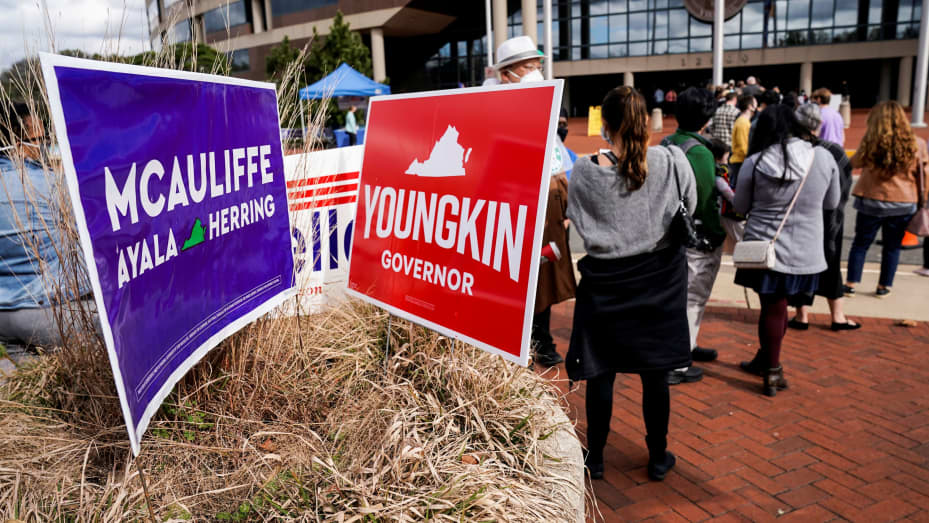 In Virginia, McAuliffe and Youngkin are running neck and neck, and observers are speculating about how the result with impact the midterm elections in 2022. Bloomberg: Virginia Race Offers Hint of 2022 Fight to Control Congress.
Virginia’s gubernatorial contest Tuesday between Terry McAuliffe and Glenn Youngkin will offer the clearest picture yet of how much momentum Republicans have heading into 2022 elections that will decide control of Congress, while President Joe Biden struggles to advance his agenda in Washington.
Polls show the Virginia race essentially deadlocked as Democrat McAuliffe’s lead during the summer evaporated along with Biden’s approval ratings. In the final weeks of the campaign, Republican Youngkin, the former co-chief executive officer of the Carlyle Group Inc., has capitalized on voter frustration with national Democrats and local education issues.
The election comes a day after Senator Joe Manchin, a moderate Democrat from West Virginia, slammed the door on Biden’s wish for Congress to take quick action on his $1.75 trillion tax and spending package, the centerpiece of his presidential campaign. Virginia, a state Biden won by 10 percentage points a year ago, is a bellwether for the Congressional midterms. A McAuliffe loss would be the biggest omen for Democratic prospects to hold onto their slim majority in Congress.
Longtime Democratic strategist Jesse Ferguson said that Virginia is often an “early-warning system” for the party in power as to how it will do in the midterms, especially because of the diversity of the state, which includes rural, suburban and urban areas; military, farming and technology workers; and White, Hispanic and Black voters.
“Virginia allows you for a dry run of the arguments you’re going to make in the midterms, to see how different parts of the electorate respond,” Ferguson said.
Read more at the link.

Peter Saul, Donald Trump in Florida, 2017.
At The Atlantic, Virginia resident Michael Tolhurst writes that a Youngkin win in Virginia could lead to a Constitutional crisis. That’s because governors control the National Guard. I can only provide a brief excerpt, so I hope you’ll read the entire article at The Atlantic.
…[i]n addition to the substantive policy disagreements or politics as pastime, people across America should be monitoring the outcome of this race for another reason: Governors command the National Guard, and after the January 6 riot, the country saw the National Guard defend our constitutional order.
at the outbreak of the Civil War, the prompt arrival of the 6th Regiment Massachusetts Volunteer Militia in Washington, D.C., in April 1861 helped secure a capital precariously close to the battlefront. Later forces arrived, building up the defenses around the city in the Northern Virginia towns of Arlington and Alexandria. This included, a century and a half before I came to live in the area, Connecticut’s 22nd Regiment in which my many-greats-grandfather Edwin Tolhurst served. (His military experience was unromantic—he dug ditches in the red mud of Northern Virginia for nine months, caught consumption, and died shortly after he was discharged.)
We’re not, of course, in a civil war. But law professors and public intellectuals have seriously discussed the possibility of secession or a “national divorce.” A recent University of Virginia study revealed that 41 percent of people who voted for Joe Biden in 2020 and 52 percent of Donald Trump voters “at least somewhat agree that it’s time to split the country.” The same study revealed that significant numbers on both sides wish their preferred president wouldn’t have to be constrained by Congress or the courts.
Given this tinderbox, we unfortunately have to revisit the question of what role the present-day state militias—the National Guard—and the governors who command them might play in a constitutional crisis. As the writer Andrew Sullivan put it, there is an “increasingly nihilist cult on the right among the GOP” that has shown an “increasingly menacing contempt for electoral integrity and a stable democracy.” Will all elected governors rush to the defense of the constitutional order when necessary, as did the 6th Massachusetts and the 22nd Connecticut? Or will they fight for a separatist movement? This is not a happy thought, but as even previously respectable institutions are being coy about the possibility of such a conflict, it must be considered.
It’s difficult to accept that the situation is getting that serious, but you just have to look at how completely the Republican Party has been captured by the Trump/Q-Anon cults to understand that we need to be prepared for the worst. I still need to finish reading the powerful Washington Post series on the January 6 insurrection, but I hope to do so this afternoon.
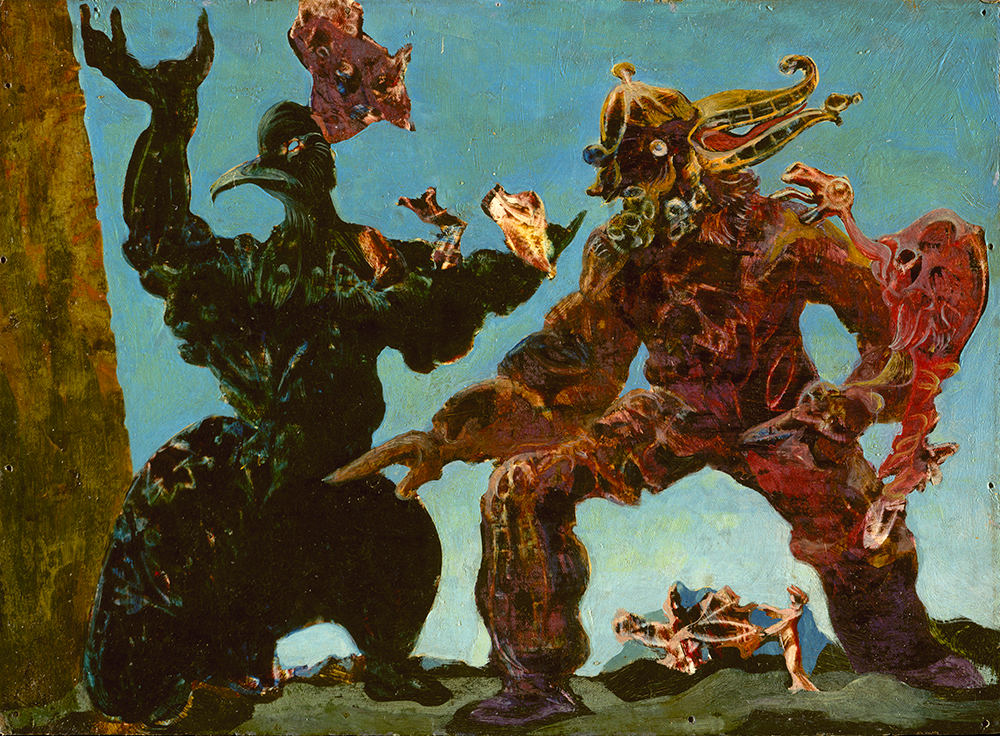
The Barbarians by Max Ernst, 1937
Harking back to the 2020 presidential election, Georgia Secretary of State Brad Raffenspurger has written a book. AP: Georgia official: Trump call to ‘find’ votes was a threat.
Donald Trump was threatening Georgia Secretary of State Brad Raffensperger when he asked him to help “find” enough votes to overturn his loss in Georgia to Democratic President Joe Biden, Raffensperger writes in a new book.
The book, “Integrity Counts,” was released Tuesday. In it, Raffensperger depicts a man who defied pressure from Trump to alter election results, but also reveals a public official settling political scores as he seeks to survive a hostile Republican primary environment and win reelection in 2022.
An engineer who grew wealthy before running for office, Raffensperger recounts in his book the struggle in Georgia that followed Biden’s narrow victory, including death threats texted to his wife, an encounter with men who he says may have been staking out his suburban Atlanta home, and being escorted out of the Georgia capitol on Jan. 6 as a handful of right-wing protesters entered the building on the same day many more protesters stormed the U.S. Capitol.
The book climaxes with the phone call, which was recorded and then given to multiple news organizations. Raffensperger — known as a conservative Republican before Trump targeted him — writes that he perceived Trump as threatening him multiple times during the phone call.
“I felt then — and still believe today — that this was a threat,” Raffensperger writes. “Others obviously thought so, too, because some of Trump’s more radical followers have responded as if it was their duty to carry out this threat.”
Fulton County District Attorney Fani Willis is investigating potential attempts to improperly influence Georgia’s 2020 election. Raffensperger said in an interview with The Associated Press that Willis’ investigators have talked to some employees in his office, but that he hasn’t been interviewed.
Read more about the book at USA today: Brad Raffensperger, GOP target of Trump ire in Georgia, warns of potential for more election violence.

Ruth Bader Ginsburg, by Bijou Karman
Another extremely important issue we face is that “conservatives” have taken over the Supreme Court. Linda Greenhouse at The Atlantic: What Can Liberals on the Supreme Court Do Now? They’re outnumbered, but they’re not powerless.
By the time the Supreme Court started its new term on the first Monday of October, a tumultuous summer of midnight orders and unsigned opinions had left no doubt about who was in charge. A five-member conservative bloc, anchored by three Trump-appointed justices, had largely stripped Chief Justice John Roberts of leverage and the three remaining liberals of any hope of striking a meaningful alliance with him. The best the liberals can hope for now, even with the chief justice on their side, is a 5–4 loss.
What path is open to them? Can they play a weak hand in a way that can make a difference? Is building bridges worthwhile, or has the time come to burn them all down? These are the questions hovering over the opening of a term that is likely to produce major decisions on abortion, religion, and the Second Amendment.
Perhaps some answers can be found in the memory of Ruth Bader Ginsburg, who died in September 2020 and was replaced with astonishing speed by Amy Coney Barrett. Powerless in her later years to change minds on the increasingly conservative Court, Ginsburg used the tool at her disposal: her voice. The purpose of her blunt and quotable dissenting opinions was not only to call out the majority when she believed it was wrong but to shape how the public understood the Court’s actions.
It’s easy to forget that this was not always Ginsburg’s way. For most of her years on the public stage, there was nothing flamboyant about her. Quite the opposite: A woman of few, precisely chosen words, she seemed content to fade into the background. During her years on the federal appeals court in Washington, she was so well known for her friendship with that court’s conservatives, particularly Antonin Scalia, who moved up to the Supreme Court in 1986, that many leaders of the women’s movement didn’t quite trust her when Bill Clinton chose her to fill his first Supreme Court vacancy, in 1993. In a lecture Ginsburg delivered months before her nomination, she emphasized the importance of dialogue and said that the “effective judge … strives to persuade, and not to pontificate,” and “speaks in a moderate and restrained voice.”
She didn’t become the “Notorious RBG” until much later; the bestselling biography Notorious RBG: The Life and Times of Ruth Bader Ginsburg came out in 2015. By then, Ginsburg had been on the Court for 22 years. It wasn’t so much that Ginsburg had changed as that the Court and the culture had changed around her.
Read the rest at The Atlantic.
Today will be a busy news day. What stories are you following? Please share your thoughts and links in the comment thread below.
Did you like this post? Please share it with your friends:
Posted: October 30, 2021 | Author: bostonboomer | Filed under: Afternoon Reads | Tags: Greg Jacob, January 6 insurrection, John Eastman, Mike Pence, National Archives, Trump attempted cover up, Trump coup attempt |

Le Chat Noir, Théophile Steinlen (1896)
Good Afternoon!!
There is a great deal of news today about Trump’s attempted coup and his attempts to cover up what he did. The more that comes out the clearer it becomes that Trump really tried to bring down the U.S. government and install himself as a Putin-like strongman. Furthermore, he’s not finished yet.
Last night, The Washington Post broke a bombshell story about the extent of Trump lawyer John Eastman’s efforts to force Mike Pence to overturn the electoral college votes on January 6, 2020: During Jan. 6 riot, Trump attorney told Pence team the vice president’s inaction caused attack on Capitol.
As Vice President Mike Pence hid from a marauding mob during the Jan. 6 invasion of the Capitol, an attorney for President Donald Trump emailed a top Pence aide to say that Pence had caused the violence by refusing to block certification of Trump’s election loss.
The attorney, John C. Eastman, also continued to press for Pence to act even after Trump’s supporters had trampled through the Capitol — an attack the Pence aide, Greg Jacob, had described as a “siege” in their email exchange.
“The ‘siege’ is because YOU and your boss did not do what was necessary to allow this to be aired in a public way so that the American people can see for themselves what happened,” Eastman wrote to Jacob, referring to Trump’s claims of voter fraud.
Eastman sent the email as Pence, who had been presiding in the Senate, was under guard with Jacob and other advisers in a secure area. Rioters were tearing through the Capitol complex, some of them calling for Pence to be executed.
The Post also published a draft op-ed that Jacob wrote but never submitted until now. Back to the original story:
Jacob, Pence’s chief counsel, included Eastman’s emailed remarks in a draft opinion article about Trump’s outside legal team that he wrote later in January but ultimately chose not to publish. The Washington Post obtained a copy of the draft. Jacob wrote that by sending the email at that moment, Eastman “displayed a shocking lack of awareness of how those practical implications were playing out in real time.”

Black Cats in Paris, by Atelier De Jiel
Jacob’s draft article, Eastman’s emails and accounts of other previously undisclosed actions by Eastman offer new insight into the mind-sets of figures at the center of an episode that pushed American democracy to the brink. They show that Eastman’s efforts to persuade Pence to block Trump’s defeat were more extensive than has been reported previously, and that the Pence team was subjected to what Jacob at the time called “a barrage of bankrupt legal theories.”
Eastman confirmed the emails in interviews with The Post but denied that he was blaming Pence for the violence. He defended his actions, saying that Trump’s team was right to exhaust “every legal means” to challenge a result that it argued was plagued by widespread fraud and irregularities.
“Are you supposed to not do anything about that?” Eastman said.
He stood by legal advice he gave Pence to halt Congress’s certification on Jan. 6 to allow Republican state lawmakers to investigate the unfounded fraud claims, which multiple legal scholars have said Pence was not authorized to do.
There’s much more at the link.
Also at The Washington Post, Aaron Black highlights the story’s revelation that Trump and Eastman tried to leverage the attack itself to force Pence’s hand: The most shocking new revelation about John Eastman.
After Pence aide Greg Jacob emailed Eastman to tell him that his “bull—-” legal advice was why Pence’s team was “under siege,” Eastman responded that it was in fact Pence’s fault.
“The ‘siege’ is because YOU and your boss did not do what was necessary to allow this [election challenge] to be aired in a public way so that the American people can see for themselves what happened,” Eastman replied, as revealed in a previously unpublished op-ed by Jacob.
Blaming a guy currently in hiding for fear of his life is certainly a position to take. We knew Trump posted a tweet attacking Pence early in the riot, even after Pence had just gone into hiding, but it hasn’t been clear that Trump knew he was in hiding or the level of the danger involved. Here is Trump’s lawyer suggesting that even when they were able to appreciate the danger, Pence was still being leaned on.

By Day She Made Herself Into A Cat, Arthur Rackham (1920)
But that’s arguably not even the most compelling evidence that Trump and Eastman tried to leverage the mob. Check out this section of The Post’s report about what happened after the Capitol had been cleared and Congress had reconvened:
Pence allowed other lawmakers to speak before they returned to counting the votes, and said he wasn’t counting the time from his speech or the other lawmakers against the time allotted in the Electoral Count Act.
Eastman said that this prompted him to email Jacob to say that Pence should not certify the election because he had already violated the Electoral College Act, which Pence had cited as a reason that he could not send the electors back to the states.
“My point was they had already violated the electoral count act by allowing debate to extend past the allotted two hours, and by not reconvening ‘immediately’ in joint session after the vote in the objection,” Eastman told The Post. “It seemed that had already set the precedent that it was not an impediment.”
This is all a bit dense. But what it basically amounts to is Eastman attempting to use the fallout of a mob riot — one spurred by his and Trump’s baseless claims of voter fraud and Eastman’s highly unorthodox plan to overturn the election — to then get Pence to reject election results based upon a technicality.
This morning The Guardian published this piece by Ed Pinkington: ‘A roadmap for a coup’: inside Trump’s plot to steal the presidency.
In an interview with the Guardian, Eastman explained that he had been asked to prepare the memo by one of Trump’s “legal shop”. “They said can you focus first on the theory of what happens if there are not enough electoral votes certified. So I focused on that. But I said: ‘This is not my recommendation. I will have a fuller memo to you in a week outlining all of the various scenarios.’”
Inside the Oval Office, with the countdown on to 6 January, Trump urged Pence to listen closely to Eastman. “This guy’s a really respected constitutional lawyer,” the president said, according to the book I Alone Can Fix It.
Eastman, a member of the influential rightwing Federalist Society, told the Guardian that he made clear to both men that the account he had laid out in the short memo was not his preferred option. “The advice I gave the vice-president very explicitly was that I did not think he had the authority simply to declare which electors to count” or to “simply declare Trump re-elected”.
Eastman continued: “The vice-president turned to me directly and said, ‘Do you think I have such powers?’ I said, ‘I think it’s the weaker argument.’”

Grumpy Cat, by Vanessa Stockard
Instead, Eastman pointed to one of the scenarios in the longer six-page memo that he had prepared – “war-gaming” alternatives. His favorite was that the vice-president could adjourn the joint session of Congress on 6 January and send the electoral college votes back to states that Trump claimed he had lost unfairly so their legislatures could have another go at rooting out the fraud and illegality the president had been railing about since election day.
“My advice to the vice-president was to allow the states formally to assess the impact of what they had determined were clear illegalities in the conduct of the election,” Eastman said. After a delay of a week or 10 days, if they found sufficient fraud to affect the result, they could then send Trump electors back to Congress in place of the previous Biden ones.
The election would then be overturned.
“Those votes are counted and TRUMP WINS,” Eastman wrote in his longer memo, adding brashly: “BOLD, certainly … but we’re no longer playing by Queensbury rules.”
Then why did Eastman send that e-mail to Jacob in the middle of the violent insurrection? It’s pretty obvious that Eastman is just trying to get himself out of trouble. It’s a mystery to me why he hasn’t been disbarred. Pilkington’s story is long and well worth reading in full.
Andrew Kaczynski and Em Steck at CNN’s KFILE: Trump lawyer John Eastman said ‘courage and the spine’ would help Pence send election to the House in comments before January 6.
Yeah, right. Eastman is a liar, and not a very good one.
There’s also news about the documents Trump is trying to hide from the January 6 committee. Kyle Cheney at Politico: Call logs, speech drafts among records Trump is trying to block from Jan. 6 investigators.
Donald Trump is seeking to prevent Jan. 6 investigators from accessing daily presidential diaries, drafts of election-related speeches, logs of his phone calls, handwritten notes and files of top aides, the National Archives revealed in a Saturday morning court filing.
According to the National Archives, the former president has sought to block about 750 pages out of nearly 1,600 identified by officials as relevant to the Jan. 6 investigation. Among them are hundreds of pages from “multiple binders of the former press secretary [Kayleigh McEnany] which is made up almost entirely of talking points and statements related to the 2020 election,” according to the court filing.

Painting by Donge Kobayashi
The filing details are the clearest indication yet of what Trump is trying to withhold from congressional investigators seeking information about his efforts to overturn the 2020 election results and his activities on the day that a mob of violent Trump supporters stormed the Capitol and disrupted the peaceful transfer of power.
The National Archives indicated that many files were drawn from the systems of key Trump aides including former Chief of Staff Mark Meadows, adviser Stephen Miller and deputy counsel Patrick Philbin.
Other documents include “draft text of a presidential speech for the January 6, 2021, Save America March; a handwritten list of potential or scheduled briefings and telephone calls concerning election issues; and a draft Executive Order concerning election integrity … a draft proclamation honoring deceased Capitol Police officers Brian Sicknick and Howard Liebengood, and associated e-mails from the Office of the Executive Clerk, which relate to the Select Committee’s interest in the White House’s response to the Capitol attack.”
“These records all relate to the events on or about January 6, and may assist the Select Committee’s investigation into that day, including what was occurring at the White House immediately before, during and after the January 6 attack,” Justice Department attorneys, acting on behalf of Archivist David Ferriero, wrote in the filing.
Read more at Politico; see also this article at CNN by Katlyn Polantz: New January 6 court filings reveal what Trump is trying to keep secret from Congress.
Have a very spooky Halloween weekend, Sky Dancers!
Did you like this post? Please share it with your friends:
Posted: October 29, 2021 | Author: bostonboomer | Filed under: Afternoon Reads | Tags: Build Back Better plan, CIA black sites, democracy, Facebook name change, Filibuster, Gender Equality, George W. Bush, Guantanamo, Joe Manchin, Mark Zukerberg is evil, National Cat Day, paid family leave, right to vote, Torture |

Audrey Hepburn, Breakfast of Tiffany’s publicity photo by Howell Conant, 1960
Happy National Cat Day!!
47ABC: National Cat Day shines light on fostering, adopting.
SALISBURY, Md. – Friday is National Cat Day, a day all about celebrating our feline friends, but also about raising awareness of adopting and fostering.
This time of year especially, local shelters tell us they’re very busy with kittens and are in need of fosters.
Arynn Brucie with the Brandywine Valley SPCA says adopting and fostering cats and kittens are equally important, and National Cat Day can shed a light on all of the four legged friends who are looking for temporary and permanent homes.
“The shelter is a great stop for them, but not necessarily great long term, so for the older kitties that may not be adjusting well to the shelter, fostering is great for that, kittens that come in without a mom, or super young or a mom with kittens that may not have a soft nice place to land, fostering is really important for that,” she said.
News Nation:
According to nationaltoday.com, National Cat Day was founded in 2005 by Colleen Paige, a lifestyle writer who set out to celebrate beloved pet cats while also putting a spotlight on the thousands still waiting to be rescued.
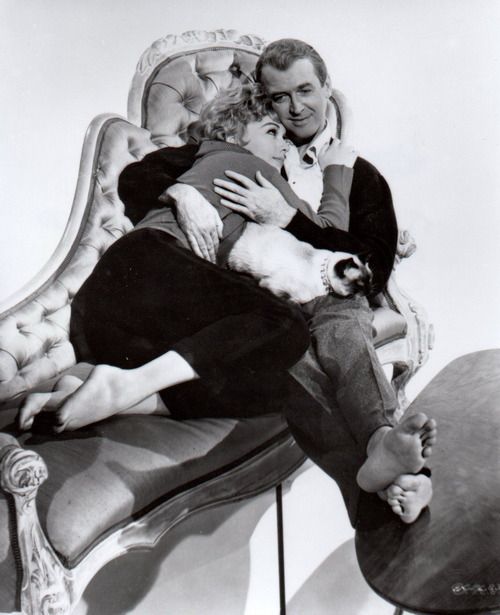
Jimmy Stewart, Kim Novak and Pyewacket. Promo for “Bell, Book and Candle” (1958)
In celebration of this year’s event, here are some facts, tips and must-have feline finds for any cat lover:
- Cats have been companion animals to humans since ancient times. Research suggests that cats first lived close to humans and primarily served as pest control before being domesticated as pets.
- Cats have been sharing our daily lives for a long time. It’s estimated that cats were first domesticated in Egypt between 10,000 and 12,000 years ago. Today, there are more than 400 million pet cats worldwide and around 90 million pet cats in the United States.
- Cats’ whiskers help them navigate their surroundings. While face whiskers are the most obvious, cats also have object-sensing hairs throughout their bodies.
- Most cats experience a euphoric reaction to catnip. Purring, pawing, rolling and romping are common reactions. Catnip is a safe treat that many felines enjoy as much as their humans enjoy watching their reactions.
- There are a lot of cats in need of rescue. According to the ASPCA, about 3.2 million cats end up in animal shelters each year. Spaying and neutering cats are vital to preventing unwanted litters of kittens.
- Pet cat ownership increased during the pandemic. A 2021 survey by the American Pet Products Association found that 14% of respondents got a new pet in the past year, many of whom chose to get a cat.
Here’s what’s happening in non-cat news:
Jill Filipovic at The Guardian: Joe Manchin single-handedly denied US families paid leave. That’s just cruel.
Americans will remain some of the last people on the planet to have no right to paid leave when they have children, and for that, you can thank Joe Manchin.
To be fair, 50 Republicans are to blame for this as well. All 50 of them oppose Biden’s paid family leave plan, and none were expected to vote for this bill. If even a few of them had been willing to cross the aisle to support parents and new babies – to be, one might say, “pro-life” and “pro-family” – then Manchin would not have the power he does to deny paid family leave to millions of American parents. So let’s not forget this reality, too: most Democrats want to create a paid family leave program. Republicans do not.

Sigourney Weaver in Alien, 1979
But Manchin’s actions are particularly insulting and egregious because he is a Democrat. He enjoys party support and funding. He benefits when Democrats do popular things. And now, he’s standing in the way of a policy that the overwhelming majority of Democrats want, and that is resoundingly popular with the American public, including conservatives and Republicans.
Paid family leave brings a long list of benefits to families, from healthier children to stronger marriages. And it benefits the country by keeping more working-age people in the workforce – when families don’t have paid leave, mothers drop out, a dynamic we’ve seen exacerbated by the pandemic. By some estimates, paid family leave could increase US GDP by billions of dollars.
This is good policy. But it’s also a policy that is, in large part, about gender equality. While paid leave is (or would have been) available to any new parent, the reality is that it’s overwhelmingly women who are the primary caregivers for children, it’s overwhelmingly women who birth children, and it’s overwhelmingly women who are pushed out of the paid workforce when they have kids.
Read more at the The Guardian.
Not to worry though, we can also thank Manchin for preserving the filibuster (sarcasm). Joyce White Vance at MSNBC: Democracy is dying a slow death in America. At least we have the filibuster!
Those who suggest we should sacrifice the right to vote in order to preserve the filibuster are telling a fairy tale about a democracy gone bad.
As of this month, 19 states have passed 33 new laws since the 2020 election that will make it harder for Americans to vote. Using false allegations of voter fraud like a monster beneath the bed, Republican state legislatures have passed laws that make it harder to register to vote, stay registered, cast a ballot and have it counted. We’re already entering the next wave of voting rights violations, as data from the 2020 census is stretched and pulled into politically gerrymandered districts that will be with us for the decade.
These laws will make it much more difficult for some voters — and especially for people of color, people with disabilities, and people of lower economic status — to exercise their rights. Some of the statutes veer perilously close to enabling future candidates to do what former President Donald Trump and his allies attempted in 2020: cancel just enough votes to win.

Anita Ekberg in La Dolce Vita, 1960
Democrats have passed legislation in the House of Representatives that would provide a fix. But it’s come to a standstill in the Senate. That’s true even though Sen. Joe Manchin, D-W.Va., morphed the House’s Help America Vote Act into the less beefy but still important Freedom to Vote Act. He thought, unlike anyone who’s been paying attention to Congress over the last few years, that he could attract Republican votes. Whether Republicans are afraid of their party’s de facto leader or afraid of their own political prospects if all of their constituents are free to vote, the Senate floor vote last week made the state of play clear. We are losing ground, and dangerously so, in the fight to ensure American voters can exercise their most essential right in our democracy. But that’s OK! Because we’ll have something much more important, at least according to the Republicans and to Sens. Manchin and Kyrsten Sinema of Arizona — the filibuster.
In 2024, your state legislature may decide that because your majority-Black county voted Democratic in the presidential election, there must have been fraud involved. They may remove your local election officials and replace them with their own handpicked people who will “find” enough votes to “fix” the outcome of the election for the Republican — all legal because the Senate failed to pass the law that would have prevented states from doing this. When your vote isn’t counted, you can console yourself with the knowledge that the filibuster is still there for you.
I wonder which side Manchin and Sinema would have been supported in the Civil War?
Mark Zukerberg–another candidate for most valuable player in the destruction of democracy–announced yesterday that he’s changing Facebook’s name to Meta. Jason Koebler at Vice News: Zuckerberg Announces Fantasy World Where Facebook Is Not a Horrible Company.
Moments before announcing Facebook is changing its name to “Meta” and detailing the company’s “metaverse” plans during a Facebook Connect presentation on Thursday, Mark Zuckerberg said “some people will say this isn’t a time to focus on the future,” referring to the massive, ongoing scandal plaguing his company relating to the myriad ways Facebook has made the world worse. “I believe technology can make our lives better. The future will be built by those willing to stand up and say this is the future we want.”

Marlon Brando in The Godfather, 1972
The future Zuckerberg went on to pitch was a delusional fever dream cribbed most obviously from dystopian science fiction and misleading or outright fabricated virtual reality product pitches from the last decade. In the “metaverse—an “embodied” internet where we are, basically, inside the computer via a headset or other reality-modifying technology of some sort—rather than hang out with people in real life you could meet up with them as Casper-the-friendly-ghost-style holograms to do historically fun and stimulating activities such as attend concerts or play basketball.
These presentations had the familiar vibe of an overly-ambitious video game reveal. In the concert example, one friend is present in reality while the other is not; the friend joins the concert inexplicably as a blue Force ghost and the pair grab “tickets” to a “metaverse afterparty” in which NFTs are for sale. This theme continued throughout as people wandered seamlessly into virtual fantasy worlds over and over, and the presentation lacked any sense of what this so-called metaverse would look like in practice. It was flagrantly abstract, showing more the dream of the metaverse than anything resembling reality. We’re told that two real people, filmed with real cameras on real couches, are in a “digital space.” When Zuckerberg reveals that Facebook is working on augmented reality glasses that could make any of this even a possibility, it doesn’t show any actual glasses, only “simulated footage” of augmented reality.
“We have to fit holograms displays, projectors, batteries, radios, custom silicon chips, cameras, speakers, sensors to map the world around you, and more, into glasses that are five millimeters thick,” Zuckerberg says.
Whatever the metaverse does look like, it is virtually guaranteed to not look or feel anything like what Facebook showed on Thursday.
Read more delusional stuff at the link. I’m not sure what any of this has to do with the mess I see when I dare to open Facebook.
Of course George W. Bush contributed to the anti-democratic world we’re in today. Here’s a flashback for you from Carol Rosenberg at The New York Times: For First Time in Public, a Detainee Describes Torture at C.I.A. Black Sites.
GUANTÁNAMO BAY NAVAL BASE, Cuba — A suburban Baltimore high school graduate turned Al Qaeda courier, speaking to a military jury for the first time, gave a detailed account on Thursday of the brutal forced feedings, crude waterboarding and other physical and sexual abuse he endured during his 2003 to 2006 detention in the C.I.A.’s overseas prison network.
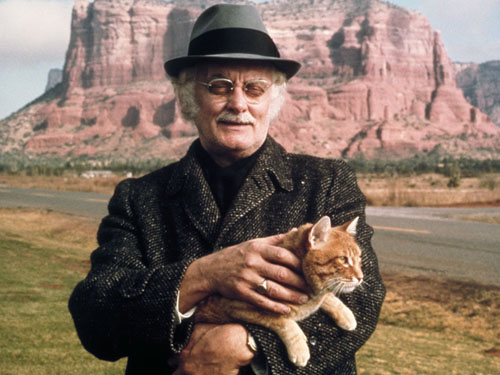
Art Carney in Harry and Tonto
Appearing in open court, Majid Khan, 41, became the first former prisoner of the black sites to openly describe, anywhere, the violent and cruel “enhanced interrogation techniques” that agents used to extract information and confessions from terrorism suspects.
For more than two hours, he spoke about dungeonlike conditions, humiliating stretches of nudity with only a hood on his head, sometimes while his arms were chained in ways that made sleep impossible, and being intentionally nearly drowned in icy cold water in tubs at two sites, once while a C.I.A. interrogator counted down from 10 before water was poured into his nose and mouth.
Soon after his capture in Pakistan in March 2003, Mr. Khan said, he cooperated with his captors, telling them everything he knew, with the hope of release. “Instead, the more I cooperated, the more I was tortured,” he said.
The dramatic accounting capped a day in which eight U.S. military officers were selected to serve on a jury, which will deliberate Friday on his official sentence in the range of 25 to 40 years, starting from his guilty plea in February 2012.
Read the rest at the NYT.
More stories to check out:
Will Sommer at The Daily Beast: He’s Writing Tucker’s Deranged Jan. 6 Movie—After Directing a Pizzagater’s Opus.
The Washington Post: Flight attendant suffers broken bones in ‘one of the worst displays of unruly behavior’ in the skies.
Reuters: Trump’s real-estate empire pays the price for poisonous politics.
The Bulwark: Truth Social Violated Mastodon’s ToS; Trump’s Entire Platform Might Now Be DOA.
The Washington Post: Chief federal judge in D.C. assails ‘almost schizophrenic’ Jan. 6 prosecutions: ‘The rioters were not mere protesters’
Buzzfeed News: White Supremacists Used Racist Slurs And Cursed In Bizarre Opening Statements For The Charlottesville Trial.
Jane Mayer at The New Yorker: A Retiring Democrat Places Blame for Paralysis in Congress.
Did you like this post? Please share it with your friends:
Posted: October 26, 2021 | Author: bostonboomer | Filed under: Afternoon Reads | Tags: abortion, Build Back Better plan, Climate change, Federal Spending, Joe Manchin, nor'easter, Roe v. Wade, Supreme Court, weather |

The Northeaster, by Winslow Homer
Good Afternoon!!
A huge nor’easter is moving up the coast and will likely hit us this afternoon. New Jersey and New York have already declared states of emergency. It has already been pouring rain here for the past two days and it will continue into tomorrow. We are expecting 70 mph wind gusts, maybe a bomb cyclone, and, of course, power outages. I just hope I don’t lose power. I need to get a better flashlight.
The Washington Post: Intensifying nor’easter lashing Northeast with flooding rain and high winds.
A storm offshore the Mid-Atlantic explosively intensified Monday night, and it is buffeting the Northeast with strong winds and flooding rains.
Flash flood watches are up from extreme northern Delaware and New Jersey through eastern Pennsylvania and most of southern New England. Up to five inches of rain are possible, falling on soils that are largely saturated following an exceptionally wet summer. Parts of New Jersey have already seen more than 4 inches, with rainfall rates topping an inch per hour….
Wind advisories also stretch from the nation’s capital to the coastline of Maine, with a high-wind warning up for the shorelines of Massachusetts and Rhode Island, where gusts could top 70 mph. The nor’easter is the first of two sprawling storm systems that will bring inclement weather to the East Coast this week. Its rate of intensification is expected to qualify it as a “bomb cyclone,” or a storm that strengthens with unusual haste.
The storm is the final act of a destructive ensemble that brought tornadoes to the Ozarks and Midwest on Sunday and a line of strong thunderstorms to parts of the Mid-Atlantic overnight Monday, which unloaded 1 to 3 inches of rain from Washington to Philadelphia. By Tuesday, rain and downpours were exiting offshore of the Delmarva Peninsula, spiraling into a new developing low pressure center taking shape off the East Coast.
But nearly half of Americans are deluded about what causes climate change, according to a new poll.
Vice News: 45% of Americans Don’t Believe Humans Cause Climate Change, VICE News/Guardian Poll Shows.
This year was marked by several unprecedented natural disasters, including a “heat dome” marked by sweltering temperatures of up to 113 F that plagued the Pacific Northwest, killing hundreds, and record-breaking wildfire seasons that razed entire towns and displaced thousands. Experts linked the string of natural disasters to the climate crisis, and yet, many Americans are still struggling to understand whether and why the generation-defining crisis is happening.

Emil Carlsen, Nantasket Beach Nor’easter, 1882
The poll, which surveyed 1,000 Americans on behalf of VICE News, the Guardian, and Covering Climate Now, by YouGov, comes less than a week before leaders and delegates from around the world meet in Glasgow, Scotland, for COP26, the United Nations’ climate change conference. The data shows that climate change is a top voter issue in the U.S., behind health care and social programs. For college grads and Democrats, climate change jumped to top spot (for Democrats it was tied with health care).
But while 69.5 percent of respondents believe global warming is happening, they were divided on what’s causing it. Forty-five percent don’t think humans are mostly to blame for global warming, opting instead to blame “natural changes in the environment” or “other,” and 8.3 percent denied global warming is happening altogether.
That’s mostly due to Republicans (55.4 percent) and independents (33 percent) though, who were far more likely than Democrats (17.2 percent) to believe “natural causes” have led to global warming. Young people and educated folks too were significantly more likely to believe humans are to blame for climate change.
Republicans aren’t satisfied with destroying U.S. democracy and killing as many people as possible with Covid-19; apparently they are also determined to hasten the end of the human race. Of course Republican are getting help with their goal of ending democracy and doing nothing about climate change–from a so-called Democrat.
John Nichols at The Nation: Joe Manchin’s Surefire Strategy to Ensure That Democrats Lose in 2022.
If Joe Manchin gets what he wants in negotiations with the Biden White House and his fellow Democratic senators regarding climate policy, which now seems likely, it could have a devastating impact on the planet—and on Democrats’ prospects in 2022.
How so? Let’s answer that question by asking and answering two other questions.
First: Name an issue that young people—an increasingly important and frequently decisive voting bloc—are passionate about? When the US Conference of Mayors surveyed potential voters between the ages of 18 and 29 in 2020, 80 percent said the climate crisis was “a major threat to human life on earth as we know it.” By a 3-1 margin, young people said “bold measures” needed to be taken to address that threat.

Greg Cartmell, October Nor’easter
Second: Name the issue that Democrats are now talking about downplaying in the ”Build Back Better” agenda in order to secure the West Virginia senator’s support? The Biden administration is by all accounts preparing to cut from the budget plan the Clean Electricity Performance Program (CEPP), a key climate initiative that would use a combination of incentives and mandates to get utilities to embrace renewable energy.
Much of the serious reporting on the issue has focused on the devastating impact that losing those clean-energy provisions could have on upcoming climate negotiations at the United Nations Climate Change Conference in Glasgow, Scotland. Without them, it will be tougher for Biden to convincingly pledge a 50 percent reduction in US carbon emissions by 2030. That could undermine negotiations on the issue, according to Michael Mann, director of the Earth System Science Center at Penn State. So serious is the threat that Mann greeted the news of Manchin’s push to abandon the CEPP by declaring, “Joe Manchin just launched a hand grenade at Glasgow.”
Read the rest at The Nation.
More depressing articles on Biden’s shrinking “Build Back Better” legislation:
The Washington Post: Additional Medicare, Medicaid benefits may be whittled or cut as Democrats woo moderates.
Democrats’ sweeping plans to bolster Medicare and Medicaid benefits have been scaled back amid an assault from industry groups and opposition from centrists like Sen. Joe Manchin III (D-W.Va.), with popular coverage expansions likely to be narrowed in hopes of reaching a deal this week.
A proposal to expand Medicare to cover dental, hearing and vision benefits is in danger of falling from the tax-and-spending package rapidly taking shape in Congress. A framework to expand Medicaid to cover Americans in a dozen mostly Southern states has also been reworked.
Meanwhile, drug-pricing reforms have come under sustained attack from pharmaceutical lobbyists, with some Democrats now balking at empowering Medicare to negotiate the price of prescription drugs. Scaling back that proposal, which was expected to cut government spending by more than $700 billion over a decade, would complicate Democrats’ ambition to subsidize their coverage expansions.
Manchin told reporters on Monday that he had concerns about some of Democrats’ signature proposals, underscoring the fragile state of negotiations. “You’ve got to stabilize” Medicare’s long-term finances before adding new benefits, the senator said, adding that he thought the Medicaid proposal was “unfair” to states like his, which have already expanded the program under the Affordable Care Act.
The infighting over health care also prompted Democratic leadership this month to consider a plan to delay some of the party’s health agenda to next year, including a plan to repeal a Trump-era ban on prescription drug rebates, hoping that election-year deadlines would force lawmakers to seal deals that are currently proving elusive, said three people with knowledge of the negotiations, who spoke on the condition of anonymity because of the sensitivity of the negotiations.
That won’t excite Democrats about voting in 2022. And Bernie Sanders is fighting back. The Hill: Sanders draws red lines on Medicare expansion, drug pricing plan in spending bill.

Karol Wyckoff, Nor’easter
Robert Reich at The Guardian: Is Biden’s entire agenda about to shrink into nothingness?
This week, Democrats either reach an agreement on Biden’s social and climate agenda or the agenda may shrink into meaninglessness. The climate measures in particular need to be settled before Biden heads to Scotland for the UN climate summit this weekend, so other nations will see our commitment to reduce carbon emissions.
On Sunday, Biden met with key Democrats to work out spending and tax provisions. Yet every senate Republican and at least two senate Democrats continue to assert that Biden’s agenda is too costly.
Too costly? Really? Compare the Biden’s social and climate package’s current compromise tab of $2tn (spread out over the next 10 years) with:
The $1.9 trillion Trump Republican tax cut that went mostly to the wealthy and large corporations.
Americans were promised that its benefits would “trickle down” to average workers. They didn’t. Corporations used them to finance more stock buybacks. The wealthy used them to buy more shares of stock (and shares of private-equity and hedge funds).
The Trump Republican tax cut should be repealed to pay for Biden’s social and climate package. There is no good reason to retain it. But no senate Republican will vote for its repeal, nor will Arizona’s Kyrsten Sinema – making it a political non-starter in a chamber where Democrats have just half the votes.
The $2.1 trillion that America’s 750 billionaires have raked in just since the start of the pandemic.
You might think that at least a portion of this windfall should help pay for Biden’s agenda since much of it has been the result of monopoly power (for example, Amazon’s dominance over e-commerce during the pandemic).
Oregon Senator Ron Wyden, chair of the Senate Finance Committee, is proposing a “Billionaires Income Tax,” to be paid by the roughly 750 Americans with $1bn in assets or $100m in income for three consecutive years. It would be a yearly tax on the increasing value of their assets – such as stocks and bonds – regardless of when they sell. They could still write off losses every year. Interestingly, neither Sinema nor West Virginia Senator Joe Manchin, the other holdout, has voiced opposition to Wyden’s proposal.
The nearly $8 trillion we’ll be spending on the military over the next 10 years.
The United States already spends more on our military than the next 10 biggest military spenders in the world combined.
Last week, the Senate Appropriations Committee unveiled a nearly $726bn budget for the Defense Department in 2022. That was about $20bn more than Biden requested. Some $14bn in other funds are set aside for the Pentagon in separate military construction and energy appropriations bills, bringing the total budget to about $740 billion. Over ten years, that comes close to $8tn.
More at the link. Also see this from The Washington Post Editorial Board: Build Back Better is getting worse and worse.

Karen Blackwood, A Nor’easter Coming
I’ll end with this piece by Erin Gloria Ryan at The Daily Beast: These Aren’t Justices. They’re Used Car Salesmen, and They’re Coming for Your Abortion Rights.
One of the oldest sales tricks in the book is the one where the salesperson presents the potential buyer with an extremely crappy option first, and follows that up with an only moderately crappy second option. The potential buyer, dazzled by the jump in quality between options one and two, won’t scrutinize option two as much, because it’s so much better than option one. This has been employed by slimy realtors, wedding planners, and used car salesmen.
And now, we’ve reached the point in the American experiment where the Supreme Court’s new conservative majority has resorted to a cheap sales tactic in an attempt to rehabilitate its image. Lower the customer’s expectations enough, conventional wisdom goes, and they’ll thank you for ripping them off.
The high court agreed to hear the Biden administration’s challenge to the law on Nov. 1, on an expedited schedule. Legal observers predict that the court will toss the law out. I—and many wary pro-choicers—predict that after tossing the law out, the media will fawn over the court’s newfound social moderation, and the Susan Collinses of the world will crow that they were right, the hysterical feminists were wrong, and the Supreme Court was never going to toss abortion rights on—as Mike Pence would say—“the ash-heap of history.”
The following month SCOTUS will hear oral arguments in the case of Dobbs vs. Jackson Women’s Health, testing the constitutionality of a Mississippi law that directly confronts Roe v. Wade by banning abortion after 15 weeks’ gestation. Roe established in 1973 that the government has no right to interfere with abortion access prior to fetal viability—around 24.5 weeks’ gestation (a full-term pregnancy takes 40 weeks). Dobbs is the direct challenge to Roe that conservative activists have had a hard-on for since Reagan.
Ryan argues that, using the “smokescreen” provided by the ridiculous Texas law, the right wing justices will use the Alabama law to overturn Roe v. Wade.
Sorry this post is so full of woe. Hope you all have a pleasant Tuesday; I’ll be taking a news break for the next few hours at least.
Did you like this post? Please share it with your friends:
Posted: October 23, 2021 | Author: bostonboomer | Filed under: morning reads | Tags: Coup attempt, Donald Trump, January 6 Committee, January 6 insurrection, Jeffrey Clark, Steve Bannon |

Mädchen mit Katze, 1956, by Otto-Dix
Good Morning!!
There is a great deal of news today about the January 6 Capitol insurrection and the House committee’s investigation of what happened.
First up: if you didn’t think Trump and his gang were trying to organize a serious coup attempt, you need to read this stunning article at The Washington Post: Ahead of Jan. 6, Willard hotel in downtown D.C. was a Trump team ‘command center’ for effort to deny Biden the presidency.
They called it the “command center,” a set of rooms and suites in the posh Willard hotel a block from the White House where some of President Donald Trump’s most loyal lieutenants were working day and night with one goal in mind: overturning the results of the 2020 election.
The Jan. 6 rally on the Ellipse and the ensuing attack on the Capitol by a pro-Trump mob would draw the world’s attention to the quest to physically block Congress from affirming Joe Biden’s victory. But the activities at the Willard that week add to an emerging picture of a less visible effort, mapped out in memos by a conservative pro-Trump legal scholar and pursued by a team of presidential advisers and lawyers seeking to pull off what they claim was a legal strategy to reinstate Trump for a second term.
They were led by Trump’s personal lawyer Rudolph W. Giuliani. Former chief White House strategist Stephen K. Bannon was an occasional presence as the effort’s senior political adviser. Former New York City police commissioner Bernard Kerik was there as an investigator. Also present was John Eastman, the scholar, who outlined scenarios for denying Biden the presidency in an Oval Office meeting on Jan. 4 with Trump and Vice President Mike Pence.
They sought to make the case to Pence and ramp up pressure on him to take actions on Jan. 6 that Eastman suggested were within his powers, three people familiar with the operation said, speaking on the condition of anonymity to describe private conversations. Their activities included finding and publicizing alleged evidence of fraud, urging members of state legislatures to challenge Biden’s victory and calling on the Trump-supporting public to press Republican officials in key states.
The effort underscores the extent to which Trump and a handful of true believers were working until the last possible moment to subvert the will of the voters, seeking to pressure Pence to delay or even block certification of the election, leveraging any possible constitutional loophole to test the boundaries of American democracy.
Here’s what these coup-organizers were doing:

Kaate Diehn-Bitt, Peter Paul Diehn with cat
The three people familiar with the operation described intense work in the days and hours leading up to and even extending beyond 1 p.m. on Jan 6, when Congress convened for the counting of electoral votes.
In those first days in January, from the command center, Trump allies were calling members of Republican-dominated legislatures in swing states that Eastman had spotlighted in his memos, including Pennsylvania, Georgia and Arizona, encouraging them to convene special sessions to investigate fraud and to reassign electoral college votes from Biden to Trump, two of the people familiar with the operation said.
On Jan. 2, Trump, Giuliani and Eastman spoke to 300 state legislators via a conference call meant to arm them with purported evidence of fraud and galvanize them to take action to “decertify” their election results. “You are the real power,” Trump told the state lawmakers, according to a Washington Examiner report. “You’re the ones that are going to make the decision.”
The goal was to convince these state lawmakers to work to decertify the election results in their states and to try to convince Mike Pence to delay certification of the electoral college results to give these insurrectionist legislators time to convince their colleagues to overthrow the election results. And Bannon was involved in these efforts.
Also on Jan. 2, Eastman, Giuliani and Epshteyn appeared on Bannon’s podcast to make the case directly to Bannon’s pro-Trump listeners. They discussed what Bannon called that day’s “all-hands meeting with state . . . legislators that the Trump campaign and also others are putting on.” The comments were first highlighted by Proof.
They argued that state lawmakers were legally bound to reexamine their election results. “It’s the duty of these legislatures to fix this, this egregious conduct, and make sure that we’re not putting in the White House some guy that didn’t get elected,” Eastman said. He contended that Congress could itself decide on Jan. 6 to select Trump electors in contested states, but that “it would certainly be helped immensely if the legislatures in the states looked at what happened in their own states and weigh in.”
I hope you’ll go read the rest. Every sentence in the article is important.
Will Bannon pay a price for his involvement in the coup attempt? That will be up to Attorney General Merrick Garland. Former U.S. Attorney and Deputy Assistant Attorney General Harry Litman writes: Don’t be too sure about the Justice Department’s ‘duty’ to indict Bannon.
Atty. Gen. Merrick Garland has a far more complicated decision coming his way than people realize.
The Department of Justice, in the person of the United States attorney for the District of Columbia, has received a referral from the House of Representatives to bring criminal contempt charges against Stephen K. Bannon, who has refused to comply with a subpoena from the House select committee investigating the events of Jan. 6.

Two Cats, by Franz Marc
The righteousness of the referral is not in doubt. There is every reason to think Bannon has important first-hand information about the planning of the Capitol attack. After all, he crowed the night before on his podcast: “All hell is going to break loose tomorrow…. Strap in.”
In addition, as the committee’s vice chair, Rep. Liz Cheney (R-Wyo.), emphasized Tuesday, there is strong reason to think Bannon knows if and how Trump was “personally involved” in the Jan. 6 attack. No matter is more important for Congress to probe or for the American public to understand.
As for Bannon’s thumbing his nose at a subpoena, it could not be a more flagrant or a more contemptuous violation of the law.
Enforcing the subpoena “should be a slam dunk,” Littman writes, “But it isn’t.” According to Littman, there are several Office of Legal Counsel memos that will impact Garland’s actions. One decision is that the DOJ is not required to enforce subpoenas on members of the executive branch–the AG makes the decision. Other OLC memos address the issue of White House officials and executive privilege. I’m not sure I understand this, because Bannon was not a White House official when all this was happening–even when he was in the White House, he was only a political adviser. Furthermore, Trump is no longer president and how can he invoke executive privilege over planning for a coup? Littman writes:
There is a way for Garland to square the circle. The Office of Legal Counsel’s memo that has precluded pursuit of criminal contempt charges was based on cases in which the department issued legal opinions that the assertions of privilege were proper.
Bannon’s suggestion that the subpoenaed documents and communications are properly covered by executive privilege is spurious at best. First, there’s the fact that Trump hasn’t actually asserted the privilege. On top of that, the select committee’s subpoena involves events that happened years after Bannon left the executive branch; it’s ridiculous to say the relevant testimony and documents must be kept secret to ensure that presidents can freely do the country’s business.
Finally, even if Bannon had a sound claim to executive privilege, Congress’ and the public’s need to know the information covered by the subpoena is paramount, and that factor should prevail. (Likewise, public interest trumped Nixon’s claim to privacy in the 1977 Supreme Court case, which was about the disposition of the disgraced president’s papers.)
More January 6 committee news:
CNN: Former DOJ official Jeffrey Clark, who pushed baseless election fraud claims, expected to testify before January 6 committee.
Did you like this post? Please share it with your friends:





 peej
peej Carissa
 bostonboomer
 dakinikat
 ecocatwoman
 mablue2
 Mama Lopez
 peggysue22
 quixote
 skydancingguestblogger
 Mona (aka Wonk the Vote)



 Sky Dancing
Recent Comments