Posted: December 21, 2021 | Author: bostonboomer | Filed under: just because |

Winter Landscape on the Banks of the Seine, Henri Matisse
Happy Winter Solstice!!
When will there be good news? I feel as if I’m living in the apocalypse. In just a couple of weeks, the latest Covid-19 variant has become dominant in the U.S. Once again, new cases are rapidly rising even in fully vaccinated and boosted people. Hospitals are running out of beds and health care workers are overworked and exhausted. Democrats are in grave danger of losing the House and possibly the Senate to Republicans who have lost touch with reality. And, as we all know, Joe Manchin has dashed Democrats’ hope of passing a bill that would have made everything better for Americans who aren’t in the top 1 percent. Can you tell I’m discouraged? Here’s what’s happening:
Covid-19, Omicron Variant
AP News: Omicron sweeps across nation, now 73% of new US COVID cases.
Omicron has raced ahead of other variants and is now the dominant version of the coronavirus in the U.S., accounting for 73% of new infections last week, federal health officials said Monday.
The Centers for Disease Control and Prevention numbers showed nearly a six-fold increase in omicron’s share of infections in only one week.
In much of the country, it’s even higher. Omicron is responsible for an estimated 90% or more of new infections in the New York area, the Southeast, the industrial Midwest and the Pacific Northwest. The national rate suggests that more than 650,000 omicron infections occurred in the U.S. last week.
Since the end of June, the delta variant had been the main version causing U.S. infections. As recently as the end of November, more than 99.5% of coronaviruses were delta, according to CDC data.
CDC Director Dr. Rochelle Walensky said the new numbers reflect the kind of growth seen in other countries….

Paul Gaugin Winter Landscape,
Much about the omicron variant remains unknown, including whether it causes more or less severe illness. Early studies suggest the vaccinated will need a booster shot for the best chance at preventing omicron infection but even without the extra dose, vaccination still should offer strong protection against severe illness and death.
“All of us have a date with omicron,” said Dr. Amesh Adalja, a senior scholar at the Johns Hopkins Center for Health Security. “If you’re going to interact with society, if you’re going to have any type of life, omicron will be something you encounter, and the best way you can encounter this is to be fully vaccinated.”
Craig Spencer at The Atlantic: Omicron Will Overwhelm America’s Emergency Rooms. Hospitals are already strained and many health-care workers have little left to give.
Like most of my colleagues, I haven’t arrived at this moment unscathed. I weathered the brutal first wave of the pandemic, often witnessing more COVID deaths during my shifts in New York City than I saw working in an Ebola-treatment center in West Africa in 2014.
When I was vaccinated against COVID a year ago, I was already exhausted. But better times seemed close at hand. Perhaps soon we wouldn’t have to endure wearing full personal protective equipment for hours on end. I was wrong.
After two years of dealing with this virus—working extra shifts, watching families sob on grainy FaceTime calls while their loved ones slipped away—many health-care workers are already in a dark place. With a new wave of COVID upon us, we face this grim truth: You can’t surge a circuit that’s been burned out. For frontline providers, there’s simply no new fuse that can fix the fact that we’re fried.

Edvard Munch, Snow Falling in the Lane
Many people are holding out hope for the possibility that the Omicron variant may cause less severe disease. But this is little comfort for those worried about our hospitals and the people who work there: A large surge of even a more mild variant will still produce more patients than our already maxed-out system can handle. Moreover, doctors and nurses will themselves get sick.
The looming tidal wave of Omicron cases comes at an already challenging time for emergency departments across the U.S. The Delta wave never fully subsided, and a lot of ERs are already attending to too many COVID patients. Also making things worse: Emergency-room visits are up for non-COVID illness as well, in part because people have postponed some routine medical care throughout the pandemic. As a result, we head into winter with emergency rooms across the country overwhelmed and over capacity.
Here in Massachusetts, Governor Baker has issued a new mask advisory and activated 500 National Guard members to aid hospitals. He has also asked hospitals to cancel all elective surgeries. He said he won’t issue a mask mandate and says schools must stay open.
ABC News: Biden to announce plan to mail 500 million free rapid tests to Americans next month.
President Joe Biden will announce a plan on Tuesday to distribute 500 million free at-home rapid tests to Americans beginning in January as part of an attempt to double down on the spread of a transmissible variant that has hit the U.S. distressingly close to the holidays.
Biden’s new efforts come as the omicron variant became the most dominant COVID strain in the country Monday, accounting for nearly three-quarters of all cases, and just as travel kicks off at nearly pre-pandemic levels for the holiday season.

Sleigh Ride, Winslow Homer
The free at-home rapid tests will be delivered by mail to Americans who request them, a senior administration official told reporters on Monday night in a preview of the speech, marking a slightly different approach from European countries that chose to send tests to all residents.
Americans will have to request the tests through a website that will launch in January, the official said, and its not yet clear how many tests Americans will be able to request per household.
Danger Ahead from the Trumpist Party
Doug Sosnik at The Washington Post: Opinion: As the GOP sheds its moderates, a whirlwind approaches.
We don’t need to wait for the results of next year’s midterm elections to know that a political shock wave is headed toward Washington. The early tremors are already detectable.
Donald Trump’s takeover of the Republican Party will soon be complete, and what had previously been a fringe element within the GOP will emerge fully in control. The two big lies — that the 2020 election was stolen from Trump and that the Jan. 6 attack on the U.S. Capitol was not serious enough to merit an investigation — are no longer considered radical inside the GOP.
Republicans can be expected to take over the House of Representatives after the midterm elections — most likely by a considerable margin. Trump already dominates the GOP at the state and local levels, and with the notable exceptions of Reps. Liz Cheney (R-Wyo.) and Adam Kinzinger (R-Ill.), has a vice-like grip on Republican House members. Even if Trump does not run in 2024, his views and policies now represent mainstream Republican thinking.
And even if the Democrats maintain their narrow grip on the Senate, what is left of the reasonable wing of the Republican Senate is about to disappear. The Republican half of the Senate is on the brink of a new, and irresponsible, era. The 2022 election will cement the trend.

Richard von Drasche-Wartinberg, In Deep Winter
The Senate Republican Caucus has been the last remaining guardrail preventing Trump’s complete takeover of the Republican Party. That is about to change. There are five senators from what passes for the “governing wing” of the Republican Party who have announced their retirements: Richard C. Shelby (Alabama), Roy Blunt (Missouri), Richard Burr (North Carolina), Rob Portman (Ohio) and Patrick J. Toomey (Pennsylvania). Because Trump carried all but one of these states (Pennsylvania) in 2020, it is a safe bet all these men will be replaced by more Trump acolytes. In each of these states, the Republican primary has been a referendum on which candidate is most similar to Trump.
It is only because of some of the soon-departing establishment Republicans — and a small handful of others — that President Biden got a hard infrastructure bill on his desk and an increase in the debt ceiling while at the same time allowing the government to remain open.
Because they control the redistricting process in most states, Republicans have been busy redrawing maps and packing swing districts to provide them with more conservative voters. Since winning a Republican congressional primary is tantamount to winning the general election, the GOP will have spent 2021 creating the conditions that will push the party even further to the right.
If you can bear it, three examples of what GOP crazies are up to:
Dana Millbank at The Washington Post: Sarah Palin’s anti-vax talk shows Republicans have become a death cult.
The Daily Beast: Anti-Vaxxer Crowds Are Now Attacking Cheesecake Factories, REIs, and Panera Bread.
The Daily Beast: Dallas QAnon ‘Cult’ Is Now Drinking Terrifying Chemical Cocktail, Family Says.
The Manchin Problem
Evan Osnos at The New Yorker: West Virginians Ask Joe Manchin: Which Side Are You On?
The active ingredients in Manchin’s political calculus have never been a great mystery: he is a Democrat aiming to get reëlected in an increasingly Republican state, and he is among the Senate’s largest recipients of campaign cash from the coal, oil, and gas industries, which have lobbied against the climate-change provisions in the bill he scuttled. But, to the West Virginians who begged him to support the anti-poverty programs in the Build Back Better bill, his rejection reflects a fundamental seclusion from the needs of people which he is no longer willing or able to perceive. To such critics in the state, Manchin has become an icon of Washington oligarchy and estrangement, a politician with a personal fortune, whose blockade against programs that have helped his constituents escape poverty represents a sneering disregard for the gap between their actual struggles and his televised bromides.

Peter Doig’s Cobourg 3 + 1 More (1994)
If Manchin’s opposition holds, his vote will be decisive in ending the expanded Child Tax Credit program, which, according to the Treasury Department, last week delivered payments benefitting three hundred and five thousand children in West Virginia. Statewide, ninety-three per cent of children are eligible for the credit, tied for the highest rate in the country. Analysts estimate that, if the program is allowed to expire, at the end of the month, fifty thousand children there will be in danger of falling into poverty. The average payment per family: four hundred and forty-six dollars a month.
Manchin is especially vulnerable to accusations of imperial remove. Photos that circulated online show him chatting over the rail of his houseboat in Washington with angry constituents, who had arrived by kayak. After he persuaded the Biden Administration to drop from the bill the Clean Electricity Performance Program, the centerpiece of efforts to slash greenhouse-gas emissions, climate protesters surrounded Manchin’s silver Maserati.
Jim McKay, the director of Prevent Child Abuse West Virginia, a nonprofit organization that lobbied Manchin to support the bill, told me that the senator was “conspicuously absent” from “personal meetings with West Virginia families.” McKay said, “Unfortunately, while his staff did have some meetings—which we are thankful to have had—personal contacts with Senator Manchin were extremely limited.” Dodging uncomfortable meetings is not unique in politics, but the accusation carries a special sting for Manchin, whose status as a Democrat in a red state makes him especially keen to project an image of a man who refuses to “go Washington.” McKay said, “I look forward to when Senator Manchin reconnects with average people.”
Read more from West Virginians at CNN: Coal miners want Joe Manchin to reverse opposition to Build Back Better.
The Washington Post on Manchin’s final offer to Biden: Manchin’s private offer to Biden included pre-K, climate money, Obamacare — but excluded child benefit.
Sen. Joe Manchin III last week made the White House a concrete counteroffer for its spending bill, saying he would accept a $1.8 trillion package that included universal prekindergarten for 10 years, an expansion of Obamacare and hundreds of billions of dollars to combat climate change, three people familiar with the matter said.
But the West Virginia Democrat’s counteroffer excluded an extension of the expanded child tax credit the administration has seen as a cornerstone of President Biden’s economic legacy, the people said, an omission difficult for the White House to accept in the high-stakes negotiations. The people spoke on the condition of anonymity to discuss the closed-door deliberations.
 Manchin’s private proposal to the White House — the details of which have not been previously reported — was made just days before a spectacular public collapse in negotiations between the White House and the senator, marked by bitter and personal recriminations that left the status of the talks unclear.
The White House was weighing how to respond to Manchin’s proposal last week when on Sunday he told Fox News that he would be unable to support the current version of Democrats’ Build Back Better agenda.
Why does Manchin hate children? More details at the link.
The Washington Post: Liberal lawmakers don’t want to talk about scaling back their ambitions to revive some of what Joe Manchin killed.
Liberals are furious.
Their hopes of enacting an expansive domestic policy bill focused on health care, education and climate change have been dashed. They blame Sen. Joe Manchin III (D-W.Va.), arguing he failed to keep his word to negotiate in good faith with the White House before announcing his opposition to the package on “Fox News Sunday.”
And they are in no mood, at the moment, to think about scaling back their policy ambitions in hopes of getting some part of what they want into law following Manchin’s proclamation that he “can’t get there” on President Biden’s “Build Back Better” proposal.
“Why do we have to acquiesce to what members of another party think we should be doing, what so called moderates think we should be doing, what so called independents think we should be doing? All of that represents a status quo,” said Rep. Jamaal Bowman (D-N.Y.). “Our status quo is rooted in racism, sexism and classism, and us not passing Build Back Better or scaling it back dramatically, even more so than has already been done, is going to disproportionately harm people of color, women, the poor, children and seniors.”
The intense frustration emanating from the most liberal members of Congress adds an extra layer of complication for the White House and Democratic leaders who are scrambling to find a path forward to save some of the roughly $2 trillion domestic policy bill Manchin torpedoed over the weekend.
That’s all I have for you today. I’m sorry I can’t be more upbeat about what’s happening. I can’t give up hope, but I’m exhausted by it all. I don’t know what I would do without all of you Sky Dancers!
Did you like this post? Please share it with your friends:
Posted: December 18, 2021 | Author: bostonboomer | Filed under: Afternoon Reads | Tags: 2024 Elections, Ali Alexander, caturday, Civil War, coronavirus pandemic, Covid-19, January 6 insurrection, Omicron variant, Rick Perry, U.S. Military |
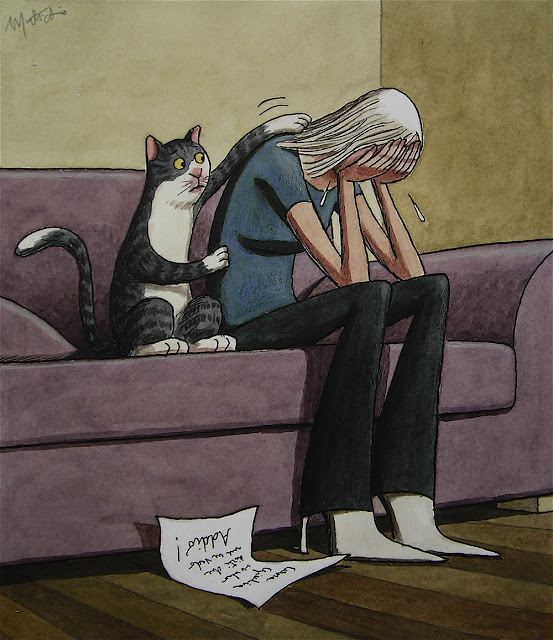
By Pat Matticchio
Good Afternoon!!
I’m beginning to accept that we are never going to return to “normal.” After 6 years of dealing with Trump and his domination of the Republican party, after 2 long years of Covid-19 and the loss of more than 800,000 lives, we now face the threat of losing our democracy as we deal with a new Covid variant that is already spreading rapidly and is likely to kill many more Americans. And I haven’t even touched on the dangers we face from climate change.
On the threats to U.S. democracy:
The Washington Post: Opinion: 3 retired generals: The military must prepare now for a 2024 insurrection, by Paul D. Eaton, Antonio M. Taguba, and Steven M. Anderson
As we approach the first anniversary of the deadly insurrection at the U.S. Capitol, we — all of us former senior military officials — are increasingly concerned about the aftermath of the 2024 presidential election and the potential for lethal chaos inside our military, which would put all Americans at severe risk.
In short: We are chilled to our bones at the thought of a coup succeeding next time.
One of our military’s strengths is that it draws from our diverse population. It is a collection of individuals, all with different beliefs and backgrounds. But without constant maintenance, the potential for a military breakdown mirroring societal or political breakdown is very real.

Le Chat Van Gogh by Toni Goffe
The signs of potential turmoil in our armed forces are there. On Jan. 6, a disturbing number of veterans and active-duty members of the military took part in the attack on the Capitol. More than 1 in 10 of those charged in the attacks had a service record. A group of 124 retired military officials, under the name “Flag Officers 4 America,” released a letter echoing Donald Trump’s false attacks on the legitimacy of our elections.
Recently, and perhaps more worrying, Brig. Gen. Thomas Mancino, the commanding general of the Oklahoma National Guard, refused an order from President Biden mandating that all National Guard members be vaccinated against the coronavirus. Mancino claimed that while the Oklahoma Guard is not federally mobilized, his commander in chief is the Republican governor of the state, not the president.
The potential for a total breakdown of the chain of command along partisan lines — from the top of the chain to squad level — is significant should another insurrection occur. The idea of rogue units organizing among themselves to support the “rightful” commander in chief cannot be dismissed.
Please go read the rest at the WaPo.
Molly Jong-Fast at The Atlantic: How Do You Get People to Care About Democracy? The preservation of Democracy shouldn’t be a partisan activity.
Every time the January 6 committee holds a hearing, it seems clearer and clearer that Donald Trump was trying to keep control over the government after losing reelection. The past week alone produced the “how to coup” PowerPoint, widely circulated in Trumpworld, and a slew of text messages, including this sorry we weren’t able to pull off a coup note from an unidentified lawmaker to Mark Meadows: “Yesterday was a terrible day. We tried everything we could in our objection to the 6 states. I’m sorry nothing worked.” It’s pretty clear what Trump was up to: trying to reinstall himself as president and end American democracy as we know it.
Trump’s crew surely knew how bad the events of January 6 were even as they were unfolding. “The president needs to tell people in the Capitol to go home … he is destroying his legacy,” Fox News host Laura Ingraham wrote to Mark Meadows in a text message read by Republican Representative Liz Cheney during the opening statements of the Jan 6 committee meeting on Monday night. A range of journalists sent similar messages. Actual reporter Jake Sherman—who had been stuck in the Capitol during the riot, and who released his texts with Meadows “out of transparency”—wrote, “Do something for us. We are under siege in the [Capitol].” Another “journalist” exchanging texts with Meadows at the time: Fox propagandist Sean Hannity, who wrote, “Can he make a statement? Ask people to leave the Capitol.”

We are not alone, Greeting card by Alison Friend
It’s a long piece, but here’s the conclusion:
But how you safeguard democracy when only one party supports it is a riddle. How do Democrats permeate the Fox and Facebook anti-fact chamber, which paints Trump as the real victim of the insurrection he helped instigate?
I don’t know how you get Republicans to see past this election, to understand that losing democracy is about more than just a win for their guy. Some members of the mainstream media have been defensive, saying they aren’t covering the threat to democracy because lawmakers aren’t talking about it. But here’s the thing: It’s the media’s job to make people care, to highlight the stories that matter. We don’t look to elected officials to tell us what to write about. We journalists may be the bulwark that keeps America from resembling Hungary or Turkey in a few years. Keeping democracy shouldn’t be a partisan fight, but it is, and perhaps that’s the most damning thing of all.
Okay, then how do we get the most powerful newspaper–The New York Times–to care about democracy?
About that text to Meadows expressing sorrow that the coup failed? It appears to have come from Rick Perry’s phone. CNN: Exclusive: Jan 6 investigators believe Nov. 4 text pushing ‘strategy’ to undermine election came from Rick Perry.
Did you like this post? Please share it with your friends:
Posted: December 16, 2021 | Author: bostonboomer | Filed under: just because, morning reads | Tags: bell hooks, coronavirus pandemic, Covid-19, feminism, January 6 investigation, Omicron variant |
Good Morning!!
Yesterday we lost bell hooks (born Gloria Watkins), feminist theorist, poet, and activist.
I’m ashamed to admit that I’ve never read her work, but I was impressed by what I read about hooks this morning. Dakinikat was inspired by her, so perhaps she will share her thoughts today and/or tomorrow.
Lucy Knight at The Guardian: bell hooks, author and activist, dies aged 69.
Gloria Jean Watkins, better known by her pen name bell hooks, has died aged 69.
Her niece Ebony Motley tweeted: “The family of @bellhooks is sad to announce the passing of our sister, aunt, great aunt and great great aunt.”
She also attached a statement, which said that “the family of Gloria Jean Watkins is deeply saddened at the passing of our beloved sister on December 15, 2021. The family honored her request to transition at home with family and friends by her side.”
The author, professor and activist was born in Hopkinsville, Kentucky in 1952, and published more than 30 books in her lifetime, covering topics including race, feminism, capitalism and intersectionality.
She adopted her maternal great-grandmother’s name as a pen name, since she so admired her, but used lowercase letters to distinguish herself from her family member. hooks’ first major work, Ain’t I a Woman?, was published in 1981, and became widely recognised as an important feminist text. It was named one of the 20 most influential women’s books in the last 20 years by Publishers Weekly in 1992.
She went on to write Feminist Theory: From Margin to Center in 1984, All About Love: New Visions in 2000 and We Real Cool: Black Men and Masculinity in 2004, continuing to draw on themes of feminism, race, love and gender.
Since 2004, she taught at Berea College in Kentucky, a liberal arts college that offers free tuition.
In 2016 hooks wrote in the Guardian that Beyoncé’s album Lemonade was “capitalist money-making at its best”, but criticised the notion of “freedom” depicted in the lyrics. “To truly be free,” wrote hooks, “we must choose beyond simply surviving adversity, we must dare to create lives of sustained optimal wellbeing and joy.”
“I want my work to be about healing,” she said in 2018 when she was inducted into the Kentucky Writers’ Hall of Fame. “I am a fortunate writer because every day of my life practically I get a letter, a phone call from someone who tells me how my work has transformed their life.”
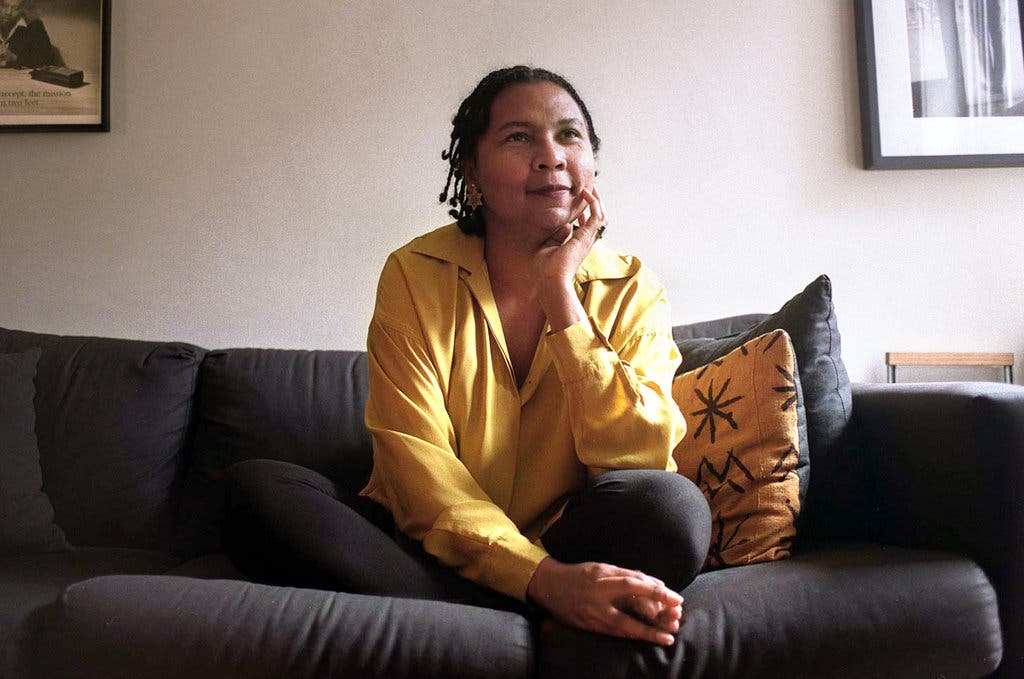 From The Literary Hub:
hooks’s first published work of theory, Ain’t I A Woman: Black Women and Feminism, was published when she was 29 but written when she was an undergraduate, launching a four-decade-long career of writing and teaching, with a focus on classroom accessibility. hooks’s extensive body of scholarship and poetry—that remains and will continue to remain relevant—was consistent in its generosity, emphasizing the importance of loving communities to challenging systemic inequalities. Hooks believed a “militant commitment to feminism” was not at all at odds with joy and humor; in fact, that love “is the necessary foundation enabling us to survive the wars, the hardships, the sickness, and the dying with our spirits intact.” As she told The New York Times in 2015,
“We cannot have a meaningful revolution without humor. Every time we see the left or any group trying to move forward politically in a radical way, when they’re humorless, they fail. Humor is essential to the integrative balance that we need to deal with diversity and difference and the building of community. For example, I love to be in conversation with Cornel West. We always go high and we go low, and we always bring the joyful humor in. The last talk he and I gave together, many people were upset because we were silly together. But I consider it a high holy calling that we can be humorous together. How many times do we see an African-American man and an African-American woman talking together, critiquing one another, and yet having delicious, humorous delight? It’s a miracle.”
hooks’s family said contributions and memorials can be made to the Christian County Literacy Council, which promotes reading for children, or the Museums of Historic Hopkinsville Christian County, where a biographical exhibit is on display.
From the New Yorker piece:
I came to her work in the mid-nineties, during a fertile era of Black cultural studies, when it felt like your typical alternative weekly or independent magazine was as rigorous as an academic monograph. For hooks, writing in the public sphere was just an application of her mind to a more immediate concern, whether her subject was Madonna, Spike Lee, or, in one memorably withering piece, Larry Clark’s “Kids.” She was writing at a time when the serious study of culture—mining for subtexts, sifting for clues—was still a scrappy undertaking. As an Asian American reader, I was enamored with how critics like hooks drew on their own backgrounds and friendships, not to flatten their lives into something relatably universal but to remind us how we all index a vast, often contradictory array of tastes and experiences. Her criticism suggested a pulsing, tireless brain trying to make sense of how a work of art made her feel. She modelled an intellect: following the distant echoes of white supremacy and Black resistance over time and pinpointing their legacies in the works of Quentin Tarantino or Forest Whitaker’s “Waiting to Exhale.”
Yet her work—books such as “Reel to Real” or “Art on My Mind,” which have survived decades of rereadings and underlinings—also modelled how to simply live and breathe in the world. She was zealous in her praise—especially when it came to Julie Dash’s “Daughters of the Dust,” a film referenced countless times in her work—and she never lost grasp of how it feels to be awestruck while standing before a stirring work of art. She couldn’t deny the excitement as the lights dim and we prepare to surrender to the performance. But she made demands on the world. She believed criticism came from a place of love, a desire for things worthy of losing ourselves to….
This has been a particularly trying time for critics who came of age in the eighties and nineties, as giants like hooks, Greg Tate, and Dave Hickey have passed. hooks was a brilliant, tough critic—no doubt her death will inspire many revisitations of works like “Ain’t I a Woman,” “Black Looks,” or “Outlaw Culture.” Yet she was also a dazzling memoirist and poet. In 1982, she published a poem titled “in the matter of the egyptians” in Hambone, a journal she worked on with her then partner, Nathaniel Mackey. It reads:
ancestral bodies
buried in sand
sun treasured flowers
press in a memory book
they pass through loss
and come to this still tenderness
swept clean by scarce winds
surfacing in the watery passage
beyond death
I enjoyed reading this piece from 2019 by Min Jin Lee in The New York Times: In Praise of bell hooks.
In 1987, I was a sophomore at Yale. I’d been in the United States for 11 years, and although I was a history major, I wanted to read novels again. I signed up for “Introduction to African-American Literature,” which was taught by Gloria Watkins, an assistant professor in the English department, and she was such a wonderful teacher that I signed up for her other class, “Black Women and Their Fiction.”
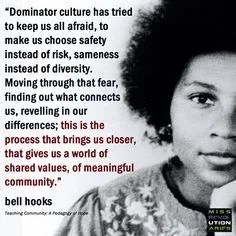 Gloria — as we were allowed to address her in the classroom — had a slight figure with elegant wrists that peeked out of her tunic sweater sleeves. She was soft-spoken with a faint Southern accent, which I attributed to her birthplace, Hopkinsville, Ky. She was in her mid-30s then but looked much younger. Large, horn-rimmed glasses framed the open gaze of her genuinely curious mind. You knew her classes were special. The temperature in the room seemed to change in her presence because everything felt so intense and crackling like the way the air can feel heavy before a long-awaited rain. It wasn’t just school then. No, I think, we were falling in love with thinking and imagining again….
I was 19 when I took hooks’s classes, and I was just becoming a young feminist myself. I had begun my study of feminism with Mary Wollstonecraft, Charlotte Perkins Gilman, Susan B. Anthony, Elizabeth Cady Stanton, Virginia Woolf, Betty Friedan and Gloria Steinem, among other white women, and perhaps, because I was foreign-born — rightly or wrongly — I had not expected that people like me would be included in their vision of feminist liberation. Women and men of Asian ethnicities are so often neglected, excluded and marginalized in the Western academy, so as a college student I’d no doubt internalized my alleged insignificance. bell hooks changed my limited perception.
Her book of theory taught me to ask for more from art, literature, media, politics and history — and for me, a Korean girl who had been born in a divided nation once led by kings, colonizers, then a succession of presidents who were more or less dictators, and for millenniums, that had enforced rigid class systems with slaves and serfs until the early 20th century, and where women of all classes were deeply oppressed and brutalized, I needed to see that the movement had a space for me.
What else is in the news? January 6 and the never ending pandemic.
January 6: Could it be that the investigation is really heating up?
David Rohde at The New Yorker: Is There a Smoking Gun in the January 6th Investigation?
William Saletan at Slate: The Chilling Lesson of Mark Meadows’ Text Messages.
The New York Times: Meadows and the Band of Loyalists: How They Fought to Keep Trump in Power.https://www.nytimes.com/2021/12/15/us/politics/trump-meadows-republicans-congress-jan-6.html
Kyle Cheney at Politico: The Jan. 6 puzzle piece that’s going largely ignored.
Kyle Cheney at Politico: Jan. 6 investigators mull whether Trump violated obstruction law.
CNN: Jim Jordan sent one of the texts revealed by January 6 committee.
The Washington Post: Role as Trump’s gatekeeper puts Meadows in legal jeopardy — and at odds with Trump.
Georgia Public Radio: Exclusive: More Georgia Secretary of State’s office officials interviewed by Jan. 6 committee.
The never ending pandemic
CNBC: Omicron symptoms could seem like a cold — but don’t underestimate this variant, experts warn.
AP via KTLA: U.S. faces a double coronavirus surge as omicron variant advances.
Ian Bogost at The Atlantic: I’m Starting to Give Up on Post-pandemic Life.
Yasmin Tayag at The Atlantic: Don’t Be Surprised When You Get Omicron.
Ed Yong at The Atlantic: America Is Not Ready for Omicron. The new variant poses a far graver threat at the collective level than the individual one—the kind of test that the U.S. has repeatedly failed.
Have courage and enjoy the present moment. There’s no telling what will happen next.
Did you like this post? Please share it with your friends:
Posted: December 14, 2021 | Author: bostonboomer | Filed under: Afternoon Reads, just because | Tags: January 6 Committee, January 6 insurrection, Jungle art, Mark Meadows |

Cat, by Gabriel Alix, Haitian artist, 1979
Good Afternoon!!
The paintings in this post are examples of “jungle art” by Haitian artists. Dakinikat posted a couple of these yesterday and I really like them. They have a similar quality to “folk art.”
Last night the House January 6 committee met to vote on whether to refer Mark Meadows to the Justice Department for criminal contempt of Congress. The session was televised and generated quite a bit of news and commentary. The committee plans to hold televised meetings “in the first quarter” of 2022. When that happens, we could see more interest from the general public. I only hope the hearings start sooner rather than later.
Here’s the latest news on the hearing:
The Washington Post: House Jan. 6 committee votes to hold Meadows in contempt, details texts from Trump allies who wanted him to call off rioters.
The House committee investigating the Jan. 6 attack on the Capitol voted Monday night to hold former White House chief of staff Mark Meadows in criminal contempt for defying a subpoena, while also releasing a series of texts from Fox News hosts and Donald Trump Jr. urging Meadows to implore President Donald Trump to call off the violent mob.
The seven Democrats and two Republicans tasked with investigating the insurrection all supported the resolution that could be taken up by the full House as soon as Tuesday.
Last week, Meadows backed away from cooperating with the committee just days after saying he would, arguing that the panel was pressuring him to discuss issues that the former president said are protected by executive privilege. However, he had already produced thousands of documents for the panel, including text messages and emails related to the events of the day.
At a public meeting ahead of the vote Monday, members of the committee used information already provided by Meadows to make the case that he is a key figure in understanding Trump’s efforts to overturn the election results, what role the White House played in planning the rally that preceded the attack, and why Trump did not immediately come out and forcefully call on his supporters to stop their assault on the Capitol once it was underway.

By Jean Claude Paul, Haitian artist
“History will not look upon you as a victim. History will not dwell on your long list of privilege claims or your legal sleight of hand,” the committee chairman, Rep. Bennie G. Thompson (D-Miss.), said of Meadows and others who are refusing to cooperate. “History will record that in a critical moment in our democracy, most people were on the side of finding the truth, of providing accountability, of strengthening our system for future generations. And history will also record, in this critical moment, that some people were not.”
Read about the hearing in detail at the WaPo. This article covers everything this happened in the meeting.
The New York Times: Fox News Hosts Sent Texts to Meadows Urging Trump to Act as Jan. 6 Attack Unfolded.
Three prominent Fox News anchors sent concerned text messages on Jan. 6 to Mark Meadows, the last chief of staff for President Donald J. Trump, urging him to persuade the president to take the riot seriously and to make an effort to stop it.
The texts were made public on Monday, shortly before the House committee scrutinizing the Jan. 6 attack on the Capitol voted 9-0 in favor of recommending that Mr. Meadows be charged with contempt of Congress. Representative Liz Cheney, Republican of Wyoming, read the text messages aloud.
The texts, part of a trove of 9,000 documents that Mr. Meadows had turned over before he stopped cooperating with the inquiry, were sent to the former White House chief of staff by Laura Ingraham, the host of the nighttime show “The Ingraham Angle”; Sean Hannity, a longtime prime-time host who once appeared onstage with Mr. Trump at a campaign rally; and Brian Kilmeade, a host of the morning show “Fox & Friends.”

By Gabriel Alix
“Mark, the president needs to tell people in the Capitol to go home,” Ms. Ingraham wrote. “This is hurting all of us. He is destroying his legacy.”
Mr. Kilmeade echoed that concern, texting Mr. Meadows: “Please, get him on TV. Destroying everything you have accomplished.”
Sean Hannity texted: “Can he make a statement? Ask people to leave the Capitol.”
Ms. Ingraham’s text came in contrast with what she said on her Fox News program in the hours after the attack, when she promoted the false theory that members of antifa were involved.
Yesterday Fox News ignored the January 6 committee hearing.
The committee also met yesterday with the former commander of the DC National Guard, who has accused defense department officials of refusing to deploy the guard during the violent insurrection. CNN: Former DC National Guard commander meets with January 6 committee
Commentary on recent revelations about Mark Meadows and others about January 6
Jennifer Rubin at The Washington Post: Opinion: Mark Meadows has already established a coup plot. Do we care enough to save the republic?
Multiple pieces of evidence have emerged pointing to a deliberate effort to overthrow our democracy. And it is former White House chief of staff Mark Meadows who is key to piecing them all together.
Now, we just need to see if the country cares enough to hold all those involved accountable.
Start with the two memos from John Eastman, President Donald Trump’s lawyer, who sketched out a plan for Vice President Mike Pence to block Joe Biden from assuming the presidency. After making false accusations of election fraud, Eastman suggested Pence could simply refuse to accept electoral college votes when Congress met on Jan. 6 to certify the results, making Trump the “winner” or throwing it to the House where Republicans on a unit vote (one per each state delegation) might have crowned Trump president.
Two additional memos from Trump campaign counsel Jenna Ellis, one on Dec. 31 and one on Jan. 5, have also surfaced. Politico reports: “In the Jan. 5 memo, Ellis argued that key provisions of the Electoral Count Act — limiting Pence’s authority to affirm or reject certain electors — were likely unconstitutional. She concluded that Pence, while presiding over lawmakers’ counting of electors, should simply halt the process when their alphabetical proceeding reached Arizona.” This, of course, would be patently illegal. (Has her state bar been contacted?)
 We also know of Trump’s efforts to force the Justice Department to declare the election was corrupt and “leave the rest to me” and Republicans in Congress. And we have seen the mind-boggling 38-page PowerPoint plan to conduct a coup, including a declaration of “national security emergency” that could halt the voting, if needed. As bizarre as the document was, even more bizarre are the alleged meetings that Meadows and lawmakers had with the plan’s author, none of whom had the common sense and loyalty to report it to the FBI.
The House select committee on the Jan. 6 insurrection, in its document release in advance of the contempt vote for Meadows’s failure to appear for his deposition, sets out a list of questions it would have asked Meadows. In doing so, they provided the outline of the coup plot:
Click the link to read the rest.
SV Date at HuffPost: Meadows’ ‘Protect Pro Trump People’ Email May Explain Military Reluctance To Deploy Troops.
An email authored by Donald Trump’s chief of staff in the run-up to the Jan. 6 assault on the U.S. Capitol may help explain military leaders’ reluctance to deploy troops that day: Doing so could have forced troops to choose between following the orders of their direct commanders or obeying the commander in chief of the United States armed forces.
Mark Meadows wrote that the National Guard would be deployed to “‘protect pro Trump people’ and that many more would be available on standby,” according to the resolution by the House committee investigating Jan. 6 that recommends referring criminal contempt of Congress charges against Meadows to the Department of Justice.
The resolution did not specify the recipient of that note or when it was sent.
Top military officials in the Trump administration’s final days have previously said they were concerned that Trump would try to use the military to remain in power. At the time, describing his goals through the end of Trump’s term, acting Secretary of Defense Chris Miller told associates “No military coup, no major war, and no troops in the streets,” according to the book “Betrayal,” by ABC’s Jon Karl.
Joint Chiefs of Staff Chairman Mark Milley also worried about a coup, and told colleagues that Trump had become “the classic authoritarian leader with nothing to lose,” according to the book “I Alone Can Fix It,” by Washington Post reporters Carol Leonnig and Philip Rucker.
One source familiar with the Jan. 6 committee’s work said the worry about troops potentially receiving “conflicting orders” ― one set via the non-political military chain of command, to protect the constitutional process, and the other from Trump himself, designed to let him retain power ― was a real concern in early January.
Read the rest at HuffPo.

Tigre, by Gabriel Aliz
Aaron Rupar at Public Notice: Unpacking the pro-coup PowerPoint that wound up in Mark Meadows’s emails.
Thanks to the work of the January 6 committee, the gaps in our knowledge of what happened in the weeks leading up to the insurrection are finally being filled. In fact, as I write this newsletter late Sunday, a major story just broke about a January 5 email from then-White House Chief of Staff Mark Meadows advising an unnamed person that the National Guard was on standby to “protect pro Trump people.”
That obviously sounds bad, but the extent to which then-President Trump tried to subvert the military to help him overturn his election loss (and thereby essentially end democracy in the US) remains somewhat shrouded in mystery. A White House document that surfaced as a result of the committee’s subpoena of Meadows, however, indicates the National Guard comment was more than idle chatter.
The document I’m referring to is a PowerPoint presentation that circulated around Trumpworld ahead of January 6 and was part of the emails Meadows turned over to the committee. And unlike the often dull PowerPoints you are I are familiar with from offices or academic settings, this one was basically a blueprint to a coup.
Some key details remain unknown — such as who authored the presentation and to what extent it embodied the White House’s thinking — but the man who circulated it around the White House, a retired US Army colonel named Phil Waldron, was influential enough to reportedly work alongside Rudy Giuliani, be in meetings with Trump, and brief multiple members of Congress about the contents of the PowerPoint ahead of January 6.
On Sunday I put together a Twitter thread sharing notable details from the 36-page document. You can check out the whole thing starting here. But to boil it down, it outlines a fantastical, fact-free, debunked conspiracy theory about China being behind a global conspiracy to get Donald Trump out of the White House, then cites that conspiracy as a pretext for Trump to throw out the election results….
The details of the conspiracy aren’t really important. A flood of official investigations and lawsuits (not to mention a number of former Trump administration officials) have affirmed time and time again that Biden’s win was fair, and nothing in the PowerPoint will persuade anyone who isn’t already guzzling the MAGA Kool-aid. All that matters is it provided a cover story for then-Vice President Mike Pence to take extraordinary steps to prevent the election from being certified.
Read the rest at the link and do check out Rupar’s twitter thread.

By Fritz Philemon
Finally, check out Hunter Walker’s new piece at Rolling Stone: Two Jan. 6 Organizers Are Coming Forward and Naming Names: ‘We’re Turning It All Over’
Two key organizers of the main Jan. 6 rally in Washington, D.C. are coming in from the cold.
Dustin Stockton and Jennifer Lynn Lawrence are set to testify next week before the House select committee investigating the attack on the U.S. Capitol. The pair will deliver testimony and turn over documents, including text messages, that indicate the extensive involvement members of Congress and the Trump administration had in planning the House challenge to certifying Biden’s election and rally near the White House where Donald Trump spoke — efforts that ultimately contributed to a massive and violent attack on the Capitol.
Among the documents the couple is providing are conversations they had with staffers and members of Congress as they planned the main rally that took place on the White House Ellipse that day. Stockton described these discussions as largely logistical and focused on planning the members’ participation in objections to the electoral certification on the House floor and various events that were staged to protest against the election. They include Instagram messages Lawrence exchanged with Rep. Madison Cawthorn (R-N.C.) as she tried to get him to speak at the Ellipse rally. Cawthorn, whose office did not immediately respond to a request for comment, ultimately appeared onstage at that event.
“We’re turning it all over and we’ll let the cards fall where they may,” Stockton says.
It’s the latest revelation from the couple, veteran activists who have spent the better part of a decade specializing in staging political stunts while working for conservative activist groups, Republican campaigns, and Trump’s on-again-off-again strategist Steve Bannon. Stockton and Lawrence were members of the team that led the nationwide “March for Trump” bus tour, which ended with the Jan. 6 rally at the White House Ellipse. In recent weeks, Stockton and Lawrence have participated in an extensive series of interviews with Rolling Stone revealing what they knew about the day.
The pair were the sources for a story that was published in late October, when they said members of Congress were involved in planning Trump’s efforts to overturn the election and the Jan. 6 Ellipse rally. They claimed one of these lawmakers, Rep. Paul Gosar (R-Ariz.), suggested the possibility Trump could get them a “blanket pardon” in an unrelated ongoing investigation if they helped protest the election. (Gosar later suggested that story was “categorically false and defamatory.”) Stockton and Lawrence also say they were told that Trump’s former chief of staff, Mark Meadows, had communicated with the organizers and was warned about concerns of potential violence.
Nothing in the documents viewed by Rolling Stone or the couple’s statements revealed any planning for, or coordination with, the violent attack on the Capitol by Trump supporters.
I’ll post a few more stories in the comment thread and I hope you will too.
Did you like this post? Please share it with your friends:
Posted: December 9, 2021 | Author: bostonboomer | Filed under: Afternoon Reads | Tags: David Perdue, democracy summit, Donald Trump, GOP ongoing coup attempt, Joe Biden, Mark Meadows, U.S. democracy |

Illustration by Susan Wheeler
Good Afternoon!!
Sorry if today’s illustrations seem incongruous, but I found them comforting and I need that right now.
This morning President Biden is hosting a virtual “democracy summit,” and the current state of democracy in the U.S. is getting lots of criticism. The AP reports on Biden’s open speech: Biden sounds alarm at virtual summit about global democracy.
President Joe Biden on Thursday opened the first White House Summit for Democracy by sounding an alarm about a global slide for democratic institutions and called for world leaders to “lock arms” and demonstrate democracies can deliver.
Biden called it a critical moment for fellow leaders to redouble efforts on bolstering democracies. In making the case for action, he noted his own battle win passage of voting rights legislation at home and alluded to the United States’ own challenges to its democratic institutions and traditions.
“This is an urgent matter,” Biden said in remarks to open the two-day virtual summit. “The data we’re seeing is largely pointing in the wrong direction.”
The video gathering, something that Biden had called a priority for the first-year of his presidency, comes as he’s repeatedly made a case that the U.S. and like-minded allies need to show the world that democracies are a far better vehicle for societies than autocracies.
The premise is a central tenet of Biden’s foreign policy outlook — one that he vowed would be more outward looking than his predecessor Donald Trump’s “America First approach.
Some critiques:
The New York Times on criticism from foreign adversaries: Biden Rallies Global Democracies as U.S. Hits a ‘Rough Patch.’
A few days before President Biden’s Summit for Democracy, a virtual meeting of more than 100 countries that opened Thursday morning, the Chinese foreign ministry released a stinging report about the American democratic system.
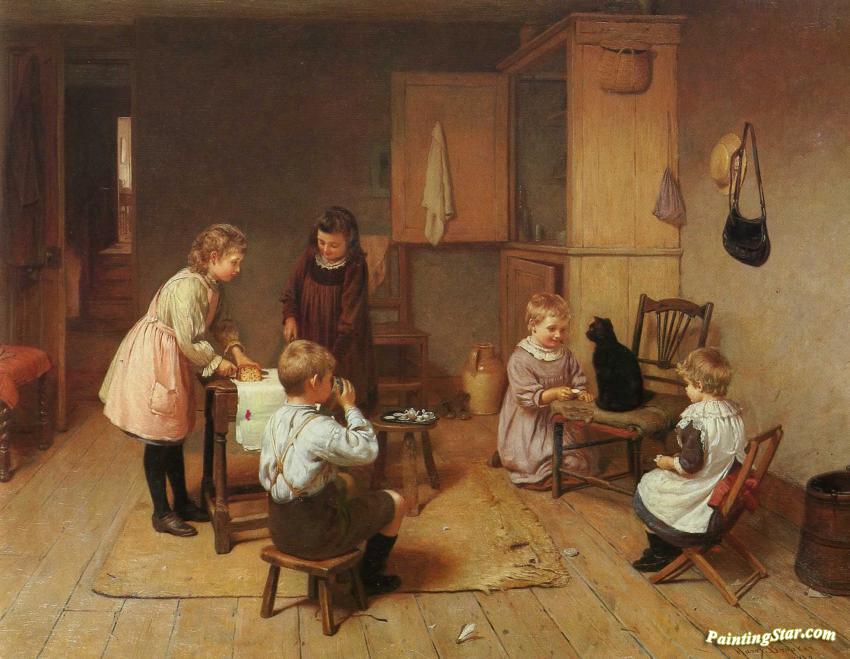
Kitty’s Tea Party, by Harry Brooker
The “gunshots and farce on Capitol Hill have completely revealed what is underneath the gorgeous appearance of the American-style democracy,” the Chinese report said, citing the Jan. 6 riot. In a country where “money decides everything,” the report charged, “an entrenched political paralysis” renders governing impossible.
A spokeswoman for the Russian foreign ministry struck a similarly contemptuous tone in late November. “The United States claims the right to decide who is worthy of being called a democracy and who is not,” said the spokeswoman, Maria Zakharova, according to Tass, the state news agency. “It certainly looks cynical. I would say that it looks pathetic, given the state of democracy and human rights in the United States and in the West in general.”
During the presidential campaign, Mr. Biden vowed to shore up U.S. alliances, which he has said suffered badly during the Trump era, and to unite democracies against the authoritarianism of rising powers, including Russia and China. So a backlash from authoritarian governments that were not invited to a summit meeting meant to support democratic values is hardly surprising.
But even U.S. officials concede that American democracy is straining from political polarization, racial injustice and discord, voting rights restrictions and domestic extremism, among other issues. Some activists are urging Mr. Biden to devote more attention to problems at home before turning his focus abroad.
“You can’t try to export and defend democracy globally when you can’t protect it domestically,” said Cliff Albright, a co-founder and executive director of the Black Voters Matter Fund, a progressive nonprofit group in Atlanta. “You can’t be the global fireman when your house is on fire.”
That tension will loom over the two-day virtual gathering of leaders from model democracies like Germany, Japan and Sweden to countries with mixed records such as Georgia, Nigeria and Pakistan. The meeting, which also includes journalists, civil society activists and business leaders, is meant to be a forum for democracies to exchange ideas and critiques, U.S. officials say. Participants will also make commitments on political reform, corruption, human rights and other matters.
 A tongue lashing from David Rothkopf at The Daily Beast: The First Rule of the Democracy Club? Be a Damn Democracy.
For the summit, which will virtually host 110 countries, to be of any real value, it needs to establish real benefits for being a democracy, penalties for not being one, incentives to promote democracy, and standards high enough to preclude faux democracies, non-democracies and fading democracies from participating.
So far, the White House has been trying to have it both ways. It has excluded countries like China and Russia from the summit because they’re not democracies and are seen as the central bad actors in President Joe Biden’s view of geopolitics today as a struggle between democracies and autocracies.
In fact, excluding them was, polite press statements notwithstanding, one of the main reasons for holding this event.
On the other hand, it has tried to tiptoe around the list of who is in and who is out with statements like Jen Psaki’s “Inclusion or invitation is not a stamp of approval on their approach to democracy—nor is exclusion a stamp of the opposite of that, of disapproval.” I’m a big Jen Psaki fan, but that is weak stuff. Exclusion most definitely is a stamp of disapproval, as it should be. Indeed, that’s the point. And exclusion has already sent a strong and much-needed message to countries like Turkey, Hungary, Egypt and, for that matter, every government in the Middle East except for Iraq and Israel.
And inclusion is definitely a stamp of approval, one that has been extended to governments and leaders invited despite demonstrably undermining democracy in their own countries? That includes Jair Bolsanaro in Brazil and Rodrigo Duterte in the Philippines, both of whom have shown strong autocratic tendencies. Narendra Modi in India, who has overseen serious backsliding on democratic rights and protections in India. And the governments of Pakistan, Poland, Angola, and Congo, all of which probably should have been dinged from the list. As for Iraq and Israel, the former is often more influenced by the neighboring government in Iran than it is its own people while the other excludes millions within its borders from full participation in its government and society.

Bunnies’ tea party postcard
On the precarious situation here in the U.S.:
…[T]he Democracy Summit is a U.S. foreign policy initiative that was conceived from the get-go with a domestic political element. When Biden talks about the battle between pro-democratic and pro-autocratic forces in the world, he is not just thinking about China and Russia but also about Donald Trump and his Republican Party’s systematic efforts to undercut democracy here.
This is a party that is defending the organizers of a coup attempt, promoting the principle architect of that attempt as their leader, carving away voting rights, seeking to disenfranchise voters of color through gerrymandering and racism-bespoke voting restrictions, promoting an anti-democratic, extraconstitutional, minority-driven rule in the US Senate, enabling the minority to dictate the course of the judiciary, and promoting campaign finance rules that give huge advantages to America’s wealthiest citizens at the expense of everyone else.
Further, should that party win in 2022 and 2024, the experience of the Trump years suggests they will take further steps to ensure that their president is above the law, carve away at congressional oversight, negate checks and balances, twist the mission of the Department of Justice, and eliminate laws and mechanisms that might constrain their ability to impose their will on the American people.
The efforts of the enemies of democracy in the U.S. have already taken a toll. According to a Pew Global Attitudes survey of leading countries this spring, few believe U.S. democracy is any longer a “good model” for other nations. Among foreigners in 16 countries polled, a median of 17 percent saw us as a good model while 57 percent said “we used to be a good example.” We know it, too. Among Americans surveyed, just 19 percent said we are a good example, while 72 percent said we are no longer.
At HuffPost, SV Date states it baldly: U.S. Now ‘Exhibit A’ Among Imperiled Democracies At Summit, Thanks To Trump.
As President Joe Biden opens a long-ago-promised “democracy summit” Thursday with over 100 nations participating, he finds himself in charge of “Exhibit A” among the world’s imperiled democracies.
Among the major industrial powers that make up the Group of Seven, only the United States has suffered an attempt to overthrow representative democracy since the group’s creation a half century ago, in the form of Donald Trump’s efforts to void the 2020 election and remain in power. Among the 17 democracies in the G-20, the U.S. is one of just two, along with Turkey, to have seen its chief executive abuse that power to in an attempt to remain in office.

Tea Party, by Nancy Lee Moran
Fiona Hill, a former National Security Council analyst and United Kingdom native who was among the first to describe the Trump-incited insurrection on Jan. 6 as a coup attempt, said the idea that it could ever happen in this country had been unthinkable.
“Not in a million years did I imagine that the United States would be exemplifying this crisis in democracy,” she said.
“Biden has to be candid upfront about the U.S. being the latest battleground of democracy versus autocracy,” said Ruth Ben-Ghiat, a history professor and authoritarianism expert at New York University. “And use the summit to send a message to democrats and autocrats that the U.S. will pursue anti-democratic forces with vigor and resolve.”
Ironically, Biden specifically citied Trump’s anti-democratic tendencies when he first mentioned the need for a summit to rally the world’s democracies in a July 11, 2019, campaign speech.
Read the rest at HuffPost
Today’s news on the ongoing Republican coup attempt:
The Washington Post: Low-profile heiress who ‘played a strong role’ in financing Jan. 6 rally is thrust into spotlight.
Eight days before the Jan. 6 rally in Washington, a little-known Trump donor living thousands of miles away in the Tuscan countryside quietly wired a total of $650,000 to three organizations that helped stage and promote the event.
The lack of fanfare was typical of Julie Fancelli, the 72-year-old daughter of the founder of the Publix grocery store chain. Even as she has given millions to charity through a family foundation, Fancelli has lived a private life, splitting time between her homes in Florida and Italy, and doting on her grandchildren, according to family members and friends.
Now, Fancelli is facing public scrutiny as the House committee investigating the insurrection seeks to expose the financing for the rallythat preceded the riot at the U.S. Capitol.Fancelli is the largest publicly known donor to the rally, support that some concerned relatives and others attributed to her enthusiasm for conspiracy theorist Alex Jones.
The Washington Post previously reported that on Dec. 29, 2020, Fancelli donated $300,000 to Women for America First, a nonprofit group that helped organize the Jan. 6 rally, and $150,000 to the nonprofit arm of the Republican Attorneys General Association, which paid for a robocall touting a march to “call on Congress to stop the steal.”
On the same day, Fancelli gave $200,000 to State Tea Party Express, according to Sal Russo, a top consultant to the conservative group. Russo told The Post last week that he gavethe House committee recordsof Fancelli’s donation, which he said was used for radio ads and social media urging supporters of President Donald Trumpto attend the rally and subsequentmarch. He condemned the violence at the Capitol.
Read the rest at the WaPo.

Illustration by Susan Wheeler
Greg Sargent at The Washington Post: Opinion: Mark Meadows’s new effort to cover up Trump’s coup is ludicrous — and dangerous.
Mark Meadows, who recently revealed that Donald Trump tested positive for the coronavirus before the first 2020 debate without telling its organizers, is frantically atoning for his momentary lapse of loyalty. Trump’s former chief of staff just filed a new lawsuit designed to help Trump cover up his coup attempt.
Mark Meadows, who recently revealed that Donald Trump tested positive for the coronavirus before the first 2020 debate without telling its organizers, is frantically atoning for his momentary lapse of loyalty. Trump’s former chief of staff just filed a new lawsuit designed to help Trump cover up his coup attempt.
But this core idea is central to Meadows’s lawsuit, and indeed to the broader legal attack on the Jan. 6 committee that is coming from Trump himself.
Meadows is suing the committee over its subpoenas for extensive documents from Meadows and others. He wants the court to toss out subpoenas, which would keep buried untold new details about Trump’s coup attempt.
One of Meadows’s core arguments is that the subpoena, and the committee’s activities, lack a “legitimate legislative purpose.” The suit notes that if this can be established, the subpoena is invalid.
But that’s nonsense. There are many valid legislative purposes driving the committee’s investigation.
Of course it’s nonsense. A judge should just throw the lawsuit out. But that hasn’t been happening with other ludicrous claims–like Steve Bannon’s.
Jennifer Rubin at The Washington Post: Opinion: David Perdue confesses he would have aided a coup. He’s not the only one.
David Perdue, the former U.S. senator from Georgia and now a candidate for governor, made a stunning confession on Wednesday: Despite there being no evidence of election fraud and multiple audits that showed President Biden won the state, he would have refused to certify Georgia’s 2020 results.
The Republican told Axios: “Not with the information that was available at the time and not with the information that has come out now. They had plenty of time to investigate this. And I wouldn’t have signed it until those things had been investigated and that’s all we were asking for.”
The results were investigated in multiple audits and court cases. There was no fraud.
Perdue is saying the quiet part out loud. Given the same circumstances in 2024 — a clean election with close results in key states — Republicans would seek to undo the will of the voters, call on the House of Representatives to “fix” the election and thereby sink our democracy.
Click the link to read the rest.
It really isn’t looking good for democracy. I hope Biden has better answers for how to deal with the ongoing efforts of the Trumpists to overthrow the government he currently leads.
What do you think? Please post your thoughts and links on any topic in the comment thread below.
Did you like this post? Please share it with your friends:






 peej
peej Carissa
 bostonboomer
 dakinikat
 ecocatwoman
 mablue2
 Mama Lopez
 peggysue22
 quixote
 skydancingguestblogger
 Mona (aka Wonk the Vote)



 Sky Dancing
Recent Comments