A couple of Caturdays ago, I posted illustrations from a 1950s children’s book called Space Cat and the Kittens. My brother had shared them with me after he bought the book at a used bookstore. This week, he came across the first book in the four-part series, and I’m going to post some of the illustrations from that book today. I think they are really cute. The story:
A little gray kitten with a taste for adventure stows away on an airplane, and the daring stunt turns out to be his first step toward becoming … Space Cat! The plane’s pilot, Captain Fred Stone, names his fuzzy new friend Flyball and welcomes him to an experimental station set up in the middle of the desert. Flyball enjoys supervising the station’s workers and takes particular interest in the big rocket ship that he’s not allowed to explore. Regardless of the rules, the kitty is determined to hitch another ride, and before you know it, Flyball’s wearing a custom-made pressurized suit and headed for the Moon.
As for the news, everything is awful as usual today. We’re dealing with a “president” who is well on the way of becoming a dictator. He plans to meet with fellow dictator Vladimir Putin to hand over territory in Ukraine; He is allowing his HHS secretary RFK Jr. to endanger Americans with anti-vaccine policies; and he is deliberately damaging American higher education.
President Trump said he would meet with President Vladimir V. Putin of Russia next Friday in Alaska, as he tries to secure a deal to end the war between Russia and Ukraine.
Mr. Trump announced the meeting Friday shortly after he suggested that a peace deal between the two countries could include “some swapping of territories,” signaling that the United States may join Russia in trying to compel Ukraine to permanently cede some of its land.
“We’re going to get some back, and we’re going to get some switched,” Mr. Trump said while hosting the leaders of Armenia and Azerbaijan for a peace summit at the White House. “There’ll be some swapping of territories to the betterment of both, but we’ll be talking about that either later, or tomorrow.”
The meeting, the first in-person summit between an American and Russian president since President Joseph R. Biden Jr. met with Mr. Putin in June 2021, reflects Mr. Trump’s confidence in his ability to persuade Mr. Putin in a face-to-face encounter, a goal that has eluded Mr. Trump and his predecessors. For Mr. Putin, the meeting itself is a victory after he spent the past several months largely isolated from the international community, with NATO leaders — other than Mr. Trump — refusing to communicate directly with him.
Carrying cat to the rocket
At least he didn’t invite Putin to the White House, but will Putin try to get him to give Alaska back to Russia while they are swapping land in Ukraine?
The meeting also presents a host of challenges. Ukrainian leaders have adamantly opposed relinquishing any of their land to Russia, and the country’s constitution bars President Volodymyr Zelensky of Ukraine from ceding any territory.
There would also be numerous political and military hurdles for Ukraine in turning over land to Russia, as well as questions including security guarantees for Ukraine and the future of frozen Russian assets. And many diplomats have suggested that Mr. Putin may be more interested in dragging out diplomacy to give him time to pummel Ukraine than in securing a peace deal.
White House officials declined to say exactly where in Alaska the two leaders would meet or why Mr. Trump decided to hold the meeting there, though it is the closest U.S. state to Russia. In 2021, the Biden administration held talks with China in Anchorage, Alaska.
Mr. Trump also provided little additional detail about the meeting, what territory could be swapped or the broader contours of a peace deal, saying earlier Friday that he did not want to overshadow the peace pledge between Armenia and Azerbaijan. But he told European leaders earlier this week that he planned to follow up his session with Mr. Putin with a meeting with Mr. Putin and Mr. Zelensky.
President Volodymyr Zelensky of Ukraine on Saturday flatly rejected the idea that Ukraine could cede land to Russia after President Trump suggested that a peace deal between Ukraine and Russia could include “some swapping of territories.”
“Ukrainians will not gift their land to the occupier,” Mr. Zelensky said in a video address from his office in Kyiv, several hours after Mr. Trump’s remarks, which appeared to overlook Ukraine’s role in the negotiations.
“Any decisions made against us, any decisions made without Ukraine, are at the same time decisions against peace,” Mr. Zelensky said. “They will bring nothing. These are dead decisions; they will never work.”
His blunt rejection risks angering Mr. Trump, who has made a peace deal between Ukraine and Russia one of his signature foreign policy goals, even if it means accepting terms that are unfavorable to Kyiv. In the past, Mr. Trump has criticized Ukraine for clinging to what he suggested were stubborn cease-fire demands and for being “not ready for peace.”
Cat in a hammock on spacecraft
What doesn’t anger Trump? Anything except blind loyalty and obedience.
A recent poll by the Kyiv International Institute of Sociology found that more than three-quarters of Ukrainians are against transferring Ukrainian-controlled territory to Russia. When it comes to ceding land that includes territory already under Russian control, opposition drops slightly, with a little more than half of Ukrainians against it, “even if this makes the war last longer and threatens the preservation of independence,” the poll says.
But support for land concessions has grown since Ukraine’s failed 2023 counteroffensive, which underscored its inability to retake substantial territory. About 38 percent of the population thinks ceding land is acceptable now, according to the poll, up from only 10 percent about two years ago.
Russia has long demanded that Ukraine give up four regions in the east and south that Moscow claims to have annexed in late 2022, even though some of that territory remains under Ukrainian control. The Kremlin is particularly intent on seizing full control of the eastern regions of Luhansk and Donetsk, which it has long sought to capture with relentless assaults.
But ceding Luhansk and Donetsk, which are part of an area commonly known as the Donbas region, would create a host of issues for Ukraine. It would mean giving up a region rich in cities and industrial centers that Russia could use as a launchpad to reignite the war.
And Ukraine would have to abandon its main fortified defensive line in northern Donetsk, stretching between the cities of Sloviansk and Kostiantynivka, which has so far withstood Russian assaults.
Location matters, former real estate mogul US President Donald Trump said. Moments later he announced Alaska, a place sold by Russia to the United States 158 years ago for $7.2 million, would be where Russian President Vladimir Putin tries to sell his land deal of the century, getting Kyiv to hand over chunks of land he’s not yet been able to occupy.
The conditions around Friday’s summit so wildly favor Moscow, it is obvious why Putin leapt at the chance, after months of fake negotiation, and it is hard to see how a deal emerges from the bilateral that does not eviscerate Ukraine. Kyiv and its European allies have reacted with understandable horror at the early ideas of Trump’s envoy, Steve Witkoff, that Ukraine cede the remainders of the Donetsk and Luhansk regions in exchange for a ceasefire.
Naturally, the Kremlin head has promoted the idea of taking ground without a fight, and found a willing recipient in the form of Witkoff, who has in the past exhibited a relaxed grasp of Ukrainian sovereignty and the complexity of asking a country, in the fourth year of its invasion, to simply walk out of towns it’s lost thousands of men defending.
Space cat in freefall
It is worth pausing and reflecting on what Witkoff’s proposal would look like. Russia is close to encircling two key Donetsk towns, Pokrovsk and Kostiantynivka, and may effectively put Ukrainian troops defending these two hubs under siege in the coming weeks. Ceding these two towns might be something Kyiv does anyway to conserve manpower in the months ahead.
The rest of Donetsk – principally the towns of Kramatorsk and Sloviansk – is a much nastier prospect. Thousands of civilians live there now, and Moscow would delight at scenes where the towns evacuate, and Russian troops walk in without a shot fired.
Ukrainian President Volodymyr Zelensky’s rejection of ceding land early Saturday reflects the real dilemma of a commander in chief trying to manage the anger of his military and the deep-seated distrust of the Ukrainian people towards their neighbor, who continues to bombard their cities nightly.
What could Ukraine get back in the “swapping” Trump referred to? Perhaps the tiny slivers of border areas occupied by Russia in Sumy and Kharkiv regions – part of Putin’s purported “buffer zone” – but not much else, realistically.
The main goal is a ceasefire, and that itself is a stretch. Putin has long held that the immediate ceasefire demanded by the United States, Europe and Ukraine for months, is impossible as technical work about monitoring and logistics must take place first. He is unlikely to have changed his mind now his troops are in the ascendancy across the eastern frontline.
Read more analysis at the CNN link.
RFK Jr. is doing untold damage to the health of Americans.
During the early days of the coronavirus pandemic in the spring of 2020, President Trump was warned by medical officials that the development of a vaccine that could turn the tide against Covid could be over a year away.
For Mr. Trump, that timeline was not good enough.
He demanded a faster program. The creation of that program, Operation Warp Speed, led to lifesaving vaccines that contained messenger RNA, or mRNA, a synthetic form of a genetic molecule that helps stimulate the immune system. Those vaccines are widely regarded in the scientific community as the quickest way to protect Americans against future threats, including viruses that could mushroom into a pandemic, or man-made menaces, like a bioweapons attack.
Time has marched on and, apparently, so has Mr. Trump in his second term.
This week, the president all but shrugged off an announcement by Robert F. Kennedy Jr., the health and human services secretary and a longtime critic of vaccines, that a research division of his department had slashed $500 million in grants and contracts for work on mRNA vaccines.
“That was now a long time ago, and we’re onto other things,” the president told reporters on Wednesday. Mr. Trump added that his administration is now “looking for other answers to other problems, to other sicknesses and diseases.” He said he was planning to meet with Mr. Kennedy on Thursday to discuss the decision, but by Friday, White House officials did not say whether that meeting took place.
Space cat is first to land on the Moon.
A bit more:
Mr. Trump’s willingness to give Mr. Kennedy the space to impose his views is notable, given that the vaccines were once seen as legacy achievement during Mr. Trump’s first term. But his laissez-faire posture also leaves room for Mr. Trump to position himself in line with the portion of his base that has grown deeply skeptical about the safety and efficacy of vaccines.
Adm. Brett Giroir, an assistant health secretary in the first Trump administration who was involved in the development of the Covid vaccines, recalled that the president had been “very pro-vaccine,” particularly on matters involving flu preparedness. In 2019, Mr. Trump signed an executive order calling for the modernization of flu vaccines, because “he knew we weren’t as well prepared as we should be.”
Now it’s different. Trump would rather sacrifice millions more American lives than confront his conspiracy-minded followers.
As a record number of people in the U.S. are sickened with measles, researchers are resurrecting the search for something long-deemed redundant: treatments for the viral disease.
After the measles vaccine was introduced in the 1960s, cases of the disease plummeted. By 2000, federal officials had declared measles eliminated from the U.S. This success led to little interest in the development of treatments. But now, as vaccination rates fall and infections rise, scientists are racing to develop drugs they say could prevent or treat the disease in vulnerable and unvaccinated people.
“In America, we don’t like being told what to do, but we like to have options for our medicine chest,” said Marc Elia, chairman of the board of Invivyd, a Massachusetts-based drugmaker that started working on a monoclonal antibody for measles this spring.
Scientists across the country including at biotechs Invivyd and Saravir Biopharma—and institutions such as Vanderbilt University Medical Center and Georgia State University—are in the early stages of measles-treatment development. The drugs are still a ways from becoming available to patients but could offer alternatives to people who are immunocompromised, don’t respond to the measles vaccine or are vaccine skeptics.
Space cat saves astronaut’s life by plugging a hole in his helmet.
Some doctors and researchers warn that measles treatments could further drive the drop in vaccination. Nationally, 92.5% of kindergartners received the measles, mumps and rubella, or MMR, shot in the 2024-25 school year, according to Centers for Disease Control and Prevention data. In 2019-20, the vaccination rate was over 95%, which is the rate encouraged by health authorities to prevent community transmission of measles.
More than 1,300 people, most of them unvaccinated, have been diagnosed with measles this year—a 33-year high.
“One of the motivations of getting the vaccine right now is that there are no treatments,” said Dr. Joel Warsh, a pediatrician who says more research is needed into immunization safety.
Still, Invivyd is betting its measles monoclonal antibody could help curb infections and outbreaks. Unlike the MMR vaccine, which is designed to train the body to make its own antibodies—proteins that help defeat specific pathogens—monoclonal antibodies are lab-made versions that can be delivered intravenously or as an injection and boost immunity immediately.
Antibody treatments could treat someone who is sick or help prevent measles in people recently exposed to the virus. They could benefit newborns and immunocompromised people who can’t be vaccinated, as well as the minority of people who don’t respond to the vaccine or whose immunity has waned. The treatments could offer weeks or months of protection against measles, researchers said.
“Think of it like antivenom after a snake bite,” said Erica Ollmann Saphire, chief executive of the La Jolla Institute for Immunology, whose lab is developing its own monoclonal antibodies for measles. “Even people unsure about vaccines, if they are already sick with measles, getting an antibody treatment could be palatable.”
There’s much more at the link. I got past the paywall by clicking the link at Memeorandum.
As an infectious disease physician who cared for dozens of critically ill Covid patients in December 2020, I witnessed a remarkable shift in the months that followed. As mRNA vaccines became available in early 2021, severe cases among vaccinated individuals became extremely rare. Deaths were almost exclusively among those who declined vaccination, which was tragic given how preventable these outcomes had become.
Space cat in the moon cave
No vaccine for respiratory viruses has ever provided complete, lasting protection against all infections. Not the flu vaccine. Not RSV vaccines. That never should have been the expectation. Some vaccines, like those for measles or polio, can effectively prevent infection and transmission, but these target fundamentally different viruses that don’t constantly mutate and reinfect the respiratory tract. The purpose of respiratory virus vaccines is to prevent severe disease, hospitalization and death. By that measure, mRNA vaccines have been revolutionary.
The data confirms what I witnessed firsthand. According to research by the Centers for Disease Control and Prevention, unvaccinated individuals had 53 times the risk of death compared to those who had been fully vaccinated during the Delta wave in 2021. A New England Journal of Medicine study analyzing over 6 million Covid cases found that protection against death remained above 90% and remarkably durable, even as protection against infection declined.
In winter 2020, my hospital’s ICU overflowed with COVID patients. Like many colleagues worldwide, I watched patient after patient die despite our best efforts. It was unlike anything any of us had ever seen. By summer 2021, after vaccines rolled out widely, the change was undeniable. Far fewer patients arrived with respiratory failure. Nursing homes saw deaths plummet.
As vaccine expert Paul Offit stated in December 2020: “All you want to do is keep people out of the hospital and keep them out of the morgue and I think this vaccine can certainly do that.” Even then, before vaccines were widely available, experts understood the real goal.
The Trump administration is seeking a $1 billion settlement from the University of California, Los Angeles, a White House official said Friday, after the Department of Justice accused the school of antisemitism and other civil rights violations.
UCLA is the first public university to be targeted by a widespread funding freeze over allegations of civil rights violations related to antisemitism and affirmative action.
President Donald Trump’s administration has frozen or paused federal funding over similar allegations against elite private colleges. In recent weeks, the administration has struck deals with Brown University for $50 million and Columbia University for $221 million but has explored larger settlements, such as in its ongoing battle with Harvard University.
The White House official did not detail any additional demands the administration has made to UCLA or elaborate on the settlement amount. The person was not authorized to speak publicly about the request and spoke on condition of anonymity.
The university had drawn widespread criticism for how it handled dispersing an encampment of Israel-Hamas war protesters in 2024. One night, counterprotesters attacked the encampment, throwing traffic cones and firing pepper spray, with fighting that continued for hours, injuring more than a dozen people, before police stepped in. The next day, after hundreds defied orders to leave, more than 200 people were arrested. Later, Jewish students said demonstrators in encampments blocked them from getting to class.
The Trump administration is warning Harvard University that it could take over its patents, worth hundreds of millions of dollars, if a review finds the university hasn’t complied with federal law, an escalation of the continuing negotiations between the White House and America’s oldest university.
Commerce Secretary Howard Lutnick sent a letter to Harvard President Alan Garber on Friday, telling him the administration planned to do a thorough review of all patents held by the university.
General likes Space Cat.
“We believe that Harvard has failed to live up to its obligations to the American taxpayer and is in breach of the statutory, regulatory, and contractual requirements tied to Harvard’s federally funded research programs and intellectual property arising therefrom, including patents,” the letter says.
A Harvard spokesperson called the move “yet another retaliatory effort targeting Harvard for defending its rights and freedom.” The university’s technology and patents help save lives and redefine industries, and Harvard is committed to complying with all federal laws around the patenting of work from federally funded research, the spokesperson said.
The letter is another point of leverage for the Trump administration in its effort to punish the university for allegedly failing to stop antisemitism on campus. The administration has frozen billions of dollars in Harvard’s federal research money and cut the university off from future grants.
Lutnick told Garber that he had until Sept. 5 to respond with a list of all patents that have stemmed from federally funded research grants and to provide information showing it complied with federal regulations, including a 1980 act by Congress known as Bayh-Dole that allowed institutions to retain ownership of a patent even if the innovation used taxpayer dollars.
A bit more, because of the paywall:
Harvard has more than 5,800 patents, according to its website. In its fiscal year ended in June, the university was issued 159 patents. Startups from Harvard range from pharma and biotech companies to manufacturing.
Federal regulations under Bayh-Dole require a litany of disclosures for a patent, including how the American people benefit from an invention. If a patent holder fails to make these disclosures, the government has the right to take ownership of the invention.
Lisa Ouellette, a law professor at Stanford, said the Trump administration’s move appears to be unprecedented in the four and a half decades of the Bayh-Dole Act. “I have never seen the government step in to reclaim control of a university’s patents in any sense,” she said. The Biden administration considered using a provision of the act to try to lower pharmaceutical prices, but the proposal never came to pass, Ouellette said.
The Trump administration has been in talks with several universities, including the University of California, Los Angeles, Cornell and Northwestern, and sees striking a deal with Harvard as an essential mission. The White House has already reached a $200 million settlement with Columbia and a $50 million deal with Brown.
This is breathtaking.
That’s all I have for today. What’s on your mind?
Did you like this post? Please share it with your friends:
Yesterday, Trump wandered around on the White House roof, and shouted inanities at reporters on the ground, including a joke about nuclear weapons. He is such an embarrassment.
President Donald Trump made a surprise appearance on the White House roof above the briefing room in an apparent effort to inspect future construction.
The press, which had been pushed significantly down the driveway, attempted to figure out what was going on.
“Mr. President, what are you doing up there?”
“Just taking a little walk,” he shouted back.
“What are you building?”
“It goes with the ballroom, which is on the other side,” he said.
Pressed again by reporters, Trump said “Something beautiful,” while pantomiming with his hands.
Great. So he’s planning to wreck both the East and West wings?
The president was accompanied by a small group of aides and Secret Service. The group included architect Jim McCrery, who has been commissioned to add Trump’s ballroom to the White House. The two men appeared engaged in intense conversation as they surveyed the grounds with lots of animated pointing….
“What are you trying to build?” one reporter shouted.
“Missiles,” Trump responded, presumably joking. “Nuclear missiles,” he repeated while making the gesture of a rocket launching.
Q: Sir, what are you trying to build?TRUMP: Missiles. Nuclear missiles
Americans who haven’t visited the White House for a guided tour probably can’t picture the East Wing. There’s no TV show about it. It has no famous office to rival the Oval. There are relatively few photos of it in its current form.
As someone who worked there for six months (I moved to the West Wing after the 1984 election), allow me to sing its praises: The East Wing was built in 1902 as a visitors’ entrance and then expanded in 1942 to house the First Lady’s offices. Its style echoes the West Wing in design and footprint, which gives the White House complex a rough symmetry. Like the West Wing, it’s smaller than Hollywood imagines. It conveys stability and authority without ostentation. Unlike the West Wing, it’s flooded with sunlight and, at least when Nancy Reagan held court, adorned with fresh flowers. The two-story structure melds seamlessly into the surrounding gardens. You can hardly see it from the street.
Rendering of planned White House ballroom
Now President Trump has announced that he will “modernize” (which must mean demolish) the East Wing and replace it with a huge, gaudy ballroom. At 90,000 square feet, the ballroom will dwarf the West Wing and even the residence. Naturally it will be adorned in white and gold (to get a flavor, have a look at the way Trump has decorated the Oval Office). This permanent disfigurement will solve a problem that doesn’t exist. When the president entertains more people than can comfortably fit in the East Room (about 200), tents are erected on the lawn complete with floors and walls. But Trump is dissatisfied with the historic building that was good enough for Lincoln and Eisenhower and Reagan. Ladies’ high heels sink into the grass, he says, explaining why he has also paved over the Rose Garden.
But rather than rail against this desecration of a key national symbol, perhaps it’s better to welcome it. The presidency will never be the same post-Trump, so why not the White House? Why not make concrete and visible the destruction of centuries-old norms and values? This president has just elevated to a Court of Appeals a lawyer who presided over a purge of FBI agents who investigated Trump for January 6th and instructed his underlings at the Justice Department to “F— the courts.” He has opened a criminal investigation into former Special Counsel Jack Smith on the specious charge of violating the Hatch Act. His attorney general has opened a disciplinary investigation of Judge James Boasberg because Boasberg privately expressed concerns that the Trump administration might, to borrow a phrase, “F— the courts.”
In past Olympic Games held on American soil, sitting presidents have served in passive, ceremonial roles. President Trump may have other plans.
An executive order signed by Trump on Tuesday names him chair of a White House task force on the 2028 Games in Los Angeles, viewed by the president as “a premier opportunity to showcase American exceptionalism,” according to a White House statement. Trump, the administration said, “is taking every opportunity to showcase American greatness on the world stage.”
At the White House, speaking in front of banners adding the presidential seal to the logo for LA28, Trump said he would send the military back to Los Angeles if he so chose in order to protect the Games. In June, Trump sent the National Guard and U.S. Marines to the city amid widespread immigration enforcement actions, despite widespread condemnation from Mayor Karen Bass and other local officials.
“We’ll do anything necessary to keep the Olympics safe, including using our National Guard or military, OK?” he said. “I will use the National Guard or the military. This is going to be so safe. If we have to.”
Trump’s executive order establishes a task force led by him and Vice President JD Vance to steer federal coordination for the Games. The task force will work with federal, state and local partners on security and transportation, according to the White House.
Those roles have been fairly standard for the federal government in past U.S.-hosted Olympic Games. But Trump’s news conference could present questions about whether a president with a penchant for showmanship might assume an unusually active role in planning the Olympics, set to take place in the twilight of his final term.
There is ample precedent for military and National Guard forces providing security support during U.S.-hosted Olympic Games. But coming on the heels of the recent military deployment to Los Angeles, Trump’s comments may prove contentious.
Anyone who thinks Trump is planning to leave the White House at the end of his term is living in a fantasy world. He’s turning the White House into Mar-a-Lago North, and he doesn’t plan to leave. Next, he’ll build a golf course on White House grounds. Rachel Maddow said it out loud on Monday night.
Rachel Maddow did not sugarcoat it for viewers: The MSNBC anchor warned viewers that the United States is not headed towards an authoritarian state under President Donald Trump: “We are there. It is here.”
“Life in the United States is profoundly changing and is profoundly different than it was even six months ago,” the anchor said Monday night on “The Rachel Maddow Show.” “Because we do now live in a country that has an authoritarian leader in charge, we have a consolidating dictatorship in our country.”
Maddow went on to paint the picture of what she called a caricature of an authoritarian state. She mentioned secret police, prison camps and individuals fired for speaking a truth that does not please their authoritarian leader.
“We’re beyond waiting and seeing now. It is clear what’s going on,” she said. “We have crossed a line. We are in a place we did not want to be, but we are there.”
She pointed to immigration raids happening nationwide, comparing ICE agents with masked secret police, even referring to immigrants as “the scapegoated enemy on whom all things must be blamed and against whom all things are justified.” Another element she raised was that Trump has turned military force inward on the American people.
In addition to acts of violence against Americans, Maddow noted that under this authoritarian rule protests must be criminalized and media must be intimidated into saying and doing what the leader wants. She added that top universities and law firms are also subject to funding cuts if they do not bow to the president.
And if you release facts to the contrary of the president, be careful.
“Because he said it, then it must be true, and if you say otherwise then you will be fired,” Maddow said.
Also during the Olympics event, Grandpa Trump repeated, for he umpteenth time, his insane ideas about California’s supposed mismanagement of water and forest fires.
oh my goodness — get a load of Trump's incoherent rant about water management in California (this is an event about the Olympics!)
In Epstein scandal news, Trump and Vance will meet with other top officials, including the Attorney General and Assistant Attorney General and the head of the FBI to discuss how to control the fallout from the highly unusual meeting of Assistant AG Todd Blanche with Ghislaine Maxwell and her subsequent transfer to a minimum security prison. Remember the days when the Department of Justice remained scrupulously independent of the president?
Top Trump administration officials will gather at the vice president’s residence Wednesday evening as they continue to weigh whether to publish an audio recording and transcript of Deputy Attorney General Todd Blanche’s recent conversation with Jeffrey Epstein accomplice Ghislaine Maxwell.
The administration’s handling of the Epstein case, as well as the need to craft a unified response, is expected to be a main focus of the dinner, three sources familiar with the meeting told CNN. The meeting will include White House chief of staff Susie Wiles, Vice President JD Vance, Attorney General Pam Bondi, FBI Director Kash Patel and Blanche.
Officials who will meet to discuss Epstein strategy
With the exception of Vance, the White House considers those officials the leaders of the administration’s ongoing strategy regarding the Epstein files, two of the sources said.
The meeting comes as Trump’s administration is considering releasing the contents of Blanche’s interview last month with Maxwell. Two officials told CNN that the materials could be made public as early as this week.
There have also been internal discussions about Blanche holding a press conference or doing a high-profile interview, possibly with popular podcaster Joe Rogan, according to three people familiar with the discussions, though those conversations are preliminary. Rogan, who endorsed Trump on the eve of last fall’s election, has been highly critical of the Trump administration’s handling of the Epstein case and previously called their refusal release more information about Epstein a “line in the sand.”
Meanwhile, CNN previously reported that the Justice Department has been digitizing, transcribing and redacting the interview materials as they weigh if and when to publicly release the information from the Maxwell interview. There is over 10 hours of audio, a senior Trump administration official said. Portions of the transcript that could reveal sensitive details like victim names would also have to be redacted, one of the officials said.
One official told CNN that some of the conversation within the White House has focused on whether making the details from the interview public would bring the Epstein controversy back to the surface. Many officials close to Trump believe the story has largely died down.
The House Oversight Committee on Tuesday issued subpoenas for Department of Justice records on the Jeffrey Epstein investigation, as well as for interviews with a slate of former government officials in connection to the case.
Oversight Chair James Comer (R-Ky.) announced that he was summoning nearly a dozen former officials to appear for depositions on the Epstein investigation — a list that includes former President Bill Clinton and former Secretary of State Hillary Clinton.
Former U.S. Attorneys General William Barr, Alberto Gonzales, Jeff Sessions, Loretta Lynch, Eric Holder and Merrick Garland, as well as former FBI Directors Robert Mueller and James Comey were also tapped to give testimony in connection to the case.
The move is the latest in a broader battle over the Epstein files, which took the Trump administration by storm last month as anger boiled over from within MAGA circles about the administration’s handling of the case.
The committee’s subpoena of Bill Clinton in particular seems more symbolic than substantive. No former president has ever testified to Congress under the compulsion of a subpoena — and lawmakers have tried only twice before: once in 1953, when the House Un-American Activities Committee subpoenaed Harry Truman, and once in 2022, when the Jan. 6 select committee subpoenaed Donald Trump.
Neither president testified in those instances, and the Justice Department has long cited Truman’s example — though not backed by any legal precedent — to suggest that it is improper for Congress to compel even former presidents to testify, given separation of powers concerns.
Yesterday The New York Times published photos from inside Jeffrey Epstein’s New York townhouse. The article also included the full text of a letter from Woody Allen on Epstein’s 63 birthday. (gift link): A Look Inside Jeffrey Epstein’s Manhattan Lair.
As a gift for Jeffrey Epstein’s 63rd birthday, friends sent letters in tribute to the wealthy financier and convicted sex offender. Several shared a common theme: recounting the dinner gatherings that Mr. Epstein regularly hosted at his palatial townhouse on Manhattan’s Upper East Side.
Ehud Barak, former prime minister of Israel, and his wife noted the great diversity of guests. “There is no limit to your curiosity,” they wrote in their message, which was compiled with others in January 2016. “You are like a closed book to many of them but you know everything about everyone.”
A sculpture of a bride clinging to a rope dangled in a central atrium of Jeffrey Epstein’s mansion.
The media mogul Mortimer Zuckerman suggested ingredients for a meal that would reflect the culture of the mansion: a simple salad and whatever else “would enhance Jeffrey’s sexual performance.”
And the director Woody Allen described how the dinners reminded him of Dracula’s castle, “where Lugosi has three young female vampires who service the place.” [….]
But Mr. Epstein’s prized property was no gloomy Transylvanian fortress. He had spent years turning the seven-story, 21,000-square-foot townhouse into a place where he could flaunt — and deepen — his connections to the rich and powerful, even as hints of his dark side lurked within, according to previously undisclosed photos and documents showing how he lived in his later years.
Since Mr. Epstein’s death in federal custody in 2019, which was ruled a suicide, many mysteries about his life have remained unsolved. How did he amass a nine-figure fortune? And why did so many powerful men continue to fraternize with him long after he became a registered sex offender?
The White House had pledged to release details about the federal investigations into Mr. Epstein and his associates. But this summer the Trump administration backpedaled. The ensuing right-wing outrage has threatened to splinter the Make America Great Again movement — for whom Mr. Epstein is a central figure in conspiracy theories — and has put Mr. Trump on the defensive like few other issues….
At least one other MAGA luminary also visited the townhouse: Stephen K. Bannon, a former adviser to Mr. Trump and an online media personality, who has said that he videotaped hours of interviews in the mansion with Mr. Epstein in 2019. Framed photos of Mr. Bannon — including a mirror selfie snapped by Mr. Epstein — were kept in at least two rooms in the mansion.
Use the gift link to read the rest if you’re interested.
The long-running scandal surrounding the disgraced late financier and convicted sex offender Jeffrey Epstein broadened on Tuesday after the New York Times published a trove ofpreviously unseen letters to Epstein from numerous powerful figures as well as unseen photographs from inside his Manhattan mansion.
The letters, written to Epstein by a number of high-profile individuals, were reportedly compiled as a birthday gift for Epstein’s 63rd birthday in 2016. Their publication comes amid intense speculation around Donald Trump’s ties to Epstein, who was found dead in a New York jail in 2019 and had long cultivated a celebrity social circle of the rich and powerful.
In one letter, former prime minister of Israel Ehud Barak and his wife wrote “there is no limit to your curiosity.”
“You are like a closed book to many of them but you know everything about everyone,” they wrote, describing Epstein as “A COLLECTOR OF PEOPLE”.
They continued: “May you enjoy long and healthy life and may all of us, your friends, enjoy your table for many more years to come.”
In a letter from film-maker Woody Allen, Allen reminisced about Epstein’s dinner parties at his Upper East Side townhouse and described the gatherings as “always interesting”. He noted that the parties included “politicians, scientists, teachers, magicians, comedians, intellectuals, journalists” and “even royalty”.
Allen also described the dinners as “well served”: “I say well served – often it’s by some professional houseman and just as often by several young women” who he said reminded him of “Castle Dracula where Lugosi has three young female vampires who service the place.”
Other letter writers reportedly included billionaire media mogulMortimer Zuckerman;Noam Chomsky and his wife; Joichi Ito, the former head of the Massachusetts Institute of Technology (MIT) Media Lab; physicist Lawrence M Krauss; and Harvard biologist and mathematician Martin Nowak.
The US Department of Health and Human Services (HHS) plans to cancel $500m (£376m) in funding for mRNA vaccines being developed to counter viruses that cause diseases such as the flu and Covid-19.
That will impact 22 projects being led by major pharmaceutical companies, including Pfizer and Moderna, for vaccines against bird flu and other viruses, HHS said.
Health Secretary Robert F Kennedy Jr, a vaccine sceptic, announced he was pulling the funding over claims that “mRNA technology poses more risks than benefits for these respiratory viruses”.
Doctors and health experts have criticised Kennedy’s longstanding questioning of the safety and efficacy of vaccines and his views on health policies.
The development of mRNA vaccines to target Covid-19 was critical in helping slow down the pandemic and saving millions of lives, said Peter Lurie, a former US Food and Drug Administration official.
He told the BBC that the change was the US “turning its back on one of the most promising tools to fight the next pandemic”.
In a statement, Kennedy said his team had “reviewed the science, listened to the experts, and acted”. “[T]he data show these vaccines fail to protect effectively against upper respiratory infections like COVID and flu,” he said.
He said the department was shifting the funding toward “safer, broader vaccine platforms that remain effective even as viruses mutate”.
Kennedy also claimed that mRNA vaccines can help “encourage new mutations and can actually prolong pandemics as the virus constantly mutates to escape the protective effects of the vaccine”.
Health experts have said that viruses mutate regardless of whether vaccines exist for them.
The Trump administration has asked NASA employees to draw up plans to end at least two major satellite missions, according to current and former NASA staffers. If the plans are carried out, one of the missions would be permanently terminated, because the satellite would burn up in the atmosphere.
The data the two missions collect is widely used, including by scientists, oil and gas companies and farmers who need detailed information about carbon dioxide and crop health. They are the only two federal satellite missions that were designed and built specifically to monitor planet-warming greenhouse gases.
It is unclear why the Trump administration seeks to end the missions. The equipment in space is state of the art and is expected to function for many more years, according to scientists who worked on the missions. An official review by NASA in 2023 found that “the data are of exceptionally high quality” and recommended continuing the mission for at least three years.
Both missions, known as the Orbiting Carbon Observatories, measure carbon dioxide and plant growth around the globe. They use identical measurement devices, but one device is attached to a stand-alone satellite while the other is attached to the International Space Station. The standalone satellite would burn up in the atmosphere if NASA pursued plans to terminate the mission.
NASA employees who work on the two missions are making what the agency calls Phase F plans for both carbon-monitoring missions, according to David Crisp, a longtime NASA scientist who designed the instruments and managed the missions until he retired in 2022. Phase F plans lay out options for terminating NASA missions.
Crisp says NASA employees making those termination plans have reached out to him for his technical expertise. “What I have heard is direct communications from people who were making those plans, who weren’t allowed to tell me that that’s what they were told to do. But they were allowed to ask me questions,” Crisp says. “They were asking me very sharp questions. The only thing that would have motivated those questions was [that] somebody told them to come up with a termination plan.”
If Transportation Secretary and acting NASA Administrator Sean Duffy wanted to do his part to help provide a distraction from the Trump administration’s Jeffrey Epstein files scandal, his announcement of a plan to put nuclear reactors on the moon was a partial success. In the 24 hours after his announcement on Monday, he was briefly trending on social media, just behind Ghislaine Maxwell.
If he intended this to be a serious proposal for human occupation of the moon, he failed. For the near future, nuclear reactors on the moon are impractical, expensive and dangerous.
Duffy may not understand this. He has no experience in space or nuclear technology. He is a former Fox News host who became interim director in June when President Donald Trump pulled the nomination of Elon Musk’s choice, billionaire Jared Isaacman, after Trump’s breakup with Musk.
Space exploration has used nuclear materials for power for many decades. This is overwhelmingly in the form of radioisotope thermoelectric generators. These use plutonium-238, which gives off heat used to generate electric power for small probes, including some of the rovers on Mars. This typically involves 20 or 30 pounds of material. In fact, several of the Apollo missions left some behind on the moon were powered by such radioactive means.
But a nuclear reactor is another matter altogether. This would involve potentially hundreds of pounds of low-enriched uranium in yet-undeveloped small reactors delivered by space launchers that don’t exist.
The top stories today focus on Trump’s failing economy and his firing of Bureau of Labor Statistics commissioner Erika McEntarfer after she released weak job numbers yesterday. Dakinikat provided a deep dive into the economy yesterday and addressed the firing in the comments to her post, so I hope you’ll forgive me if I don’t spend much time on economic issues, which are not my area of expertise, to put it mildly.
I’m still laser focused on the Epstein/Maxwell story. I’m currently reading Julie Brown’s book on the case, Perversion of Justice: The Jeffrey Epstein Story, and it is fascinating and enlightening. Brown is was responsible for keeping the case alive–after Epstein received a only slap on the wrist for his crimes–with her investigative stories in the Miami Herald
I’m also concerned about the news that Trump has moved nuclear submarines closer to Russia, perhaps as a threat to Putin and as another attempt at distraction from Epstein/Maxwell news.
Another important story breaking today is about Trump’s plans to further involve the military in his deportation efforts and build more concentration camps to detain migrants.
President Trump has now imposed his new tariff regime on the world, and the triumphalism is palpable in MAGA land. But maybe hold the euphoria, as this week’s reports on jobs and the economy suggest the new golden age may take a while to appear.
Friday’s labor report arrived with a particular jolt, with a mere 73,000 net new jobs in July. Even more bearish were the downward revisions of 258,000 jobs in May and June. Job gains over the last three months are barely more than 100,000.
The details in the report provide little solace. The jobless rate ticked up only to 4.25% from 4.1%, but that was in part because the labor force continued to shrink. The labor participation rate fell again to 62.2% and is now down half a percentage point in a year.
Employers aren’t laying off workers, but they have all but stopped new hiring. Notably, most of the new jobs are in healthcare and social assistance, which rely heavily on government spending. This continues the Biden-era trend that Trumponomics was supposed to change. Not so far.
The much-advertised rebirth of U.S. manufacturing also hasn’t arrived. The economy shed 11,000 manufacturing jobs in July, following a loss of 26,000 in May and June. The ISM Manufacturing Index fell again in July to 48, the fifth straight month below 50.
A bit more:
One labor market problem may be the crackdown on migrant workers. The foreign-born workforce has fallen by about a million since Mr. Trump took office. The National Foundation for American Policy, a nonpartisan think tank, says immigrants accounted for over half of the labor force increase in each of the last three decades. Fewer workers means fewer new jobs as employers conclude they can’t fill them.
How much of this jobs and growth slowdown owes to Mr. Trump’s tariffs? It’s hard to say for sure. But it has occurred in the wake of Mr. Trump’s April 2 tariff shock, his rapid backtrack from the highest rates, and then his willy-nilly threats and deal-making with the world. The policy uncertainty has surely affected business hiring and investment. How can you hire or invest if you don’t know what your cost of goods will be, or from which supplier you will be able to buy at a competitive price?
On that score, Mr. Trump’s latest tariff blast this week hasn’t put an end to the uncertainty. Much of the world will now pay 15%, if Mr. Trump sticks to his deals. But some of the biggest U.S. trading partners—Mexico, Canada, China and India—remain in tariff limbo. Brazil will pay 50%, though it has a trade surplus with the U.S. And what did Switzerland ever do to Mr. Trump to deserve 39%? Charge too much for a watch?
One basic character of the politicization necessary to create an authoritarian regime is that public employees are reluctant to share information that displeases their political bosses. When those bosses can fire them, the incentives to suppress uncongenial information, or provide false information, become overwhelming.
Modigliani’s Cat by Eve Riser Roberts
Over time, life in these countries become bifurcated. Statistics become propaganda. There is an official reality, which many proclaim but few believe, and actual reality. And at some point actual reality catches up with the fantasy.
We have seen examples of this dynamic already play out in the Trump administration. Career civil servants have been reluctant to contradict, for example, Musk’s false claims about fraud in government, or Kennedy’s nonsensical claims about vaccines, knowing that doing so would probably cost them their jobs. In certain areas, such as environmental policy, the people that produce factual information that the administration dislikes are being fired.
Trump just took his attack on reality to a different level, by firing the head of the Bureau of Labor Statistics. Why? Because he did not like the job numbers her agency produced.
In related news, we just saw the last credible BLS data for the rest of the Trump administration….
Trump’s claim is that the head of the BLS is somehow “rigged” the data “to make the Republicans, and ME, look bad.” “We need accurate Jobs Numbers” that reflect Trump’s opinion that “The Economy is BOOMING.”
As Trump fires an official because he does not like the job numbers, he proclaims that says that such numbers “can’t be manipulated for political purposes.” But revisions to job numbers are routine, and there is no reason to assume that an official would willingly publish false data knowing the ire that would follow from the White House.
Trump has no evidence for what he claims. He simply does not like reality, and will do what he can to deny it. And as tariffs kick in, and Trump’s layoffs of public employees becomes incorporated into jobs data, that reality will look worse and worse.
Ghislaine Maxwell, the associate of Jeffrey Epstein who is currently serving a 20-year prison sentence for sex-trafficking crimes, has been transferred from a federal prison in Florida, to a lower-security facility in Texas, the US Bureau of Prisons said on Friday.
“We can confirm, Ghislaine Maxwell is in the custody of the Bureau of Prisons (BOP) at the Federal Prison Camp (FPC) Bryan in Bryan, Texas,” a spokesperson for the Bureau of Prisons said in a statement.
Maxwell’s attorney, David Oscar Markus, also confirmed the transfer but declined further comment. FPC Bryan is described as a “minimum security federal prison camp” that houses 635 female inmates.
According to the Bureau of Prisons’ inmate locator, the Texas facility is also home to Elizabeth Holmes, the disgraced former CEO of the California-based blood-testing company Theranos, who is serving a lengthy sentence for fraud. Real Housewives of Salt Lake City TV star Jen Shah is also serving time there for fraud.
Oh good. Maybe they can all hang out.
Maxwell’s move from FCI Tallahassee, a low-security prison, to the federal prison camp in Bryan comes roughly a week after she was interviewed in Florida over two days about the Epstein case by the deputy US attorney general, Todd Blanche, who is also one of Donald Trump’s former lawyers.
Amadeo Modigliani, by Nancy Alari
Blanche had said that he wanted to speak with Maxwell – who was sentenced in 2022 for sex trafficking and other related crimes – to see if she might have “information about anyone who has committed crimes against victims”.
Details of that meeting have not been made public but Maxwell’s lawyer described it as “very productive”, adding that Maxwell answered the questions “honestly, truthfully, to the best of her ability”.
The interview took place amid growing political and public pressure on the Trump administration to release additional federal documents related to the Epstein case – a case which has, for years, been the subject of countless conspiracy theories.
Earlier in July, the justice department drew bipartisan criticism and backlash after announcing that it would not be releasing any more documents from the investigation into the late Epstein, who died in prison in New York in 2019 while awaiting federal trial. This was despite earlier pledges to release more files, by the US president and the US attorney general, Pam Bondi.
Allison Gill notes that this transfer was highly irregular:
The reason for the move is listed as a “lesser security transfer” (code 308) according to a transfer document I reviewed, which is completely inappropriate of for inmates who are in the early stages of serving their sentences, according to another source. “This is such obvious corruption. I have never seen this before,” said another person at BOP familiar with the situation.
The unit that approves waivers for sex offenders to be moved to minimum security camps is the Designation and Sentence Computation Center near Dallas. Currently, the senior deputy assistant director is Rick Stover, a career BOP employee who speaks frequently with White House officials.
I can’t help but wonder whether this is part of a deal struck between Maxwell and Blanche in exchange for her testimony.
Two sexual abuse victims of Jeffrey Epstein and the family of late Epstein victim Virginia Giuffre on Friday blasted President Donald Trump after learning that Epstein’s accomplice Ghislaine Maxwell had been transferred to a less restrictive prison in Texas from Florida….
“President Trump has sent a clear message today: Pedophiles deserve preferential treatment and their victims do not matter,” the statement said, noting that the two women and Giuffre’s family had not been notified of Maxwell’s transfer before media reports of it….
“It is with horror and outrage that we object to the preferential treatment convicted sex trafficker Ghislaine Maxwell has received,” the statement said.
“Ghislaine Maxwell is a sexual predator who physically assaulted minor children on multiple occasions, and she should never be shown any leniency,” the statement said.
“Yet, without any notification to the Maxwell victims, the government overnight has moved Maxwell to a minimum security luxury prison in Texas,” the statement said.
“This is the justice system failing victims right before our eyes. The American public should be enraged by the preferential treatment being given to a pedophile and a criminally charged child sex offender. The Trump administration should not credit a word Maxwell says, as the government itself sought charges against Maxwell for being a serial liar,” the statement said.
“This move smacks of a cover up. The victims deserve better,” the statement said.
No kidding. And as we all know, the coverup is usually worse than the crime.
Before Maxwell’s arrival in Texas was reported, MSNBC legal correspondent Lisa Rubin was asked about the interactions between Maxwell and the Trump administration on Thursday’s “Deadline: White House,” and called the timeline “curious.”
Rubin recounted that before that late July meeting between Blanche and Maxwell, the Trump administration, through Solicitor General D. John Sauer, submitted a brief to the Supreme Court arguing Maxwell’s conviction should stand.(Maxwell was sentenced to 20 years in prison in 2022 after being convicted of sex-trafficking-related crimes.)In that July 14 filing, Sauer shot down Maxwell’s claim that she was protected from prosecution due to Epstein’s 2007 plea agreement in Florida.
But the following day, Rubin recalled, on July 15, Trump was contacted by reporters from The Wall Street Journal about an alleged birthday card he had written to Epstein in 2003. Trump has denied the Journal’s reporting, but the president was inundated with questions about the details of his relationship with Epstein.
One week later,Blanche posted to social media that the Justice Department would reach out to Maxwell for an interview, and later that week, he met with her in Florida.
Rubin noted that the government had “two days of conversations with her, not in the federal prison where she’s serving time, but in a U.S. Attorney’s Office, so she theoretically could be more comfortable during those conversations.”
While we know that the meeting took place, Rubin stressed that many of the details are still unknown: “We still don’t know who else from the Department of Justice was there. We don’t know how that conversation was recorded, if at all. And yet, we still don’t know what the resolution is.”
So what changed? Was it just about the birthday note/drawing? Or did Trump learn something else about how he was portrayed in the FBI files?
Cat in a Hat, inspired by Amadeo Modigliani painting, by Olga Koval
The FBI redacted Donald Trump‘s name, along with the names of other prominent public figures, from references in the Jeffrey Epstein files, three people familiar with the matter told Bloomberg‘s Jason Leopold.
Internal directives instructed about 1,000 FBI agents to flag any mention of Trump during a March review of roughly 100,000 pages of records, people familiar with the process told Bloomberg.
The Justice Department said the review turned up no “client list” or evidence linking Trump to criminal activity, despite his name appearing in Epstein’s contact book and flight logs….
The Bloomberg report said that earlier this year, FBI agents were directed to search for all documents associated with the Epstein case and determine which could be released, totaling tens of thousands of pages, following Attorney General Pam Bondi‘s request for them.
During the review, in March, FBI personnel were said to have identified numerous references to Trump and other high-profile people, with the names then redacted by FOIA officers because they were private citizens at the time—a common practice under FOIA case law.
US President Donald Trump said Friday he was ordering two US Navy nuclear submarines to “appropriate regions,” in response to remarks by Dmitry Medvedev, Russia’s former president and current deputy chairman of its Security Council.
In what he called an effort to be “prepared,” Trump said in a Truth Social post that he had “ordered two Nuclear Submarines to be positioned in the appropriate regions, just in case these foolish and inflammatory statements are more than just that.”
The president did not specify what type of submarines were being moved or where to, and the Pentagon usually reveals little about any of its subs’ movements.
The US Navy has three types of submarines, all of which are nuclear-powered, but only one of which carries nuclear weapons.
Ballistic Missile Submarines
The US Navy has 14 Ohio-class ballistic-missile submarines (SSBNs), often referred to as “boomers.”
SSBNs “are designed specifically for stealth and the precise delivery of nuclear warheads,” a Navy fact sheet on them says.
Each can carry 20 Trident ballistic missiles with multiple nuclear warheads. Tridents have a range of up to 4,600 miles (7,400 kilometers), meaning they wouldn’t need to move closer to Russia to hit it – in fact, they could do so from the Atlantic, Pacific, Indian or Arctic oceans….
Olga Koval, Cat is on the chair, inspired by Amadeo Modigliani painting
Guided missile submarines
In the 1990s, the Pentagon determined the Navy didn’t need as many Ohio-class SSBNs in the nuclear deterrent role, converting four of them into guided-missile submarines (SSGNs).
Retaining the same overall specs as the boomers, the SSGNs carry Tomahawk cruise missiles instead of the Trident ballistic missiles.
Each can carry 154 Tomahawks with a high-explosive warhead of up to 1,000 pounds, and a range of about 1,000 miles….
Fast-attack submarines
These form the bulk of the US Navy’s submarine fleet and are designed to hunt and destroy enemy subs and surface ships with torpedoes. They can also strike land-based targets with Tomahawk missiles, though they carry the Tomahawks in much smaller numbers than the SSGNs.
Donald Trump, beset by a week of bad news, has decided to rattle the most dangerous saber of all. In a post today on his Truth Social site, the president claimed that in response to recent remarks by former Russian President Dmitri Medvedev, he has “ordered two Nuclear Submarines to be positioned in the appropriate regions.” (All American submarines are nuclear-powered; Trump may mean submarines armed with ballistic nuclear weapons.) “Words are very important,” Trump added, “and can often lead to unintended consequences, I hope this will not be one of those instances.”
And then, of course: “Thank you for your attention to this matter!”
Trump’s words may mean nothing. The submarines that carry America’s sea-based nuclear deterrent routinely move around the world’s oceans. Each carries up to 20 nuclear warheads, on missiles with a range of more than 4,000 miles, and so almost anywhere can be an “appropriate region.” And Trump may not even have issued such orders; normally, the Pentagon and the White House do not discuss the movements of America’s ballistic-missile submarines.
Medvedev is a man with little actual power in Russia, but he has become Russia’s top internet troll, regularly threatening America and its allies. No one takes him seriously, even in his own country. He and Trump have been trading public insults on social media for months, with Trump telling Medvedev to “watch his words” and Medvedev—nicknamed “Little Dima” in Russia due to his diminutive stature—warning Trump to remember Russia’s “Dead Hand,” a supposed doomsday system that could launch all of Russia’s nuclear weapons even if Moscow were destroyed and the Kremlin leadership killed.
The problem is not that Trump is going to spark a nuclear crisis with a post about two submarines—at least not this time. The much more worrisome issue is that the president of the United States thinks it is acceptable to use ballistic-missile submarines like toys, objects to be waved around when he wants to distract the public or deflect from bad news, or merely because some Russian official has annoyed him.
Unfortunately, Trump has never understood “nuclear,” as he calls it. In a 2015 Republican primary debate, Trump said: “We have to be extremely vigilant and extremely careful when it comes to nuclear. Nuclear changes the whole ball game.” When the moderator Hugh Hewitt pressed Trump and asked which part of the U.S. triad (land-based missiles, bombers, and submarines) would be his priority, Trump answered: “For me, nuclear, the power, the devastation, is very important to me.”
That power and devastation, however, is apparently not enough to stop the president from making irresponsible statements in response to a Kremlin troll. One would hope that after nearly five years in office—which must have included multiple briefings on nuclear weapons and how to order their use—Trump might be a bit more hesitant to throw such threats around. But he appears to have no sense of the past or the future; he lives in the now, and winning the moment is always the most important thing.
Use the gift link above to read more.
Are More Concentration Camps Like Alligator Alcatraz Coming?
President Donald Trump has already enmeshed the United States military in domestic law enforcement operations involving immigration to an unprecedented degree. He has authorized a major military buildup at the border. He has maximized the use of military planes for deportations, complete with the White House pumping out imagery of migrants getting frog-marched onto souped-up military aircraft. He sent the National Guard into Los Angeles amid large-scale protests there—and then sent in the Marines.
But an internal memo circulated inside the Department of Homeland Security suggests that Trump’s use of the military for domestic law enforcement on immigration could soon get worse. The memo—obtained by The New Republic—provides a glimpse into the thinking of top officials as they seek to involve the Defense Department more deeply in these domestic operations, and it has unnerved experts who believe it portends a frightening escalation.
Woman red dress grey cat, by Theresa Tanner, based on a painting by Modigliani.
The memo lays out the need to persuade top Pentagon officials to get much more serious about using the military to combat illegal immigration—and not just at the border. It suggests that DHS is anticipating many more uses of the military in urban centers, noting that L.A.-style operations may be needed “for years to come.” And it likens the threat posed by transnational gangs and cartels to having “Al Qaeda or ISIS cells and fighters operating freely inside America,” hinting at a ramped-up militarized posture inside the interior.
“The memo is alarming, because it speaks to the intent to use the military within the United States at a level not seen since Japanese internment,” Carrie Lee, senior fellow at the German Marshall Fund, told me. “The military is the most powerful, coercive tool our country has. We don’t want the military doing law enforcement. It absolutely undermines the rule of law.”
The memo was authored by Philip Hegseth—the younger brother of Defense Secretary Pete Hegseth—who is a senior adviser to Homeland Security secretary Kristi Noem and DHS liaison officer to the Defense Department. As such it also sheds light on Hegseth the Younger’s role, which has been the subject of media speculation labeling him an obscure but influential figure in his brother’s MAGA orbit.
The memo outlines the itinerary for a July 21 meeting between senior DHS and Pentagon officials, with the goal of better coordinating the agencies’ activities in “defense of the homeland.” It details goals that Philip Hegseth hopes to accomplish in the meeting and outlines points he wants DHS officials to impress on Pentagon attendees.
Participants listed comprise the very top levels of both agencies, including Defense Secretary Pete Hegseth and several of his top advisers, Joint Chiefs chairman Dan Caine, and NORTHCOM Commander Gregory Guillot. Staff include Phil Hegseth and acting ICE commissioner Todd Lyons….
Immigration and Customs Enforcement (ICE), now the best-funded federal lawenforcement agency in the United States, is embarking on a plan to drastically expand its detention infrastructure. But considering the $45 billion it’s been given for the job, the agency’s vision for its new facilities seems startlingly low-tech.
In July, the Wall Street Journal got its hands on internal government documents revealing that ICE wants to incarcerate more immigrants in tents, or “hardened soft-sided facilities.” The administration hopes to erect thousands of these tents “as quickly as possible to expand detention capacity…at US military bases and adjoining bricks-and-mortar ICE jails,” the Journalreported. Officials say they like this approach, at least for now, because they can quickly set up tons of beds in a few new locations rather than finding space at existing facilities here and there.
But tents raise serious humanitarian and safety issues. “There’s a reason no one wants to live in a tent,” says Eunice Cho, an attorney who challenges unconstitutional conditions in immigrant detention centers with the ACLU’s National Prison Project. “There are many, many logistical problems—with sanitation, getting food. They certainly are not weatherproof. They do not have the setup to make sure people’s medical concerns are addressed.”
Prior to 2025, ICE did not use tents for long-term detention, but soft-sided facilities are not completely new in the incarceration realm. Here are some recent examples, each highlighting problems that are almost sure to repeat themselves as the Trump administration rolls out its plan.
Michaels provides a detailed history of tent cities in the U.S. The article is well worth reading in full.
Those are my offerings for today. What do you think? What else is on your mind?
Did you like this post? Please share it with your friends:
Trump is keeping the Jeffrey Epstein scandal alive with his multiple explanations about his long-time relationship with the notorious pedophile and sex trafficker and how he supposedly ended it. He just can shut up about it.
The president has repeatedly professed a desire to move on from questions about whether he’s included in Department of Justice files outlining the investigation of Epstein’s sex trafficking charges. Yet Trump has provided seemingly conflicting information about his relationship with Epstein — helping sustain a scandal that has hounded him more than any other, even though his friendship with Epstein ended more than two decades ago and Epstein died in a Manhattan jail cell six years ago.
The White House has long insisted Trump and Epstein’s friendship ended after the president kicked Epstein out of Mar-a-Lago at some point for being a “creep,” although previous reports suggested their friendship ended years earlier, when Trump outbid Epstein for a piece of property in Palm Beach, Florida.
Trump, when speaking with reporters who traveled with him to the United Kingdom on Monday and Tuesday, gave yet another explanation for their break.
“He stole people that worked for me,” Trump told reporters on Monday during a meeting with British Prime Minister Keir Starmer. “I said, ‘Don’t ever do that again.’ And he did it again. And I threw him out of the place. Persona non grata. I threw him out and that was it.”
On Tuesday, aboard Air Force One, Trump suggested it was possible Virginia Giuffre, a prominent Epstein accuser who died of suicide last year, was among the employees Epstein “stole.” In 2000, Epstein confidante Ghislaine Maxwell recruited Giuffre to be Epstein’s masseuse while Giuffre was working at Mar-a-Lago, leading to years of abuse.
“I think she worked at the spa,” Trump said. “I think so. I think that was one of the people. He stole her.” He added: “She had no complaints about us, as you know. None whatsoever.”
Every new comment Trump makes about Epstein leads to another series of stories illustrated by the many photos of the president with his former friend. The text often contains Trump’s creepy praise, from 2002, for the deceased sexual predator: “He’s a lot of fun to be with. It is even said that he likes beautiful women as much as I do, and many of them are on the younger side.”
US President Donald Trump speaks to the press before boarding Marine One from the South Lawn of the White House in Washington, DC on June 24, 2025 Photo by MANDEL NGAN, AFP via Getty Images
Donald Trump likes to hear himself talk….He became president because of his talent as a demagogue. And what makes a con man and a demagogue successful is the ability to talk persuasively—even if untruthfully.
So talking has served Trump well. He has confidence in his ability to talk his way to money and power—and he has confidence in his ability to talk his way out of a jam. He’s done it often enough.
He now thinks that he can do it again. So he talks about the Jeffrey Epstein scandal virtually every day. That includes yesterday, on Air Force One, when he walked over to talk to the press.
Trump was asked about his comment the day before in which he said he had cut ties with Epstein not, as he had previously maintained, because of a real estate dispute, but because Epstein “stole people who worked for me.”
Reporter: You’re saying Epstein poached two of your staffers?
Trump: . . . Yeah, he took people and because he took people, I said don’t do it anymore—they work for me. Beyond that, he took some others and once he did that, that was the end of him.
So Trump knew that Epstein “took” multiple “people” from Mar-a-Lago.
A reporter asked the logical next question: “Were some of the workers taken from you, were some of them young women?”
Trump began by answering, “Well I don’t want to say.” Perhaps Trump had an instinct he was getting into deeper waters. But he couldn’t resist continuing to talk. “Everyone knows the people who were taken.” So, he went on, “the answer is yes, they were.” And Trump provided a little more detail as he continued talking: “People were taken out of the spa . . .’”
Of course, it’s well known that when Ghislaine Maxwell approached Virginia Giuffre at Mar-a-Lago in 2000, the then 16-year old Giuffre was working at the spa. So a reporter asked: “Was one of the stolen people Virginia Giuffre?”
Trump kept on talking. “I think so. I think that was one of the people. He stole her.”
So: Trump knew that Epstein (and Maxwell) had “taken” or “stolen” Virginia Giuffre and “some others” from Mar-a-Lago. And, of course, Trump knew about Epstein’s proclivities for younger women at the time. Two years after Giuffre was “stolen” from him, he infamously told New York magazine that Epstein liked “beautiful women as much as I do, and many of them are on the younger side.” Or as he reportedly wrote in his now-famous 50th birthday note to Epstein a year after that, in 2003, “Enigmas never age, have you noticed that?”
Trump knew what Epstein was up to. He was fine with it. He didn’t care.
President Donald Trump has a new explanation for why he ended his long friendship with convicted sex offender Jeffrey Epstein. The story now involves Epstein stealing away Mar-a-Lago spa employees in Palm Beach, Florida, an apparently unforgivable sin.
A young Virginia Giuffre with Prince Andrew. Ghislaine Maxwell is in the background.
On July 29, aboard Air Force One, Trump was asked more about this employee stealing, and he flashed his true colors, instantly making the spiraling Epstein scandal measurably worse. Without a hint of empathy or compassion, the president said Epstein “stole” a teenage Mar-a-Lago spa worker named Virginia Giuffre.
Trump used that word: stole. As if Giuffre, who would become one of the most public of Epstein’s accusers, was a piece of property wrongly poached by the notorious sex trafficker.
And this is how Trump spoke about her when asked if she was one of the Mar-a-Lago workers drawn away by Epstein: “I think she worked at the spa. I think so. I think that was one of the people. He stole her. And by the way, she had no complaints about us … none whatsoever.”
“He stole her.” And, of course, she never said anything bad about Trump or his precious resort. That’s how this soulless person speaks about a teenager who wound up in a life of hell, trafficked like a piece of property. Treated, just as Trump describes her, like a thing. A thing that can be stolen.
Virginia Giuffre with her attorneys
A bit more from Huppke:
At no point in the unfolding Epstein scandal has Trump focused on the young victims of these heinous criminals. Trump’s own Justice Department, in a statement, “confirmed that Epstein harmed over one thousand victims” and that each “suffered unique trauma.”
The president has shown no concern for anything other than protecting himself.
Right before making his comment about Giuffre, Trump created a new reason why he broke off his lengthy friendship with Epstein, saying it was all about employee poaching. This is how he described it: “People that worked in the spa – I have a great spa, one of the best spas in the world at Mar-a-Lago – and people were taken out of the spa, hired by him, in other words, gone. And other people would come and complain, ‘This guy is taking people from the spa.’ ”
In talking about a convicted sex offender recruiting teenagers who would go on to be raped and abused, Trump is hailing the greatness of his resort’s spa. He is hanging his dislike of Epstein on the inconvenience it caused his company.
Of course Trump cares only about himself–that’s nothing new. Right now he and his thugs are working toward getting Epstein’s sidekick Ghislaine Maxwell out of jail so she can accuse Trump’s enemies of colluding with Epstein and claim that Trump had no role in her and Epstein’s horrific abuse of young girls.
Ghislaine Maxwell has one card to play, and she’s playing it well. The convicted sex trafficker knows that there is just one way out of a cell in Tallahassee, and she is dancing hard for that golden key.
Maxwell needs a presidential pardon if she wants to see the outside of a prison before she’s 75, and so she’s hawking her wares all over DC, promising the White House and Congress that what she’s got will blow their minds.
Of course, this is the same person whose “willingness to brazenly lie under oath about her conduct, including some of the conduct charged in the Indictment, strongly suggest[s] her true motive has been and remains to avoid being held accountable for her crimes” — at least according to the Justice Department. So, YMMV….
Multiple women testified that they were groomed and exploited by Maxwell for Epstein’s gratification. And in 2022, a jury convicted her of sex trafficking a minor, transporting a minor across state lines for criminal sexual activity, and three conspiracy charges related to grooming and transporting minors. Maxwell has never shown an iota of remorse, and has consistently denied her role in the exploitation scheme.
All of which makes it exceptionally inappropriate, not to mention cruel, for the Justice Department to be cozying up to her and potentially rewarding her conduct.
Trump sent his former defense attorney to see what he could get from Maxwell.
On July 22, Deputy Attorney Todd Blanche tweeted that he was heading into the lion’s den: “Justice demands courage. For the first time, the Department of Justice is reaching out to Ghislaine Maxwell to ask: what do you know?”
It is not normal for prosecutors to keep the public updated on criminal investigations via social media. But Blanche’s boss, Attorney General Pam Bondi, congratulated herself on the righteousness of their cause.
Former Trump defense Attorney and current Assistant Attorney General Todd Blanche
“If Ghislane Maxwell has information about anyone who has committed crimes against victims, the FBI and the DOJ will hear what she has to say,” she tweeted magnanimously. She did not explain why she and Blanche weren’t directing their inquiries to the victims themselves.
But posting through it was only the beginning of the wild impropriety.
Blanche reportedly spent nine hours huddled up with Maxwell and her lawyer David Oscar Markus and no one else. In normal circumstances, an experienced prosecutor would conduct a high-stakes interview in the presence of a law enforcement agent to act as a witness. If the interviewee later changes her story, someone needs to be able to testify about what was actually said during the proffer session — and that someone cannot be the lawyer.
Moreover, Blanche has minimal ability to assess Maxwell’s credibility in the context of the interview — something that’s critical when the subject is a prolific liar who was already indicted for perjury. The Maxwell and Epstein case files run to hundreds of thousands of pages, including hundreds of witness interviews. It’s not something he could familiarize himself with on the flight from Dulles to Tallahassee!
White House officials are worried about losing support from Trump’s MAGA base outraged about his handling of Jeffrey Epstein’s case—with an insider saying that the president’s all-important crowd sizes could be affected.
Americans give President Donald Trump low marks on his handling of the controversy, which has dominated headlines for weeks after the Department of Justice and FBI announced earlier this month that the evidence showed conclusively that the disgraced financier died by suicide and did not keep a “client list.”
The administration’s failure to produce new revelations in the case has infuriated many of the MAGA faithful, who have long believed Epstein was murdered in his cell while awaiting trial on charges of sex trafficking to protect his powerful associates.
A poll released this week by The Washington Post found just 43 percent of MAGA Republicans approved of how the administration has handled the issue, compared to 17 percent who disapproved and 39 percent who hadn’t formed an opinion.
White House officials are now worried that even a relatively smaller number of defectors could hurt Trump’s efforts to sell his equally unpopular budget bill to the public, The Washington Post reported. The president could begin holding rallies as soon as next month to tout the legislation, the newspaper reported.
Democrats are hoping to get their hands on the Epstein files from the DOJ.
Senate Democrats are using an obscure federal law in an attempt to force President Donald Trump’s Justice Department to hand over information related to Jeffrey Epstein.
Trump and Jeffrey Epstein at Mar-a-Lago in their friendly days
Minority Leader Chuck Schumer and Democrats on the Homeland Security and Governmental Affairs Committee sent a letter to Attorney General Pam Bondi requesting that DOJ turn over the “full and complete Epstein files.”
Democrats are invoking a rarely used provision that requires an executive branch agency to hand over requested information when it’s requested by at least five members of the Senate’s Homeland Security and Governmental Affairs Committee.
Schumer, top committee Democrat Gary Peters of Michigan and other panel Democrats are expected to hold a news conference Wednesday to discuss the letter and their latest effort to force the administration to release the files related to the late convicted sexual predator. The New York Times first reported the letter to Bondi.
Senate Democrats have been seeking to increase public pressure on the administration to try to release the files or hand over information to Congress. Schumer recently called for Trump officials to provide a closed-door briefing to senators on the Epstein files. This week he called for the FBI to conduct a counterintelligence threat assessment related to the files.
In the weeks after Jeffrey Epstein died at the Metropolitan Correctional Center in lower Manhattan, in August 2019, then-Attorney General William Barr said his “personal review” of surveillance footage clearly showed that no one entered the area where Epstein was housed, leading him to agree with the conclusion of the medical examiner that Epstein had died by suicide.
It’s a claim that’s been repeated by other top federal officials, including FBI Deputy Director Dan Bongino, who said on Fox News’ “Fox and Friends” in May, “There’s video clear as day — he’s the only person in there and the only person coming out.”
But a CBS News analysis of the video the FBI made public earlier this month reveals that the recording doesn’t provide a clear view of the entrance to Epstein’s cell block — one of several contradictions between officials’ descriptions of the video and the video itself.
CBS News also digitally reconstructed the Special Housing Unit, or SHU, where Epstein was held, using diagrams and descriptions from the 2023 report on Epstein released by the Justice Department inspector general. The CBS News review found the video does little to provide evidence to support claims that were later made by federal officials. Additionally, CBS News has identified multiple inconsistencies between that report and the video that raise serious questions about the accuracy of witness statements and the thoroughness of the government’s investigation.
The review doesn’t refute the conclusion that Epstein died by suicide. But it raises questions about the strength and credibility of the government’s investigation, which appears to have drawn conclusions from the video that are not readily observable.
Senate Republicans on Tuesday confirmed Emil Bove to a lifetime federal judgeship, choosing to ignore credible allegations that Bove had told Justice Department attorneys to defy court orders and say “fuck you” to judges who ruled against them.
Bove was confirmed, 50-49. Every Democrat opposed him, along with two Republicans: Sens. Lisa Murkowski (Alaska) and Susan Collins (Maine).
Emil Bove
Bove, 44, will now serve on the U.S. Court of Appeals for the 3rd Circuit, which has jurisdiction over cases in Pennsylvania, Delaware, New Jersey and the Virgin Islands.
Given his age, he will potentially sit on this court for decades.
Bove is easily President Donald Trump’s most alarming court pick in his second term. He was previously Trump’s personal criminal defense attorney and, until now, has been Trump’s so-called “enforcer” at the Justice Department, where he’s spent months carrying out an apparent campaign of retribution against Trump’s perceived political enemies.
As a senior DOJ official, Bove ordered the firings of federal prosecutors who worked on criminal cases stemming from the Jan. 6, 2021, insurrection. He ordered career prosecutors to dismiss corruption charges against New York City Mayor Eric Adams in a clear quid pro quo deal. He also called for the firings of senior FBI officials who were involved in the Jan. 6 probes.
Bove has faced damning allegations from former senior DOJ attorney Erez Reuveni, who claimed in a whistleblower disclosure that Bove had told DOJ attorneys to ignore court orders, mislead judges and tell them “fuck you” if they ruled against the department in a case involving the removal of hundreds of immigrants to a prison in El Salvador.
Horrific man-made starvation in Gaza afflicting everyone from civilian children, to doctors caring for the sick and dying, to journalists struggling to survive so they could cover the catastrophe could have been avoided.
Months ago, Donald Trump, who holds sway over Israeli Prime Minister Benjamin Netanyahu, could have demanded an end to a war that no longer serves any military purpose. (Over 70% of Israelis want the war to end.) Unbelievably, he did not insist on ceasefire as a condition for U.S. strikes on Iran—yet another cruel, mortifying failure to deploy our influence by a pathetically inept “dealmaker.”
Palestinians gather to receive food from a charity kitchen in Gaza City on Monday. Photograph by Khamis Al-Rifi, Reuters
Israel, which has moral and legal obligations to protect civilians under its occupation, could have refrained from imposing a blockade, which only worsened the food shortage, empowered Hamas, and caused more violence. Instead, Netanyahu (whose coalition partners still speak about ethnic-cleansing) insists that there is no starvation, a monstrous lie illustrative of a government that has lost its moral bearings.
Israel could have allowed the existing humanitarian infrastructure to continue feeding Gazans rather than insist Hamas was systematically stealing food (a charge debunked by the IDF) and erect an inexperienced, incompetent distribution entity that predictably was overwhelmed.
The results have been horrific and predictable. “Throughout that two-month period, the humanitarian crisis in Gaza steadily worsened, as international criticism grew in proportion,” the Times of Israel reported. “It reached a crescendo last week as 28 Western allies, including the UK, Australia, Canada, France, and Italy, said in a joint statement that the war in Gaza ‘must end now,’ arguing that civilian suffering had ‘reached new depths.’” In recent weeks, over 800 Palestinians were killed while desperately scrambling for food.
One of the strongest earthquakes ever recorded struck off Russia’s sparsely populated Far East early Wednesday, sending tsunami waves into Japan, Hawaii and the U.S. West Coast. Several people were injured, but none gravely, and no major damage has been reported so far.
Authorities warned the risk from the 8.8 magnitude quake could last for hours, and millions of people potentially in the path of the waves were initially told to move away from the shore or seek high ground.
The worst appeared to have passed for many areas, including the U.S., Japan and Russia. But along South America’s Pacific Coast, new warnings were forcing evacuations in Chile and Colombia.
In the immediate aftermath of the quake off Russia’s Kamchatka peninsula, residents fled inland as ports flooded, and several were injured while rushing to leave buildings.
In Japan, people flocked to evacuation centers, hilltop parks and rooftops in towns on the Pacific coast with fresh memories of the 2011 earthquake and tsunami that caused a nuclear disaster.
Cars jammed streets and highways in Honolulu, with standstill traffic even in areas away from the sea.
That’s all I have for you today. What’s on your mind?
Did you like this post? Please share it with your friends:
The Caturday illustrations today come from a children’s book: Space Cat and the Kittens, by Ruthven Todd. The illustrator is Paul Galdone. I know it’s a little incongruous to include cute kitten pictures in a depressing political post, but perhaps they will provide a bit of relief from the ongoing evil deeds of Donald Trump and his gang.
Here is the summary of the book from Amazon:
Flyball, the famous Space Cat, is a father now! He and Moofa, the last of the Martian fishing cats, are the proud parents of a pair of mischievous, fun-loving kittens, Marty and Tailspin. The whole family joins Colonel Fred Stone and a new friend, Bill, on a mission to Alpha Centauri to seek out places where humans can live. Along the way, the crew makes an amazing discovery — a planet abounding in iguanodons, pterodactyls, tyrannosauri, and a host of other prehistoric creatures.
Now for today’s news. I admit it. I’m obsessed with the Jeffrey Epstein/Ghislaine Maxwell story. And so is Donald Trump. He’s living in fear of the gory details of his close relationships with Epstein and Maxwell seeing the light of day. He ran away to play golf and open a new golf course in Scotland yesterday, but he can’t completely escape drip drip drip of revelations. Could this be the scandal that really damages him?
Fleeing Washington’s oppressive humidity and nonstop questions over heated controversies, President Donald Trump is once again taking weekend refuge at his golf clubs — this time more than 3,000 miles away in Scotland.
While the White House has called his five-day trip a “working visit,” it’s fairly light on the formal itinerary. Trump is poised to hold trade talks Sunday with the chief of the European Union and is scheduled to meet with British Prime Minister Keir Starmer on Monday.
But he’s expected to spend most of his trip out of public view at two of his golf resorts – Trump Turnberry in the west and Trump International about 200 miles away in the north, near his mother’s ancestral homeland….
Even as protesters demonstrated against Trump here on Saturday, the four nights in temperate Scotland come as a summertime respite after six months back in office. His administration is engulfed in a deepening political crisis over its handling of disclosures around the case of Jeffrey Epstein, accused sex trafficker and former friend of the president’s.
Nearly every time Trump has spoken with reporters in recent weeks, he’s been pressed with new questions about the Epstein scandal, many of which are fueled by deep suspicions that he and his followers have been stirring for years. New revelations about his personal ties to the disgraced financier have kept the matter alive.
Scottish folks do not like Trump, to put it mildly.
Authorities in Scotland have spent weeks preparing for Trump’s arrival. Assistant Chief Constable Emma Bond told reporters the security operation would be the largest the country has mounted since the death of Queen Elizabeth II in 2022, including local officers, national security divisions and special constables.
The overall tone toward Trump has been markedly less fond, however. The Friday edition of The National, a liberal-leaning newspaper that supports Scottish independence, rolled out a not-so-welcoming message to Trump with a blaring and bold front-page headline: “Convicted US Felon to Arrive in Scotland.”
A group called Stop Trump Scotland, a coalition of demonstrators, organized protests at Aberdeen and outside the US consulate in Edinburgh as part of a “Festival of Resistance.” A few hundred people turned out Saturday to raise their voices against the visiting American president, waving colorful signs and chanting slogans….
It’s the first visit Trump has made to the country since 2023, when he broke ground on the golf course dedicated to his mother. But returning this weekend as the sitting American president has roused critics, including Green Party leader and member of parliament, Patrick Harvie.
“Donald Trump is a convicted criminal and political extremist,” Harvie told reporters in Scotland this week. “There can be no excuses for trying to cozy up to his increasingly fascist political agenda.”
On June 6, 2025, Donald Trump’s FBI Director, Kash Patel, discussed the Jeffrey Epstein files with podcaster Joe Rogan. “We’ve reviewed all the information,” Patel stressed, “and the American public is going to get as much as we can release.”
One month later, on July 6, a joint, unsigned statement from the FBI and the Department of Justice announced that nothing would be released—except for a prison video. The video turned out not to be, in fact, the “raw” video the statement promised. But it was in any case an attempt at misdirection—an effort to get people to focus on the question of Epstein’s death, rather than on the crimes he committed when alive.
Space cats and brontosaurus
For that is where the danger to Trump lies. And, naturally, that is what is now being covered up.
As a story in yesterday’s New York Timesmakes clear, the documents about Epstein’s crimes were pretty much ready for release three months ago. The FBI and Justice Department had conducted extensive reviews and re-reviews of the files. They had considered what should and shouldn’t be released due to legal and privacy concerns.
The Times explains:
After the F.B.I. finished its review of the files, the materials were handed over to a team of dozens of Justice Department lawyers who were given the job of double-checking the bureau’s redactions to ensure that neither too much nor too little information was disclosed, according to a person familiar with the process. The lawyers, drawn from multiple divisions from within the department, sat at their desks beginning in late March or early April reviewing documents for the better part of two weeks, the person said. . . . By mid-April, the department’s review had been largely completed.
So in mid-April, the Trump administration was, it seems, very close to being ready to go with the oft-promised release of the bulk of the Epstein files.
But then, in May, Attorney General Pam Bondi and her deputy Todd Blanche briefed President Trump on the files. According to the Times, they told the president his name appeared multiple times.
Two months later, a decision: No files would be released….
But it is the safest of safe bets that Bondi and Patel didn’t simply sit and reflect and deliberate and come to a judicious determination not to release the files. We know Trump had been briefed on the files. We don’t know what subsequent conversations he had about them, or with whom. But we can safely conclude that the Justice Department and the FBI don’t make joint determinations on matters of great interest to the president without consulting him—indeed, without taking direction from him.
It is also the safest of safe bets that it was Trump’s determination that no further disclosure would be “appropriate or warranted.” And it is the safest of safe bets that Trump made that determination because he knew that no further disclosure would be in his interest. At this juncture, it’s impossible, indeed irresponsible, not to note that both Bondi and Blanche served as personal lawyers for Trump prior to taking on their government roles.
Epstein is President Trump’s coverup, as surely as Watergate was President Nixon’s.
And as we all know from Watergate, the cover-up is always worse than the crime. And the cover-up is moving in overdrive.
On his way out of town, Trump dangled a pardon for Ghislaine Maxwell, who spent hours Thursday and Friday being interviewed by Trump’s former defense attorney and now second in command at DOJ. It was likely a “queen for a day” interview, in which she was given limited immunity–a guarantee that she can’t be prosecuted for anything she says in the interview, as long as she tells the truth.
A senior administration official confirms to NBC News that Ghislaine Maxwell was granted limited immunity by the Justice Department in order to answer questions about the Jeffrey Epstein case.
Astronauts and Pterodactyls
This type of immunity allowed Maxwell to answer questions from Deputy Attorney General Todd Blanche without fear that the information she provided could later be used against her in any future cases or proceedings.
The immunity is “limited” because it only covers Maxwell if she tells the truth; if it’s later determined that she lied during the interviews then the deal is off the table.
An immunity agreement like this one, often called “a queen for a day” deal, is common in criminal cases when a defendant offers to cooperate with prosecutors and provide information on an investigation and potential codefendants.
As part of the agreement, that information generally cannot be used against the defendant down the road.
In exchange, prosecutors will commonly consider the defendant’s cooperation while recommending a lighter sentence for a plea deal, or in some cases outright immunity from prosecution.
Interviewing Ghislaine Maxwell is the Trump administration’s first big move to allay concerns about its hugely unpopular handling of the Jeffrey Epstein files. Deputy Attorney General Todd Blanche on Friday wrapped up two days of interviews with Epstein’s convicted associate.
But there were already all kinds of reasons to be skeptical of this move and what it could produce, given the motivations of the two sides involved.
Ghislaine Maxwell, the partner of the late convicted sex offender Jeffrey Epstein, completed a second day of questioning Friday, sharing information on about 100 different people with the Department of Justice.
Maxwell, who was convicted of child sex trafficking in connection with the disgraced financier in 2021, met with Deputy Attorney General Todd Blanche for about three hours on Friday at a courthouse in Tallahassee, Florida.
Escaping by helicopter
She also sat down with Blanche to answer questions for about six hours on Thursday as the DOJ tries to control the fallout from its handling of the Epstein files….
The meeting between the top Trump official and Maxwell was announced by the Justice Department amid mounting pressure for the administration to release more information on the case after it said there was no Epstein client list and indicated there would be no further prosecutions in a recent memo….
A bombshell report this week by the Wall Street Journal alleged that Attorney General Pam Bondi briefed Trump in May that his name was in the files multiple times, as were other names.
On Friday, the president would not rule out pardoning Maxwell, who was sentenced to 20 years in prison in 2022 for facilitating and participating in the sex trafficking of teenage girls….
Maxwell’s lawyer said in Florida on Friday that his team has not spoken to Trump about a potential pardon but indicated they will push for one.
“We hope he exercises that power in a right and just way,” Markus said.
Deputy Attorney General Todd Blanche met for a second day with Jeffrey Epstein’s accomplice, Ghislaine Maxwell, and a long-time prosecutor and former general counsel at the FBI is warning it could all “blow up in their face.”
MSNBC’s Nicolle Wallace noted on her Friday show that she can’t understand why Blanche would ignore the career prosecutors who have been steeped in the case for years and are aware of the details.
New York University Law School Professor Andrew Weissmann connected the dots from the cases involving Epstein and Maxwell to other Justice Department scandals, such as the one involving Mayor Eric Adams.
“Mayor Eric Adams, where this administration learned to shut out the career people,” said Weissmann. “If you are trying to get the defendant or in this case, Ghislaine Maxwell, to say something that will help Donald Trump, if that’s your goal and it’s not about sort of justice writ large, it is a continuation of your work for the president. In other words, you were his personal attorney, and you are still essentially operating as his personal attorney. If that’s your goal, you do not want the career prosecutors and agents in the room for the same reason you didn’t want them in the room for Eric Adams.” [….]
“You’re not engaging in what’s in the public interest. You’re engaging in what is in Donald Trump’s interest, and whether that is to exonerate Donald Trump, as Tim [Miller] suggested, or whether it’s to implicate other people. So, it’s sort of a distraction. Those are things that Todd Blanche can do and can do better when he doesn’t have career people in the room,” Weissmann clarified.
Ms. Maxwell has made it clear she wants her 20-year sentence thrown out or reduced or a pardon. President Trump, asked whether he would consider pardoning her, said, “I’m allowed to do it, but it’s something I haven’t thought about.” He made the remarks before he headed off to Scotland, wishing her well….
Mr. Blanche has described his trip as a neutral fact-finding mission, saying he would share details of the discussion “at the appropriate time” — yet he has also declared that the federal criminal investigation into targets beyond Ms. Maxwell and Mr. Epstein remains closed. By that standard, new interviews would appear to serve a function beyond the purposes of traditional law enforcement, unless new evidence of criminality has been discovered, current and former officials said….
Teresa Helm, who was abused by Mr. Epstein and testified against Ms. Maxwell, was blunt about the consequences of such a deal in an interview with MSNBC on Friday. “It would mean the complete crumbling of this justice system that should first and foremost stand for, fight for and protect survivors,” she said, adding that the government had accused Ms. Maxwell of perjury on top of other charges.
“She should stay in prison,” said Lisa Lloyd, 65, the lone protester at the courthouse. “This is wrong. Anyone who is concerned with justice should be appalled by this.” [….]
Some conservative news outlets friendly to Mr. Trump have begun to soften their tone about Ms. Maxwell — whom they previously described as a child sex predator — suggesting she might now be trusted to tell the truth about the case. This week, a host on Newsmax who has praised Mr. Trump went so far as to suggest that Ms. Maxwell “just might be a victim” who was not given a fair legal hearing.
That is outrageous. Maxwell is far from being a victim. She lured young girls and brought them to Epstein to be abused. He couldn’t have had access to as many victims without her help. She also participated in the abuse.
The revelation this week from The Wall Street Journal about Donald Trump and the so-called Epstein files was shocking — and, for those following the administration closely in recent weeks, not shocking at all.
According to the Journal, Attorney General Pam Bondi and Deputy Attorney General Todd Blanche told Trump during a White House meeting in May that his name appeared multiple times in the Epstein files. The fallout continues as we speak, with the White House and Republicans in Congress facing that age-old Washington question: What did they know, and when did they know it?
We have gathered below some of the most significant statements that Trump and his senior officials have made on the topic, focusing in particular on what they have said since Trump returned to office.
For starters, there is a conspicuous rhetorical shift that occurs after May, when Bondi and Blanche reportedly briefed Trump. The administration’s statements became more terse, and Trump in particular began pointing the finger at people — the Democratic Party and the mainstream media — that had little to nothing to do with the Epstein frenzy.
Even before May, Trump himself tended to add qualifiers to his statements that he does not typically use when he talks about investigations — like the probe into the origins of the Trump-Russia investigation by special counsel John Durham — that are of interest to him.
In an interview with Fox News last June during the heat of the 2024 presidential campaign, Trump said that he would release more information if reelected but hastened to add that he was concerned about the impact of revealing more material on third parties and the possibility that there might be “phony stuff” in the government’s investigative files. More recently, Trump has said that he supports the release of “credible” information and “pertinent” grand jury testimony while accusing the media of focusing on old news.
These are concerns that Trump does not typically invoke in other settings. Taken together, Trump’s comments suggest the possibility that he suspected that there may be politically damaging information about him in the files and wanted to preemptively discredit revelations about him. Following the reported briefing in May, Trump appears to have sought to narrow the government’s public disclosures to avoid releasing information. Trump has not been accused of any wrongdoing linked to Epstein.
I’m sure he did. Read the rest at the Politico link.
Brrrr. Brrrr. Brrrrrrr. That’s the sound of Donald’s Trump’s distraction machine, which has been running at full power as the president tries his best to stop us all from talking about Jeffrey Epstein. Or, to be more specific, from talking about just how chummy he was with the dead paedophile.
Though he’s usually a master of controlling the narrative, none of Trump’s normal distraction techniques seem to be working now. Indeed, at this point we should probably rename the Streisand effect the Trump-Epstein effect because the president’s repeated insistence that there is NOTHING TO SEE HERE EXCEPT A VERY NASTY WITCH-HUNT only has people scrutinizing his dealings with Epstein more carefully. From South Park to Scotland to billboards in Times Square, Trump can’t escape his past association with Epstein.
Over the past couple of weeks, a lot of new information has come out about just how close Epstein and the president were. On 17 July, for example, the Wall Street Journal reported Trump allegedly sent Epstein a 50th birthday card in 2003 with a drawing of a naked woman and a message which said, in part, “may every day be another wonderful secret.” Trump denied writing the card and filed a $10bn lawsuit against the rightwing paper and its owner, Rupert Murdoch, a day after the outlet published the story.
Trump’s lawsuit clearly didn’t scare off the Journal because, on Wednesday, it published a new report stating Trump’s name appears “multiple times” in justice department files about Epstein. On Wednesday CNN also published newly uncovered photos and video footage of the two men together, including one of Epstein at Trump’s wedding to Marla Maples at the Plaza hotel in New York in 1993 and footage from a 1999 Victoria’s Secret fashion event. Then, on Thursday, the New York Times confirmed that Trump’s name appeared on a contributor list for a book celebrating Epstein’s 50th birthday, as the Journal first reported, along with a number of other well-known Epstein associates including Leslie Wexner, then the owner of Victoria’s Secret. The Times further reported that in 1997 the president had written a note calling Epstein “the greatest!” in a copy of Trump: The Art of the Comeback.
While none of these new bits of information are evidence of criminal conduct on Trump’s part, the president’s furious reaction to anything Epstein-related, along with his administration’s sudden U-turn on its promise to release damning evidence related to possible Epstein clients, certainly makes Trump look like he’s got something to hide. And it’s not just Trump, of course. The sudden flurry of reporting about Epstein means that a lot of powerful men, including Bill Clinton, who the Journal says also sent a birthday letter to the disgraced financier, have been having a bad couple of weeks.
The big question now is this: will the renewed interest in Epstein blow over in a few more weeks or could this deal a serious political blow to Trump and his lackeys? Trump is nicknamed the “comeback kid” for good reason: the man has an uncanny ability to shake off scandal. Still, nobody is completely untouchable; could the ghost of Epstein be the thing that finally topples King Trump from his throne? While that’s obviously an impossible question to answer, there are a few ways this could all play out.
Again, read the rest at the link.
That’s it for me today. As I said, I can’t stop thinking about the Epstein story. What’s on your mind today?
Did you like this post? Please share it with your friends:
The Sky Dancing banner headline uses a snippet from a work by artist Tashi Mannox called 'Rainbow Study'. The work is described as a" study of typical Tibetan rainbow clouds, that feature in Thanka painting, temple decoration and silk brocades". dakinikat was immediately drawn to the image when trying to find stylized Tibetan Clouds to represent Sky Dancing. It is probably because Tashi's practice is similar to her own. His updated take on the clouds that fill the collection of traditional thankas is quite special.
You can find his work at his website by clicking on his logo below. He is also a calligraphy artist that uses important vajrayana syllables. We encourage you to visit his on line studio.











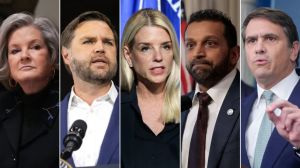
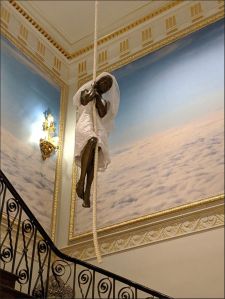
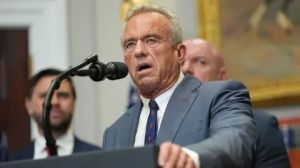






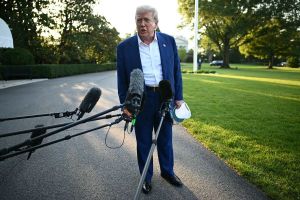

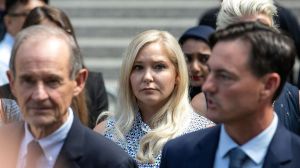
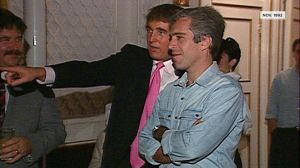









 peej
peej Carissa
 bostonboomer
 dakinikat
 ecocatwoman
 mablue2
 Mama Lopez
 peggysue22
 quixote
 skydancingguestblogger
 Mona (aka Wonk the Vote)



 Sky Dancing

Recent Comments