Two days ago, Gloria Steinem died at age 92. How can we quantify the massive legacy this brilliant woman left us? For those of us women who grew up in the 1960s and 1970s, she was a gigantic figure. She helped to change our lives forever. Today those massive changes are threatened by truly evil forces. So I want to pause and take note of her life’s work.
Gloria Steinem, the feminist crusader who galvanized the modern women’s movement, helping millions of women develop a sense of self-worth and gain a measure of equality at home, at work and in society at large, died on Wednesday at her home in Manhattan. She was 92….
Calling herself “an entrepreneur of social change,” Ms. Steinem helped usher in sweeping cultural transformations across virtually every facet of American life, from the boardroom to the courtroom to the bedroom.
For more than half a century, she personified the women’s movement and became its most enduring symbol; her tinted aviator glasses and curtain of streaked-blond hair parted in the center made her one of the most recognizable women in the world.
She was an unlikely revolutionary. Growing up a transient in the Midwest, she was 10 when her parents divorced and she was left to mother her mentally anguished mother — a formative experience that reverberated throughout her life. She had scant formal education until sixth grade; her big dream, as a budding tap dancer, was to become a Rockette.
But she read voraciously, graduated from college with honors and believed fiercely that women should be able to live whatever life they chose.
Her own feminist awakening didn’t come until her mid-30s, when, as a journalist in 1969, she attended a “speak out” of women discussing their illegal abortions. Charismatic, articulate, media savvy, deeply empathetic and a workaholic, she evolved into a political and cultural force.
She led protests and consciousness-raising sessions, wrote essays and delivered speeches, delved into political organizing, helped establish rape crisis centers and shelters for battered women, founded numerous groups that promoted women and had the Midas touch when it came to raising money for their causes.
And she and a cadre of feminists had the audacity to start a publication that flew in the face of traditional women’s magazines, examining topics like abortion, domestic violence and equal pay for equal work. The first glossy national periodical to be created, owned and run entirely by women, Ms. magazine, founded in 1971, sought to capture and channel a rising sense of female empowerment and eradicate the sexist assumptions that permeated the culture.
The magazine served as the movement’s manifesto, an incubator for social transformation and a blueprint for action. As such, it helped embolden women as they fought blatant discrimination and harassment in the workplace and unspoken oppression, and sometimes outright abuse, at home.
“When we started, there was not even a term for sexual harassment,” Ms. Steinem often said. “It was just called life.”
Decades after the movement dissipated and progressive women faced renewed setbacks, Ms. Steinem continued to push for their rights and equality. Indefatigable, she wrote essays and lectured into her 90s, and the news media never stopped seeking her opinion. She was the author of nearly a dozen major nonfiction books; her latest, “An Unexpected Life,” is scheduled for publication in late September.
Use the gift link to read the rest. You can also read an excerpt from Steinem’s memoir at The Atlantic (gift link): ‘Everything We Do Matters.’ Gloria Steinem on what older people can teach America.
To preteen girls of my 1970s junior high, there was no other way to be. Hiphuggers, short skirts, aviators, long swingy hair. A lot of sass. And for many of us, the first post “Women’s Lib” generation, the expectation of an adventure-filled, self-reliant future with marriage and motherhood as options not imminent requirements.
To her peers in the adult public square at the time, she had threaded the needle of sexy and smart in a way that made male detractors look like idiots. The record of their blustering scorn and contumely and the open ridicule heaped on her, and the women she led, is part of history.
Feminazi. Furry Legged fanatic. C-word. B-word. And the perennial favorite: Man-hater.
They couldn’t take it. Her wit and panache drew out their scorn the way certain salves drain boils. The casual insolence and open diminishment toward her and her peers was part of the cultural wallpaper of the era. Among the men engaged in it, the psychological temperature ranged from lightly snide to psychotic.
Reporting on the creation of Ms. Magazine, ABC news anchor Harry Reasoner said on national television, “I give it six months before they run out of things to say.”
By the 1980s, the Viagran Centurions of the media had mobilized. The shock jocks – Limbaugh, Imus Stern – can’t you take a joke? – and their spiritual grandsons the fight club rape propagandist Tate bros and their herd of manosphere sheep. The disappointed entitled, the preternaturally insecure, the incels, and their insidious cousins, the fascist tiki-torch carrying “You Will Not Replace Us” troops.
Gay Talese, revered chronicler of the famously misogyinistic Italian Mafia, sharing a taxi with Steinem and another great 20th Century phallocrat the author Saul Bellow – once famously said: “You know how every year there’s a pretty girl who comes to New York and pretends to be a writer? Well, Gloria is this year’s pretty girl.”
To her face.
Can’t you take a joke?
Charles Manson, weighing in from prison in a 1970 interview uttered a phrase that decades later is close to an actual slogan dripped from the mouths of men from JD Vance to the Tate brothers:“Gloria Steinem and all those girls’ libbers, they’re taking the manliness out of the man. They want to be the men, but they don’t want to carry the weight.”
Replacement was always the underlying fear.
Millions of men now share the views of a psychotic mass murdering cult leader.: Taking the manliness out of the man.
Steinem saw this coming back in 1972: “Some of us are becoming the men we wanted to marry.” In later speeches she would add to that: “But too few men are becoming the women they wanted to marry.”
She could name the core issues like no one else. Cut to the chase. “Any woman who chooses to behave like a full human being should be warned that the armies of the status quo will treat her as something of a dirty joke. That’s their natural and first weapon.”
Robin Morgan, a former editor-in-chief of Ms. Magazine who co-founded the Women’s Media Center with Ms. co-founder Gloria Steinem and Jane Fonda, died today, September 5, just several days after the passing of her friend and colleague Steinem. Morgan was 85.
Her death was announced by her son Blake Morgan and Julie Burton, president and CEO of the Women’s Media Center. A cause of death was not disclosed, but her son noted that she died peacefully in her sleep. Robin Morgan was in her second decade of living with Parkinson’s Disease.
Girl with a cat (2020) by Olga Gordienok
In a statement, Fonda said, “Robin Morgan was an artist, a poet, an activist, and in my eyes, a living legend — a woman whose anthology series, Sisterhood is Powerful, Sisterhood is Global, and Sisterhood is Forever provided the evidence needed to launch a feminist revolution, and it was part of my feminist education that led to the movie, 9 To 5.”
“I have learned so much from Robin over the years,” Fonda added. “I love her and all that she has brought to the world, the women’s movement, and to me on the most personal levels. I already miss her and my heart is broken.”
The editor-in-chief of Ms. Magazine from 1989 to 1994, Morgan, over the last decade, hosted, wrote, and produced the award-winning WMC podcast Women’s Media Center Live with Robin Morgan. The podcast recently produced its 500th episode.
Morgan, Fonda and Steinem co-founded the Women’s Media Center 21 years ago with a mission to give voice to and strengthen democracy for women in media and beyond. “Our job is to make women visible and powerful in the media,” Morgan once told Fox 5 Good Day New York. “And we do that through lots of programs — through training women in media skills, through SheSource, which is the go-to place for experts, through many programs and our radio program [now podcast], Women’s Media Center Live with Robin Morgan.”
And now, sadly, back to the reality of Trump world.
Yesterday, during one of his oval office bull
sessions with the media, Trump revealed his true feelings toward the men and women he has sent to fight and die in his Iran war.
President Donald Trump has dismissed his war in Iran, in which 18 U.S. service members have been killed, as “small potatoes for us.”
The president, 80, was taking questions in the Oval Office on Friday when he was asked how he would describe the conflict with Iran.
The question came after Vice President JD Vance insisted on Thursday it wasn’t a war despite the U.S. carrying out new strikes this week.
“Can you explain to the American people, if this is not a war, what exactly is it?” ABC News’ Rachel Scott asked Trump.
“Well, I’ll tell you what, a lot of people don’t call it a war. I call it a military conflict because it’s, it’s small potatoes for us. It’s not a big thing,” Trump said. “We did Venezuela, and we did this.”
But the president did not stop there. He went on to compare war casualties to back up his claim that the conflict in Iran was “small potatoes.”
“In Venezuela, we lost nobody, and this, we lost 18 people,” Trump said. “In Vietnam you lost 100,000 people, and in other conflicts, you lost tens of thousands of people.”
Trump, who himself received five military draft deferments during the Vietnam War, went on to say that he would call the conflict with Iran “intermittent strikes” and agreed with Vance that it was not a war.
“We’re not fighting right now. There’s no fighting,” Trump rambled.
Trump obviously couldn’t care less about the men and women who have died and been injured in his war. And actually, there is fighting.
The U.S. military said Saturday it hit three Iranian oil tankers, including one near Kharg Island, the country’s main oil terminal, after Iran launched missiles toward two U.S. Navy warships.
U.S. Central Command, which oversees operations in the region, said in a statement that its strikes disabled an oil carrier off the coast of Kharg Island and another off Jask, and it destroyed a third one in the Gulf of Oman.
Blaise, Saint-Louis (1956 – 1995) Haitian artist
“Let the message to the IRGC be clear: If you shoot at two of our ships, we will impose an even higher economic cost — taking out three of yours,” said Adm. Brad Cooper, Centcom commander, referring to the Islamic Revolutionary Guard Corps. “We will not hesitate to defend American forces, and if necessary, destroy Iran’s limited and exposed oil fleet.”
Iranian state media earlier in the day reported that an oil tanker was hit by U.S. missiles near Kharg Island.
Iran’s foreign ministry did not immediately respond to requests for comment.
Kharg Island, about 15 miles from the Iranian mainland in the Persian Gulf, is the centerpiece of Iran’s oil-based economy, with about 90 percent of the country’s oil exports moving through there.
Since the U.S. and Israel launched the first airstrikes against Iran six months ago, President Donald Trump has been mired in an unpopular war with no end in sight.
No end in sight. And it’s a war.
Meanwhile, back home in the Pentagon, Paranoid Whiskey Pete is hunting for leakers.
U.S. government investigators have taken the extraordinary step of subjecting roughly 50 members of the U.S. military’s Joint Staff to polygraph tests over leaks to journalists, including about how the Iran war has created a shortage of crucial munitions, according to officials briefed on the move.
The investigators asked military officers and civilian employees on the Joint Staff if they disclosed classified information to members of the press, and about whether they provided information about diminished U.S. munitions stocks.
The polygraph tests were conducted in August after a flurry of news reports detailed diminished stocks of crucial munitions, including of long-range missiles and Patriot interceptors. The show of force appeared aimed at not just ferreting out anyone who may have shared information, but intimidating others who might do so in the future, according to people with knowledge of the effort.
Between 1,500 and 2,000 officers and officials work for the Joint Staff, which coordinates operations, policy and war plans with combatant commanders around the world….
The scope of the investigation is without parallel. Mass polygraph tests have never been administered to the top ranks of the U.S. military in modern history.
Woman with cat, Tracy Porter
“I’ve never seen polygraphs employed this broadly or at this seniority level,” said Rear Adm. Donald J. Guter, a retired top judge advocate general for the Navy from 2000 to 2002. “In my experience, it’s unprecedented.”
The move comes as multiple news organizations have revealed details about how the war with Iran has drained munition stockpiles and reported on concerns inside the administration about the strategic direction of the conflict.
President Trump has pressured administration officials to aggressively hunt for those leaking information. But the president has gone further than merely trying to stop the flow of unauthorized information; he has labeled “treasonous” the media coverage that is critical of the U.S. handling of the war in Iran and the shortages of munitions.
The leaks have intensified an atmosphere of deep distrust and paranoia inside the Pentagon, one that current and former officials say has been fostered by Defense Secretary Pete Hegseth.
Surrounded by a tight inner circle of loyalists, Mr. Hegseth has pushed out or blocked the promotions of at least 80 generals, admirals and other officials during his tenure. Since early last year, the Pentagon has been conducting a number of leak investigations in response to news coverage about his leadership, even as he faced criticism for sharing sensitive details about strikes in Yemen in a Signal group last year.
The only thing Trump really seems to really care about is building his ballroom and putting his name on everything he can think of. The latest announcement from the administration is that they are going break ground for Trump’s “triumphal” Nazi arch.
The Trump administration plans to break ground on its proposed 250-foot arch near Washington, D.C.’s National Mall in the coming days, without key approvals and despite an ongoing lawsuit.
Interior Secretary Doug Burgum wrote on social media Thursday that “we are preparing to start, over the next two-week period, the excavation work necessary for the Great Triumphal Arch and Military Observation Deck.”
But the arch is still awaiting final approval from the National Capital Planning Commission, as well as federally mandated reviews regarding aviation safety and historic preservation.
Historic preservation experts have long criticized the Trump administration for seeming to rush the arch approval process, including by moving to weaken protections for historic sites altogether. This latest development raises concerns that the White House seeks to sidestep the process, which it denies.
Cecilia Beaux, Man with the cat
“Work will begin that does not require approval, but rather helps in the process,” the White House told NPR in a statement on Friday. “We will of course continue on our path of seeking final approval from all applicable entities.”
The White House, Department of the Interior and National Park Service did not respond to NPR’s questions about the timeline and extent of the excavations or the addition of the word “military” to the structure’s title.
President Trump told journalists last year that the arch is for “me.” But since then, the administration has said the arch is intended to honor the nation’s 250th anniversary.
“This will be one of the Great Pieces of American Architecture, honoring the history and significance of Arlington Cemetery and befitting the most powerful Capital in the World,” Burgum posted this week, alongside renderings of the white-and-gold structure, topped with three large gilded statues.
The administration told the judge something different.
The Trump administration told a federal judge that it was not preparing to start construction on the president’s planned triumphal arch in Washington, a day after Interior Secretary Doug Burgum announced that excavation work for the project would begin within the next two weeks.
The work the government plans to do, the Department of Justice said in a court filing on Friday, consists of archaeological excavation of the site necessary for the required historic review of the project. And it stated, despite President Trump’s frequent promotion of the project, that no final decision had been made to begin building the arch, which would stand near Arlington National Cemetery.
That starkly different message follows a pattern across other cases in which the administration has made one pronouncement in public and another in court.
Responding to the conflicting messages, Judge Tanya S. Chutkan of the U.S. District Court for the District of Columbia ordered the administration late Friday night to give her at least 48 hours’ notice if it proceeds with anything other than the limited archaeological work. And she reminded the administration that it is under an existing order to give the court 14 days notice before beginning construction on the arch.
The flurry of filings on Friday followed Mr. Burgum’s surprise announcement that excavation work for the arch would begin, even before it receives final approvals.
The Language of Care, by Kateryna Kolesnykova
“We are pleased to announce that after a very long wait (over 125 years!), we are preparing to start, over the next two-week period, the excavation work necessary for the Great Triumphal Arch,” Mr. Burgum wrote on social media.
The Department of Justice put things differently, after a group of veterans suing to block the arch sought a temporary restraining order on Friday. “This activity is not construction, or demolition in preparation for construction, of an arch,” the department said.
Judge Chutkan appeared to tread a middle path, allowing the limited work the government said in court it was pursuing, while warning it against going any further at this point.
My guess is that Trump will go ahead with the construction regardless of what the judge says. Remember, he has immunity for anything he does as president.
President Donald Trump has made a stunning admission while revealing why he’s obsessed with remodeling Washington.
Trump, 80, has candidly told New York magazine that he is building monuments for himself and slapping his name everywhere because he knows that nobody else will do so when he is gone.
Reporter Ben Terris shared with Trump an attack line from Democratic Sen. Jon Ossoff, a potential 2028 presidential candidate, who says that Trump’s obsession with vanity projects stems from knowing he is the only person willing to memorialize him.
“That’s true,” Trump responded. “Nobody will do it once I’m gone. When I leave here, nobody will.”
That is just pathetic.
That’s it for me today. Have a great long weekend, Sky Dancers!
Did you like this post? Please share it with your friends:
Yesterday was the Massachusetts primary and, as expected, 80-year-old Ed Markey defeated 47-year-old Seth Moulton in the contest for U.S. Senator nomination. I voted for Moulton, even though I agree more with Markey’s politics; because I really believe we need to get younger people into Congress. I knew Markey would win anyway. Our other Senator, Elizabeth Warren, is 77. Her term will not be up until 2031. Stephen Lynch, 71, also defeated a younger opponent for his House seat. I don’t have as much of a problem with that. His term is only 2 years. But we really need new blood in Congress–not to mention the White House!
Massachusetts, as it turns out, is a good state in which to be a very old Democratic incumbent.
Three Democrats who have been in office since long before the iPhone was in stores all won renomination Tuesday. Senator Ed Markey, 80, and Representatives Richard Neal, 77, and Stephen F. Lynch, 71, are all likely to return for additional terms.
Ed Markey
Each faced challengers who had called for a new generation of leadership. Mr. Markey coasted past Representative Seth Moulton, 47, who ran to the middle, while Mr. Neal and Mr. Lynch both fought off progressive challengers.
Mr. Markey has been in office for 50 years. Mr. Neal has represented western Massachusetts since 1989. Mr. Lynch first won election from South Boston in 2001. The state’s Democrats do not seem inclined to reject their incumbents….
The party still scarred by former President Joseph R. Biden Jr.’s public meltdown during the 2024 campaign was not convinced that an octogenarian senator should not serve another six years.
Seth Moulton
Perhaps if Mr. Markey, 80, had faced a younger challenger with better political relationships than Mr. Moulton, he would have been in trouble in Tuesday’s Democratic primary. But Mr. Moulton has spent his career challenging his party’s orthodoxy and its leaders.
That record left Mr. Markey the political space he needed to paint himself as the progressive in the race, campaigning on the ideas of the future — even though he has been in Congress for 50 years.
In the waning days of the Massachusetts primary, several Democrats described Mr. Moulton as having the generational change message the party needed but being the wrong messenger to deliver it.
Mr. Markey said throughout the campaign that he would resign his seat if his advanced age left him unable to properly fulfill his Senate duties. He is now favored to win in November, which would have him serve in the Senate until he is 86 years old.
Moulton also hurt himself with his remarks about trans athletes.
…from the moment Mr. Moulton entered the race last October, Mr. Markey used his remarks questioning transgender girls’ participation in girls’ sports as a battering ram against him. Not only did it galvanize the L.G.B.T.Q. vote for Mr. Markey, it also helped frame him as the progressive candidate.
It was the same formula that powered Mr. Markey’s last primary triumph in 2020 against another younger, more moderate Democrat, Joe Kennedy III.
Mr. Moulton eventually offered a qualified apology for his remarks, which came the day after President Trump won a second term in the 2024 election. But by then the state’s progressive voters had heard for months from Mr. Markey and his supporters that Mr. Moulton, during tough times, was willing to toss trans people aside.
Use the gift link to read more if you’re interested.
Rep. Stephen Lynch and Rep. Richard Neal also defeated younger opponents.
Democratic Rep. Stephen Lynch has defeated a younger, more progressive primary challenger, NBC News projects, in the highest-profile test remaining for House incumbents after a turbulent primary season.
Stephen Lynch in 2025
Lynch, 71, won renomination over Patrick Roath, a 39-year-old former aide to former Massachusetts Gov. Deval Patrick. With his win, Lynch staved off an attempt to add him to the list of Democratic officeholders dethroned by rivals pushing for generational change.
Elsewhere in the state, fellow veteran Democratic Rep. Richard Neal also secured renomination, defeating teacher Jeromie Whalen in another Democratic primary.
On the other side of Massachusetts, Roath outraised Lynch, outspent him significantly on the airwaves and scored The Boston Globe editorial board’s endorsement to go with backing from Patrick, progressive activist David Hogg’s group, Leaders We Deserve, and key teachers unions.
That support helped Roath press Lynch for months in one of the toughest fights of his political career. He highlighted Lynch’s various breaks with his party in the past, including votes against the Affordable Care Act and, more recently, for the Laken Riley Act. Roath also called for progressive measures like “Medicare for All,” abolishing ICE and restricting military aid to Israel.
But Lynch persevered, trumpeting work that he says held the Trump administration accountable and leaning on his decades of experience, including deep relationships with unions and other fixtures in the district….
Richard Neal
Neal also avoided defeat in another primary marked by arguments over generational change and progressive policy proposals. Whalen, 39, a high school teacher, ran a campaign decrying the “old-school political entanglements that got us into this mess” and called to abolish ICE and cut off U.S. military aid to Israel.
Neal spent more than $1 million on campaign ads, according to the ad-tracking firm AdImpact, about 10 times what Whalen spent.
The United States and Iran exchanged a barrage of strikes overnight, an outburst of violence that killed both military personnel and civilians in Iran, including four people at a wedding, according to Iranian news media and officials.
U.S. Central Command, which oversees the military’s operations in the Middle East, said that it had struck Iranian military targets in retaliation for attacks on ships and American forces in the region.
Four members of the aerospace division of the Islamic Revolutionary Guards Corps were killed in a U.S. strike in the western city of Kermanshah, according to a Guards statement published on Wednesday by Tasnim, an Iranian news agency. At least 12 people were killed in strikes across Iran’s southern region, the Iranian state outlet Press TV reported on Wednesday.
A still from a video provided by the Iranian Red Crescent rescue service showed damage in Kuhestak, southern Iran, on Wednesday.Credit…Iranian Red Crescent Society, via Reuters
In response to the latest attacks, the Revolutionary Guards said in statements Wednesday morning that they had launched missiles overnight at an American military base in Jordan, at U.S. military equipment warehouses in Iraq and at an air base in Kuwait hosting American forces.
A U.S. official, speaking on condition of anonymity to discuss operations, said Wednesday all American service members were accounted for but declined to share any damage assessments.
The deadly back-and-forth overnight was a demonstration of the stalemate between Washington and Tehran, more than six months after President Trump launched strikes on Iran, saying that he expected a quick resolution.
Among the locations hit by the U.S. military was a wedding in a residential area in the small port town of Kuhestak in the Hormozgan province of southern Iran, according to Iranian officials. Four people, including a child, were killed in the attack, with around 50 others wounded and hospitalized, Iranian state media reported.
Use the gift link to read more if you’re interested. The NYT now allows subscribers unlimited gift links.
Iran fired on U.S. allies in the Gulf early Wednesday following a night of American bombardment that Iranian officials say included a deadly strike on a wedding party.
The latest violence came after a monthlong lull in fighting. The six-month war has led to a spike in oil prices, roiled the global economy and posed increasing political problems for U.S. President Donald Trump’s Republican Party ahead of November midterm elections.
Fighting has escalated since the American military hit Iranian rocket launchers on an island in the Strait of Hormuz over the weekend, saying Iran was planning to use them to shoot mines into the waterway. Iran retaliated by firing missiles at American bases in Jordan that were intercepted.
American military resources are stretched and political pressure in Washington is mounting, while Iran’s economy falters. Iran’s currency hit another record low on Wednesday, with traders in Tehran exchanging 2.20 million rials for one U.S. dollar, a 10% hike from last week’s record.
Neither side can continue indefinitely between full-scale war and a truce, said Hamidreza Azizi, senior Iran analyst at the Crisis Group, an international think tank.
“At some point, one of the sides may see a need to escalate in order to break this cycle,” he cautioned. “So that could bring the two sides to a point that they have been trying to avoid until now, which is a full-scale war.”
Trump made a bunch of insane threats on Truth Social, including that he would completely destroy Iran’s civilization. Then he suddenly switched gears and announced another cease fire.
President Donald Trump announced a two-week ceasefire with Iran on Tuesday night — hours after he’d threatened “a whole civilization will die tonight” and about 90 minutes before a deadline he set for Tehran to reach an agreement with the United States.
“Based on conversations with Prime Minister Shehbaz Sharif and Field Marshal Asim Munir, of Pakistan, and wherein they requested that I hold off the destructive force being sent tonight to Iran, and subject to the Islamic Republic of Iran agreeing to the COMPLETE, IMMEDIATE, and SAFE OPENING of the Strait of Hormuz, I agree to suspend the bombing and attack of Iran for a period of two weeks,” he wrote on Truth Social.
Earlier in the day, Trump had warned on social media that “a whole civilization will die tonight” if there was no deal between the two warring countries.
That threat, Trump’s most extreme public rhetoric in the conflict to date, had included a vow to launch attacks on Iran’s infrastructure over its continued disruption of shipping through the Strait of Hormuz.
The two-week ceasefire, Trump said, is contingent upon Iran reopening the strait. For its part, Iran proposed a 10-point plan to end the war, which includes “controlled passage” through the strait, coordinated by Iran’s armed forces.
Iran’s plan also calls for compensation for damages and the withdrawal of U.S. forces from “all bases and positions in the region.” On social media, Trump called the plan “workable.” [….]
After he extended the deadline multiple times for Iran to reopen the vital shipping route, which about a fifth of the world’s oil and natural gas usually passes through, Trump announced 8 p.m. ET Tuesday as the final deadline for Iran to come to a deal.
In a post Sunday, Trump threatened Iran’s power plants and bridges if it did not reopen the strait by the Tuesday deadline, using expletives and invoking Islam.
It was the latest in a series of escalating threats by Trump against Tehran, including threatening to bomb the country into “the Stone Ages” and calling the Iranian government “crazy bastards” while demanding that it open up the key shipping route.
Trump’s threat Tuesday morning sparked a wave of fierce and immediate condemnations from Democrats, who said such strikes on infrastructure would constitute war crimes.
Trump is psychotic and should be removed from office. He’s a danger to the U.S. and the world. He has completely out of touch with reality.
President Donald Trump on Wednesday floated renaming the Strait of Hormuz — the central point of contention in the ongoing war against Iran that the U.S. and Israel started — after himself.
The proposal via a Truth Social post came less than a week after Trump, who is locked in an intensifying feud with Canada, signed an executive order to change the name of Lake Ontario to “Lake America.”
“Now that we have it under U.S.A. control, should we change the name Hormuz Strait to TRUMP STRAIT???” Trump wrote in the post Wednesday morning.
“Like America itself, it would be ‘hotter’ than ever before! Thank you for your attention to this matter. President DONALD J. TRUMP,” he wrote.
It was not immediately clear how the president would attempt to implement a name change in the strait, which is not near the U.S. The order renaming Lake Ontario directed Interior Secretary Doug Burgum and his department to update the Geographic Names Information System with the new name. Canada rejected the change, though Google and Apple have recently updated their maps. Early in his second presidential term, Trump also declared he was renaming the Gulf of Mexico as the Gulf of America, a change also rejected by Mexico and other international counterparts. The U.S. borders Lake Ontario and the Gulf of Mexico, both of which have had their names for centuries….
The Strait of Hormuz yestereday
Trump and his administration have repeatedly insisted that Iran has lost control over the strait, which carried one-fifth of the world’s oil trade before the war began in late February.
But transits through the waterway remain far below prewar levels, and ship-trackers say they have dropped further in recent days, as military strikes in the region have resumed following a weekslong hiatus.
Again, Trump lives in an alternate reality. He is insane and should be removed from office immediately.
Meanwhile, Pete Hegseth is destroying the Department of Defense.
In the aftermath of the resignation of Army Secretary Dan Driscoll, multiple sources told CNN they believe Defense Secretary Pete Hegseth is damaging the Army’s efforts to adapt to the modern battlefield as he focuses on culture wars and prioritizing his own image of the “American warfighter,” and pushes out leaders who don’t align with his vision.
In submitting his resignation, a source familiar said Driscoll brought up “concerns with the administration surrounding Army transformation and readiness and Hegseth’s blocking those efforts specifically by firing the generals who were responsible.”
Driscoll announced Tuesday evening that Wednesday would be his “last full day in the role.”
Multiple sources agreed with the concerns Driscoll raised: that Hegseth is damaging the Army’s efforts to modernize and adapt to the 21st century battlefield environment – where drone warfare is becoming increasingly important – by firing or pushing out leaders who were spearheading those efforts.
“It’s critical that you have key leaders that understand technology and have the temperament to deal with industry and turn that into the formation,” a former senior Army official said. “When you fire these guys for arbitrary reasons, it creates confusion and a void … the Army is enduring turbulence right now.”
Senior US military officials have privately acknowledged they have come under what could be characterized as political pressure during Hegseth’s tenure — particularly when he has prioritized culture war issues — and voiced concerns about the secretary’s recent efforts to fire or push out uniformed and civilian leaders.
A defense official in Europe told CNN that even though Hegseth has spoken about technology reform and even previously released guidance on unmanned systems, in practice they see a secretary and Pentagon leadership more focused on cultural issues than modernization.
“It’s conflicting because yeah he put out a memo saying this is important, but … he’s talking about muscles, dudes in dresses, testosterone,” the official said. “We don’t see a change at that level.”
Pete Hegseth is accused of setting the military up for potential disaster as the fallout of his ego-driven overhaul of top leadership spills into public view.
The 46-year-old former Fox News host has masterminded a massive purge within the Defense Department that saw Army Secretary Dan Driscoll walk out on Monday, raising fears about a lack of experienced leadership at the top of the military.
It comes as the Pentagon burns through resources—both material and human—in its fight with Iran, which has now dragged on for over six months despite President Trump initially projecting it to last four to five weeks.
Army Secretary Daniel P. Driscoll submitted his resignation to President Trump.Credit…Haiyun Jiang for The New York Times
The fight is thought to be exacting a heavy toll on the nation’s weapons and munitions stockpiles, which the Center for Strategic and International Studies says will last for the war in Iran, but which pose a threat to the U.S.’s ability to fight future wars. The Associated Press, however, reports that the war has used around 65 percent of Patriot interceptor missiles.
Driscoll said he feared that Hegseth’s leadership of the Defense Department could cause “generational damage,” a person familiar with the close JD Vance ally told the Financial Times.
He “had tried so many different ways and so many different times, but it was just clear that… Hegseth wasn’t willing to listen to the facts or the truth, or the reason, or any of that, because of his personal animosity,” they said.
Reflecting on his exit, Brookings Institution senior fellow Tom Wright told the FT that it was a “revelatory moment, and I think it illustrates that the Pentagon is in disarray.”
Defense Secretary Pete Hegseth has fired or blocked the promotions of more than 80 generals and admirals, a purge that has hit about 10 percent of the military’s top officers and shows no signs of slowing.
In recent days, Mr. Hegseth targeted seven Army officers who had been selected for two-star general rank by a board made up of senior Army leaders, according to current and former military officials, who discussed sensitive personnel matters on the condition of anonymity.
The moves come at a time when the military is badly strained by the Iran war, which has gone on far longer than administration officials anticipated.
Pete Hegseth
The military, especially the Army, is also racing to keep up with the proliferation of sophisticated drones and precision missiles that have exposed the vulnerability of its overseas bases and weapons systems.
The firings and Mr. Hegseth’s refusal to explain the logic behind them are dividing the Pentagon and alienating many in Congress, the officials said. The latest to register his disapproval was Army Secretary Daniel P. Driscoll, who recently submitted his resignation to Mr. Trump.
In a meeting with the president, Mr. Driscoll complained that Mr. Hegseth had fired some of the Army’s most combat-tested leaders, imperiling its efforts to modernize the force, military officials said.
He also warned Mr. Trump that the firings and blocked promotions have damaged morale, causing some in the military to question the fairness of a promotion system that is supposed to be apolitical and merit-based, senior officials said.
Mr. Hegseth’s purge does not appear to be driven by job performance, but rather is part of a broader effort by the defense secretary to fashion a force, particularly at senior levels, that is aligned with his political and ideological views, according to military officials.
Also his preference for white males.
Sean Parnell, the Pentagon spokesman, defended Mr. Hegseth’s decisions as normal Pentagon business. “The idea that these lists cannot be altered is ridiculous; every single secretary has exercised this exact prerogative,” he said.
But senior officials and members of Congress have said that Mr. Hegseth’s moves are without precedent. In the past, the defense secretary and service secretaries have removed officers for moral or ethical breaches. But officials said that these officers have behaved in accordance with Pentagon policy.
Senator Jack Reed of Rhode Island, the top Democrat on the Senate Armed Services Committee, has called Mr. Hegseth’s removals “illegal.”
More than half of the officers affected by Mr. Hegseth’s dismissals are Black or female in a force whose senior ranks are dominated by white male officers. Of the seven officers Mr. Hegseth removed from the Army two-star promotion list, two are Black and two are female.
Use the gift link to read more if you wish.
Those are my recommended reads for today. Thoughts? What other stories are you following?
Did you like this post? Please share it with your friends:
Russian artist Alexander Sokht, Between books and cats
Today’s top stories:
Trump’s war on Canada escalated yesterday as he ordered 50 percent tariffs on Canadian goods. Canadian Prime Minister Mark Carney called his bluff, and the tariffs have taken effect for now.
Trump’s war on the free press also escalated Friday, after Whiskey Pete Hegseth fired the editor and publisher of Stars and Stripes because of their coverage of the dire conditions on the carrier S.S. Lincoln and their criticism of the Pentagon’s interference in their coverage.
Trump is threatening Iran with economic sanctions and Iran is threatening a “devastating response.” Iran also responded to Trump’s claim that the Strait of Hormuz is a “U.S. territory.”
ICE is getting a new weapon to use against immigrants and citizens who get in the way of their fascist attacks: shock gloves.
The disaster in Indiana is still going on after massive storms, flooding, and power outages.
The Trump administration’s latest round of tariffs against billions of dollars worth of Canadian goods took effect just after midnight Saturday, after the two countries failed to seal a last-minute trade deal that satisfied both sides.
Prime Minister Mark Carney said Ottawa would retaliate “dollar for dollar” after the White House delivered on its threat to impose crushing 50 per cent tariffs on a wide range of products. The two governments’ trade representatives said they had come close to finalizing an agreement in recent days, but Carney said Ottawa ultimately couldn’t accept the terms on the table.
“I have decided to suspend trade negotiations with the U.S. and have directed Canada’s negotiators to return to Ottawa,” the prime minister said in a statement.
“They have worked hard, in good faith, to defend the interests of Canadians throughout these negotiations up until the very last minute. However, last-minute changes in the U.S. proposed terms were unfair, uneconomic, and called into question the reliability of any deal.” [….]
In his own statement, U.S. Trade Representative Jamieson Greer said talks crumbled because Canada didn’t accept the agreement the administration had offered.
“Tonight, Canada declined to finalize the trade deal under the terms agreed earlier this week, despite the U.S. offer to Canada to receive the best treatment of any major exporter to our market, new demands and walk backs of other commitments by Canada have upended the careful balance reached in the past days,” Greer said in a statement.
“In addition, Canada is continuing to maintain its prolonged retaliation against the United States, including, among other things, flat out prohibitions on certain American goods and services.”
Now we wait for Trump to TACO (Trump Always Chickens Out), likely right before the stock market opens on Monday.
Crucial trade talks between the United States and Canada to stave off punishing new tariffs by the Trump administration on Canadian goods collapsed late Friday, with Canada saying it would retaliate “dollar for dollar.”
Prime Minister Mark Carney of Canada said he had decided to suspend the talks because the American side had introduced last-minute terms that were “unfair, uneconomic, and called into question the reliability of any deal.”
By Merle Keller
He added that the talks, which had been going on for weeks and had intensified in the past few days, had marked important progress but had ultimately “not been enough to meet our objectives for Canadians.”
United States Trade Representative Jamieson Greer told reporters that Canada had walked away from the negotiating table, minutes before a deadline ushering in new 50 percent tariffs by the Trump administration on a broad range of Canadian goods.
“Tonight, Canada declined to finalize the trade deal under the terms agreed earlier this week, despite the U.S. offer to Canada to receive the best treatment of any major exporter to our market,” Mr. Greer said on a virtual briefing with the press.
“New demands and walk backs of other commitments by Canada have upended the careful balance reached in the past days,” Mr. Greer added.
Shortly before Mr. Greer’s statement to the press, U.S. Customs and Border Protection sent out guidance for importers saying that the Canadian products that the president had identified would face tariffs after 12:01 a.m.
Use the gift link to read more if you’re interested. I still expect Trump to TACO.
Pete Hegseth’s Pentagon on Friday fired the publisher and editor of the independent military news outlet Stars and Stripes for “insubordination.”
Long-time publisher Max Lederer and Editor-in-Chief Erik Slavin were given “separation notices” that allow five days to appeal the decision, CBS News reports. Reporter Lara Korte announced on social media that she had also been fired.
Korte and Slavin traced the decision back to interviews they did that aired on CBS Sunday Morning in July.
“According to the notice, I am being fired for stating in a CBS interview that censorship of news for service members would constitute a red line. The Pentagon’s public affairs office has charged me with insubordination,” Slavin told CBS.
“I stand by the principle that Stars and Stripes must remain editorially independent, as required by law and by the department’s own policies.” [….]
Portrait of Kolya with a Cat, by Arkady Plastov
“It’s a shame for the institution and service members, who swore to defend the Constitution and deserve the right to a free and independent press,” Korte wrote in a series of posts about her firing.
Although the newspaper operates within the Department of Defense, it is legally mandated by Congress to remain editorially independent.
Lederer had announced on Wednesday his intention to step down from the post he’s held since 2007, since his opinions on how to run the media organization differed in “fundamental ways” to the Pentagon’s plans for Stars and Stripes, the newspaper reported.
“I think the right step is for me to step down, get out of the way, and let different leadership step in and continue to make this, the great organization that it is, even better,” he said.
Lederer was slated to finish up his tenure on Sept. 30, but now both he and his editor-in-chief have been turfed out.
The move comes after President Donald Trump, Hegseth, and other military leaders downplayed reporting on dire conditions aboard the USS Abraham Lincoln reported by families of service members.
The Pentagon on Friday fired the editor-in-chief of Stars and Stripes and a top reporter for insubordination after they spoke publicly against any interference by the Defense Department in the military news outlet that has a long history of editorial independence. It was the latest move by an administration that has grown increasingly aggressive toward the news media.
Erik Slavin, editor-in-chief of the military newspaper that is partly funded by the Pentagon, told The Associated Press he was dismissed for insubordination after an interview he gave that objected to potential censorship by the U.S. military. He received a notice of separation, as did publisher Max Lederer — who had just announced his upcoming retirement — and Middle East reporter Lara Korte, Slavin said.
Slavin said he was being fired “for stating in a CBS interview that hypothetical censorship of news for service members would constitute a red line.” Korte participated in the same interview.
“I stand by the principle that Stars and Stripes must remain editorially independent, as required by law and by the department’s own policies,” Slavin said.
Grocery shelves have been empty for days. Children who had just started school haven’t seen their classrooms in more than a week. Insulin has spoiled in warm refrigerators, and people who depend on oxygen cannot pump it from their tanks.
Electricity has been out for 10 days throughout much of Gary, Ind., since deadly storms ripped through, knocking down trees and power lines. On Friday, residents said they were growing increasingly desperate, even as another round of rain was on the way.
Lecture en fauteuil rouge, by French artist Flora Merleau
“Every day I’m crying,” Renita Theus, 41, said outside her darkened apartment, where her car remained trapped under a fallen tree. “It’s hot in the house. I toss and turn and can’t sleep. I walked to the dollar store and they’re all out of candles and batteries.”
Storms on Aug. 11 caused flooding and havoc throughout the Chicago area and neighboring northern Indiana, hitting Gary, where one-third of residents live in poverty, especially hard. More than a week later, the regional power company said its crews were working tirelessly to restore electricity but were overwhelmed by unprecedented levels of damage.
The utility, Northern Indiana Public Service Co., said on Friday that 43,400 of its customers remain without power in the region, down from more than 300,000 in the storm’s immediate aftermath. Service is expected to be restored to Gary by Tuesday, the company said, calling it a “monumental undertaking.”
On Friday, Gov. Mike Braun said that he had requested an expedited major disaster declaration from the Federal Emergency Management Agency that would allow more assistance to pour into the state. Last week, President Trump granted an emergency declaration for Indiana counties affected by the disaster, and a state relief fund is providing emergency aid grants of as much as $5,000.
“I will do everything in my power to ensure Hoosiers have the resources needed to recover,” said Mr. Braun, a Republican.
Local officials warned that cleanup would likely take months.
“It’s just widespread devastation throughout the city of Gary,” said Larry E. Tillman, the chief of the fire department.
Use the gift link to read more if you’re interested. So far, Trump has said nothing publicly about this disaster. I guess he’s too busy with his building projects.
That’s all I have for today. Take care everyone!
Did you like this post? Please share it with your friends:
I’m going to follow up on two important stories that Dakinikat wrote about yesterday: Trump’s order for the Navy to redesign its warships to resemble those used in WWII, and his uncaring attitude toward sailors who are serving in horrible conditions on the USS Lincoln and other warships because of Trump’s Iran war. Then I’ll move on to other news.
The U.S. Navy is considering a major redesign of its new aircraft carriers to better match President Donald Trump’s preferred aesthetic for the warships, according to seven current and former U.S. officials familiar with the matter.
The service isevaluating the feasibility of moving the multistory tower that acts as the carrier’s command center farther forward, toward the middle of the ship, to resemble older vessels, the officials said. The review, which has not been previously reported, is in response to Trump’s concerns about the “look” of the new Ford-class ships, where the tower is near the rear, these people said.
The timing and extent of the Navy’s evaluation is unclear, with current and former officials cautioning that the service was concerned that such a change would require significant time and money. Like others, they spoke on the condition of anonymity to discuss a sensitive situation.
Moving that command center, known as the “island,” would be the second major design change prompted by the president, who on Thursday issued a national security memorandum directing the Navy to develop a plan to revert to older steam-powered catapults on future carriers. The systems help launch jets off the ships’ flight decks.
Trump’s preference, current and former officials said, is for the new aircraft carriers to look more like those that were in service during World War II.
The Navy also examined the issue during his first term as president, said a former senior U.S. official. A study found that moving the island could cost billions of dollars in redesign costs and significantly delay the program, this person said.
“It came back that the cost and time to do so would just be extraordinary,” the former official said.
You can read more details using the gift link above.
Cat and kittens, 19th Century American, National Gallery of Art
Trump is obsessed with appearances. These demands for changes in the warships are crazy. He spends even more time obsessing about his ballroom. It really is time for the 25th Amendment, if only we had responsible people in the cabinet.
The Iranian attack, retaliation for the U.S.-Israeli assault on Tehran, destroyed much of the base. And as it went up in smoke, so did a major logistics hub that the Navy has relied on for decades.
The Navy needed a Plan B to continue feeding the sailors working around the clock to keep warplanes flying strike missions, and later to maintain a blockade of Iran’s ports.
With the threat of Iranian attacks at other ports in the region, the Pentagon looked to a base under British command on the island of Diego Garcia as its supply hub, which is south of the Maldives and roughly 2,200 miles from where two aircraft carrier strike groups have been operating in the Gulf of Oman.
The loss of the hub in Bahrain has contributed to a host of reported problems on carriers supporting operations against Iran, as Democratic senators raise concerns about the Lincoln’s 5,000 sailors and their nearly nine-month deployment.
Senator Richard Blumenthal, Democrat of Connecticut, said in a letter to Defense Secretary Pete Hegseth that the reported problems included shortages of basic supplies and the deteriorating mental health of its crew members.
Again, you can read more with the gift link. Both Trump and Hegseth have dismissed the problems sailors are facing and the concerns of their families, but they actually have moved to relieve the USS Lincoln and replace it with the USS George Washington, recently stationed near Japan and currently near Indonesia.
A U.S. official told ABC News on Thursday that the aircraft carrier USS George Washington, which is homeported in Japan, will replace the Lincoln as part of a long-planned rotation of ships and has begun heading toward the Middle East.
By Daniel Merlin (French artist)
The aircraft carrier’s movements come amid reports of mental health and supply issues aboard the USS Lincoln, whose long deployment to the Middle East in support of the Iran war includes a record-setting time at sea of more than 200 days. Navy leaders, including the Navy’s acting Secretary Hung Cao, last week held a heated town hall for families of the USS Lincoln who had raised concerns about the conditions on the ship.
When a reporter on Friday said that family members of people aboard that ship are concerned about the conditions, Trump interjected to suggest that they are “not” actually worried.
“No, they’re not. That ship is moving right now, or very shortly, and it’s being replaced with another very similar ship,” Trump said.
When pressed by a reporter about whether the deployment of the USS Abraham Lincoln has gone on for too long, Trump said not that it hasn’t gone on “nearly long enough.”
“No, no, not nearly long enough,” Trump said.
Family members can’t be happy to read those quotes. We’ve known for a long time that Trump couldn’t care less about our troops, but to see it spelled out in print is still shocking.
It is among the most famous phrases in presidential history: “ The buck stops here.” Except with President Donald Trump, it almost never does.
Concerns about a weak economy and still-high inflation? His predecessor, Joe Biden, saddled him with that, he says, even though the Democrat has been out of office for 18-plus months and despite Trump once promising an immediate turnaround.
The increasingly unpopular war in Iran that has kept oil prices high, Trump’s approval rating low and sent shock waves through the global economy? Actually, this was Trump making up for timid earlier presidents who, he argues, squandered nearly 50 years of opportunities to curb Tehran’s nuclear ambitions.
Trump’s tendency to point fingers at others is increasingly in the spotlight before November’s midterm elections, when Republicans are trying to retain control of Congress. His unwillingness to accept blame sometimes leads him to deny that there are problems at all, and could leave GOP leaders in tight races with little reassurance for voters that their concerns are being addressed.
A bit more:
Accepting the 2016 presidential nomination, Trump said, “Nobody knows the system better than me, which is why I alone can fix it.” But as president, he has often suggested that the solution and blame rest elsewhere.
“The buck stops with everybody,” Trump said in 2019, during a lengthy government shutdown. In 2020, on the same day he declared the coronavirus pandemic a national emergency, he said, “I don’t take responsibility at all” for a lack of COVID-19 testing….
The president acknowledged in a recent Punchbowl interview that voters are angry, but he said they are not mad at him but at congressional Republicans.
Trump believes his party can hold its congressional majorities after November, but he was clear that if Republicans lose, it won’t be his fault — echoing his comments before the 2018 midterms that he would not accept blame if his party lost control of the House, which it did.
There’s even more at the link. I’m glad at least one journalist is writing about this.
President Donald Trump is heading to another weekend at his Bedminster, New Jersey, golf club as questions mount over promises he made to Americans on energy costs and his pledge to take care of the U.S. military. Trump campaigned on cutting energy and electricity prices in half within his first year in office and repeatedly promised Americans $2 gasoline.
However, energy costs have not fallen anywhere close to those levels and gasoline prices remain well above the $2 target. Many are experiencing some of the highest electricity bills they have ever seen.
At the same time, thousands of sailors aboard the USS Abraham Lincoln have reportedly endured food and water shortages, disrupted mail, long workdays, plumbing problems and deteriorating mental health after more than 250 days at sea. Against that backdrop, Trump is once again retreating to Bedminster for a weekend that is largely closed to the press.
Trump doesn’t seem to do much of anything other than sit in oval office talking to reporters and falling asleep and then playing golf at every opportunity.
In a speech last night, a delusional Trump claimed he could make the Strait of Hormuz “a territory of the United States.” Again, it’s 25th Amendment time.
President Trump claimed during remarks on Long Island, N.Y., on Friday that he will make the Strait of Hormuz a U.S. territory, despite the fact that Oman and Iran share jurisdiction of the waterway.
“Pretty soon, I will be declaring the Hormuz Strait a territory of the United States,” Trump said during an address highlighting his administration’s efforts to combat crime in the U.S.
Trump did not elaborate on how he would make the critical shipping lane a U.S. territory, considering the U.S. does not have jurisdiction over the waterway….
Trump has said since the conflict started roughly six months ago that the U.S. has controlled the strait. He deployed a U.S. naval blockade in the strait twice, claiming U.S. supremacy over the transit of oil exports from the region.
Iran has pushed back on Trump’s claims that the U.S. controls the waterway. In a post on the social platform X on Wednesday, Iran’s Persian Gulf Strait Authority said that whoever owns it does “not change the reality: the Strait of Hormuz remains blocked and will not be reopened until Iran’s conditions are accepted.”
“We all know why Todd Blanche was sworn in as the U.S. Attorney General behind closed doors in the Oval Office.” John Buss, @repeat1968
Good Day, Sky Dancers!
As we continue Joint Operation Chaos with Israel in the Middle East, it’s becoming apparent that more money and thought are going into Project Glitz up the White House than into taking care of our all-volunteer army. The headlines this week and today have been disgraceful. The latest weird decision by the peerless leader, which put others’ lives in danger as he escaped in a food cart to a different plane, is to spend billions of dollars on the US Navy to restore old technology.
It’s also becoming apparent that almost all the ships at sea have deplorable living conditions. Trump has never had respect for those serving in the military, but this is over the top. It goes beyond calling them all “suckers”. It endangers their lives. Senator Mark Kelly has a lot to say about this today. This report is at The Hill and covered by Finya Swai. “Mark Kelly on aircraft carrier catapult order: ‘Donald Trump knows nothing about this stuff’.” I hate to think that the U.S. Military is one of the things Trump touches that dies.
Sen. Mark Kelly (D-Ariz.) blasted President Trump on Thursday for ordering the U.S. Navy to revert to older catapult systems on its aircraft carriers, arguing the change would be costly while questioning Trump’s qualifications to make such a call.
“He’s a marginally failed real estate developer with multiple bankruptcies,” Kelly said in an interview with MS NOW. “He shouldn’t be weighing in on systems, on aircraft carriers.”
Trump earlier Thursday directed the Navy to return to steam-powered catapults and hydraulic systems on its Ford-class aircraft carriers, ditching the newer electromagnetic technology.
The order would require changes to future carriers, including the USS Doris Miller, which is currently under construction and already slated to use the Electromagnetic Aircraft Launch System (EMALS).
Kelly, a former Navy combat pilot and NASA astronaut who sits on the Senate Armed Services Committee, warned the move would force the Navy to redesign ships that are well into development and are “probably going to cost billions of dollars.”
The Arizona Democrat has said that despite his own experience in hundreds of career takeoffs and landings, his degree in aeronautical and marine engineering and his work as a test pilot, he still would not tell Navy engineers how to design a carrier.
“Donald Trump knows nothing about this stuff,” the senator continued in the interview. “Not in any world would I suggest to the Navy to change the design of some system on a ship at this point.”
He added, “I mean, does the guy know nothing about the way our government is supposed to work and how it’s supposed to be managed?”
As usual, Orange Caligula is always thinking like it’s still the late 20th Century. This is from the AP. “Trump orders the Navy to return to an older system of launching jets off aircraft carriers.” It’s reported by Konstantin Toropin.
President Donald Trump is ordering the U.S. Navy to remove the advanced system used to launch fighter jets from its newest type of aircraft carrier and return to using older steam catapults that he has long said he prefers, according to a directive issued Thursday.
The new mandate would likely cost billions of dollars and revert the Navy’s most advanced ships to a system that takes more sailors to operate and is more difficult to maintain.
The memo directs the Pentagon and the Navy to present Trump with plans to remove the Electromagnetic Aircraft Launch System, also known as EMALS, within two months. It also says the Ford-class carrier’s electromagnetic weapons elevators should be replaced.
The move comes after years of Trump railing against the new, magnetically powered catapult system that shoots fighter jets off the deck of the carriers. It also comes at a time when the U.S. military is trying to find funding from Congress for all its desired equipment and as the Navy is struggling to fill its ships with enough sailors.
Trump’s memo directs the fourth Ford-class carrier, the USS Doris Miller, to be the first ship to include the new changes. That will leave the USS Gerald R. Ford, as well as the forthcoming USS John F. Kennedy and USS Enterprise, untouched.
However, redesigning an already finalized ship for such a major system change will not be an easy task.
MS NOW interviewed the wife of the sailor who recently jumped ship. “‘The boat is finally getting to me’: Wife of USS Abraham Lincoln sailor who jumped overboard shares texts. The sailor’s wife told MS NOW her husband expressed his mental health concerns to leadership during his long deployment on the aircraft carrier in the Iran war, but was brushed off.” Lindsey Pipia and Priya Sridhar share the lede.
The wife, who was granted anonymity to describe sensitive mental health issues, said she was not contacted by Navy officials about the incident until four days after her husband jumped off the ship on Aug. 3.
“I think that it was handled very poorly because they didn’t inform me and they didn’t want me to know, and they’re just trying to cover this up,” she told MS NOW as she awaits her husband’s arrival back to San Diego after he was medically evacuated off the ship.
She learned about what she described as a suicide attempt after one of her husband’s friends on the ship messaged her that someone from his squadron went overboard, she said. Later, that friend told her it was her husband, according to messages reviewed by MS NOW. Unable to reach him, she reached out to the ship’s ombudsman in hopes of receiving more information.
Her account contradicts what Navy leadership told family members of the sailors and Marines serving on the Lincoln during tense in-person and virtual town hall meetings last week. Navy officials said they could not comment on the medical records of individual service members, to protect patient privacy.
Many family members are concerned about potential exhaustion, low morale and the mental health of those on board, as the aircraft carrier’s deployment at sea appears to have been extended twice during the ongoing Iran war, with no clear end in sight.
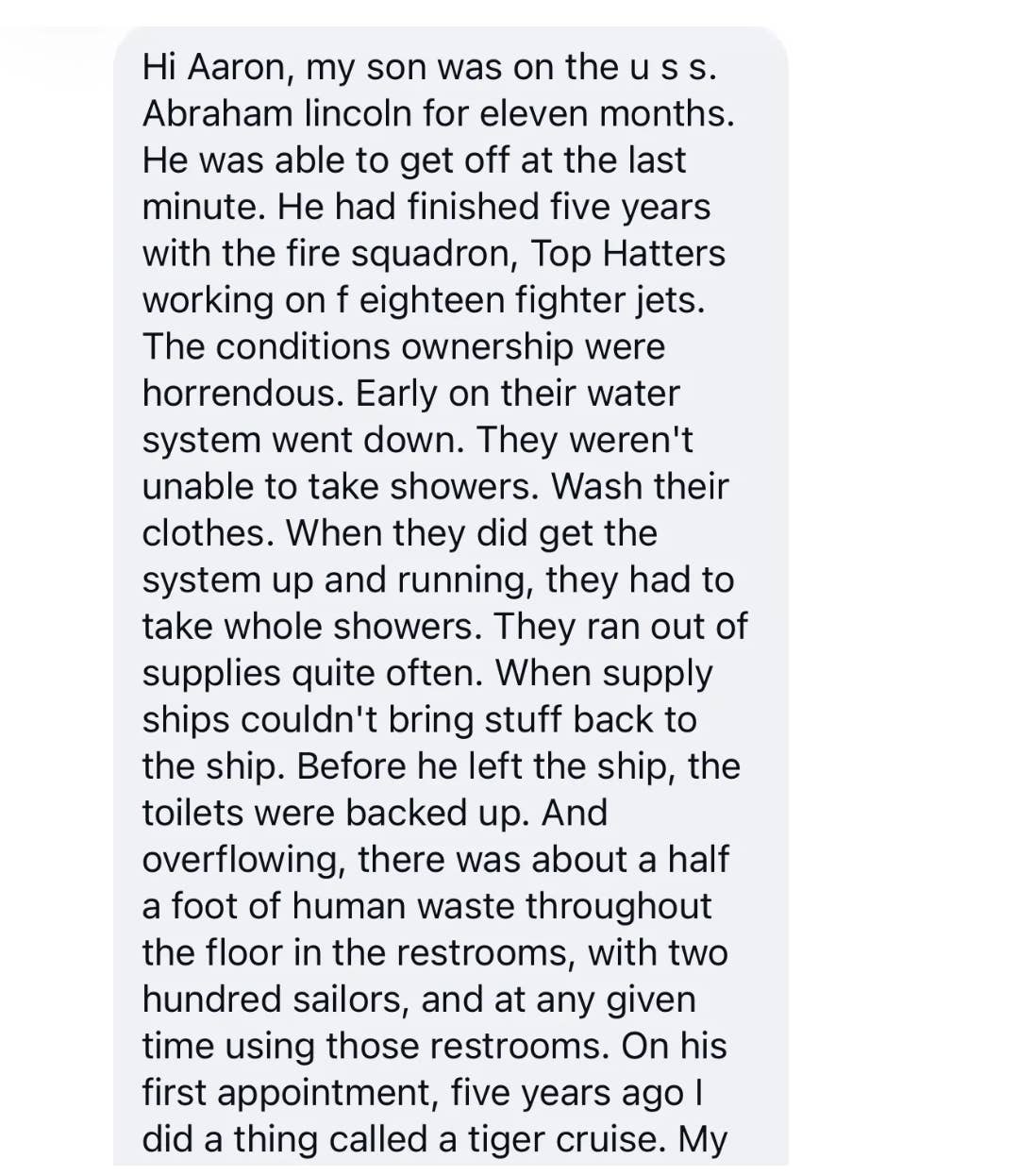
MeidasTouch continues to investigate the conditions on the USS Lincoln and has expanded its research to other ships. This is the report by Aaron Parnas. “Not Just the Lincoln: Families Describe Human Waste, No Food, No End in Sight Across Multiple Ships.” Well, that certainly isn’t a good approach to maintaining morale.
One parent whose son recently returned from eleven months aboard the Lincoln, after finishing five years with an F/A-18 fire squadron known as the “Top Hatters,” described conditions that had deteriorated badly by the time he got off the ship.
Early in the deployment, the ship’s water system went down entirely, leaving sailors unable to shower or wash their clothes. When the system was eventually restored, showers had to be tightly rationed. Supplies ran low repeatedly, made worse when resupply ships were unable to bring materials back to the carrier. By the time this sailor left the ship, the parent said, toilets had backed up and overflowed, leaving roughly half a foot of human waste across restroom floors used by around 200 sailors at any given time.
There are many more stories included in the lengthy piece. It’s basically horrifying. Meanwhile, Cadet Bonespurs is threatening Iran again. This is from Reuters. “Hormuz traffic slows further after US threatens more economic pressure on Iran.” The lede is shared by Jonathan Saul, Phil Stewart, and Idrees Ali.
Transit through the Strait of Hormuz appeared to grind to a near standstill on Friday after two more ships were attacked there and the United States said it could maintain a naval blockade of Iran indefinitely.
A senior Iranian source said on Wednesday that there had been no progress in talks to build on a June agreement to end the war. Since the ceasefire renewed in the June deal broke down, Iran has resumed attacks on ships it accuses of trying to transit the strait without its permission.
The United Arab Emirates’ Abu Dhabi National Oil Company said two of its vessels were attacked transiting the strait on Thursday evening. The UAE government blamed Iran, which made no immediate comment.
Two vessels passed through the narrow waterway on Friday, according to analysis from ship tracking firm Kpler: a grain ship entering Iranian waters and an empty dry bulk ship going in the other direction.
A separate empty liquefied petroleum products tanker was sailing into the Gulf via the strait, the data showed. There were no crude oil shipments visible on Friday.
Nine vessels passed through the strait on Thursday, up from five on Wednesday but below the average of 12 for August.
I’d say there’s no Nobel Peace Prize for Cadet Bonespurs this year. So, what exactly are Trump’s priorities? Lawrence Hurley at NBC Newshas this report. “Trump asks Supreme Court to allow White House ballroom construction to continue’. The president wants the justices to act before a court ruling that would block construction goes into effect.”
President Donald Trump on Friday asked the Supreme Court to allow him to continue construction of a sprawling ballroom adjacent to the White House.
The emergency application follows an Aug. 7 ruling by an appeals court in Washington upholding a federal judge’s decision that would block abovegroundwork on site while litigation moves forward.
“If allowed to go into effect, the injunction would wrongfully install a single district judge as sole arbiter of what further construction is ‘strictly necessary’ to protect the safety of the President, his family, staff members, and visitors to the White House, including foreign dignitaries, and presidents and prime ministers of other countries,” Solicitor General D. John Sauer said in the filing.
The appeals court decision has yet to go into effect, meaning construction continues while the Supreme Court decides what to do next. The deadline for the justices to act is Aug. 21, with Sauer asking the court to act immediately.
The U.S. Court of Appeals for the District of Columbia Circuit upheld an injunction issued by U.S. District Judge Richard Leon.
Leon said that the White House could move forward with below-ground construction of security and medical facilities, but not the ballroom itself.
The administration immediately appealed, and his ruling has not gone into effect.
One key issue in the case is whether the National Trust for Historic Preservation, which brought the underlying lawsuit, has legal standing to sue based on its members being harmed by construction of a building they object to on aesthetic grounds.
Well, the same agenda as ever. He wants to build himself a Wonderland of monuments and buildings in the District. He wants his name on everything. He wants freedom to grift at will. He wants to live forever in the White House. We need to stop all of this, now!
What’s on your Reading, Action, and Blogging list today?
We know the answer to this question.
Did you like this post? Please share it with your friends:
The Sky Dancing banner headline uses a snippet from a work by artist Tashi Mannox called 'Rainbow Study'. The work is described as a" study of typical Tibetan rainbow clouds, that feature in Thanka painting, temple decoration and silk brocades". dakinikat was immediately drawn to the image when trying to find stylized Tibetan Clouds to represent Sky Dancing. It is probably because Tashi's practice is similar to her own. His updated take on the clouds that fill the collection of traditional thankas is quite special.
You can find his work at his website by clicking on his logo below. He is also a calligraphy artist that uses important vajrayana syllables. We encourage you to visit his on line studio.





















 As usual, Orange Caligula is always thinking like it’s still the late 20th Century.
 There are many more stories included in the lengthy piece. It’s basically horrifying. Meanwhile, Cadet Bonespurs is threatening Iran again. This is from
  y at
y at 
 peej
peej Carissa
 bostonboomer
 dakinikat
 ecocatwoman
 jjlo
jjlo mablue2
 Mama Lopez
 peggysue22
 quixote
 skydancingguestblogger
 Mona (aka Wonk the Vote)



 Sky Dancing
Recent Comments