
Someone Needs to Remind President Obama Who Won the Election
Posted: December 19, 2012 Filed under: 2012 presidential campaign, Barack Obama, Republican politics, U.S. Economy, U.S. Politics | Tags: AARP, AFL-CIO, Bush tax cuts, Chained CPI, debt ceiling fight, fiscal cliff, inner child issues, John Boehner, Markos Moulitsas, Social Security 53 Comments
Barack Obama’s inner child?
In November, President Obama won reelection cleanly and decisively–it was a landslide. Immediately after his victory, Obama appeared determined to stand up to Republican intransigence in the battle over the “fiscal cliff” and the debt ceiling. He “assured a gathering of progressive and labor leaders…”
“I am not going to budge,” he told the group, according to an attendee who relayed material from the meeting on condition of anonymity. “I said in 2010 that I’m going to do this once, and I meant it.”
….two other sources who attended the meeting confirmed the quote. The administration seems to have staked out a firmer position than during the first stand-off over the Bush-era tax cuts, in November and December of 2010, leaving the impression that it won’t sign off on a compromise that doesn’t increase the tax burden on the wealthy as a means of paying down the deficit….
Top Democrats in the Senate have said they would be comfortable letting all the tax rates expire — as they are scheduled to do — at the end of the year, after which they will put together a tax cut bill that would re-establish the Bush-era rates for incomes below $250,000.
As the talks began, the White House emphatically stated that Social Security was not part of the deficit and that cuts in this important program were off the table. But just a few weeks later, the odious New York Post is laughing at Obama for “caving” on Social Security. Why should Boehner negotiate in earnest when he knows his opponent–one of the most powerful men in the world–will eventually give in because of some perverse need to demonstrate “bipartisanship?”
A short time ago Obama gave a press conference in which he admitted,
“I have gone at least half way” to meet Republican concerns, Obama told reporters at the White House after he announced the formation of a special panel to recommend steps to prevent gun violence. “The fact that they haven’t taken it yet is puzzling.”
Obama’s offer includes raising tax rates on income above $400,000; increasing rates on capital gains and dividends to 20% from 15% for incomes above $250,000; and billions of dollars in cuts to health care and other programs.
While Obama has backed off on earlier proposals — including a $250,000 threshold for higher income taxes — Republicans continue to say that the president’s fiscal-cliff plan is flawed.
“It is not ‘puzzling’ to reject an agreement that…fails to remotely meet the test of balance [the president] himself has promised,” said Kevin Smith, a spokesman for House Speaker John Boehner, in a post on Twitter.
He’s sounding whiny again. Why is he so surprised? He’s like Charlie Brown with the football. Obama never seems to finally learn that if he stands strong against Boehner, he not only will defeat the Republicans but also he’ll earn the respect and support of the American people.
Markos has an interesting post at Dailykos that demonstrates this: It wasn’t Obama’s negotiating style that won him reelection. It almost cost him. Markos demonstrates with a chart and timeline that Obama’s approval rating rose and fell dramatically during his negotiations with Boehner over the debt ceiling last year.
President Barack Obama entered the debt ceiling negotiations with a net-negative approval rating. As House Speaker John Boehner became more belligerent and confrontational, Obama soared. The people were firmly behind him! But then he began offering concession after concession, hoping to seem “reasonable” and look like the “adult in the room,” and his numbers simply tanked. That’s a mathematical fact, not opinion.
He didn’t return to net-positive approvals until the Democratic convention this September. People didn’t reward Obama’s conciliatory approach to the negotiations. Rather, they saw it (rightly) as weakness, and reacted accordingly. No one likes a weak president.
Then Markos uses the 2012 exit polls to show that Obama was reelected despite his “leadership style,” because people sensed that the President really cared about their problems.
For those who based their choice on leadership, Obama got killed 61-38. And the president lost the “vision” and “values” questions handily as well. So how did he win? He cleaned up 81-18 with people who voted on which candidate cared about them the most. In other words, voters thought Mitt Romney was an aloof dick and trusted Obama most to look out for them. So maybe he should validate that trust.
Obama isn’t doing himself any favors by drawing lines in the sand and then inevitably capitulating.
Republicans have learned that there isn’t a negotiating stance that Obama won’t compromise. That doesn’t lend itself to smart negotiations. Rather, it creates unbalanced ones, as Republicans simply wait for Obama to cave on his demands. They’ve learned that for Obama, making a deal is more important than what’s in the deal.
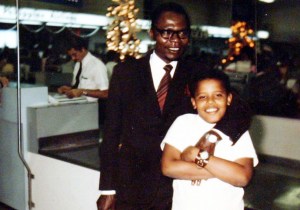
Why does Obama repeatedly do this? I can’t possibly know for sure, but I think he has inner child issues. We all have times when we regress back to a time in childhood when we were weak and had few options. It’s important to learn how to deal with that when it happens.
Obama needs to learn to remind himself that he’s no longer a small child abandoned first by his father and then by his mother–sent away to be raised by his grandparents. That must have been very difficult for him, but he’s not that sad, lonely little boy anymore. He’s the President of the United States, and those of us who voted for him need him to act like it.
Cutting Social Security and backing off the $250,000 income level for those who must pay more taxes is unacceptable. Not only will caving on these issues hurt seniors, disabled people, and force middle class and working class Americans to pay more than their share, but also giving in to Boehner’s demands will hurt Obama’s legacy and the Democratic Party as a whole. As David Johnson of The Campaign for America’s Future points out, “Social Security is Still the Third Rail,” and cutting it would be “political suicide.”
We JUST had an election where the public (not to mention Every. Single. Poll.) overwhelmingly said no cuts to Social Security or Medicare, and raise taxes on income over $250K. That ought to mean something. But the “word” out of DC is that a deal is underway that cuts the Social Security COLA and increases the income level subject to a higher tax from $250K to $400K.
Senators and Representatives who are thinking of touching the “third rail:” How many constituents are calling your office today to say, “Yes, I want you to cut the Social Security COLA”?
Cutting Social Security makes no sense, and is bad politics because it hurts people. Old people depend on this meager benefit and by law Social Security can not contribute to deficits. But never mind the numbers, look at the social and political effects of a deal that cuts the Social Security cost-of-living-adjustment (COLA) immediately after the public voted not to do this.The social effect: Does our society care about people, or just about money? Cuts in Medicare, Medicaid and Social Security hurt PEOPLE. Raising tax rates on the wealthy is just money. What does it tell the public about our society if their government cuts Social Security benefits immediately after we have an election in which the public overwhelmingly votes against cuts in Social Security or Medicare, and to increase taxes on $250K and up? This reported deal raises that $250K to $400K, reduces military cuts, and ignores that the same amount of money could be raised in ways that actually help the country and economy, like a Financial Transaction Tax.
The AARP has come out strongly against applying the chained CPI to Social Security.
“Adopting the chained consumer price index for Social Security benefits will take $112 billion out of the pockets of current Social Security beneficiaries in the next 10 years alone, and is neither fair nor warranted.
“Social Security is currently the principal source of income for nearly two-thirds of older American households, and roughly one third of those households depend on Social Security for nearly all of their income. Half of those 65 and older have annual incomes below $18,500. Every dollar of the average Social Security retirement benefit of about $14,800 is absolutely critical to the typical beneficiary.
“The Chained CPI is a stealth benefit reduction that will compound over time and cut thousands of dollars in retirement income for current beneficiaries. A typical 80-year-old woman will lose the equivalent of 3 months worth of food annually. The greatest impact of Chained CPI would fall on the oldest, eventually resulting in a cut of one full month’s benefit annually. This dramatic benefit cut would push thousands more into poverty and result in increased economic hardship for those trying desperately to keep up with rising prices.”
Labor unions are also warning Obama to “Back off Social Security.”
The AFL-CIO is pushing President Obama to back off from Social Security benefit cuts in the “fiscal cliff” negotiations.
The nation’s largest labor federation sent an email Tuesday to activists asking them to email the White House and lawmakers and oppose the changes to Social Security that the president has offered to Speaker John Boehner (R-Ohio) in deficit-reduction package.
“Boehner has been talking to President Obama about cutting Social Security Cost-of-Living Adjustments (COLAs), which are especially important to keep inflation from eating away the benefits that seniors and people with disabilities depend on,” said the email, signed by Damon Silvers, the AFL-CIO’s director of policy.
“Email President Obama, your member of the House of Representatives and your senators to demand they reject House Speaker Boehner’s proposal to extend tax cuts for the rich and that they oppose COLA cuts and any other cuts to Social Security, Medicaid or Medicare benefits, regardless of who proposes them.”
These are the people who worked in the trenches to get out the vote and get Obama reelected despite the weak economy and high unemployment. But Obama the people-pleaser only seems to care about what the Republicans think of him. He probably knows intellectually that he’ll never get them to like him, but he just can’t help it. It’s as if Boehner somehow represents Barack Obama, Sr., the man who abandoned a little boy decades ago.
Obama needs to listen to the people who got him where he is and stop worrying about pleasing the people who hate him. He needs to listen to the AARP, Labor, and other progressive groups. It’s not too late to withdraw his latest offer–after all, Boehner has already rejected it and moved on to “Plan B.”
Take Social Security off the table, Mr. President. Go back to your original stand on taxing incomes over $250,000. Your place in history and the well being of the American people depend on it.
Monday Reads
Posted: August 8, 2011 Filed under: morning reads | Tags: AFL-CIO, double dip recession, Jackie O Tapes, market turmoil, Merce Cunningham, Timothy Geither, Trade agreements 31 Comments Good Morning!
All eyes are on global markets for bonds, commodities, currencies, and equities. Gold futures were hanging around $1700 a troy ounce last night when the Asian markets opened. Silver is also moving up. The US dollar set a record low against the Swiss Franc. There’s the down grade to US Treasuries and the negative outlook given to the US to reprice and there’s still consideration for a second recession which could be much worse than the last one.
“It would be disastrous if we entered into a recession at this stage, given that we haven’t yet made up for the last recession,” said Conrad DeQuadros, senior economist at RDQ Economics.
When the last downturn hit, the credit bubble left Americans with lots of fat to cut, but a new one would force families to cut from the bone. Making things worse, policy makers used most of the economic tools at their disposal to combat the last recession, and have few options available.
Anxiety and uncertainty have increased in the last few days after the decision by Standard & Poor’s to downgrade the country’s credit rating and as Europe continues its desperate attempt to stem its debt crisis.
Good news for investment banks. Timothy Geithner has agreed to stay on as Treasury Secretary.
Geithner told the president Friday morning that he would remain in his post. Hours later, he had to go to the White House to meet with Obama again and tell him the nation would likely lose its AAA credit rating.
On Sunday afternoon, Geithner joined an emergency conference call involving the seven major economic powers to discuss the impact of the downgrade.
“Secretary Geithner has let the president know that he plans to stay on in his position at Treasury,” Treasury spokeswoman Jenni LeCompte said in a statement. “He looks forward to the important work ahead on the challenges facing our great country.”
White House press secretary Jay Carney said, “The president asked Secretary Geithner to stay on at Treasury and welcomes his decision.”
So, let me change the topic to real Camelot Days and The Daily Mail who claims that there’s some Jackie O tapes with some interesting gossip from back in the day.
Jackie Onassis believed that Lyndon B Johnson and a cabal of Texas tycoons were involved in the assassination of her husband John F Kennedy, ‘explosive’ recordings are set to reveal.
The secret tapes will show that the former first lady felt that her husband’s successor was at the heart of the plot to murder him.
She became convinced that the then vice president, along with businessmen in the South, had orchestrated the Dallas shooting, with gunman Lee Harvey Oswald – long claimed to have been a lone assassin – merely part of a much larger conspiracy.
Texas-born Mr Johnson, who served as the state’s governor and senator, completed Mr Kennedy’s term and went on to be elected president in his own right.
The tapes were recorded with leading historian Arthur Schlesinger Jnr within months of the assassination on November 22, 1963, and had been sealed in a vault at the Kennedy Library in Boston.
The President and Republicans in Congress may want full speed ahead on trade agreements but labor organizations are trying to put on the brakes. There are agreements with Panama, Colombia and South Korea in the pipe.
“We’ll be talking to every legislator out there about the trade deals,” AFL-CIO President Richard Trumka said Friday.
The AFL-CIO will hold more than 450 events across the country this month where the deals will be discussed, and it has started a petition “urging politicians to bring the same urgency to the jobs crisis that they brought to the politically manufactured crisis over the deficit,” Trumka said.
The fight over the agreements is splitting President Obama from unions and other liberal groups at a time when there is already tension between the White House and the left over the debt-ceiling deal.
Supporters of the trade deals in the administration, Congress and the business community argue they will create jobs and help the economy recover.
Juno began its journey to Jupiter on the 5th of this month. Juno is a solar-powered probe with a mission to study the origins of our solar system.
Juno is set to unite with Jupiter on July 4, 2016, when the spacecraft will enter orbit around the largest planet in our solar system. As the spacecraft circles Jupiter 33 times over the course of one year, passing over the planet’s poles, Juno will gather information about its atmosphere, magnetic field and structure.
Of all the planets in the solar system, astronomers think that Jupiter formed first, and its strong, clingy gravitational field means that any scraps of primordial material it snatched up then may still be present today—and in 2016, when Juno arrives at the gas giant. By measuring Jupiter’s chemical content, Juno could aid in scientists’ understanding of what this solar system looked like when it first formed.
Two years ago, my brother-in-law’s uncle died, but his dance troupe and legacy live on. There’s a wonderful article on the legacy of Merce Cunningham at NPR that includes a beautiful photo of the troupe performing Antic Meet. It’s a wonderful narrative of dancers committed to keeping the spirit and vision of the famed choreographer alive.
Passing on Cunningham’s legacy is crucial to more than just the world of dance. In the 1950s, Cunningham broke with the basic notion of dance being inspired by drama and emotion, as he and his partner, the composer John Cage, moved dance into a new era of abstraction. Their work was a key part of the art world’s seismic shift to post-modernism; Cunningham is now seen as one of the 20th century’s most influential artists, on a par with Picasso and Stravinsky.
By the end of his 90 years, Cunningham was in a wheelchair, and instead of creating new dances, he finally began to think about saving the ones he had already made. His longtime friend Laura Kuhn says she urged him to plan for his legacy before it was too late.
“He was making new work up until the end of his life,” Kuhn says. “But the making of new work was less possible — it became less and less possible for him. So I think it became clear to him that in order for his work to survive, someone was going to have to step in.”
So Kuhn and others close to Cunningham helped him set up the Merce Cunningham Trust, which will maintain an archive of his work and license his pieces, and employ former dancers, like longtime Cunningham dancer Rob Swinston, to teach them to other troupes.
What’s on your reading and blogging list today?
A little Economics this and that …
Posted: December 27, 2010 Filed under: Catfood Commission, Civil Liberties, Civil Rights, The Media SUCKS, U.S. Economy, U.S. Politics, Voter Ignorance, We are so F'd, WE TOLD THEM SO | Tags: AFL-CIO, Chris Hedges, commodity prices, Paul Krugman, wealth gap 44 CommentsI thought I’d post a little end of the year economics stuff just in case you need a nap!!

A nifty chart to show we are SO f'd!!!
I’ve been writing for around a year about a possible bubble in commodity prices but a definite increases in base commodity prices coming shortly. Now, this doesn’t necessarily mean it will involve an increase in over all inflation because these price increases are mostly in the already volatile areas of food and energy which are considered outside the ‘core’ inflation measures because they tend to bump and shuffle a lot. This is from Paul Krugman in his column: “The Finite World”.
Oil is back above $90 a barrel. Copper and cotton have hit record highs. Wheat and corn prices are way up. Over all, world commodity prices have risen by a quarter in the past six months.
Is it speculation run amok? Is it the result of excessive money creation, a harbinger of runaway inflation just around the corner? No and no.
What the commodity markets are telling us is that we’re living in a finite world, in which the rapid growth of emerging economies is placing pressure on limited supplies of raw materials, pushing up their prices. And America is, for the most part, just a bystander in this story.
Krugman goes on to explain how booms in the economies of developing nations is causing increased Demand for certain commodities. This simply means the price will go up when the supply is limited for some reason or another. Some times the supply is slow to increase because of production considerations or inventory considerations. Other times the supply is limited just because there is a finite amount of it on the planet. Some of this may also be due to the market taking in the impact of those just passed subsidies to corn-based ethanol which take farm land out of food/other crop production and funneling it to corn production, This decreases the supply of wheat, soybeans, and cotton too.
And those supplies aren’t keeping pace. Conventional oil production has been flat for four years; in that sense, at least, peak oil has arrived. True, alternative sources, like oil from Canada’s tar sands, have continued to grow. But these alternative sources come at relatively high cost, both monetary and environmental.
Also, over the past year, extreme weather — especially severe heat and drought in some important agricultural regions — played an important role in driving up food prices. And, yes, there’s every reason to believe that climate change is making such weather episodes more common.
Krugman concludes with the important question of what does this mean for us?
So what are the implications of the recent rise in commodity prices? It is, as I said, a sign that we’re living in a finite world, one in which resource constraints are becoming increasingly binding. This won’t bring an end to economic growth, let alone a descent into Mad Max-style collapse. It will require that we gradually change the way we live, adapting our economy and our lifestyles to the reality of more expensive resources.
But that’s for the future. Right now, rising commodity prices are basically the result of global recovery. They have no bearing, one way or another, on U.S. monetary policy. For this is a global story; at a fundamental level, it’s not about us.
Yes. The world economy is “not about us” any more. So many other countries now have huge viable economies that we are no long the center of the Supply and Demand world like we were post World War 2. This is definitely going to take some adjusting on our part and some ignoring of the rhetoric of the right on our country’s role in the world. We can not continue to maintain the idea of American Exceptionalism in its current form given that we are really no longer exceptional in many, many ways. That adaptive behavior does not diminish our historical role as the original provider of Democracy-based Constitutions and Civil Liberties or our military role in freeing many countries from monarchy and fascism in both world wars.
We can continue to pour our resources and the lives of our young into asserting ourselves as the global military police in attempt to maintain our delusion of being ‘special’, or we can put our resources into assuring ourselves and our children a comfortable niche in the world with a respected voice at a big table. The Right Wing has to understand that we don’t own the table anymore. If only our politicians would grow up enough to make the best choice for us instead of deluding us into thinking that we’ll ever see post World War 2 America again.
I want to couple this with something I got in a tweet from the AFL-CIO: ‘U.S. Workers Earned Less in 2009 Than in 2008’. This goes along with the fact that many things we could finance or buy twenty to thirty years ago will elude us today.
New data show America’s workers earned less in 2009 than in 2008, according to the Bureau of Labor Statistics. Compensation was down by 3.2 percent in 2009 with declines in construction and manufacturing fueling the plunge. St. Louis County, the hardest hit, saw a decline of 11.5 percent.
For those lucky enough to have a job, average pay increased by 1.2 percent. But overall income inequality is now at its worst since 1928. As the chart by the Economic Policy Institute (EPI) shows here, between 1979 and 2005, households at the bottom fifth of the income scale have seen an average, inflation-adjusted income growth of just $200. The $200 figure does not represent an average annual increase in income, but rather an increase of $200 over the entire 26-year period. By contrast, a small number of households at the top 0.1% of the income scale saw average income growth of almost $6 million over that same period.
In addition, the “wealth gap,” which differs from the income gap because it measures total net worth, is now 225 times greater between the richest 1 percent and the median family net worth.
Lest we forget, corporations are sitting on $1.93 trillion as of Sept. 30—up from $1.8 trillion at the end of June–and not using some of that money pot to create jobs.
The bottom is falling out for the middle classes in this country. Income inequality is as bad as it was in 1928 during the peak of the Robber Baron age. There is no way we’ll have a shot at seeing ‘morning again in America’–even one concocted from a senile man’s political rhetoric–without a strong middle class. This is one of the reasons that I highly recommend your holiday reading included Chris Hedges ‘Death of the Liberal Class’. Here’s Sanctuary TV’s you tube on his explanation the “genesis of the book”. Wonk mentioned some of his thesis in her excellent post yesterday.
The ‘lies of omission’ that we see in the Main Stream Media today makes this imperative that we have conversations outside of channels that are controlled by for-profit corporations. Listen in to the video at around 2:45.
Most of the images that are disseminated around our culture are skillfully put together and are disseminated by for profit corporations so that we are made to …or we confuse … how we are made to feel with knowledge. Which is precisely how ended up with Barrack Obama.
This is especially true with things economic. I had a conversation with my Republican Dad yesterday which ended up with him accusing me of sounding just like the Democrats after the Great Depression. (I will wear that badge proudly, thank you.) I was trying to explain to him how Social Security isn’t going bankrupt, that the overages are invested in T-bonds and T-bills and that isn’t the same as massive borrowing from the fund by the federal government, and that if social security can’t rely on the interest and their capital invested in T-bonds or T-bills in the future, we will undoubtedly have a much greater problem than having smaller social security checks. (My guess is that we would be in the middle of a government collapse similar to what happened to the USSR in the 1980s.) Dad kept accusing me of living in the theoretical world of economics–me, an empirical economist–when I kept telling him it was just a matter of debits and credits which are anything but theoretical economics.
The deal is this if you read studies, and follow the debits and the credits. The threat to social security isn’t coming from its cash flows. It’s coming from the politicians in Washington, D.C. and it appears that it will shortly be led by the aforementioned Barrack Obama. Some of these people seem intent on collapsing our Republic and its democratic roots. These Bircher-like attacks on the New Deal are real attacks on the ways the government–through New Deal Policies, Laws, and Agenciess- levels the economic playing field for small businesses and working class people. This is the same way that Bircher-like attacks on Civil Rights attacks the ways the government levels the legal playing field for minorities and women.
Again, I’m drawn to the quote most attributed to the late great Senator Patrick Monihan. People and politicians are entitled to their opinions but not the facts. The problem is that fact manufacturing–or labeling political diatribes by media monsters like Glenn Beck–appears to be rampant in the very outlet that provides the life blood of our democracy.
This maldescriptions of unemployment, the role and purpose and very political independence of the Fed are more features of this misinformation campaign. I’m going to further reference Paul Krugman and his economist yogini–yup, there’s at least two of us out there–wife Robin Wells here. They co-authored an excellent essay on “Where do We Go from Here” in The New York Review of Books. This part comes after their joint call to the Democratic congress critterz–left standing from the midterms elections–to fight.
First, it would mean fighting on economic issues. While it is extremely unlikely that Democrats can undertake any further fiscal stimulus, they can put Republicans on the spot, resisting calls for austerity and making the case, repeatedly, that the GOP is standing in the way of necessary action. The fight over renewal of unemployment benefits should be only the start. Democrats can also denounce Republican attacks on the Federal Reserve and defend the Fed’s independence. They can resist attempts to turn back health care reform, on both humanitarian and long-term budgeting grounds, as health care reform is the critical factor in reining in the long-term budget deficit.
Health Care Reform Inc. could be one more rung on the ladder for the middle class on the ladder back to upwards mobility. Instead of repealing the now unpopular bill, we should be working actively to get the right things into its corporate enabling shell. That would be–at minimum–a Public Option. We have to get them to fight on Economic issues. Also, we desperately need to deal with Fannie and Freddie. These organizations used to be the way to home ownership for working class Americans. I stand proudly as an example in that regard. My little kathouse in the bayou in the middle of a solid urban hood shines as a beacon of what those things were supposed to do before they started manufacturing loans to the derivatives market.
And there are steps that the White House could take without congressional approval. Democrats could pressure the administration to fix the inexcusable mess at the HAMP (mortgage modification) program—a program whose Kafkaesque complexity has in many cases made matters so bad for home owners that it has triggered the foreclosures it was supposed to avoid. In addition, mortgage relief would benefit the wider economy. Furthermore, the scope of mortgage relief could be made much wider if Fannie Mae and Freddie Mac were used to guarantee mortgage refinancing. Other proposals go even further: for example, that Fannie and Freddie engineer reductions in mortgage principals. All of this could be done, conceivably, by executive order.
What we are seeing is a brick by brick removal in the walls that support the social net built during the New Deal that helped America become the thing it was during the 1950, 1960s and 1970s. Yes, we helped many countries get rid of Nazis and Fascist and this did make us some what exceptional at the time, but ushering in the very policies and attitudes of fascism does not make us the least bit exceptional now. It weakens the very people that make for a vibrant Democracy. Also, given that the Wikileaks information has been the soul source recently of unmanufactured news and opinion passed off as fact, it also gives us a glance at why the rest of the planet has ceased to see the US as exceptional too.
To paraphrase the words of Common Dreams and Margaret Flowers: We Must Resist. Okay, so this essay was a little Political Economy and not just economics. You awake?
update:
I get to update this post with a link to one of the more influential ‘liberal’ economist who is also writing on the changes in the Political Economy at Project Syndicate. Here’s something from Jeffrey D. Sachs writing on ‘America’s Political Class Struggle’. You may recall that both Krugman and Sachs were called to the Obama woodshed a few weeks ago and told to get on board with the McConnell-Obama tax cuts.
America is on a collision course with itself. This month’s deal between President Barack Obama and the Republicans in Congress to extend the tax cuts initiated a decade ago by President George W. Bush is being hailed as the start of a new bipartisan consensus. I believe, instead, that it is a false truce in what will become a pitched battle for the soul of American politics.
As in many countries, conflicts over public morality and national strategy come down to questions of money. In the United States, this is truer than ever. The US is running an annual budget deficit of around $1 trillion, which may widen further as a result of the new tax agreement. This level of annual borrowing is far too high for comfort. It must be cut, but how?
The problem is America’s corrupted politics and loss of civic morality. One political party, the Republicans, stands for little except tax cuts, which they place above any other goal. The Democrats have a bit wider set of interests, including support for health care, education, training, and infrastructure. But, like the Republicans, the Democrats, too, are keen to shower tax cuts on their major campaign contributors, predominantly rich Americans.
The result is a dangerous paradox. The US budget deficit is enormous and unsustainable. The poor are squeezed by cuts in social programs and a weak job market. One in eight Americans depends on Food Stamps to eat. Yet, despite these circumstances, one political party wants to gut tax revenues altogether, and the other is easily dragged along, against its better instincts, out of concern for keeping its rich contributors happy.
This tax-cutting frenzy comes, incredibly, after three decades of elite fiscal rule in the US that has favored the rich and powerful. Since Ronald Reagan became President in 1981, America’s budget system has been geared to supporting the accumulation of vast wealth at the top of the income distribution. Amazingly, the richest 1% of American households now has a higher net worth than the bottom 90%. The annual income of the richest 12,000 households is greater than that of the poorest 24 million households.
Please go read the rest of the article. I think this shows further evidence that Obama didn’t placate liberal economists.

 peej
peej Carissa
 bostonboomer
 dakinikat
 ecocatwoman
 jjlo
jjlo mablue2
 Mama Lopez
 peggysue22
 quixote
 skydancingguestblogger
 Mona (aka Wonk the Vote)





Recent Comments