
Monday Reads: Supreme Justice
Posted: June 29, 2026 Filed under: #We are so Fucked, 2026 SCOTUS Decisions, Corrupt and Political SCOTUS, MIA Mitch McConnell, Polycrisis, Refugees | Tags: #Where's Mitch?, 2026 Supreme Court Rulings, Counting Late Ballots, FED governor Lisa Cook, Hapless Chief Justice Roberts, Justice Amy 10 Comments
“Old man seen wandering around Washington DC babbling to an imaginary crowd.” John Buss, @repeat1968
Good Day, Sky Dancers!
The Supreme Court of the United States released some interesting decisions today. For a change, some of them are likely to frustrate Orange Caligula. My guess is he’ll be on social media all day ranting. At least, we don’t have to hear the ongoing lies about that failure of a fair he did over the weekend.
One case sent mixed messages. I’ll start with that.
This is from Politico. “Supreme Court widens Trump’s power to fire agency leaders — except the Fed. The exception for the Federal Reserve is a blow to Trump’s efforts to prod the central bank to lower interest rates.” At least he won’t be able to increase the inflation rate through that nonsense.
The Supreme Court on Monday granted President Donald Trump sweeping power to control executive branch agencies, while effectively exempting the Federal Reserve.
The justices voted 6-3, along ideological lines, to scuttle a 91-year-old precedent that said Congress can limit the president’s ability to fire Senate-confirmed leaders to instances of “inefficiency, neglect of duty, or malfeasance in office.”
But in a separate ruling, the high court voted 5-4 to rebuff Trump’s bid to carry out his firing Lisa Cook, a Fed member appointed by President Joe Biden. The decision, which allows Cook to remain in her post while litigation continues over the effort to dismiss her, is a blow to Trump’s efforts to prod the Fed to lower interest rates.
Chief Justice John Roberts wrote the majority opinions in both cases.
The court’s conservative majority has been whittling away for years at the 1935 ruling known as Humphrey’s Executor, which allowed Congress to limit presidents’ power to fire the leaders of certain agencies.
The justices finished off Humphrey’s Monday in a case brought by Federal Trade Commission member Rebecca Slaughter, whom Trump attempted to fire in March 2025.
“If anything more is left of Humphrey’s, we overrule it,” Roberts wrote. “This is not a close case….The FTC unquestionably exercises executive power, and must therefore be controlled by the Chief Executive, in whom such power is vested. It follows, then, that Slaughter served as the President’s subordinate at the FTC—and that the President was entitled to cut her tenure short.”
When the White House dismissed Slaughter last year, it provided no detailed reason, simply telling her in an email that she was terminated effective immediately because her continued service was “inconsistent with Administration’s priorities.”
 Did I mention that Roberts is probably the worst Chief Justice ever? He’s not the least transparent about his politics, which include racism and the destruction of checks on the executive branch that are centuries old. This analysis is by Melissa Quinn of CBS News. “Supreme Court expands presidential firing power, overturning 90-year-old ruling.”
The Supreme Court on Monday ruled that removal protections for members of the Federal Trade Commission are unconstitutional and overturned a 90-year-old decision that allowed Congress to shield members of certain independent agencies from being fired by the president at will.
The decision from the high court expands the president’s power over many independent boards and commissions, which Congress had insulated from political pressure by saying their members could only be removed by the president for cause.
In a 1935 decision in a case known as Humphrey’s Executor v. United States, which involved removal protections for the FTC, the Supreme Court said Congress could restrict the president’s ability to fire officials from multi-member agencies at will.
But the ruling from the high court’s conservative majority in the case Trump v. Slaughter overturns that 90-year-old decision and marks the culmination of a years-long weakening of the New Deal-era precedent.
The ruling was 6 to 3, with Chief Justice John Roberts writing for the majority, joined by the other conservative justices. The three liberals dissented, and Justice Sonia Sotomayor read a summary of her dissent from the bench, a rare occurrence that signals strong disagreement with a decision. Roberts wrote that limits on the president’s ability to fire those who wield executive power on his behalf infringe on his constitutional authority.
The FTC of today, the court’s majority found, “unquestionably” exercises executive powers and therefore must be under the president’s control.
“Although it is up to the Senate to decide whether to confirm those with whom the President would prefer to work, neither Congress nor the courts may saddle him with those with whom he cannot work,” Roberts wrote. “Subordinates who exercise the President’s power are subject to removal by him. Then, and only then, can they remain accountable to the President, and the President to the people.”
 And, of course, all this diddling with election laws and voting access basically limits the accountability of said President to said people. That’s my major takeaway. And, of course, Orange Caligula is already ignoring the parts he doesn’t like. This is from the New York Times. “Trump Renews Threat to Fire Fed Governor in Wake of Court Loss. The president promised to “take appropriate action immediately” against Lisa D. Cook, a Fed governor.”
President Trump renewed his intention to try and fire Lisa D. Cook from the Federal Reserve on Monday, saying he would look for a way to oust her after the Supreme Court blocked his previous attempt to fire a sitting governor at the central bank.
In a social media post, Mr. Trump described the Supreme Court’s 5-to-4 decision as “procedural,” adding that he would “take appropriate action immediately to make sure that someone who has committed wrongdoing will not be making vital decisions concerning the Welfare of the United States of America!”
Mr. Trump took the extraordinary step of trying to fire Ms. Cook from the Fed last year, claiming that she had misrepresented her finances in order to obtain more favorable mortgage terms. Ms. Cook has not been charged with a crime, and has denied any wrongdoing.
She challenged her firing in court, as her lawyers sought to argue that the attempted dismissal fit a pattern by Mr. Trump, who has sought to pressure the Fed into lowering interest rates. In late September, a federal judge allowed Ms. Cook to continue serving in the role as she contested the legality of the firing, prompting the administration to appeal to the Supreme Court.
The opinion, written by Chief Justice John G. Roberts Jr., kept that decision in place. The majority found on Monday that the president had not properly afforded Ms. Cook the ability to respond to the allegations against her.
But the decision still left much unanswered. While the justices emphasized the uniquely important nature of the Fed as an independent body, they did not clearly define the conditions under which Mr. Trump could fire a Senate-confirmed governor.
“To be clear, the ultimate question of whether the president can remove Cook for cause will depend in part on the underlying facts,” Chief Justice Roberts wrote for the majority.
“In this opinion, we have not addressed the facts, as they have yet to be found or analyzed under the relevant legal standards,” he continued. “Rather, we have simply addressed the parties’ arguments about the appropriate legal standards under which the facts must be evaluated.”
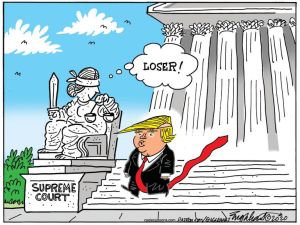 It’s just a matter of time before Trump starts raging on this decision, as covered by the AP. “Supreme Court rules states can count late-arriving mailed ballots, rejecting Trump-led challenge.” Mark Sherman has the lede on this.
The Supreme Court on Monday ruled that states can count ballots that arrive after Election Day, a persistent target of President Donald Trump.
The 5-4 decision rejected a Republican-led attack on laws in more than half the states and the District of Columbia that permit mailed ballots to arrive and be counted some number of days after the election, provided they are postmarked by Election Day. The outcome spares officials the headache of changing their ballot rules just a few months before the 2026 midterm congressional elections.
In just over half those states, the more forgiving deadlines apply only to ballots cast by military and overseas voters.
Justice Amy Coney Barrett wrote the court’s majority opinion, joined by Chief Justice John Roberts and the three liberal justices.
Federal laws setting a single Election Day “leave open when those votes must be received,” Barrett wrote.
Congress could change the law, she said. “If varied deadlines for ballot receipt similarly call for a national solution, the American people must choose it through their elected representatives,” Barrett wrote.
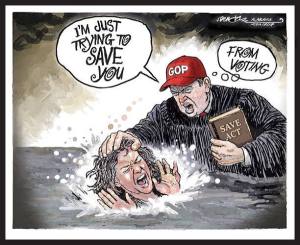 So, Orange Caligula’s latest hissy fit this morning about the court’s decisions is this one, as reported by Politico‘s Emilio Perez Ibarguen. Maybe with all this ranting, he’ll blow a gasket and join Mitch McConnell in whatever ether he’s disappeared into. “Trump doubles down on SAVE America Act after Supreme Court loss on mail voting. The president’s desire for a signature elections bill has all but frozen Hill Republicans’ agenda.”
President Donald Trump intensified his efforts to pass his signature elections bill on Monday after the Supreme Court handed the president a loss in his push to add restrictions to mail voting.
The decision — where the Supreme Court ruled that states may choose to count ballots that arrive after Election Day, so long as they are either postmarked before then or otherwise deemed cast on time — sparked a flurry of activity Monday among the president and his allies.
“In light of the tremendous loss in the Supreme Court today concerning Voter’s Rights, and the fact that ‘people’s’ votes are allowed to be counted LONG AFTER an Election is over, it is more important than ever to pass THE SAVE AMERICA ACT,” Trump wrote on Truth Social.
Trump has advocated for severely restricting mail voting, which he has claimed without evidence is responsible for widespread fraud.
The Trump administration has also sought to empower the Postal Service to withhold ballots if states don’t hand over their voter rolls, though an executive order instructing the agency to do so was batted down by a federal judge.
A core tenet of the SAVE America Act, according to the president, would be to drastically limit when voting by mail is available to citizens with few exceptions, alongside requiring voters to present photo identification and proof of citizenship
The president has fixated on the SAVE America Act, even as some Senate Republicans insist the legislation simply does not have enough votes. Trump called out five senators as “Hold Outs” on the bill, naming Sens. Lisa Murkowski (R-Alaska), Susan Collins (R-Maine), Thom Tillis (R-N.C.), Bill Cassidy (R-La.) and Mitch McConnell (R-Ky.).
Monday’s ruling upheld a Mississippi law allowing election officials to count mail-in ballots received up to five days after Election Day. A bipartisan mix of over a dozen states allow at least some ballots that arrive after Election Day to still be counted so long as they are postmarked before then. More states extend that grace period to certain military and overseas voters.
 Okay, so my big question today is where the fuck is Mitch McConnell? Why aren’t we getting any status reports on his health? Is the Republican Party hiding something? We have to go to the local news just to get a hint of why he’s not voting this week, and whether he’s even alive at this point. This is from the Lexington Herald Leader. “Few details known on Mitch McConnell’s health 2 weeks after hospitalization.” This is reported by Hannah Pinski.
The public has received few details surrounding Sen. Mitch McConnell’s health condition after he was admitted into the hospital two weeks ago. A spokesperson for McConnell’s office did not have any updated information regarding the Kentucky senator’s health to share as of Monday.
McConnell, 84, was hospitalized June 14, but his staff did not give details about his condition at the time, other than to say he was receiving “excellent care.” During the Republican Party of Kentucky’s Lincoln Day Dinner in Lexington June 20, Rep. Andy Barr told reporters after the event that he’d exchanged text messages with McConnell, saying “he’s good.” McConnell’s office has not confirmed whether he is still hospitalized. On June 22, spokesperson Stephanie Penn said he would not vote in the Senate that week but is working “closely” with staff as his health continues to recover. As of Wednesday, the Senate is not in session and will reconvene July 13. McConnell has held his Senate seat since 1985 and is in his seventh term. From 2007 to 2025, he served as the leader of the Senate GOP. He is not seeking reelection this year.
 The reason that this is important and is leading to conspiracy theories about proof of life is that his death or resignation would mean a special election would need to be held. This would drain Republican Resources away from the Midterm elections and possibly further endanger their chances of holding on to majorities in both houses. I’m not into conspiracy theories, but all this is extremely suspicious IMHO.
There are more decisions coming tomorrow. The Hill‘s Jack Schonfeld has the list and the associated ramifications. Let me just add that these are big and also controversial topics. “Supreme Court to hand down final decisions Tuesday: Here’s what’s left.”
Here’s what the court will hand down beginning 10 a.m. EDT Tuesday:
Birthright citizenship
President Trump’s banner immigration policy hangs in the balance.
The Supreme Court is set to decide whether Trump’s restrictions on birthright citizenship can stand, or if they are unconstitutional.
It’s a major test for the 14th Amendment, which guarantees citizenship to all persons born on U.S. soil and “subject to the jurisdiction thereof.”
The president’s executive order, which has not gone into effect amid legal challenges, limits birthright citizenship to children with at least one parent with citizenship or permanent legal status.
It upends the conventional understanding that the 14th Amendment leaves room for only narrow exceptions, like babies born on enemy warships and the children of foreign ambassadors.
The president, who attended the Supreme Court’s oral arguments in the case, hasn’t sounded optimistic about the case.
“This decision by the Supreme Court is a very big one,” Trump said in the Oval Office last month. “They’ll probably rule against me, because they seem to like doing that.”
Transgender athlete bans
The Supreme Court is preparing to say its piece on the national debate surrounding school sports and transgender athletes.
…
Campaign finance
The Supreme Court will rule on a GOP-backed challenge to a campaign finance provision.
At issue is how much money candidates can spend in coordination with their political party.
It’s going to be a busy conscientious week.
What’s on your Reading, Action, and Blogging list today?
Monday Reads: Continued Focus on America’s Refugee Children
Posted: July 14, 2014 Filed under: child sexual abuse, children, Honduras, morning reads, physical abuse, Refugees 29 CommentsGood Morning!
 I’d like to continue to focus on the crisis of Central American children from three countries who are looking for refuge in the United States. This story continues to be a source of misinformation and misunderstanding of U.S. policy. Most countries rise to the occasion of humanitarian crisis and act progressively to help the victims and to try to determine why the countries are in such crisis. Not so with our country. A primary misunderstanding comes from a 2008 law that stipulates children from places other than Canada and Mexico be treated differently.
A 2008 anti-trafficking law that passed Congress nearly unanimously and was signed by President George W. Bush gave new protections to children who were not from neighboring Canada or Mexico, stipulating that their asylum requests be fully adjudicated if they were picked up for being in the country illegally.
Administration officials say smugglers have exploited that statute and the long judicial processes that resulted from it, persuading Central American parents to risk sending their children on a dangerous journey to the United States in hopes that they would be able to stay permanently.
Republicans argue that Obama himself sent a signal that the borders were open to younger immigrants when he issued his 2012 executive order.
There is also the question of whether the Obama administration ignored the signs as the emergency was developing.
As far back as May 2012, Texas Gov. Rick Perry (R) warned Obama in a letter that “there is a surge of unaccompanied illegal minors entering the United States. Apart from being part of an obvious humanitarian crisis, these unaccompanied illegal minors have left the federal government scrambling to triage the results of its failed border security and immigration policies.”
Clearly, there were signs that the numbers of children from Guatemala, Honduras, and El Salvador was increasing phenomenally since 2009 as 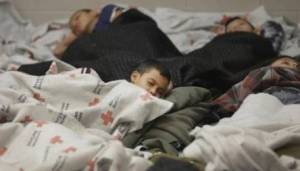 Friday’s post uncovered. What was the rationale for this 2008 Act and what role has it played in this influx?
The William Wilberforce Trafficking Victims Protection Act of 2008, so named in honour of the great British abolitionist, was among the last pieces of legislation of the George W Bush presidency, passed unanimously by the then Democrat-controlled Congress. The measure provided sanctuary for children from countries such as Guatemala and Honduras (though not Mexico) who might have been victims of sex slave trafficking.
Then, a couple of years ago, President Obama issued an order deferring deportation for children who arrived in the country aged under 16, and who had permanently lived in the US since 2007. The aim was to allow two million people who were, to all intents and purposes, Americans, to live a semi-normal life. But for millions of wretched souls in Central America yearning for a foothold in the US, and the gangs that demand an extortionate price to enable them to get it, the two presidents might have posted signs on the bridges across the Rio Grande, saying: “Come in”.
In terms of numbers, the crisis is nothing compared with the tidal waves of refugees forced from first Iraq and now Syria by sectarian conflict. Even so, some 57,000 children, some of them aged as young as four, and many of them unaccompanied, have made their way across the US border since last October, most of them from Honduras, Guatemala and El Salvador, far overwhelming the capacity of immigration services to process them.
The intentions on the part of the US authorities might have been noble. But the result has been a 21st-century nightmare, exposing the children to journeys of danger and suffering, and the US to accusations of incompetence at best, heartlessness at worst, and charges that the country’s politics have reached a nadir of selfish partisanship.
You might have thought that, faced with a crisis of such poignancy and immediacy, Republicans and Democrats would put aside their differences. After all, the root of the problem lies not in the US but in the children’s lawless but not-too-distant homelands.
Honduras may be the most dangerous place on earth, with a murder rate of 90 per 100,000 (compared to five in the US and one in Britain), and Guatemala and El Salvador are in the top six. Along with the violence, there is desperate need: across swathes of Central America, Mexico apart, half the population lives below the poverty line.
True, America contributes to the problem, as the main buyer of the drugs sold by the traffickers, and the main seller of the guns with which they enforce their rule. But the only lasting solution to the crisis lies in ensuring the populations of Central America have a better life in their own countries. On this, at least, you might expect the parties to agree. But you’d be wrong.
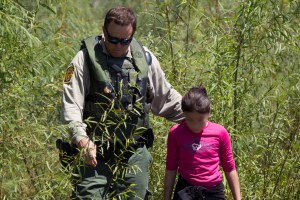 The incredibly hateful response by many Americans towards the children and the crisis itself have made odd bedfellows of several activists. First, this example from the left is from Bill Moyers’group as written by Joshua Holland.
Those seething with so much rage and xenophobia that they’d hurl ugly epithets in the faces of children fleeing bloody violence in Central America bring shame to the whole nation. But the response of mainstream America hasn’t been much better.
The media’s characterization of what’s going on at our southern border as a “crisis,” politicians pointing fingers at one another and Washington’s refusal to provide the resources necessary to care for a small wave of refugees — not to mention the bipartisan push to send them back home — is just as shameful when one considers the context.
In June, the United Nations High Commissioner for Refugees (UNHCR)reported that in 2013, the global population of refugees from war and persecution hit 51.2 million — exceeding 50 million for the first time since World War II.
Half of them were children.
The vast majority were “internally displaced persons,” homeless people within their home countries. Many live in fetid refugee camps run by underfunded NGOs, where they face continuing privation and abuse.
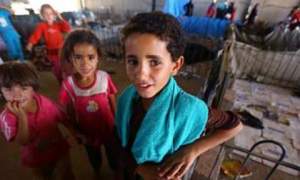
Glenn Beck says he has come under fierce attack from some of his fellow conservatives for a grave transgression.
His crime? He announced plans to bring food, water, teddy bears and soccer balls to at least some of the tens of thousands of Central American children who have crossed the border into the United States.
“Through no fault of their own, they are caught in political crossfire,” Beck said. “Anyone, left or right, seeking political gain at the expense of these desperate, vulnerable, poor and suffering people are reprehensible.”
Beck, not averse to a certain grandiosity, let us know that “I’ve never taken a position more deadly to my career than this.” But assume he’s right — and he may well be. It’s one more sign of how the crisis at our border has brought out the very worst in our political system and a degree of plain nastiness that we should not be proud of as a nation.
Children still leave Honduras to reunite with a parent, or for better educational and economic opportunities. But, as I learned when I returned to Nueva Suyapa last month, a vast majority of child migrants are fleeing not poverty, but violence. As a result, what the United States is seeing on its borders now is not an immigration crisis. It is a refugee crisis.
Gangs arrived in force in Honduras in the 1990s, as 18th Street and Mara Salvatrucha members were deported in large numbers from Los Angeles to Central America, joining homegrown groups like Los Puchos. But the dominance in the past few years of foreign drug cartels in Honduras, especially ones from Mexico, has increased the reach and viciousness of the violence. As the United States and Colombia spent billions of dollars to disrupt the movement of drugs up the Caribbean corridor, traffickers rerouted inland through Honduras, and 79 percent of cocaine-smuggling flights bound for the United States now pass through there.
Narco groups and gangs are vying for control over this turf, neighborhood by neighborhood, to gain more foot soldiers for drug sales and distribution, expand their customer base, and make money through extortion in a country left with an especially weak, corrupt government following a 2009 coup.
Enrique’s 33-year-old sister, Belky, who still lives in Nueva Suyapa, says children began leaving en masse for the United States three years ago. That was around the time that the narcos started putting serious pressure on kids to work for them. At Cristian’s school, older students working with the cartels push drugs on the younger ones — some as young as 6. If they agree, children are recruited to serve as lookouts, make deliveries in backpacks, rob people and extort businesses. They are given food, shoes and money in return. Later, they might work as traffickers or hit men.
Teachers at Cristian’s school described a 12-year-old who demanded that the school release three students one day to help him distribute crack cocaine; he brandished a pistol and threatened to kill a teacher when she tried to question him.
At Nueva Suyapa’s only public high school, narcos “recruit inside the school,” says Yadira Sauceda, a counselor there. Until he was killed a few weeks ago, a 23-year-old “student” controlled the school. Each day, he was checked by security at the door, then had someone sneak his gun to him over the school wall. Five students, mostly 12- and 13-year-olds, tearfully told Ms. Sauceda that the man had ordered them to use and distribute drugs or he would kill their parents. By March, one month into the new school year, 67 of 450 students had left the school.
Teachers must pay a “war tax” to teach in certain neighborhoods, and students must pay to attend.
I urge you to read their stories and decide for yourself.
What’s on your reading and blogging list today?
Friday Reads: Our Crisis of Child Refugees from Central America
Posted: July 11, 2014 Filed under: El Salvador, Foreign Affairs, Guatemala, Honduras, immigration, morning reads, Refugees, social justice 14 Comments Good Morning!
Recently, we’ve seen a lot in the news about the surge in women and children coming in from Central America. I was aware there had been ongoing civil wars in Honduras and problems in both Belize and El Salvador but really felt I needed more information to figure out what is going on. The huge numbers alone are disturbing. I know that we’ve needed immigration reform for some time. I also know that it’s impossible to get nearly anything done in this country anymore, because Republican members of Congress refuse to participate in governance. They seem to be boycotting democracy and everything else. So, I’ve done some reading and research. Today’s post will be on this one subject, but you can still consider it the usual Morning Reads post where you can post items of interest to you.
My first question was about the home countries of these refugee children. Where are they coming from and is this a big change from previous years? This NBC report has some of those facts and figures.
The U.S. Customs and Border Protection agency says that apprehensions of undocumented immigrants along the Southwestern U.S. border remain near historic lows, but agents have seen a sharp increase in the number of unaccompanied minors trying to enter the country illegally over the past five years. Over the first 8 1/2 months of fiscal year 2014, 52,193 unaccompanied minors have been taken into custody — a 99 percent increase over 2013.
In Texas’ Rio Grande Valley alone, where most border crossings now occur, apprehensions have increased 178 percent over last year, with 37,621unaccompanied minors apprehended so far this year.
Minors from Mexico or Canada who are apprehended at the border can be quickly returned to their home countries in expedited removal proceedings. But those from other countries – mostly teens but sometimes as young as toddlers – are transferred to the custody of the Office of Refugee Resettlement (ORR), part of the Department of Health and Human Services.
The ORR maintains custody of the minors only until they can be placed with family members in the U.S. or in foster care to await a decision on whether they can remain in the country. That occurs through a formal deportation proceeding, which can take months or years, during which they can petition an immigration judge to remain in the country.
The soaring number of migrant children has strained the system, forcing the federal government to scramble to open additional emergency facilities across the country and prompting President Barack Obama to request Tuesday for an emergency appropriation of $3.7 billion to fund the operation.
ORR also has seen its caseload jump sharply in recent years, rising from an average ofbetween 7,000 and 8,000 unaccompanied children from FY 2005 through 2011 to 24,668 last year, according to figures provided by HHS. This year, officials estimate, the office will receive at least 60,000 referrals.
The childrenWhere do they come from?: Four countries – El Salvador, Guatemala, Honduras and Mexico — account for almost all of the unaccompanied minor cases, according to a 2014 report by the Congressional Research Service. As recently as 2009, Mexico accounted for 82 percent of the apprehended children, but the three Central American countries have propelled the recent influx, comprising 73 percent of those apprehended last year, it said.
 So, you can see that there’s been a great change in the number of children and their home countries recently. This means there must be something going on in those three countries since around 2009 that has led to the change. What exactly has happened? I have assumed that a lot of it has to do with our own foreign policy because those three nations have experienced a lot of US intervention and have been considered client states. Has what we’ve done in the past come back to haunt us? Here’s a report in The Nation on that.
But the United States has a particular moral responsibility in the Central America refugee crisis that goes even deeper. Americans, especially young Americans, probably know more about the 1994 genocide in Rwanda than they do about how their own government funded murderous right-wing dictatorships in Central America back in the 1980s. The Reagan administration’s violent and immoral policy included $5 billion in aid to the military/landowner alliance in El Salvador, which prolonged an awful conflict in which some 75,000 people died—a toll proportionally equivalent to the casualty rate in the American Civil War. But once shaky peace agreements were signed in the 1990s, the United States walked away, leaving the shattered region to rebuild on its own.
In response to today’s exodus, President Obama is showing little concern for international law, and none at all for Washington’s own historic responsibility in Central America. Instead, the administration announced on June 28 that it is asking Congress to change the law so America can deport the refugee children more quickly.
The very name of one of the giant criminal gangs—18th Street, or Calle 18—reveals the origins of the current crisis. Eighteenth Street is not in San Pedro Sula, or in San Salvador, or in any of the other Central American cities torn apart by gang warfare. Eighteenth Street is actually in Los Angeles, where the gang and its rival, the Mara Salvatrucha, were born among young Salvadorans who had been displaced by the civil war in the 1980s. After the United States started deporting gang members, they arrived back in Central America, some barely speaking Spanish and knowing only how to do one thing: grab the weapons the region was already awash in and start killing. During the decade-long civil war, family and community life had weakened, so the newly arrived gangs partly filled a vacuum.
America’s responsibility in Honduras, Esperanza and Angelica Ramirez’s home nation, is even more recent. In 2009, the Honduran military overthrew the elected government, and the Obama administration accepted the coup over the protests of brave pro-democracy forces there. The respected International Crisis Group explains that the political turmoil weakened the central government, and in some places the criminal gangs became the de facto authority. What’s more, Washington’s war on drugs, in Honduras and elsewhere, has also raised the overall level of violence.
The Women’s Refugee Commission has been studying this issue for several years and predicted the current crisis. They have a study and a site that  explores many of the most important issues surrounding this crisis. This includes treatment of the children during their journey and the risks they face as well as the United States Policy and treatment of the children once they are found by the Border Patrol. They also have looked at the key issues surrounding the diaspora as well as have come up with policy suggestions.
There has been a great deal of research into the root causes of this surge of unaccompanied children fleeing the region. In 2012 we interviewed 161 children to find out why they were coming. In our interviews, the children reported to us that they were predominately being pushed from their homes due to rising violence and insecurity in their home countries. Moreover, almost every single child we spoke with reported having a good understanding of the dangers of trying to migrate through Mexico and into the United States without authorization. They knew of the risks of kidnapping, rape, and even death. The children we spoke with told us they felt like they would die if they stayed in their home country, and although they might die during the journey, they at least would have a chance.
In 2013, the U.S. Conference of Catholic Bishops traveled to Central America to interview children who had tried to migrate to the United States. Their report reaffirmed our findings that violence in the three countries of El Salvador, Guatemala and Honduras was the overriding factor leading to the migration of these children.[8] One mother they spoke with told them that she knew her son might die on his journey to the U.S. but she preferred that he die trying to find safety, then on her doorstep.
Most recently, in 2014, United Nations High Commissioner for Refugees (UNHCR) interviewed over 400 children who had left their homes countries. Most children – even those who had a parent or family member with whom they wished to reunite – cited domestic abuse within the home, gang and cartel violence, deprivation of basic survival necessities, and labor and sex trafficking as the reasons for their migration.[9] Most significantly, UNHCR found that the majority of the children made statements indicating that they may be in need of international protection.
There have been numerous reports and claims by government authorities that many of these children or the family members who may try to help them migrate are being encouraged to undertake the dangerous journey by false promises from smugglers or inaccurate media reporting on U.S. policies that do not exist or that cannot benefit them. But it is impossible for us to dispute the root causes that make these children desperate to leave their home countries and seek a safe haven. No child or parent would agree to pay a dangerous smuggler to take a young child on such a harrowing journey if they did not feel it was the only option. No promise of a tenuous and temporary status in the United States, such as administrative closure or Deferred Action for Children Arrivals (DACA), would encourage someone to risk their lives, or risk the lives of their child. It is the underlying severe conditions in Mexico and these Central American nations that is forcing this migration pattern, not the lure of intangible reform.
Furthermore, the facts do not support that rumors or U.S. policy with respect to these populations is what is encouraging the migration. Nicaragua is the poorest country in the region. At the same time Nicaragua, like El Salvador, Honduras and Guatemala, has a history of migration to the United States, resulting in many Nicaraguan children having family members in the United States. Yet, we have not seen any increase in the number of Nicaraguan children arriving at the Southern border. The difference is that Nicaragua, as one of the safest countries in the region, is not experiencing the violence that is driving children from its three neighbors.
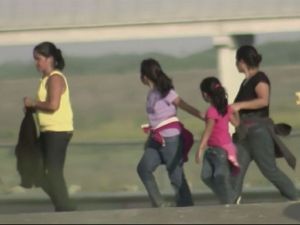 The UN is requesting the US treat the people from these three countries as refugees. They are basically no different that refugees fleeing Syria or Iraq to escape violence from countries torn by civil war. Bordering nations like Jordan routinely provide shelter to refugees fleeing the violence in areas filled with armed violence. We’re talking women and children in both cases. These aren’t able bodied men looking for work. They are victims of violence looking for safety.
Officials with the U.N. High Commissioner for Refugees say they hope to see movement toward a regional agreement on that status Thursday when migration and interior department representatives from the U.S., Mexico, and Central America meet in Nicaragua. The group will discuss updating a 30-year-old declaration regarding the obligations that nations have to aid refugees.
While such a resolution would lack any legal weight, the agency said it believes “the U.S. and Mexico should recognize that this is a refugee situation, which implies that they shouldn’t be automatically sent to their home countries but rather receive international protection.”
Most of the people widely considered to be refugees by the international community are fleeing more traditional political or ethnic conflicts like those in Syria or the Sudan. Central Americans would be among the first modern migrants considered refugees because they are fleeing violence and extortion at the hands of criminal gangs.
Central America’s Northern Triangle of Guatemala, El Salvador and Honduras has become one of the most violent regions on earth in recent years, with swathes of all three countries under the control of drug traffickers and street gangs who rob, rape and extort ordinary citizens with impunity.
Honduras, a primary transit point for U.S.-bound cocaine, has the world’s highest homicide rate for a nation that is not at war. Hondurans who are used to hiding indoors at night have been terrorized anew in recent months by a wave of attacks against churches, schools and buses.
During a recent visit to the U.S., Honduran President Juan Orlando Hernandez said migrants from his country were “displaced by war” and called on the United States to acknowledge that.
Honduran police routinely are accused of civil rights violations. The AP has reported at least five cases of alleged gang members missing or killed after being taken into police custody in what critics and human rights advocates call death squads engaged in a wave of social cleansing of criminals.
Violence by criminal organizations spread after members of California street gangs were deported to Honduras, Guatemala and El Salvador, where they overwhelmed weak and corrupt police forces.
In El Salvador, the end of a truce between street gangs has led to a steep rise in homicides this year.
Salvadorans heading north through Mexico who were interviewed by The Associated Press last month said there also was fear of the “Sombra Negra,” or “Black Shadow” – groups of masked men in civilian clothes who are believed responsible for extrajudicial killings of teens in gang-controlled neighborhoods. The Salvadoran government denies any involvement in death squads, but says it is investigating the reports.
In El Salvador, at least 135,000 people, or 2.1 percent of the population, have been forced to leave their homes, the vast majority due to gang extortion and violence, according to U.N. figures. That’s more than twice the percentage displaced by Colombia’s brutal civil war, the U.N. says.
Immigration experts in the U.S. and Central America say the flow of migrants from Honduras and El Salvador is likely to rise as the two countries experience more gang-related violence.
“They are leaving for some reason. Let’s not send them back in a mechanical way, but rather evaluate the reasons they left their country,” Fernando Protti, regional representative for the U.N. refugee agency, told The Associated Press.
Even though the agreement would not be legally binding on the countries that sign it, advocates say it would help create international consensus to help the migrants.
Those actions could include emergency aid and social services for internally displaced people inside Honduras, Guatemala and El Salvador.
So, this has gotten to be a very long post already. I’m going to run a second edition of this with more information. Meanwhile, this gives you some background.
What’s on your reading and blogging list today?

 peej
peej Carissa
 bostonboomer
 dakinikat
 ecocatwoman
 jjlolat
 mablue2
 Mama Lopez
 peggysue22
 quixote
 skydancingguestblogger
 Mona (aka Wonk the Vote)



 Sky Dancing
Recent Comments